Jay Fisher - Fine Custom Knives
New to the website? Start Here
"Courbe Vaste"
Welcome to my FAQ page. When I first built the website back in the mid-1990s, there were not many frequently asked questions about my custom and handmade fine knives, so the FAQ page was simple, small, and quick to read. As inquiries and web site traffic grew, I realized that many of the same questions appeared repeatedly. I used to answer each of these individually, until I found myself spending several hours each day giving the same replies over and over. So I added the most commonly asked questions to this page, with what I hope will be clear and definitive answers, so that interested parties and clients can access them quickly, have them continually available, and maybe even have a chuckle or two.
The topics and answers here only apply to me and my works; other knife makers and artists will obviously conduct their business and tradecraft differently. Please remember that the information presented here is my own opinion, presented after having made knives for nearly 40 years, and professionally as a full time knife maker since 1988. Thanks for being here, without you, the reader, this website is not possible!
Throughout this page, you'll see this style of highlighted box. To break up the text, I've inserted some interesting photographs of and around the studio with some related comments and offer a little insight into my work making knives.
I've added comments on the treatment of the photos that I think you'll find interesting. All of the photos are thumb nailed, so please click on them to see a fully sized image. I hope you enjoy them.
Jay: I don't expect an answer to this email. I just wanted to tell you that, as a new maker, your site is extremely informative and just totally awesome!
Thanks,
Dick Absher
Woodturner, New Knife Maker, Retired USN(CWO4), and Retired Art Teacher

Bolsters are highly underrated in both the finished knife and in the construction and effort of building a knife. The bolster not only bolsters or strengthens the full tang knife blade, but also beds and anchors the handle scales, gives a thickened area for the hand to apply pressure to the knife handle, and offers an area for embellishment and artwork.
Here is a pan of 50 freshly cut bolsters in 304 high nickel, high chromium stainless steel, the same steel used to make stainless bolts and fasteners.
The photo was manipulated with a radial blur filter and the tonal curve modified in linear scale.
Short answer: It's about you.
Long answer: It's about your relationship with knives. Perhaps you've looked over some of the pages, and you see my knives, read what I've written, and hopefully smiled at my humor. You've undoubtedly learned something about knives and gained some insight through a professional knife maker's own eyes. Though I would love to say it's all about me, in reality, it's about you. Because you are reading this at this moment, you have more than a passing interest in knives, fine craft, and art. Otherwise, you would be on some other website. So when you peruse the pages, read and enjoy seeing what I see in the magnificent field of knives and art, please think about your own relationship with knives. It is not subjective, it is not objective, true art is interactive.
In very few other fields does interactivity with art come to such a basic act. A knife is a tool, and must perform the simplest, oldest, and most necessary function of interaction in humanity, which is to cut. Since the knife is man's oldest tool, it makes sense that we revel in its form, function, creation, and expression. At the core of our physical interaction with the world is this thing we call a knife. You have a direct, personal relationship to the knife and I invite you to share my own interactive expression in a refined, elegant, and durable modern tool. My hope is that you, too, will deepen your relationship with the knives in your life, and share that with others near you. Thanks for being here; it is about you, after all!
Jay,
I am the one who is in debt to you for letting me purchase the art works that you create.
I am so happy to be able to purchase classic art work knives without worrying about the quality and design.
Most importantly, I am dealing with someone who is old school whose word is his bond. In the world
I deal with every day, someone is always trying to scheme and scam you out of something. It is like a
breath of fresh air dealing with you.
--P.

The belt grinder is the mainstay of the knife maker's shop and studio. The machine is simple, a belt and contact wheels, with abrasive belts that grind the wide variety of metals, ferrous and otherwise, manmade materials, hardwoods, horn, bone, and just about any material one can grind (except stone!). No matter how knives are made, the belt grinder is the tool that allows knife makers the freedom of shaping hardened, tough, and durable metals and materials.
This is a photo of me, hollow grinding a broadsword blade offhand... really!
The photo was manipulated with a digital embossing filter.
Short Answer: I make knives. I also offer Professional Knife Consultation services.
Long Answer: I make and sell knives, by hand, from my own designs and by custom order. I also consult professionally, about knives. For more information about my Professional Knife Consultation services, click on the link.
This is a large website, and there are many ways to arrive here. So, at first glance, it can be confusing and overwhelming, even for me! There are a tremendous amount of knives on these pages (over 630 pages and 15,000 photos currently), accompanied by a massive amount of information, particularly for this field.
When someone sees the site for the first time, they may note the tremendous variety and scope of knives here. All of the knives you see on this site are made by me, one at a time, by hand. The only exceptions are the collaborative knives I've made, mainly with family members who have learned knifemaking from me in the past. Every knife you see on the site that has only my name on the blade (the Maker's Mark) is of my sole authorship, made completely by me, in my studio. Nearly every photograph is also my work, and every word that you read, aside from the testimonials, is my own creation. Simply put, I make and sell knives, photograph them, describe them, and offer what I have learned and know from nearly 40 years as a knife maker.
The knives I make and offer are of two types: Custom Orders and my own Creative Works (finished knives).
Don't worry about using the wrong word or phrase if you contact me about a knife project. I'm expected to know these terms, not you; I fly the plane, you just tell me your origin and destination.
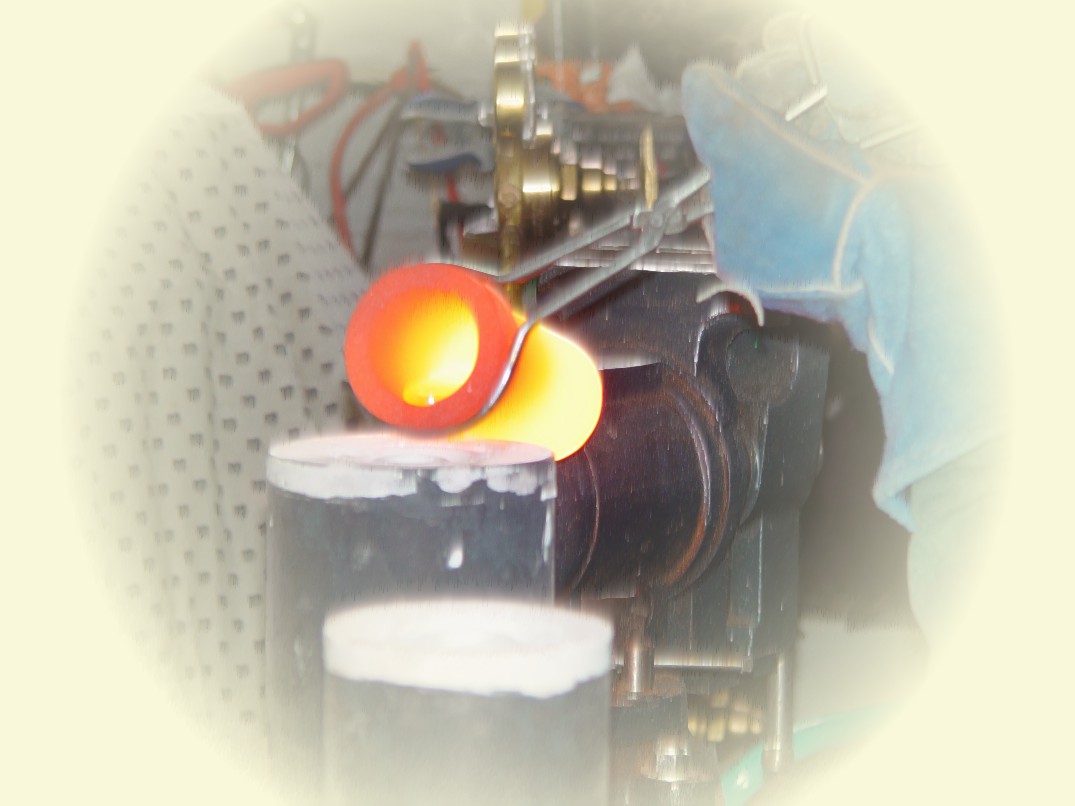
A process I offer in the studio is knife sculpture. One of the exciting aspects of this is actually a very old process, that of lost wax casting. I carve clay or wax models, either mold or create one-of-a-kind originals, and follow up with investing a mold and either gravity cast, vacuum cast, or centrifugally cast molten metals into the mold. My favorite is silicon bronze. This allows me to create entire sculptural works, fittings, stands, displays, or components for my original works of knife art.
This is a photo of the casting pour, molten bronze at 1975° F is being poured into molds that are 900° F.
The photo was manipulated with a bright molten bronze colored vignette, and a vertical wind filter.
There are many kinds of handmade knives and knifemakers who make them. Most are hobbyists and part-time knifemakers. A very few are full-time professional career knifemakers. This is what I am. You can learn more about knifemaking on this page.
When someone first encounters my website, they can be overwhelmed at the information, photography, and the sheer amount of knives. It's easy to see that the knives are beautiful, truly works of art. Is a work of art to be used, or is it to be collected as art and investment?
The confusion starts with the perspective that a knife cannot be both, and that's in error. Any beautiful tool can be appreciated not only for its appearance, but also for its function. To clarify that a bit, here's a response I gave to a person who asked, "Are these working knives or art pieces?"
To answer your question about knives for use, or works of art, the answer is yes and yes.
The most important aspect of making fine knives is that they exemplify their position, first, as tools. In doing so, my goal is to make the very best knives possible, with absolute premium materials and advanced, even extraordinary process and treatments. From steels to fittings, from handles to sheaths, stands, and accessories, the entire scope of work is based on working tools and function. Many of the knives I make go to specialized users: chefs, outfitters, military, rescue, and counterterrorism professionals. The knife is first and foremost, a tool.
As the quality and execution of knife creation advances, the materials, finish, and embellishment also advance. For example, a mirror finish on a knife blade is not just for show; the smooth and polished finish dramatically improves corrosion resistance and with the proper heat treatment, repassivation of the steel increases corrosion resistance even more. This is the evolution of construction of the tool.
So, also, is the advancement of the handle material. When people see gemstone (mineral) handles for the first time, they may believe that they are just for aesthetics, and indeed, they are the most beautiful handle materials available. More than that, they are incredibly durable, eternal materials. Unlike woods, horn, bone, and antler, they do not absorb moisture or dry out, they do not shrink and expand, and unlike plastics, they do not scratch and dent and show wear. When you think of the longest lasting materials ever made by man, you realize that they are stone age tools and implements. Because stone is so difficult to work with due to its hardness and refractory nature, it’s rarely used but only on the finest knives.
Since the knife is man’s oldest tool, it is to be expected that it is refined to an extraordinary degree. This encompasses design, embellishment, and the accoutrements commensurate with the knife; it is all the purview of the knifemaker. Therefore, as the knifemaker advances, his work will necessarily be collected and be appreciated for its investment value.
I suppose that’s more of an answer than you expected, but this is why fine working tools can become instruments, and then investment art. They are both tools and art.
--Jay
My knives are used professionally, by military and counterterrorism professionals, by chefs and restaurateurs, by guides and outfitters. They are also collected for investment, purchased and kept for heirlooms, and used and admired daily. Every knife I make will outlast me, and the following generations of owners and patrons. It's a humbling honor to know the work of my hands and mind will be around and valued not only for its aesthetic appearance, but for its prime functionality.
They are tools: beautiful, timeless tools.
Short answer: Yes. If it has only my name on the blade, it is ALL my work.
Long answer: I make everything you see here, except (obviously) the knives in collaboration.
I start with a six foot long bar (billet) of annealed and spheroidized high grade tool steel. Tool Steels are a special classification of steels, made by special metallurgical processes, and must be hardened and tempered and treated with highly specialized equipment. I add to the process raw rock, horn, bone, ivory or wood. Rock in this case means gemstone, either solid masses or groups of minerals that form semi-precious and precious gemstone. The manmade materials I use for handles are the finest, most durable, and most dependable created in our modern times. The horn, bone and ivory I may use is of the tougher variety, and may be stabilized, partially mineralized, or specially sealed to increase the durability. Woods I use are tough, durable, and may be exotic, rare, or domestic.
I design the knife from the ground up, and currently have over 500 patterns. I profile, drill, mill, shape, grind, heat treat, finish grind, and polish the blades, I profile, shape, finish, polish, and attach bolsters and guards. I saw and slab gemstone, cut, grind, drill, shape, sand, polish, and attach gem handles as well as manmade materials, hardwoods, and horn, bone, and ivory. I design, create, and execute all the hand engraving you see on this web site; I do all the machine engraving, I do all the high resolution etching, artwork, and design. I do all the chemical processes, including diffusion welding, etching, electroplating, electroforming, and several different types of professional hot bluing and antiquing. I heat treat in inert atmosphere controlled furnaces, do complete and sophisticated shallow and deep cryogenic processing of my knife blades. I perform the gas tungsten arc welding, the shielded metal arc welding, brazing, soldering, and multi-process welding. I sculpt wax and cast bronze, silver, brass, and nickel silver fittings, components or display stand elements. I make every part of the sheaths, the stands and the cases; I do all the carving, hand-dying, inlaying, and stitching. I make every component of my knife stands and cases, from design to sculpting, carving, carpentry, joinery, embellishment, and finishing. No other hands are involved in my knives! If it has my singular maker's mark on the blade, it is all my own work.
I also design, build, maintain, and repair specialized shop equipment, electric motors, machinery and controls, lighting, jigs, tools, and devices. I experiment with new techniques, apply creative technology, and constantly strive to improve my skills and product. I do all the photography, write everything on this site (except the testimonials), build and maintain this huge site with over 15,000 pictures and 550 pages. It is the largest, most comprehensive website of any singular knifemaker in the world.
I also vacuum the shop floor of the metal swarf, muck out the rock saws, sweep up the wood dust, and wash the windows (once every several years). This is my full time job and has been since 1988.
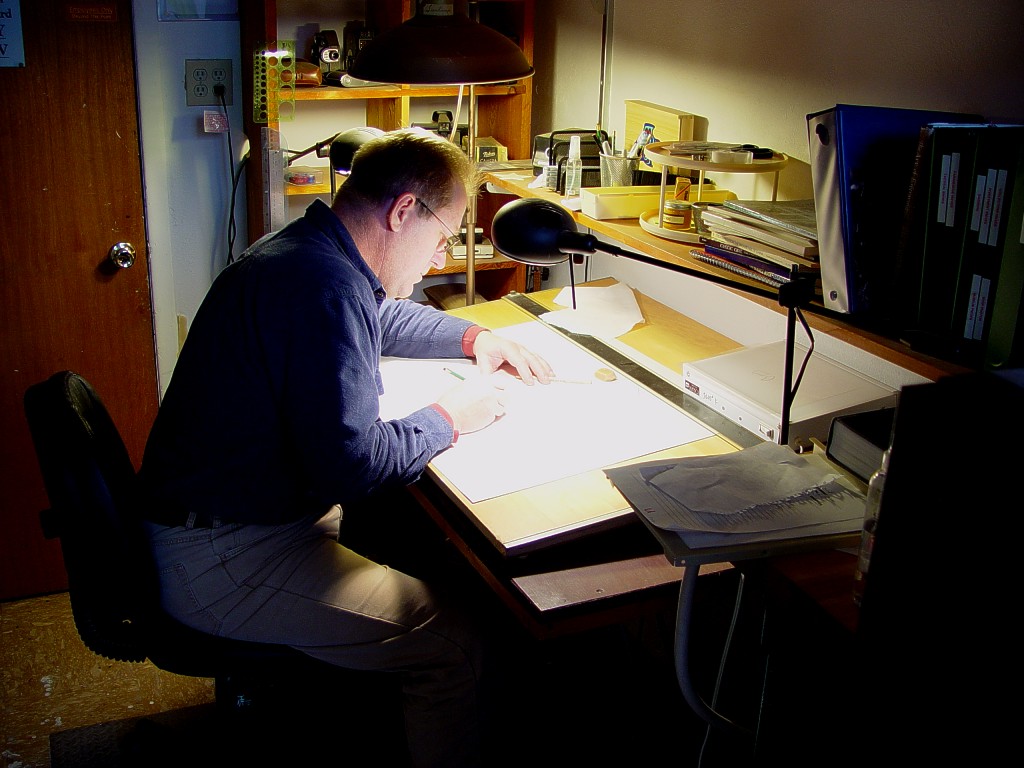
Knife makers may benefit from being educated on drawing, studying perspective, negative space, and relationships of objects. It helps to have a background in photography, as that can offer insight to density and perspective.
The older I get, and the more I learn, the greater the amount of time I spend at the drawing table.
Benvenuto Cellini once said: "Though many have practiced the art without making drawings, those who made their drawings first did the best work."
A high contrast photo, warming the surroundings and washing out the subject. I start nearly every project on the drawing table, using references, tools, and a lot of erasers until I get what I want and what my clients desire!
Hi.
I just found your website yesterday. I was doing a search on desert ironwood, and I happened across the 'wood'
section of your site. After I finished with that I started looking around, and I must say that I am very impressed,
not just with your edged creations, but also with the site itself. I have never seen so much useful knife related
information on a single website before (and I use the word 'single' in the loosest possible sense, as it is huge).
It is a digital treasure trove of information for anybody that is interested in anything that has to do with knives,
and it is all available for free.
While I am not currently able to afford one of your creations (or to be more honest, I do not think I will be able to justify it to the wife), thoughts are spinning in my head already about how my dream knife would look. Amber handle scales in particular keep making an appearance. If I later feel that I can justify spending several thousand dollars on a knife (and I think I will, given time), I will definitely contact you again to discuss the possible project.
For now I just wanted to say thank you for everything that is available on the website, as all the information and inspiration is greatly appreciated. I spent about four hours reading and looking around yesterday, and I have done almost as much already today. I must say I appreciated the humor in the 'what I do and don't do' page in particular, as it made me smile several times.
I understand that you are a busy man, so I am not expecting you to respond to this e-mail, A response is not needed. I had something on my heart I wanted to say, and now I have done that. Perhaps we will talk together about a project sometime in the future.
Sincerely,
Truls Lindskog,
Norway
Short answer: As long as it takes.
Long answer: This is the most often asked question to knifemakers. I can make a simple, basic knife in about 16 hours. A basic knife described here has a satin finished blade, full non-tapered tang, no bolsters, hardwood handle, and untooled leather sheath. I rarely make this kind of knife any more, as most clients expect much finer and more elaborate work from an established maker.
Some pieces I've worked on for weeks; some take months; one in particular art piece cost me a year and a half. It depends on how much work goes into a piece. Design and engraving takes extra days, filework takes hours, grinding through 12 steps takes many hours. Handle finishing is done off hand; often the sheath work and stand are not even considered by the curious when they ask the question. In some tactical and counterterrorism rigs, the clients request multiple sheaths and many different mounts for a variety of wear options. When you make everything by hand, including setting up, repairing, building shop tools and jigs from scratch, knife making takes a tremendous amount of time. It is not a casual endeavor.
Sometimes the person who asked about the time is considering just how much I get paid by the hour. You can see the little calculator clicking away inside their skull, trying to figure my wages. They don't know about materials and supplies, abrasives and electricity. They don't know about shop overhead, machinery cost, material prices, and failure rates (yes, things break, wear out, and are used up).
Let me set this straight. I can make an inexpensive knife for about $12.00 an hour. Yep, that's not much considering the decades of practice I have. Also, making $12.00 an hour in a shop with maybe hundreds of thousands of dollars of equipment and supplies and 40 years of training and experience does not make sense. That's why I make knives that start at about $1000.00. This way, I can make maybe $13.00 to $15.00 an hour! You've got to love it; your not making knives to get rich.
If your idea is to get rich making knives, you would be better served to start your own knife factory, make a cheap product that competes with imports, or better yet, have the work farmed out overseas and assembled here in America (like so many factories now do), and claim that it's Made In America. But then, you would be a manufacturing interest and not an artist. People who are creative artists for a living are driven by a passion for their trade, not a passion for a dollar.
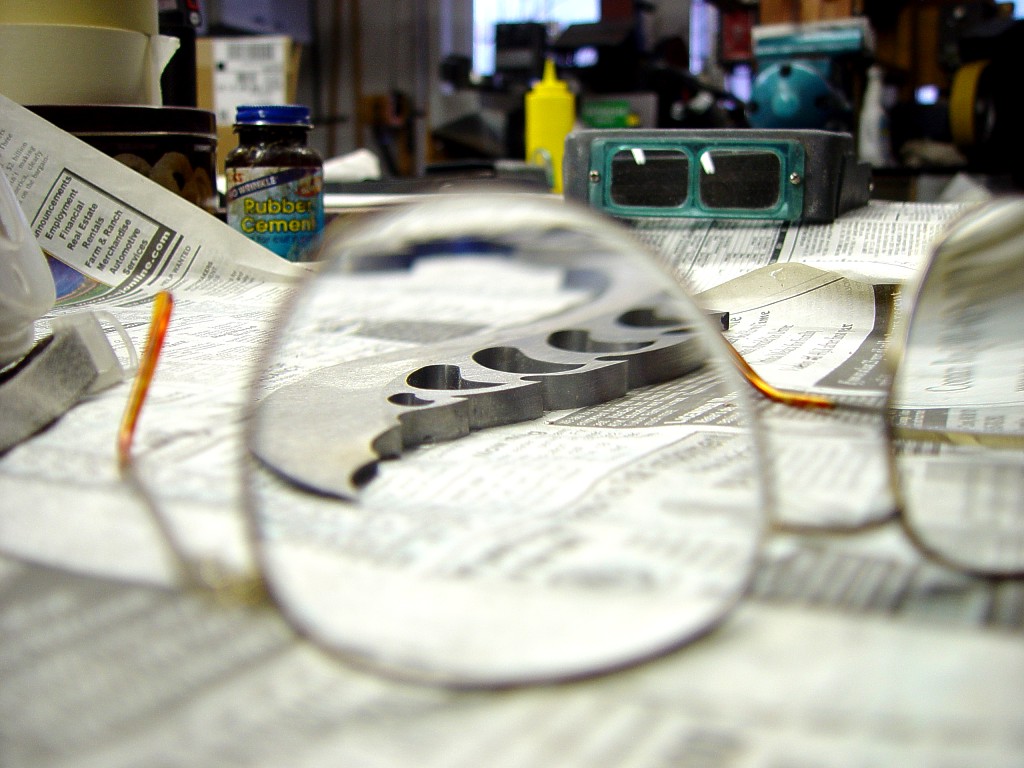
A young man has to be told repeatedly to wear his safety glasses in the shop or on the job site. As he gets older, his corneas stiffen, and he has to wear magnifiers just to see close up.
I've found that as I grow older, I prefer strong magnification and the security of knowing there is something solid between me and all the dangerous swarf, sparks, chemicals, dust, and exposure.
Binocular magnification is a must; from simple 1.75 power glasses to a 30 power binocular microscope; a wide range is necessary for a variety of jobs.
Nice focus control in macro mode on this pic.
Short answer: Get in line.
Long answer: Because I make extremely fine and sophisticated knives, the work takes a lot of time. My clients expect the very best knives for their money, and I guarantee their satisfaction. Consequently, making knives this way takes a lot of time, more than most people realize. Considering the investment value and quality of fine custom knives, this is how it should be, and my clients are willing to wait for fine hand craftsmanship, not hurried, with attention to detail.
A while back, a writer for a magazine insisted that he watch me make a knife from start to finish, taking notes, photos, and documenting the experience. I warned him that it may be boring watching someone work at a machine for hours; he insisted he was up for the experience. After two hours watching me stand at the grinder, he left. He simply had no idea.
A long time ago, I realized that if I hurry, I'll make a mistake, and the whole project gets pushed back or worse, has to be started over (eek!). In this world of instant gratification, I do offer a solution for those who are unwilling to patiently wait for their hand-crafted knife, sword, or project. Go to the finished knives for sale pages here and here. There you may find fine work that is ready to be shipped immediately, but new inventory knives posted there do not typically last very long.
For those of you who've ordered custom work, the best thing you can do to help me out is to be patient, and know that it will be worth the wait. If I've given you a time frame for your project, please remember that it is just an estimate, based on the current work load (which changes almost daily).
Delivery times are a hot topic, so I've dedicated a page to the subject. Click here.
Hey Jay,
I have just spent about 4 hours on your site (just kept opening tabs with more useful information), and
I'm going to have to keep this brief because I'm aware of just how many emails you must still get.
Man, what a fantastic resource your site is, how well written, how honest, how informative. Being raised
in Sydney, Australia, I was raised to view weapons as tools used only by military / law enforcement, and
a sign of insecurity or aggression if carried by a civilian (it's very different over here, I've never
seen a knife displayed in a home, let alone carried on a person, save maybe a
Swiss army knife). Becoming
older however, I've revisited previous assumptions, and it's just fantastic to read about your craft,
and not just your knife making, your philosophy on things, it's bringing me around.
Being an avid hiker, I'm all but sure one day I'll be emailing you with a design for my own Jay-forged knife. The only thing is, your
website has created just as many questions as it solved. I've realized it's going to take me a year to even work
out and express to you what I want in a knife. Although the solution of course is to have you make me a dozen
knives, one for each task, since I probably still need to eat, I plan to dream up the perfect knife for the average
tasks I will encounter from now till forever.
Short version: Your website is inspirational and awesome, keep doing your thing! Currently finding more work so I
can be a proper Jay customer some day soon.
Kind Regards,
James Bailey
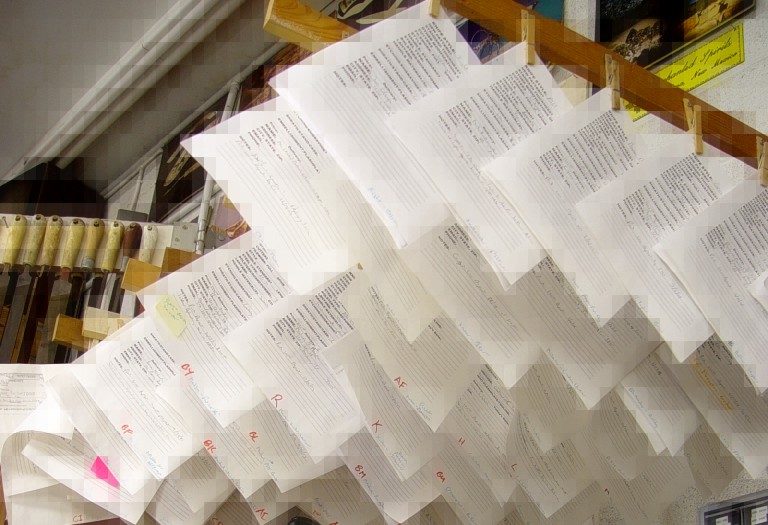
These days, the order rack stays pretty full; I'm thankful for that.
Sometimes guys start worrying about how their knife is progressing, and their order hasn't even made it to the rack, it's still in the file in the office.
The printed sheets help me keep everything straight; each project and knife has a specific designation.
I used a large rectangular pixilation in this photo to accentuate the repeating sheets of paper.
Short answer: Prices start at $1000.00 and go up from there.
Long answer: That $1000.00 knife is a skeletonized working knife with a simple sheath. This is rarely the type of knife clients want me to make, so prices average much higher. How much is the average? This is impossible to calculate because I make so many different kinds, styles, and types of knives and knife projects.
The cost of a project depends on five factors:
I use a strict pricing structure, based on 67 points of the individual knife construction. This way, I can calculate exactly what work goes into a knife and offer a fair price to everyone without guesswork. For more specific discussion and pricing details for my custom knives, swords, daggers, folding knives and artwork, here's a dedicated page.
For more information on these individual components of custom handmade knife construction with many examples, pictures and more in-depth details, here are some important links on this site:
Remember, there are many makers who won't even talk to you for less than $5K. I know of one guy who does the same looking knife over and over, and he doesn't even consider making a knife for less than $7000!
Someone once asked, "Why would anyone pay over a thousand dollars for a knife?"
The answer is simple: because they understand the value, and they can afford it.
The prices of my current works change from time to time. The utilities, supplies, and materials I use to make the knives go up constantly, as does the cost of keeping a piece current, maintaining it on this website, and the utilities of storage, shipping, and care costs as well as the costs of maintaining the knife shop equipment, storefront shop building, and this website.
In addition to my costs, as my work becomes more popular, the prices go up. Simply put, the more in demand a piece of artwork is, the more valuable it is. This also helps my existing clients, who have pieces that they expect to increase in value over the years. Their investment value grows, and so does the value of my older works, whether in the hands of clients or waiting on the website for purchase. Incidentally, my pricing structure for new knives grows too, as does the basis and the cost of the 67 points I use to determine price.
Though I use detailed guidelines for pricing quotes, I stay away from itemizing each feature to justify a price. For a deeper discussion on price justification, please click here to jump to the topic on my "Business of Knifemaking" page.
I detail payment types on the pages listed below. Most of my clients pay by personal check or cashier's check sent in the mail (USPS), through UPS, or FedEx, or they pay by direct bank transfer.
Beginning in March of 2017, I've stopped taking credit cards for payments. The reason for this is because for over two years, not one client had used a credit card to pay for their purchase. It makes no sense for me to pay for a merchant account when none of my clients are using it. Clearly, direct wire transfer and checks are my client's preferred way of paying for their purchase, and they may well be using a credit card online through their bank to complete a wire transfer. Exchange of money for services and products is evolving, and I believe that in the future, wire transfer will be the main way that money and payments are made.
For more information:
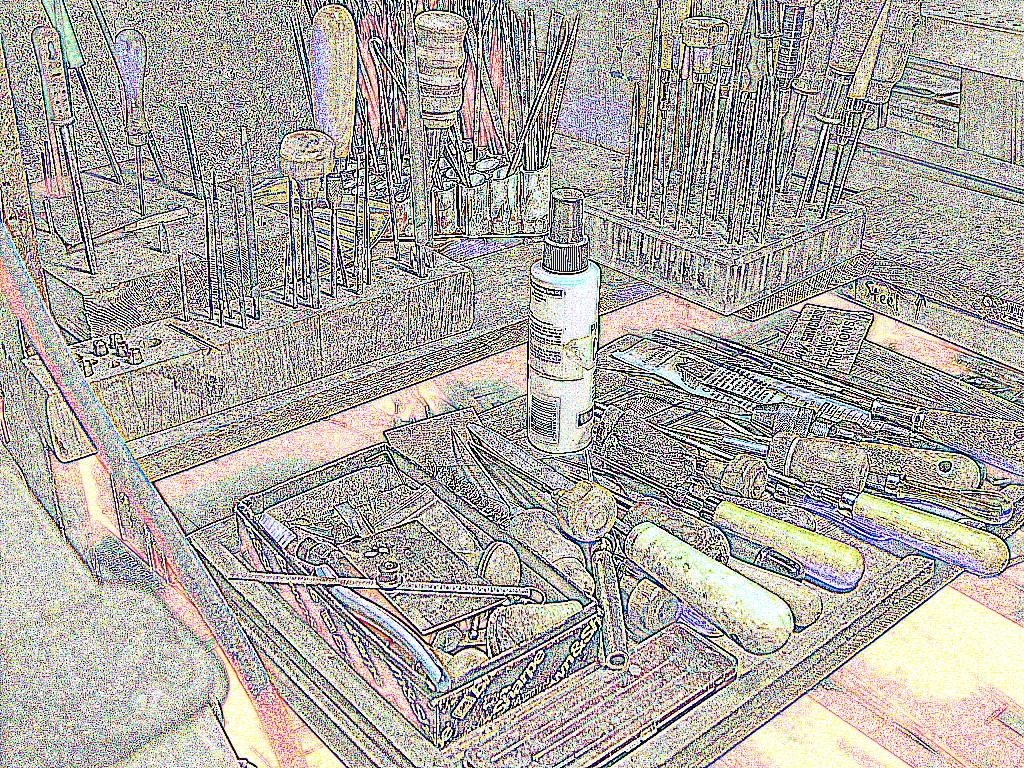
Files are one of man's simplest tools, yet are capable of an unbelievable amount of cuts, forms, and shapes. Though there are only a handful of file shapes, there are numerous sizes, cuts, and wear conditions. A worn file may still be a useful file, creating a softer cut with a smoother edged line.
Cutting can benefit from liquid solutions and wax lubricants, easing clogging and reducing friction and heat. A simple file cleaner is denatured alcohol.
File handles are very important. Most are too small for comfortable use.
The photo is manipulated with contrast tracing, embossing, and light solarization.
Short answer: Yes I can, but why?
Long answer: Sometimes a client receives a quote from me and realizes he's chosen features, materials, finishes, and embellishments that are out of his price range. With custom knives, the inclination is to go all-out, to get the features and materials you want, often because it's a dream knife, sometimes even a once-in-a-lifetime investment. The client wants his money to go as far as possible, and also wants a very fine knife, one that will appreciate in value over the years. A knife made to these high quality standards will often become an heirloom piece, graciously handed down through generations. If only he could buy the knife ... for a lot less.
If a client needs a lower price, the conversation between client and maker might erode to a line by line evaluation of each feature, cutting away what is refined and valuable, and leaving out features in order to fit the knife within the budget. The knife concept will ultimately suffer to become less than ideal, and less than the client (or maker) imagines. This is not a way to commission a fine handmade custom knife that will be worthy of investment, use, or collection.
From the knife maker's perspective, it doesn't make a lot of sense, with a high shop overhead, plenty of orders of fine pieces, and over three decades of hard experience making knives to then make budget knives. There are already a great deal of inexpensive knives in the world for sale: from makers, from factories, from dealers, and outlets for a modest price.
As the maker's clientele become more vigilant of the maker's trends and knife values and the maker creates a much better product in higher demand for higher prices, it is clear that the maker should serve his existing clients by only making the very best of knives. How might the collector of fine handmade knives feel if his favorite knife maker is now creating a cheap, quick product? This direction might indicate that the interest in the maker's work is waning in the marketplace, and this devalues existing collections.
How to say it clearly without causing offense? Here's an email response where I tried to do just that:
Thank you for considering my work. I’m afraid that I'm just not making
any low end knives currently; most of my clients are
requesting finer knives. Once we start whittling away the
features, materials, and finishes in the sake of economy,
the knife would be less of a knife overall and probably
wouldn’t do justice to your investment.
Thank you for your interest,
Jay
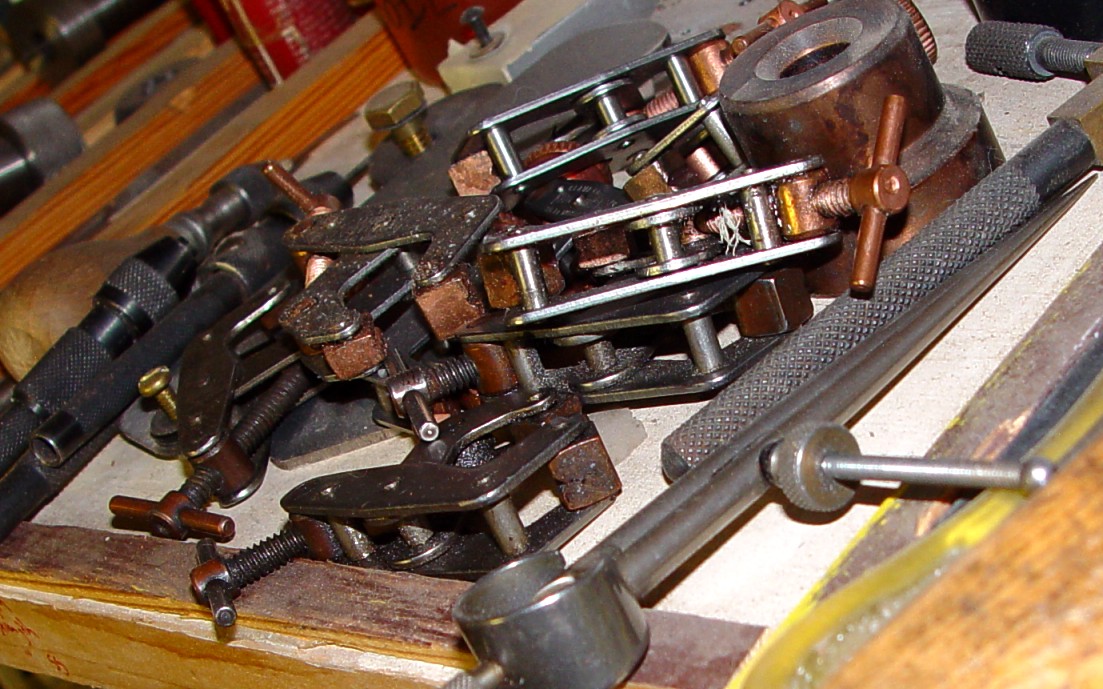
Only one thing can be said of clamps in the studio and workshop. You can never have enough.
These are small cantilever clamps used in my folding knife work, and hold strong and parallel.
In Great Britain, they call these "cramps." I'm sure our wives would raise an eyebrow...
This photo was taken on macro setting, with good depth of field for such a close shot with flash.
Short Answer: No, thanks; this is not a fruit market.
Long Answer: Occasionally, I get asked to consider a offer from a potential client that is lower than what the knife is listed for. Simply put, this is not something I do. There are several reasons that I don't do this, and you can apply this logic to other businesses, other knifemakers, and your own work and pay. When you do, I'm certain you'll see the integrity of fixed prices.
A client might think, "Why not ask? It can't hurt to ask, and maybe Jay will drop his prices."
No. But I will try not to be insulted.
Bargaining, bartering, dickering and haggling applies to petty items.
A fine handmade knife is not a petty item.
I've seen all sorts of reasons why these potential clients can't afford my work; some of them even ask for total donations! I've had people send unsolicited gifts, write long sad emails, and detail their painful circumstances while ignoring the fact that I have my own bills to pay so my family doesn't starve in the dark. This brings up the simple statement:
When a sale is made, it's simple logic:
The buyer understands the value, and he can afford it.
To the potential client who does not quite understand: The last thing I want to do is impose any financial burden on my clients. Every knife will sell, or I'll be happy to keep it. I'm not desperate; don't demean the conversation by haggling. I'm a professional; this is not a fruit market.
One more thing: How fair is it to all the other clients who do purchase my knives, often saving up for years to do so, in order to get the very best. That best may hang on their gear when they are in combat defending our country for freedom. How fair is it to let someone, anyone, pay less than they have? More about this on my Business of Knifemaking page.
Return to Topics
I always wondered what the grinder nest would look like if everything was made of chromium steel...
The grinder nest is an extremely important part of the studio, and you can tell a lot about the knifemaker by the grinders. Are they well made, safely equipped, tidy and well-lit?
A functioning studio must be constantly upgraded and this means all of the equipment, controls, dust collection, lighting, and even matting on the floor.
This photo was enhanced with "chrome" mask function, with contrast control.
I make tactical, working, rescue, combat, and counterterrorism knives. Since they are real tactical knives, not just "tactical" in appearance, they are actually made to be worn and used in the most serious of uses. Because of their real world application, it has been necessary over the years to include everything my clients request for them.
This starts with the toughest, most durable, and best made knife sheaths in the world today (and ever): my positively locking sheath, my hybrid tension-locking sheath, or my new tab-lock sheath. My experience has been that since the sheaths have to be worn, and since everyone is different and every mission or application is different, it's important to include all of the necessary straps, clamps, hardware, mounts, and equipment to wear each knife and sheath with every tactical knife.
It is rare that a tactical knife is only worn in one place; as the owner's gear is refined and regularly upgraded, the sheath must be able to mount to an evolving combat framework. Typically, a client who wears these knives will have multiple applications and missions, and because of the limitations of his other gear, he'll have to move the knife and sheath to different locations to accommodate. For example, the United States Marine in desert warfare currently has only about one place he can mount a tactical knife, and that is along his leg, below the waist, and above the knee. Of course, this may change depending on his particular gear, environment, or mission. I want my clients to have all their bases covered, and every option available.
From time to time, I receive requests for tactical knives that are "bare bones," that is just the knife and sheath, and no accessories. I rarely do this because of the reasons above, but taking it a step further, let's just examine what would happen if I did offer simple knife and sheath combinations, without all of the other hardware.
I've had the experience of doing this very thing; this is how I used to make and sell my tactical knives. When I did, the first thing that would happen would be the client contacting me and saying, "Gee, I really like the knife and sheath, but do you have a way to mount it lower on the belt?"
This is how and why I developed and include the BLX, UBLX, and EXBLX Belt Loop Extenders.
Then a client would ask, "Is there any way I can mount this horizontally along my belt line?"
From this, I developed the Horizontal Belt Loop Plates.
Then a client would ask, "Is there a way I can fix the sheath to my PALS on MOLLE, or vest webbing?"
I developed the Horizontal and Vertical Clamping Straps.
Another client would ask, "Can you make something to mount the knife over my sternum? It's the only place I can wear the knife. And by the way, it has to be handle-down."
I created the Sternum Harness and the Sternum Harness Plus.
A client submitted, "I do a lot of work where I might be in the field after dark, and sometimes, even in the daytime, I need a small light for examination or emergencies, or just finding my way."
I created the LIMA, with the Maglite® Solitaire, then the Solitaire LED, and then the ThruNite® Ti3 LIMA.
Then clients asked, "The little light is great, but can you actually give us a main (or key) flashlight. We need one that can be our main lamp, with super-bright illumination for nighttime operations. Oh, and we need it to be able to be aimed in a fixed position, in any direction from the sheath. Then, we need to be able to remove it, replace it, and depend on the holder to never rust, corrode, or bend."
I created the HULA with Maglite® XL100, then XL200, then MagTac®, and then Fenix® E35 and Fenix® RC11, and Streamlight® Sidewinders, and the Powertac models. My counterterrorism clients claim that "Two lights are only one light, and one light is no light." This is a logical, serious, and practical observation, since lamps can fail, batteries can die, and components in flashlights, no matter how tough, can stop working. A simple failure of a light can leave the owner crippled in the darkness, so most CT kits have both the LIMA and the HULA.
Some of the accessories were needs that I noticed, like the simple need for a touch-up sharpener, so the pocket on the UBLX was added with a DMT Dia-Fold® sharpener. Another was the fire starter for outdoorsmen, less often requested. I had knives with lanyard holes, but no lanyards; two types were added. I've added real diamond sharpening pads with essential pad-bags to carry, store, and use them. When I noticed that some of the drawstring bags the knife kits were stored in were literally worn out, I looked for a durable duffle that could accommodate the entire kit. There were no duffles of any strength or durability, so I saw the necessity to create my own, with 1000 denier, polyester-coated, water resistant Cordura® ballistic nylon and heavy 2" wide straps and large, durable zippers. I even added Velcro® patch removable embroidered name tags so the client can tell one of his Jay Fisher knife kits from another!
Consequently, the kits grew, and continue to grow to this day. My logic is this: I simply want my client to have everything associated with his knife. It's part of my service commitment to my career field.
Let's just look at what happens if I don't include all these accessories in the kit. I can reveal this because it's happened before. The client buys just the knife and sheath. He then notices that the sheath is a fixed form, and has a definite and universal mounting hole arrangement for straps and hardware. Since no one else in the world makes this, he then contacts me because he wants a different mounting or wearing arrangement. It's just a few straps to create, and maybe I can match the color of the anodizing with the rest of his gear, but maybe not, since I anodize in batches. But in order to make his accessories, I would have to stop what I'm doing (while five years in backorders) to make the parts. More logically, he should take his place in the queue, and wait five years for his straps to mount his knife. What? And then later, he wants a UBLX, but it's custom made for the knife (they all are) and I have to have the knife shipped back to me, so I can get the sizing and arrangement correct for the custom fit, and maybe he has to wait five years for that-
You can see why this is impractical.
Another point is that sometimes, a potential client may think that if I just offer the simple knife and sheath combination, he'll get a big discount and get the knife for less money. And then, he can add those accessories as time goes on, to spread out his investment. That doesn't work either.
If a client is strapped to pay for the kit, he probably should not be buying the knife. Most other knifemakers won't say this, but the last thing I want to do is to impose any financial burden on my clients. I know what it is to live and work within a budget, and I also know what a tremendous amount of work it takes to make these knives; they are quite literally the finest, most complete tactical knife kits in the world. If you don't think so, I challenge you to find any that compare, anywhere. The fact that they are so difficult to make is why you don't see them anywhere else. This means that the incredible amount of labor means a higher price. As I've stated before, I'm not interested in making budget knives; I've only got one life and one career, and I want to make the very best knives (and kits) I can possibly create in that time.
They arrived today. I expect perfection and you delivered as always.
The kits were a surprise to me. I know this sounds stupid to you, but, I am so use to
a masterpiece and a sheath to be put on display. The embellishments, on the weapons, cause
one to look at them as art pieces and not weapons of war. The kits bring home the seriousness
of your works and the need for full kits. In the future I will get full kits.
I would guess the majority of patrons do not truly understand what you do. The trolls and detractors
miss the mark completely. Your creations mean the difference between life and death.
Yours Truly:
P.
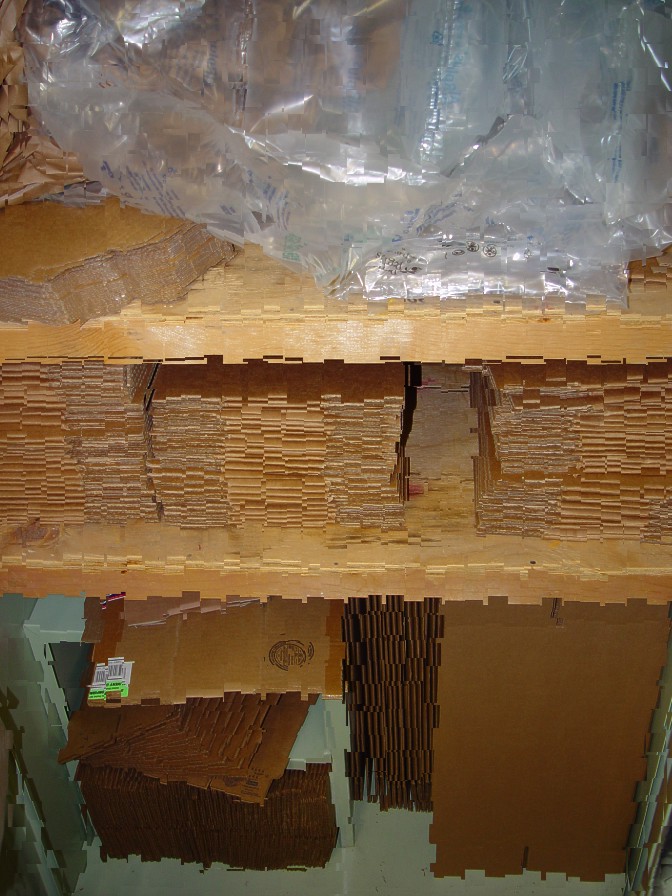
Since nearly every single one of my knives is shipped to a destination, it's important to know that they will arrive in the condition they're sent, as soon as is reasonably possible, at a reasonable cost. Shipping is no place to cut costs in the modern internet based business of making fine custom knives, and with today's technology, packing, tracking, and care are paramount to the completion of an order.
A package from me doesn't only include a knife. It includes an engraved acrylic permanent description plate, a bio sheet, a care sheet, and a cover sheet. It includes the receipt, business card for your file, and any information or reference material you might need. I want the experience of opening this package to be the height of the entire knife ordering process; it should be!
I don't rest easy until I've heard from the client upon delivery. What they think about their new knife, knives, or artwork upon delivery is my most important feedback.
This photo of shipping boxes is manipulated by a puzzle filter and contrast adjustment.
Short answer: the best fine, modern, high quality, high alloy, high strength tool steels.
Long answer: I use about a dozen types of fine tool steels, and like most makers, I have my favorites. These steels are modern, high tech tool steels made to the highest quality and purity that the foundry can produce. Most of them can not be hand-forged, because of their high alloy content, high critical temperatures, and high purity process requirements. They must be treated in a clean, specific environment, with careful steps of stress relieving, annealing, heat treating, and tempering. Most are high alloy, hypereutectoid, and benefit from cryogenic processing that I do right here in my studio. My clients expect the best, and these steel types have a proven record in combat, rescue, professional use, kitchens, and in the counterterrorism field, and retain their investment value in collections. Here they are with some of their properties:
I also use other specialty steels, like stainless damascus and powder technology steels. Pattern welded damascus is decorative and beautiful, but no matter how well it's made, those layers constitute welds, potential places of stress in the billet. Although most of pattern welded damascus is entirely usable, I don't use it in high strength tactical models, when a client requests "shove it in a rock and stand on it" tough. The other specialty steels that I use are expensive, hard to work, and have definite applications, but each has specific characteristics and limitations. They are RWL-34, W1, A2, BG-42, 440V, CPM440V, CPMS30V, CPMS60V, M2, CPM154CM, CTS-XHP, and more.
Custom knife blades deserve their own page, and mine is one of the most popular and detailed in the world. Click here for my Blades Page.
Return to Topics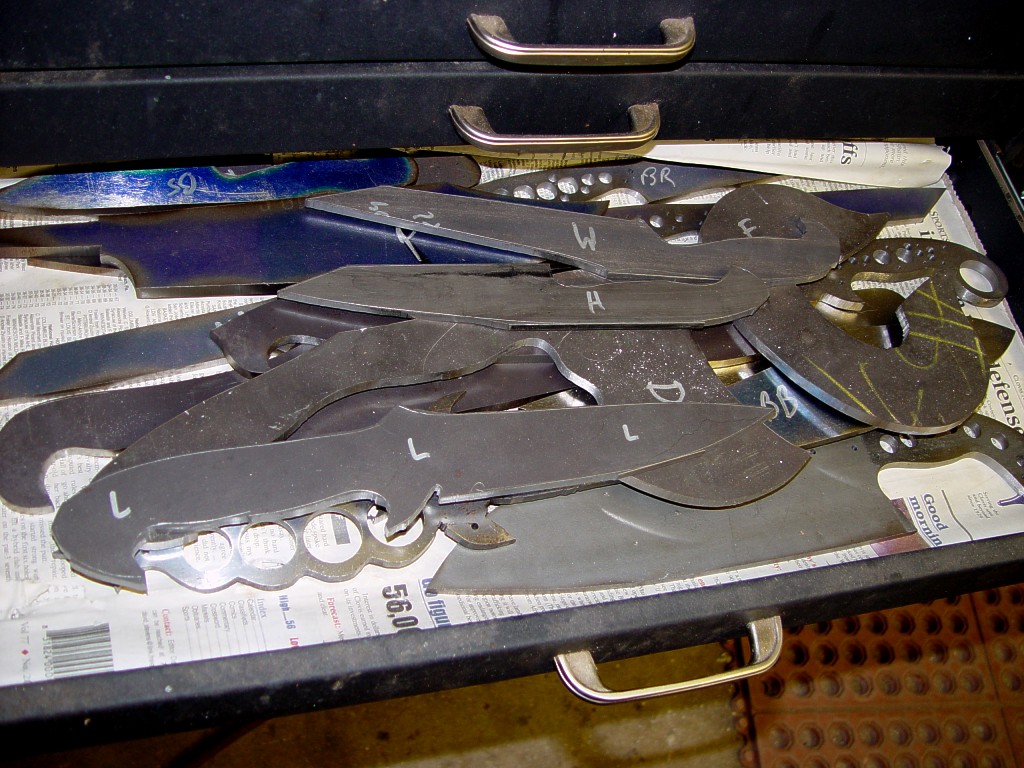
Profiled blades seem to multiply around the shop. When a maker is tired, or has just a few minutes before lunch, or just wants to do something mindless, he can usually cut out a blade. It's slow, boring work, as cuts are made with a slow moving high cobalt band saw blade.
People have asked why I don't use a plasma cutter. Because the edge will be burned, or at the very least, the alloy properties and distribution may be compromised, and I won't take that chance (particularly at the critical cutting edge).
A water jet may be nice to use, but I have too much of a variety of patterns to justify it and I don't farm anything out.
The letter designations are my tracking system.
Short answer: They're the best.
Long answer: Okay, I make a lot of gem handled knives. In fact, I make more gemstone handled knives than any other single maker in the world. That's rock, real stone, not the plastic stuff that is made to look like rock and then called "stabilized." That's one of my fortes. I have a complete professional lapidary shop nested in the knife making studio. Lapidary is the art and skill of cutting, carving, sculpting, and polishing of precious and semi-precious gems, rocks, and minerals. I can start with a two foot in diameter boulder and cut it down to a beautiful handle, nicely shaped and carved, brilliantly polished, and luscious to hold in the hand. Stone is cool, hard, and dense, and the balance is perfect.
I love gem for many reasons. It's impervious to all chemicals that a knife might be exposed to. It has a similar density and coefficient of thermal expansion as steel (steel is made of carbon, iron, chromium, magnesium, selenium, silicon, tungsten, molybdenum, phosphorus, and other elements, all found in rock) and gemstone won't expand and contract and eventually loosen on the knife like horn, bone, wood, plastic, and ivory do. It doesn't absorb moisture, or oils, or corrosives. It's hard, so it doesn't scratch. Some gemstone can only be cut by silicon carbide or diamond. Gemstone will outlast the knife blade in all cases. The very oldest tools, predating man as we know him, are stone.
Some people worry about toughness; if they drop it on concrete will it break? The knife blade TIP is the most likely thing to break on any knife so you shouldn't be worrying about the handle. But just to soothe your fears, the stones are usually protected in the critical areas by bolsters and the tang, or they are nearly as tough as the blade (particularly nephrite jades, flints, quartzes and jaspers). If the chunk of mineral makes it through the cutting, grinding, and finishing process, it will last on the knife. I thoroughly test the stone before using it on a knife handle. I've seen some beautiful rock that I can't use because it's too friable. Stone is tough. I had one knife client return a knife to me for sharpening and reconditioning after years of use and abuse. The blade was scratched and beaten, but the gemstone handle looked like the first day it left the shop... amazing. Just ask yourself what are the longest lasting tools, implements, art and artifacts created by man made of? Why, stone of course.
Stone is beautiful. Nothing can match Gods' geologic creations from our planet for color, pattern, and texture. One of my complaints about gemstone in jewelry is that you can only see a small piece of stone, not getting a real feel for the full pattern and characteristics, and you can't hold it. Gripping a dense chunk of polished gemstone and steel in your hand is a great feeling. When you pick it up, it's cool and solid. After you put it down and pick it up again, it's still warm from your hand. All gemstone handles are unique, I couldn't make two of them the same even if I tried. Natural rock is distinctive even when scales are cut from the same stone. The feeling is comfortable, the color exciting, the finish striking.
Though you don't see them much in the modern knife world, gemstone knife handles are nothing new. The ancient Persians and Chinese made some beautiful jade handles that would rival work done today. The reasons most modern knife makers do not make gemstone handled knives is that lapidary is a separate, distinctive tradecraft and art, and requires training, investment, and professional skill as well as many rather expensive specialized tools and techniques. Even more than that, good lapidary requires immense patience, as gemstone is much more difficult and time consuming to work, shape, and finish than even a hardened knife blade.
The methods I use to attach gemstones to the handle substrate are both mechanically and adhesively secure, and in the thousands of knives I've made, I've never had one standard mounted gemstone handle fail. Read more about that here.
There are a few other Knifemakers who work with stone handles, and there is some poor work out there. Guys try to finish the stone without lapidary tools or knowledge and burn and pit the finish. They misidentify inexpensive common stone as valuable, such as telling a client that a piece of serpentine is jade (I've seen this a lot). They might finish a piece without rounding and finishing and attaching the handle properly, that is, with cohesive methods of jewelry bonding. I've even seen plastic rock identified as real gemstone, and plastic amber called "reconstructed" because it has 10% "real amber dust" in the acrylic! Real stone has millions of combinations of play and color and light. It has imperfect lines, seams, and occasionally inclusions of other material. You know it when you feel it, it's cool to the touch (or warm if it's been under lights or in sunshine). To find out if it's real, you can tap it with a piece of steel and it "clicks;" a piece of plastic will "thud." The ultimate test is heating up a needle to dull red, then touching the handle. Plastic will melt and smell, stone will laugh at your feeble attempt to burn it.
Learn more about gemstone use on my custom knife handles on my "Gemstone Knife Handles" page here. It will link you to over 630 pictures of finished gemstone handles.
Learn more about knife handles in general on the Knife Handles, Bolsters, and Guards page here.
Return to Topics
I use literally hundreds of types of rock, mineral, and gemstone in my knives. I try to keep them organized, but sometimes it's overwhelming. For example, If I'm making a knife on the fly for inventory, I might stand staring at the racks for an hour, looking, perusing, thinking just what gemstone might look good on the knife.
Most gemstones are known by their common name, not their mineralogical name. Common names vary from place to place, and from industry to industry. Jewelers, construction trades, sculptors, carvers, and even gravestone carvers all have their own distinctive names for particular rock, gem, and mineral.
This photo was highly solarized with contrast enhancement. the labels are actually white.
Short answer: I make those, too.
Long answer: Horn, bone and ivory can be described together. They are porous, so require some care to prevent moisture absorption and drying. Continuous wetting and drying caused merely by changes in the weather will eventually lead to cracking and checking. Don't even think about using them by the ocean! Some of the material can be stabilized or surface sealed, and in ivory this is undesirable. Ivory ages gracefully to yellow and check, which can be beautiful. By the way, I don't use any elephant ivory on any knife handle, in 2016, that became illegal in the United States, so I'm talking about other ivories: wart hog tusk, hippopotamus tusk, mammoth or mastodon ivory, and ancient walrus ivory. There is also a difference in the coefficient of thermal expansion between steel and horn, bone, and ivory, so this will eventually take its toll. Keep them in a stable environment, and out of hot, dry light. Beware of these characteristics, and your knife should age gracefully.
Mastodon, mammoth or "fossil" walrus ivory are a bit more stable due to infiltration of minerals while buried. The "fossil" term is used loosely in knife making, these are not true fossils, because they are not fossilized, that is, replaced over millions of years by stone. A real fossil is a rock, with all the characteristics of a rock. When modern knifemakers use the term "fossil walrus tusk" or "fossil ivory," they are referring to ivory that has been buried in the ground for thousands or tens of thousands of years and has absorbed some of the mineral stain and is lightly impregnated with minerals that change the color and hue of the original ivory. This hardens it somewhat, but it is still ivory. The correct term would be "mineralized," or "ancient." I also used petrified ivory tusk, which is solid rock. Read more about horn, bone, and ivory on a dedicated page here.
Hardwoods can be magnificent on knives, and are the choice of many owners and makers, and I use them too. They are tough, resilient, and some are very hard. But they, too, can absorb moisture, liquids, corrosives, and have a different expansion coefficient than steel, which may lead to changes over time, and if severe, loosening of the handle. So it's good to opt for stabilized hardwoods, or sealed hardwoods, or extra oily and resinous hardwoods like cocobolo, rosewoods, ironwoods, and lignum vitae. Hardwoods are comfortable to hold and most of them are light in weight, helping balance a knife. They need to be attached with pins: for mechanical as well as adhesive fixture. They can be scratched, dented and dinged, and some darken with age and exposure, but most of this change is moderated if the knifemaker practices good application and sealing and finishing techniques, and the user routinely cares for them (see "Care of your Custom Knife" here). Learn more than you ever wanted to know about hardwoods and stabilized woods used in modern custom knife handles on my "Custom Knife Handles: Woods" page here.
I use plastics also, but usually only on request, and I never use "plastic rock." Most of the manmade (plastic) material I use is Micarta®. It is tough, hard phenolic thermoset plastic originally created as a high strength electrical insulator, and sometimes reinforced with canvas, linen, or paper. This is usually used on military knives and it is bead blasted or sandblasted for a rough, textured grip. Micarta is impervious to everything but heat, and it is lightweight. But it is not exactly what you could call beautiful. It attaches very well, is strong and long lived. I also use G10, which is an epoxy reinforced with fiberglass. I've also used pure nylon on special projects, pure acrylic, Delrin, vulcanized fiber, carbon fiber, and even Teflon. These can be a good choice for tactical knives. I don't make "soft" grips like Kraton, because it has to be molded onto the knife, and flexibility will eventually lead to durability problems. Not many of my clients ask for that type of handle, either, as it is weak and short-lived. Learn more about these and other manmade handle materials on a dedicated page on this site here.
I use Kydex® for combat and tactical sheaths, which is a blend of acrylic and PVC. Colors available are black, gray, camo desert, camo forest, digi-Polar, digi-Forest, and digi-Desert. I also use the polished form: Concealex® These thermoset materials repel just about anything except high heat, and might become brittle in Antarctica (see "Care of your Custom Military Knife here). Learn more about the manmade sheath materials I use on a special knife sheaths page here.
Return to Topics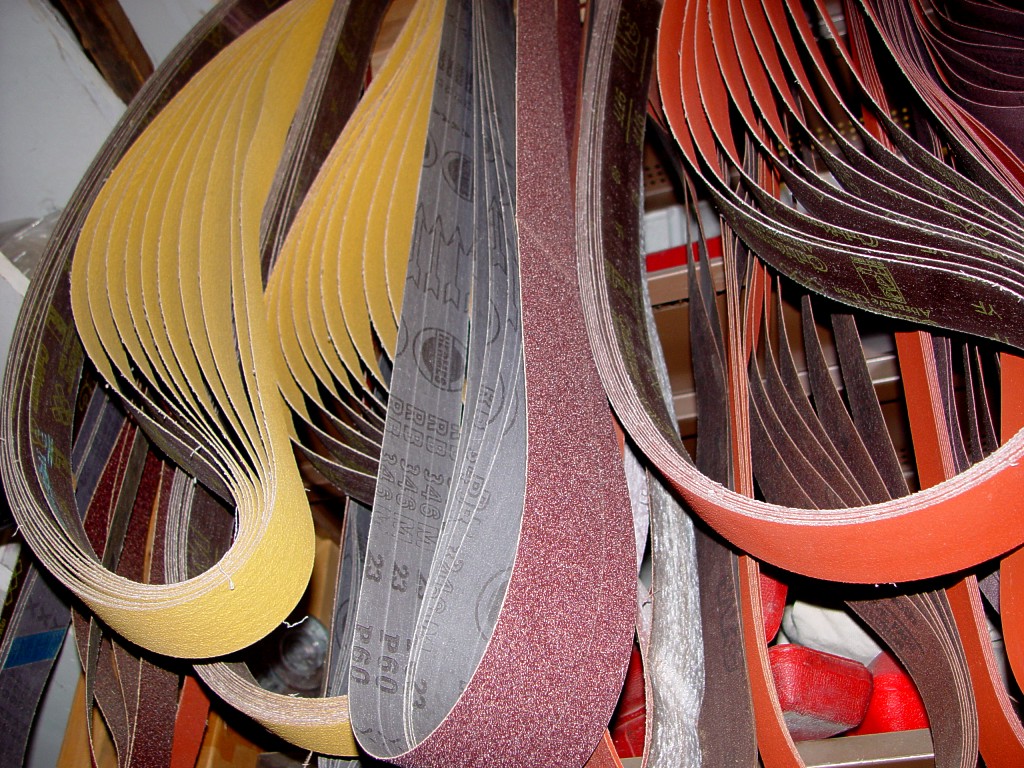
The mainstay of the knife maker is the 2" by 72" grinding belt. There are a hundred different types, all manufactured for specific purposes, for certain materials, for dedicated applications. Suppliers give discounts if purchased in volume.
Abrasives are the heart of shaping and finishing, and modern craftsmen owe their success to modern abrasives technology. This is not your Grandfather's sandpaper. I use 15 different grit sizes, six different materials, four different structures, and eight different bonds on five different backings of belts from six different manufacturers.
The colors of the belts actually mean... nothing!
Short answer: You'll be handing it down to your grandson.
Long answer: The first word that describes modern handmade and custom knives is durable. My handmade custom knives are fine, well-made instruments and tools. The fit and finish are excellent, so corrosion won't start. The materials are impervious to just about anything you can throw at them. The woods are either decay-resistant or pressure stabilized and sealed. Gemstones are hard, tough, may be sealed, and are impervious to all fluids. Most of the steels are stainless, the guards and bolsters are corrosion resistant or corrosion proof, and attached with at least two zero-tolerance peened pins. Guards are closely fitted and dissimilar metals are soldered. Pommels are tapped, threaded, and every piece is assembled with jewelers quality water-clear epoxy. Most of the knives should last 3 generations or more with reasonable care. It is interesting to note that if you have one of my knives that has a stainless steel mirror polished blade, with 304 stainless bolsters/fittings and a gemstone handle, the most ambitious care requires only an occasional dusting and waxing. Most gemstones will outlast the blades.
It gives me great (if somewhat apprehensive) satisfaction that ninety percent of the pieces I make will still be admired centuries after my bones are dust! They will, however, continue to appreciate in value. Unfortunately, I won't be able to benefit from that-
Return to Topics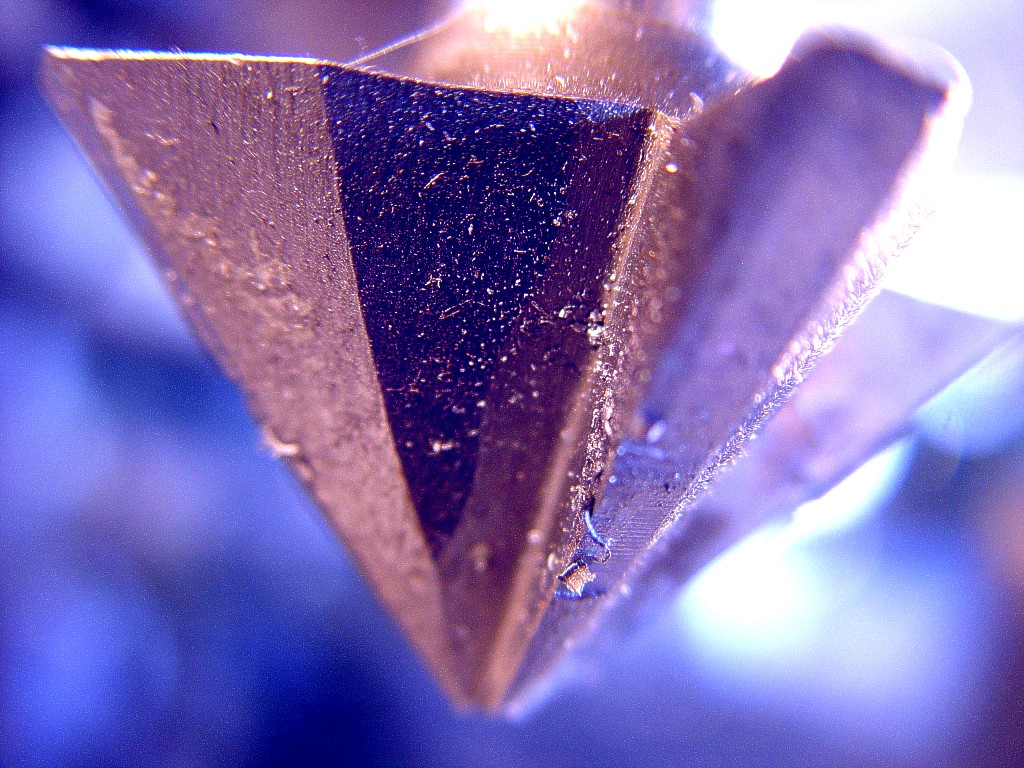
A large variety of cutting tools are used to cut other tool steels. This is a chamfer bit, used to dress the angle on the secondary cut for knife handle finger holes. Aggressive tool steel bits like this are specially made, this one is in M2 tool steel, a steel I've used on knives before. But it's an ugly steel and does not finish well.
Steels used to cut other tool steels must be used with great care, with attention to speed feeds, pressures, and lubricants. Of course, all of this cutting must happen before the knife is hardened and tempered.
The photo was taken with outside backlighting, adjusted for color balance and contrast under tungsten lighting.
Short answer: That's impossible.
Long answer: There is no such thing as perfect. Though the human hand can be very well practiced, it is not possible for it to create any object of perfection. Show me any knife, any sculpture, any work of art and I can find irregularities, mistakes, an errors, or a flaw. Anything.
Sometimes people think that if an object is constructed entirely by machine, it can be made perfectly, without flaw. This is, sadly, one of the most persistent and mistaken beliefs that permeate our culture. Items and objects created by machine are limited by the process and that is the first imperfection. What that means is that a Computer Numerically Controlled (CNC)device can only cut what can be held, measured, indexed, and manipulated by the machine itself. The machine limits what can be produced by its own nature. Add to that the human input that has programmed it, the human hand that chooses cutters, initializes, and designs the operation, and the imperfect hand is afoot. No machines are capable of fine finishing to the degree of hand finishing, and cutters, variations in wear, machine play, lubricants, and the materials themselves are all imperfect in make-up and execution.
So if a machine can not make a perfect item, can the human? Absolutely not. Everything is variable by degrees. Here's a great example: I was at a fine custom knife show, and an artist who was touted as one best engravers who ever lived had some items on display. I wanted to see what the items looked like close up, and I had seen many of his representative works in magazines and periodicals. Upon arriving at his table I put on my glasses. If you're over 45, you know that magnifying glasses become a necessity. As we age, the pupils stiffen, and you simply can't focus on nearer items. The glasses I had were only 1.25 magnification, so it wasn't like I was peering through a microscope, which is what he used to engrave the knives. These are glasses that would allow one to read the text on a newspaper at 24 inches. What I saw was a significant variation from what I had heard about this guy's work, and what I had seen in the small printed photographs. There were a few overcuts, some misaligned shading, some places where curves and cuts were not the best executed. What this told me was that the idea of being one of the best did not have to do with perfection, it was his overall designs, knife skills, reputation, and longevity that made him popular. Simply put, his work was imperfect. His knives sold for many thousands of dollars, imperfect every one.
Please remember that typically, the magnification factor of most knives presented on the internet, in websites, and in print media is actually negative. Put another way, what you are looking at is a reduced size, an image smaller than the knife actually is. This is well-known in photography as a technique that will hide flaws, imperfections, and irregularities. If a photo is half the size of the original item, the flaw is also half the size. If a 12 inch long knife is actually presented in a photo that depicts the knife as three inches long, it is a four power reduction. This is a tiny rendition of the knife, and flaws may be invisible. It is no wonder why this size photo dominates nearly all products on the internet, a place where the size of the photo is not critical anymore, since most of the world is not limited by bandwidth and display speed in photos anymore.
This is why I include an array of photos on my individual knife pages, including many that are significant enlargements of the knife, bolsters, fittings, handles, and sheaths. Few people do this because they don't want you to see any flaws or irregularities in their work. I know that these exist, but in an effort to be clear, show them anyway! I want my clients, patrons, and knife enthusiasts to see the knife, the real, handmade knife.
It does not take an expert to detect imperfection. Anyone given enough time can find something amiss or unsuitable with any item, no matter how it is created. In some cultures, it is expected that an obvious and even dominant flaw, mistake, or error is placed in the object so the viewer knows the frailty of the human hand that produced it. There can be a lot of respect for our imperfect nature; it's all part of being human.
A person who demands absolute perfection is not only unreasonable, but also may suffer form a form of obsessive-compulsive disorder. As an artist and maker of fine knives and sculpture, it will be impossible to satisfy this person. Though I make a knife as well as I possibly can, and you can see the results of that in the thousands of photographs on this web site, there is not a one that is, or ever will be perfect. And every one of them can still be unique, useful, durable, valuable, and beautiful in their own right.
Do I worry that my knives are not perfect? No. I've been making knives for so long that I'm very, very good at it. As one of those imperfect humans, I'll continue to strive for perfection, and until then, I'll just make excellent knives!
Return to Topics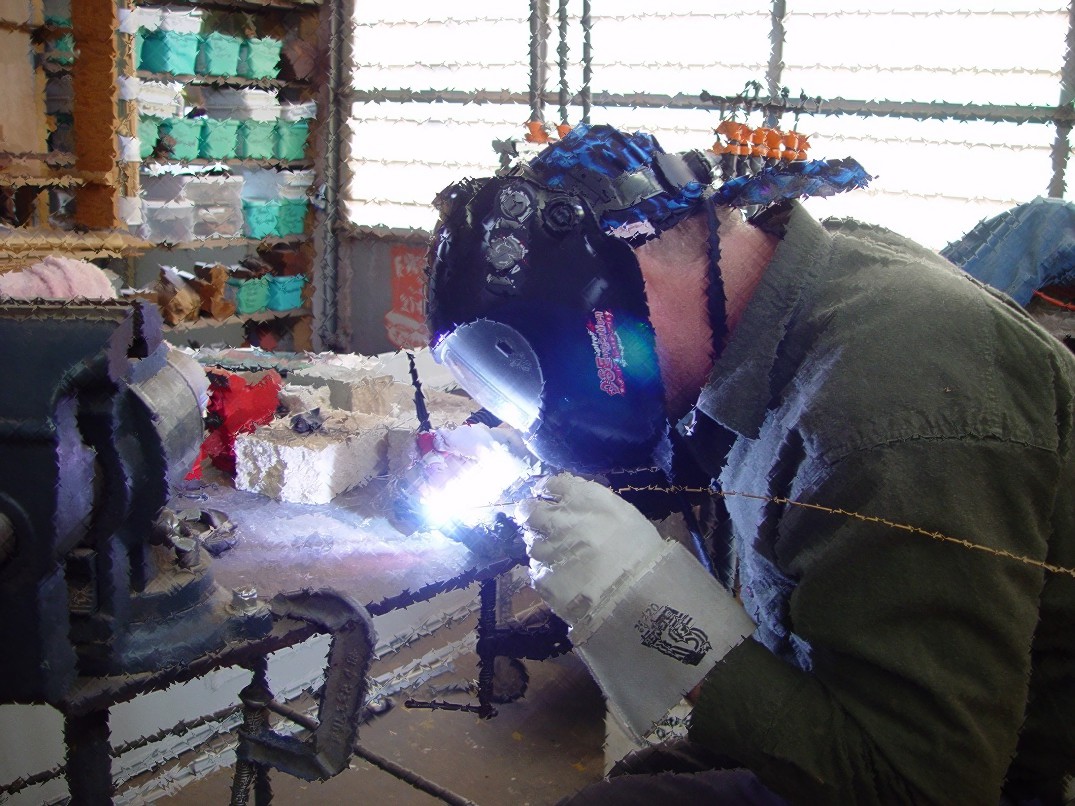
I don't get enough time behind the stick. That's a welding term if you're wondering. It takes some fairly advanced tools and techniques to weld some of the exotic and unusual materials I use in the fine handmade knife trade. Martensitic stainless steels, titanium, aluminum alloys and bronze, copper, and nickel silver can only be welded in the GTAW (Gas Tungsten Arc Welding) process. Here the weld is up close and personal, I'm welding a bronze casting for a sword guard. I'm inches away and using a 3 power magnifier under my auto-darkening space aged hood. When I started welding in the mid-70s, this type of weld was not even possible in the small shop. Tools have advanced considerably.
The photo was taken in ambient light, with a star pattern displacement filter applied.
Short answer: It's custom. You decide.
Long answer: Sometimes, this is the hardest question to answer, and often the first question a client may ask. You might think that a client ordering from a custom knife maker would know exactly what he wants, but because there are so many options available, it may be overwhelming to clarify his exact needs for each particular knife.
The easiest way to decide is to determine how the knife will be used, or even whether it will be used. The heaviest use knives I make are military combat knives, and the lightest duty knives are the sculptural art pieces or collectors knives. This doesn't mean that a knife built for collecting is not or can not be used, because those knives are built to the same tough standards as the combat knives. The main difference is that working knives are made to be worked with, used, scratched, abraded, scuffed, sharpened, and often encounter dirt, debris, moisture, and other detrimental exposures. Collectors grade knives are meant to be mostly stored, displayed, and are expected to retain and even appreciate in value. Between these two extremes are most knives, knives that are occasionally used, periodically stored, and expected to retain some if not all of their original value, and even sometimes appreciating in value. So to initially decide, you must consider several factors: frequency of use, intended long term value, and initial cost. The most important thing to decide is which of these types of use your knife will see: serious use, occasional use, or collector’s grade?
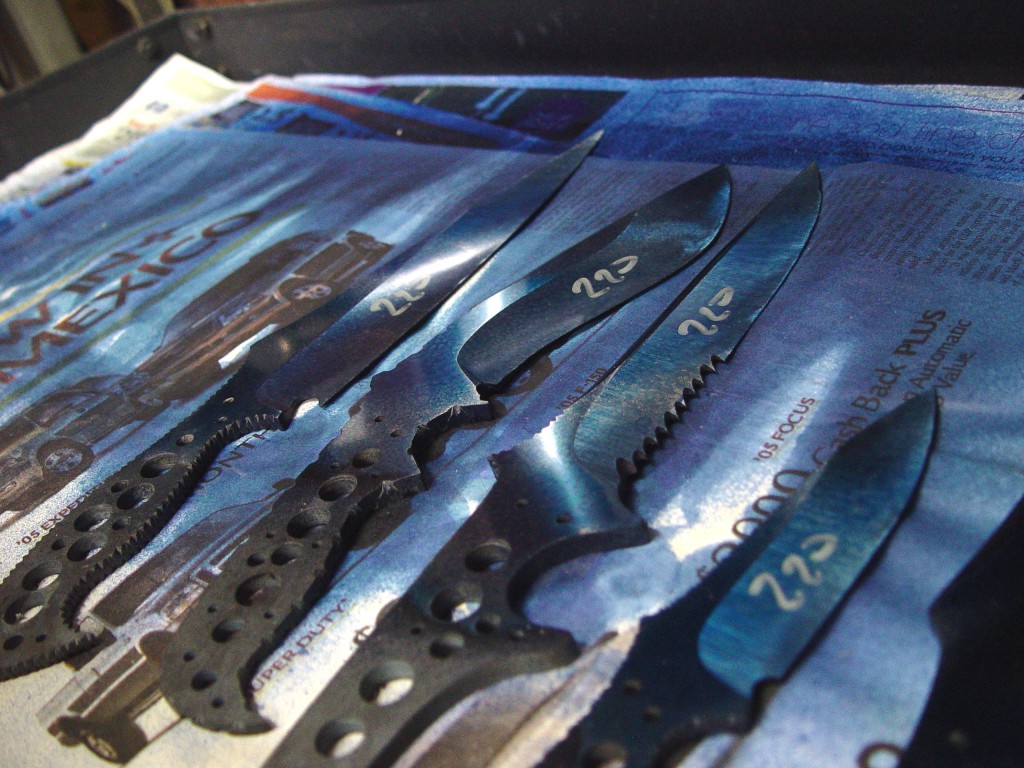
Blades for combat, tactical knives after heat treat, and ready for 360 grit, or 40 micron grinding stage.
Blades are sprayed with layout dye for indication of grinding. There is no shortcut to blade grinding to mirror finish, each step must completely remove all scratches (cuts) from the previous step. This is a long, tedious process and I believe that is why you don't see many well-made mirror finished steel knife blades.
The "220" on the blades reminds me of the last grinding step. The eye can't tell the difference in grit scratches, particularly in the finer grits.
Color, spray shadows, and dynamic angle all suggest progress in this photo.
Short answer: It's a knife. Of course it's sharp. Be careful.
Long answer: All knives have cutting edges. But so does an ax, a hand plane, and a chain saw. Even factory knives have edges. What's the difference? The difference is in blade geometry, an often neglected factor of knife making. In order for knives to be sharp, they must be thin where the edge is relieved and maintained (that's the cutting edge). So pay attention to the thickness right behind the cutting edge. The blade should be strong enough to take some use, but not abuse; it's a knife, after all, not an axe. The key to good thin hollow-ground blade geometry lies in the skill and practice of the knifemaker. Factories grind with CNC machines, or with jigs, or with little kids in Pakistan, so they leave the blade thick. This makes for a tough-looking knife, but after three sharpenings, it's so thick that it now has a "chisel" edge, unsuitable for cutting. Factories think that this is when you'll just go buy another knife. A properly hollow-ground knife blade is thin throughout most of the blade, so that repeated sharpenings will still leave a usable, thin geometry. Another factor of good blade geometry is in the method of grinding. If the maker uses a jig, or has bad technique, he grinds straight across the blade, neglecting the curvature or belly of the blade shape. This leads to thick and thin areas of the blade: not good. Particularly noticeable with this method is a very thick point, exactly what you don't need in a knife! Why have a point if it's not thin and sharp? A skilled knifemaker grinding offhand follows the curvature of the blade with the hollow-grind perpendicular to the edge along the entire edge, leading to uniform thinness throughout the cutting edge. This makes devastatingly sharp bellies for skinning, dressing, or tactical knives. It also makes thin, aggressive, extremely sharp points. Take a good look at that bulky factory steel. Isn't it just a bar of metal that's dressed up to look like a knife? See detailed drawings about cutting edges, blade geometry, relief angles, and custom knife blades on my Blades page here.
Return to Topics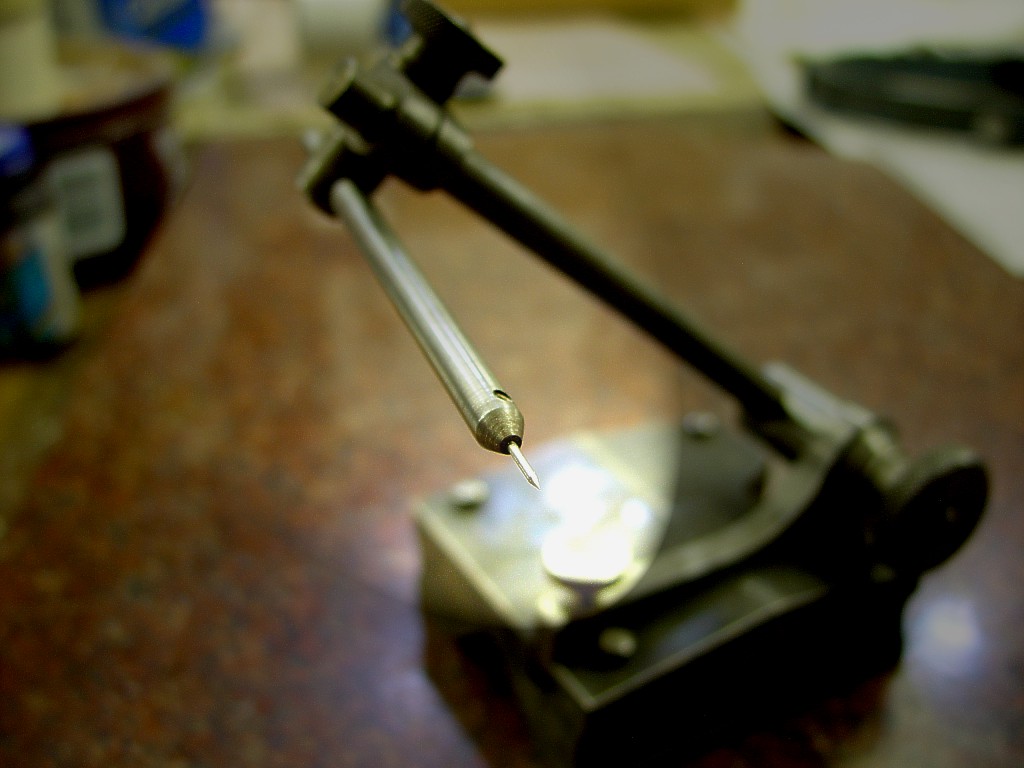
There are countless measuring tools and reference guides in the modern machine shop. Measurements have to start from a fixed, verifiable, absolute point of reference. In this case, it's the granite base this height gauge is resting on. The granite is lapped and polished to extremely high accuracy, about 1/10,000th of an inch in variation.
This gauge is actually an antique, with handmade parts. It's heavy, solid and well made. It's used to transfer a set height to various objects via a hardened, pointed scribe.
In the photo, I went for very narrow depth of field to accentuate the point, and applied a light wash in the axis direction of the main rod.
Short answer: Not if you take care of it.
Long answer: Different steels are different, but there is no "rust-proof" tool steel. The addition of carbon to iron (to make steel) means that it can corrode. Steels that are "rust-proof" do not classify as tool steels (like the 420 stainless used in knives sold in late night infomercials), and they can be used as knife blades, but they are weak and short lived. Sure, you might see one of them cut a soft tile then a tomato, but their ability lies in the thin edge, which quickly wears away. They are very tough (that's flexible, with resistance to breaking), but so is a spring. In fact, that is almost exactly what they are: soft, thin stainless steel springs. You wouldn't take one on your favorite deer hunt, or into the combat theater, or hand it down to your grandson. Other corrosion-proof knives are dive knives. These are often made of 316 stainless steel, which is used in making stainless pipes to carry chemical corrosives, such as acid. Others are made of titanium which cannot be hardened any more than 35 Rockwell on the C scale, whereas knives are typically 58C Rockwell, dozens of times harder and wear resistant. These blades won't corrode, but are also soft and weak and do not classify as tool steel.
Corrosion can occur on fine stainless tool steel knives, but only if you let it. A high quality 440C stainless knife steel will only corrode if left exposed to sea water (for a long time, longer than a day or two) or orange soda pop, or battery acid, or left in a wet leather sheath (acids are used in tanning leather) or stored long term in the sheath and not allowed to breathe, unwaxed and unprotected. ATS-34 is a bit less corrosion resistant, so blood, orange juice, etc. will also stain it. D-2 is even less corrosion resistant, and I've seen people's acidic fingerprints etch into the blade finish. And O-1 will flat out rust, unless you keep it coated with car wax, or Break-Free®, or silicone-based polish-sealants. A high mirror polish on knives can help, as debris cannot cling to the blade. There are some new developments in the nitrogen stainless steels that have extremely high corrosion resistance, but these steels are very expensive, limited in production runs and sizes, and typically only used for dive knives in marine environments
So what to do? Clean your knife, keep it reasonably dry, wax it periodically, do not store it long term in the sheath, and it will be just fine. Read more about knife care on a dedicated page here.
Return to Topics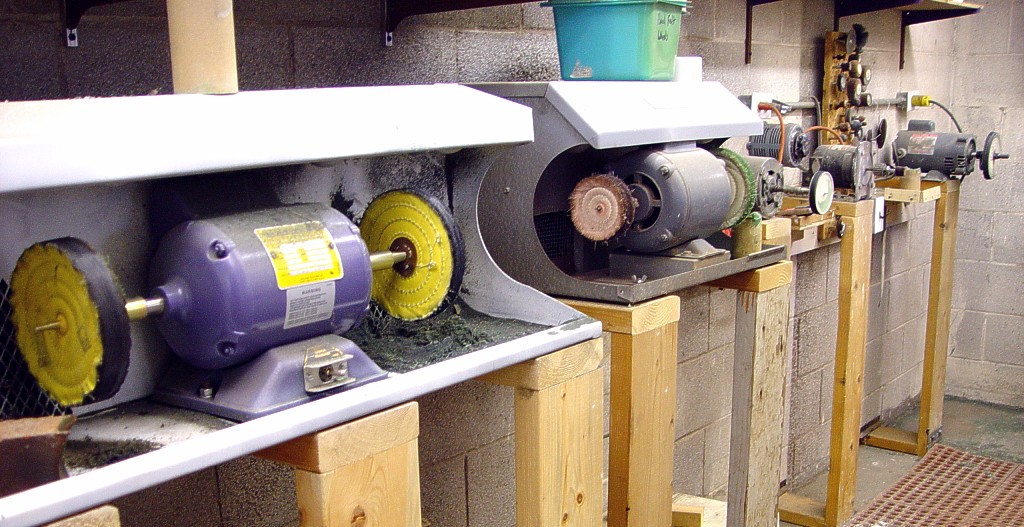
The buffers are the most dangerous machines in the shop. They spin cloth, felt, or other material at a very high rate of speed, in the order of over 110 miles per hour at the surface. They can catch on any projection of the item being polished, and the item grabbed, spun, and thrown back at the operator before his heart can beat one time.
I've known of several knife makers killed by these machines, but nothing can match a well polished metallic surface.
Photo constructed for high depth of field, dynamic angle.
Short answer: They're dark.
Long answer: Several clients have asked why active duty military would carry mirror finished blades into combat where they lack "stealth." I explain that some of them are spraying the knives with camo paint, sheaths and all, then washing it off with denatured alcohol when they return from their deployment. This way they've protected the finish somewhat, and had something very nice to place on their mantle afterwards, eventually to hand down to their children. Others leave the blades polished, and figure if they have to pull their knife, the situation has already gone to hell and some shiny high-chromium tool steel might make an influential.... statement.
Coatings: I do not typically coat blades, because that would hide the grinds, hide any potential flaws, eventually chip and peel, and may actually accelerate corrosion. I go into detail about this topic including a section on Parkerizing on my Blades page at this bookmark.
Bluing is a process of oxidizing (rust is a form of oxidation, uncontrolled and irregular). Hot bluing (which is what I do) is a controlled, deep passive oxidation process whereby the steel is cleaned thoroughly, chemically and molecularly, then immersed in a superheated boiling solution of sodium nitrate and other salts for 40 minutes or longer. This deeply oxidizes the surface of the steel. The bluing process is the same used on all fine firearms, that black, dark look that takes years to buff, scrape, or polish off. My process excels in penetration, where most firearms might be blued for 10-20 minutes, I start at 40. To give you an illustration, when I cut my makers mark into a blued blade using a sharp stylus diamond point engraver at 50 pounds per square inch, it takes three full passes to cut through the bluing to achieve a bright cut.
To sum, hot caustic bluing is a well-recognized, time-proven method of inhibiting corrosion (not preventing it) on the surface of steels. My own son (in the US Army 101st Airborne) has carried a hot-blued skeletonized knife in combat in Iraq. So has his squad. They're very happy with the performance.
Please remember, there is NO corrosion proof tool steel. Even 440C, which contains 18% chromium will rust and corrode in salts or acidic environments. There are some new developments in the nitrogen stainless steels that have extremely high corrosion resistance, but these steels are very expensive, limited in production runs and sizes, and typically only used for dive knives in marine environments.
Please look at my "Care of Your Custom Military Knife" page on this website and the "Will it Rust?" topic above.
Return to Topics
The wet grinding bench and related apparatus is for gemstone. The body of the grinder is stainless steel, all fittings, shaft, and mechanical parts are stainless steel because it is constantly under water. In my early years, I would heat the water sump to boiling to keep my hands from freezing and cramping, particularly in the winter while grinding rock. The heavy neoprene gloves help some, but have to be removed when fine finishing takes place under water.
Nearby equipment must be protected from water spray.
Photo is from bench level view, gloves on petrified dinosaur bone and flint dressing stone.
New! While I'm not hot-bluing stainless steel blades, I've developed a new process for stainless steel counterterrorism knives in my "Shadow" line that creates a subdued, dark, and variable finish for non-reflectivity!
Short answer: Can be done, but why?
Long answer: There are several methods for bluing stainless steel. They are complicated and expensive, compared to the standard process of bluing carbon steels (see "What about blued blades and coatings" above). First, please consider why stainless steel is "stainless" in the first place. It's because of chromium, and we're all familiar with the permanence of a chrome plated bumper of a car (though newer cars are plastic, yecch!). Chromium steels are resistant to corrosion because they form a passive oxide coating at the surface as soon as it's exposed to the atmosphere. Aluminum has a similar property. So corrosion (rust) does not easily start. The most common reason to blue a blade is to impart a corrosion resisting controlled oxidation to the surface of the steel, that way it inhibits further corrosion. Since true stainless steels contain a lot of chromium (more than 13% to be classified as stainless), they are already more resistant to corrosion than a blued steel. So the only reason then to blue a stainless steel blade is for color and appearance.
Though stainless tool steels can be blued, currently, I do not have enough requests to add an additional and expensive bluing bath for stainless steels to my already huge list of processes. I get requests for blued stainless about six times a year, and that is not enough to offset the cost of the chemistry, tanks, and process, a cost that ultimately, I would have to pass on to the clients. Also, from what I've determined by study, the blued stainless tool steels have a questionable and variable appearance. Perhaps in the future it will be worthwhile to blue stainless tool steel blades. Right now, it's not just cost effective, and no advantage for corrosion resistance is obtained.
I go into detail about this topic including a section on Parkerizing on my Blades page at this bookmark.
Return to Topics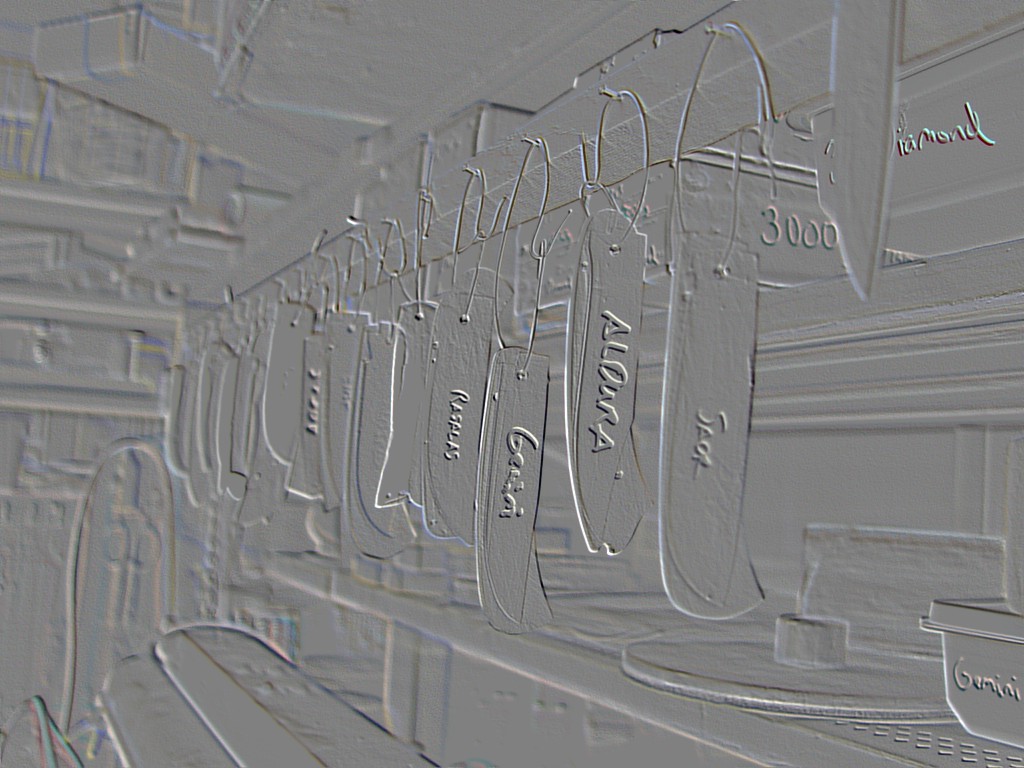
Folding knives require tough, rigid templates to lay out the patterns and align the holes to be drilled or milled into the final knife liners, blades, bolsters and components. So, in addition to the plastic patterns that represent the finished knife profile, I have a group of metallic templates racked and labeled for the folding knives.
Patterns for knives may be passed around among knife makers, or even given to other makers after a death. Even with the pattern in hand, each maker applies his unique style, arrangement, materials, and finish to a knife pattern, and thus, puts his own name into the work.
Photo is high contrast, embossed manipulation.
Short answer: No. Read, study, ask, learn, and make the best purchase you can afford for your intended use.
Long answer: Lots of claims have been made. Since ancient times, man has marveled over the properties of the cutting edge, and then sadly, discovered its limitations. I can imagine that the first obsidian swords made by Meso-Americans were incredibly scary, until they hit another rock, or sand, or dirt, or Spanish armor, and the sharp flakes of obsidian were broken off. Early steels seemed wonderful, but wore down easily, and rusted, and bent, and broke (often in battle ...oh, crap!). Sure, we've all heard of near-magical properties of Japanese swords, until we realize that they are folded 80 thousand times to get the grain to run straight in the metal, because it's so crappy and random to begin with. And that they used differential tempering because the cutting edge would be too soft, and the spine too brittle if they didn't. We've heard of magical blades of the Persians, Arabians, Chinese, and (let us not forget Excalibur) the British. Most of us know this is fairytale stuff, but some hold out the hope that there will be a super material that will someday be used to make the ultimate last knife you ever need. It will stay razor-keen forever, be feather-light, be super-tough, never break or bend, never corrode, and never be lost, staying by your side like a perfect extension of yourself, like an accessory of your hand.
Until that day comes, ceramics, titanium, super steels, and experimental blades will all have their limits. Every edge dulls. The pressure per square inch that is placed on the cutting edge can be enormous, the abrasion horrific. Even the hardest titanium-nitride coated ceramic metal cutting tools will dull (and they are extremely brittle). There is no alloy strong enough to lift a truck, yet light enough to weigh a feather. That's science fiction. Oh, yes, additionally, we would prefer our super material be cheap-
We're all adults here; we've used knives to cut. Some are much better than others, and they cost more, some are more beautiful and comfortable to use, and they cost more, and some are cheap and ugly and common. There is an entire range of types, anything to fit the value you place upon your knife. Just beware all of the hyperbole.
It's simple enough to know that there are only a handful of fine tool steels used to make high quality custom knives, mainly 440C, D2, ATS-34, RWL-34, BG-42, A-2, O-1, W-1, CPMS30V, 440V, CPMS90V, CPM154CM, N360, and custom Damascus. They are the most commonly used steels for fine knives for a reason. It's important to note that how the steel is formed, ground, heat treated, tempered, finished, and mounted is immensely more important than the steel type. That is why custom makers take responsibility for these processes in their own works. Read, study, ask, learn, and make the best purchase you can afford for your intended use.
Read more details than you probably ever wanted to know about custom knife blades here.
Return to Topics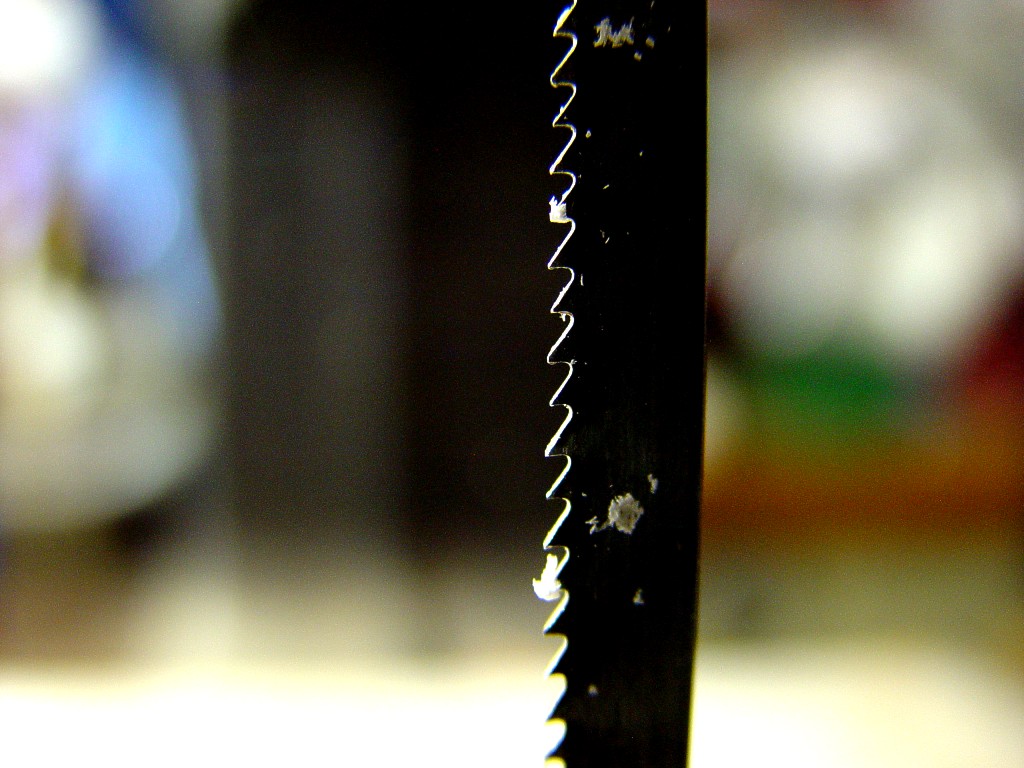
The saw blade is highly underrated in the shop. Not only is it used to cut out and profile blades, bolsters, liners and most metallic components of knives, it's used to cut out thick leather, plastic patterns, exotic woods, and all the components of stands and cases.
There are numerous types of band saw blades used in the modern knife maker's studio. Blades may be carbide tipped, regular rake, skip toothed, zero rake, in M42, high cobalt, high speed steel, or bimetal. They may be constant tooth, variable pitch, and vary greatly in size, thickness, and feed and speed rates. They are tough, yet delicate and require specific break-in procedures.
This blade had just cut an acrylic template. Photo is backlit through cutting fluid containers.
Short answer: Why toss your weapon in the direction of your enemy for him to pick up and use?
Long answer: "Projectile" tools. "Throwing" knives. You might hear all kinds of hype about super-duper knives that can be thrown, but this is Hollywood cowboy talk. I would begin to question why you would toss away (perhaps even in the direction and to the benefit of your enemy) your edged weapon in the first place.
I don't make knives for throwing. The reasons are these: Throwing knives are usually throwaway knives, in that they're made of a cheap and soft steel, so that when you hit that occasional rock or concrete (which will inevitably happen if you're practicing throwing a knife), then they will just bend, not break. That requires them to be soft or springy steel. Imagine if the first time you threw a knife and hit a rock, a chip of metal broke off your blade or point.
The proper temper of a true knife (in layman's terms) is for the knife to just get to the point of bending when it breaks. Some knives are tested this way: the knife blade is clamped in a vise, pressure is applied to the handle sideways until the knife bends enough to snap the blade in half. Around the break, there should be just the initial signs of permanent bending, and the break should be clear, fine grained, gray metal. This is a simple old test, that generalizes the hardness and temper of the blade.
Nowadays, knifemakers should grind the knife for the best cross-sectional geometry of the knife, considering the use, steel type, and manufacturer's design data. The results are the same: for a knife to be hard, the steel will sacrifice toughness. For the knife to be tough, hardness must be sacrificed. It is a careful balance, as there is no material that is both very hard and very tough when ground thin enough to be sharp. To understand this better: hardness is the resistance to penetration, and toughness is the resistance to breakage. An extremely tough knife is a soft knife, so that the steel can bend instead of breaking. An extremely hard knife is a brittle knife, so that the steel cannot be penetrated. Both extremes cannot be achieved, but only balanced as closely and carefully as the particular tool steel will allow. That is my job.
So if I made a knife for throwing, it could not be hard (throwing knives are usually butter-soft), and if I make a properly hardened knife, it would be too brittle to throw. The only way to possibly balance this is to leave the steel thick, and then it cannot be made very sharp, and future sharpening would be impossible. Get details of the hardness-toughness relationship on my Blades page at this bookmark.
If you must have a throwing knife, you should make one yourself out of a piece of rough stock, as it will probably be ruined anyway the first time you hit a piece of concrete, dirt, rock, or hard wood. Or you can purchase them cheaply from numerous import companies here on the web, just do a search. If you practice a lot, and get really good, maybe I'll see you at the county carnival! In Hollywood? I doubt it. All that knife flying through the air stuff is computer generated.
Read more about professional tool steel treatment, grind geometry, and custom knife blades on the Blades page.
Return to Topics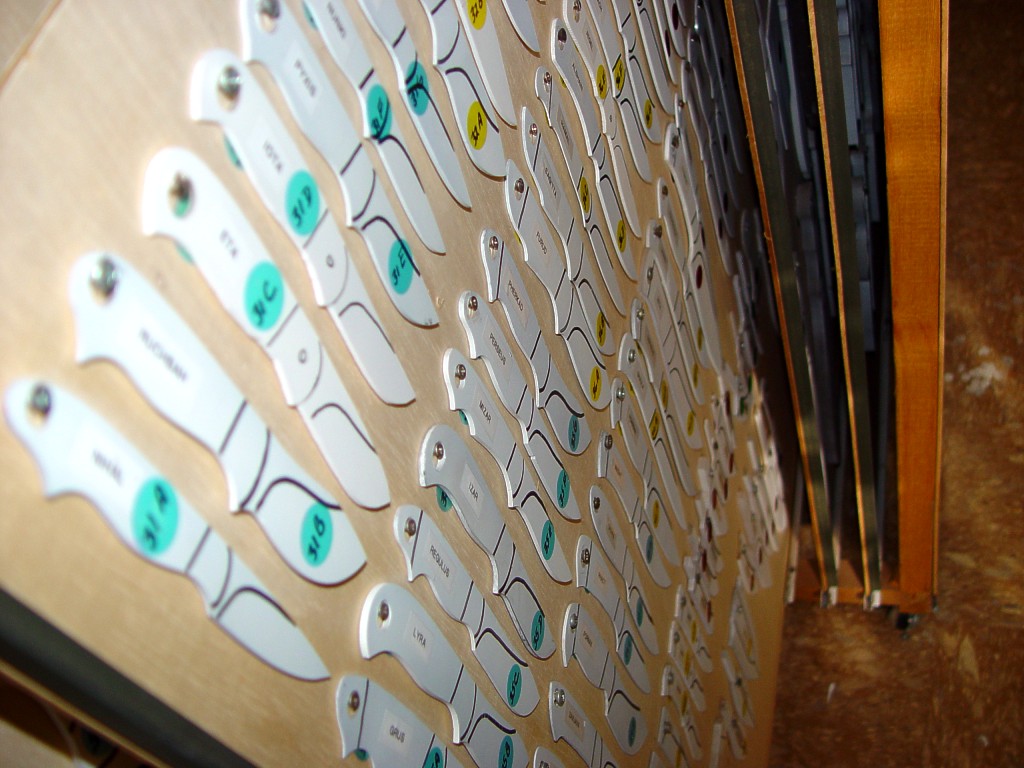
If a knife maker makes a lot of custom knives, he ends up with plenty of patterns. It becomes an issue then, how to store and yet display patterns in a quick, easy way.
I constructed this pattern rack with sliding panels of thin plywood, with steel reinforcement and steel runners. Each pattern is labeled, indexed, and catalogued by page, corresponding to the same pages on the patterns page on this web site. I sketch on the approximate grind lines and bolster locations, but that varies even on the same knife.
The pattern helps me put the knife into three dimensions, and I adjust it by feel in the hand.
The camera angle was tilted in this photo, creating dynamic tension with repeating patterns and rule of thirds composition.
Short answer: Very. It's the number one thing a knife maker should know and do himself.
Heat treating is a specific process laid out in clear and concise steps for each type of steel.
Long answer: The reason I started making knives is because when I was young, I heard about the secret of steel: the fact that steel could be heated and cooled at different temperatures and rates, deriving a piece of metal that was dozens (sometimes hundreds) of times softer or harder than a piece cut from the same bar. It amazed me and an old welder said, "If you want to learn about heat treating, make a knife."
He was right. I started annealing springs and "found" steel stock, and working on every piece of steel I could get my hands on. And I studied. What I found was that there was an entire science of the crystalline structure of steel: how it forms entirely different components and allotropes based on metallurgy, mixtures, exposures to heat, cold, duration, and more. Tool steel is not just steel, it's martensite, austenite, pearlite, bainite, cementite, and ferrite. It's carbon, chromium, silicon, manganese, magnesium, molybdenum, tungsten, vanadium, and sulfur. It is a complex scientific field of study and practice, and as a knifemaker, I'd better be knowledgeable about my field. So I studied, experimented and learned some more. I've built half a dozen modified ovens over the years, and I realize that the heat treating is still at the core of making an exceptional blade. I heat treat in vacuum-nitrogen quenched inert gas electric and high-intensity rapid ramp ovens. I sub-zero quench, perform sophisticated shallow cryogenic and deep cryogenic quenching and aging at -320° F! I heat-treat specifically as the manufacturer requires, and modern tool steels are made in clean, accurate, regulated, and verified conditions, so that is how I treat them.
You might wonder why I do all my own heat treating and don't trust it to an outside contractor, as many knifemakers do.
Who knows if an outside heat treating contractor is paying attention to these items? I trust myself to do this critical set of processes, not an outside heat treating contractor. That's why heat treating is the number one thing a knife maker should know and do himself. Read and learn more than most knifemakers about Heat Treating and Cryogenic Processing of Knife Blade Steel on this page.
I read on one forum where one anonymous idiot submitted that "Jay Fisher's heat treating is nothing special." This shows the absolute ignorance of the person who would post this. Heat treating is not some special inconsistent and ambiguous art, where individuals get to creatively modify times, temperatures, process steps, and handling of the blade depending on their mood. Heat treating is a specific process, determined by the engineers who work for the steel supplier, laid out in clear and concise steps for each type of steel. Heat treating is not "special," it is a recipe to be followed exactly to produce a specific result. When you hear that guys have some proprietary, exclusive, and secret method of hardening and tempering blades, you need to run the other way (tightly clutching your money). Do you honestly think that finely engineered products in the best military, industrial, and medical field are handled with mystery steps, secret process, or magical methods? Okay, scratch the mysticism and ask yourself if you think that any part of this process is variable, changeable, erratic and whimsical. Of course not; that's just ridiculous. Any machinist who works with tool steel knows that the manufacturer of the steel explains exactly how to heat treat the blade to yield a reliable and dependable result. It's a process, a set of instructions, and all good knife makers follow it to the letter, or the steel won't perform as it was engineered to.
If a knife maker does not follow these steps, he is claiming that he knows better than the trained engineers who develop these fine steels, knows better than the thousands of machine shops that use them, knows better than the (International) American Society for Testing and Materials, the American Iron and Steel Institute, the American National Standards Institute, and the American Society of Mechanical Engineers. Do you honestly think that the tens of thousands of ASTM, AISI, ANSI, and ASME technical specialists and engineers have less knowledge about steels than a guy who makes knives? That's why I follow the manufacturers guidelines as all good makers should.
Most heat treating companies who work with knives set the blade at one hardness: 58 on the Rockwell C scale. I have blades that range from 54 Rockwell C for heavy choppers that must be shock resistant and tough to 55HRC for springy, flexible fillet knives, to 56 for very thinly ground moderately light trailing point blades, to 57 for standard but thinly ground knives with a light cross-sectional profile, to 58 for many standard knives, to 59 for harder, thicker tactical models, to 60 for short and robust small folders and heavy-spined knives, to 61 for special-purpose cut-off blades for hazardous materials rescue and light metal cutting. I even have blades that are differentially heat treated and tempered, for a range of hardness along the blade. Where I set the final temper depends on three things:
I can't see an outside heat-treater working with a hundred custom knife blades all from different makers knowing these details. Read more about the Rockwell hardness scale on the Blades page at this bookmark.
Watch out for all claims of a range of hardness. When you see a manufacturer's ad that claims the steel is 58-60 or 52-60 Rockwell, they are trying to pull a fast one. Each point of hardness on the Rockwell scale is significant and drastically effects the performance of the blade. Each blade, and each batch of knives will test at exactly one point (or half point!) of hardness, and there is no excuse for a range to be claimed. Why do they do this? This is typical with blades that are 420 stainless steel, or 420HC, or any other designation beginning with 420. 420 stainless can not be hardened to any higher hardness than 52, no matter what range they claim. Ad writers do this in hopes that you will ignore the 52 and choose (in your mind) that your knife is 58 or 60. If it's 420, it's 52C, and no more. It might even be much softer!
And factory knives? Makes me growl. A group of USAF Pararescuemen brought me some factory made knives they'd been issued. They claimed that the edge "rolled" when used. I'd never seen such a thing, so I got permission to do a diamond penetrating hardness test on them. They were 100 times softer that they should be, that is: they weren't even heat treated! Then, a friend took one to a metals analysis lab, and found out the steel (which was marked right on the blade "ATS-34") had none of the percentages of alloy components of ATS-34. They didn't even know what the blade steel was! And this popular American factory sells thousands and thousands of knives a year. By the way, there is no law preventing a factory from stamping anything on a blade (except gold "kt" marks). Read more about knife manufacturers, factories and boutique shops.
I know some old time makers who will tell you that unless you do your own heat treating, you're not really a knife maker. That may be, but many knife makers do not do their own heat treating. They like to boast that their heat treating is done by old so-and-so, and everybody knows he does a good job. Sure, there are some good heat treaters out there. Several can do a predictable job, producing repeatable standard results. I simply won't have my blades leaving the shop and not knowing what someone is doing with them. So, since heat treating is an extremely important part of knife making, I do it myself. I buy my steel from a reputable supplier, and it's done right here in the shop, it's tested for certainty, and it's done right.
Read and learn more than most knifemakers about Heat Treating and Cryogenic Processing of Knife Blade Steel on this page.
Return to TopicsHey Jay,
First off, wow. What an unbelievable weapon. From its razor's edge to
the perfectly formed handle, it's the most impressive and useful tool I
have ever bought...because before the Anzu I didn't even
know what a real combat knife was. But now I can guarantee, it will be
on my gear anytime I go overseas.
Second, I got some serious use out of it in the field just recently
and that edge just keeps on cutting. It's still as keen as the day I
unopened it. Every time I take it out of its sheath, there are always
a few who look at it and ask where in the hell I got a knife like
that. Actually seeing the difference between a real combat knife and
those bendy POS knives from cold steel puts it into perspective.
Anyway, I am extremely happy with the knife and I apologize for not
writing sooner. Take care Jay, and the best to you and yours.
Respectfully,
-Chris
P.S. I will be contacting you in the near future with a custom knife order if you are accepting them right now.
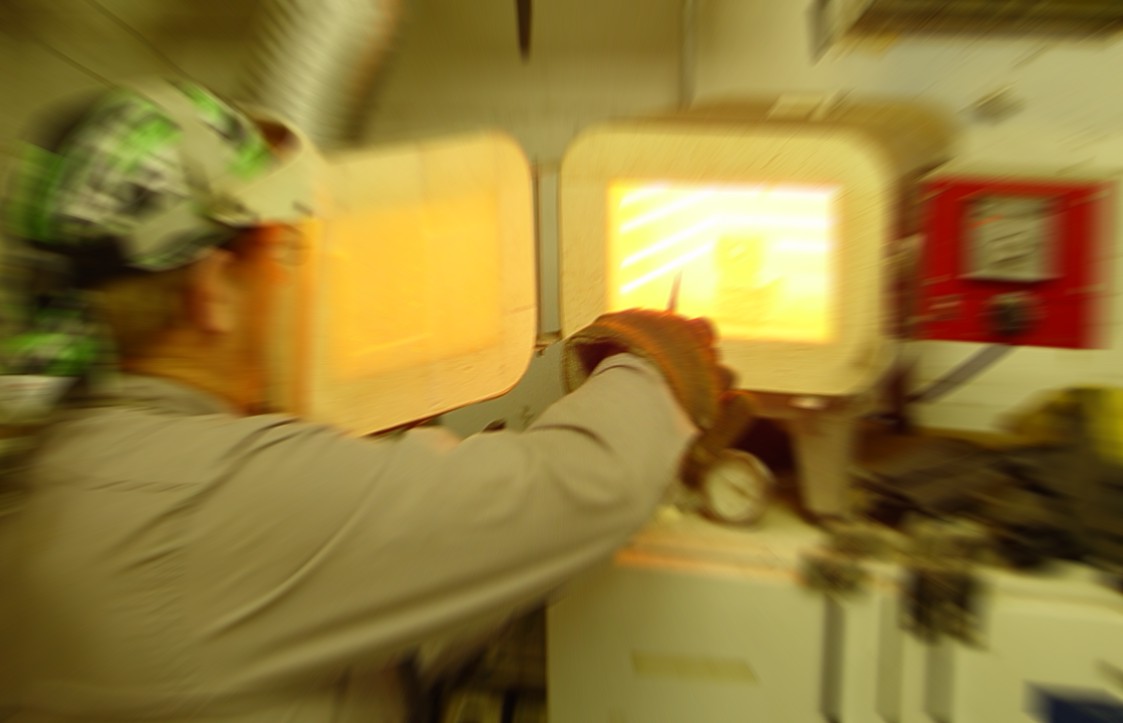
Heat seems like magic to a metals artist, but is actually a carefully handled tool. Here is a picture of the crucible oven, and I'm pulling out a crucible of molten bronze. The temperature of the bronze and crucible is about 2000° Fahrenheit, and while the copper-tin alloy is very liquid, this is the critical point of transformation for several types of knife steel, where the structure changes to a fine grained crystalline lattice, and is frozen in position by rapid cooling (quenching). At this temperature, the high alloy steels are still solid.
This photo was take by my wife, and modified by a radial motion spin filter.
Short answer: Don't. That really sucks.
Long answer: I've heard guys say for years that they won't buy a fine knife, because they'll probably just lose it. Why would they say that? Perhaps they lost some knife in the past and were heartbroken about it. I'd look at that heartbroken emotion with a little more interest. The knife they lost meant something, maybe it was irreplaceable. Perhaps it was a knife handed down through the family, or it dressed a particularly fine animal on a mystic hunt, maybe it still had the tobacco stain that Grandpa left on it, or maybe it was just the right shape, or had a really nice edge, or was just plain sweet. What did they do, set it down on a rock and walk away? Did they have it in their shirt pocket and bend over and have it fall into the lake? Did they shove it in a locking sheath, but not tug it to make sure it's locked, and lose it while crawling through the brush in a combat training exercise? All of these have happened with fine custom knives I've made, so that's why they're cited here.
For every knife lost, there are thousands and thousands that are still in use, so the chances are slim. Besides, what other tool might you carry and lose? A compass? A fishing rod, a rifle? Not likely, because you've got a good hold on them, you check to make sure they're secure: you value them. Just keep this in mind: if you're lost in the wilderness, with only one hand tool, what would that tool be? How important is your knife? How important is your life? You might want to think about the knife you carry and it's quality now. And don't use that lame excuse for not owning a fine knife. It's just another way of saying "I'm too irresponsible to own a fine custom knife." Ouch!
Return to Topics
Making knives is a dangerous, dusty business. The abrasive particles and the tiny chips of material (swarf) that is cut away during grinding, sanding, and finishing are a constant issue in the studio. While the largest offenders, the belt and disc grinders, have dust collection, the abrasives still swirl and settle.
Without safety measures, my life would definitely be cut short by silicosis, or deposition of non-degradable solids in my lungs. The eyes would be the first to go, as they would suffer continuous bombardment from particles flying through the air. I often wonder about knife makers who wear full beards, because they can not be achieving a seal on a respirator.
The photo was taken on macro setting, contrast enhanced and embossed.
Short answer: Somebody wants your knife. Lock it up.
Long answer: Knives are an "attractive" nuisance. This has been illustrated several times to me by gallery owners who refuse to display knives in their showrooms. Knives are frequently locked in display cases, secured behind glass, locked in vaults, covered, hidden, and protected. It might be that they're small and easy to carry away, but that's not the whole story.
Knives are valued by everyone. Not everybody can fence a diamond tiara, but everybody wants a fine knife for themselves. The knife is universal, beautiful, and handy. Fine knives by custom makers are some of the most valuable small non-jewelry items made. And some of them are jewelry, with gold, precious gems, and exotic metals dripping with elaborate embellishment. I've seen it at every show, people drool over fine knives. Someone wants your knife.
I remember a particular show in Colorado Springs where 80,000 people strolled by my table over one weekend, all with lust in their eyes. There were constant attempts to divert my attention for the quick grab and smooth blend into the crowd, but I was extra vigilant. It was a truly awful show. It was like bringing your teenage daughter to a biker bar.
Fine custom knives by a well known maker are one of the highest appreciating investments one can own. They typically appreciate 10-25% a year or more. I sold one knife for $750.00 and the next year a gentleman told me he purchased it from a dealer for $4000.00. This also illustrates the point that the cheapest place you can buy a fine custom knife is from the maker. After a dealer gets his hands on them the price goes up, up, up. Knives are valuable. Custom one of a kind handmade knives by a well-known established maker are irreplaceable. Keep an eye on them. Read the topic below for more discussion: What is the value of investment knives and why?
Return to Topics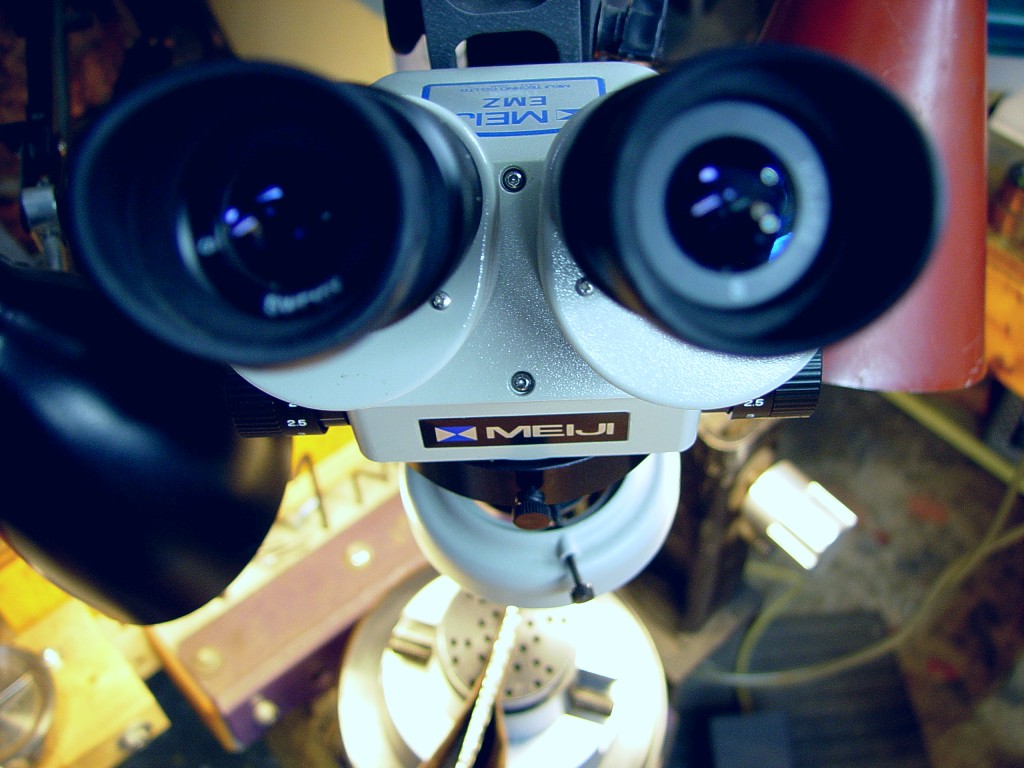
The most delicate work I do is engraving, and requires a binocular microscope. I spend many hours at the block, peering into the eyepieces at tiny areas of metal that I'm engraving. I wonder how the engravers of old did this. They probably retired after the age of 40, when their focal distances started changing.
For years, I used a variety of binocular visors, up to 10 power for engraving. The problem with them is that the are severely limited by depth of field and the area of focus. For example a 10 power binocular visor has a focal distance of 2.5 inches, meaning the front of the lens has to be 2.5" from the work. The microscope is much more forgiving and has variable focal distances, magnifications, and ocular adjustments.
This photo was taken with limited depth of field focused on the nameplates.
Short answer: They're used for different things
Long answer: Knives come in thousands of varieties. That's why I've got over 500 patterns on this website. You can see them all right here. When you think about how you might use a knife, and how many types of knives you would like to own, multiply that by how many people are using knives. Think about how another professional might use a knife. Someone once said that everything we eat, own, or use in any way has been touched by a cutting edge. So there are blades for each of these tasks. In custom handmade knives, each handle must fit a different hand. And the balance must vary, depending on the use. A heavy blade (blade-heavy) knife might be used for rescue work, light chopping, and in a pinch, digging. A handle-heavy knife usually denotes delicate work, a light thin blade, scalpel-like tasks. There are different grind geometries, like hollow, convex, and straight. There are a large variety of teeth, hooks, and serrations. Some people might prefer a long handle, some a short one. Knives might be held in a variety of ways in the hand, and there are different hands. It is absolutely bewildering the different kinds of knives history has given us. Knives may range from a simple shank of metal with a cutting edge, to high art sculpture that is based on a knife, but will never be used to cut. Get an overview of knife blade types on my blades page, then enjoy browsing through my patterns page, where there are hundreds of links to pictures of finished knives.
Return to Topics
I have a good assortment of exotic and snake skins used in inlays of the knife sheaths. Some of the snake skins are local, mainly rattlesnakes. We have a wide variety of rattlesnakes in New Mexico, including Prairie, Diamondback, Banded Rock, Blacktail, and even the rare Desert Massasauga Rattlesnake. While I don't go out and hunt rattlers for sheaths, I get plenty of skins from local ranchers, farmers, and even government wildlife specialists who might find these brutes already deposed.
After I cure and tan the hides, they are rolled and stored in plastic bags and boxed with mothballs for protection.
The photo was taken in room lighting, darkened, and manipulated with illumination to create a menacing accent light.
Short answer: One folds, the other doesn't. Both are nice, one is stronger.
Long answer: Okay, this one has inspired argument for decades. Here's the straight skinny. If a knife is to be strong, very strong and tough, used in tactical, rescue or lifesaving operations where the durability of the piece is tantamount to survival, a full tang knife is the only way to go. That's because it is one solid piece of steel from tip to tip. It is usually reinforced at the critical areas, at the bolsters. A fine handmade full tang knife should have a fully tapered tang, making the blade tang (the metal under the handle scales) lighter at the carrying end, but thick and strong at the spine (the thick part of the back of the blade).
A folding knife has one major deficiency: the pivot. History and experimentation have given us many ways to reinforce, strengthen, and attempt to make rigid this tenuous pivot, but let's face it, it's still a tiny piece of steel holding a long levered blade. Also, no matter how it's done, the handle is always longer and larger than the blade. That's why you don't see any huge folding knives, because a handle-heavy knife is usually used for light, scalpel-like cutting, and a blade-heavy knife for stout work cannot fit into the handle. Also, the locking mechanism which should reinforce the pivot must move, and be moved by simple finger pressure, so it cannot be too large or apply a great deal of mechanical pressure. Numerous tests, like applied pressure, palms on the spine, spine whacking, and torque pressure have been devised to make sure that a folding knife is not going to close on your fingers in a critical situation, but why even take that chance? I cannot imagine a folding knife even being called "Tactical." And I can't imagine a folding knife rated as CQB (close quarters battle). That is why you won't find any folding knives on my tactical, combat, or military knives pages. Though there is a billion dollar business called "tactical folding knives," there really is no such thing. They should be called: "tactical-looking folding knives that are really plain utility knives."
Picture this: your life depends on the immediate critical use of your knife.
Situation A: a neighborhood criminal or perhaps even an enemy combatant or terrorist wants to kill you. You whip out your folding knife- whoops, wait, wait, sorry, first you dig it out of your pocket, jacket, belt loop sheath, or other tight place it's tightly wedged into. Position it in your leading hand correctly, so that you can operate the speedy opening mechanism. Flip and click and he's facing a 3" blade secured by a 1/8" (or less) thick spring, a 1/4" pivot, and a hollow handle... what then?
Situation B: You've somehow got lost in the woods, and need to find or build a shelter. You might be there for several days, it's raining, you're hungry, and there are nothing but big thick trees around and a lot of silence. You whip out your 3" folding knife... oh, yeah, you're not alone. A family member is with you and they're depending on you to save their life-
The best thing to have in both these situations is probably a concealed firearm in situation A, and a full set of tools (chainsaw, axe, shovel, fire starter, etc.) in situation B. Barring that, you'll have to do with what you carry. Why do I bring up situations that probably won't ever happen? I've got news for you, my friend. Both situations have happened to me. In situation A, I happened to have a machete nearby. Guess what? The standoff ended immediately. In situation B, I had a sheath knife, big enough to hack away some small branches, build a fire to keep us warm, dig a shelter and eventually build a signal fire days later.
Now that doesn't mean that folding knives are useless, quite the contrary, and I make them myself. They have been refined to wonderful and beautiful instruments, deserving fine art status. Some of the most valuable knives in collections are folding. But the difference is clear: they're weaker at the pivot, and the handle is larger than the blade. So the fixed blade knife is stronger, period. In the fixed blade, the blade to handle length can be varied for proper balance. Folding knives are not tactical or combat knives. Want to know what real combat soldiers, emergency professionals, law enforcement and rescue personnel carry for knives? Take a look at my Military Knife Portal.
Return to Topics
There are literally hundreds of electric motors in the shop, and a lot of high speed rotating machinery. This makes for a dangerous work environment, as most of the motors are powering equipment made to cut carve, shape, or finish durable materials.
As knife makers, we get comfortable with our machines, using them day after day for years. We may be able to tell if a machine is running right by the sound, the feel, the balance of the motor's hum. Electricity is the life blood of the modern studio, and it allows individual craftsmen the capability and speed of doing what ten or twenty workers could do before electricity.
This photo was taken on macro setting, at a focal length of about 1/2 inch, with mask vignette.
Short answer: One tends to be rounder, one flatter. One is stronger. Both are nice.
Long answer: A full tang knife is a solid piece of steel from tip to tip (see "Folding or Fixed Blade?" above). The full tang is usually bolstered (reinforced) at the critical points, mainly the ricasso (where the blade joins the handle) and sometimes at the butt (where it might be bumped or tugged out of the sheath, or a lanyard tugs at a hole). The full tang is tapered in most fine knives to reduce weight, align the balance, and look really neat. Handle scales are attached with pins, rivets, or screws to the flat side of the tang between the bolsters. The bolsters are usually dovetailed to lock the handle material under a bevel and to strengthen the whole handle arrangement. A full tang knife is a strong knife, and it is usually flatter in the handle due to the design of scales, and the need to balance the tang weight against the handle material.
The hidden tang has two basic types, both of them make the tang invisible. One type has the tang extending down through a milled guard which is sometimes pinned and/or soldered against the shoulders at the ricasso (see the illustration and more details on my Knife Anatomy page at this bookmark). The tang is either threaded or a threaded rod is brazed or welded to the blade tang, and the threaded rod extends down through the handle material(s) into a threaded pommel. This allows a more sculpted and rounder handle than the full tang knife. The handle may be made of one large piece of material that can be seen in the round, or many pieces of material stacked like doughnuts onto the tang thread and then finished at once (some makers call this a stacked tang).
Because of the reduced tang size, and sometimes attached rod, the hidden tang is weaker than the full tang. It is usually used on non-combat, non-tactical knives that are not expected to suffer great stresses. Skinning, field dressing, utility, and light duty knives where a round, comfortable handle is desired necessitates this design. Also, very fine collector's knives like daggers with fluted and wire wrapped handles benefit from the hidden tang design.
Another type of hidden tang (called a rabbeted tang) does not have a pommel. The handle material is drilled, and the tang is shoved into a hole in the handle material with plenty of epoxy. Sometimes a pin is driven through the hidden tang cross section. This method is used mainly on handles like stag horn, where the shape of the butt must be left natural. It is the weakest of the tang types but can be quite beautiful and functional.
An important consideration is strength of the handle for both the hidden tang and full tang knives. You might read elsewhere on the internet that it is debatable whether the full tang or the hidden tang is stronger. This is not even a close argument. The full tang has full thickness across the width of the blade at the most critical areas, in front of and behind the front bolster location. On a hidden tang, this is where the blade is ground down and reduced in size and thickness so it can be inserted through a guard. The guard does not strengthen the knife in any way compared to a bolster, particularly when the bolster is mechanically attached and rigid. So there simply is no way that the hidden tang can compare in blade-to-handle strength to the full tang. The hidden tang simply has less metal there. Additionally, the entire butt of the knife handle is supported by the cross-sectional thickness of the threaded rod just behind the pommel. If the knife is dropped, suffers impact, or (God forbid) is used as a hammer at the butt, this weak area has a high potential for breakage since there is very little metal there. When you read the comments by supposedly knowledgeable people on internet postings, use your own common sense to consider the mechanics and geometry of the knife blade and handle, not the preferences of the particular maker. Many makers can not successfully and accurately create the difficult matching tapered tangs, or they don't want to pay for expensive blade material that is simply covered by the handle, so they create hidden tang knives. As with all commentary, please consider the source.
Do I have preferences? You bet I do. If a knife needs to be very strong, like my combat, tactical, rescue, and professional service knives, the strongest arrangement is the full tang: one solid piece of steel from point to butt. But if a particular handle material requires an "in the round" handle, or the design dictates it, I have used and will use a hidden tang. Both types have their place depending on the handle and design.
For more information and detailed descriptions, drawings, and definitions, see my "Knife Anatomy" page.
Return to Topics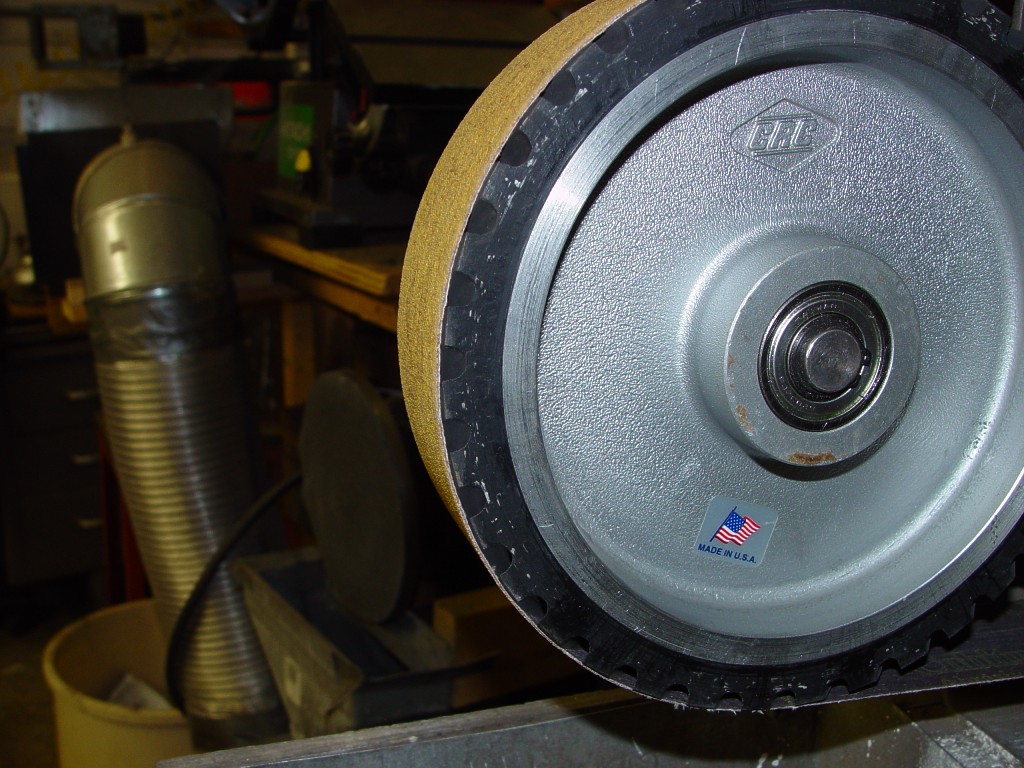
The serrated contact wheel of the belt grinder is used to rough out shapes. The aggressive "teeth" are made of hard, high durometer material, and the spaces between the teeth beneath the belt allow cooling air to flow and keep the belt, wheel surface, and hub cool.
A good belt grinder is weighty and versatile. It should allow numerous wheel arrangements, from flat platens to air-cushioned dead heads. It should be variable speed, because quality of finish relies on quality of cut. It should be completely guarded to keep dust at bay and safety first. I really know of only one grinder that fits this bill, and it's an American made Wilton. I have others, but the Wilton is my favorite.
Wilton does not make the belt grinder anymore, it's been sold to Jet. The Jet clone is almost indistinguishable from the old Wilton; they are still very well designed and simple machines.
Photo is wide angle, with narrow flash beam and rule of thirds composition.
Short answer: Size does matter...
Long answer: Most hands are close to the same size. Sure, there are differences, and occasionally a client wants a knife to match his hand precisely, usually on tactical or advanced bladed weapons, combat, or rescue knives. These are situations that require a locking fit between the fingers. I had one client, years ago, that was a boar hunter. To the unfamiliar, these guys corner the boar with dogs deep in the southeast U.S. swamps, then rush up with a knife to finish it off. Sometimes the knife is lashed to a stick, but why bother, after all, you're not there to be safe... I like the up-close, personal nature of this encounter. The boar is fighting for his life, the hunter is just out for a day of sport. Anyway, the knife had to fit his hand precisely; as you can imagine, a dropped knife in this situation is .... embarrassing. So he came into the shop, shaved off each thirty-second of an inch to get it just right to fit his hand. But he was the exception. Most of my knives fit most people's hands rather well, as there is a lot of experience from your knifemaker having to do with balance, feel, texture, and a host of manual artistic adjustments that are too deep to describe here. Let's just call it practice. I see the pleasure in their eyes as soon as the handle hits their hand.
Occasionally, a client does need a specific adjustment to fit his hand. There's an easy way to do this, which is usually only necessary on a handle that has front and rear quillons (that's the part that stops the fingers from sliding forward onto the blade). Here's how to adjust it for you:
What could be easier? To get really precise, and to see illustrations of the hand measuring process and how it applies to the knife, go to the Tactical Knives Grip Style and Hand Fitting page on this site.
Return to Topics
The metal working lathe has various purposes in the shop, and several lathe sizes may be required. The lathe is a very old tool, and lathes are still called "engine lathes" by some. This dates to a time when lathes were powered by reciprocating steam engines through a system of clutches, belts, and pulleys.
Though the machine may look large and impressive, it is a fairly simple machine capable of a great deal of cuts. Flat facing, boring, thread turning, turning cylindrical or domed forms, drilling, and even polishing are possible on the lathe.
This photo was taken of the feed rod chart where pick-off gear settings control the feed rate. The photo has a strictly defined, narrow depth of field that aligns with the chart diagonally.
Short answer: In a sheath, of course.
Long answer: If you carry a fine knife, the sheath is the most important thing! What? How can this be? We'll exclude folding knives for this conversation. A sheath's number one purpose is to protect the wearer from his own knife. Surprised? You thought its number one purpose is to carry the knife, right?
A knife, a good knife, is a sharp instrument capable of vicious damage. It will cut you if you drop it, fumble with it, let it slip, fall, trip, bump, or even touch the cutting edge. So it's important that it stays sheathed until you're ready for it, and then it must be immediately accessible. This is actually quite a task we ask of the modern knife sheath. And believe this: most modern knife makers have woefully neglected this most important part of their trade craft.
What are the characteristics we should look for in a modern knife sheath? We want the sheath strong, so that it doesn't bend. Don't buy a knife sheath that is flexible, it will flex, and the knife will not, and the knife will poke through right into your fleshy parts. That's why I use 9-10 oz. leather shoulder in most of my leather sheaths. It's just one step below the thickness of shoe sole leather, and I stiffen it as much as possible. In my military and professional tactical knives, I use Kydex®, but not just Kydex alone, I make the sheaths with aluminum welts, bonded with waterproof cement and Chicago screws. And the Kydex I use is double thick, a full .125" when most other makers are using Kydex half this thick!
Our sheath must also hold the knife. Leather has it's own frictional component, usually bearing on the bolster area of the knife. Military grade knives can utilize Kydex the same way; the Kydex is hot-formed around the knife and can actually be formed to lock the knife into the sheath with an audible "click." Some military grade sheaths use an additional snapping retaining strap of leather or ballistic nylon or other material to secure the knife. The ultimate knife retainer is a positively locking mechanism in a combat grade sheath; mine are made of stainless steel, milled and machined right into the aluminum welts, reinforced with the Chicago screws, and are waterproof. A new type I make is a hybrid of the locking and the tension fit, using a retaining system of titanium and stainless steel.
The sheath must resist the elements. With a leather sheath, there are a few things that the professional maker can do; I seal mine with waterproof lacquer, and use artificial sinew (100% polyester) to stitch the sheaths. But leather cannot be made waterproof, only water resistant, so that is its limitation. On my military and tactical sheaths, Kydex, aluminum, and nickel plated steel Chicago screws are waterproof, so that's that. My military combat tactical sheaths are suitable for periodic marine grade exposures.
The sheath must also allow accessibility. The design of the knife helps; a "hawks bill" rear finger quillon at the end of the handle allows easy removal from the sheath. The sheath may be worn in a variety of ways, even opposite side of the leading hand, cross-draw at an angle. Snapping flaps of leather sometimes are used to protect the handle, yet allow easy removal. The ultimate accessibility is the locking sheath, because it exposes the entire handle, and just sheaths the blade.
The sheath must also protect the knife. That is why the most protective sheaths are deep, that is, the knife slides deeply into the pocket, and that keeps brush and materials from bumping, snagging, and bruising your investment. The flaps (if used) must fold to the back of the wearer, so they don't catch on brush and tree limbs and open up while the wearer is moving through brush. The belt loop must secure the sheath close to your body for the same purpose. Some long knives have angled belt loops to prevent the handle from jamming up under your ribs when you sit in a vehicle or on horseback.
The sheath must protect the cutting edge. That's why you own the knife in the first place, so how is that done? In leather sheaths, the welts (the layers stitched and held between the front and back faces of the sheath) are thick and stout, mine usually have several layers tapered into the deep well of the sheath, with a visible ramp of welt to protect the sheath and blade as it is inserted and withdrawn. The military types have welts of .250" thick corrosion resistant aluminum.
The sheath must look good. For me, that means commensurate with the quality of the investment of the knife, featuring inlays of exotic skins like ray skin, snake skin, hippopotamus, gazelle, antelope, and shark, with fine tooling, airbrushed finishes, and carving, stamping, and tooling. The military models often have descriptive removable engraved lacquered brass flash plates designating operational units or slogans or personalization matching the knives. A significant thing to remember is that the sheath is seen more often than the knife, so it very important to pay attention to the aesthetics. How many makers apologize for their sheaths? Sheath making is part of this tradecraft and art, and should not be an afterthought.
Learn more than you probably ever want to know about custom and handmade knife sheaths and military combat
knife sheaths on these pages:
Knife Sheaths
Military, Combat, Professional Locking Tactical Knife Sheaths
Tactical Sheath Mounts and Accessories
Knife Anatomy, Parts, Names, Definitions
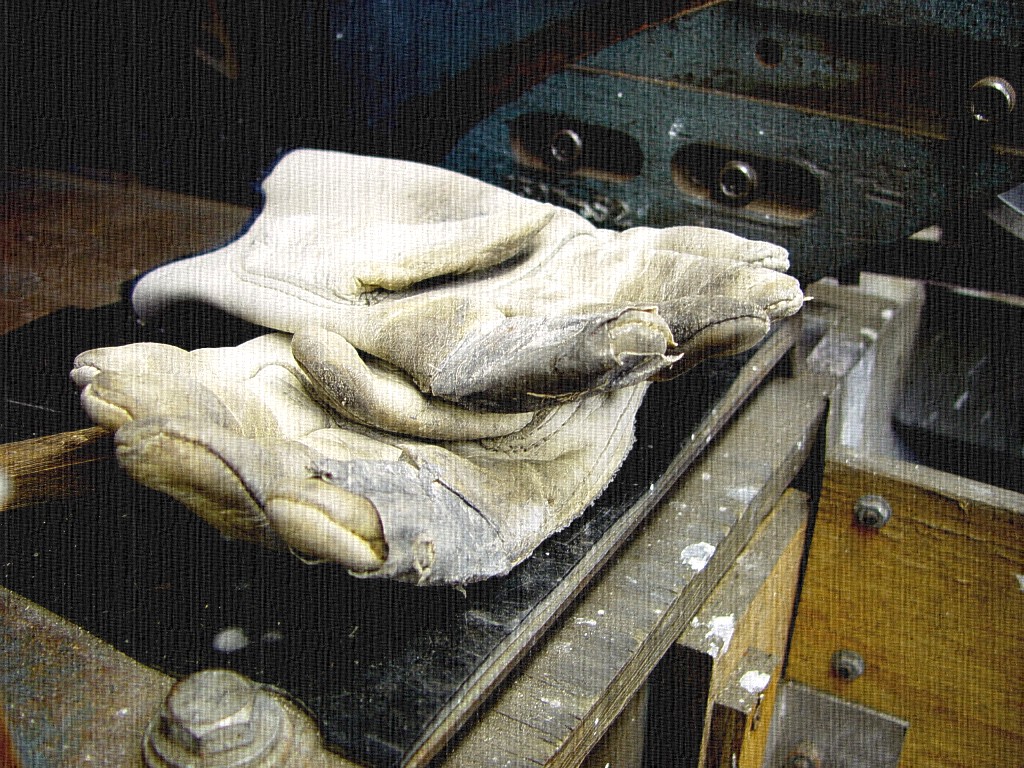
One would think that gloves would save every metal worker from the inevitable cost of flesh wounds. Unfortunately, they can not be worn for all but the roughest initial profiling of a knife blade or handle. The maker must be able to feel what is going on at the cut, and the object is almost always between the maker and the cutter. So, a sense of touch plays a huge roll in determining offhand carving, sculpting, shaping, and finishing work.
Many beginning makers quit because they don't like burned thumbs or 60 mile per hour paper cuts. These are the near daily costs of making blades for a living. When gloves are used, hot swarf does not normally burn through the leather, but through the cotton or synthetic stitches that hold the gloves together. Thus the tape.
Photo was taken with wide angle lens, density values adjusted, coarse canvas mask applied.
Short answer: Try to make one and you'll see.
Long answer: Fine custom knives by well known makers are some of the most valuable collector's pieces. The custom maker makes everything by hand (assuming you're not fooled by small production shops using a maker's name). The individual knife maker may produce 10-100 knives a year, and his life is limited. There will never be thousands of a particular model, and some makers never even make two knives alike. The value is directly attached to the maker's name, and the name is the most important thing. So what's in a name?
There are many knife makers in the world. Some say as much as 3000 in the US alone. Though that number seems large, let's really look at it. That means that .0012% of people are Knifemakers. That's one in 83,000 people. Of these, most are "garage makers", that's beginners, hobbyists, or retired tinkerers who've made a couple of knives, or made for a year or two, and nibbled around the edges of knife making. About 300 of these are serious, committed, professional makers who are at the top of the collecting desires. That translates to one in 830,000 people. If that maker has a career that lasts 20 years, and he only makes 50 knives a year (that's probably more than average), that leaves 1000 knives with his name on them. If we figure only the collectors in the US, their chances of purchasing a knife from this favorite single maker are 1 in 5,000,000 in any given year. Wow. And what collector only wants one knife? As collecting of fine custom knives grows, these odds are bound to decrease (Incidentally, what do you think the worldwide odds are?). So there are some very rough numbers, but it's not just numbers.
As technology increases, and works of "art" are cranked out by computer assisted devices, the desire for handmade objects carefully crafted with attention to detail, high beauty, and originality increases. I call it the too-tech effect. Mass machining, mass marketing, mass appeal leaves a hole in the collector's soul. This rebound effect is no better seen than in the millions of mass-produced factory knives touted as collectible because they feature a cheap cast version of a popular motorcycle brand, or a factory etched commemorative issue etching on the blade, or because they follow a design that was popular in a recent action motion picture or sci-fi film. How will these knives appreciate over the years? You'll have to live two hundred years to cash in on that, friend.
Custom handmade knives, however, may appreciate 5-30% a year, and many dealers and purveyors make a fine living from buying and selling them. As mentioned in the topic above, I sold one knife for $750.00 and the next year a gentleman told me he purchased it from a dealer for $4000.00. This also illustrates the point that the cheapest place you can buy a fine custom knife is from the maker. After a dealer gets his hands on them the price goes up, up, up.
The truth is if it were easy to make fine handmade and custom knives, everybody would be making them. You've probably noticed that there aren't many really fine knives out there. As restrictions increase (and they will), and fewer artisans are willing to invest the tremendous amount of time to hand-make fine knives, fine knife value will continue to rise.
Return to Topics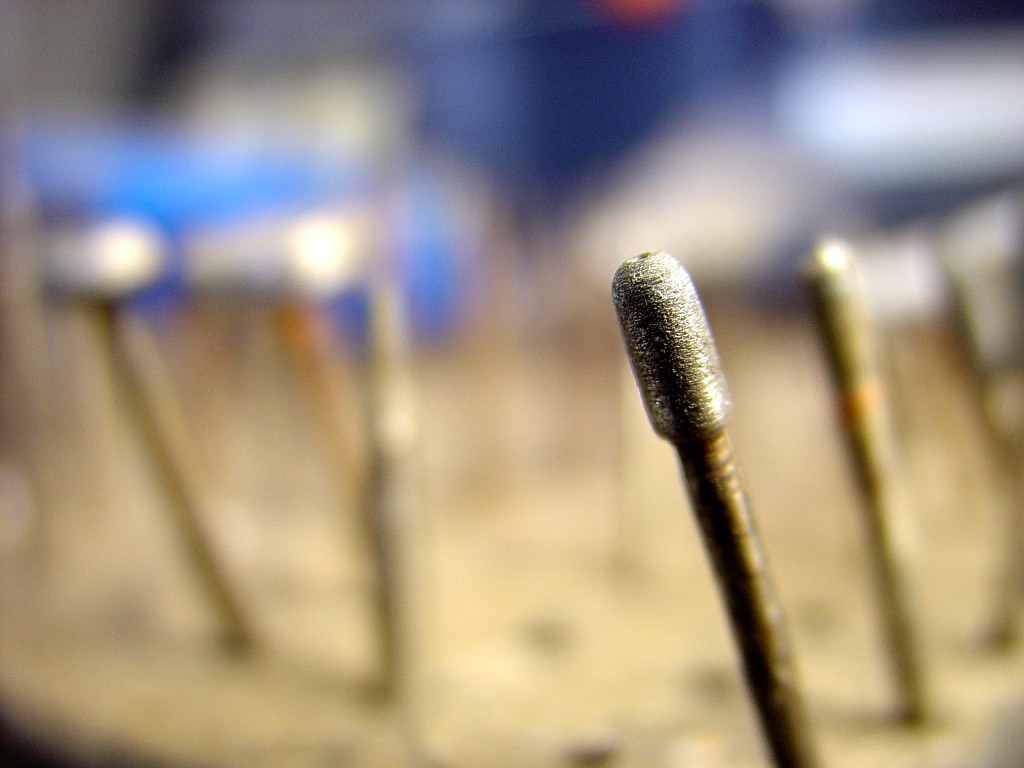
A sintered diamond abrasive point on a .09375" rod. These points have diamond particles baked into a powdered metal matrix. They are very fine, usually small, and are used to cut, carve and drill gemstone and other very hard material. Diamond is the hardest material, many times harder than steel or other minerals or materials.
General Electric first synthesized the diamond in 1955, which revolutionized industrial processes. A diamond is not an everlasting stone, is not the most traditional engagement stone for the ages, and is not the most valuable or the most rare of stones. Vast areas of huge diamond deposits are still being discovered. If you've bought any of the hype about diamonds, De Beers diamond cartel thanks you.
Photo was taken in ambient tungsten lighting at 1/4" distance.
Short answer: I make them.
Long answer: Every knifemaker is different. Some make only folders, some make only tactical knives. Some forge, some hand grind. Some heat treat, some don't. There are many beautiful, functional handmade custom knives out there, and each one displays the maker's own individual artistic style (that is if the maker isn't just copying someone else's work). The difference is in the whole package, that is, what the maker as an individual brings to the table.
Often, an enthusiastic individual will come to a Knifemaker's table at a custom knife show, or art and craft show, or website on the Internet, gawk at the beautiful finishes and glistening steel. He sees a clean, apparently simple knife offered for $600 and gasps. After the usual questions, some silent mental calculations about time and value (see "How long does it take?" above), and he'll proudly boast, "I can make that!" The knifemaker might have some pet phrase all set for the reply, like "Crap! I'm found out!" or "You flattering me?" or "Bring me one, I want to see." Some sadly misinformed might even look at a piece of carved and polished damascus and gemstone with intricate titanium filework and state, "I can do that on a CNC machine." The knifemaker usually shows great restraint at these comments, having burned or cut every finger on both hands as proof of his practice.
The most enthusiastic of these spectators will go on to be Garage Makers. They are usually men, usually retired or hobbyist types, intent on making a chunk of change in their spare time, envisioning perfect knives cranked out in a manner of hours in their spare time. After all, what has the professional knifemaker got that the garage maker doesn't? (after all, he's got an old drill press and a hand plane...) So they try, sometimes for years, to make a dent in the knife market and earn some beer money on the side and supplement their retirement.... but Garage Makers are a flash in the pan. There are hundreds of names on knives that have faded into obscurity, and after ten years, no one knows who the maker is or was or what happened to him (I get questions weekly about makers who don't exist anymore). And every guy who's acquired one of his knives swears it's the best ever. I'm not slamming Garage Makers. I was one, and that's how most of us start out... innocently enough-
The truth is, there are only a few dozen well-known full-time knifemakers who's work is highly valued. These are usually professionals, that is, their full-time living is made from knives, and knife making is their Profession. They are the ones that can demand high prices, their names are the ones recognized, their knives fetch high value initially and when resold. You don't break in to this profession or market. You build it: year after year, knife after knife, improving your skills and your client's investment with every blade.
I once had a young maker come to my shop and bemoan his recent sales. He thought all he had to do was make a knife like he'd seen so often in magazines and at shows and he could make a fine living at it. After all, how hard could it be? I call it the "four inch drop point with a stag handle" syndrome. He had floundering sales and blamed the industry (shows and organizations particularly). I told him I was doing all right. He said, "Sure, you've got those gemstone handles and no one else does them." I told him that the ancient Persians have made gem handles centuries ago, and that was nothing new. He said, "Well then it's that little filework that you do." I asked him if he'd seen old so-and-so's filework back East; that he polishes the inside of the file cuts then plates them with titanium nitride and gold. He said, "Well it's the stands then. I need a gimmick." I fought my instincts to grab him by the back of his belt and toss him out of my shop. I thought I would give him, for once in his life, some real advice from a professional.
I said, "Look, sooner or later every knifemaker has to stop looking at other people's work and develop his own style. I encourage you to do that now, to not look at the magazines, or annuals, or factory trends, or other maker's web sites, and to not cruise knife shows memorizing what is on someone else's table in hopes of copying them and stealing their business. Make your own knife."
He looked at me strangely and left, never returning to my shop. I understand that he makes a fine four inch drop point now, with a stag handle... and still complains.
I do my best to make excellent knives. I use my own hands to tune them, my touch to make them balanced and fine, my eye to make them beautiful and unique. No one can duplicate my way (or anyone else's way) of thinking. I bring my own style, tempered with decades of practice, and a lifetime of skill, steeped in the study of history. The truth is, what we create is all that we have, and all that we'll leave behind. I owe this all to God, who has blessed me with a life at this time, in a free country, with a loving and supportive family. He deserves the credit; I'm just a man.
More about Knives and Style here, and a specific topic about Copying Another's Style.
Return to TopicsIf you are in the business of making and selling knives, your knives are held to the highest professional standards. If you make and sell knives as a hobby or sideline, you are not a professional.

Metal working tools are not just for metals. Here I'm milling a block of microcrystalline wax, preparing a form for bronze casting. The lost wax process is very old, as old as the bronze age itself.
The bronze age signaled the start of man's fascination with metals, and started in 3300 B.C. when man learned how to melt metals in furnaces. He learned how elements like copper and tin created a much tougher, more durable alloy, and metals became part of our history and our life.
Interestingly, the longest lived and most numerous of artifacts from that period are weapons and ornaments, and modern knife makers today still create many weapons and ornaments!
The photo was treated with a psychedelic filter.
Short answer: There was a mystical shaman in the badlands who brought the skill to me on the wings of an owl...
Long answer: I'm entirely self-taught. Early in my interest of knife making, I started purchasing books, ultimately every book I could find on making knives, machine shop practices, and metal testing and evaluation. I machined, I welded, I ground, I heat treated, I learned. I bought every book that I could that even remotely related to weapons, embellishment, jewelry, photography, sales, and self-improvement. I made knives and more knives, and I asked for others who used them to test them, abuse them, and evaluate them. I studied historical sources, records, illustrations and text. I read, I worked, I read and worked some more. I attended shows, compared other knives, studied, practiced and learned some more. I'm still learning, in every batch, often with every knife. I'm very lucky that I am one of those people who can read and learn from the written word.
People ask this question expecting to hear that I apprenticed under some master, or that I attended some certified knife making accredited course. When they read this section, they sometimes complain that it's unlikely or impossible that I trained myself, learned on my own. I've read commentary that "one person could not do that," and that the knives would not be as well accepted as they are if this were the case.
Please allow me to be distinctly clear on the matter: I did not teach myself (alone) how to grind: I read books that described grinding by accomplished masters. I did not teach myself (alone) how to heat treat; I read various books, guides, and scientific metallurgy publications on the matter. I did not teach myself (alone) lapidary; I studied some of the most well-written sources on the trade. I did not teach myself (alone) leather craft; I read numerous books on the craft. All of the reading I've done alone; all of the practice afterward I've done alone; all of my skills are my own. Or rather, it's the Lord's skill, who has been kind enough to allow me to use it for the short stay on this planet in this human form.
You see, I read, I apply what I've read, and I read and practice more. The people who taught me are all accomplished masters of their trade, and have thoughtfully provided texts, both basic and elaborate on what they knew. Who are they? Oppi Unitract, Bob Loveless, Al Stohlman, Richard F. Burton, June Zeitner, Dr. Tobias Capwell, John M. Yumoto, Harold L. Peterson, Frank Long, and dozens and dozens of others. Perhaps you can imagine my library, hundreds of books by current and long past masters, all waiting to offer the answers through the simple act of study. In that way, you may even surmise that I trained under these folks, and they kindly offer their knowledge to anyone who will simply read and try. There are many more volumes that can instruct in ways seldom considered in modern knifemaking, like business accounting and operation, internet business development, self-improvement, inspiration, and design. These masters, too have taught me well. In this way, I, too offer what I've learned, most of it residing right here on this very website. All you have to do to learn is read and comprehend. So I suppose I must thank my English teachers, and above all, my parents who encouraged me to read and learn.
By the way, I'm still learning, reading, researching, studying, and growing. I hope to do this until the day I die.
There is no accredited or official place you can go to learn knife making, though there have been interests trying to start professional courses. I was once approached once by one of the directors of the Knifemakers Guild, and asked to be the southwestern representative and instructor for professional knife making, and the course was to be officially certified and administered by a University in Tennessee. It sounded like a great idea. They would have a handful of instructors who would teach from their own studios, and be paid for instructing small groups.
Then, like a realist, I brought up insurance and liability. Who would cover the instructor, students, and studio with liability insurance? After all, knife makers work with high speed rotating machinery and hardened, pointed, sharp blades, mostly offhand. They work with heat, chemicals, and in dusty atmospheres. The idea came to a screeching halt. It seems no one wants to be liable in these litigious times. This is the main reason I don't take any outside help or instruct anyone in my shop even today (except close family members). Documents like waivers are essentially useless in this trade. Guys who take others under their wing are asking for huge, career-ending lawsuits. I'll go into this in more detail in my book.
How does a new maker then learn? Each maker should make his own way, purchase and absorb his own books, make his own mistakes, and spill his own blood for the quality and passion he believes in. It's something few clients consider when handling their shiny new knife.
Return to Topics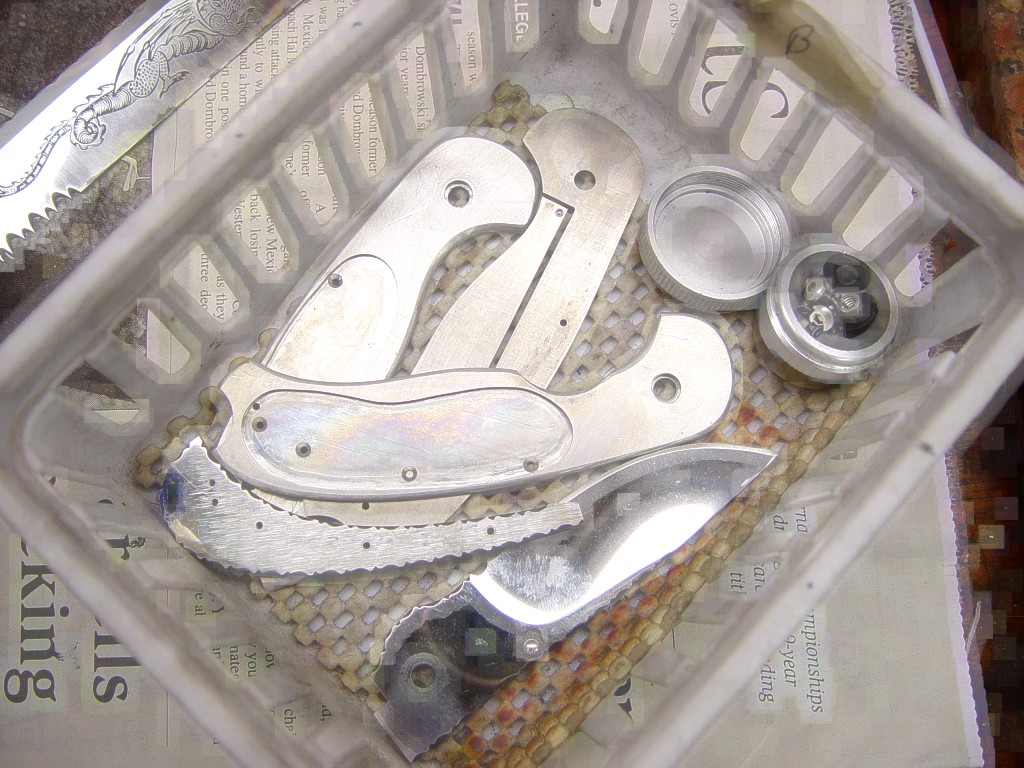
Folding knives are lots of little pieces, mechanically bound together into one, sometimes elaborate project. This one is all stainless steel and titanium, a refractory metal that can be passively anodized for color.
During the construction of a folder, I may take the knife apart 50 times to adjust, tune, work on specific areas and match one fit with another. With all of the potential places a folder can be embellished and accented with inlays, precious gems, and engraving, it's no wonder they can be a collector's most sought after knives.
This photo was taken under florescent lighting, and a maximum noise filter was applied to create metallic flare.
Short answer: Yep, every single one.
Long answer: I get this question a lot. I don't know why; it could be that the person asking is just making conversation, because if you ask anyone their favorite anything, get ready for a long-winded diatribe about what they find exciting about their favorite thing. It could be that the person asking has read a book on how to create new friends, and under the section, "How to start cold conversations," one of the tips is to ask your intended conversational mark about their favorites. Okay, forgive me; that sounds a little cynical.
Perhaps they figure if they knew my favorite knife, it would be a safe bet that it is a good knife, suitable for their interest. Or maybe, just maybe, they genuinely want to know. The truth is, I've never had a favorite. No favorite knife, filework, or handle material. No favorite sheath, embellishment, or stand. I try my best to accept and complete every single project as if it was my favorite; that way, I know that the owner will see the care and detail and consideration that I invest into their piece, and consider it their favorite. Then, when they order a second knife or art piece, they will have a hard time deciding which is their favorite!
Under this topic I have to admit that I miss them all, because once they leave the studio, I'll never see them again. Thankfully, for a lot of them, I've kept photographs. I make each knife with the intent that it will be hard for me to part with, and that way I know the client will love it, too.
Return to Topics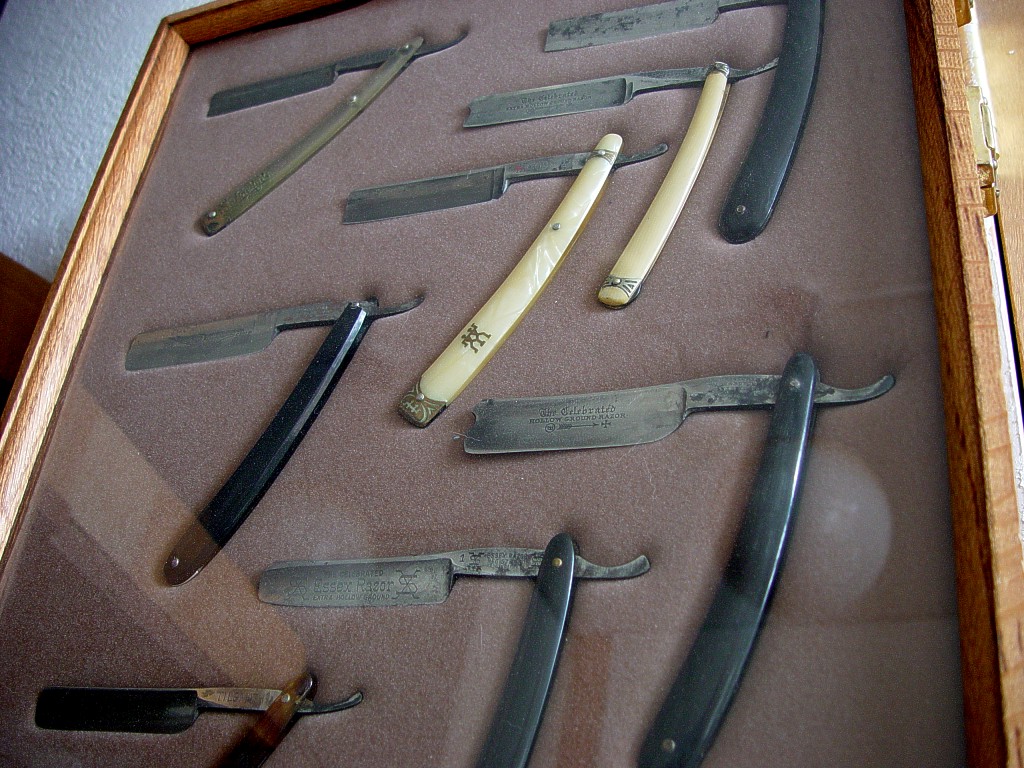
I have a collection of straight razors that came from fathers, grandfathers, and friends. They are all deeply hollow ground and extremely sharp after all these decades. I keep them in an antique Camillus knife sales and display case my brother-in-law found for me at an auction.
Though the steel may be of simple quality, the pivots light and weak, and the handle materials poor, fragile and obsolete, they serve to remind me that when someone says "sharp," they mean razor sharp, and these are the hollow ground blades that they hold other edges to for ultimate comparison.
This photo was not manipulated.
Short answer: Give me a hammer and some sandpaper, I'll "ugly it up" for you.
Long answer: It still amazes me after all these years how often this comes up. There are a host of reasons why someone would think this:
Okay, guys, beautiful does not mean delicate. And good looking knives can perform well. When you got that new truck, did you just park it in the garage, or did you want to drive it around... everywhere? I'm not going to play psychologist and analyze why you might think you're not good enough for a fine knife. If you actually believe that, there are plenty of factory knives and other custom knife makers who can make you that plain, ugly tool. You're on the wrong web site. Go away now.
The truth lies in history. The finest weapons and tools, the most sought after, the most trustworthy and dependable, the most worthwhile and valuable have always been beautiful, even mythical in value and impact, style, color, and embellishment. Not only does beauty add to the long term value of your investment, it brands your knife as unique, and reflects on you as someone who appreciates fine workmanship. Maybe you can't afford to buy an multi-million dollar estate that is a work of art (or maybe you can and need some fine knives to outfit your kitchen), but you can bring art to your hands, to use, to cherish, to pass along to your grandchildren in the form of a fine custom knife. You can hang it on the wall, shelve it in a display case, take it hunting, carry it on a hike, wear it as a proud, trusted friend, keep it as a ready ally in combat. And if you scratch the blade or ding the sheath, it will speak of maturity and dependable use, like a story behind every wrinkle on an old face. It will still be beautiful.
An old ugly plain factory knife will always be junk, and it won't be worth one penny more than you paid for it in your lifetime, your son's lifetime, or your grandson's.
Return to Topics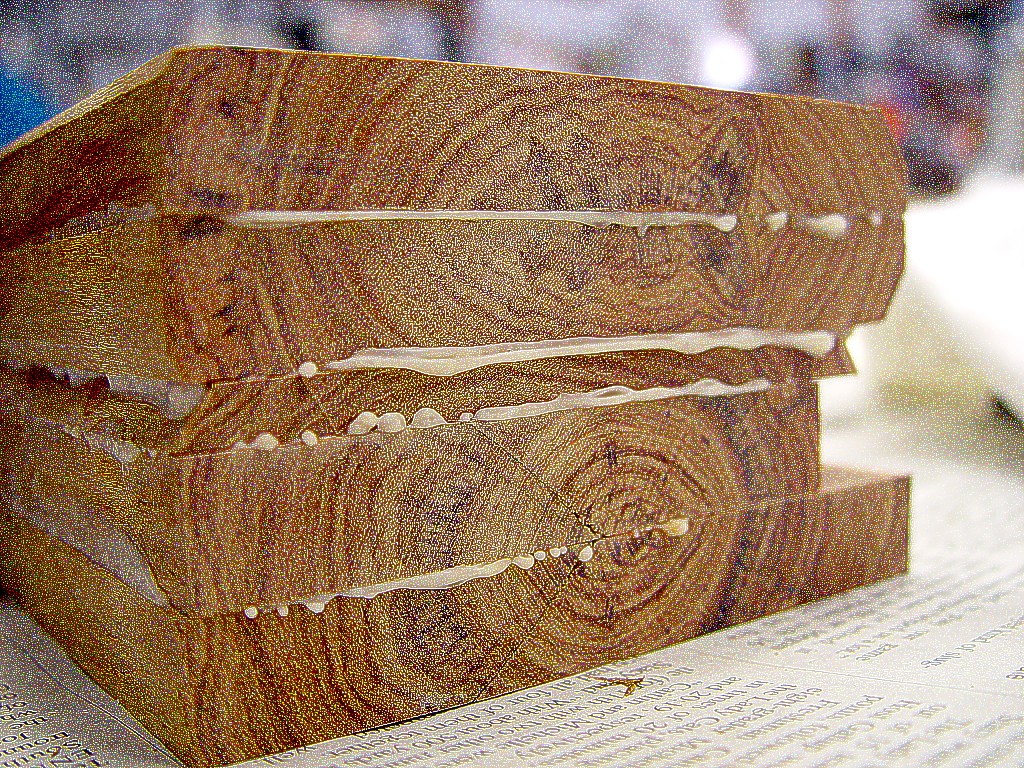
One thing that we take for granted as modern artists is adhesives. The quality and range of adhesives today surpass anything that has ever existed before in history. It's an exciting time to know that we can permanently bond dissimilar materials, and bond materials that are similar in absolute bonds that are sometimes stronger than the original material.
As craftsmen, we should be well versed in modern adhesives and their applications. We should know the difference between aliphatic resin glues and polyurethanes, between cyanoacrilate esters and polyepoxide thermosets.
This photo is of Tulipwood pieces glued with aliphatic resins for a custom knife stand, and the photo is manipulated by repeated oversharpening filters.
Short answer: You would prefer to use a sharp stick?
Long answer: I'm proud to serve my country and those professionals who protect it from terrorists, murderers, and our enemies. To do this sometimes requires the use of bladed or edged weapons. Yes, I do make weapons, not just pretty knives for show, and they are Primary Edged Weapons, not merely accessories. I listen to my clients to fulfill their needs using their field experience combined with my shop experience. Some of these men and women actually come to the shop to design their dream weapons that they use and carry in the field, and they know very well the requirements their weapon will have to meet. I know just what is possible in making an edged weapon, and the appropriate materials, geometry, shape and sizes, fixtures, and sheaths or accessories for the job. Some clients use email and mail patterns with specifics, and we work the details of their weapon out online. We put together their field experience and my shop experience, and they get the knives they want. Then I offer those same designs, styles, and features to the public. It is a partnership between warrior and weapons maker, and I take it very seriously. My combat and tactical primary edged weapons are the real thing.
I was at a knife show, and showing several clients my photo album of combat and tactical
knives and swords. A young man seemed offended and said, "They
don't really use those knives and swords in combat. If they want
to kill someone, they just shoot them."
An old, grizzled veteran of WWII overheard and turned to him. "Son," he said, "do you know
what war is?"
The kid had a blank stare that said he didn't.
"Sometimes," the old man said, "you want to sneak up behind someone and cut their head off."
The kid turned pasty white and disappeared into the crowd.
In another encounter:
One military client thanked me saying, "Your knives are doing the job over there."
I told him that I knew that, and that I had just shipped a couple to an APO military address.
He said, "No, Jay, they're doing THE job."
My job as knifemaker is more serious than I had ever imagined.
At my Military, Combat, Rescue, and Professional Knife Portal, you'll see links to the many pages of knives I make for this serious duty.
Return to Topics
Most guys end up with a wall of patches, honors, and recognition. Call it vanity if you must, but some of these are hard-earned. Some are military recognitions, some are from family. Some are from knife organizations, some are dropped off by patrons to say thanks.
It helps to keep me in touch with others, knowing for instance that the 306th Rescue Squadron has a tougher job than I ever will, and that my Dad helped put together the USS Patrick Henry nuclear submarine.
The photo was manipulated with an impressionist filter followed by wet paint filter.
Short answer: Wait while I pull it out, position it in my hand, flip it open, and make sure it clicks...
Long answer: Serious combat knives are strong. That is why you don't see any knives called "Tactical Folders" on this site. Folding knives rely on a less than .250" piece of steel to hold them together. It's called the pivot, and it's about a third the diameter of your little fingernail. That pivot is supposed to be strong and unyielding when you need it most, when you need it to save your life. That little piece of steel is supposed to transfer great energy from the handle to the blade and cutting edge. That little piece of steel is supposed to prevent twisting, resist torque, and remain rigid when thrusting, jabbing, slashing, prying, and stabbing its way through seven layers of clothing, ballistic nylon, or even body armor. And it's supposed to stay together, stay locked, and not fold up and sever the fingers of your own hand during these wild and desperate moments.
Another thing that a combat and tactical knife is supposed to do is possess enough weight, momentum, and strength at the blade spine to support the edge and point for those same aggressive and violent movements. Usually, this means that the blade must be heavier, larger, thicker, and meatier than the handle. But on so-called "Tactical Folding Knives," the handle is and must always be larger than the blade in order for the blade to fold into it. Simple mechanics. So a folding knife is out of balance... always.
Look at the combat knives on this web site. They are thickest and heaviest at the front bolster, the area where the blade and handle become one. That is the weakest point of a folding knife, and that is where the pivot is. Also, in the folding knife,the spring and locking mechanism are there, and the whole affair is usually ground very thin to try to compensate for an overly large, weighty, and disproportionate handle, which further weakens the blade-handle junction. Close to the ricasso is often a thumb stud, mounted in a hole that is drilled through the blade, further weakening it. Often, the handle area is milled to try to balance the weight, further weakening the handle.
Another often seen knife is the "Tactical Automatic" or "Tactical Gravity Knife" or "Tactical Switchblade." When a knife has a folding, sliding, or pivoting mechanism that requires little effort to operate, that means that there is little mechanical resistance in the pivot or slide area. That means loose tolerances, so the small spring or gravity that is used to operate these knives will work. The knife action must be sloppy, or resistance would prevent motion. So that means that the fit during lockup is also sloppy. It simply cannot be tight and true and solid and at the same time have unrestricted movement. Folding knives are NOT durable knives; they are NOT strong knives.
Scenario: critical and immediate use of your primary edged weapon is required. Do you:
Well?
I'm not saying that folding knives do not have applications in the combat arena, in rescues, in tactical operations, or in professional use. I just want to make it clear that NONE of my professional military, police, tactical teams, SWAT, and emergency response team clients trust a folding knife for their primary edged weapon. They carry folders, sure. For light cutting, personal use, off-duty chores, cleaning their fingernails, and to flip and click and play with while they're waiting for those extremely critical moments. And when those moments come, they've got a real edged weapon, a substantial blade and point, strong and sharp and true, in it's sheath, ready for life and death response.
Folding knives are fine. Utility folders, duty folders, service folders, working folders, and collector's folders... okay. But tactical folders or combat folding knives? NO, that's just ridiculous.
I urge you to talk to a real solider, an infantryman, a ranger, a Pararescueman. Talk to a SWAT team member, an emergency response team member, a SEAL team member. Talk to any professional who might use a knife in actual combat, rescue, or response, and ask them what kind of knife they might trust their life to. It's not a little black painted blade with a camo colored hollow handle.
For a much more detailed discussion of the folding knife issue, please take a look at the subject at these bookmarks on my Counterterrorism Knives page and on my Military Combat Tactical Knives page.
Return to Topics
Some physicist once claimed that "Nature abhors a vacuum." Meet then, nature's abhorrence.
The vacuum cleaner is the most awful contraption ever made, and yet the most necessary, particularly in the knife shop and studio. Since the creation of knives is the creation of dust, chip, and swarf, the assemblage of vacuums must be nearly daily employed to keep the debris manageable.
They're loud, obnoxious, clumsy and always in the way. Their hoses are stiff, unforgiving and intent on tripping you up so that you'll fall into a pointed blade clamped in a vise. Beware these cylindrical beasties; they will kill you if they can!
The photo was manipulated with a pin-punch filter, cleverly revealing the true gluttony of the vacuum.
Short answer: There is only one of me, and the knife should be care free.
Long answer: The biggest complaint is that their knife takes too long to make. I've even seen this posted on knife forums, that, "Jay's a great maker, but he has a "loooong" waiting list."
Well, yes, and that's how it should be. Sure, I worry about getting the knives out, about getting them to their clients (especially when they're military and need the knives for a deployment). But I am only one person and can only do so much. I keep telling myself that when my hands ache from grinding 15 rock handles for 12 hours a day or I'm nursing a torn rotator cuff. And that's my complaint: that I can't work more, because if I could, I probably would!
And what about this carefree knife?
I've been very lucky to not have many complaints about the knives themselves. My number one complaint (that is, from only a handful of clients so far, in thirty years of knife making and thousands of knives and clients) is that the client has stored his knife in the sheath, or forgotten that he's left it in the sheath (sometimes for months or years) and that there are little spots of rust starting to form. Thankfully, this is a very rare occurrence, and even the high carbon steel blades have fared very well in use, collections, and even combat.
I can't say it enough: Don't store knives in sheaths! Incidentally, what do you think would happen if you stored a blued firearm in its leather holster for years, and never looked at it? Sure, you want to keep it with the sheath, and carry it in the sheath, but long term storage in the knife sheath is probably the most destructive thing you can do to your fine custom knife. There are a couple things that can cause this problem.
Please remember that all steels can corrode, even stainless tool steels. If a blade is O1 and blued, it can corrode as easily as a firearm if not kept dry. The high carbon martensitic stainless tool steels are more resistant to corrosion than non-stainless, but can also corrode.
I have posted this on my care sheet that I hand out with every knife (and has been available on this website since the beginning (1996) in standard and military form). It makes no difference whether the sheath is leather or kydex and aluminum, whether the air is as humid as Florida or as dry as Nevada. The knife blade needs to breathe and stay dry. When humidity and temperature changes in the normal course of the day or seasons, condensation can form on any steel. If the steel is allowed access to free air, it can stay relatively dry, and corrosion can not gain a foothold. But if the knife is stored in the sheath, and an ever so slight bit of moisture is allowed to stay against the blade, the blade will start to rust. On a mirror polished blade, this can be ruinous, and if the knife has been custom etched, the only recourse is to grind off all the etching and corrosion, regrind and refinish the blade (including polish) and re-etch, which is very expensive and time consuming and may not even be possible. Even if the knife is coated heavily with wax, long-term storage in the sheath will encourage corrosion. Don't do it!
I believe a knife should be handled. Held once in a while, waxed and buffed, fondled, looked over, admired and cherished. To put it away in a drawer or closet is almost an insult. Look, if you want to store the knife long term without ever looking at it, there are a couple options:
It's simple, really: store your knife where it can breathe, not in the sheath, not where there are fluctuations of temperature or humidity, out of bright sunlight and high heat sources, and pick it up and buff it off with a soft cloth, wax it now and then.
More about refinishing knives (or not) on my Business of Knifemaking page at this bookmark.
Return to Topics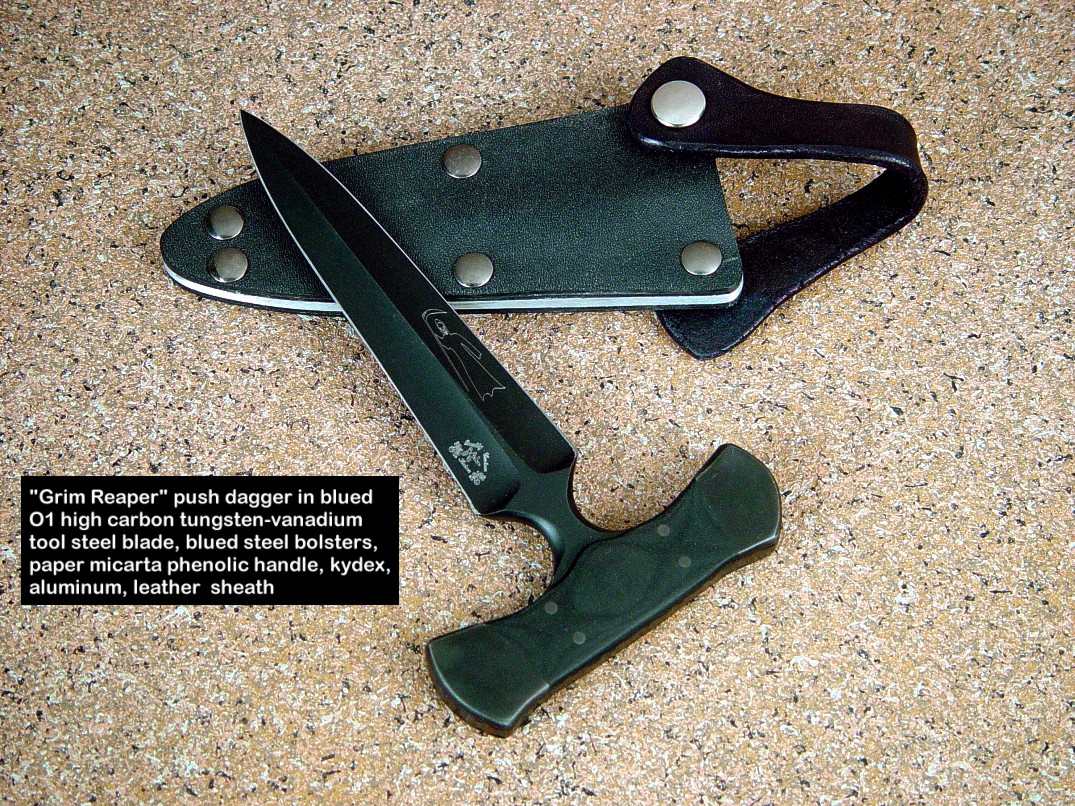 That Grim Reaper knife made it through two year long rotations to Iraq. It is well made and the heat, sandstorms, and
all that chaos that Iraq could throw at it did not phase it one bit. Thank you.
That Grim Reaper knife made it through two year long rotations to Iraq. It is well made and the heat, sandstorms, and
all that chaos that Iraq could throw at it did not phase it one bit. Thank you.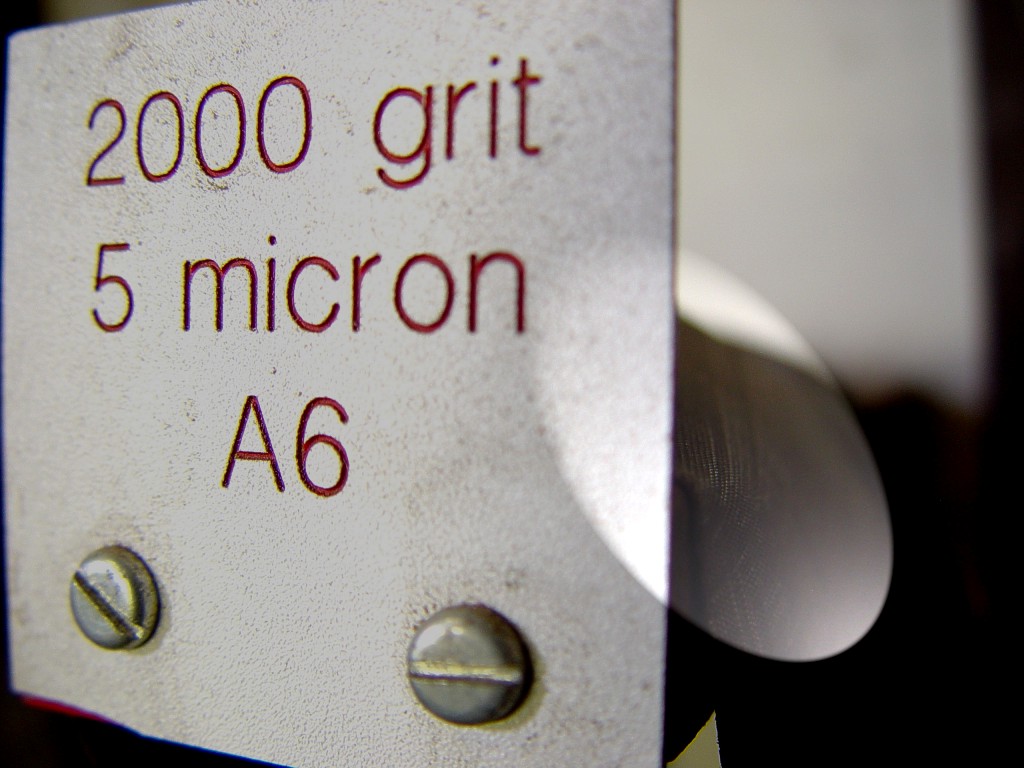
It's impossible to visually keep track of abrasives, so custom markings on racks are necessary. Also notice that there are at least three common ways to measure abrasive cutting sizes.
2000 grit is the smallest size I take a blade to before I mirror polish it. How fine is this? Most particles of cigarette smoke are larger than this. A red blood cell is eight times larger than one 2000 grit abrasive particle. Impressed? When finishing gemstone, I usually polish at 50,000 grit diamond abrasive, which consists of particles that are one tenth the size of most bacteria!
The light flare in the photo illuminates the structured abrasive of the grinding belt.
The photo was manipulated with a skew application, contrast control, and light wash.
Short answer: No.
Long answer: I have enough work with my own knives. When someone asks this question, It usually means that the place or person who they purchased the knife from in the first place did not make a suitable accouterment, stand, sheath, or embellishment. The knife owner should ask them why. I would question why the maker didn't finish the ensemble in a manner commensurate with the quality of the knife. Perhaps the maker or supplier doesn't do sheaths, engraving, embellishment or stands. You might wonder just how committed the maker is to his trade craft.
Sometimes, a collector or dealer is looking to gussy up his investment with some fine workmanship to increase its value. I don't contribute to such cases. I see many knives that are fractured in their style and form because too many hands have worked on them, and have drawn away from an original artistic idea.
At about 100,000 hits a day on this website, I get asked to do a lot of things. So much email comes in that I've had to post a clear, definitive list of what I do and don't do.
Return to Topics
I work with a lot of exotic woods. Sometimes, it's difficult to tell which is what species, and decide on the best way to apply it to a knife handle. I save small scraps for inlays, or for holders, stand pieces or mounts. Sometimes I'll construct cases for knives that may take a hundred hours or more.
Wood has a warm, organic feel to it, but can be misleading. Many of the rosewoods are downright toxic. I know of more than one maker who has nearly disabled himself by breathing the dust of these species. Not to worry on the knife handle, though, only the very fine dust is toxic. Once the woods are mounted, sanded, sealed (if necessary) and polished, they are quite benign.
The photo was manipulated with a puzzle filter.
Short answer: That depends. Are you a nice person?
Long Answer: It usually depends on my work load. Most of the time, I have over 100 knives in process. A knife may be waiting to be heat treated, or it may be in the stack of order sheets in my office. It may be waiting at the engraving block, or ready for a sheath. Because demand is high, my order list is long. If you were to visit the shop and studio, you might be overwhelmed at the amount of knives that are in the works. I know I am! I can only keep working, day by day, to complete orders, my oldest ones first.
If your knife requires a lot of engraving, detail work, etching, carving, filework and other laborious and meticulous hand work, it's going to take longer. To illustrate this, at the time of this writing, I have almost a dozen knives that need their bolsters engraved. Some of these are 304 stainless steel, which is 25% chromium and 8% nickel, and very tough to cut. Since this is done by my hands alone, I can only engrave for about 6 hours, then I need to do something else so I don't cramp up and make a mistake. So I have to spread out particular tasks over time. Please remember, too, that I do everything in the shop, that's everything, including sweeping the floor, repairing machinery, and playing webmaster, accountant, and photographer. I've photographed every single knife on this website and the the multi-disc CD FlipAlbum archive. I'm also working on a book on modern custom handmade knives. That's a lot of work!
Once in a while, a knife you might be interested in is half finished, perhaps without a handle, and hanging on my rack, waiting for someone like you. In that case your waiting period might be whittled down. You can see some of the knives and orders I'm working on and their status on my "Where's my knife, Jay?" page.
Return to Topics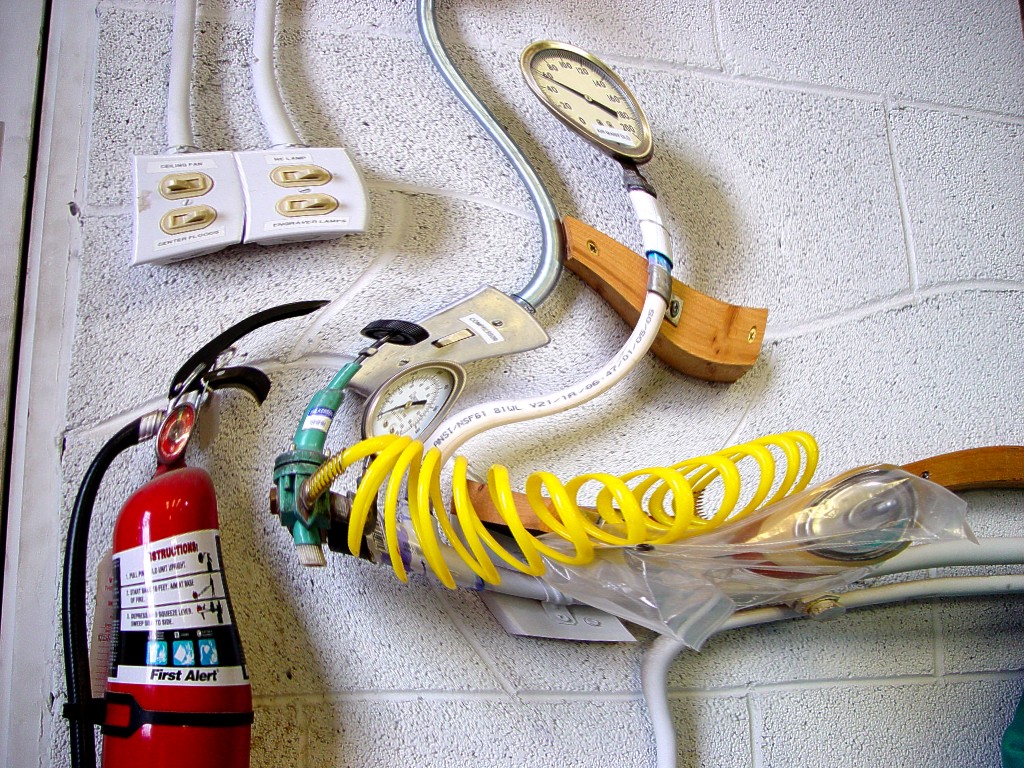
When I bought my current shop in 2002, I spend a good chunk of my savings and eight months of hard work upgrading the shop utilities. I put in central compressed air manifold, installed lighting, ran water feeds to the various machines. I created machine mounts, dedicated benches, storage and holding areas. I put in some basic fire protection and an extensive intrusion alarm system.
Some people say that the inside of the artist head is reflected in his studio. It may look like a mess to the outsider, but it's all perfectly clear to me!
No, this is not how it really looks! The photo was manipulated with a swirling filter; it's all actually very straight and square.
Short answer: What do you see yourself owning or carrying?
Long answer: It's a matter of appeal. Your choice of knife design must fit you, that's why there are over 500 patterns available on this site, and I also create new ones on request. Is it a knife you'll use every day, or will it remain in your collection? Will you use it for utility purposes, or for field use (such as hunting)? Do you like to use a point, or are you a "belly" man? A drop point is easier to put in the sheath, a trailing point is harder to sheath, but has a smaller point. A short blade suits some, a longer blade allows heavier work. A hidden tang has a more sculpted, rounder handle, a full tang is stronger. What kind of handle would you like? How about the sheath, stand, or case? Do you see something on this web site that appeals to you?
The neat thing here is that you can take your time, there are literally thousands of photographs of knives on this site alone, all here, for free. I encourage you to take this opportunity to select just the knife you want, and if you don't want to spend a lot of time worrying about details, just trust your knifemaker to make a beautiful, balanced, useful knife for you. Remember that a lot of "custom" makers make only a limited selection of knives that they like to call custom, and aren't likely to work the details out with you to fit your hand and your investment. I will.
Sometimes, it's easy to get overwhelmed by the amount, styles, types, sizes, and differences in the knives just on this site, not to mention the internet and in publications. As you are looking, one or several knives will stand out for you, catch your eye, and cause you to linger. Pay attention to that feeling. There is something about them that appeal personally to you. It may be a blade shape, a handle color, a sheath pattern. Examine these interests and identify specific features you like. That's the best way to start your quest.
If you want to get hands on with every detail of your knife, familiarize yourself with Knife Anatomy first, then look over the Patterns page. Once you're ready to detail your interest, email me.
Return to Topics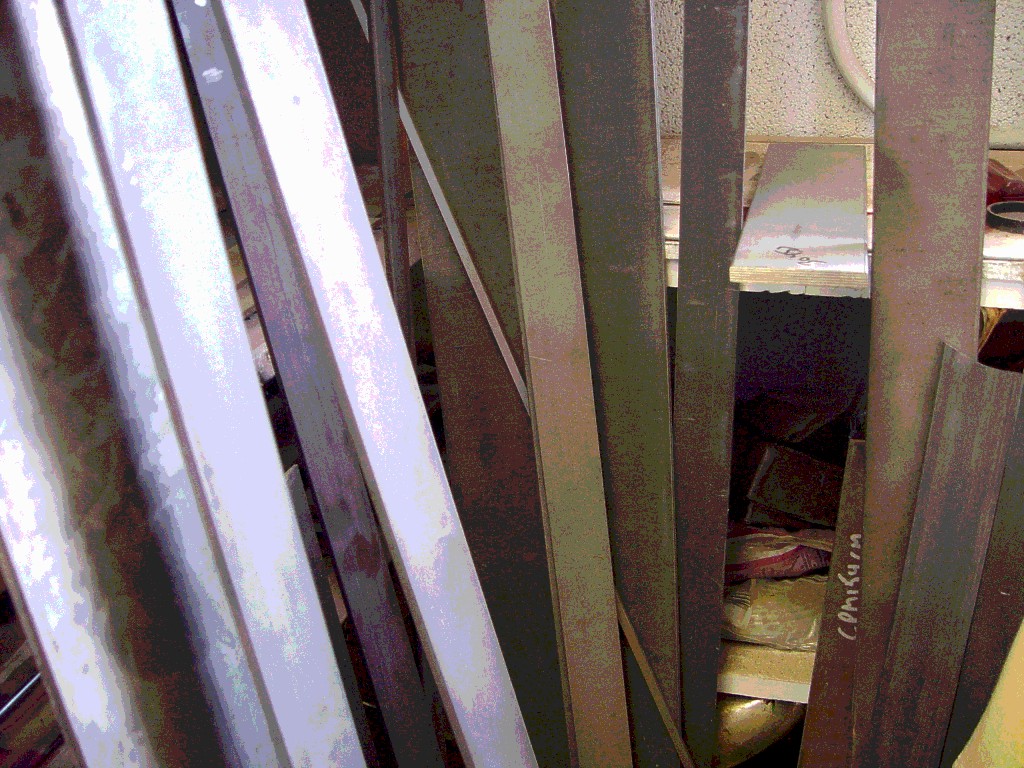
Blade steels are shipped to me in bar form, usually three to six foot lengths. It takes a bewildering amount of widths, thicknesses, and types to keep the orders moving. Knife clients today are well educated in the new exotic stainless and high alloy tool steels, and keep me on my toes. Also, there are new steels coming on the market continually.
While most steel is sold by the pound, exotic tool steels are sold by the piece. Some of these pieces may range from $100 to $1000 each. These are not your Daddy's steels!
Photo was manipulated with a light posterizing filter.
Short answer: Maybe.
Long answer: I am only making a limited amount of knives per year, so I can not accept every commission or project. Interest in my knives has been growing, and while I am a full time maker, it would be impossible for me to take on every knife project that is submitted. Please take a look at my page on Custom Knives. The best way to know for sure is to Email me with your project idea. More detailed information in the topic just below.
Return to Topics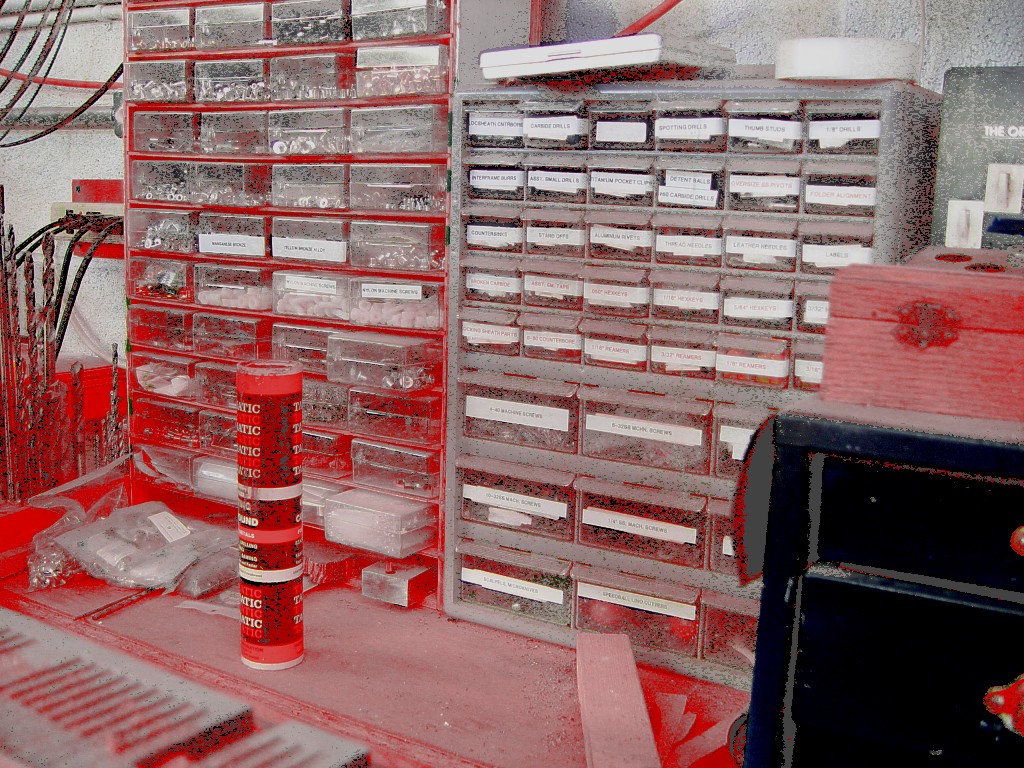
Small parts are numerous in the tradecraft and art of knife making. Hundreds of different types of hardware, fittings, components, and pieces are needed and used. There are abrasives, metal cutting mills, drills, and tools. Sure, a beginner may be able to get by with a handful of fittings, but offering a wide variety of services necessitates a wide variety of tools, jigs, fittings, components, and small parts.
You've got to have someplace to store all these little things. And if you have big fingers like I do, you might even need a pair of tweezers to get them out of the drawers. I'm always on the lookout for storage drawers, bins and methods, for keeping organized keeps projects moving along.
Photo was manipulated with multiple successive color replacements.
Short answer: If I like it...
Long answer: Perhaps I will, but maybe I will not or can not make your custom knife. To learn more about fine custom handmade knives, please visit my Custom Knives page.
About my style: you can see the style of knife I make right here on my website. You can see that I prefer finer works, cleanly executed, with bold handles, and mainly in gemstone. Most of the hardwood handles I make are on my tactical combat knives, working or utility knives. If the knife deserves the finer treatment: full filework, engraving, mirror polish, then it usually deserves commensurate handle materials (gemstone) and a commensurate sheath, stand, or case. It then makes sense that if a knife is to be handled in manmade materials like Micarta phenolic or G10, these are best served on the tactical combat knives and not on finer pieces.
Sometimes, a client's design (knife blade and handle shape) submitted is simply not a design I would make. This is harder to define, but I use the analogy: "Beauty is like the ocean; you know it when you see it." This is the same for knife pattern drawings and profiles. I'll instantly know if it is a design that I would not make, a design that is not comfortable to me, or one that, with some slight tweaking and adjustment, would be one with potential. Please understand that although I'm a custom maker, this does not mean I will make every kind of knife pattern submitted, and do not think that the submitted design is wrong, bad, or incorrect in some way, just not my style.
Another consideration is that some knife designs, ideas, and proposals submitted are common and frequently appear in the handmade knife world. Some designs, types and materials are hackneyed and cliché, like drop points in heat-colored damascus with mammoth ivory handles, or period-type bowies in ivory or pearl with blued fittings, or working knives in plain carbon steels with hamon lines and three rivets in the handle. There is nothing wrong with these designs, and there are many other makers who make this kind of knife. I simply choose to make knives that are not mainstream.
One more important thing. At the time of this writing, I'm working on plenty of orders, and also consult about knives professionally. While this is great, I'm getting older, and am currently having to consider how I'll spend my time in my 60s! While I don't plan to retire anytime soon, and hope to make knives another 20 years, I'll be more selective of my projects that are quoted for the future. I'm only interested in making the very best in my particular style that continues to evolve and develop, and I reserve the right to say no to projects that do not fit that artistic and technical ideal.
If I turn you down, no worry; you are on the internet, and there are many other fine knife makers who may accept your commission.
Return to Topics
Yep, looks like computer keys. You've probably figured I do a lot of work there, and it might be a little deeper than just typing. Note the heavy wear pattern on the comma key. Does this mean that I am abusive to the pauses of my sentences? No, it's the "less than" character above the comma. That is the angle bracket key, the one used to initiate XHTML coding tags. I'm hand-coding this entire website during my upgrade to strict XHTML with Cascading Style Sheets and Dynamic Web Templates. Why is the other angle bracket unworn, the one that ends the tags? Because I have an "auto complete" function on my program, so I don't have to bother with that. Notice, too, that the "K" key has a lot of wear. Could that be from typing the word "knife?"
This very page has been upgraded; I hope you like it.
The photo was taken on macro setting, and a light glass block filter applied.
Short answer: Visit the "Purchase" page.
Long answer: Visit
the "Purchase" page.
This page details how I accept payments and work with custom orders
and finished knives in my inventory. You could have a ready made knife
in your hands in three days, a custom order from several weeks to
several months if a knife is already in production.
Email me directly and you'll be
able to select styles, sizes, materials, finish, and everything that I
do to detail your knife order.
Books and reference materials play an important role in my job. It would be easy to get into simple habits, make the same kind of knife over and over. In order to grow, however, a constant influx of information and material keeps me learning and growing, hopefully, for my whole life.
This website is an example of that. It's constantly changing and (I hope) improving.
Were not the internet and computers going to do away with the need for printed references? Wasn't the push in the early '80s for a paperless society?
This photo was taken with real and added synthetic lens flare.
Short Answer: Yes. Visit my Knife Sales Policy page.
Long Answer: Visit my Knife Sales Policy page. There, you will see that upon receipt of knives from my inventory, you have a
day to examine them, look them over, and return them for a full refund if you're not satisfied in any way, no questions asked.
Obviously, I cannot accept knives returned that have been used.
Custom orders are different, and all the details are on the page.
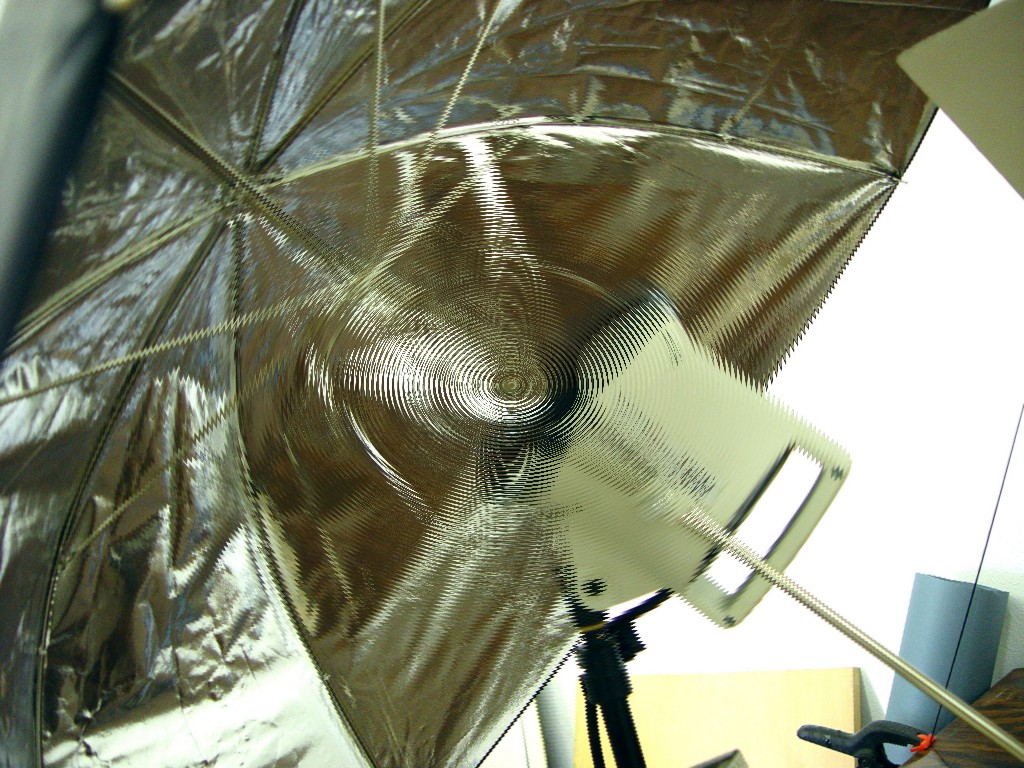
I've enjoyed playing with the photography on this page. When I teach photography, I try to weld this concept into the student's heads: It's all about light.
It's a change for most people to think of photos as the application and manipulation of light rather than the rendering of objects. Light itself is a peculiar property that I believe is not fully understood in physics.
The quality of light is an important factor in photographing knives. Here is a reflective Mylar umbrella used to apply a small amount of spectral highlights to knives when photographed in my studio.
This photo was color corrected and manipulated with a zigzag filter.
Short answer: No, that's not fair.
Long answer: I don’t offer discounts. It wouldn’t be fair to other clients. How would it appear to say that an Army soldier must pay more for his knife than a knife collector because he can only afford one knife? How fair is it to clients who have ordered or have on order multiple knives to then give a discount to another person? How fair would it be to sell knives at a lower price to a dealer who makes his living off the labor of knifemakers (and their reputation), than a young man who is defending our country (and my family) against terrorists with his life on the line?
I follow a strict pricing structure, a program that accounts for every effort, every ounce and inch of steel, every expendable, the overhead, electricity, and utilities it takes to make a knife, as well as the current market value. See "How much do your knives cost?" above. This structure defines my exact cost to make the knife, and thus the exact price to sell it. With so many modifications in the features and options of a knife, I take into account over 65 variations in the pricing breakdown.
For me to discount would suggest that the knife is not worth what the structure has assigned, or that I can’t sell within that structure framework, or that the knife has some flaw or defect or that someone paying full price is unfairly treated. This degrades the piece, its value, my craftsmanship, the client, and all other clients who purchase my custom knives. It's best to have one price, fixed, and a solid purchase based on that price. This is ultimately fair to all.
For more information and detail about discounts, please visit this bookmark on my Business of Knifemaking page.
Return to Topics
Across the street from the studio is a small park and pond. It's a very popular spot with Canada Geese, who winter here. They start arriving in giant flocks in early December and stay until March. Wouldn't you like to know what they have seen through their eyes migrating every year from the north? We counted once, and it's easy to see that there are over 2000 in the busiest times.
They take flight every evening, and spend the night in local farmer's fields. Sometimes they take off all at once, which is an incredible thing to see and hear.
The photo was adjusted for density.
Short answer: Because of the huge amount of traffic the website receives, I can only answer questions about knife orders. Email me, and I'll try to answer it directly.
Long answer: Read the entire FAQ section again, then read every other page on this site. Find out what I do and don't do here, and then email me to let me know what I've left out!
Return to Topics
Here's a sunset looking out the window of my shop and studio. This is typical of a New Mexico sunset, and one of the reasons we love it here. No colors can match the day's end, and every day is different. I only hope to see as many of these as I can!
There was absolutely no manipulation of this photo of any kind. This is exactly how it looked!
I hope you enjoyed my small photographic excursions on this page. Thanks for being here.

| Main | Purchase | Tactical | Specific Types | Technical | More |
| Home Page | Where's My Knife, Jay? | Current Tactical Knives for Sale | The Awe of the Blade | Knife Patterns | My Photography |
| Website Overview | Current Knives for Sale | Tactical, Combat Knife Portal | Museum Pieces | Knife Pattern Alphabetic List | Photographic Services |
| My Mission | My Knife Prices | All Tactical, Combat Knives | Investment, Collector's Knives | Copyright and Knives | Photographic Images |
| The Finest Knives and You | How To Order | Counterterrorism Knives | Daggers | Knife Anatomy | |
| Featured Knives: Page One | Purchase Finished Knives | Professional, Military Commemoratives | Swords | Custom Knives | |
| Featured Knives: Page Two | Order Custom Knives | USAF Pararescue Knives | Folding Knives | Modern Knifemaking Technology | My Writing |
| Featured Knives: Page Three | Knife Sales Policy | USAF Pararescue "PJ- Light" | Chef's Knives | Factory vs. Handmade Knives | First Novel |
| Featured Knives: Older/Early | Bank Transfers | 27th Air Force Special Operations | Food Safety, Kitchen, Chef's Knives | Six Distinctions of Fine Knives | Second Novel |
| Email Jay Fisher | Custom Knife Design Fee | Khukris: Combat, Survival, Art | Hunting Knives | Knife Styles | Knife Book |
| Contact, Locate Jay Fisher | Delivery Times | Serrations | Working Knives | Jay's Internet Stats | |
| FAQs | My Shipping Method | Grip Styles, Hand Sizing | Khukris | The 3000th Term | Videos |
| Current, Recent Works, Events | Business of Knifemaking | Concealed Carry and Knives | Skeletonized Knives | Best Knife Information and Learning About Knives | |
| Client's News and Info | Military Knife Care | Serrations | Cities of the Knife | Links | |
| Who Is Jay Fisher? | The Best Combat Locking Sheath | Knife Sheaths | Knife Maker's Marks | ||
| Testimonials, Letters and Emails | Knife Stands and Cases | How to Care for Custom Knives | Site Table of Contents | ||
| Top 22 Reasons to Buy | Tactical Knife Sheath Accessories | Handles, Bolsters, Guards | Knife Making Instruction | ||
| My Knifemaking History | Loops, Plates, Straps | Knife Handles: Gemstone | Larger Monitors and Knife Photos | ||
| What I Do And Don't Do | Belt Loop Extenders-UBLX, EXBLX | Gemstone Alphabetic List | New Materials | ||
| CD ROM Archive | Independent Lamp Accessory-LIMA | Knife Handles: Woods | Knife Shop/Studio, Page 1 | ||
| Publications, Publicity | Universal Main Lamp Holder-HULA | Knife Handles: Horn, Bone, Ivory | Knife Shop/Studio, Page 2 | ||
| My Curriculum Vitae | Sternum Harness | Knife Handles: Manmade Materials | |||
| Funny Letters and Emails, Pg. 1 | Blades and Steels | Sharpeners, Lanyards | Knife Embellishment | ||
| Funny Letters and Emails, Pg. 2 | Blades | Bags, Cases, Duffles, Gear | |||
| Funny Letters and Emails, Pg. 3 | Knife Blade Testing | Modular Sheath Systems | |||
| Funny Letters and Emails, Pg. 4 | 440C: A Love/Hate Affair | PSD Principle Security Detail Sheaths | |||
| Funny Letters and Emails, Pg. 5 | ATS-34: Chrome/Moly Tough | ||||
| Funny Letters and Emails, Pg. 6 | D2: Wear Resistance King | ||||
| The Curious Case of the "Sandia" | O1: Oil Hardened Blued Beauty | ||||
| The Sword, the Veil, the Legend |
Elasticity, Stiffness, Stress, and Strain in Knife Blades |
||||
| Professional Knife Consultant |
Heat Treating and Cryogenic Processing of Knife Blade Steels |