Knife Maker's Mark for Jay Fisher Knives

Jay Fisher - World Class Knifemaker

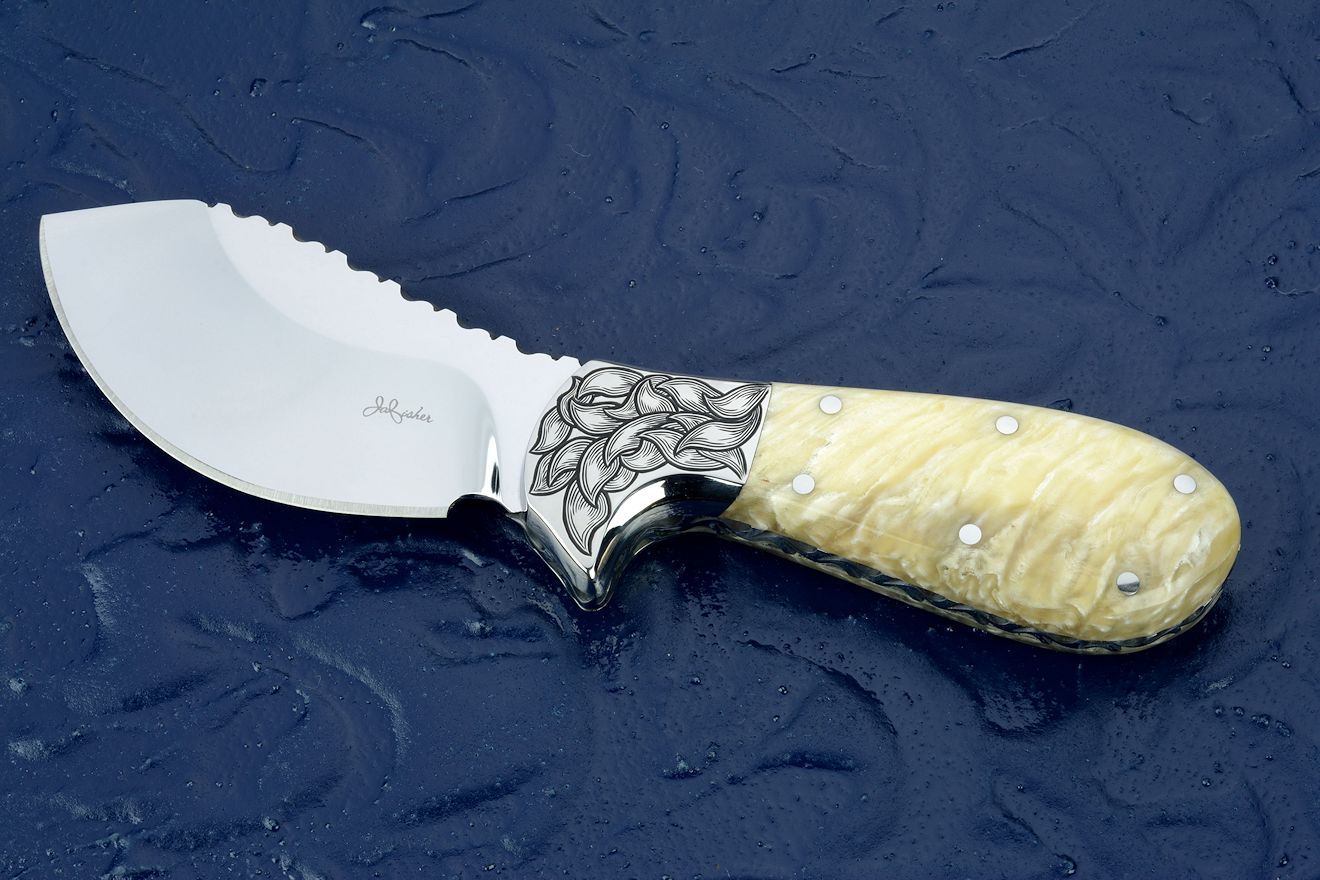
Double edged "Raptor" kerambits in a matched set
Recently Featured fine custom and handmade knives

!!!Web Page Under Reconstruction!!!


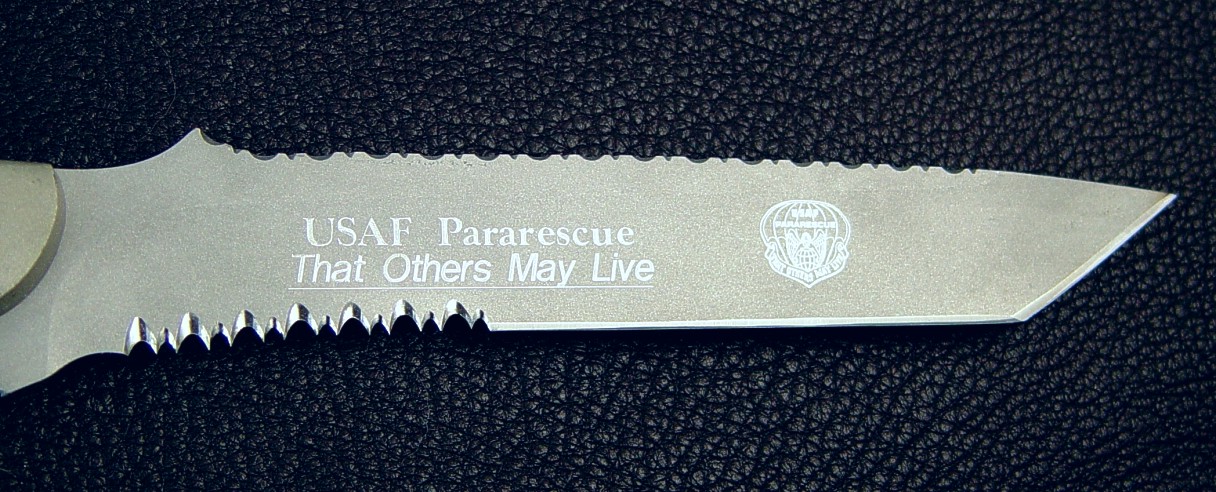
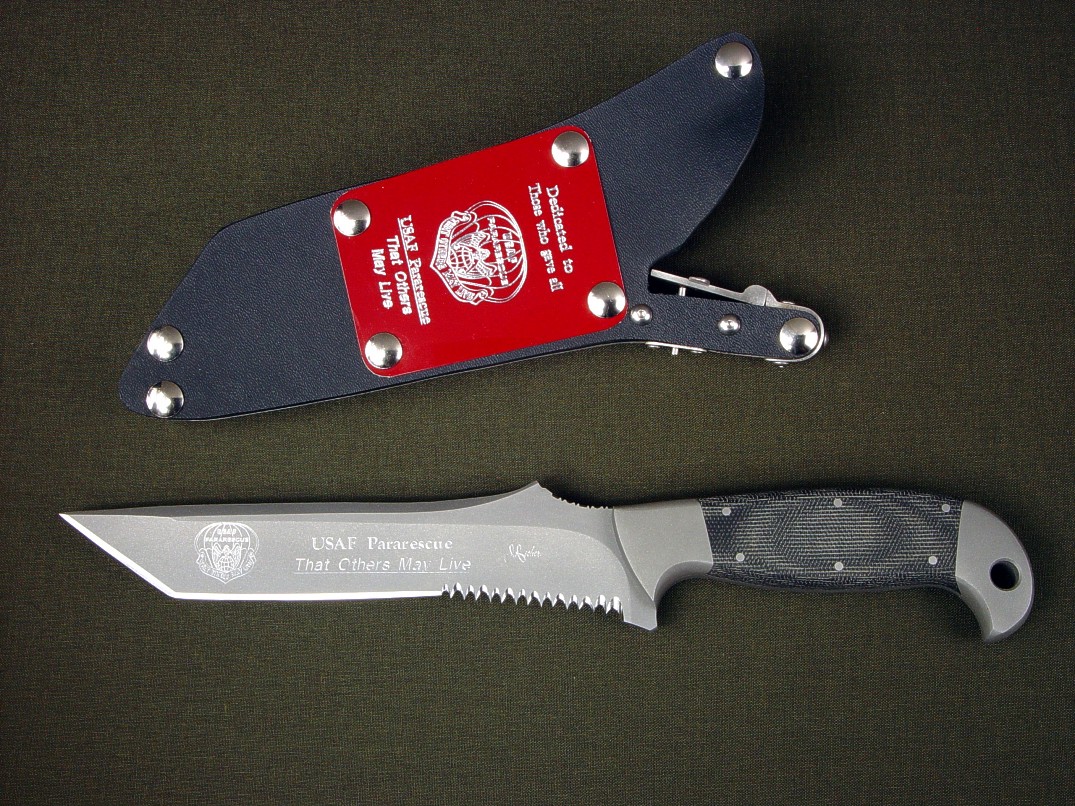
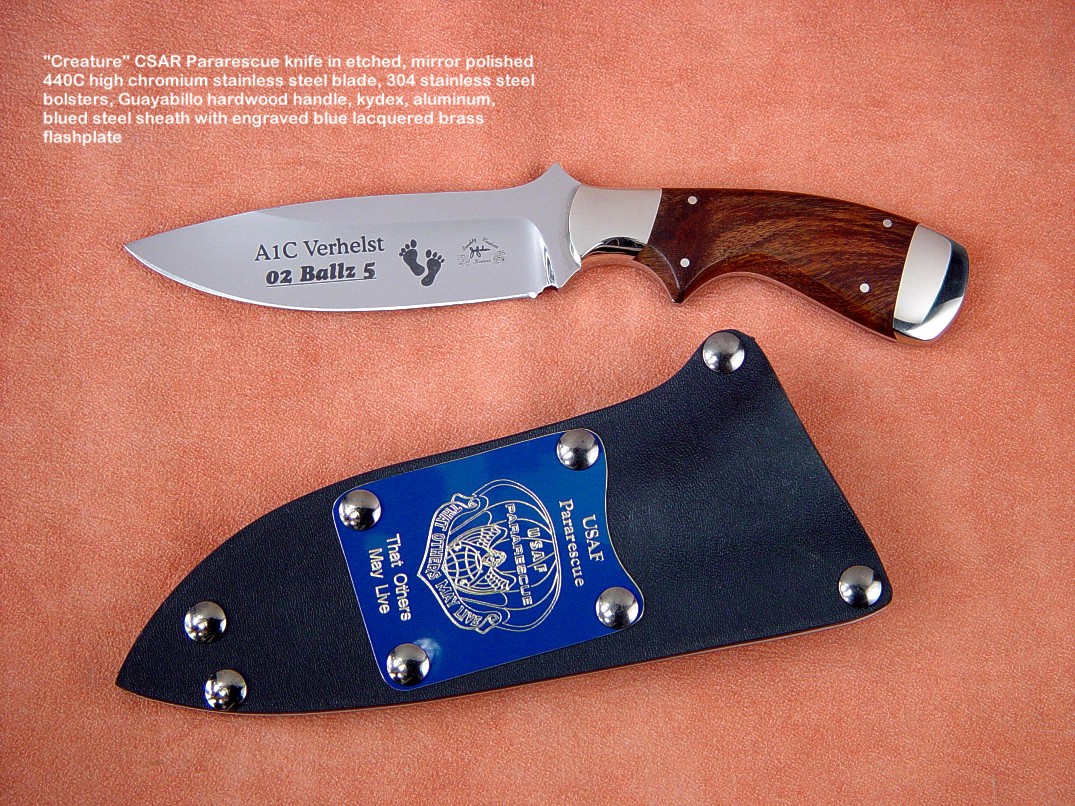
United States Air Force Pararescue Knives

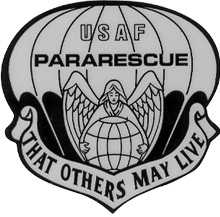
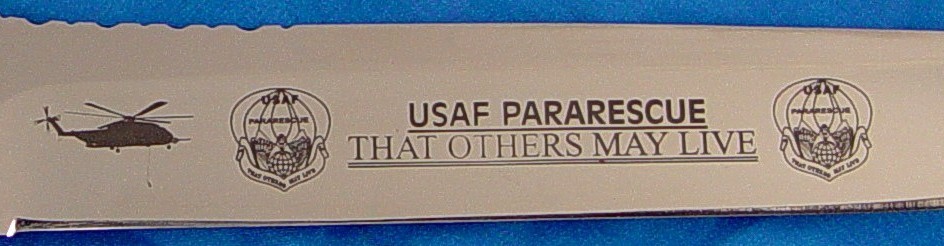
United States Air Force Pararescue Emblem (The Pararescue Angel)
"That Others May Live"

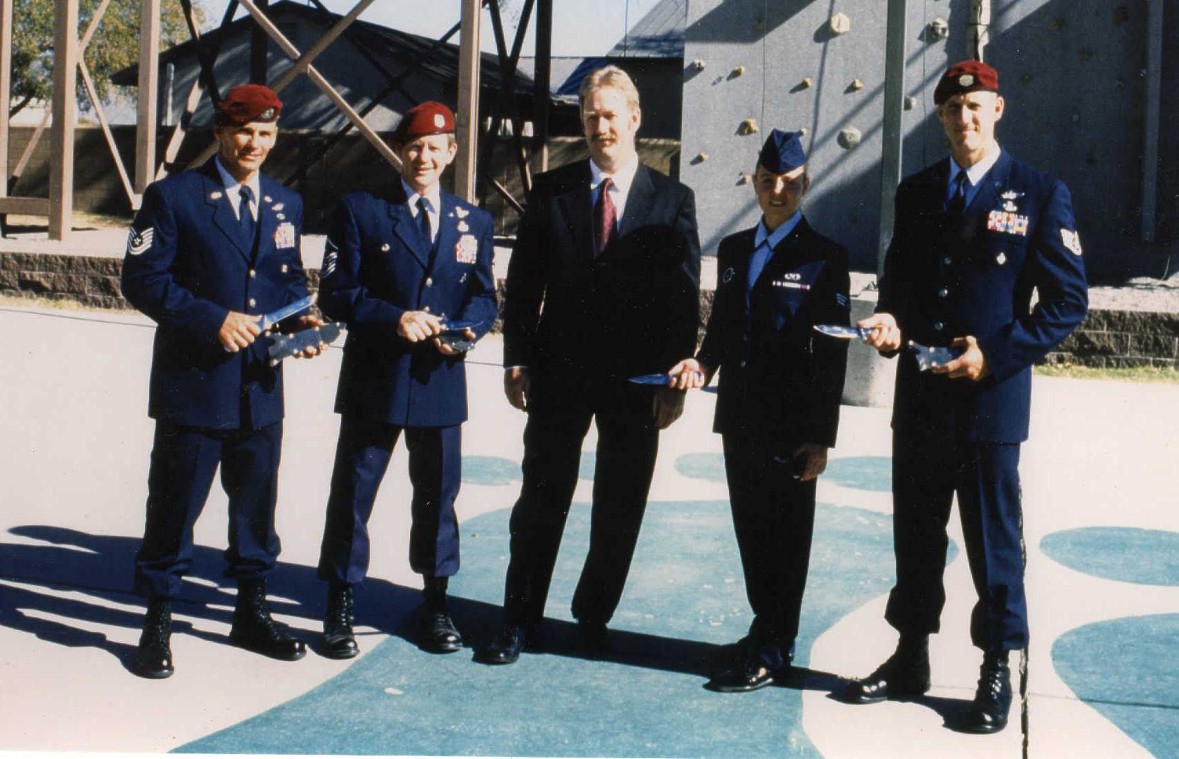
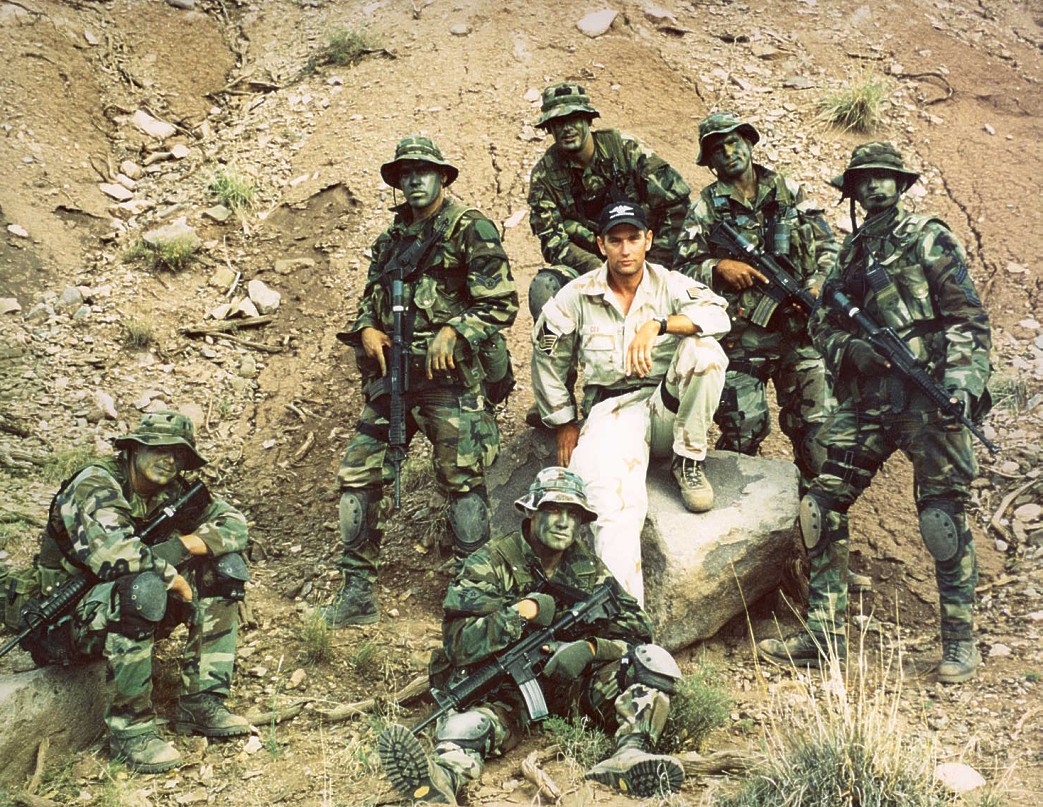
United States Air Force Pararescuemen, SERE Professionals, and Jay Fisher


"Jay Fisher is the best modern knife maker around, pursuing an ancient tradition but beautifully perfecting the craft by selecting the finest man-made and natural materials. Jay makes every type of edged steel weapon, fitting the blade to it’s purpose. The world’s elite clandestine rescue and tactical squads seek his weapons. Their lives depend on Jay Fisher Custom Knives- the best quality knives in the world."

--Bernardo M. Perez
Deputy Assistant Director-Ret.
FBI Laboratory
Washington, D.C.

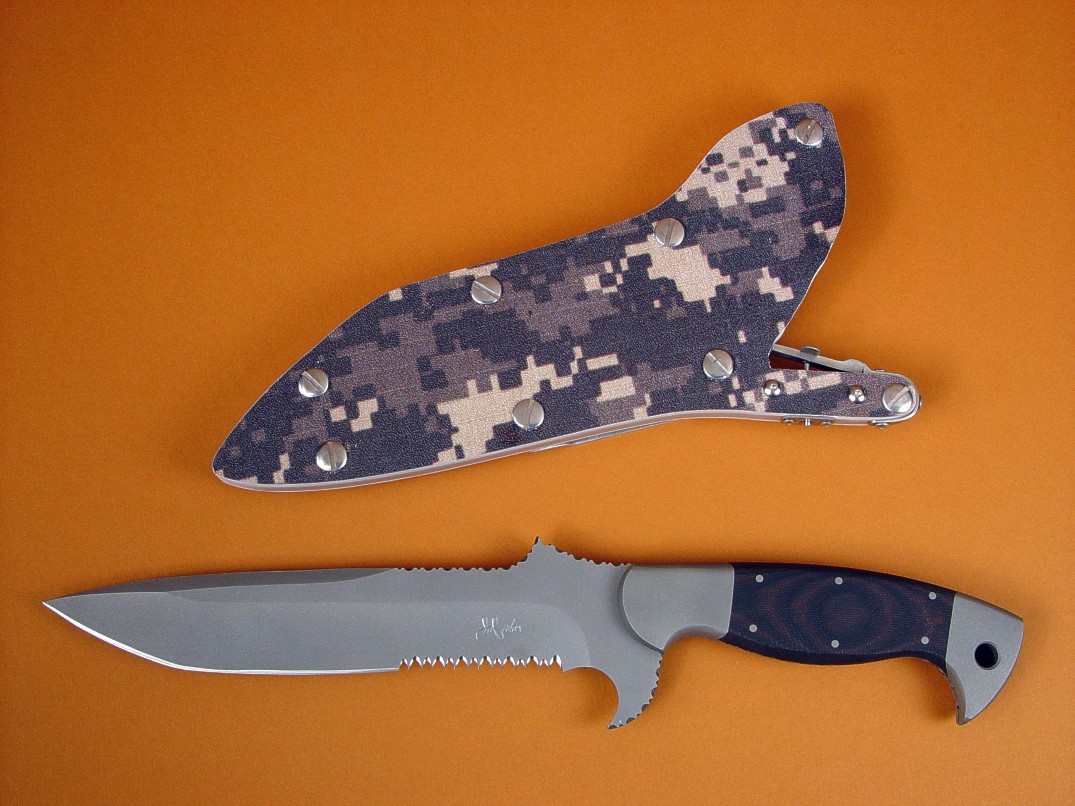
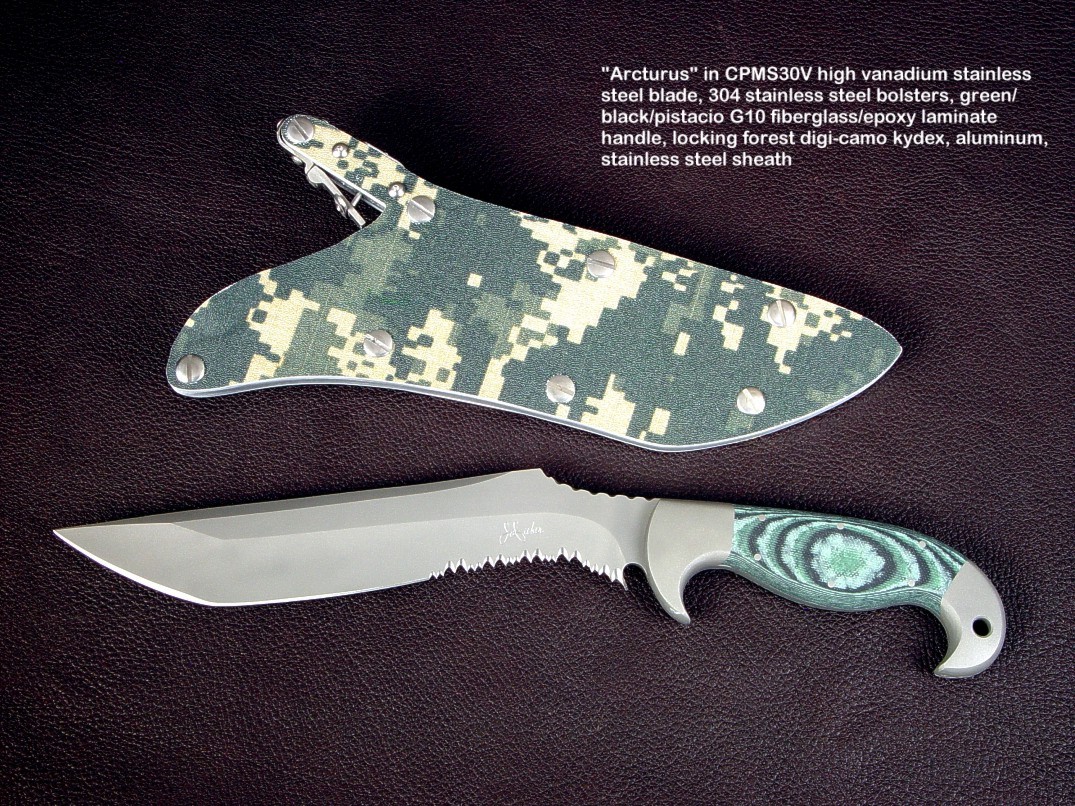
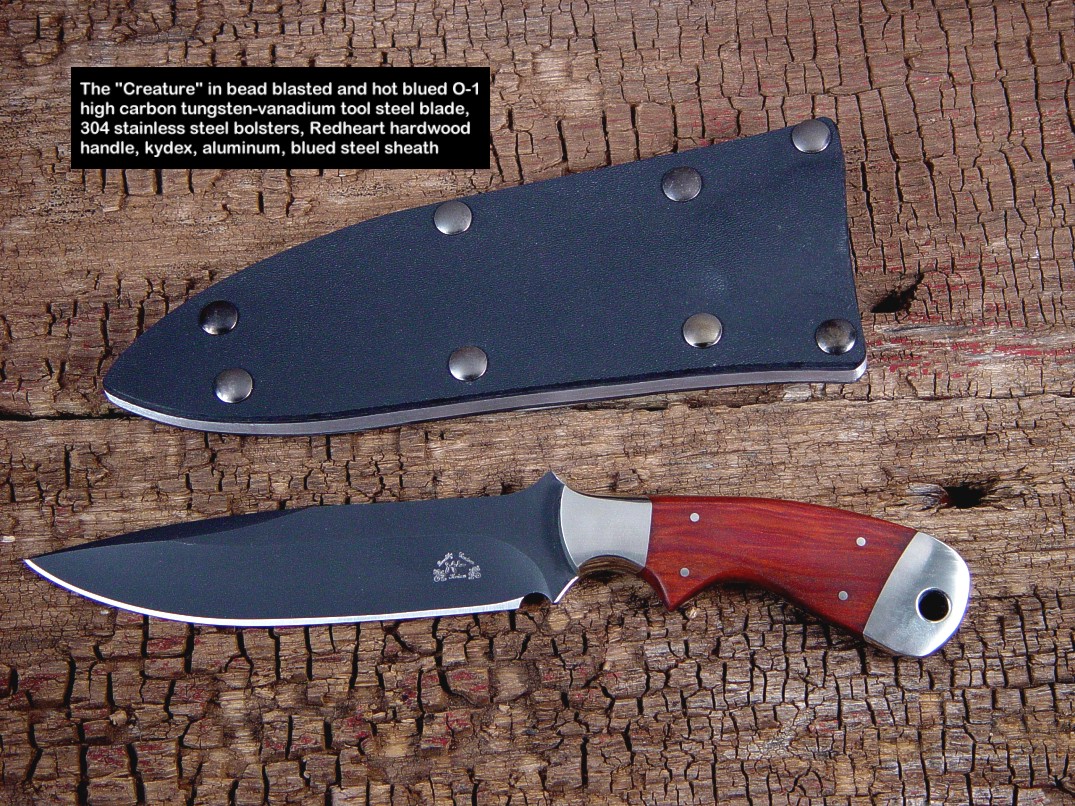
Making Knives, Primary Edged Weapons, Rescue, and Survival Tools for Special Operations, Pararescue, Combat Controllers, Combat Weathermen, and Survival, Evasion, Resistance, and Escape Professionals

What this page is about

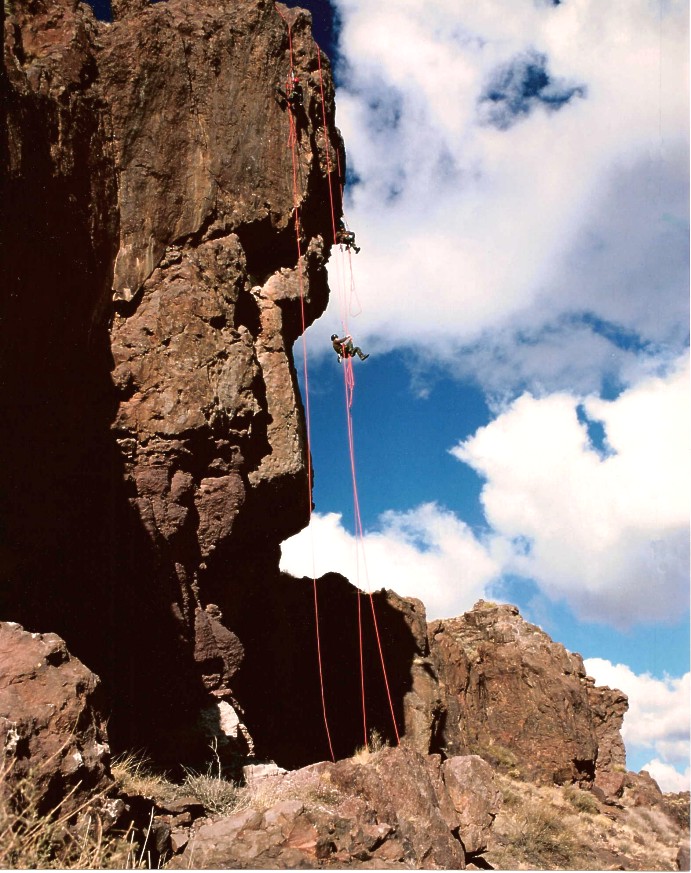
For many years, I've been honored to know and have a professional affiliation with members of the United States Air Force Pararescue, our nation's top military rescue service. These PJs (Pararescue Jumpers) are amazing men: starting with the toughest training in the military, ending up in every aircraft military rescue operation, over land or sea, and in countless civilian rescues beyond the scope of typical or civilian rescue personnel. They are incredible soldier-paramedics, trained in advanced combat lifesaving techniques, water rescue, survival, combat tactics, mountain rescue, navigation, and many other fields. They parachute behind enemy lines to rescue our own and our allies, in the worst conditions of battle and environment imaginable. When the situation completely goes to hell, these are the guys that will put their life on the line to come in and take you to safety.

This page is about the knives I make for United States Air Force Pararescuemen, with plenty of examples and links to these very special knives right here on my web site. I've included sections on the history, a bit of anatomy of CSAR knives, other associations I've had with PJs, and where the future of this is going. Thanks for being here, and please thank our servicemen for their sacrifice!
Back to Topics

Please click on thumbnail knife photos and links

Background

Many years ago, while working one morning in my studio and shop in Magdalena, New Mexico, a group of tough looking men in BDUs rang the doorbell of my shop. They had seen the sign on the store front and talked to several people in town who told them that I make knives, pretty good knives at that. They told me they were interested in some well-made Combat Search and Rescue (CSAR) knives, knives that would meet their specific needs and requirements, built with the toughest, most durable and corrosion resistant materials possible, knives meant not for show, but for real work in the field of professional rescues, both civilian and military.

I had built many tactical combat knives before that time, knives for Special Forces, knives for Army soldiers, Marines, and law enforcement. I had built EOD knives, knives for hazardous material exposure and containment, and knives for specialized rescues. I had also build plenty of commemorative knives to honor the pros that use them. Combat Search and Rescue was a new field for me then, and the PJs wanted direct input into the designs. They told me what they needed, I told them what I thought would and wouldn't work, and why. We started profiling in acrylic, forming, tuning a handful of designs, and  I continued with building some prototypes. I adjusted these designs over time, they frequently had new plans and ideas, and I incorporated those concepts into new models. They took the knives, used them in the field, and gave me feedback that would help improve the performance, carry, and use of these critical tools and weapons.

Today, I still make Pararescue knives, still continue to take ideas and design improvements, and still communicate with both active duty PJs, retired PJs, and  PJ hopefuls that are still in the pipeline. Their generous advice and input has helped me grow as a knife maker, artist, and weapon and CSAR tool professional, and I am proud that my knives have helped them in their critical and dangerous missions.

Back to Topics

Please click on thumbnail knife photos and links

The Knives

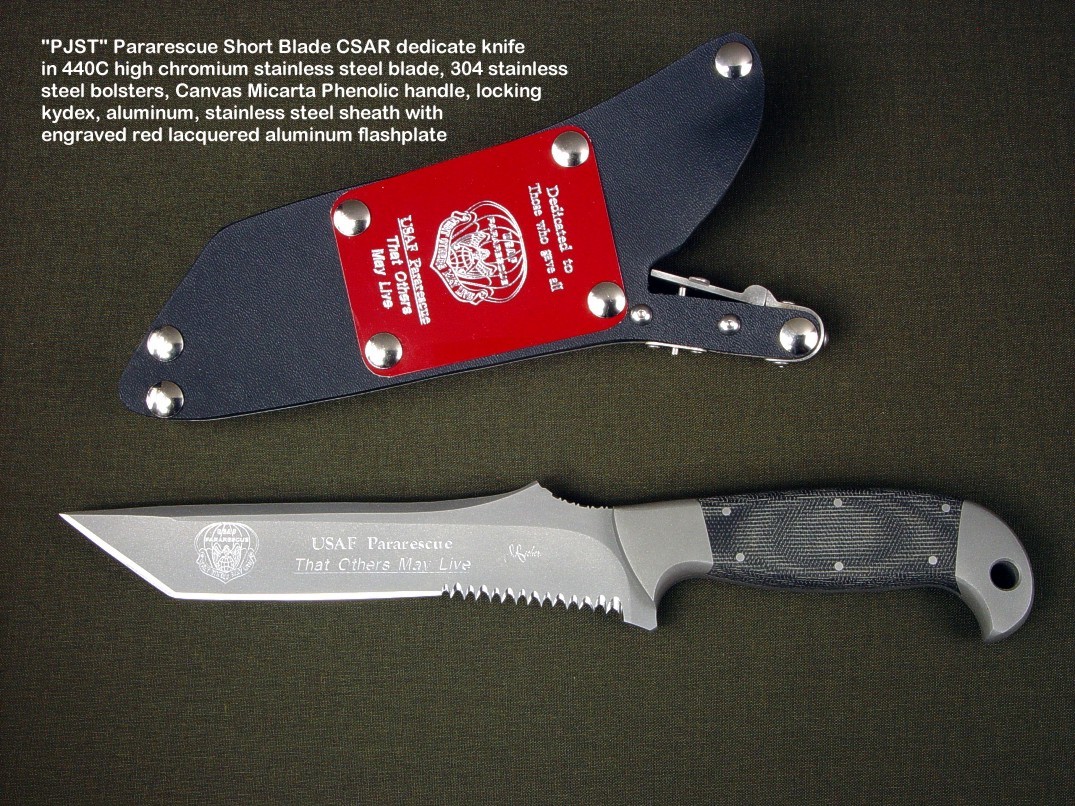
The knives I make and have made over the decades for Pararescue are wide ranging in their design, scope, and performance requirements. Each PJ has his own ideas of what he needs the knife to be able to do in the field of conflict, and since every man is different, and units allow each PJ to carry his own knife, there are a large variety of designs available. Many years ago, units quit issuing knives service wide, as few were happy with the the knives manufactured and issued for combat. I'll go into this more deeply in my book, but just remember that knives are a very personalized up close item. For example, a firearm is clearly a mechanism, and mechanisms must be standardized so that they can be repaired, components interchanged, calibers standardized, and actions all tightly confined in specifications and construction for reliability and mass use across many fields of engagement. A knife is clearly not a mechanism, it is a form, although some of my combat knives have mechanisms, these are usually in the sheath retention systems. As a form and not a mechanism, there is no possibility of a knife itself failing. It is either present or not. Thus, the dependability of the knife and its particular place in the mission is entirely dependant on the user. Because there are mechanisms in the sheath retention system, it is of a high order of importance that the mechanism be extremely well built and durable. I detail this in the accessory section below.

Here is a list of bulleted points that detail how my Pararescue knives are designed and built. If you thought that all CSAR knives are alike, read on, brother, these are important points to know to be the best equipped for your missions.

  • Designs
    • The designs may be based on either combat weaponry or rescue needs, and are often a combination of both fields, with piercing points that are durable enough for shelter building and heavy rescue needs.
    • The designs are often created with the direct input of Pararescuemen for their personal and professional use in Combat Search and Rescue operations.
    • Some of these designs have been proven in well over a decade of use, tuned, refined, and adjusted to cover a wide variety of performance needs.
    • The designs are copyrighted and are not legally available by other makers or manufacturers. Even if these entities try to copy my Pararescue knives, they are not capable of producing the geometries, craftsmanship, and high quality details and materials available in my knives.
    • I make new designs for active duty PJs continually, based on their direct input, needs, and requests. No factory will ever do that for any service member. The designs of custom knives are custom, so the professional chooses what he wants, not simply what is offered.
  • Blades
    • The blades are highly durable in geometry, with substantial spines to transfer great forces to the cutting edges and points.
    • Blades are hollow ground. This gives a very thin and reliable cutting edge with great serviceability over the years of use, while maintaining a thick spine.
    • The hollow grinds are accurately matched from side to side. This creates uniform thinness throughout the cutting edge over the life of the blade.
    • The hollow grinds have radiused and sweeping grind terminations. This is the sign of skilled off-hand grinding and is simply not possible and never seen in low end or manufactured knives. This type of grind termination reduces and distributes stresses away from the handle to blade junction, creating a stronger knife overall.
    • Many of these knives have compound tanto grinds. This creates two separate cutting edges, an obtuse angle of a secondary point to apply great pressure with the heel of the hand on the spine, and makes a very strong and fracture resistant blade and point.
    • Most of these knife blades have a top side swage taper ground on the spine. This reduces the point profile for a sharper penetration angle without sacrificing spine strength. It also offers a wider, tougher chisel type edge for scraping, fire starting, and shaving ignitable metals. These chisel-shaped swages can be used for light chopping to create tinder, without jamming in soft woods like a flat or hollow grind would.
    • All of the CSAR knife blades are made with the finest tool steels available in the modern world. This means high alloy tool steel blades, not carbon steel, decorative damascus, or softer low carbon stainless steels. These isotropic, modern tool and die steels must be hardened and tempered in high purity environments, rapid ramping ovens, and high quality processes. Most of them are martensitic stainless tool steels, with high chromium, high molybdenum, or high vanadium contents for high corrosion resistance, great toughness, and extreme wear resistance. These are the finest tool steels made today.
    • The blades are all full tang, one solid piece of steel from the point to the butt. This is the strongest blade to handle arrangement possible.
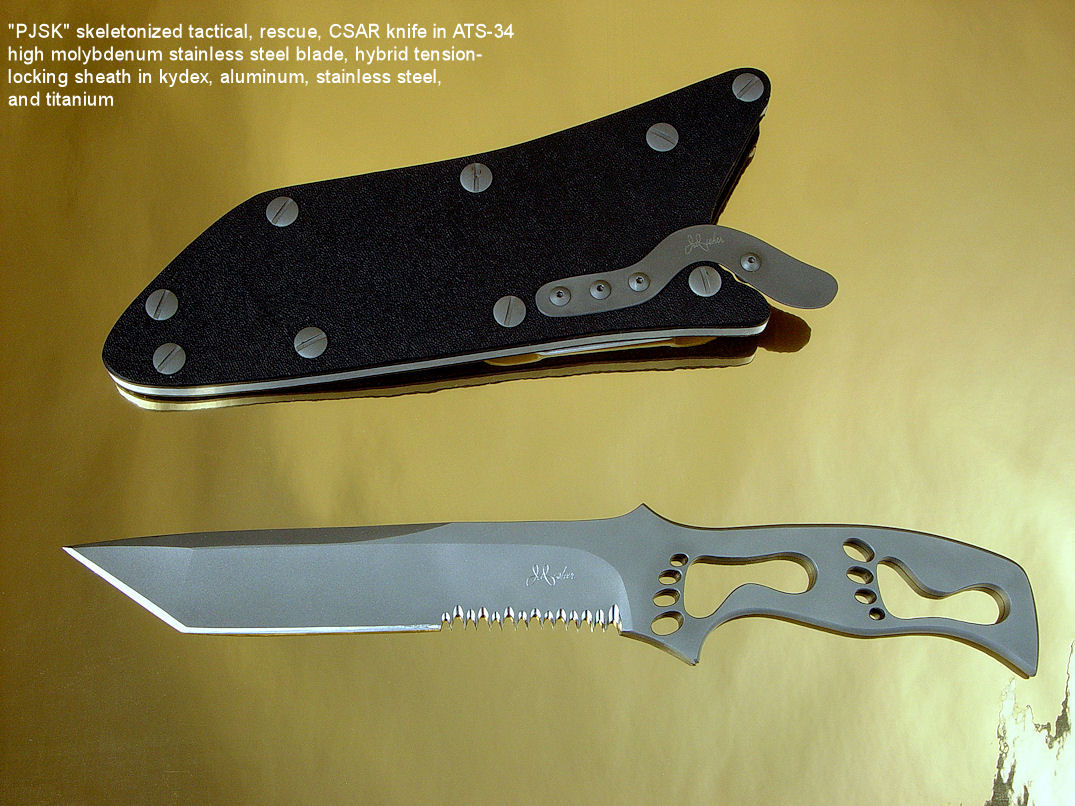
    • All blade tangs are milled and accurately tapered, unless skeletonized. This creates a very well-balanced knife, and eliminates extra metal weight in the handle where it is not needed.
    • The blades may feature serrations of several types, sharp enough to cut through hardwoods and soft metals. The points of these serrations are aggressive enough to keep cutting even if broken off.
    • Every blade is heat treated, hardened, and tempered in my shop and studio, and tested with a properly calibrated hardness tester for exact measure and reliability. Nothing is farmed out to outside contractors.
    • The blades of custom knives are truly custom, so the professional chooses what he wants, not simply what is offered.
  • Fittings
    • Most of the fittings on my CSAR knives are 304 austenitic high chromium, high nickel stainless steel. This steel has the same alloy content as 18-8 stainless steel, the same steel used to make stainless steel bolts, nuts, and fasteners. This is a very tough, extremely durable stainless steel, resistant to nearly every corrosive exposure, and as tough as is possible for any knife fitting. It's much harder, stronger, and more wear resistant than titanium, more corrosion resistant than 416 stainless steel that most other makers use, and does not have to be heat treated to reach its highest corrosion resistance.
    • The fittings I create are designed to strengthen the knife, increase the durability, and extend the longevity of the knife, as well as improve the comfort, fit, and contact of the knife handle with the human hand. While the tendency is for factory knives, manufactured knives, boutique shop knives, and other maker's knives to eliminate bolsters and fittings altogether, I believe this is a big mistake, simply a cost cutting measure for the maker of the knife, and reduces the durability of the knife tremendously.
    • The fittings help bed the handle material to the knife tang, and mechanically lock it in place with milled and ground dovetail fittings. Rarely is a straight or square fitting used on this type of knife, so that not only the shear strength of the bedding secures the fitting, but also the mechanical shape of the dovetail locks the handle to the tang.
    • My fittings are all attached with sealed, zero clearance pinned and peened large diameter multiple pins for absolute permanence. These fittings will not, can not come off, ever. The pins are hardened in the attachment process, further increasing the durability.
    • The exterior of the fittings (bolsters) are contoured, rounded, and radiused to conform to the curved surfaces of the human hand where it contacts the fitting, and smoothed to the tang for a seamless fit. The front faces of bolsters are tapered, contoured, and finished so that debris is not trapped, easing cleaning and improving corrosion resistance.
    • Often, the fittings have chamfered lanyard holes, or reinforcing lanyard tubes for extra security if the owner needs it. The lanyard holes are through the tang of the knife handle, for absolute strength. The inside of the holes are smoothed and the corners chamfered for abrasion and chafing resistance.
    • The bolsters are often designed to help the hand apply pressure to the knife handle and blade, by offering a wide area to bear down. The shapes are also wide at the forefinger to safely guard the hand from sliding forward onto the blade, and at the rear quillon to aid in extracting the knife from the sheath and locking the hand in the handle.
    • The pins always are the same material as the bolsters, usually 304 high nickel, high chromium austenitic stainless steel, mounted in zero clearance holes through the knife tang, and are multiple for the highest strength without weakening the handle material. This allows great transfer of energy through the handle to the knife blade, and no movement of woods or manmade materials.
    • The fittings and bolsters can also offer an area for personalization and embellishment. The fittings of custom knives are custom, so the professional chooses what he wants, not simply what is offered.
  • Handles
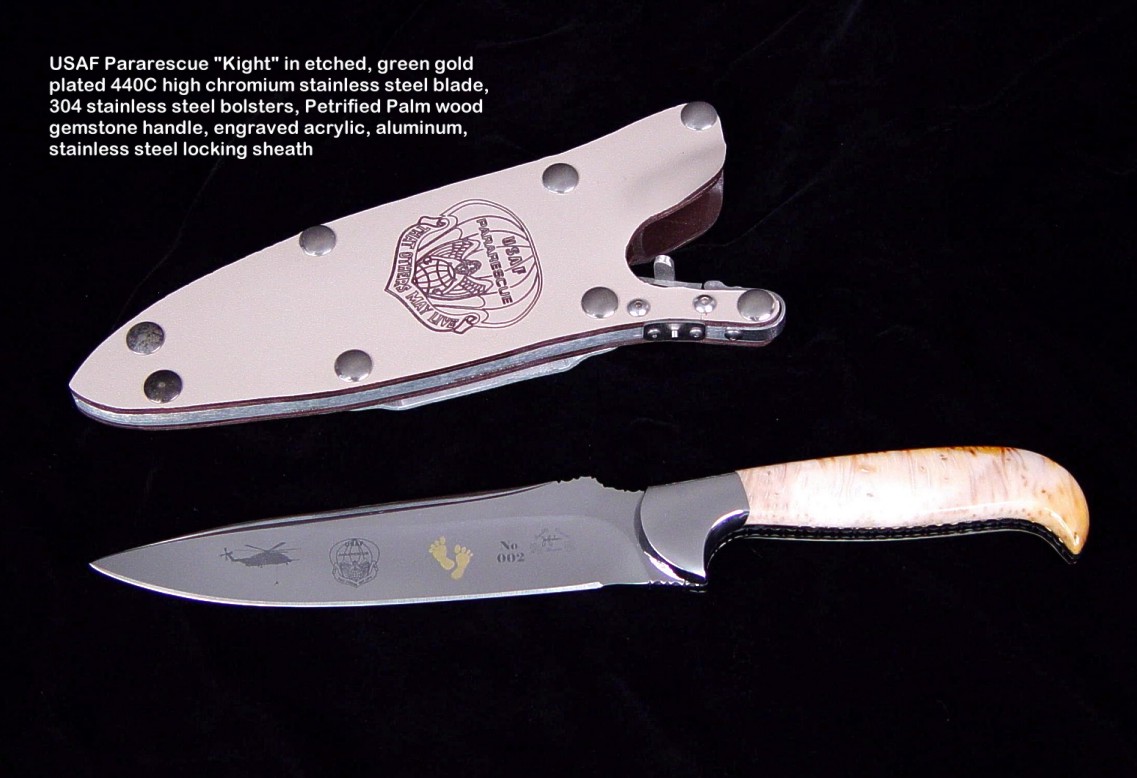
    • The handle materials vary widely, but one important aspect is always addressed. Durability is the key issue. I use high strength manmade and natural materials and never any material that is weak, soft, or can be permeated by moisture or contaminants. That means Micarta® phenolic thermosets, G10 fiberglass epoxy laminate composites, or Dymondwood stabilized and compressed waterproof wood products are used. All of these have high penetration and abrasion resistance. I also use only the best hardwoods, exotic or domestic, woods that are self-sealing, naturally oily and resinous, or are resistant to infiltration of moisture and and decay as well as being mechanically stable with little or no movement. I also use gemstone in many of these knives which is very hard, tough, and durable, and will literally outlast the knife blade, fittings, and sheath. Gemstone is the most resistant to all exposures and the only materials that can abrade it are usually silicon carbide and diamond.
    • Handles are always attached by two means, mechanically and adhesively bonded and bedded. I use solid pins, through-tang mounts, multiple members, and specialized polyepoxide thermoset bedding materials to rigidly attach and seal the handle scales to the frame of the knife for the highest reliability and permanence. I never use screws, rivets, hollow fasteners, or less than four independent mechanical mounts to affix the handle scales to the tang, and the scales are always reinforced mechanically by dovetailed bolsters for the most solid arrangement possible.
    • Handles are always bedded. Bedding not only seals the voids between the handle scales, bolsters and fittings, and the tang, it creates a solid structure to support great forces that must be transferred between the handle and the knife tang, and on to the blade. This is an often ignored aspect of the handle, and on CSAR knives, can be one of the most important factors. If great force can not be solidly transferred between the hand and the cutting edge or point, continually throughout the life of the knife, the handle will loosen, weaken and fail. Corrosive salts, acids, caustics, and moisture will infiltrate the tightest spaces if not bedded, and the handle will fail. Please remember that the CSAR knife often encounters marine saltwater environments, and even short-term immersion.
    • Handles are always contoured, shaped, and smoothed for comfort. Though a factory knife may look techie with a machined, abrupt, squarish, and angular handle, they are not suitable for duty. Milling straight cuts in a phenolic scale on a handle is a bad replacement for well-thought out contouring and finishing. The handle shape must be inviting to the hand, comfortable to use, and must lock the hand to the handle by virtue of its shape, not by a coarse surface finish. More details about that on my Combat Knives page.
    • The handles of custom knives are custom, that means the professional chooses what he wants, not simply what is offered.

Back to Topics

Please click on thumbnail knife photos and links

Missions and Considerations

The most important consideration for the Pararescue knife is the mission. There is no way that a knife maker could know the details and intricacies of mission details, no matter how well connected and knowledgeable he is about Pararescue. As a knife maker, however, I am well versed in knives in general, and my knives in particular. So when a PJ requests a specific style, attribute, or feature on a fine, handmade custom knife for CSAR, I can advise him on whether or not the feature will work, how it may compromise other components, fittings, or attributes on the knife, and if it is within the scope of his project based on the materials, design, size, accoutrements, and budget.

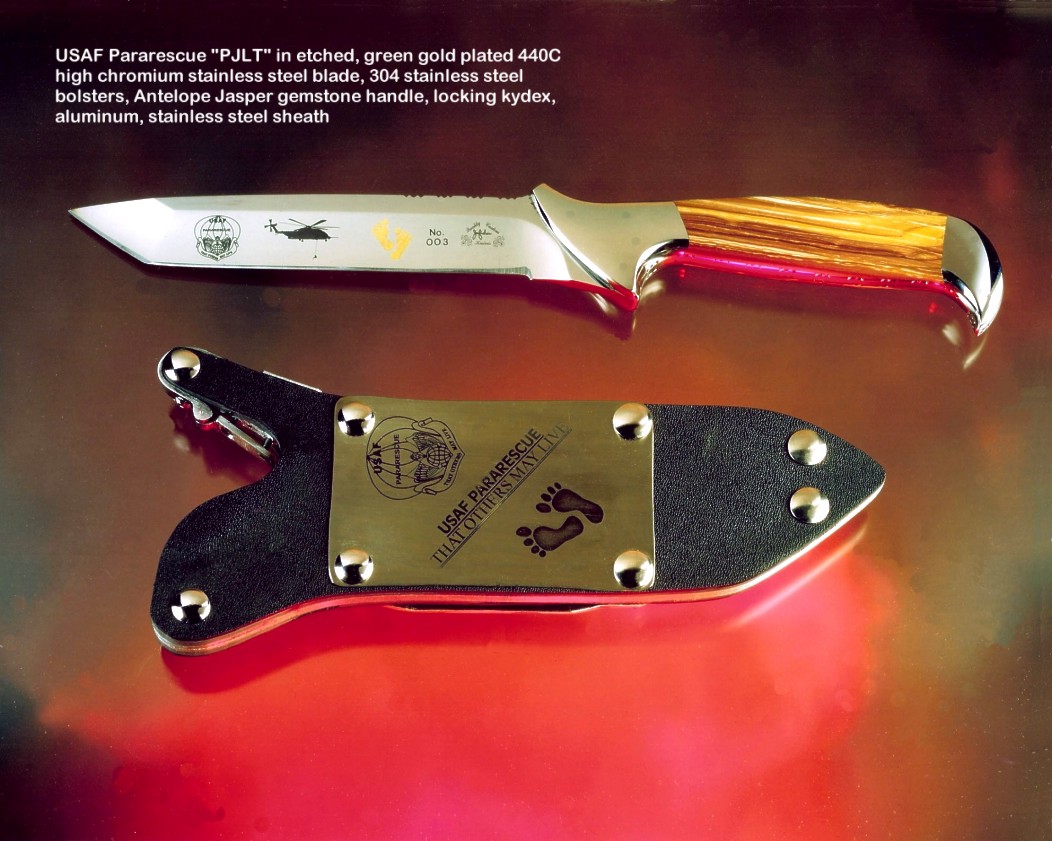
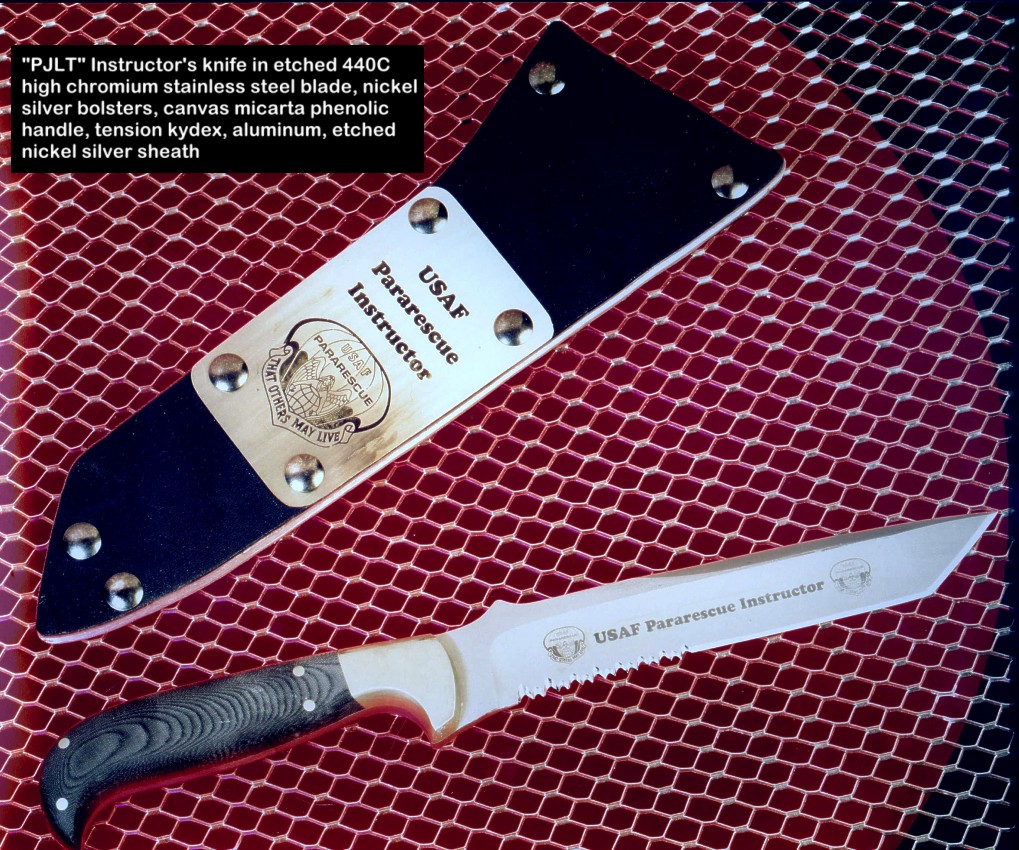
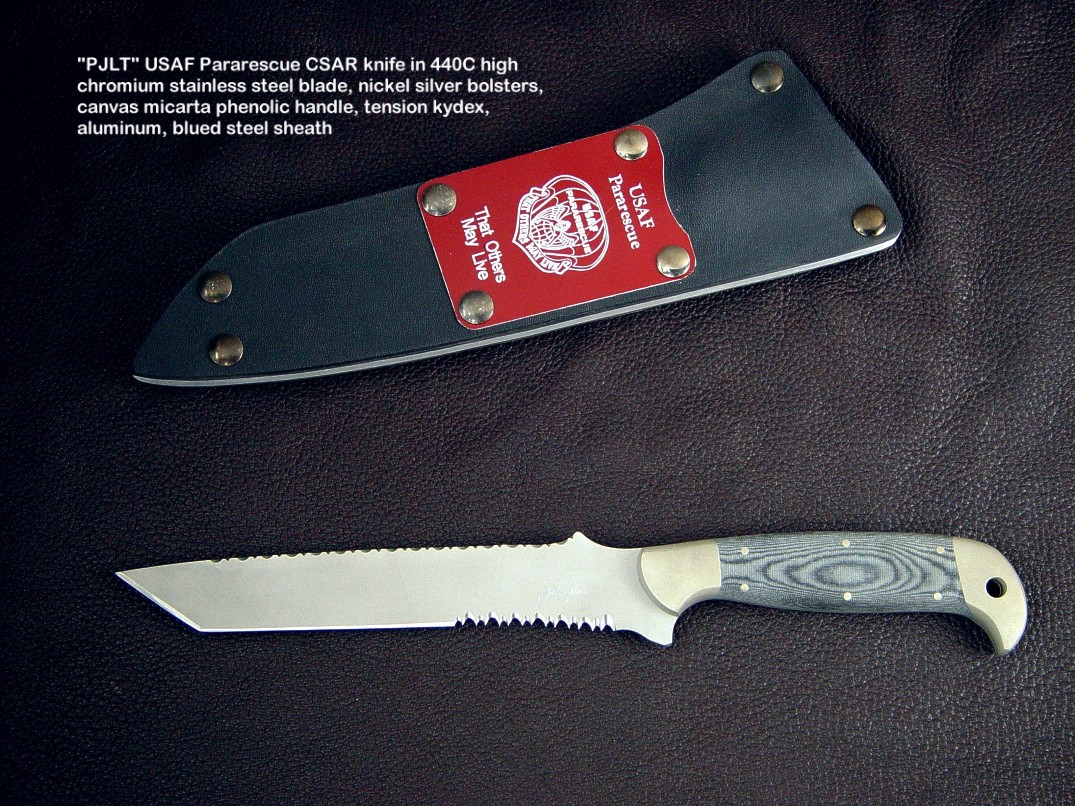
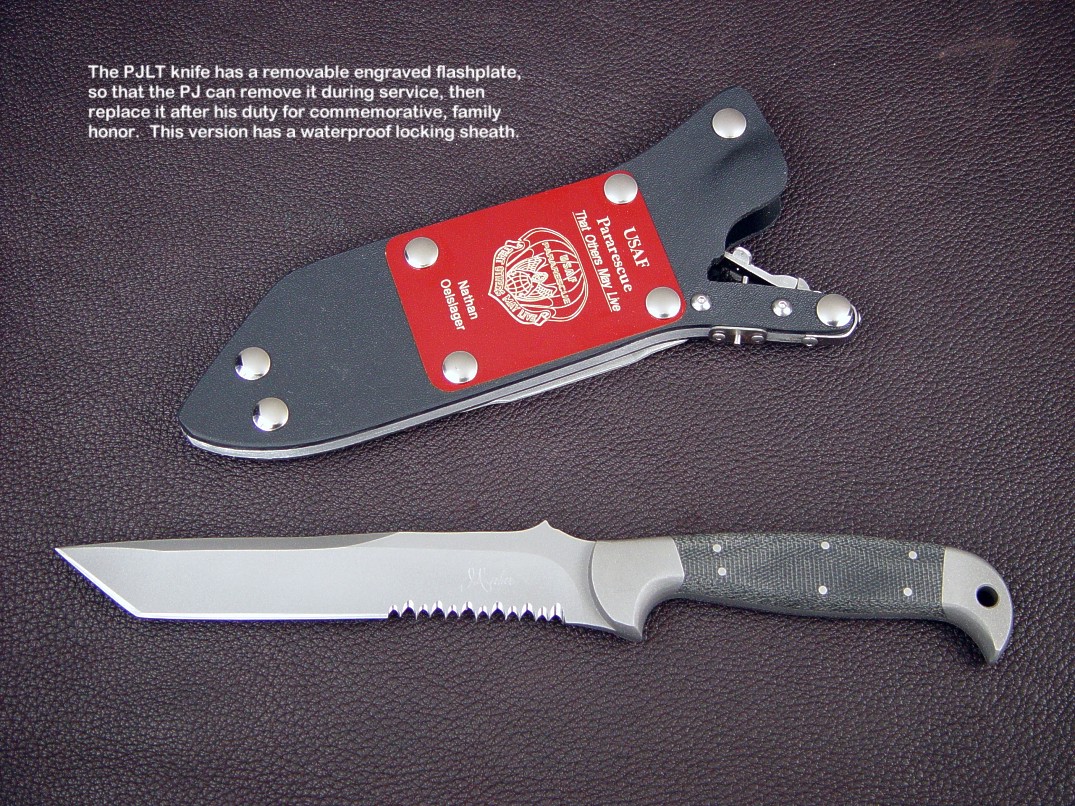
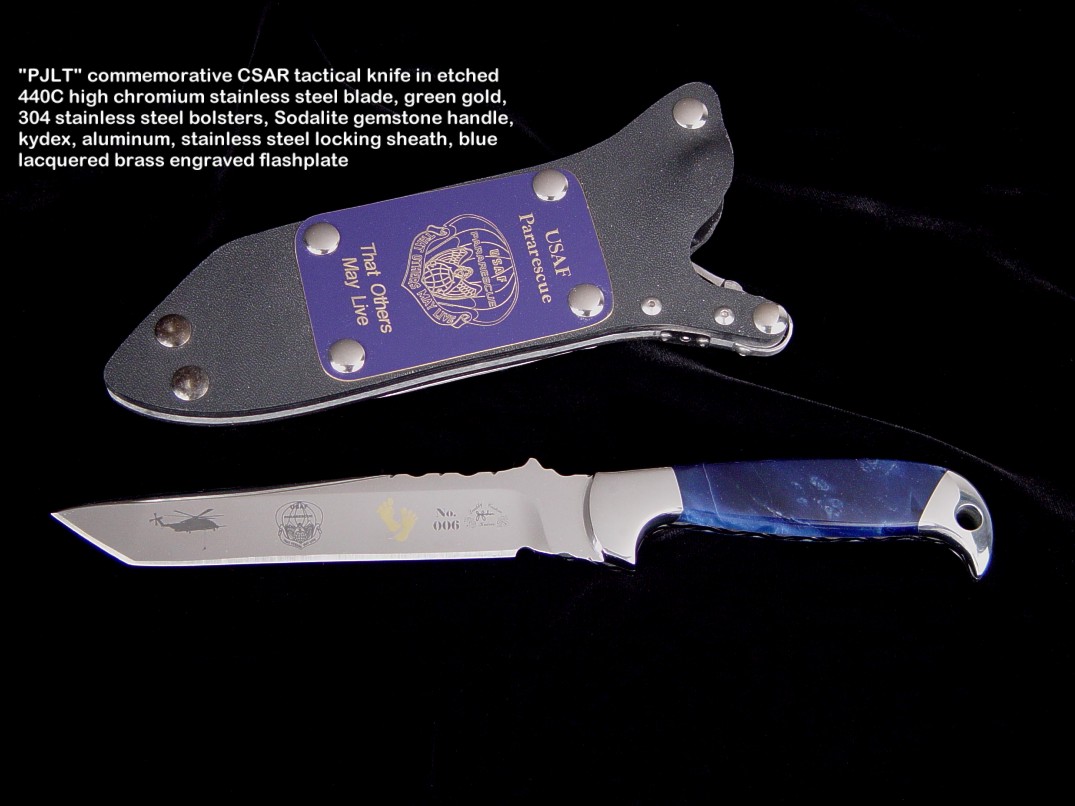
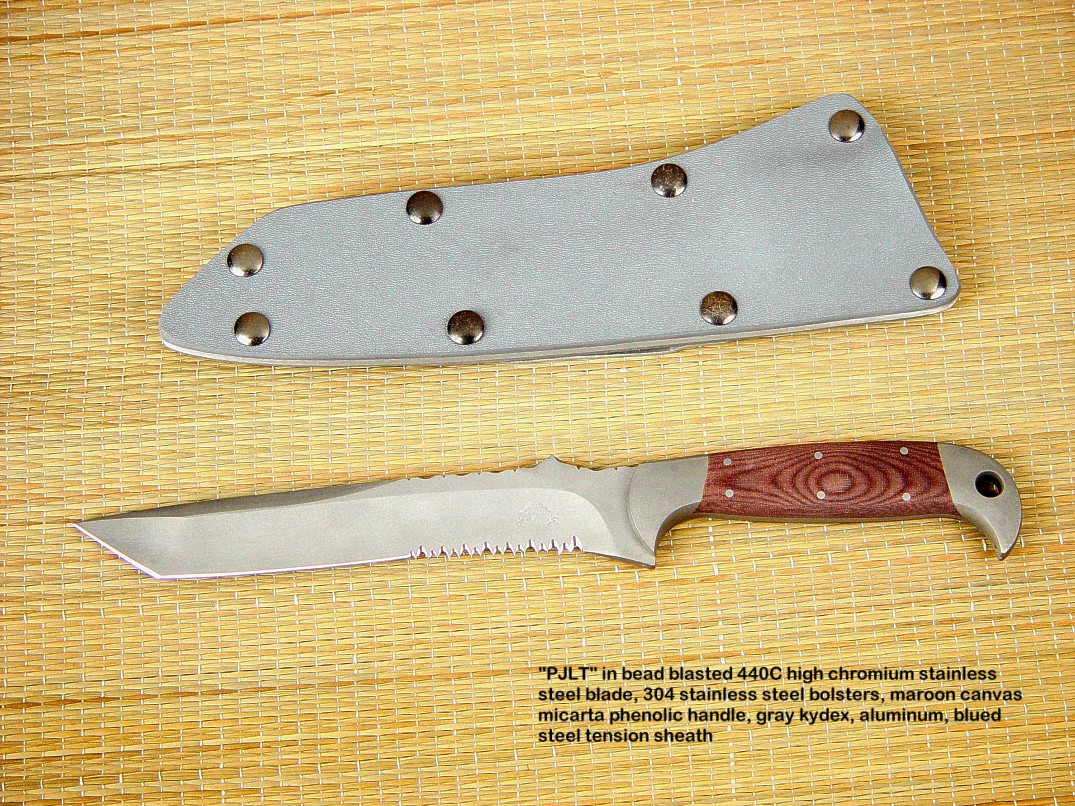
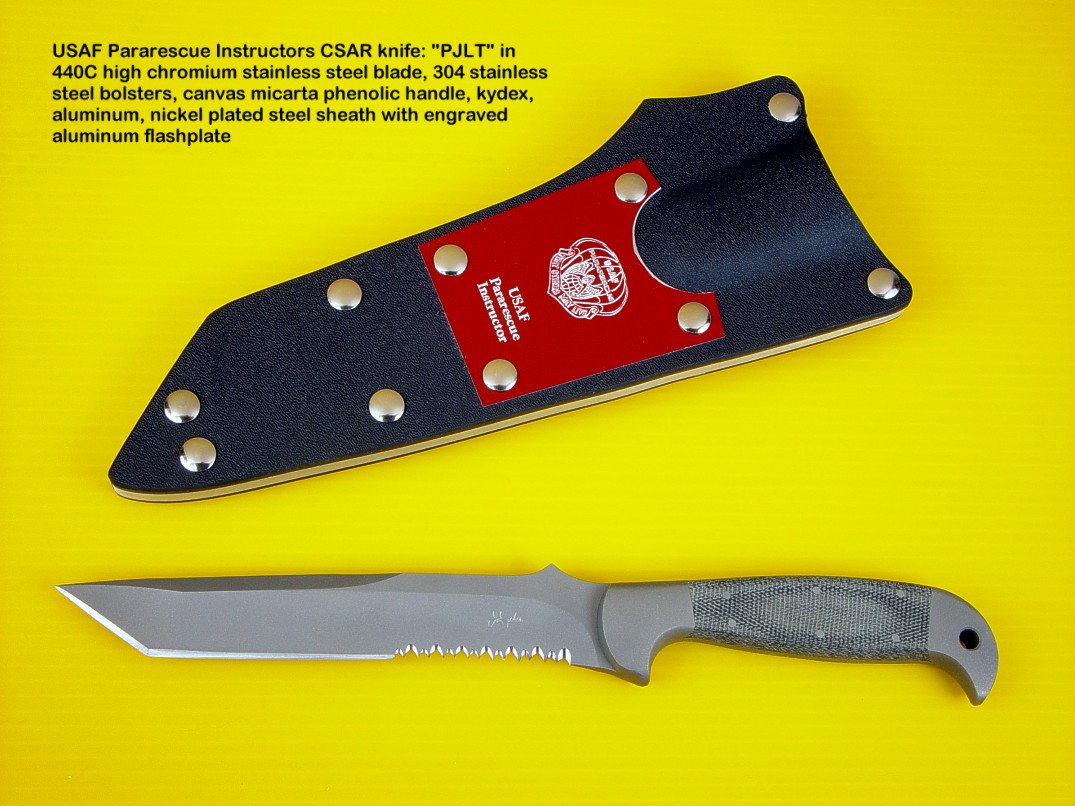
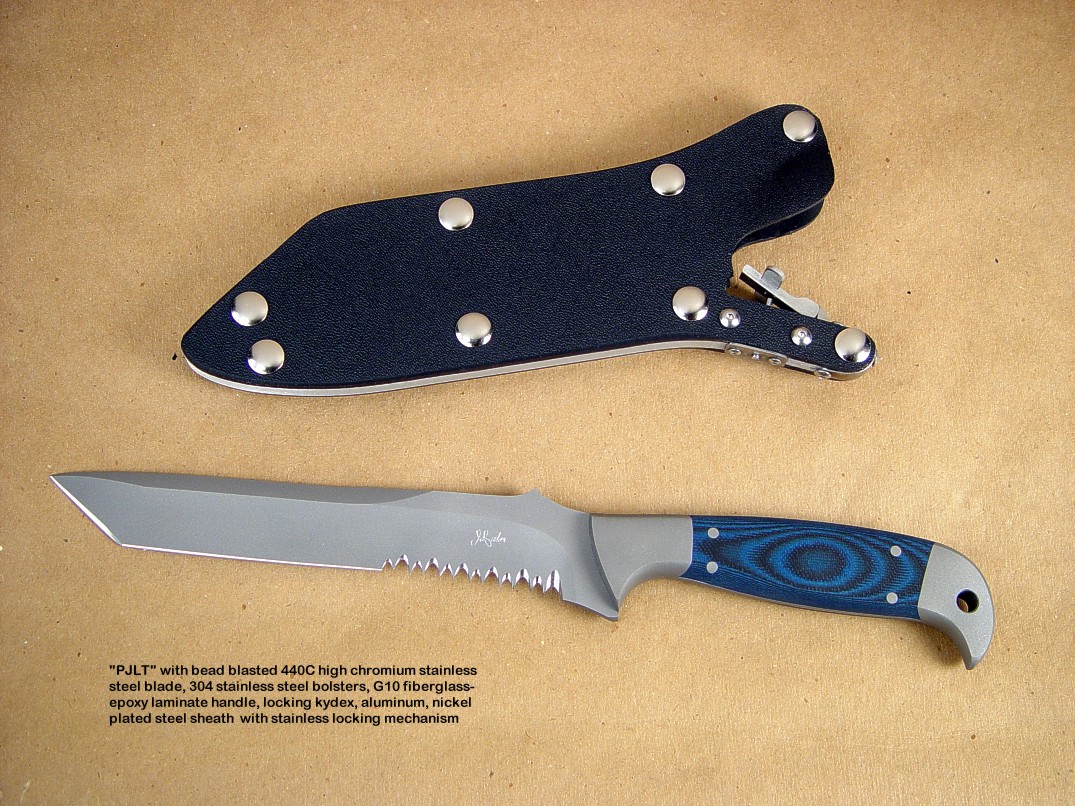
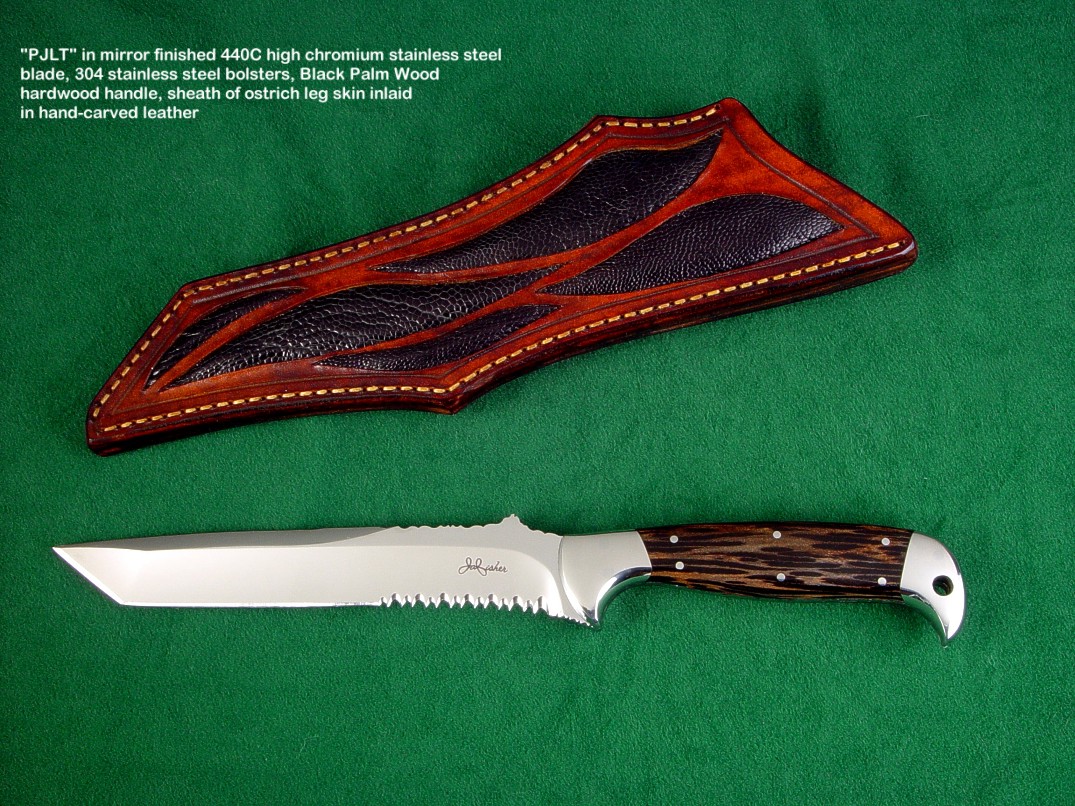
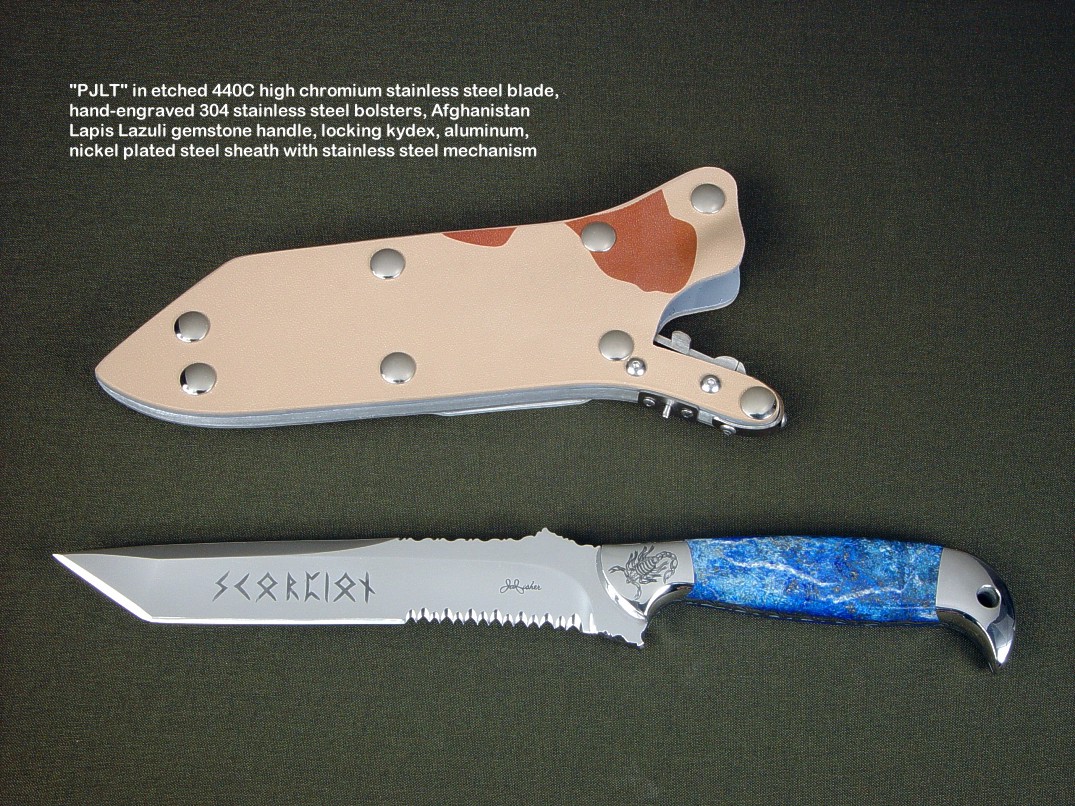
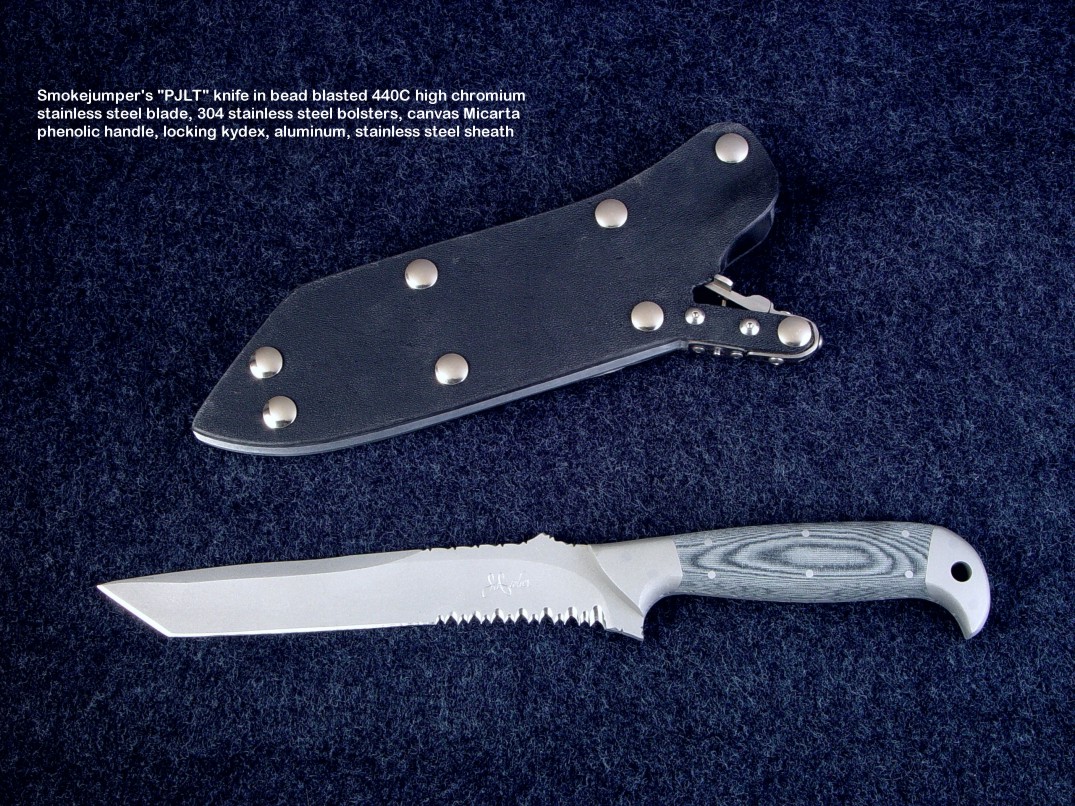
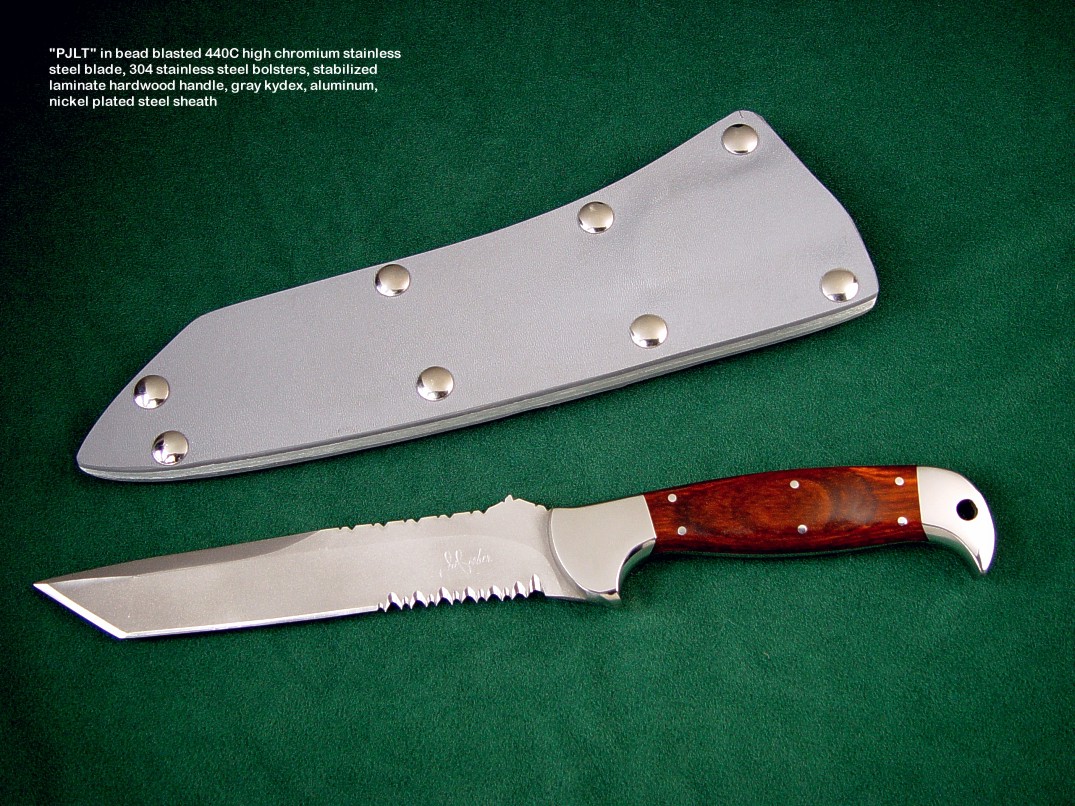
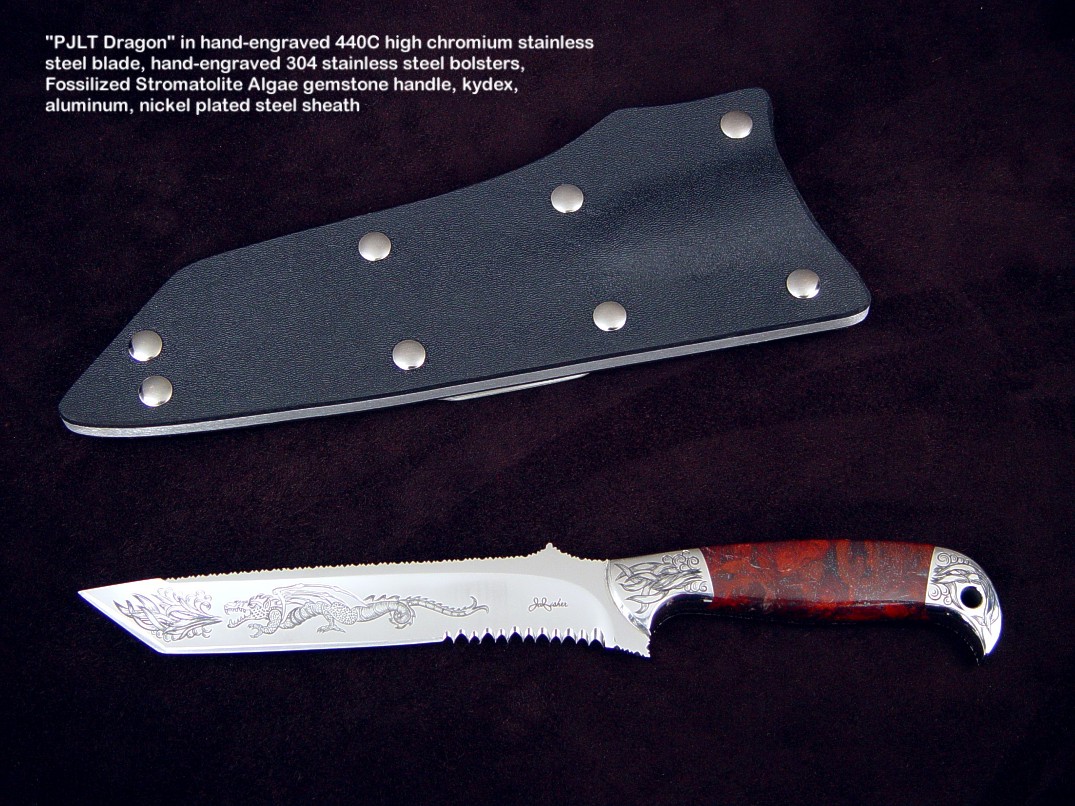
Each PJ is different, though you may see many repeats of the same knife design and style here on the site. This is because those particular knives cover a wide variety of mission requirements, along with suiting a large cross section of knife users. For example, my PJLT is my most popular CSAR knife that has found favor in many fields apart from Pararescue, in law enforcement, emergency response, and utility carry. There is no single knife style or design that can do it all, and most people know this, so choices of knife design, style and materials should be based on the idea of mission use or application. Simply put, what will the knife need to do and how will you get it there?

Some primary considerations:

  1. How will the knife be worn?
  2. How will the knife be extracted from the sheath?
  3. How will the knife be held?
  4. What will the knife be used for?
  5. What environment will the knife need to endure?
  6. How often will the knife be used, sharpened, or serviced?
  7. How will the knife be re-sheathed?

1. You might have noticed that I started with what is usually the last consideration, the sheath. A knife in combat is not carried, it is worn. A nail file, a multi-tool, a tiny pliers is carried, usually in a pocket or pouch. This is not a CSAR knife. By the very nature of its use, The CSAR knife is large, and as an independent tool, it must be worn on the body. It can be worn on the belt, but in combat, more often than not, it is worn on a tactical carry system such as PALS webbing on ILBE or MOLLE systems. Since the knife is worn, not carried, the wear system is paramount to its function in mission.

2. The knife must be extracted from the sheath. For the common knife user, it's a grab and pull operation, sometimes with the additional requirement of unsnapping a flap or strap. This is not enough to consider. The PJ may have gloves on, will undoubtedly have other gear mounted, and a CSAR knife must be accessible in a variety of physical body positions, easily available when an emergency happens. If your foot gets wrapped in a moving cargo line or webbing, and you need to sever a trap in a hurry, you'll need to get that razor sharp piece of steel into your hand quickly. If you've got a knife mounted to your leg, or at your back, you'll instantly regret that choice of location and it may cost you and your charge dearly.

3. The knife is not a fixed object, and can be held in a bewildering variety of grip styles. The professional should know whether his knife will be mostly held in forward or reverse grip, with edge out or edge in, or if he will need to neck up on the grip for fine cutting. If the knife has serrations (most CSAR knives do), will the handle shape and design support the forces applied for sawing through those tough materials? The choice of handle should be in response to how the knife will need to be held.

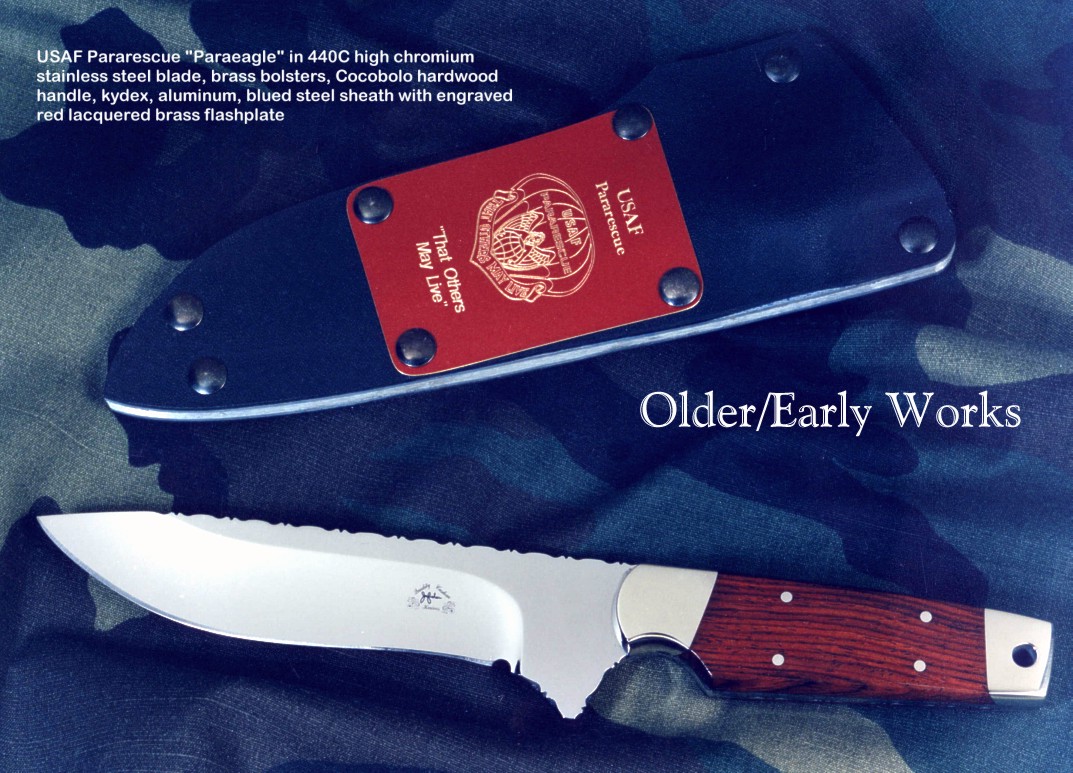
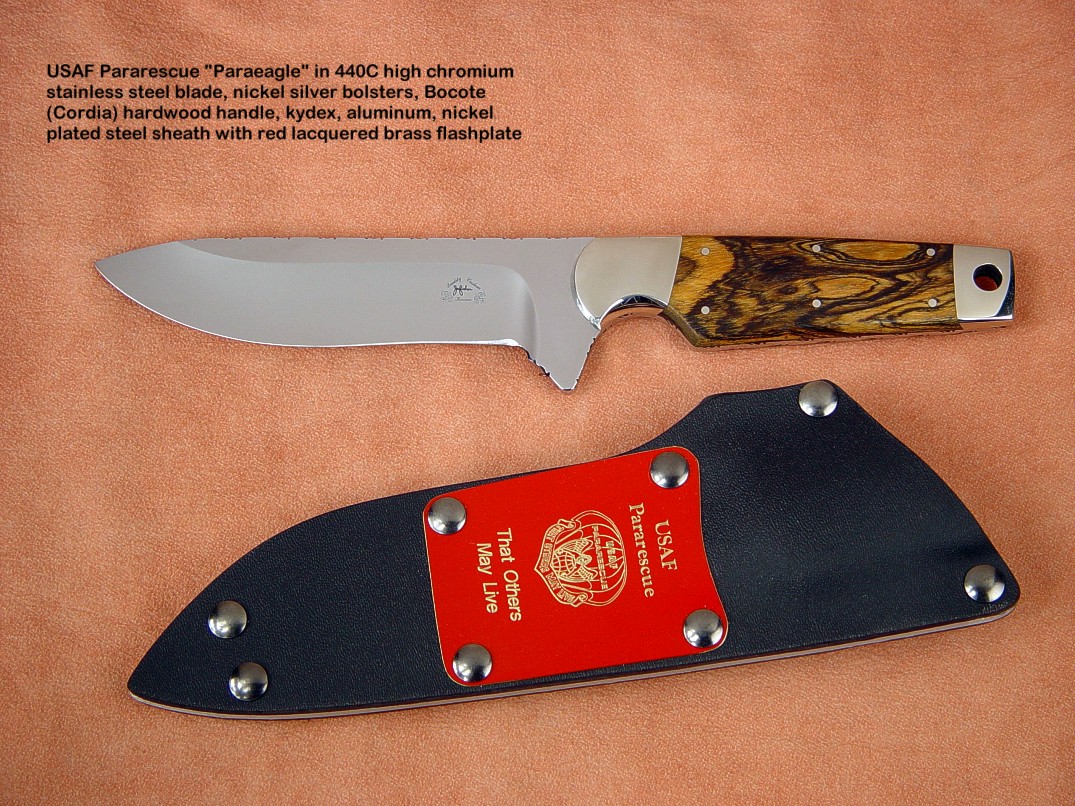
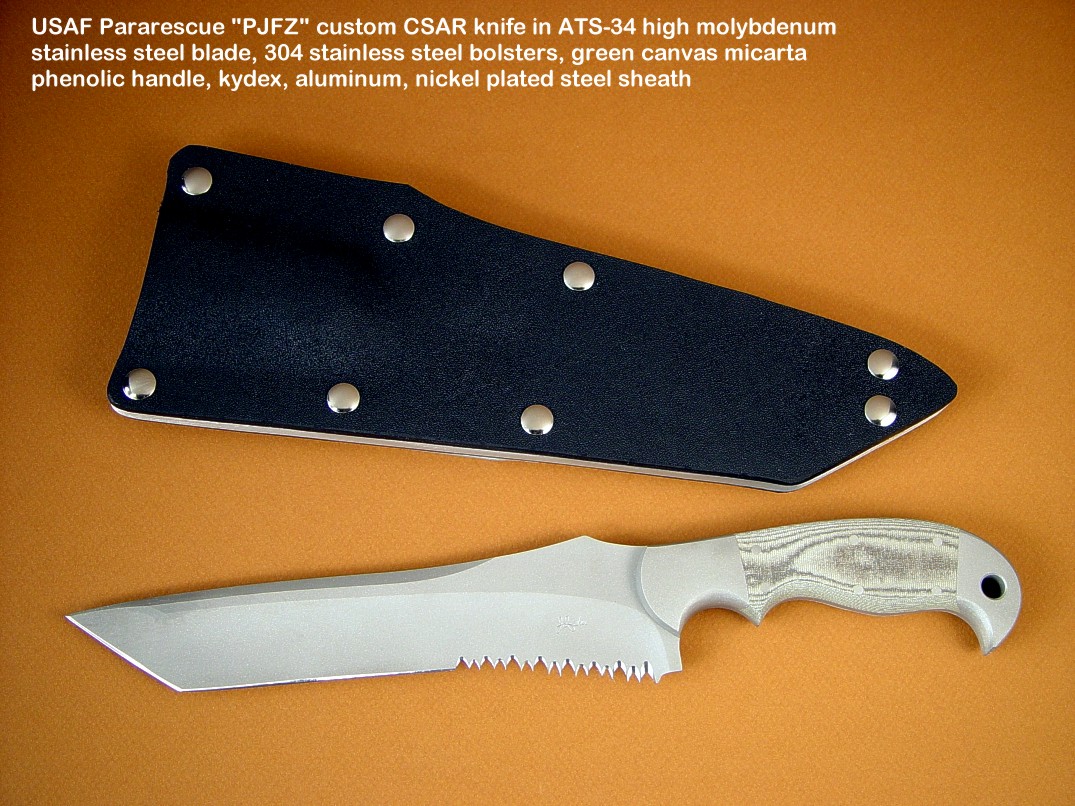
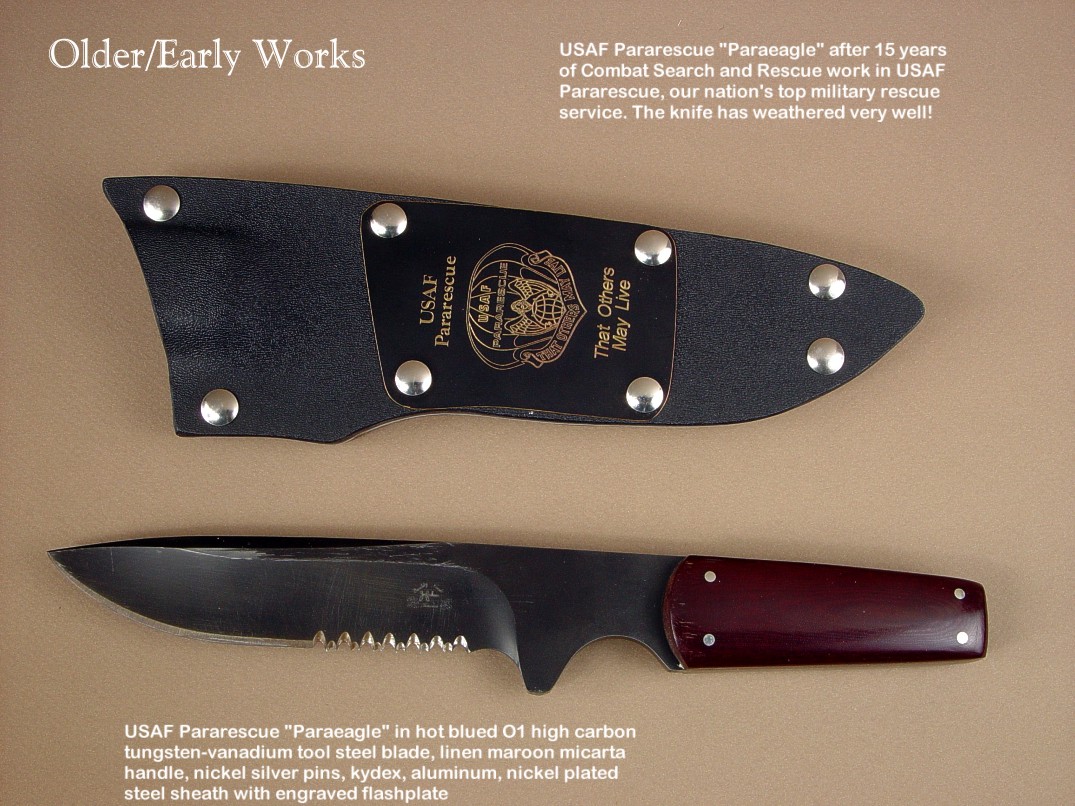
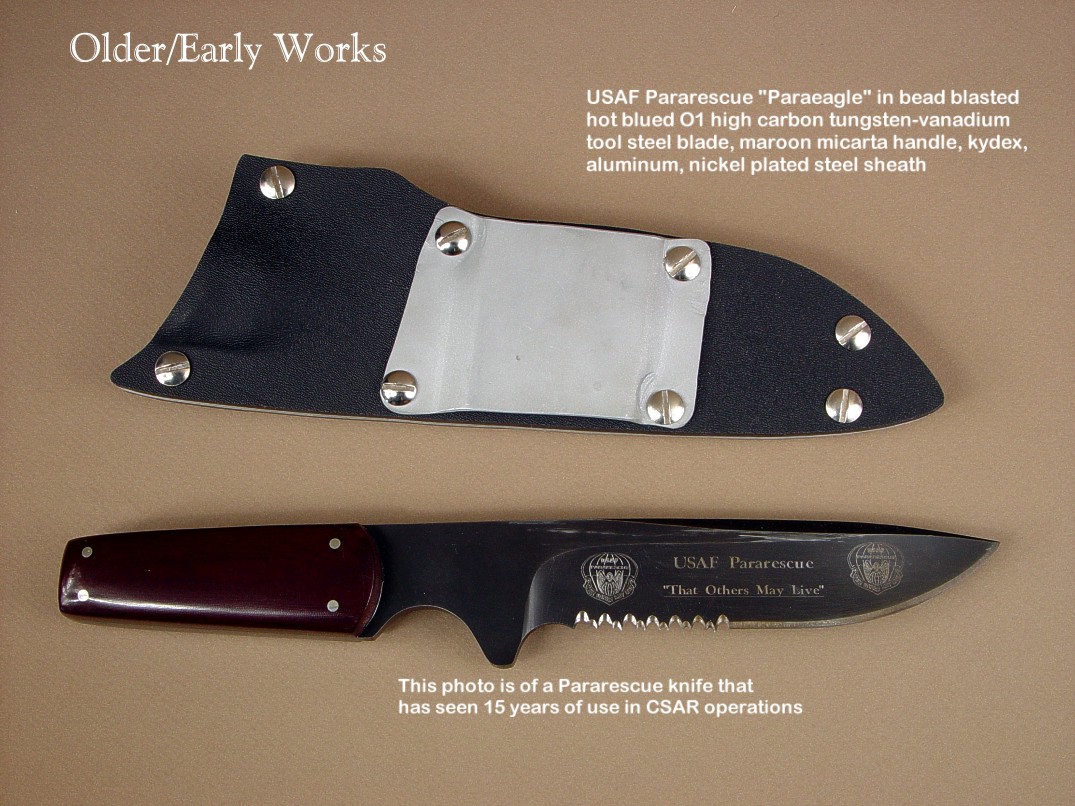
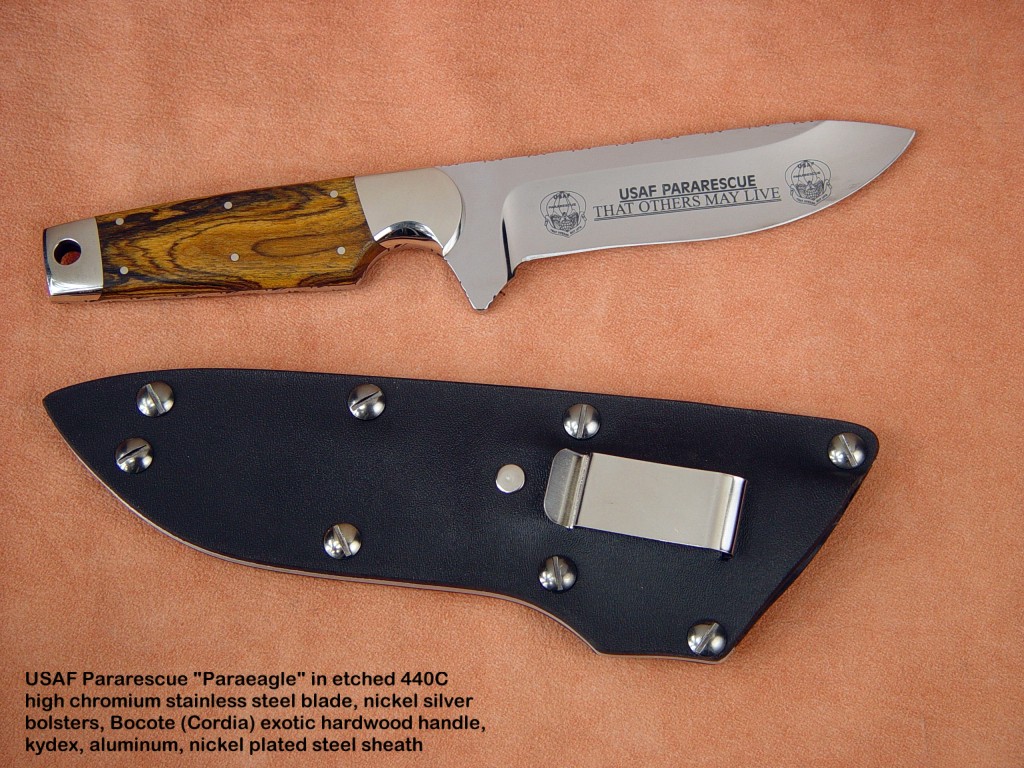
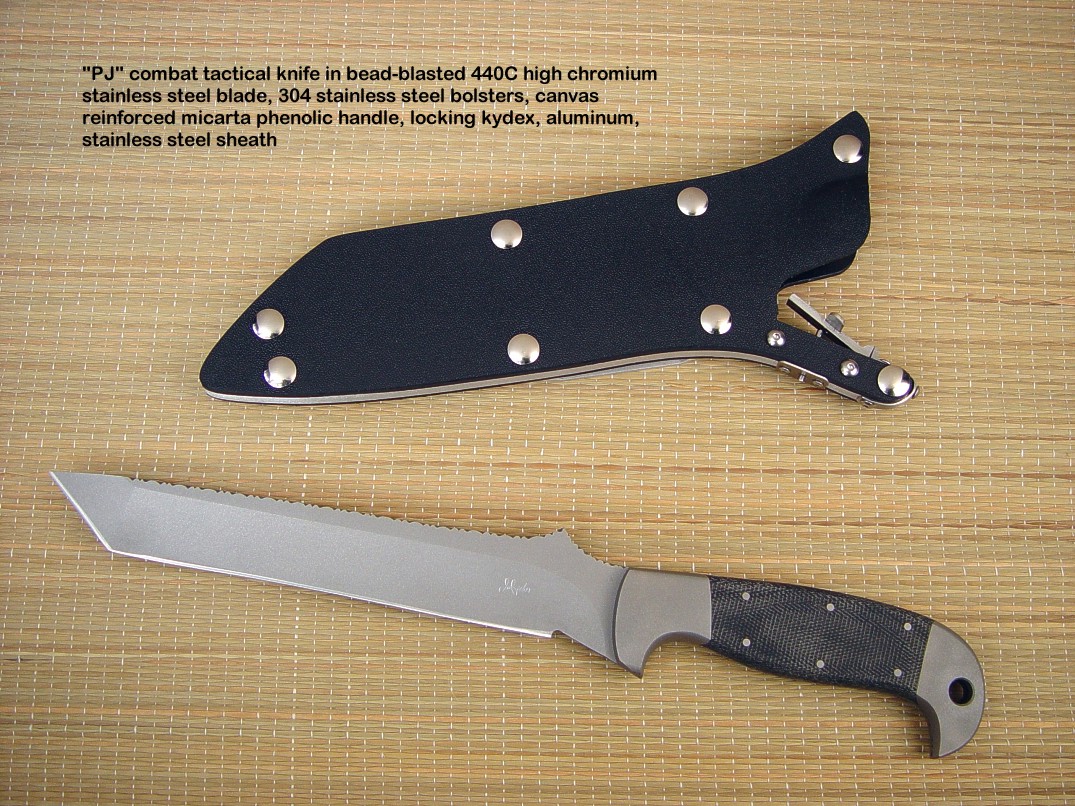
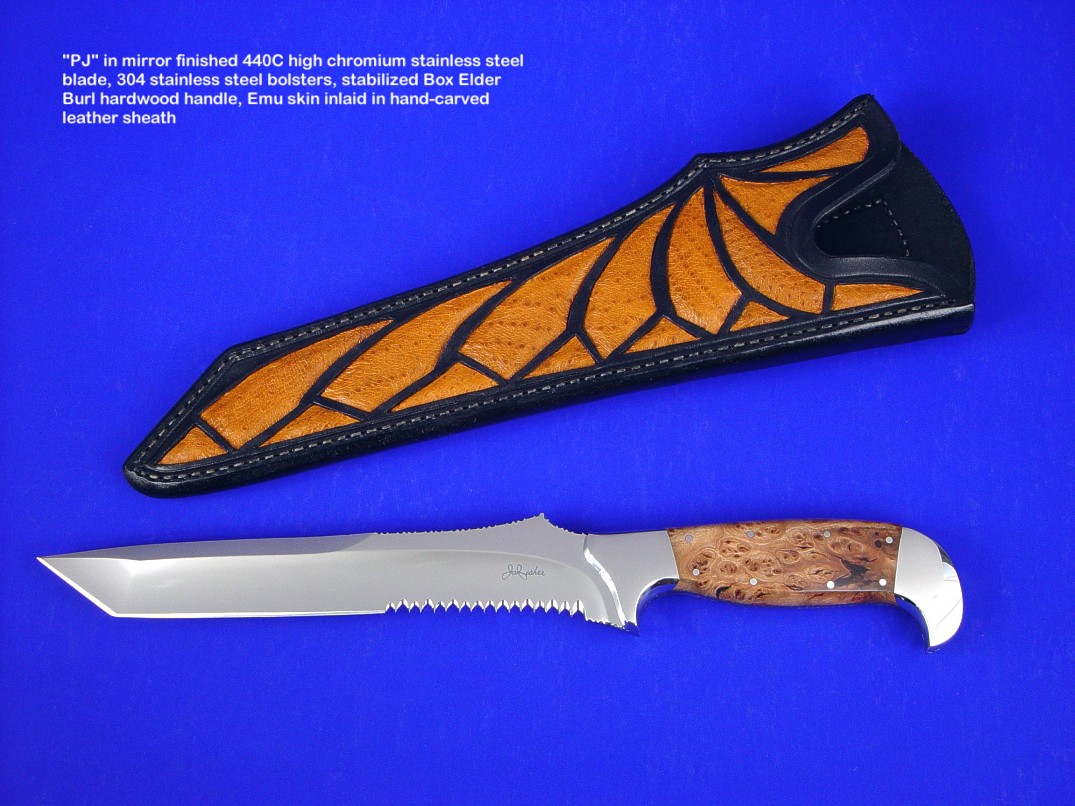
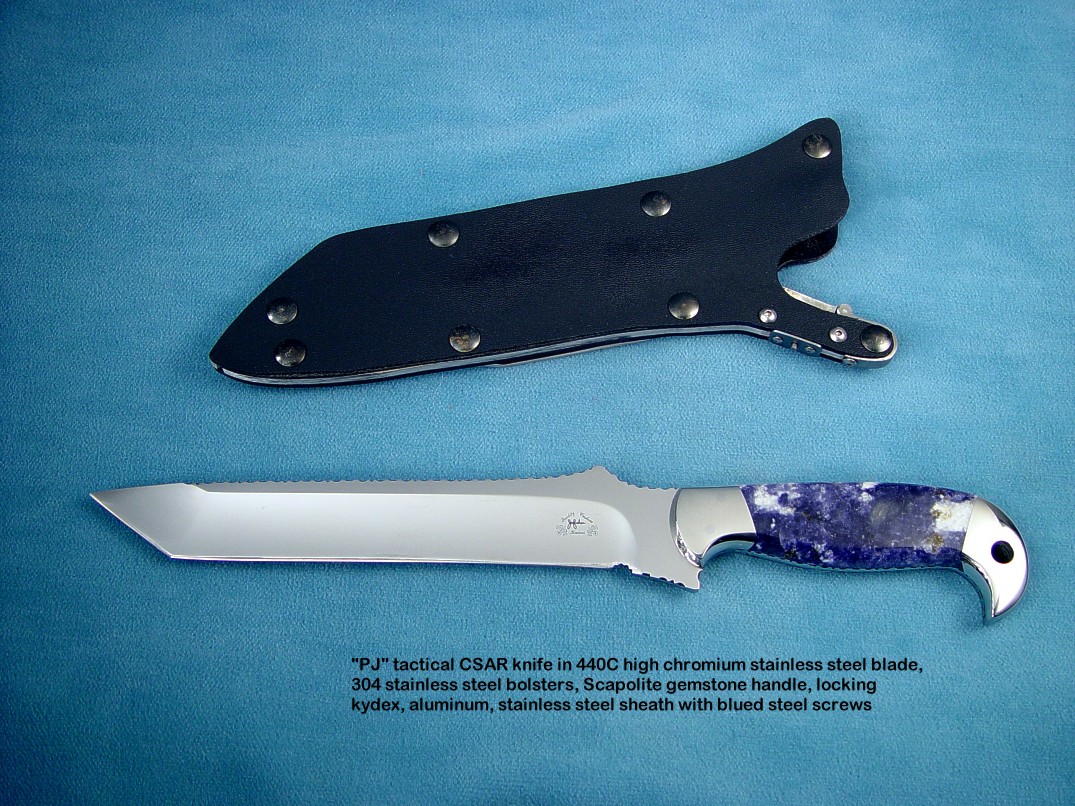
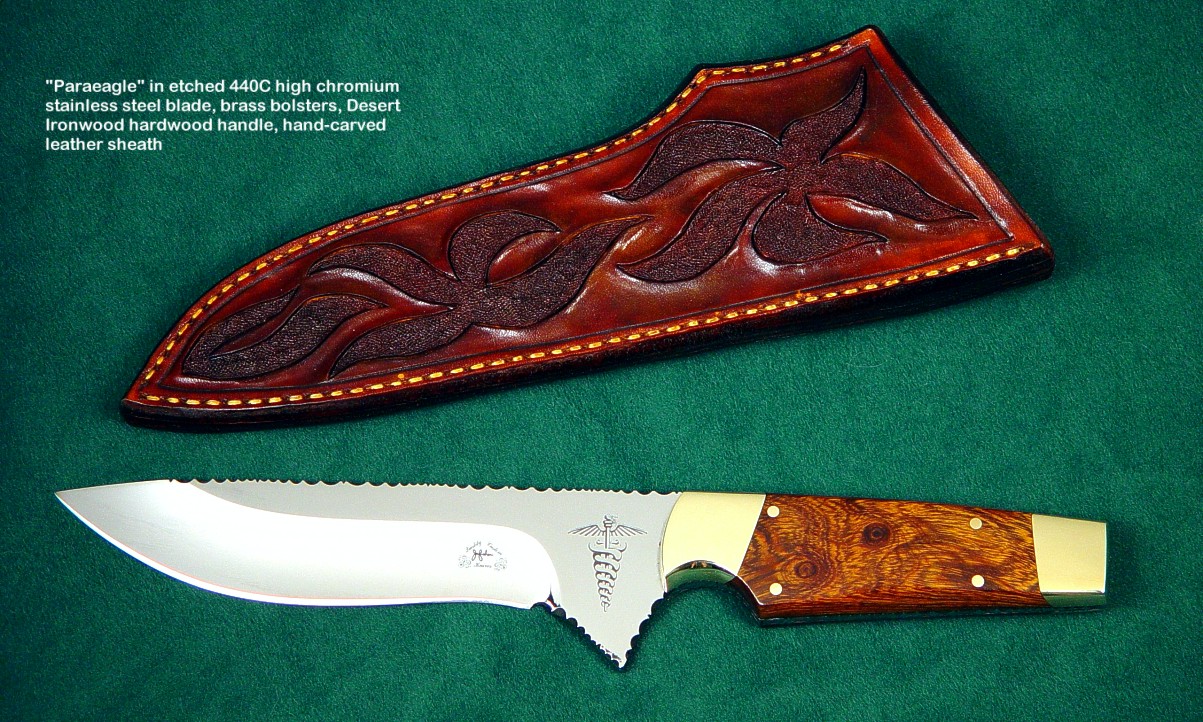
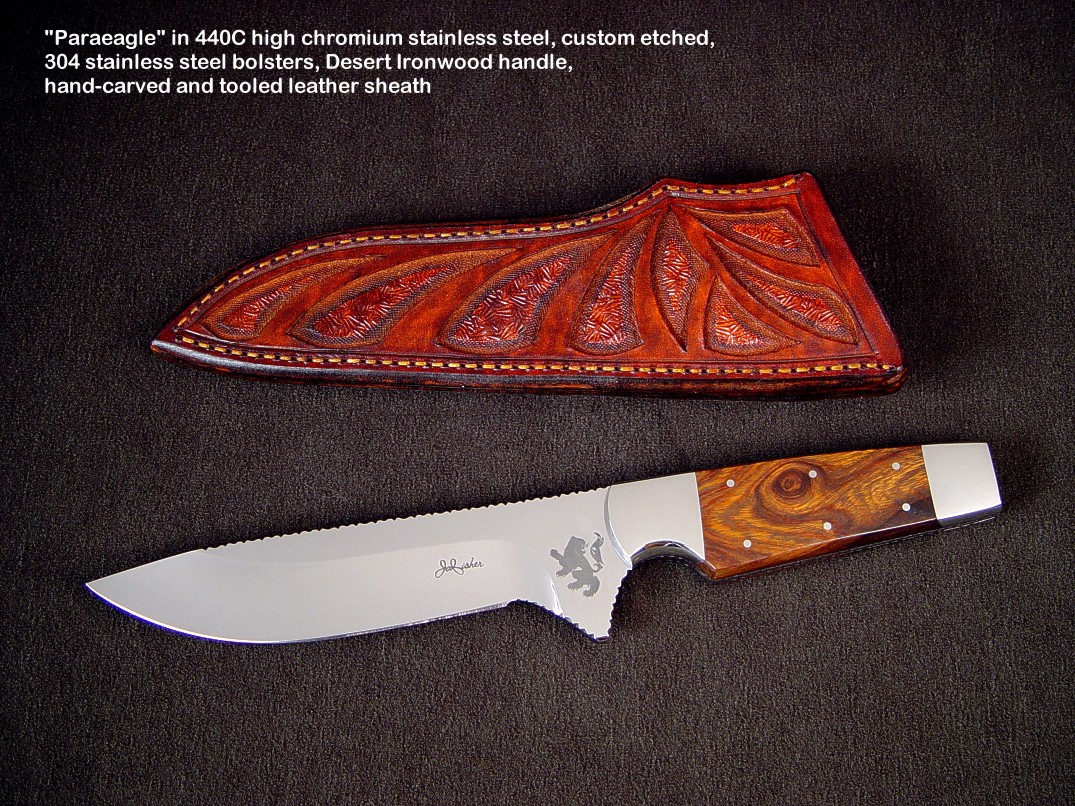
4. Only after the previous considerations should the CSAR professional examine the actual knife use. You might wonder why I'm insistent on this ordered list. It's because if you can't get the knife to the action, easily and reliably extract it and grip it, it won't matter what it's used for. If a knife does not suit these three previous points, you'll end up leaving the knife in your locker at base because it's just not practical. I get emails from guys all the time that think they have a decent knife, but can't wear it, depend on the sheath, mount it accessibly, and hold it reliably to actually use it in rescues. They do know what they will use the knife for: for extraction, cutting, sawing, slicing, light prying, rescue, or defense. I depend on the PJ or rescue professional to know these things, and consider the knife accordingly. If a knife's primary use will be deep slicing, a knife with a curved belly would apply (like the Paraeagle), if a stronger point is required, with a stronger tip, the tanto-bladed PJLT is a good bet. If a super heavy duty knife is needed, the full sized PJ may be the tool just right for the job. The PJFZ has a wider blade, but with thinner profile for reduced weight while keeping a large profile for heavy work. A skeletonized version may be applicable for a flat and less intrusive mounting arrangement. I could go on and on here, but these details are usually provided quite well by the PJ, and if I don't have the knife design he's interested in, I'll make it.

5. Environmental considerations come later in the conversation, and are an important factor determining primarily the materials of construction, and secondly the finish. If the knife should withstand temporary marine exposure (salt water) than a high chromium stainless steel like 440C or CPMS30V will withstand corrosives better than most other steels. If the use will be in the desert with plenty of abrasive sand, a bead-blasted finish will work better. If the grind is very thin and the point of the blade made with a narrow cross sectional geometry, ATS-34 or CPM154CM may apply better due to their higher toughness or resistance to breakage. If wide ranges of heat and cold are expected, multiple sheaths may be required. The handle shape must accommodate grip in slimy, or even greasy exposures. These are all important considerations.

6. The service factor of a knife is seldom considered, unless you use a knife professionally like a Pararescueman will. The knife must be maintainable within the scope of knowledge of the PJ. He'll need to know how to sharpen it, clean it, maintain the knife, the sheath, and any accessories or mounts that ride along with the package. Some steels are too wear resistant to be sharpened in the field, some unusual geometries (like deep recurves) can  only be sharpened correctly with large diameter ceramic rods. You certainly won't find any of those in the field! The finish should be regularly waxed, and that will depend on the exposures and frequency of use. The sheath and knife should be kept clean; if the sheath has a locking mechanism, it must remain clean to be operable. Even the accessories have to be cared for, checked for solidity and tightness, and inspected for ease of use.

7. Once the knife has been used, it must be re-sheathed. This seems so simple that it might not deserve discussion, but it does. Some knife designs, by nature of their blade shape are inherently difficult to sheath. Knives with straight or trailing points (where the point trails higher than the spine) require carful and slow movement into the sheath to prevent damage to the point and sheath bodies and welts. Dropped points are much easier to re-sheath. Knives with serrations have to be re-sheathed with some care and attention so that the teeth do not rip into the sheath or hang on any part of it. Blades with double edges require the most attention, as they have no safe areas except the handle. The sheath location is important. Guys like to think that a sheath in the middle of the back is cool, until they try to re-sheath a razor-tipped cutting edge aimed at their kidneys while blind to the task! Another consideration is the orientation of the knife and sheath mounts which can add difficulty to the re-sheathing operation.

Who knew there was so much to consider? If you are a professional knife user, you probably have already not only considered these points, but been frustrated by the limitations of most knives. I'm doing the best I can to help.

Back to Topics

Please click on thumbnail knife photos and links
!!!Web Page Under Reconstruction!!!

Other Involvement

When I started making knives for United States Air Force Pararescuemen, I couldn't help but admire these tough, highly trained, caring, and dedicated soldier-paramedics. I had served on several fire departments and emergency response teams and was a state registered Emergency Medical Technician myself, so that gave me some civilian background into life saving missions. While there is only the shadow of danger in civilian rescue when compared to combat rescue, many of the same concepts cross fields. My own father served in the Air Force, as did two other uncles and one son-in-law. Another uncle was a Marine. My father-in-law, my brother-in-law and my son served in the army, so the military background is prevalent in our family. So it was easy to find common ground with the PJs. Some of these guys, along with SERE professionals who affiliate with PJs became and will continue to be lifelong friends.

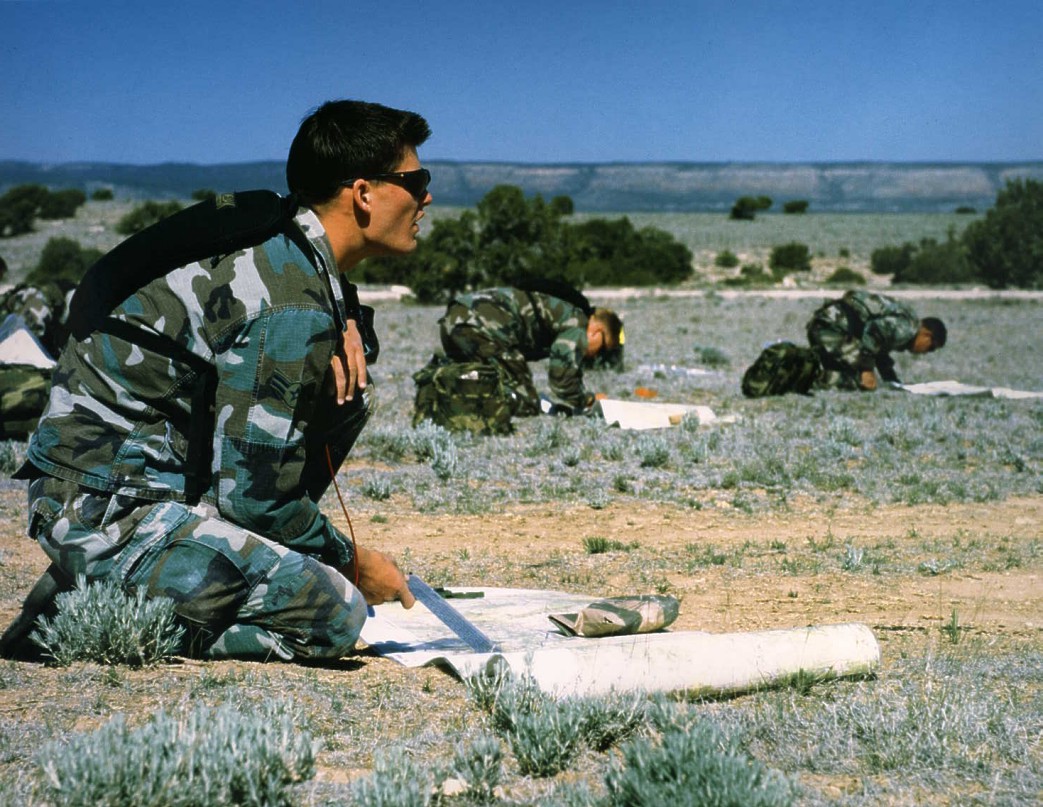
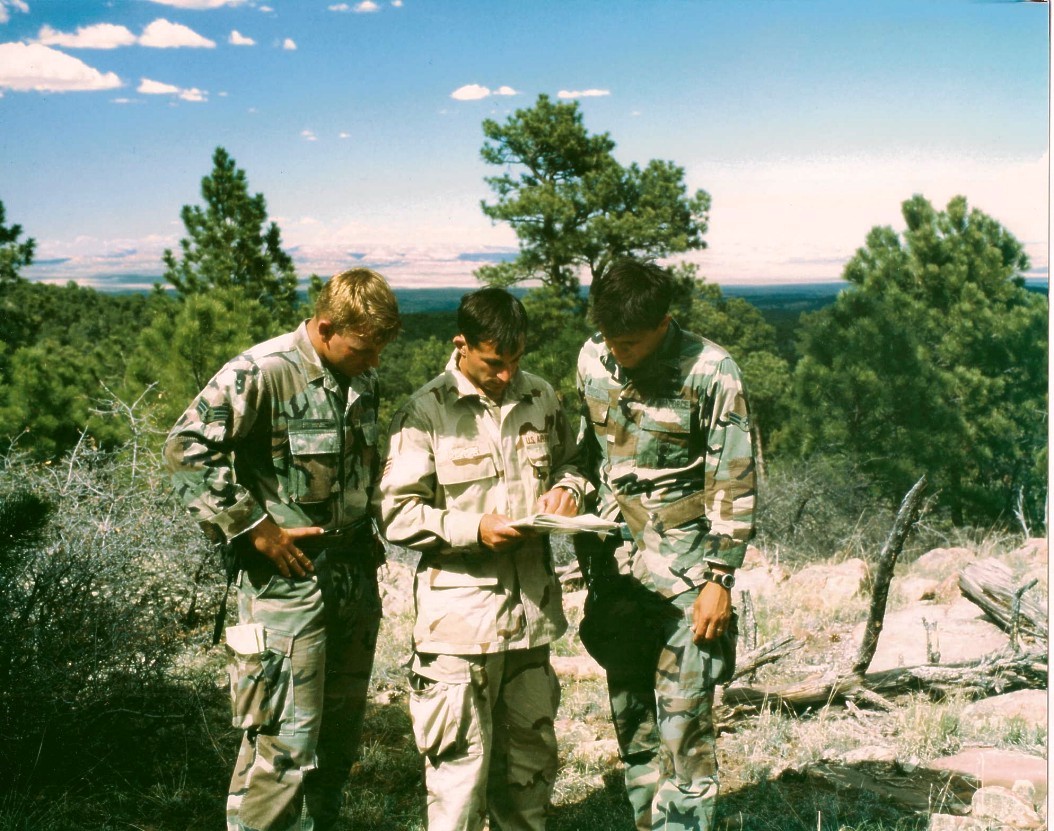
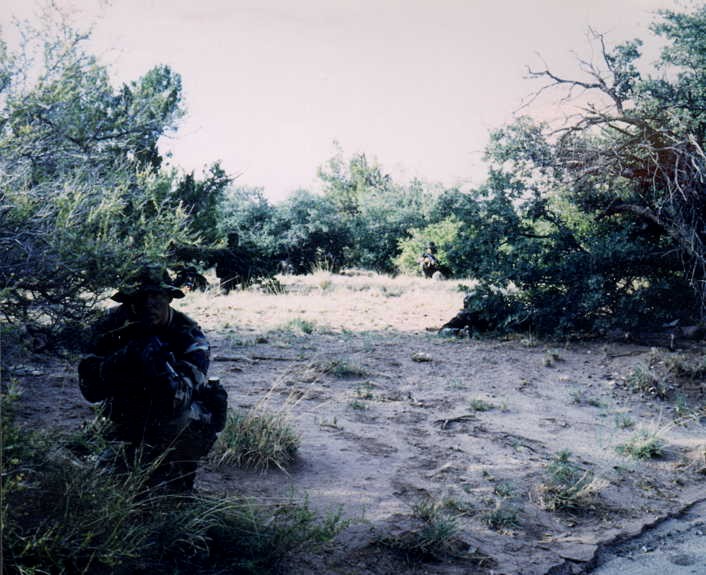
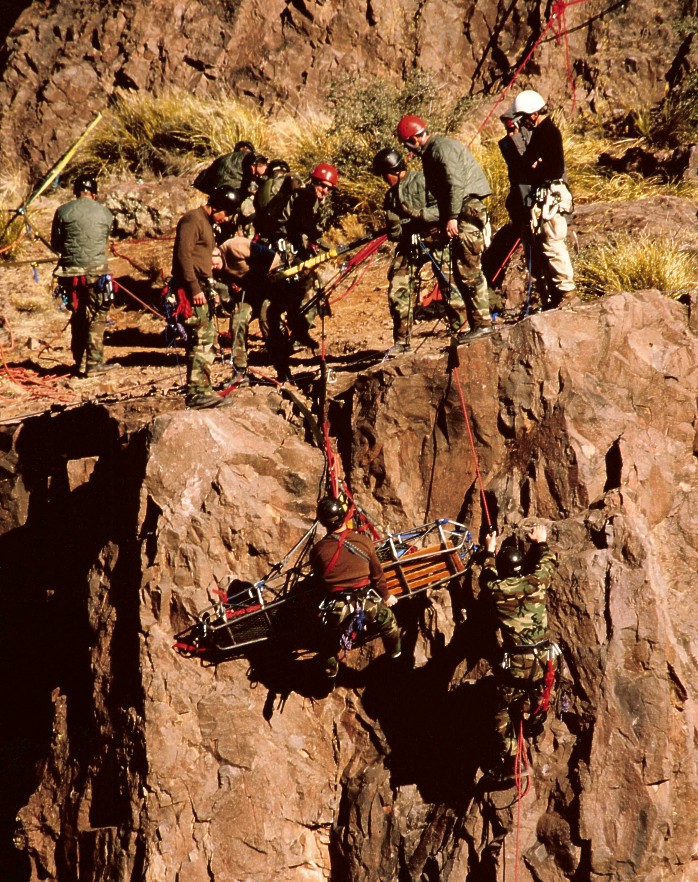
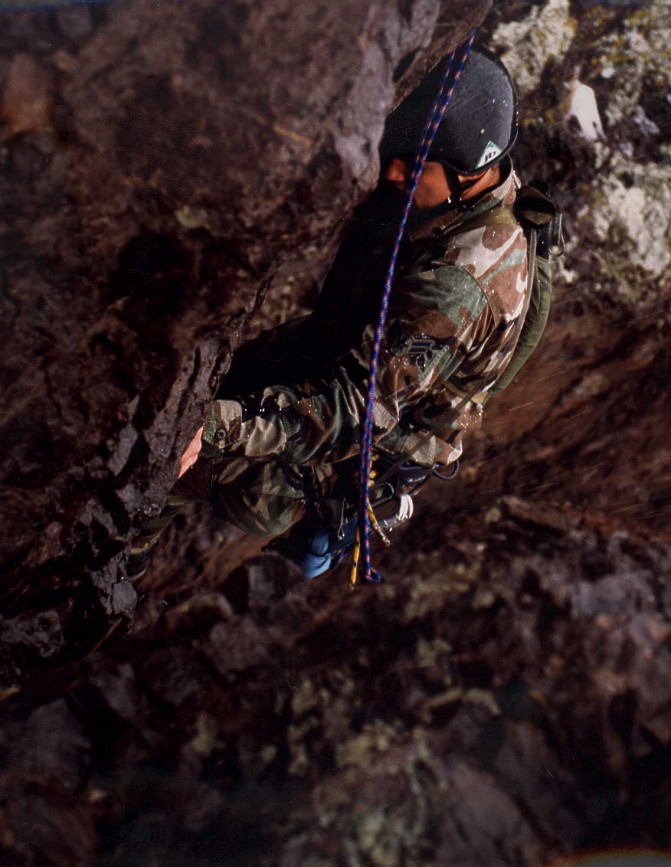
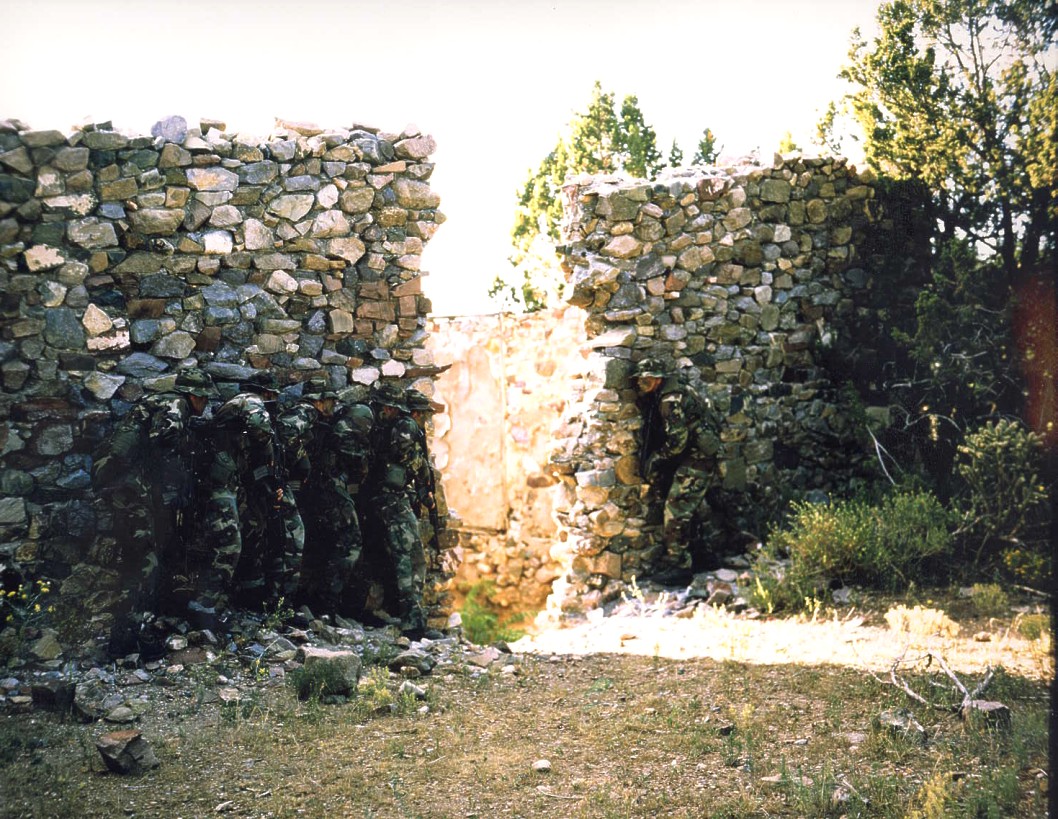
When I started working with Pararescuemen, it was all about the knives, but soon moved into other areas. Being a lifelong photographer, I started photographing PJs in their blocks of training, and some of those photographs still hang at the PJ School at Kirtland AFB in Albuquerque. I photographed them personally also, for their families and their own record during their training. I accompanied them for several of these field operations, and found their professionalism and honor to be of the highest caliber and order at all times. To keep up with them was a brutal challenge, and that was just training! I worked with Pararescue in several partisan training operations also as a civilian player and organizer, and was and still am an advocate for their professional field. It has always been, and will continue to be an honor.

I am humbled that PJs use and carry my knives in combat and civilian rescues and missions. When James Beauchamp started working in the studio with me, I pressed hard for him to create Pararescue knives in collaboration with me, because the need and honor of doing so is great. Both James and I plan to continue making Pararescue and PJ inspired knives for as long as we are able.

It is stunningly powerful to know that some of the knives have been with PJs when they have given their all in battle. This is a very serious world, extremely dangerous, and haltingly unfair. Defending our freedom and saving others who do so with the ultimate sacrifice is something that few individuals would ever understand, much less do. Yet Pararescuemen offer their all so that others may live.

Back to Topics

Please click on thumbnail knife photos and links

What this page is about

For many years, I've been honored to know and have a professional affiliation with members of the United States Air Force Pararescue, our nation's top military rescue service. These PJs (Pararescue Jumpers) are amazing men: starting with the toughest training in the military, ending up in every aircraft military rescue operation, over land or sea, and in countless civilian rescues beyond the scope of typical or civilian rescue personnel. They are incredible soldier-paramedics, trained in advanced combat lifesaving techniques, water rescue, survival, combat tactics, mountain rescue, navigation, and many other fields. They parachute behind enemy lines to rescue our own and our allies, in the worst conditions of battle and environment imaginable. When the situation completely goes to hell, these are the guys that will put their life on the line to come in and take you to safety.

This page is about the knives I make for United States Air Force Pararescuemen, with plenty of examples and links to these very special knives right here on my web site. I've included sections on the history, a bit of anatomy of CSAR knives, other associations I've had with PJs, and where the future of this is going. Thanks for being here, and please thank our servicemen for their sacrifice!
Back to Topics

Please click on thumbnail knife photos and links

What this page is about

For many years, I've been honored to know and have a professional affiliation with members of the United States Air Force Pararescue, our nation's top military rescue service. These PJs (Pararescue Jumpers) are amazing men: starting with the toughest training in the military, ending up in every aircraft military rescue operation, over land or sea, and in countless civilian rescues beyond the scope of typical or civilian rescue personnel. They are incredible soldier-paramedics, trained in advanced combat lifesaving techniques, water rescue, survival, combat tactics, mountain rescue, navigation, and many other fields. They parachute behind enemy lines to rescue our own and our allies, in the worst conditions of battle and environment imaginable. When the situation completely goes to hell, these are the guys that will put their life on the line to come in and take you to safety.

This page is about the knives I make for United States Air Force Pararescuemen, with plenty of examples and links to these very special knives right here on my web site. I've included sections on the history, a bit of anatomy of CSAR knives, other associations I've had with PJs, and where the future of this is going. Thanks for being here, and please thank our servicemen for their sacrifice!
Back to Topics

Please click on thumbnail knife photos and links

!!!Web Page Under Reconstruction!!!

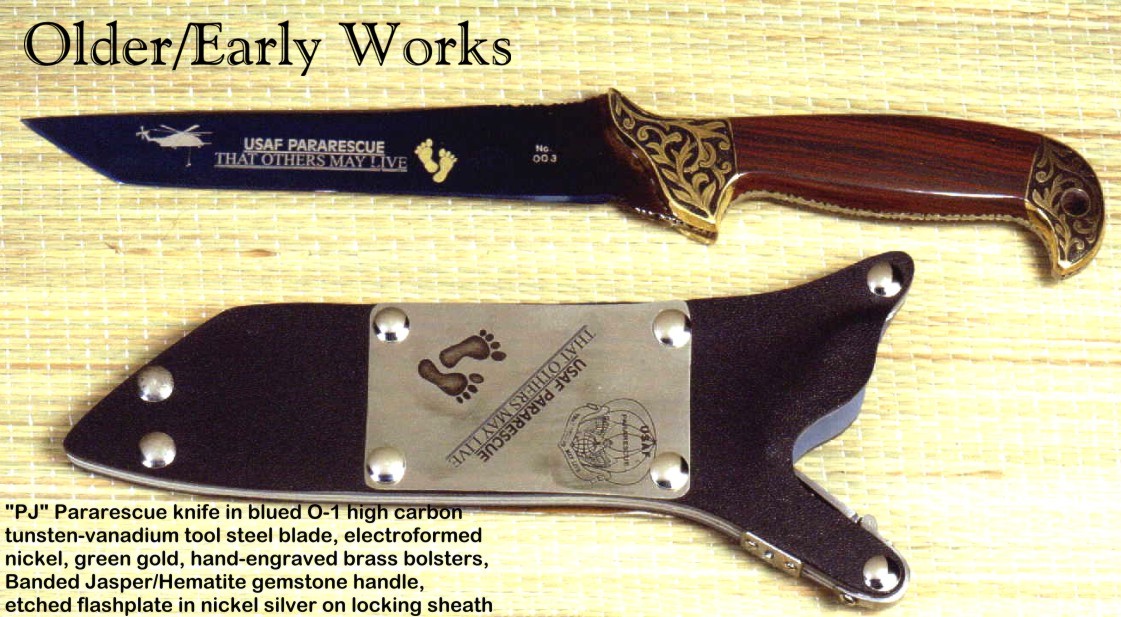
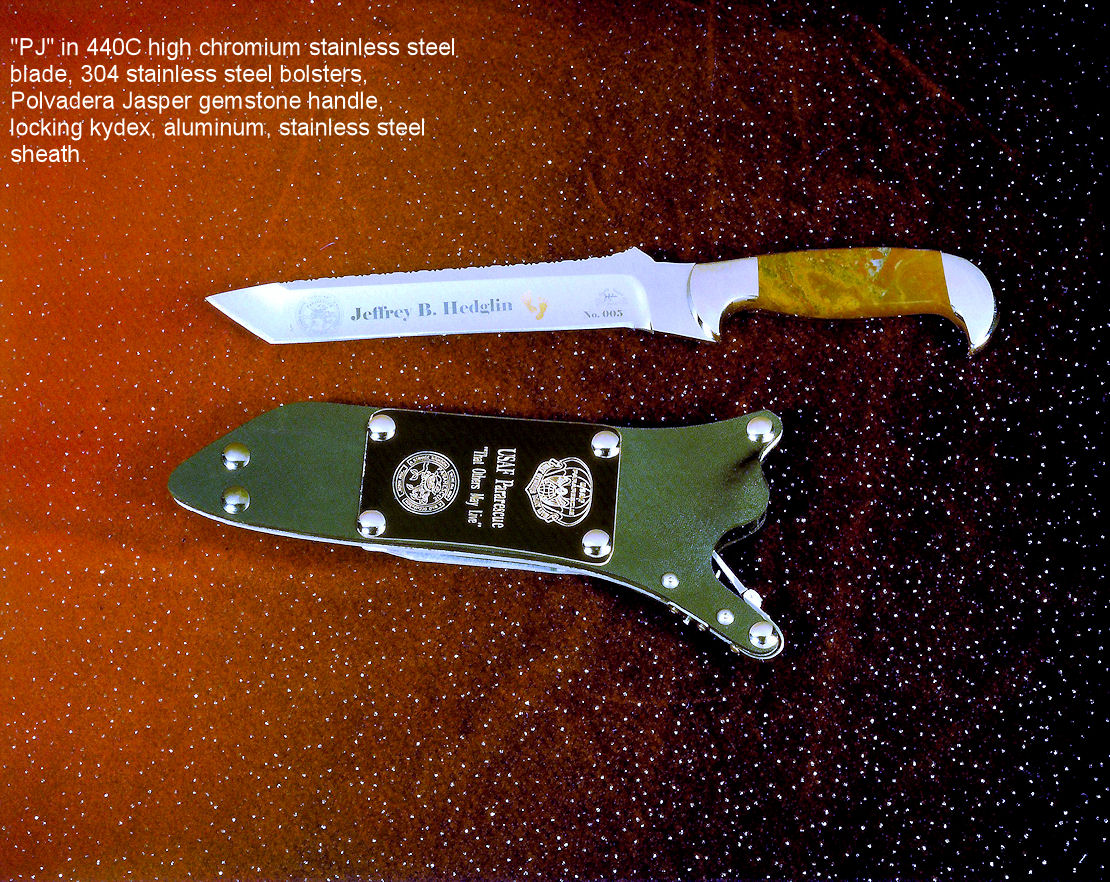
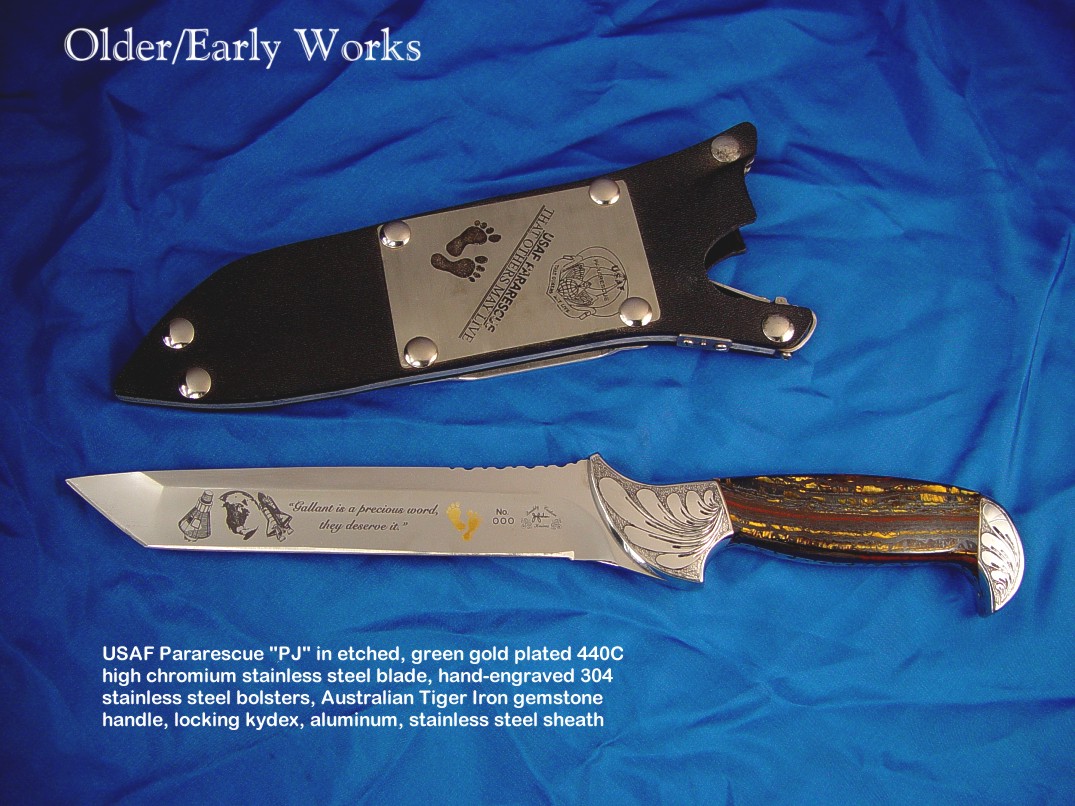
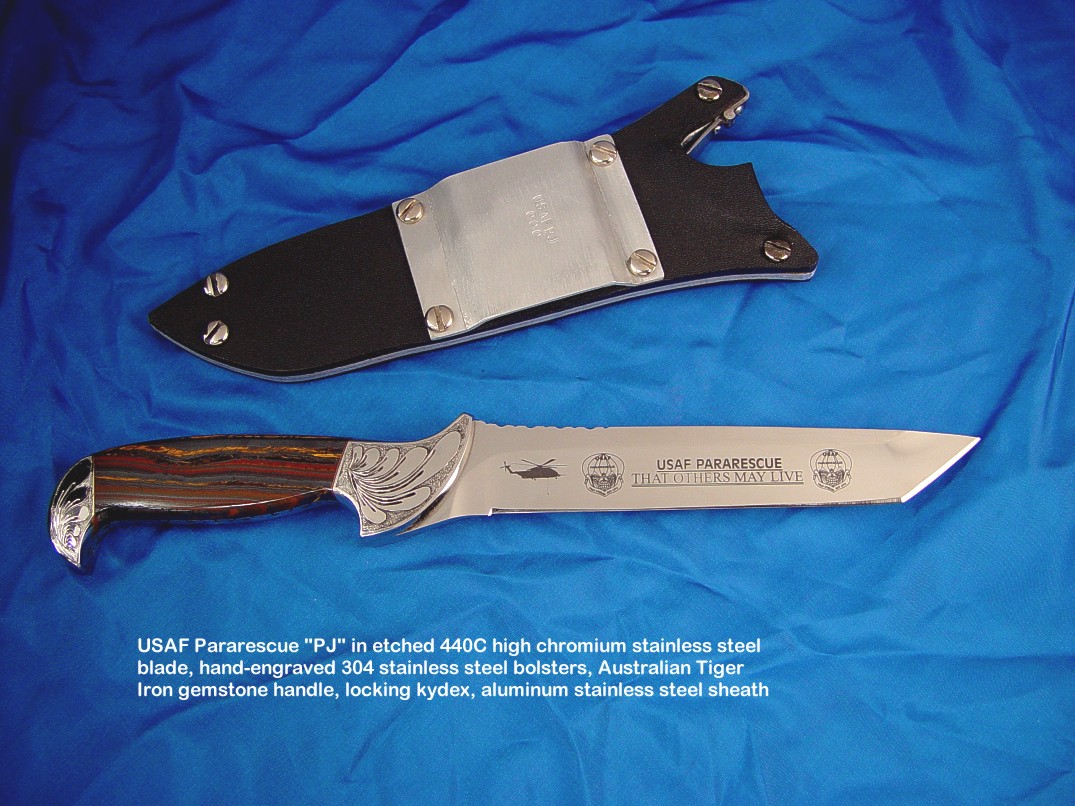
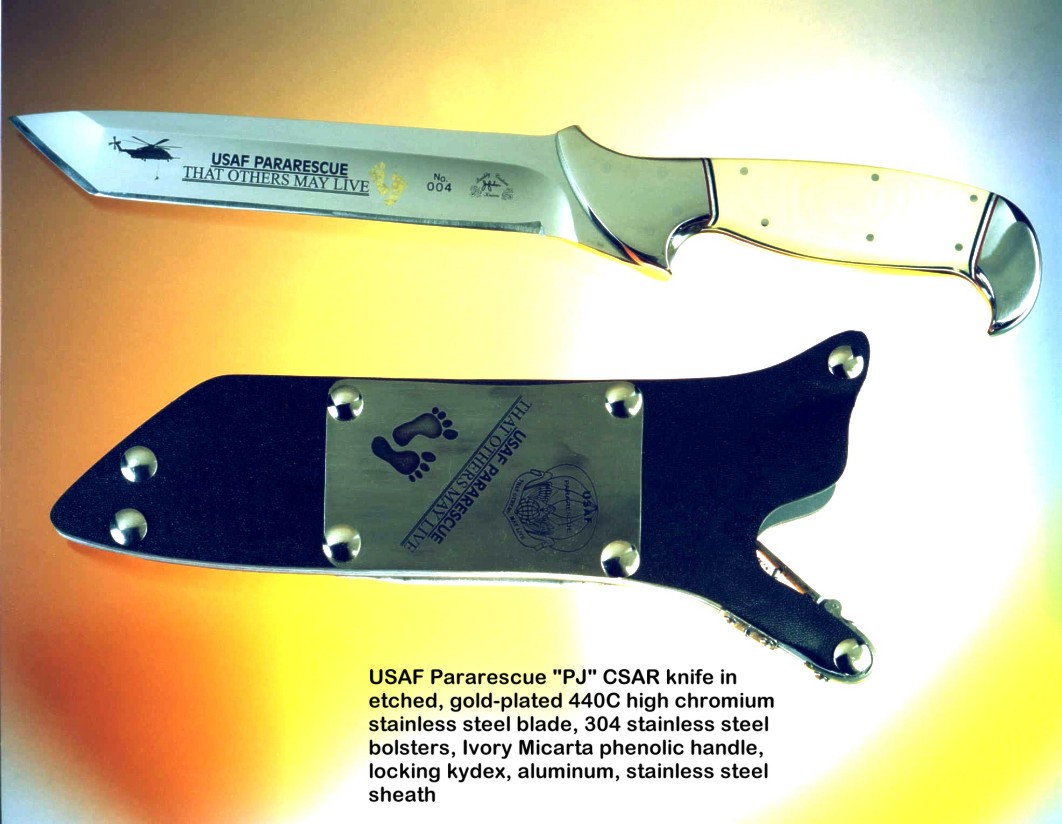
Obverse side: United States Air Force Pararescue Commemorative: "PJ" the first prototype Pararescue knife. Etched and Green Gold overlay on 440c high chromium stainless tool steel, hand-engraved 304 stainless steel bolsters, Australian Tiger Iron gemstone handle, locking kydex, aluminum, and stainless steel sheath


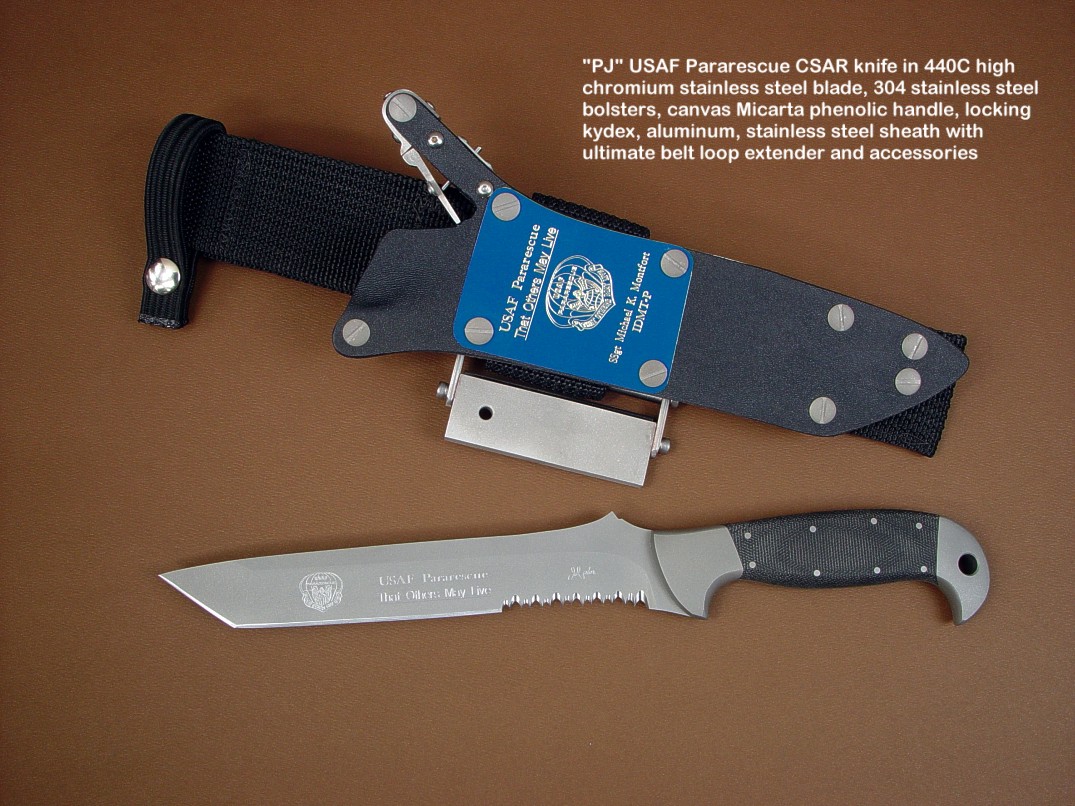
Featured: Pararescue "PJ" prototype. In the mid 1990s, I was asked by Pararescuemen to make the best knife I could, one suitable for combat and rescue operations, a knife that could be used to build a shelter, defend against an attacker, sever an entanglement, dig a hole, and be "shove it in a rock and stand on it" tough. They asked for a positively locking sheath, built "bulletproof," suitable for wearing during a HALO jump. This was my prototype. It was not a design I simply threw together; it was created from the minds of Pararescuemen: guys who took knives to the field and used them and knew just what they needed. I was honored to have them ask me to put my hands and skill to their needs. Since those beginnings, I've made many Pararescue knives with their input, suggestions, and ideas. These knives are not all as elaborate as the commemorative you see here, most of them are tactical gray, bead blasted, with micarta handles. But the most important thing is that they are out there, doing the job, in the hands of our nation's top military rescue service. I still consider it one of my greatest honors to make a knife for a PJ.
 

Reverse side: Pararescue commemorative "PJ"

Click on thumbnail photos of Pararescue Knives

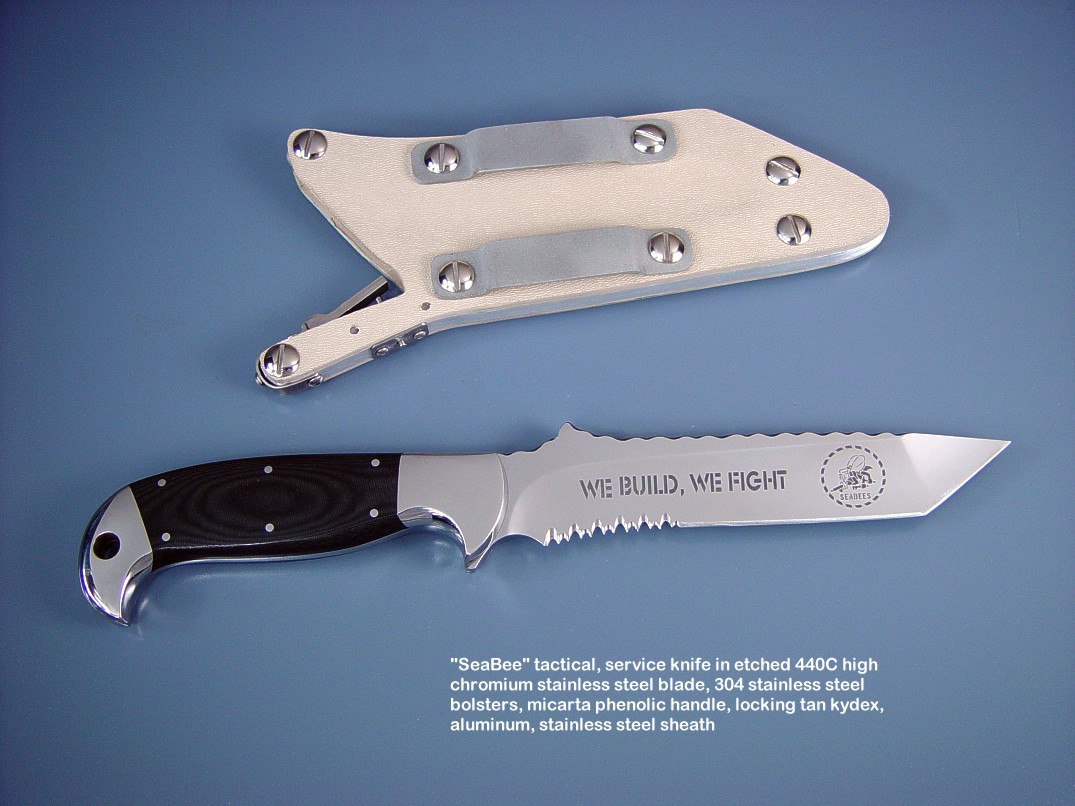
Fine commemorative military combat, Rescue knives, Pararescue  Light, Waterproof Stainless Steel Locking combat Sheath     PJLT Shank tactical combat fine custom Rescue knife, stainless steel, waterproof, kydex, skeletonized handle     Pararescue fighting knife, combat tactical rescue stainless steel, waterproof sheath     Handmade Custom Military CSAR combat and Tactical Knives,  Etched, Gemstone, Waterproof Locking Sheath     "Paraeagle" fine tactical knife in 440c high chromium stainless steel blade, custom etched, 304 stainless steel bolsters, Desert Ironwood handle, hand-carved and tooled leather sheath     "PJLT" Tactical Combat, Search and Rescue knife, obverse side view;  in 440C high chromium stainless steel blade, 304 stainless steel bolsters, Blue/Black G10 fiberglass/epoxy laminate handle, locking kydex, aluminum, stainless steel sheath

Thanks Jay. We all really appreciated that you took time out of your day, as busy as you are, to let us come by and check everything out. It was very impressive to see all the work, skill and care that goes into the knives you produce. I also wanted to express thanks for being so supportive toward what were trying to do, and more so, the military in general. We all thought that was really nice. I'm really excited about this knife, just the plastic cut out today was neat, I cant wait to see the finished product.       Once again thanks,

N.F., USAF Pararescue

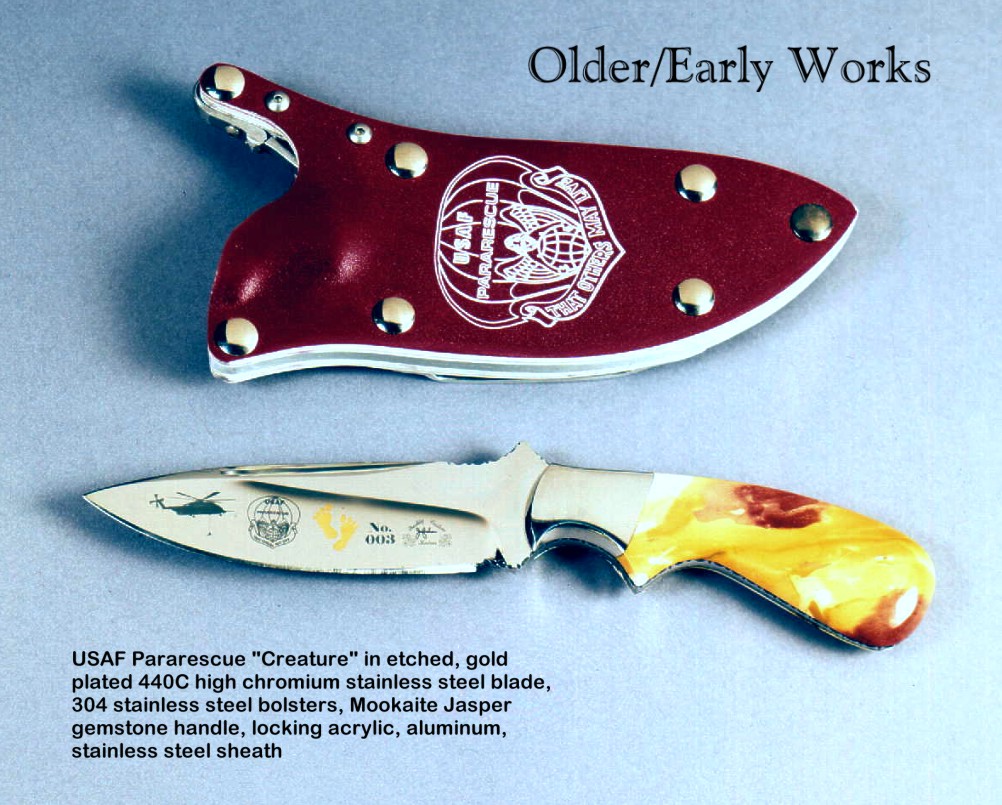
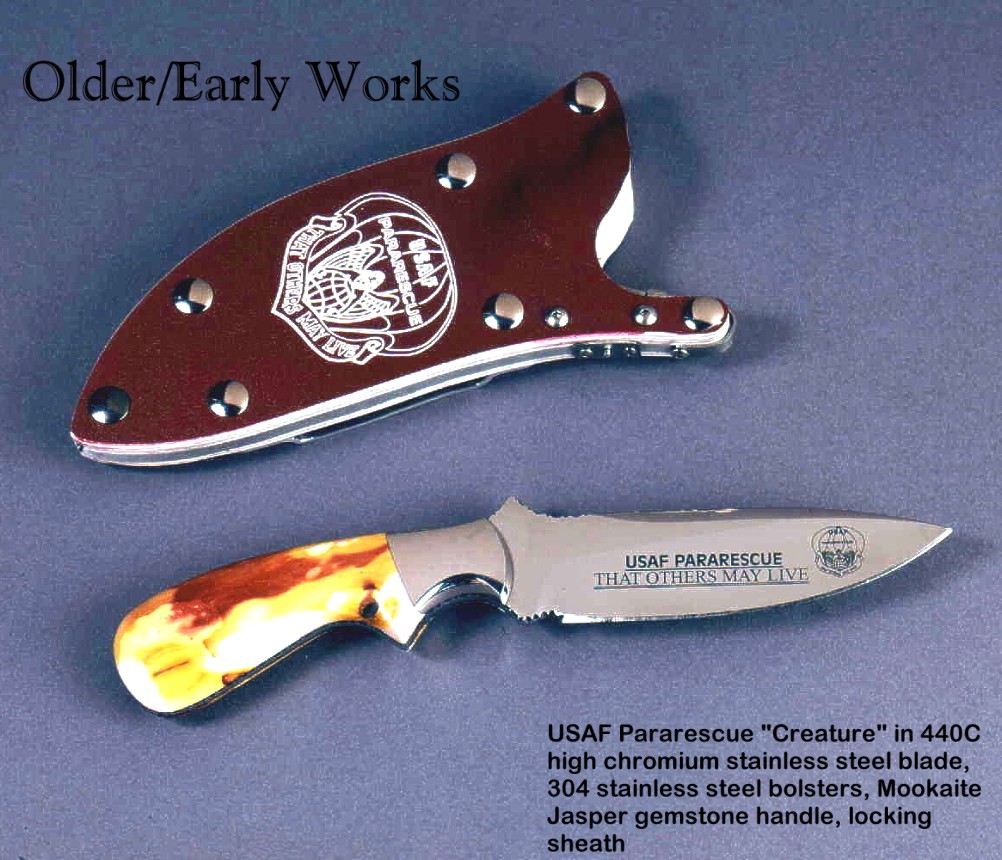
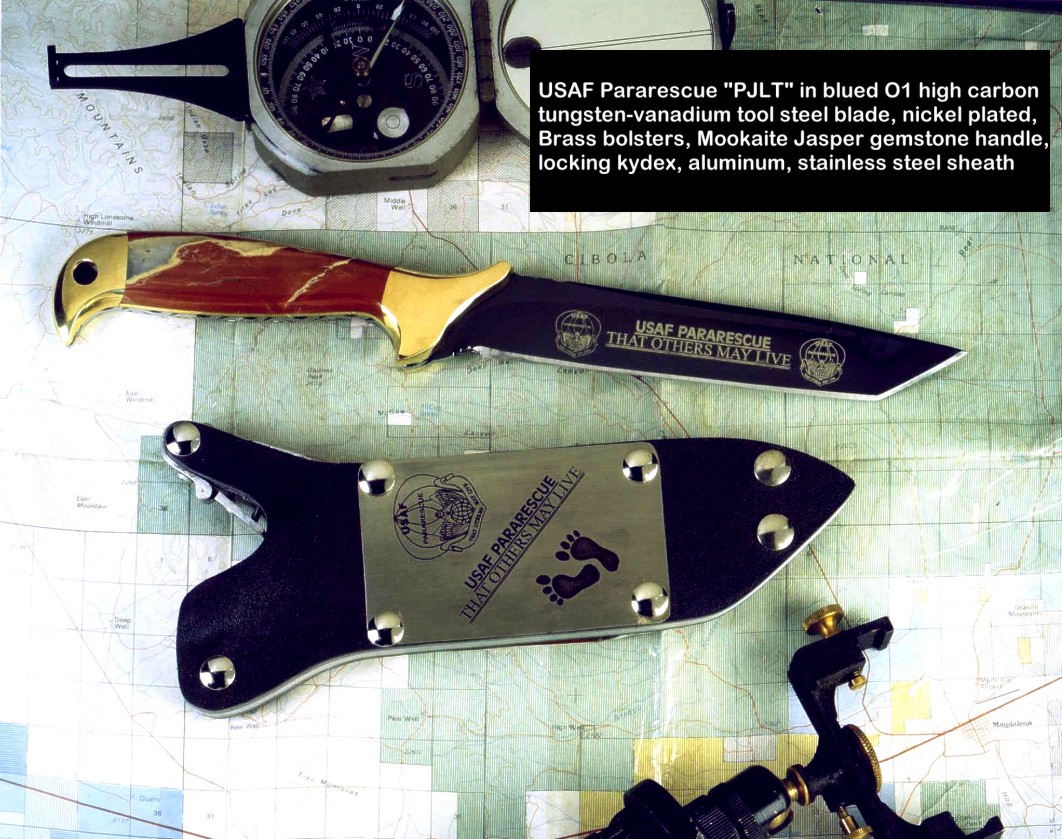
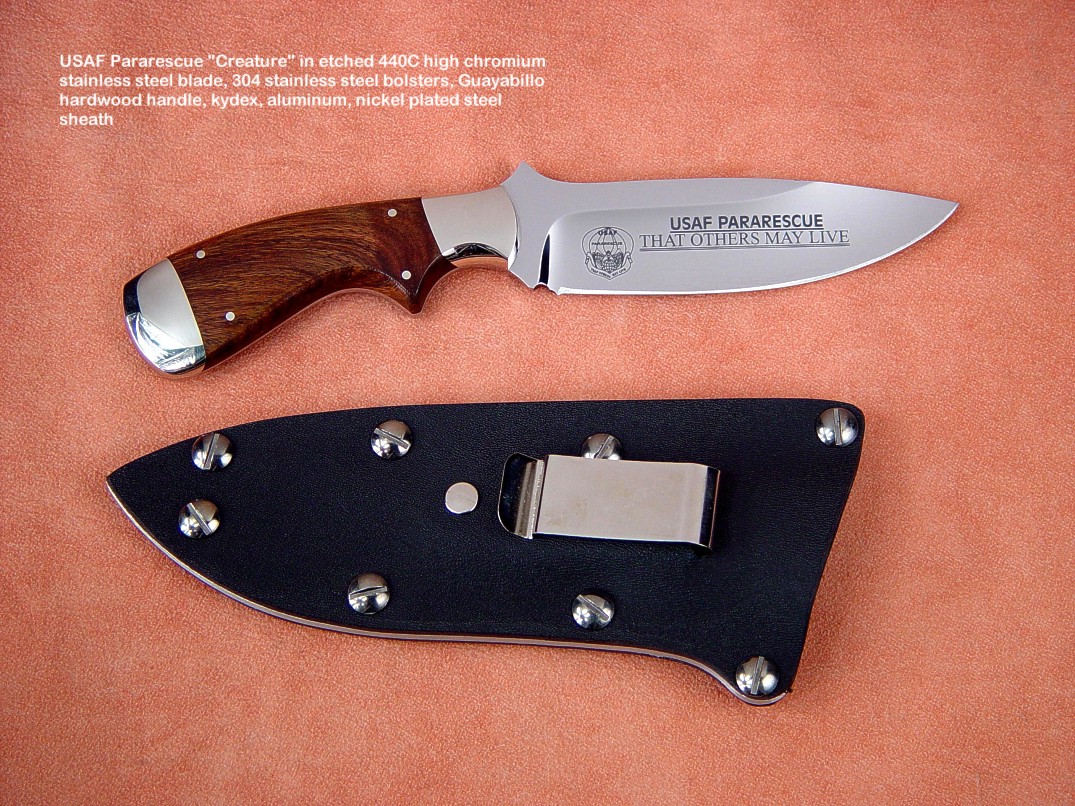
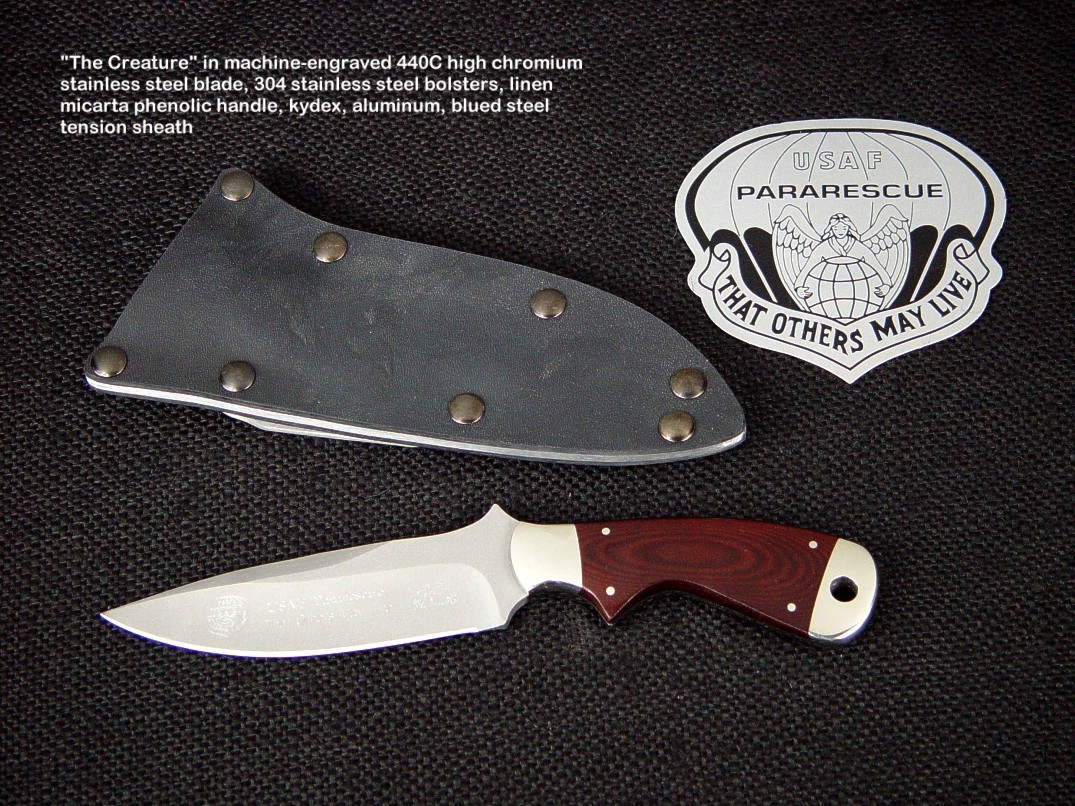
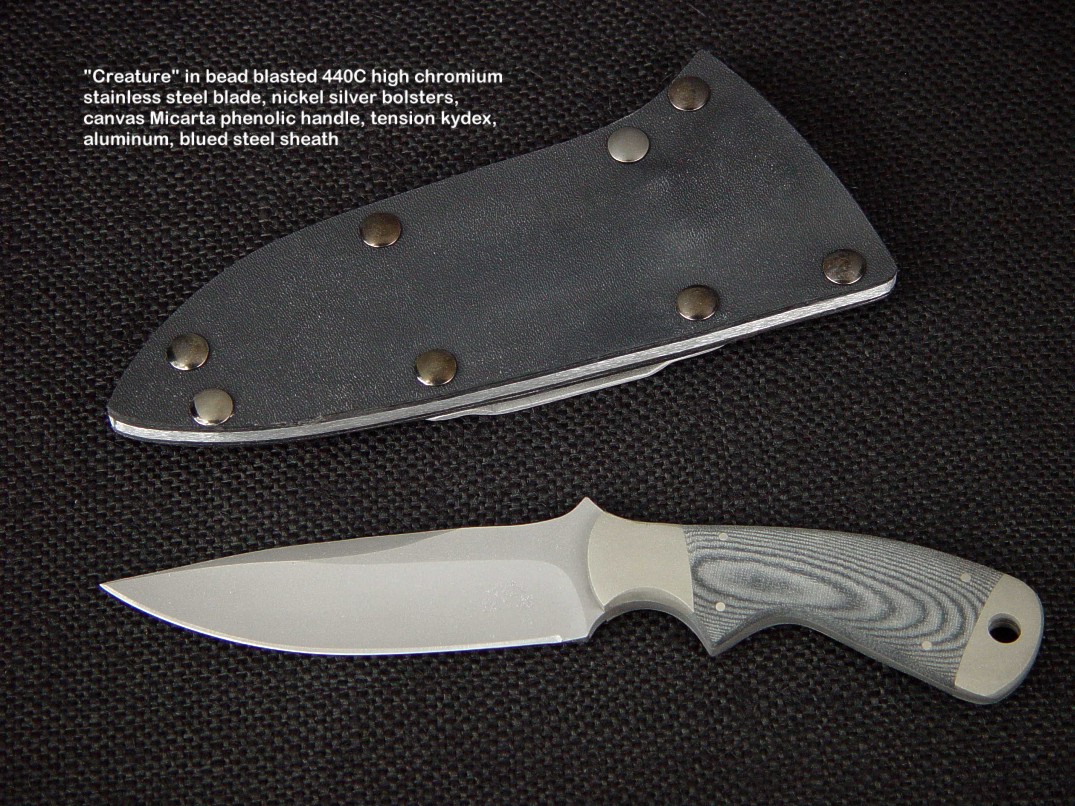
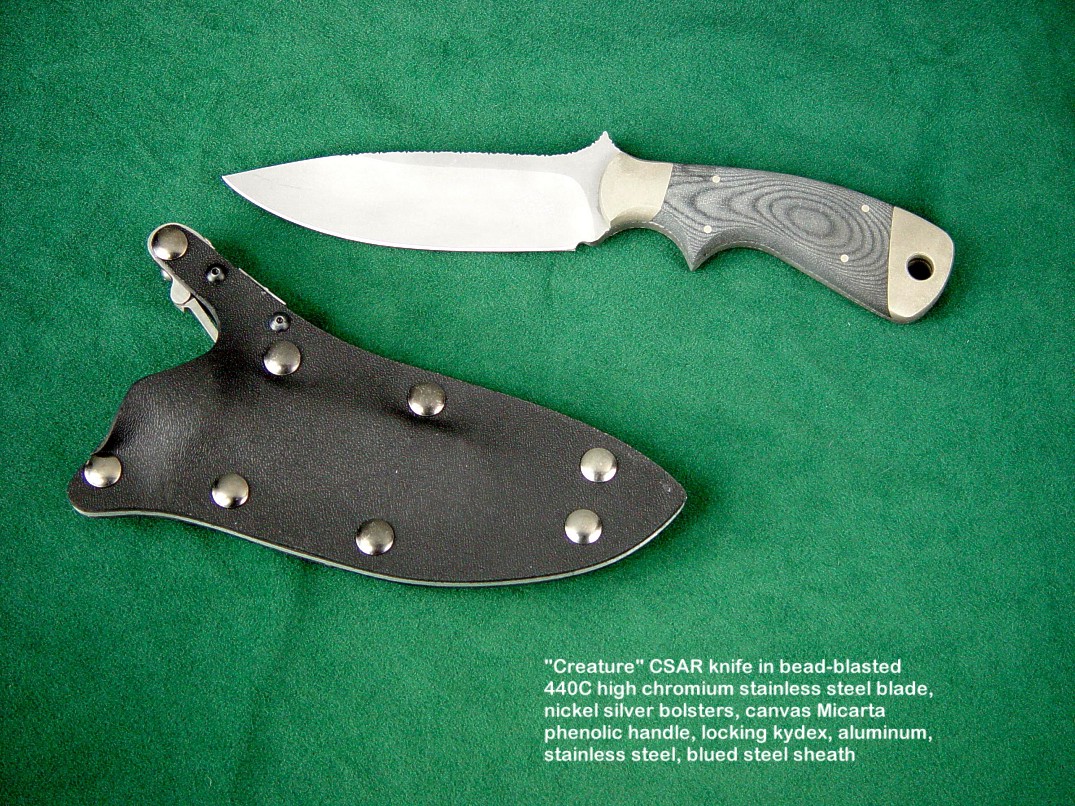
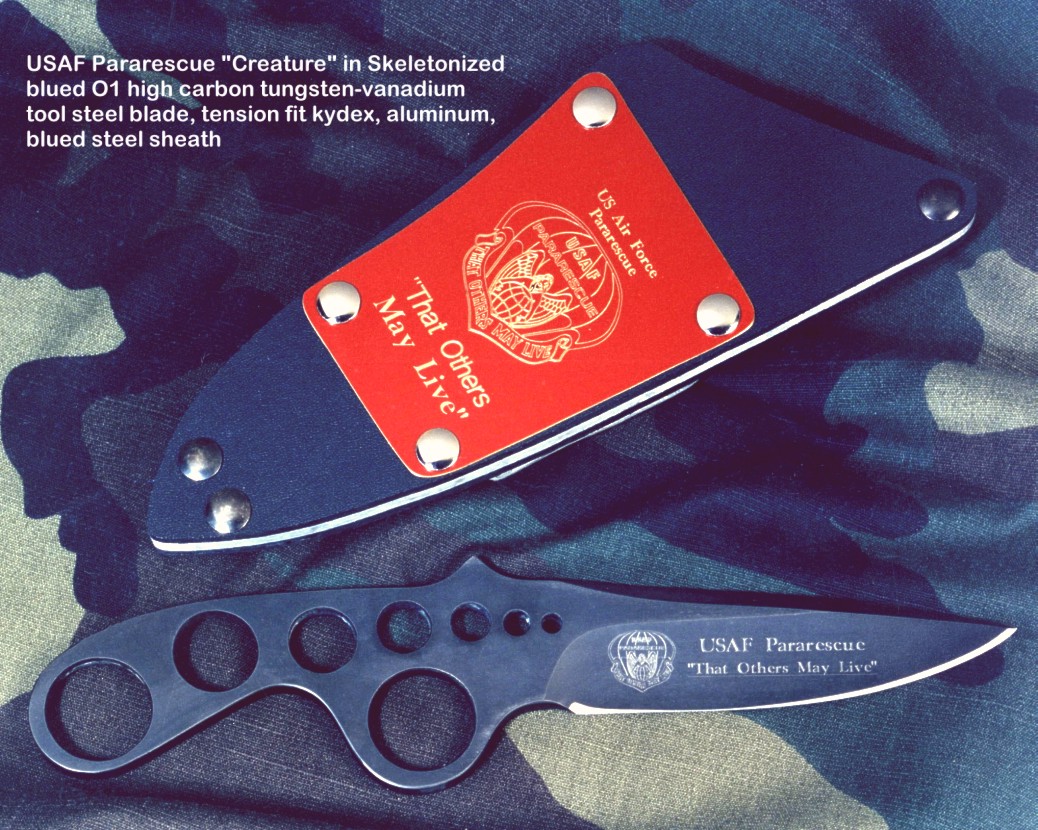
     "Creature" Pararescue knife, etched 440C stainless steel blade, engraved acrylic locking sheath     USAF Pararescue "PJLT" CSAR knife: Blued and nickel plated O-1 high carbon tungsten-vanadium alloy steel blade, brass bolsters, Red River Jasper gemstone handle, locking kydex, aluminum, stainless steel combat grade tactical sheath     USAF Pararescue Combat Tactical Knife "Paraeagle", Combat search and rescue professional knife, weapon, tool.      USAF Pararescue "Night Crawler" combat tactical fighting knife, skeletonized, lightweight, high carbon steel, CSAR knife

Pararescue Tactical Knife, combat weapon, CSAR, extended length, combat search and rescue use, Tactical sheath     USAF Pararescue knives: PJ, stainless steel, waterproof, locking sheath, combat search and rescue professinal knives     "The Creature" Bead blasted utility Pararescue tactical search and rescue knife, Micarta handle, Locking waterproof sheath     Military Combat and Tactical Commemorative CSAR Knife, Jade, blued blade: Creature, Positive Retention Locking sheath knife


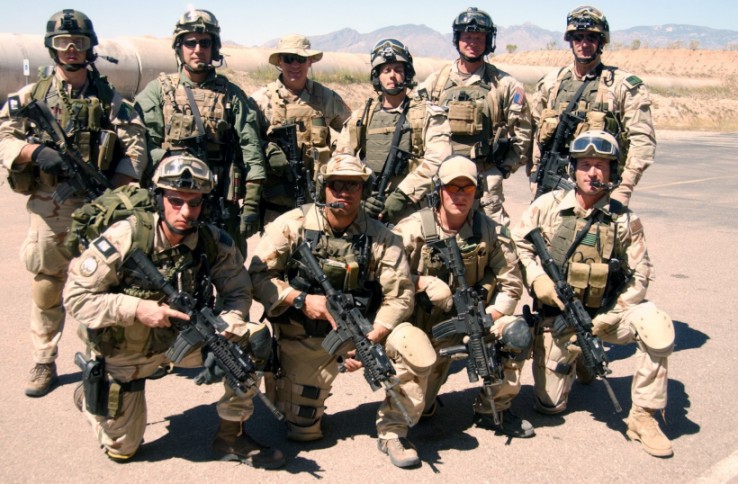
Military Combat and Rescue Professionals at work

"My sheath held my knife in place at all times... On one mission when rappelling into a hot HLZ with a 70 lbs pack I went upside down and got drug when the Helo decided to split, my knife was there. Jay, I know of no other knife that you made that has seen so much action. From the first ever Jump mission conducted at the PJ School to the 2 OEF deployments 23 Combat missions in all; “not to forget multiple peace time missions”. When my life depends on my knife why carry anything but the very best. Thanks for building the best for the best."

--SZ (Super)


Click on the thumbnails below for enlargements and details:

Full sized "PJ" tactical rescue knife, ivory micarta, gold, etching, locking waterproof sheath     USAF Pararescue Instructors Knives: the PJLT, ATS-34 High Moly stainlesss, bead blasted, waterproof sheath     PJLT, light Pararescue combat, utility, tactical SAR Knife     Custom boning knife with Pararescue Angel Shield engraved on sheath     Pararescue Light (PJLT) combat tactical rescue knife in 440c high chromium stainless steel blade, 304 stainless steel bolsters, canvas micarta phenolic handle, kydex, aluminum, nickel plated steel sheath

SERE, Pararescue Commemorative custom Dagger     Tactical knives: bead blasted, micarta handles, serious CSAR combat tools and weapons     Hot blued, flat finish, O-1 high carbon tungsten-vanadium alloy tool steel combat, CSAR knives, skeletonized or micarta handles, kydex, aluminum, steel sheaths     "Creature" Stainless Etched Combat, Tactical, Pararescue Knife     USAF Pararescue "Creature" Tactical Knife, Stainless Steel, Combat SAR

Read about a very special Pararescue knife commissioned by an anonymous patron and donated to a Pararescueman for his CSAR use!

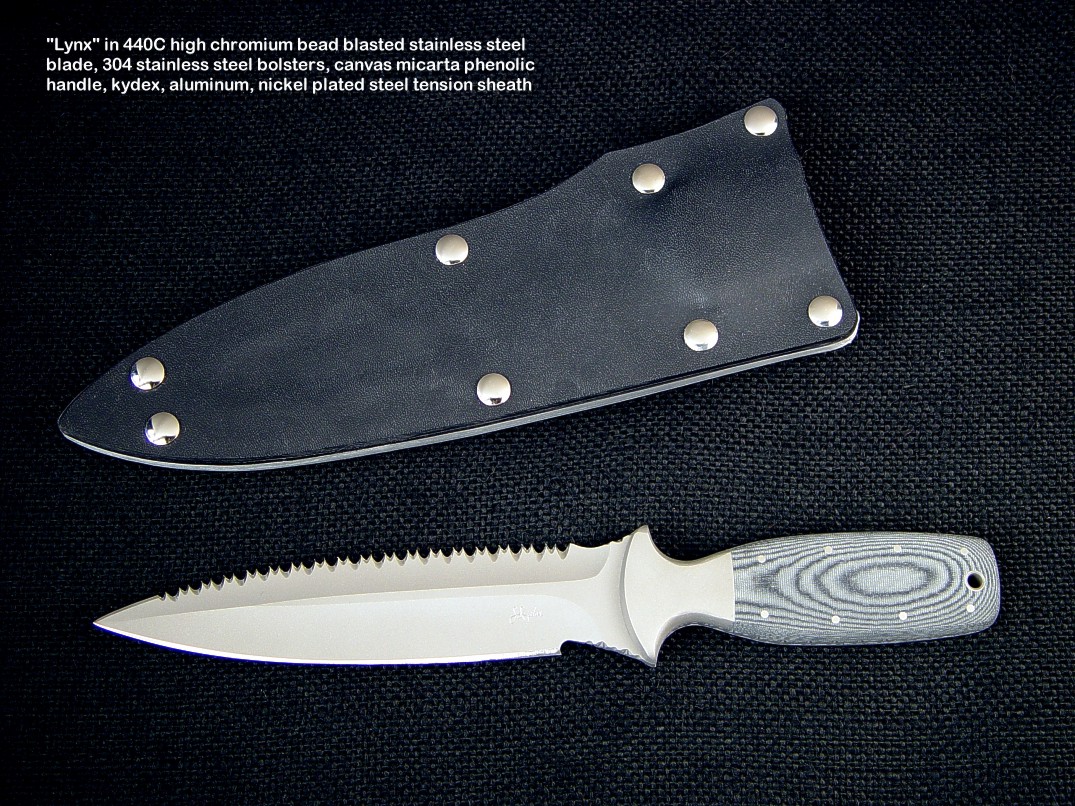
 USAF Pararescue "Creature" High Chromium Stainless Steel Rescue, Combat, Commemorative Knives     "PJLT" Pararescue Jumper LighT CSAR knife: 440C stainless steel blade, 304 stainless steel bolsters, stabilized laminate phenolic impregnated wood handle, kydex, aluminum, nickel plated steel sheath     "Lynx" combat, tactcal, CSAR knife, obverse side view: 440C high chromium stainless steel blade, 304 stainless steel bolsters, Micarta phenolic handle, kydex, aluminum, nickel plated steel sheath     USAF Pararescue "PJFZ" combat search and rescue knife, bead blasted ATS-34 stainless steel blade, 304 stainless steel bolsters, green canvas micarta phenolic handle, kydex, aluminum, nickel plated steel sheath

If you Google "Pararescue Knives," I'll be the first one on the list, worldwide. There's a reason for this. I make real Pararescue knives, for PJs, and have for many years. There are others out there, for sure, but I'll put my PJ knives against any others for design, construction, and combat worth. Simply put, they're the best CSAR knife made. And I wouldn't have a PJ carrying anything but the best!

I work with Pararescuemen to get them the knives they want to use and carry, in combat, in CSAR operations, on mountaintops, in the desert, and on the ocean. I've made honorary knives that hang in memory of fallen PJs worldwide at their Rescue Squadrons. Most of the PJ combat, tactical, CSAR (Combat Search and Rescue)and SAR knives here are evolutions of collaborative designs, field trials and combat testing and tuning. Along with the PJs, I also make knives for SERE, that's Survival, Evasion, Resistance, and Escape, of the USAF. On this page, you'll see the ever-advancing products of their input. Be sure to check out the most popular Pararescue Tactical, Combat and Rescue knife here.


Click on the thumbnails below for enlargements and details:

Tactical Knives for the Military: hand made, custom designed combat knives, commemorative and using, full tang military combat retention sheath knife     Tactical Knives for the Military: hand made, custom designed combat knives, commemorative and using, full tang military combat retention sheath knife     USAF Pararescue "Paraeagle" 440C Stainless, Combat Proven Blade, Nickel Silver bolsters, exotic hardowood handle, combat tactical sheath     Pararescue "Paraeagle" Etched High Chromium Tool Steel Blade, SAR ready combat tactical sheath

Survival, Evasion, Resistance, Escape Professional locking hookblade stainless rescue knife: The Kid     SERE Search and Rescue SAR Knife: The Kid: locking hook blade, gravity, double edged, gemstone handle, stainless steel, locking sheath     "Nightwind" SERE Combat  search and rescue knife: Stainless Steel, stainless bolsters, gemstone handle, kydex, aluminum, steel sheath

     Minuteman: tactical combat and rescue knife, bead blasted, hot blued, micarta handle, locking waterproof combat sheath     USAF Pararescue combat, search and rescue SAR tactical knife      United States Air Force Combat, tactical commemorative knives, blued steel, nickel and gold plate, gemstone jasper and jade, locking waterproof combat grade sheaths     "PJ" Pararescue style knife: 440C high chromium stainess steel blade, 304 stainless steel bolsters, Scapolite gemstone hande, locking kydex, aluminum, stainless steel sheath


Pararescue and SERE

In close affiliation with Pararescue are the advanced SERE (Survival. Evasion, Resistance, and Escape) survival specialists, who have also given me great input in CSAR knives. They may carry anything from small hand tools for light duty and shelter building to large bolo machetes. Here are some examples:

          SERE/Pararescue Instructors Knife, military Bolos, Machetes, custom tactical knives    


Link to information on my most popular Pararescue Knife

PJLT Combat, Tactical, Rescue Knife, Link to PJLT page


For you PJs who are interested in the very best CSAR knife made, to your specs:

  • Ever wondered about that particular design you doodled on a piece of scrap paper?
  • Want a combat knife that won't fall out of your hand?
  • Want a good sheath, a positively locking combat grade sheath that is waterproof and will last as long as the knife?
  • Do you have some specific need for cutting edges and geometry that your factory knife can't fill?
  • Tired of  those blocky chisel-like spec knives officially  issued and more suited to digging holes than slicing 'chute cord? 
  • Are you tired of factory knives that some pantywaist designer at a factory thinks looks "tough" and "tactical?"
  • Need a hot-blued jet black blade?
  • How about a stainless steel blade patinaed to a durable non-glare finish?
  • A unique handle material?
  • A mechanism?
  • A damn good knife that you can trust your life and your charge's life with?
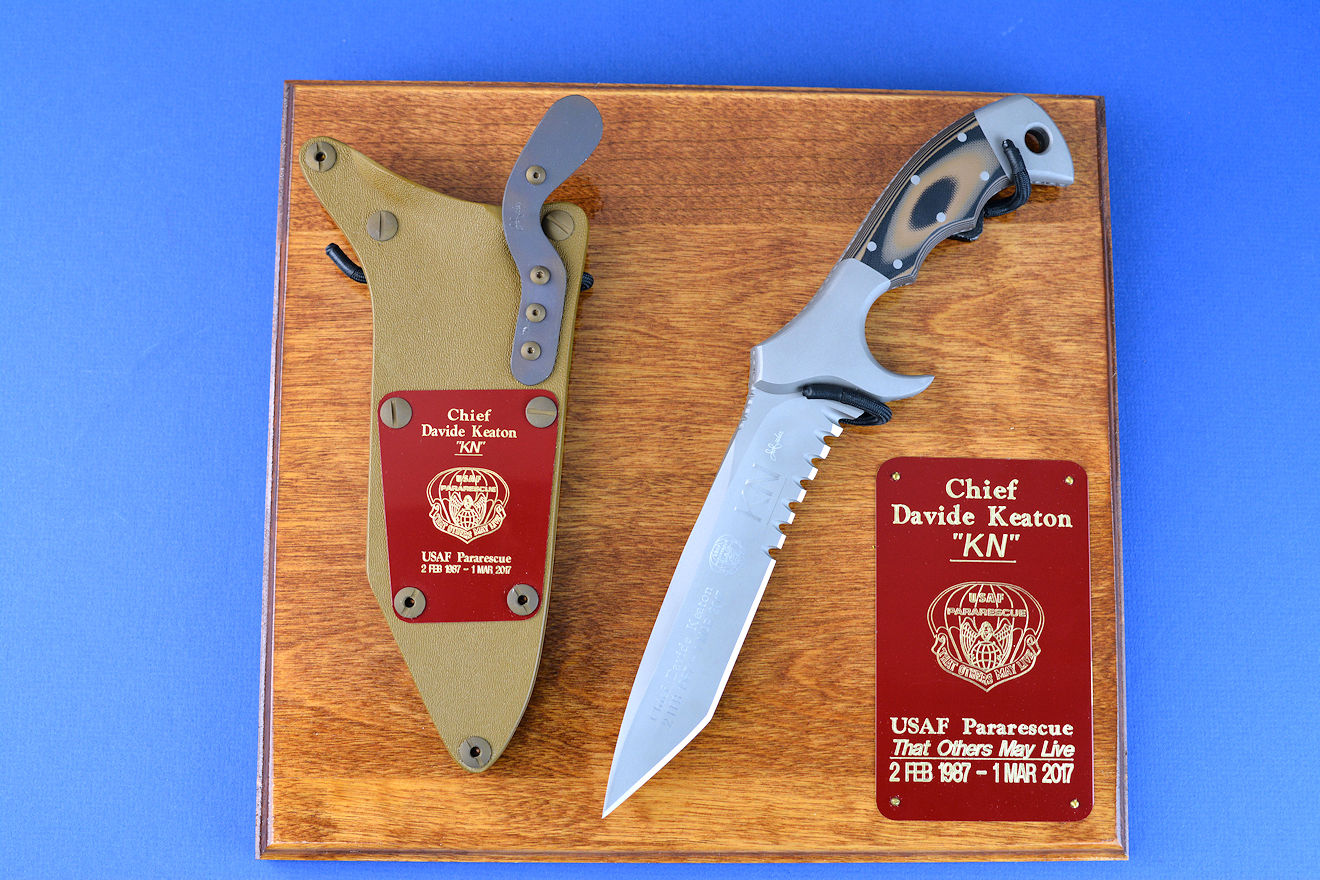
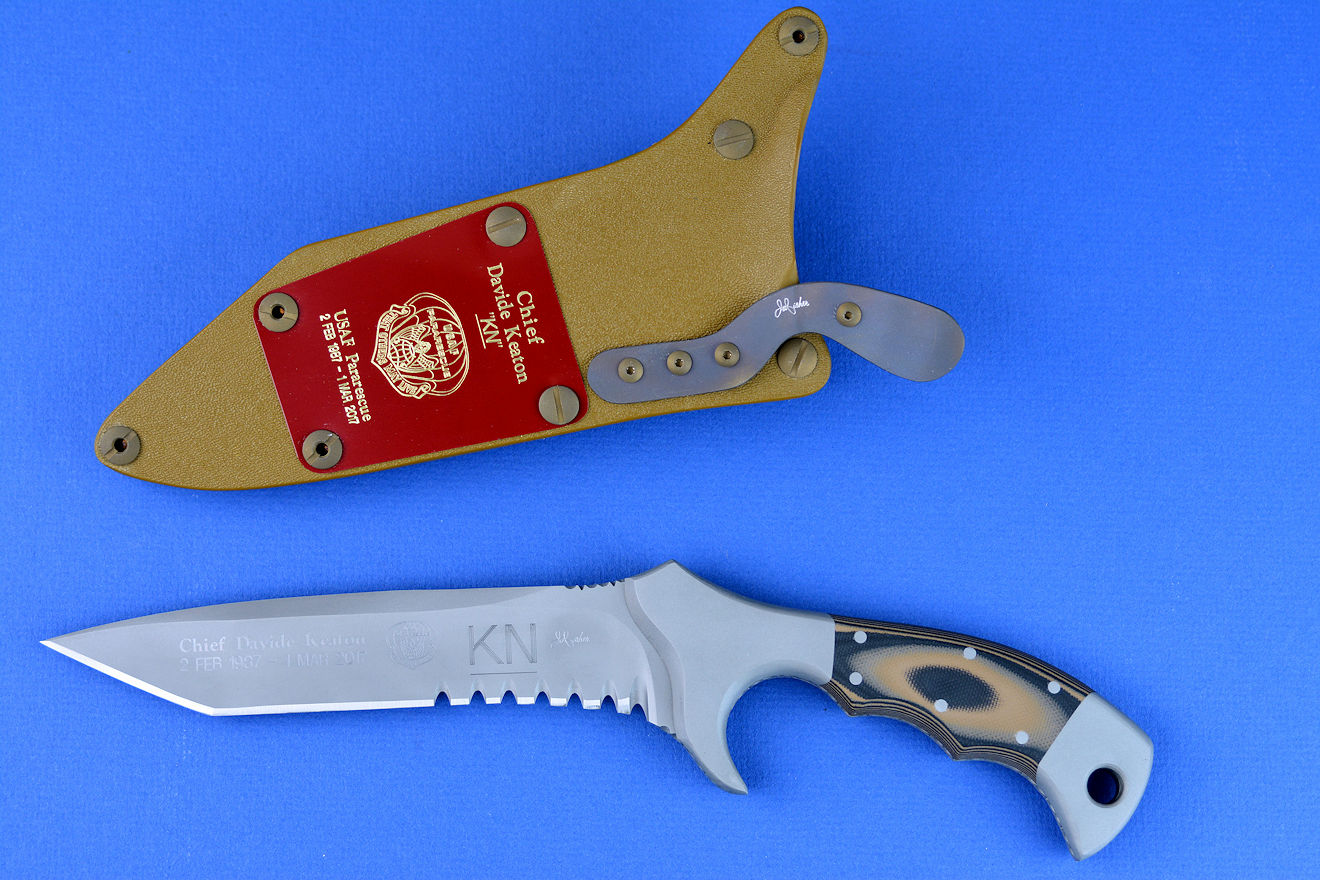
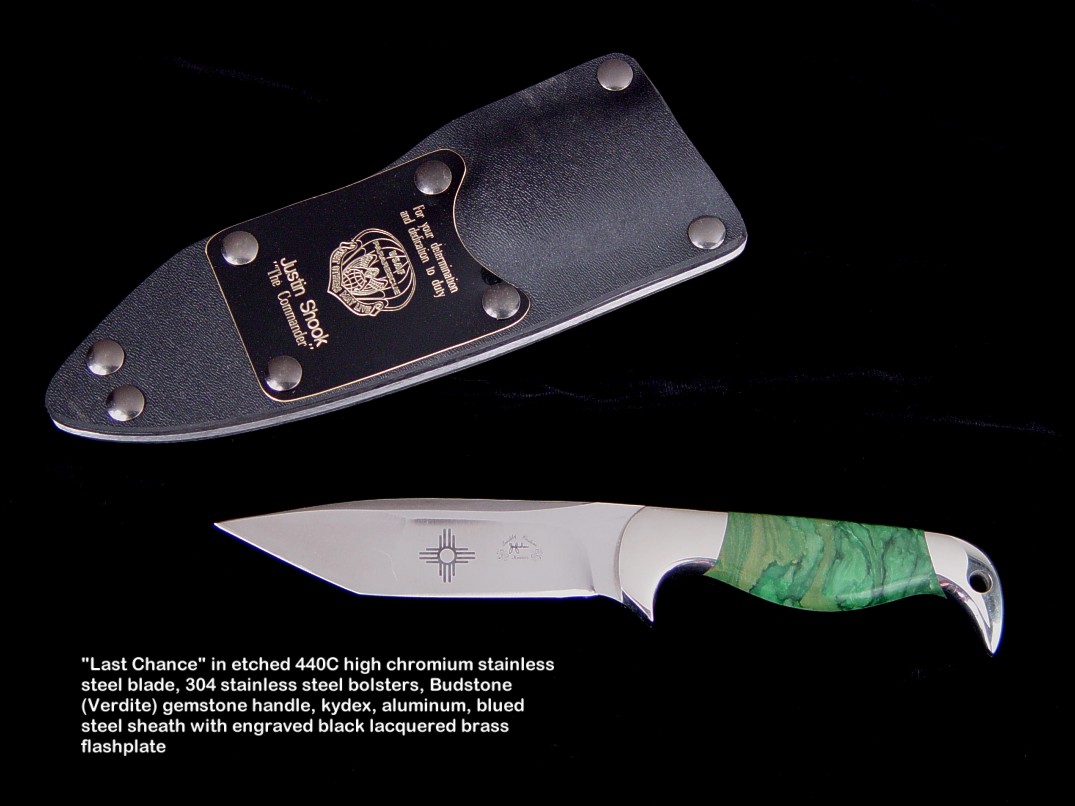
  • A commemorative gold embellished etched and engraved award for outstanding service?

I can make it for you. 

Check out the military knife pages on my site for all the models and data:


Military, Combat, Rescue Tactical Knife Portal


Commemorative Military, Combat, and Tactical Knives


All Military, Police, Tactical, Combat, Rescue and Specialty Knives


USAF Pararescue and SERE Knives


My most popular PJ Rescue Knife


Current Tactical Knives immediately available


Military Knife Care


Find out about how to order your custom knife here


Expedition Racing and USAF Parararescue and USAF SERE

Expedition Racing Team, Eco-challenge, Expedition Racing Knives

Back in 1998, I was asked to make commemorative knives designed and carried by Air Force Pararescue Team Tier One members enrolled in the Discovery Channel’s EcoChallenge Race across Patagonia, Bariloche, Argentina in December, 1999. Talk about a field test! While the team was in the studio designing their own knives, they came up with models that I offer for field ops, marine and oceanic use, and commemoratives. Below are thumbnail pictures of the prototypes roughed out.

Military Expedition Racing Knives in Production          Custom Expedition Racing Knives in Production          Construction: internal and parts view of "The Kid" a Survival, Evasion, Resistance, and Escape Combat Tactical Knife with Gravity Hook Blade, All Stainless Steel

USAF Racing Knives, Expedition Racing Knives, Discovery Channel Eco challenge race knives     Survival Knives, Eco Challenge Racing Knives, Pararescue commemorative Search and Rescue Combat knife     Military Survival Knives, Search and Rescue Combat Tactical Knives, SERE, Pararescue

Military Tactial Knives, Rescue, combat, tactical, defense commemorative knives, etched, full tang, stainless steel, collectors     Rescue Knives, USAF Survival, Evasion, Resistance, Escape, hook bladed gravity release knife, Stainless steel, Rafters knife, Tactical Search and Rescue Knives

←Here are thumbnail photographs of the completed knives: USAF Pararescue "PJ," "The Creature," "The ParaEagle," and USAF SERE (Survival, Evasion, Resistance, Escape) "The Kid." All knives complete with approved Discovery Channel Eco-challenge logo, Pararescue and SERE logos, green-gold PJ footprints, waterproof positive locking knife sheaths safe for underwater (salt) use. Knives feature removable flash plates, etched Nickel Silver, and "The Kid" features a gravity operated locking hookblade in the handle. These knives were showy, for certain, but they are real knives, designed and built for sturdy, serious use.

"Jay, the knives are great, worked good in the bamboo on the race. The knife you made us is just amazing, it is something that will be passed on to my children. Once again, thank you, it is now a showpiece on my fireplace mantle."

                                                                --Rod Alne, Captain Team Tier One, Eco-Challenge 1999

Please contact me directly about your Pararescue knife needs or ideas. Click here.

Please note: I'm only making a limited number of combat grade knives yearly. Because of high order volume, I've had to regulate the amount of combat knife orders, so I can make and deliver them in a timely fashion. Thanks for you patience and understanding.

Find out about how to order your custom knife here

See my current military, combat, tactical, and commemorative knives for sale here.