Jay Fisher - Fine Custom Knives
New to the website? Start Here
"Nunavut"
Jay Fisher - Fine Custom Knives |
|||
New to the website? Start Here |
"Nunavut" |
||
--Jay Fisher
--Genesis Ch. 3, V. 21
A knife is a sharp instrument. It has a point, a cutting edge, and sometimes other dangerous features like serrations, sharp swages, talons, skull crushers, and hooks. It has a handle which, if designed adequately, will keep the hand off the sharp edges. The knife must be carried from place to place, so from the earliest times, man has had to construct something to carry the knife in.
Not a lot of information exists today about very early sheaths, as they were assumed to be made of organic materials that have decomposed through exposure and the unceasing cadence of time. Since ancient and prehistoric sheaths are rarely found, it is the knife, the implement, the tool, and the weapon that has claimed the attention and interest of archaeologists and anthropologists. This has, I believe, relegated the sheath to the secondary role, the afterthought of the knife interest both historically and in contemporary times.
This is a sad thing, because this extremely critical component of the knife was, I believe, just as important as the knife. Yes, it's true. Without a sheath, a knife does not move, it sits. This is fine for art knives, but even they have (or should have) stands, cases, or displays to hold the sharp instrument. What is unfortunate is the modern knife maker's typical neglectfulness of a proper, commensurate, useable, and appropriate sheath.
Years ago, when I first started making knives, I asked a few (so called) masters at knife shows about their sheaths. After all, when they sold a knife, the client (customer) would ask for something to carry it in, right? You wouldn't believe some of their actual responses:
Probably the best one is the boutique shop combat knife company who makes tactical combat knives, and has a list of sheath makers that they recommend after you buy one of their sheath-less knives...

Dear Jay,
Hello sir. I am a big fan of you and your knives. I feel that you are a true professional craftsman.
Not just in metal, but also in wood and leather. I’m afraid for the time being I do not have the kind
of money for one of your knives. But someday, you will hear from me, and the knife you will make will
be extraordinary! Sorry that this email isn’t to purchase, but you’ll be hearing from me again. Until then,
Sincerely,
D.
Jay,
I just stumbled across your website and was blown away. I have been in leather supply for over 30 years and have seen an incredible
amount of great leatherwork and many talented people. Your knife sheaths
are the most beautiful I've ever seen. It is not just the quality
of the leatherwork but the incorporation of the art that is stunning. I especially like the way you make the knife and the sheath work
as a unit in pieces like the Dorado, Raptor, and Izanami sheaths. Most people see a custom sheath as one just made to fit a particular
knife. In your case it is not only the fit of the knife but matching the colors and lines of the knife to create an aesthetic that
I've never seen in a sheath before.
Your love and dedication to all the art and craft that goes into your work is apparent. Congratulations for your level of accomplishment.
Best regards,
Dennis G.
A knife is incomplete without a sheath.
I realized many years ago, when I first started in this trade, that sheaths, stands, cases, and accouterments were all a part of the trade of making fine handmade and custom knives, and if I wanted to provide a complete package, then it better include a fine sheath: tough, strong, and well-made to match the knife while being commensurate with the quality of the knife.
I was determined to make some of the best sheaths out there, sheaths that the owner would cherish as much as the knife, sheaths that would last at least a generation, maybe several, and maybe even as long as the knife. I still hold fast to that concept and I consider my sheaths and accessories a critically vital part of my art and trade.
Sheaths do take an separate and complete set of tools, techniques, processes, and skills. It takes quite an investment of reading, study, learning and practice to become comfortable with leather craft and art, and additional machine and fabrication skills and training to build reliable mechanisms for combat and locking military tactical sheaths. These skills are continually evolving with the artist, and it is an exciting and rewarding field.
I work very hard to build a fine sheath to fit the specific knife, to compliment the knife as well as protect the knife and the wearer. The color schemes match the handle materials and blades, the styles, tooling, inlays, and curves match my artistic intention for the knife. My military grade combat and tactical sheaths are probably the best and toughest made out there; I've never seen any better. Yet just like with my knives, I'm continuing to learn on every sheath I make.
Hello Mr. Fisher,
Everyone says the same thing, "That's not a knife, it's art work" People like the sheath as much as the knife!!!
Very happy with it.
Thank You,
--S.
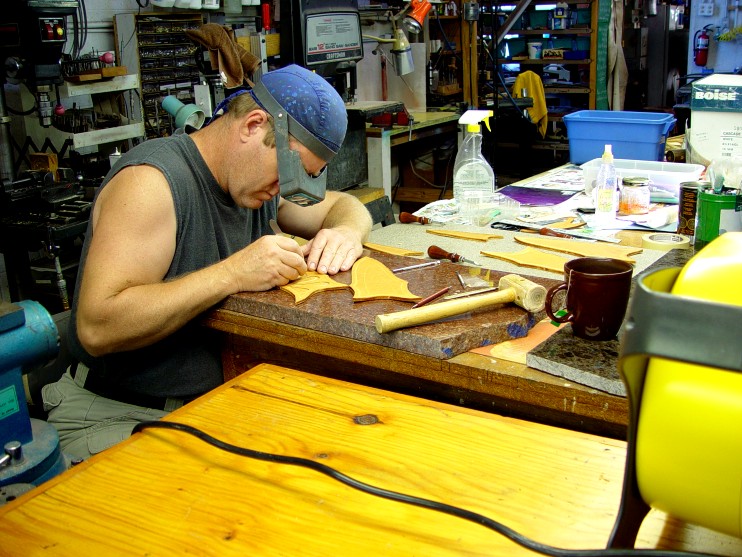
It's a sheath.
These days, most Americans use the term sheath, and less often scabbard. The word scabbard is of medieval origin, from the words scauberd or scauberk, which are from Old High German words scar (sword) and bergan (to hide and protect). So a scabbard is the case for a double edged blade, such as a sword, dagger, or bayonet.
The word holster, originating from the Dutch word holfter (meaning house) is the case for a pistol and is not a knife term.
The word sheath is of Anglo Saxon origin, from the word scæth, which is the same root of the word shed. Sheath refers to any case for any knife, sword or dagger and is a more universal term.
A sword or dagger may have a scabbard or a sheath, but a knife that is not a sword or dagger may only have a sheath. When in doubt, use sheath.
I had this this white box on my bench….Like the new drawstring bag that comes with the knife..
The knife is an amazing recreation of a vision upon which we collaborated to the “T.” I looked at every seam
and joint with 3.5X loupe magnification..polish and fit are amazing (not a space or rough spot anywhere, stone
color is dramatic and the dovetail fittings are for me technically unimaginable (except that I have it here
real-time in my hands), the sheath is a real work of art…the stitching and leather selection are so well
constructed and the edges are solid and even. This specimen and leather selection is a real work of art.
The balance and ergonomics are excellent. The appearance of the knife belies the intricate balance your
skills have achieved. One would think from looking that it would be blade heavy, but it is not.
All in
all I am totally pleased. Unfortunately words are insufficient to match your skills as a master craftsman.
Keep up the good work…
--B.
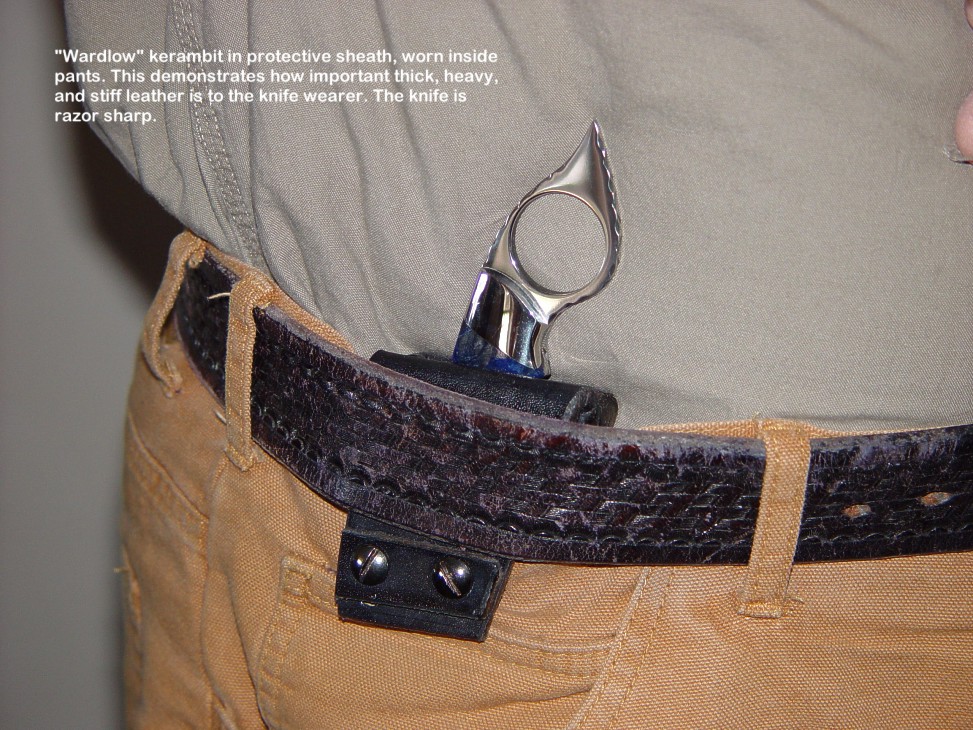
The most important function of a sheath is to protect the wearer.
The sheath should, first and foremost, protect the wearer. The knife should be honed to a razor's edge, and is (in the sheath) typically carried against a vulnerable part of the body. The sheath is your protection from your knife, not just a little thin bag that you deposit your knife in to keep the dust off.
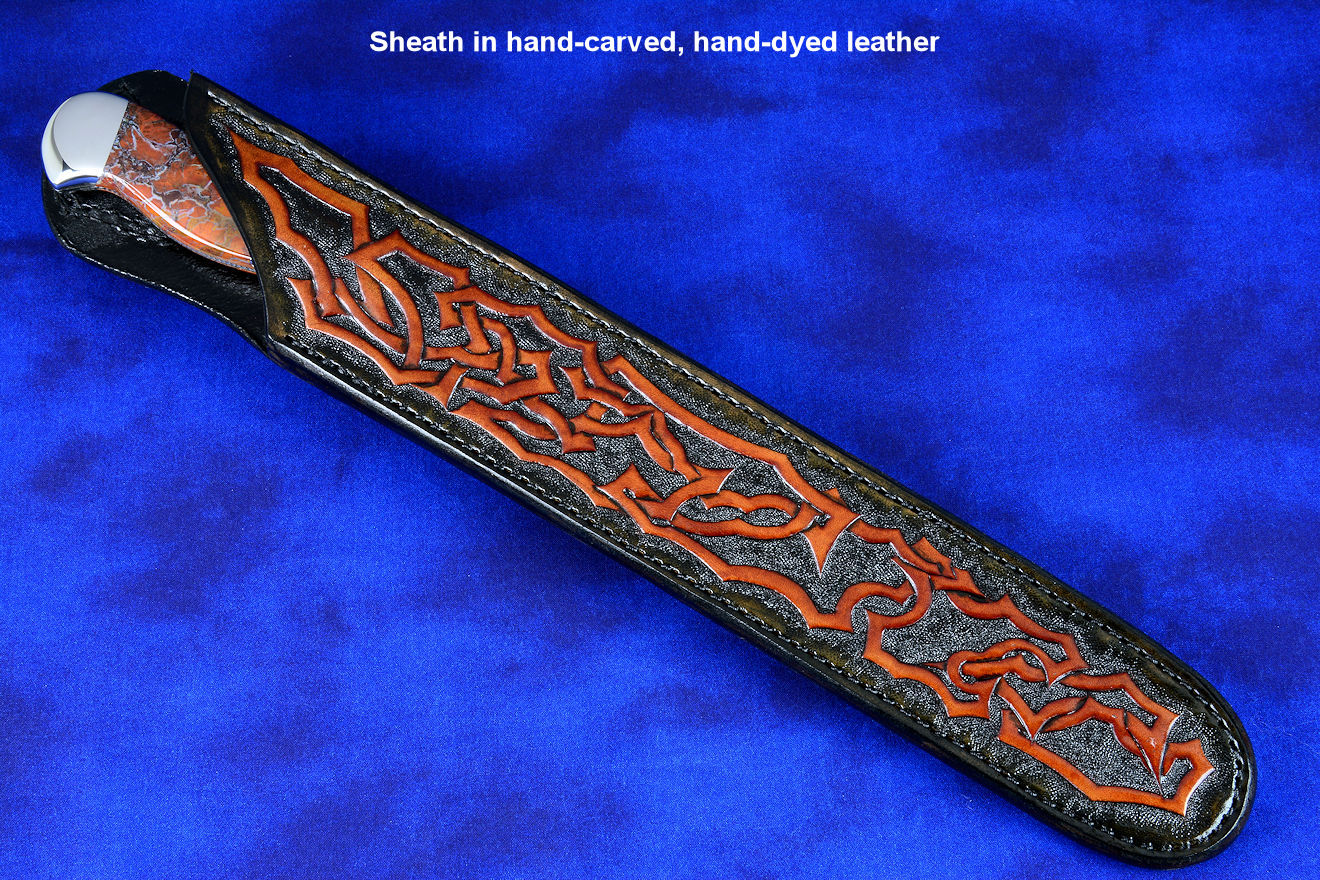
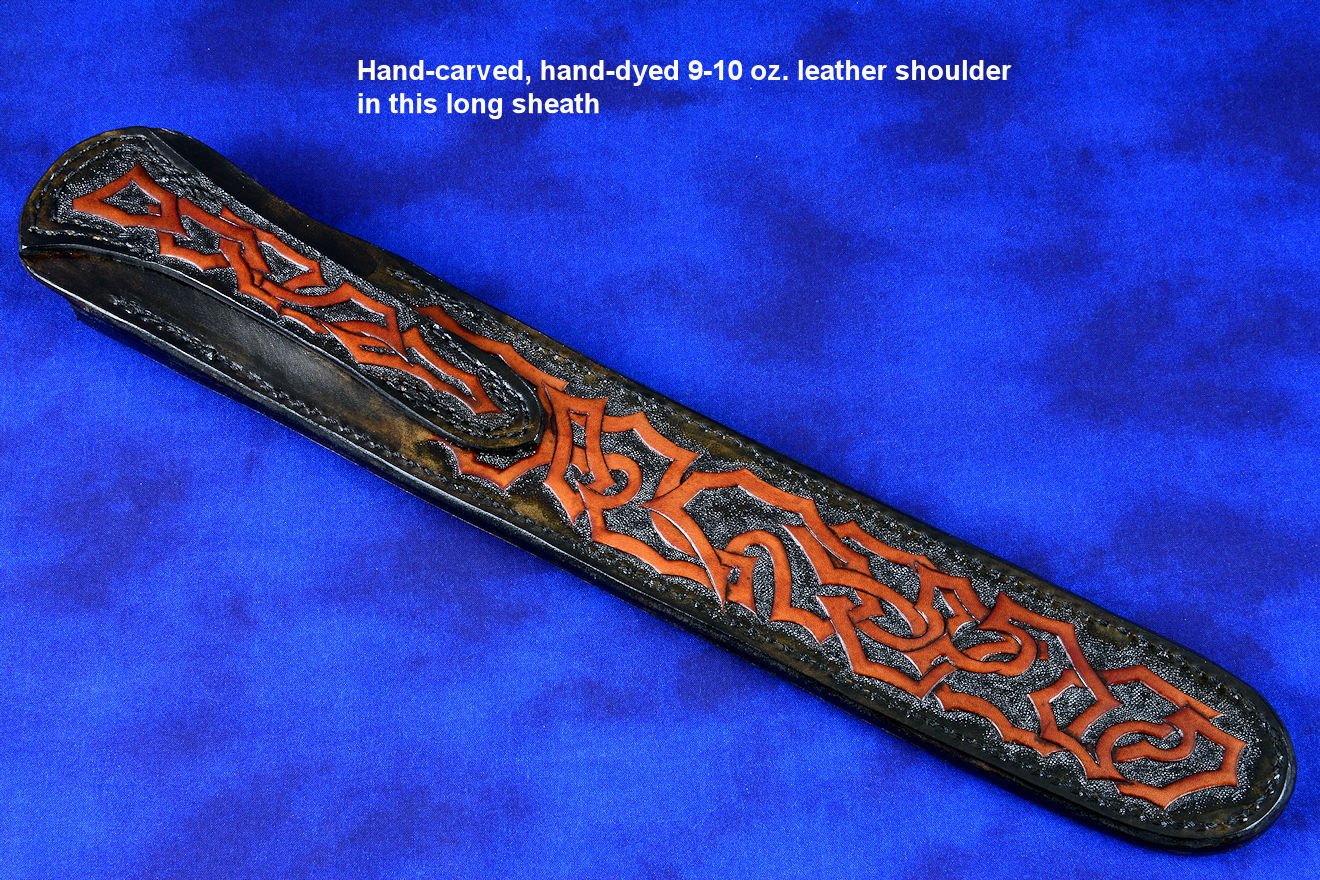
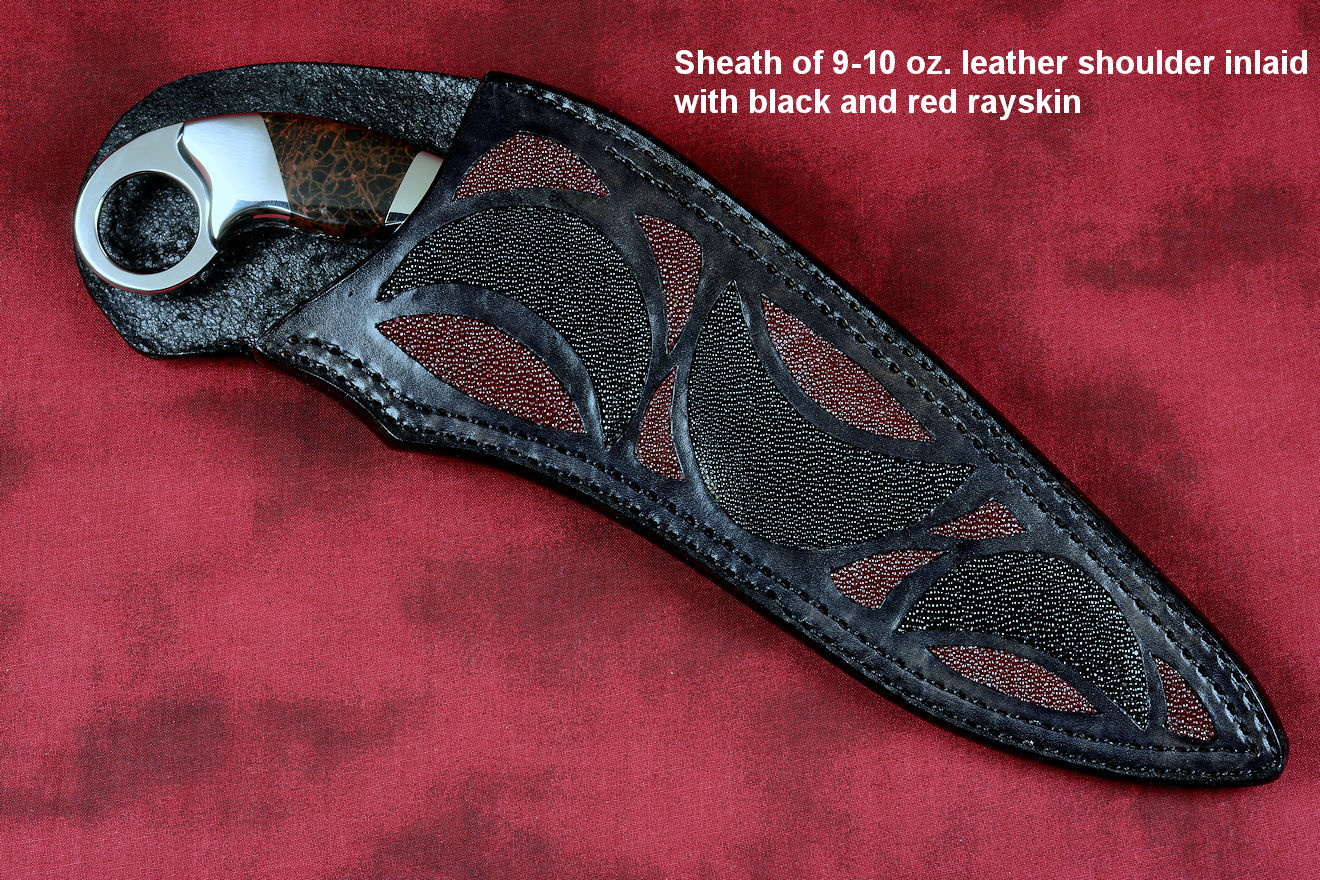
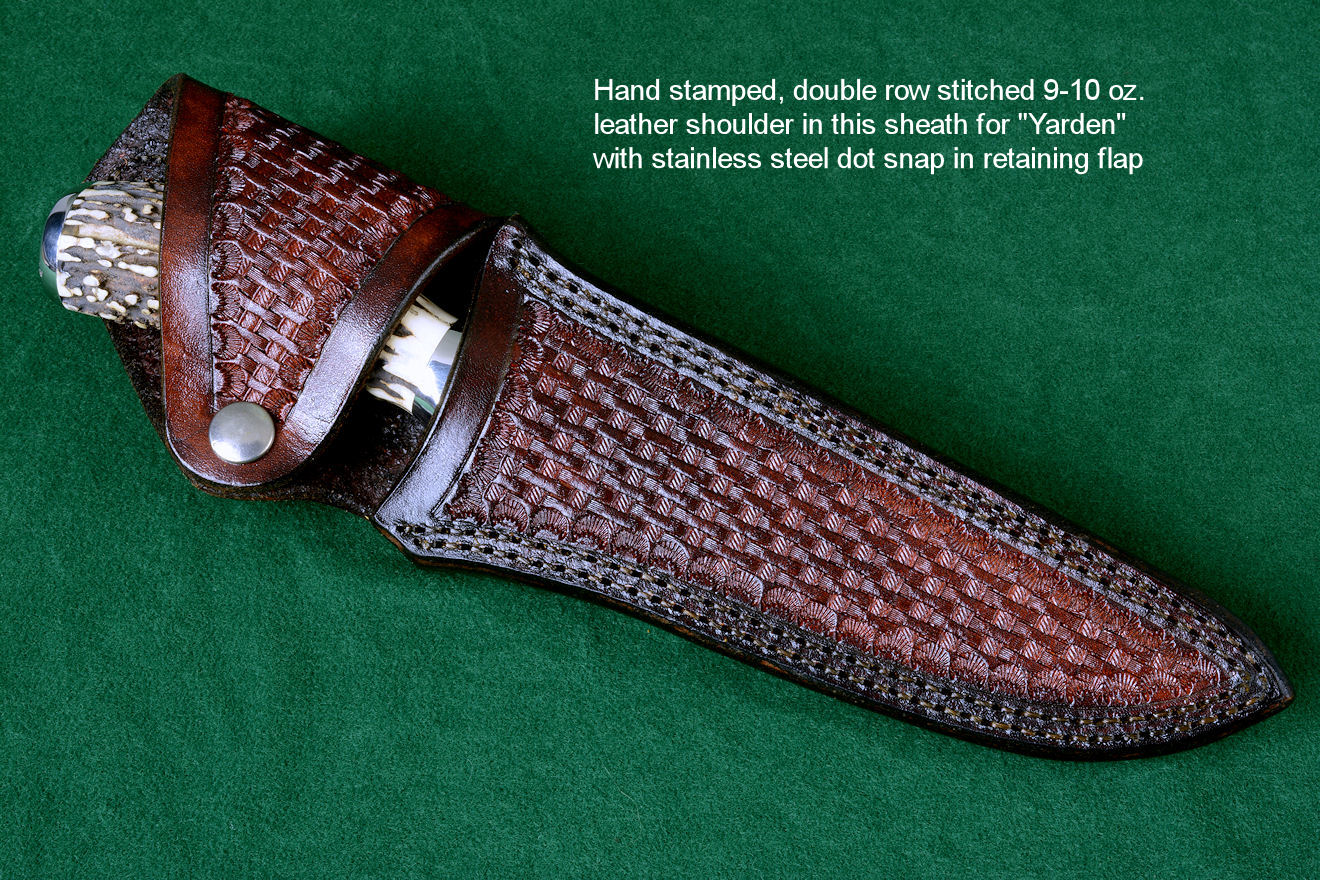
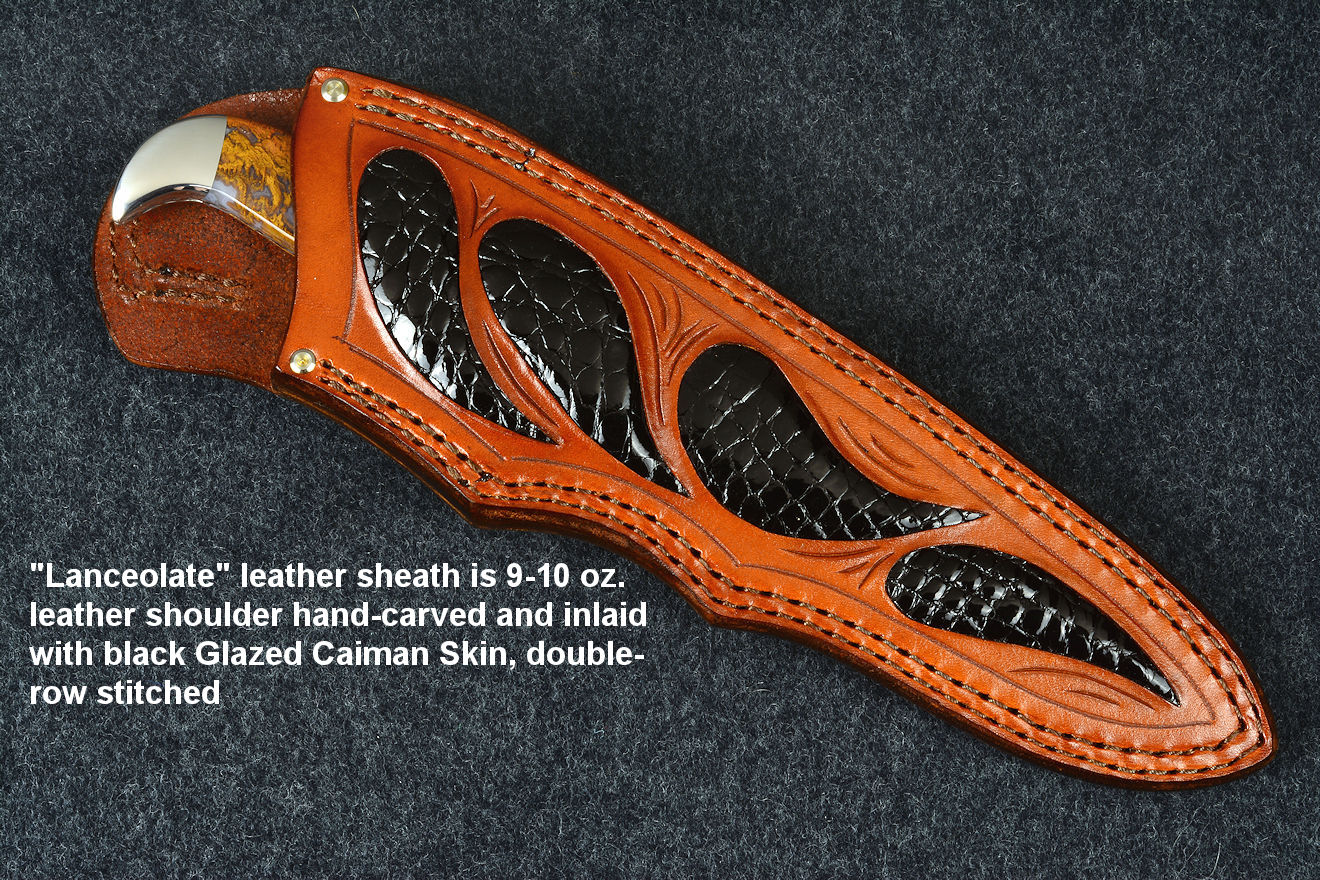
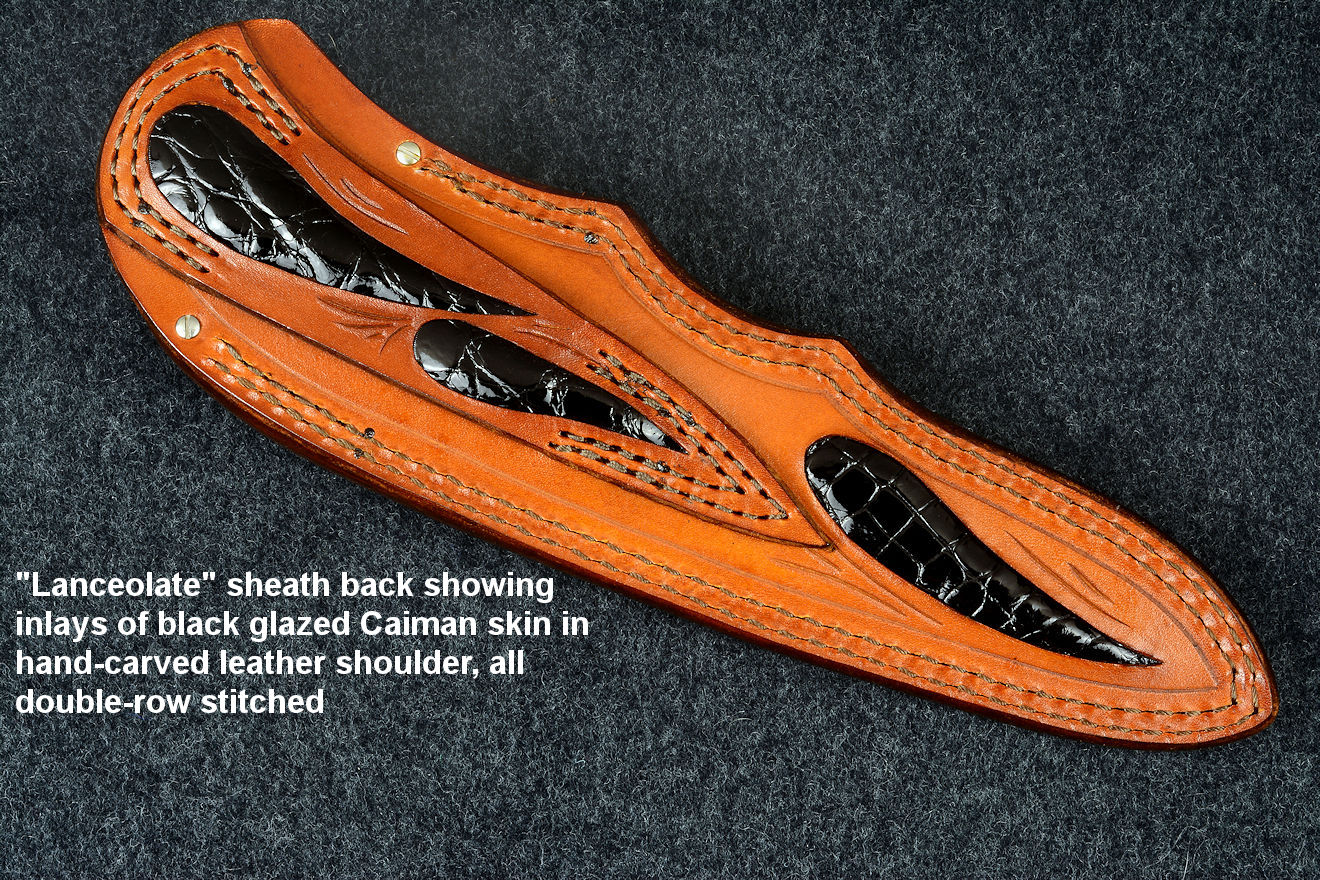
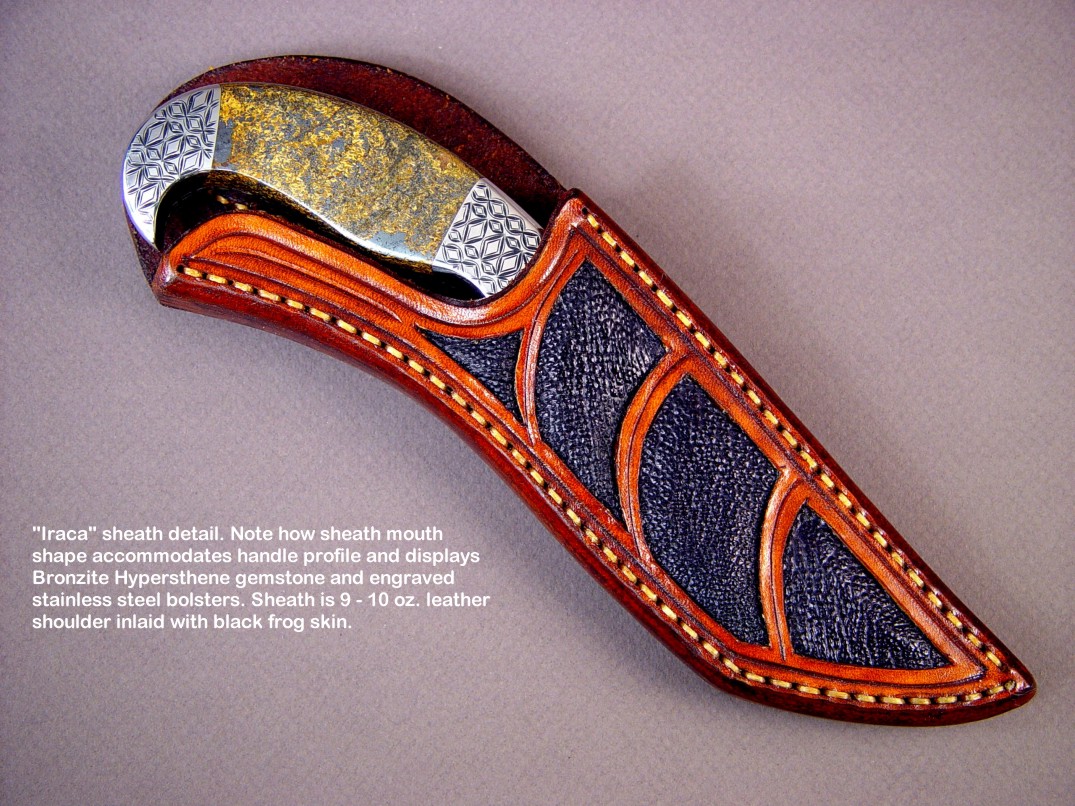
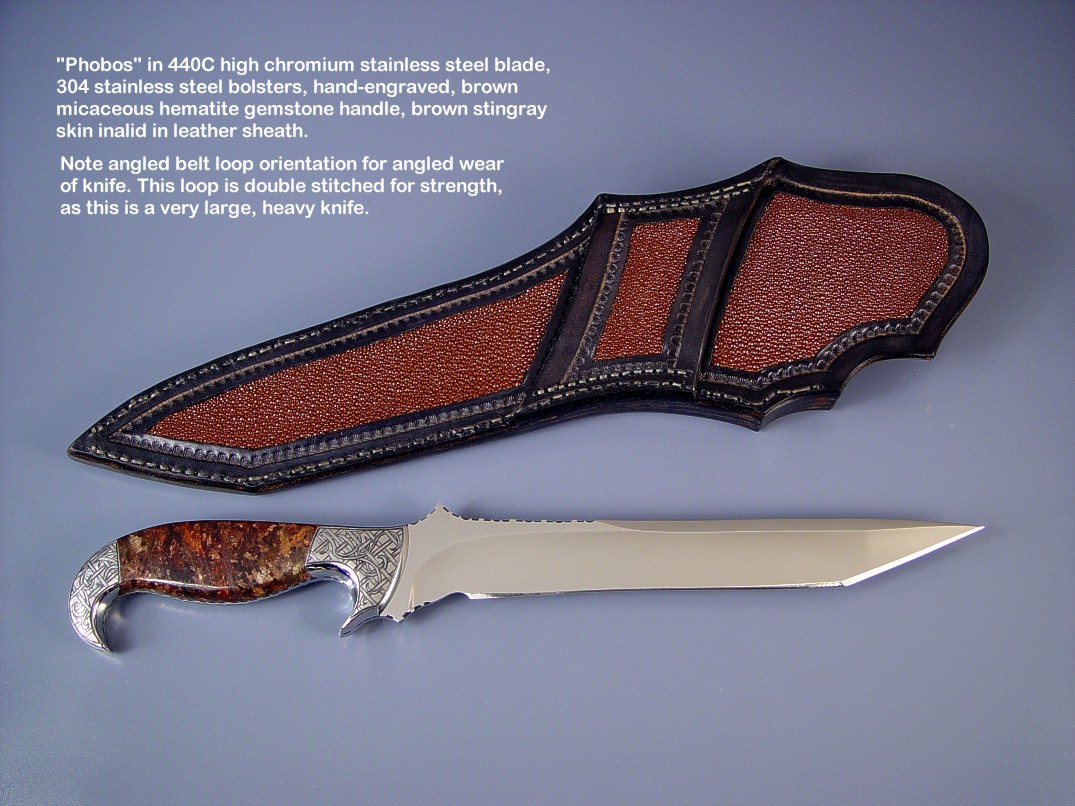
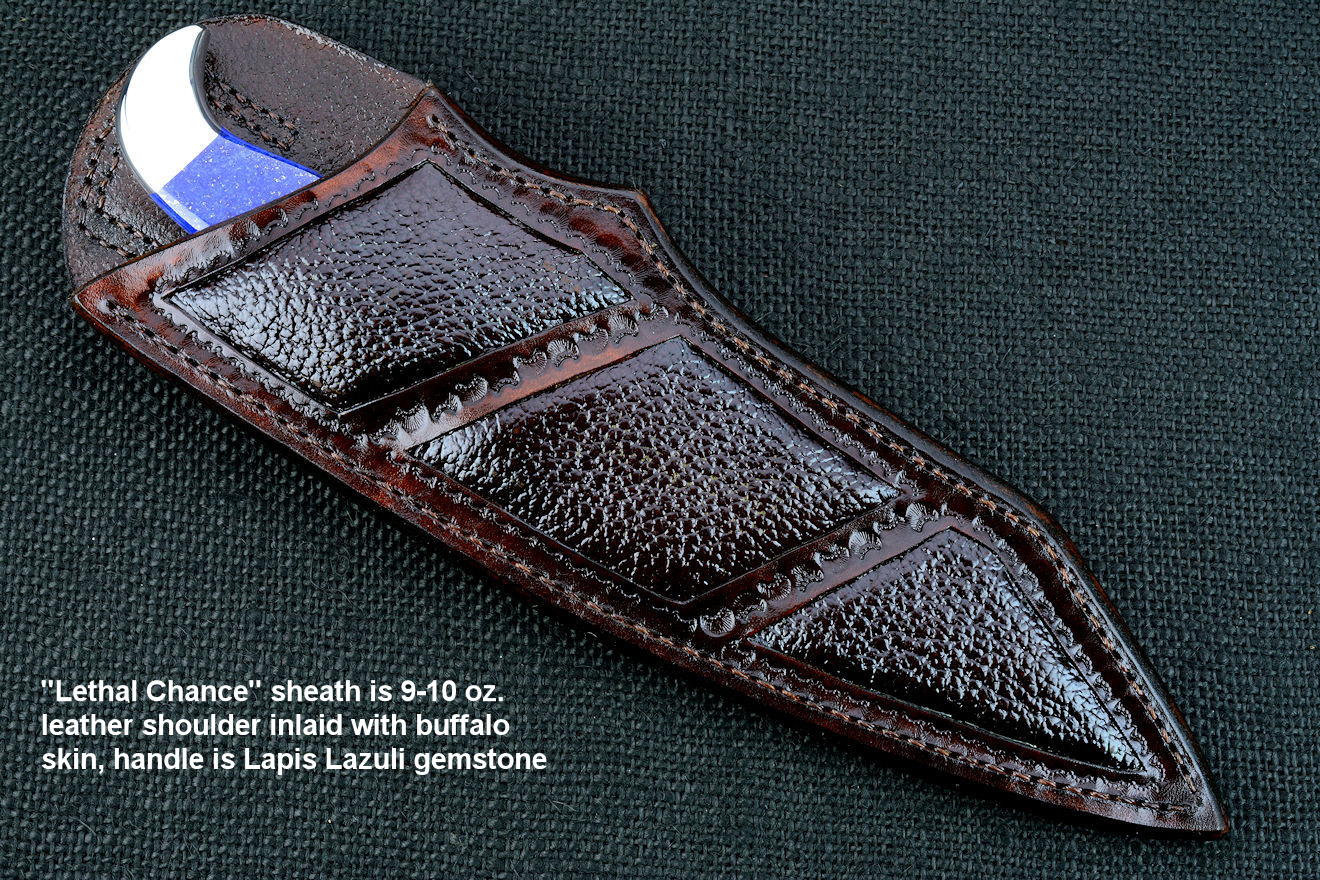
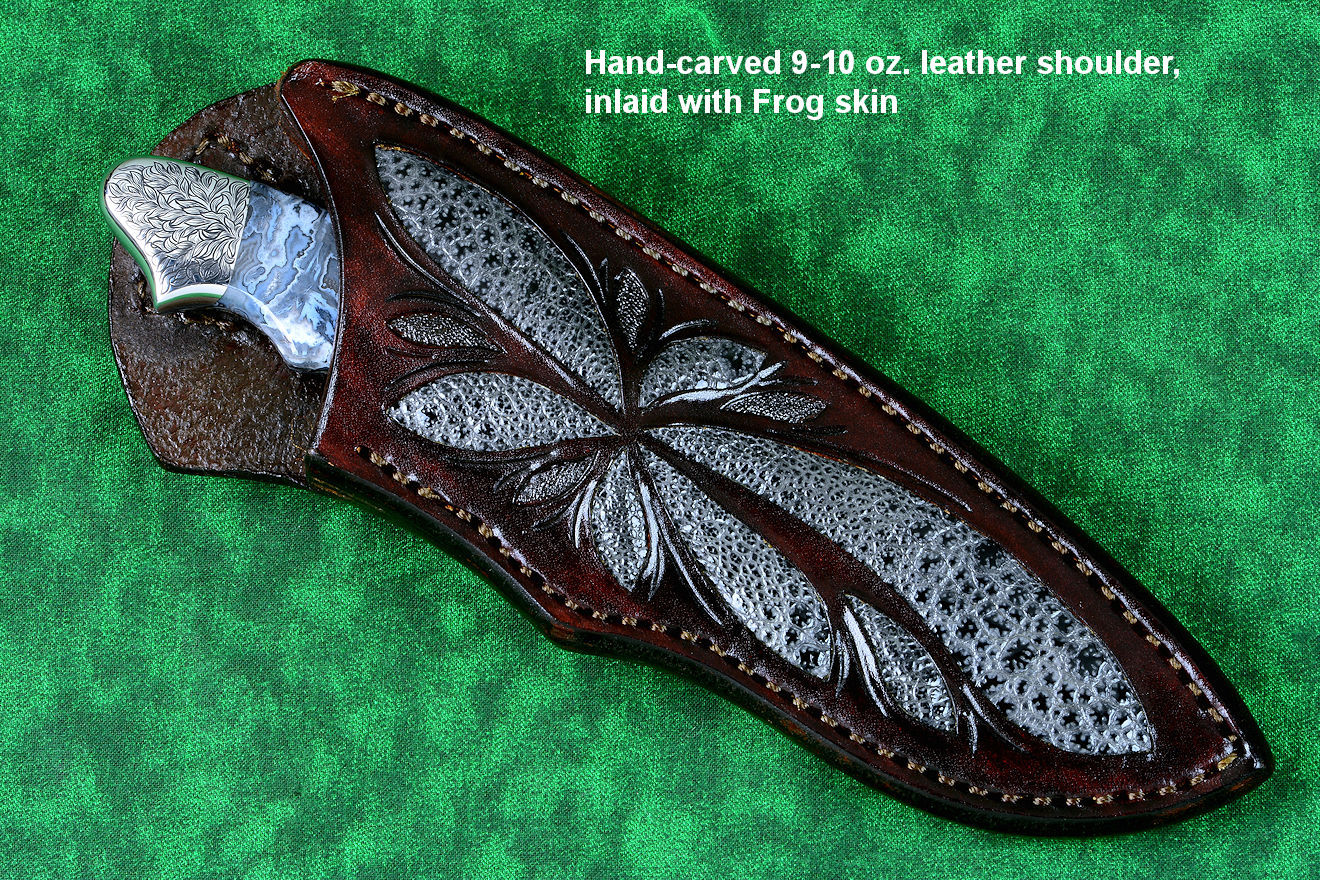
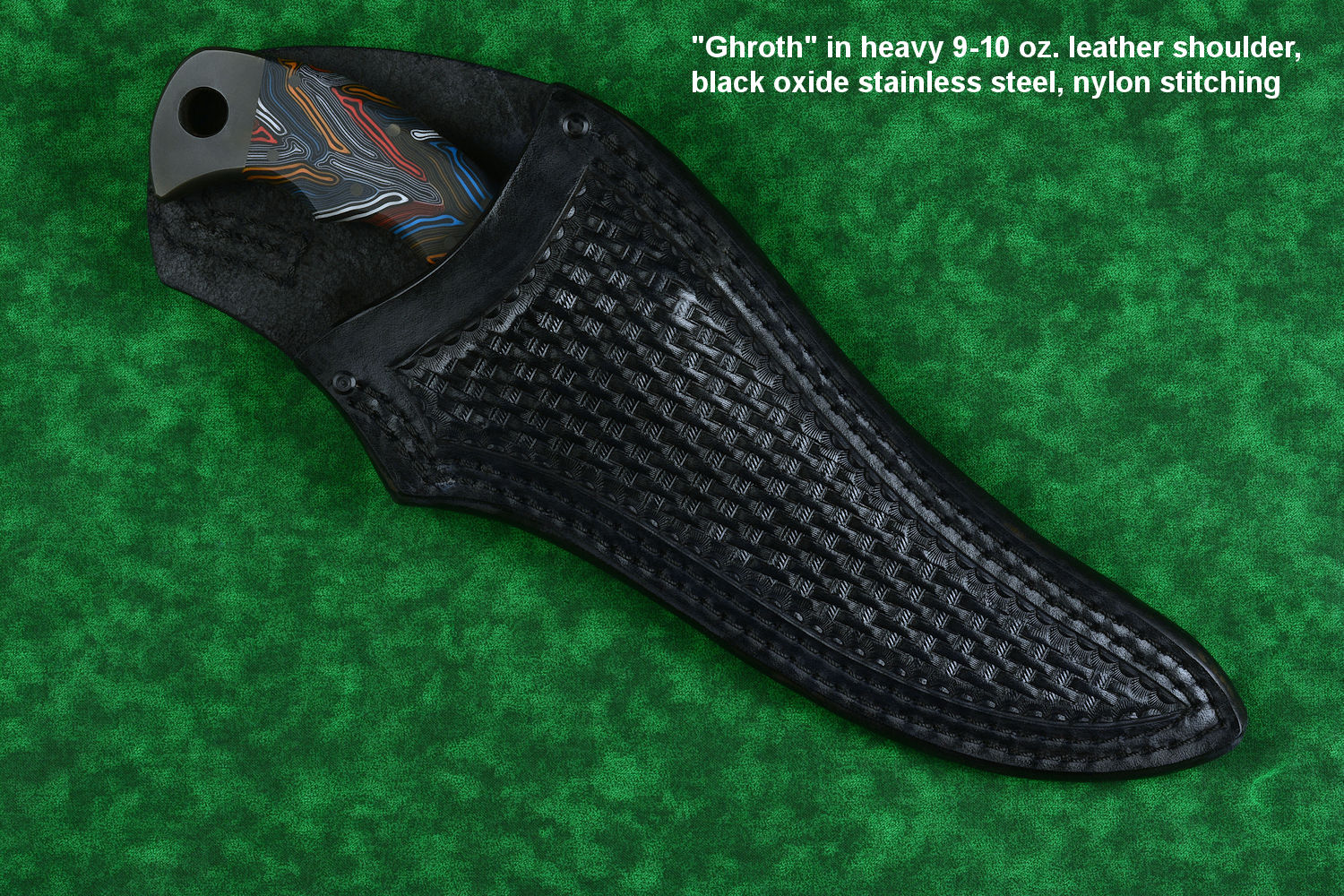
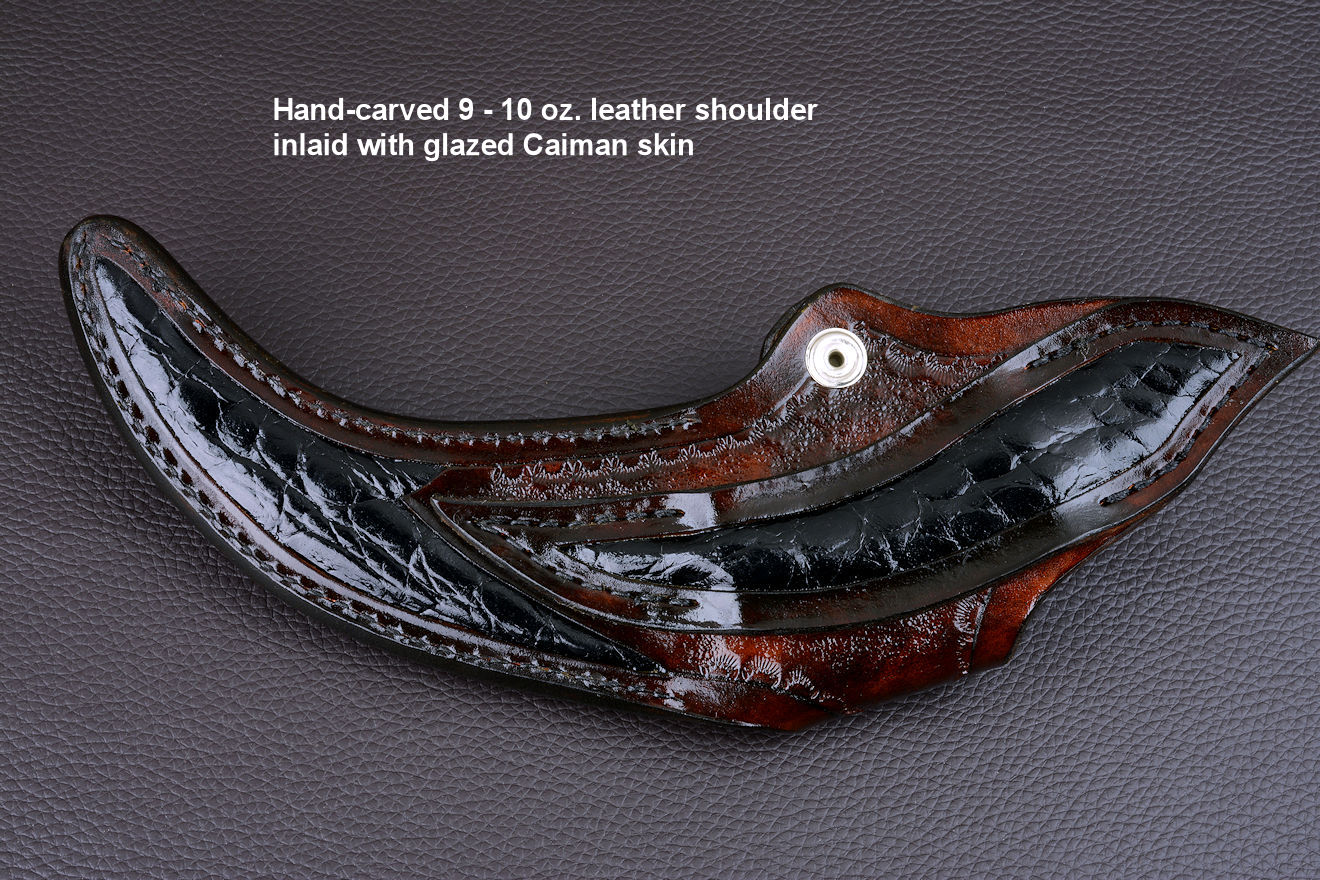
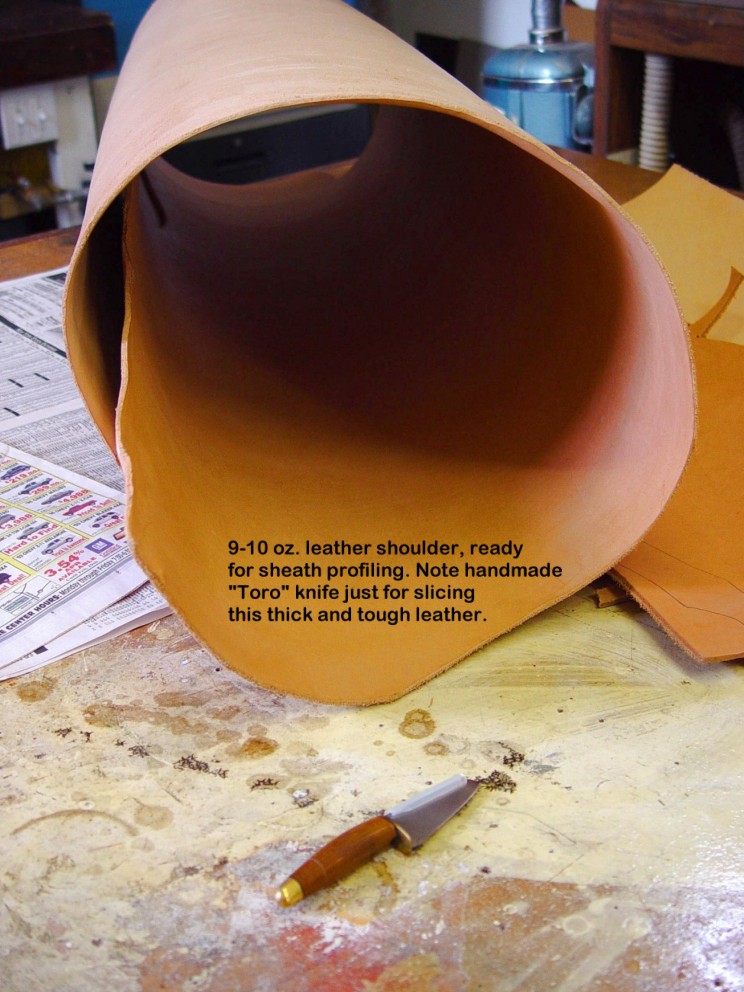
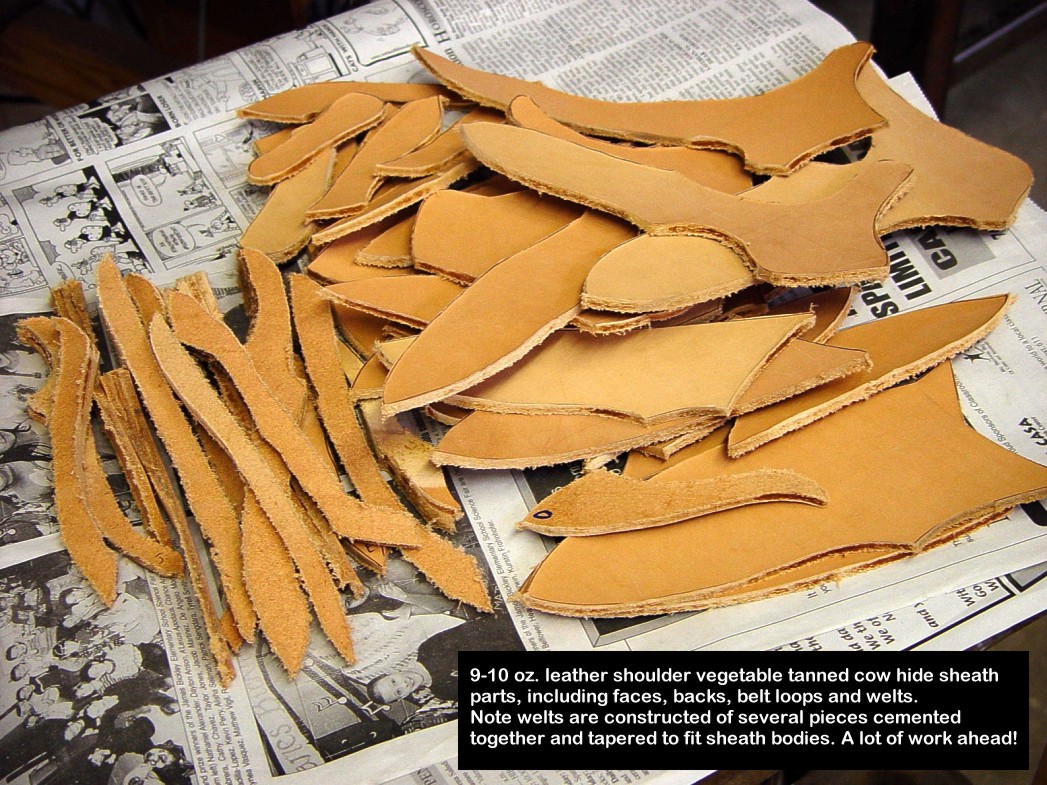
That is one of the reasons that I make my sheaths out of 9-10 oz. leather. Other makers and factories often use 4-6 oz., but that is not thick and strong enough. The reason that these companies and individuals might use thinner leather are several. First, it's cheaper. Thicker leathers have to come from mature cows, and from more expensive leather cuts (like the shoulder). Another reason is one of workmanship. Thicker leathers can not be stitched by machine, particularly with the added thickness of the welts. So the stitching on thick sheaths has to be done by hand. In order to make the sheaths quickly and cheaply, thinner leathers are used with machine stitching by many other makers and all manufacturers.
Thinner leather sheaths won't be as stiff as thicker leathers, so if you are hiking or on horseback and take a tumble, the sheath might flex enough to let your knife cut through, and cut you! If I could, I'd make the sheath as hard as lumber to prevent flexing. This is the same reason I believe that leather knife sheaths should never be oiled. Oiling will soften even the thickest leather eventually, enough to make the frame of the sheath floppy and sloppy, enough for the sheath to bend or the fit to loosen, possibly leading to loss of the knife. Oily leather will also attract and hold soil, sand, abrasives, dirt, and debris, which will eventually scratch your knife blade.
I had a good laugh when I read on one website that the sheath maker only used "Cordovan" leather. Cordovan is leather named for a place in Spain, but that is not where it comes from; it comes from the rear end of a horse. Okay, call it the hindquarters. It is a great leather for shoes, and wears well for that use, but should never be used on a knife sheath. The sheath maker claimed that one of its outstanding qualities is that it "softens with age." This is something a knife owner never wants to happen! A sheath that gets softer is one that will eventually bend and fail, with the result a knife blade cutting through. It's simple: the knife blade does not bend; neither should the sheath. So, when someone claims that a leather is soft and supple, it's fine if they're making shoes and clothing, but it is clearly a bad idea for a knife sheath. Incidentally, this particular sheath maker was not a knife maker, and that is one of the reasons the knife maker should complete his entire assembly: all parts, features, and components, including sheaths. A sheath maker is simply not familiar with the very knife he creates a sheath for but in a merely decorative way. He does not know how the knife is made, what it is to be used for, what corrosion or chemical and moisture interactions the knife will encounter, or what the knife will be used for. This is typically a conversation for the knife maker. If the maker completes the entire package, he is certain to match the knife, the sheath, and the owner with the knife's exposures and performance.
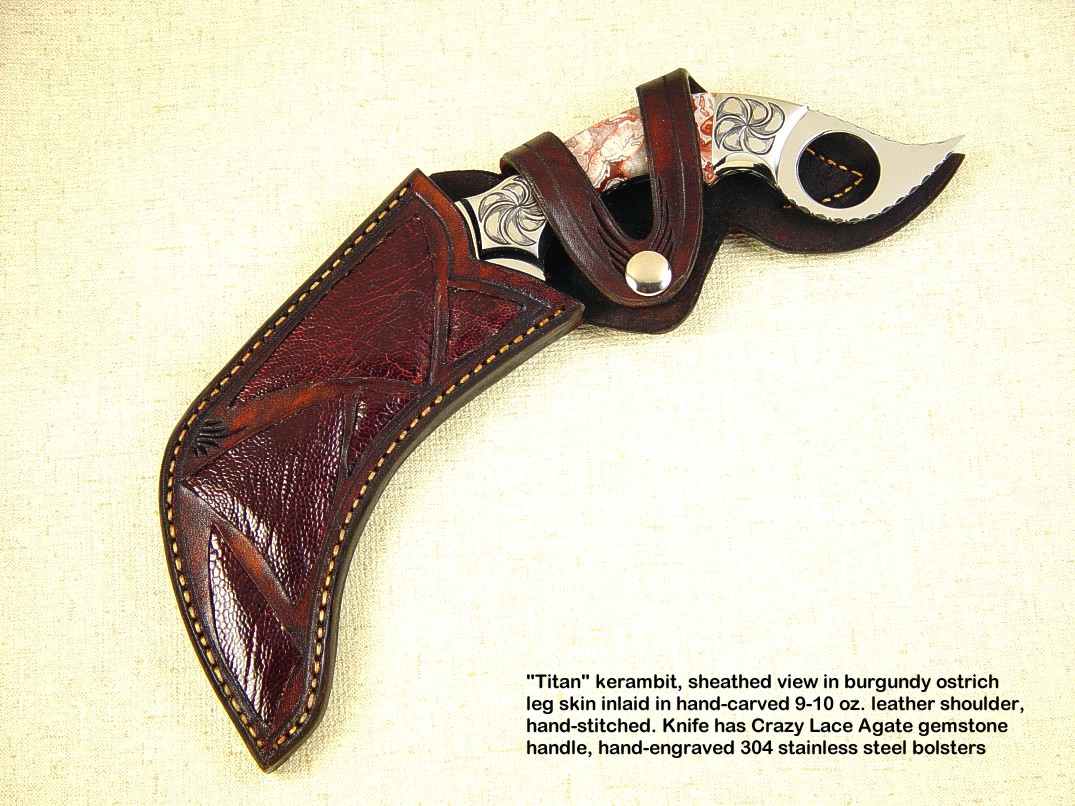
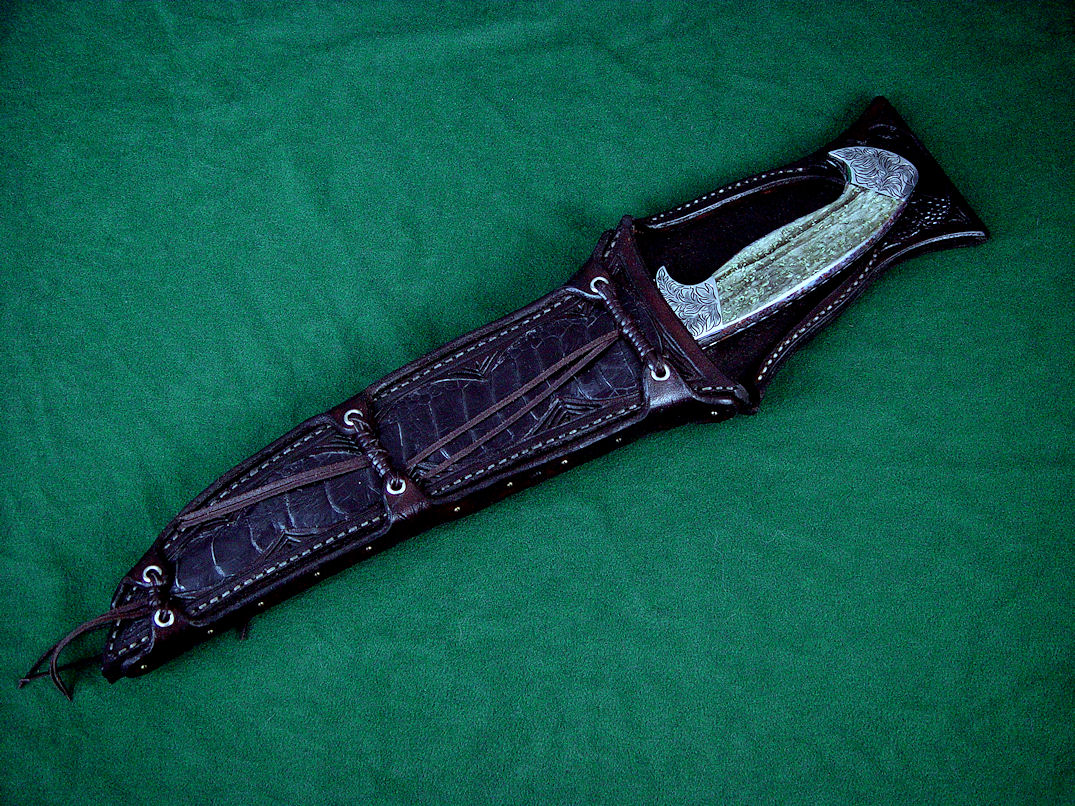
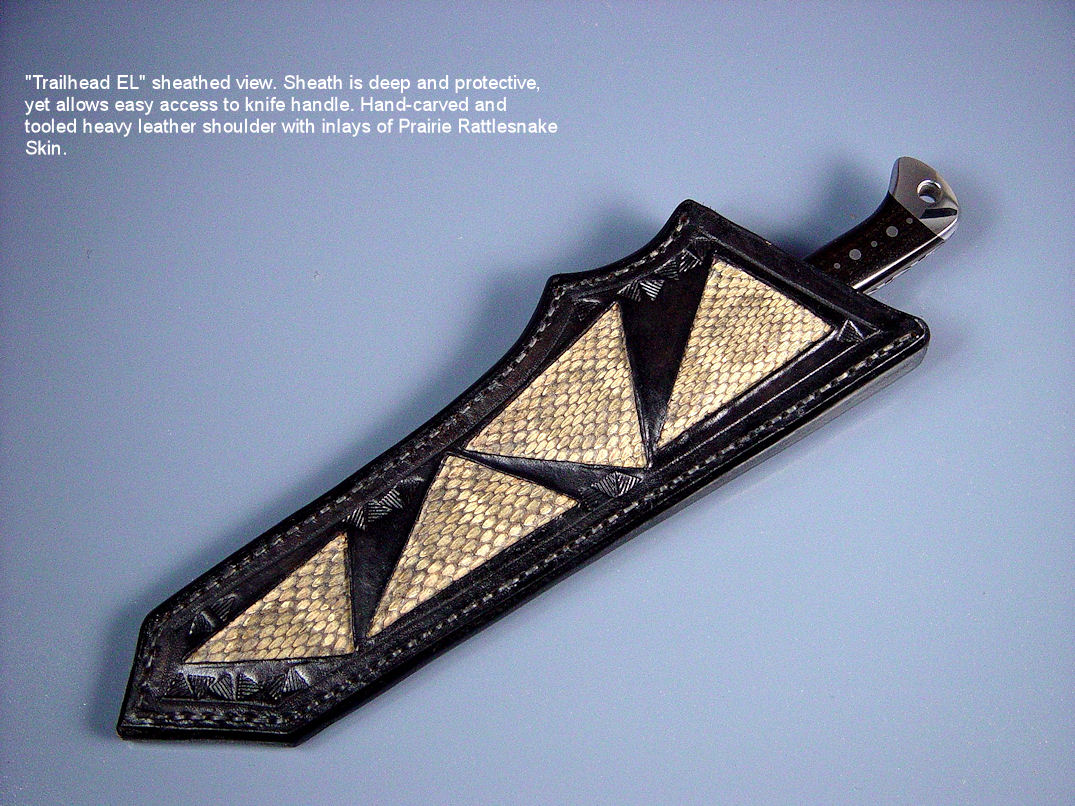
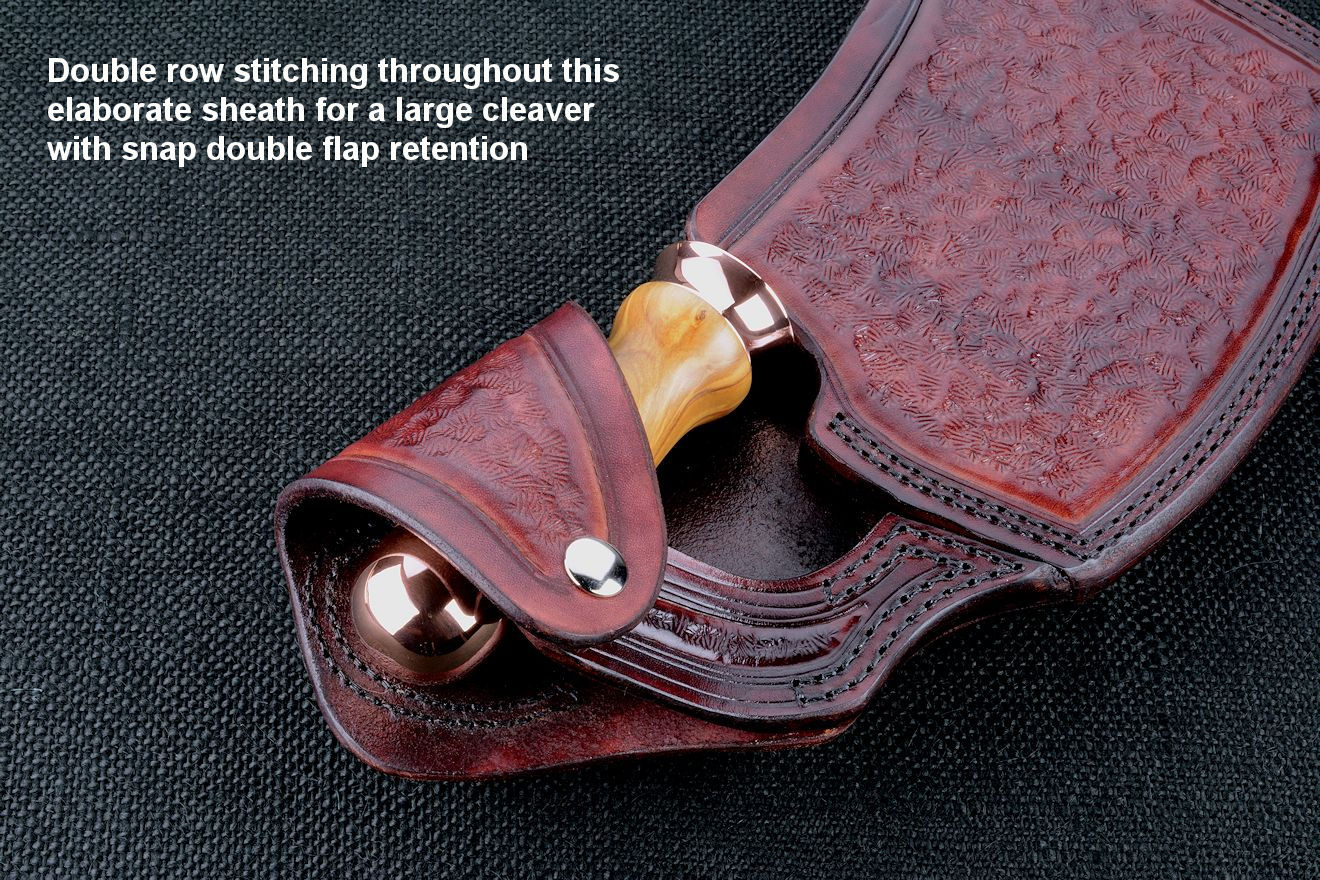
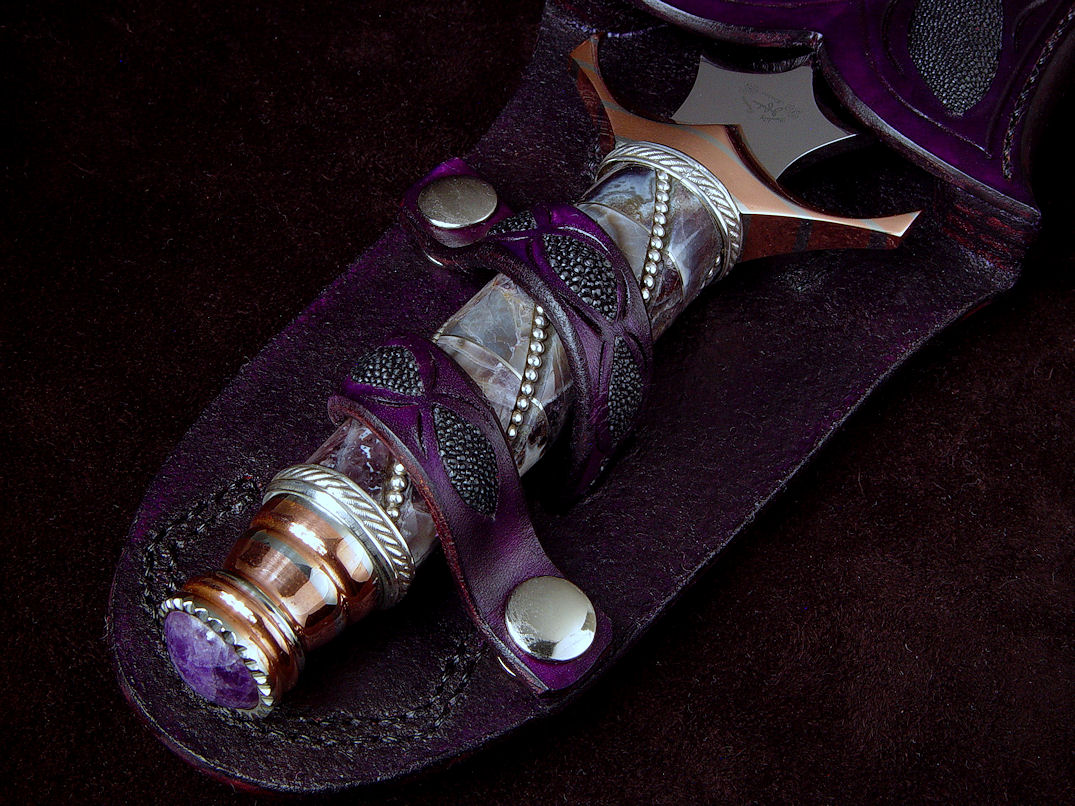
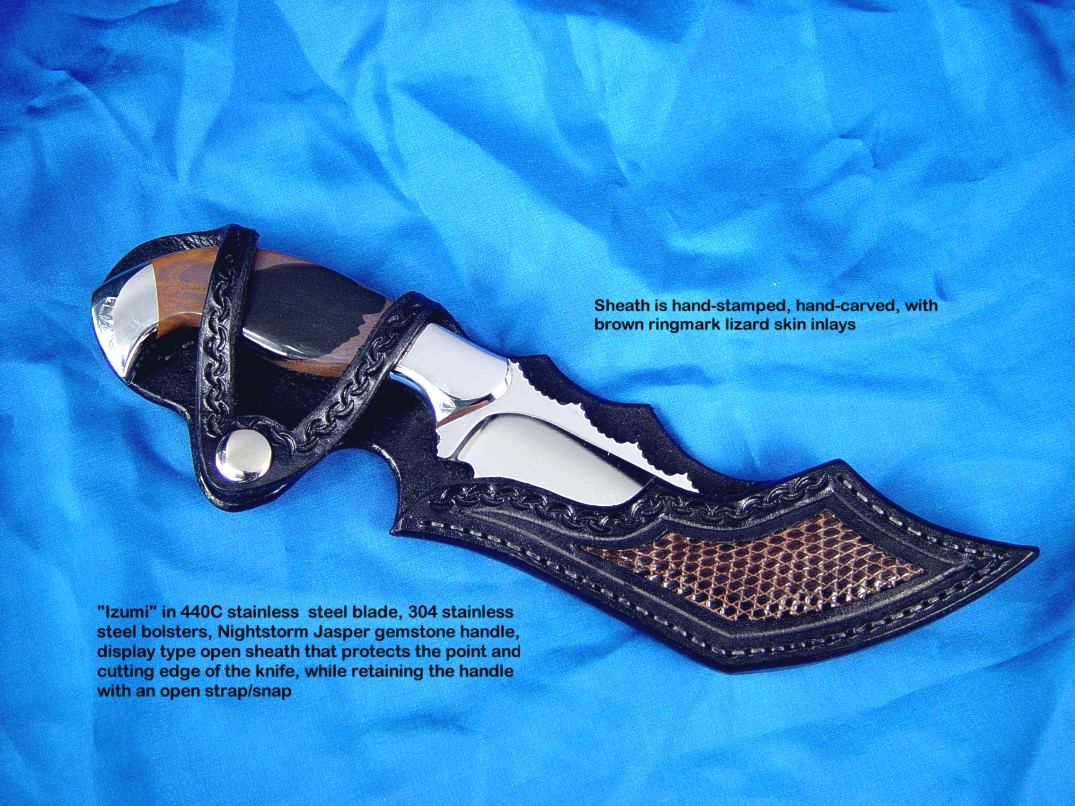
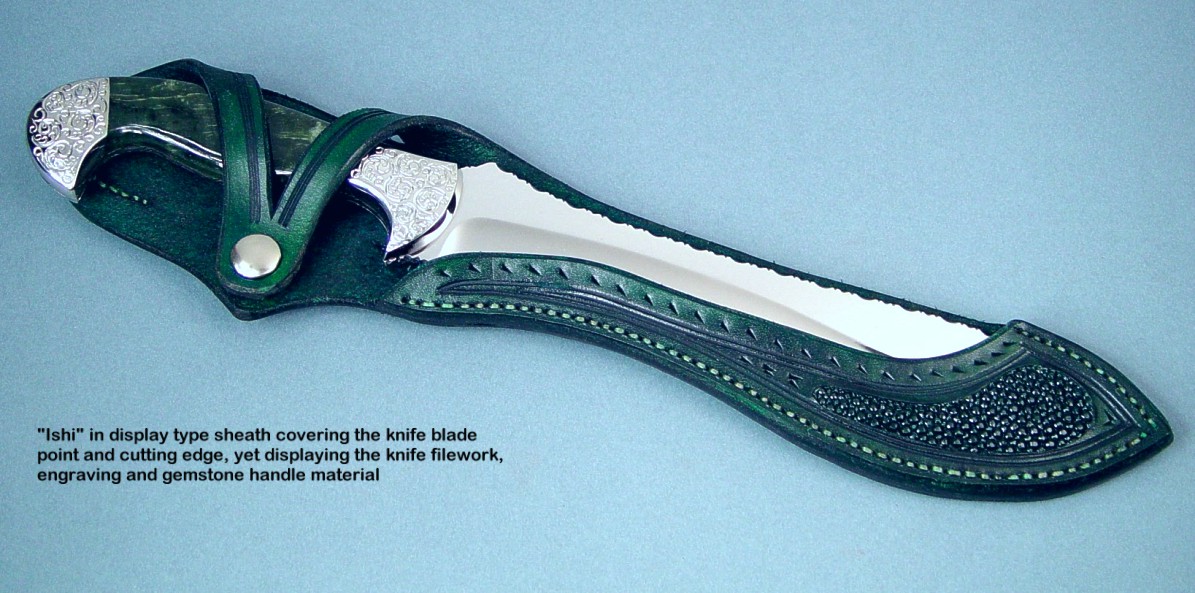
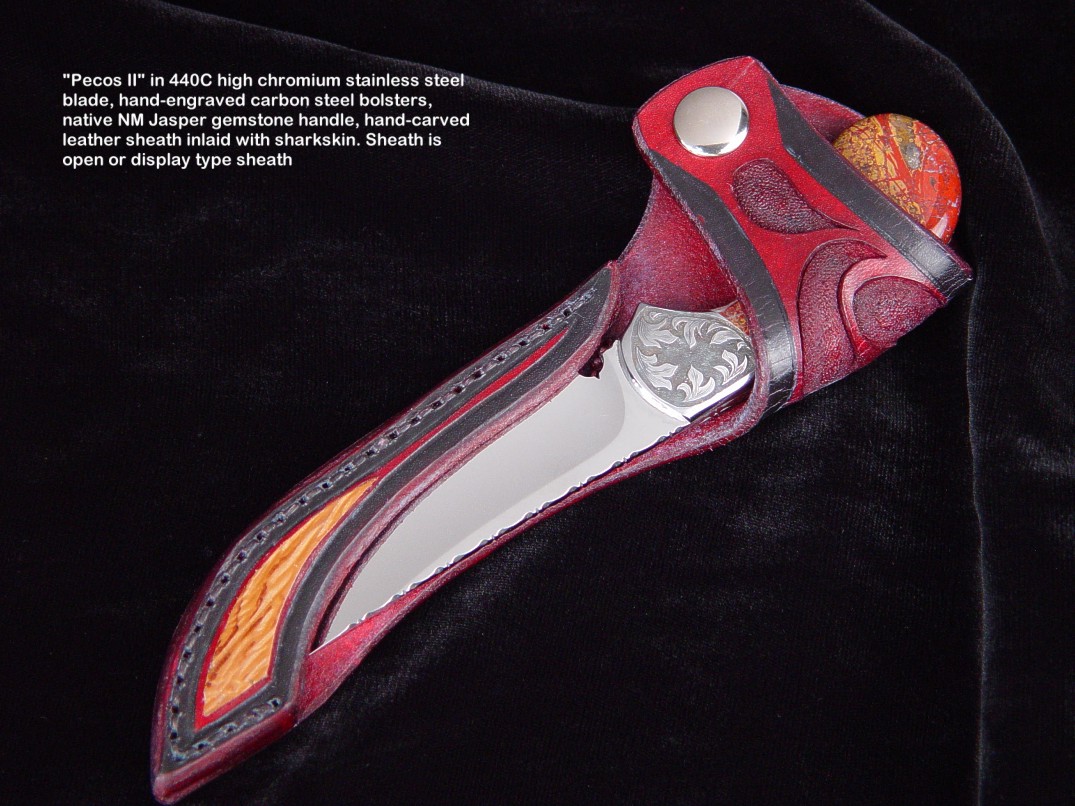
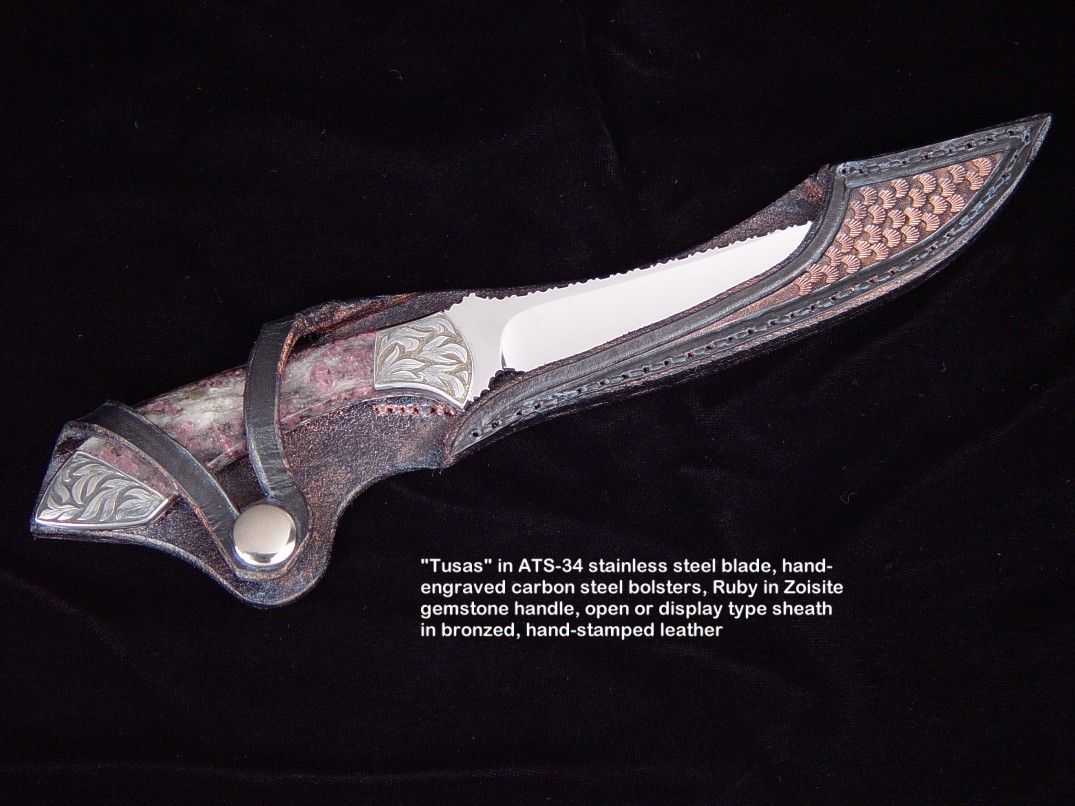
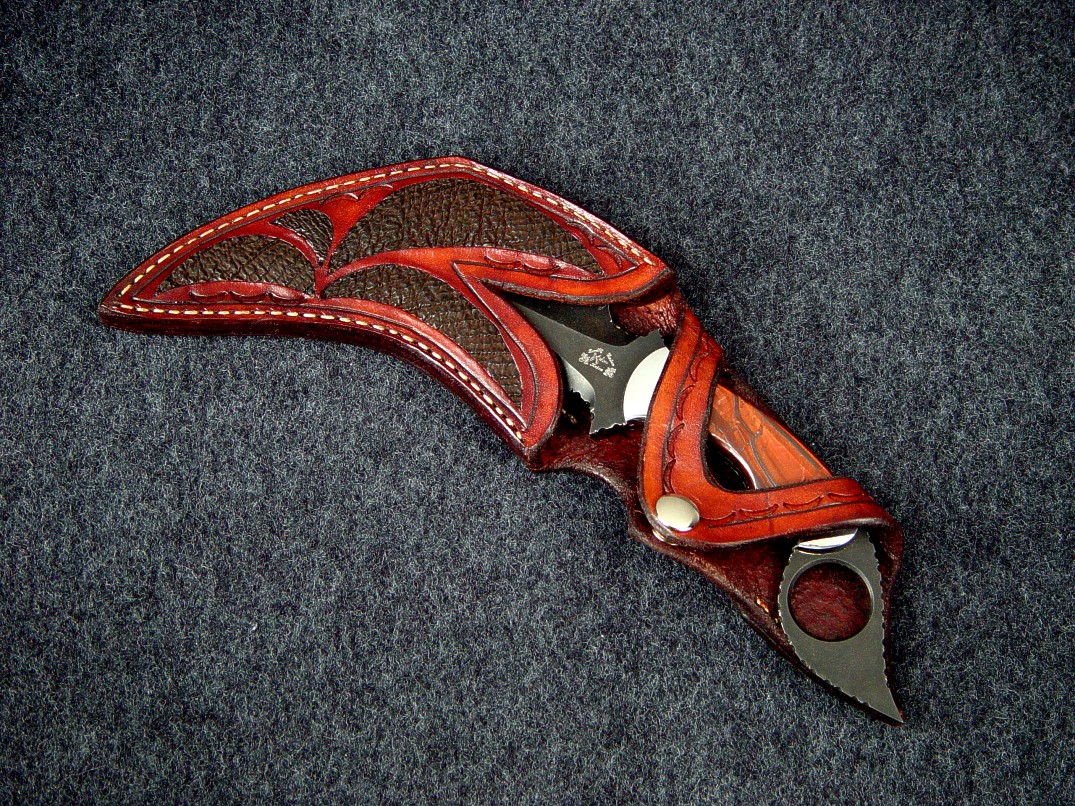
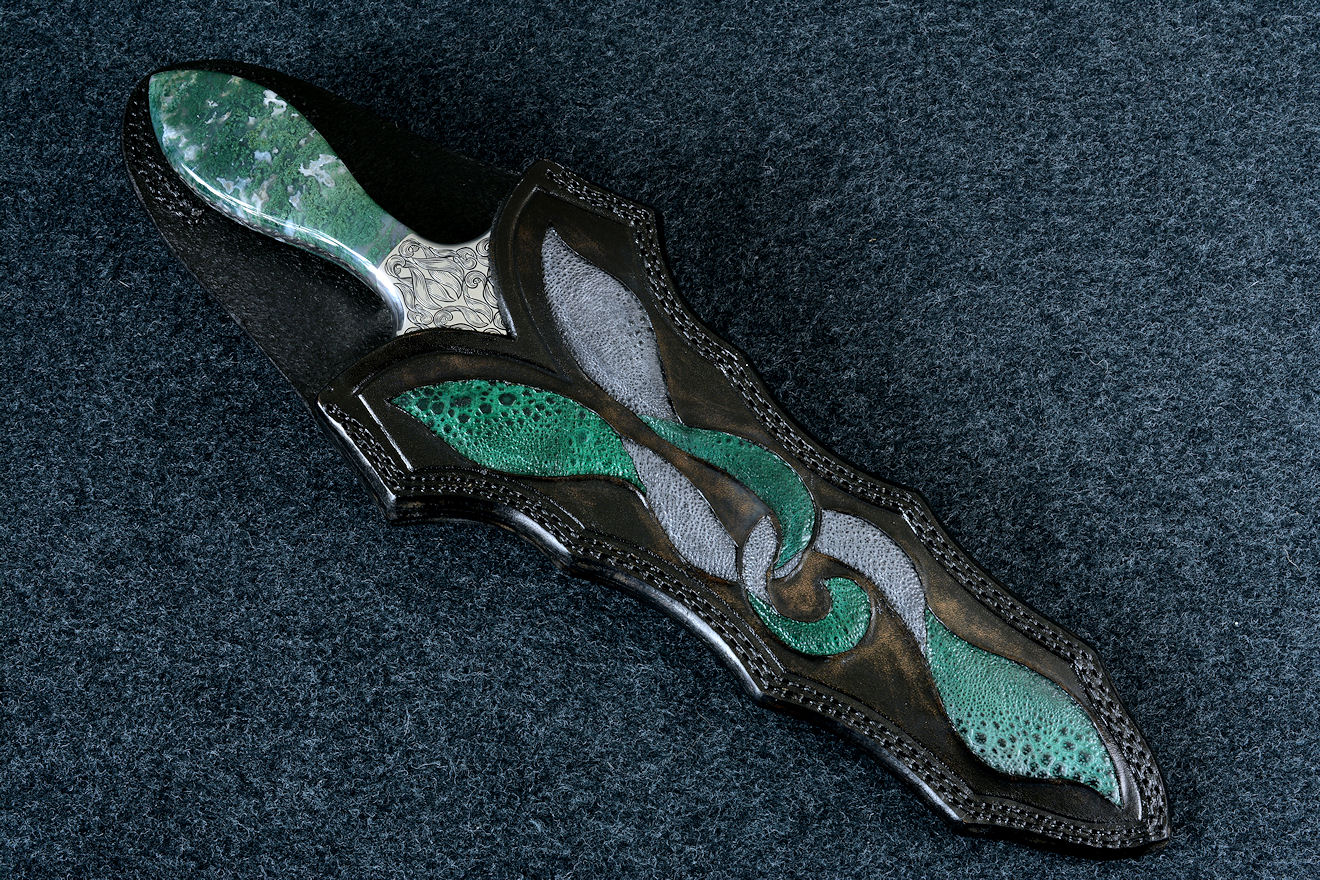
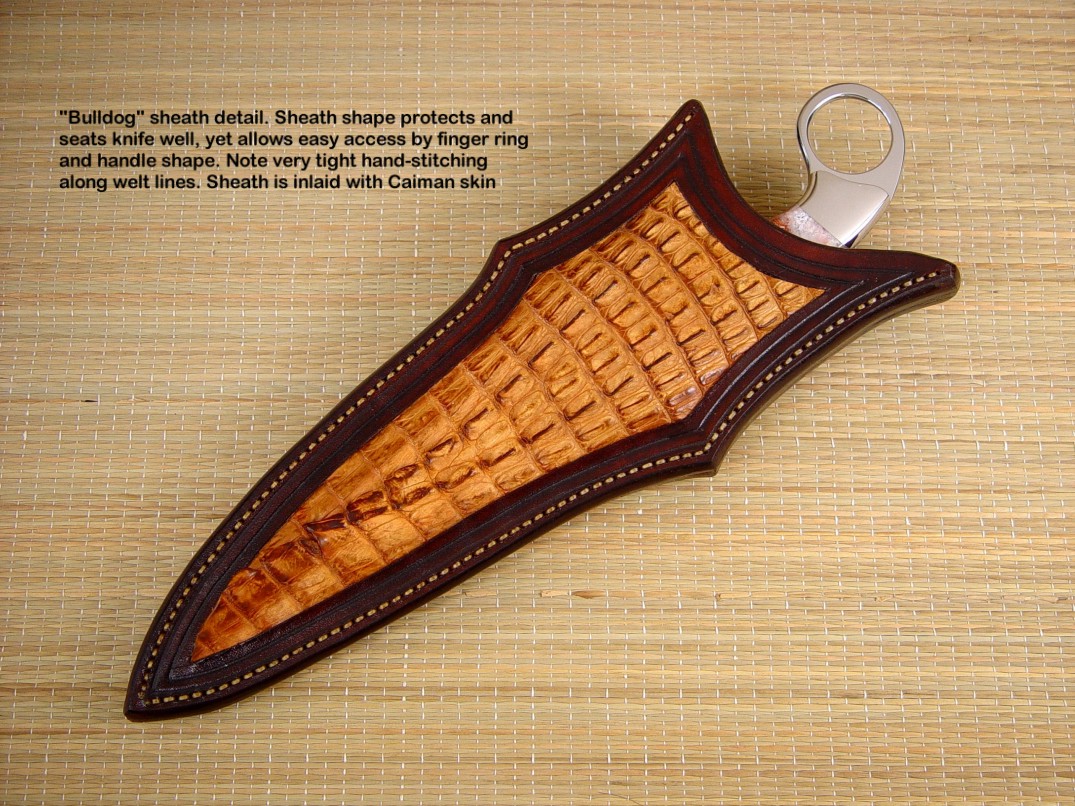
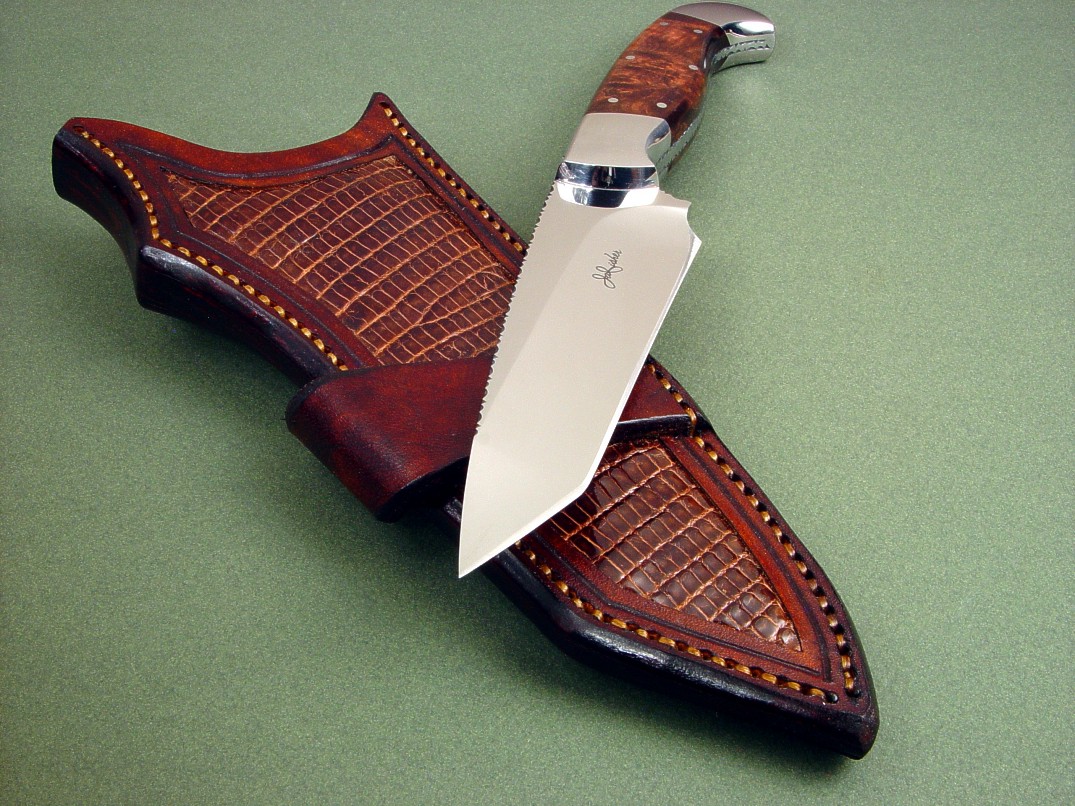
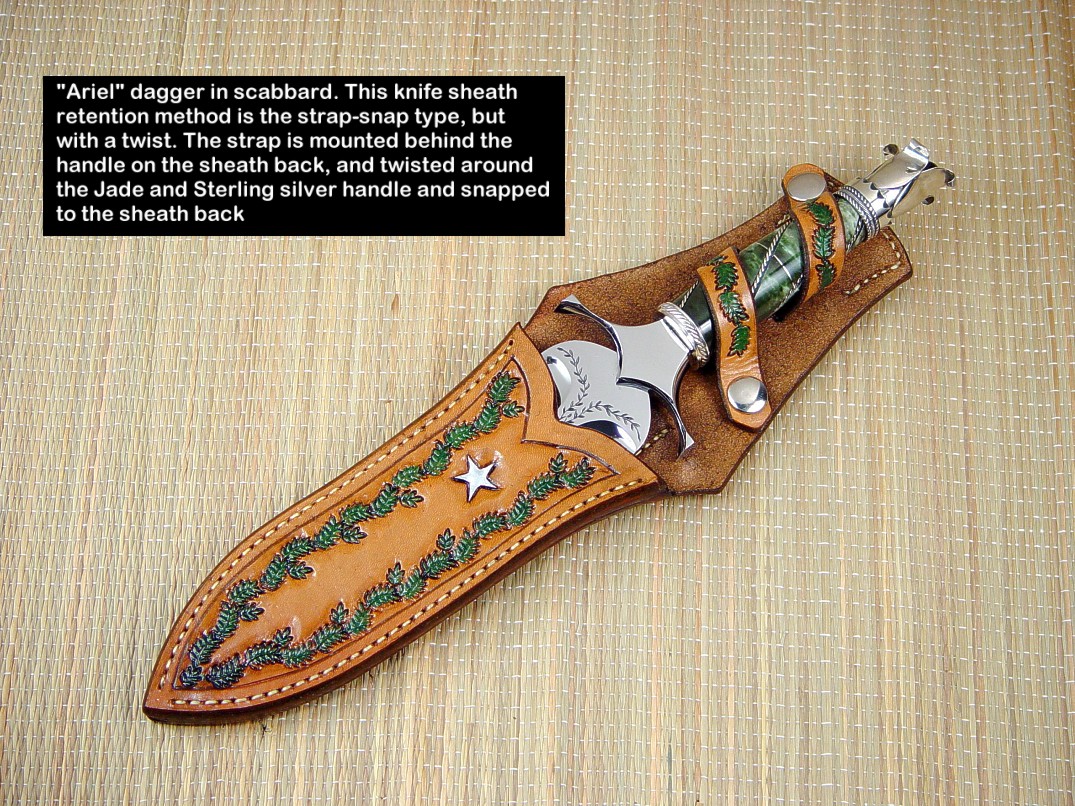
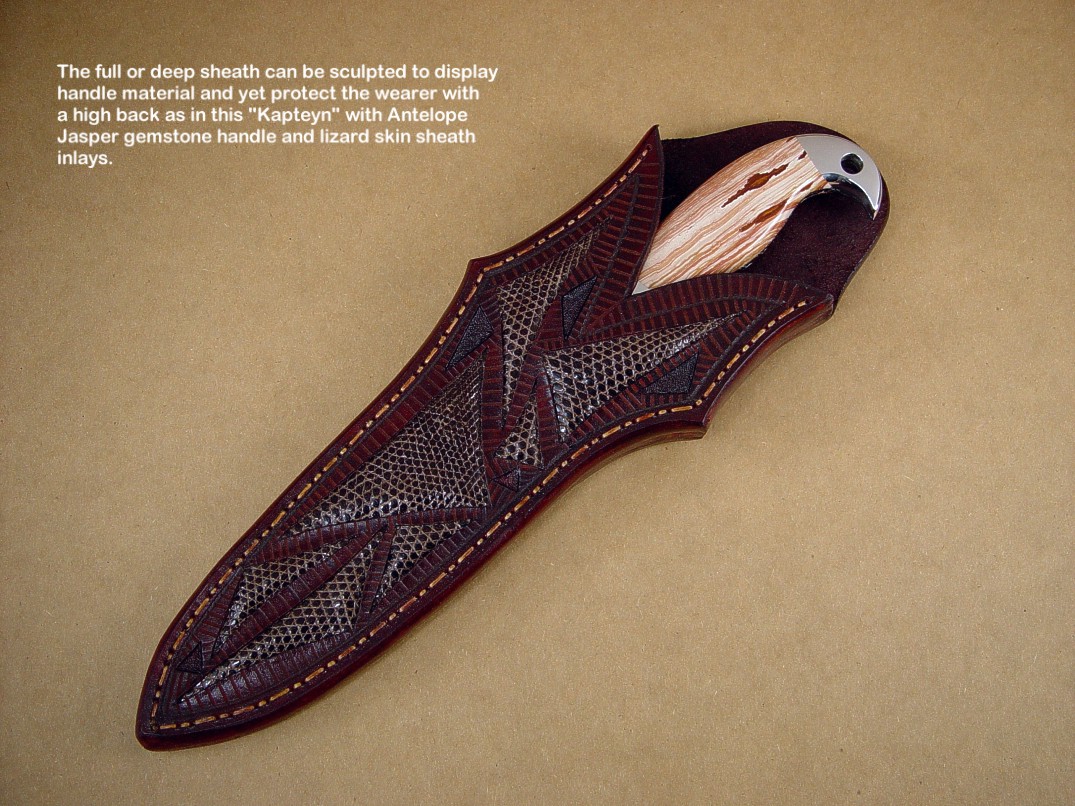
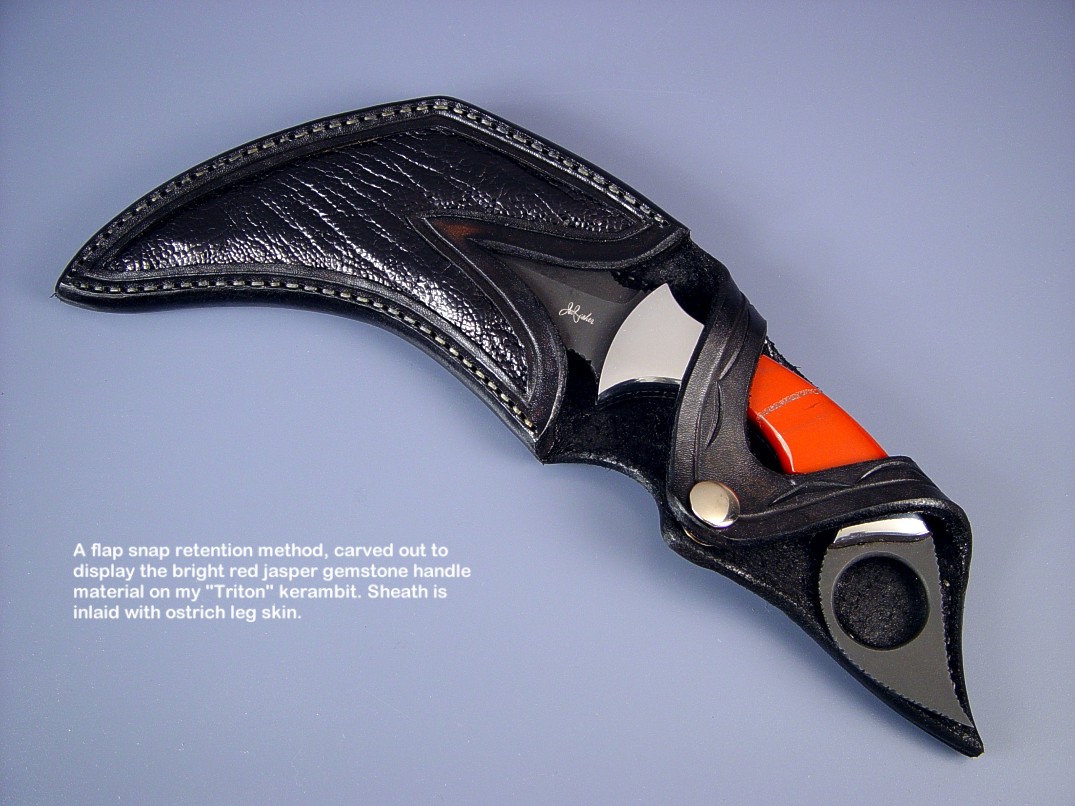
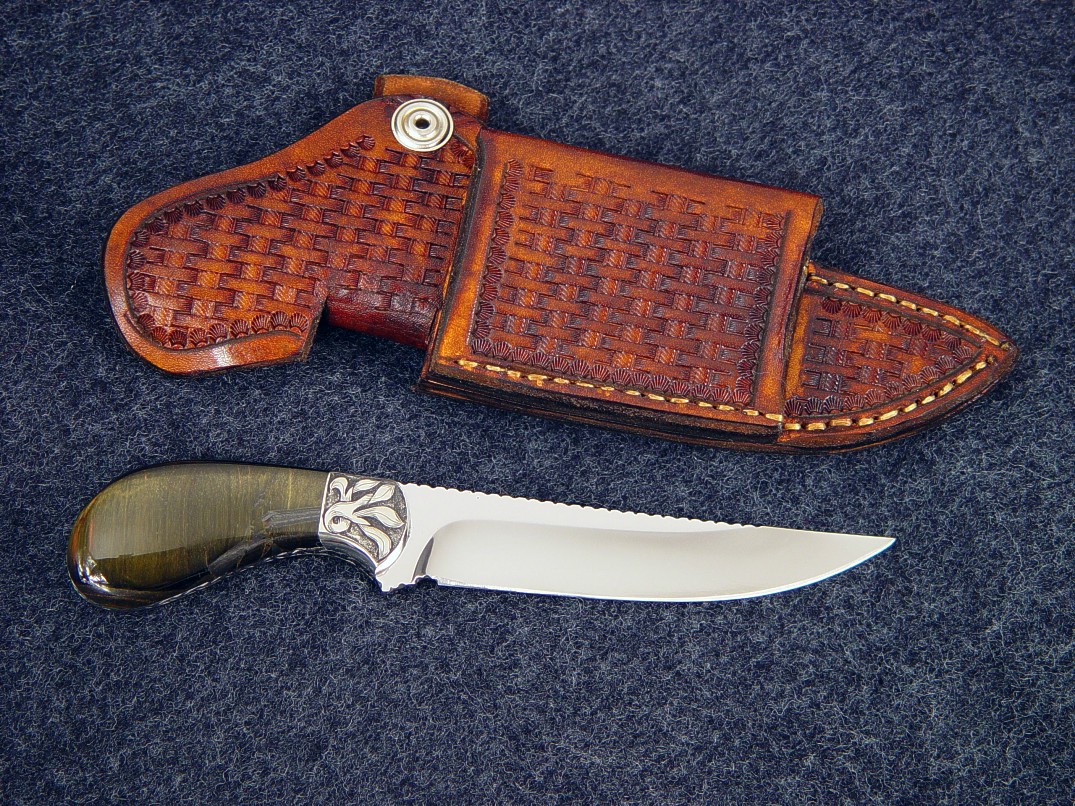
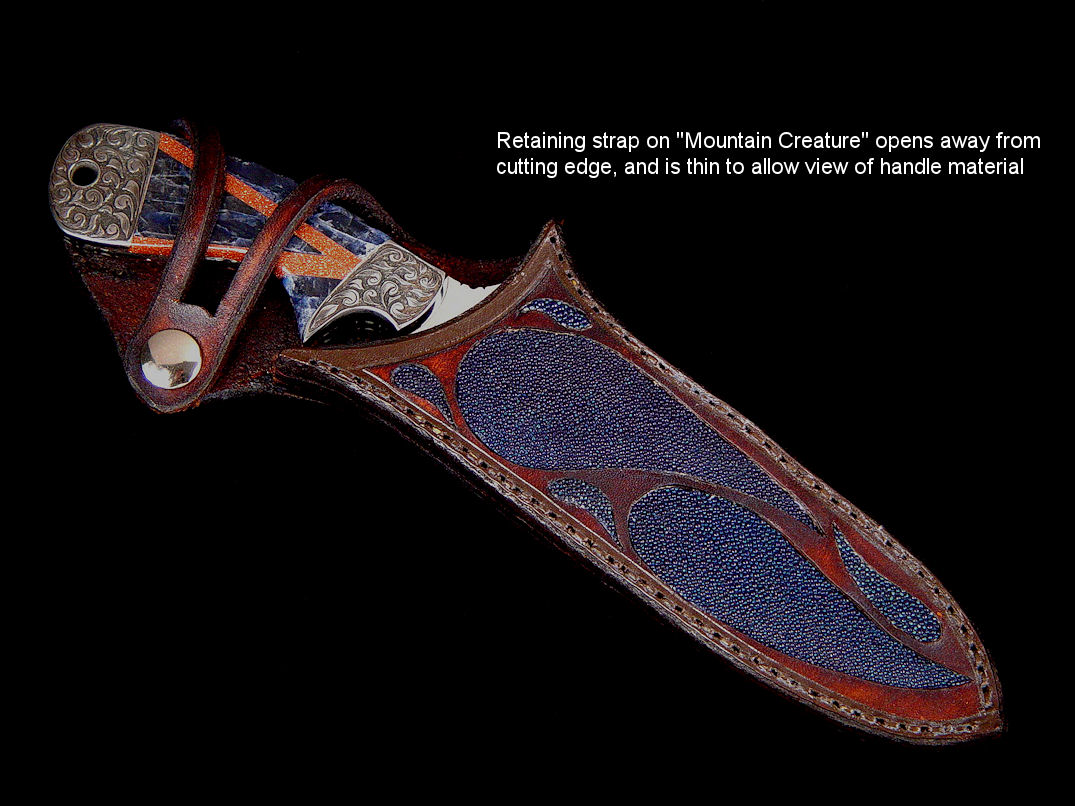
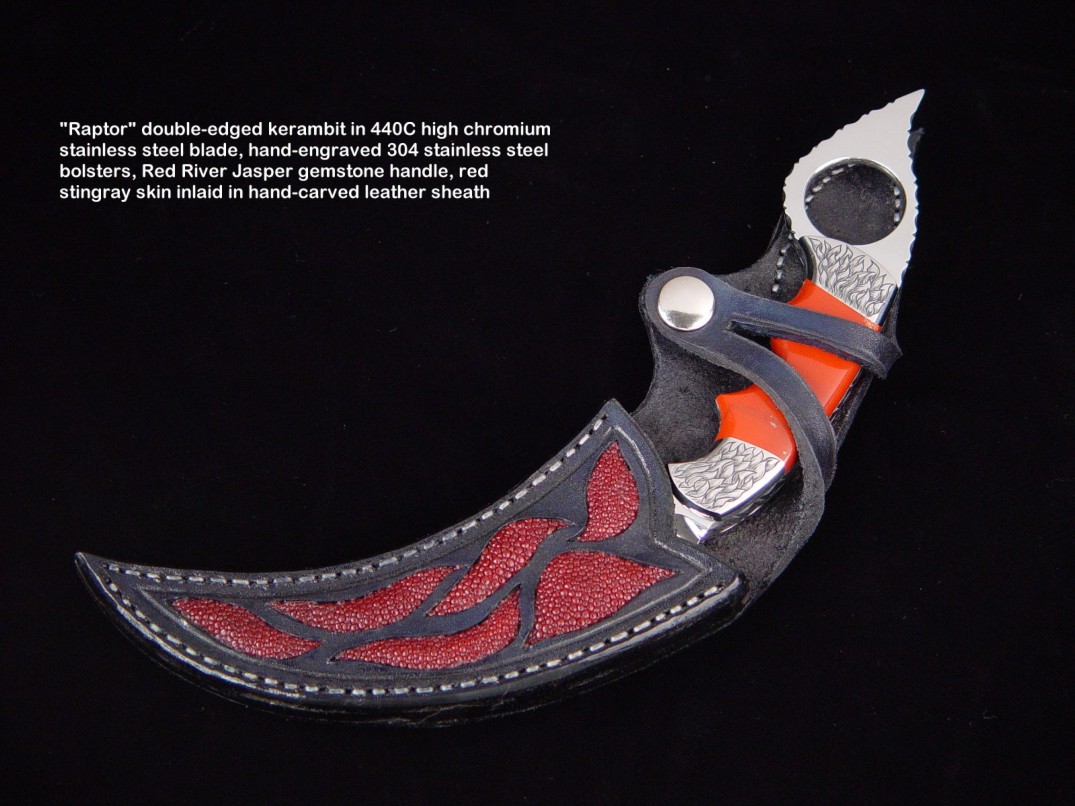
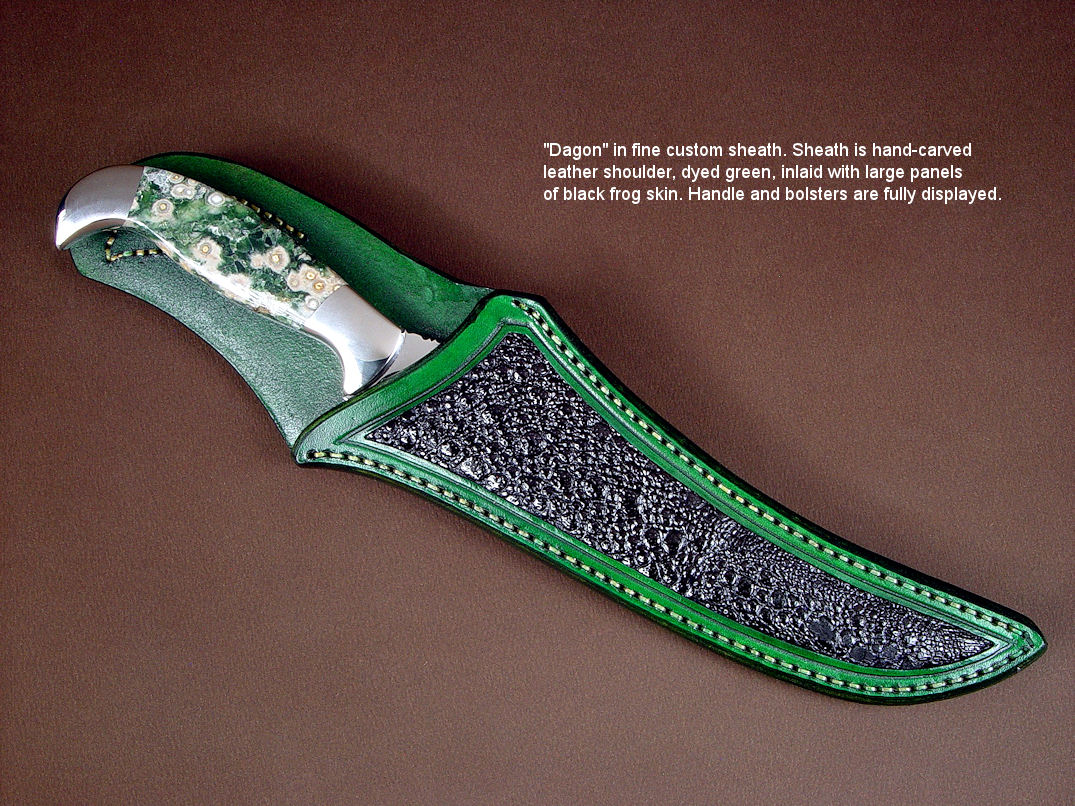
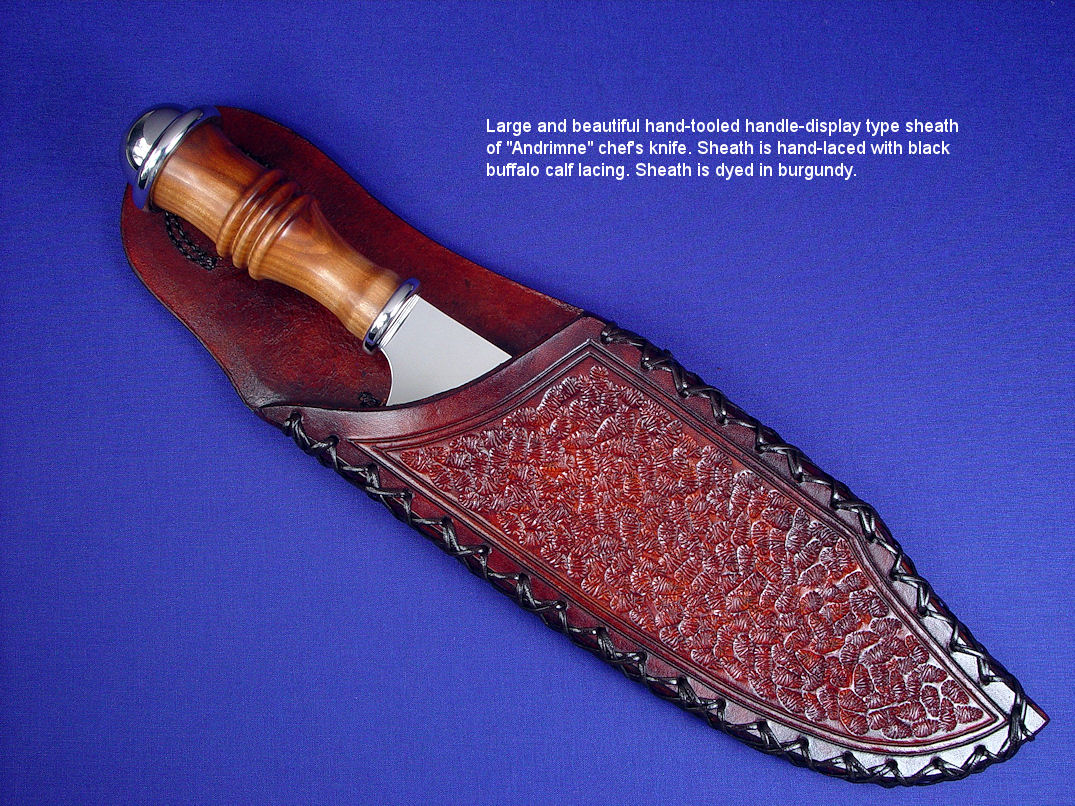
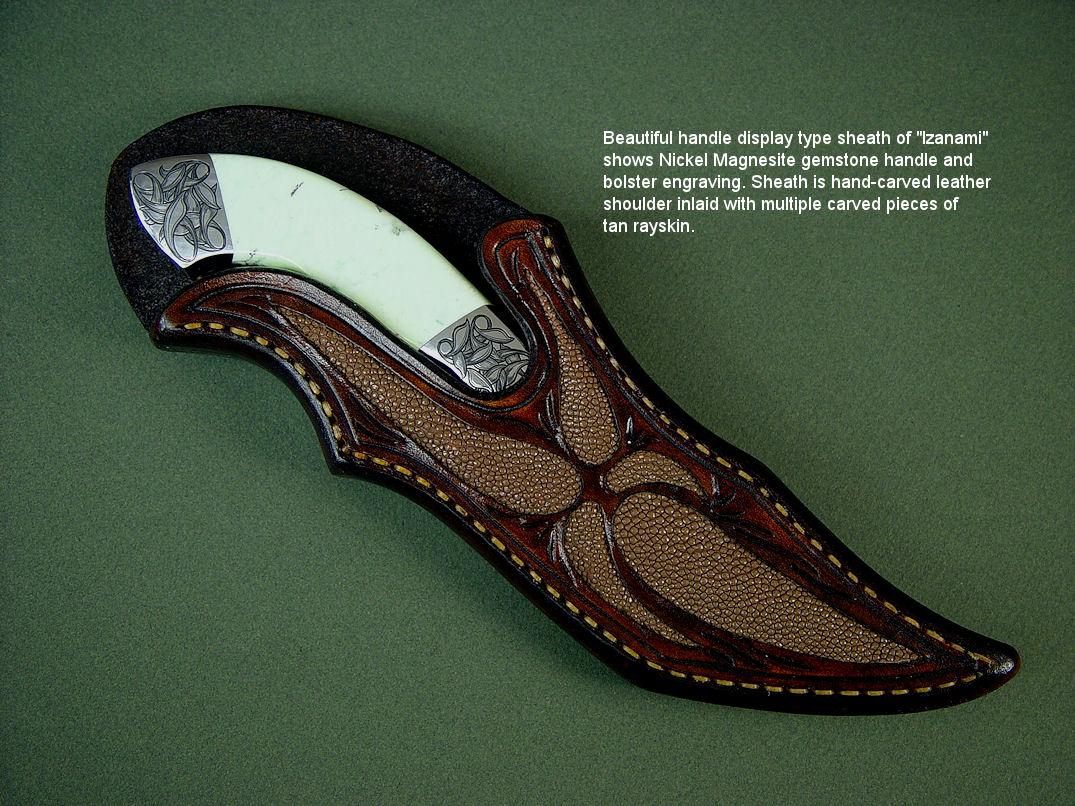
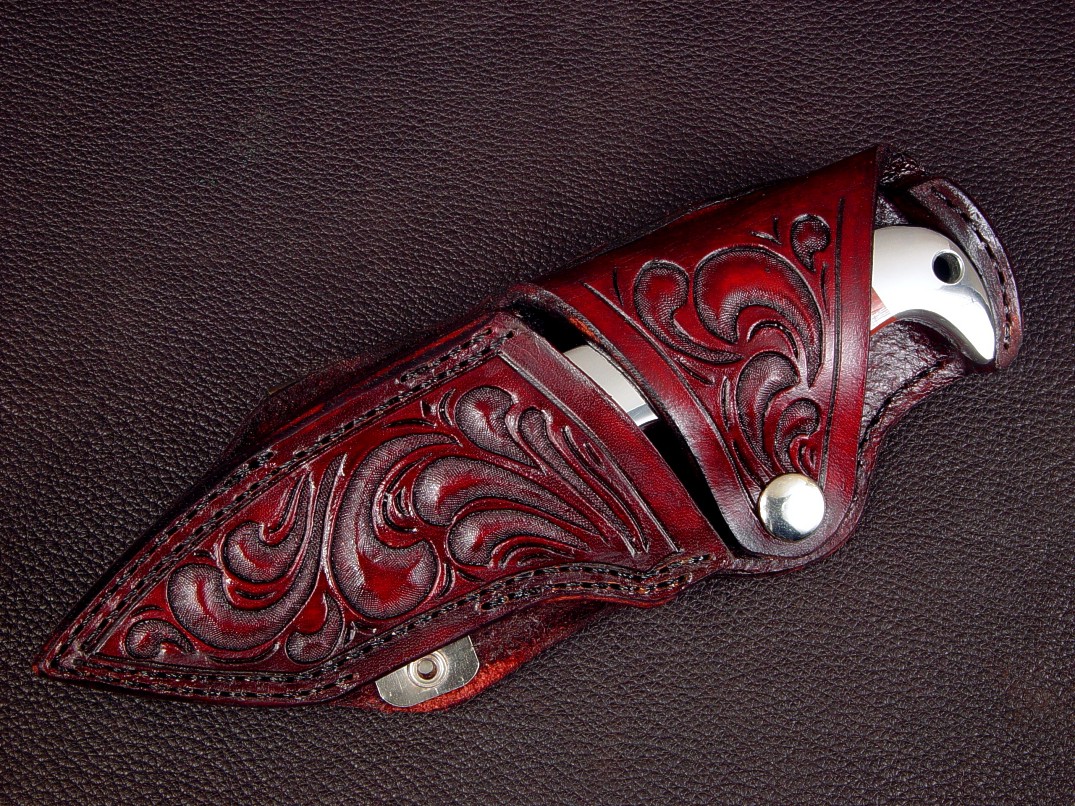
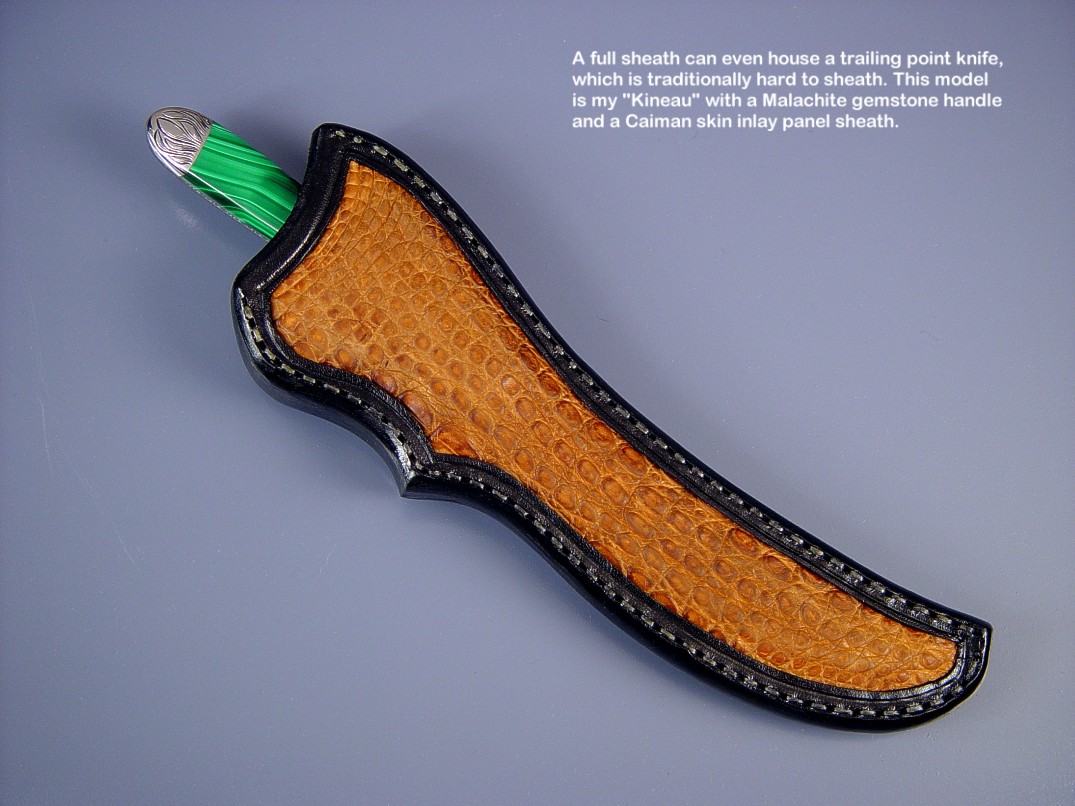
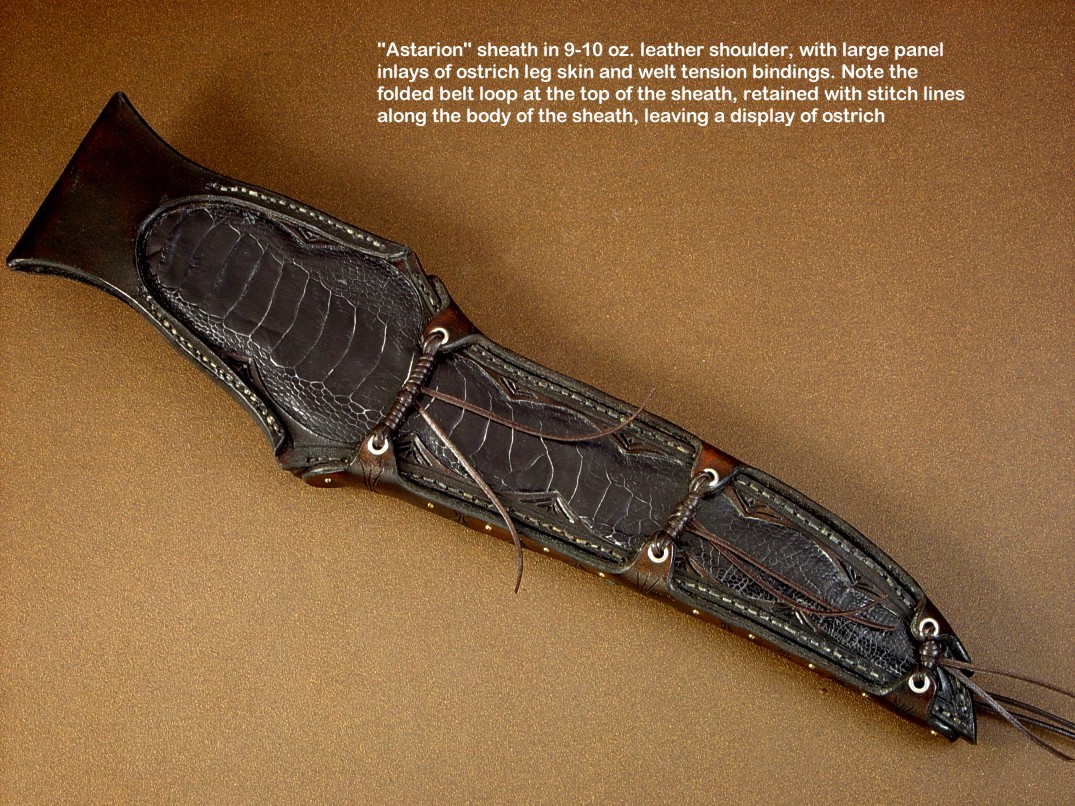
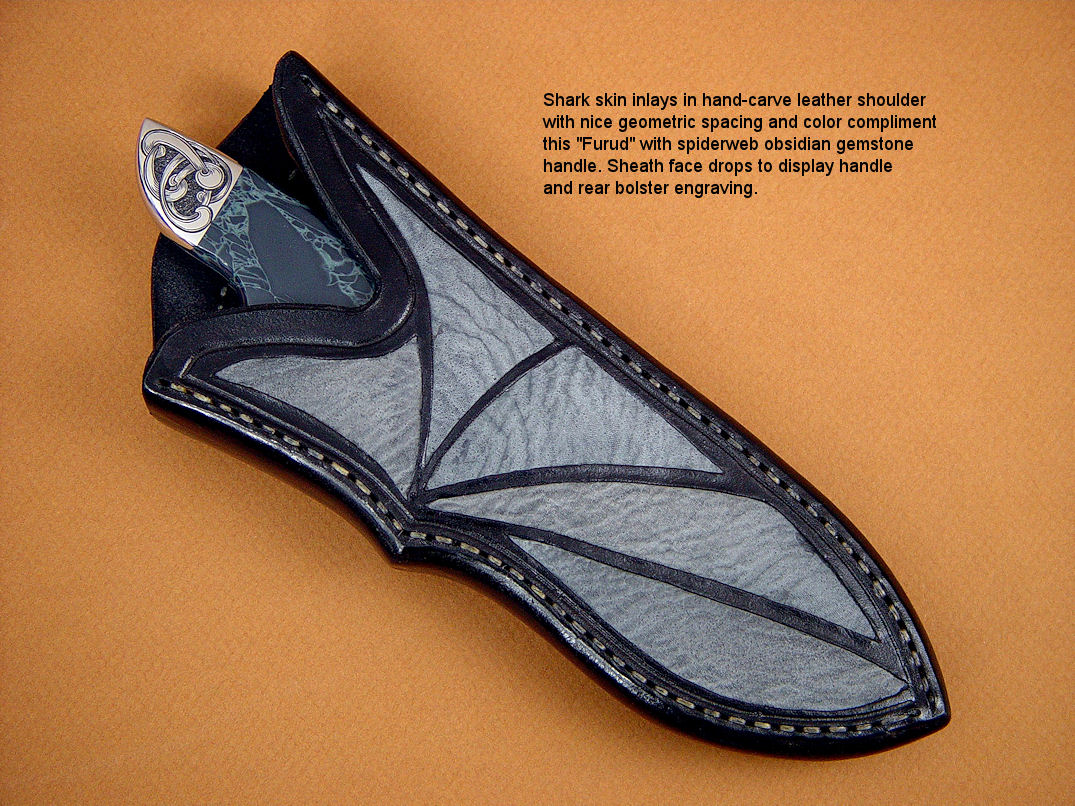
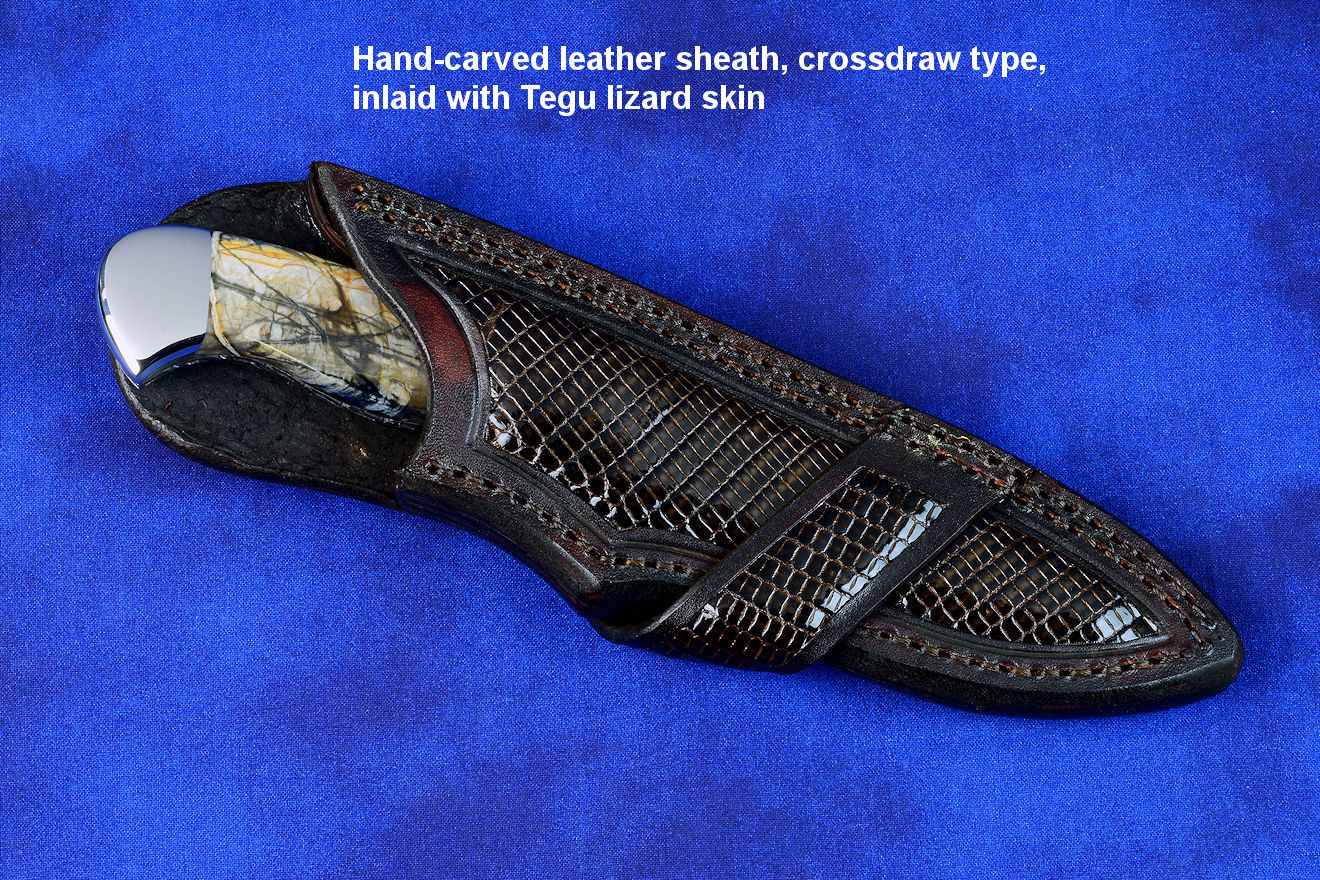
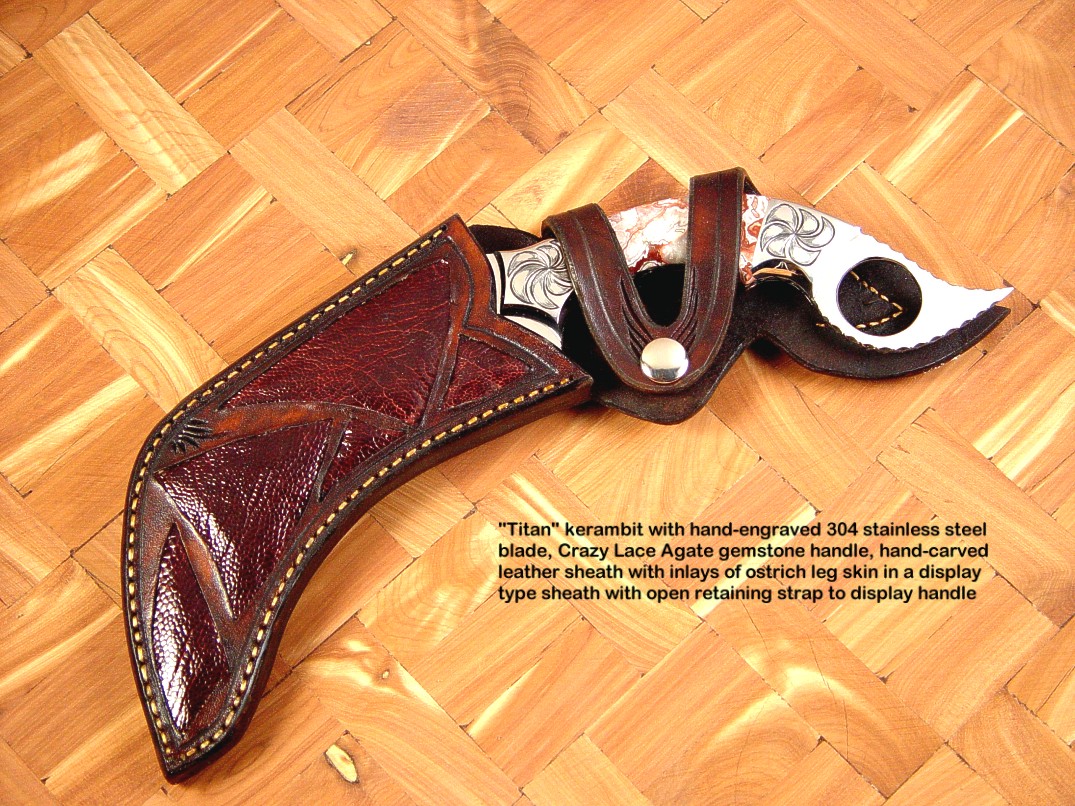
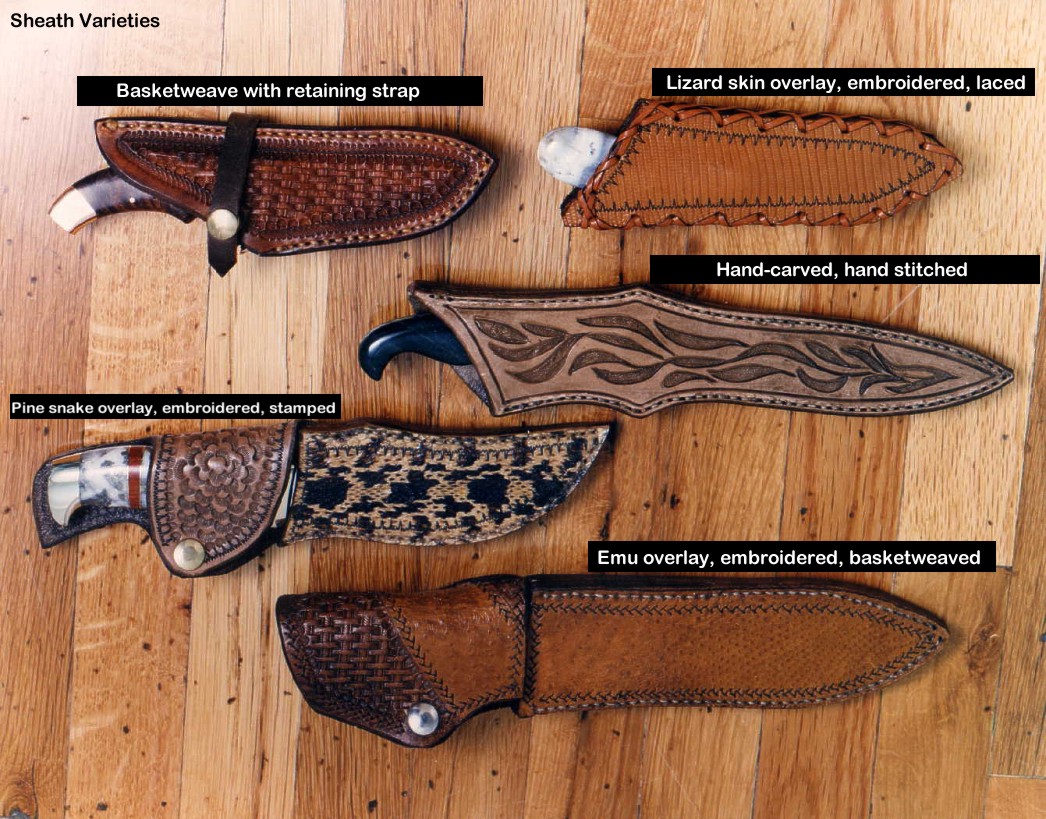
Having the protection in the proper place is the foundation of a well-designed and constructed sheath. In the thumbnail photo group below are a few pictures of finely made open or display-type sheaths that do just that, yet let the wearer display the beautiful handle and in some, even the lines of the blade. This type of sheath works well on trailing point knives which are hard to sheath because of the high point and its propensity to dig into or cut into the welts. In this sheath type, the trailing point knife must be rolled away from the point to remove it from the sheath. You'll also see that I've constructed some of the sheaths with retention straps that are open to allow a good view of the handle materials.
Dear Jay
I can truly say I have never seen such beautiful work before. I came on your page looking for knife cases and
yes, I realize you don't make them. But I wanted to take a moment to say that you have an incredible sense of
artistry. As a custom furniture builder, I have a bit of an appreciation for what you deal with - but you are
way beyond anything I ever accomplished. I now am a manufacturer of mass produced outrigger pads and don't miss
the hard times of building furniture. Anyway, great job, excellent work.
Bravo.
Bob Lifton
Welts are the spine of the knife sheath.
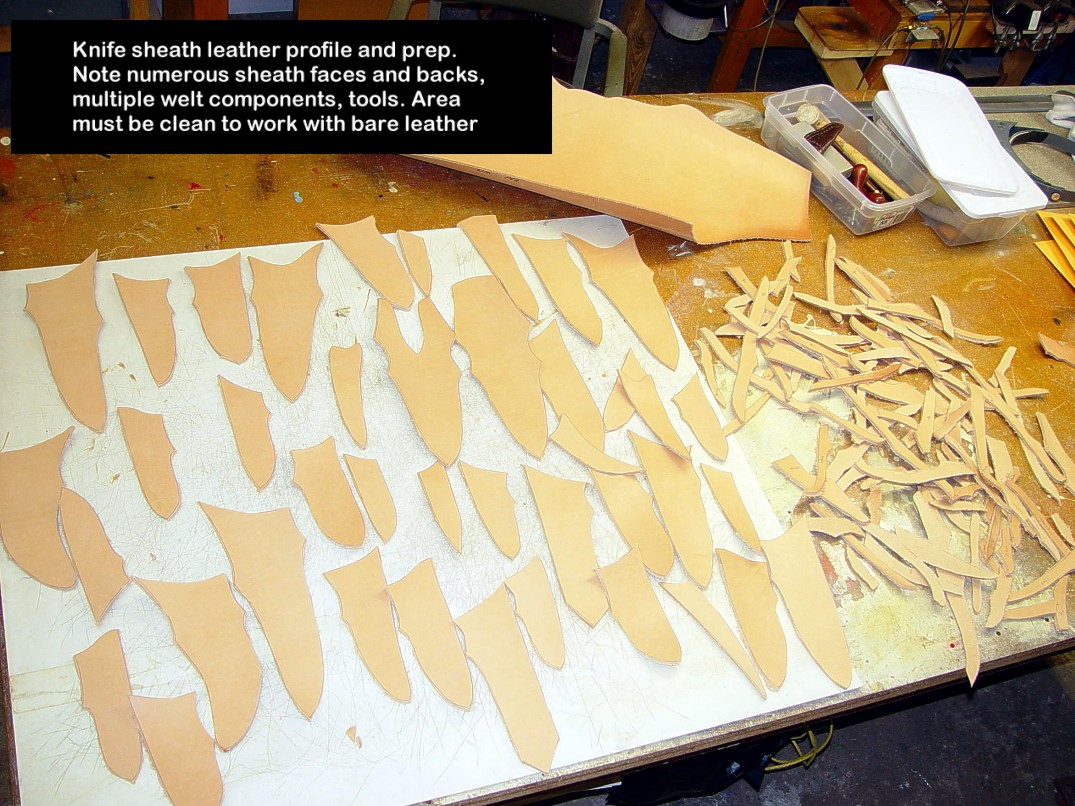
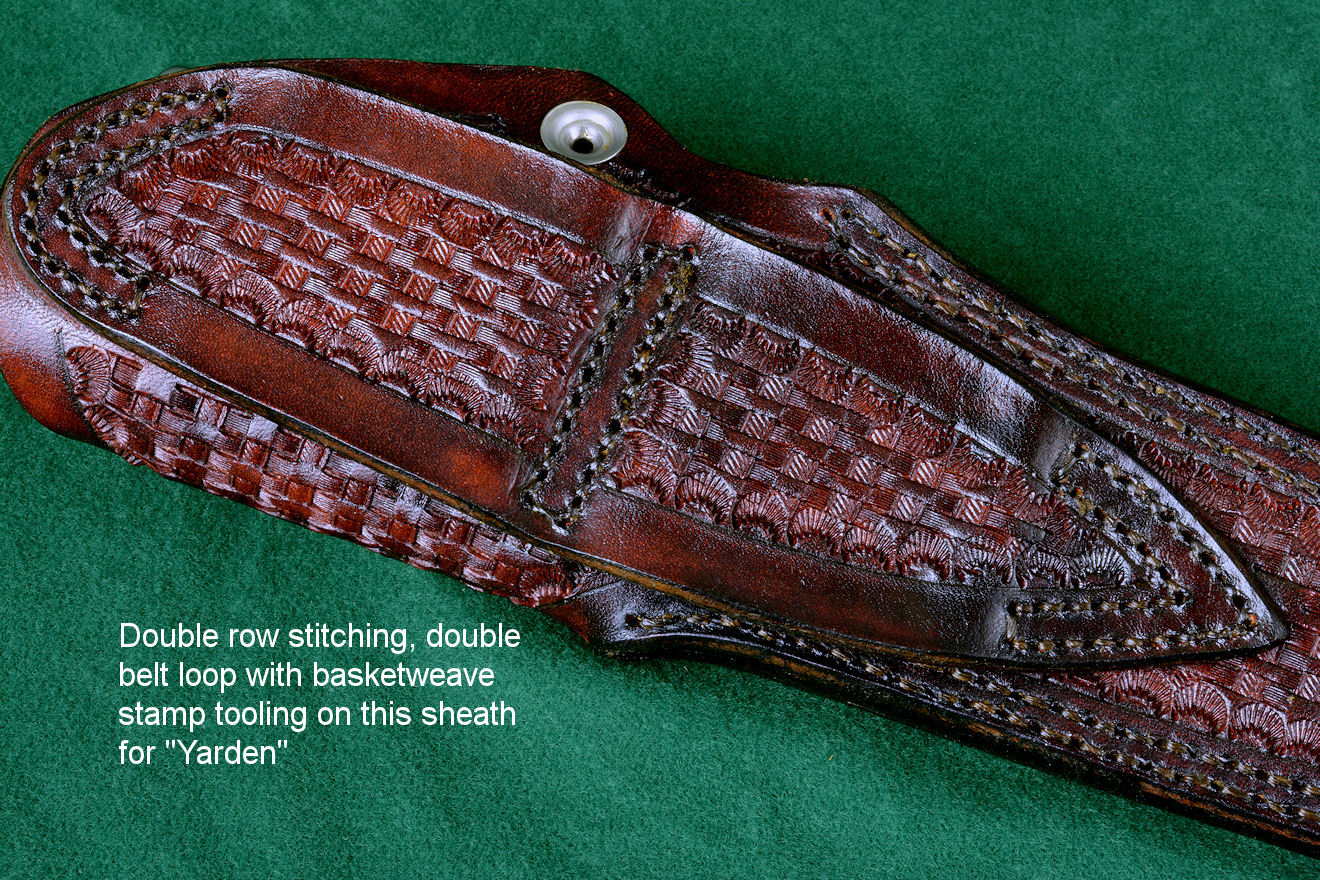
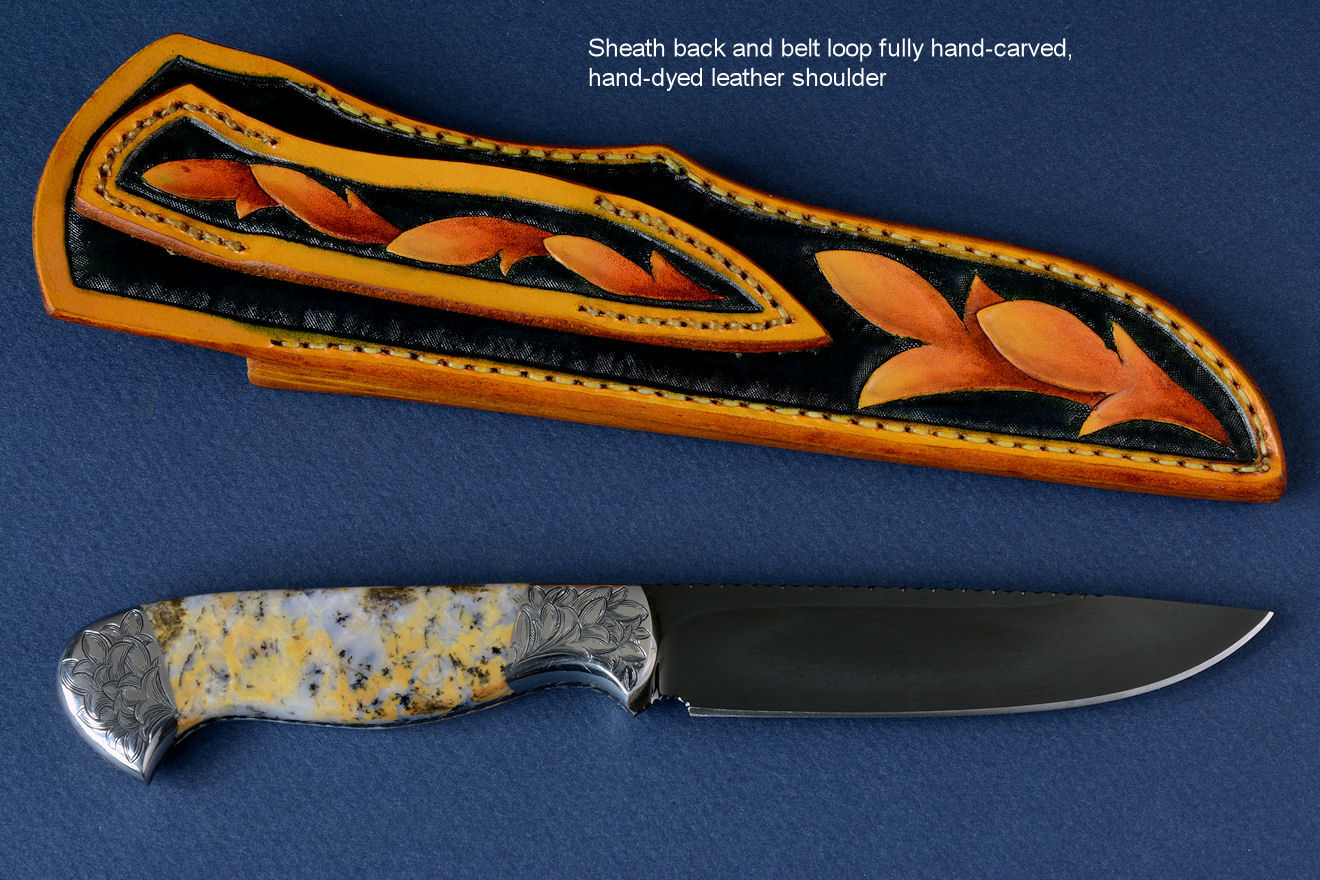
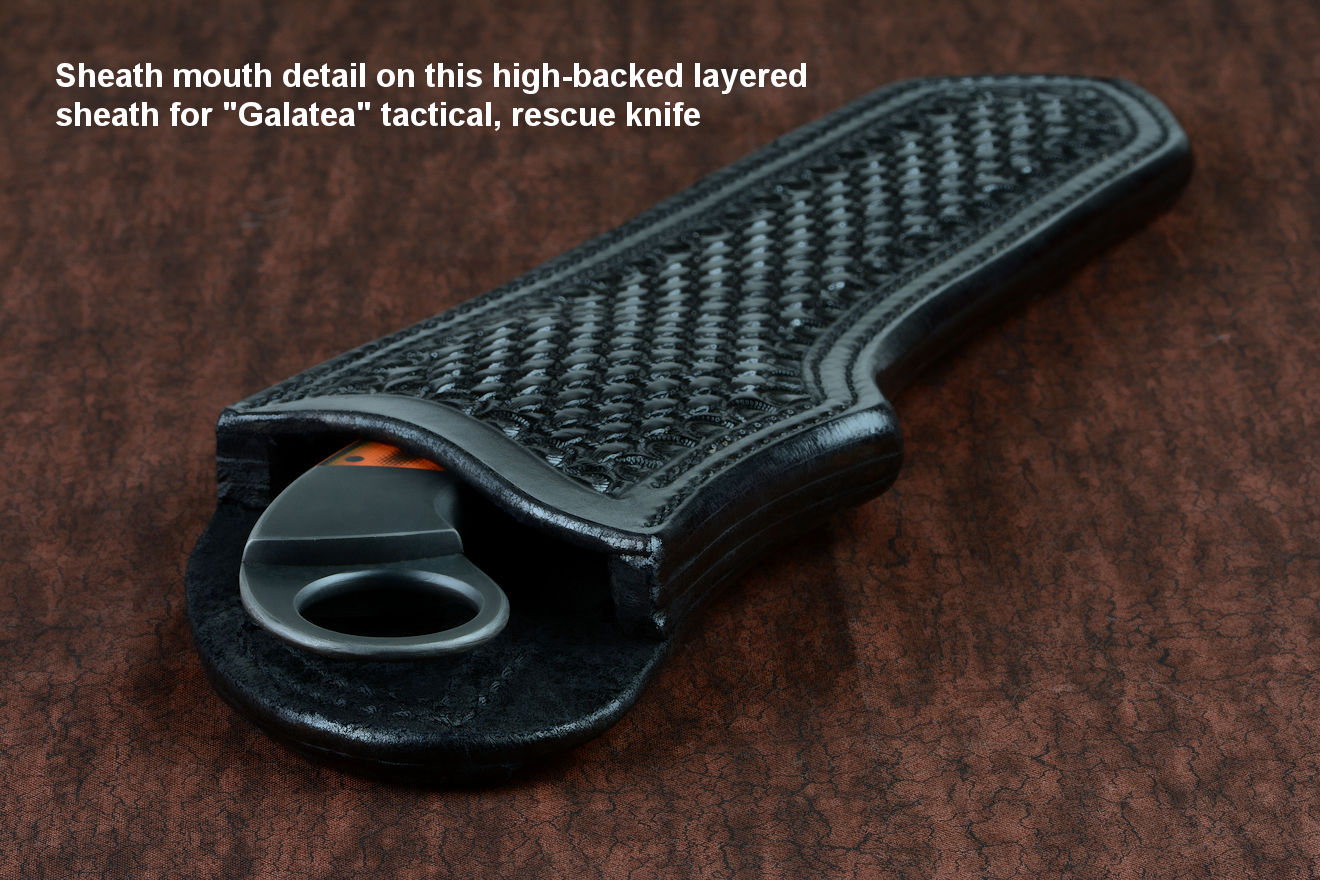
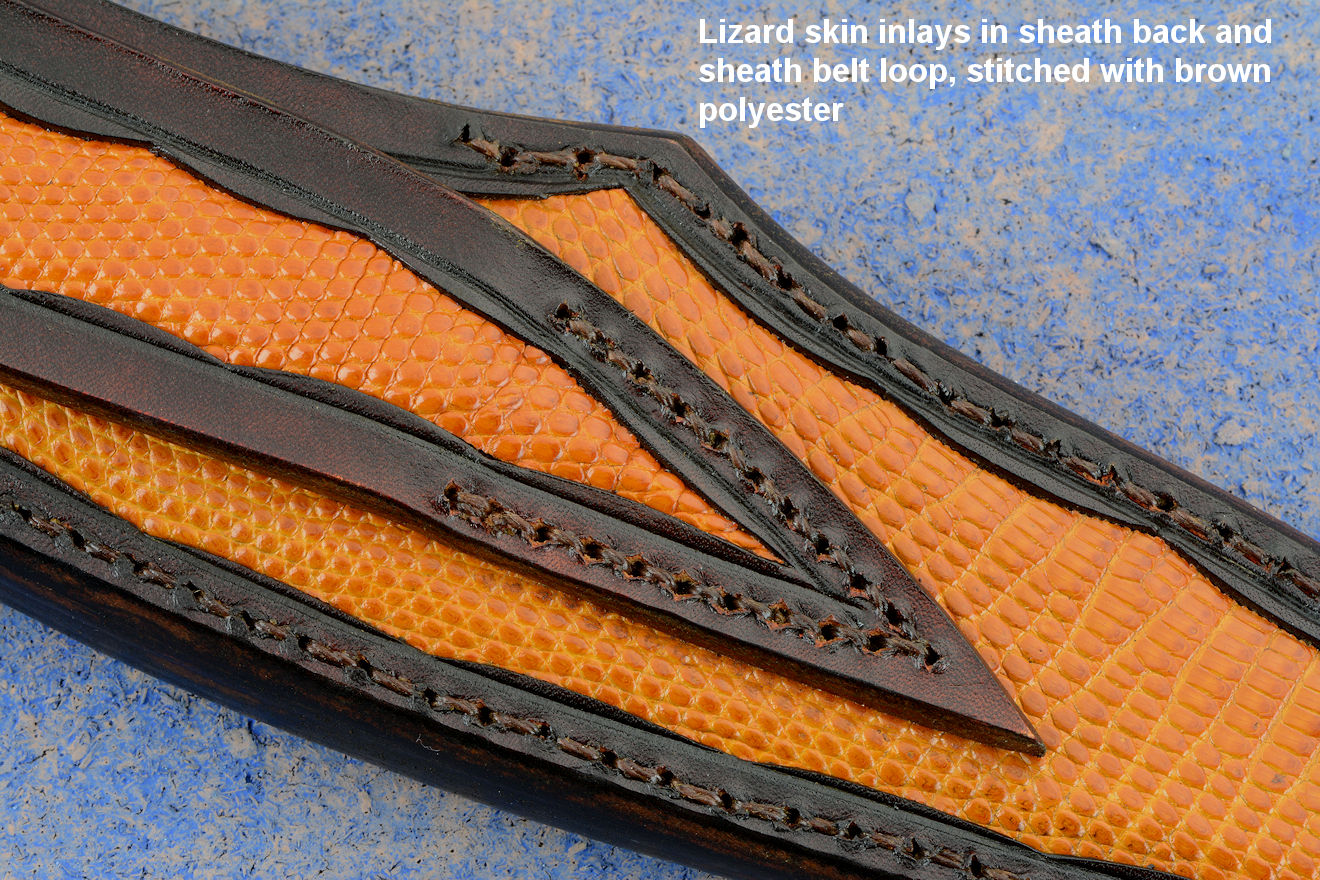
The welts are the strips along the sides of the sheath that the knife's cutting edge and spine slide down against. They are located between the sheath front and back and are also the spine and framework of the sheath, and where the stitches are located in leather sheaths. In a folded sheath, there is only one welt, located where the cutting edge of the knife rests. In a layered or sandwich style sheath, there are two welts, the second located where the knife spine sits in the sheath. Most of the sheaths I'm making currently are layered, with a distinct and separate front and back, and individual welts and belt loops.
The cutting edge welt will, over years of use, take plenty of abuse as the knife edge slides down against it every time the knife is sheathed, and the cutting edge may be dragged against it every time the knife is unsheathed. It's important that the welt is well-constructed and designed to prevent damage to the cutting edge, and to protect the sheath stitches, lacing, or other assembly components that are located at or through this critical welt.
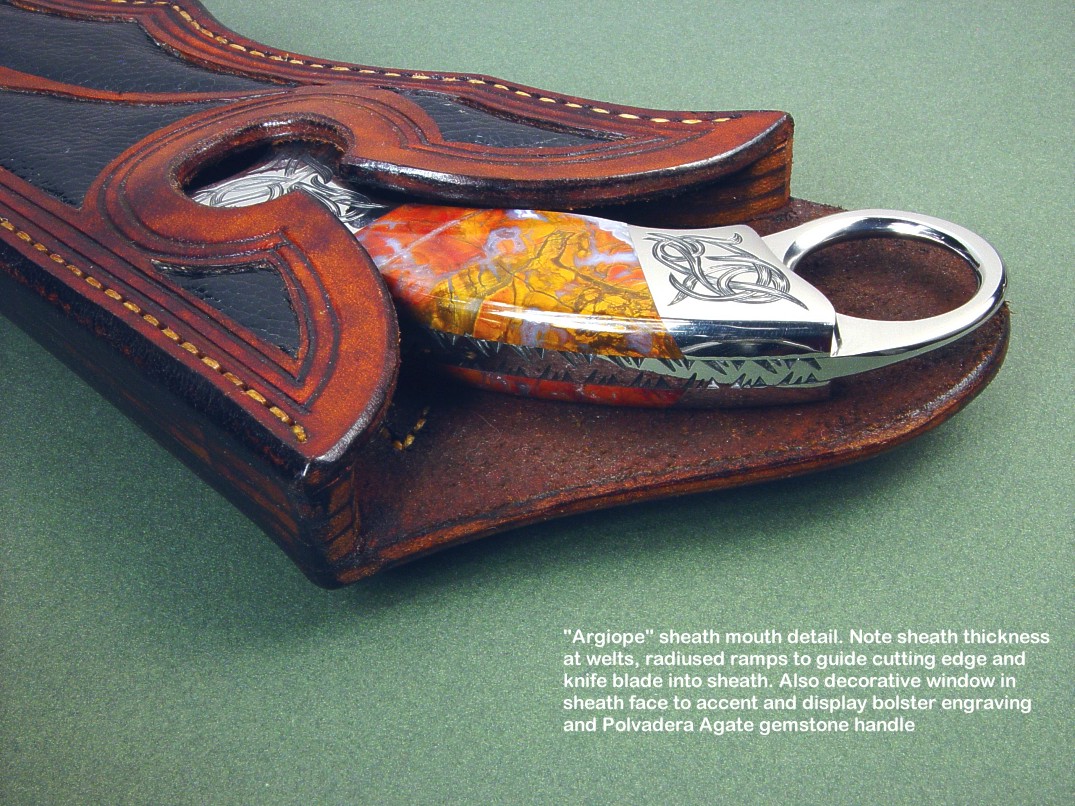
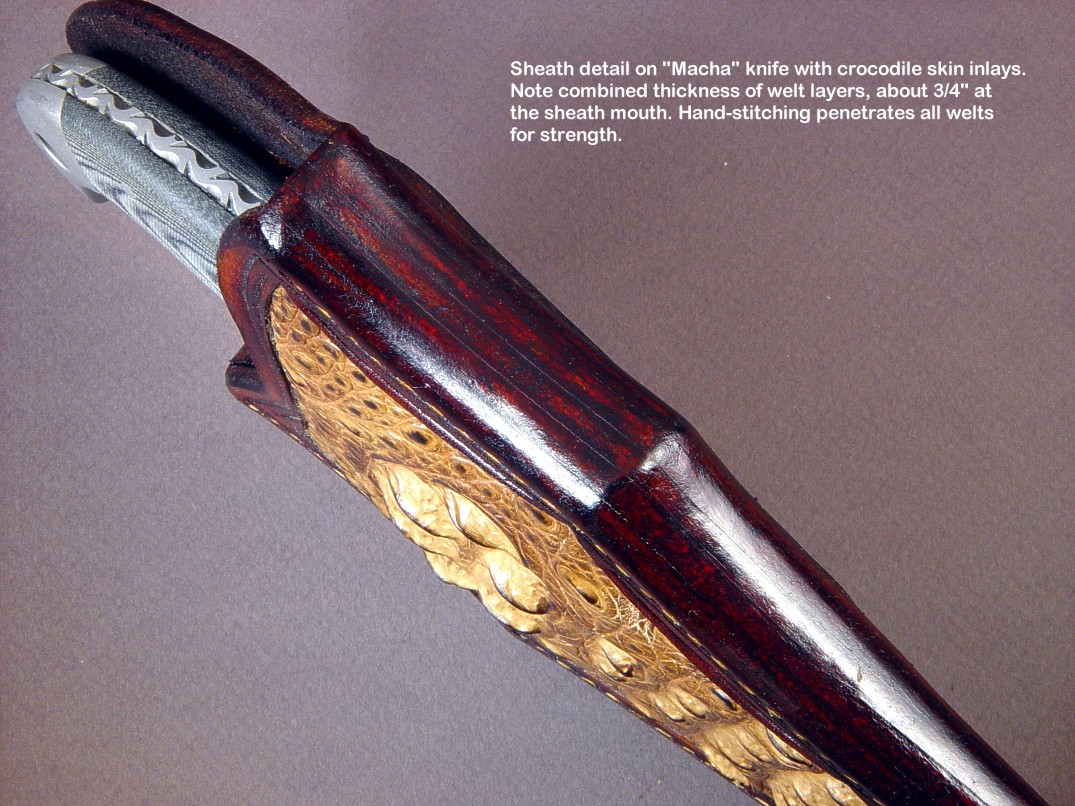
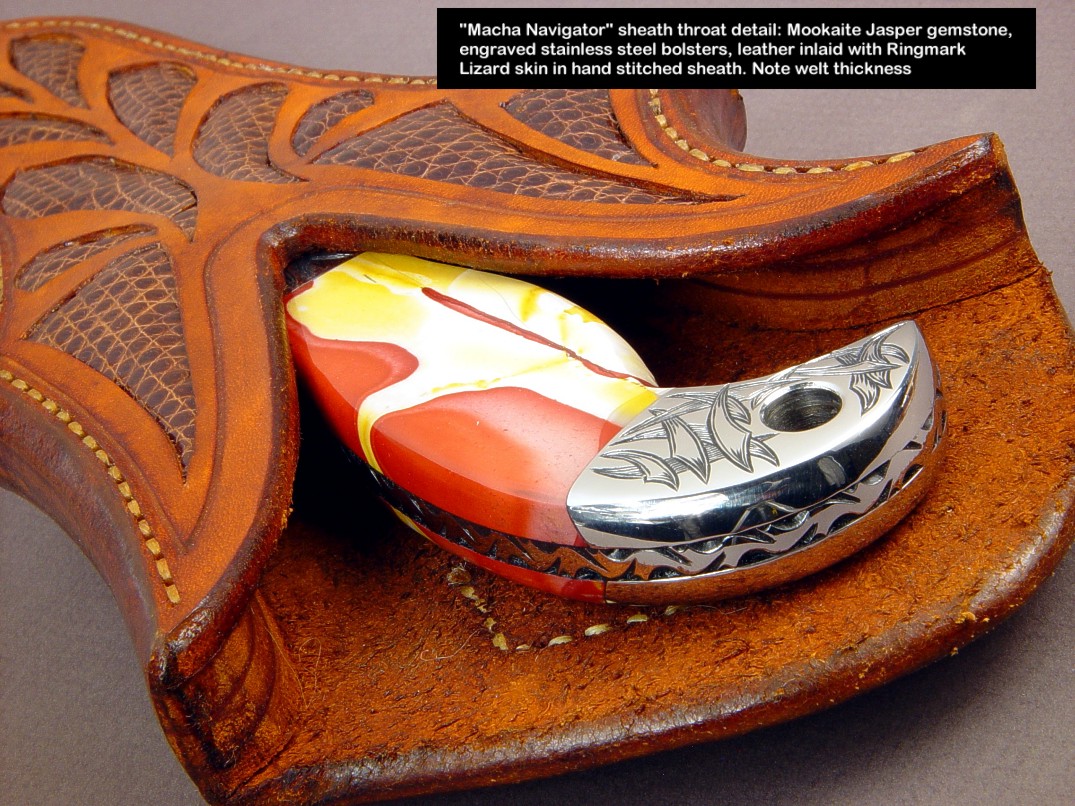
The welts also impart stiffness to the entire sheath and add necessary thickness to accommodate the handle. Good welts are usually thick for these reasons. Welts must be sealed from exposures, as well as secured with a permanent waterproof adhesive in addition to the mechanical mounting methods. Good welts in leather sheaths are often 2-3 times the thickness of the sheath front and back, and often tapered to be wider at the top for easy insertion of the handle. On my sheaths, it is not unusual for the combined thickness of the welts and sheath face and back at the sheath mouth to total over .75" (2 cm) and on larger knives to be over 1" (2.5 cm). This is some very thick leather indeed!
The welts should be ramped at the sheath mouth. This helps guide the knife blade into position in the sheath, and discourages twisting which may allow the cutting edge to slice the sheath face and back. They should also be tapered at the point, particularly in narrow bladed knives, to help guide the knife to its seated position in the sheath body.
Not all sheath makers construct a sheath the way I do; some use a single layer of leather welt and pinch the sheath sides down to accommodate the space needed for the knife and thickness. I don't like this idea because the sheath is not as strong and stiff, and if the knife is just slightly twisted or angled in insertion or removal, it can slice the sheath face or back.
The ultimate welts I use are on my military combat and tactical knife sheaths and are made of 5052H32 corrosion resistant high strength aluminum. They too, are layered to accommodate the thickness of the sheath body and can be coated to protect the knife's cutting edge, though this is not absolutely critical as the hardened blade steel is many times harder than aluminum, and is not damaged or dulled with this type of welt.
A lost knife is usually caused by two things: a careless owner or a bad sheath.
The sheath should secure the knife. There are several ways to do this. I'll list the types I use and am familiar with, though there may be others. This topic only applies to leather sheaths or traditional materials; I'll discuss kydex, composites, tactical sheaths and mechanical retention methods on my tactical and combat knife sheath topics below.


Email from a military address:
Mr. Fisher,
This email is not to inquire about purchasing one of your knives but to
ask your permission, if needed, with regards to your knife sheaths. I know
that you are extremely busy so I will try to make this as short as possible
whilst making my question clear.
I have, within the last year, begun leather crafting and started by making a
couple of sheaths for some fixed blades. I decided this because of the garbage canvas or
cheap leather sheaths that come with them so I did a lot of research on the
net, read blogs, tutorials, and watched video how to's all just to be able
to have a well built handmade real leather sheath. After finishing two, a
pocket type and a stacked leather type and showing it to some of the guys at
work I have now been getting requests to replace either worn leather or
canvas sheaths, with different carrying options. I have really learned a lot
and when I came across your site doing a search for "custom leather sheaths"
I could not believe my eyes at your designs, not just of the sheaths but of
the knives as well. The lines, curves and how everything flows together even
how the curves of the knife are incorporated into the sheath. Absolutely
beautiful! I can only hope that eventually my work will be close to the
quality of yours. Since seeing your sheath designs I really want to get more
into carving, and exotic inlays, and thus bringing me to my question:
I want to make my own designs/patterns of sheaths but yours bring a lot
of inspiration and if I end up with a clientele of people that ask for
sheaths made for knives they already have is your permission needed to take
say a retaining strap design from say your ISHI and incorporate it into a
standard stacked leather sheath just for a different effect? I did tread
through your Copyright page and you mostly covered your knives there. I do
not make knives I don't intend to, I like working with leather, it's almost
like therapy cutting out lines, choosing stamps then stamping, figuring out
how to build a sheath around a knife. This is why I would like to
respectfully request your permission to use your patterns to hopefully
inspire designs and patterns( as far as tooling, colors curves) in my own
work. I want to make it completely clear that in no way, shape, or form am I
asking to copy or duplicate any of your sheaths.
Again, your work is absolutely incredible I hope that one day I could be a
customer of yours.
Respectfully, Philip J. Walker
My response:
Hi, Philip.
Thanks for writing and thanks for your kind words. Philip,
thanks most for your service and sacrifice for the people of our country.
Philip, the retention methods of the knife sheath designs are not
copyrightable; they've existed in public form for decades, some for
millennia. Since the actual shapes of the sheaths are distinct to each knife
pattern, it is not likely your sheaths can copy mine, since you will be
making designs for unique knives. However, if you would like to publicly
credit me for inspiration, I would be greatly honored by that! I'd be
honored if you allow me to post your email as well; the conversation of
knife sheath design is an important one.
Ideas themselves are not intellectual property, so thanks for your
willingness to spread the idea of fine knife sheaths around; the world of
knives certainly needs it! Judging from the amount of inquiries and interest
I get about sheaths, if you make a good, serviceable, practical, and high
quality product, you will do well.
Thanks again, and the best of luck in all your endeavors.
Jay
A knife is not carried. It is worn.
There are several proven and accepted ways for the sheath to attach to the wearer.
Unsheathing may be dangerous; re-sheathing is dangerous and takes dedicated training. Try it with an open straight razor first to see if you like the idea!
You've seen in in the movies. A guy reaches under his jacket and extracts a foot-long knife hidden in the small of his back. Occasionally, I get asked to provide a sheath that can mount in the small of the back, sometimes horizontally, sometimes at an angle, and sometimes upside down. Guys who ask about this arrangement visualize their hand reaching behind their back and extracting their weapon, concealed from view.
I only make horizontal back sheaths for smaller knives. See the detailed page on concealed knife carry on this site at this link.
Though I have made this type of specialty sheath on occasion, the entire affair is stacked with challenges that are critical to understand.
Though it's easy to visualize the hand reaching behind the back and pulling out a long blade, the reality is more complicated. The issues with completely horizontal sheaths or highly angled sheaths are that they must be fairly tight so that the knife does not fall out. Retaining straps have their own set of problems, being mainly the potential of being sliced by the cutting edge, particularly if you can't see what is going on. Even if one of my locking sheaths is used (recommended), your hand will have to blindly locate the release mechanism, and hope that the material or cloth of a jacket, shirt or other gear would not obstruct any operation or removal. You will also have to consider the hefty thickness of a locking sheath; you wouldn't want something flimsy and thin up against your kidneys where you can't even see it. Think about sitting in a chair or vehicle, moving around, bending over, or twisting and how the rigid sheath and knife arrangement would interfere with this and even cause injury if not prepared, practiced, and competent.
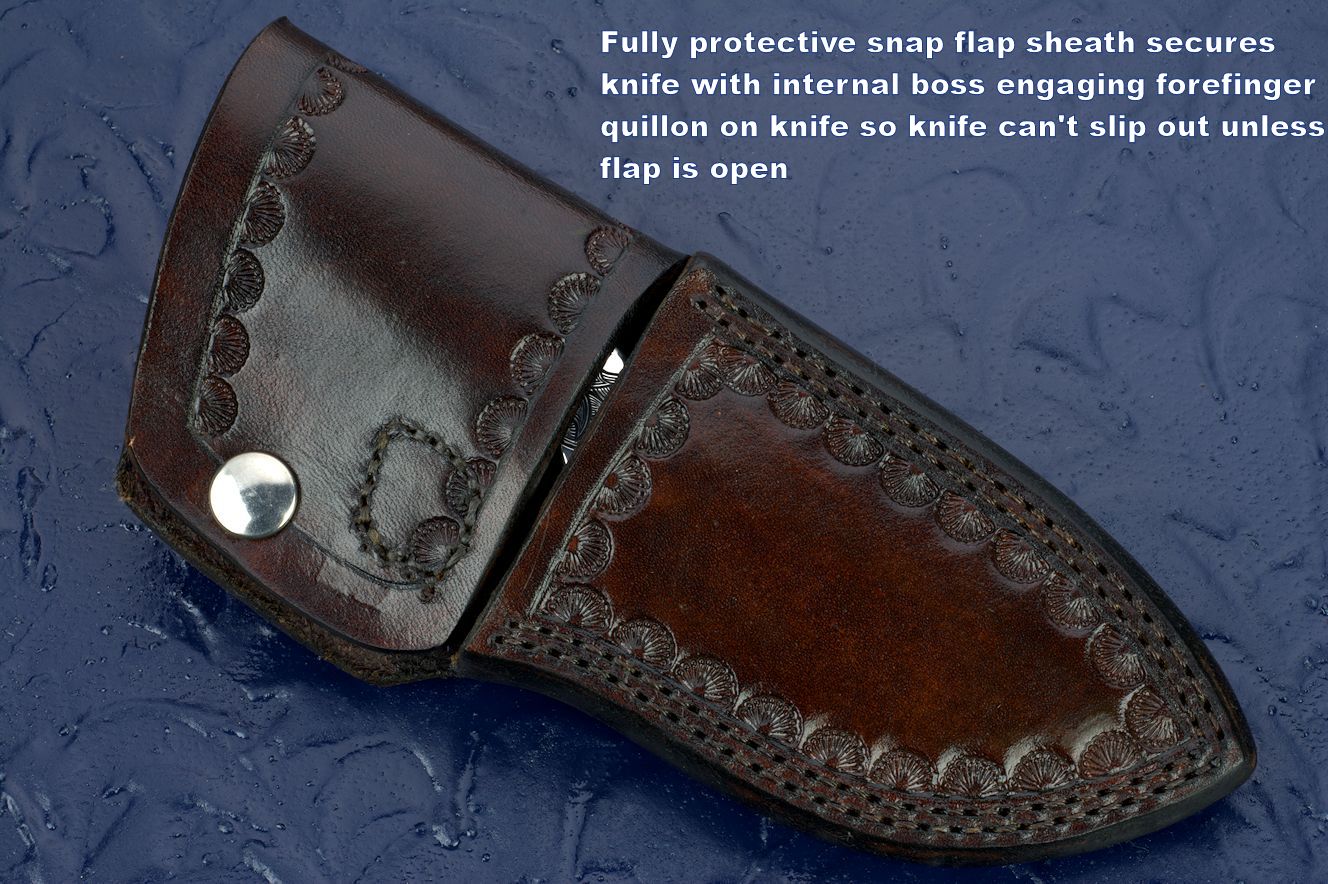
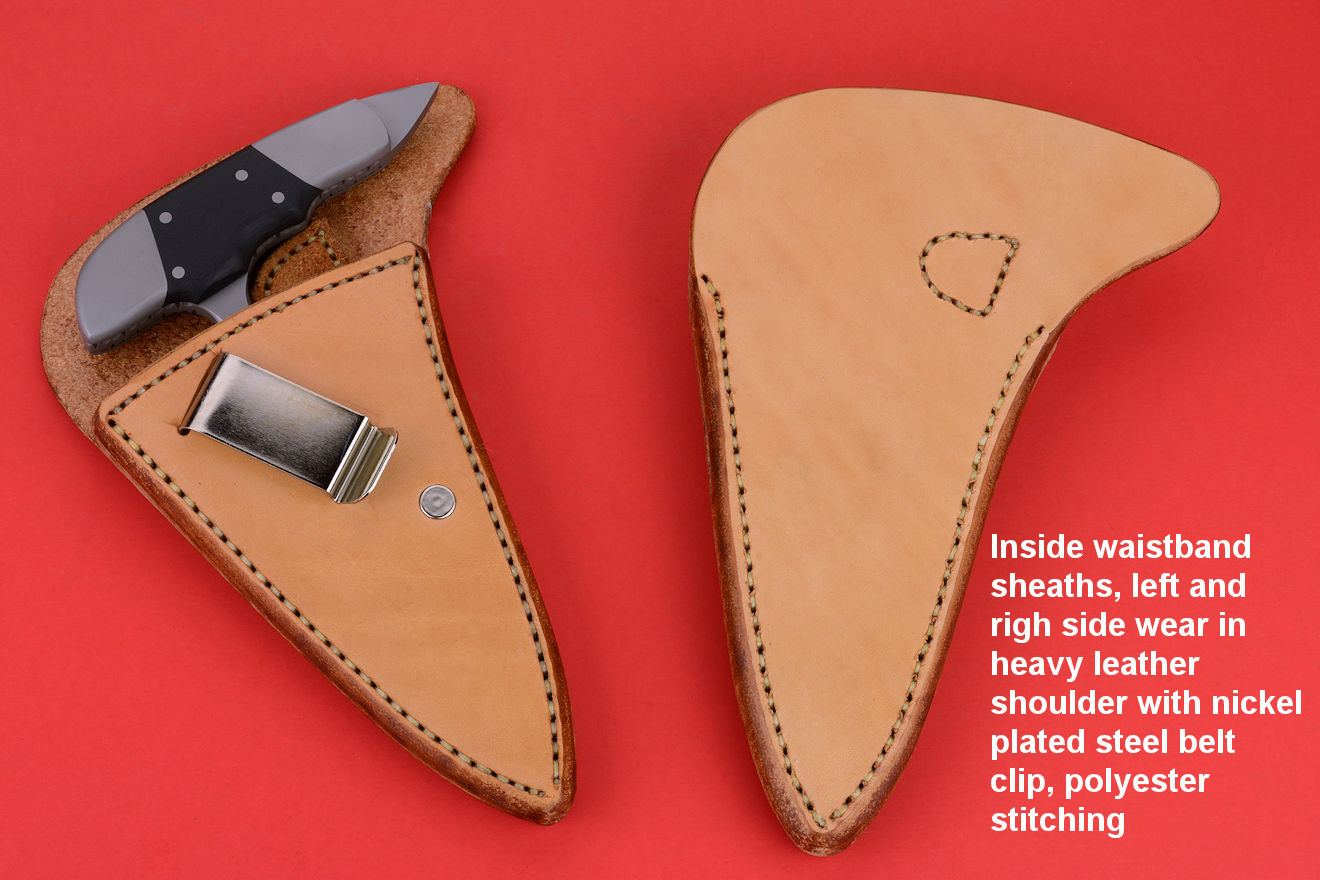
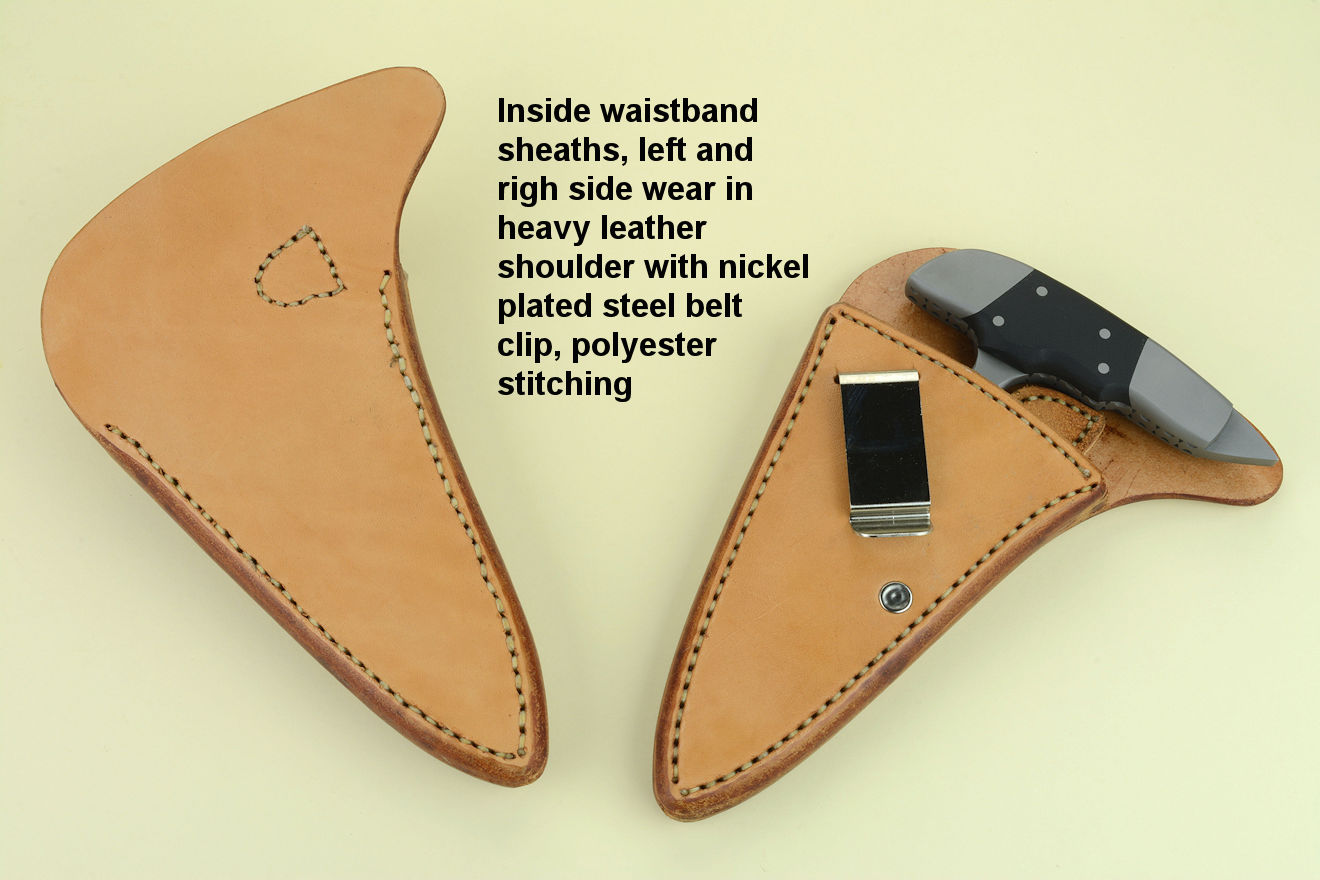
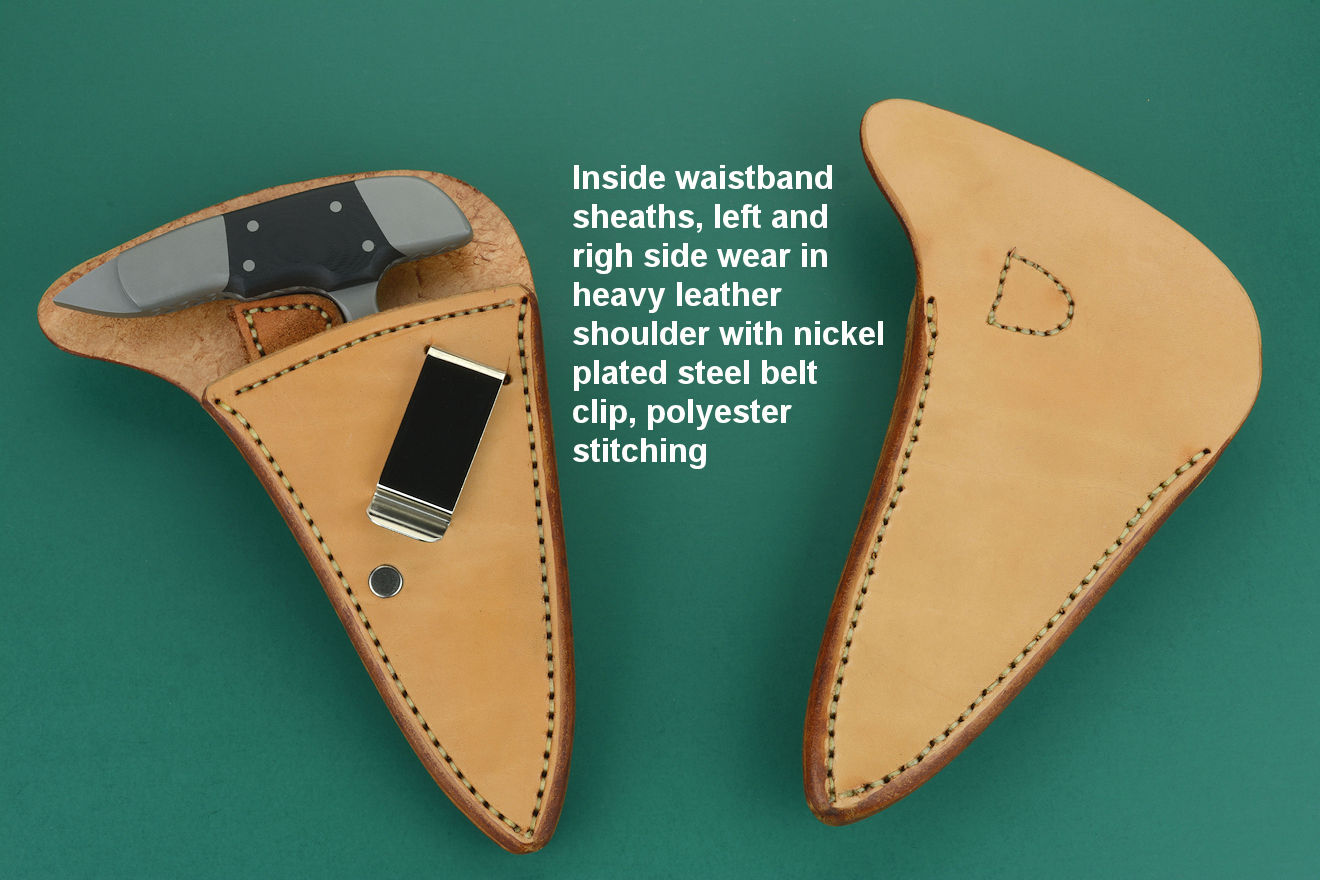
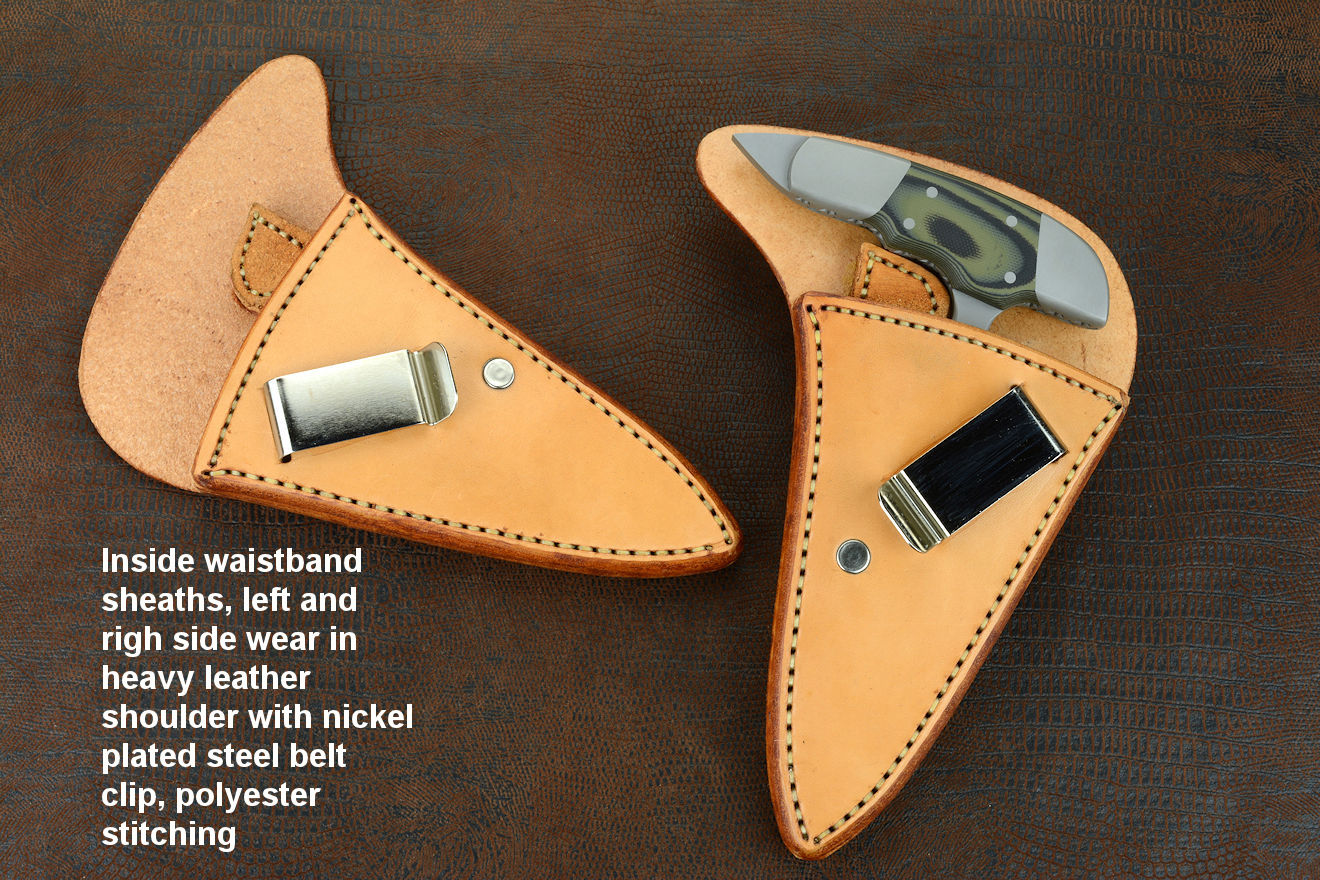
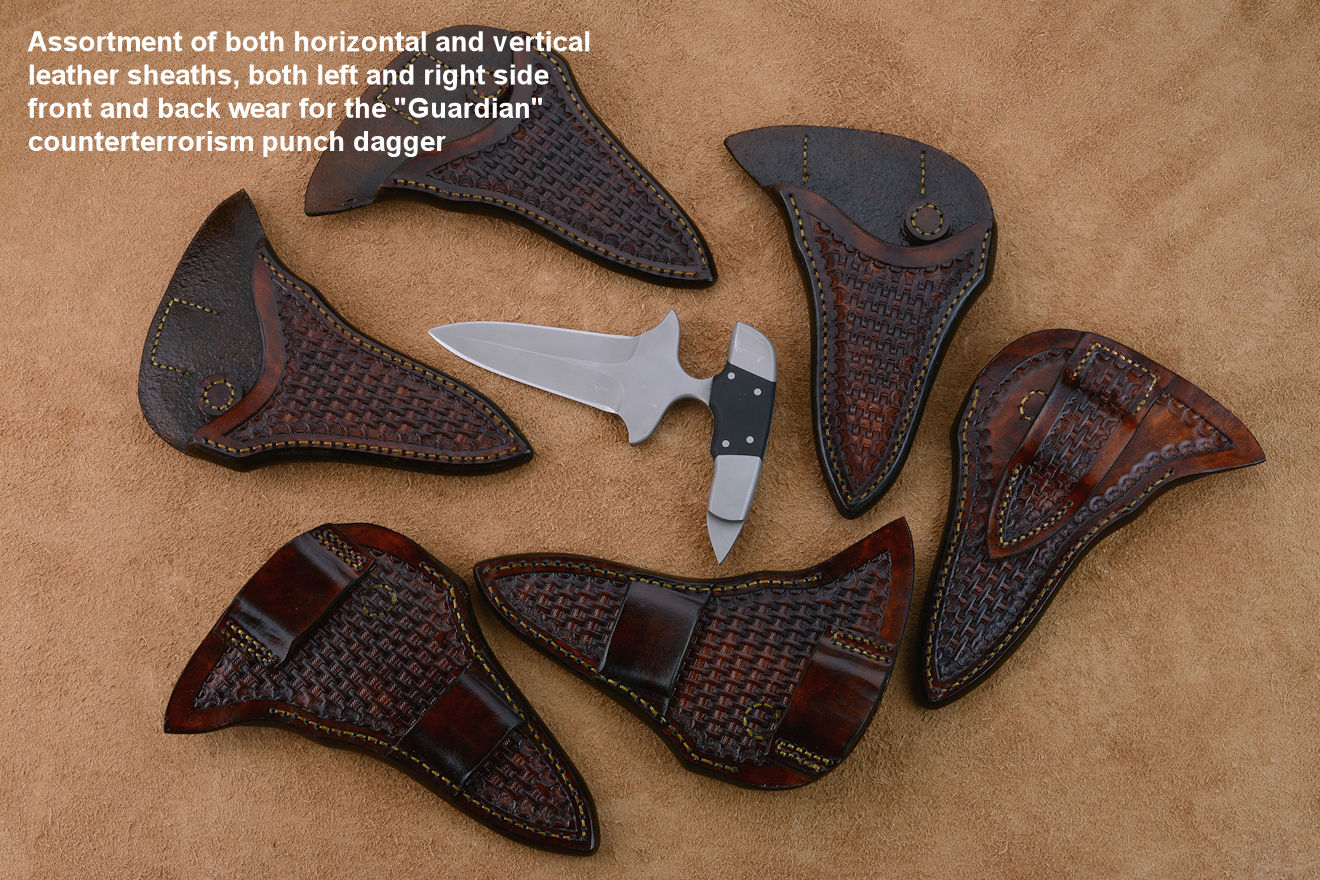
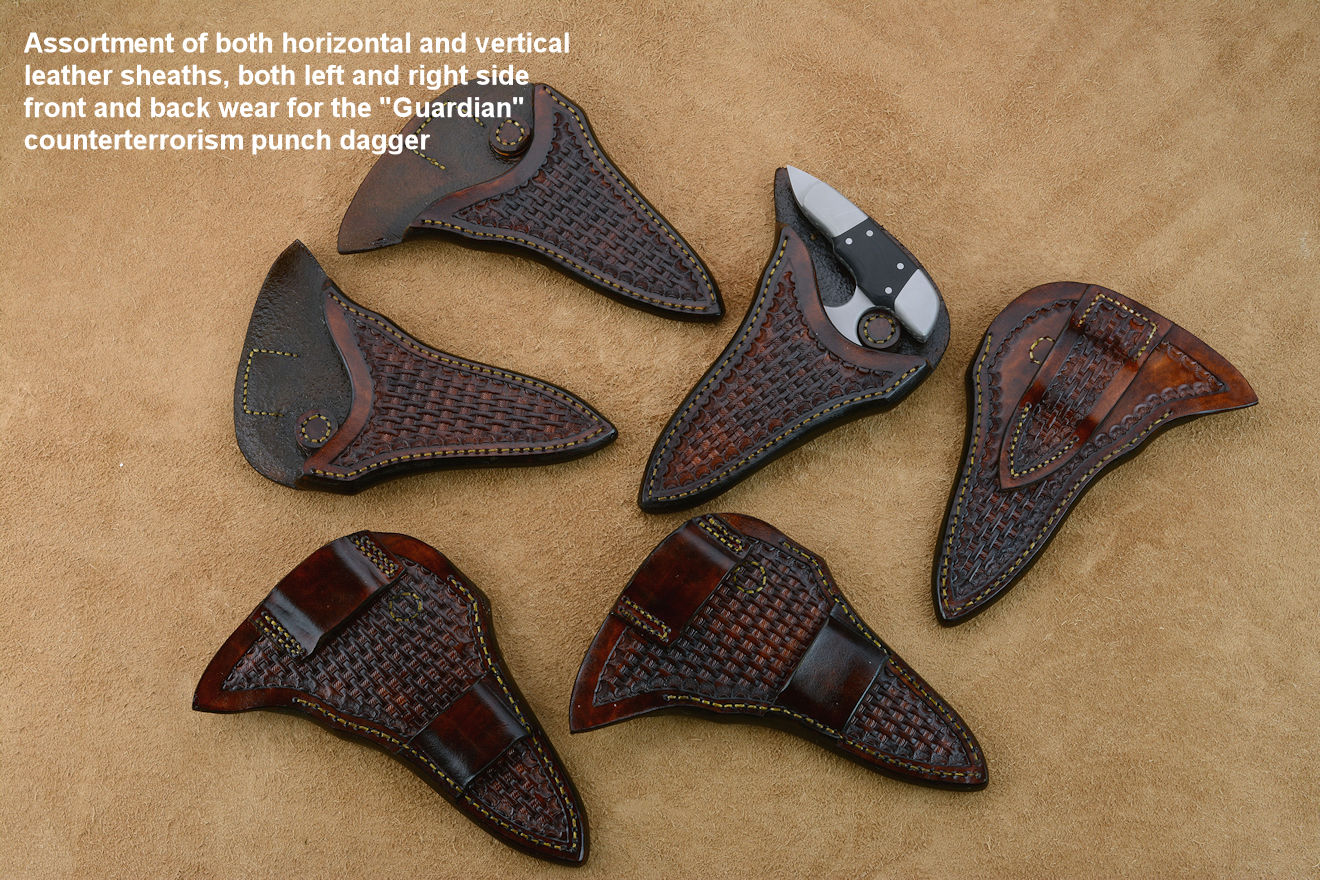
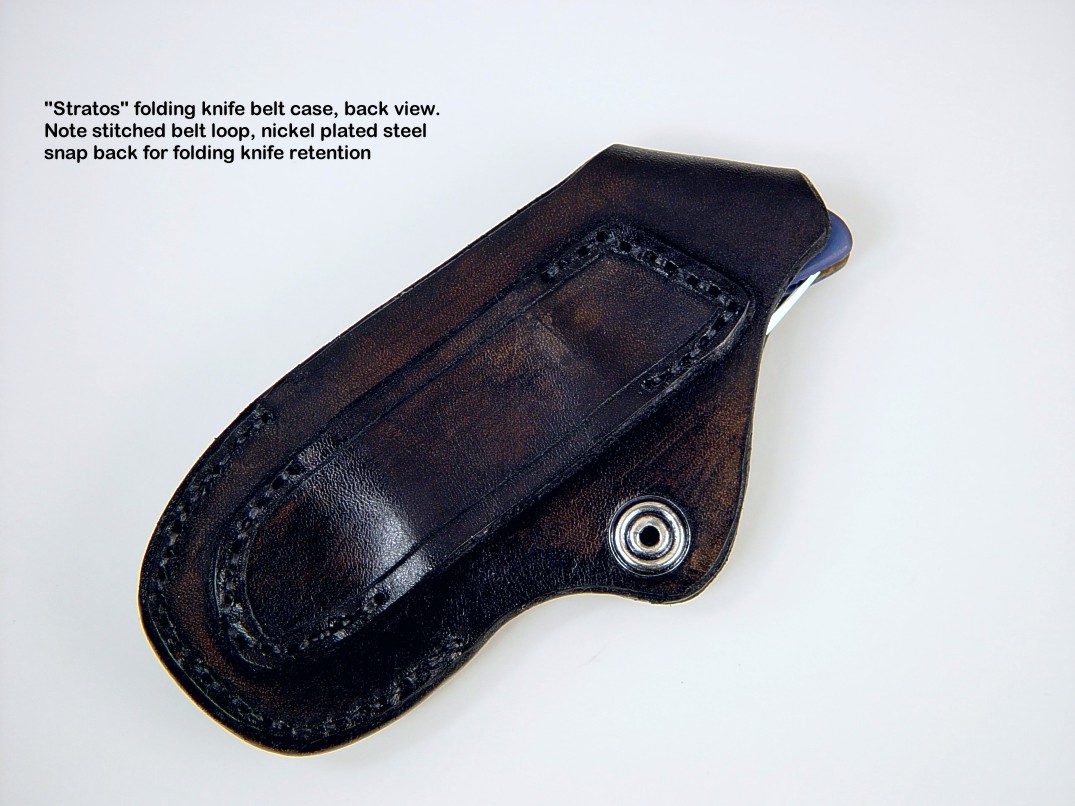
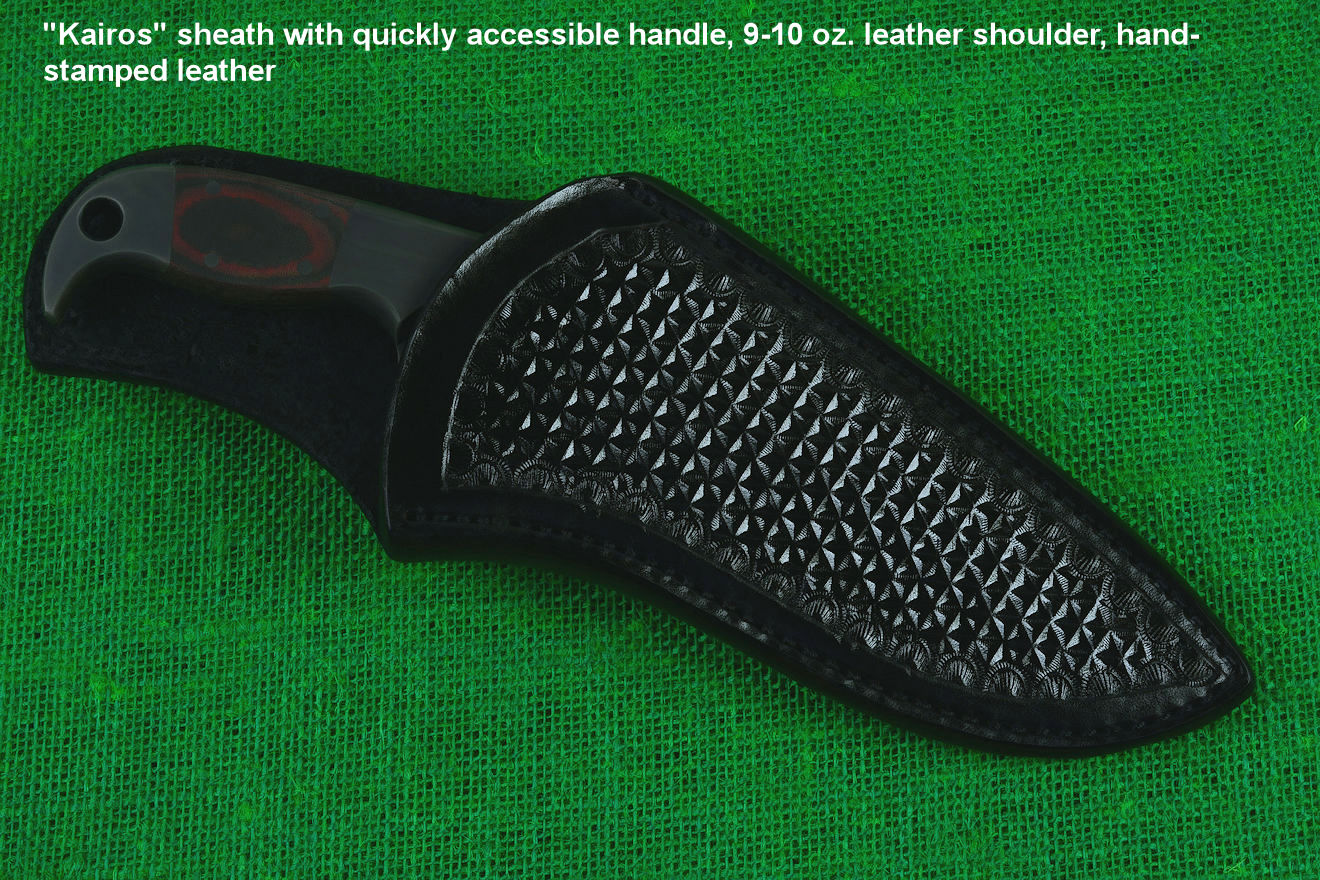
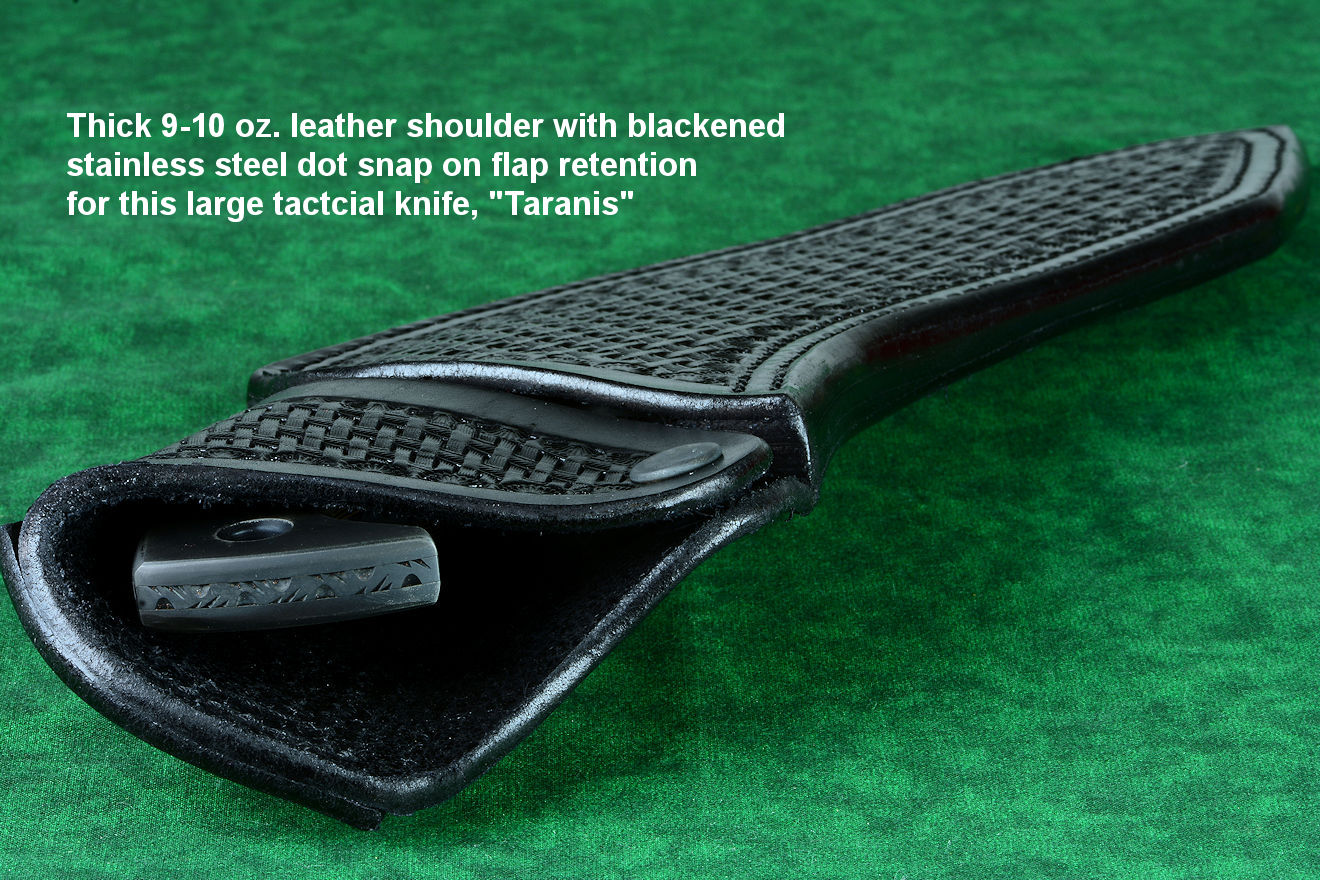
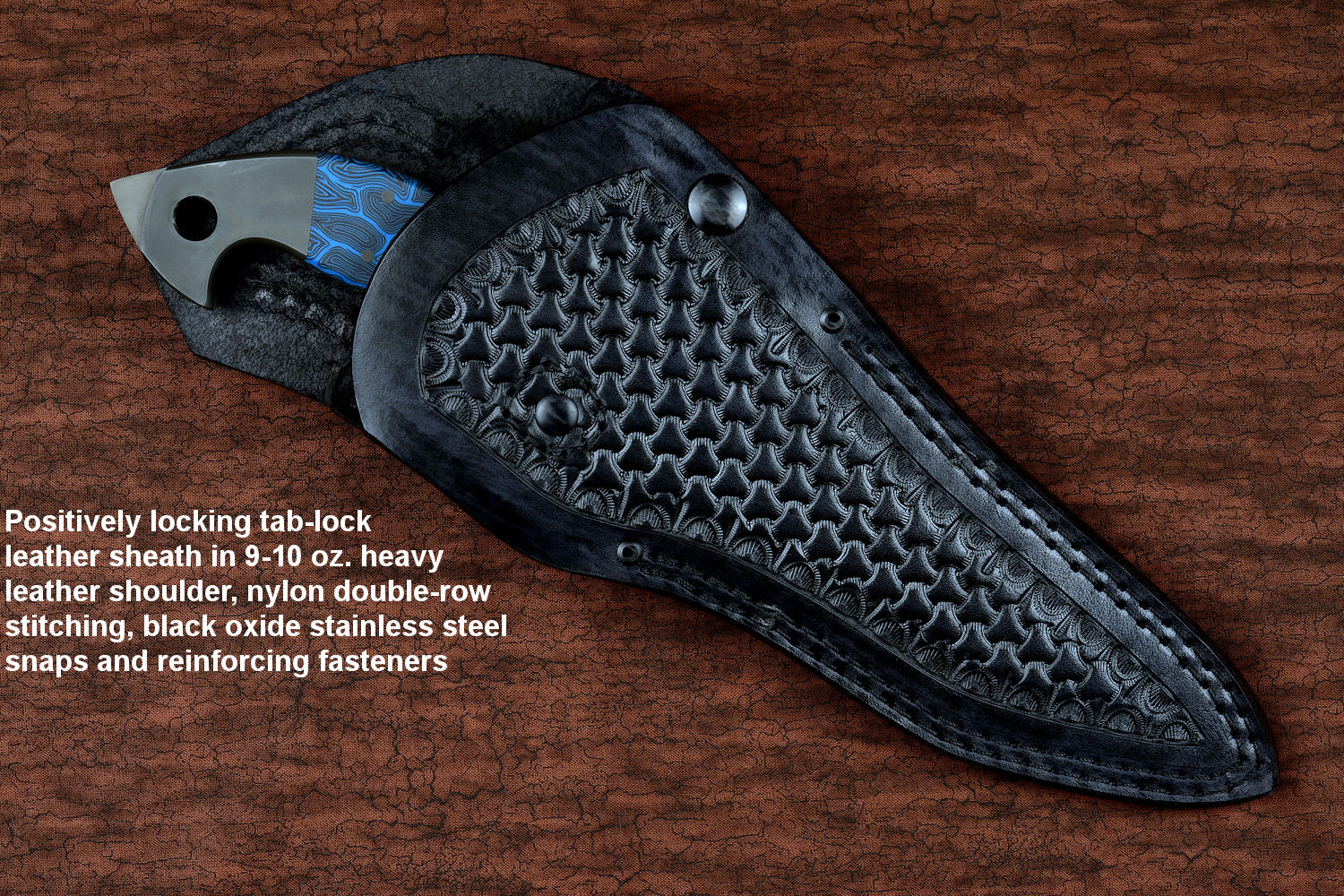
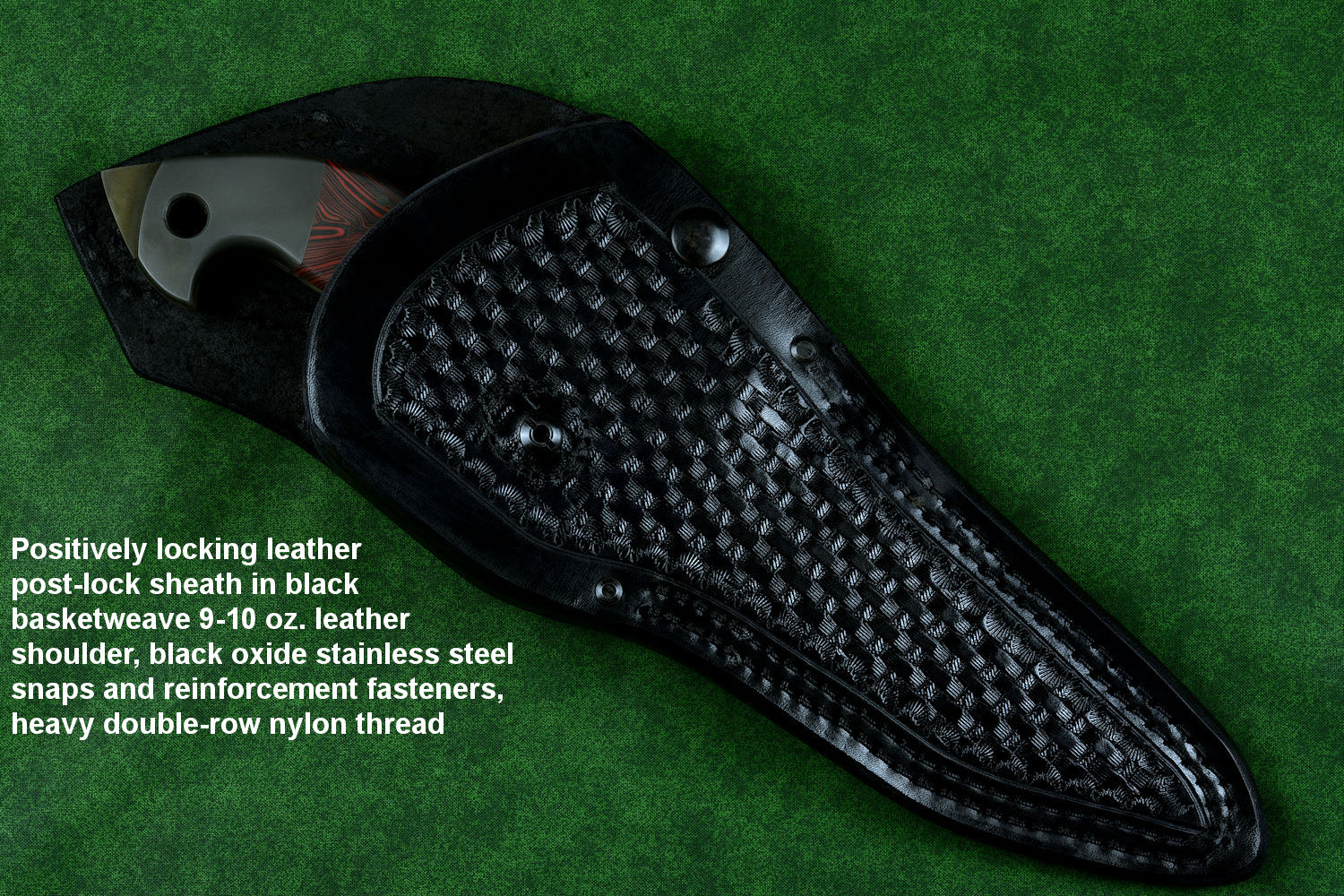
A new style of sheath I make is in leather with a ring stud or d-shaped stud sewn into the sheath back or sheath retaining flap, creating a finger-sized protuberance (stud) of several layers of 9-10 oz. shoulder that is 1/2" to 5/8" thick, and this is placed exactly in the sheath so that this stud prevents the knife from falling out. When the owner wants to remove the knife from the sheath, he presses on this stud of leather and it deflects or bends the sheath just enough to allow the knife to clear the retaining stud. I also make some of these with a stainless steel dot-snap location built into the stud for more positive retention. I've used this with great success so far particularly on counterterrorism knives and Principle Security Detail knives. it can be used on both Inside Waist Band (IWB) and both standard horizontal and vertical leather sheaths. See the thumbnailed photos just below to see how this works.
Hollywood makes the unreasonable easy.
Tougher still is the issue of reinserting the knife into a sheath on the back, something few consider. It's a blind move, with a razor- keen edge and sharp pointed blade right next to the kidneys, and usually takes both hands to manipulate the knife and sheath together. Not many guys are comfortable with pulling off this maneuver, but some are. You might be thinking of those blunt factory knives and their edges, but the reality is more like this: take a hollow ground straight razor that is honed to it's finest edge, an edge that will slice the hair off your face, slide through newspaper, and skin slivers off the toughest tomato. With the razor extended and open, hold the open straight razor in your right hand and try to manipulate it behind your back with a coat on and a loose shirt into a tight-fitting sheath of leather or even kydex. The edge on my fine knives is just as sharp as the razor, the blade is usually much larger, and probably the most important factor is that the old-time straight razor has no point. The point of a tactical, combat, and even working knife is very keen and sharp, like a honed needle, and will absolutely hang on everything it touches. You might think you can align the blade with the other hand, but if you slip, you are in for a substantial injury. This is a serious consideration. You have the right to know this before you commission any kind of horizontal back-mounted sheath.
Another seldom considered factor in this idea of mounting a knife sheath in the middle of the back vertically is the harness. Yes, I do mean harness, because that is what is required to keep everything in position, particularly if it is a large knife or short sword. Take a look at firearm holsters that are designed to carry firearms under the armpits at the side. These can be complicated affairs and it should make you wonder why you don't see harnesses for firearms mounting in the middle of the back. Sure, you'll see them designed for belt wear, but not high and above the belt. Consider that the tactical knife is physically larger and longer, and add the dimensions of length, width, and thickness of the sheath. A harness will have to be made that will stop the knife from moving around, so will have to have straps that go up over the shoulder (or both shoulders) and have anti-rotation straps around the chest to keep the whole arrangement stable. Add to that the huge adjustment range needed to match a variety of fits and individuals, and the whole affair can be complicated and expensive.
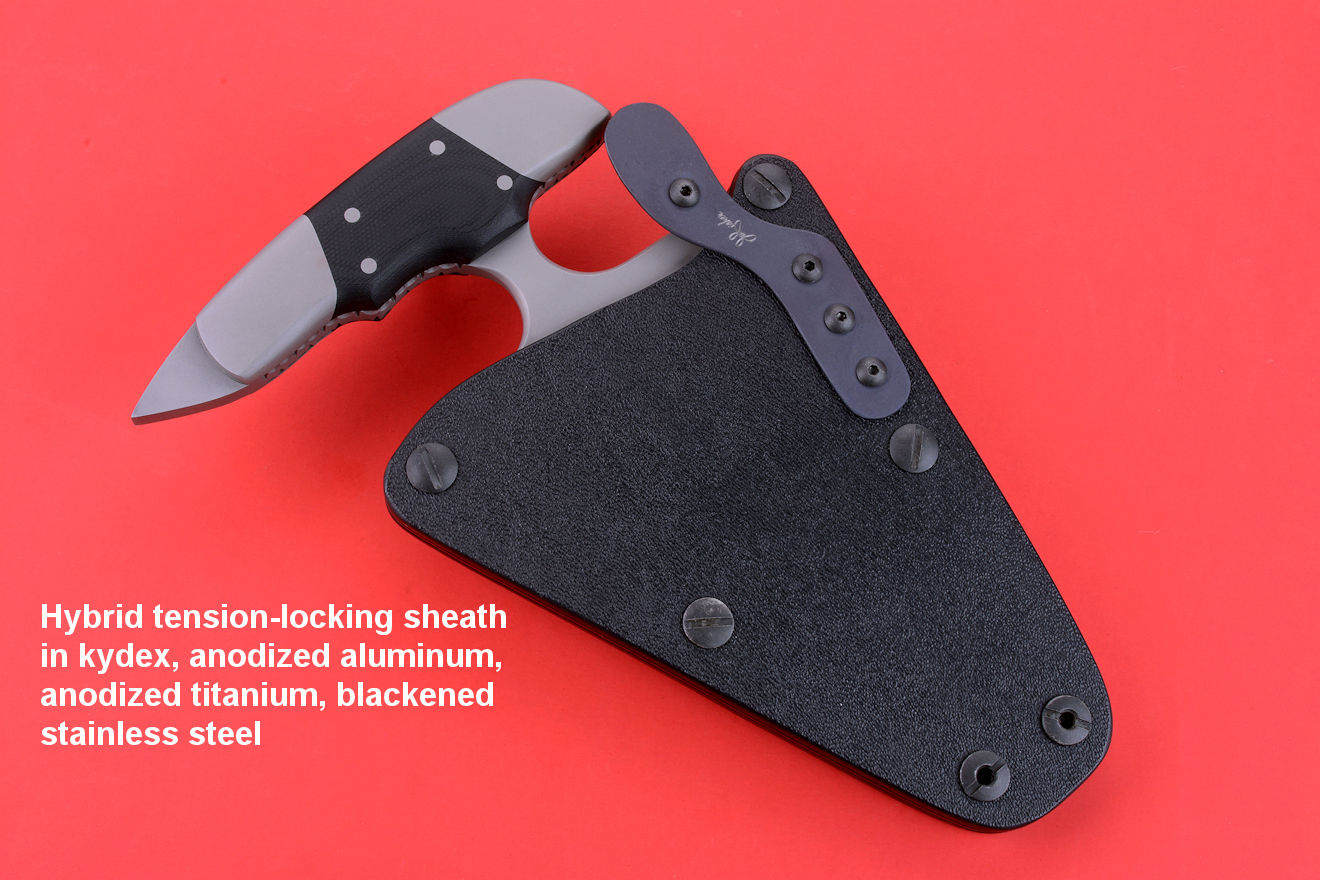
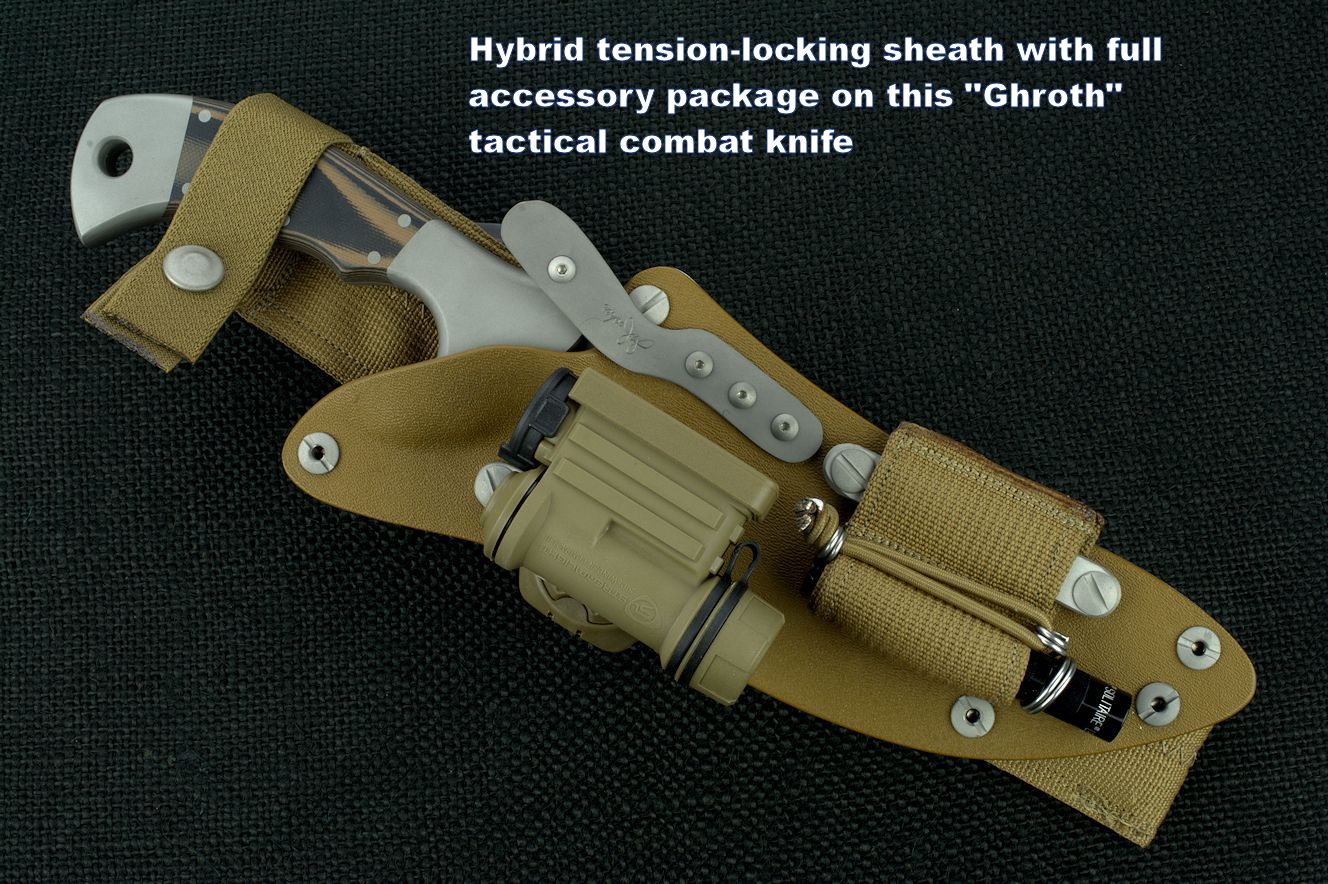
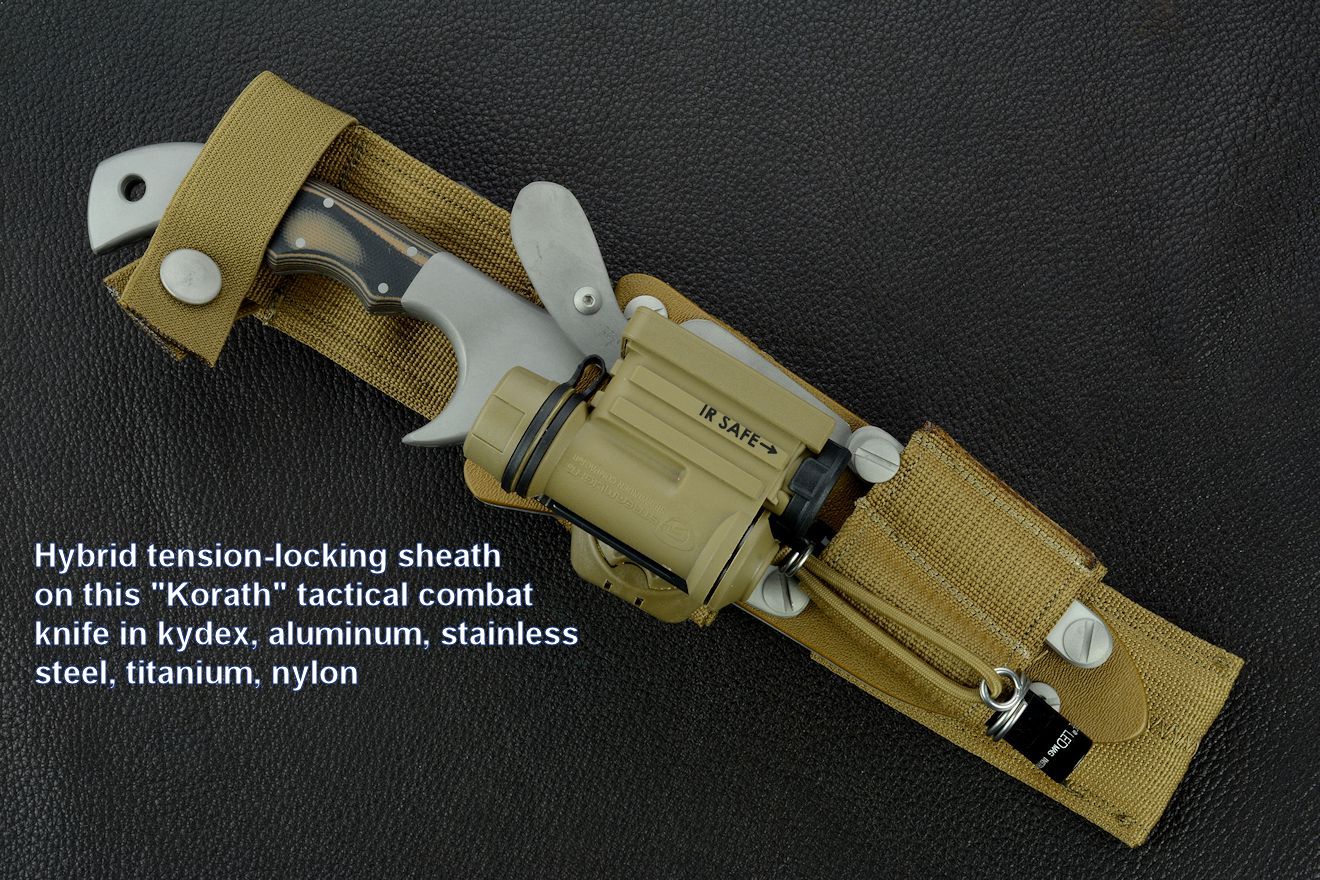
I can make any type of wear accessory, but first consider all the options. The leather or kydex and aluminum cross-draw sheath arrangement may be the answer, as the sheath can be seen, and it only takes one hand insert or remove. Or take a lesson from the military or law enforcement professionals who need a variety of wear options and positions for a variety of critical gear. They've developed systems for this, and my tactical combat sheaths fit these systems. If you're wearing a PALS arrangement on MOLLE, IIFS, ILBE, IOTV, or MTV body armor systems, the tactical combat knife can be mounted in a variety of ways, but up-front or to-the-side is usually best. My hybrid tension-lock sheath accommodates a variety of wear options, but won't fit every knife design, and must be custom made for each project and application.
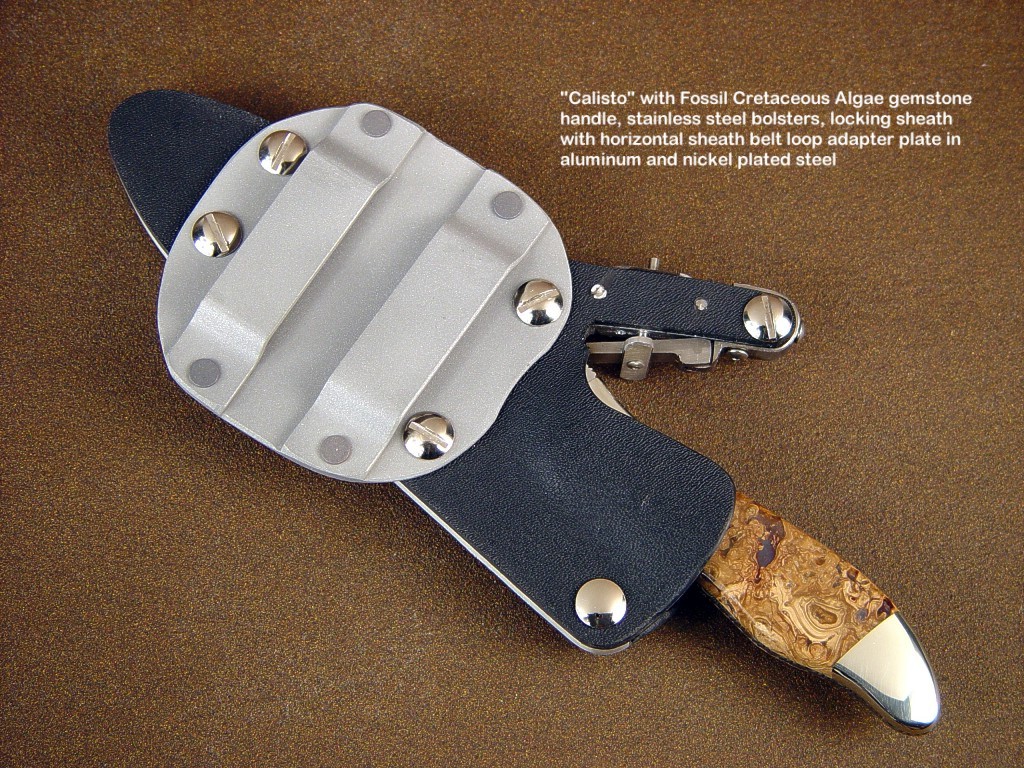
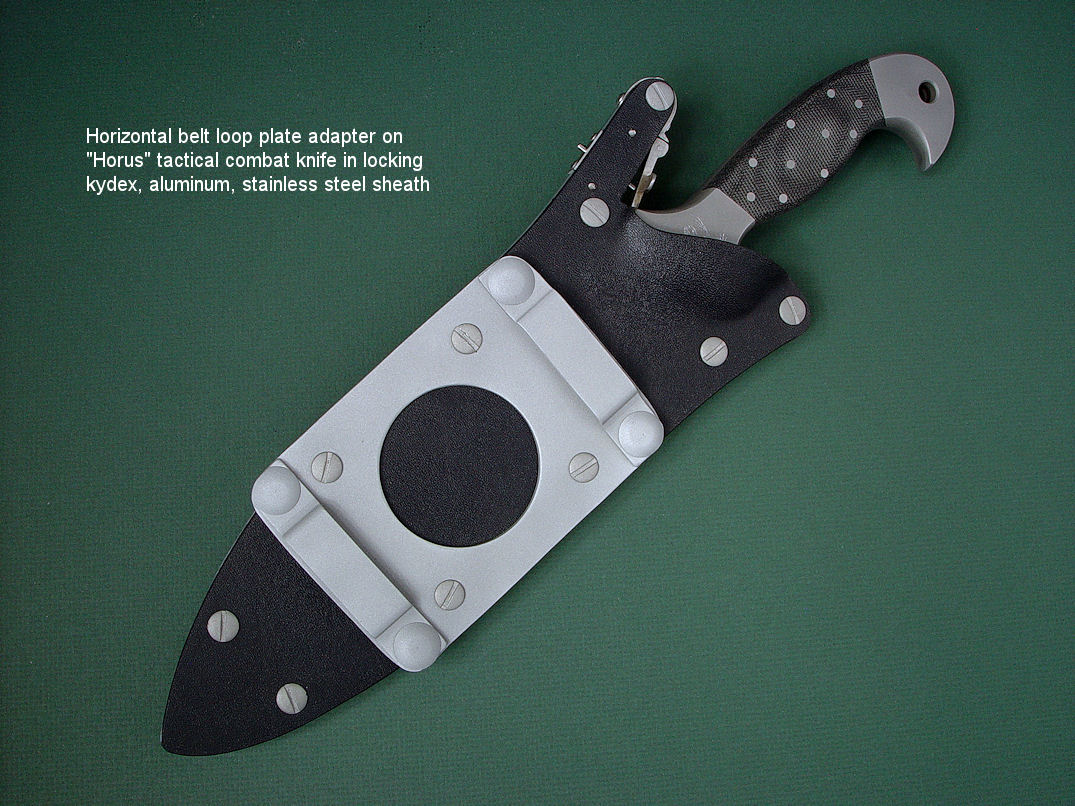
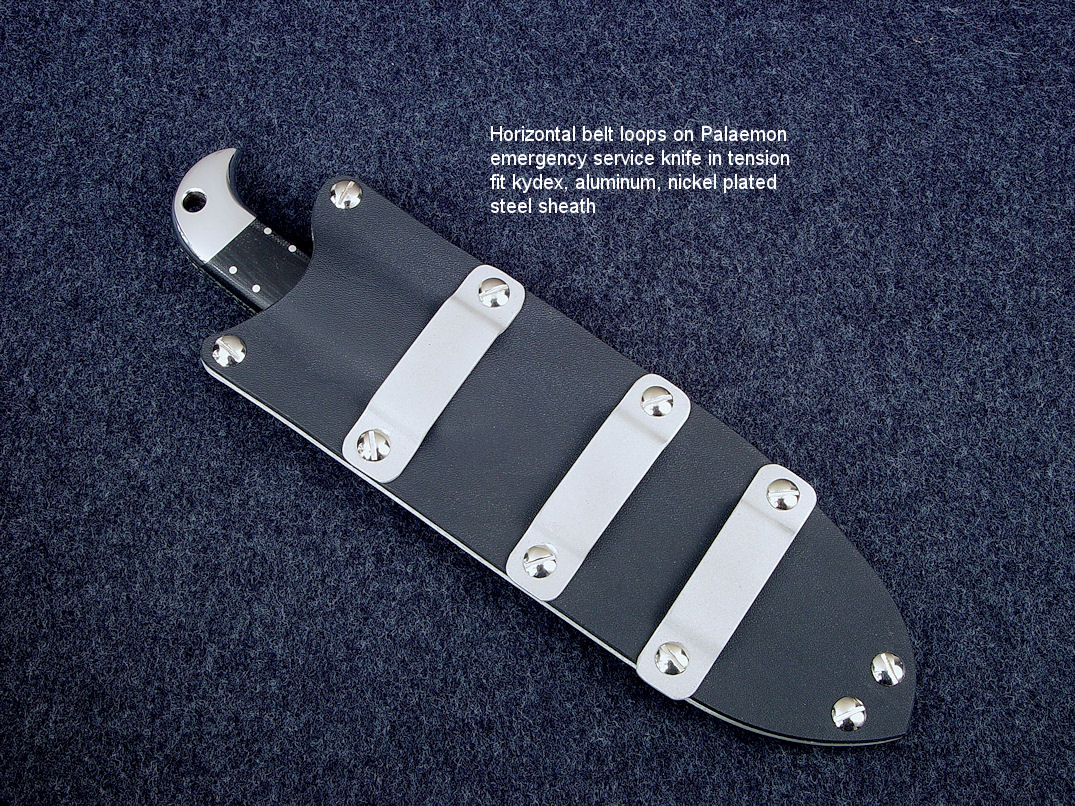
If you are absolutely set on a back-mount arrangement, this may be something I will consider, particularly as I expand the mounting and sheath accessories here at the studio. They've grown quite substantial in the last several years because it seems no one else is offering well made accessories for knives and sheaths. While a horizontal belt plate (see the photos below) may be a viable option for the rear belt, a variation of a sternum harness or back or trapezius harness may be required for larger or more complicated wear arrangements. These can be quite robust and difficult to construct, and will add to the cost of the project.
See the detailed page on concealed knife carry on this site at this link.
Hollywood makes the unreasonable easy.
See the detailed page on concealed knife carry on this site at this link.
I do not make sheaths to accommodate wear on the arms or legs. The reason for this is that the knife must fit snugly in the sheath, even if alternate means of retention are included like straps or snap flaps. When the knife is pulled out of the sheath, it is pulled in the direction of the limb's smallest diameter, which will tug the entire fixture down the arm or leg. In the arm it is particularly troublesome, because the wrist is smaller than the girth of the arm at the elbow, so the straps are trying to pull down the arm. It's the same reason that socks won't stay up. You're trying to pull downhill yet have the sheath stay in place. So the only way to counter this is with a long strap that goes up the arm that the sheath is mounted on, over the shoulder, and is retained around the neck. What a mess. It works good in Hollywood, but in reality is an entirely different affair.
Also, there is a problem with knife sheaths mounted on the leg. In order to pull against the taper of the leg, just like on the forearm, the knife must be pulled up. That means that the area to pull the knife must be as long as the sheath throat and full knife length added together. No man can lift up his pants that high; he'd have to be wearing shorts... so this is impractical. If the pull is downward on the leg, he's pulling against geometry (again) or the knife may have to have some type of complicated retention method to prevent falling out... another mess.
Then, there is the whole concealment issue. As a professional, I can't be known for helping bend concealment laws. So, generally, I stay away from this type of mounting, unless it's for law enforcement or federal agents. Please read the related topic on my Business of Knifemaking page.
Just like the arm or leg mounted sheaths and the back mounted sheaths (above) there can be significant issues and concerns with boot knife sheaths. First, please note that a boot knife is a contemporary term for a knife style, which is usually slender and narrow, with a thin blade and handle. Calling a knife a boot knife does not necessarily mean it is made for wearing in one's boot. This is a stylistic interpretation based on large cowboy boots of old times and the loose association of knives perhaps worn in the boot. If it is slender and narrow with lightweight handle and fittings, it can be called a boot knife.
Boot knives that are designed to be worn in the boot do exist, and I've made them in the past, mainly for law enforcement and federal officers. They have limitations. First, the sheath must be heavy, sturdy, and robust, because you don't want the thin and razor-keen knife cutting through and injuring the wearer. So, the knife sheath has to be thick and somewhat bulky. You could choose a thin, harder material (other than leather), but this can be uncomfortable because it is a hard surface and a rigid form against the leg. It may sound workable to have a single thickness (.060") thick kydex as a boot knife sheath, but you had better wear a very heavy sock to protect your leg and ankle from abrasion and chafing. Think about walking around for several hours with a rigid piece of hard plastic rubbing on your leg and it's not so reasonable of an idea. Also, the boot would have to be very wide, much wider than your calf and ankle if you are to wear the sheath inside, which would be the most secure method. If you are to wear the sheath outside the boot, the pant leg would have to be very wide to accommodate it, and the clip would have to be very tight and sturdy, otherwise when you pull the knife out, you'll pull the clip right off the boot top and have a sheathed (and useless) knife in your hand. No matter the wearing method, either inside or outside the boot, you'll have the same issue of the pant. In order to extract the knife from the sheath, you'll have to pull your pant up the length of the knife plus the length of the sheath. This can be quite a length, easily nine inches for a four inch blade knife. Or you'll have to pull up the pant cuff, then stuff it over the handle to the inside of the knife. When you extract a razor sharp knife from the boot sheath, the pant can then be easily cut by the blade, as can the socks, stockings, and calf. If this is in a defensive posture, please note that it's clumsy, and dangerous, fumbling a knife out of a floppy pant leg around the ankles.
These reasons are why I seldom make this kind of sheath, and when I do, the owner, more often than not, ultimately chooses to locate the clip and the sheath on his belt, tactical gear, or even on a car door.
See the detailed page on concealed knife carry on this site at this link.
A razor blade makes a dangerous necklace... for the wearer!
Neck knives are not knives used to cut the neck, nor are they knives that have a small or narrow ricasso, a slender narrow neck area, or are designed to allow you to "neck up" on the grip to get your fingers closer to the blade. They are knives that are worn around the neck, in a dangling fashion, in sheaths, on a cord, chain, wire, or loop of some material.
It sounds cool enough: suspend a little knife like a piece of jewelry around the neck, and it will always be there, at the ready, for when you need to... do exactly what?
This is the issue with neck knives. The first thing is to identify what the knife is for. If it's for opening a box, then a box cutter would do just as well, probably better. If it's for jewelry only, then why not forego the danger of a razor keen blade next to your throat and buy a nice bauble, pendant, or charm? If you intend the knife for defense, well, that's just ridiculous. In order for a knife to be tactical and defensive, it has to be large, substantial enough to do the job, and this is out of the scope of neck knives. Who wants a 12 oz. double edged, thick bladed, hardened piece of chromium steel tugging on their cervical vertebrae?
The carotid arteries to the brain, the esophagus, the trachea, and the cervical vertebrae in close proximity to razor sharp knives and narrow ligatures do not paint a comfortable picture...
The worst problem (some say insurmountable issue) with neck knives is this: in order to retain the knife, some tension or mechanism must retain the knife in the sheath. This adds weight. The sheath must be substantial enough to hold the knife securely, while offering protection for the wearer. This adds weight. The knife must have large enough handle to grip, the blade must be substantial enough to be useful. This adds weight. The cord, chain, or lanyard must be significant enough to hold all of that weight, and it must have an extra measure of strength to enable the wearer to tug the knife from the sheath and yet keep the whole ensemble secure while the activity during wearing of this appliance goes on. Movement must not be restricted, the cord must be wide enough to be comfortable, and needs to be waterproof, non-reactive to skin, easy to clean, and (of course) elegant. The cord, chain or hanging method must be strong enough to not be easily dislodged, snatched, or broken.
A troubling issue: death by strangulation. A minor concern? If you consider how easily the human can be garroted, not only by assailants and enemies, but by accident, then the prospect of having that dangling beauty is not so elegant after all. In order to prevent this catastrophe, break-away cords, chains, links, and appliances can be used, but what good are they if you lose your knife? Remember, the cord, chain, or wire must be strong enough to hold the weight plus the extracting pull from the sheath while keeping the knife secure in high activity, but weak enough to prevent strangulation. What a mess!
This is a reason I don't make this kind of knife. Though I've tried it once or twice in the past, these issues are unsafe and insurmountable. I don't need the liability, and you don't need the danger of this arrangement. It's not a good idea. Oh, and by the way, I didn't even mention re-sheathing that razor keen edge and point next to your naked throat...
The sheath is often the most short-lived part of a knife.
Most factory or common knife sheaths might last 1-3 years, even if coddled. The reason is that the knife is not often actually used; most of the time it sits in the sheath waiting, while the owner bangs the sheath on everything he runs into, leans against, or sits upon. The knife is often stored in the sheath and thrown in with tools and utensils, maybe in a toolbox, or a drawer with other sharp or hard tools. Every ding, impact, and scuff that the knife sheath takes shortens its usable life.
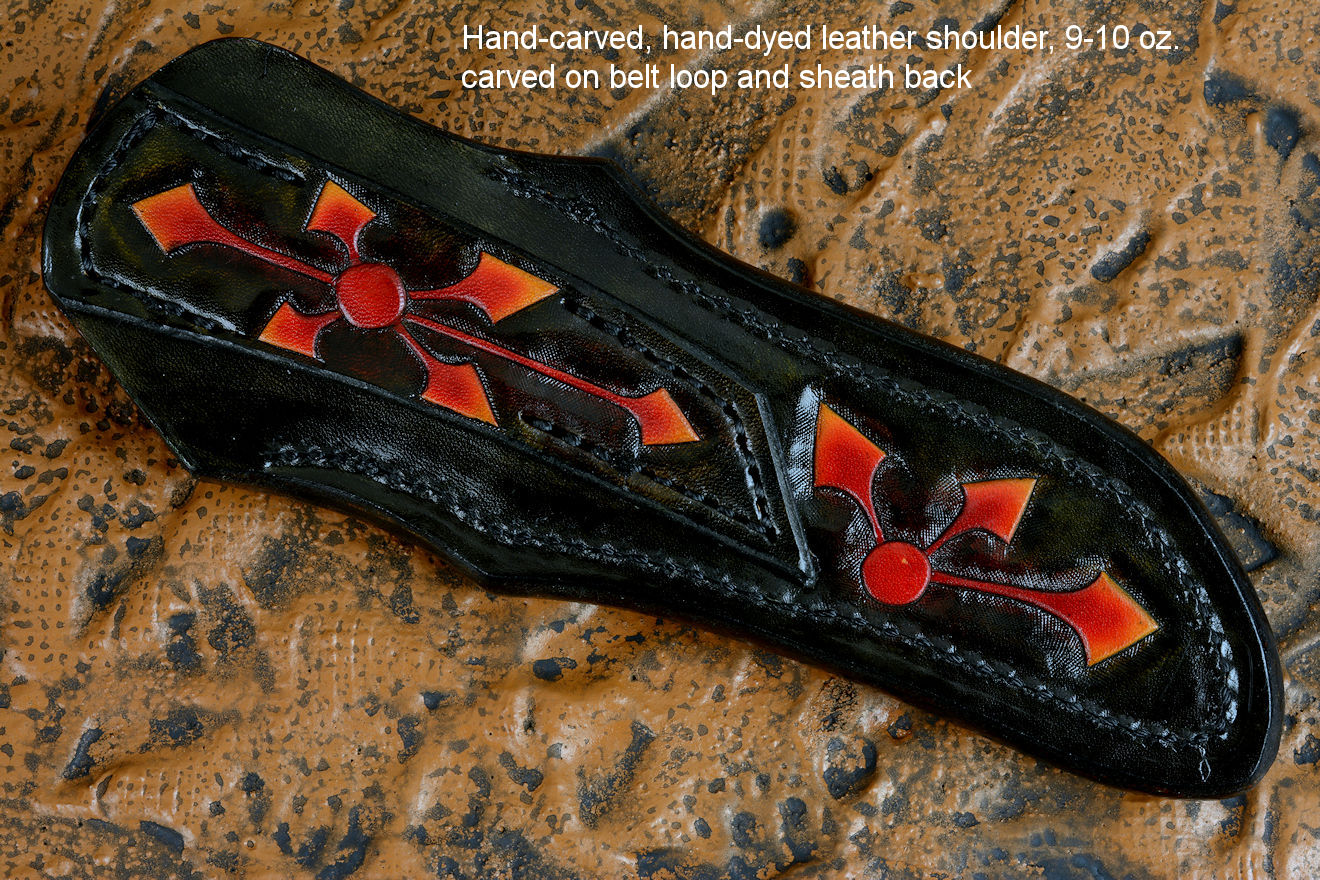
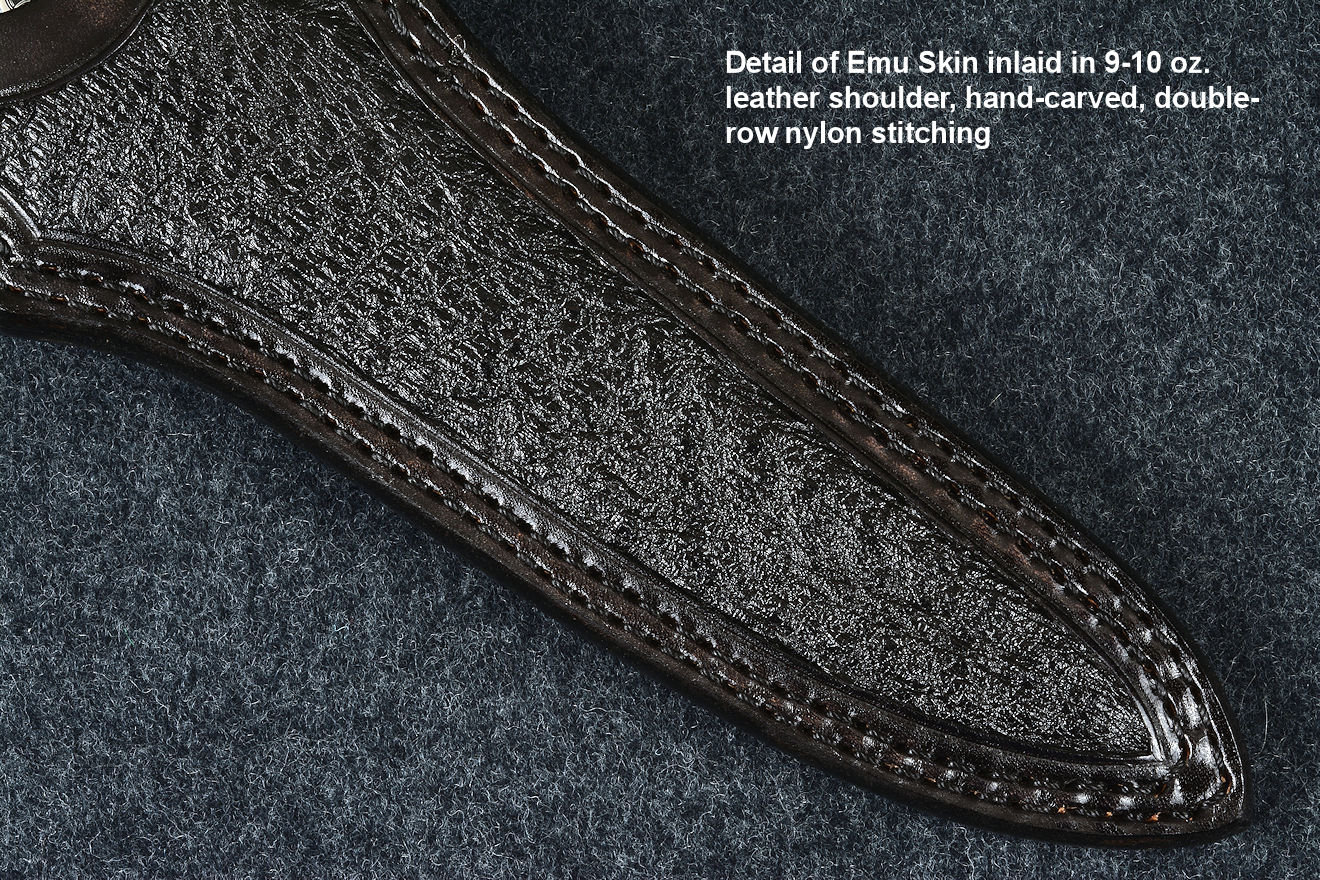
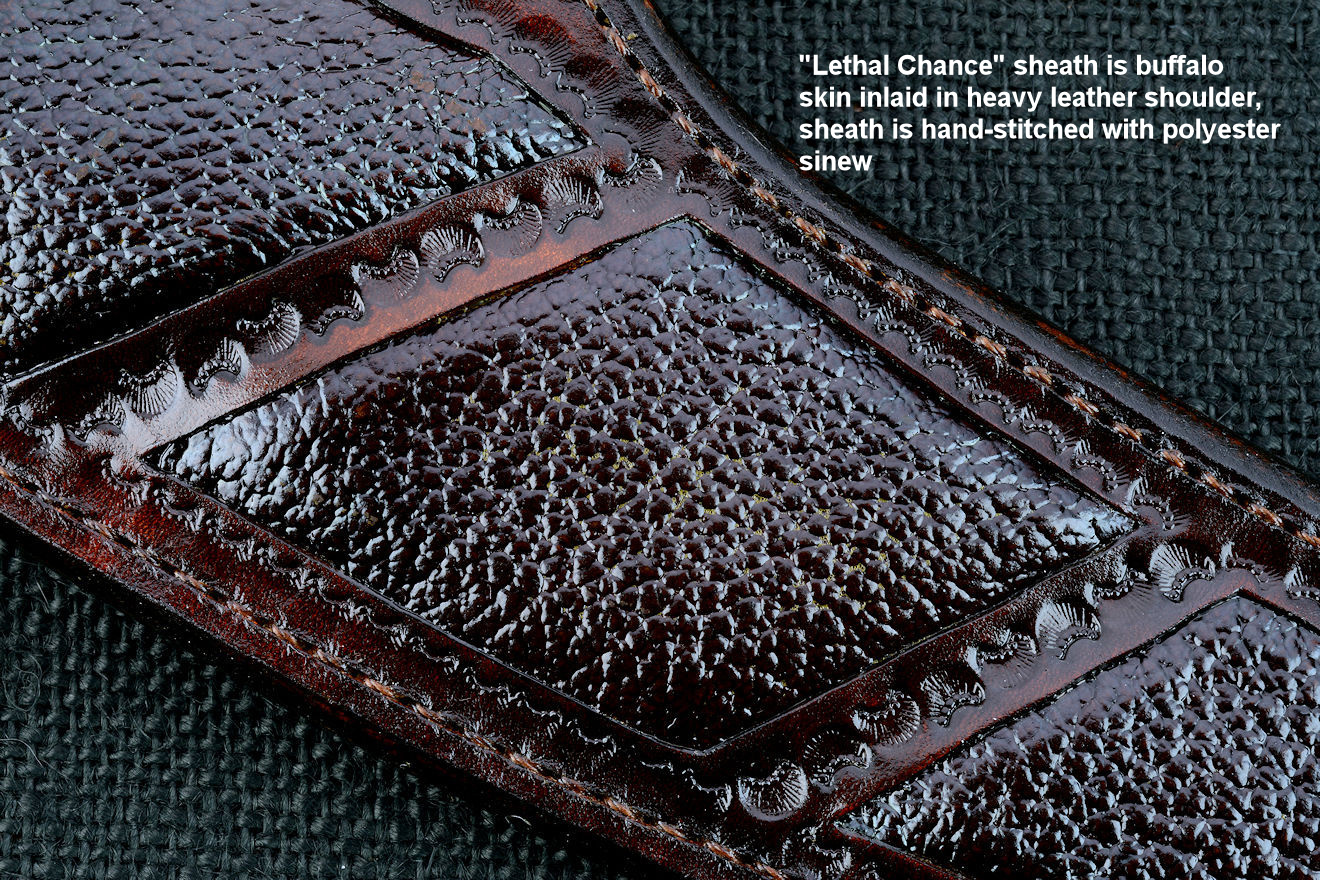
I try to make my sheaths as durable as is reasonably possible. This is the reason that I only use heavy weight (9-10 ounce) leather shoulder on most of my sheaths. I've even used shoe sole leather on particularly demanding applications. Leather shoulder is thick, hard, stiff, and long wearing. In my leather sheaths, I hand-stitch with polyester sinew or nylon, the toughest binders on the market. You absolutely cannot break this stuff with your bare hands.
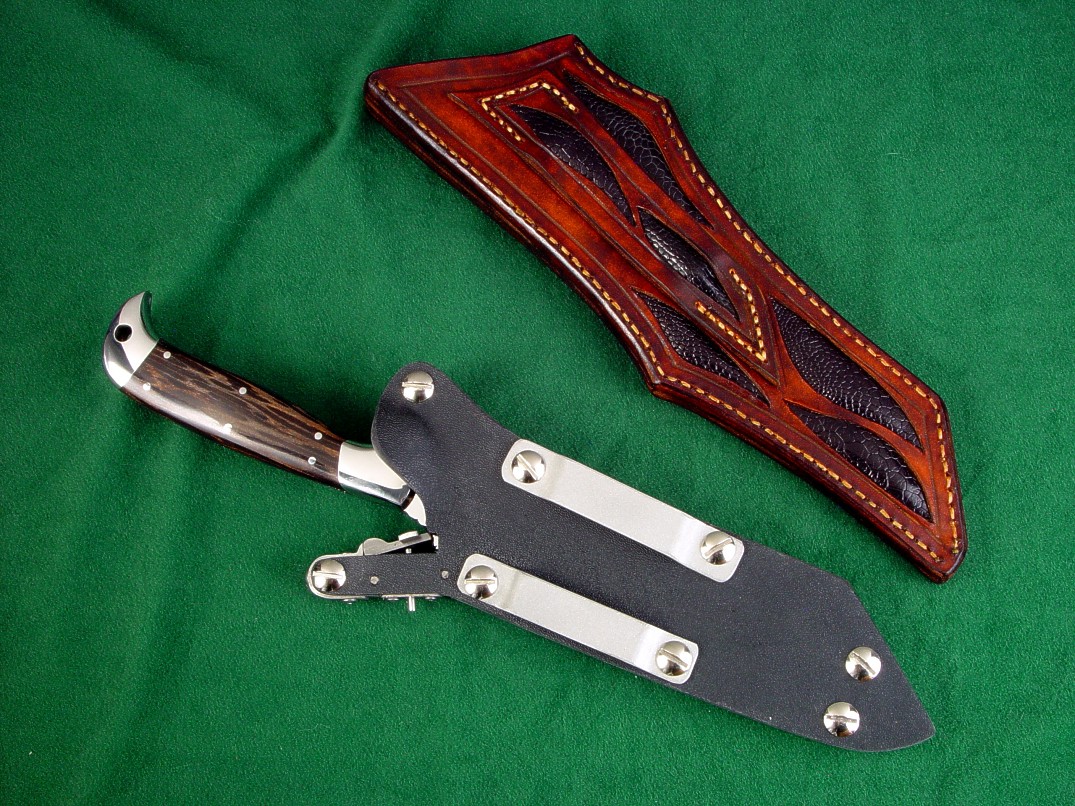
My military combat and tactical knife sheaths are assembled with waterproof cement and screwed together with steel Chicago screws, not rivets, usually through high strength aluminum alloy welts. On request, I even use stainless steel or nylon Chicago screws for extreme corrosion resistance.
With care, sheaths for my knives should wear through at least one generation, perhaps several. A good indicator of knife sheath longevity for the knife maker is returns. How many knife sheaths have I had returned for workmanship repair? In over 2000 knives in over 30 years, not one. Oh, I've had some clients cut, slice, or abrade their sheath, damaging it, but none have worn out, separated, or come apart. That's a pretty good record I think!
Leather is the hide of cattle, stripped of all hair and properly vegetable tanned. The most important size measurement in knife sheaths is the thickness, designated in the leather trade by weight. So, all cattle leathers are measured in ounces. An ounce roughly translates to 1/64th of an inch (.4mm). So one ounce thick leather is about 1/64th of an inch thick (about .015" for you machinists). Incidentally, thick leathers (over 4-5 oz.) only come from mature cattle.
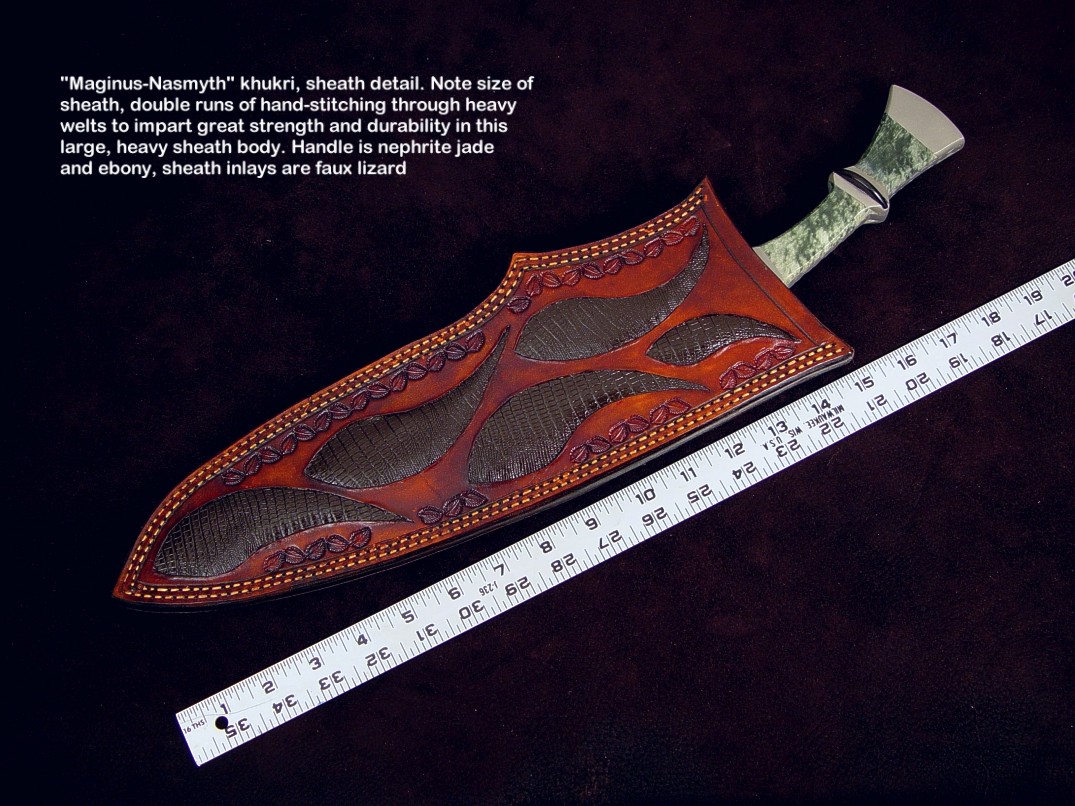
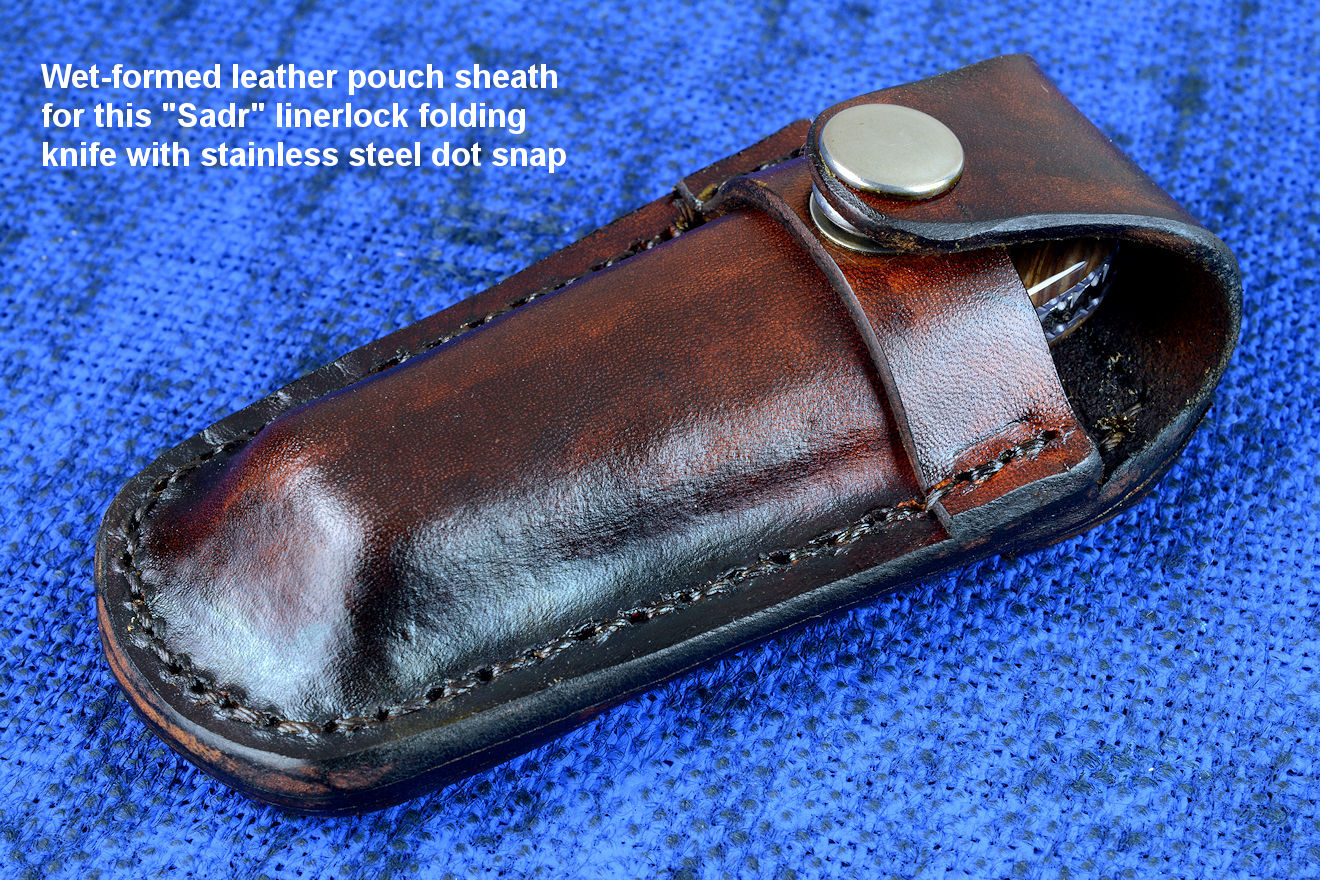
The leather I use for fixed blade knife sheaths is 9-10 oz. thick, or .150" or about 5/32 of an inch (4mm). When used in welts, which are stacked in multiples, along with the front and back of the sheath, it's not unusual for the sheath thickness to be 3/4" to 1" thick! Rarely, and only for some folding knives, which are lighter and smaller, I'll use a thinner leather, usually about 6 ounce.
You might wonder why factories or mass-produced knife sheaths are usually made of thinner leather, sometimes without welts. The reason is that they are machine stitched, and machines can not stitch through three quarters of an inch of tough leather. So in order to keep labor costs low and use machinery as much as possible, factories stay away from thicker leather. Good for them, bad for you if you want a tough, stout, useable, and protective sheath that will last a generation or more. It's another case of a bean counter offering a lesser product not to help the knife owner, but to cheapen his own costs.
Here in this studio, I offer the very best, thickest, strongest, and finest leathers available for your custom project.
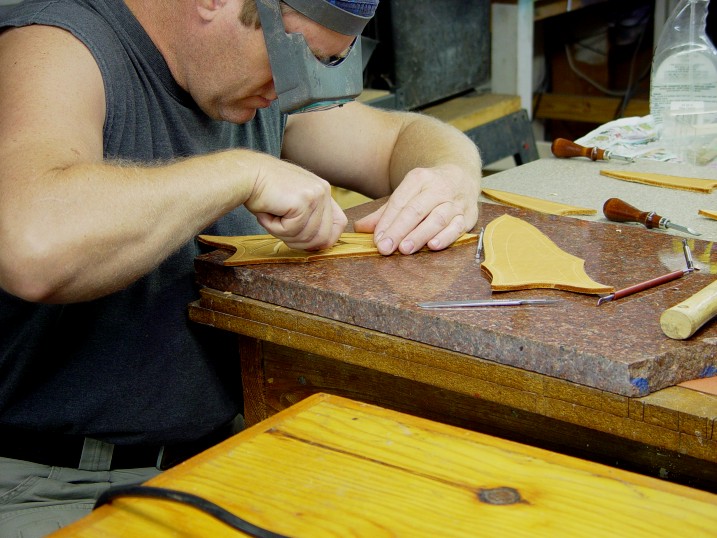
Beautiful knives should not be hidden in plain sheaths.
Not only is the sheath part of your knife investment, it is often the only thing that is seen riding on your hip, at your side, or hanging upside down on your PALS webbing on your body armor (See military combat sheaths below). So it should be attractive, as well as utilitarian. In fact, it should be commensurate with your knife investment, and should match the knife in every artistic and working fashion. The knife and sheath should work together, look good together, ride well together, be comfortable with each other and with you.
I've seen beautiful knives pulled out of ugly, plain sheaths, and with them comes an apology and a promise of "getting a nice sheath for my knife someday." The truth is, the only one who can design and make a sheath that truly matches the intent, style, flavor and mastery of the knife maker is the knife maker. So wouldn't it make sense for him to complete the package and make a fine sheath too? Sheath making is part of this tradecraft, after all.
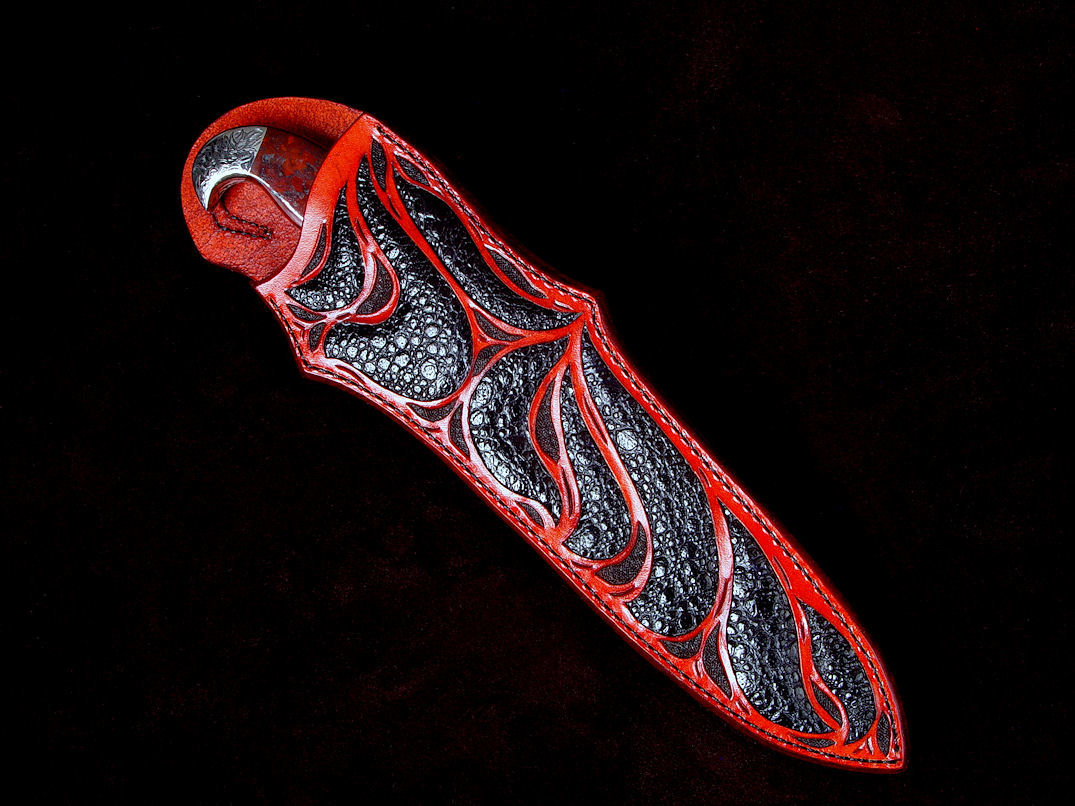
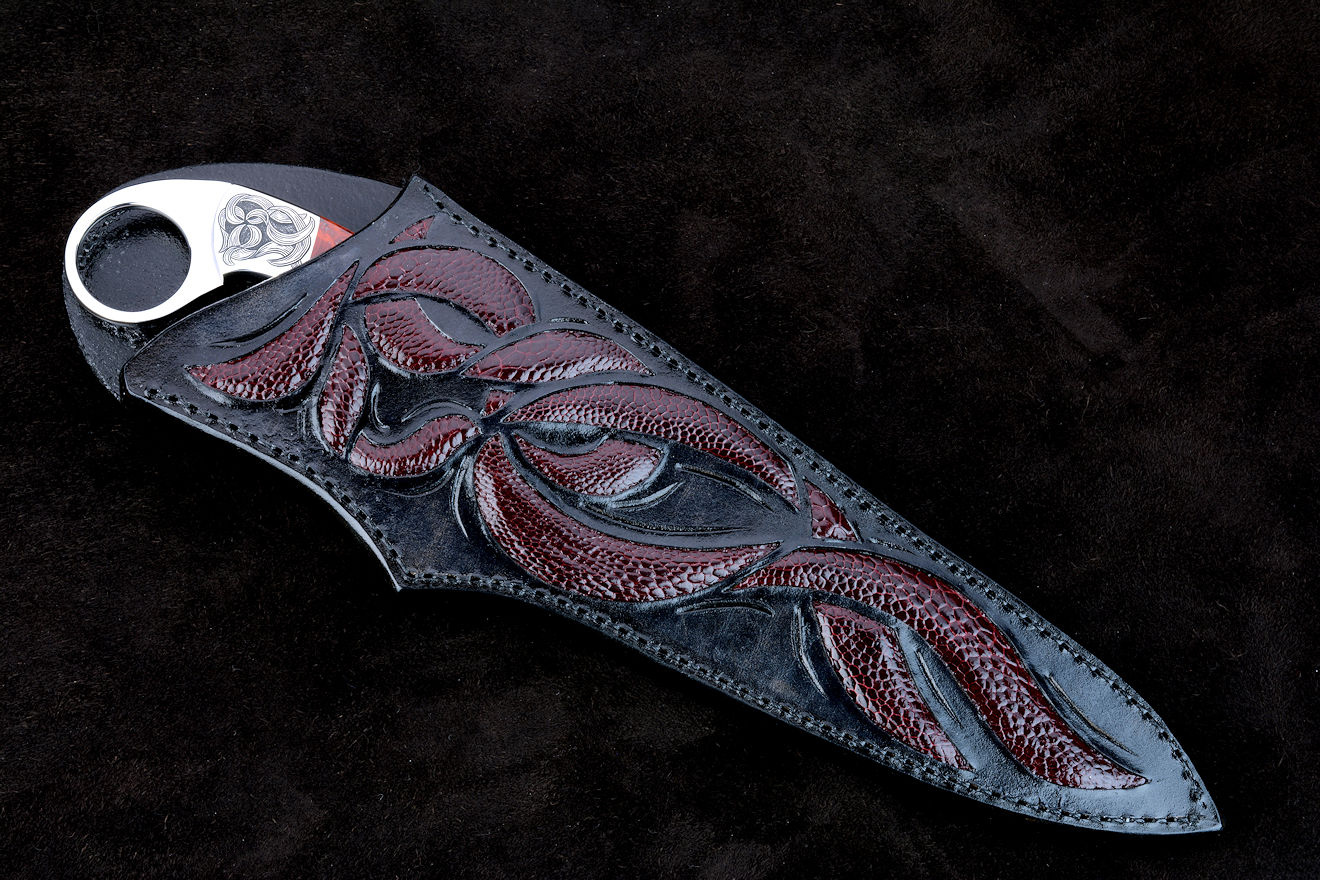
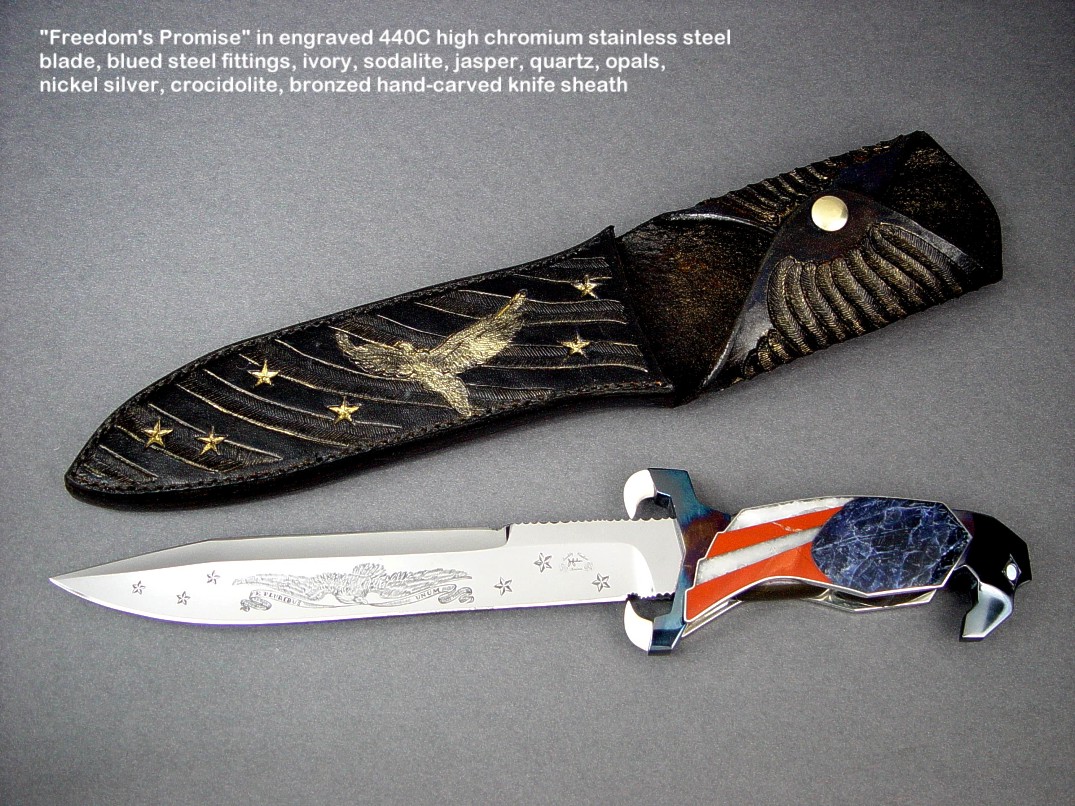
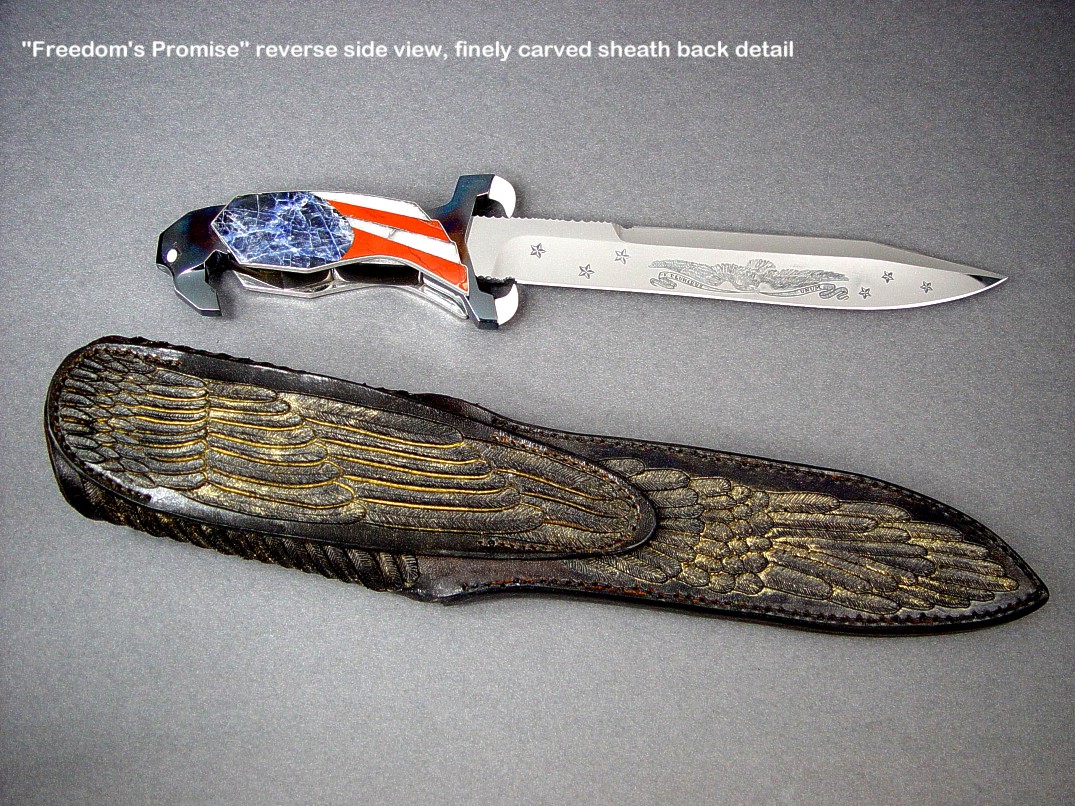
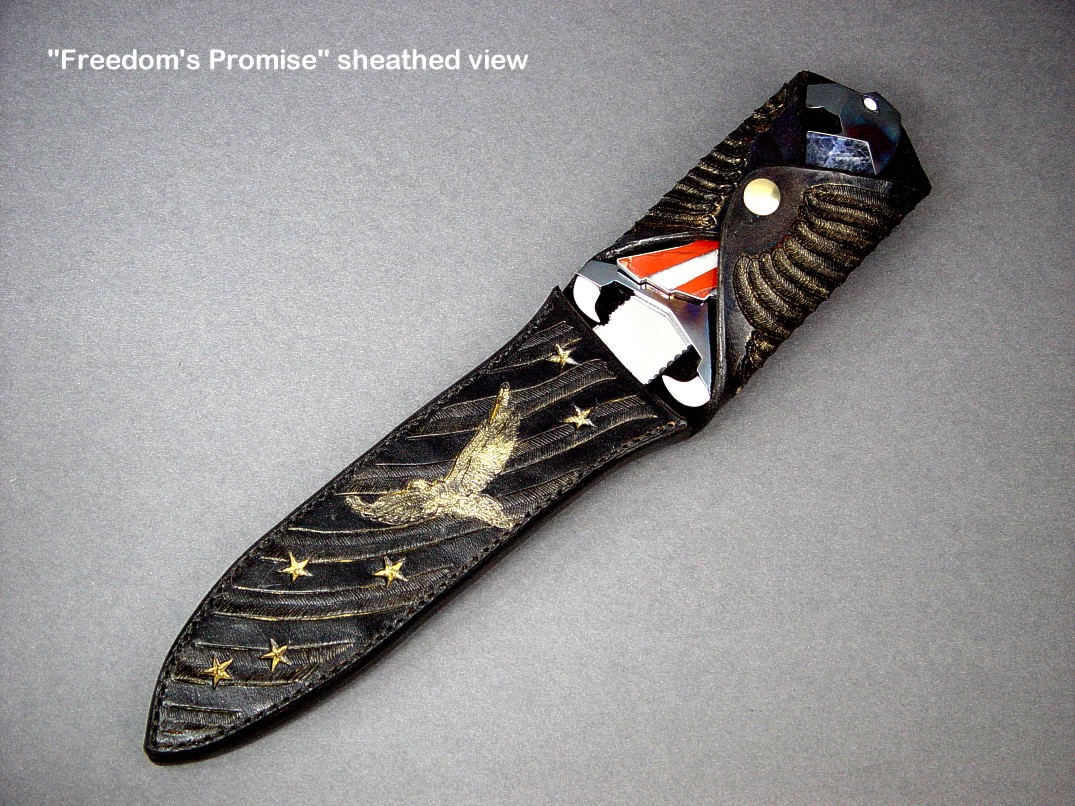
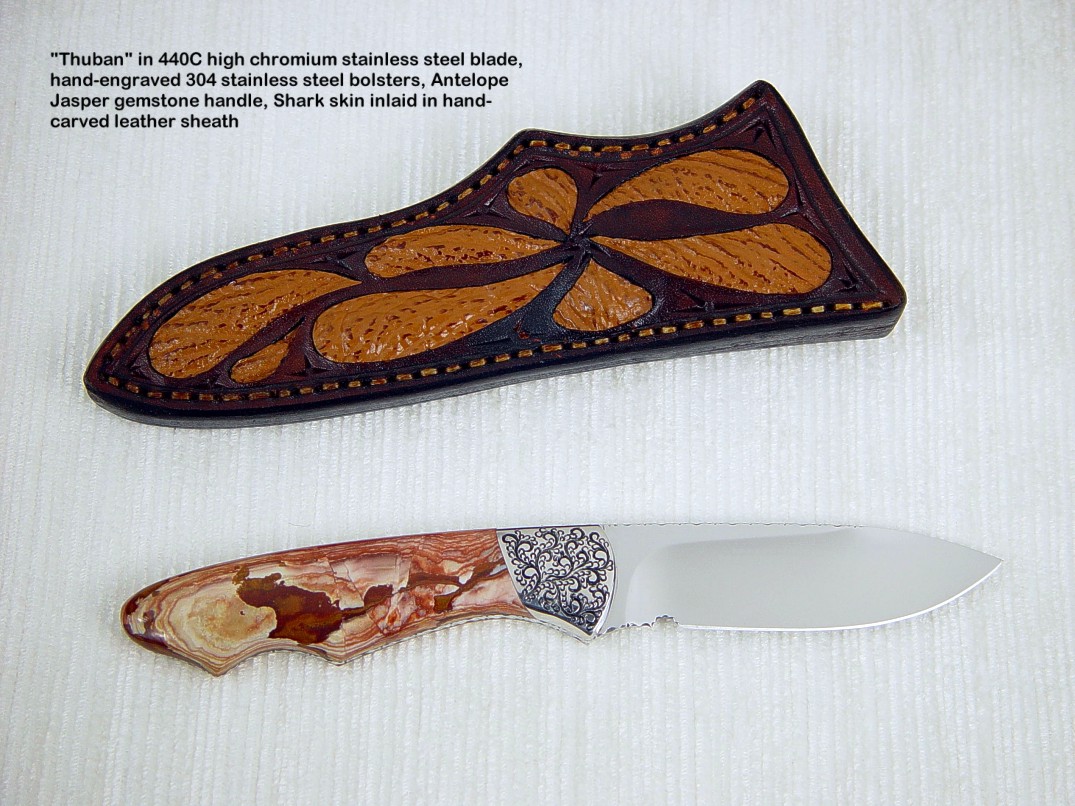
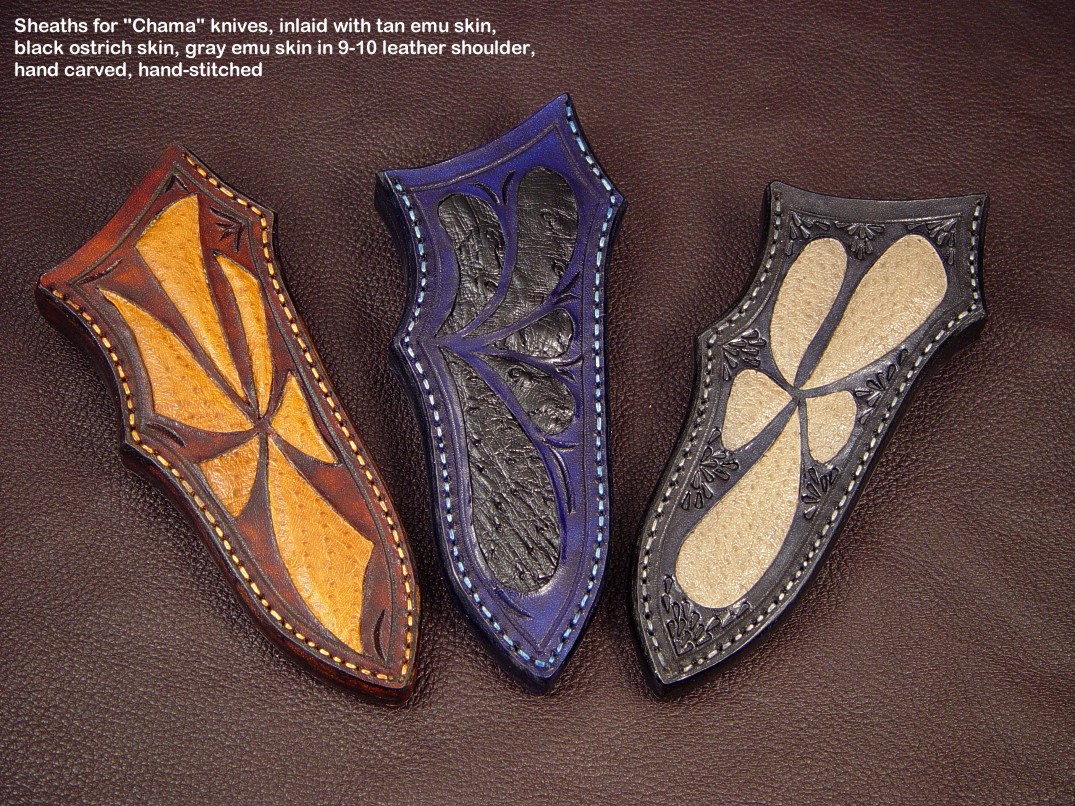
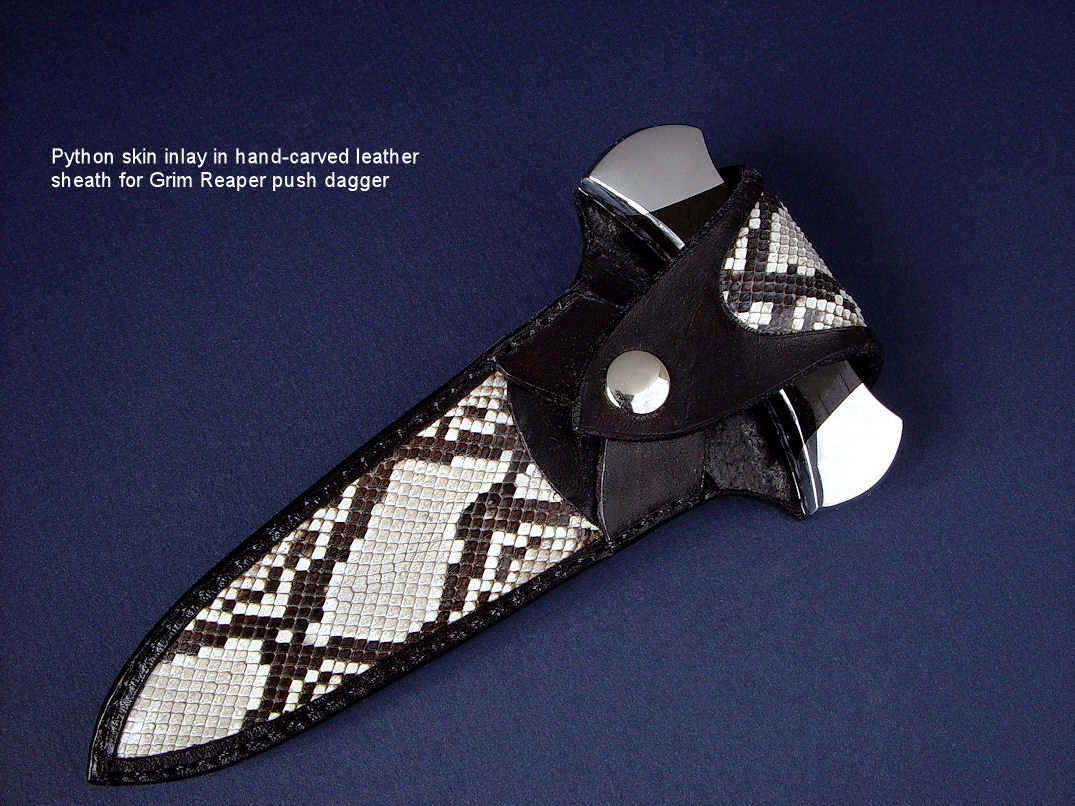
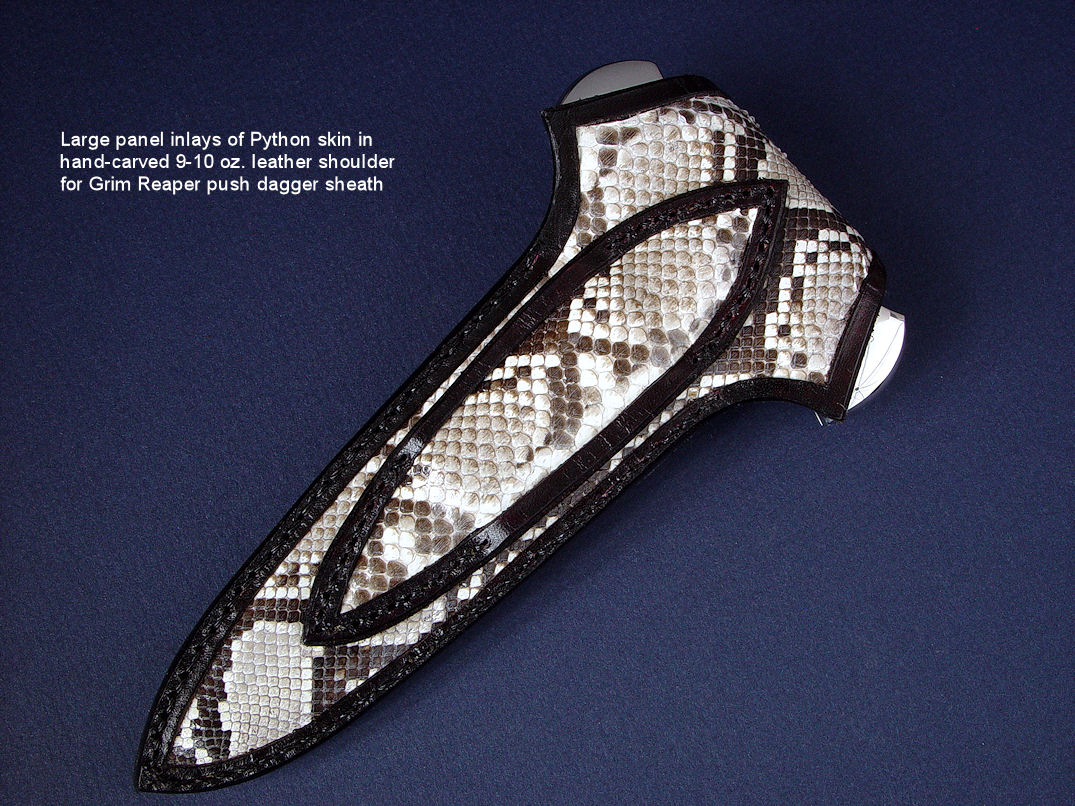
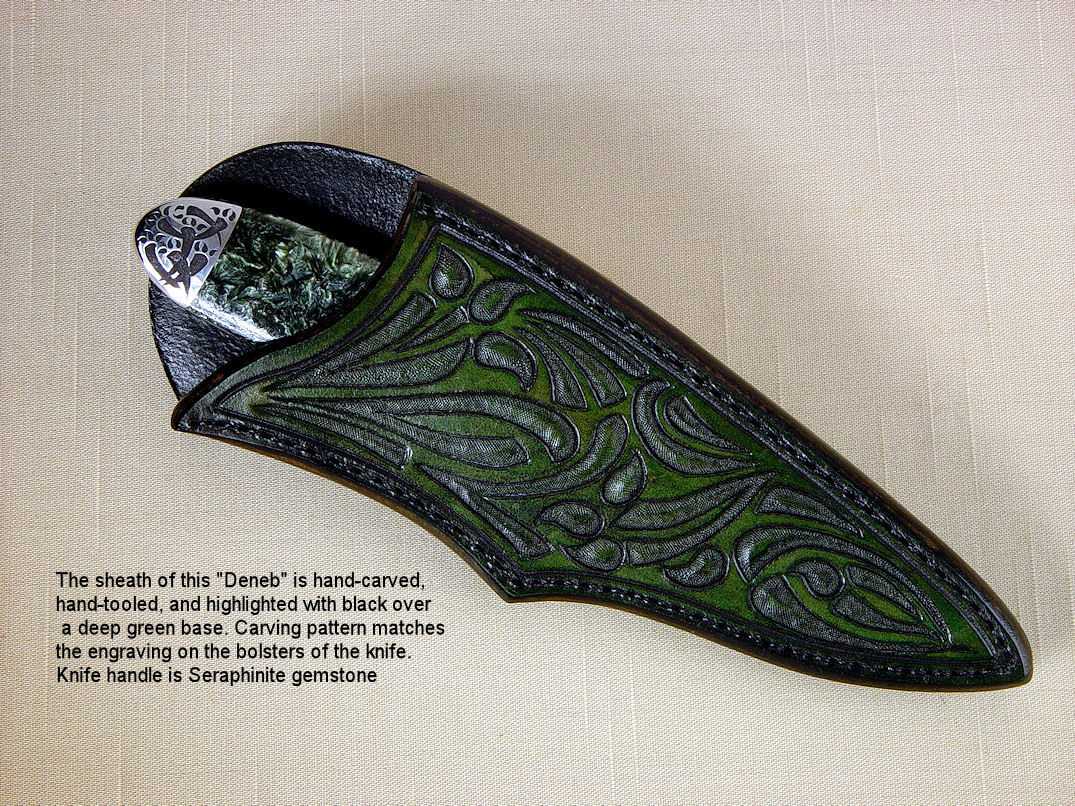
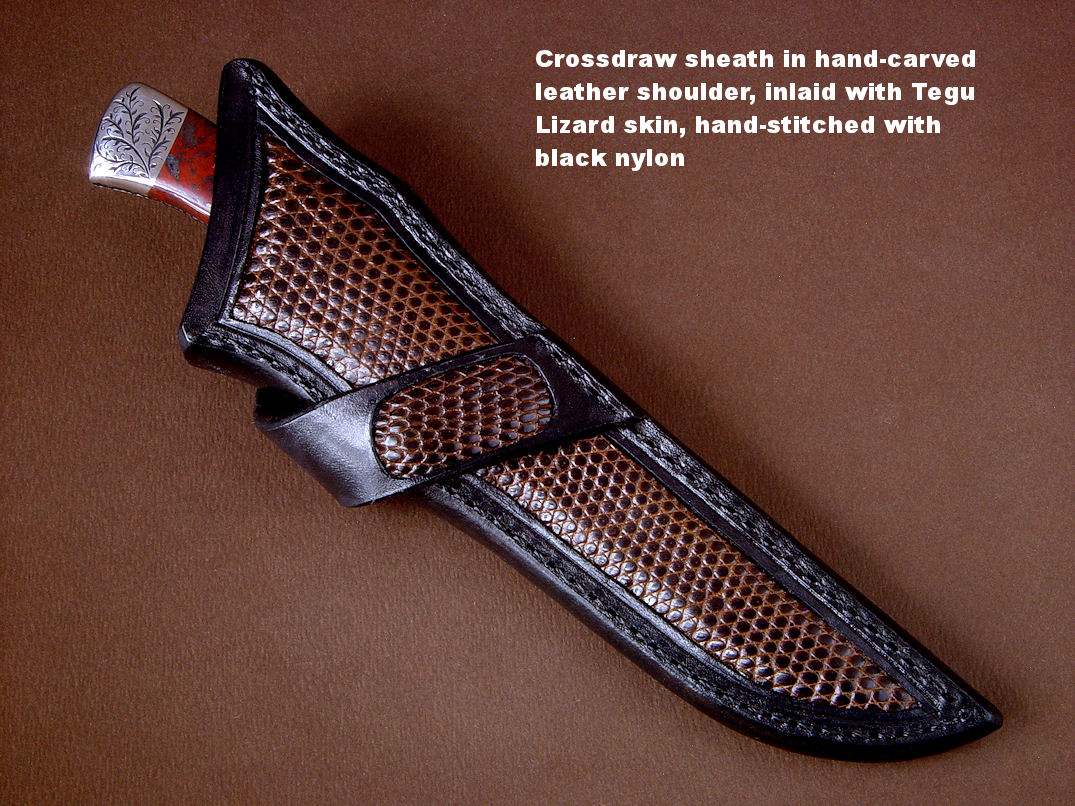
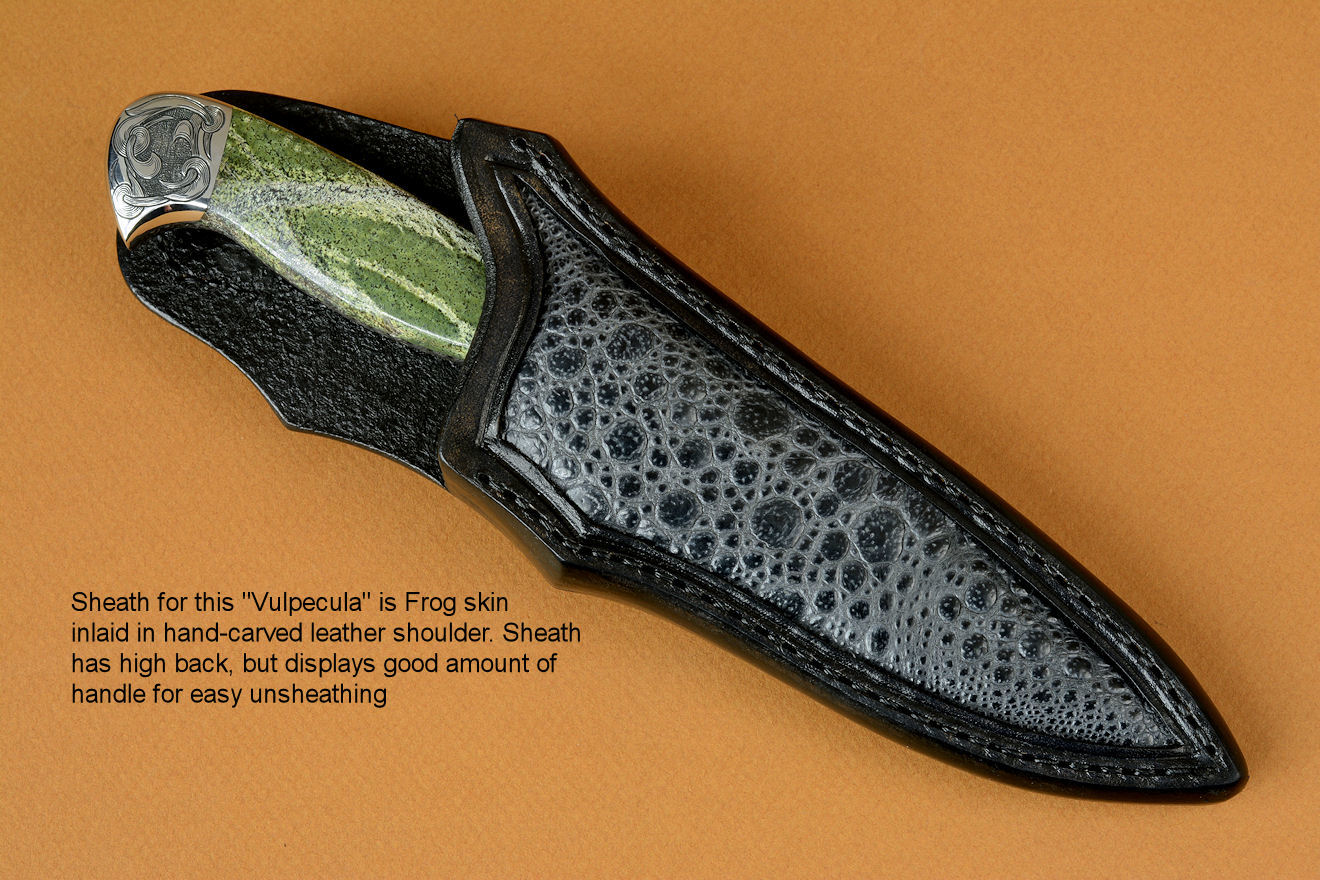
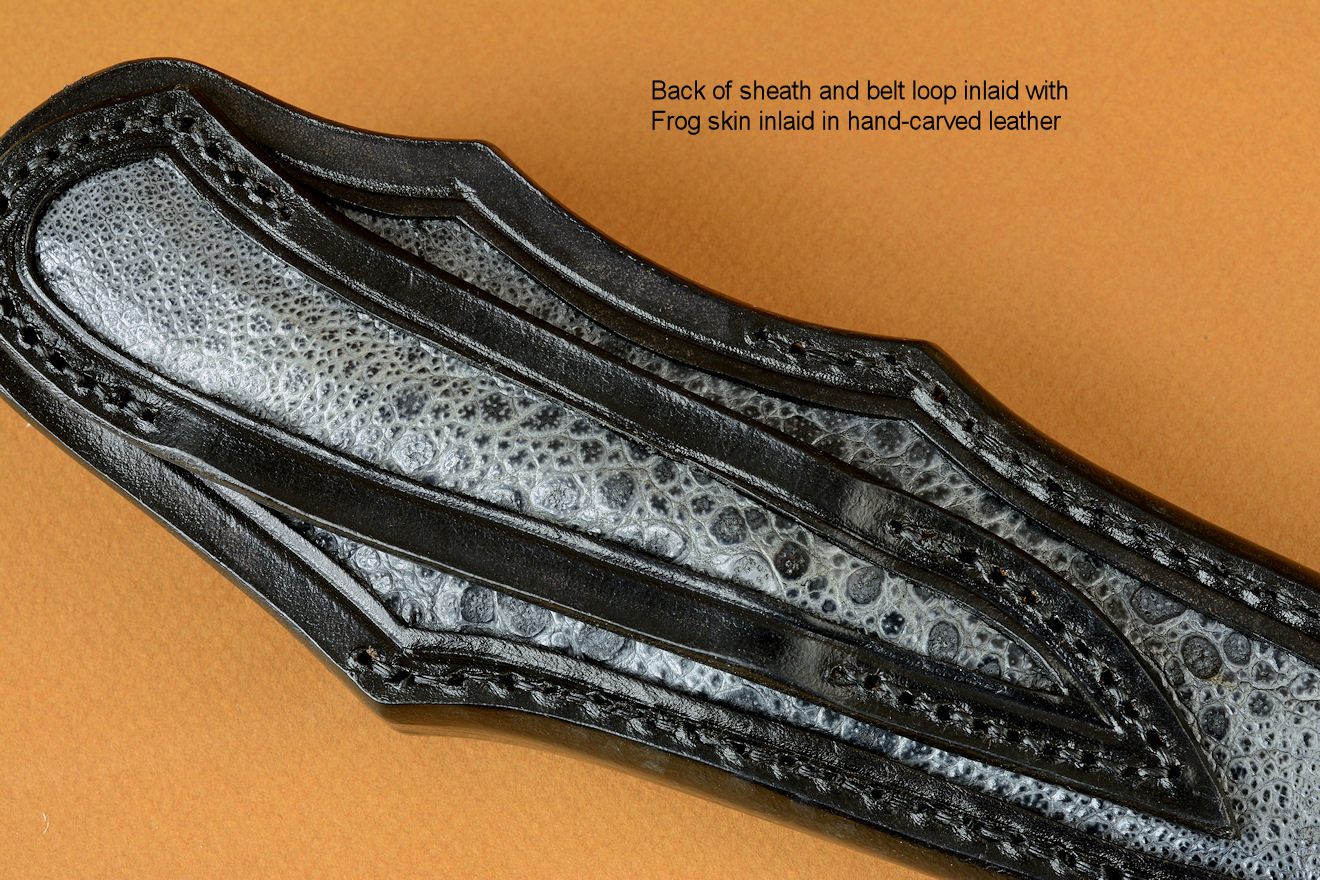
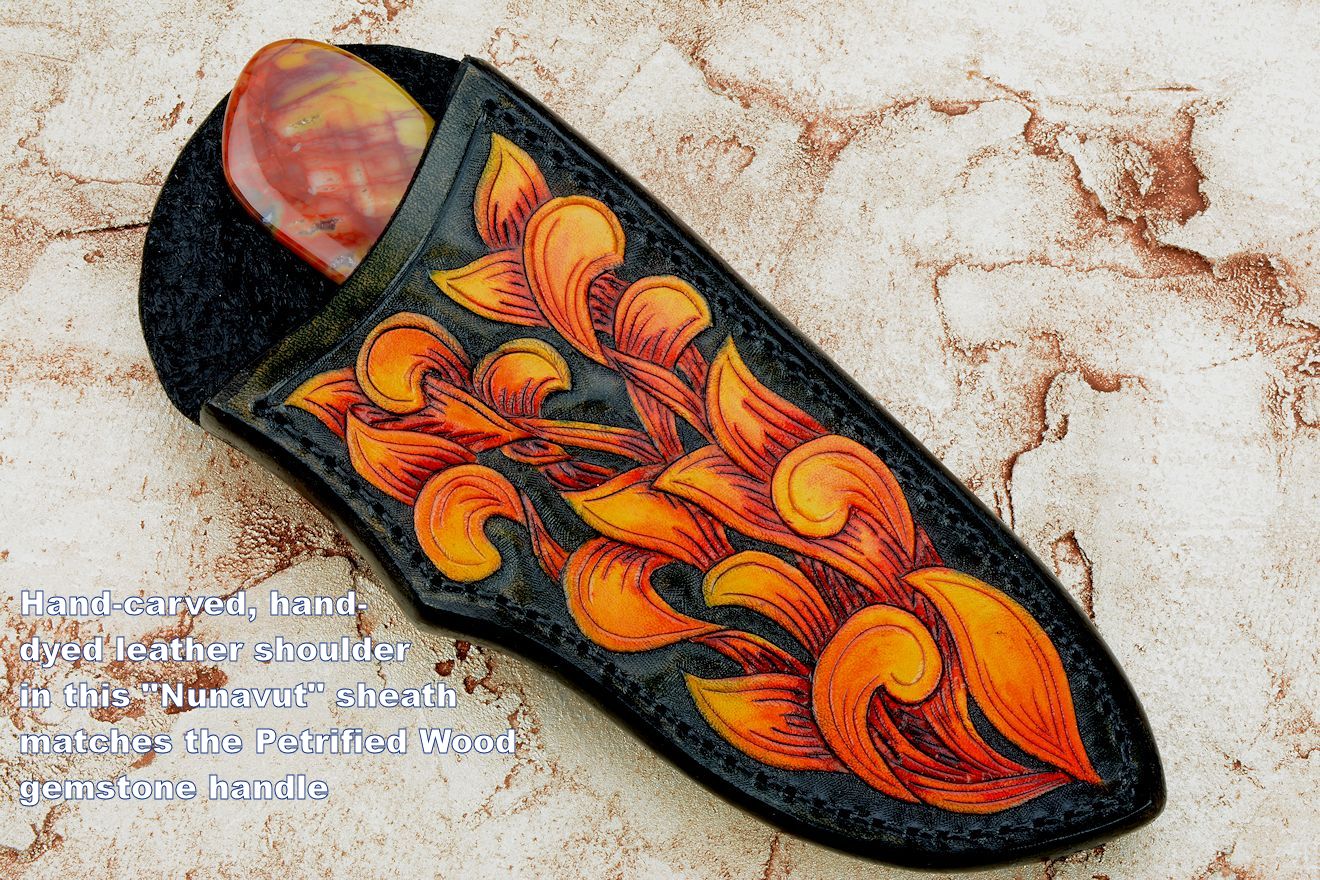
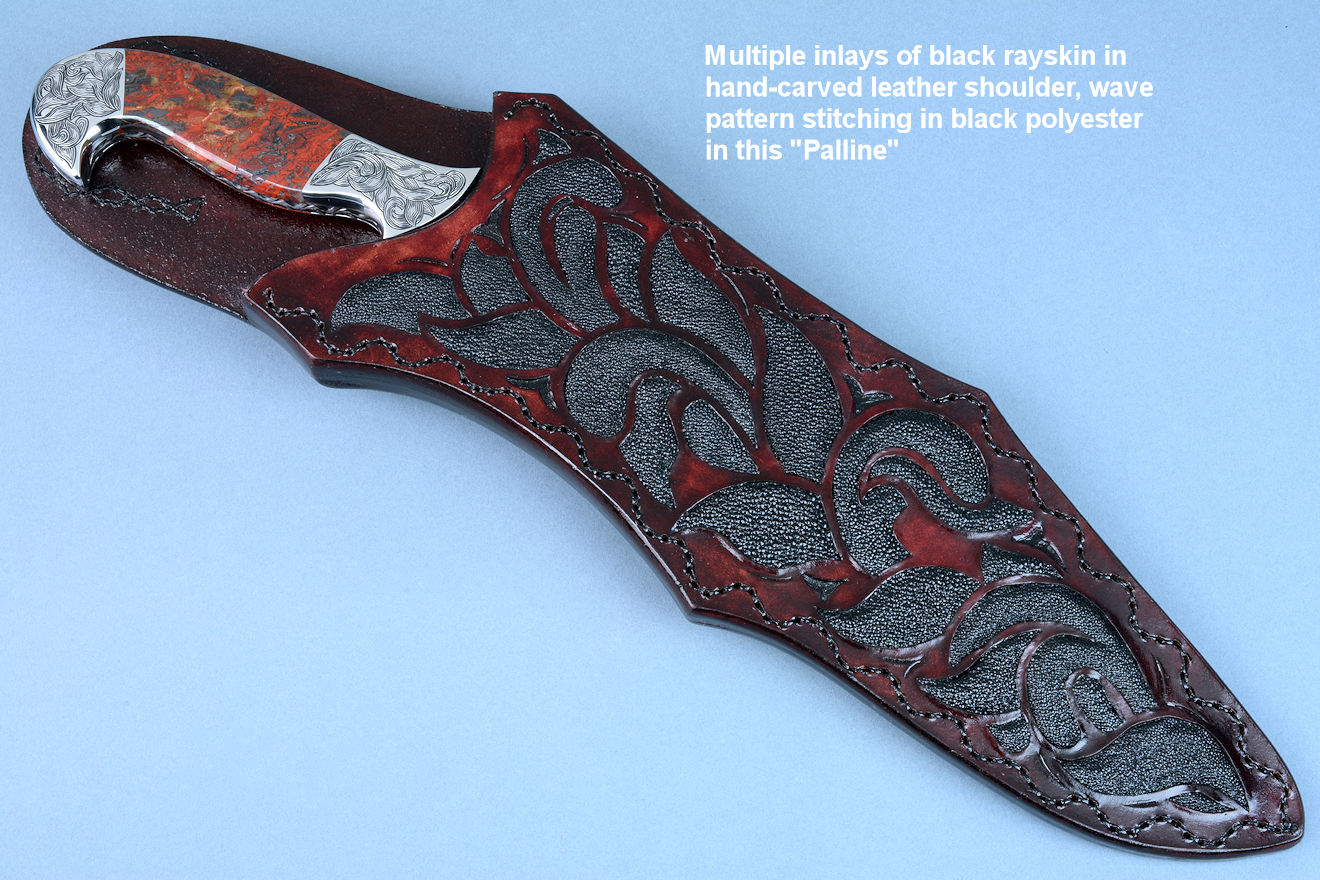
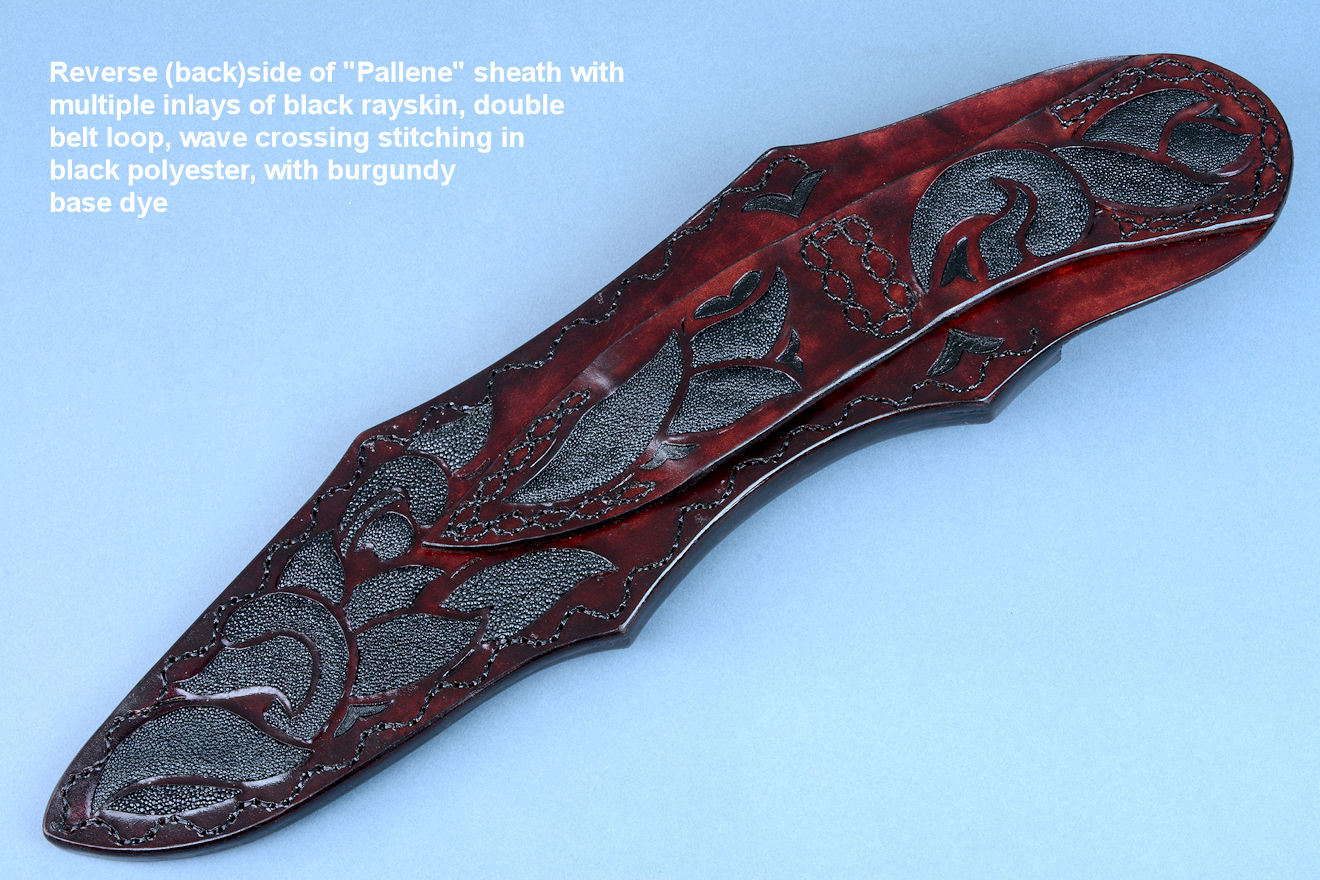
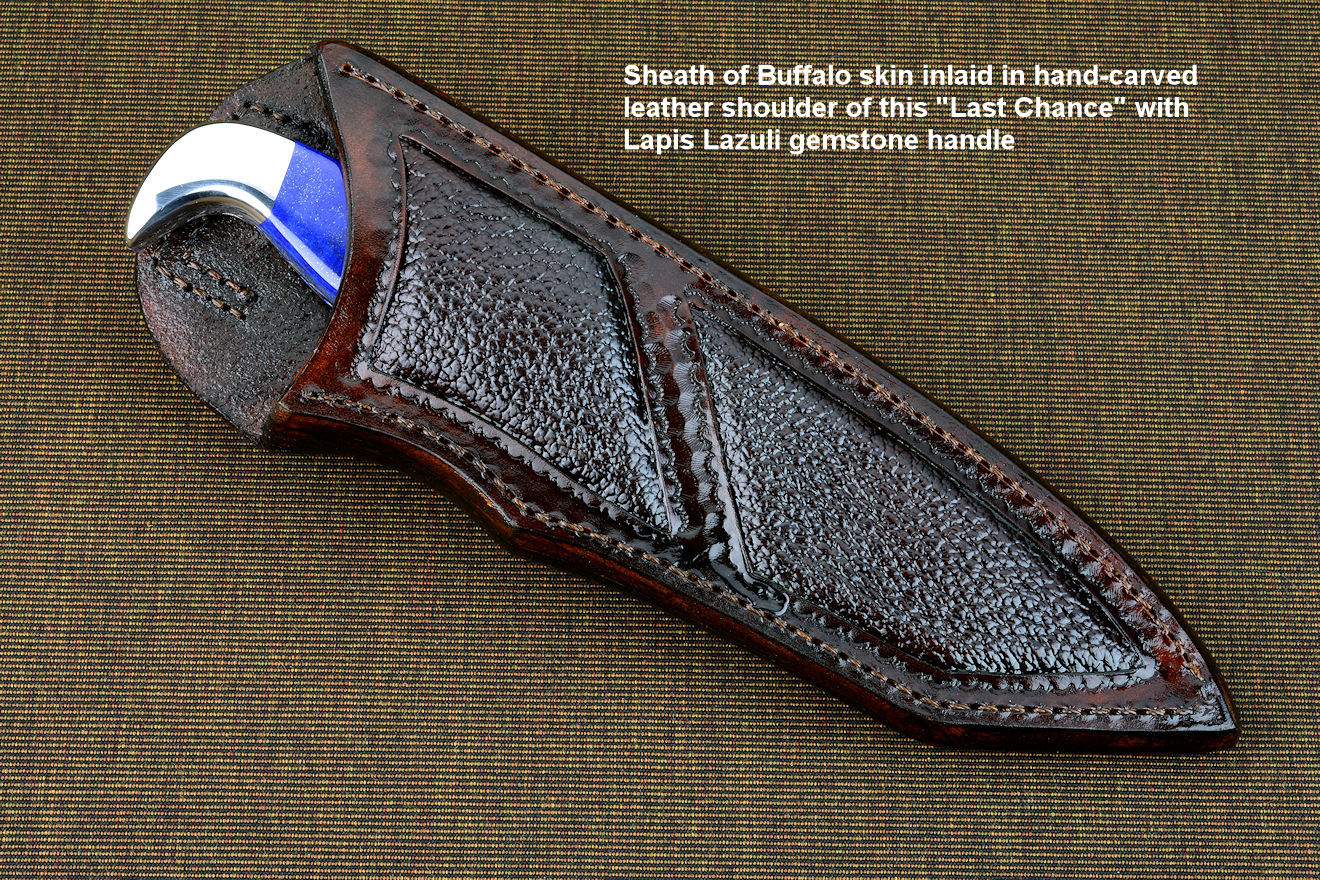
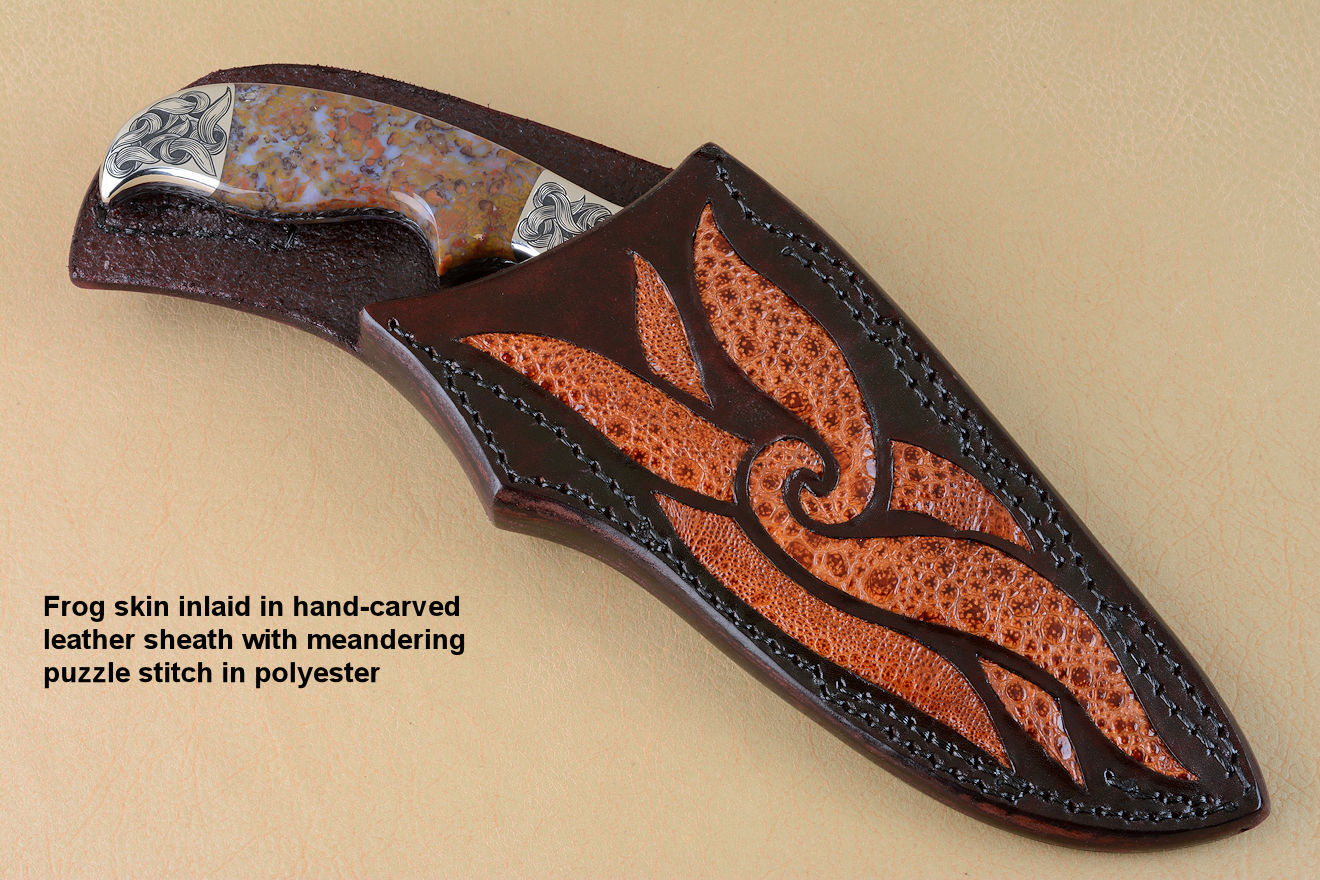
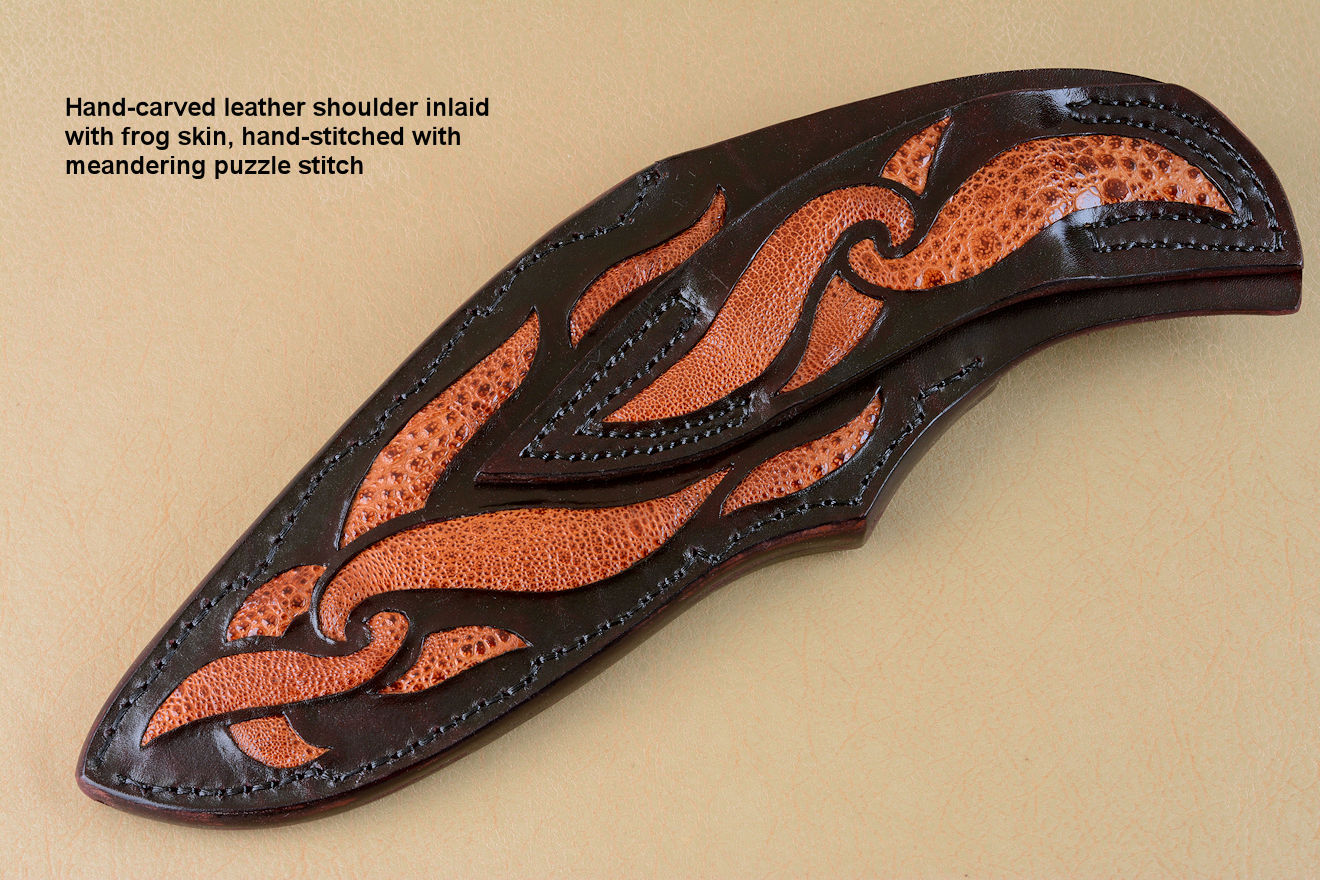
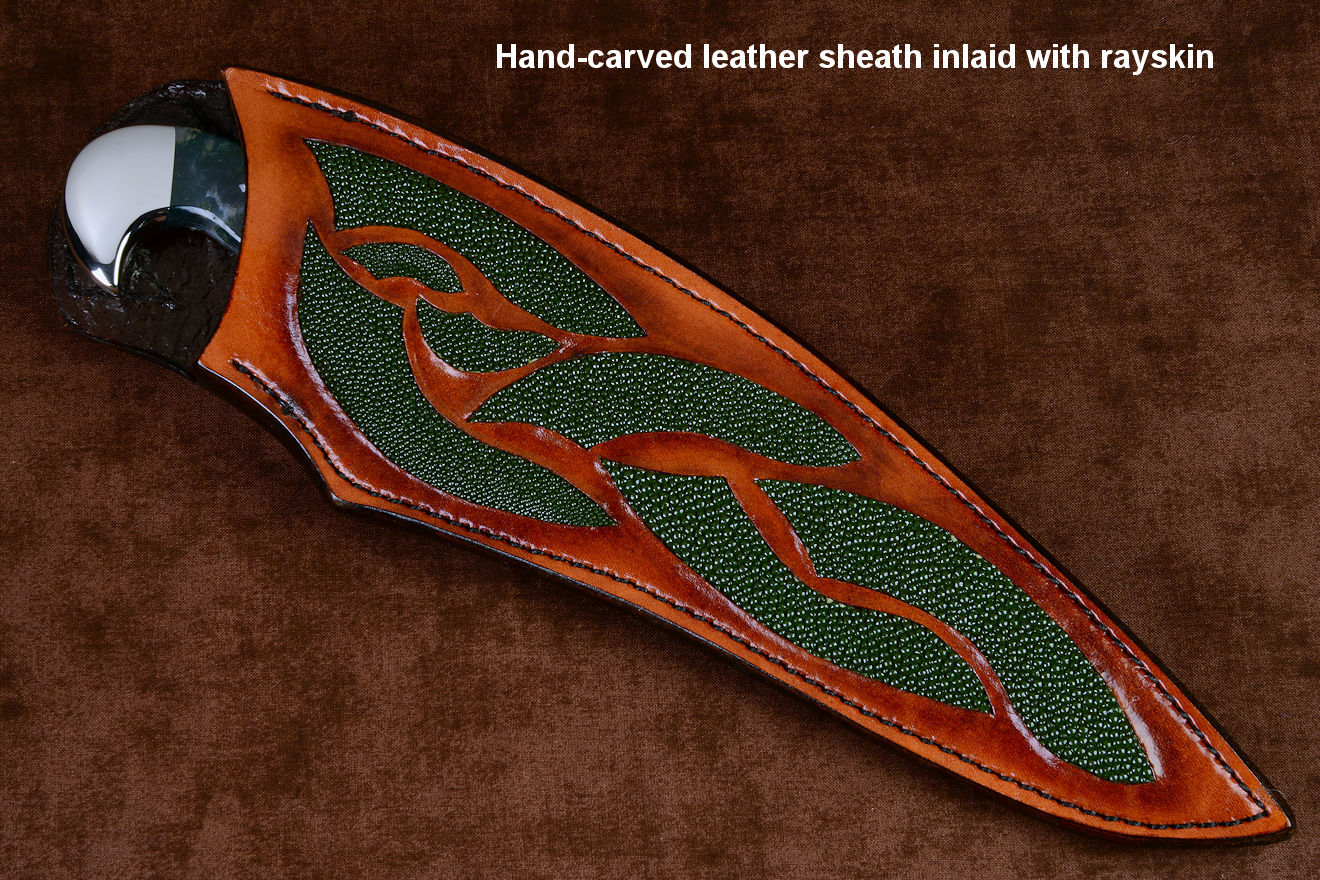
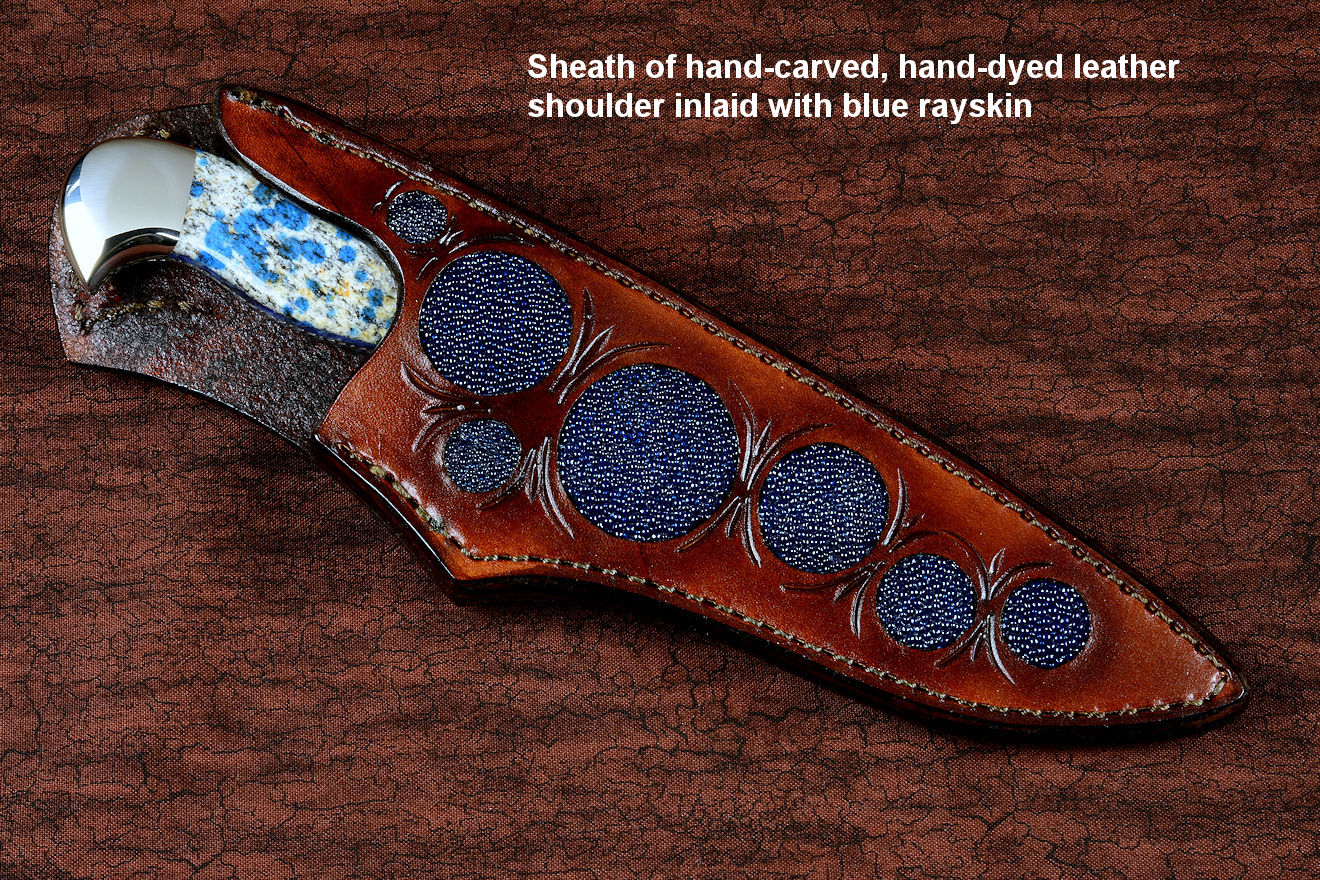
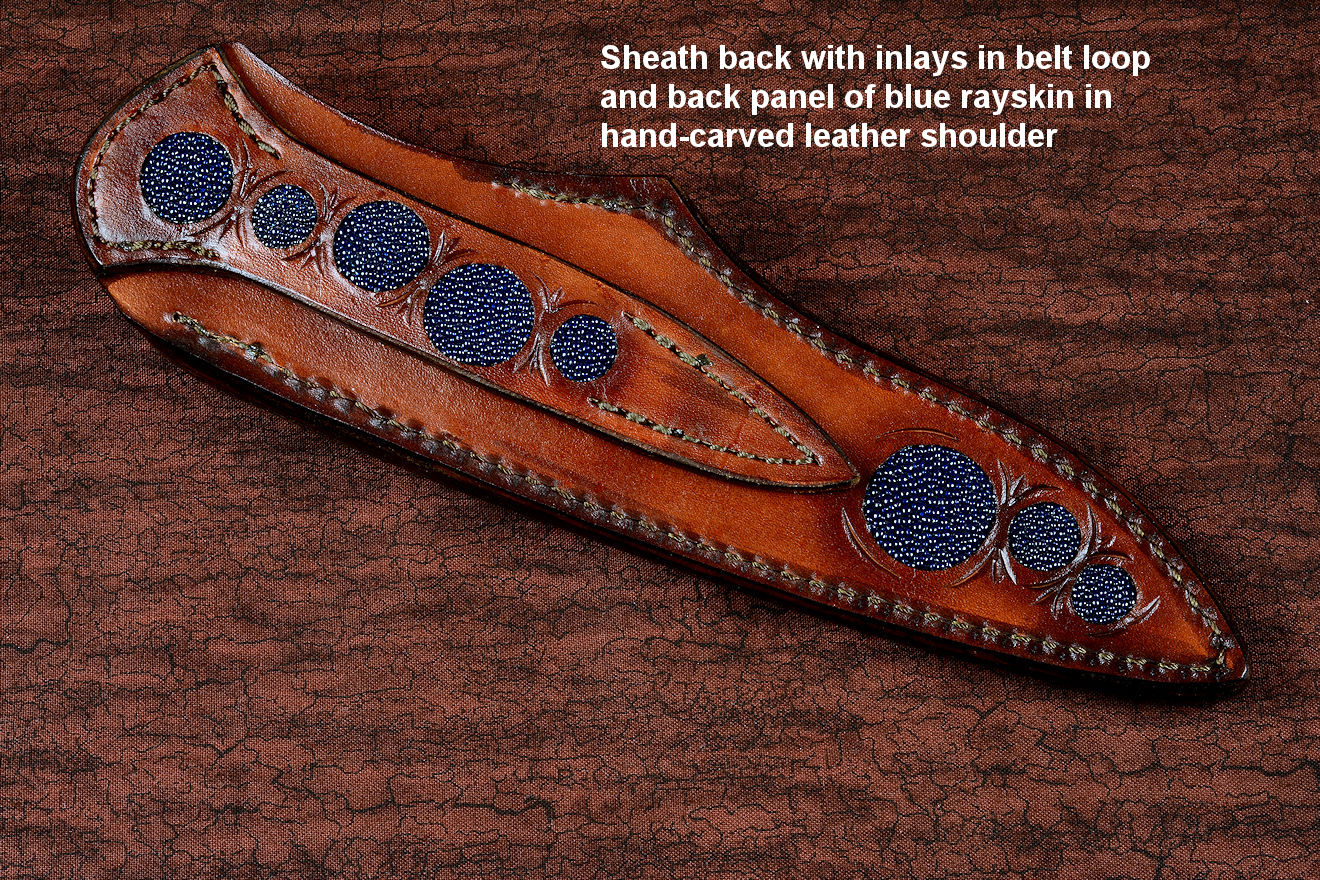
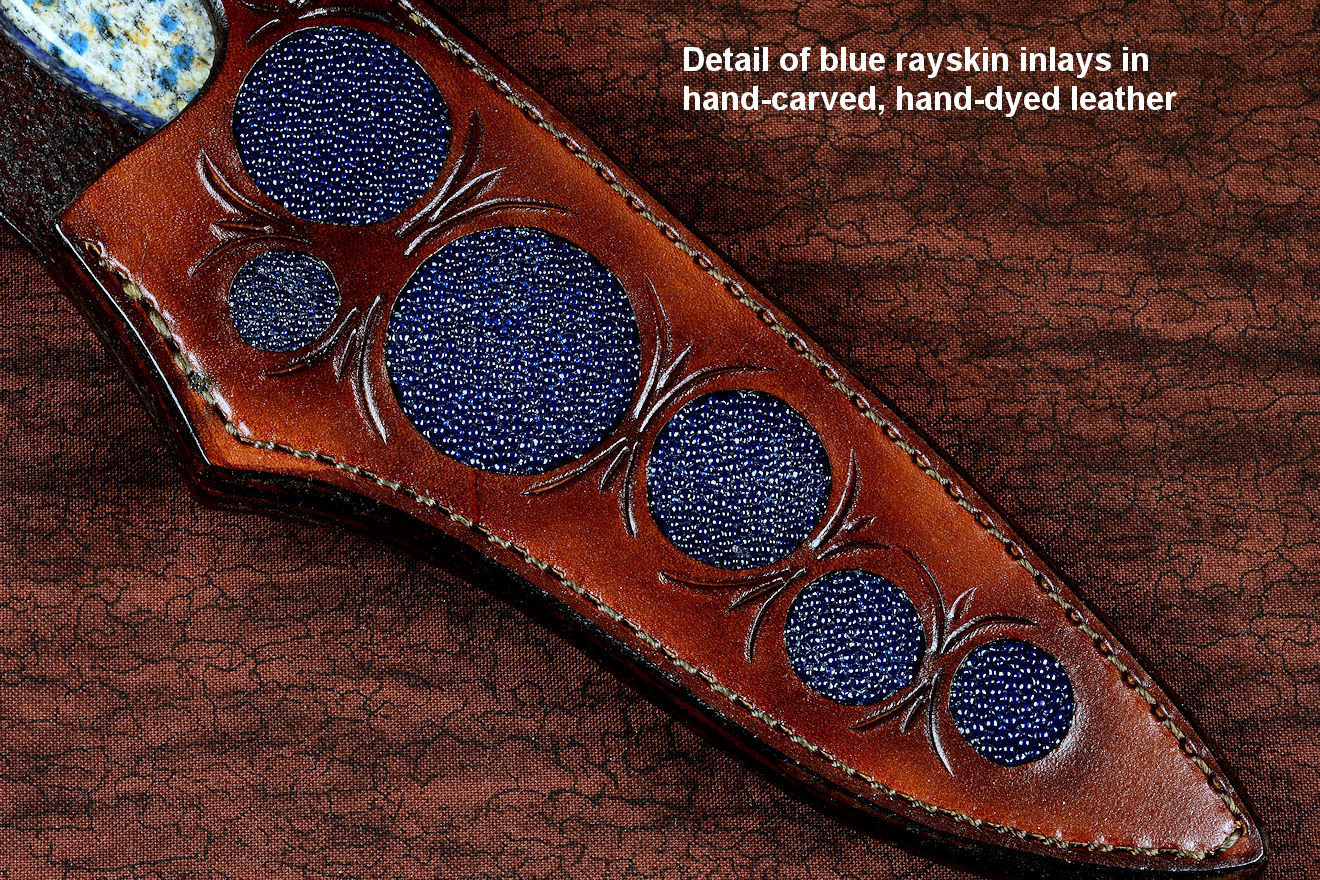
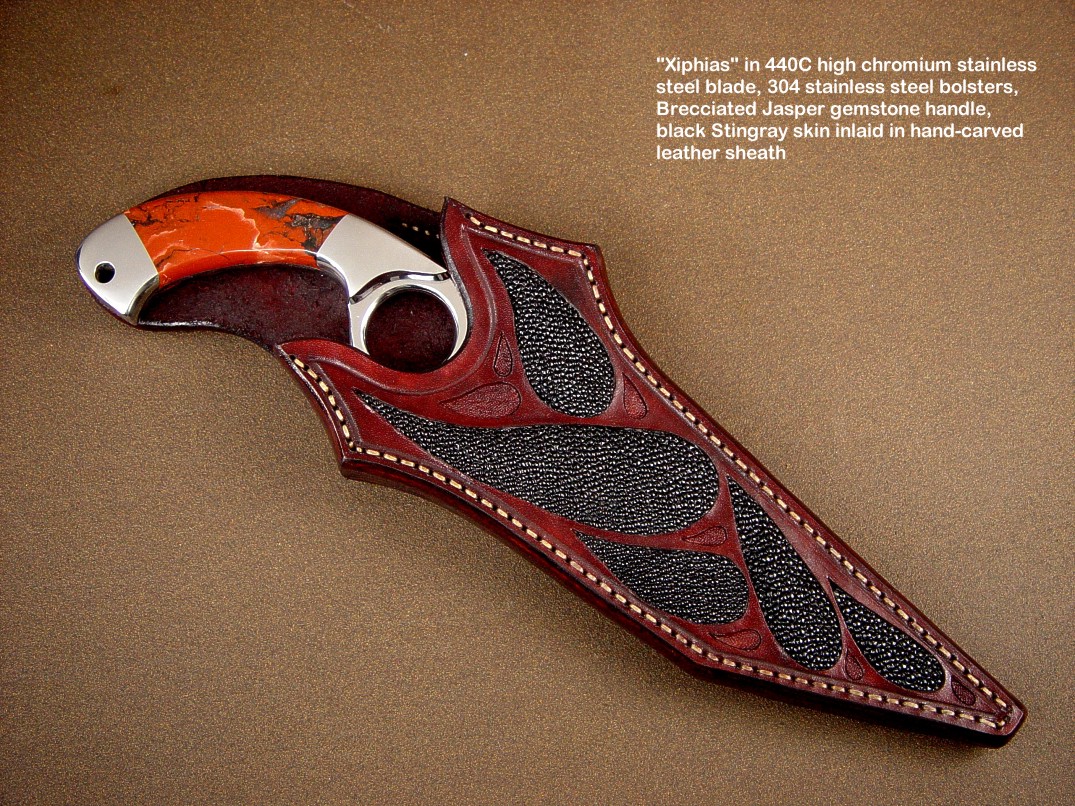
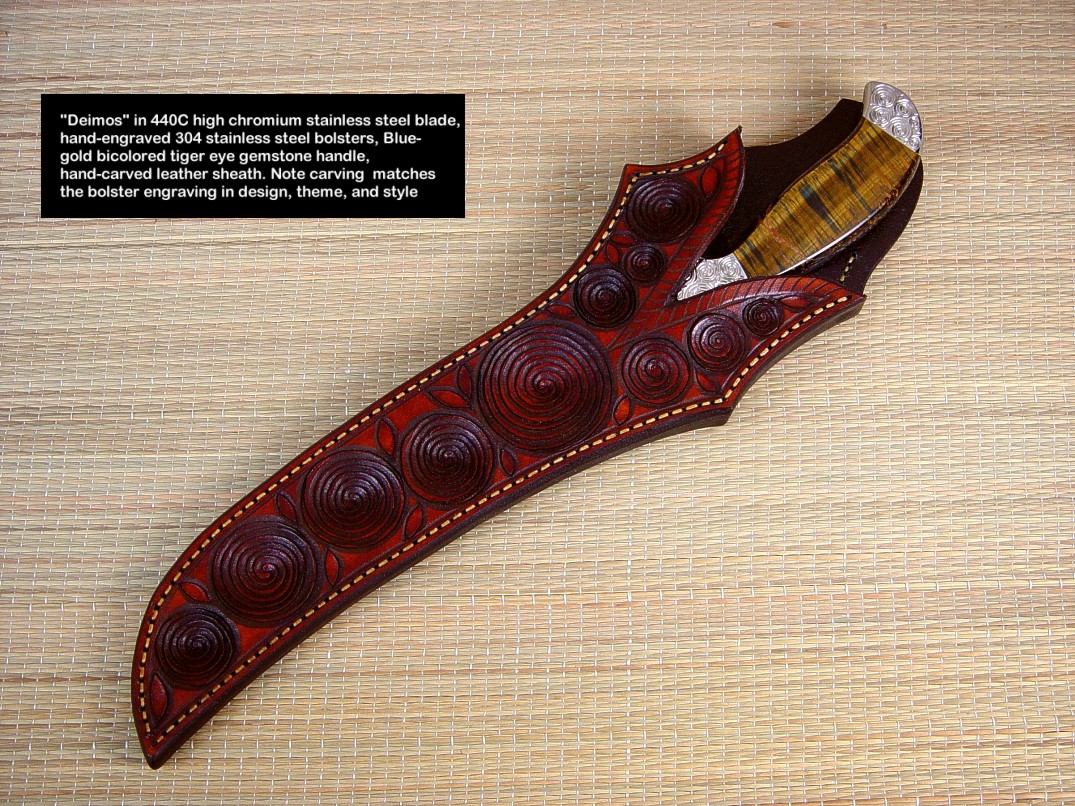
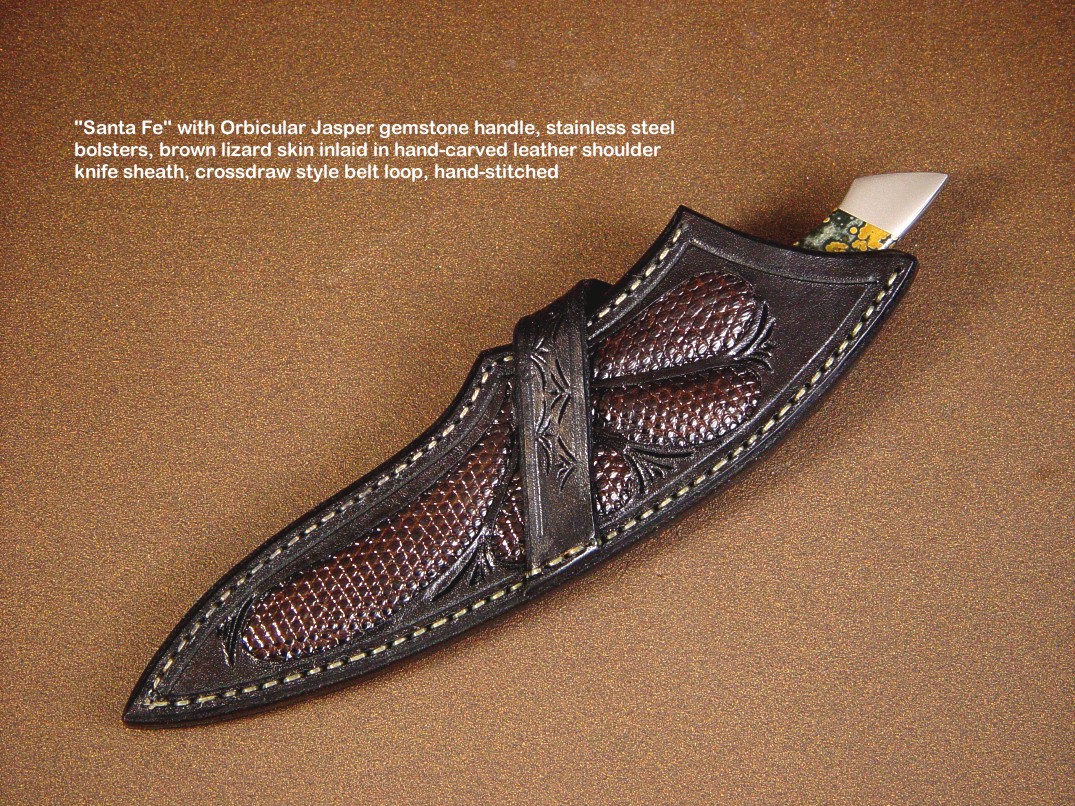
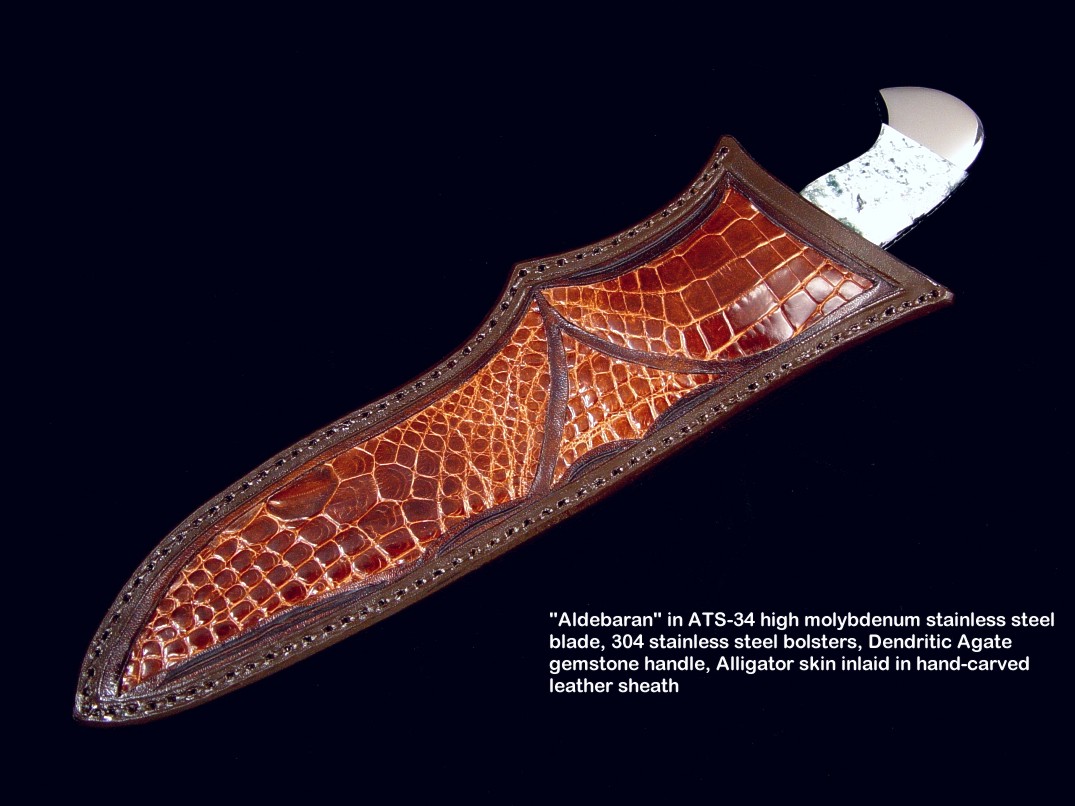
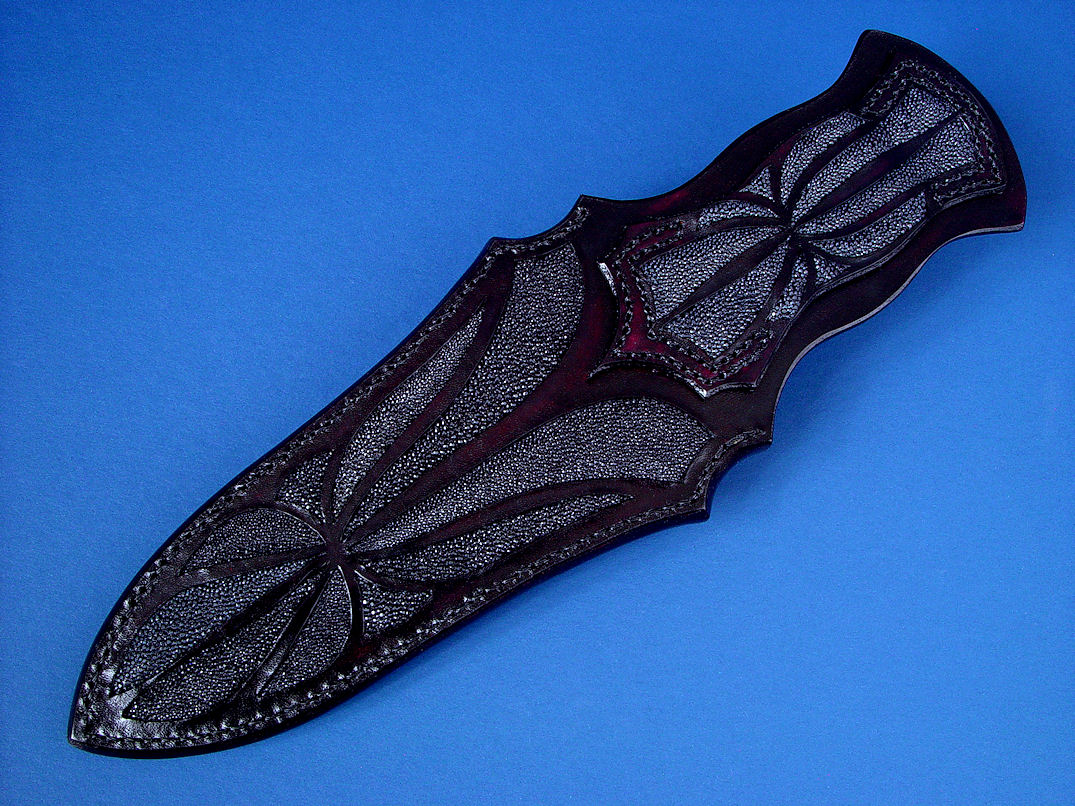
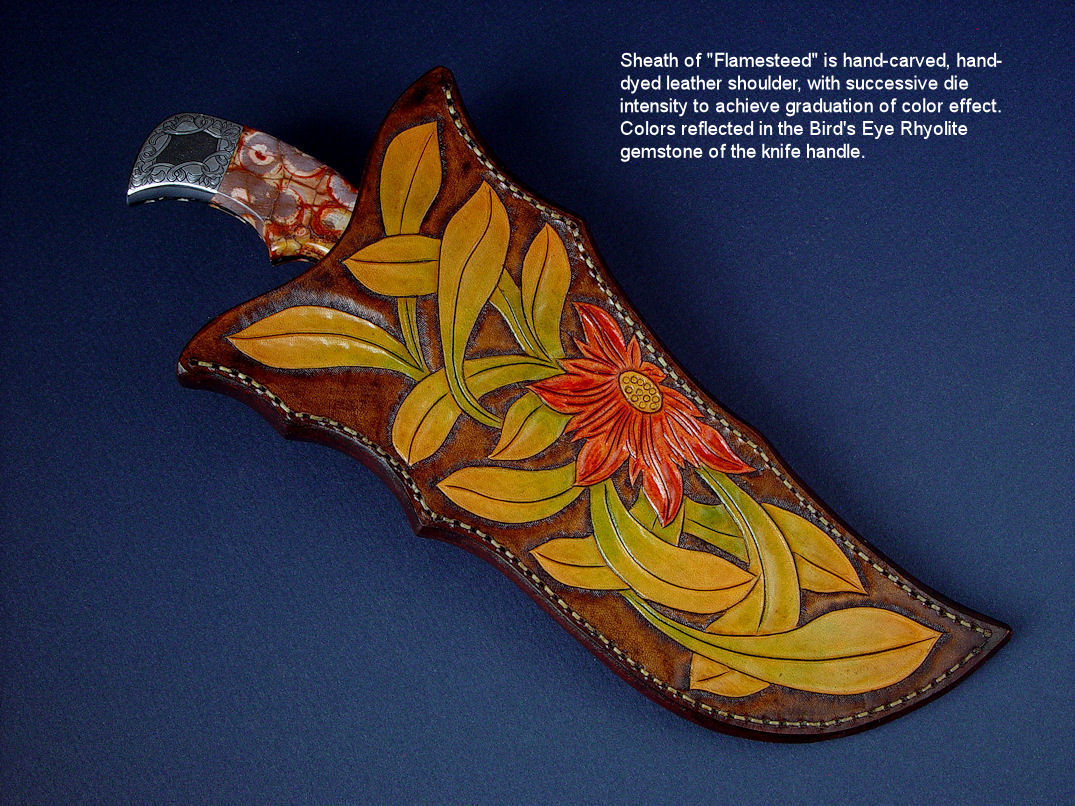
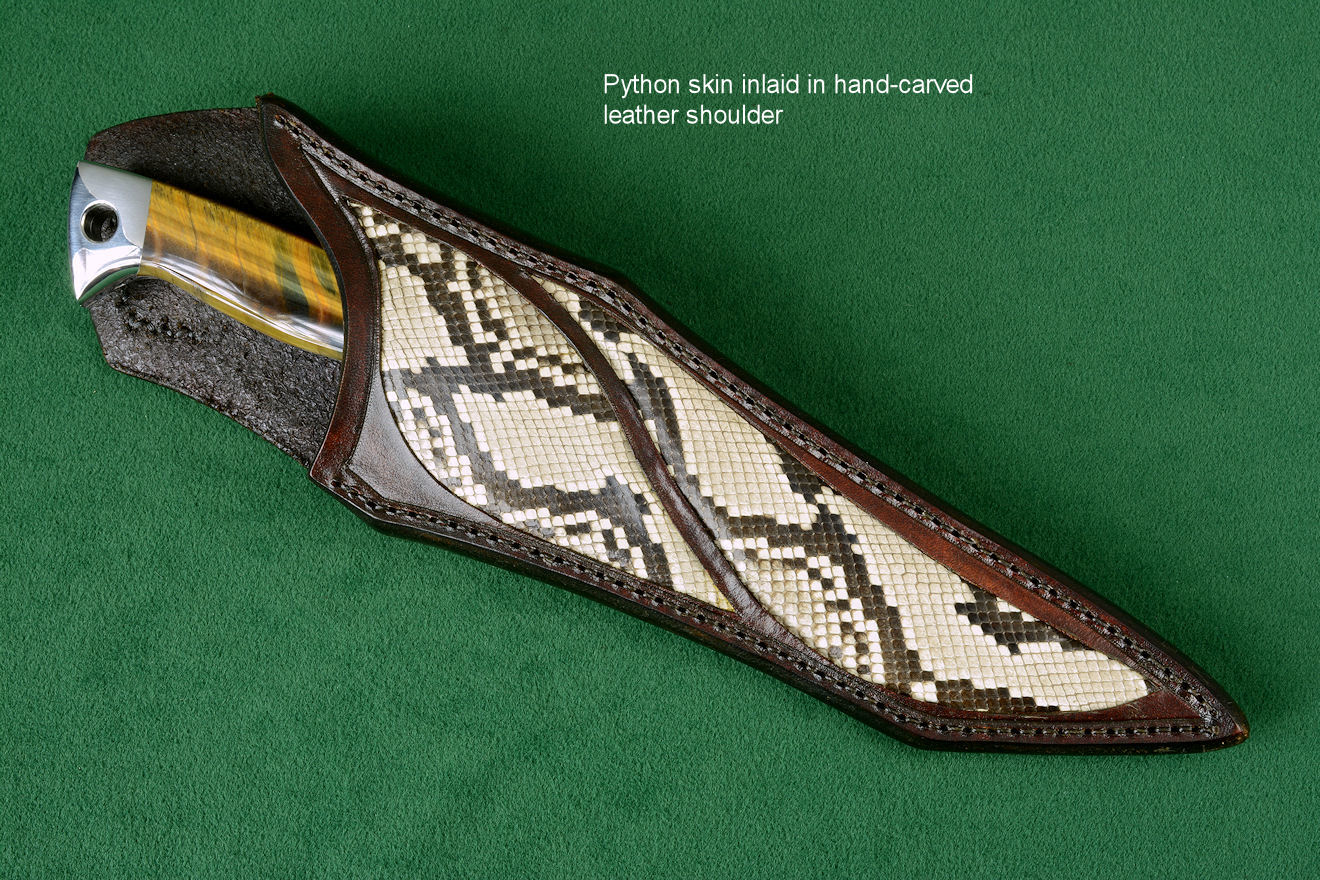
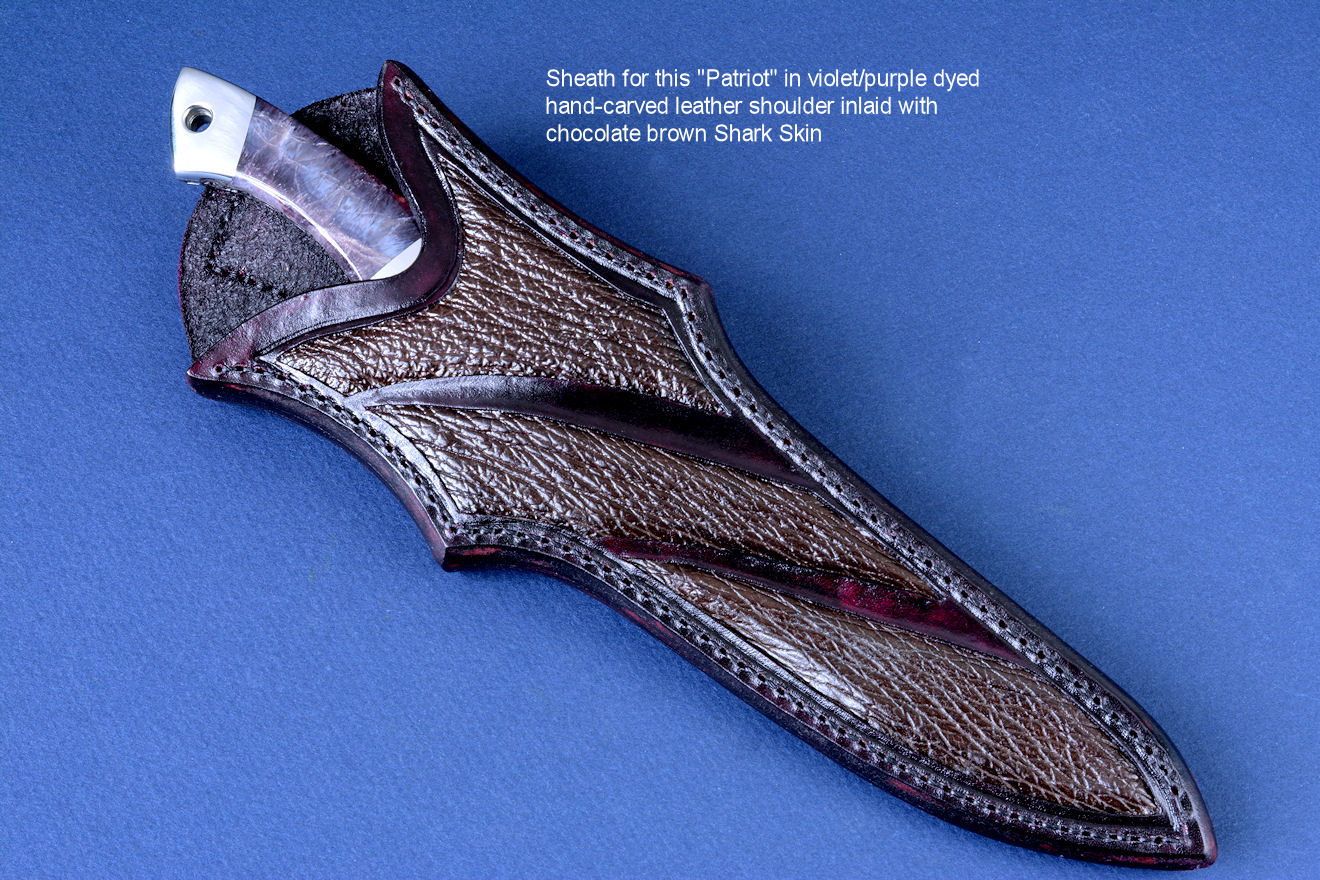
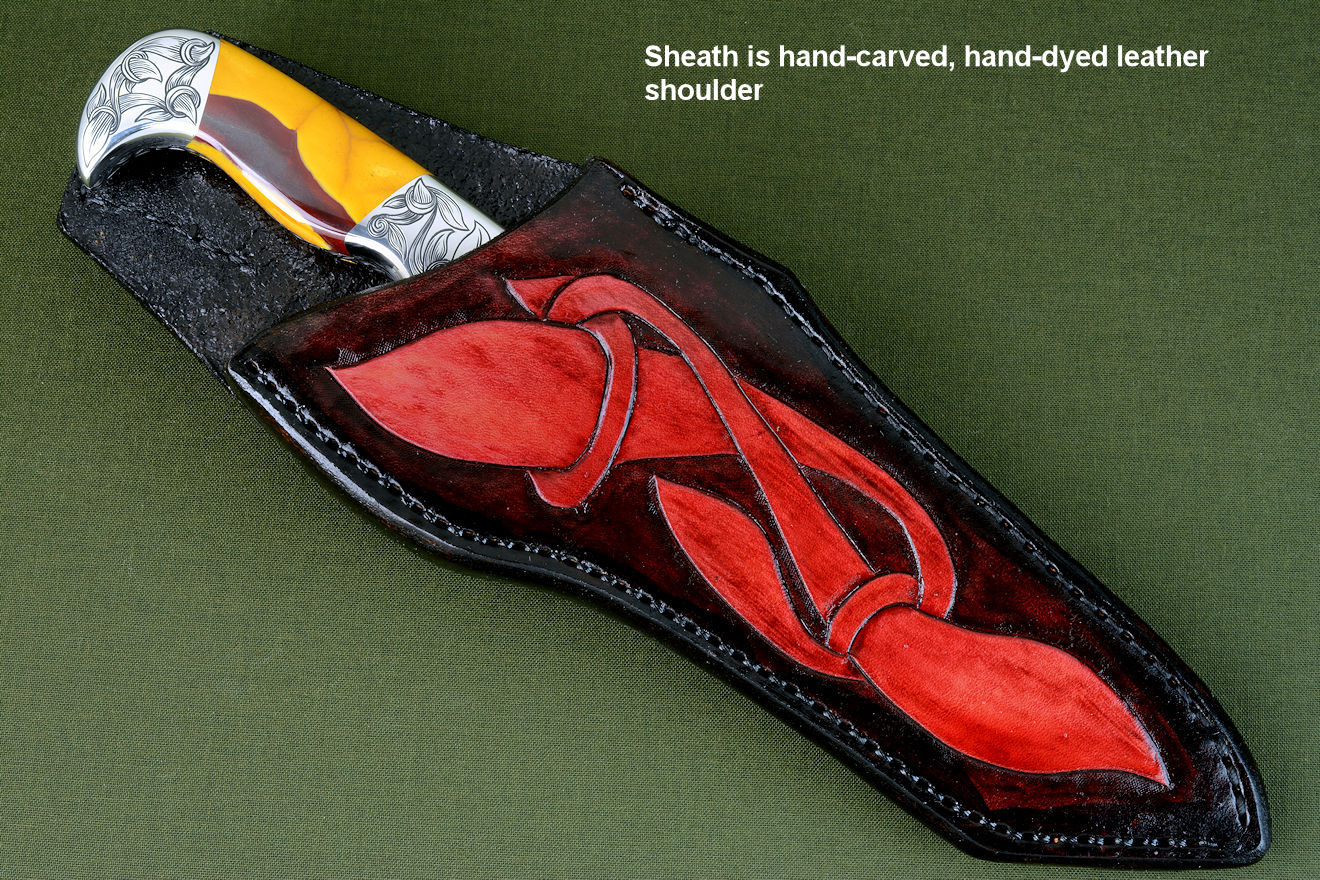
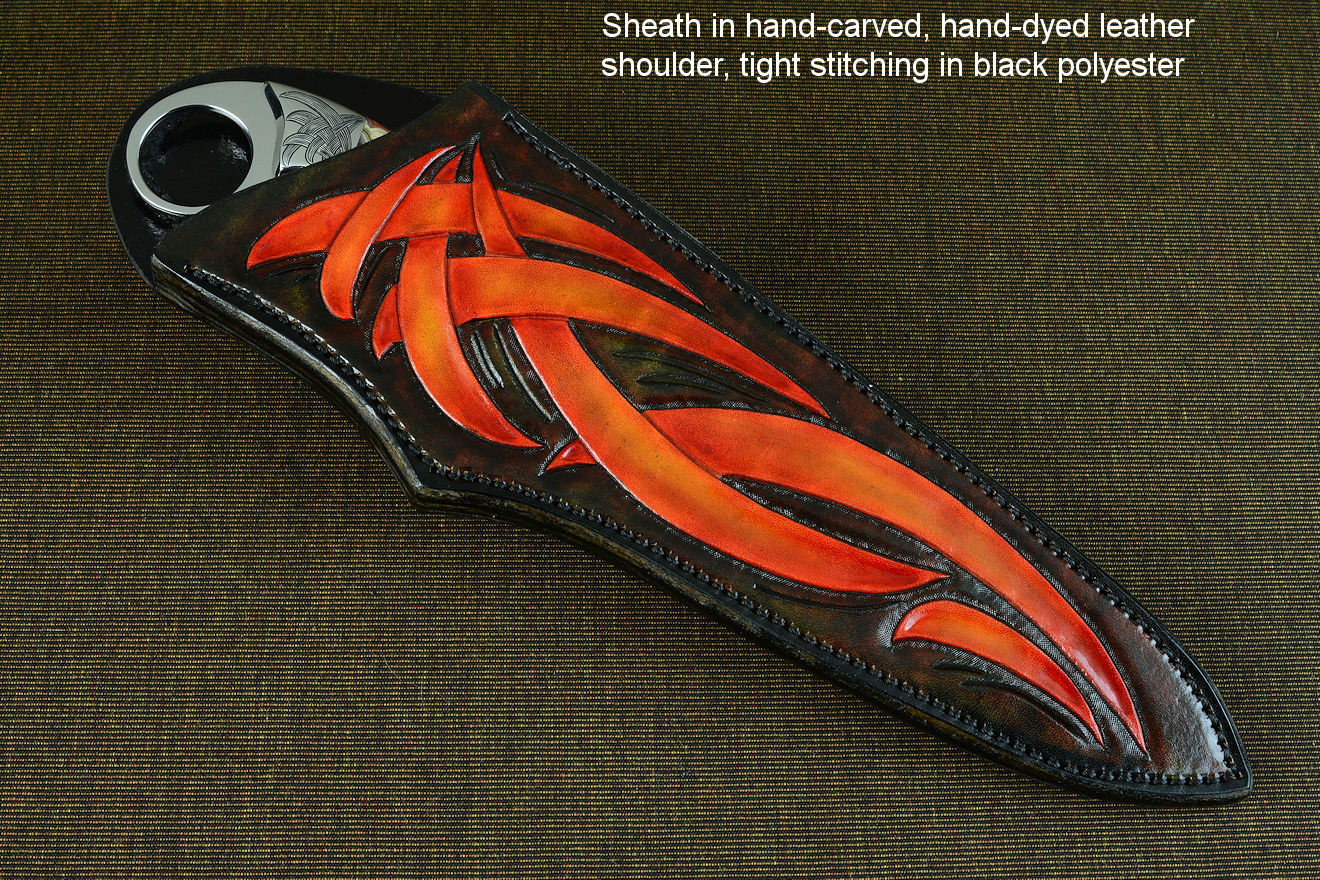
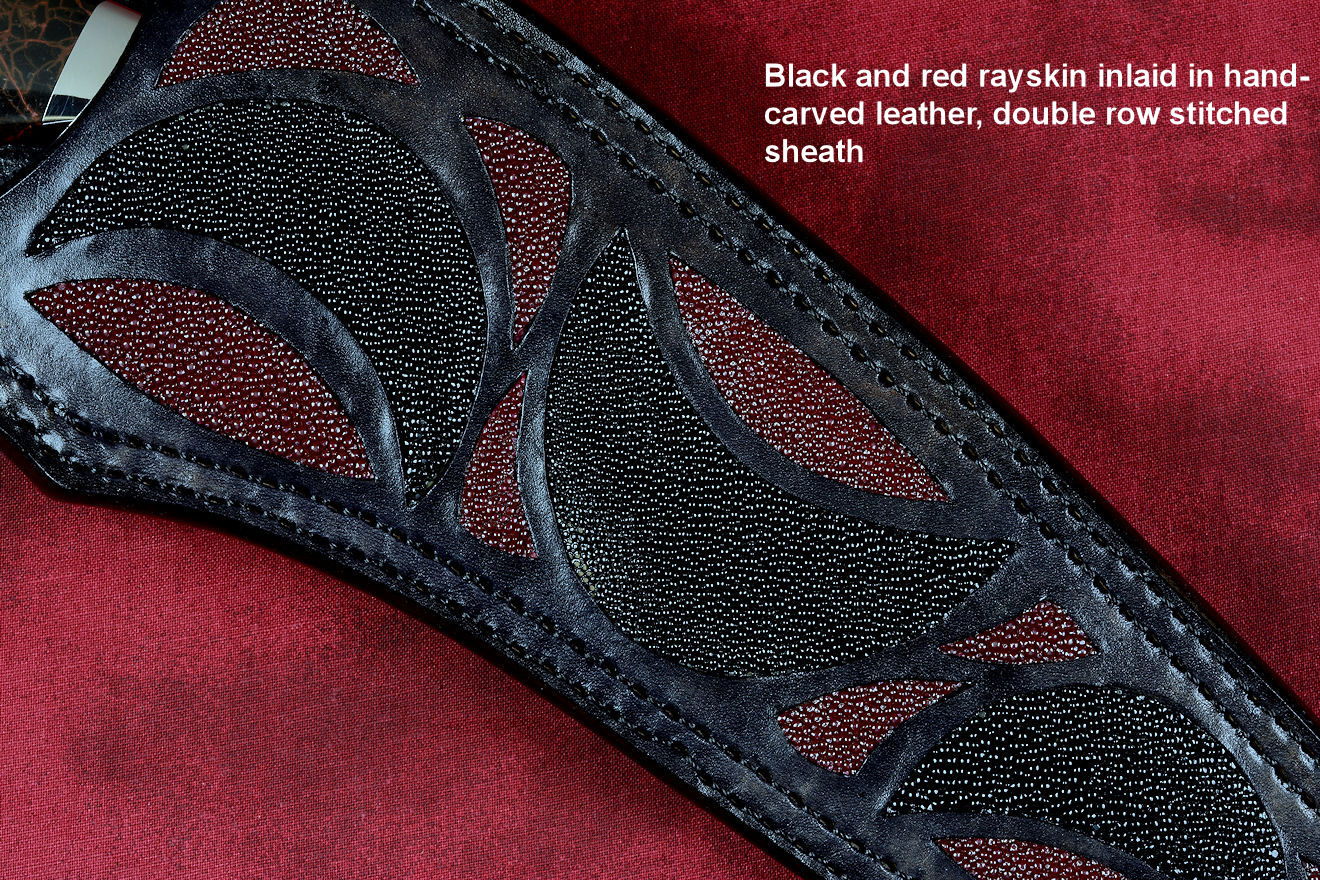
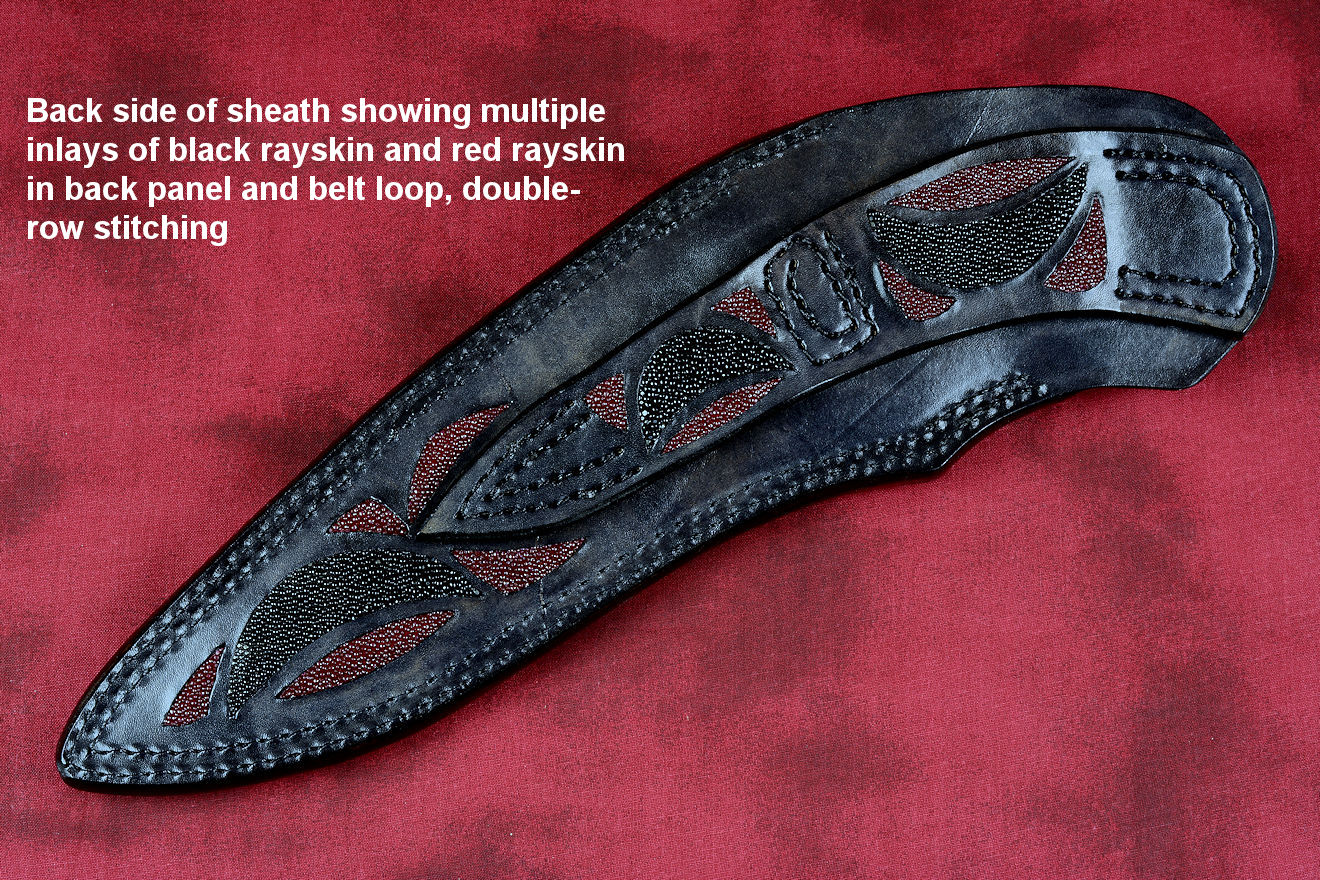
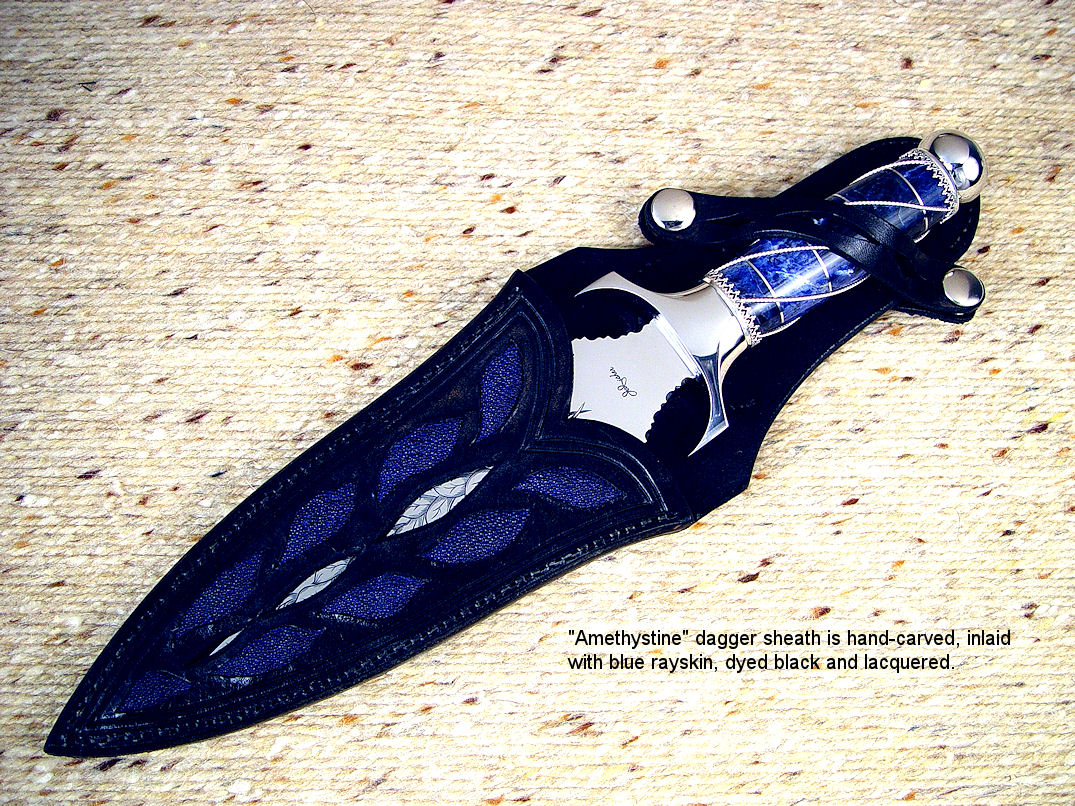
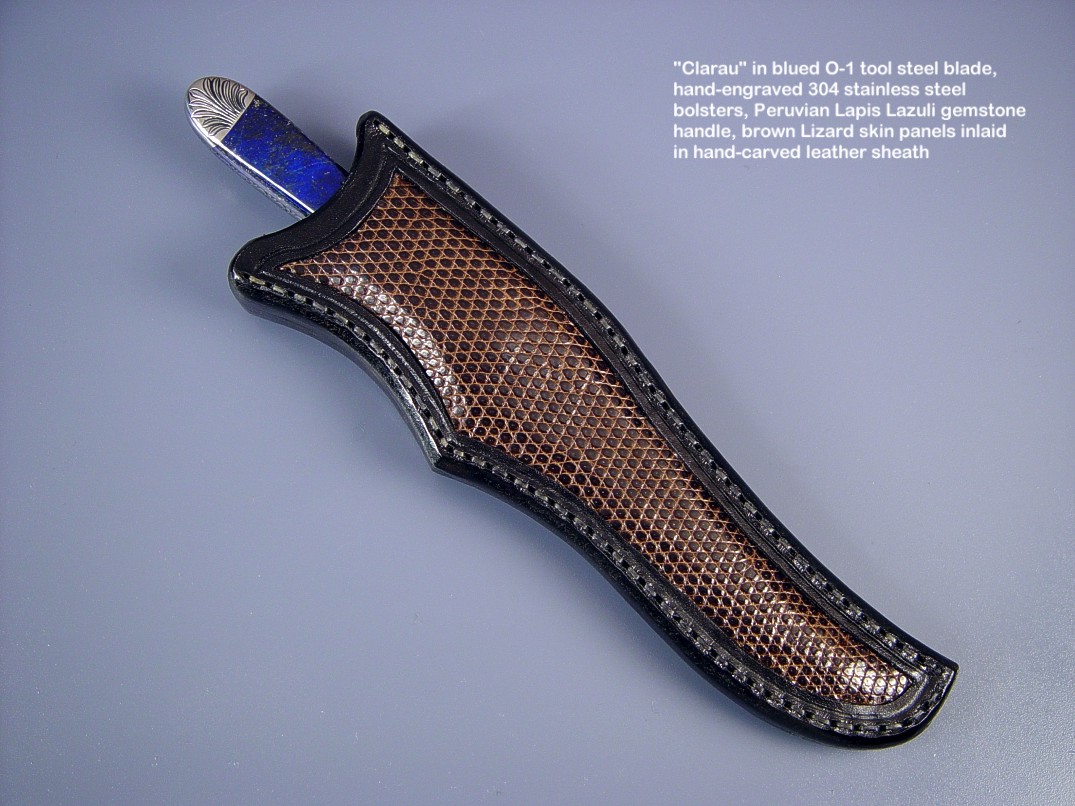
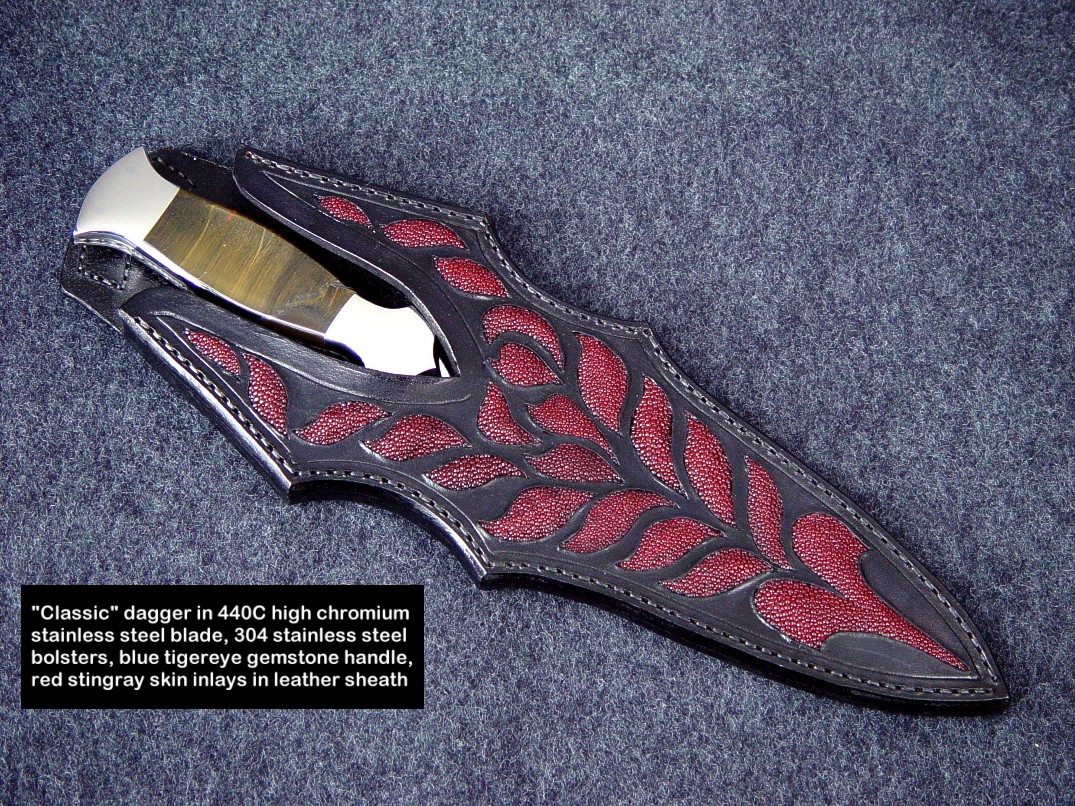
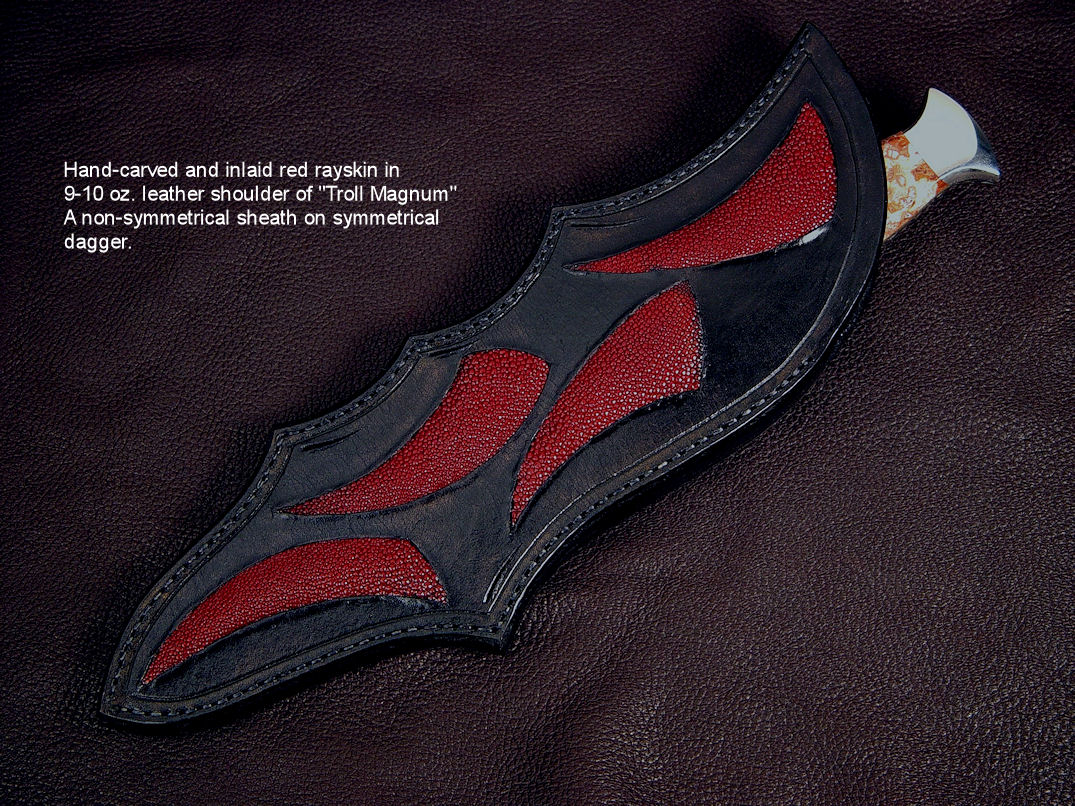
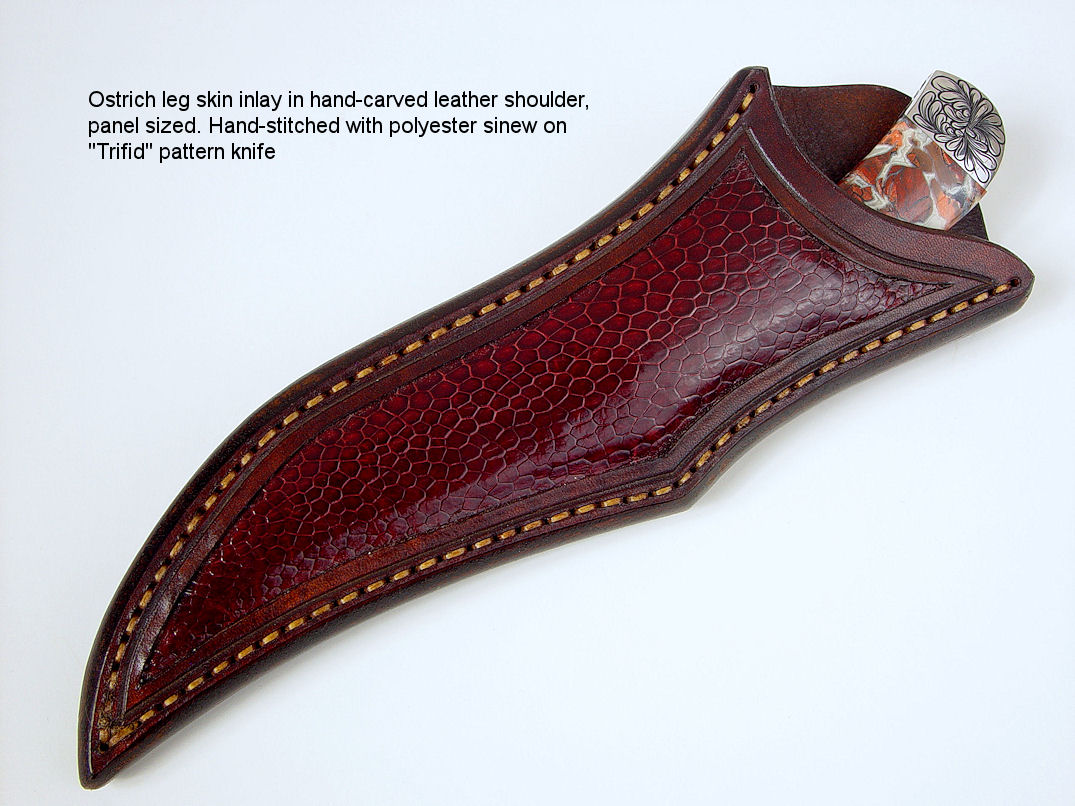
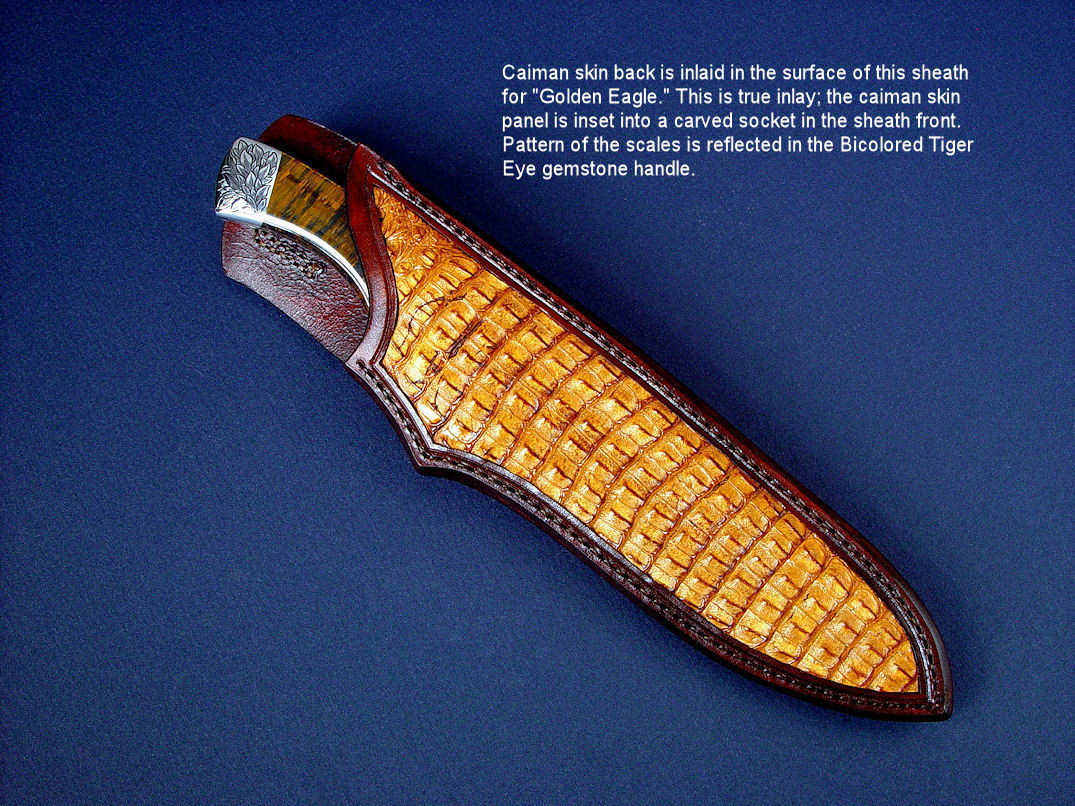
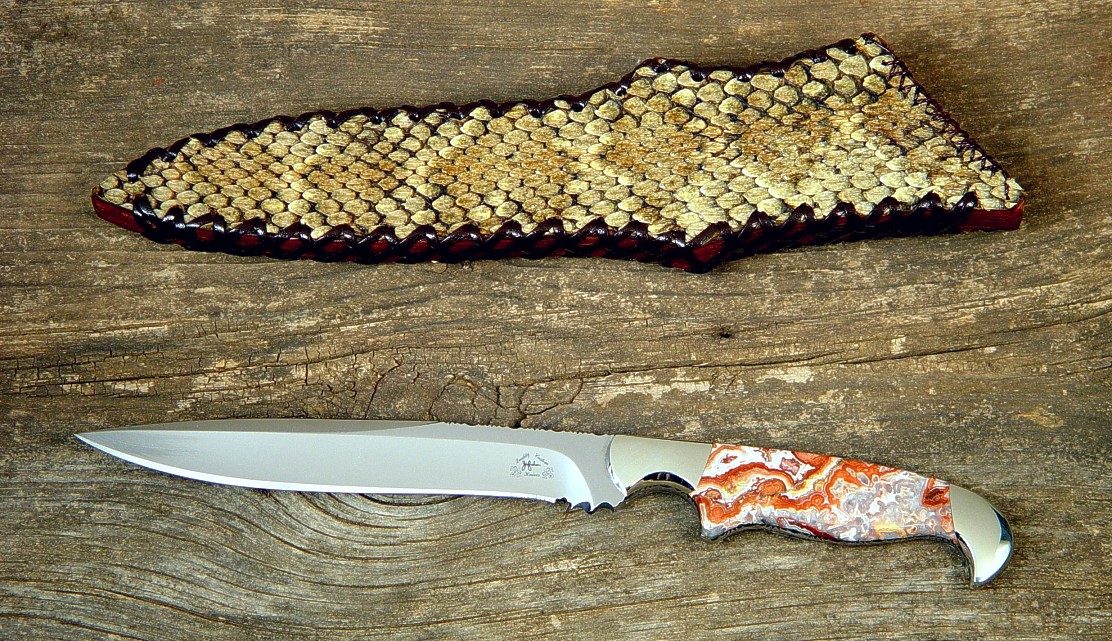
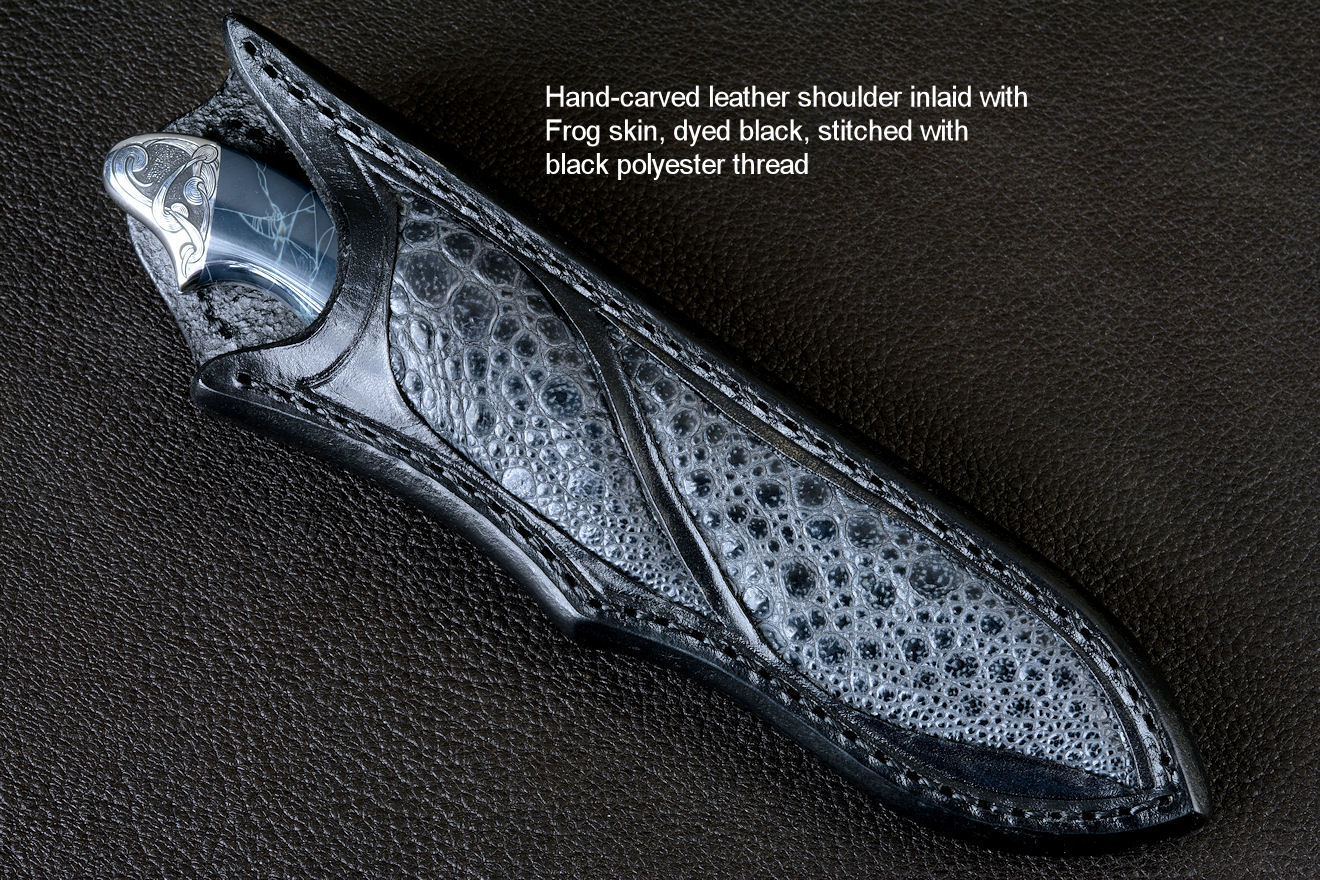
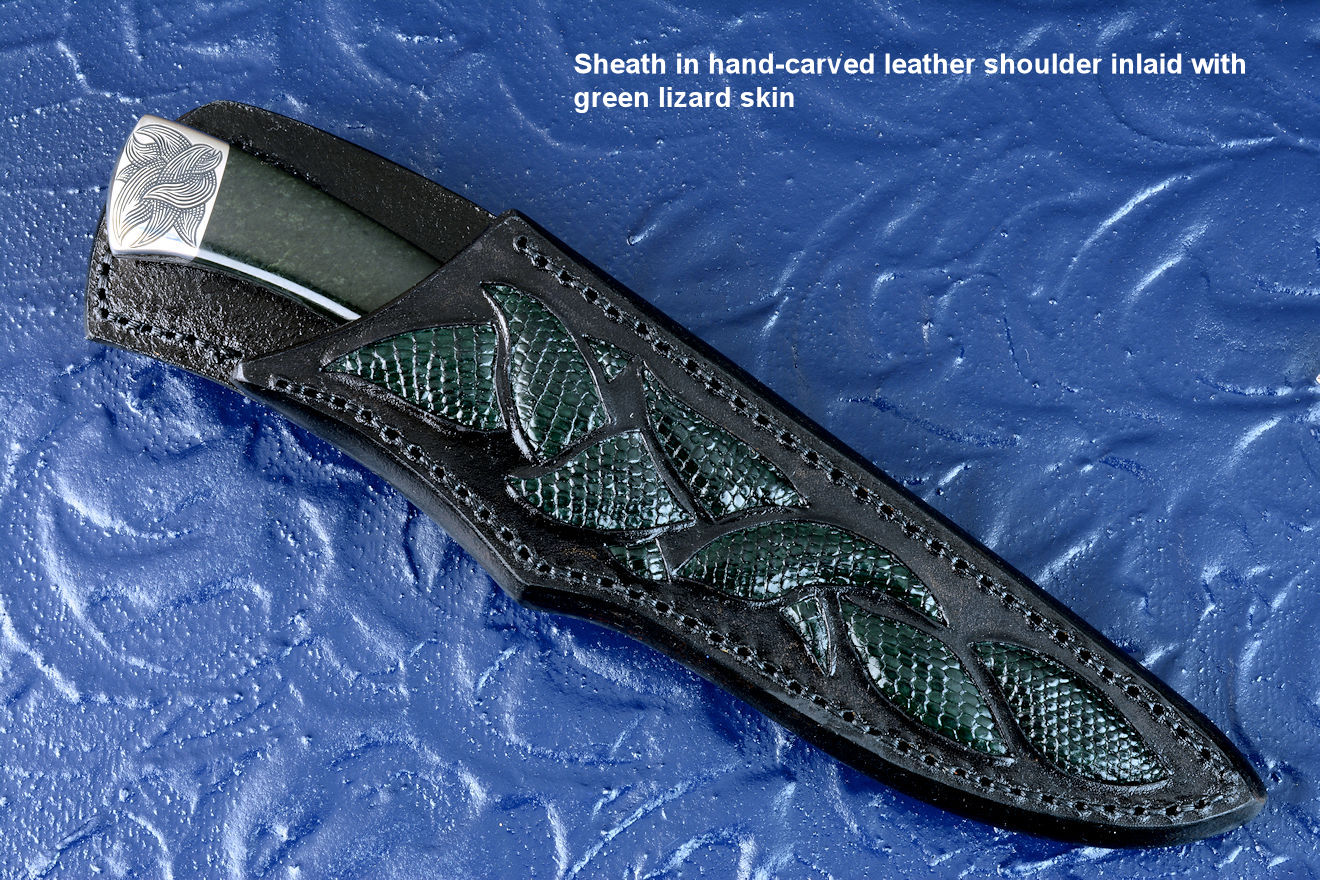
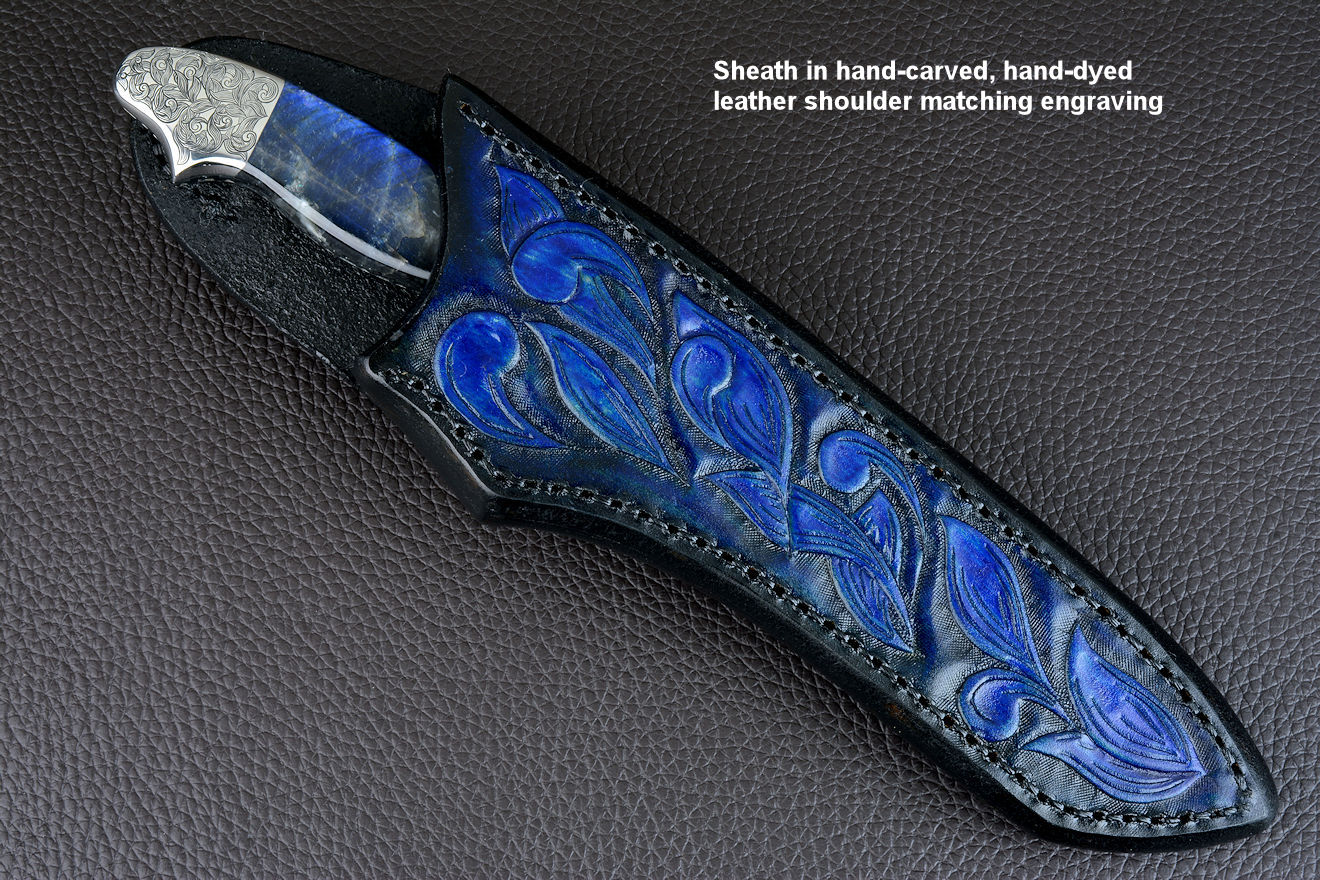
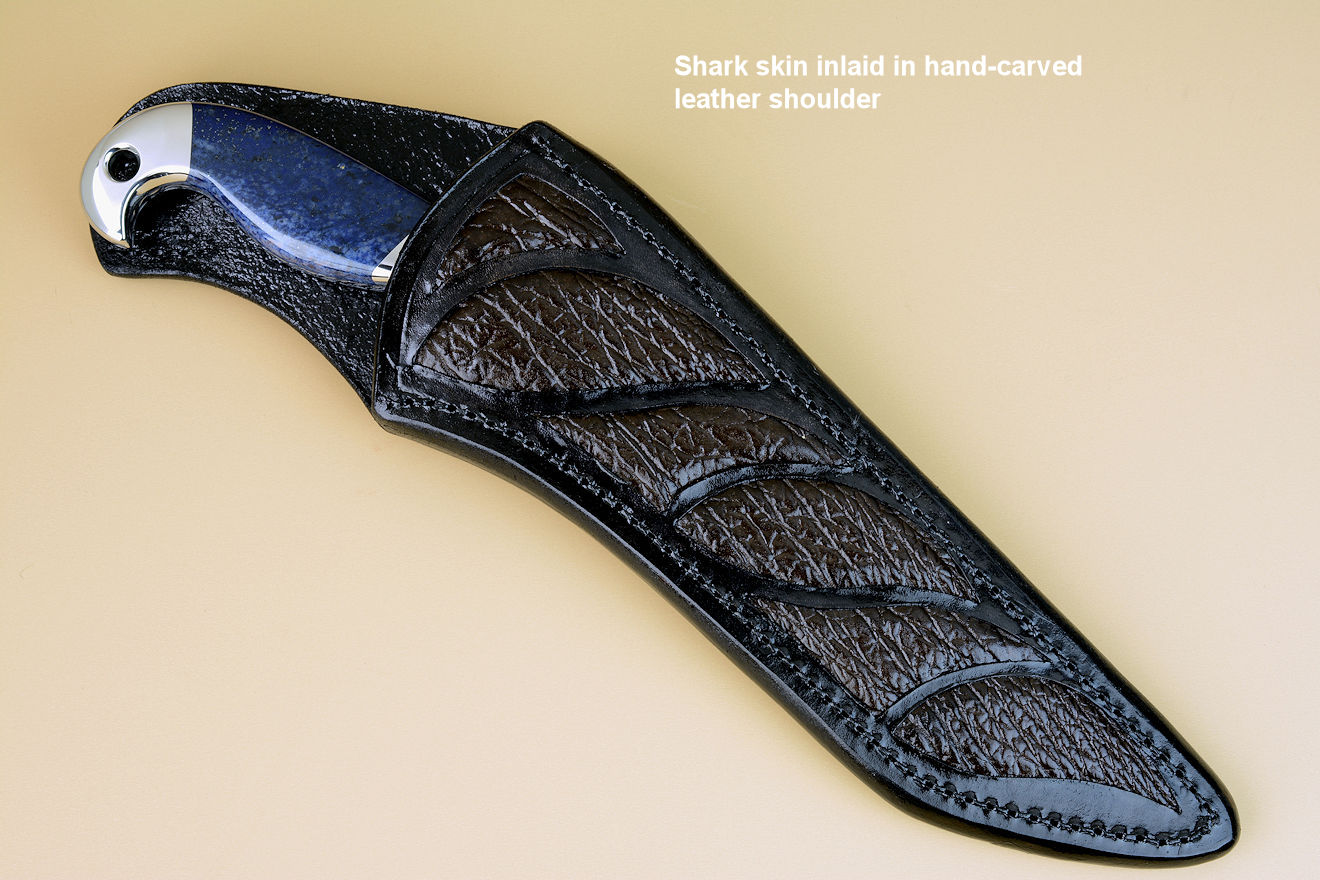
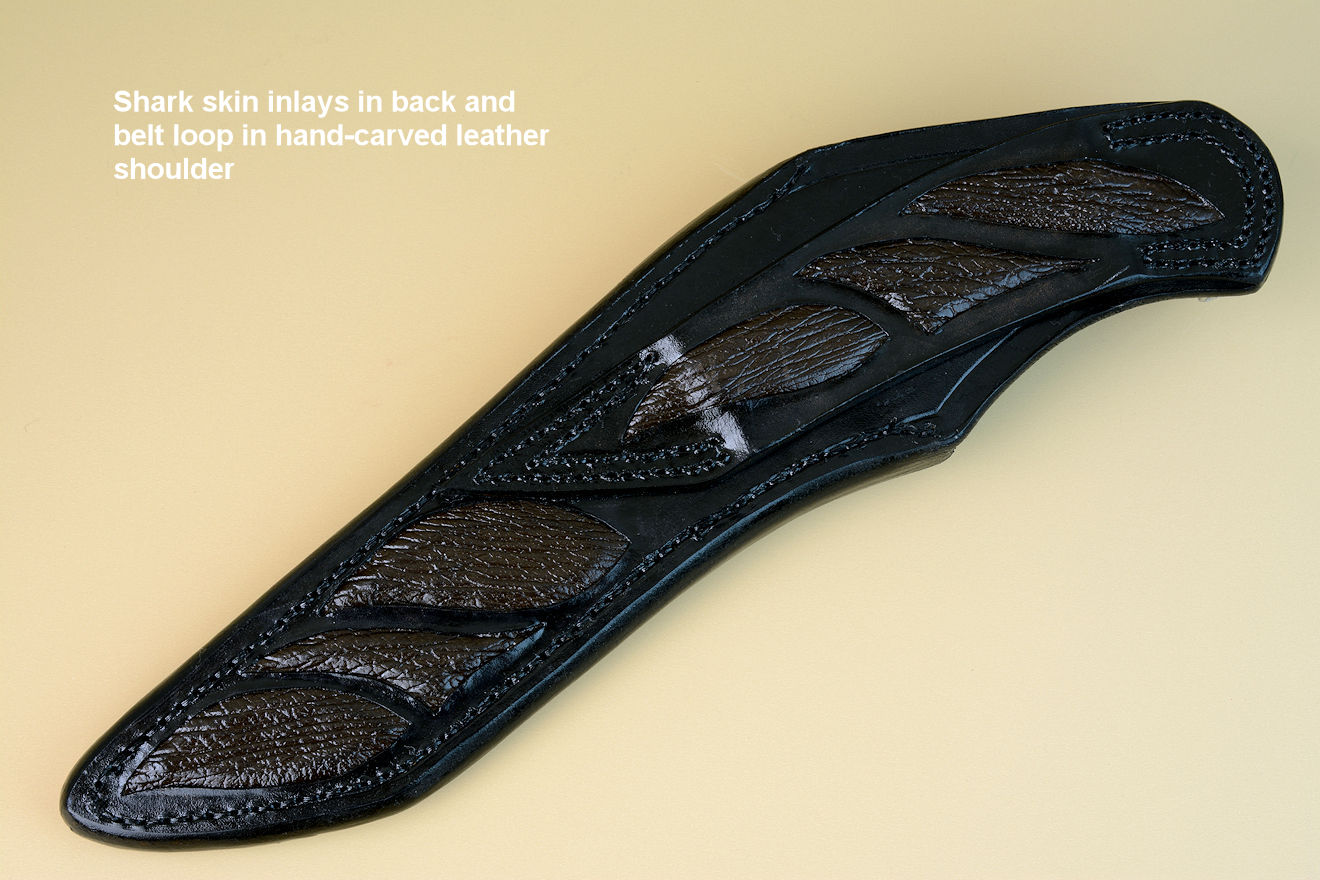
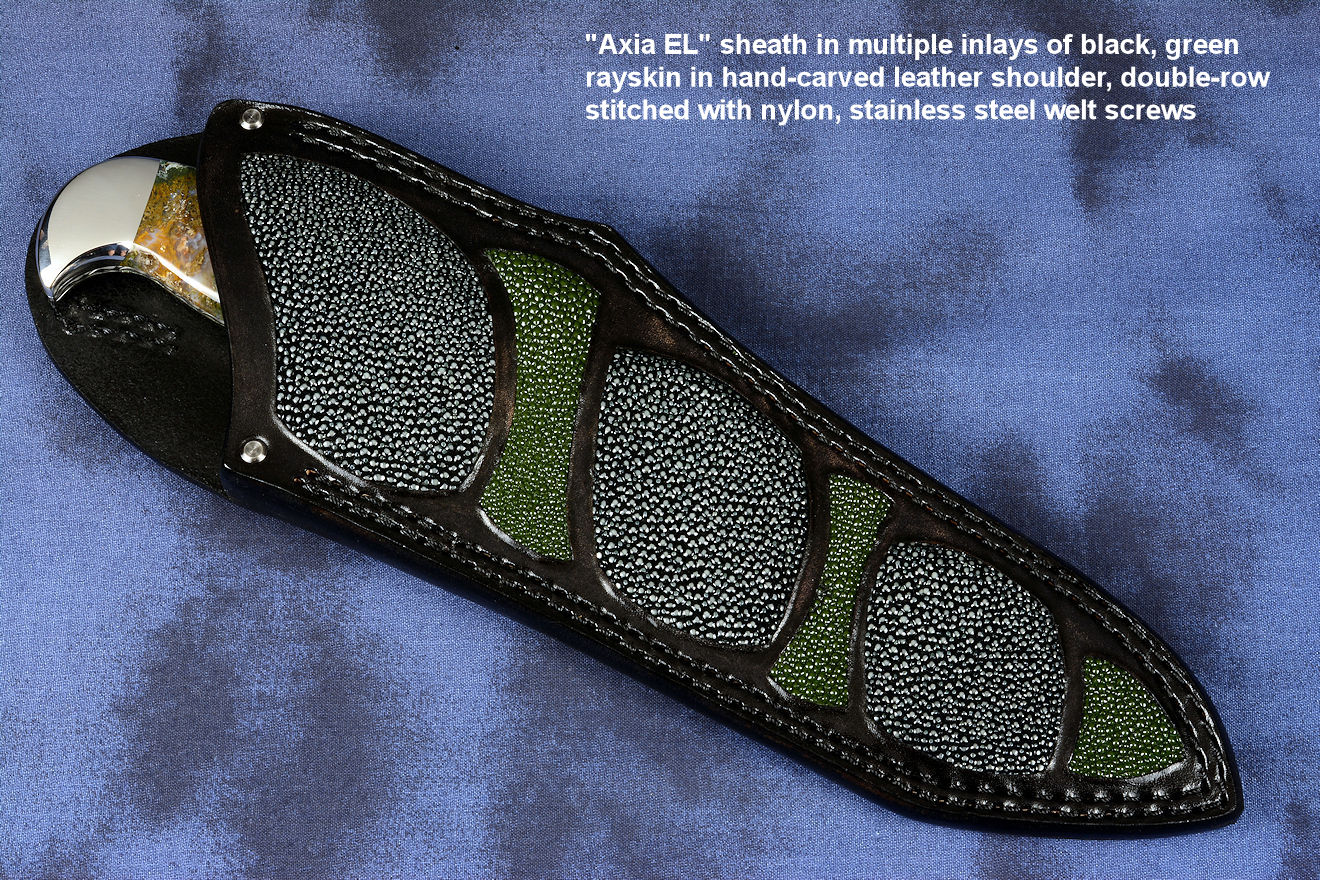
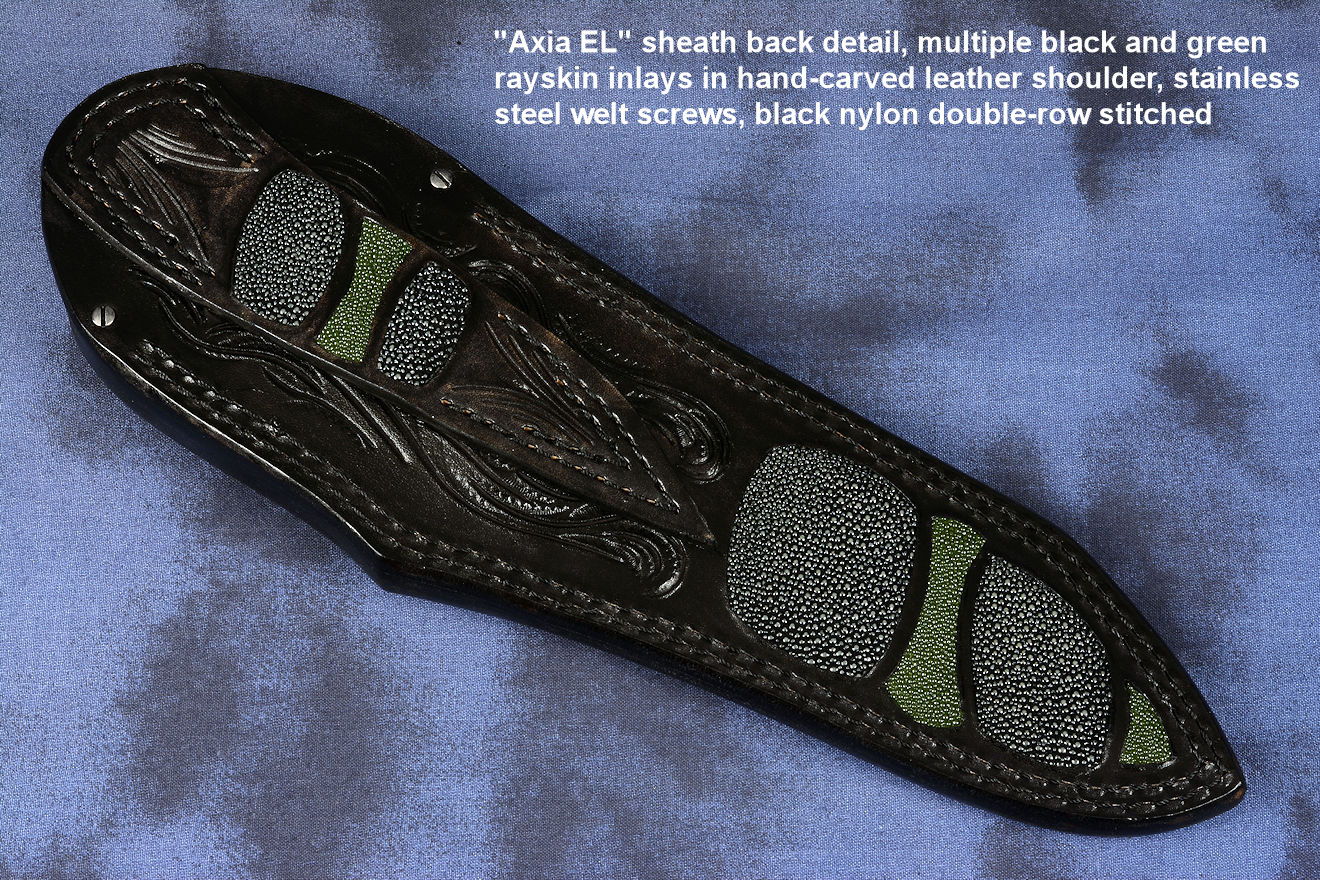
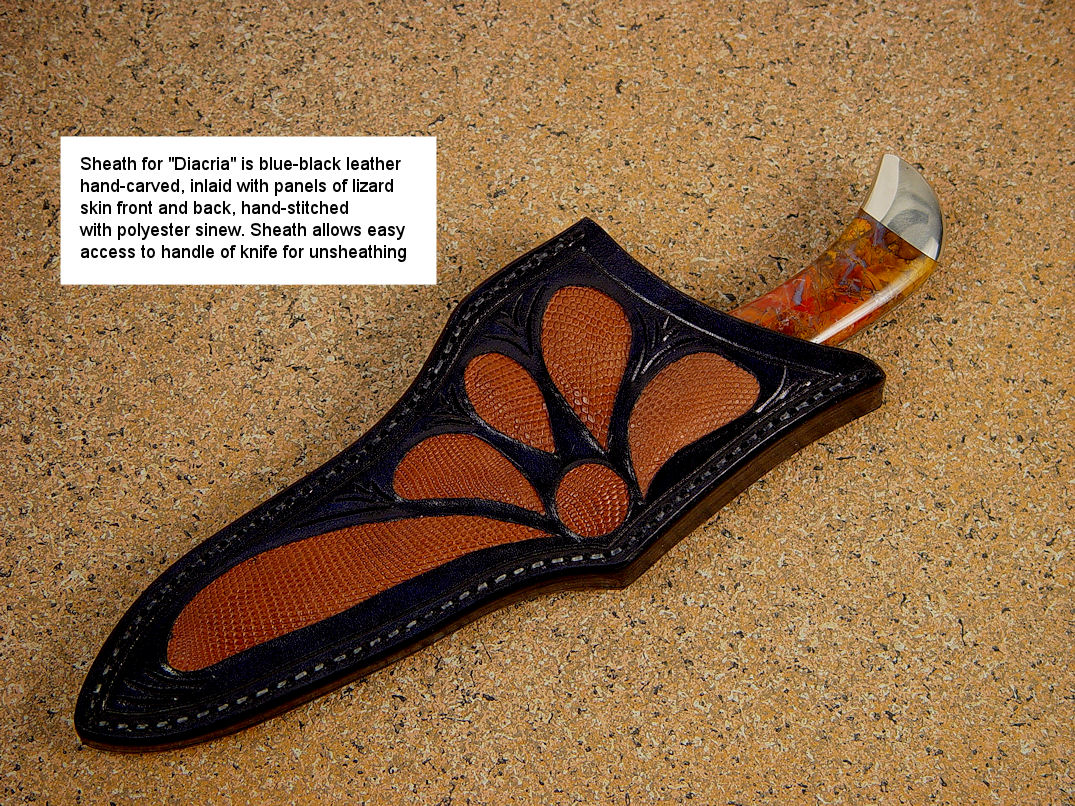
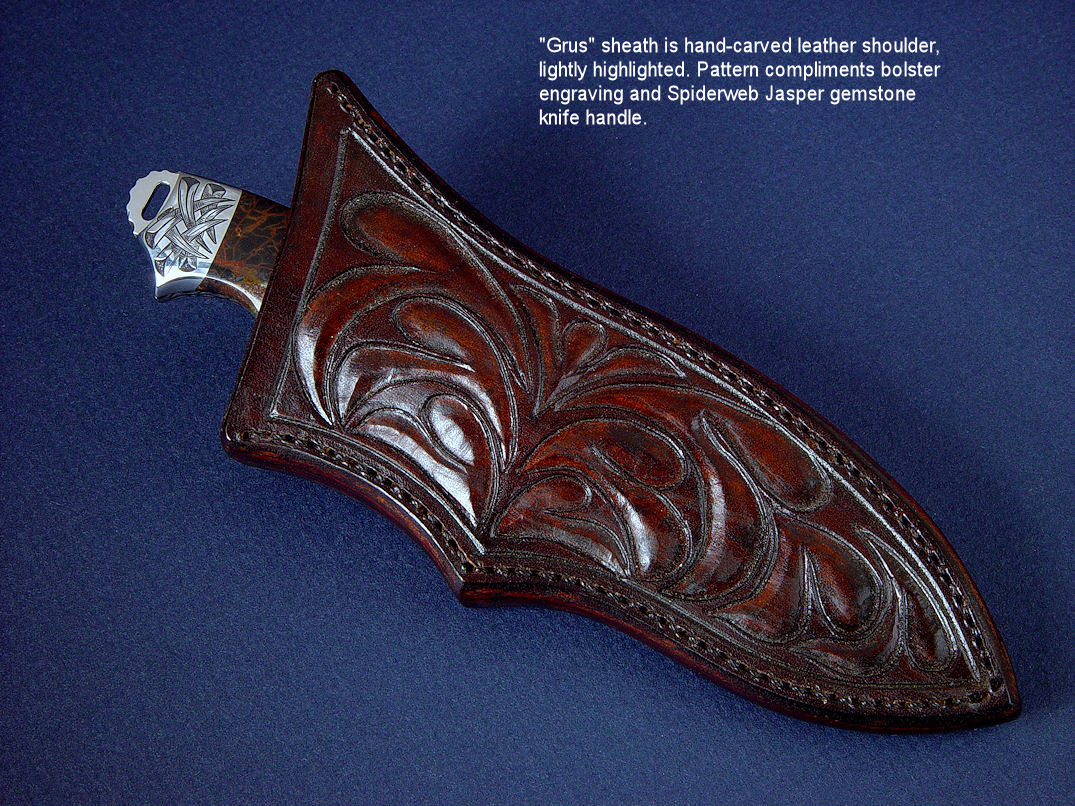
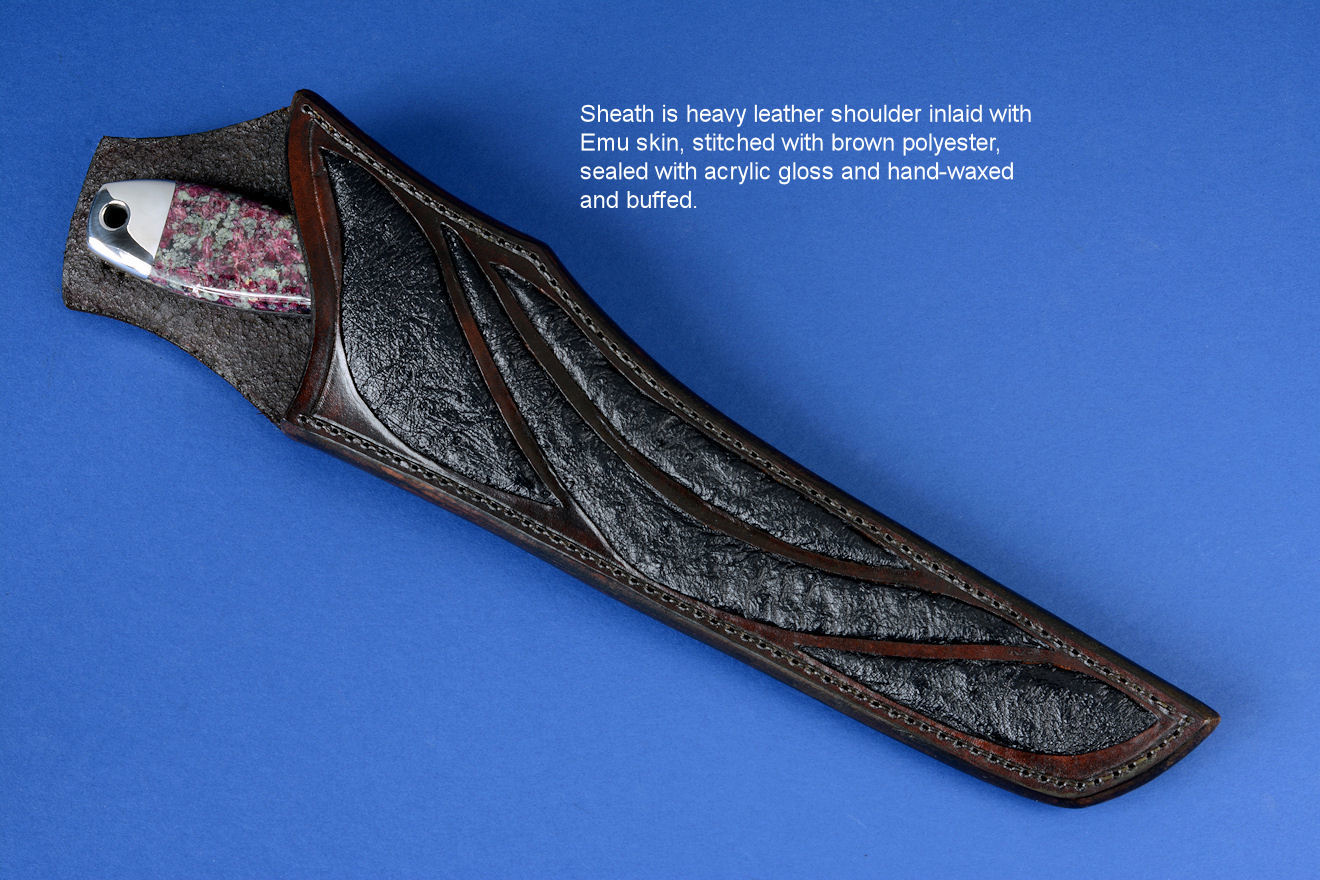
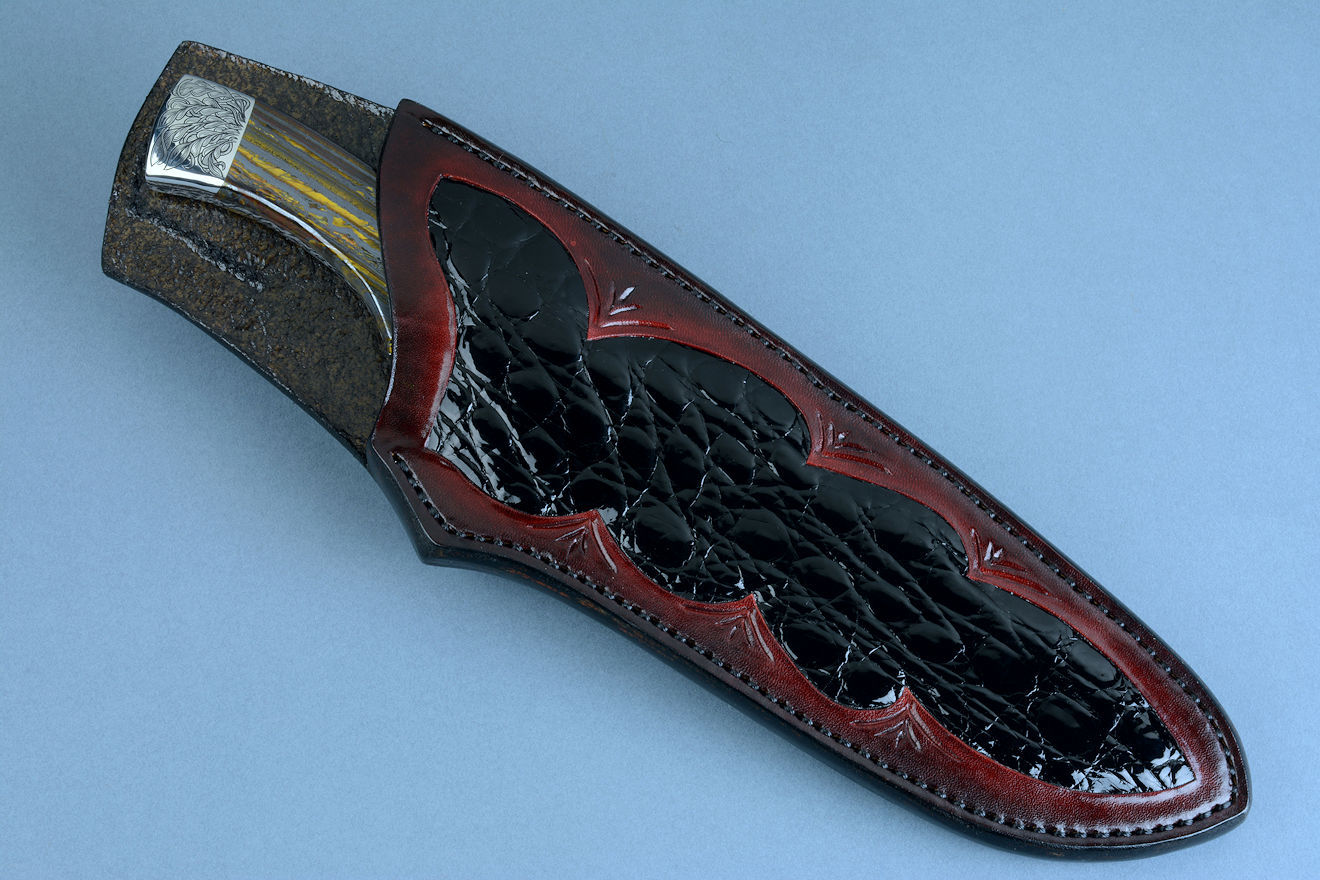
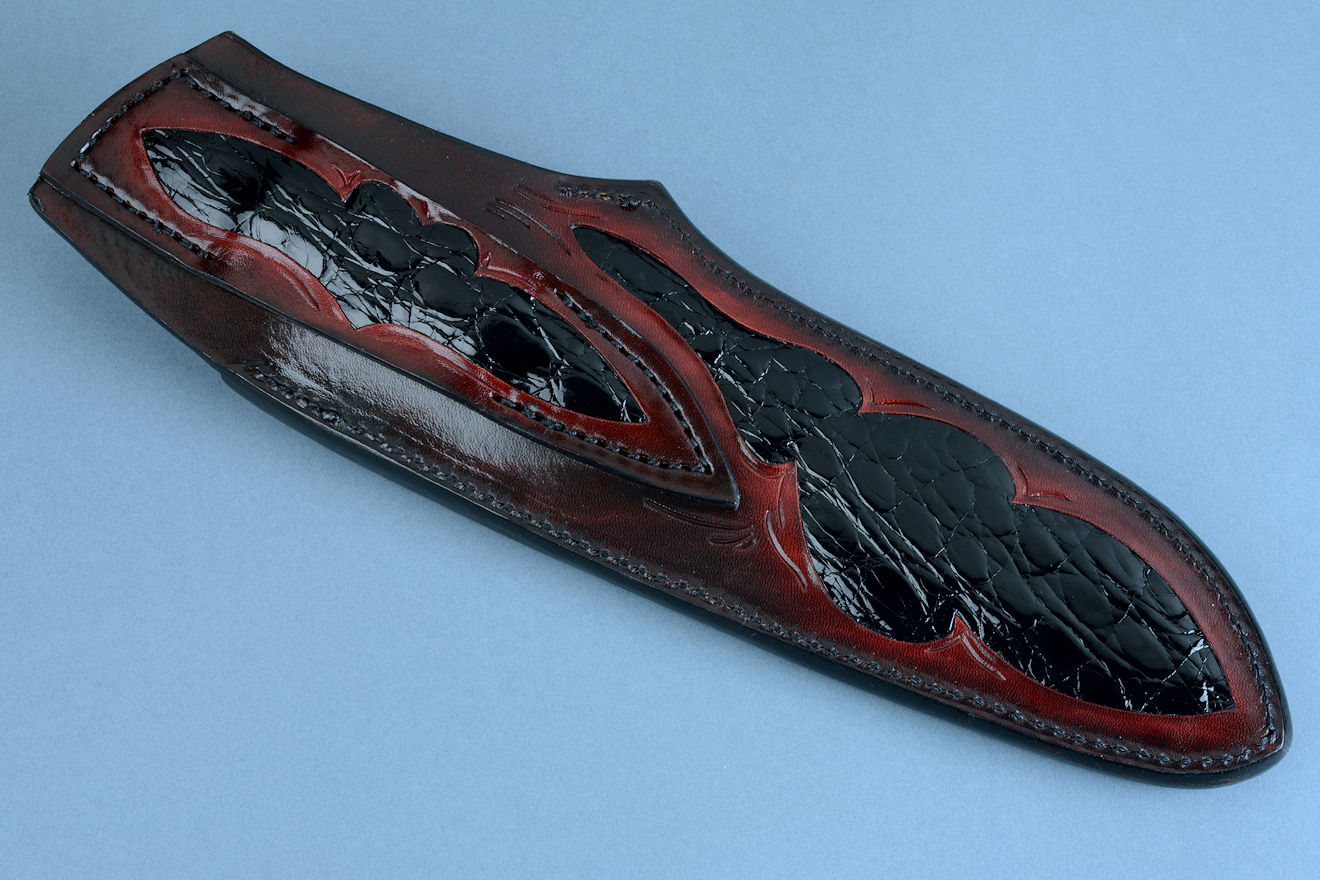
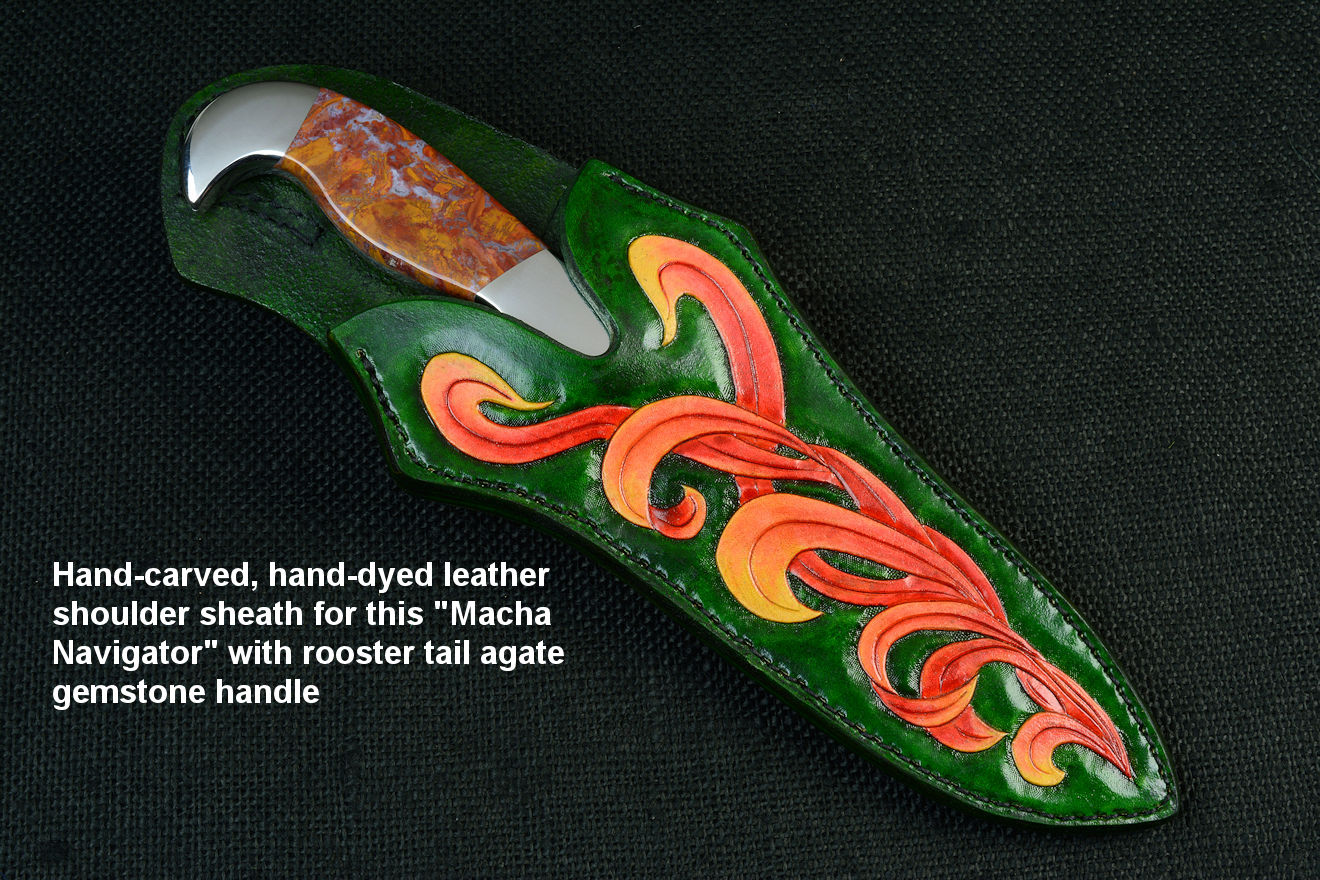
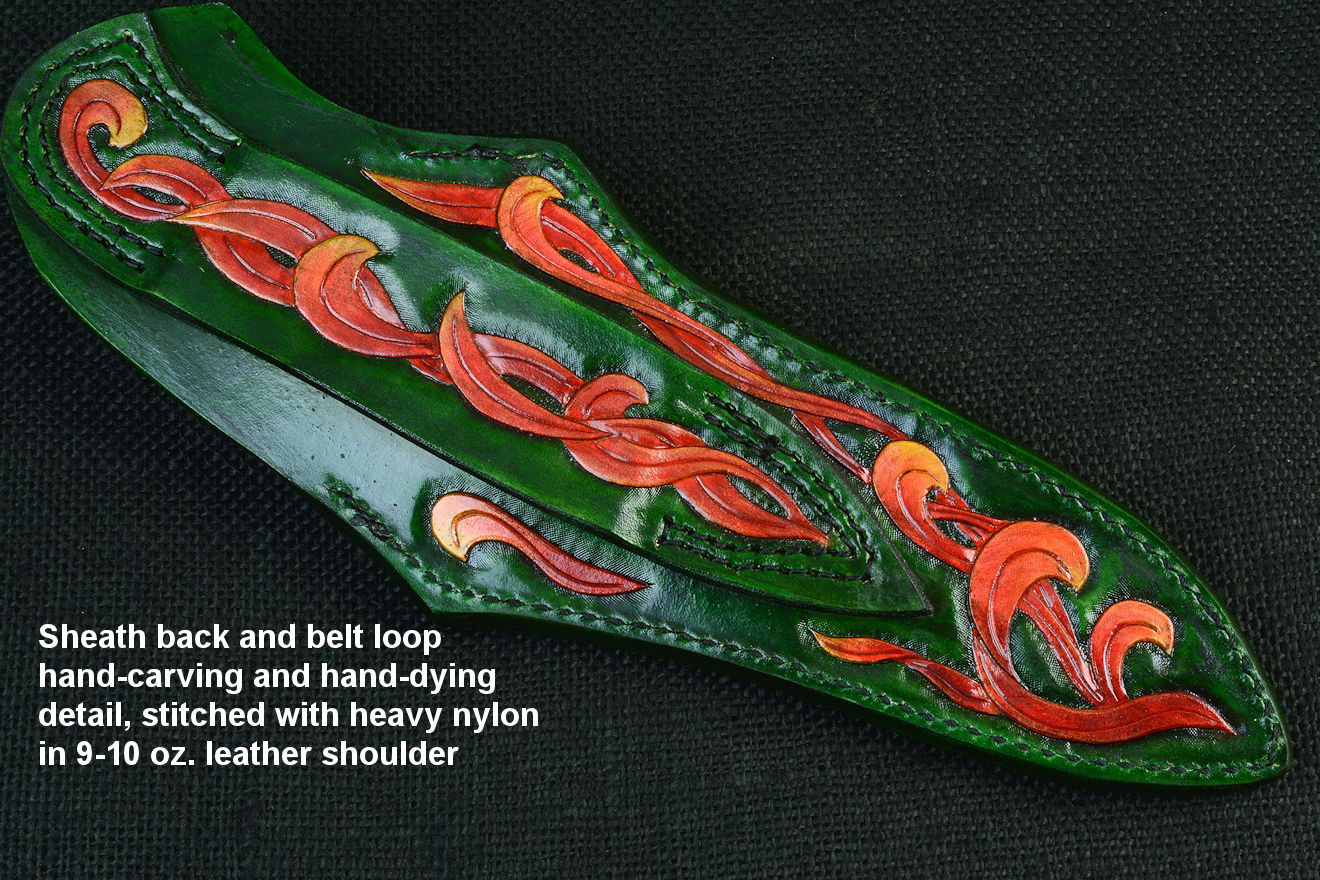
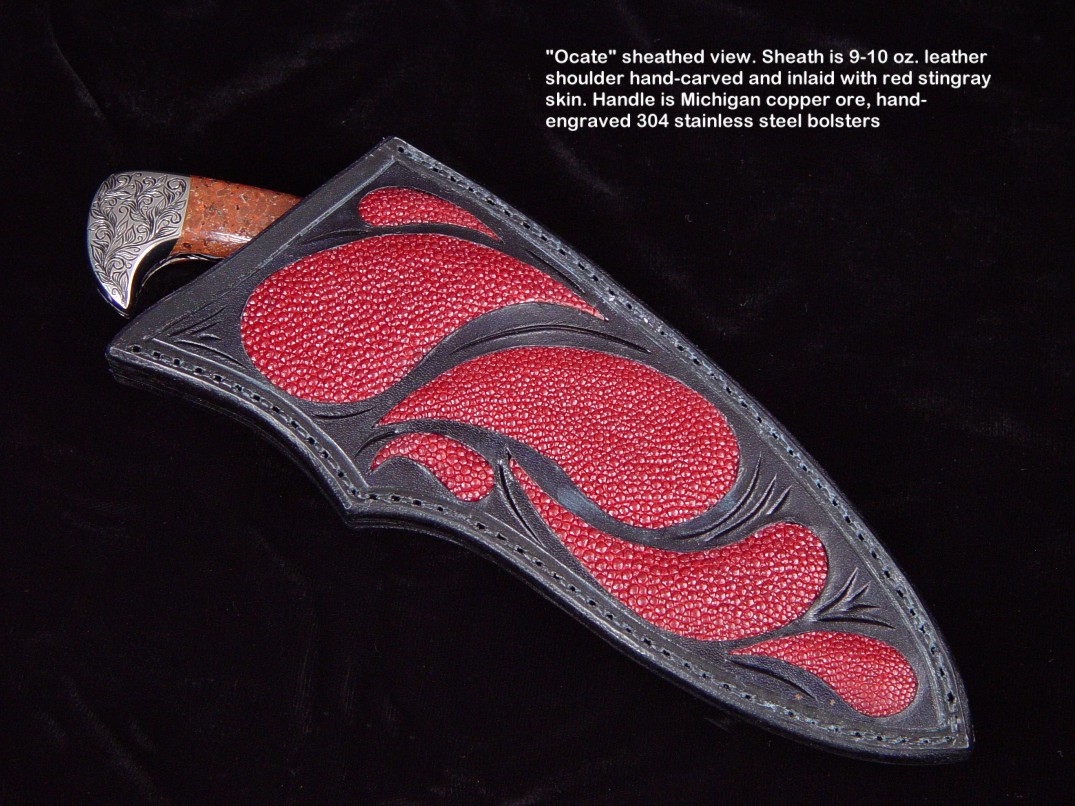
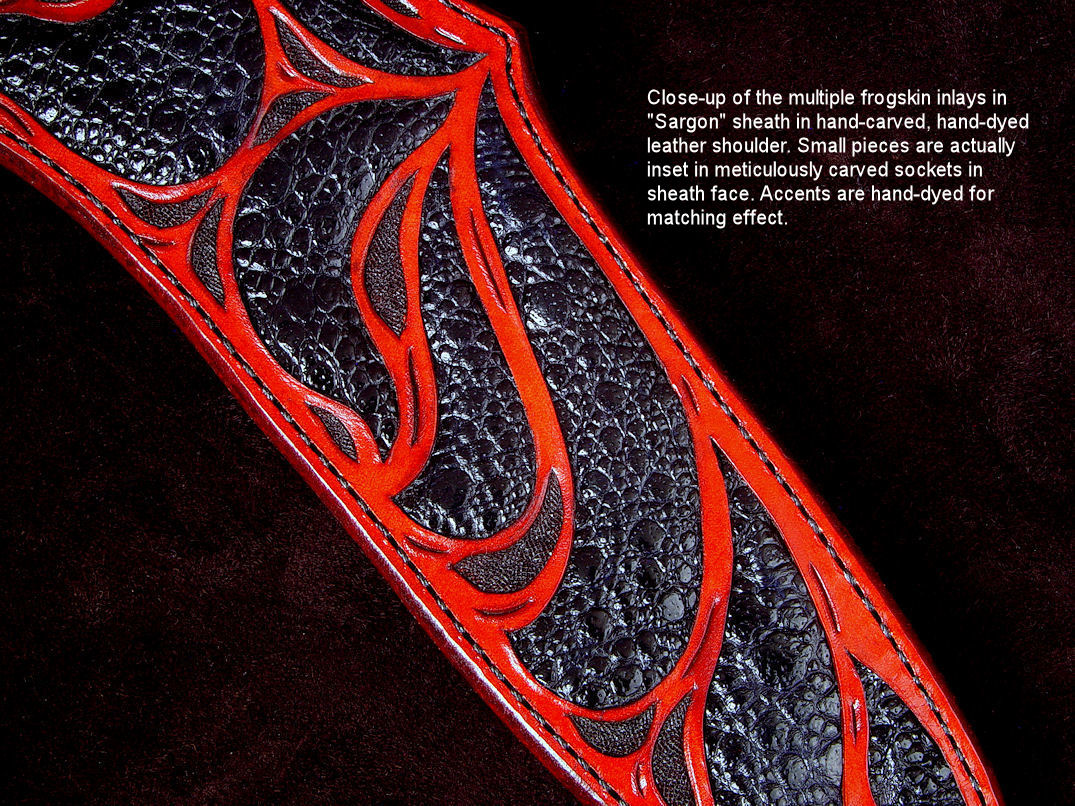
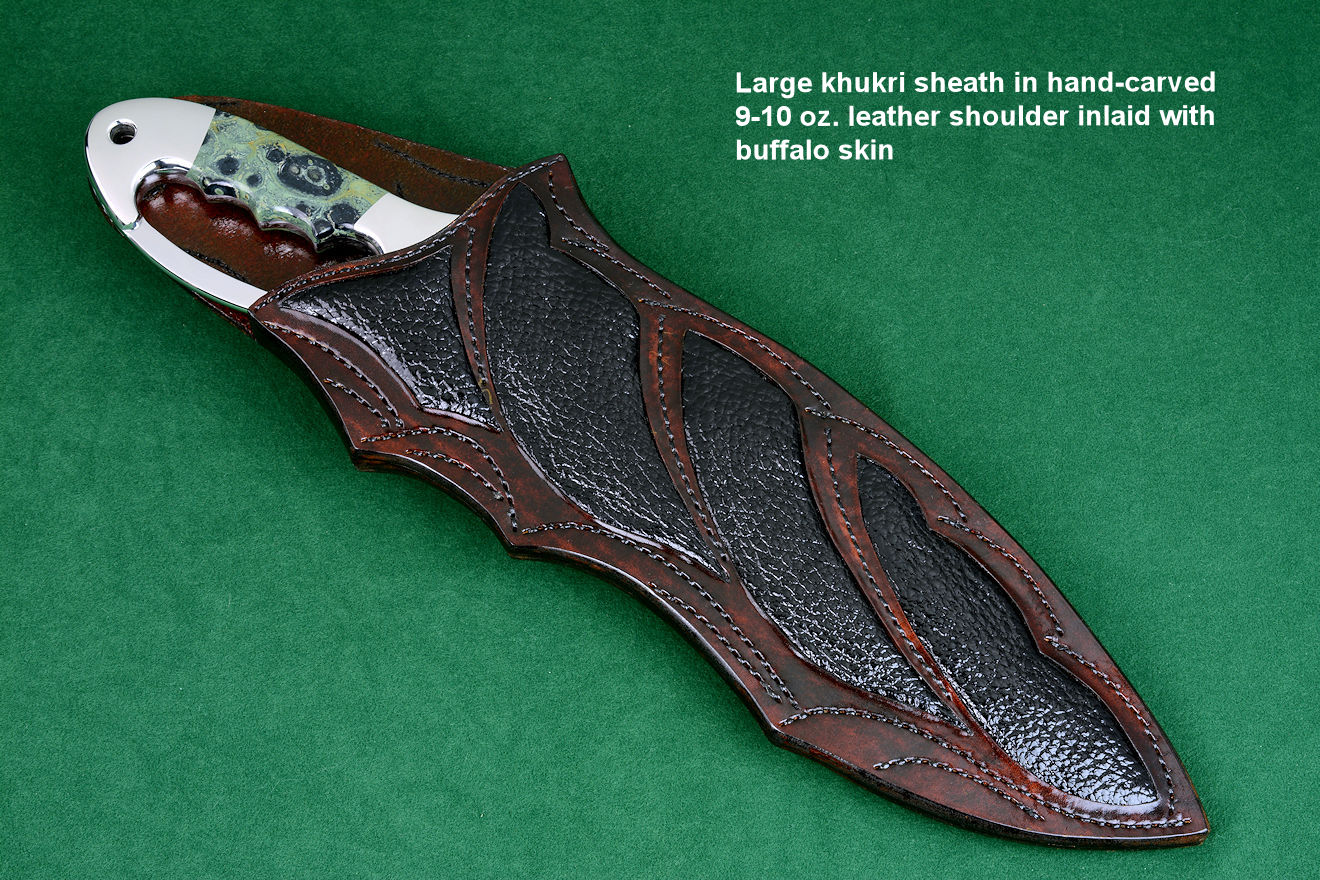
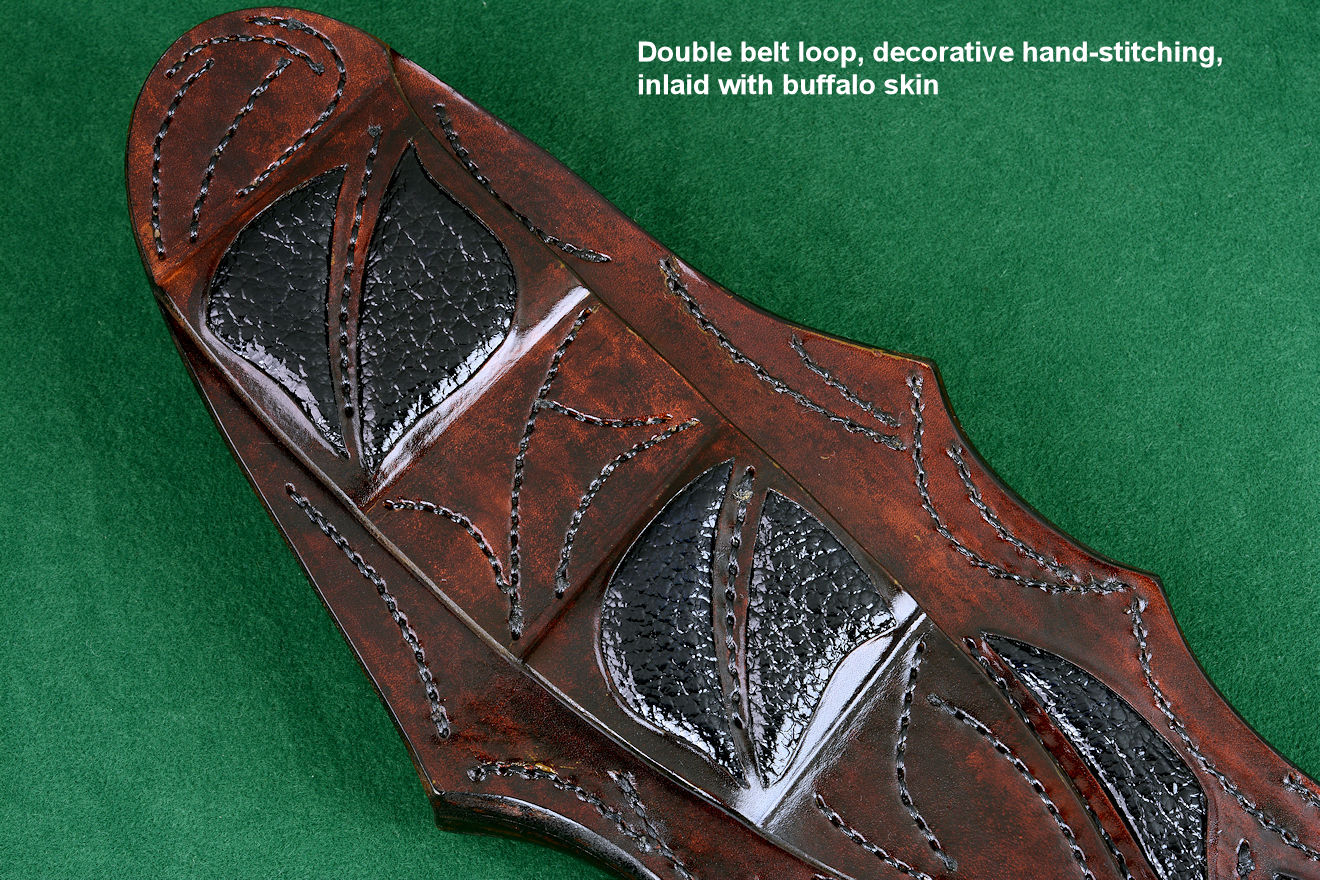
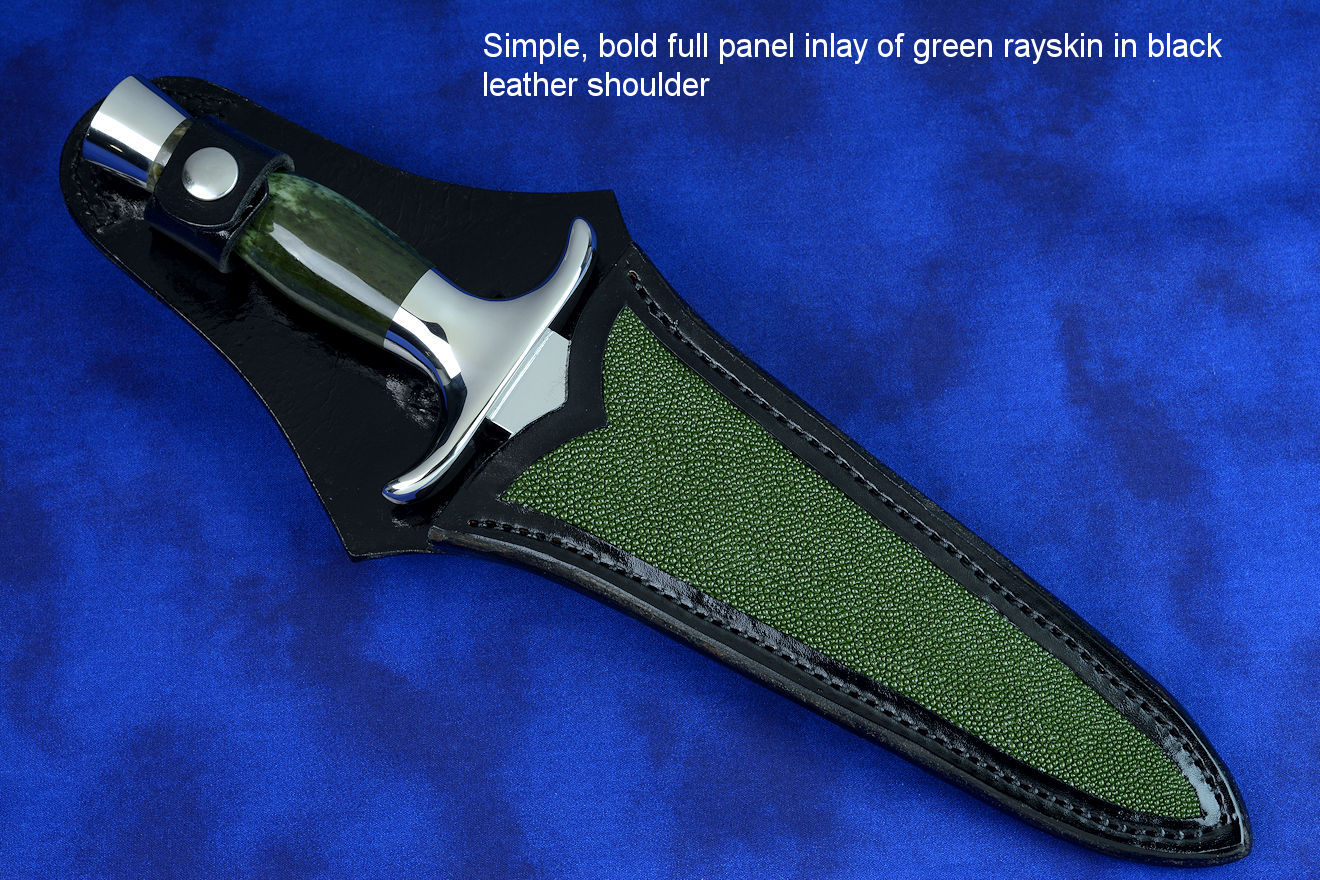
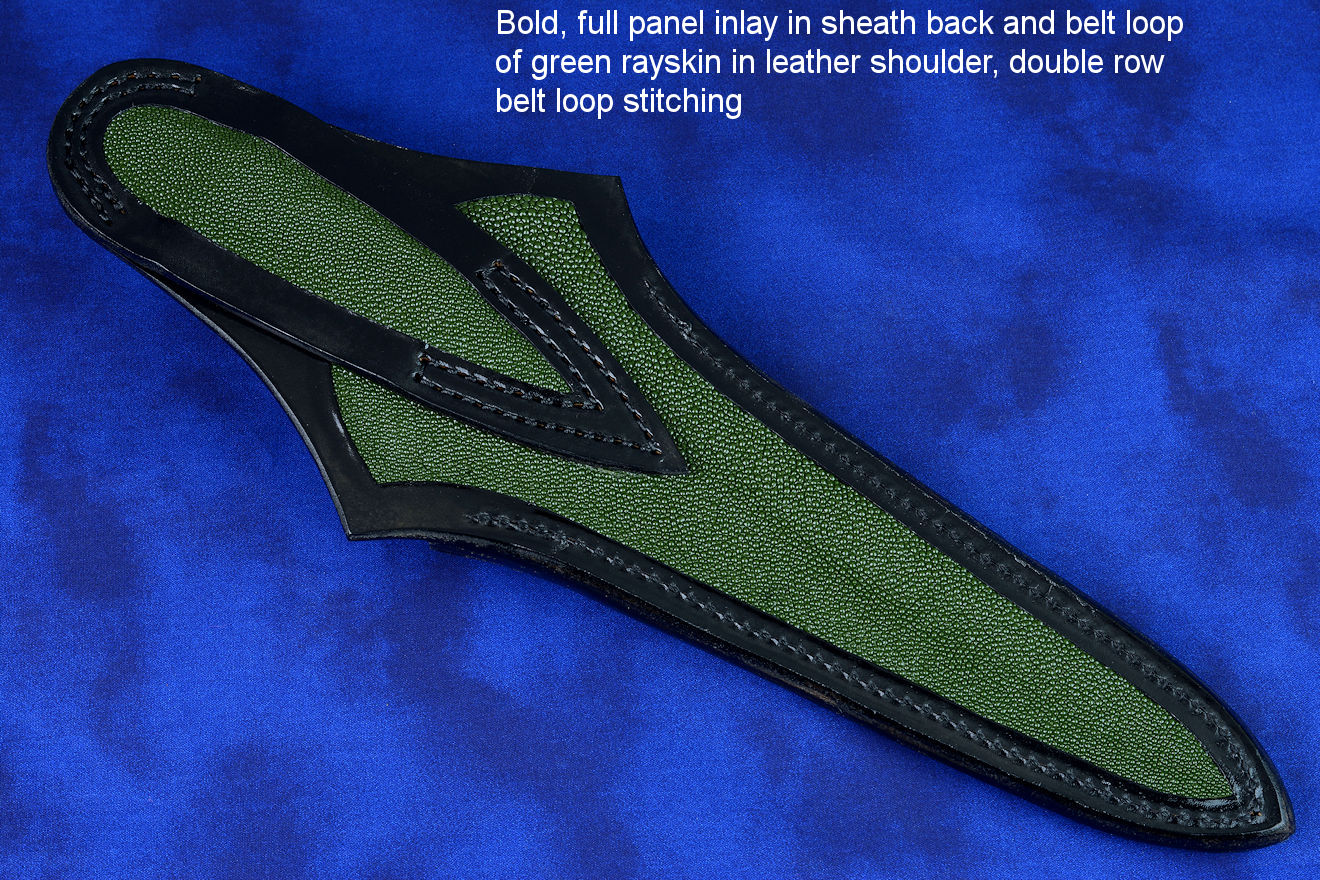
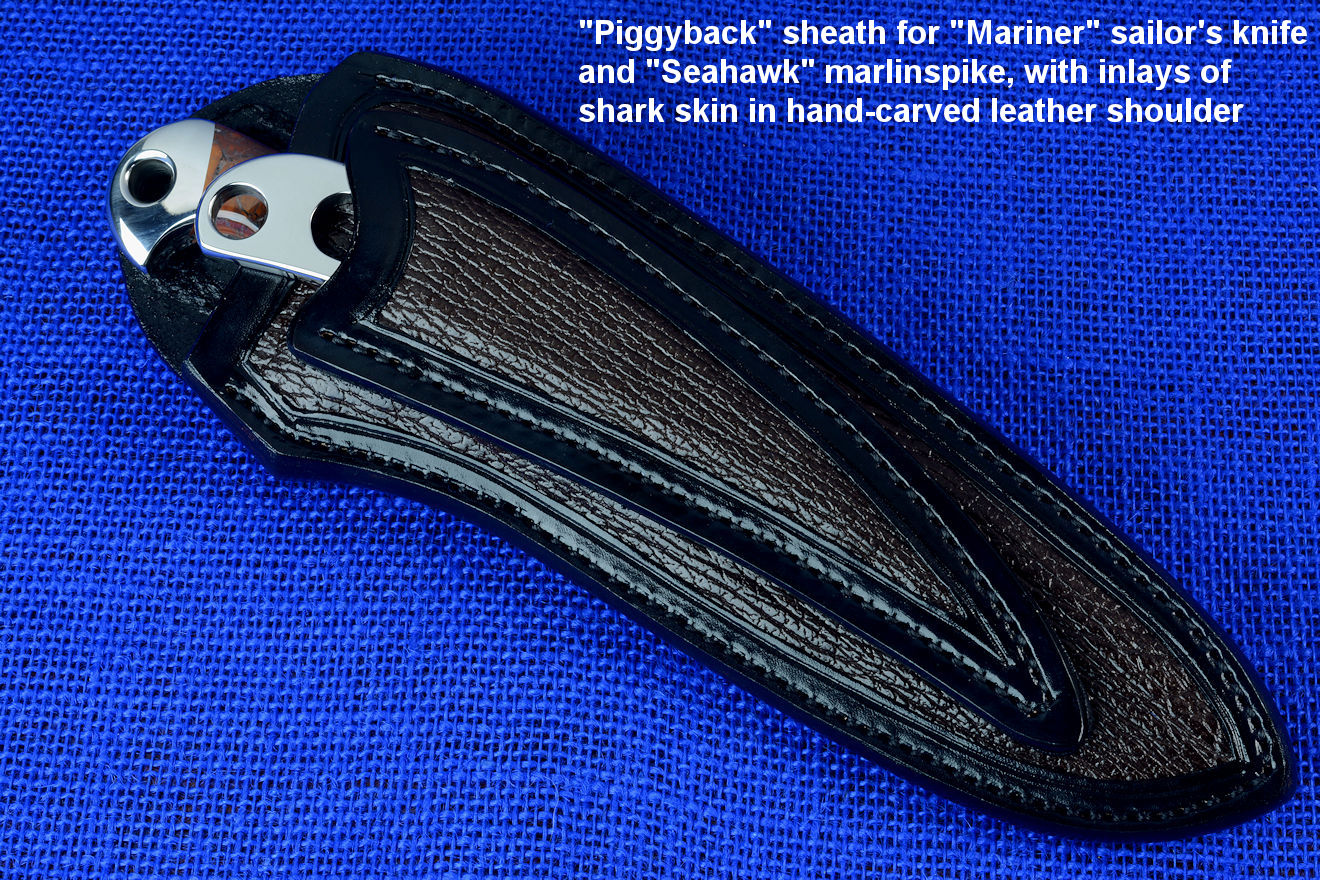
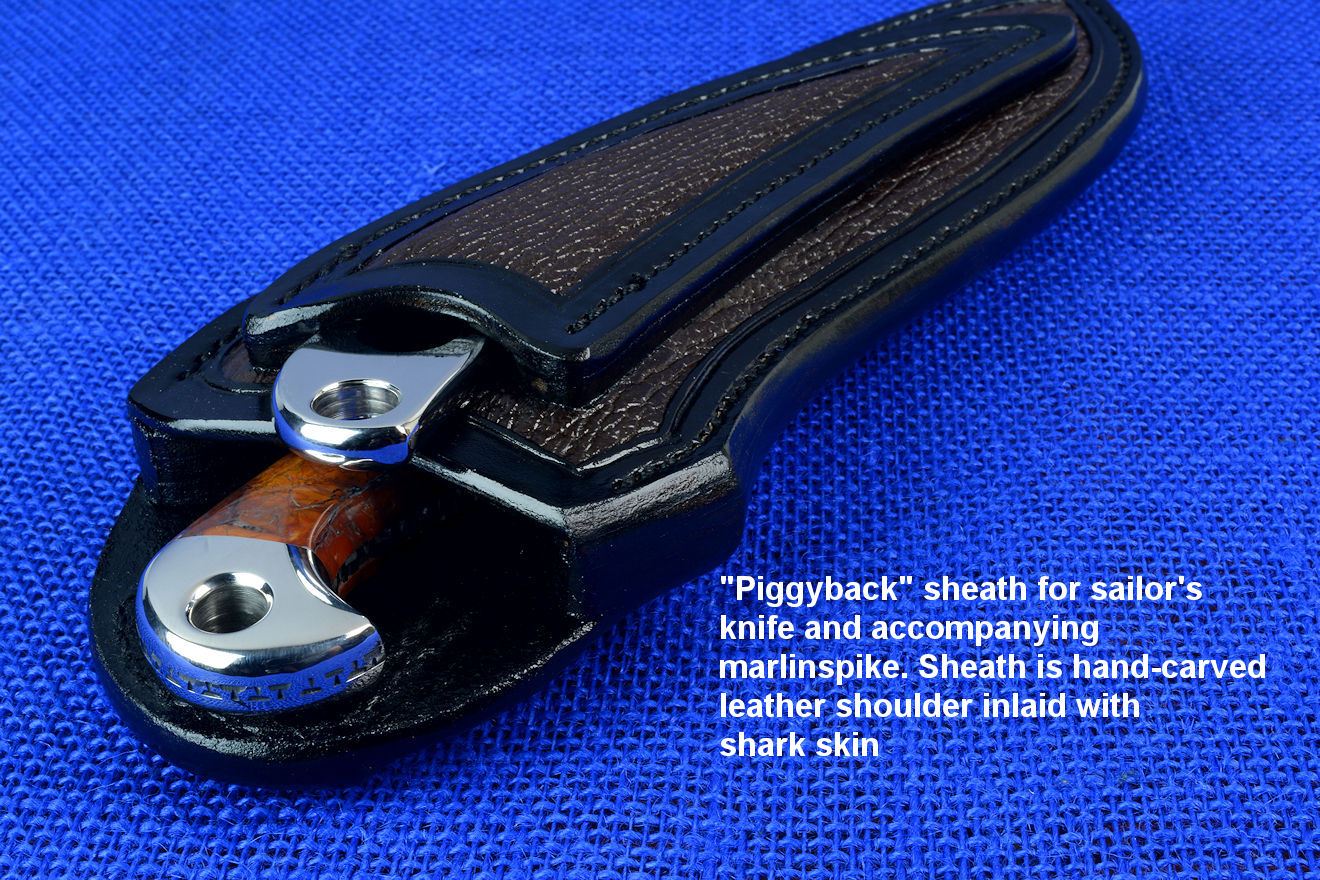
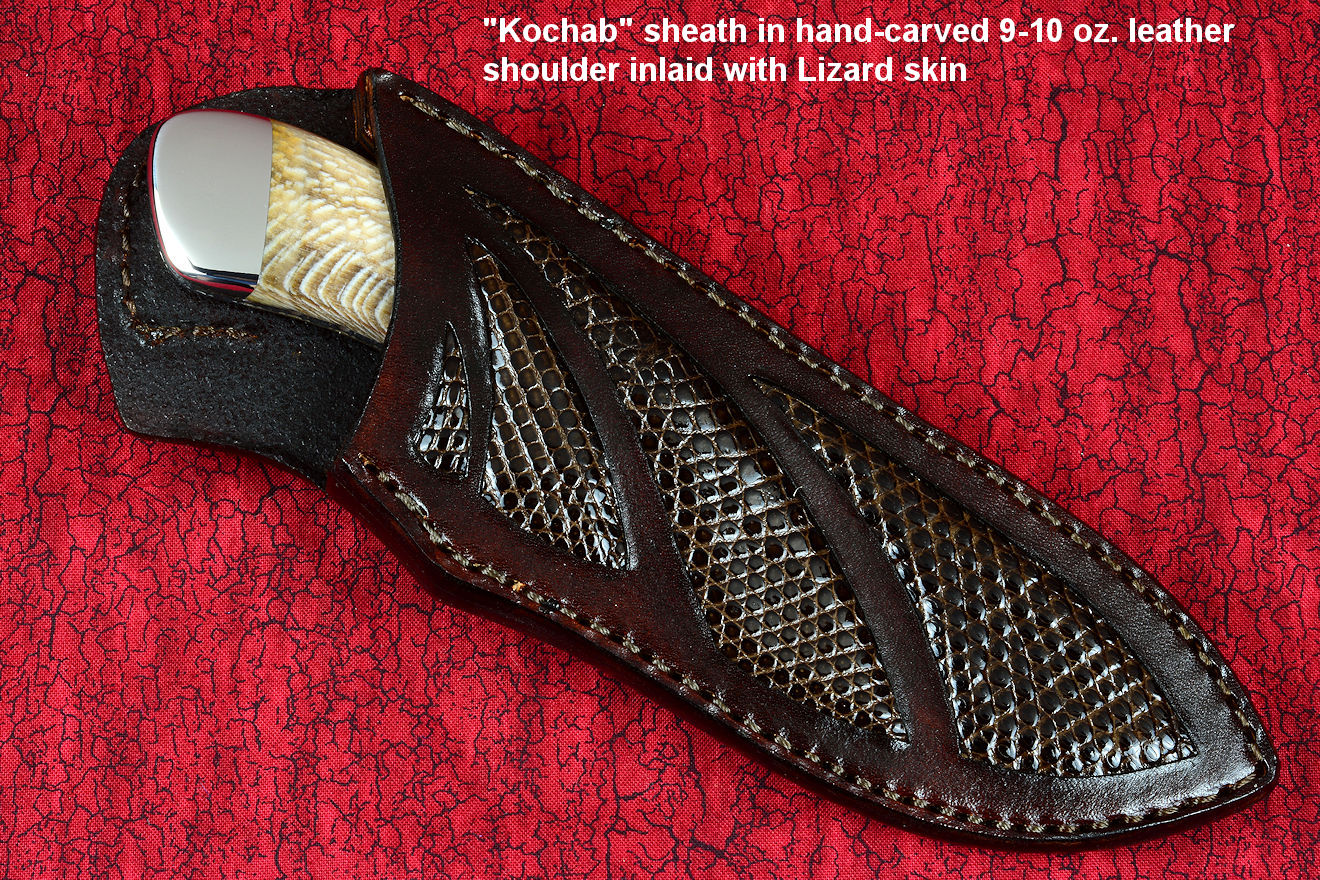
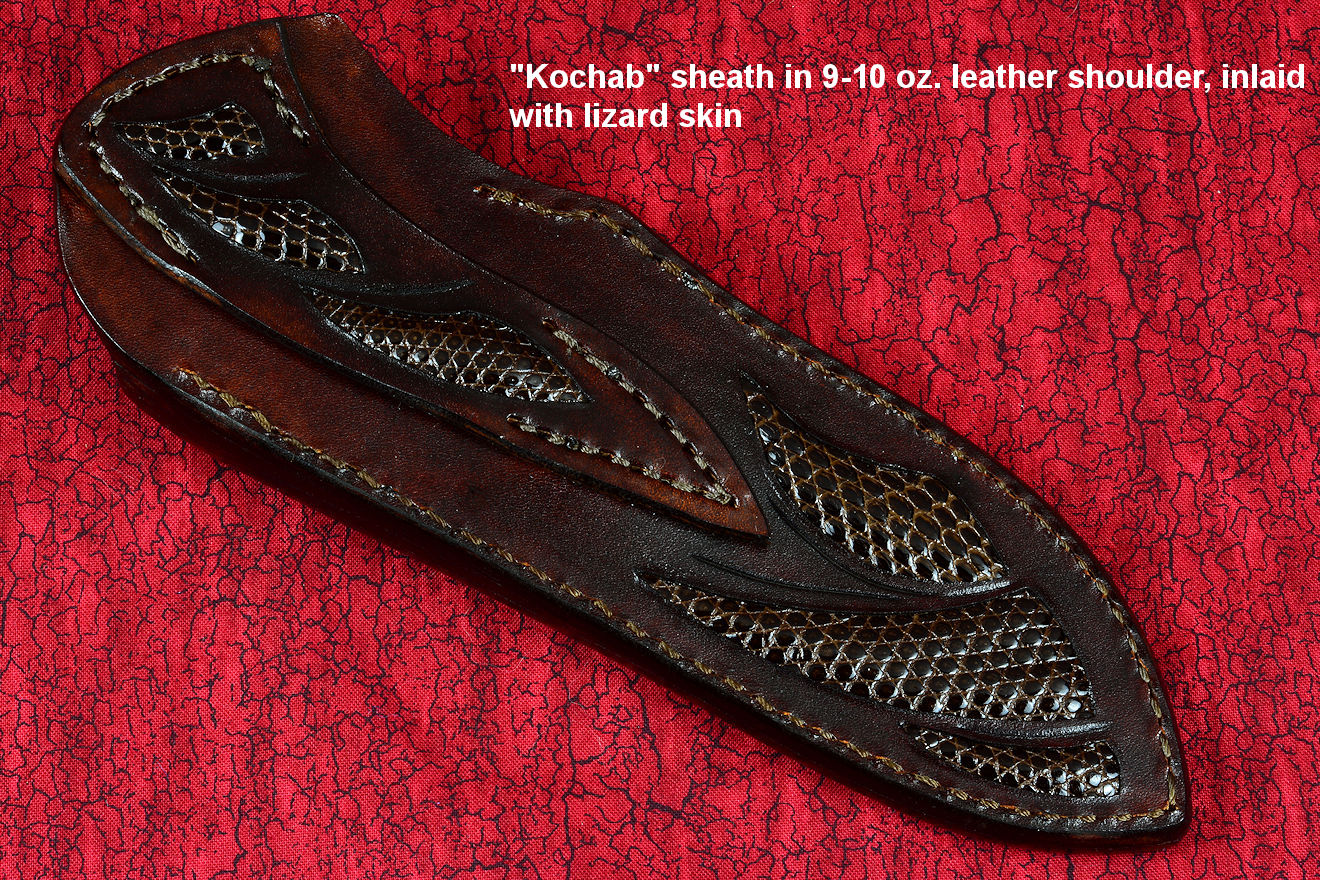
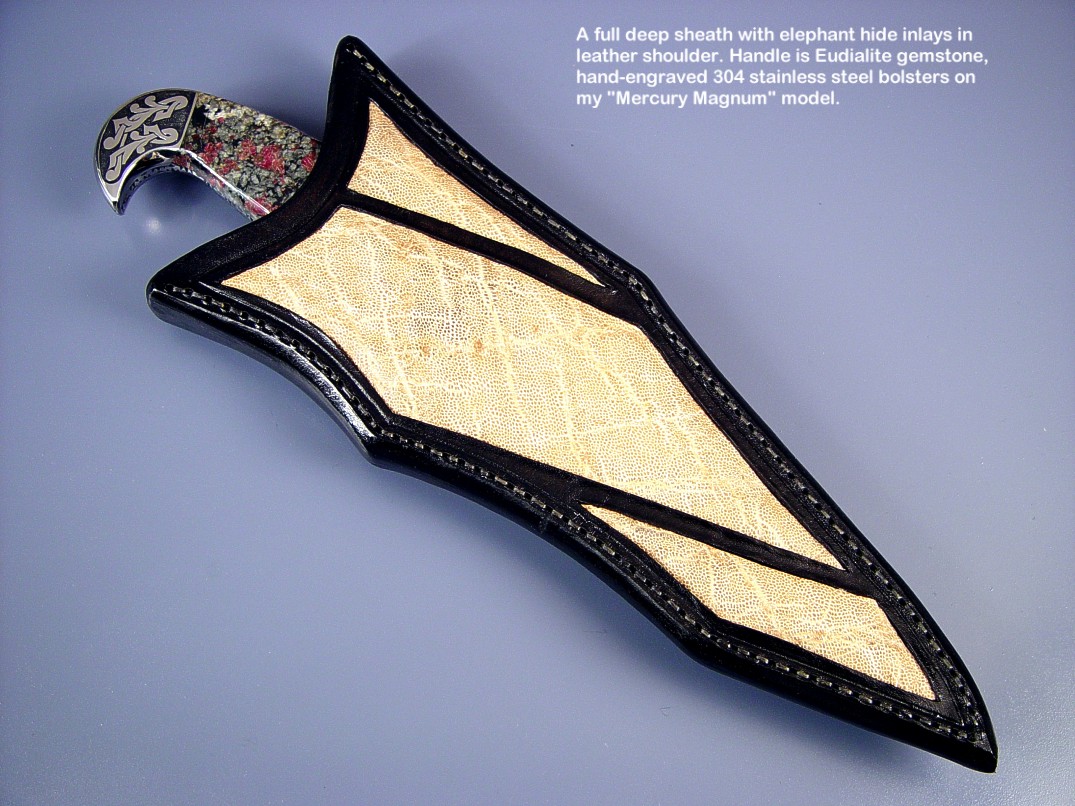
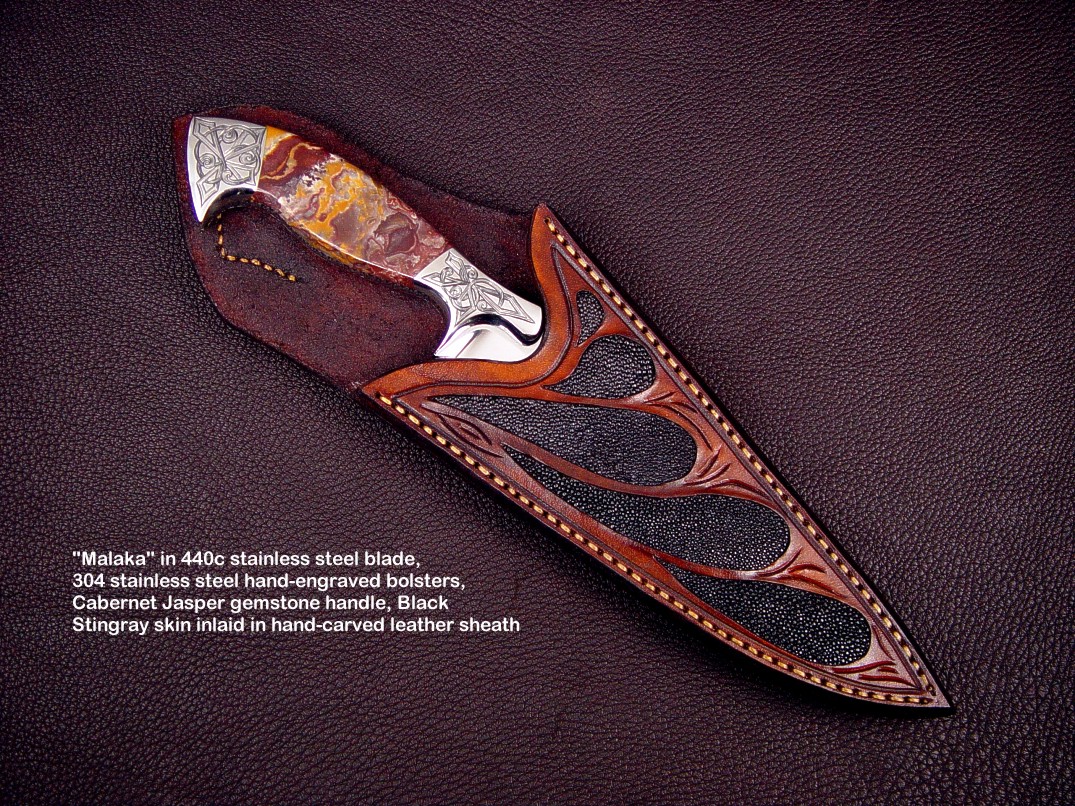
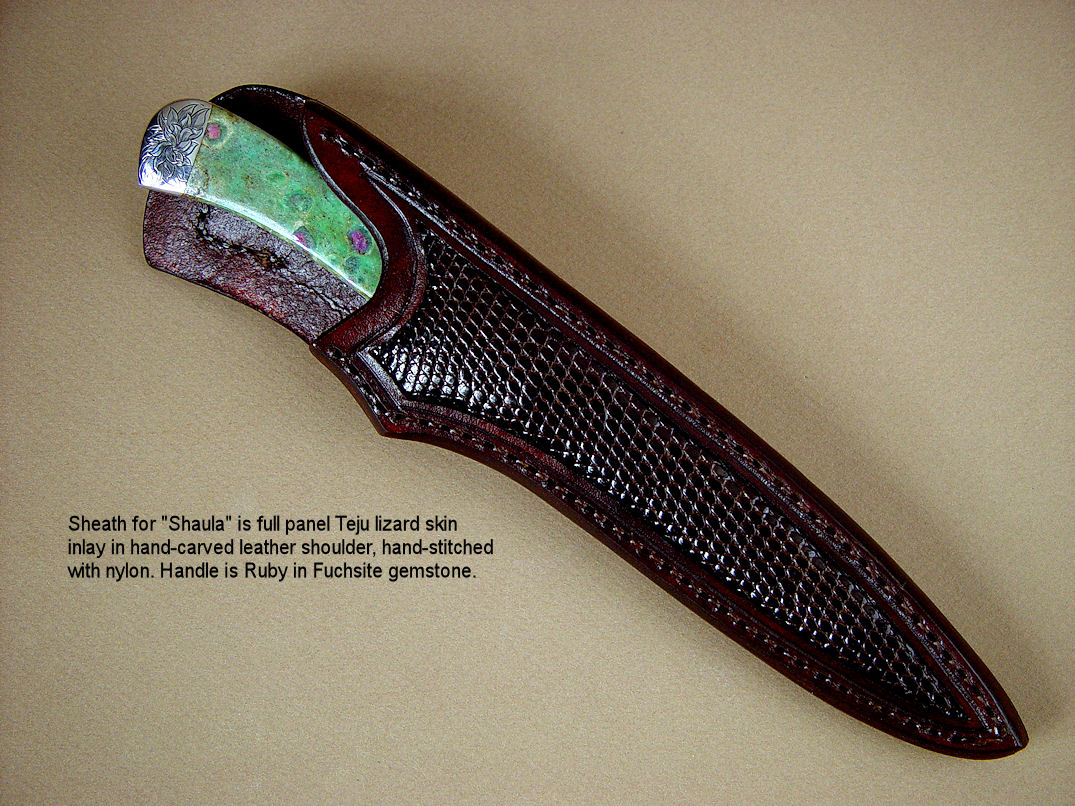
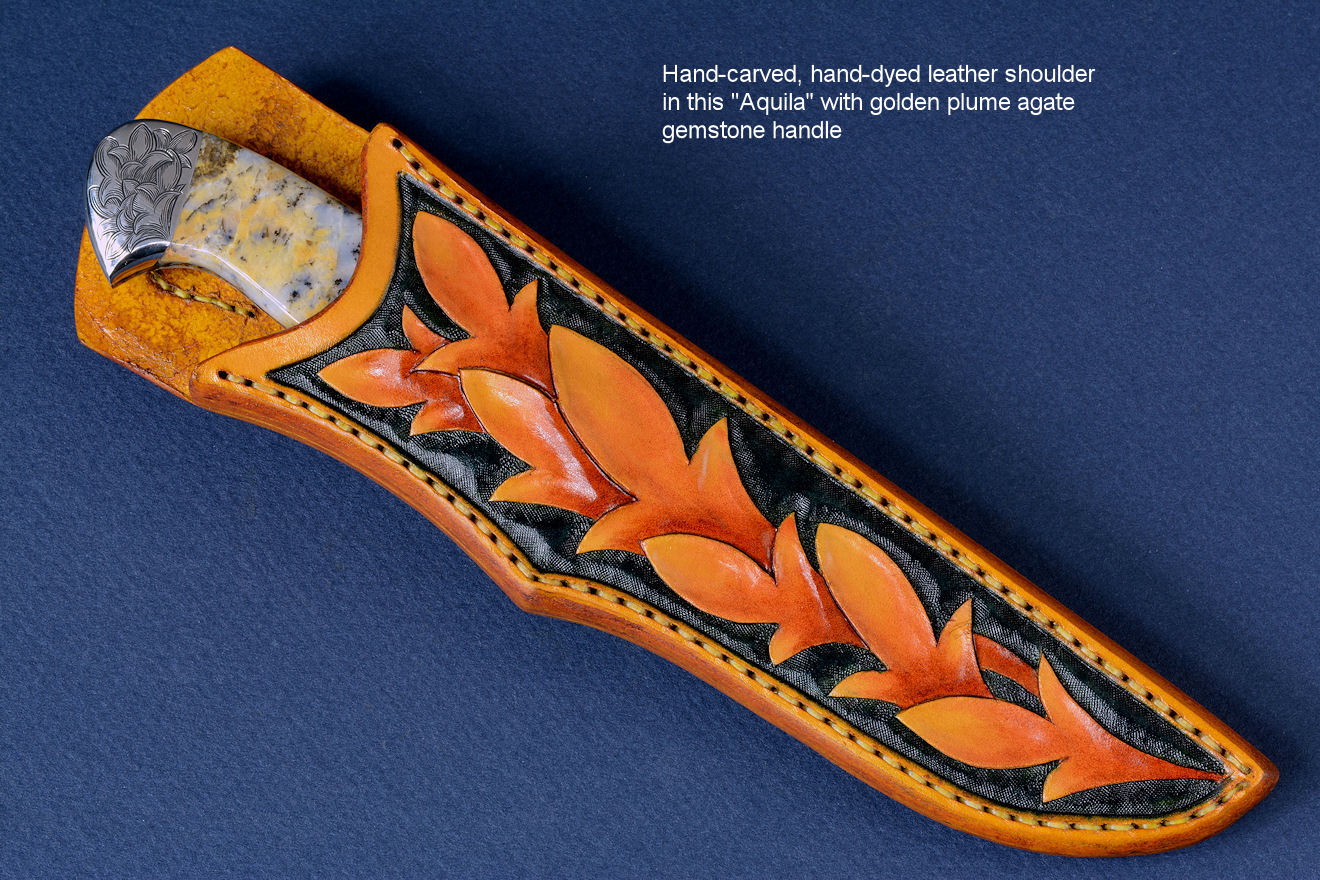
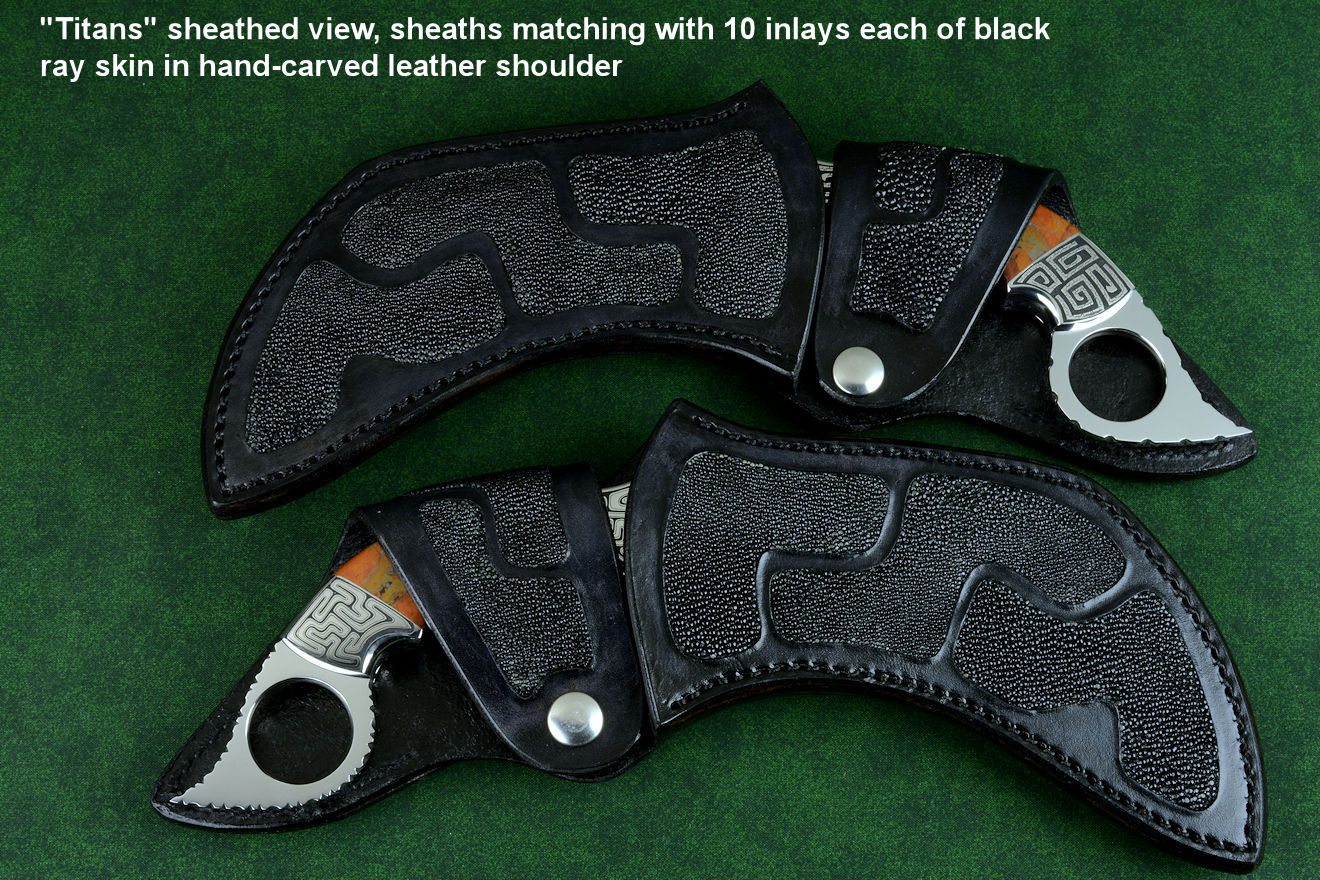
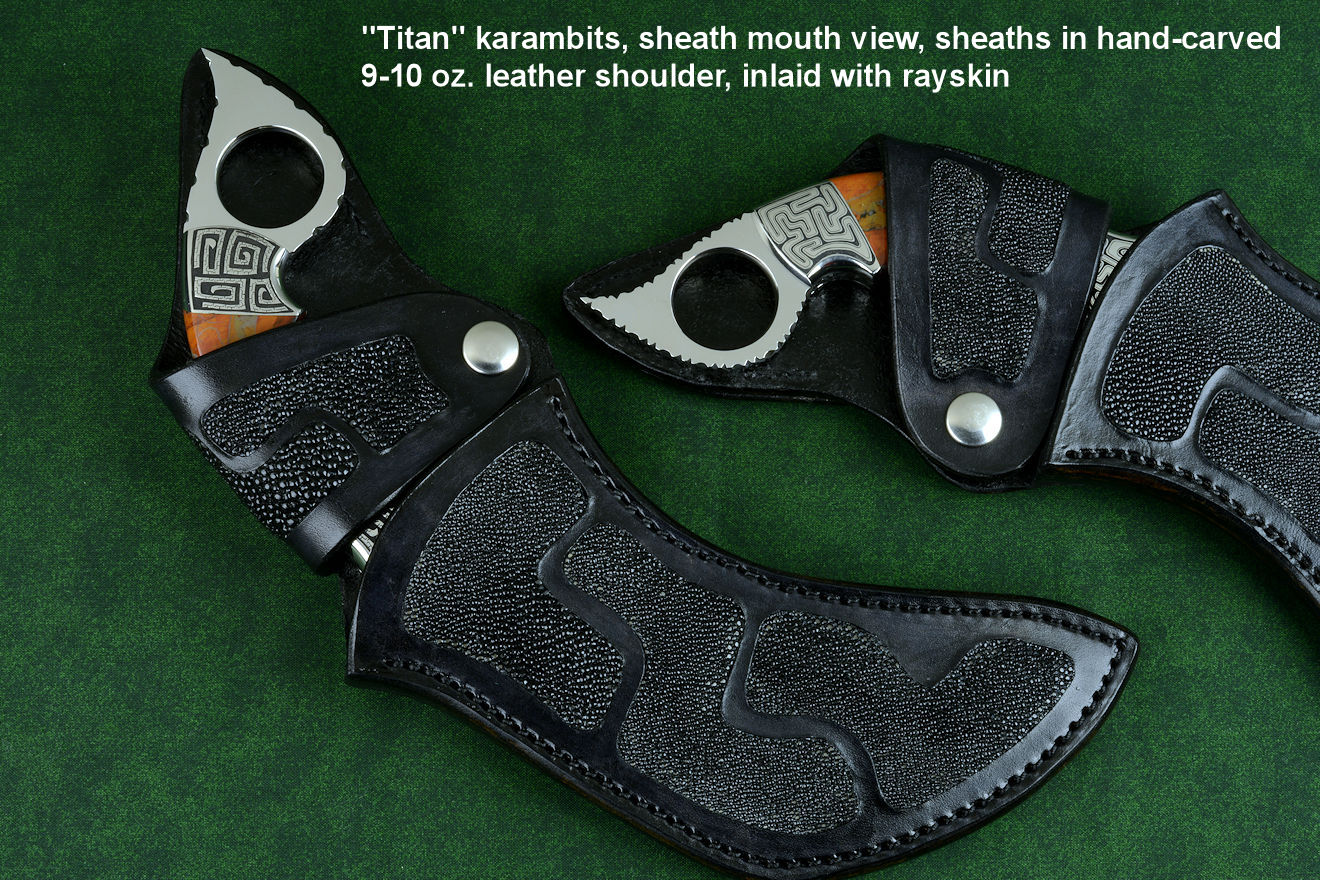
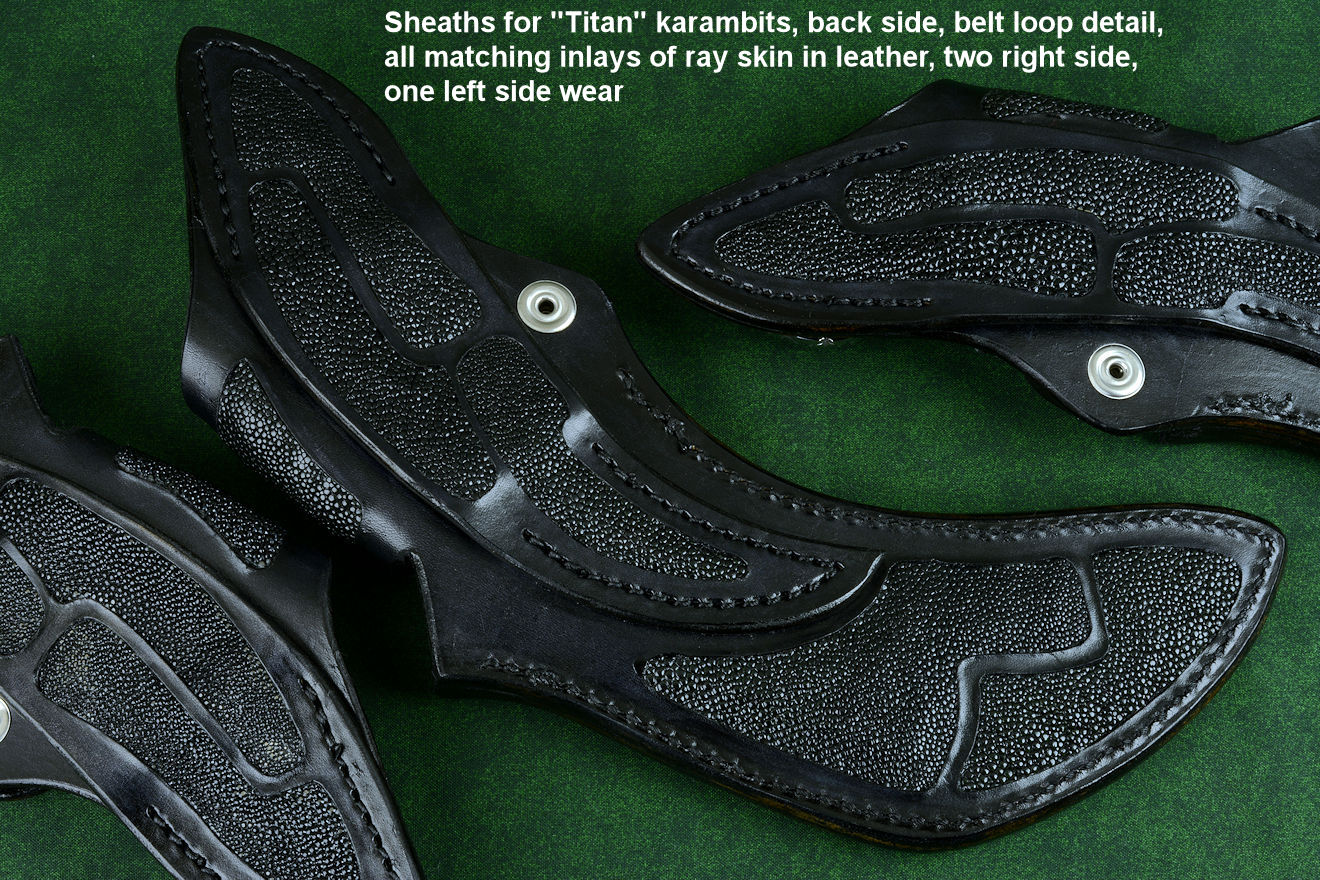
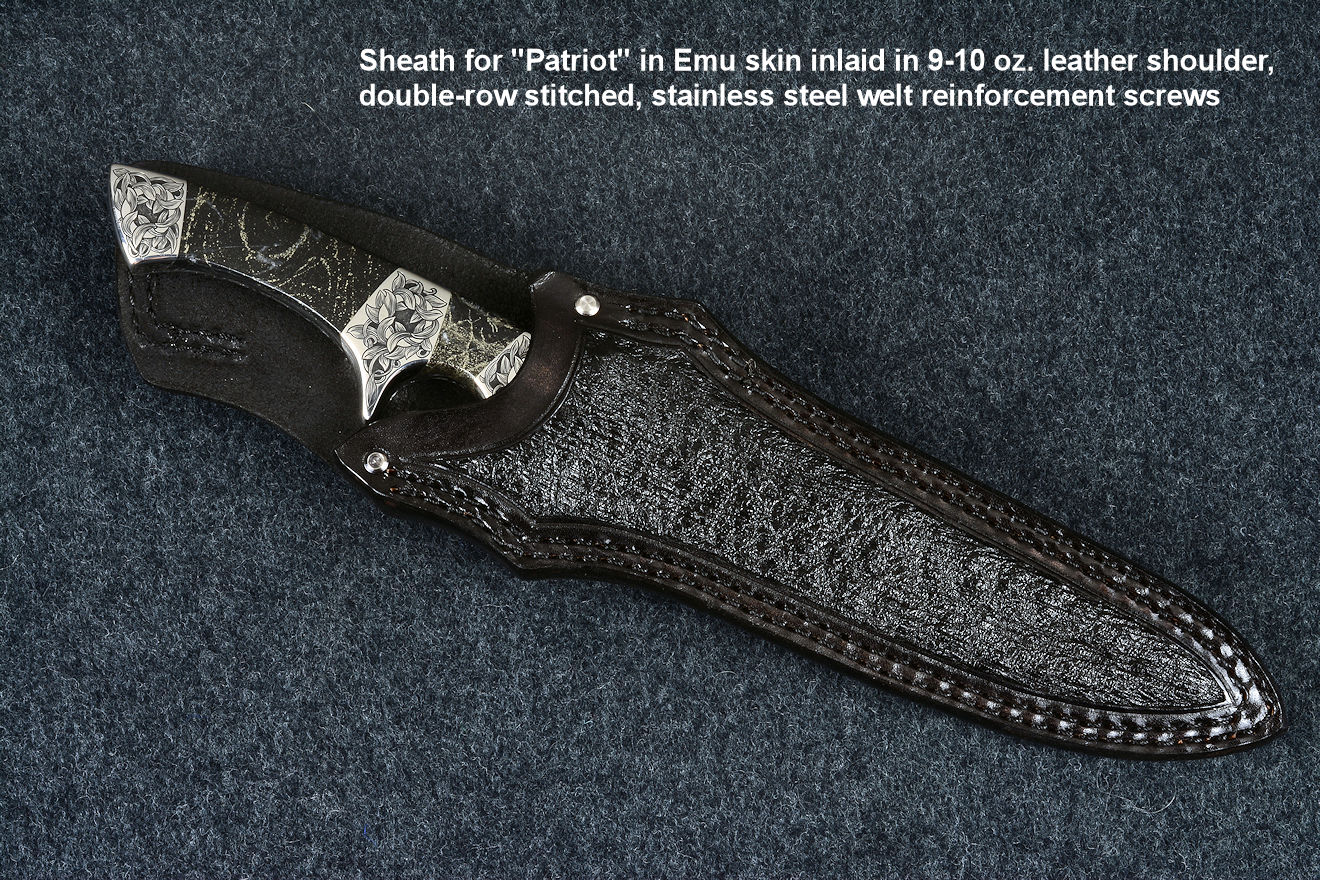
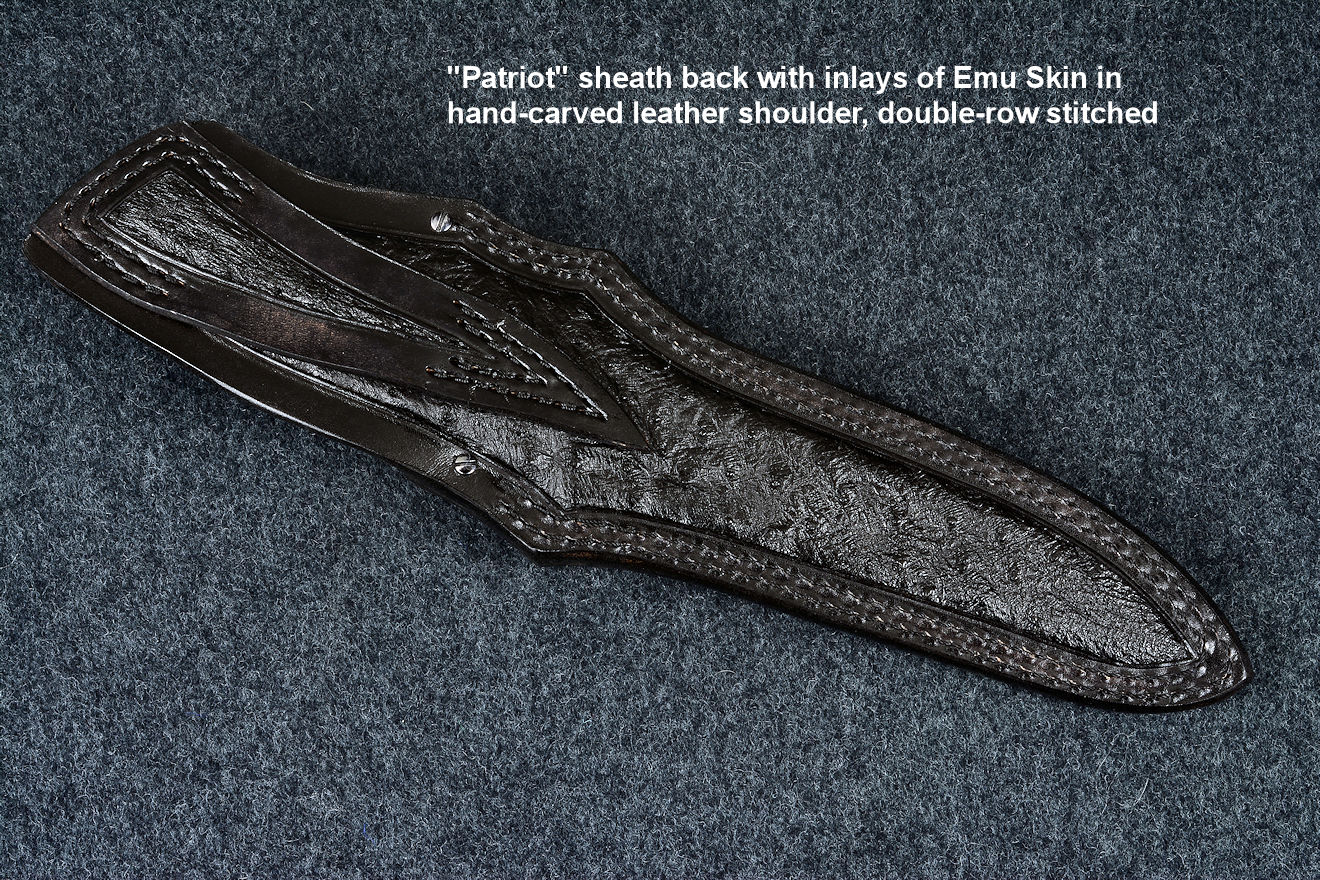
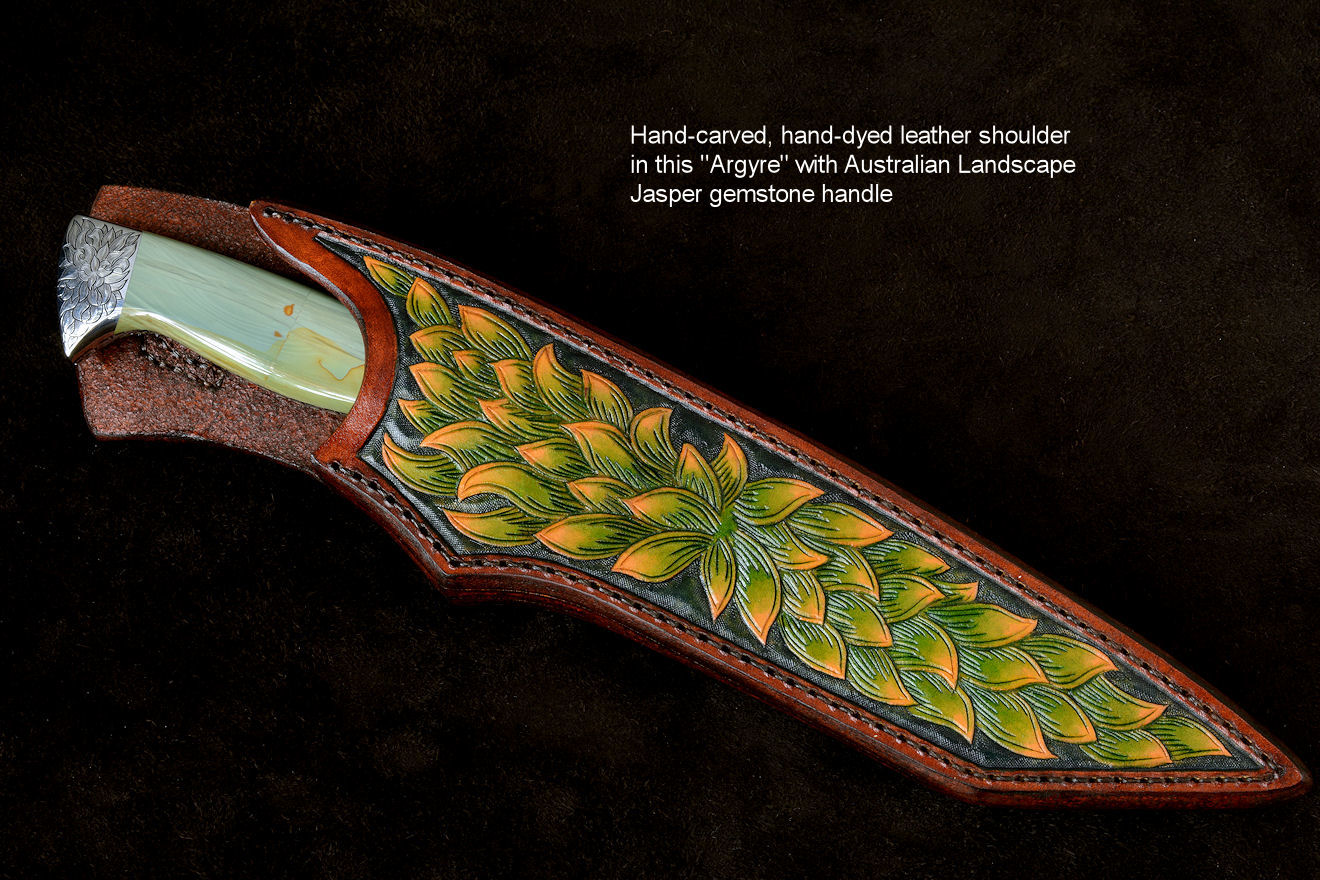
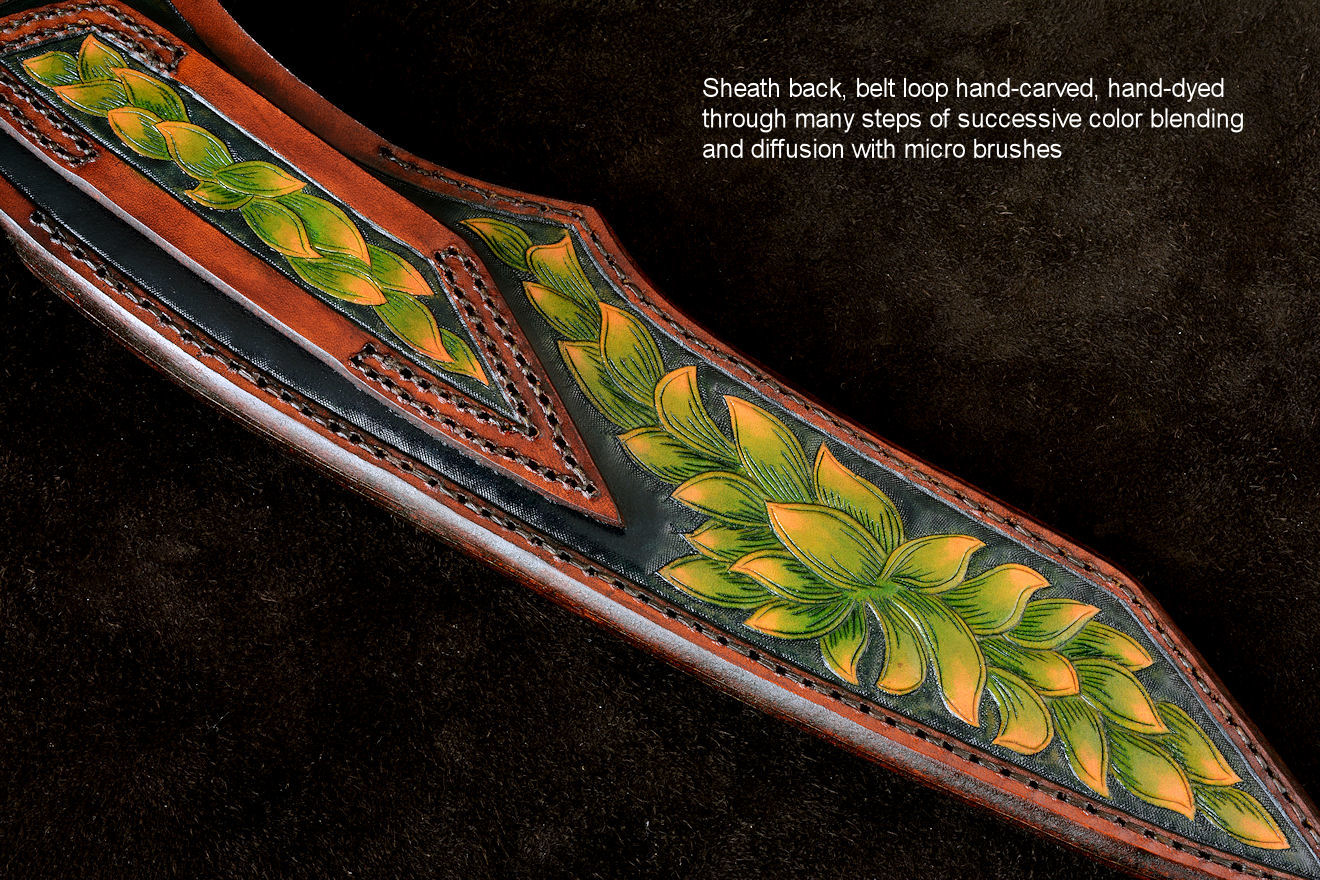
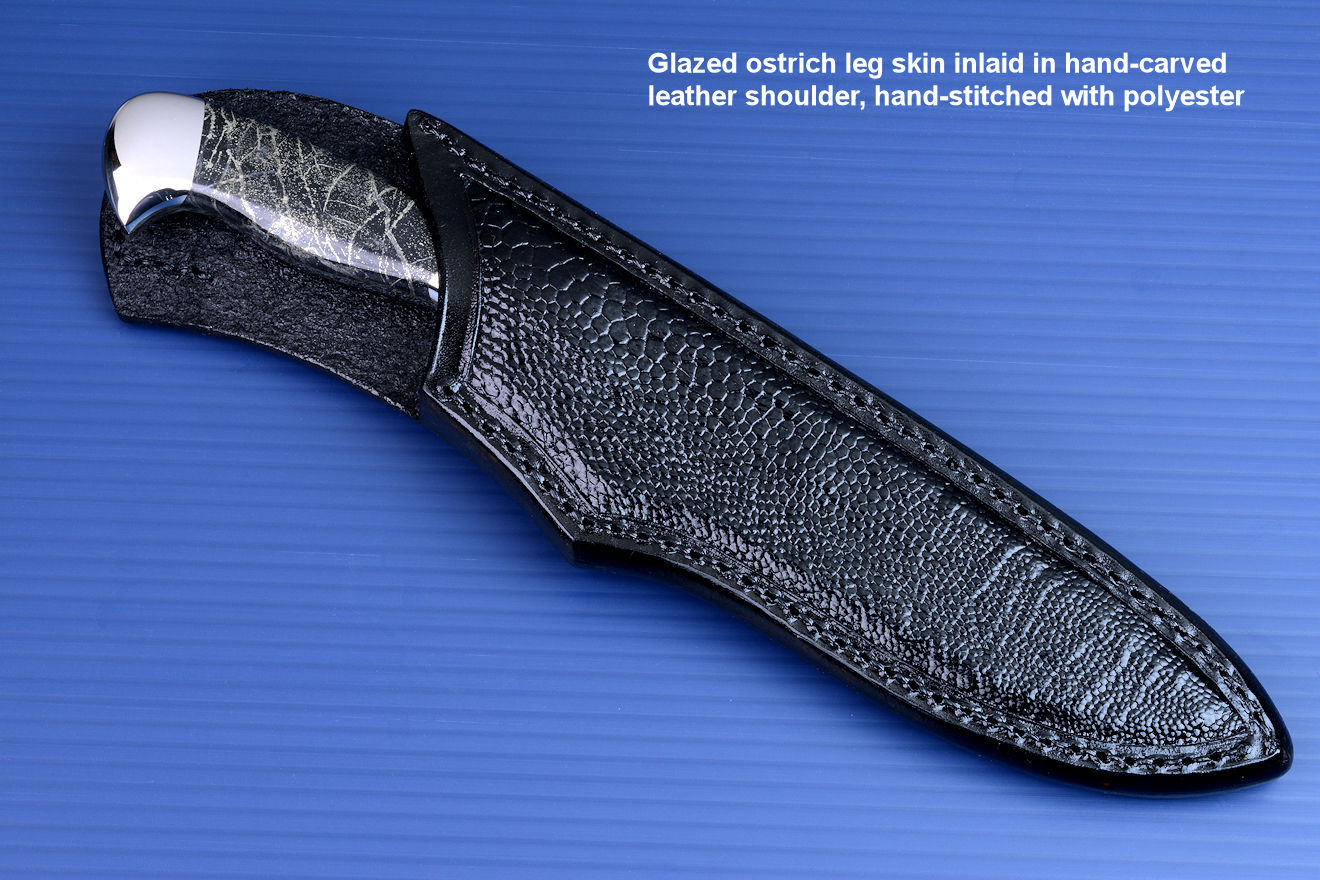
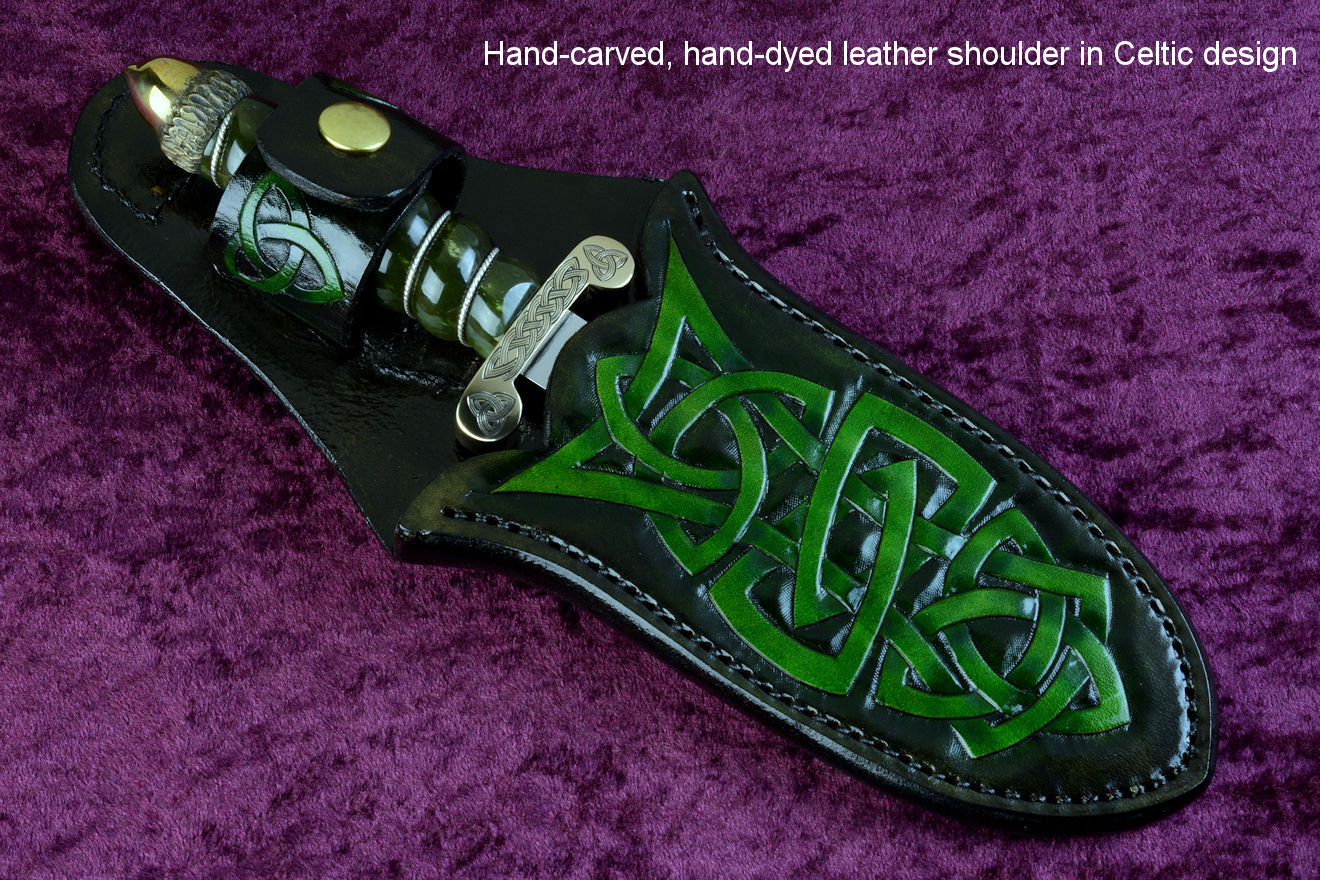
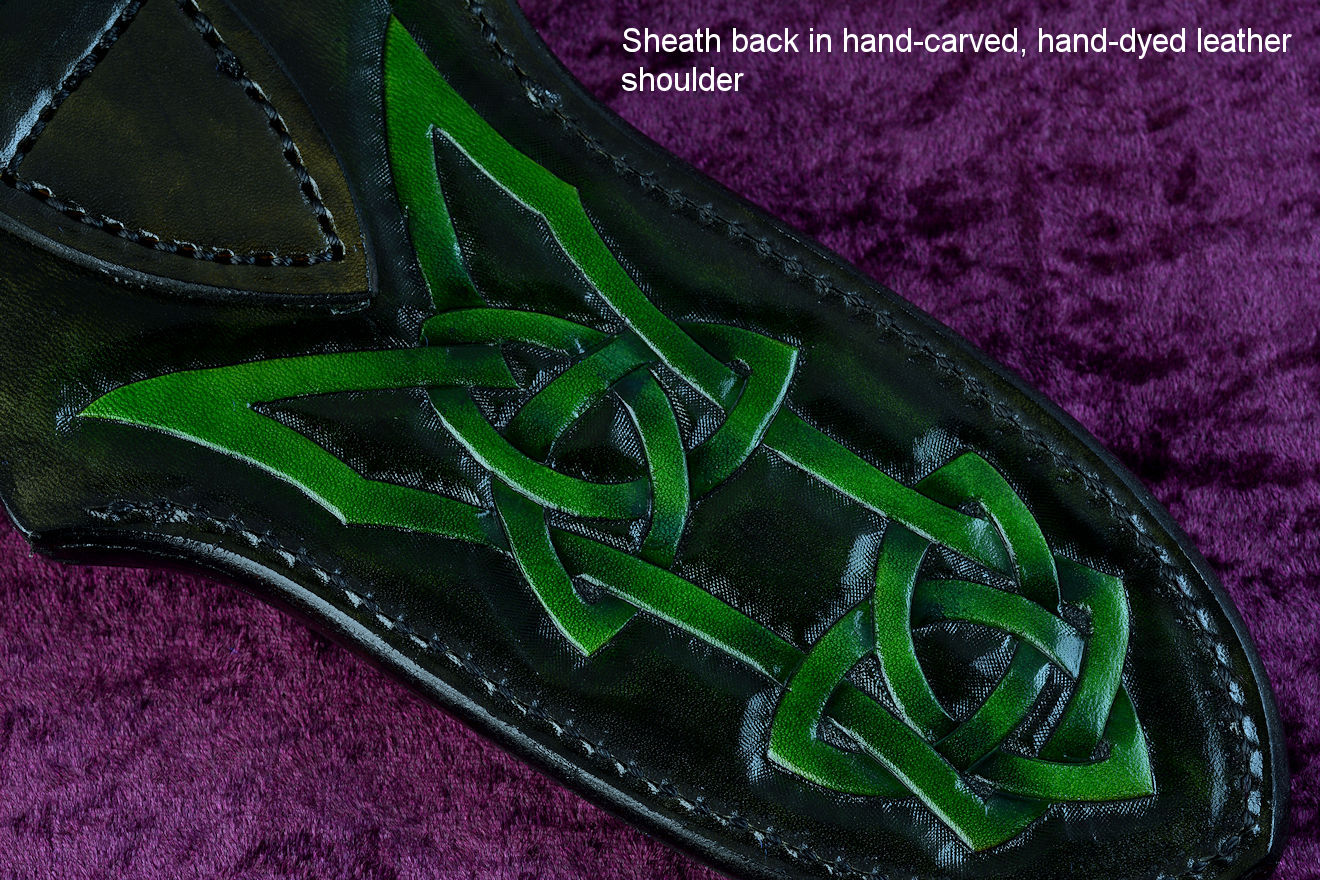
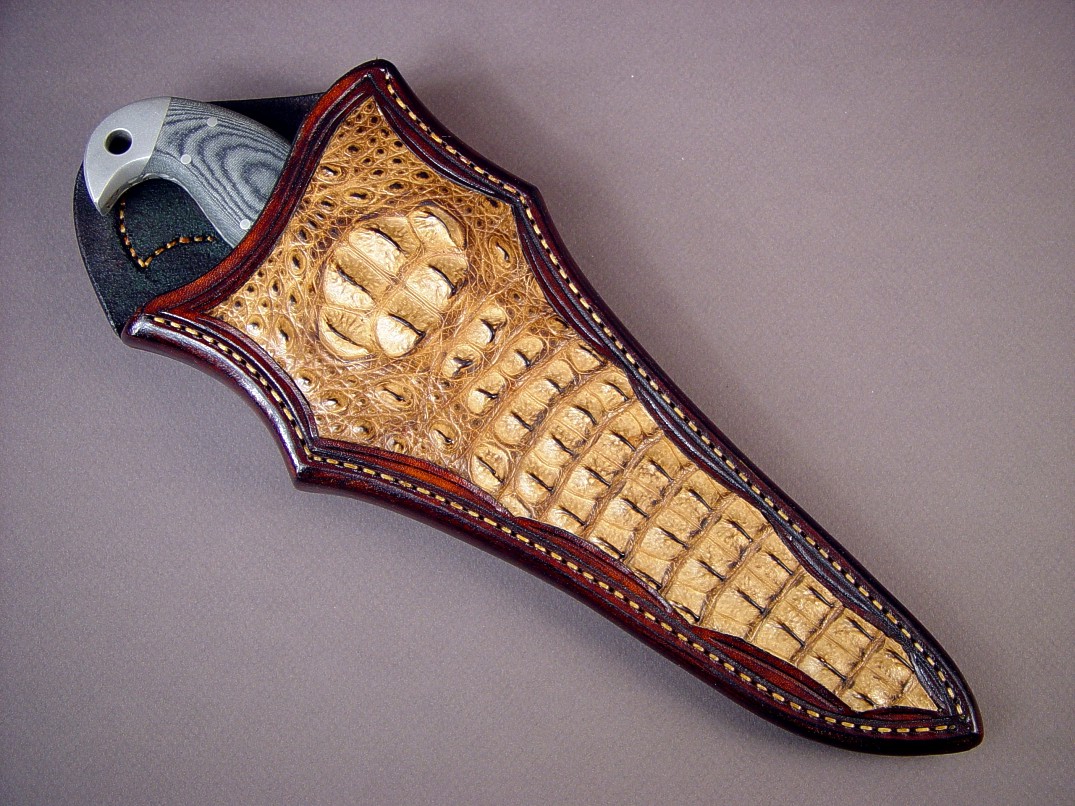
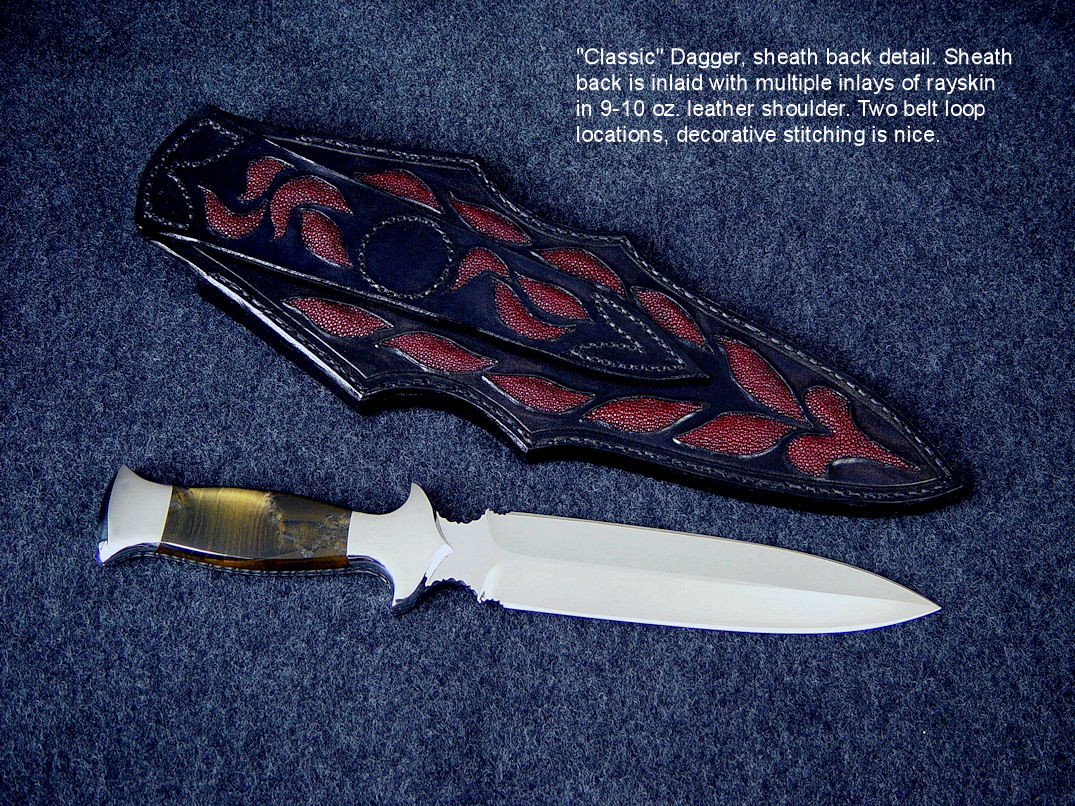
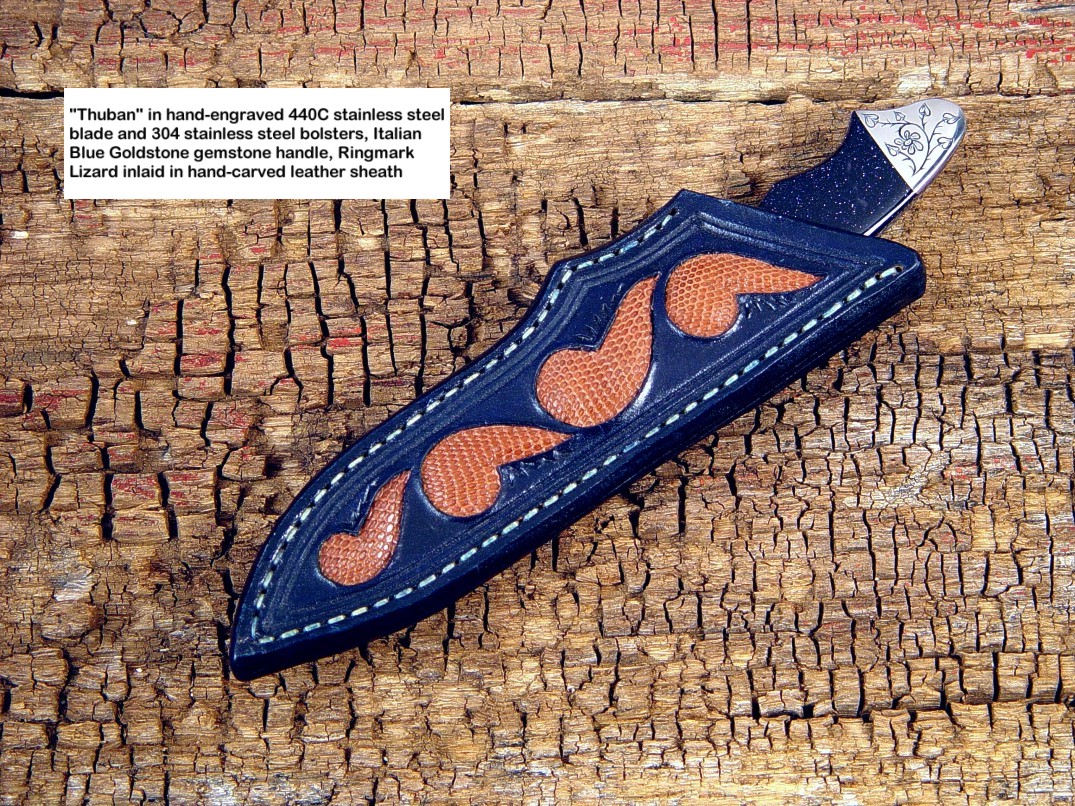
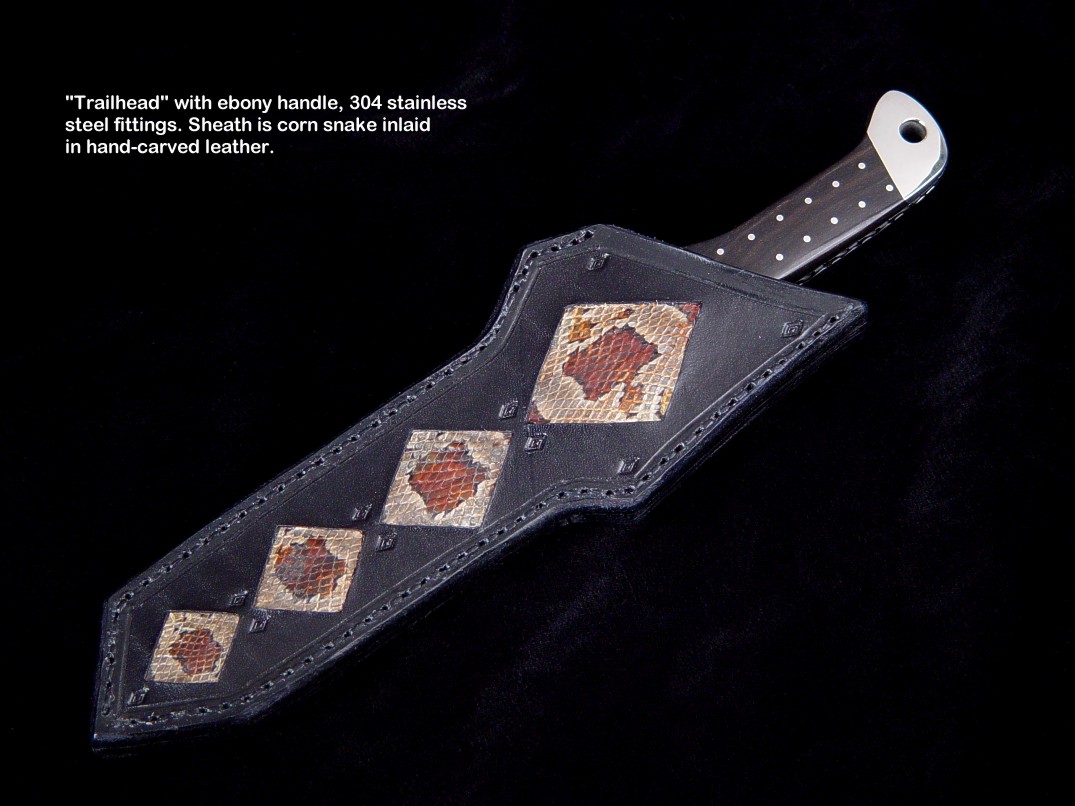
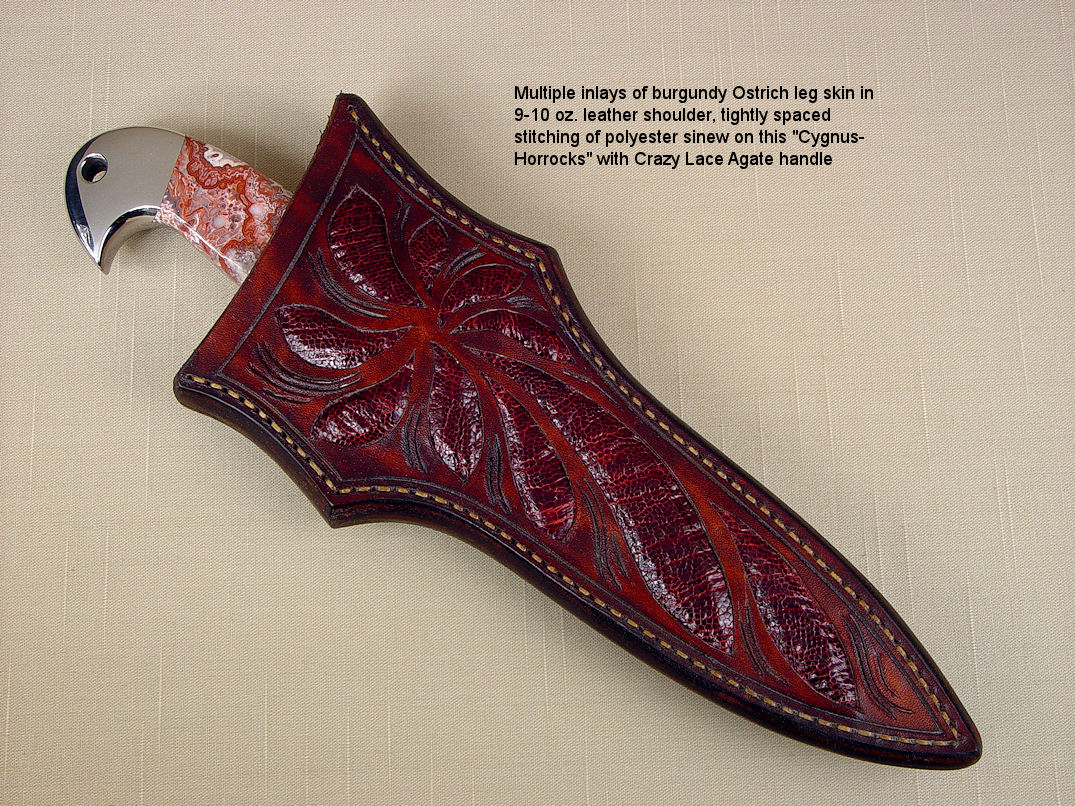
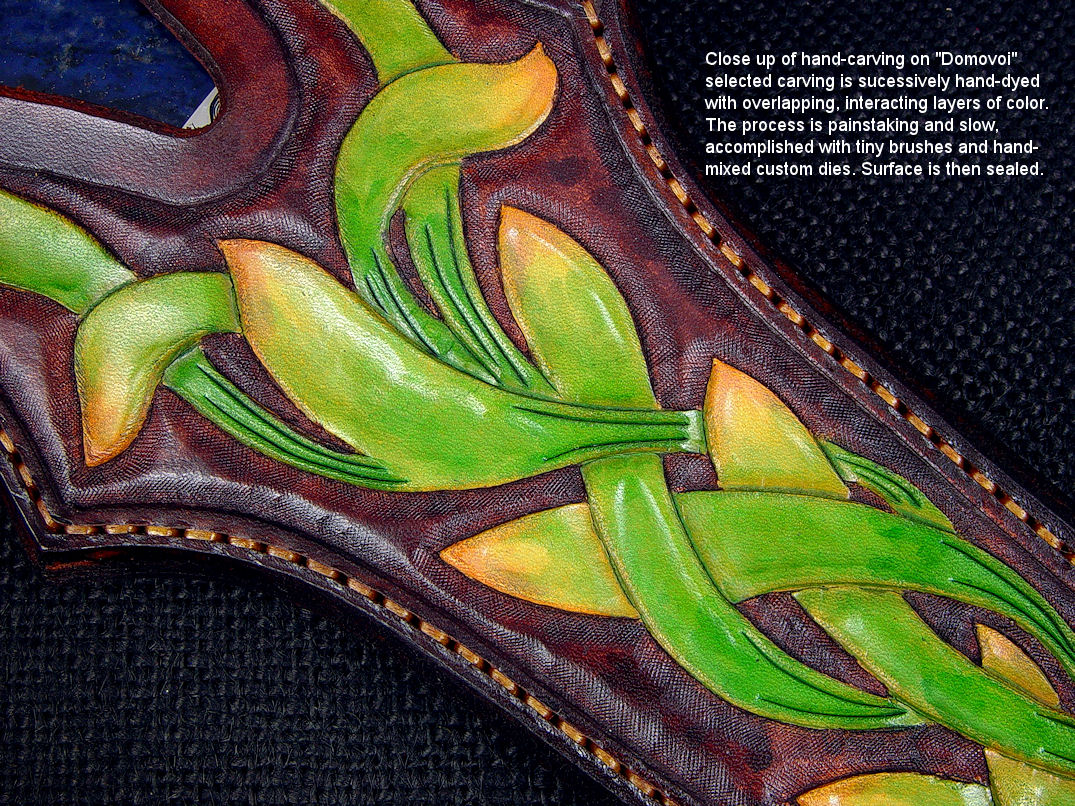
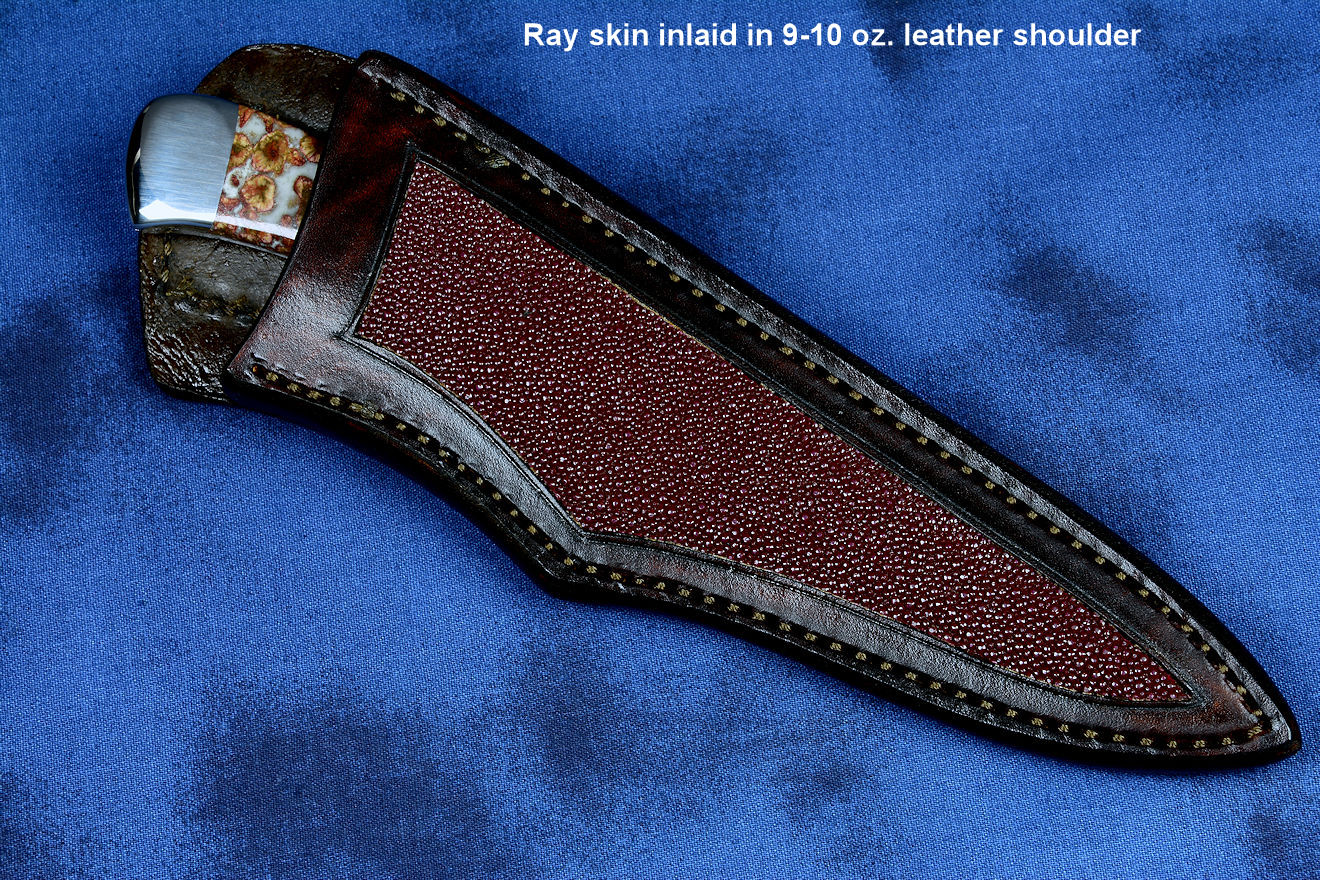
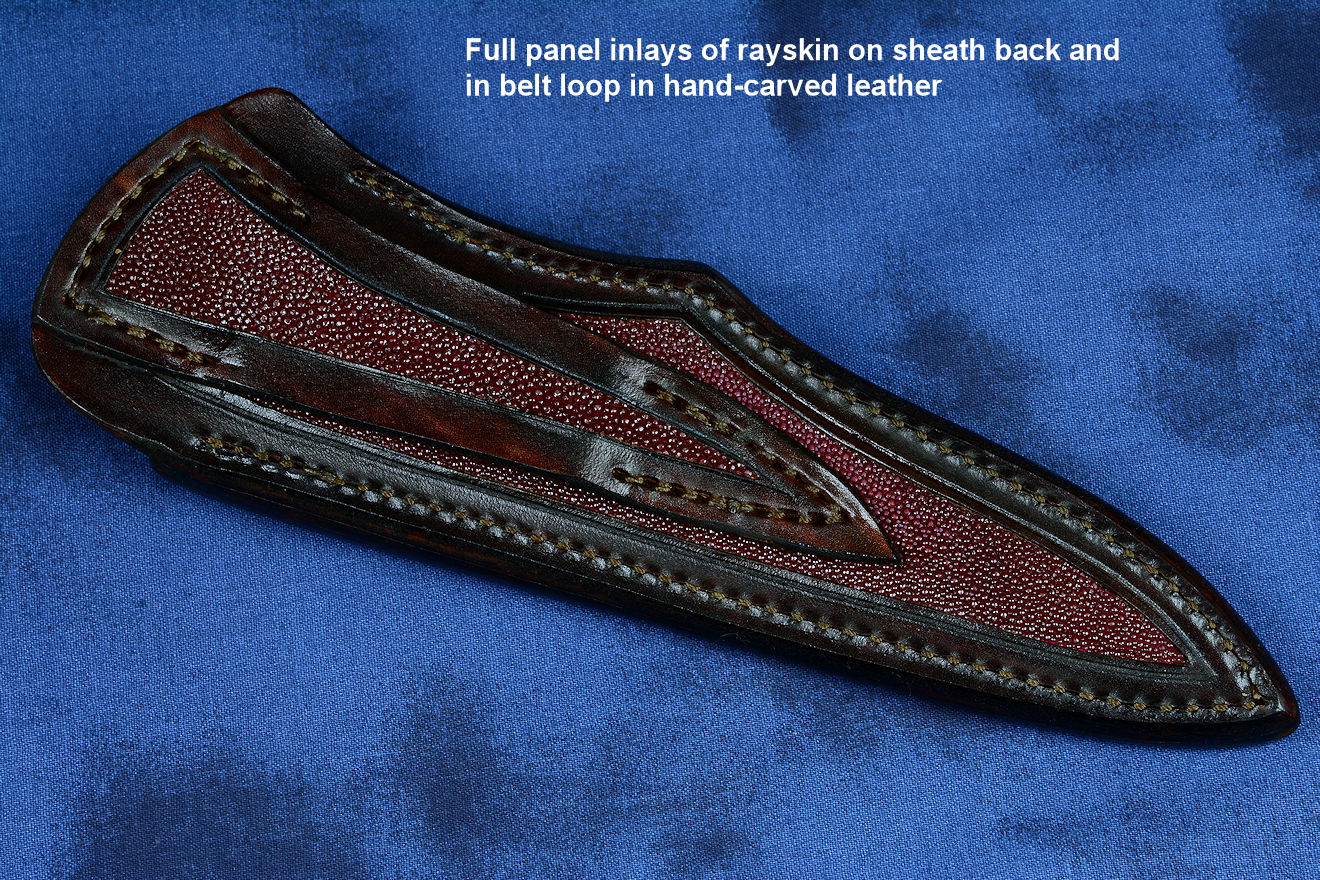
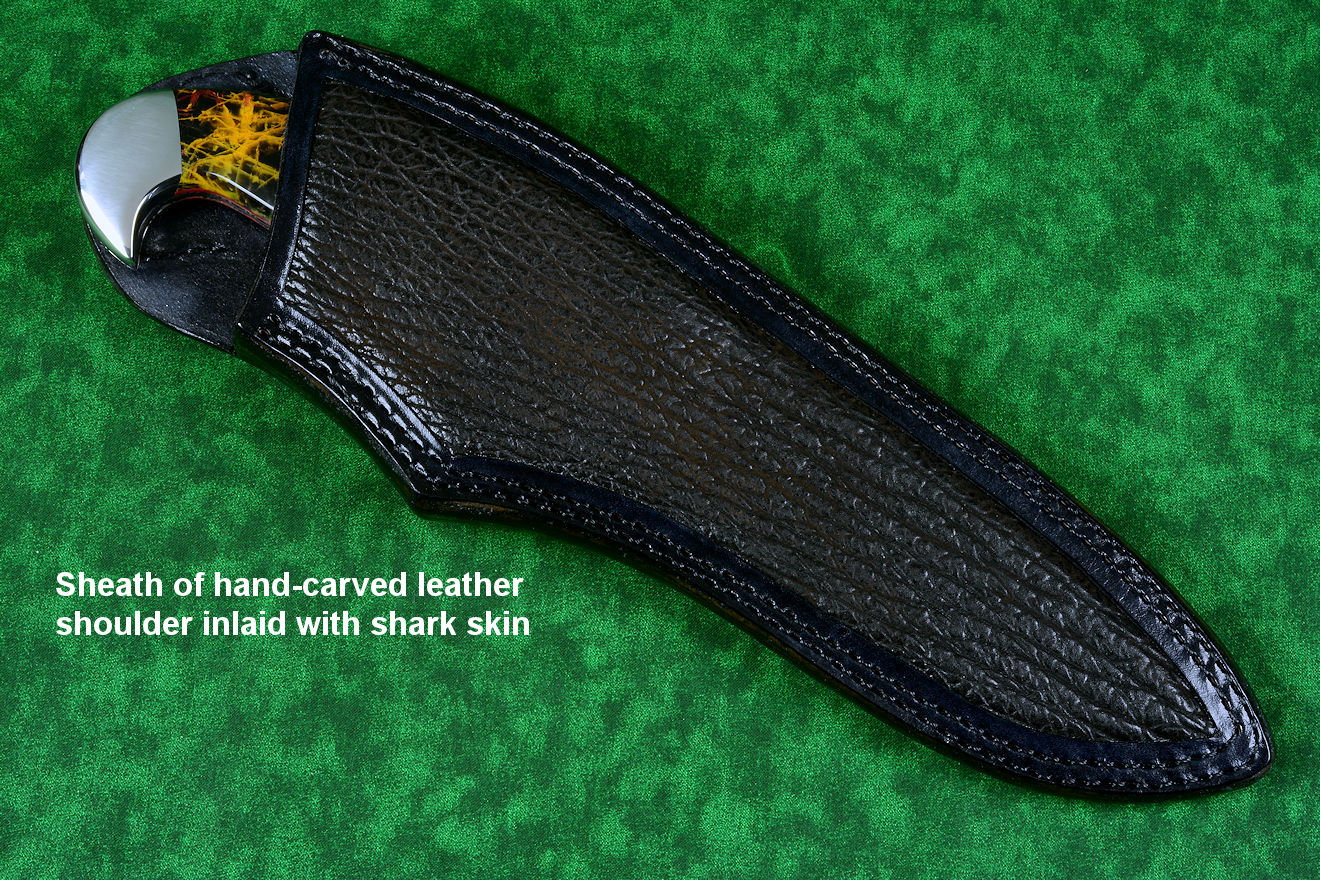
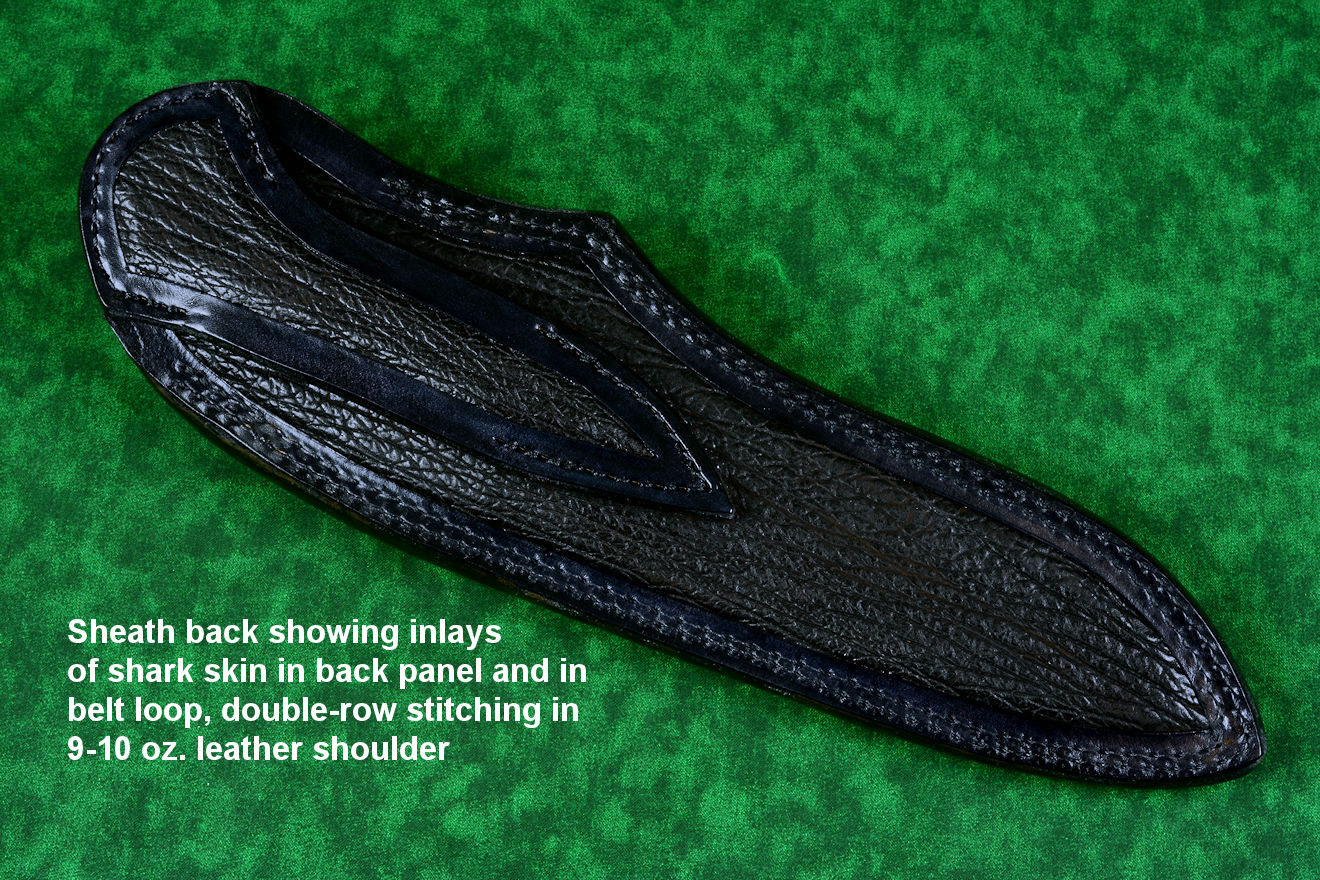
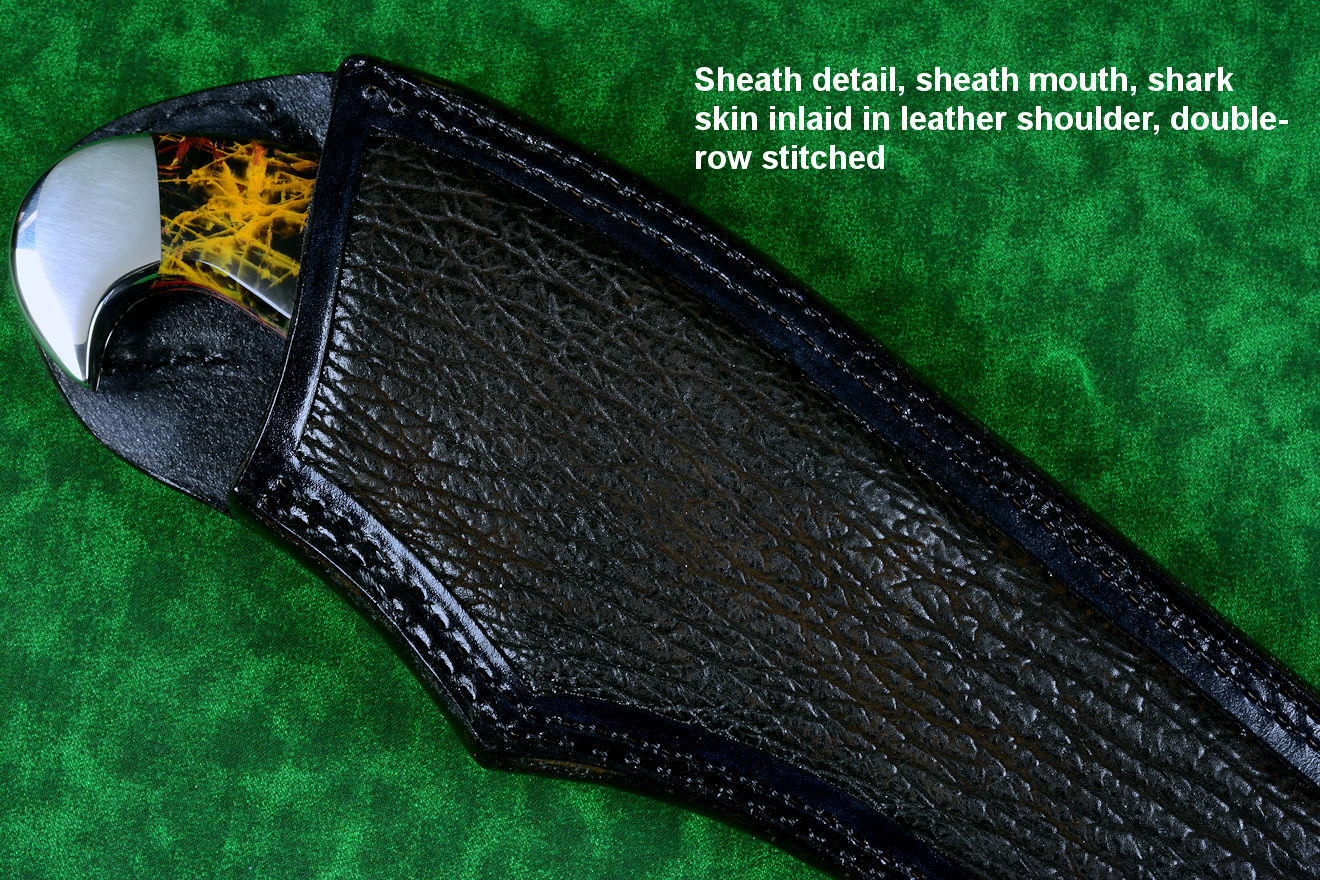
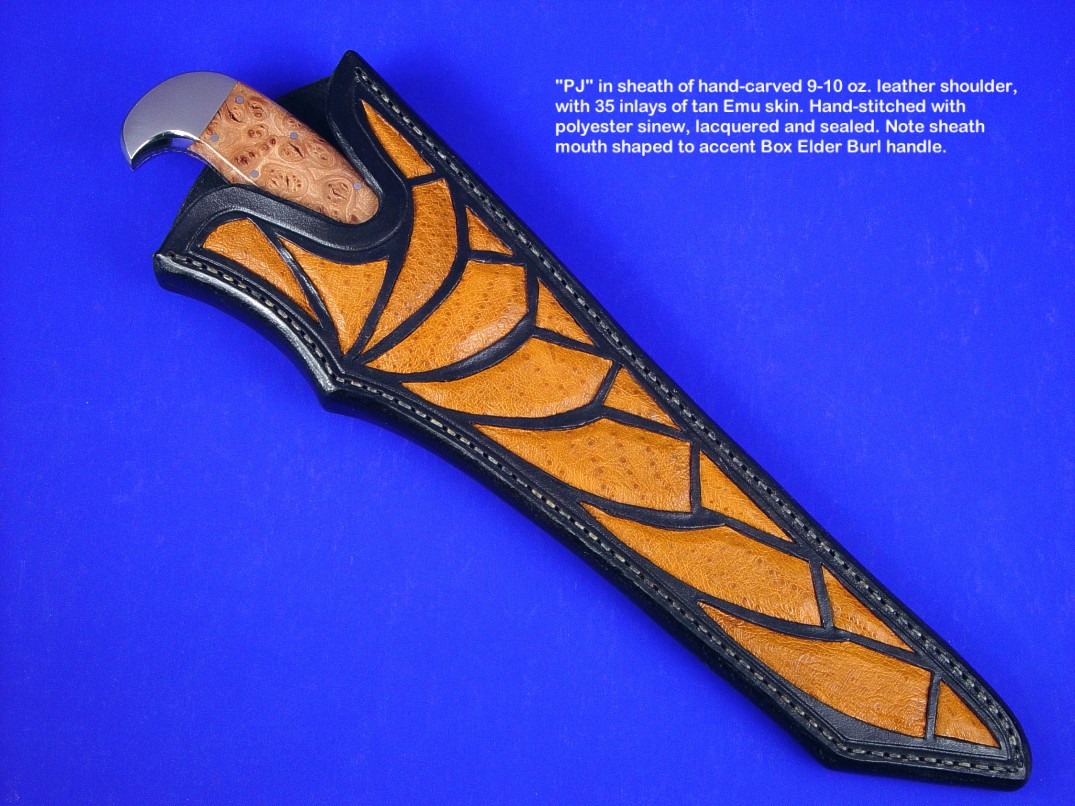
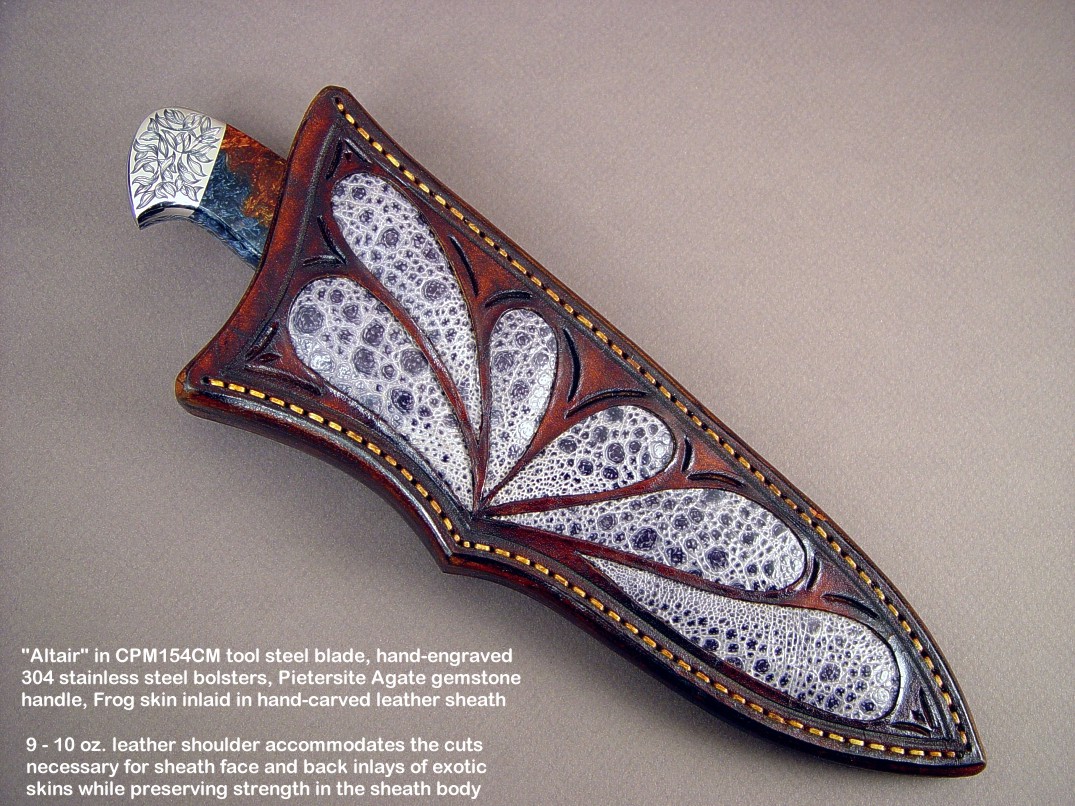
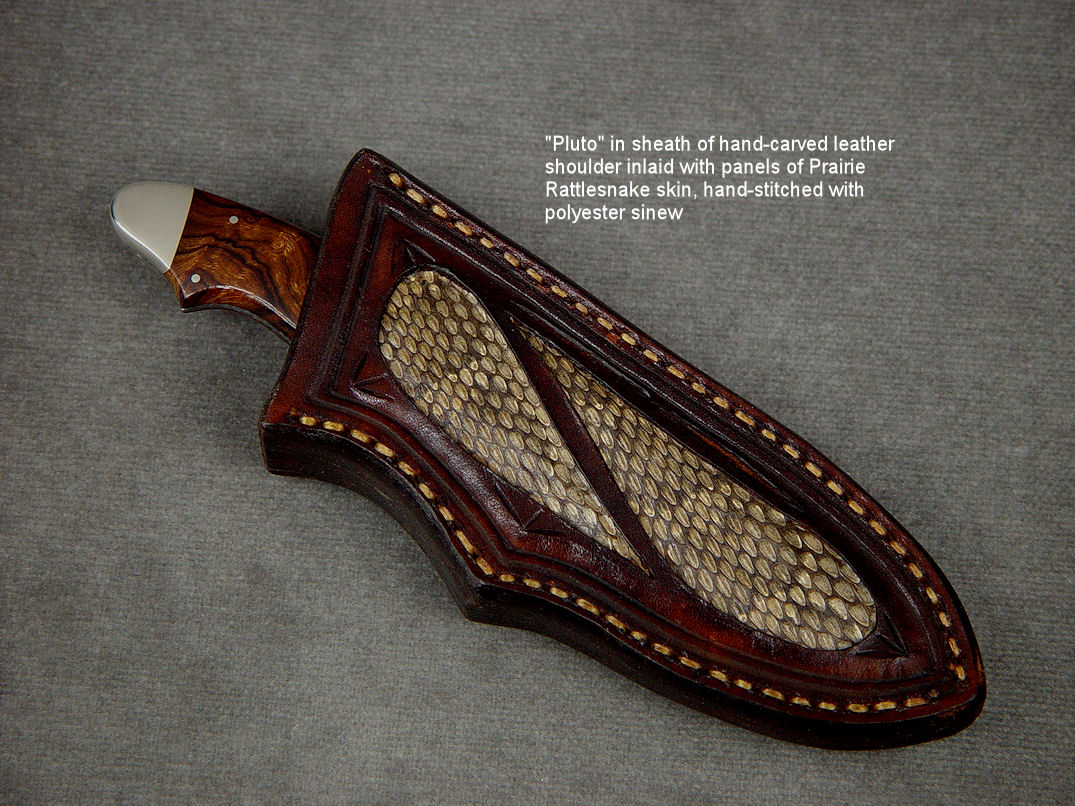
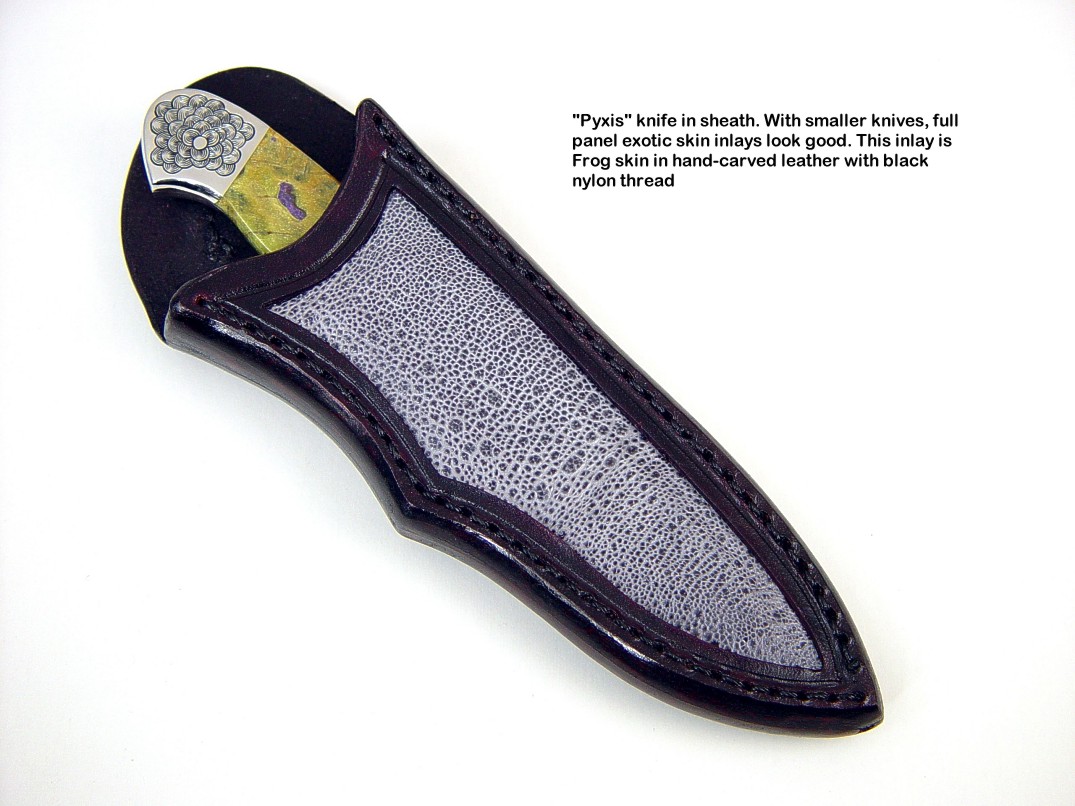
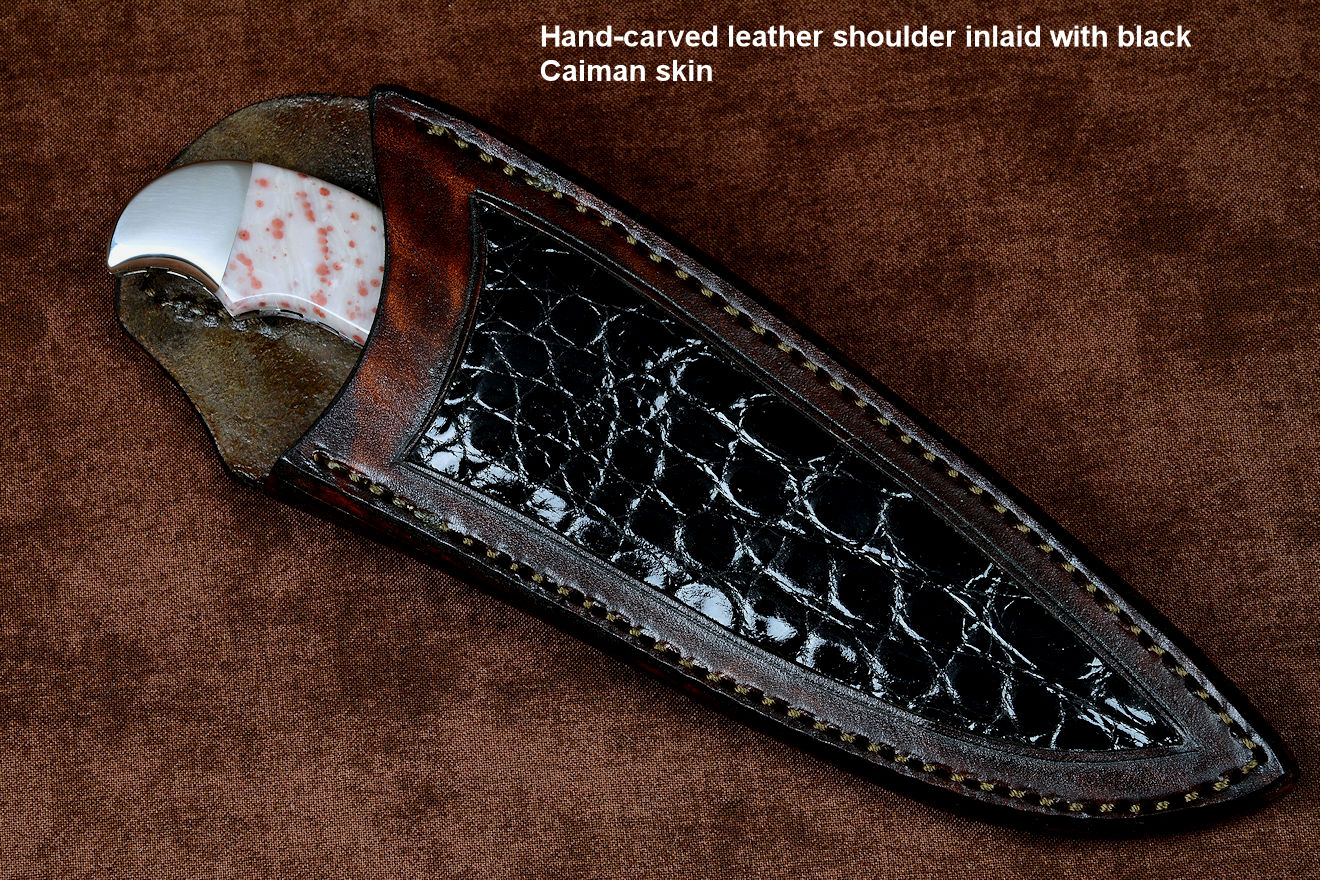
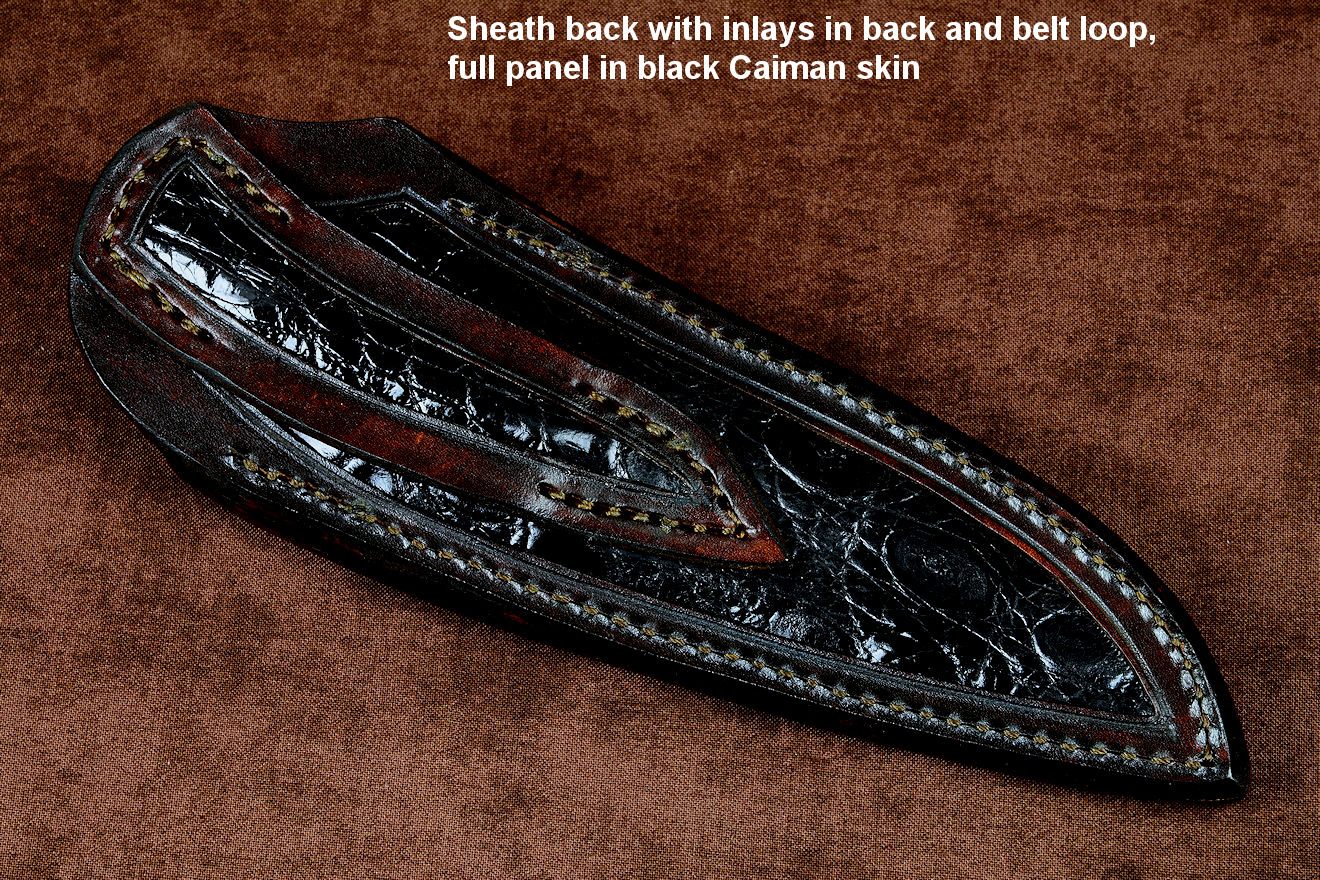
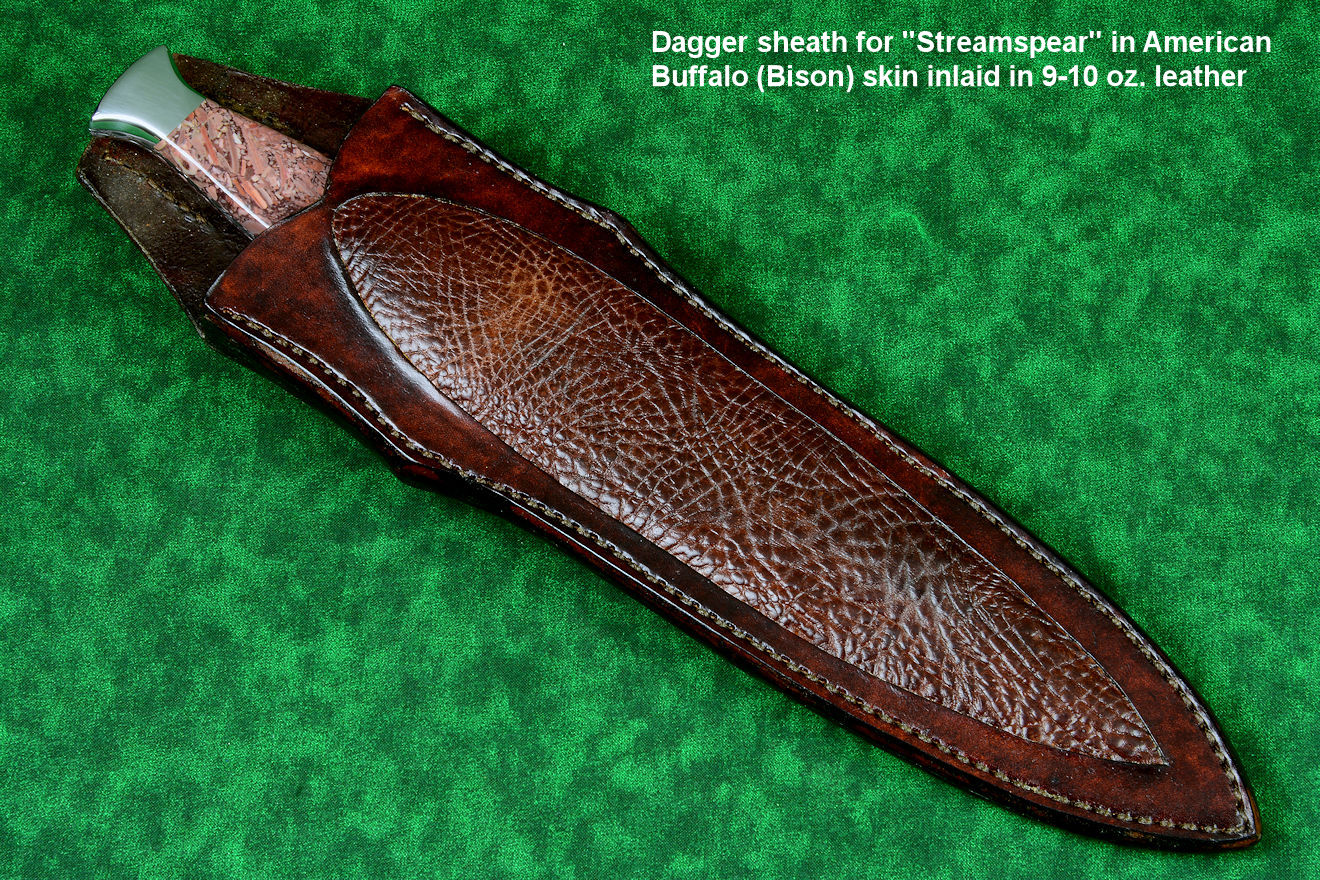
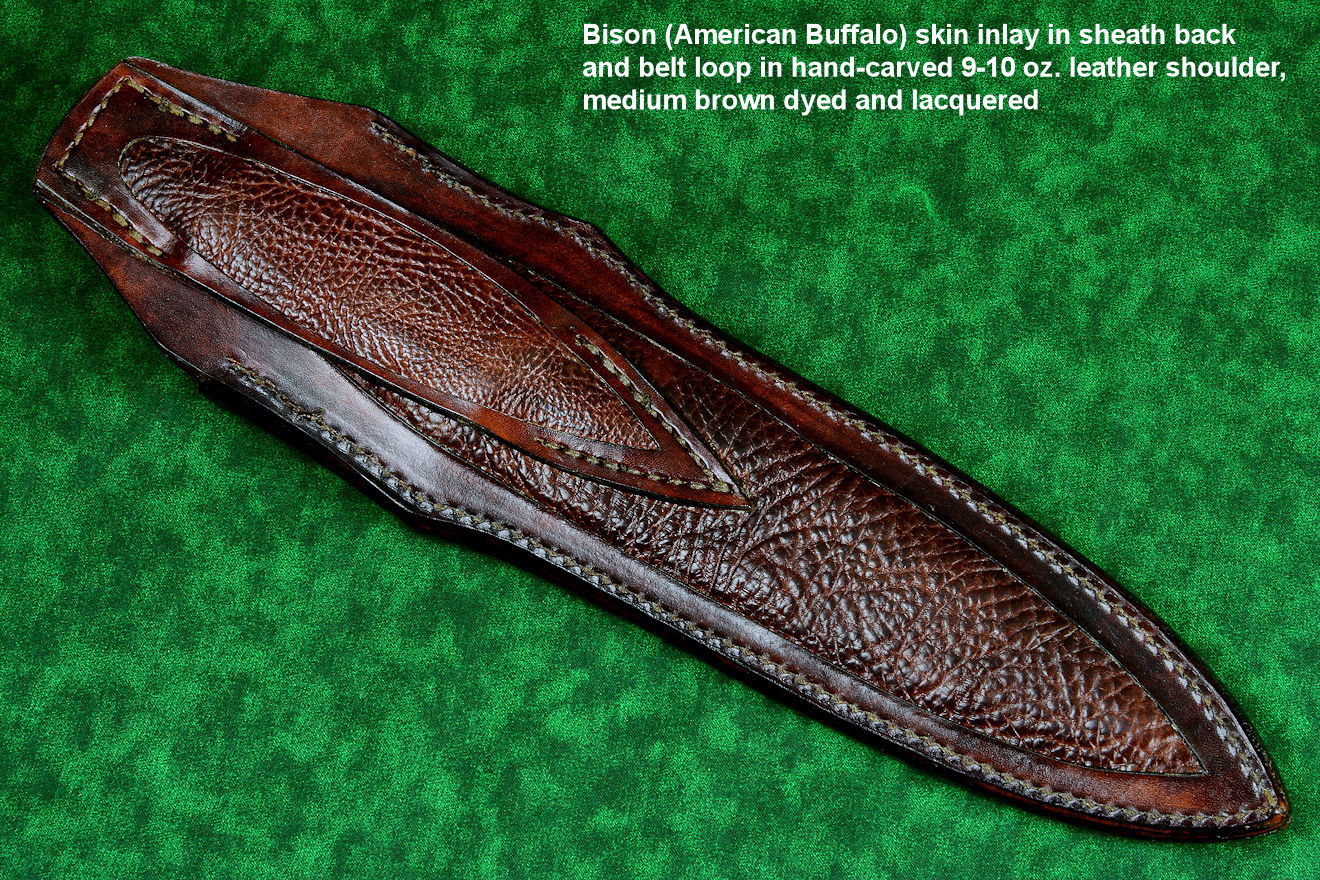
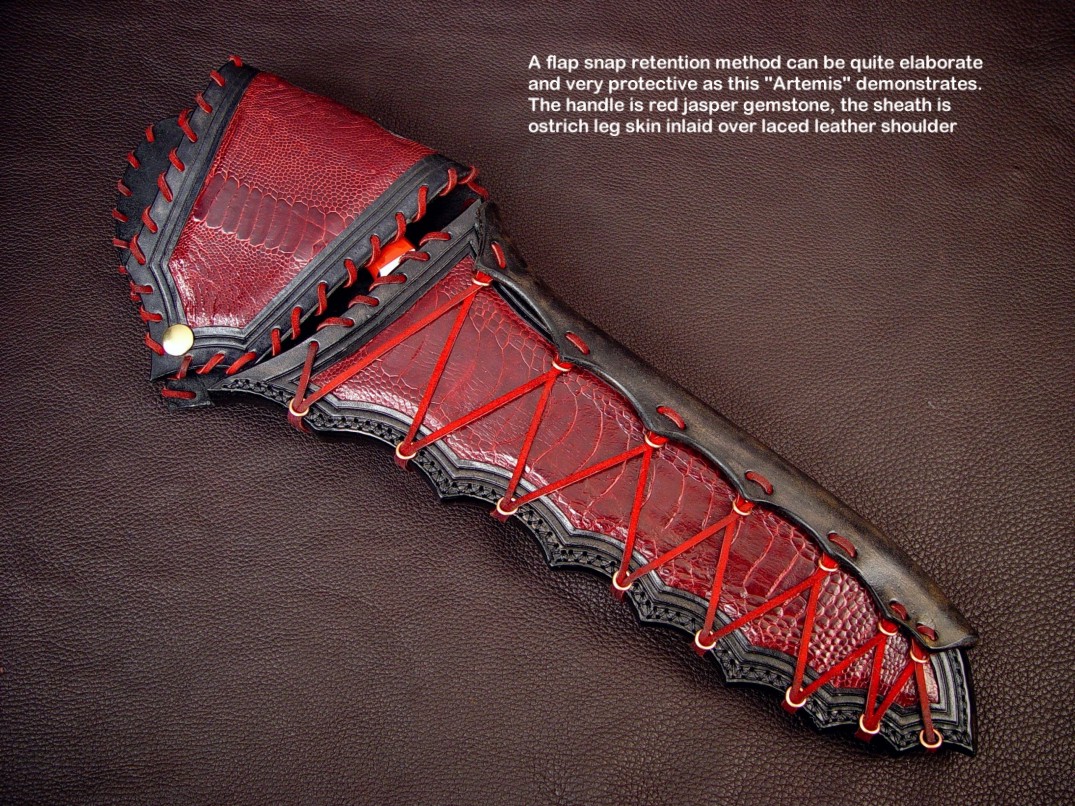
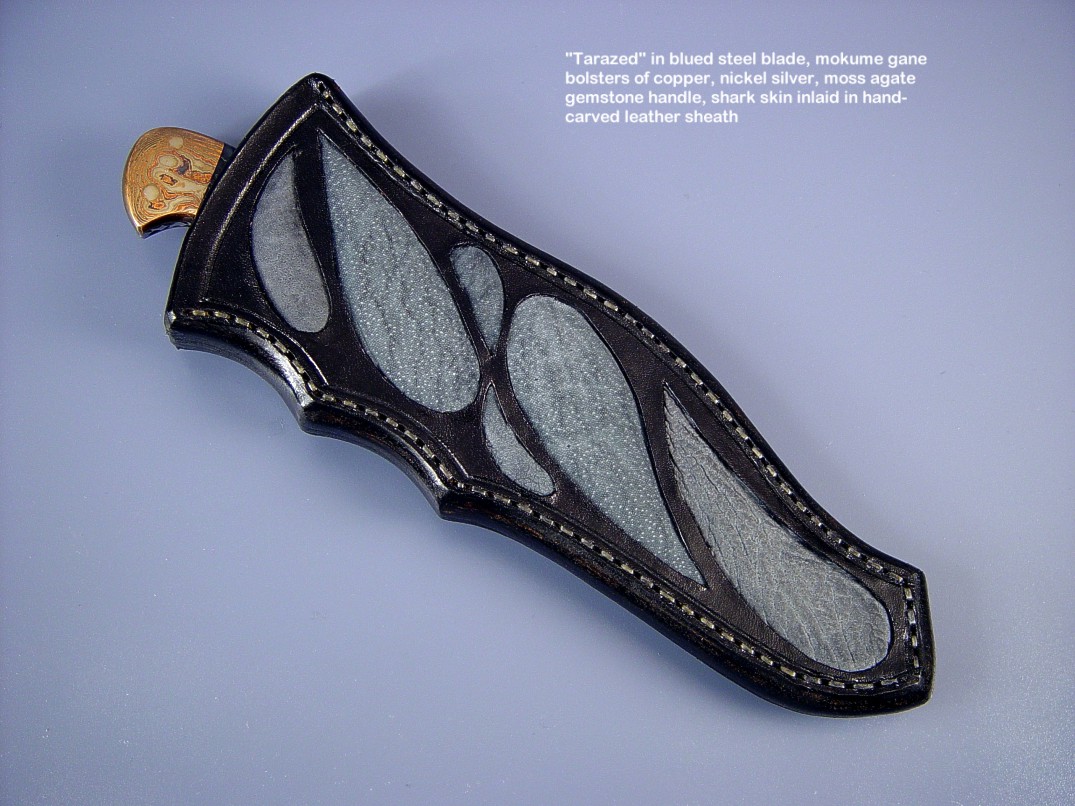
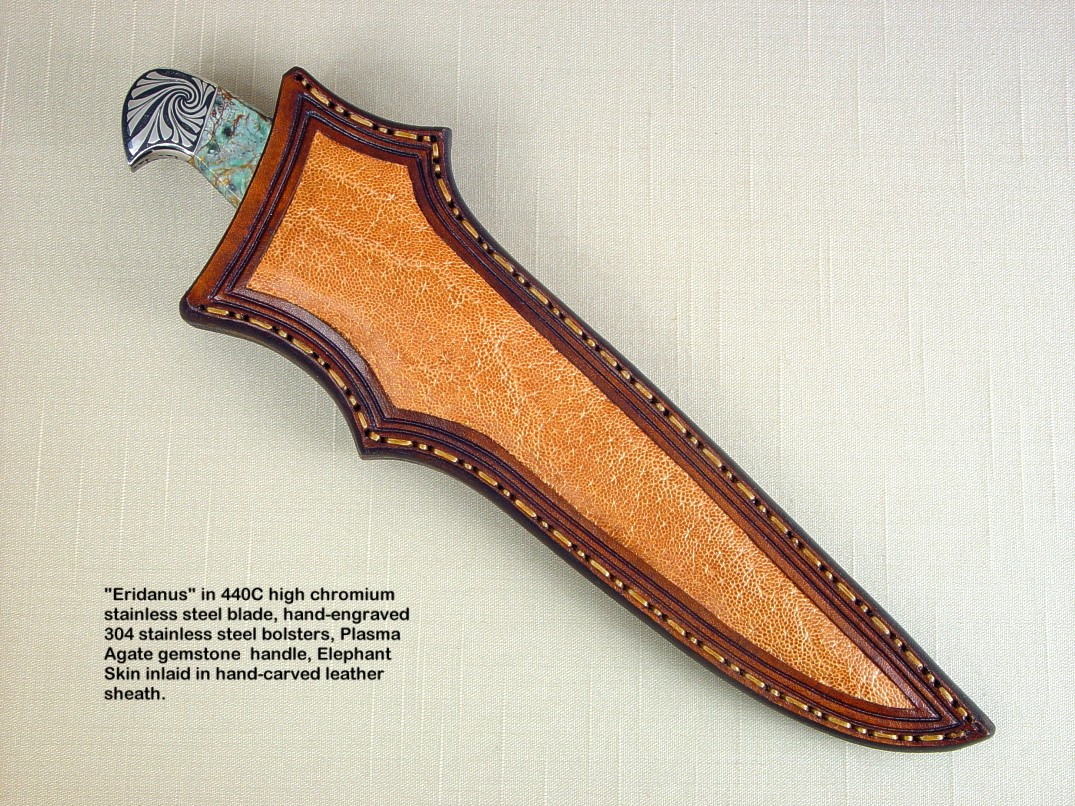
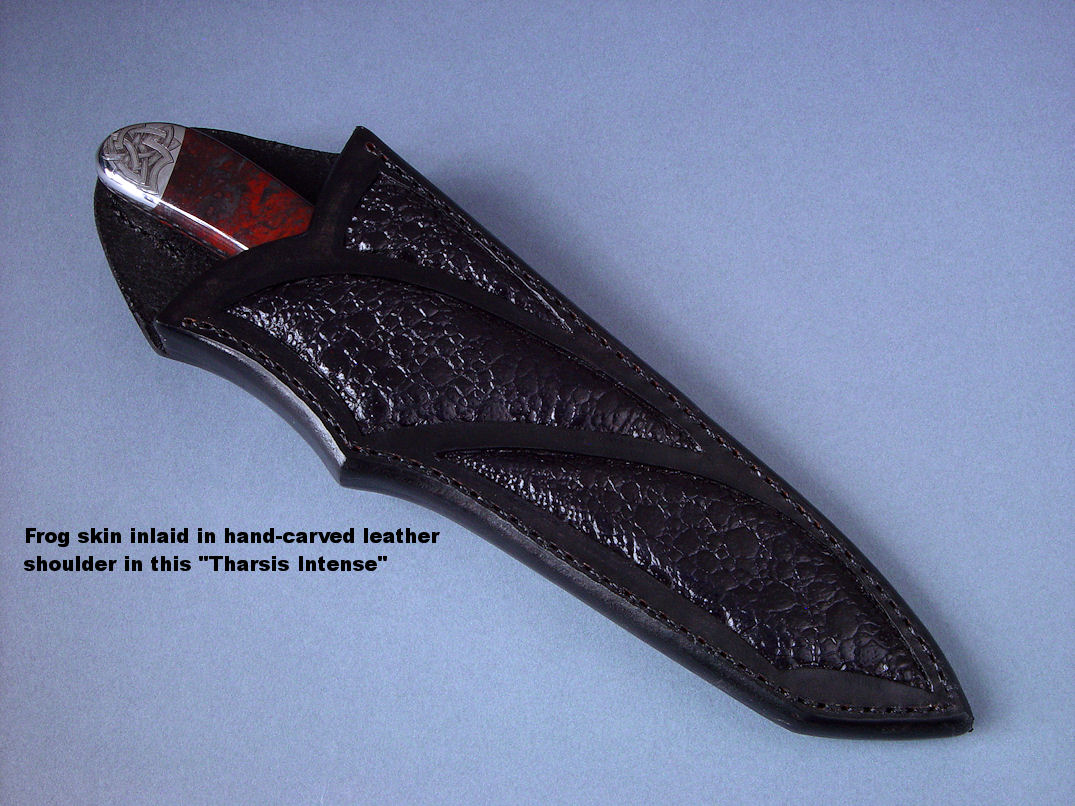
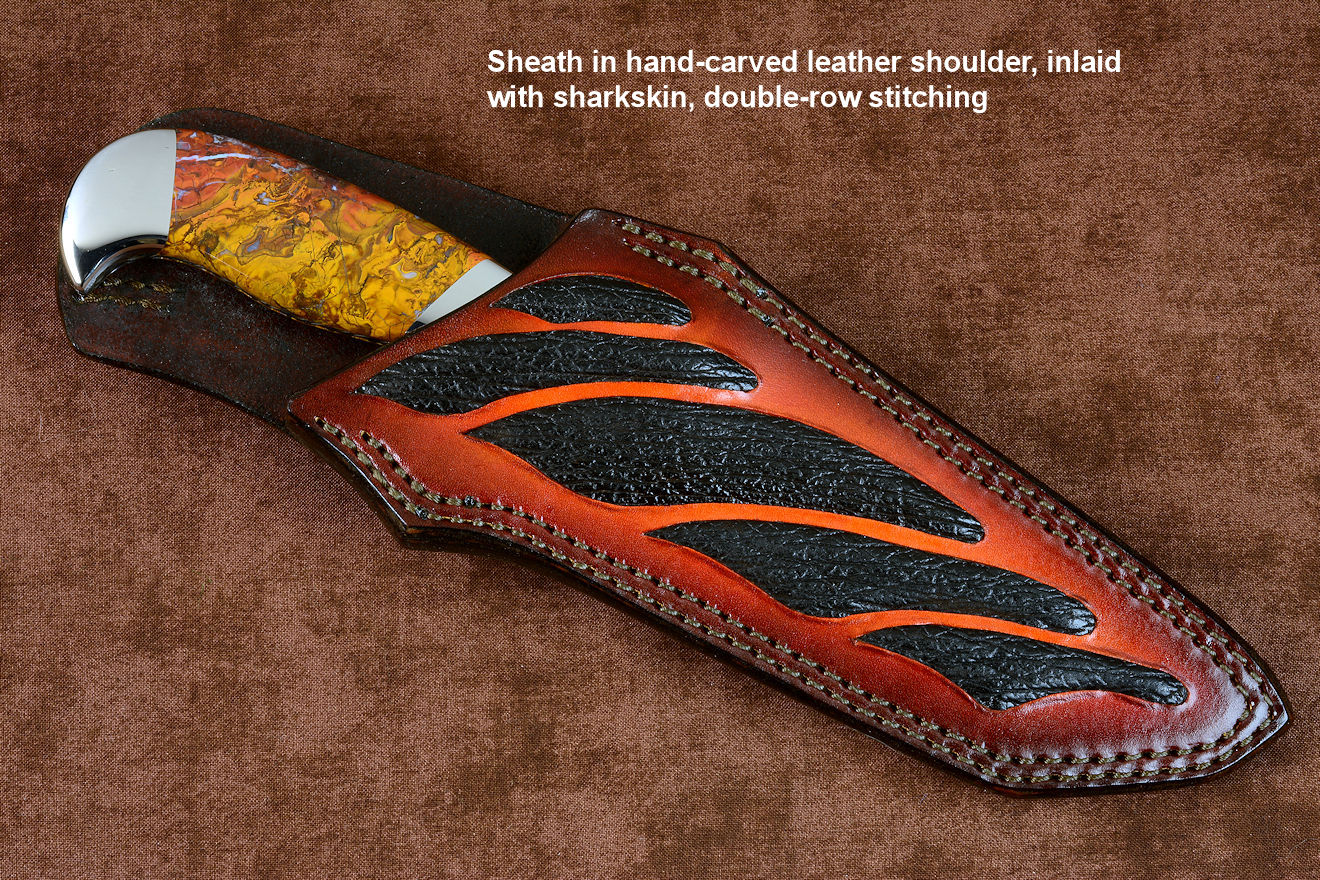
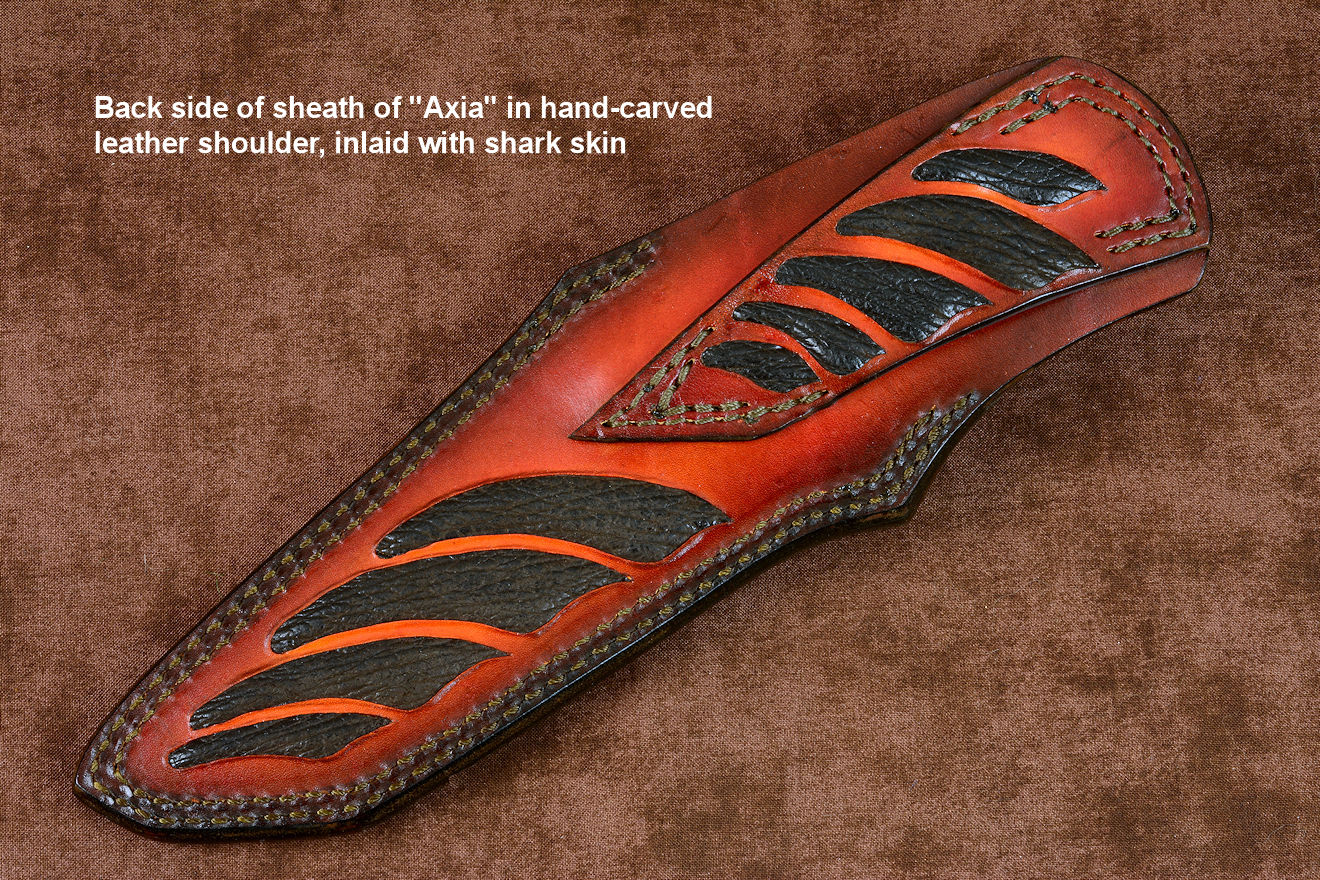
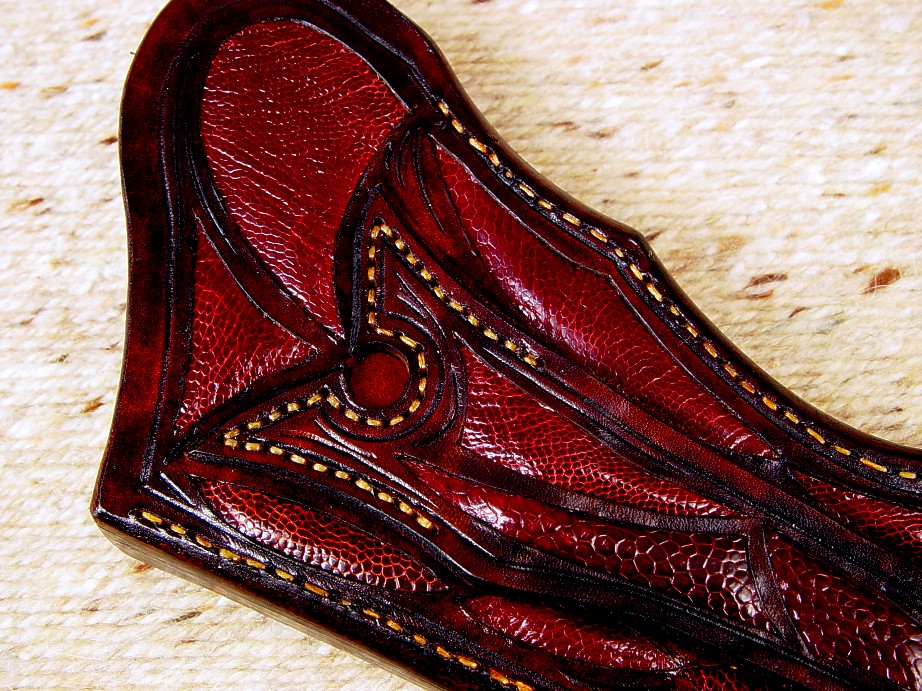
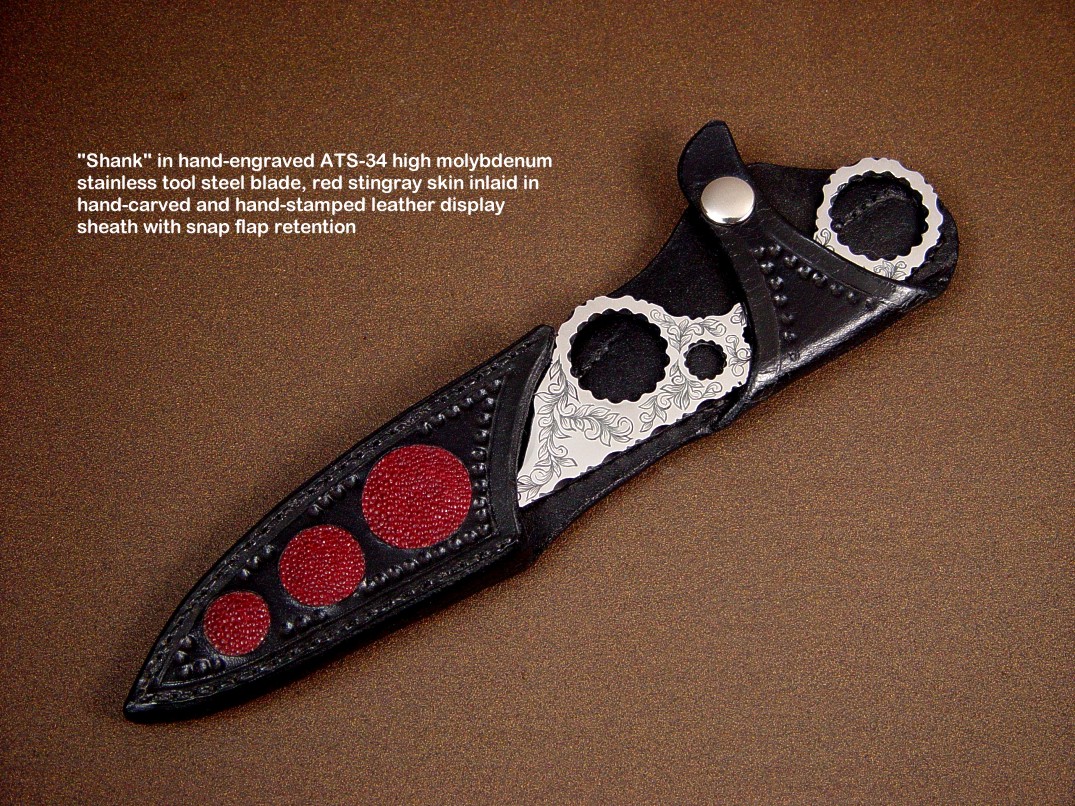
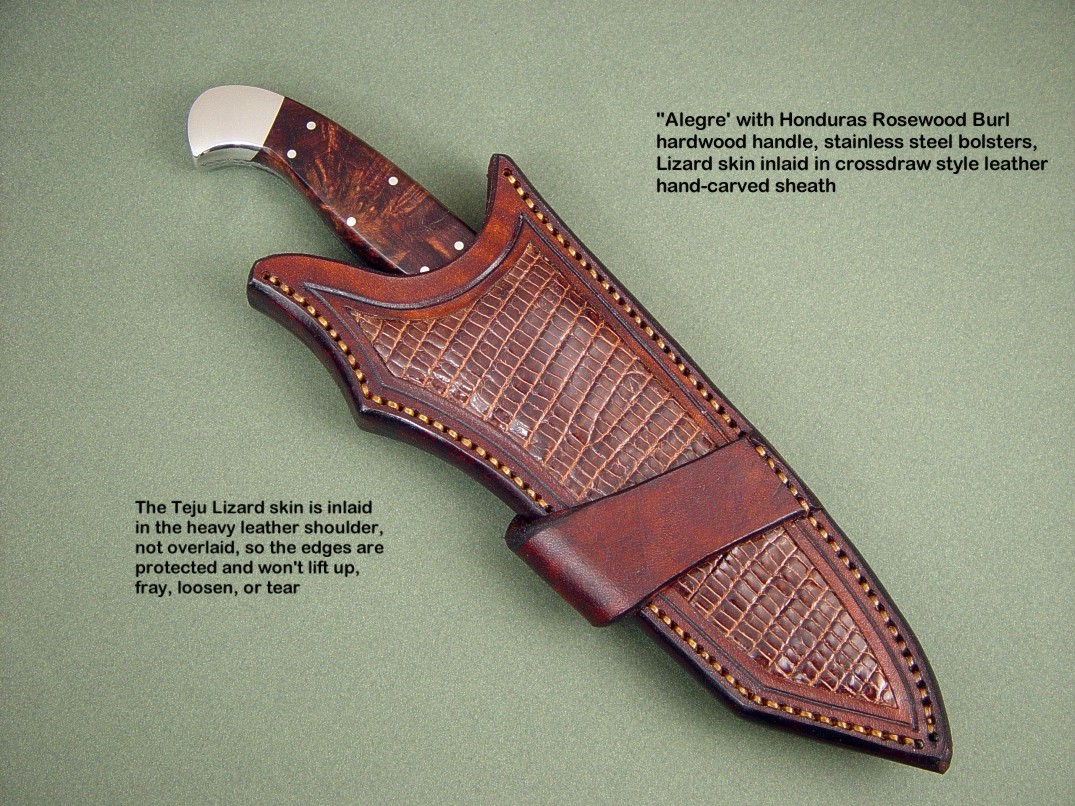
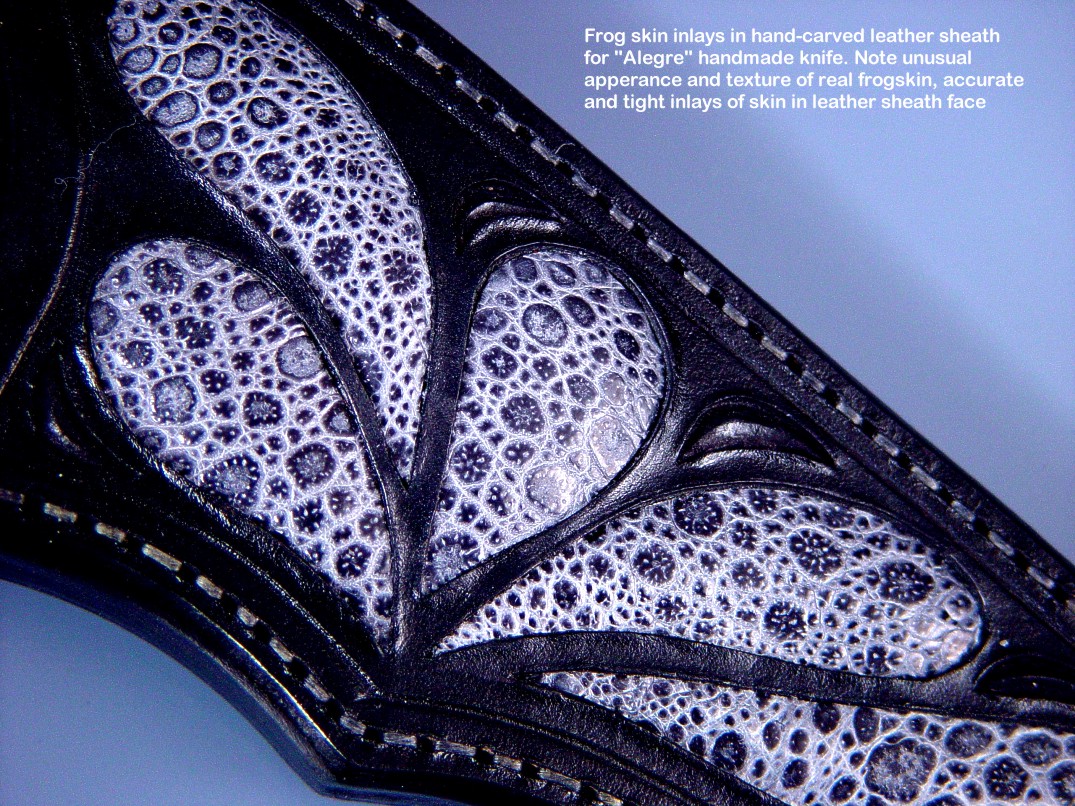
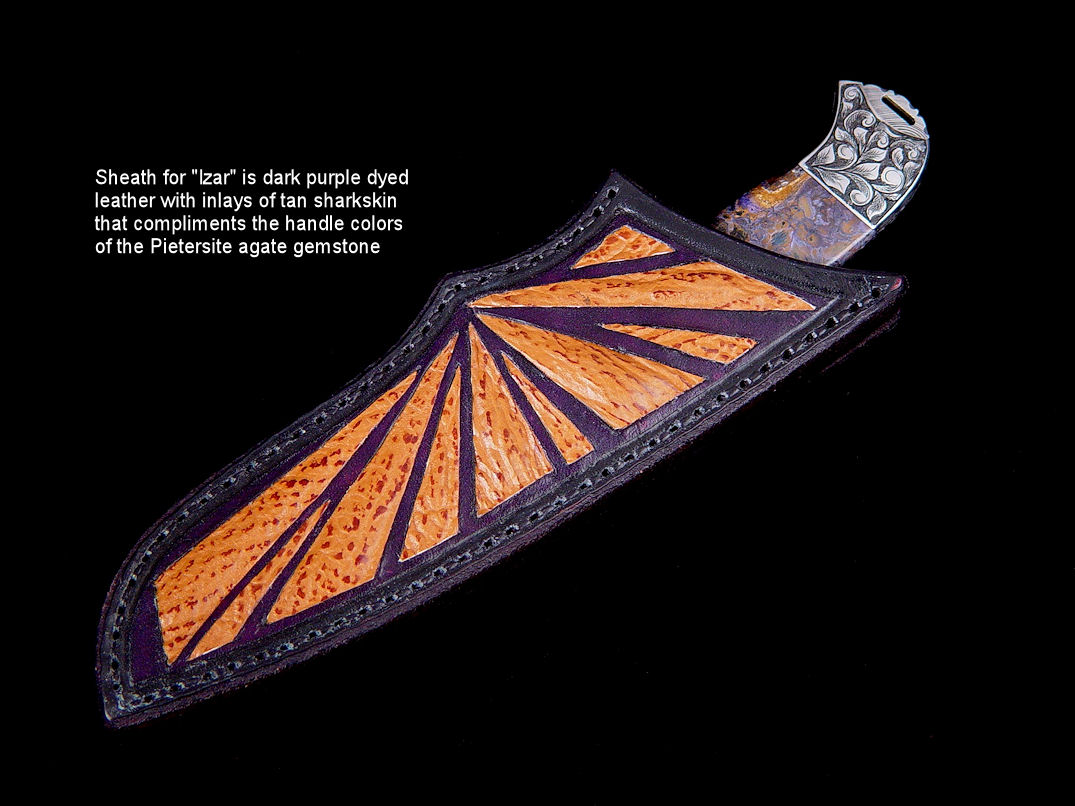
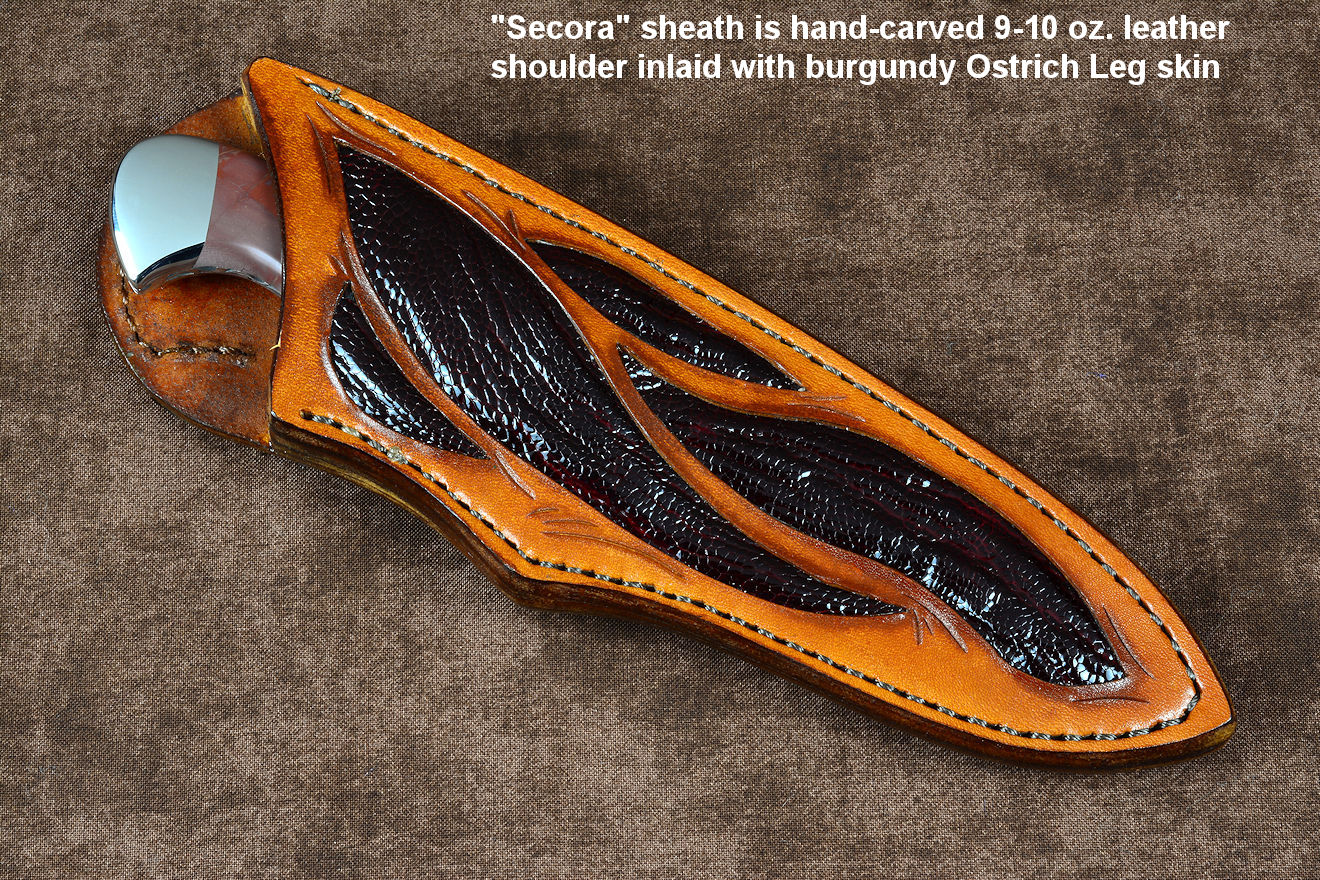
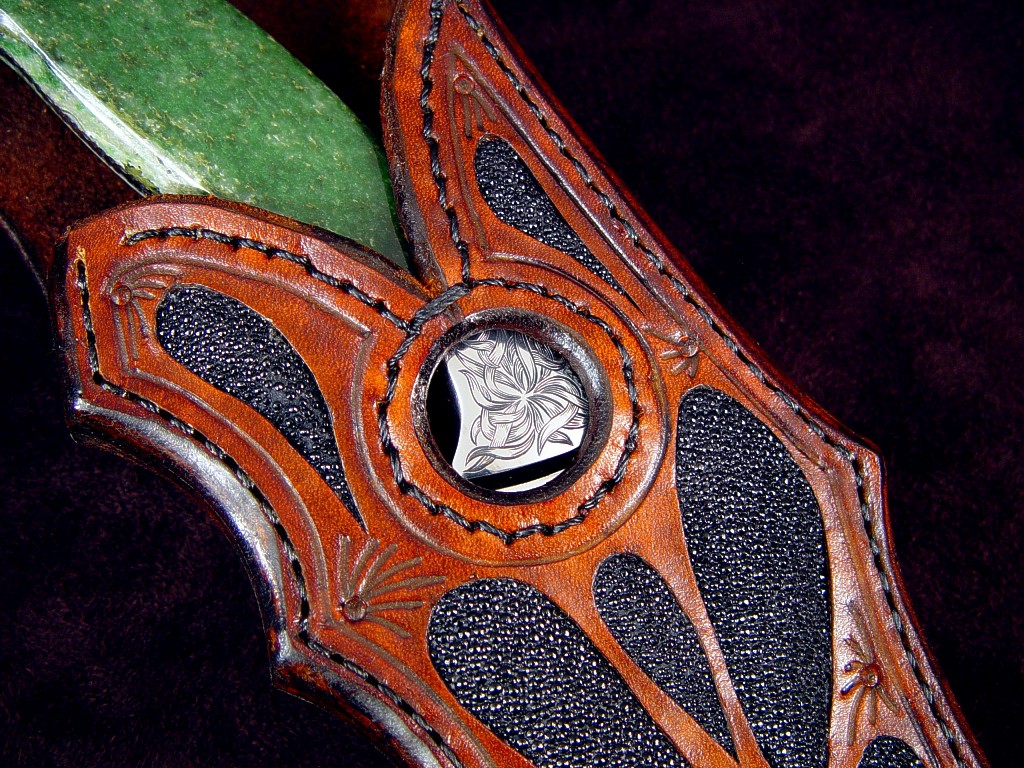
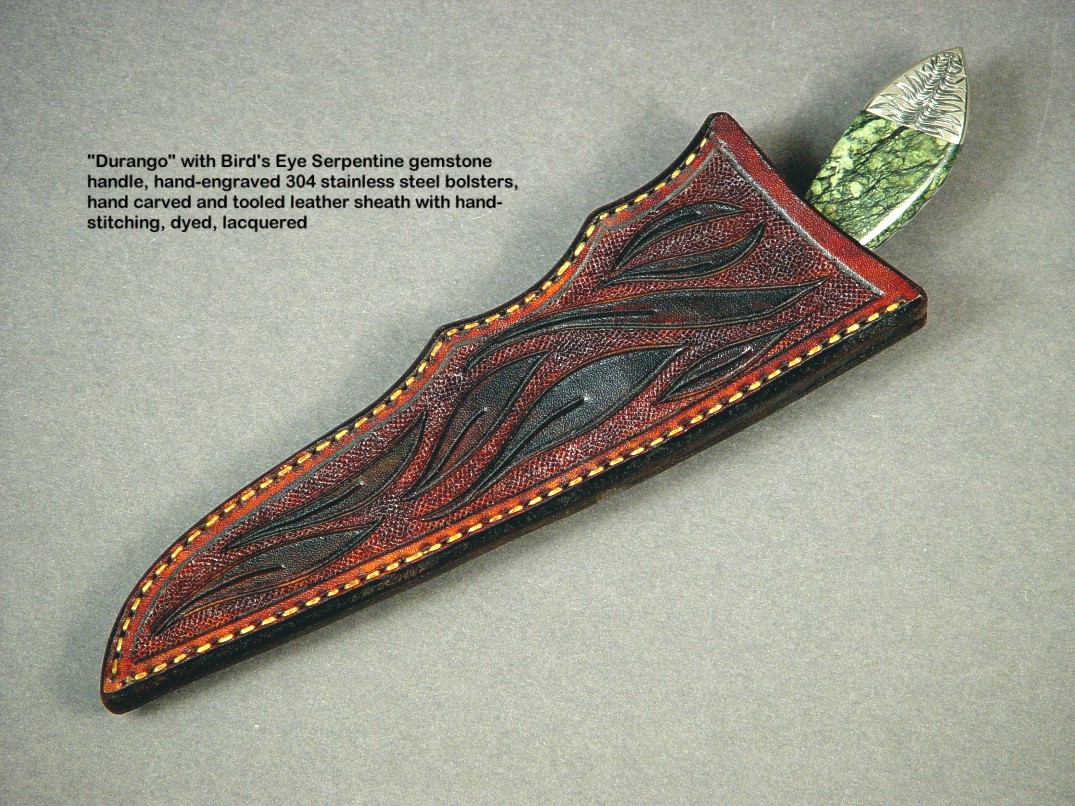
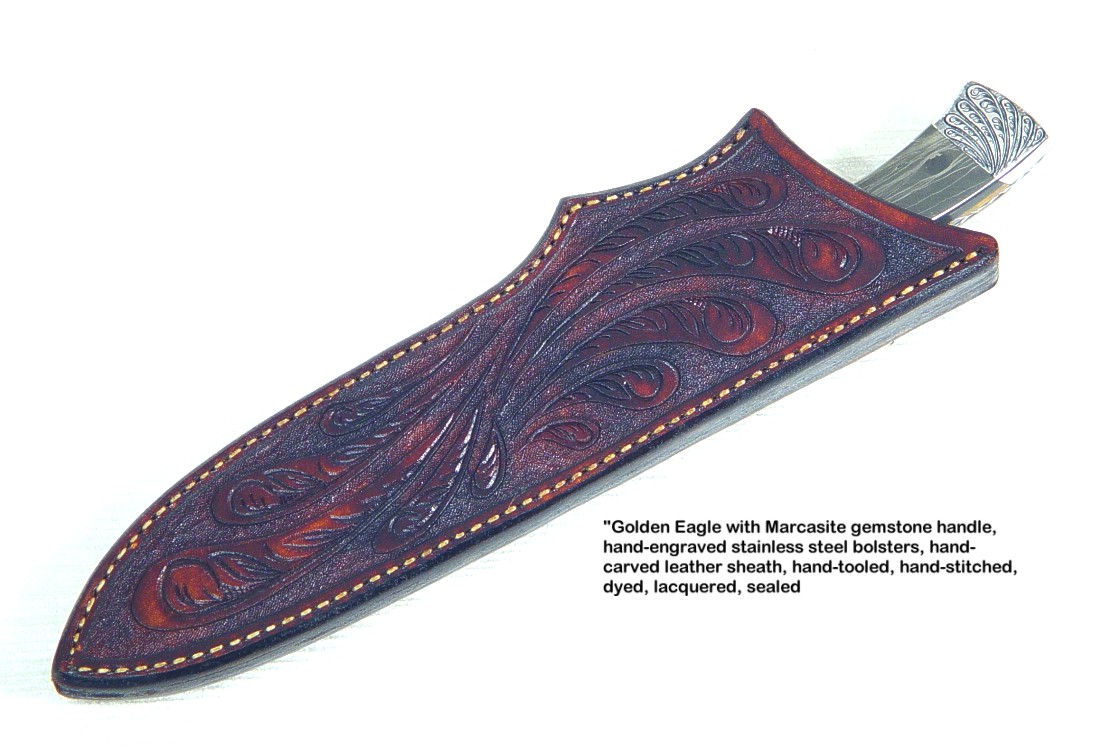
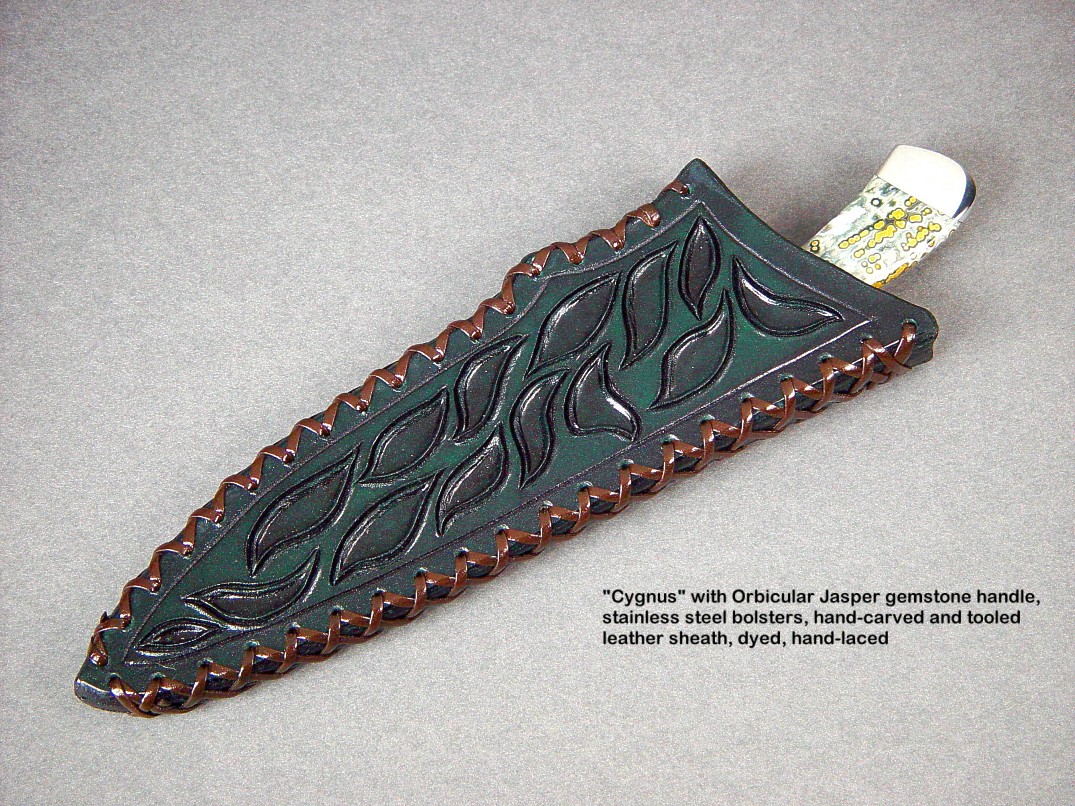
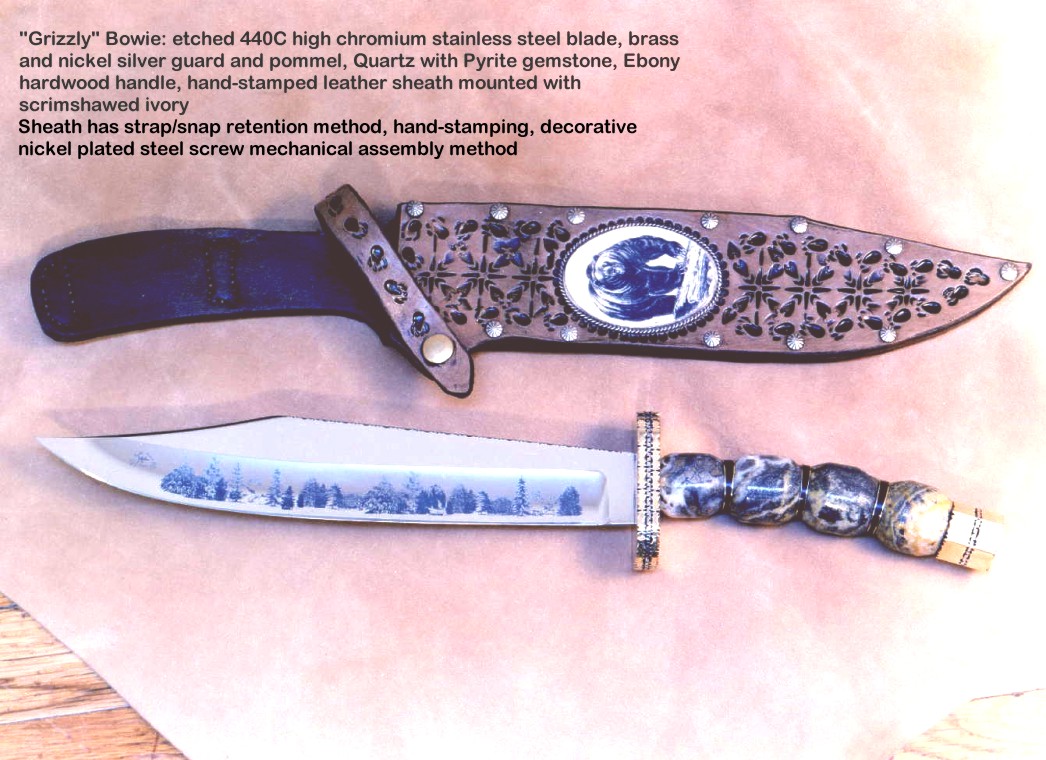
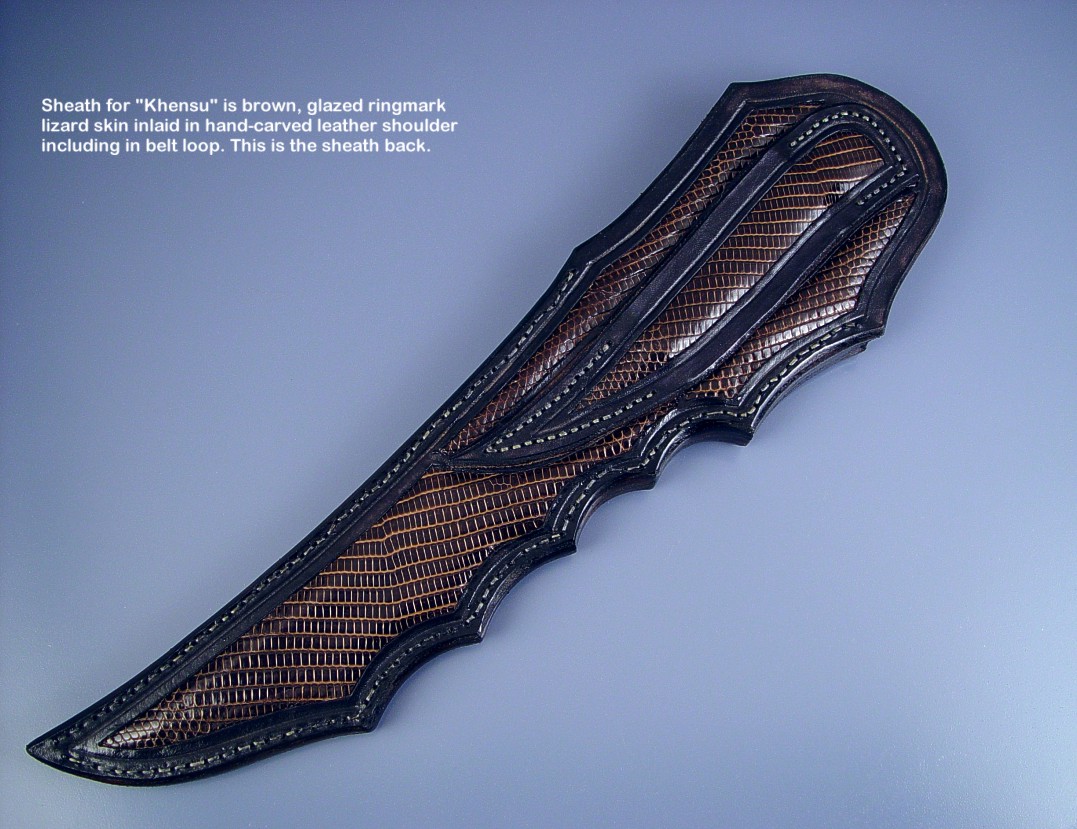
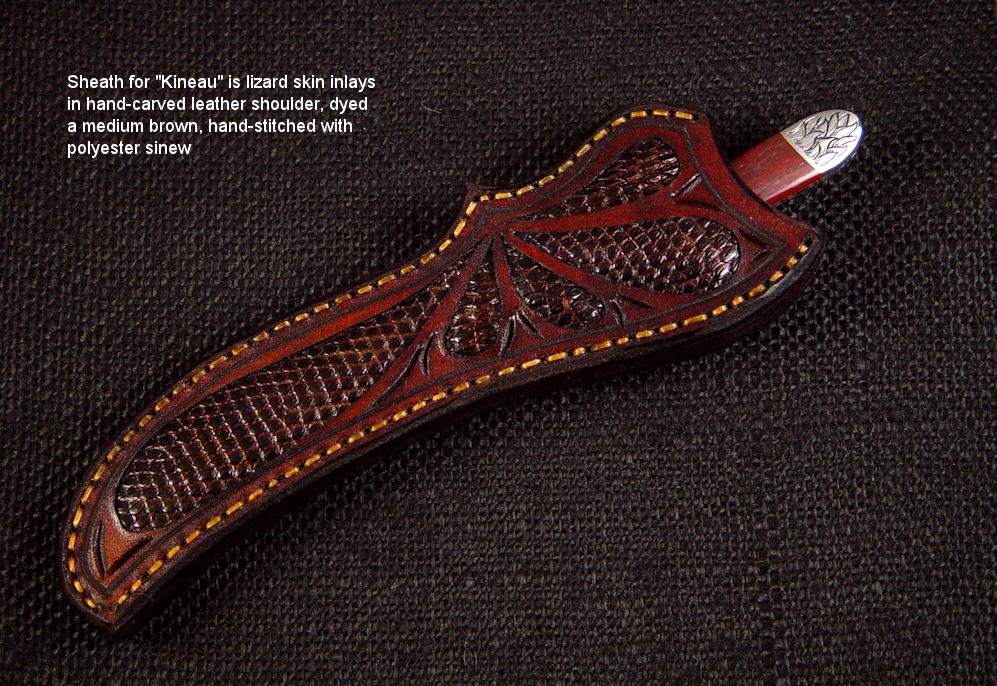
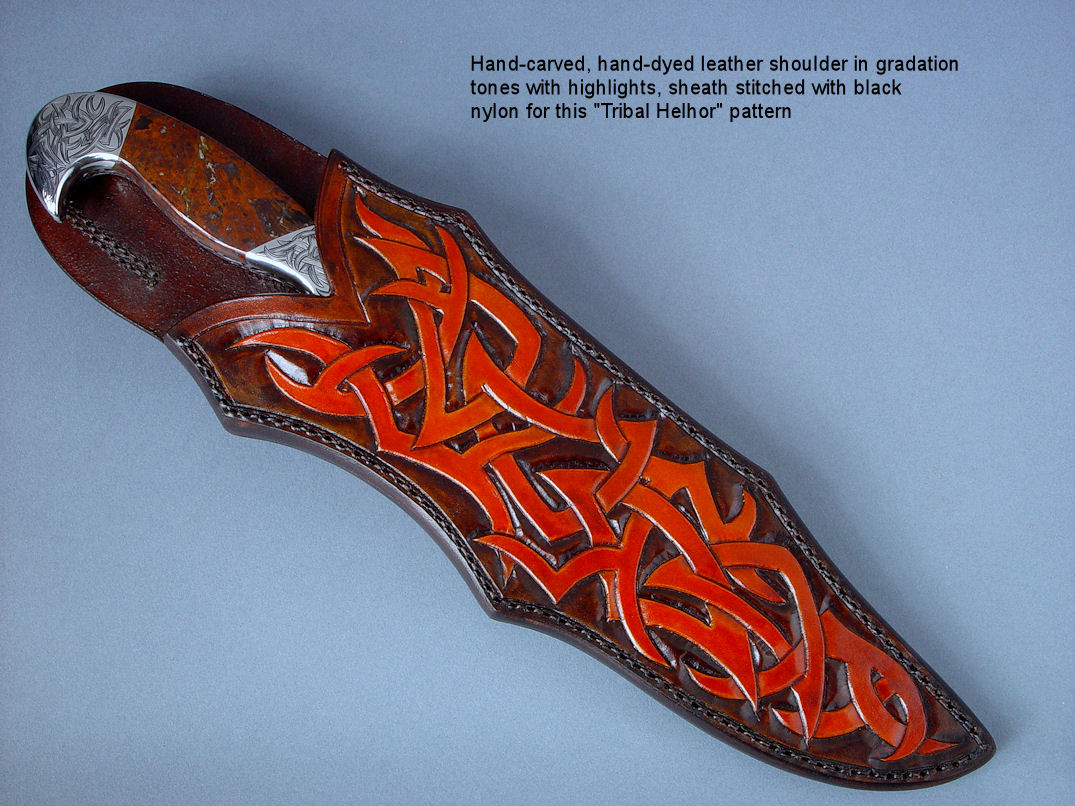
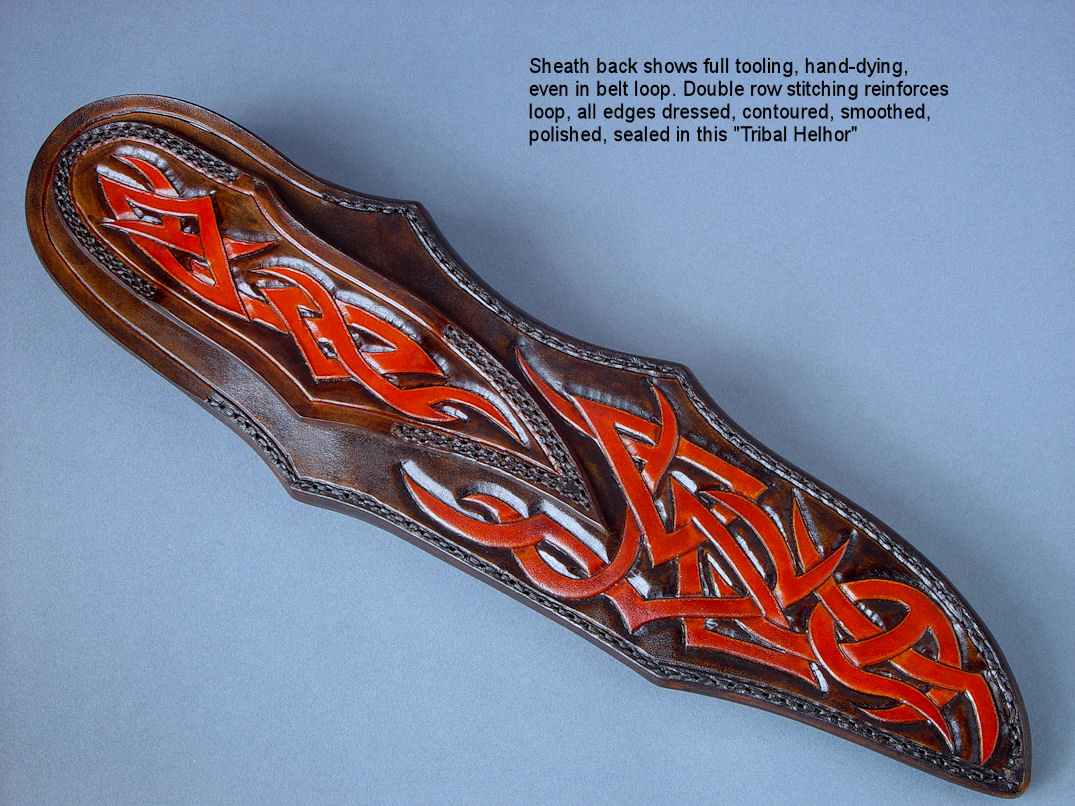
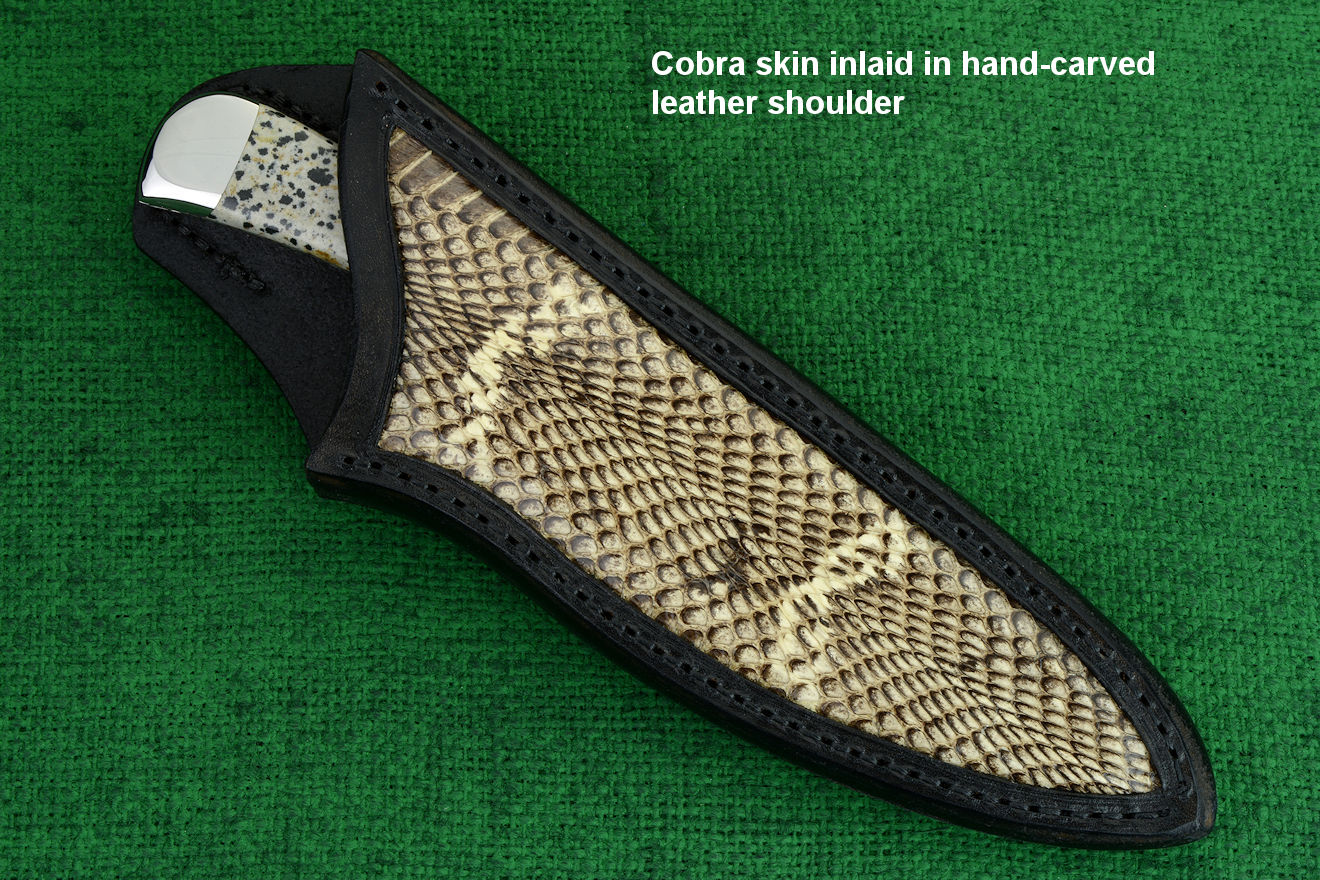
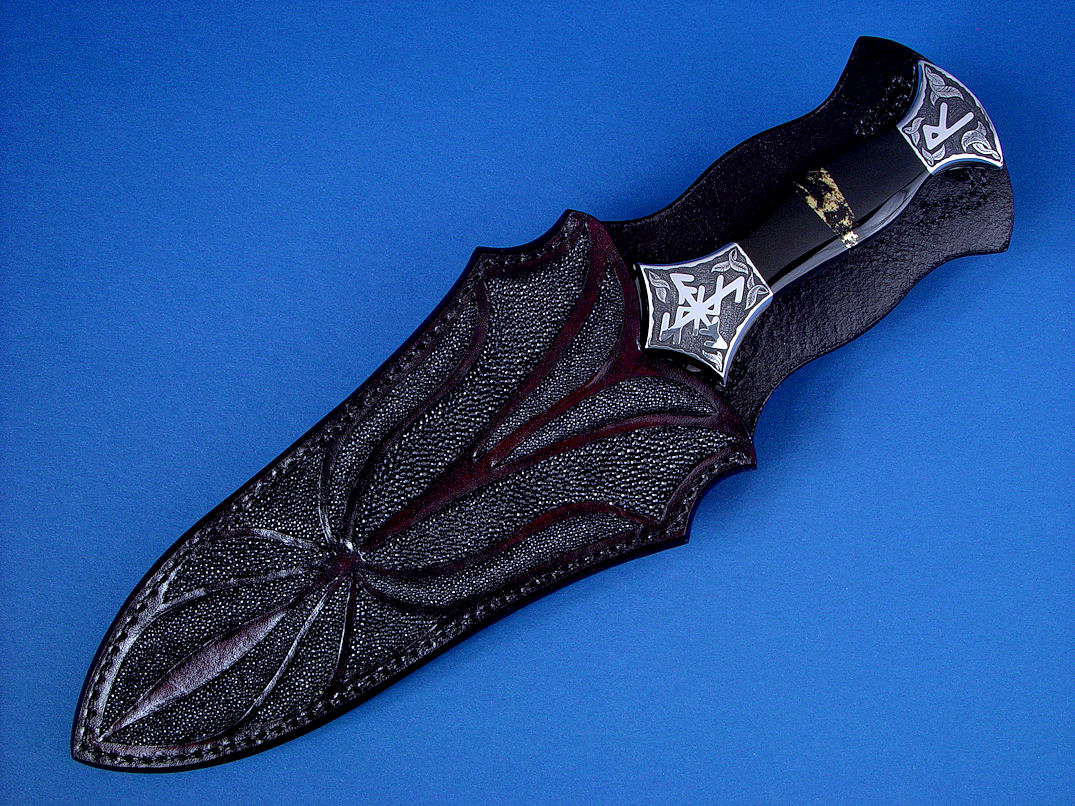
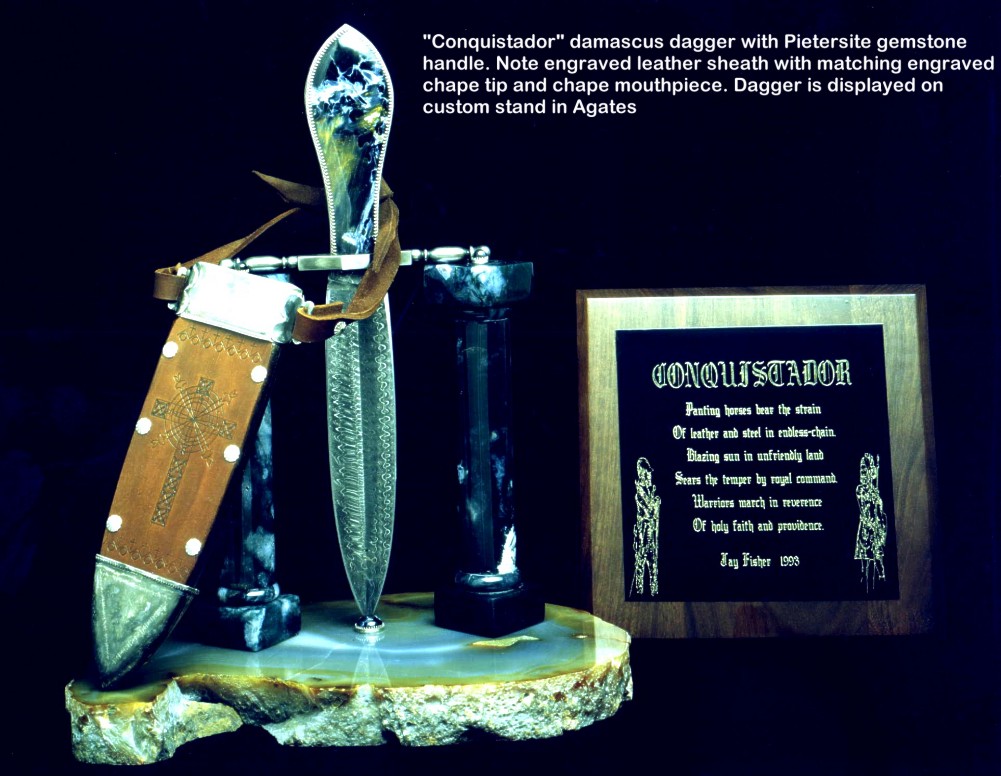
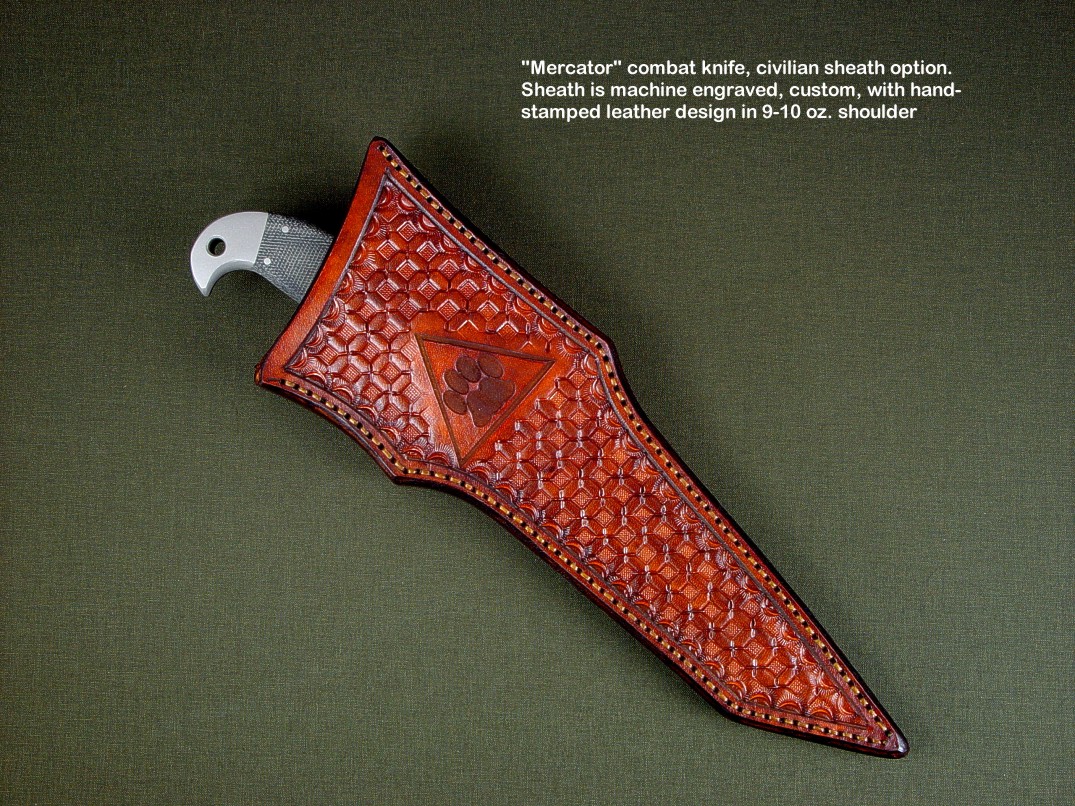
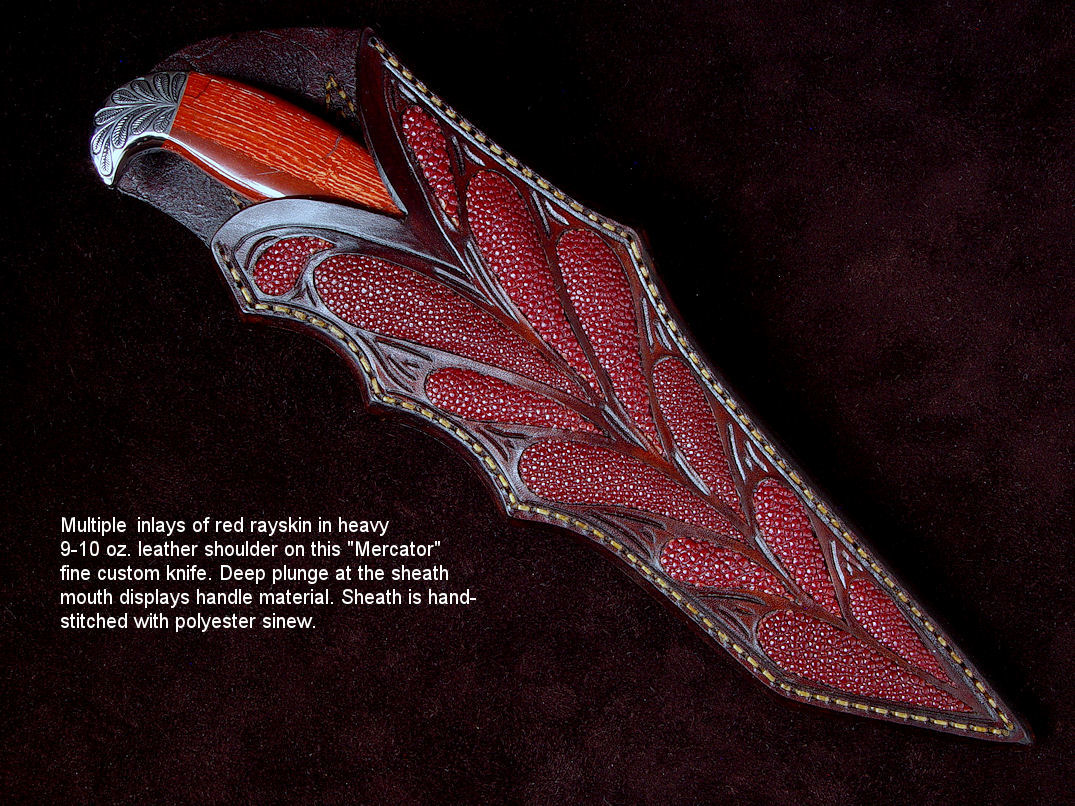
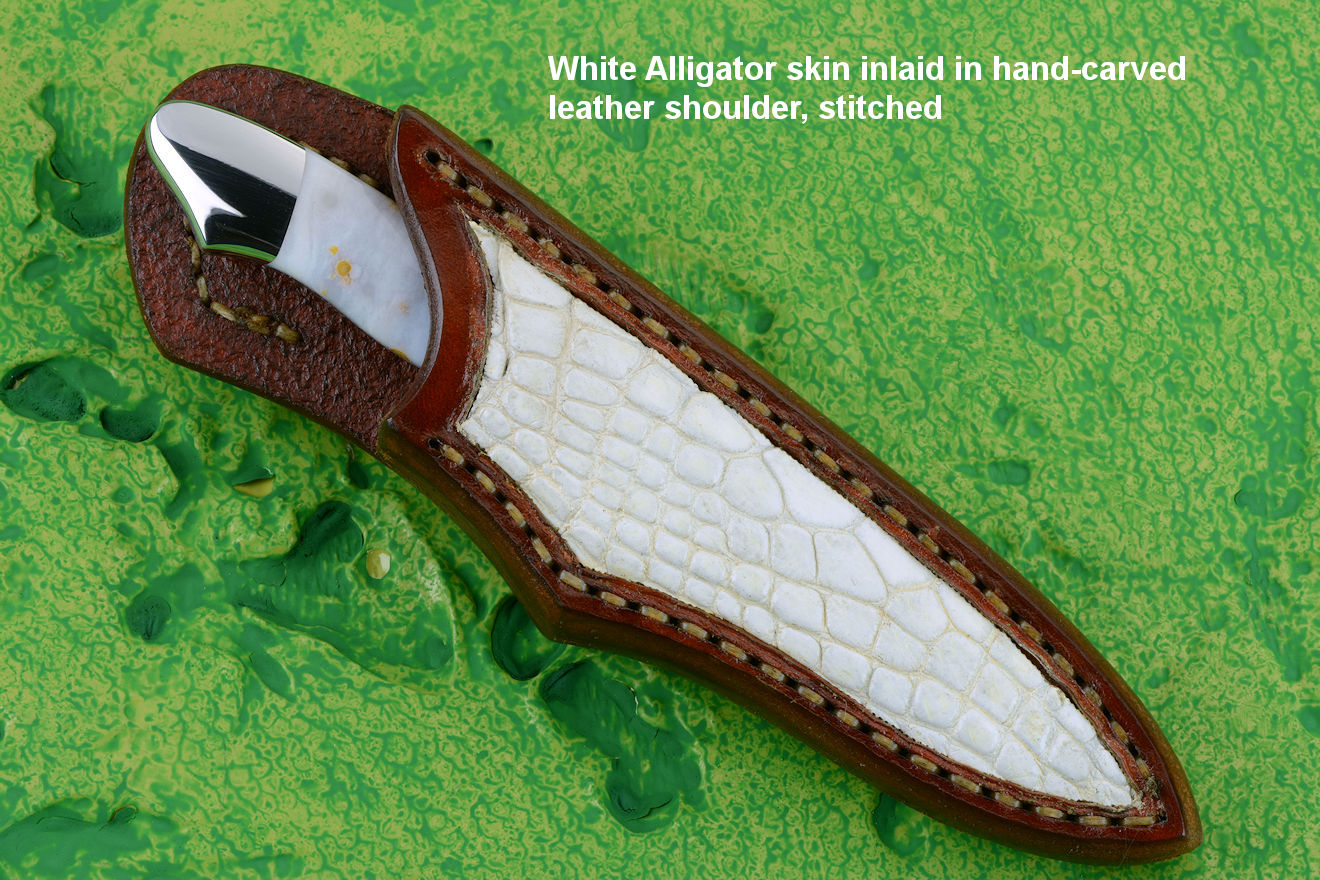
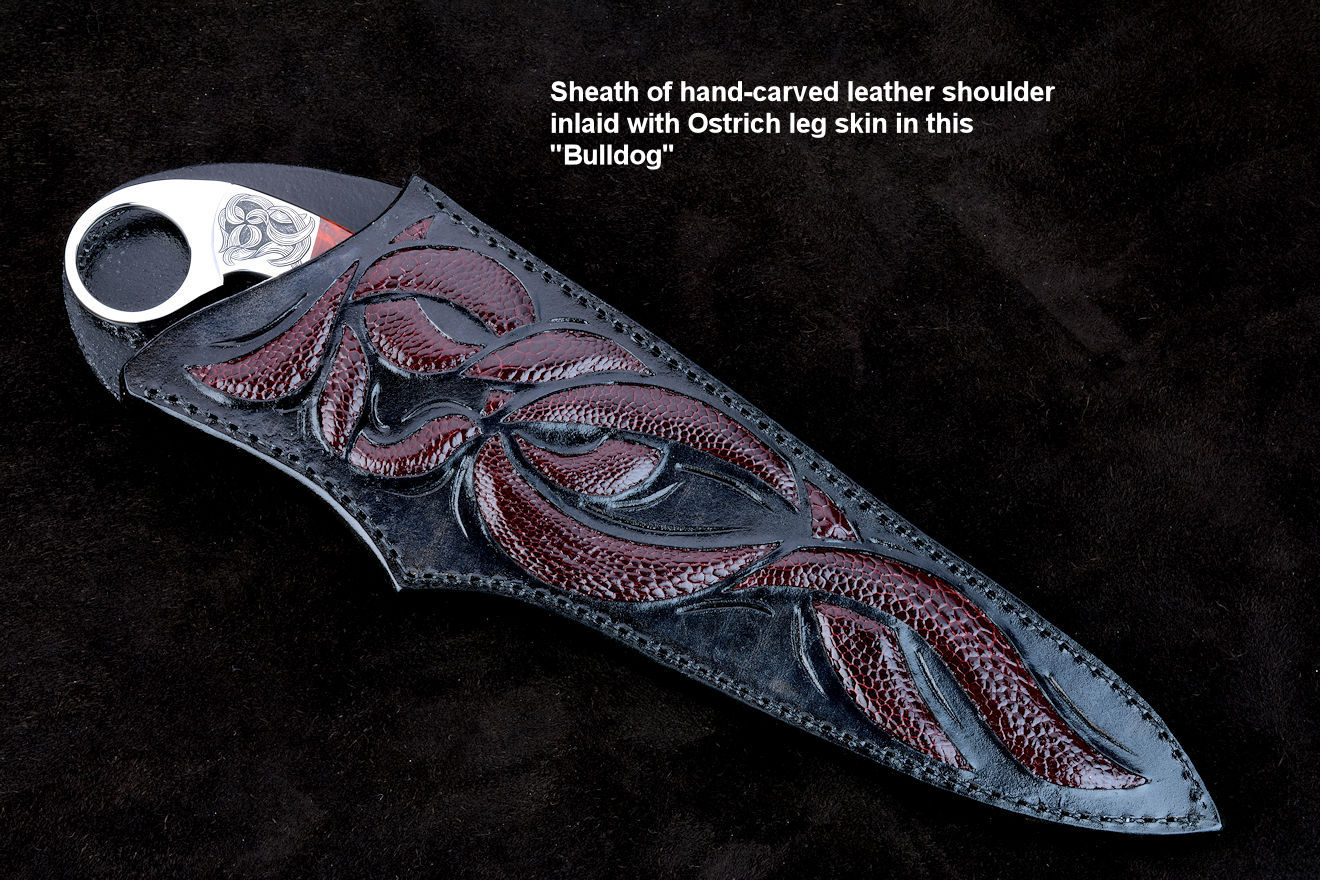
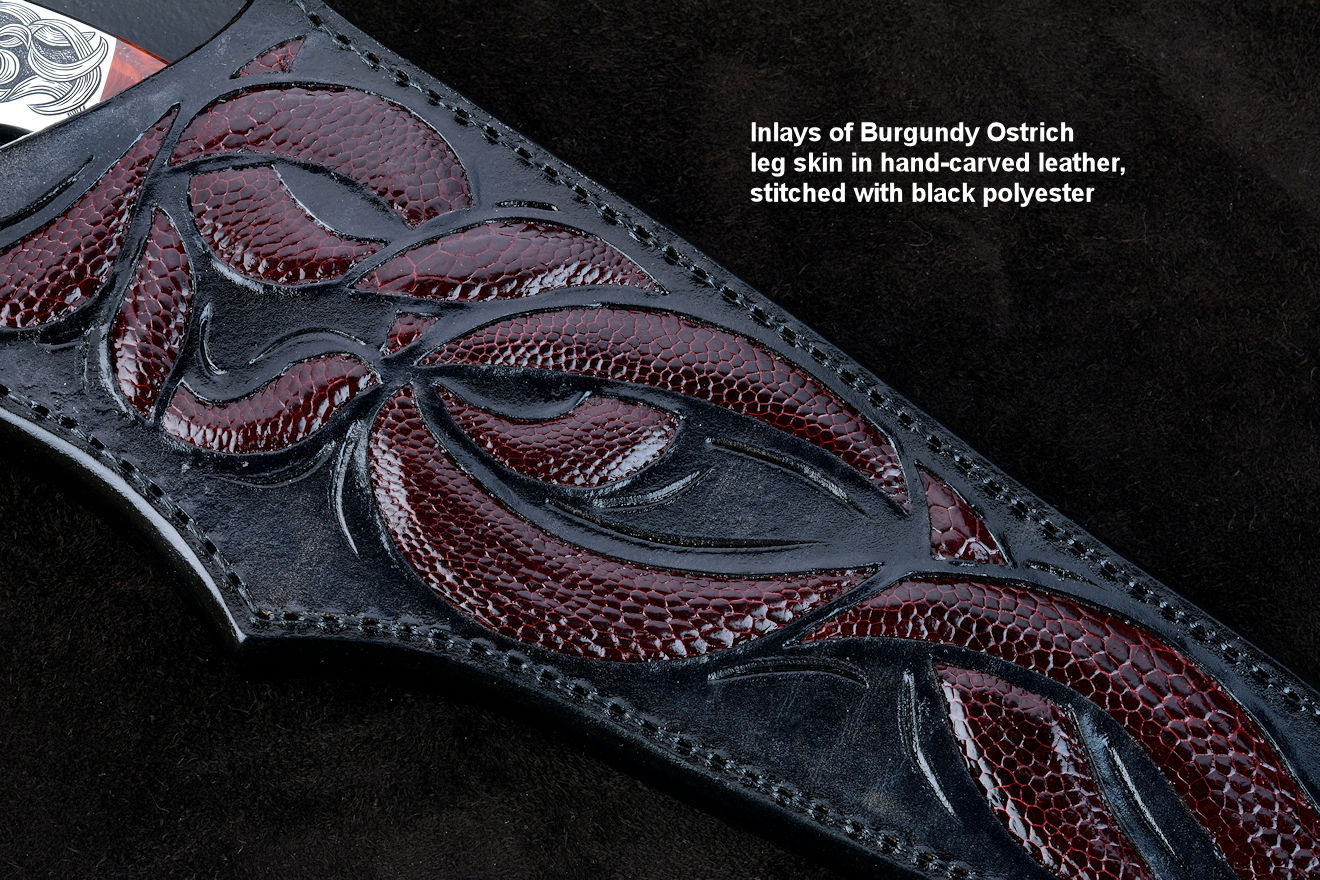
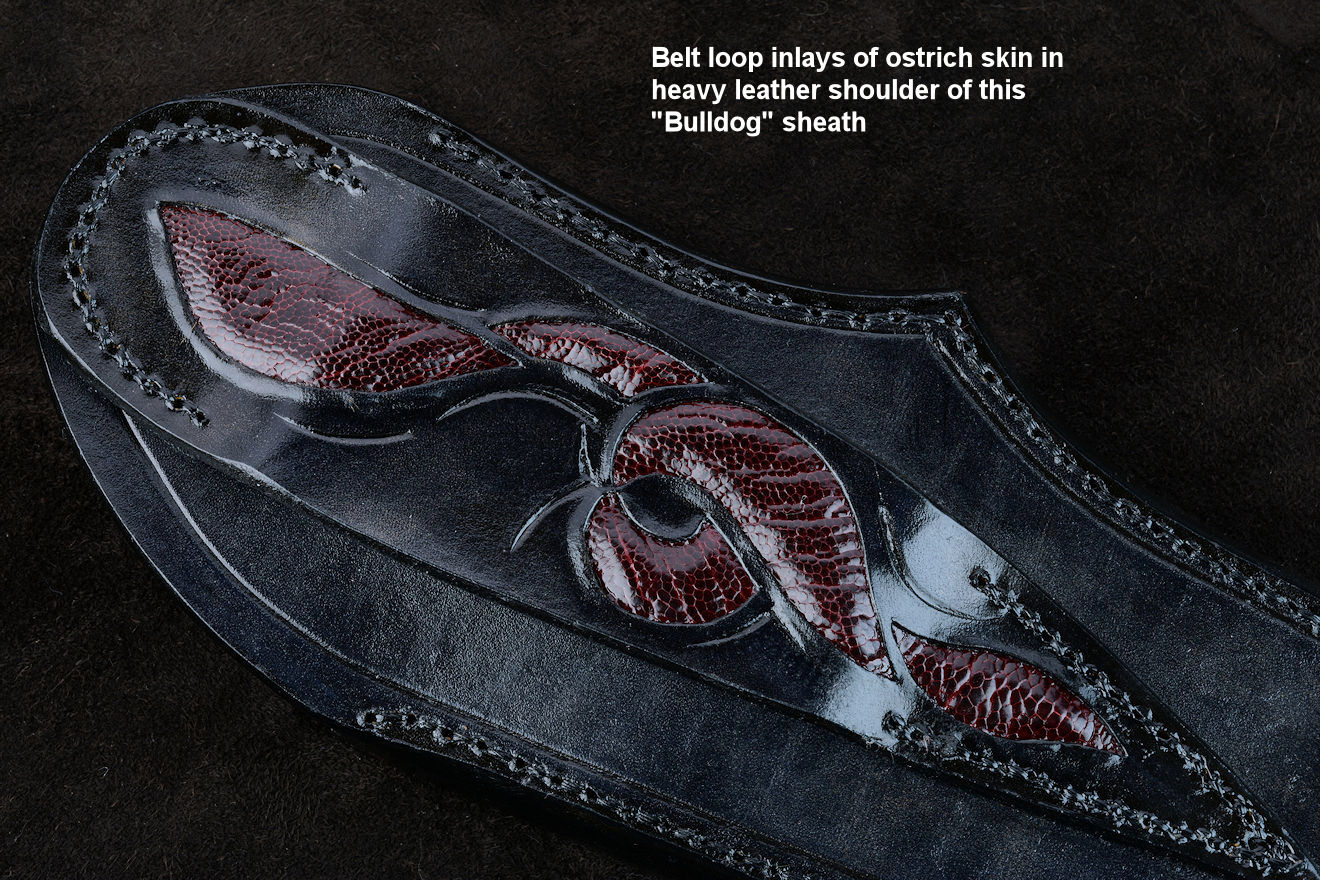
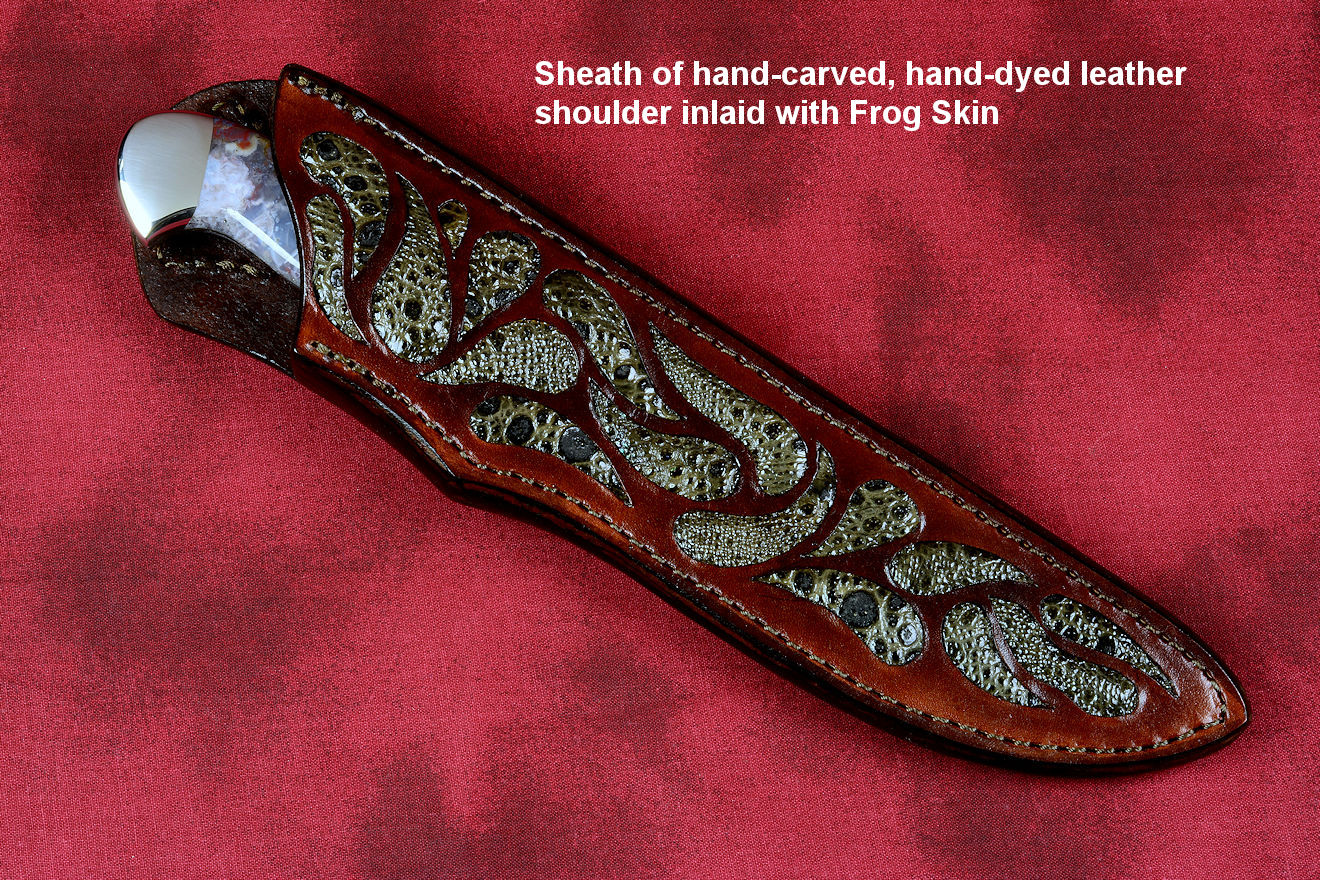
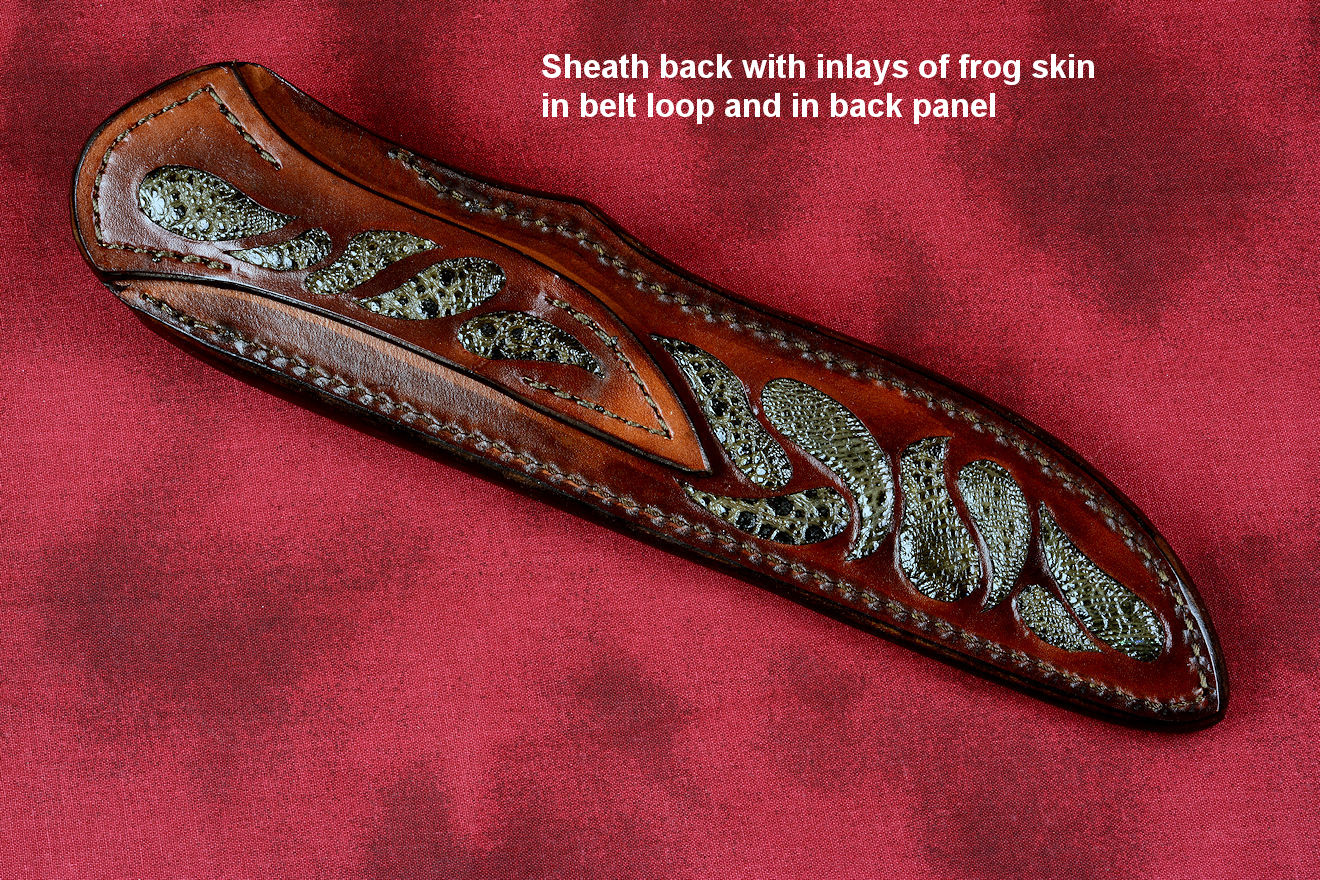
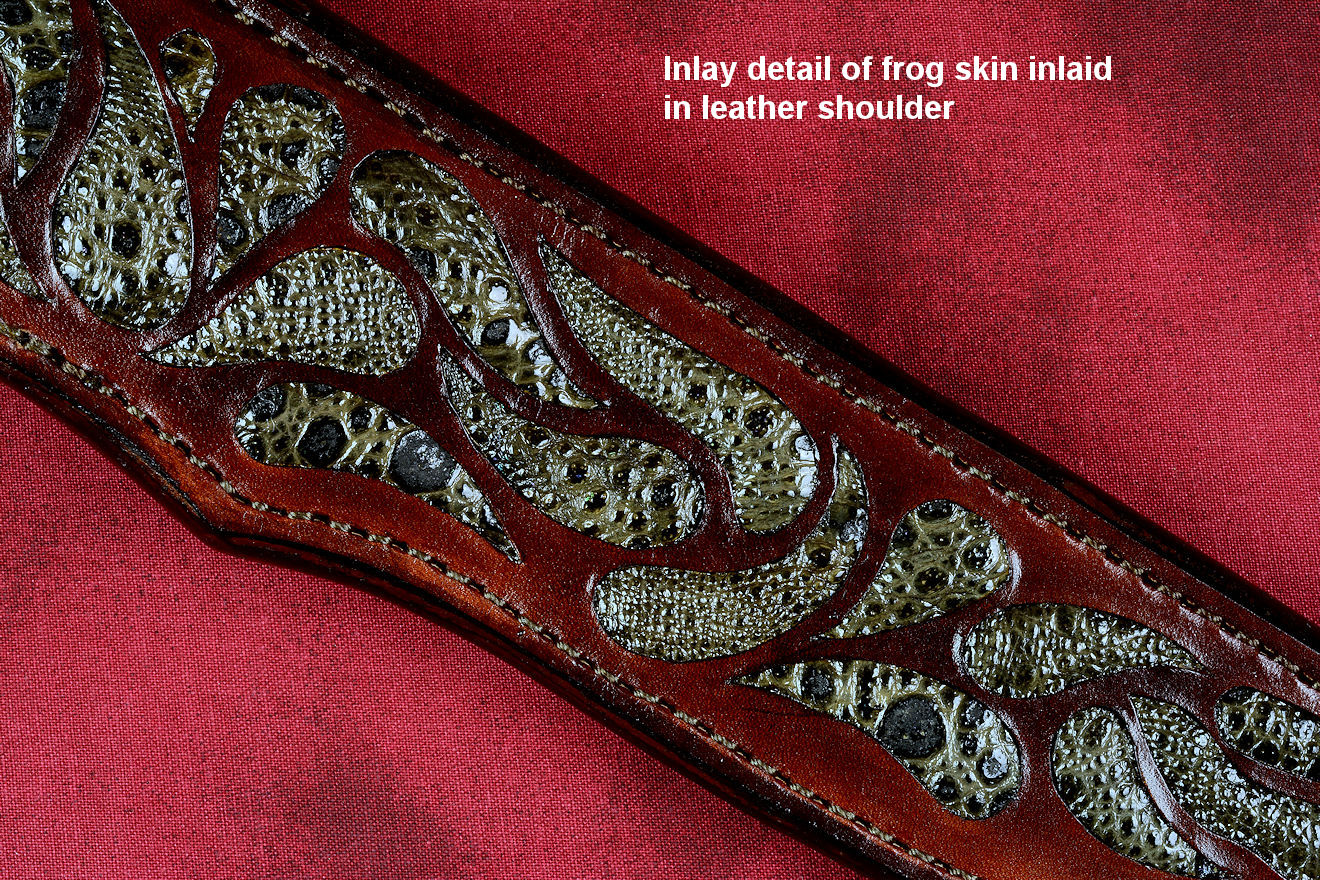
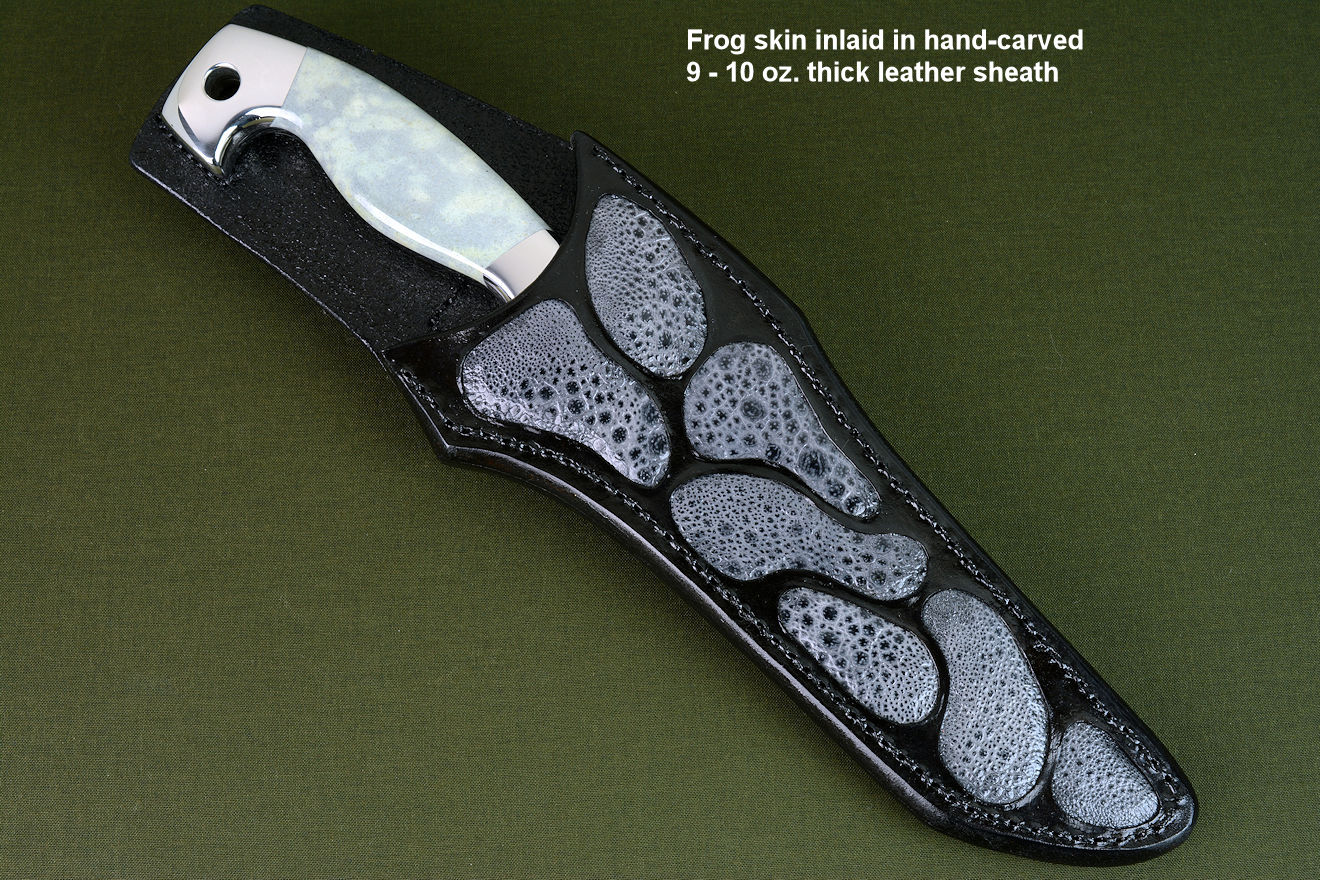
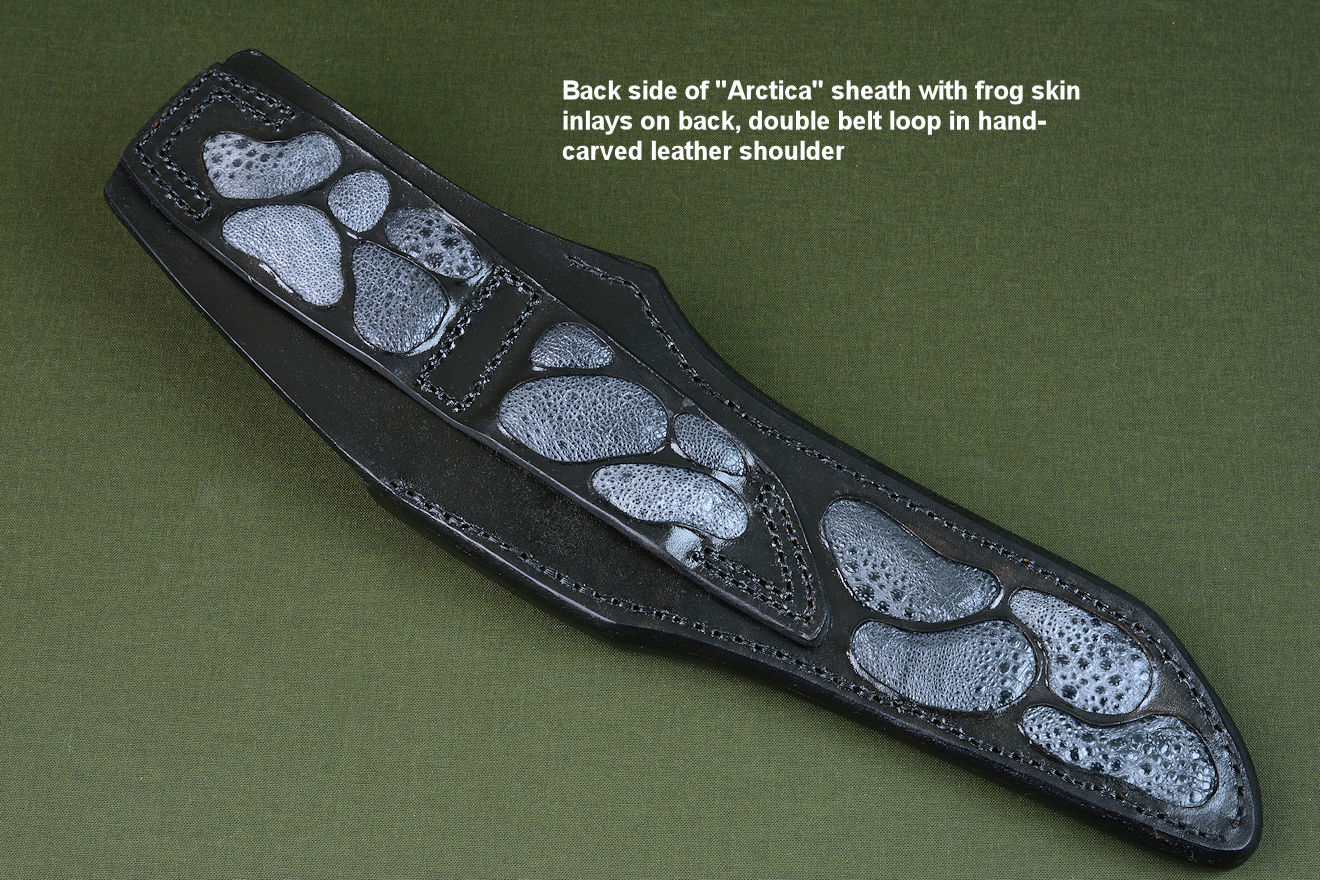
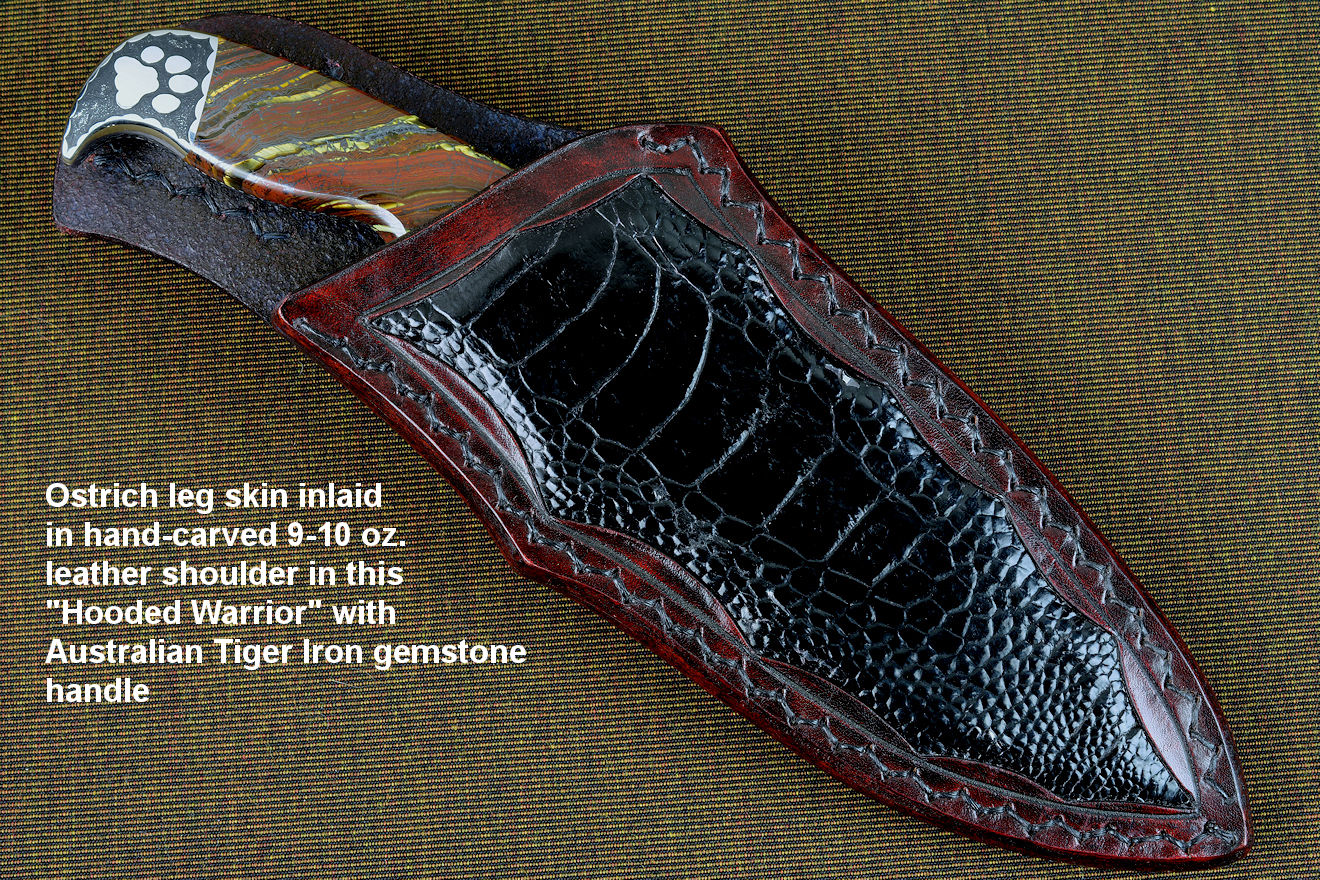
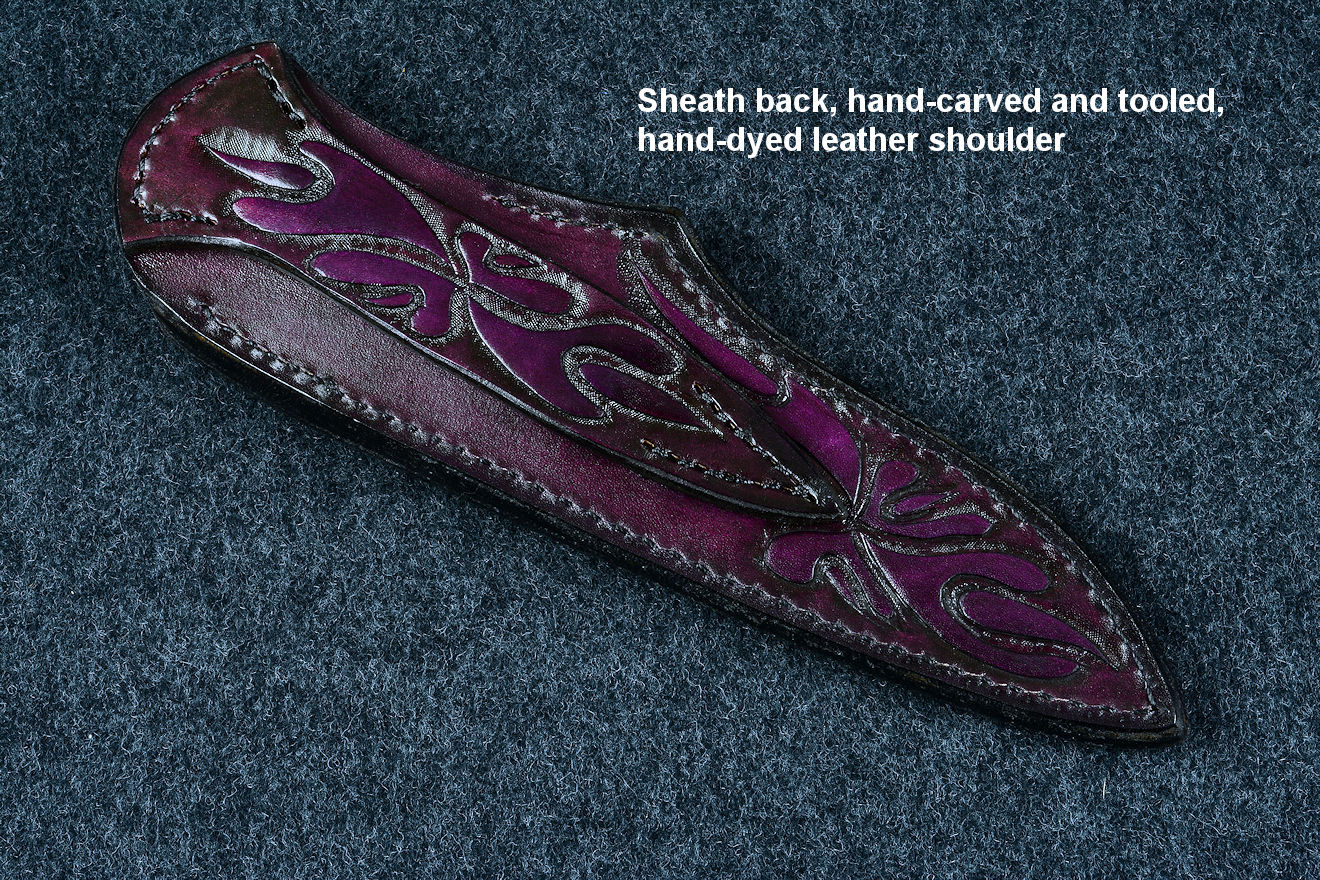
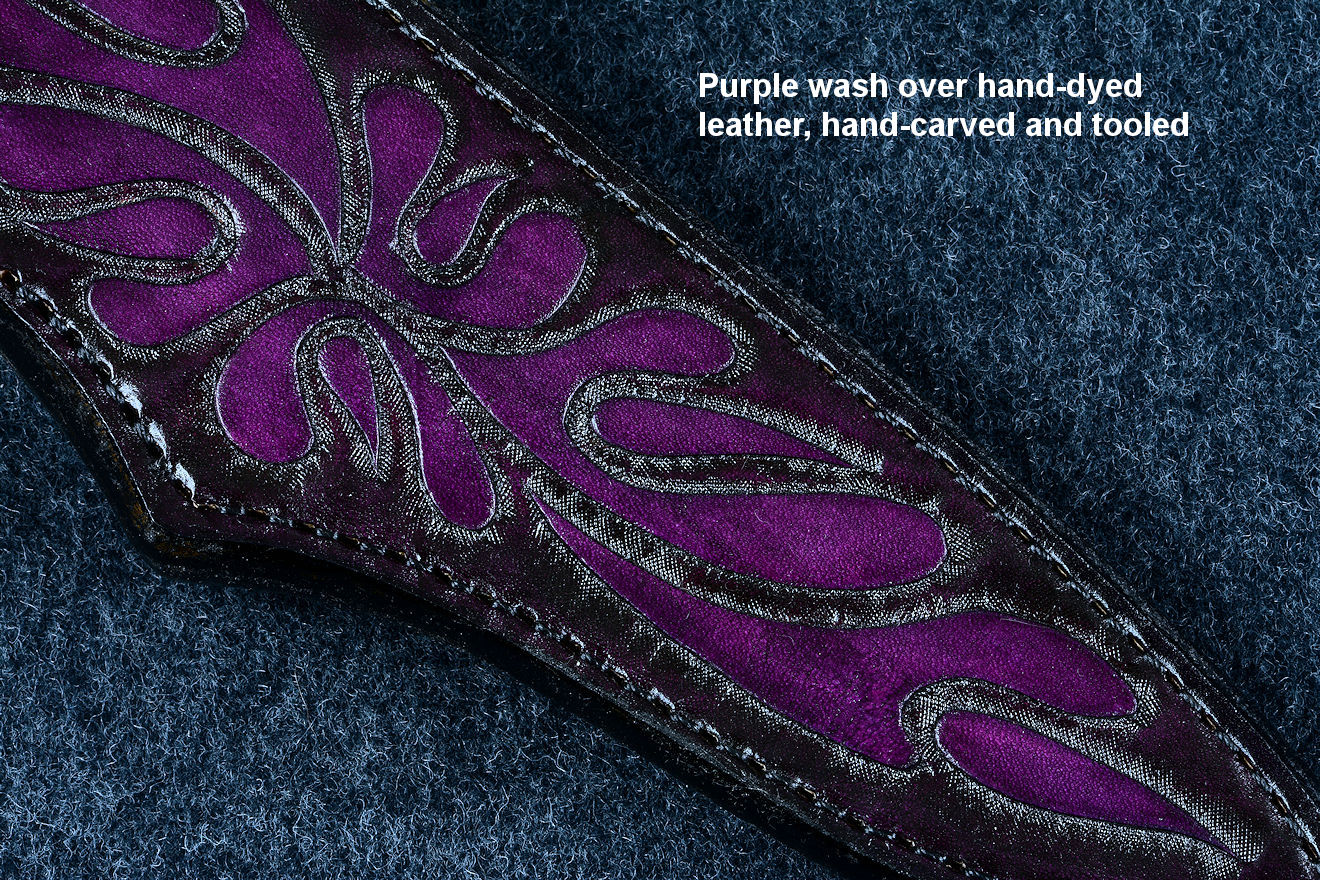
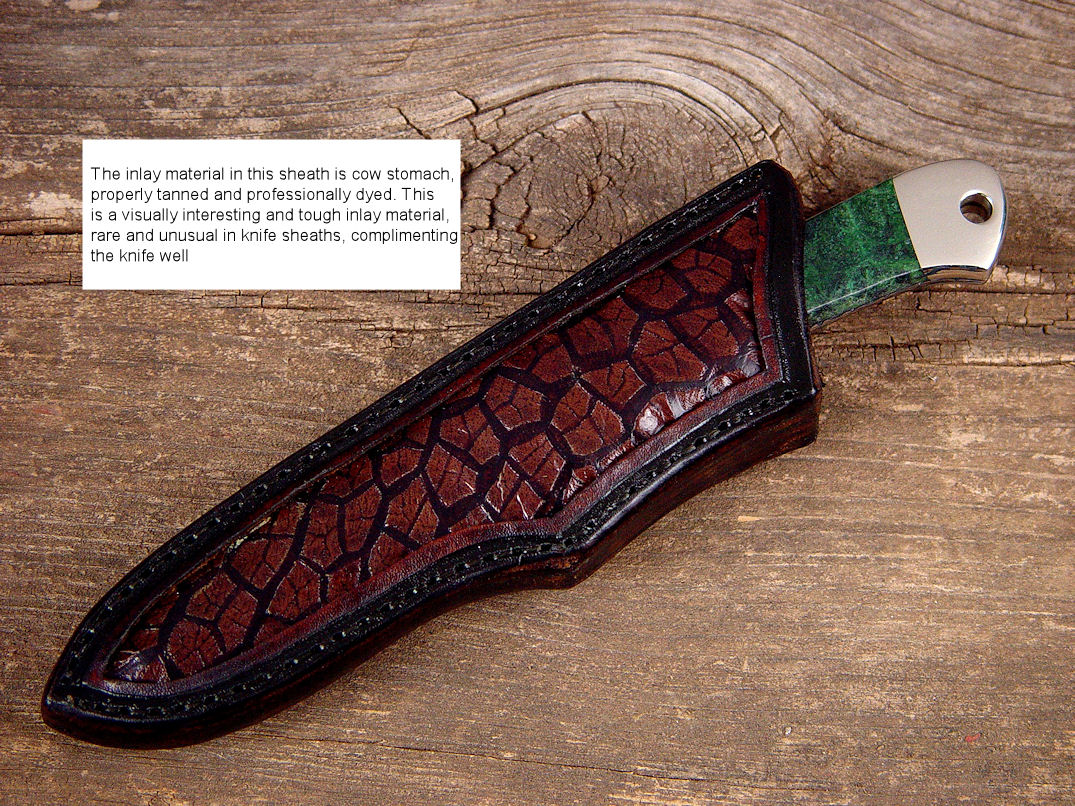
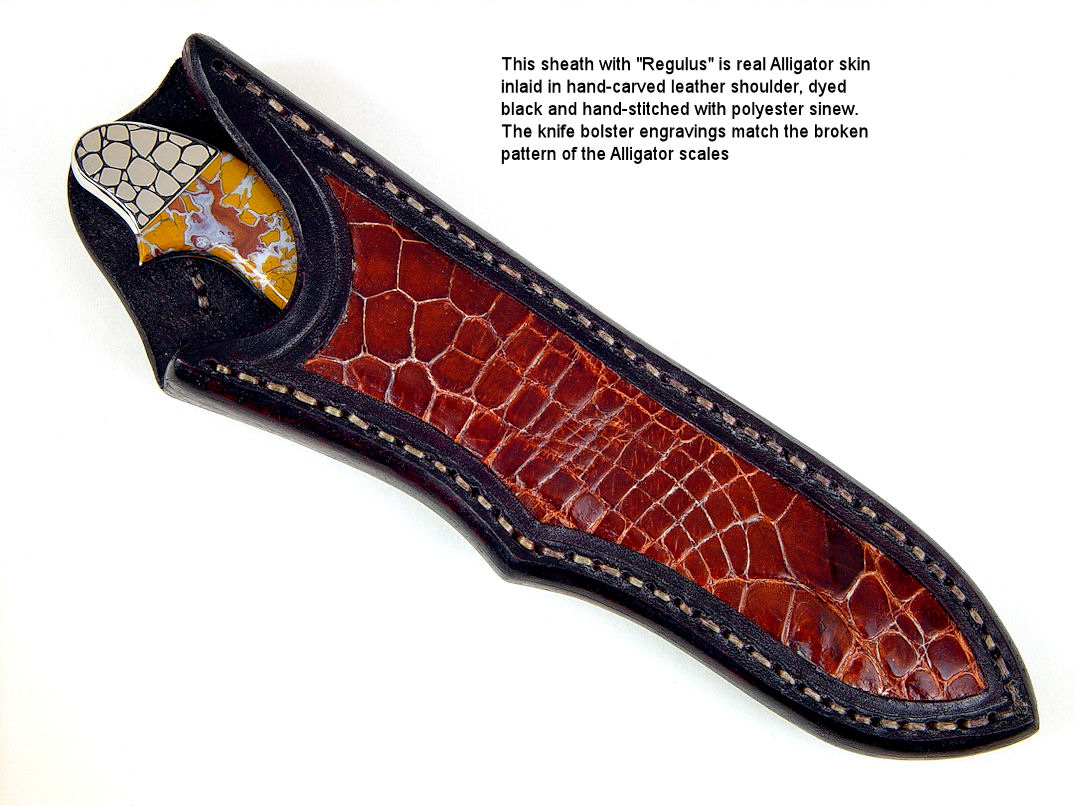
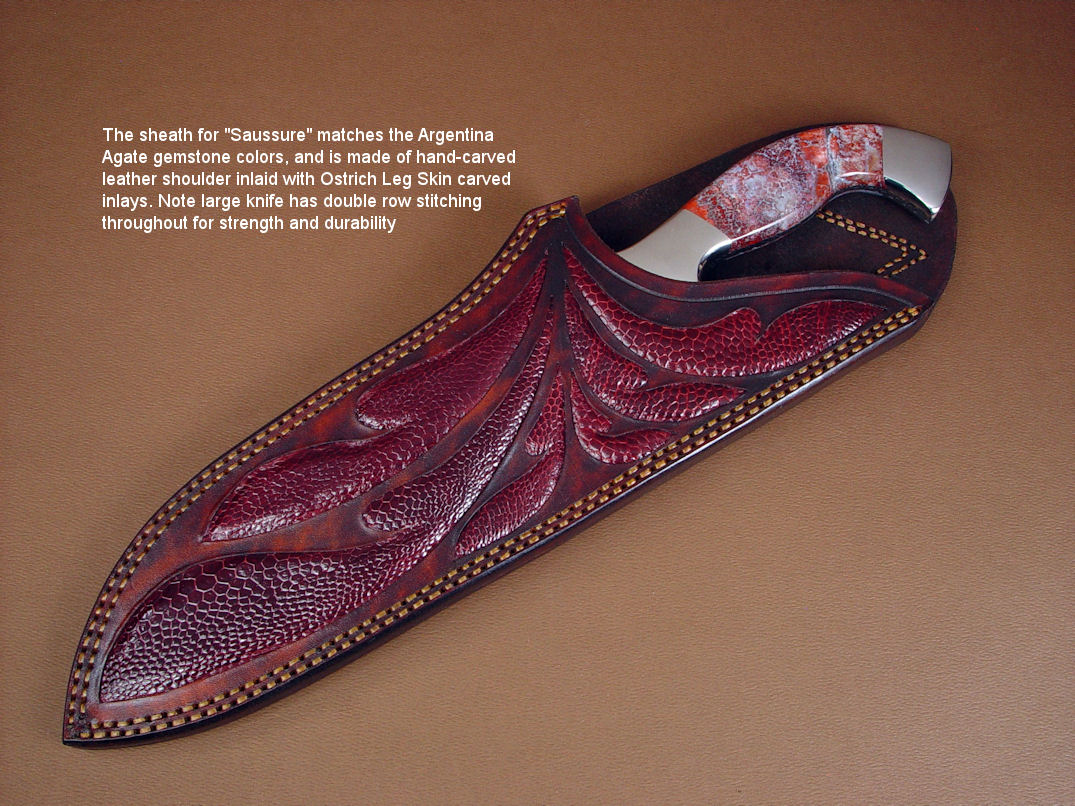
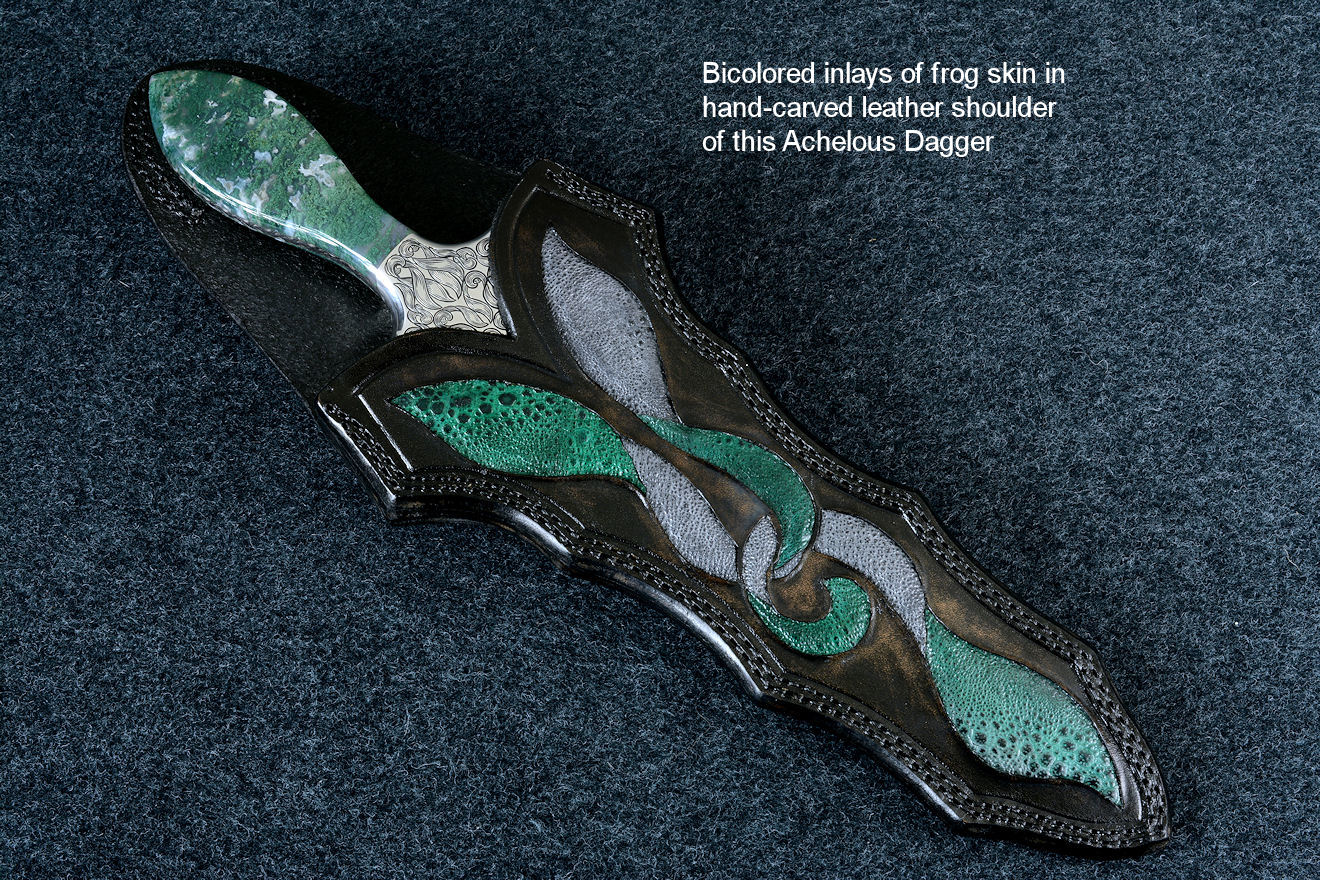
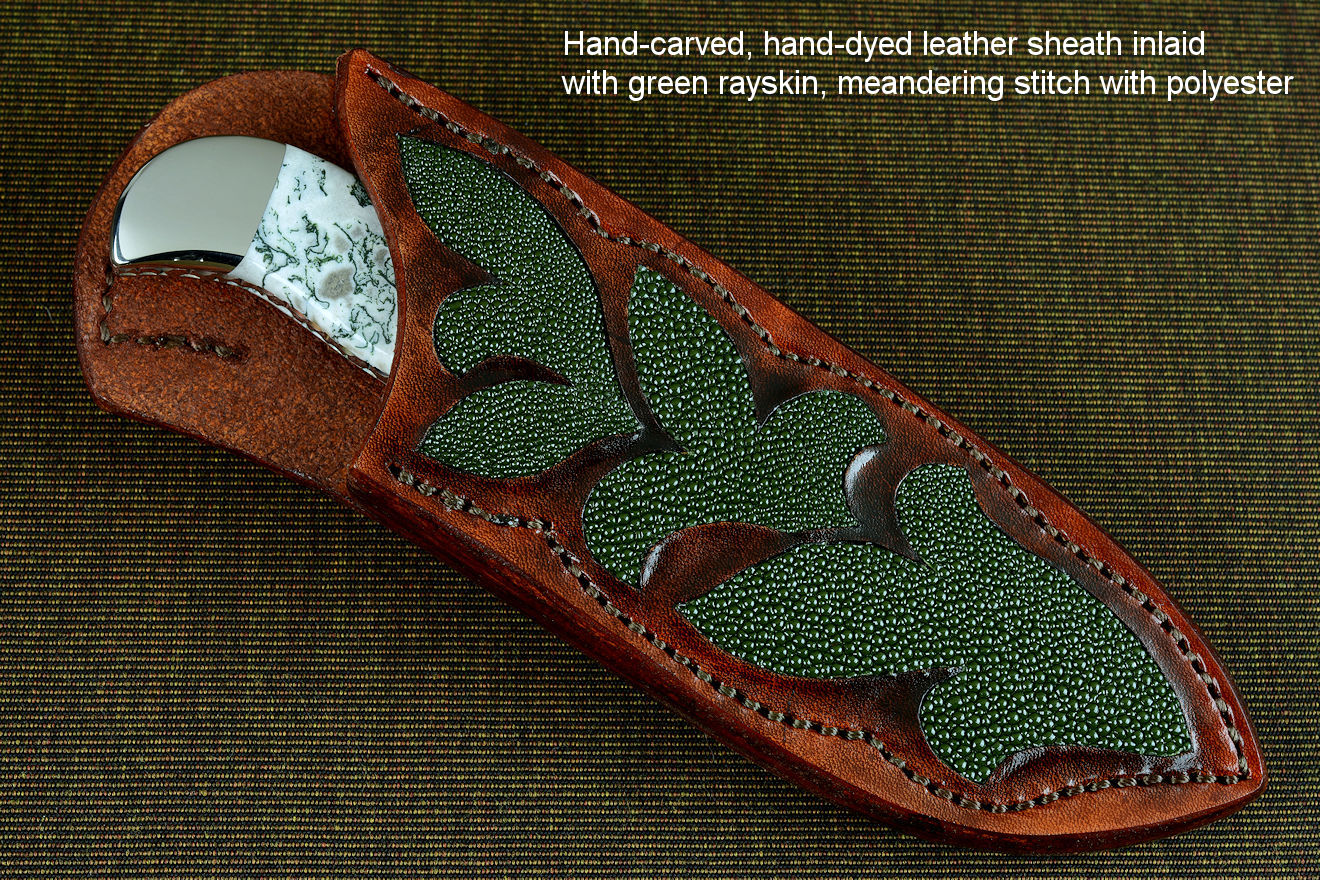
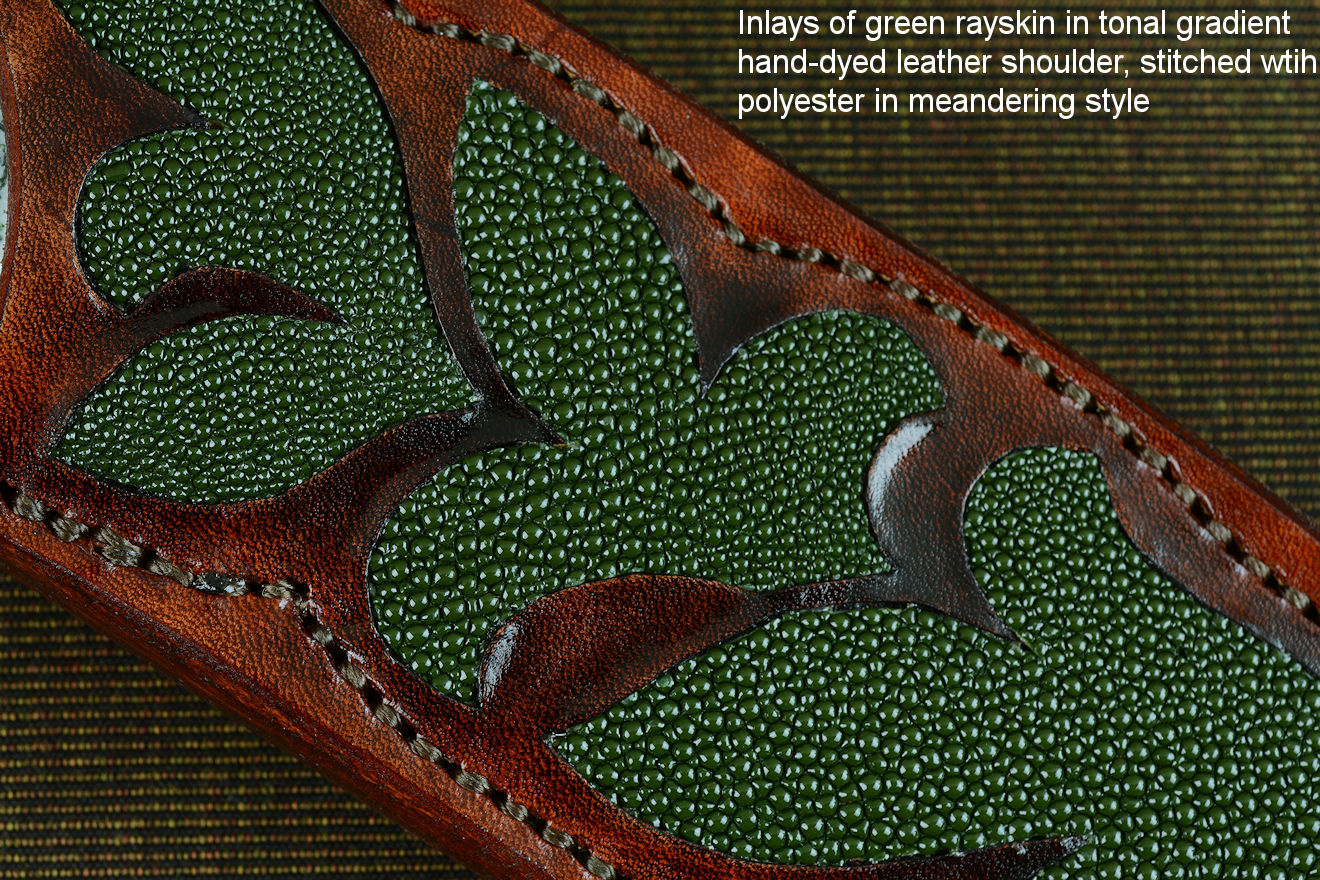
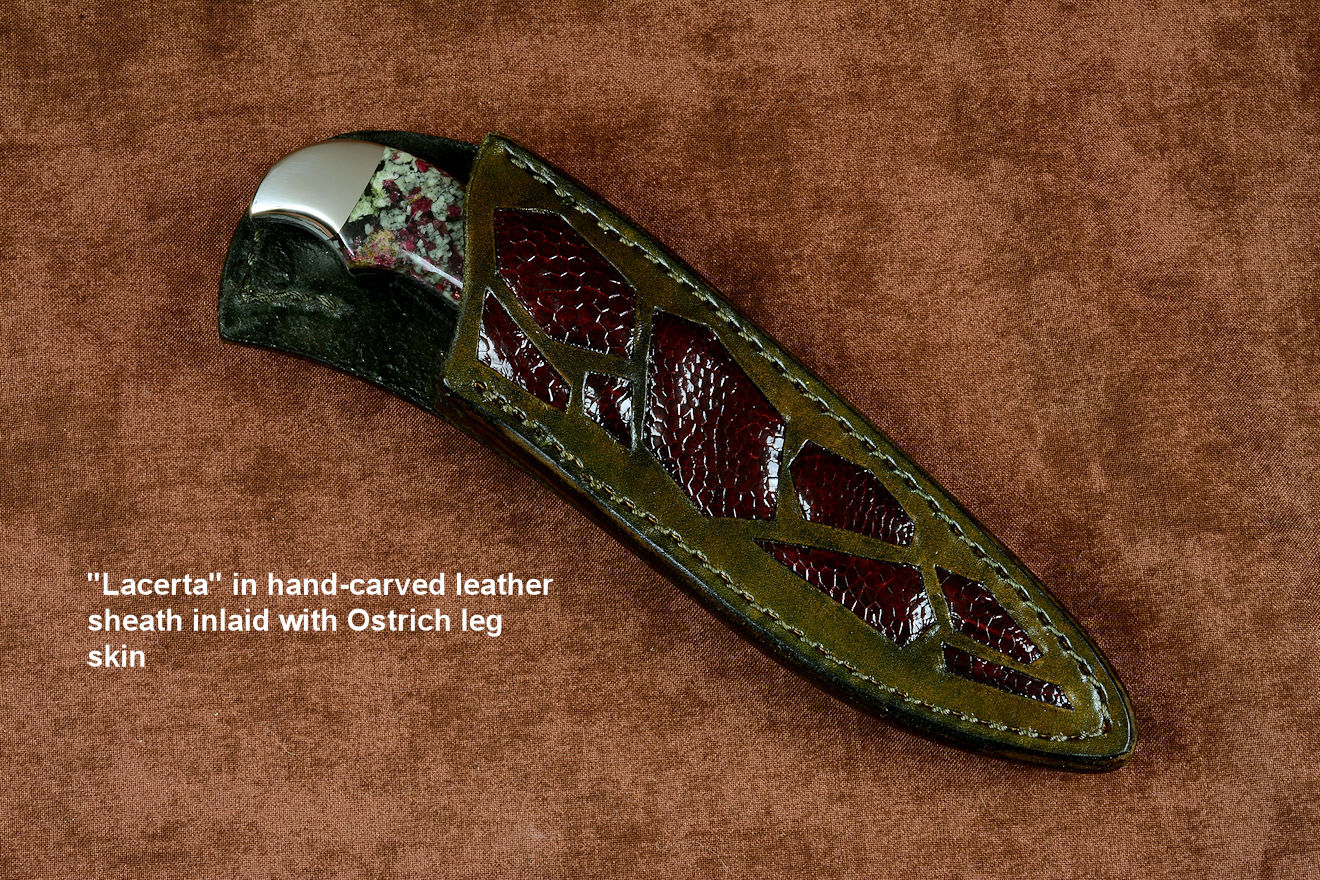
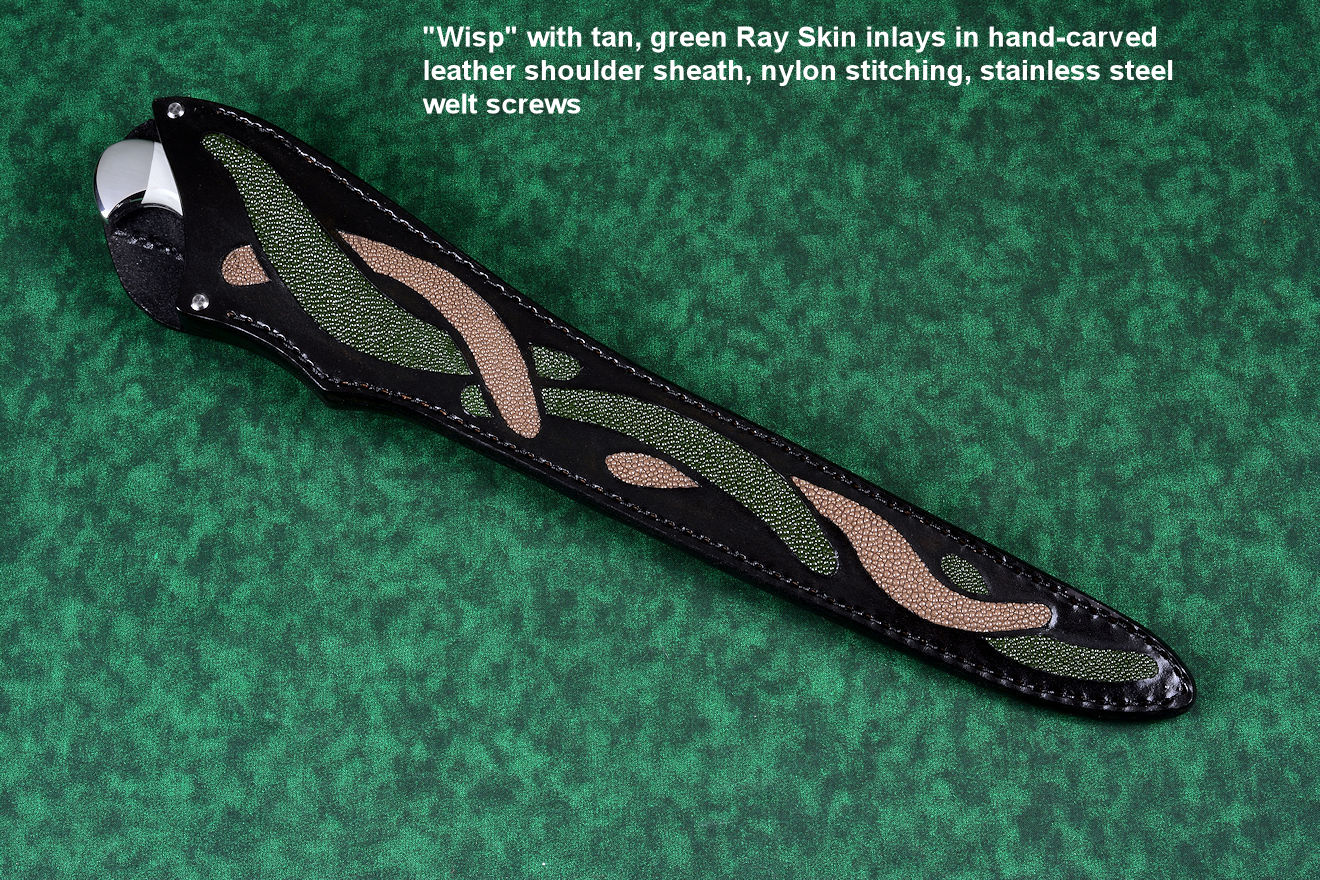
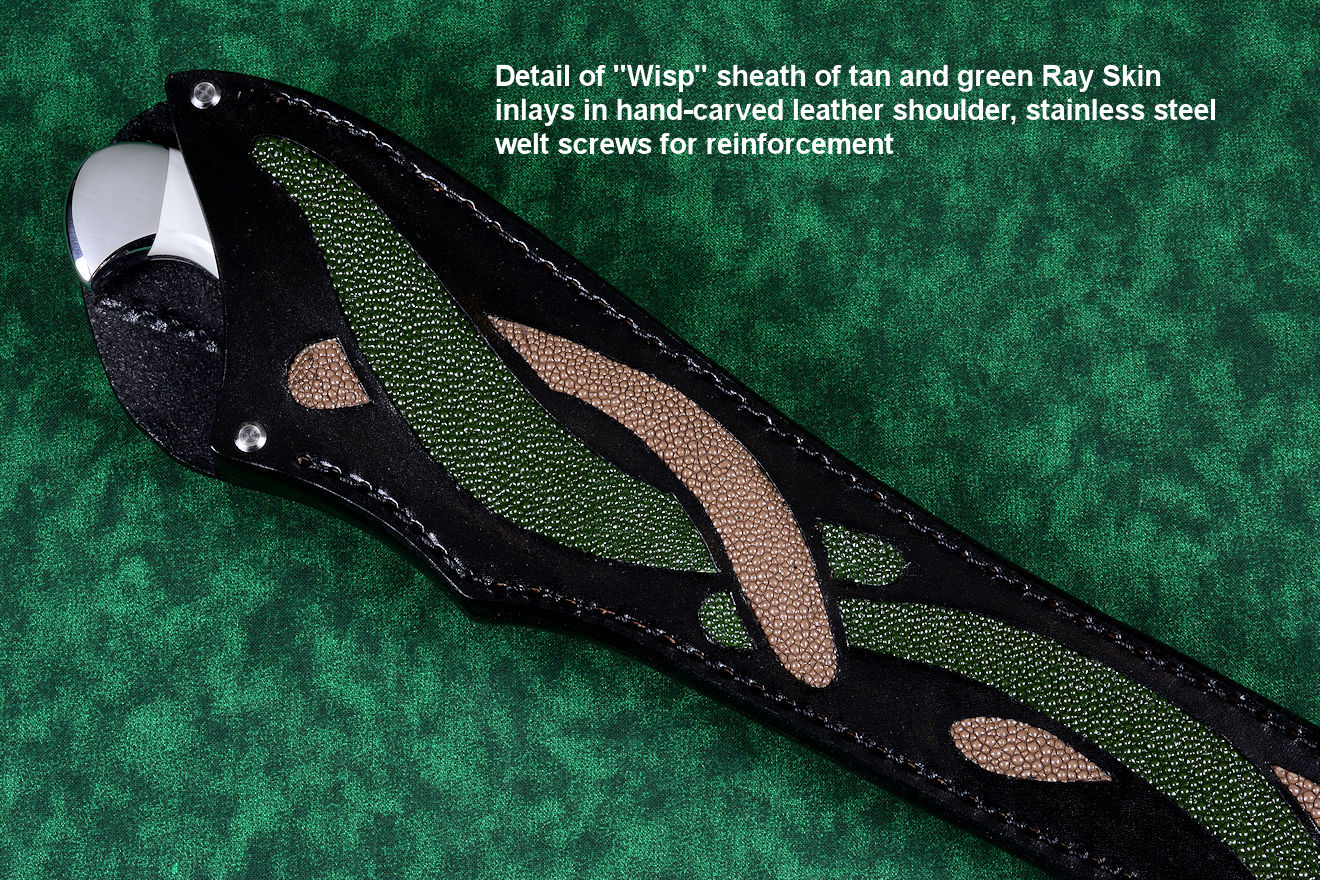
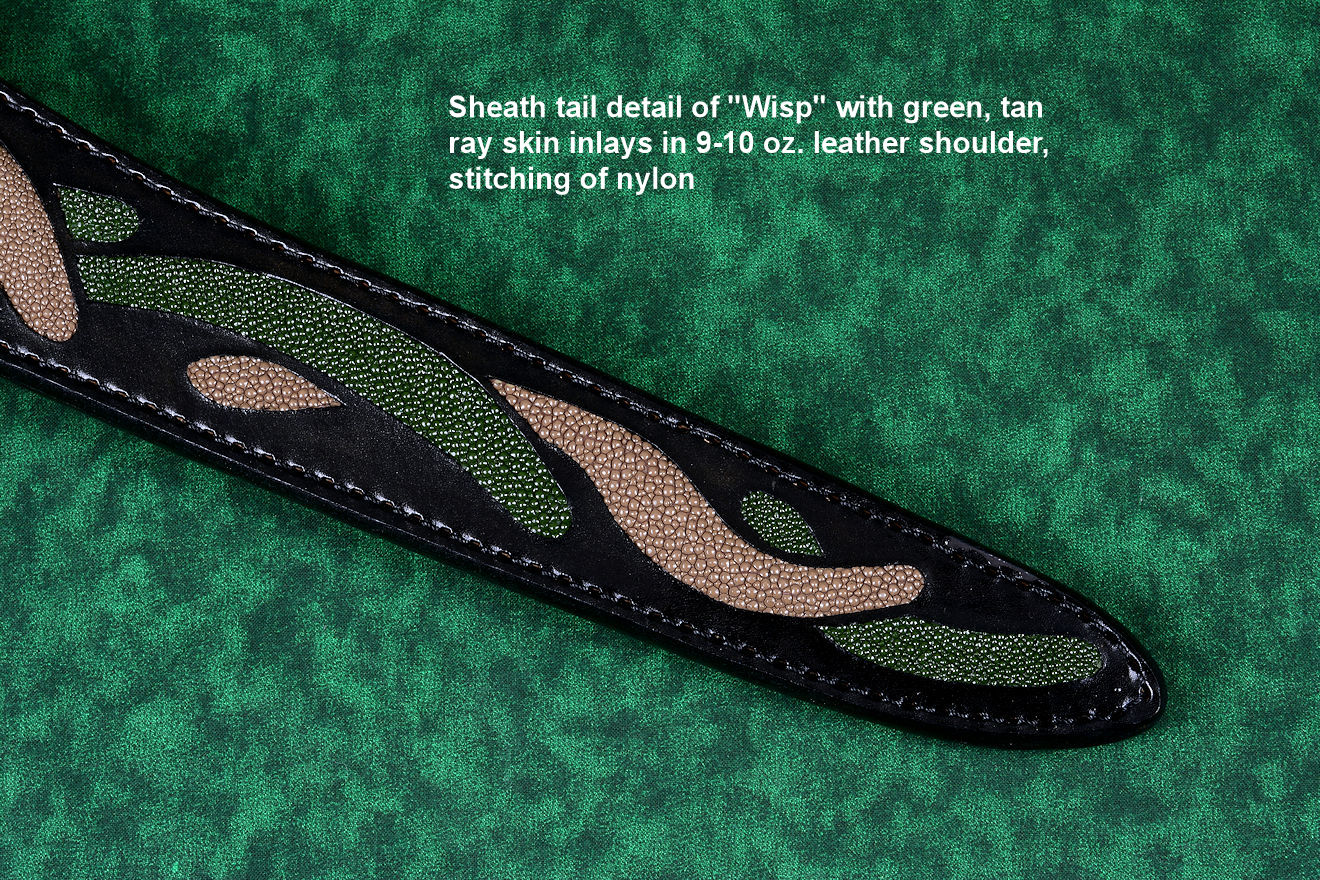
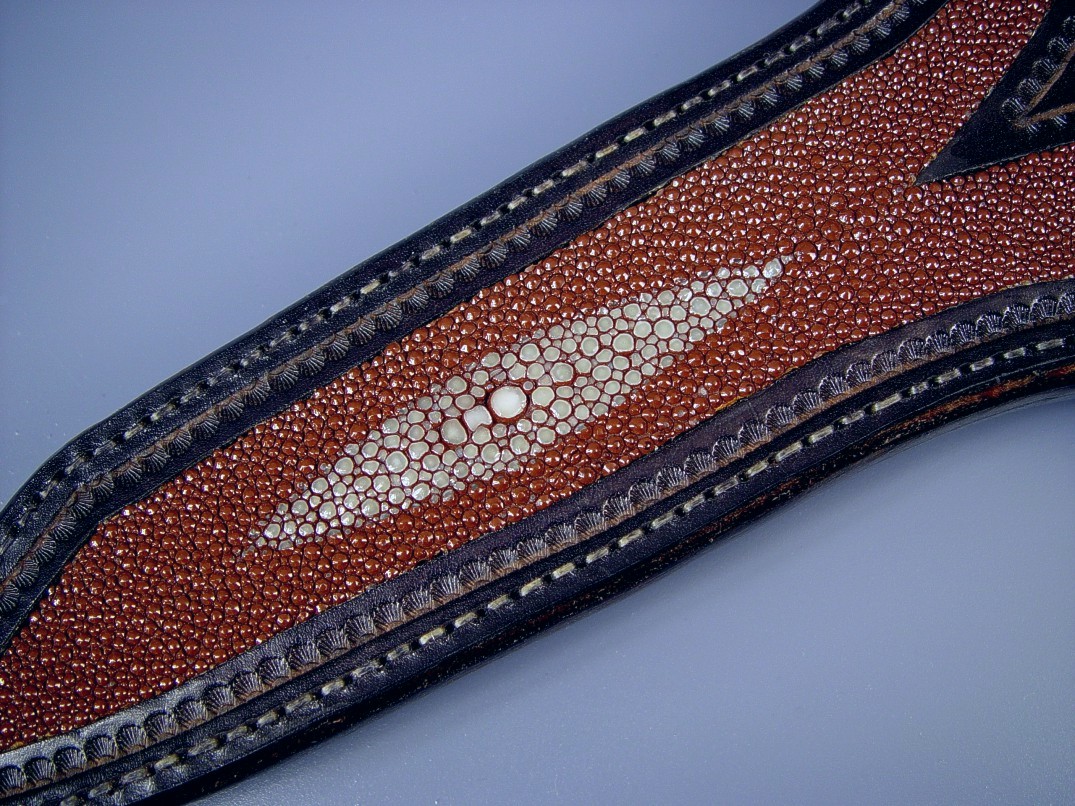
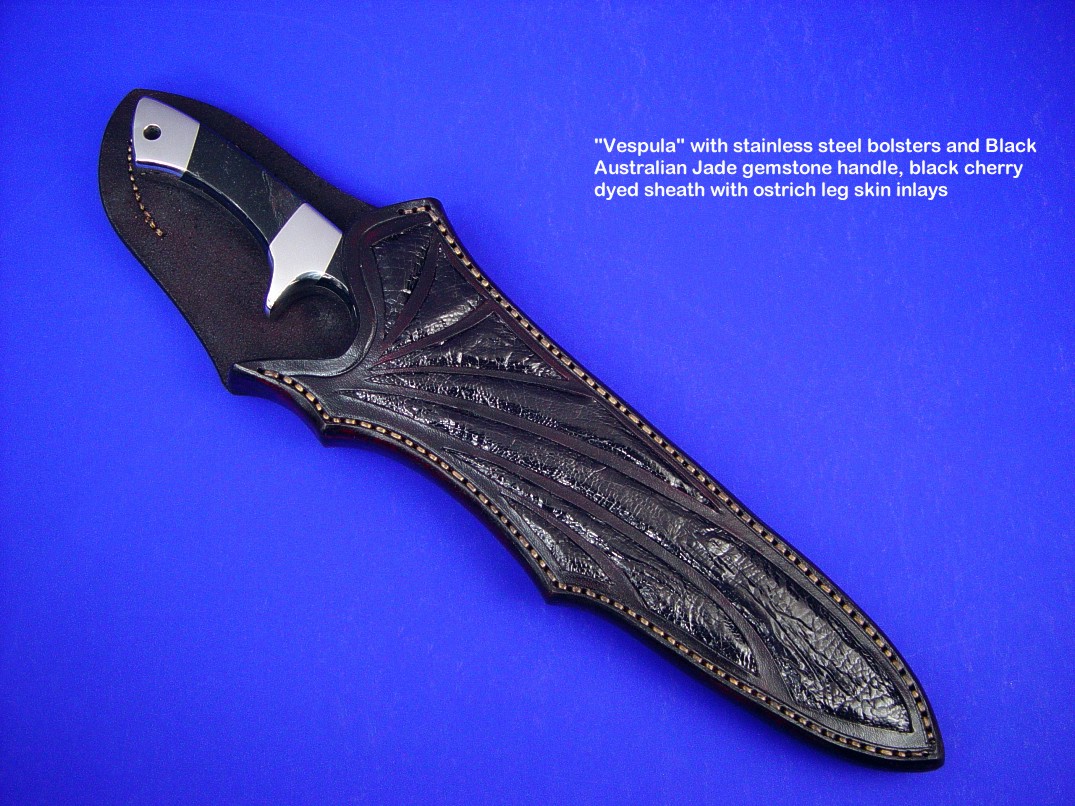
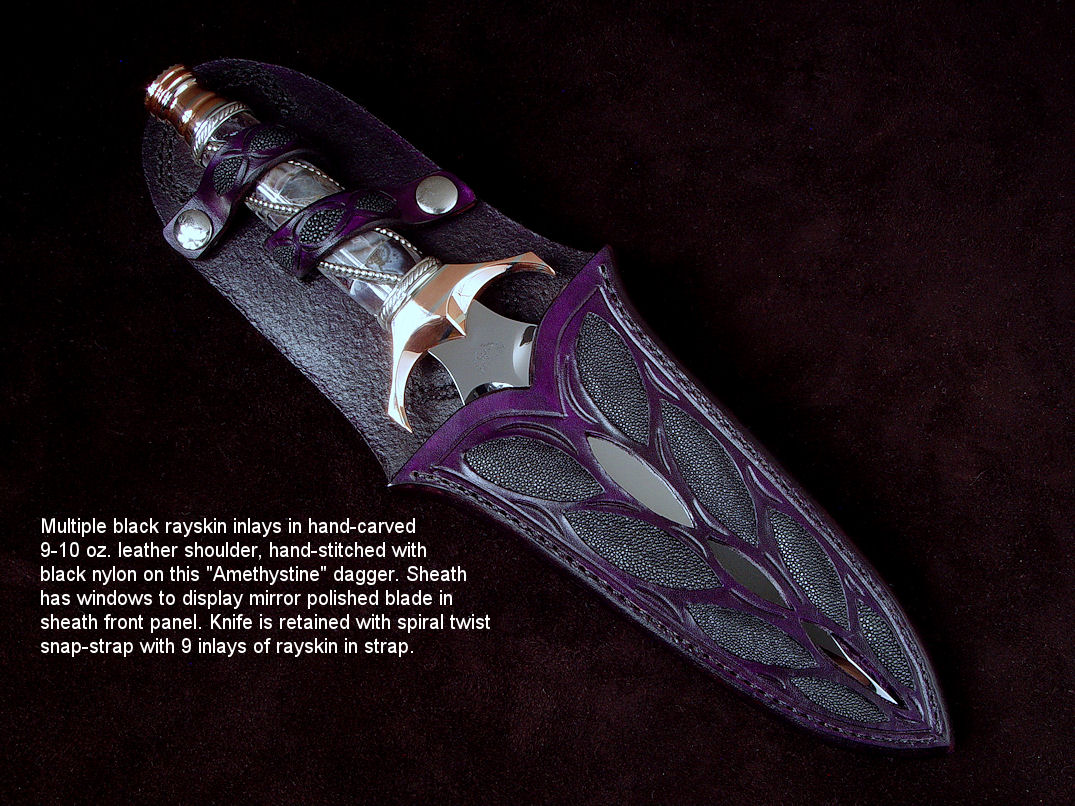
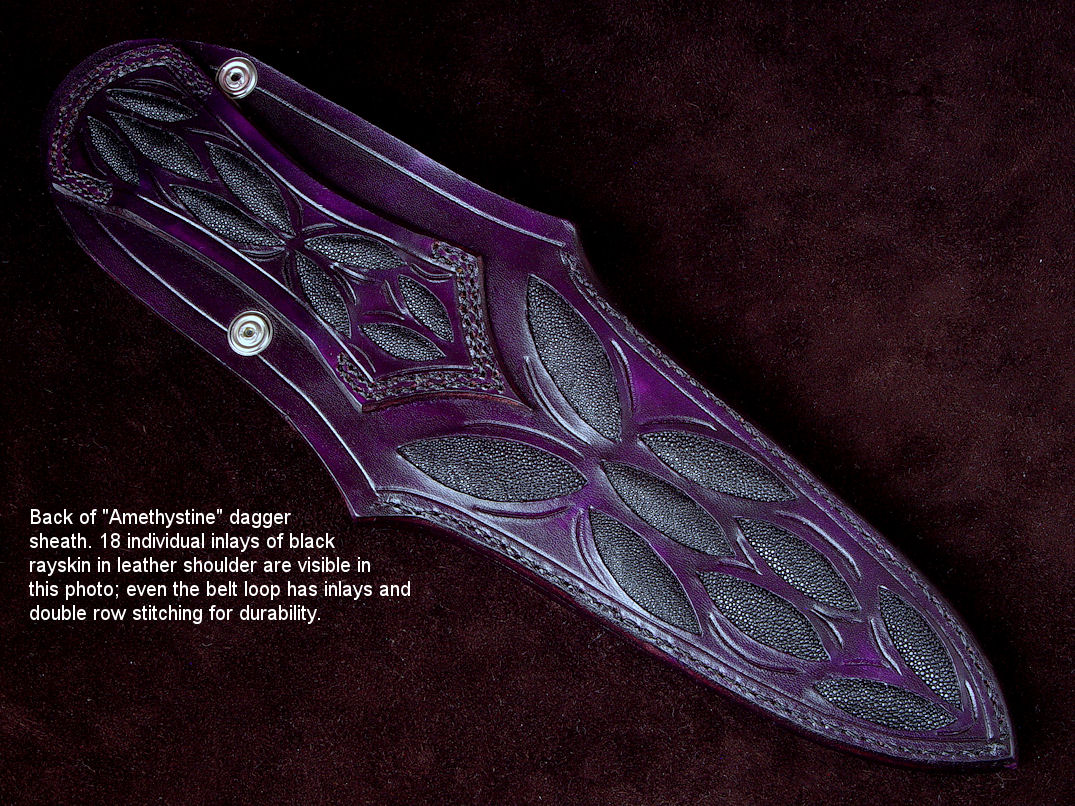
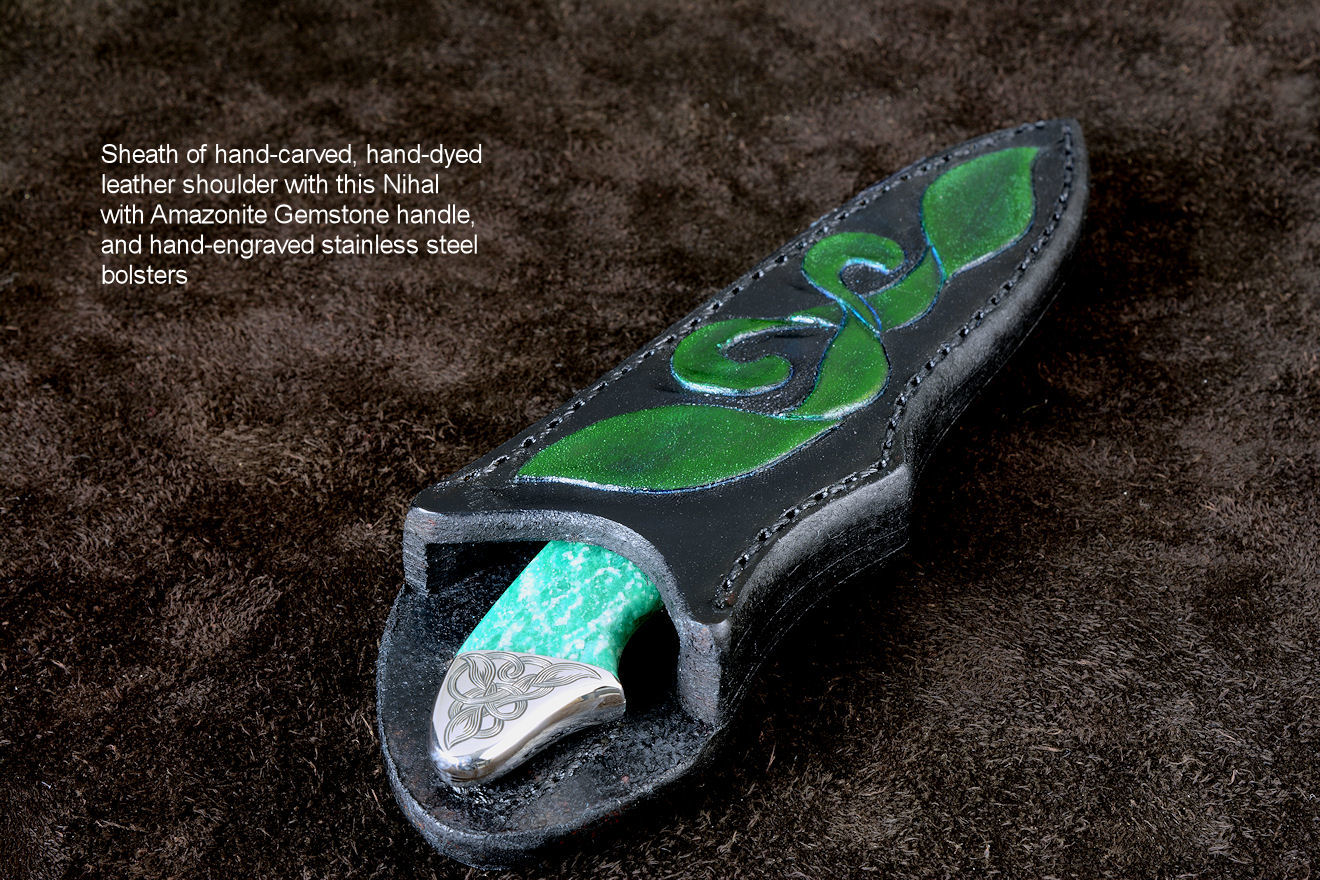
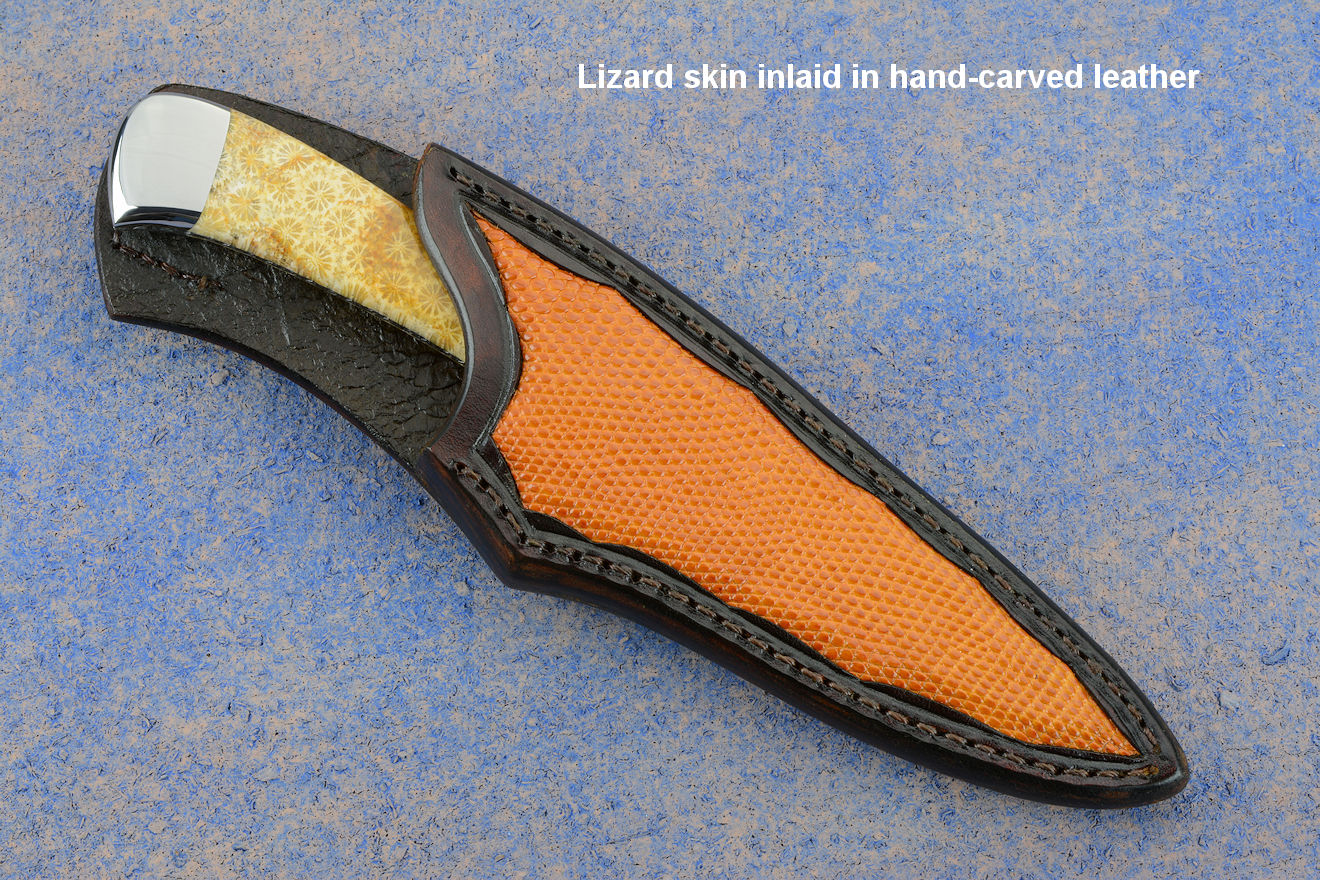
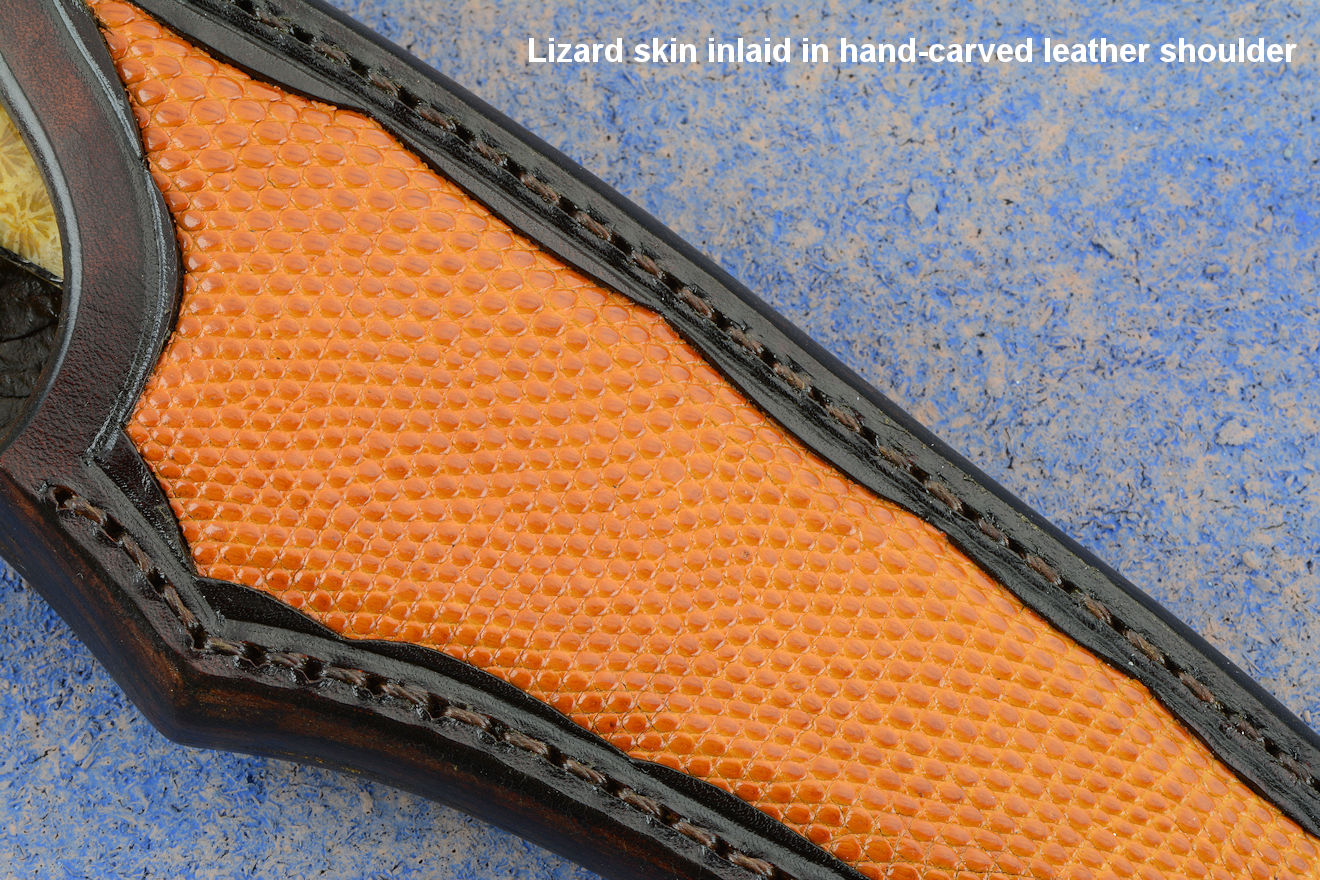
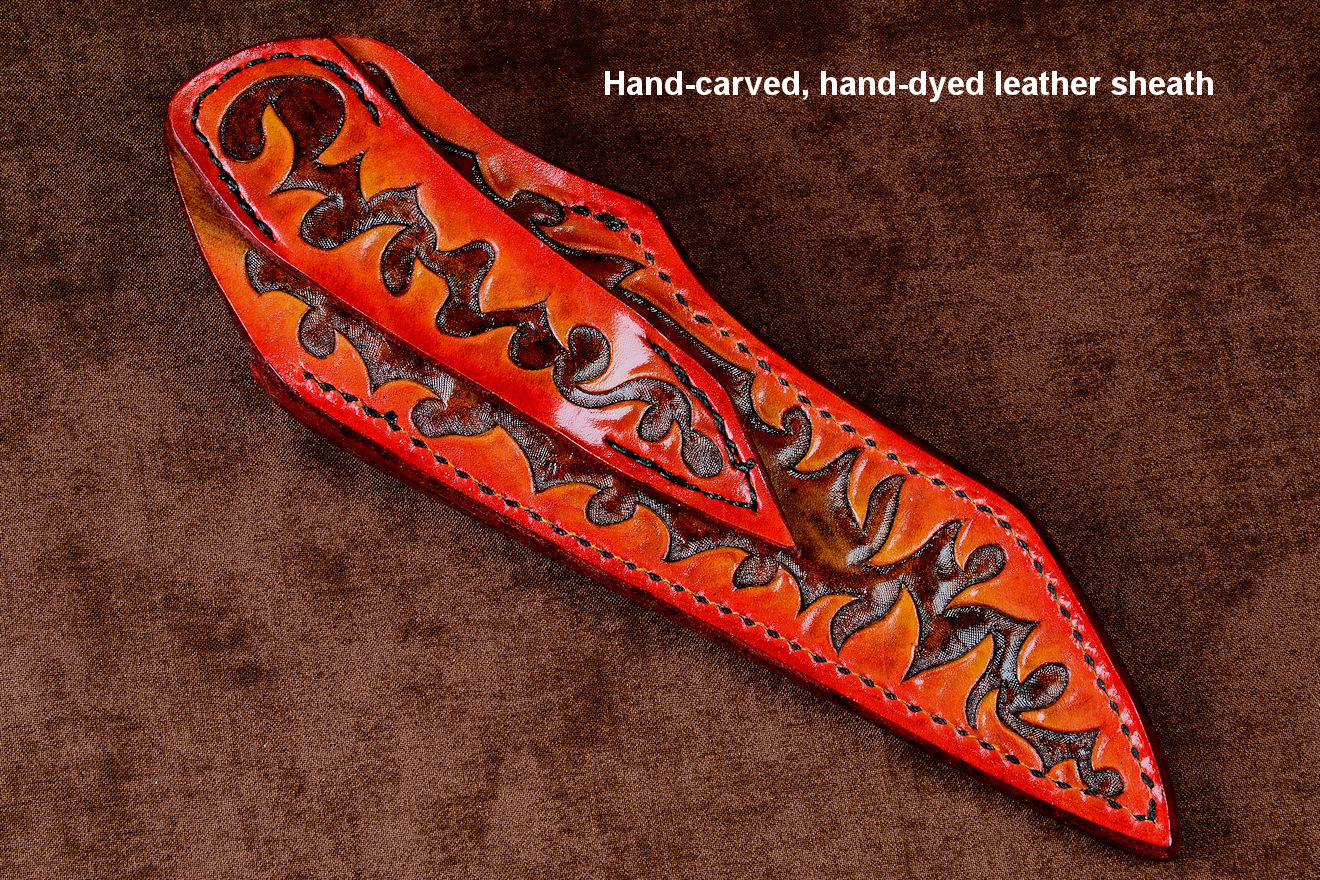
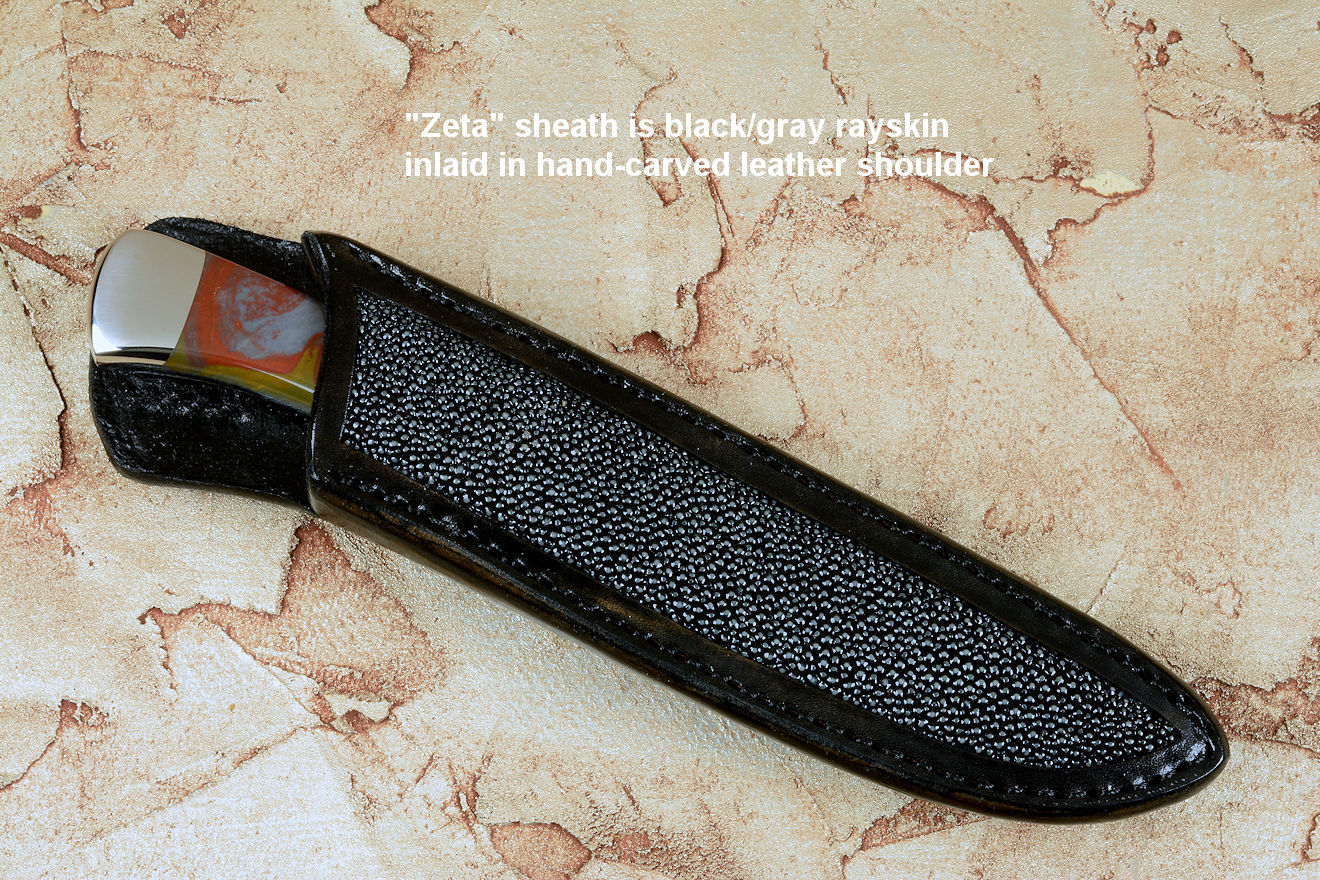
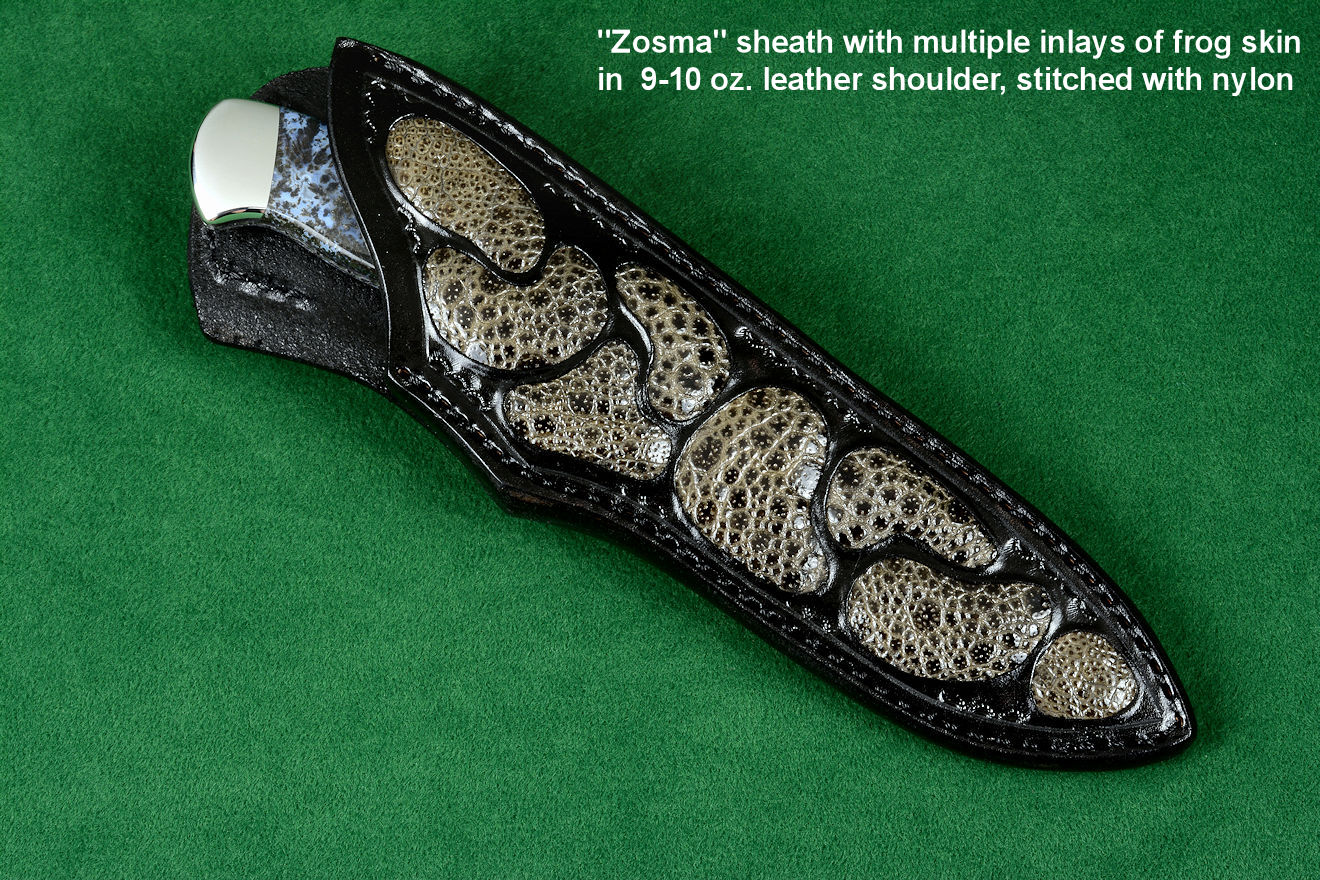
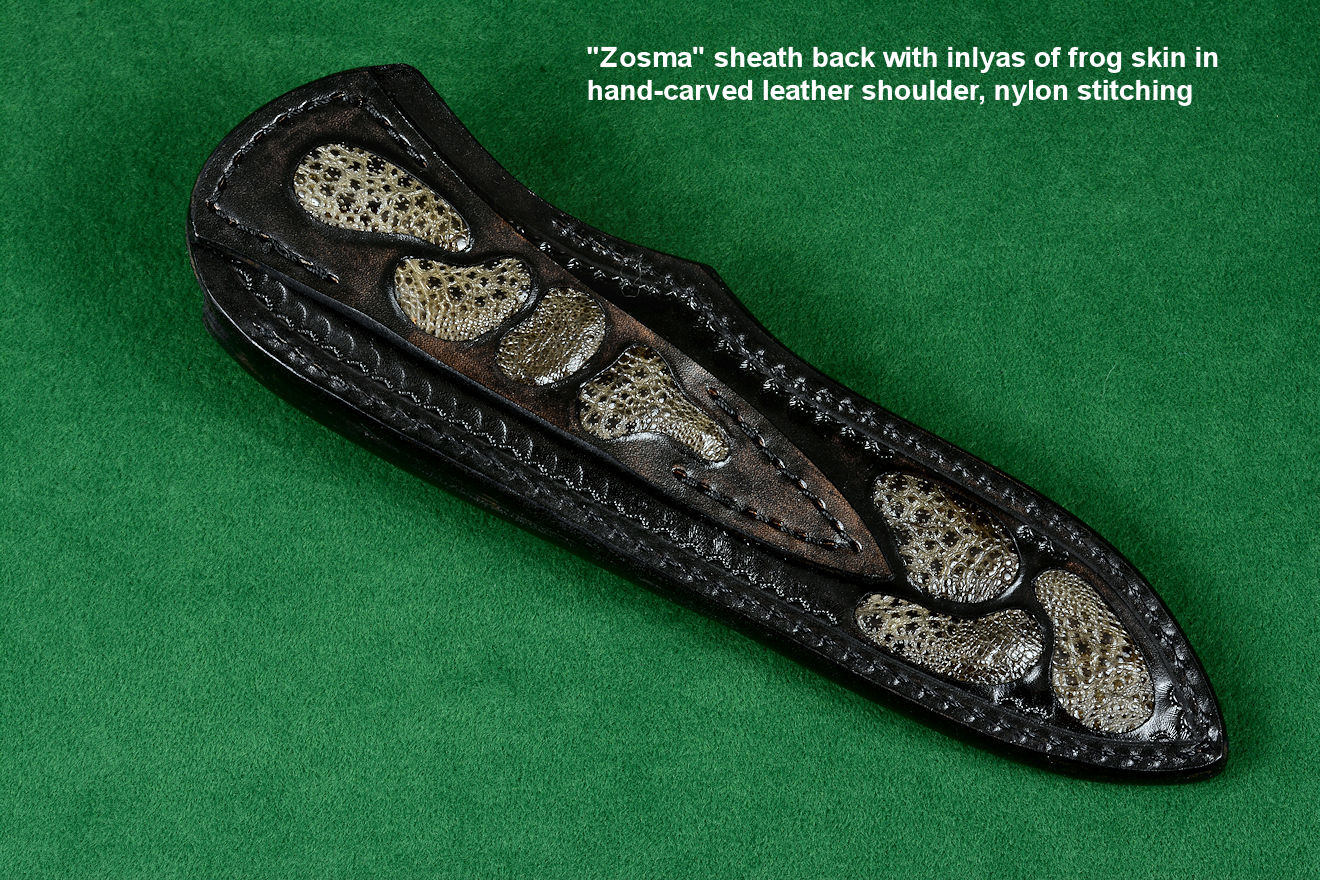
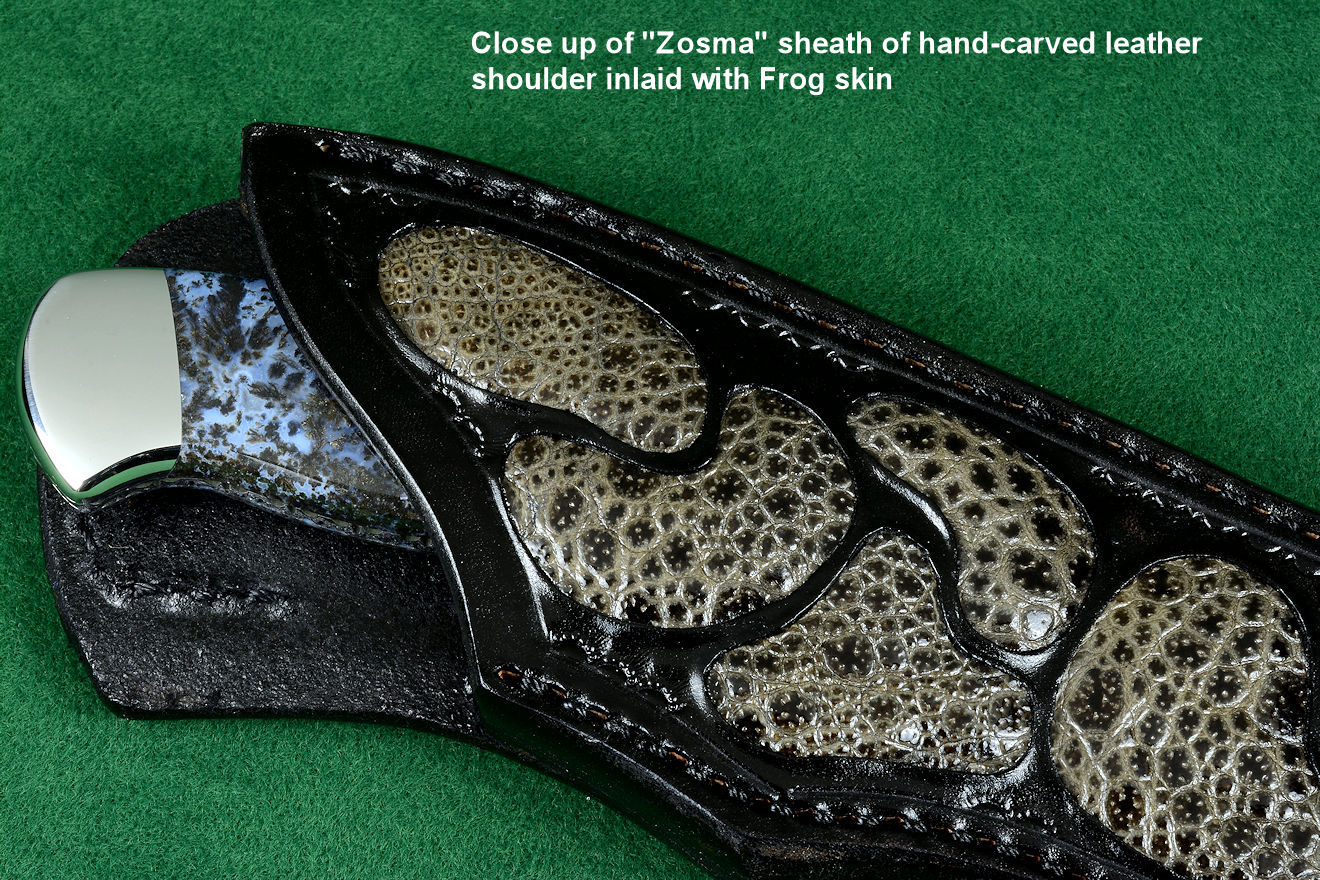
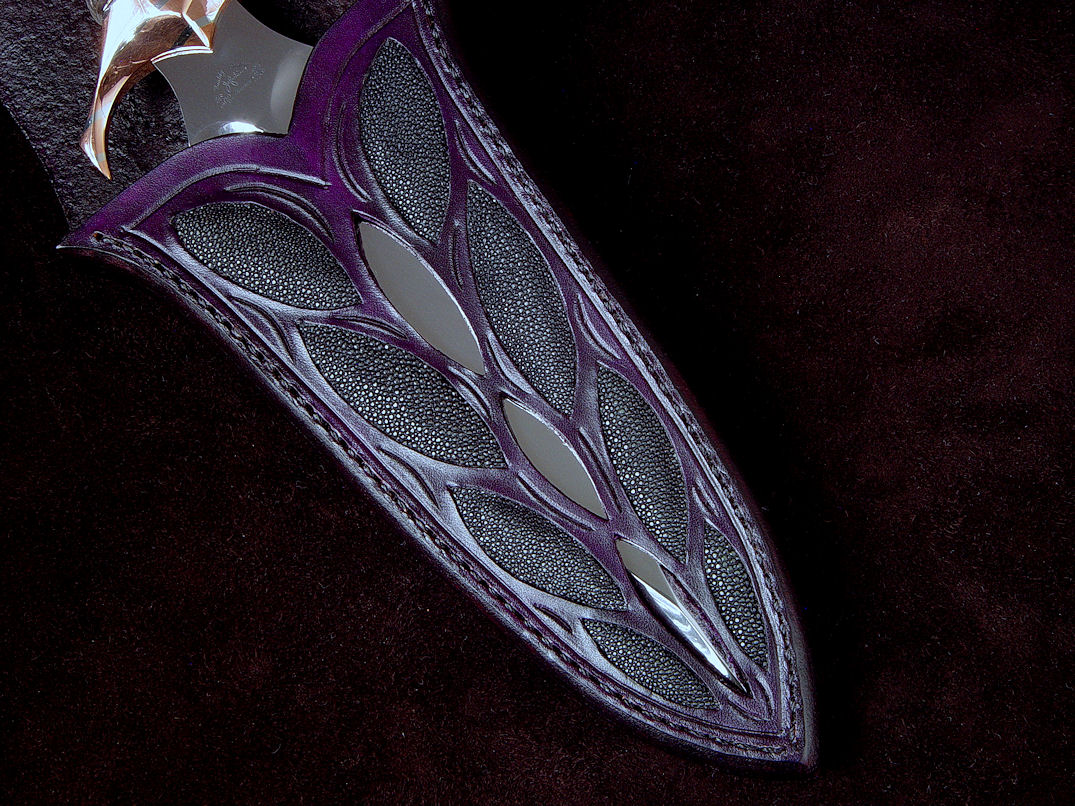
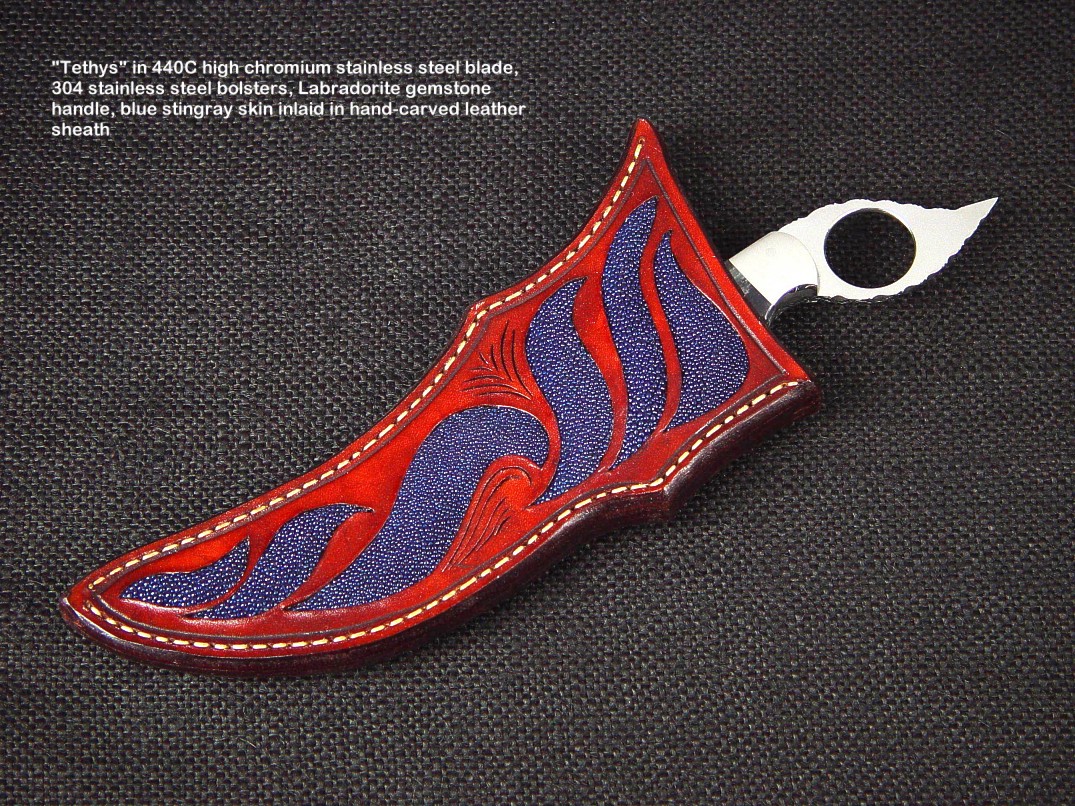
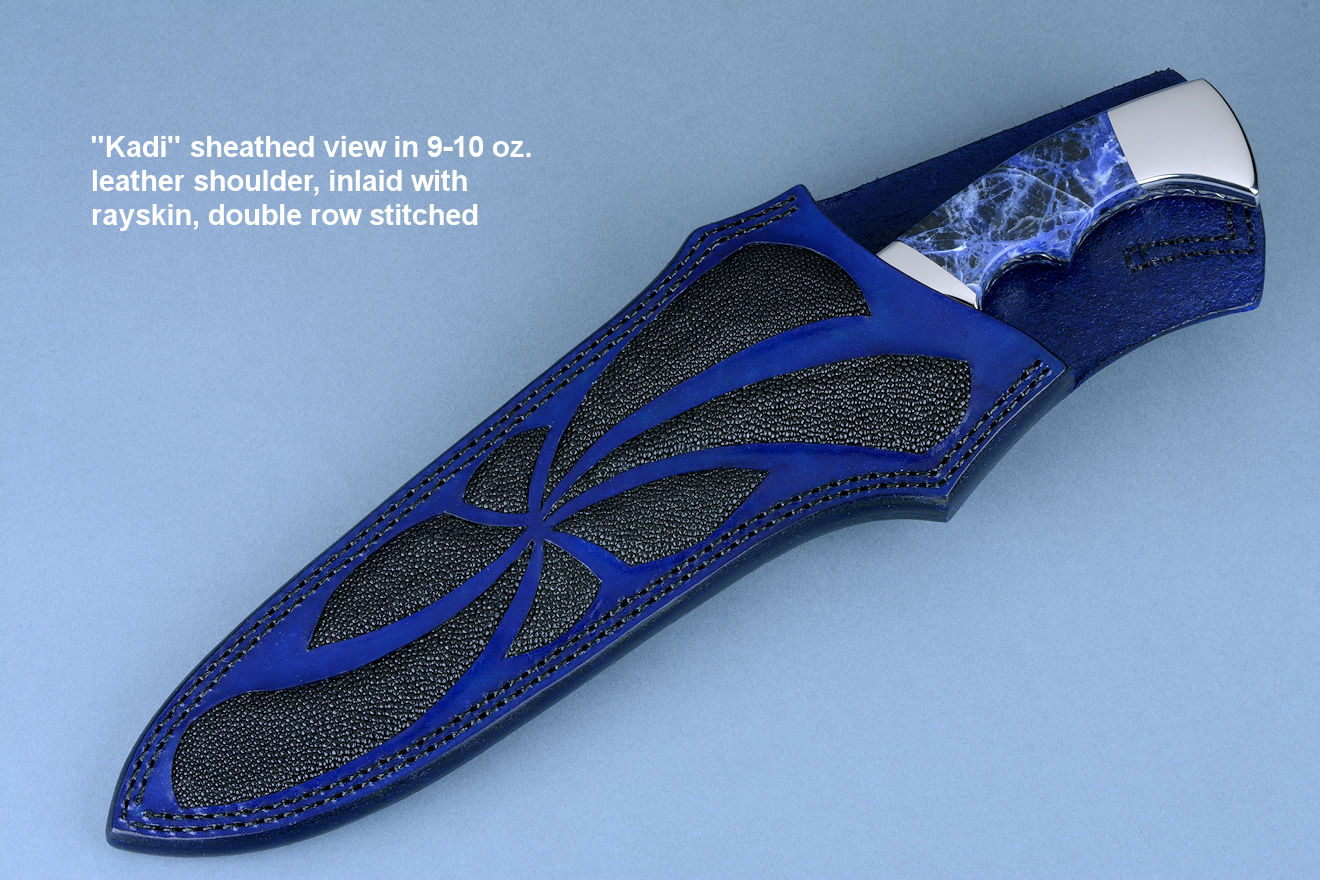
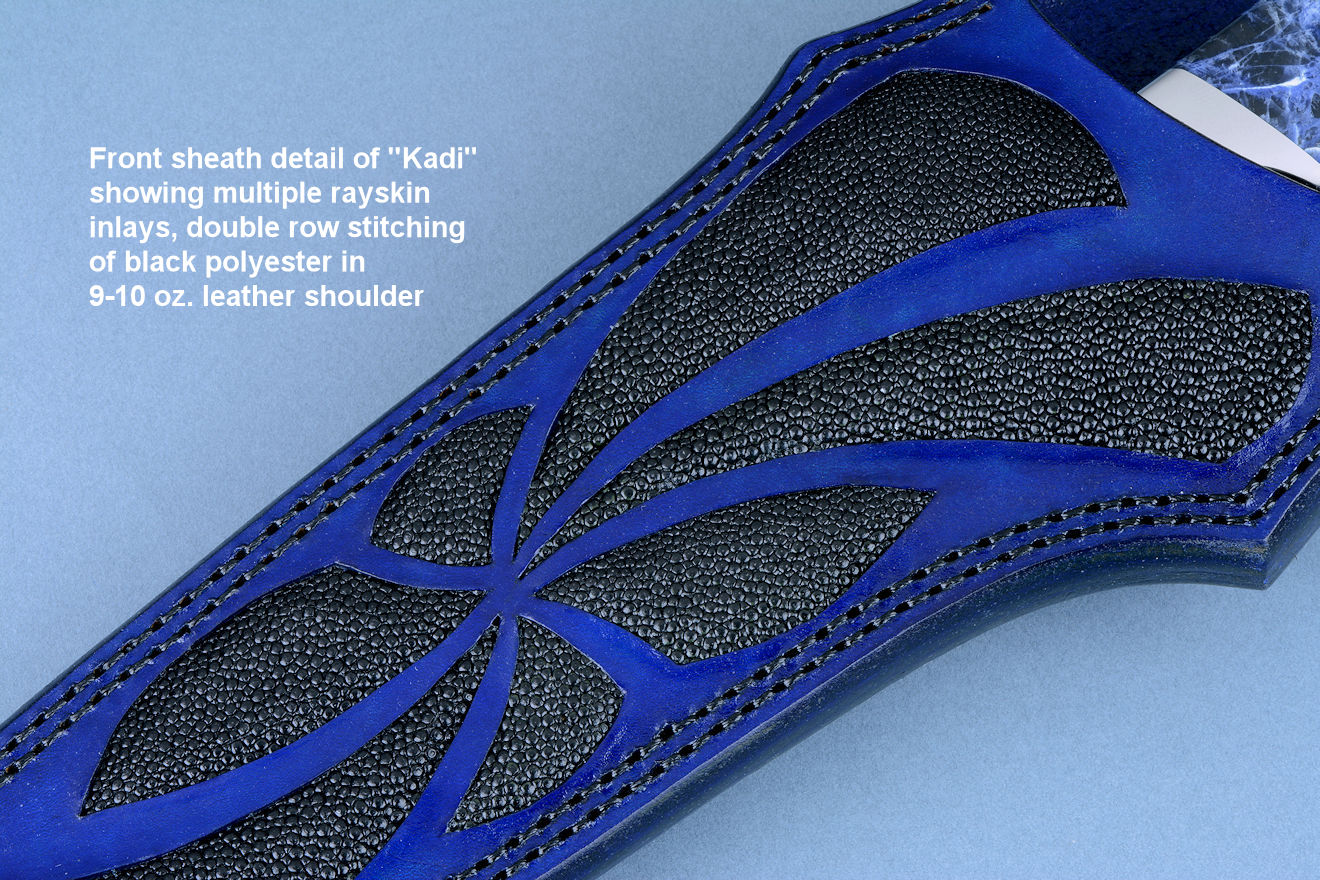
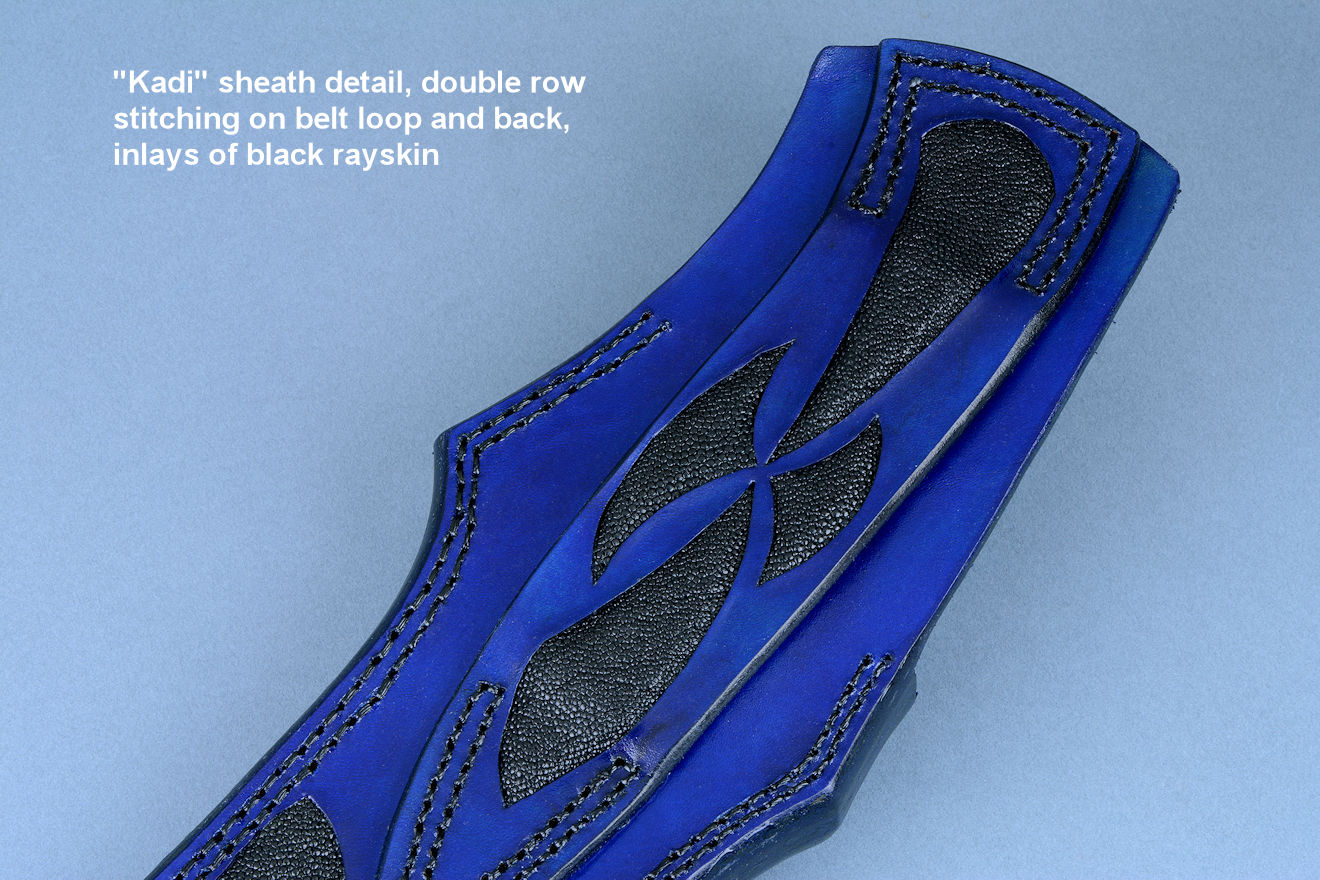
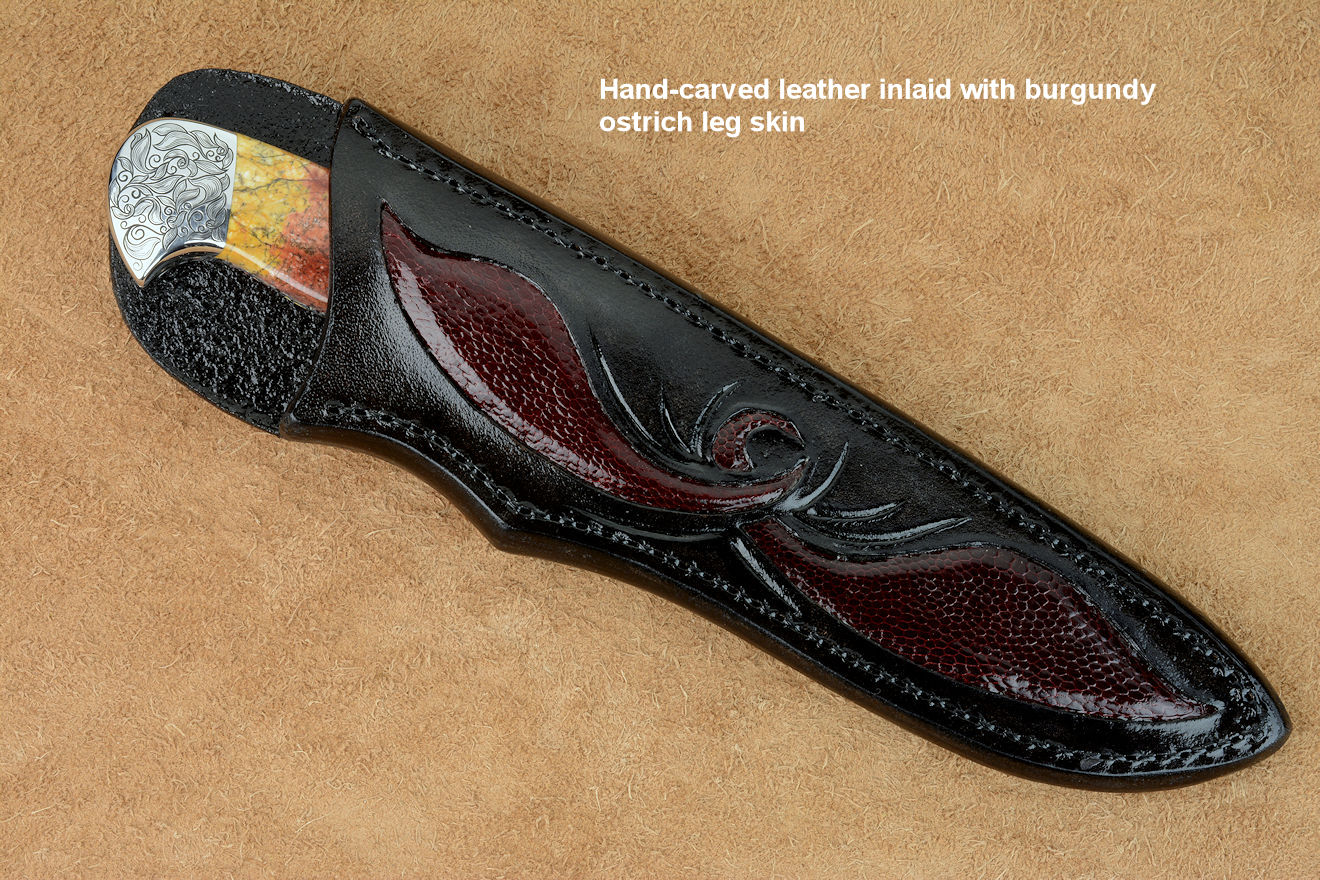
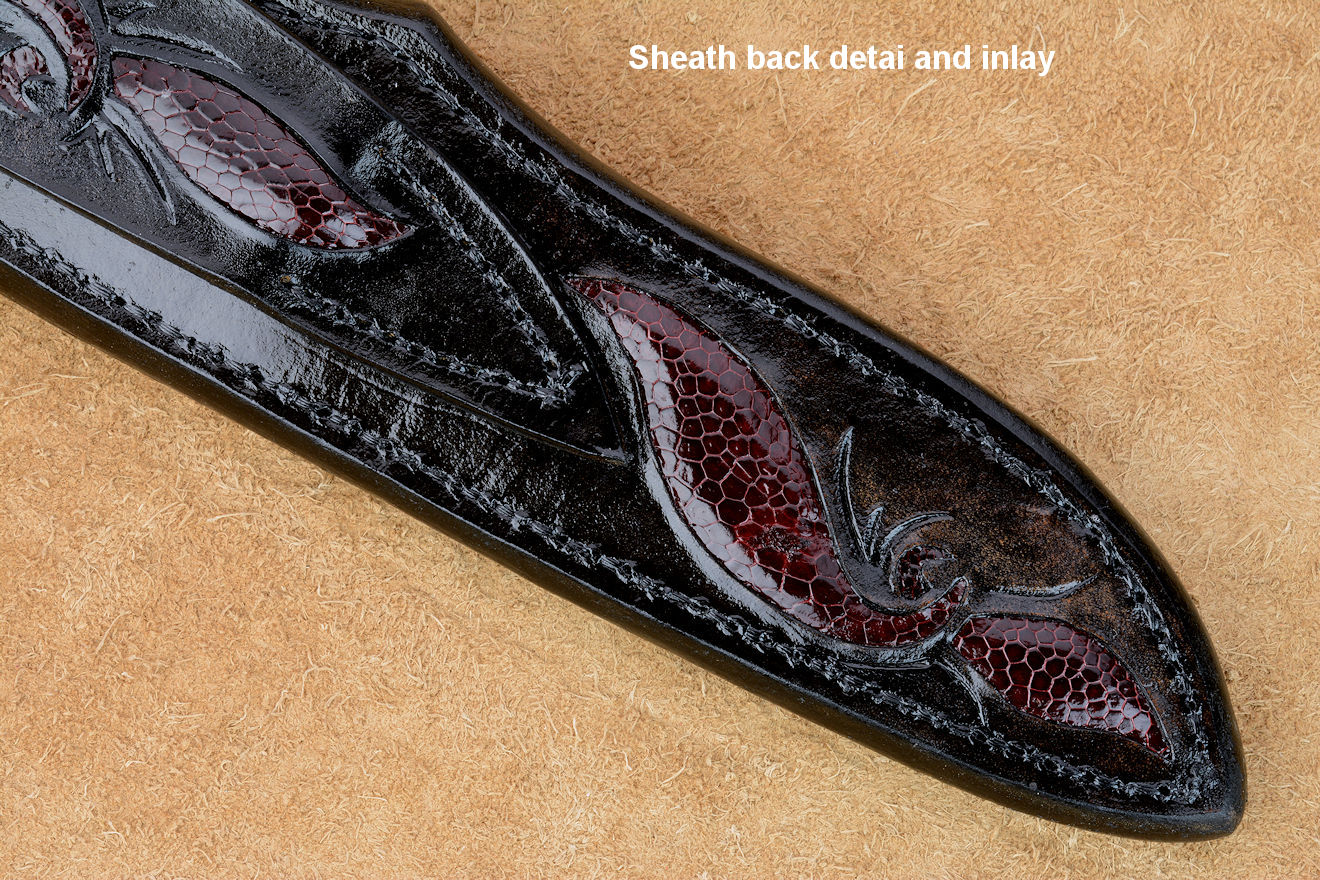
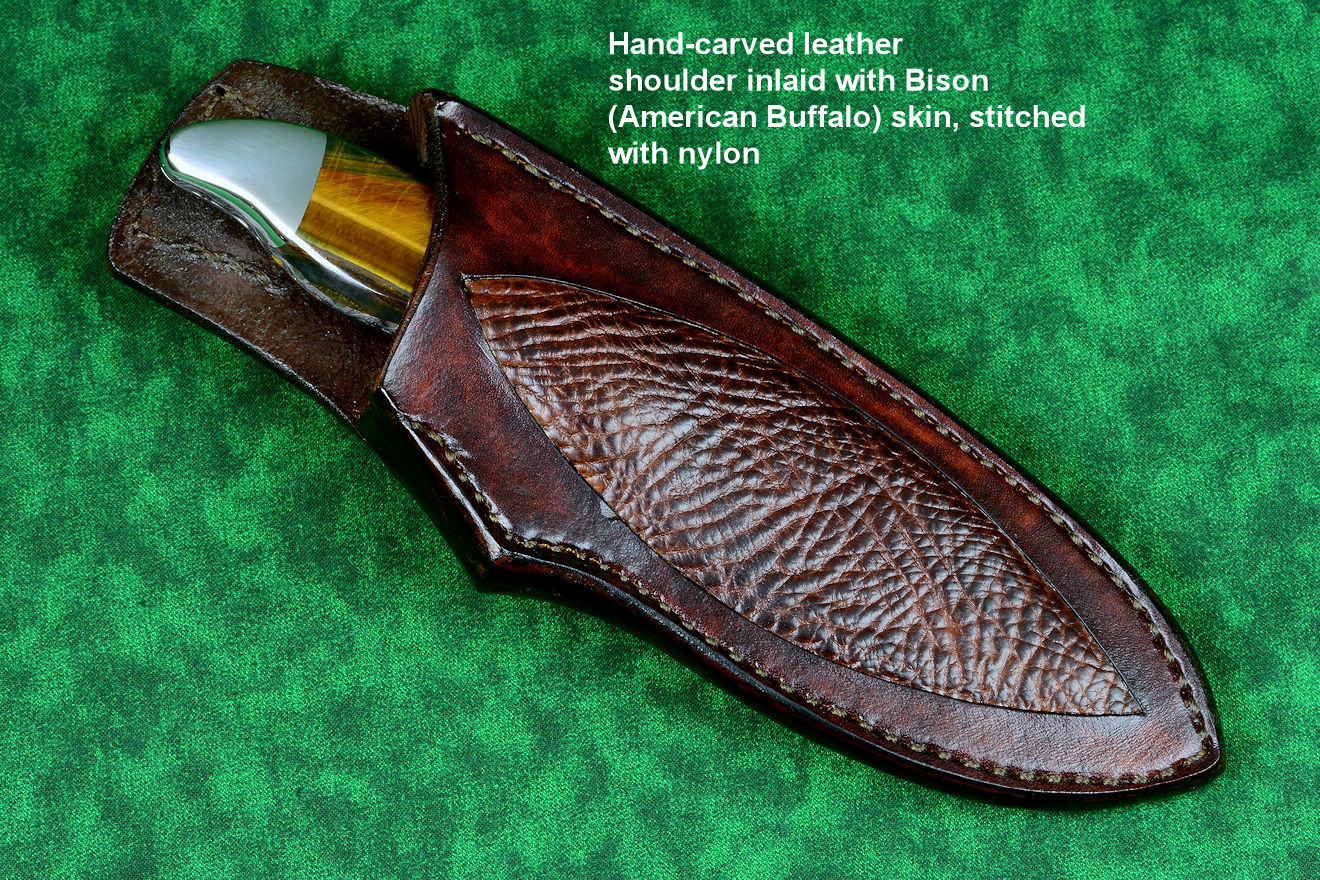
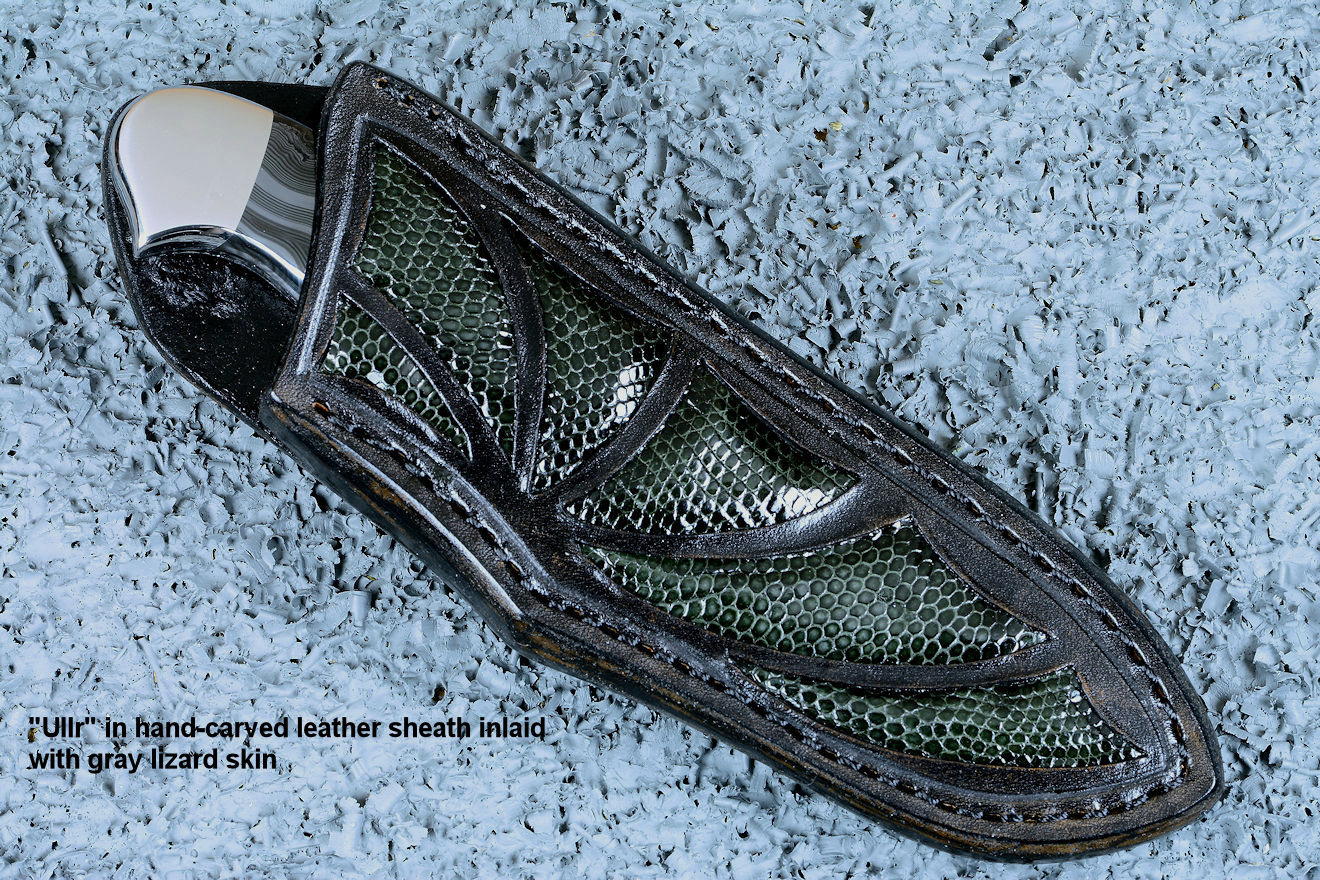
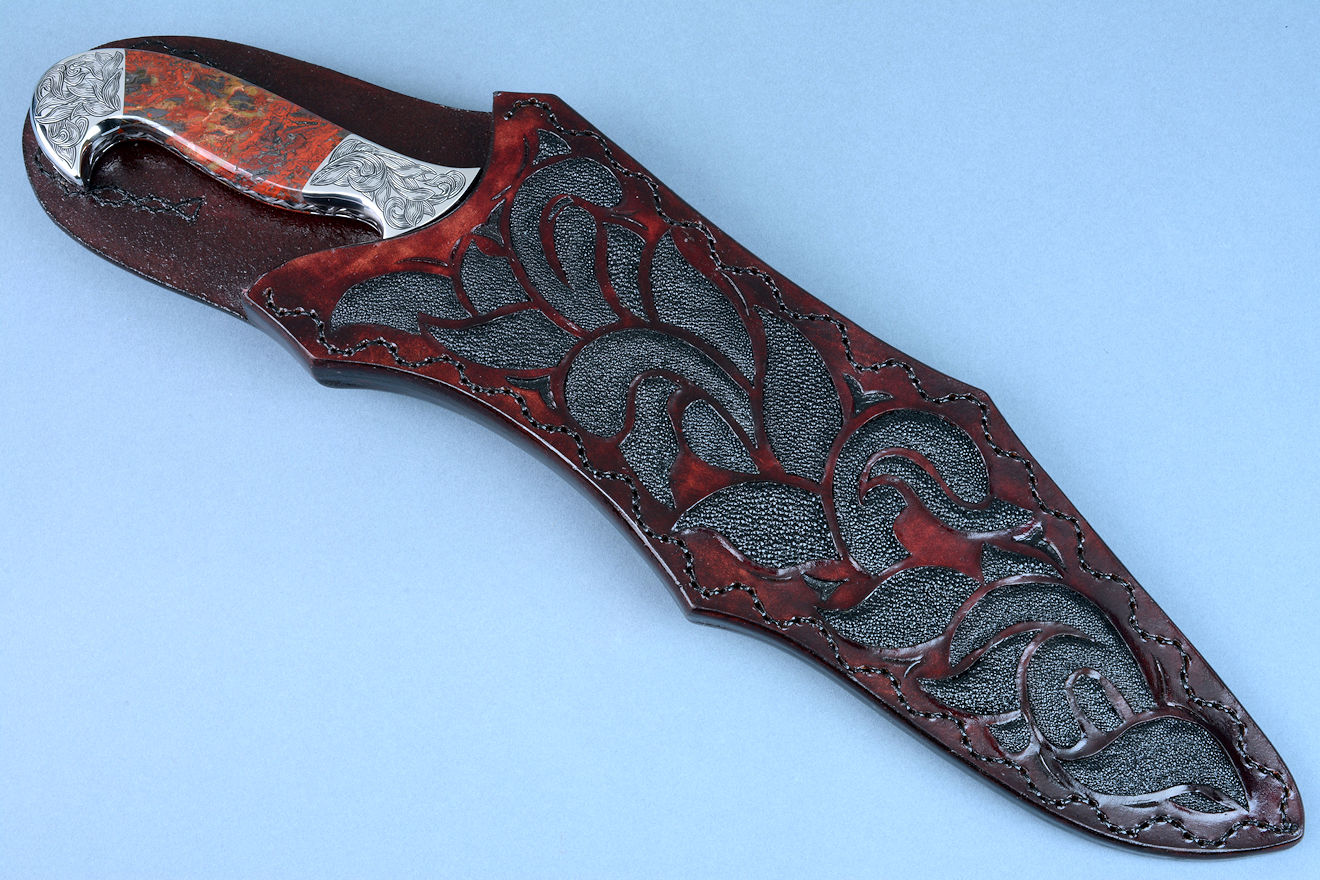
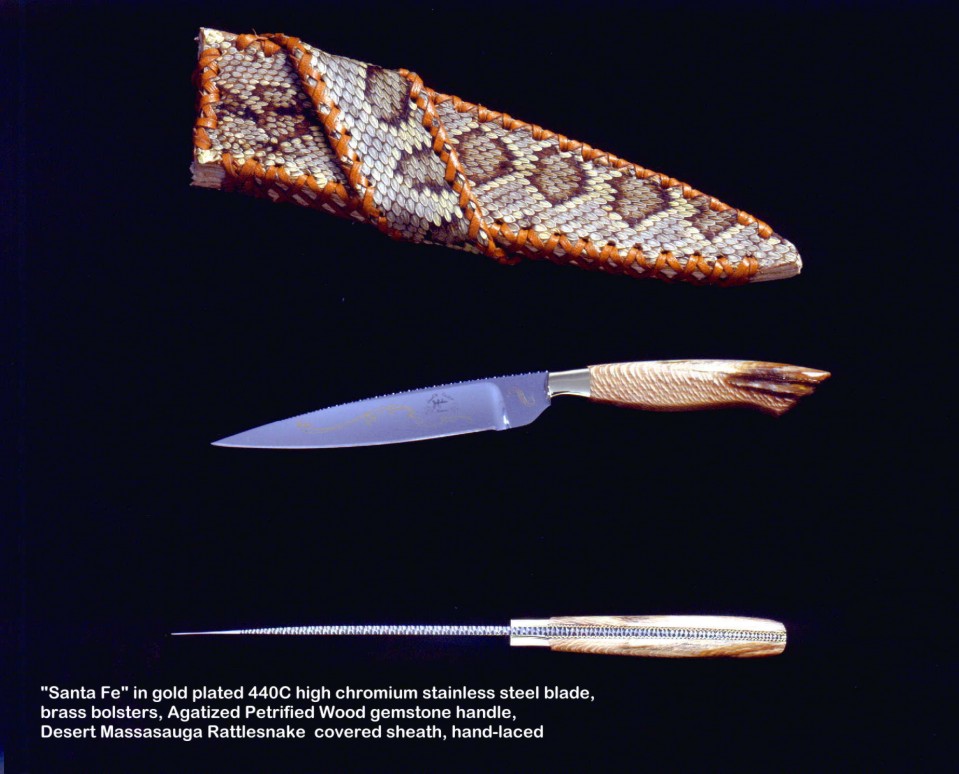
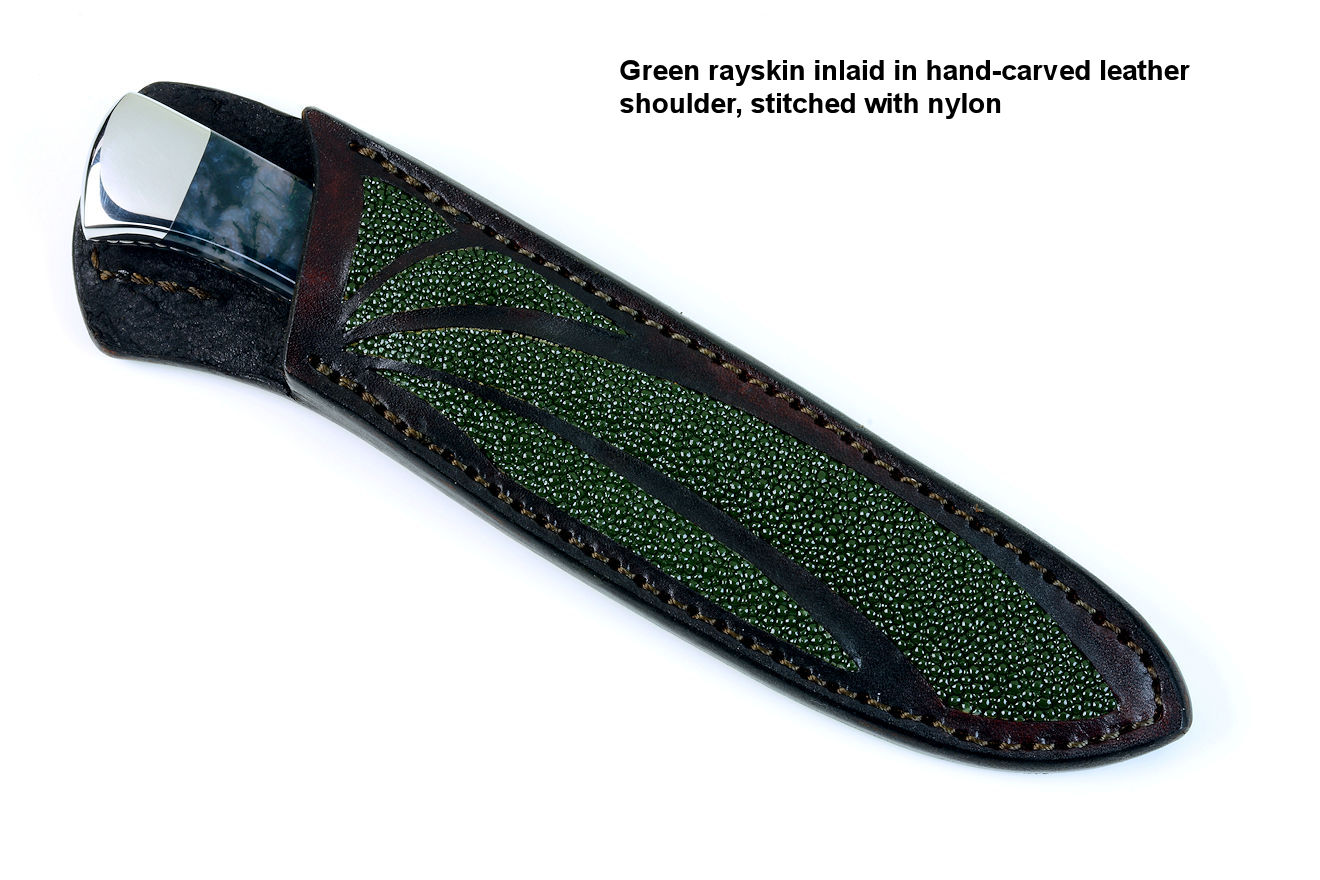
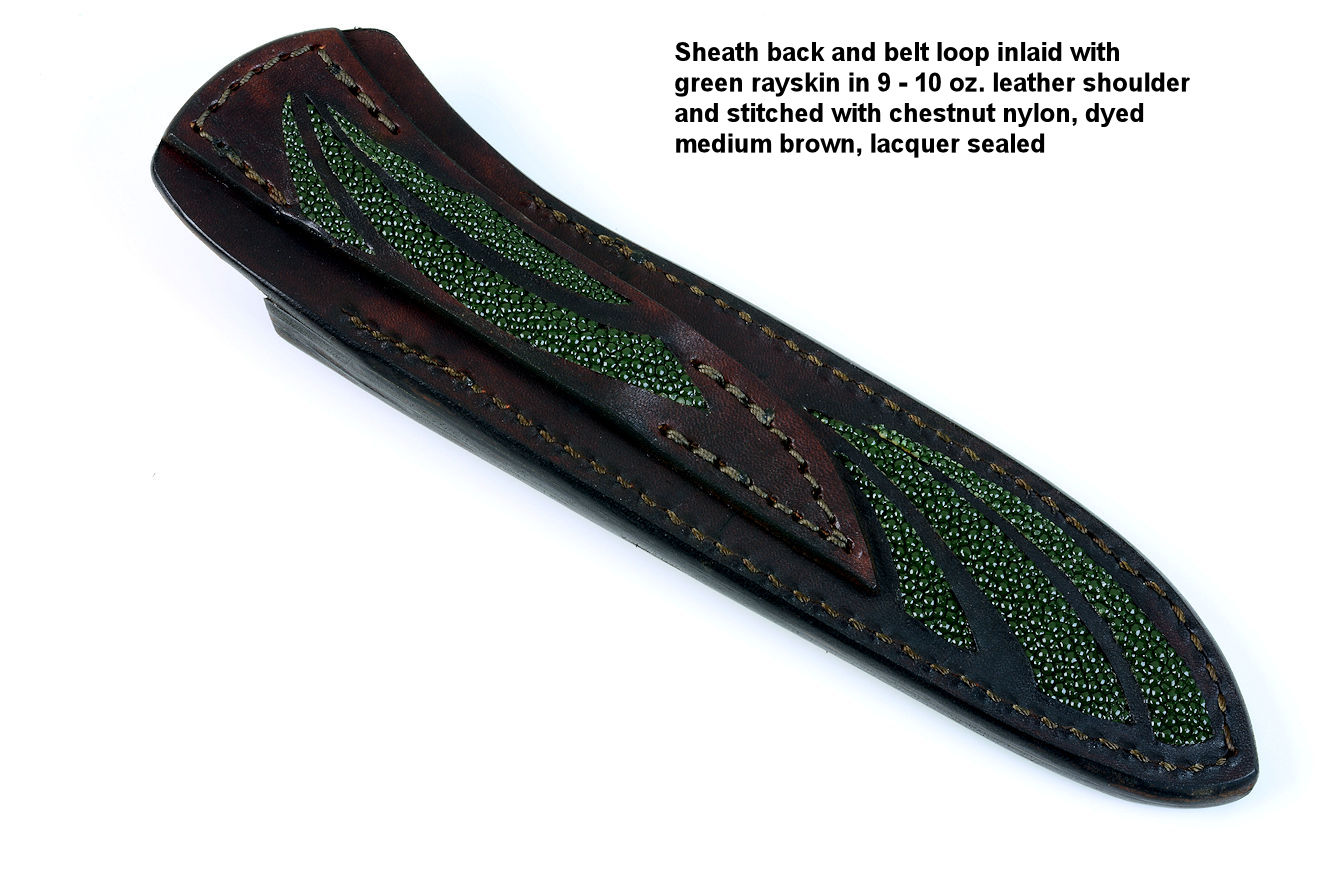
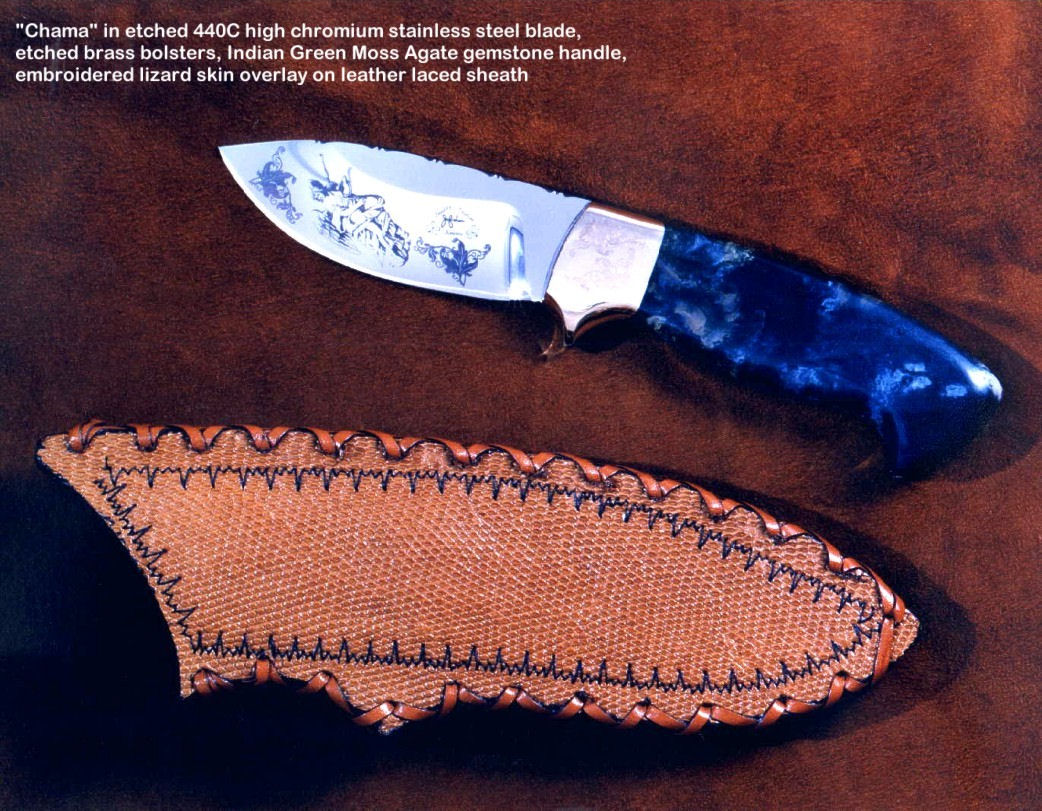
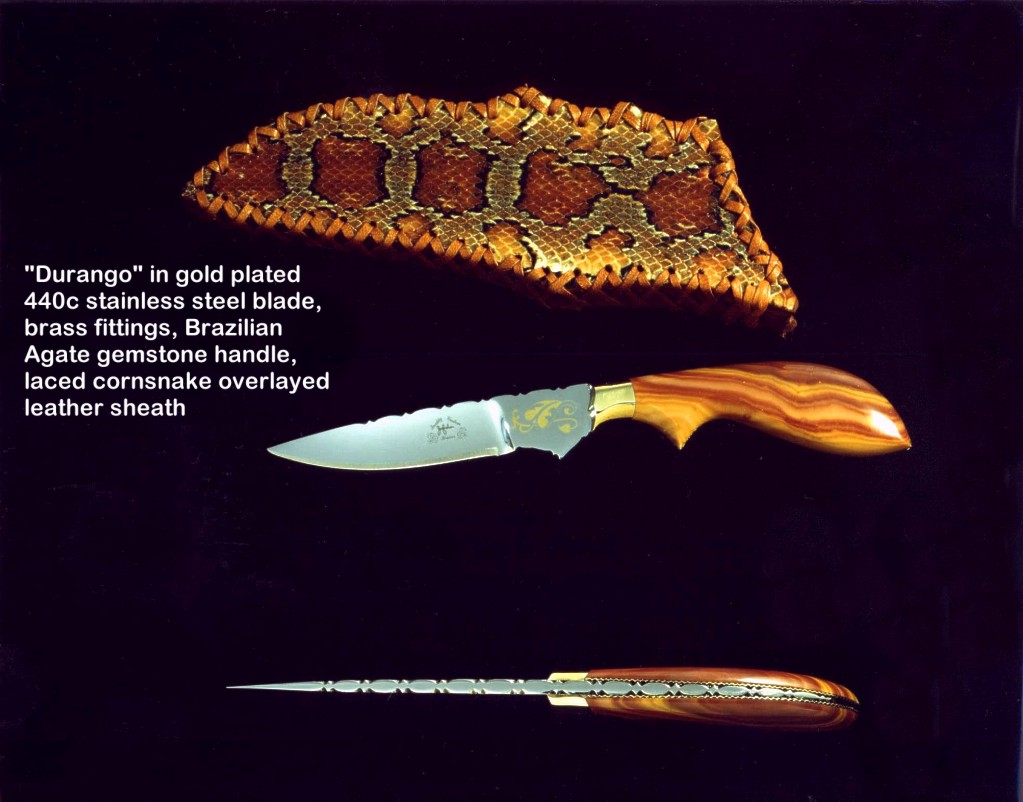
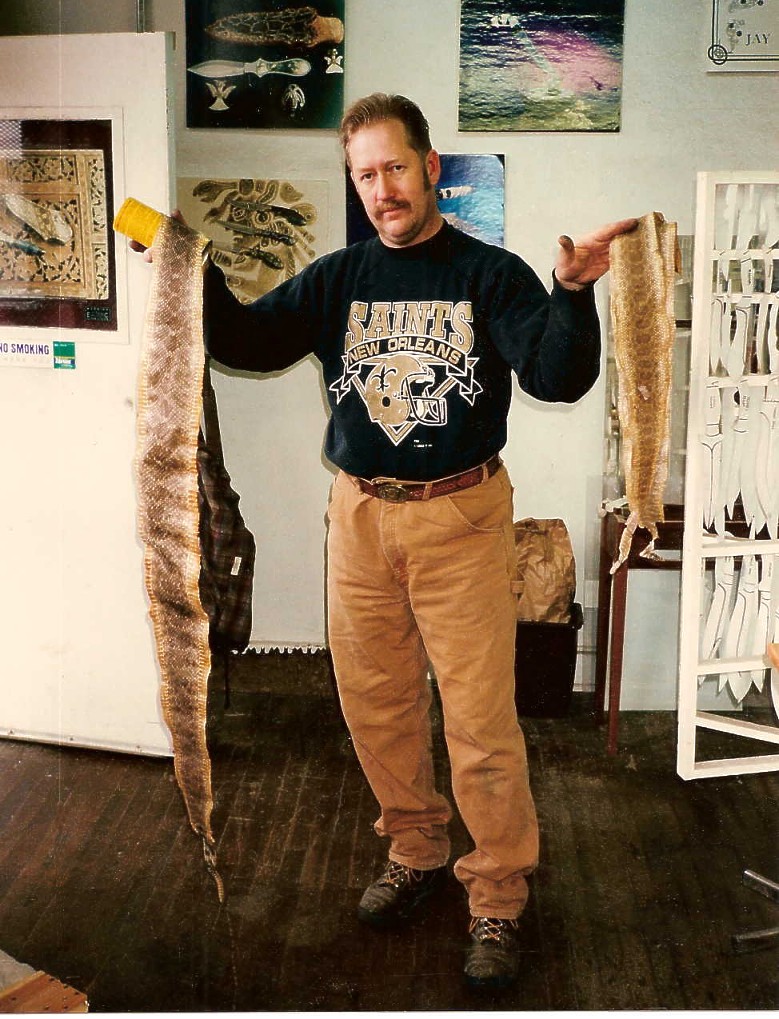
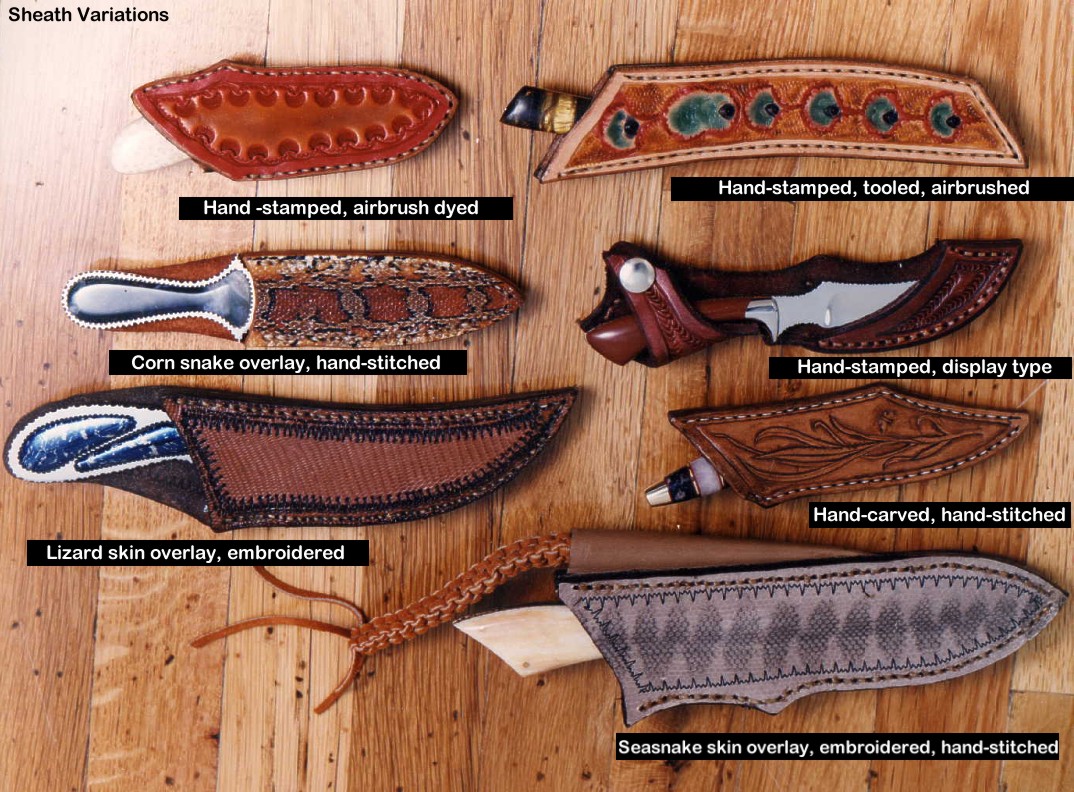
That's why I use exotic inlays of ray skin, sharkskin, caiman, alligator, crocodile, frog, hippo, rattlesnake, python, cobra, lizard, emu, safari antelope, gazelle, and even cow stomach (don't laugh, it's beautiful). I also engrave, hand-tool, hand carve and stamp, metalize, and even airbrush some of my sheaths. I've adorned sheaths with carving, inlay, overlays, and mounts of gemstone, scrimshaw ivory, and precious metals.
It's simple really; a beautiful knife deserves a beautiful and matching sheath.
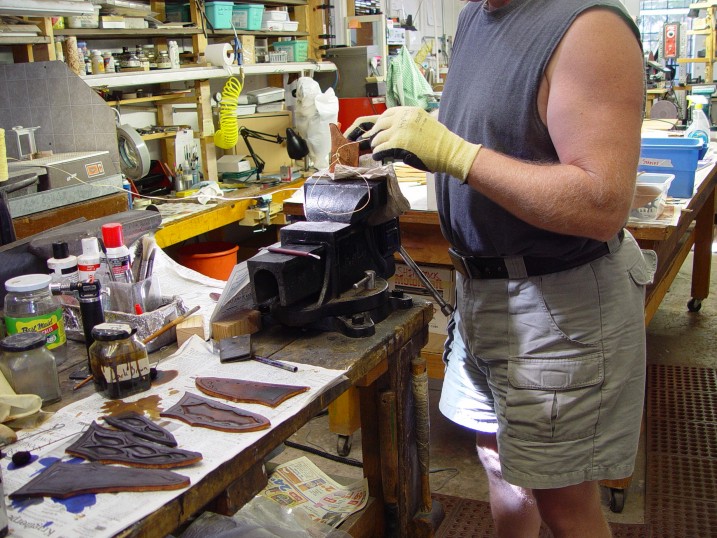
Skill is better demonstrated than defined.
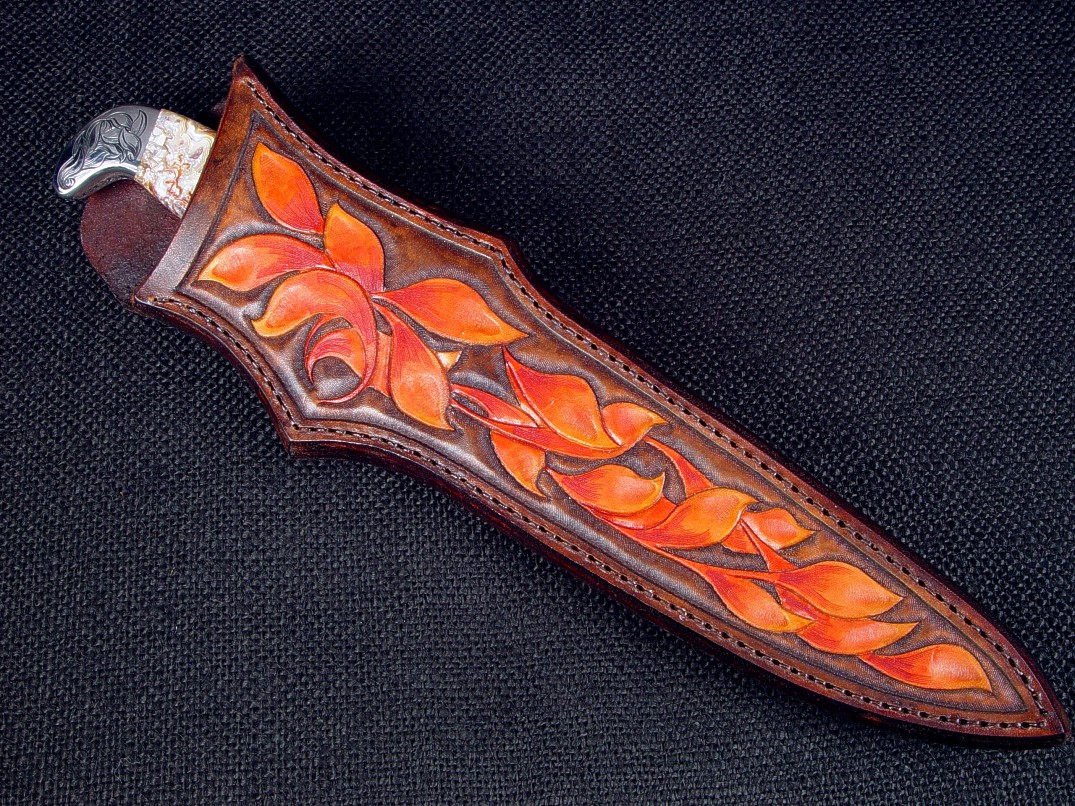
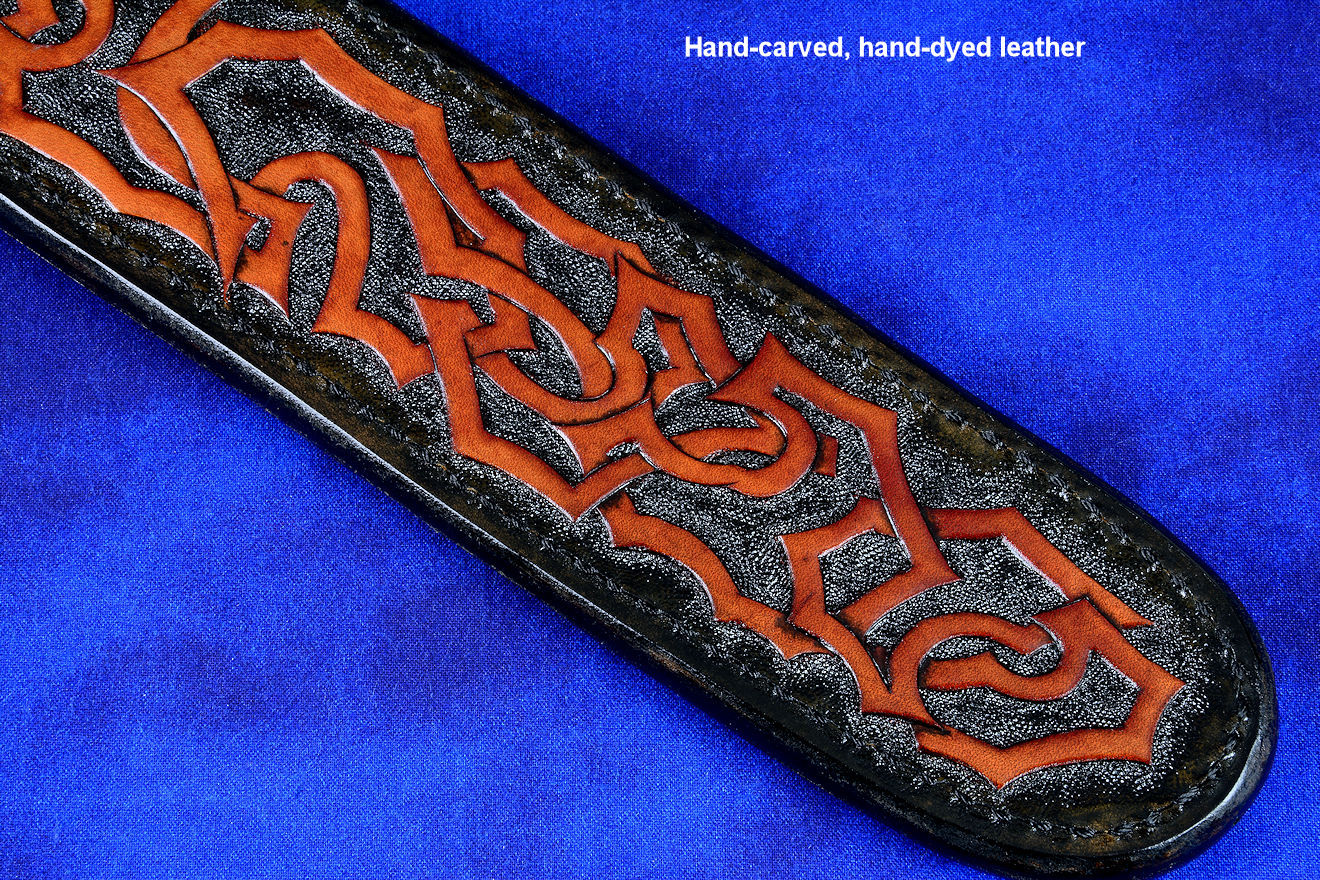
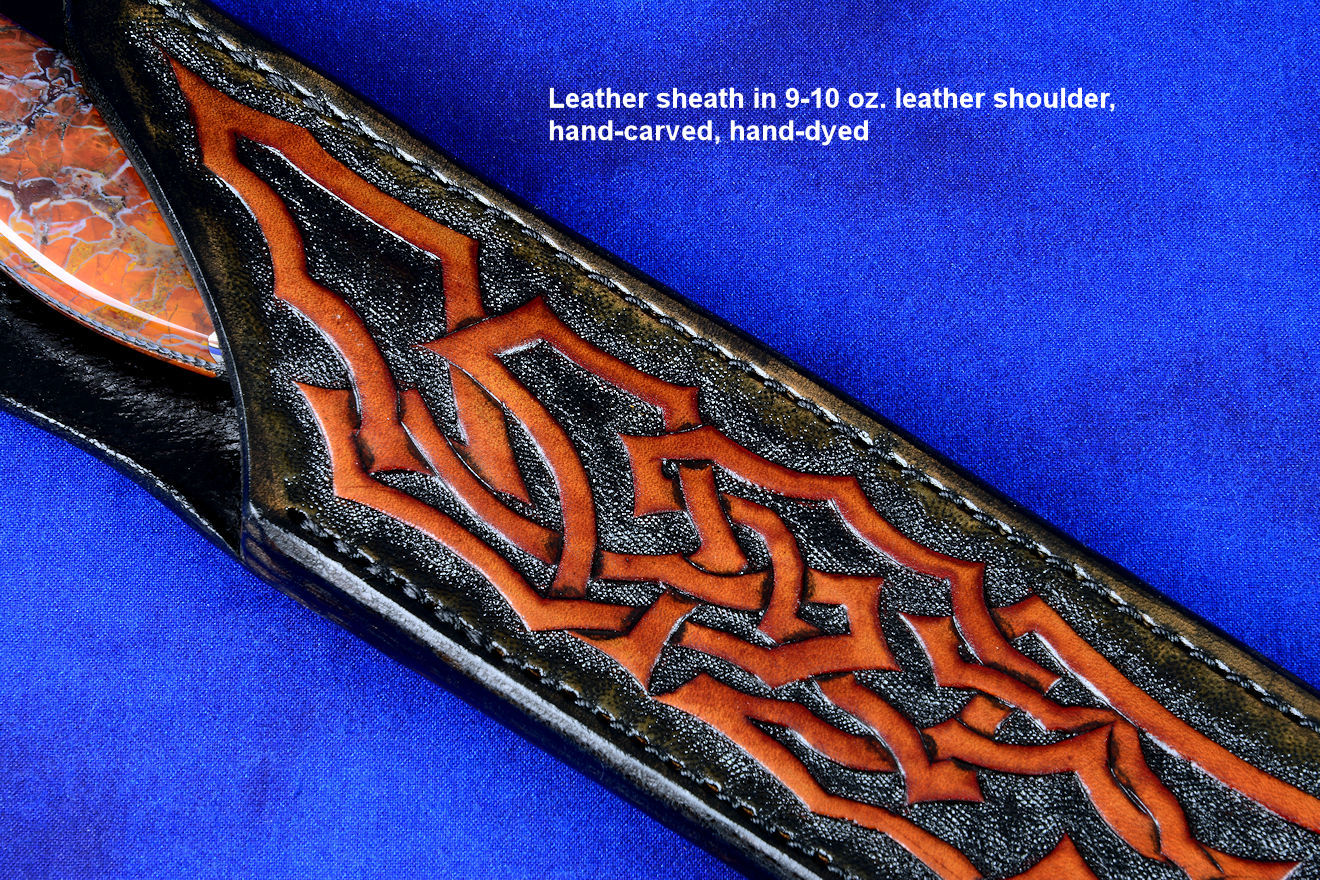
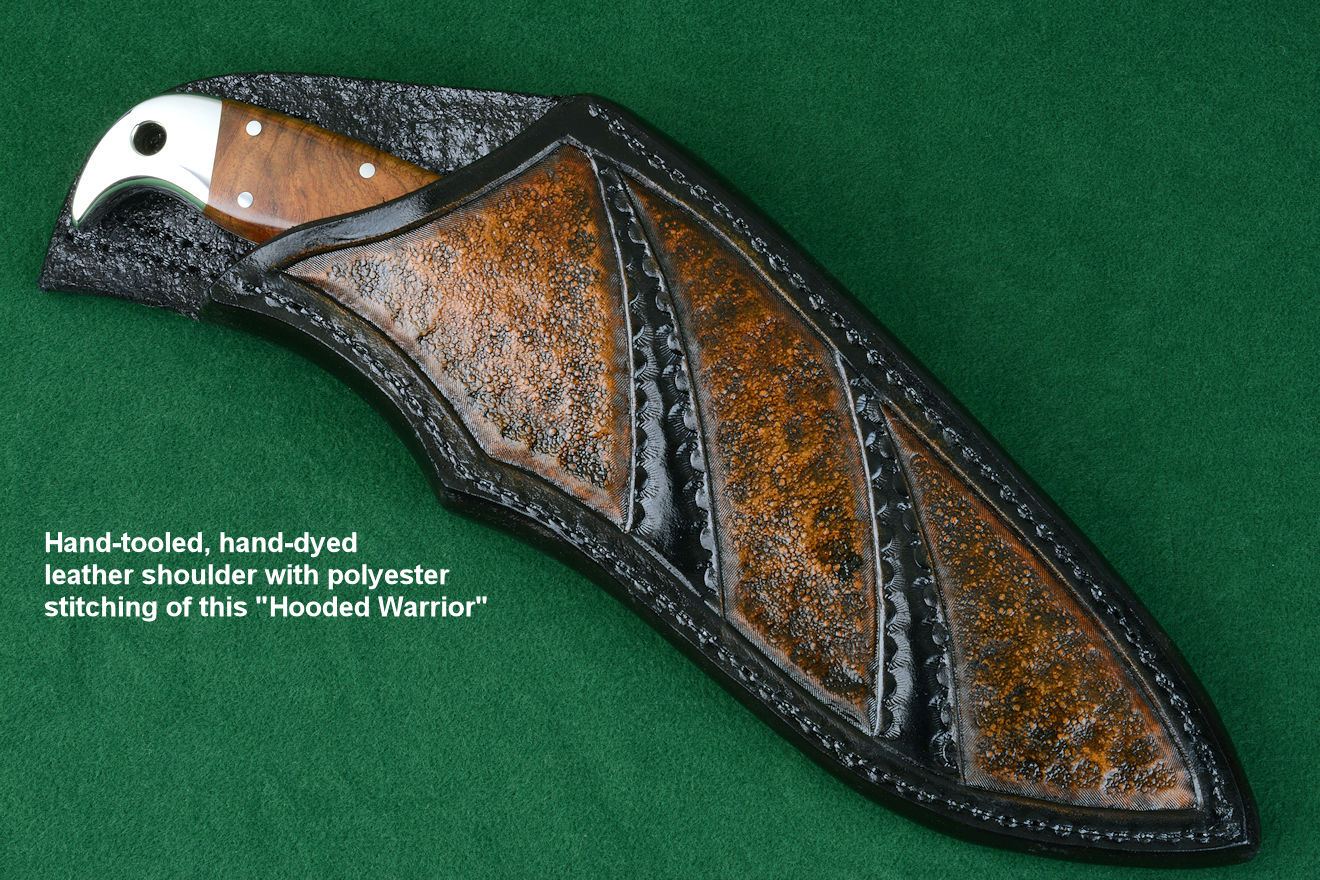
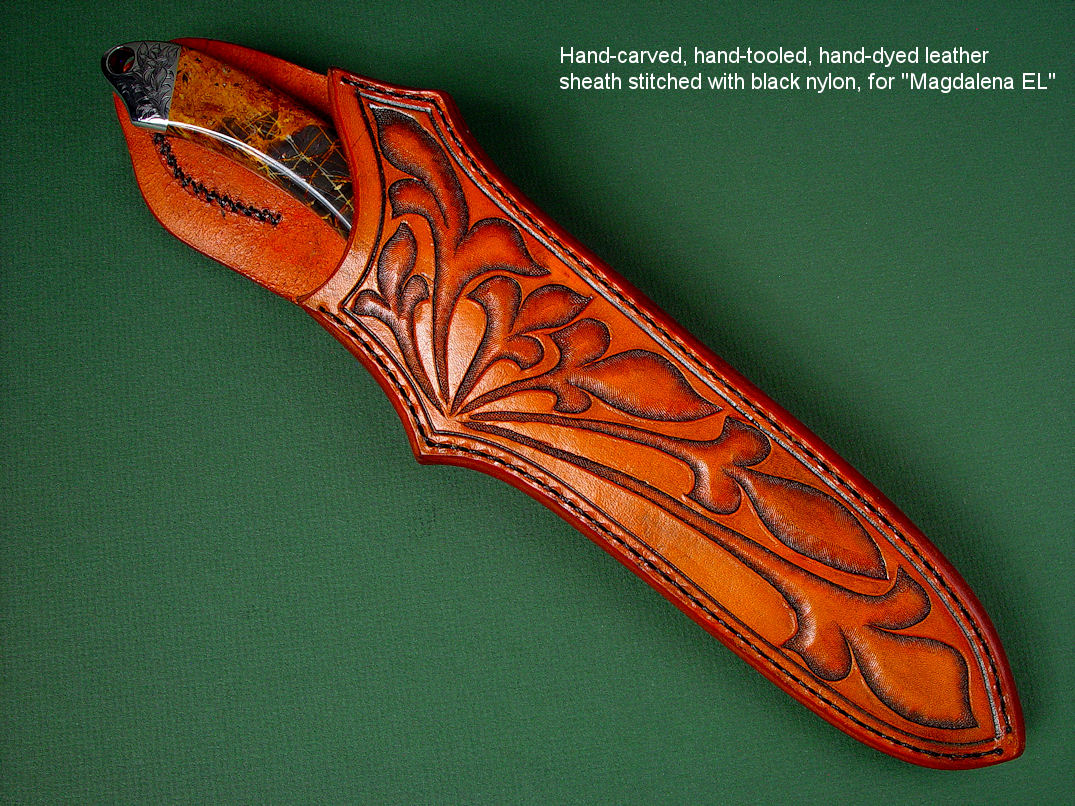
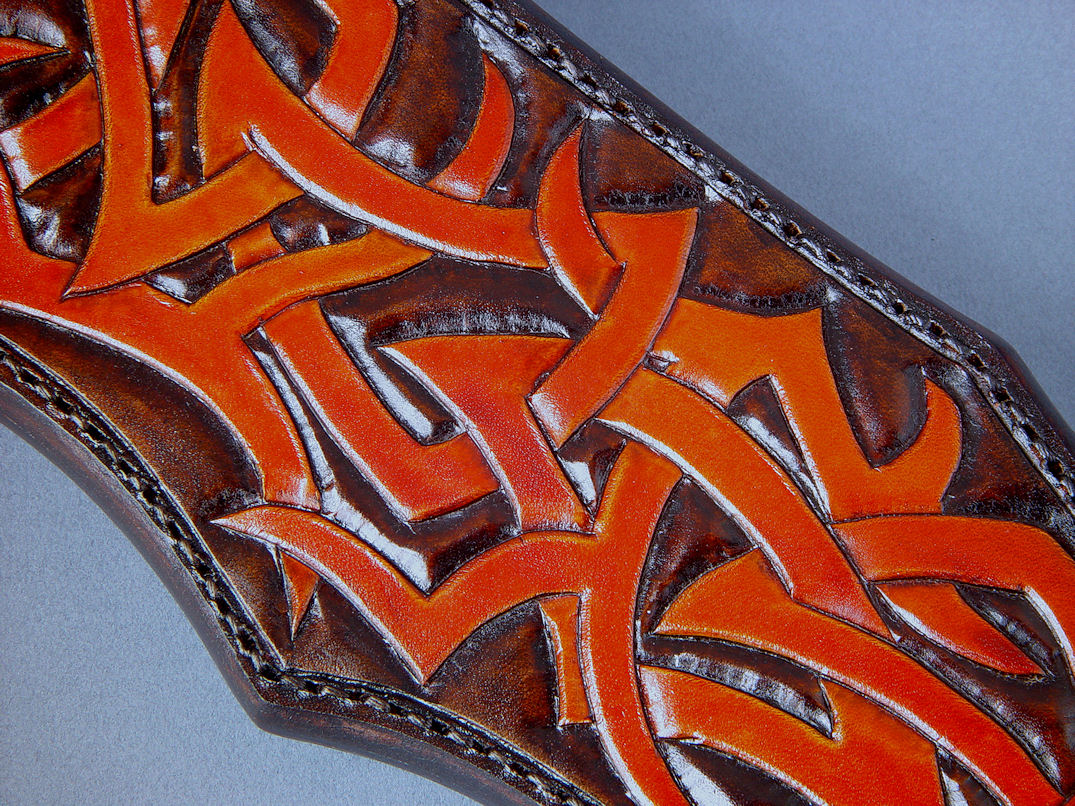
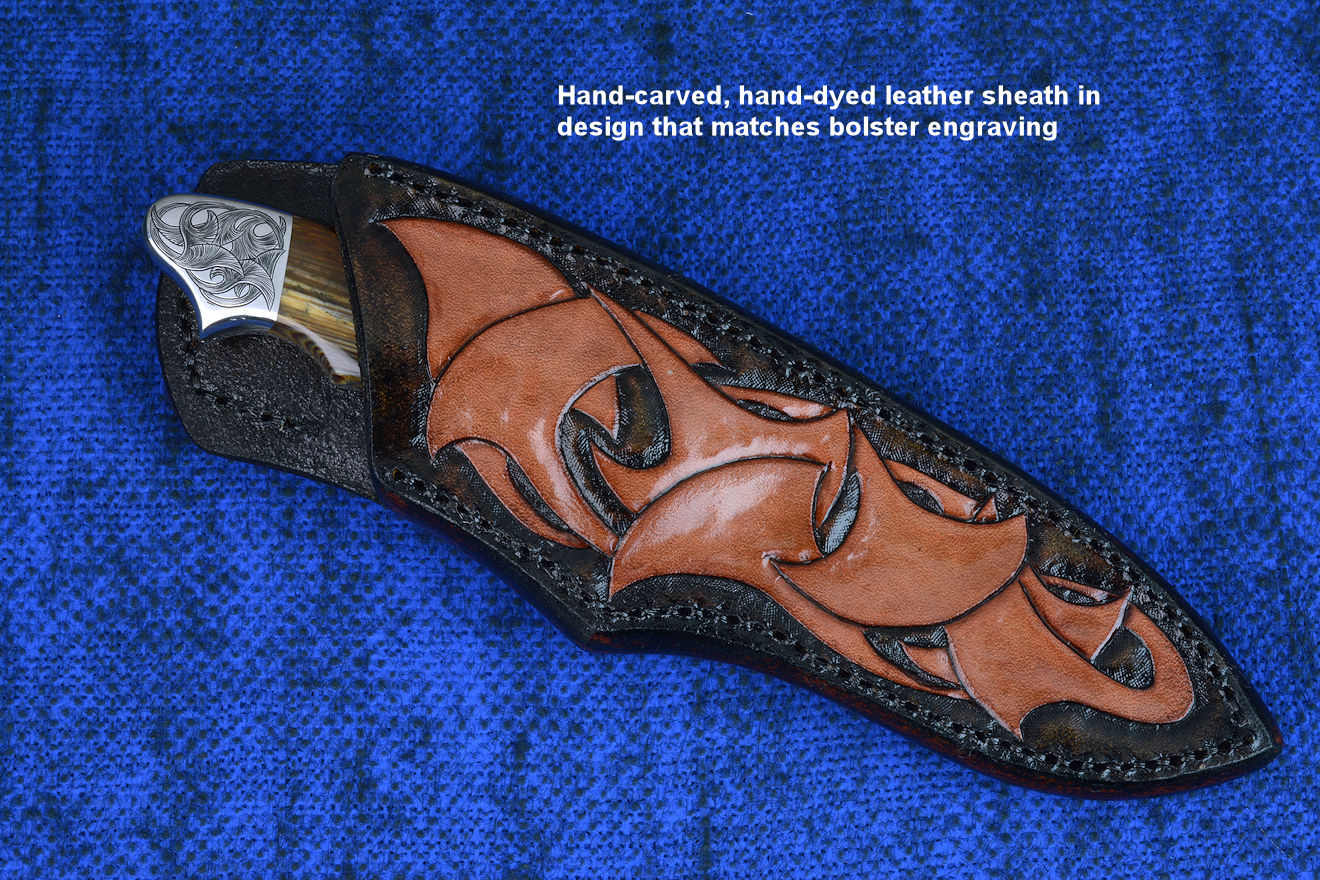
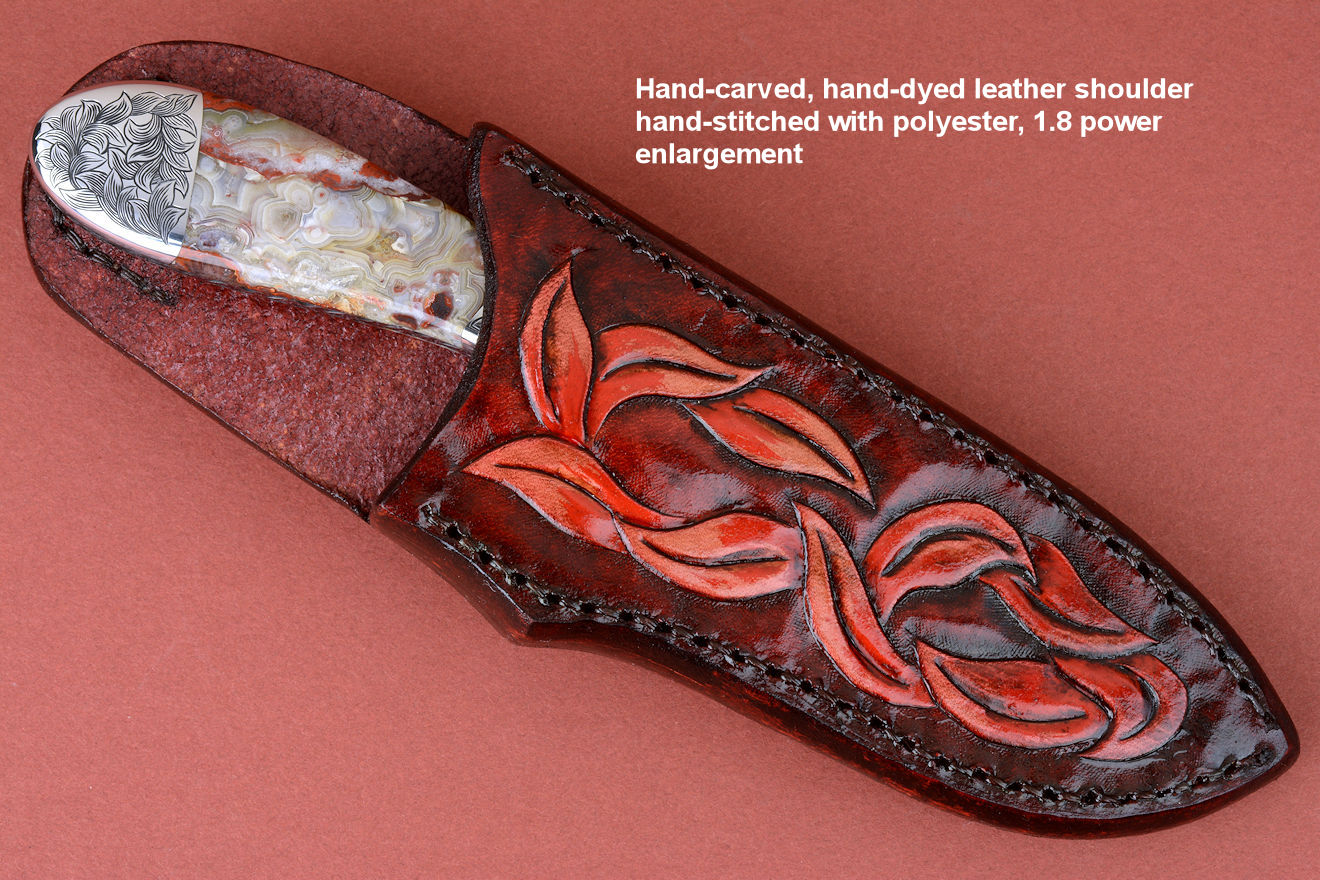
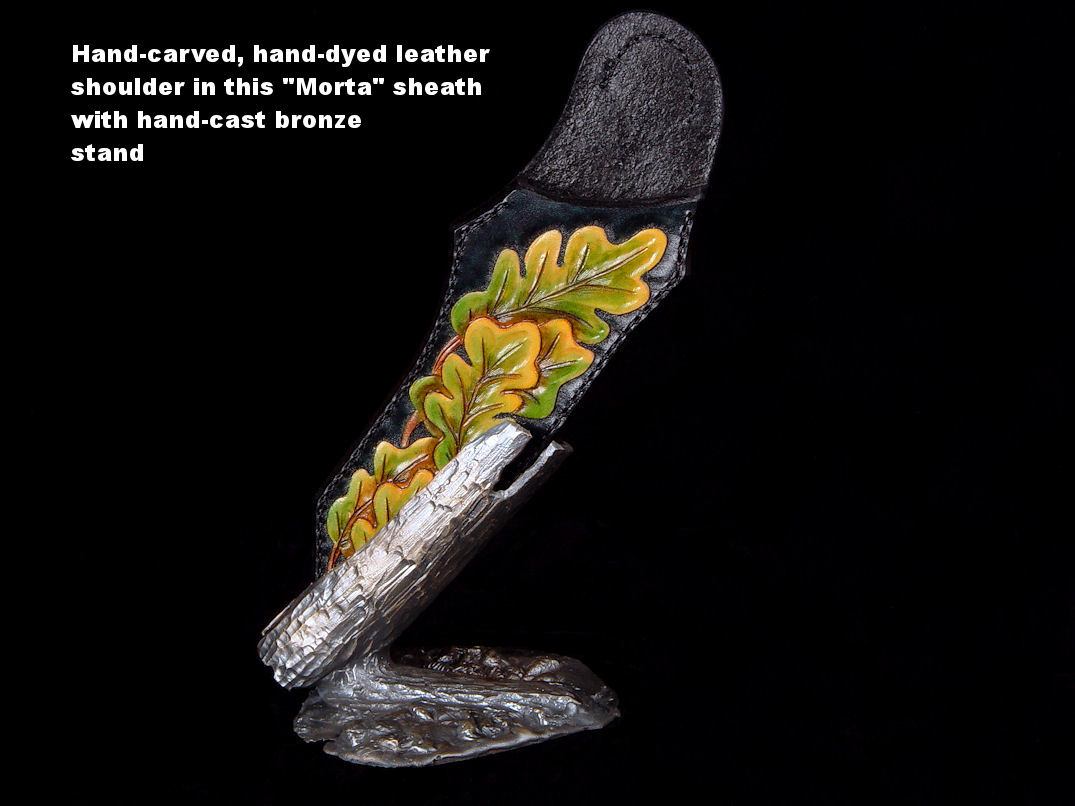
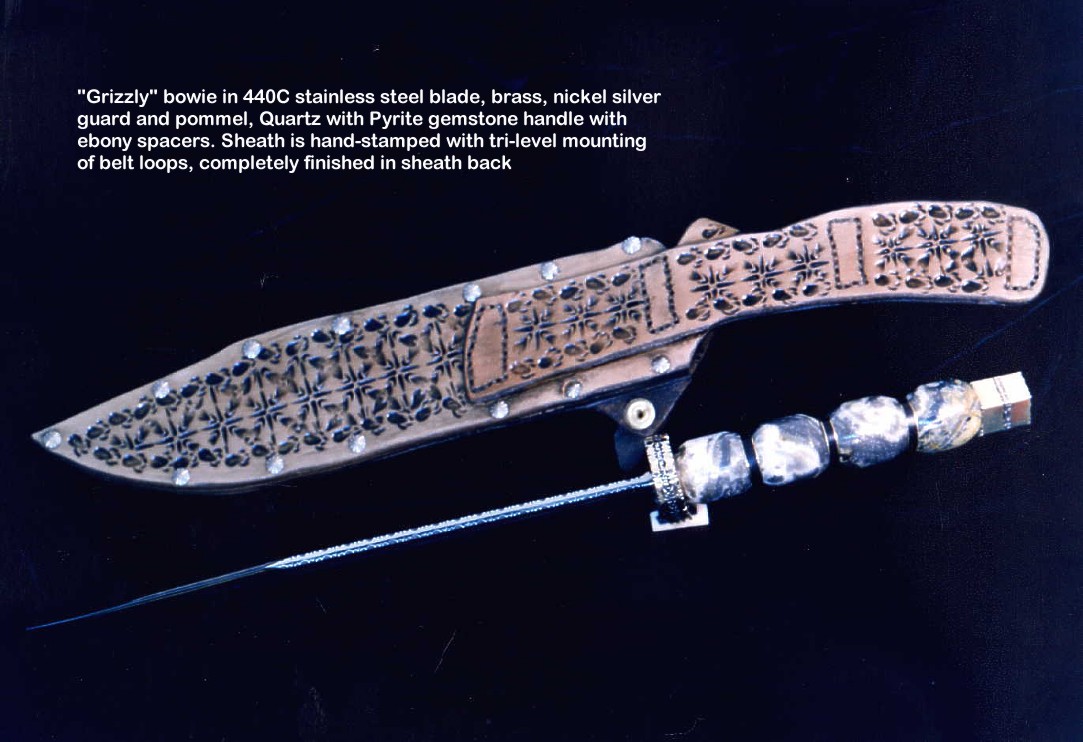
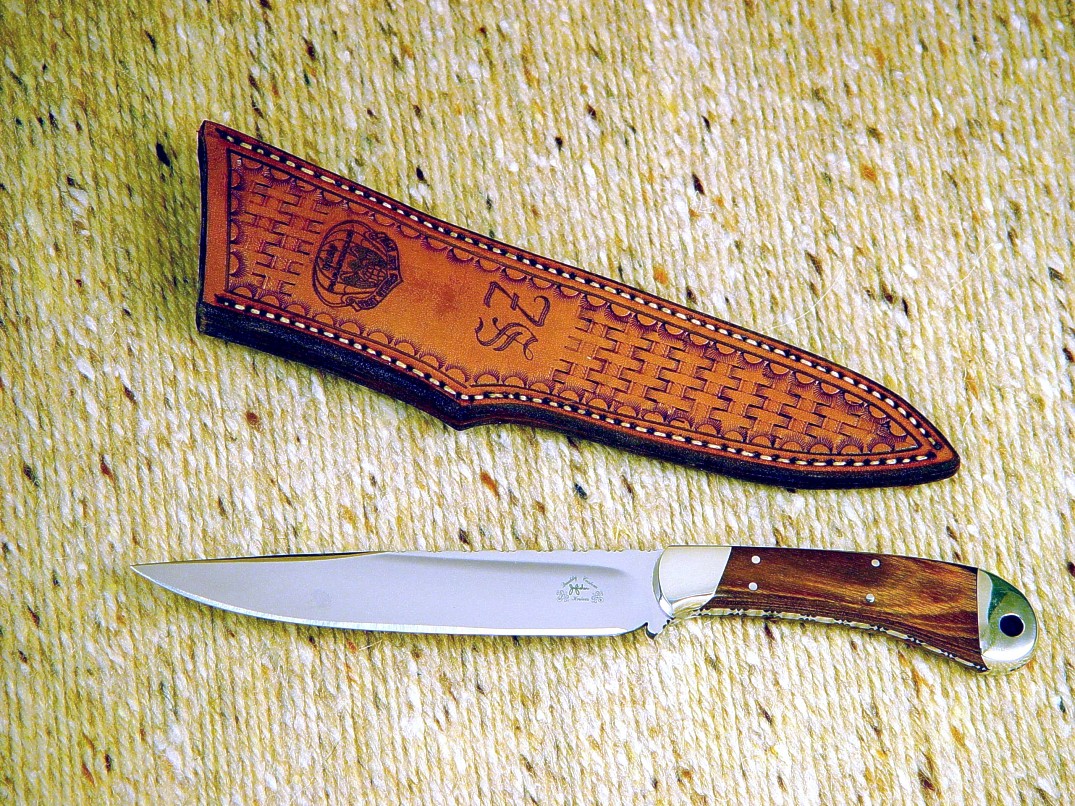
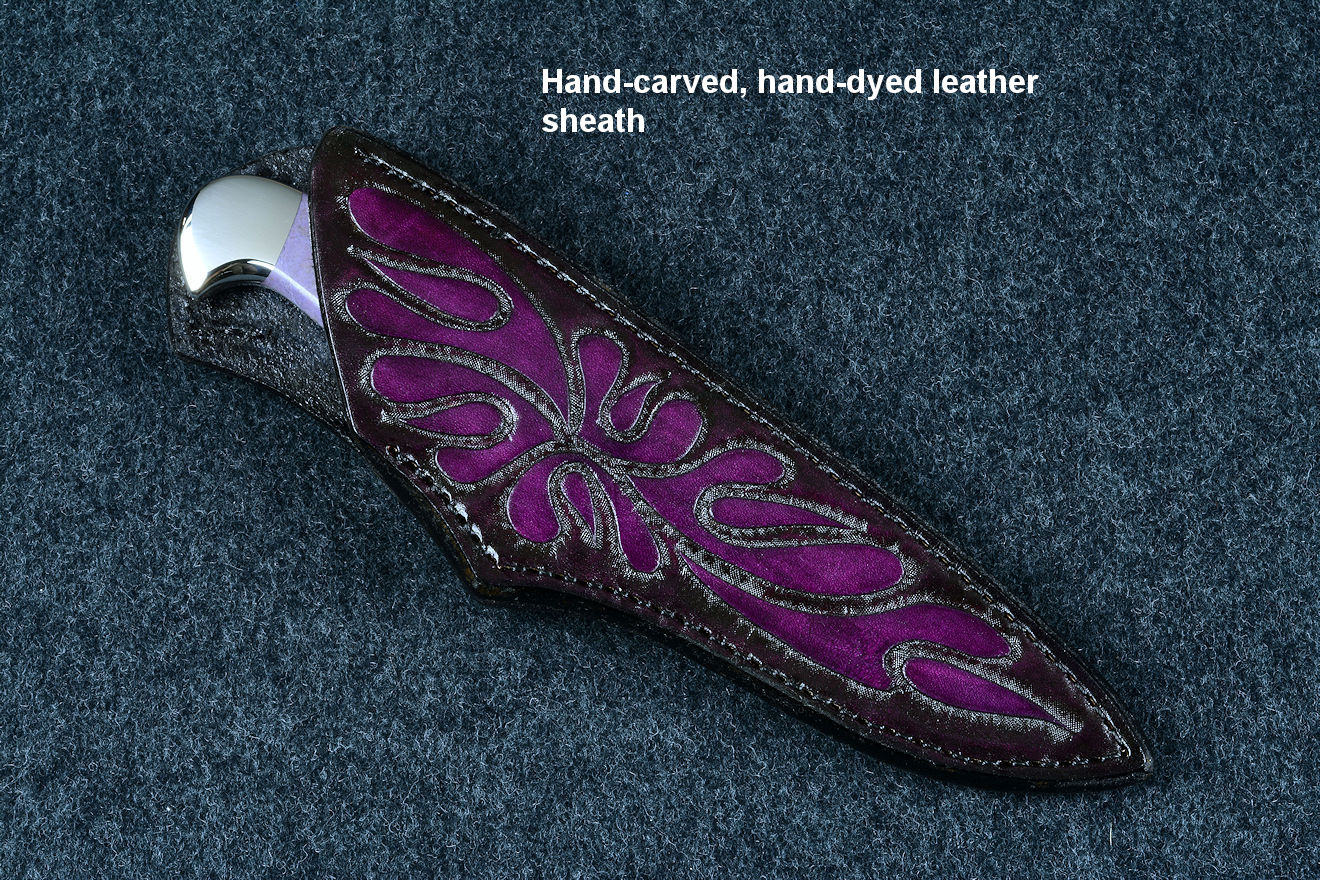
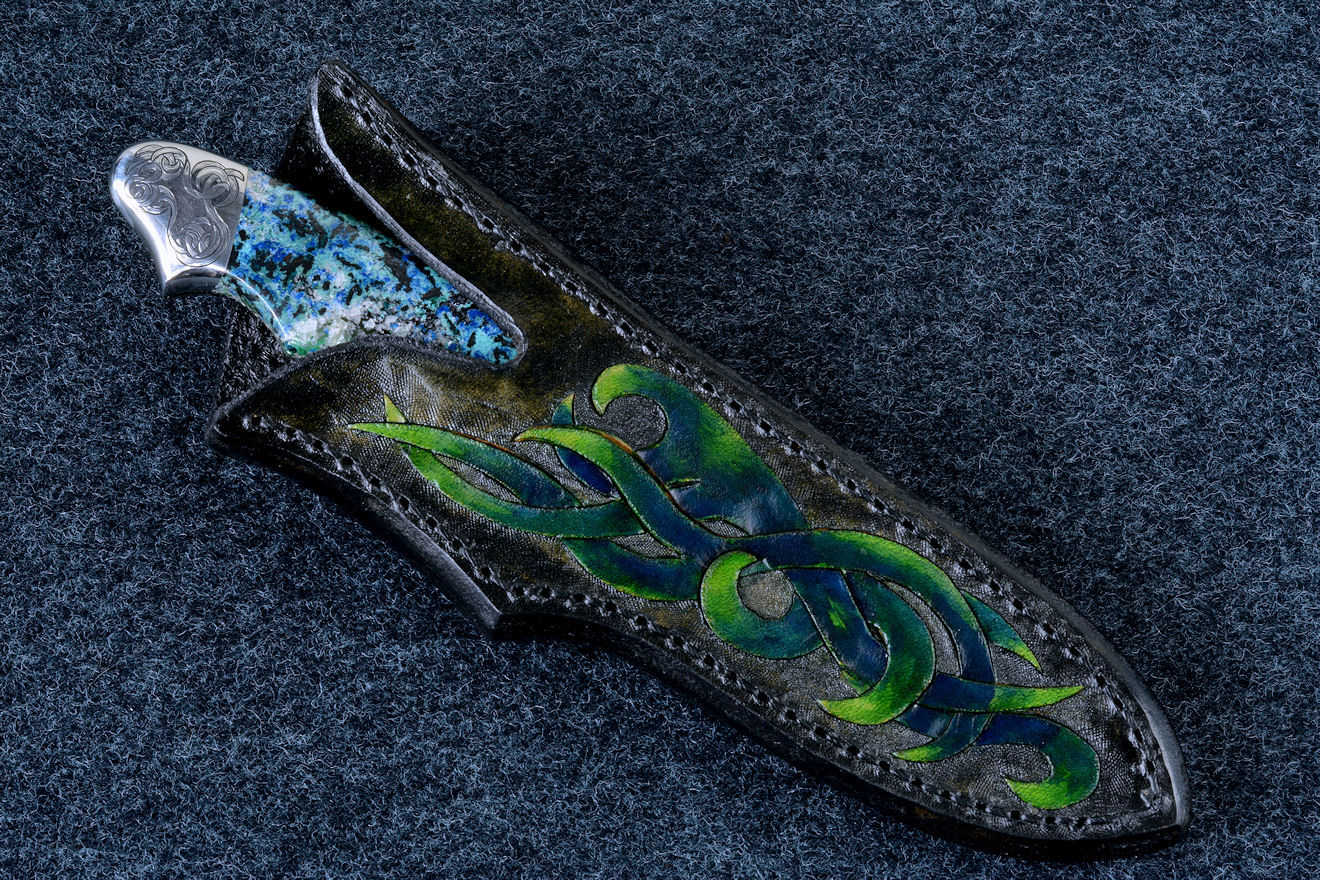
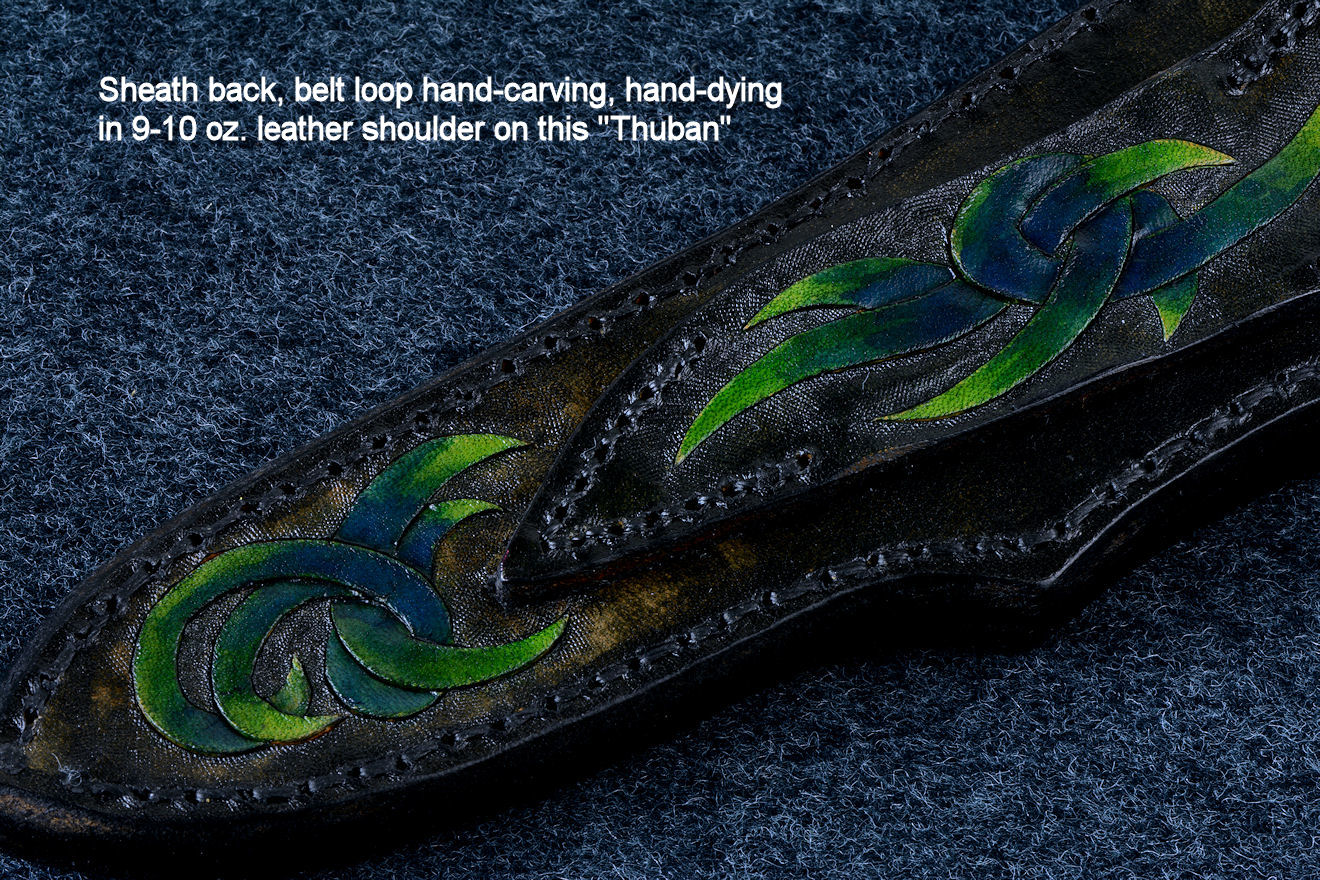
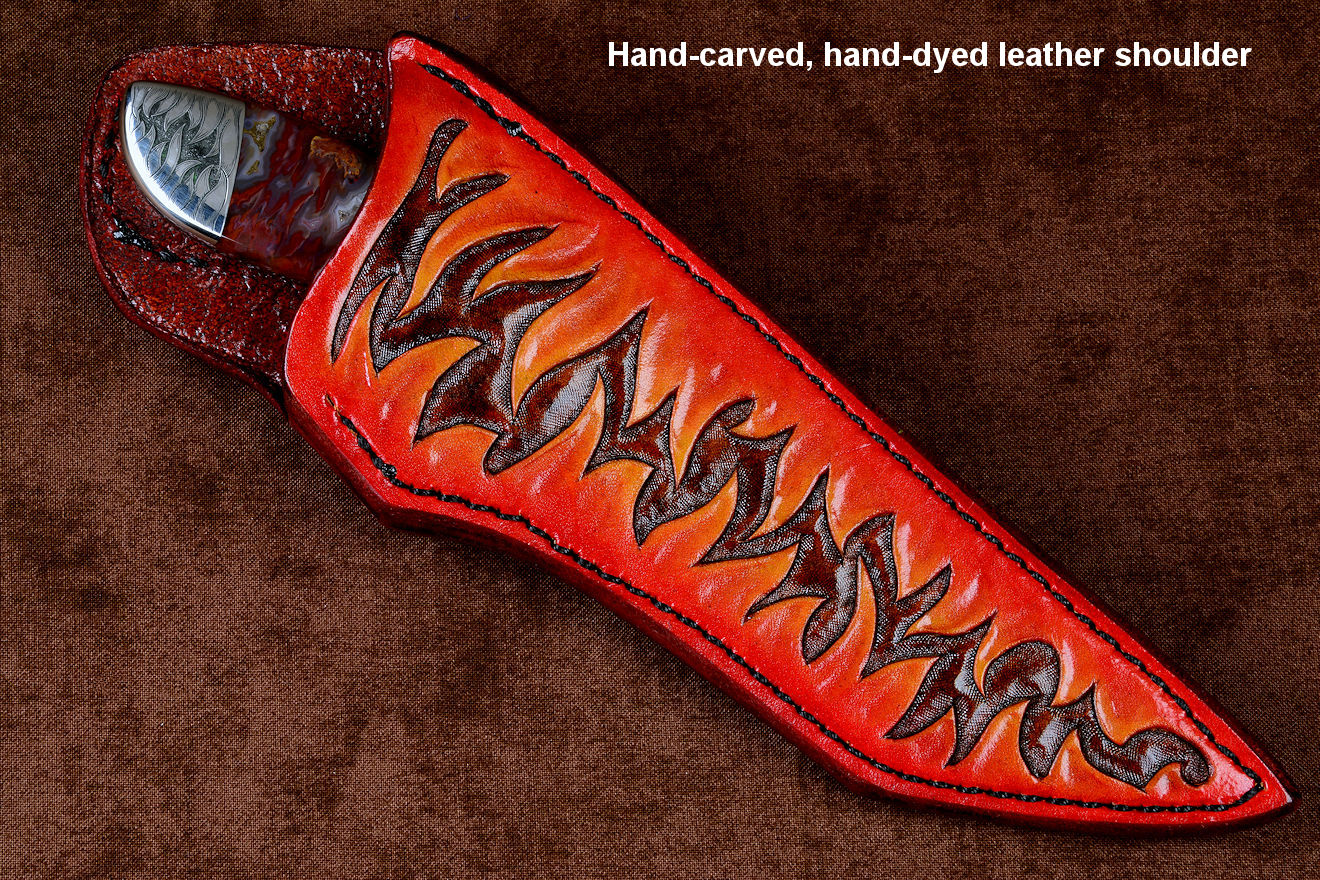
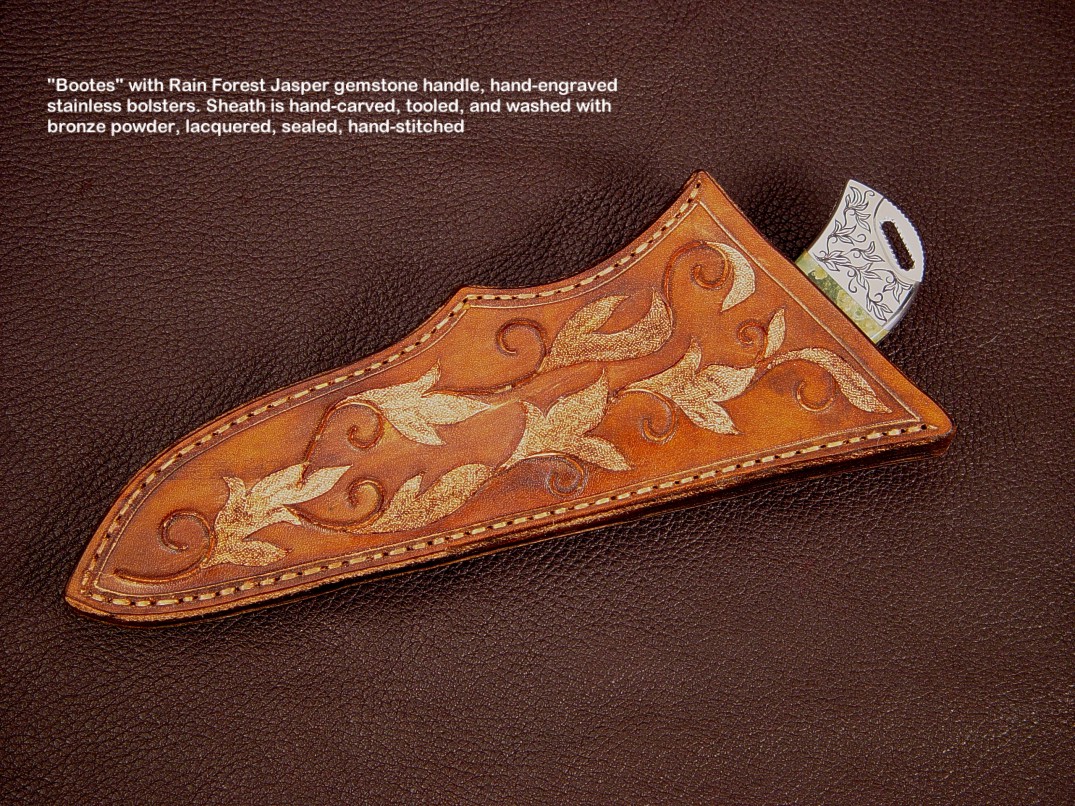
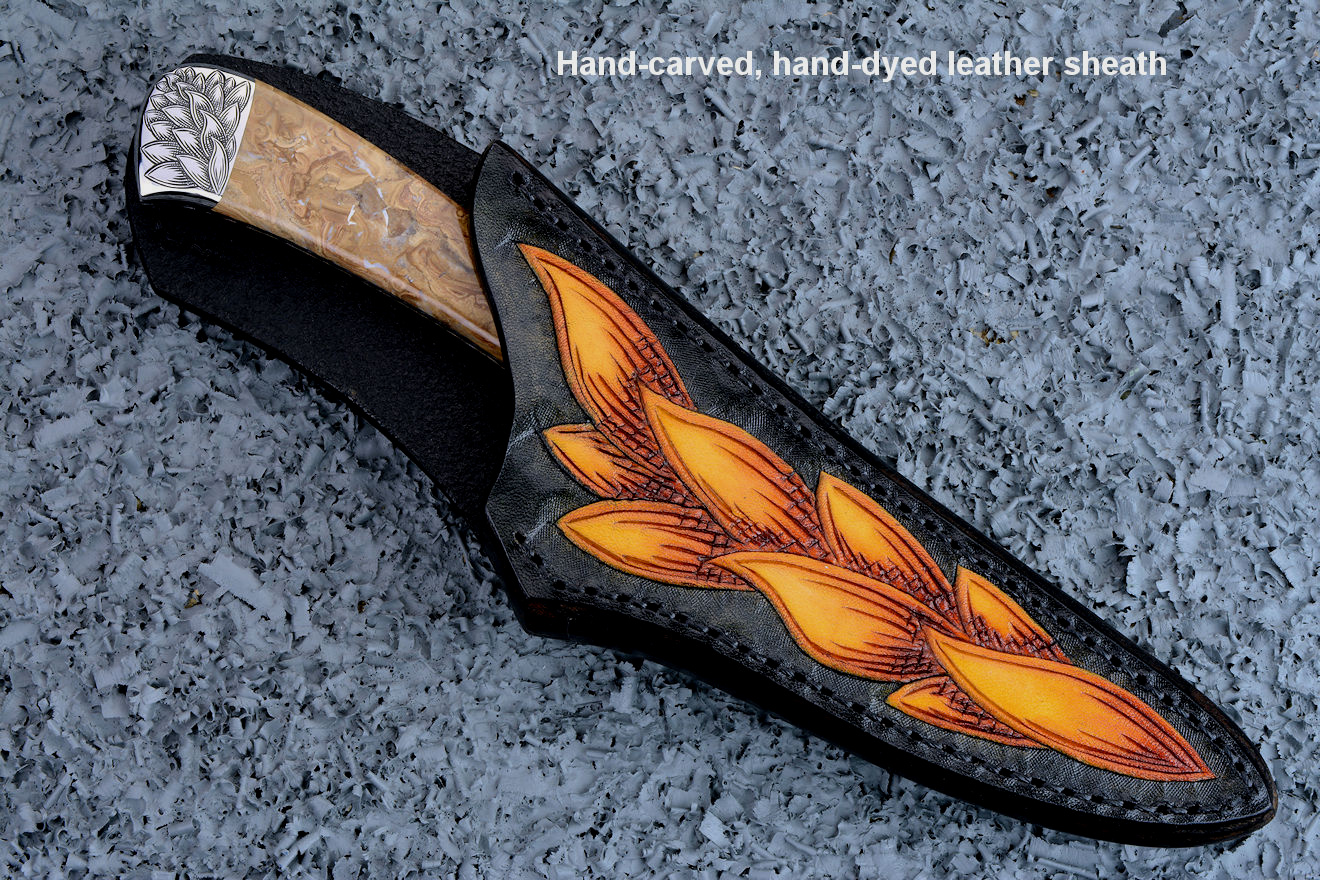
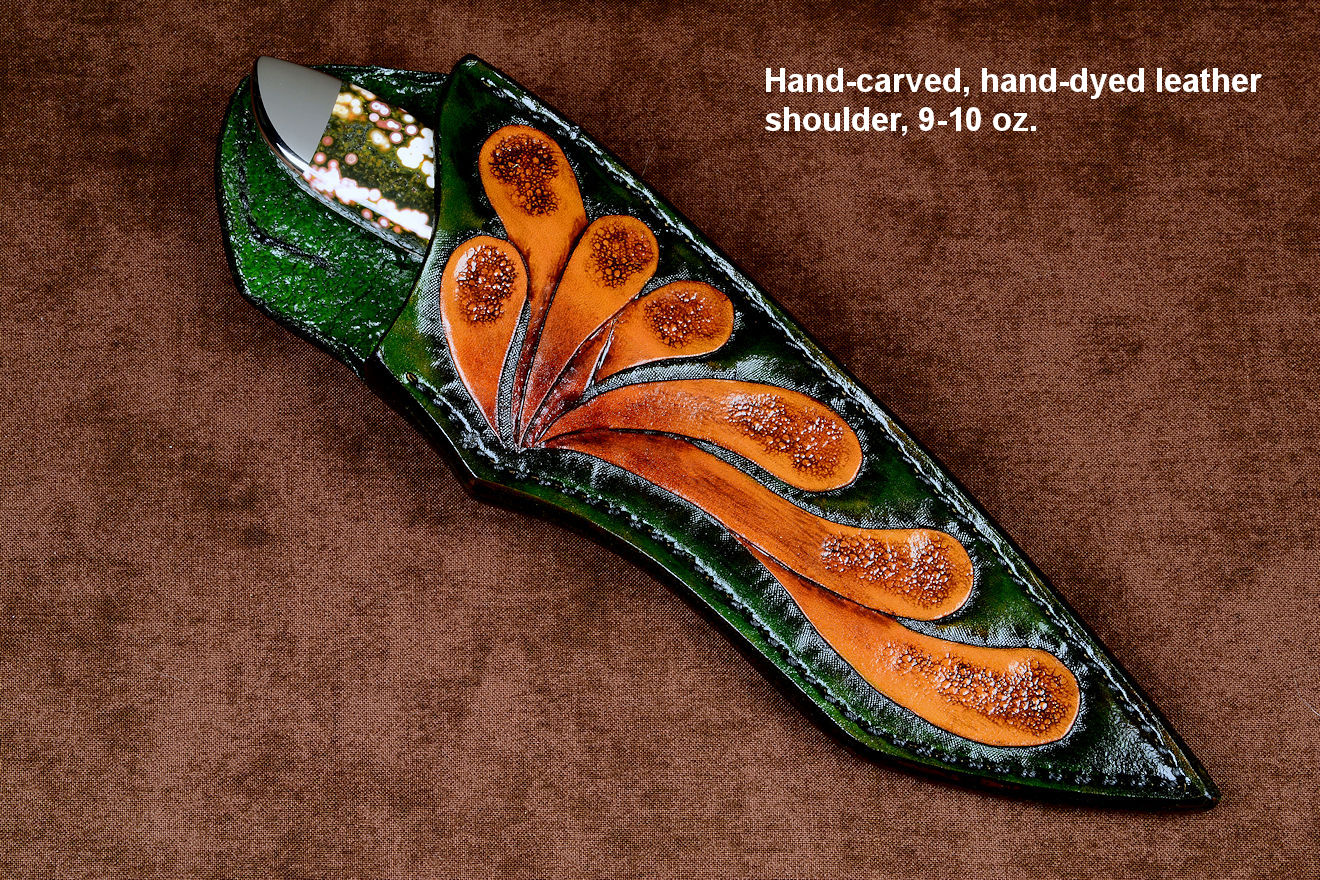
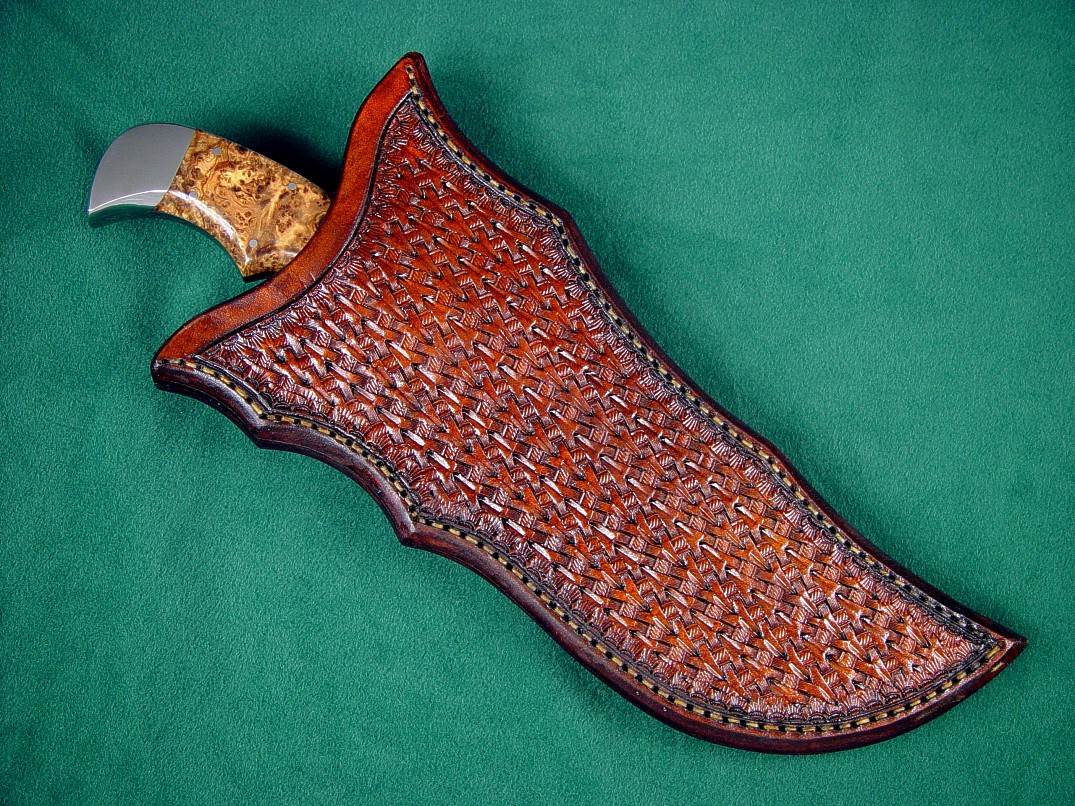
There are several ways to finish the surface of a leather sheath. Though some guys go for a minimalist look, i.e. plain leather just stitched around the edge, I rarely do this, and then only by special request. Leather is an amazing material, and lends itself to high resolution stamping, carving, and tooling, so an infinite number and arrangements of patterns, styles, and embellishment look good on the finished sheath face.
What are the different types of leather embellishment?
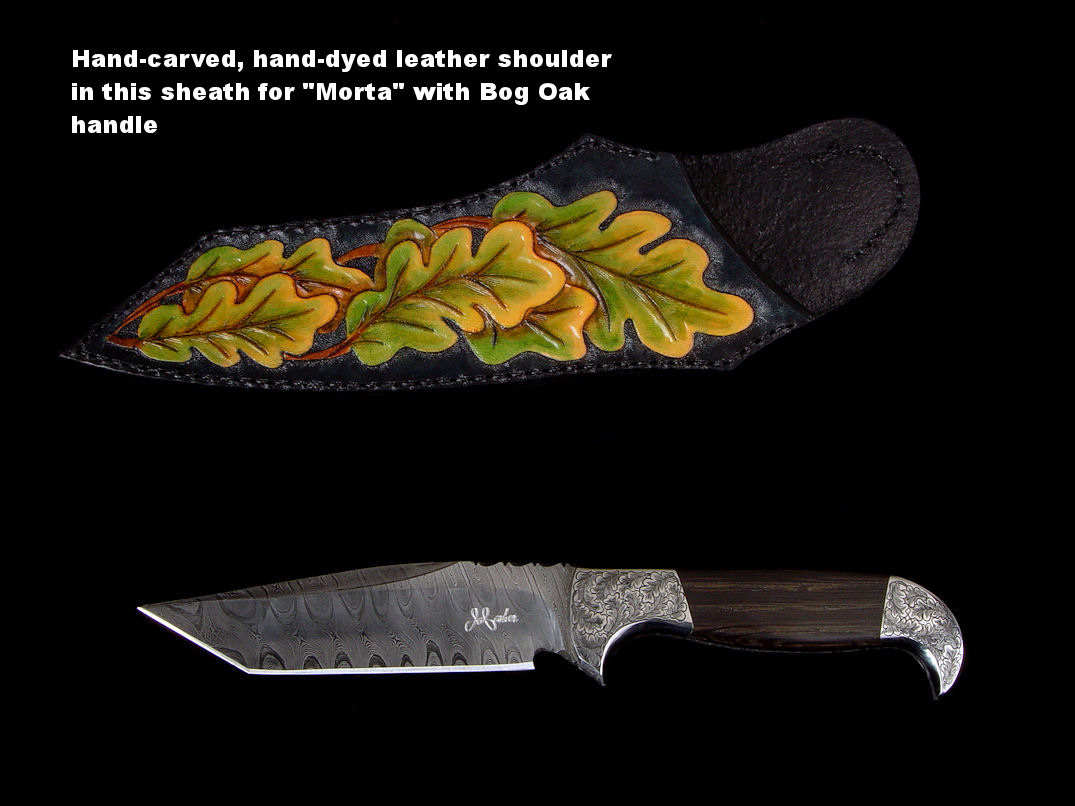
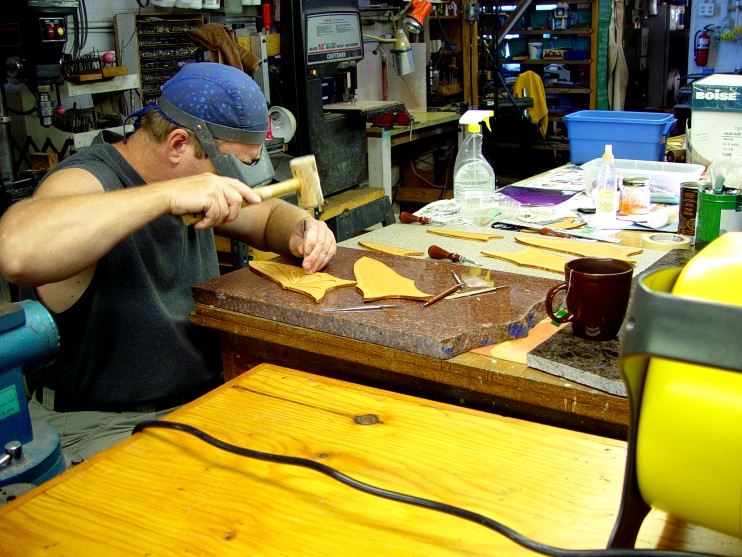
Knife sheath embellishment terminology: I've seen posts on forums and bulletin boards where guys argue incessantly about the terminology of hand-carving vs. hand-stamping and hand tooling, and stamp-tooling, and every term they think should specify the exact technique of working the leather. This is a ridiculous notion, and on one forum I was even attacked for saying that my inlaid leather sheaths are hand-carved. Please read the details on my inlay process above; this is hand-carving. Evidently, the guy complaining had a very narrow definition of what constitutes using a knife to carve leather. If I use a knife, and I cut the leather by hand, particularly if pieces are carved from the leather body, it's hand-carving. It does not take a specialized knife to create hand-carving, though I use a whole array of knives. The great Al Stohlman himself (arguably the father of American Leather crafting) says that a typical leather swivel knife is used for hand-carving, usually before hand-tooling. Stohlman, J. A. Wilson, and A. D. Patten all refer to the swivel knife used in hand-carving leather in several published texts on the subject. Why would someone argue about using this terminology?
Arguments like these may be started because leather craftsmen (like some competing knife makers) want to set their work apart from others by claiming some special skill only they know and are capable of doing. So they may form a stubborn view of their terms, not realizing that the definitions have been clarified in textbooks created by masters of the trade many decades ago. Generally speaking, the use of the word hand in carving or tooling is used only to separate it from machine-embossing or die cutting, where a machine or press is used to impart a design into the leather. Some of the other general terms used to describe leather work are: stamp/carving, embossed tooling, carved/tooled, and craftooling (coined by Stohlman).
The main point is that it's not about a word defining a particular exclusive technique. There are many ways to work leather for beauty, durability and value. The most important thing is for clients is to look at the sheath with a discriminating eye. Ask the maker who has made the sheath about his technique, and his skill should be obvious on each sheath or leather project he creates.
Permanent marks are cut, not applied.
Who in the world ever heard of engraving leather in the last century? At the time I first wrote this section, the only tool used for engraving leather was a rotary engraver, circa late 1990s. Now, we have laser engraving which burns a path into the leather with higher accuracy.
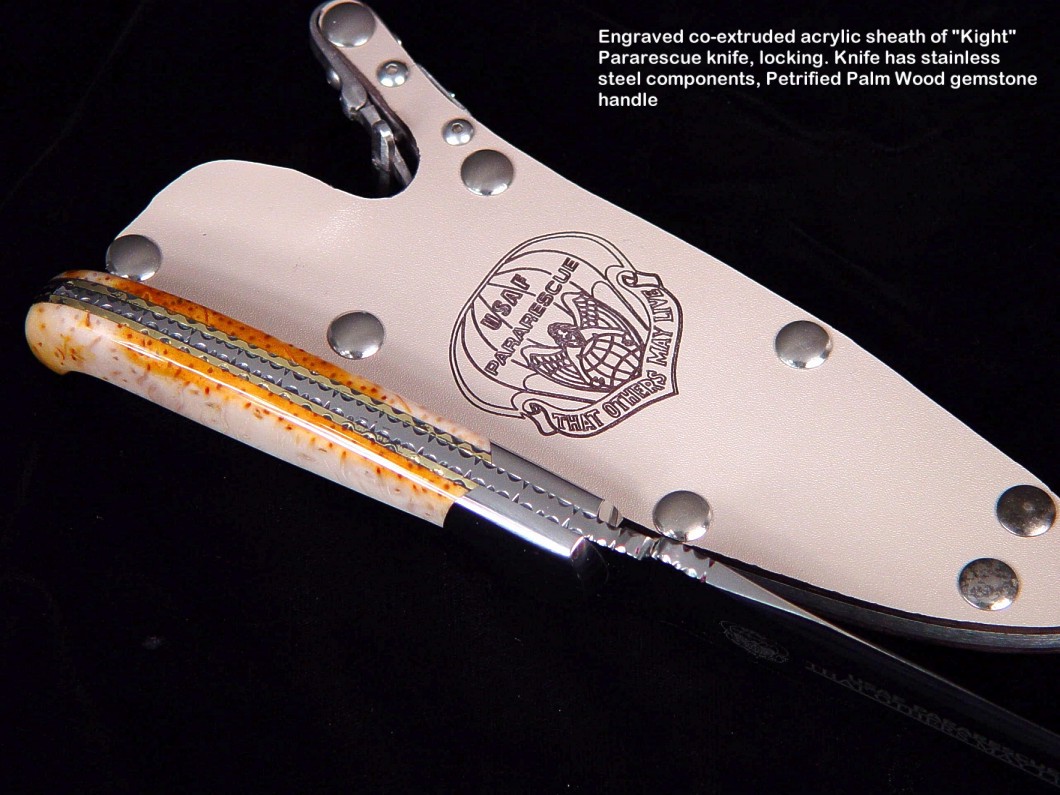
The old method used the same technique as engraving my military and combat sheath flash plates. This resulted in a crisp, highly detailed image and unique personalization that was uncommon in the field of fine custom sheaths. Unlike the hand techniques above, this is done with a machine, so the cut depths and designs are completely uniform and are generated in a computer. Check out the thumbnails below to see.
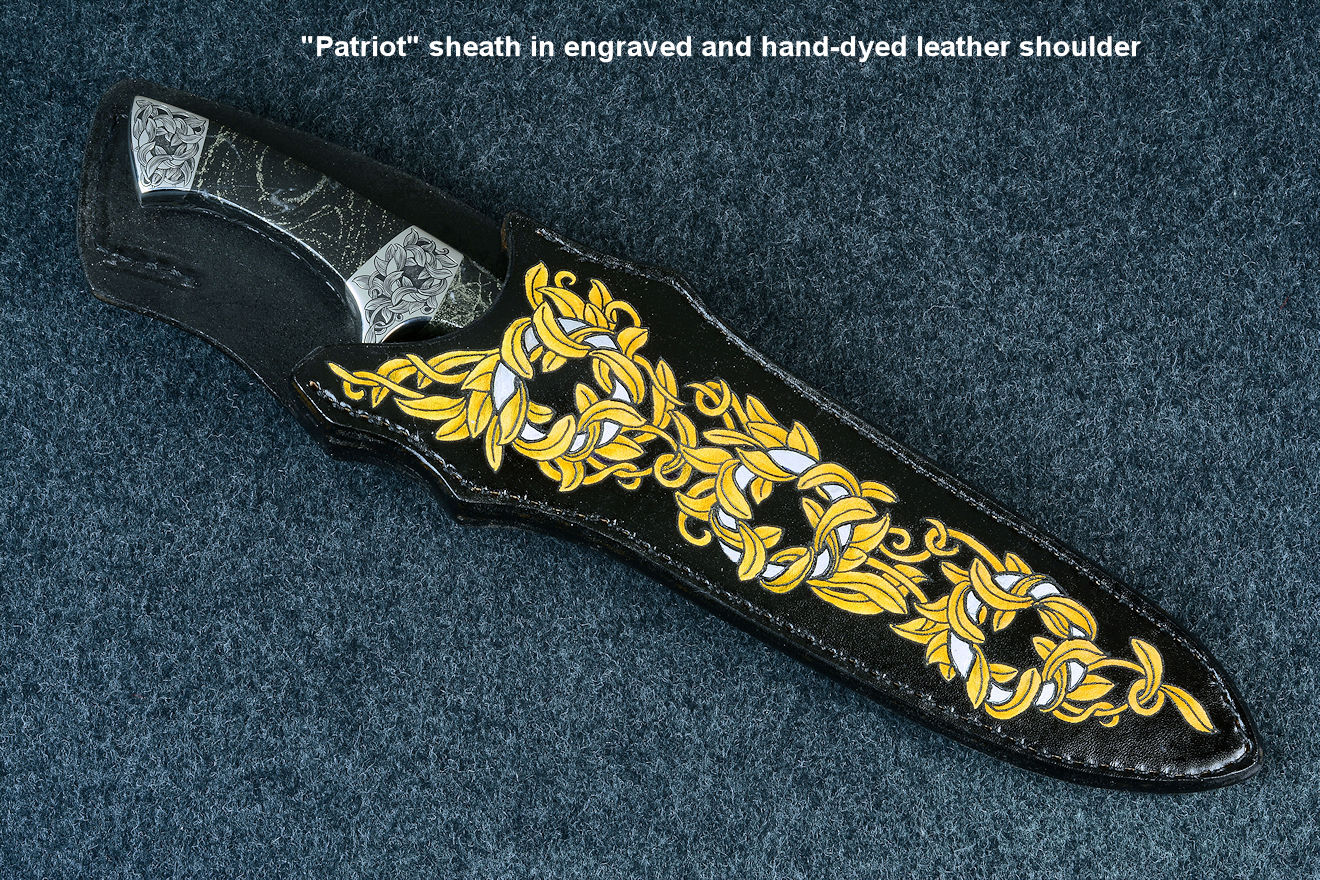
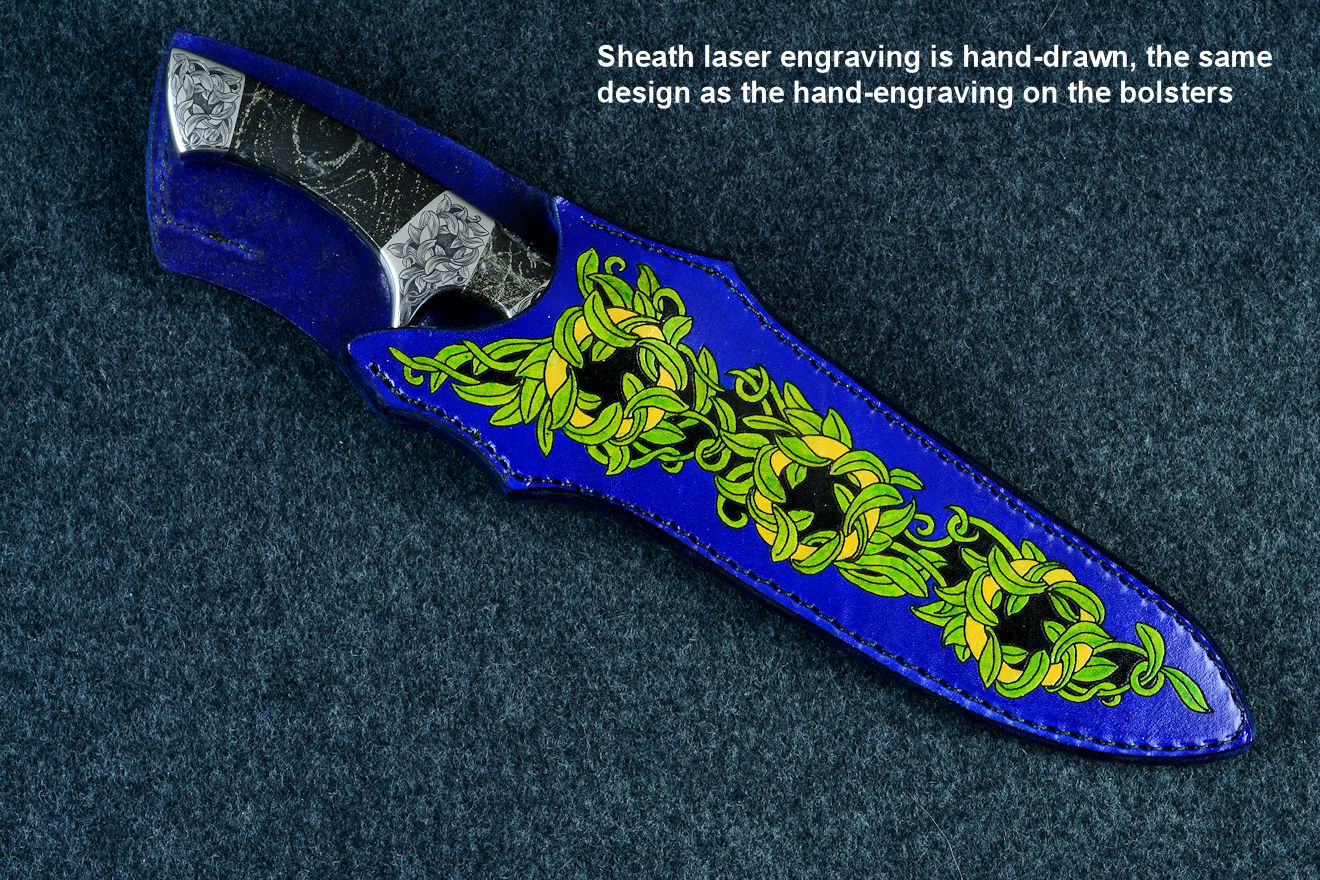
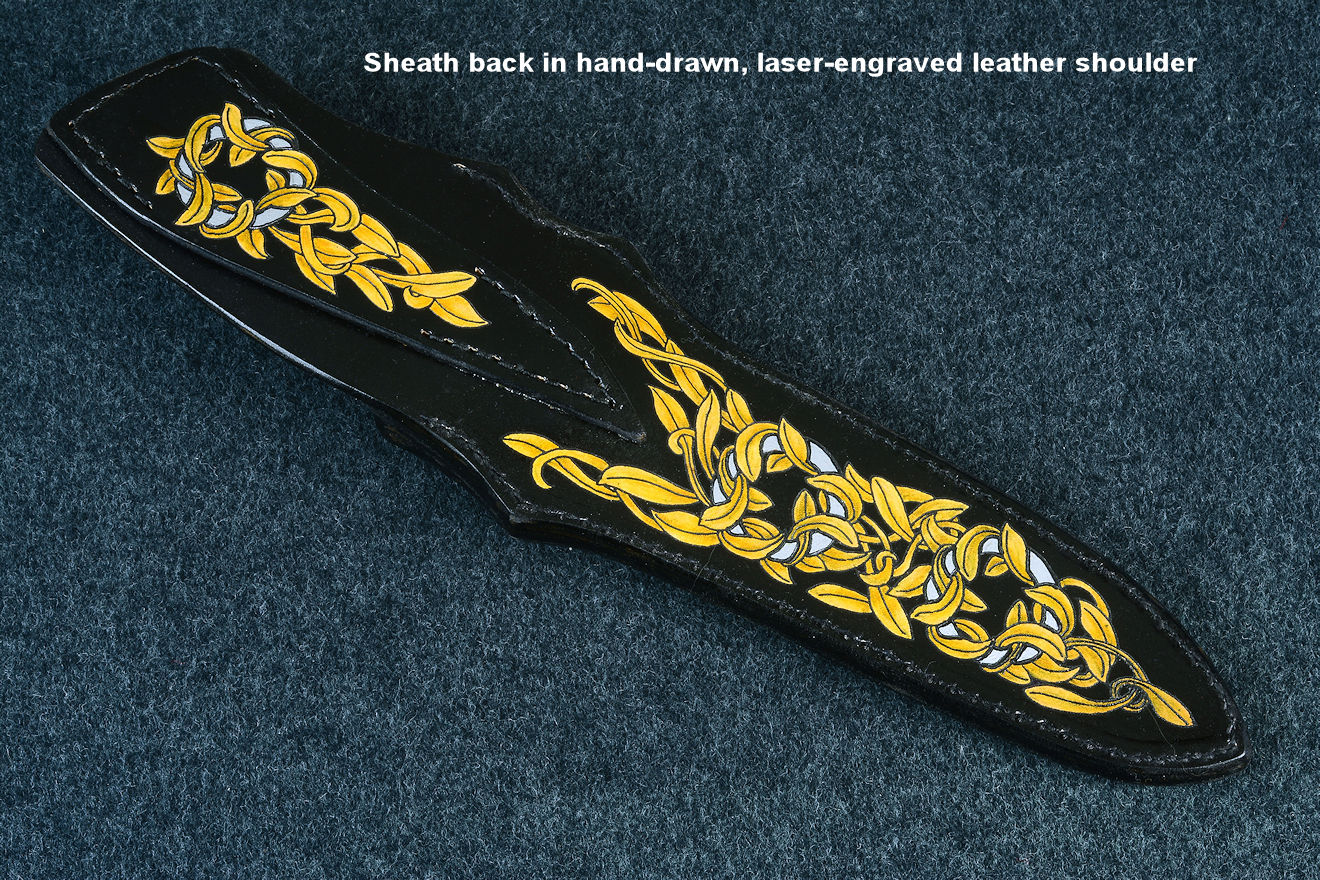
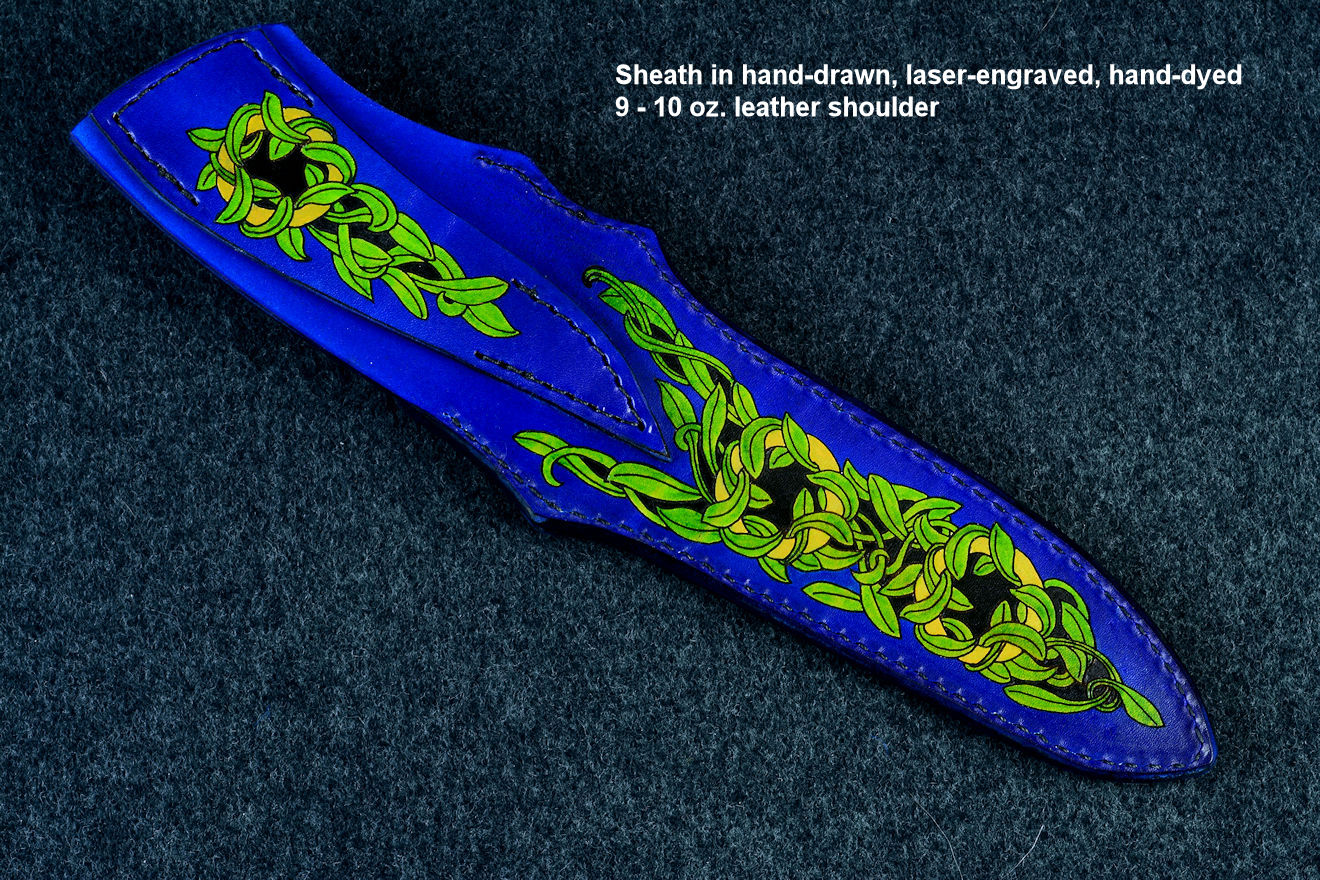
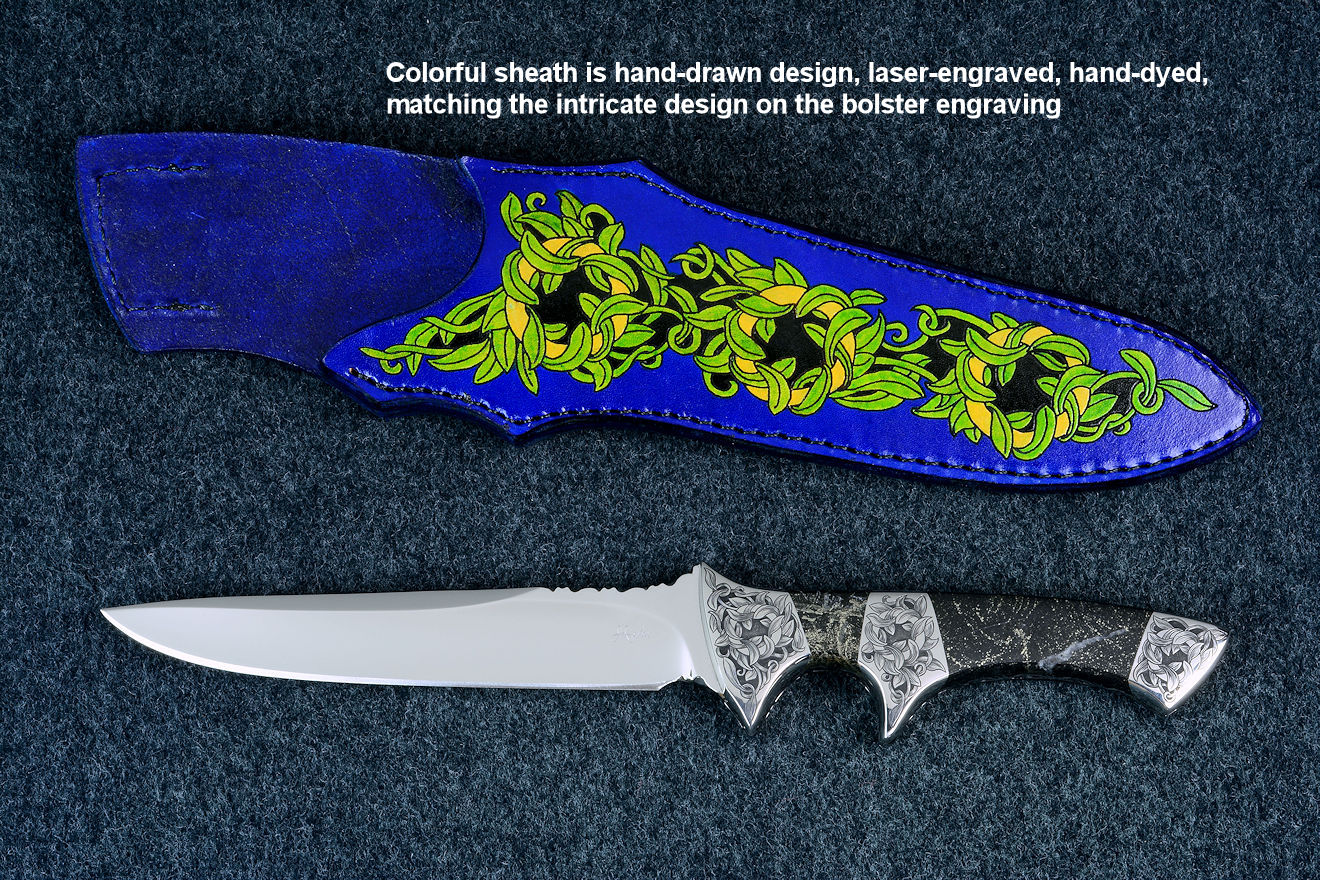
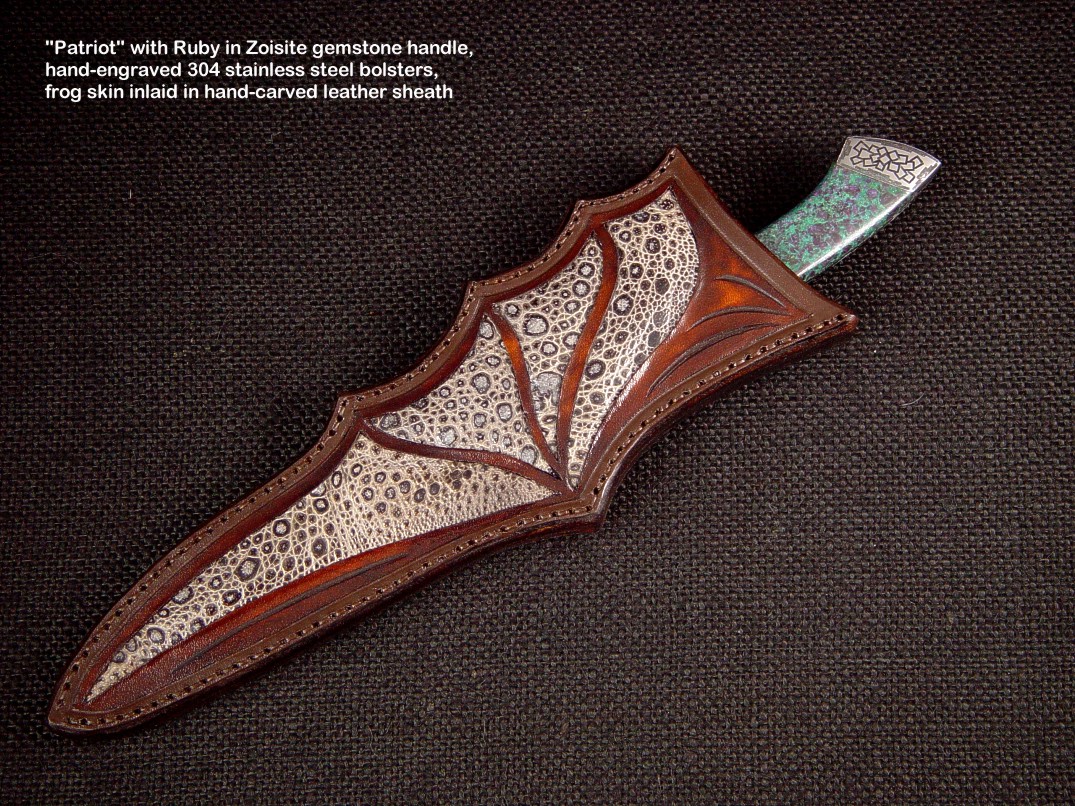
With leather engraving, a wider variety of designs may be possible. For instance, you can see in the photos below of the "Patriot" knife, that the hand-drawn design which was used for my hand-engraving on the stainless steel bolsters was also used to create the images that are laser-engraved into the sheath front, back, and belt loop of the sheath. Then, I hand-dyed the engravings to get the look I wanted.
Machine and laser engraving can lend itself to fine personalization with monograms, text lettering, names, dates, events, etc. It also is great for artistic styles and motifs, adding to, enhancing, and blending the relationship between the artwork on the knife and sheath. Since the design or text is literally carved or burned into the leather, it will never fade or deteriorate like embossing, stamping, or mask and stencil painting, and is bold and distinctive.
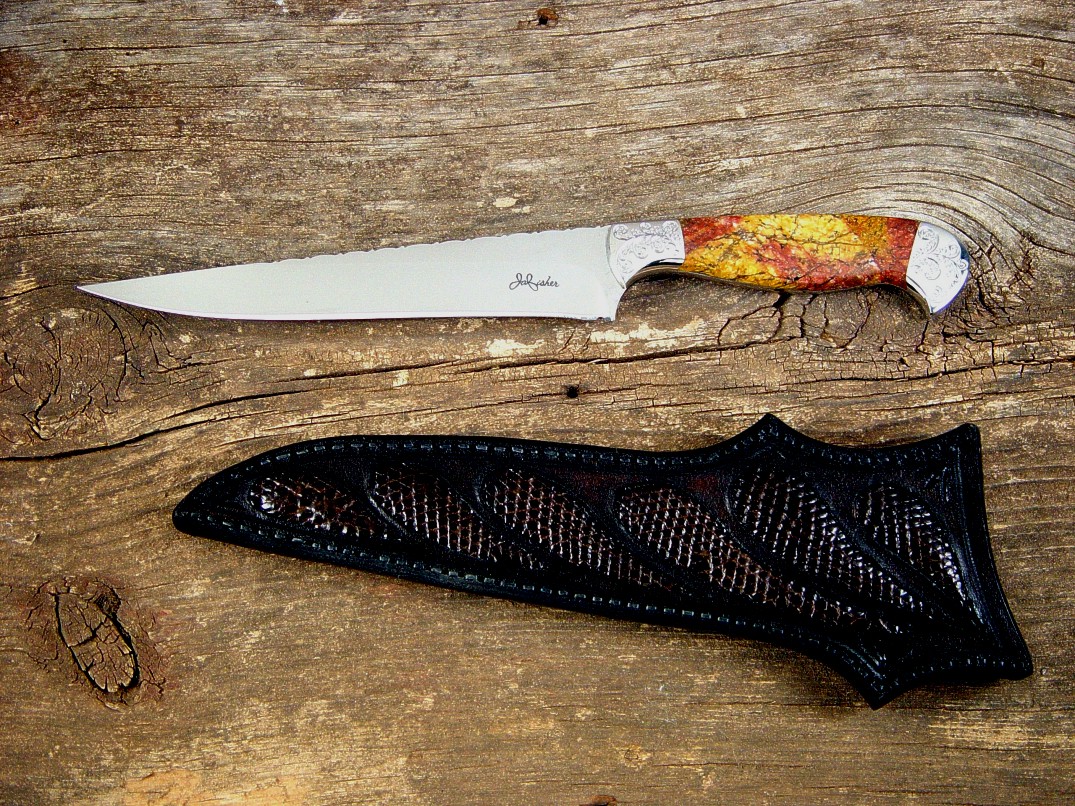
Jay, the one thing you still can't get off of the internet
is the way a knife feels. I wish anyone thinking of buying
a Jay Fisher knife could hold Eridanus in their hands for
just a few moments. Then there would be no doubt that
buying a knife from Jay is the right thing to do. I've
bought some other blades of the internet that photographed
well, but when you got hold of them, they didn't feel or
handle like much. Eridanus just feels like it belongs in
your hand. You can get a knife anywhere, but this is a work
of art.
Thanks Jay.
Oh and by the way the sheath alone is worth the price.
-Rick Stuart
Real combat sheaths are not made of nylon.
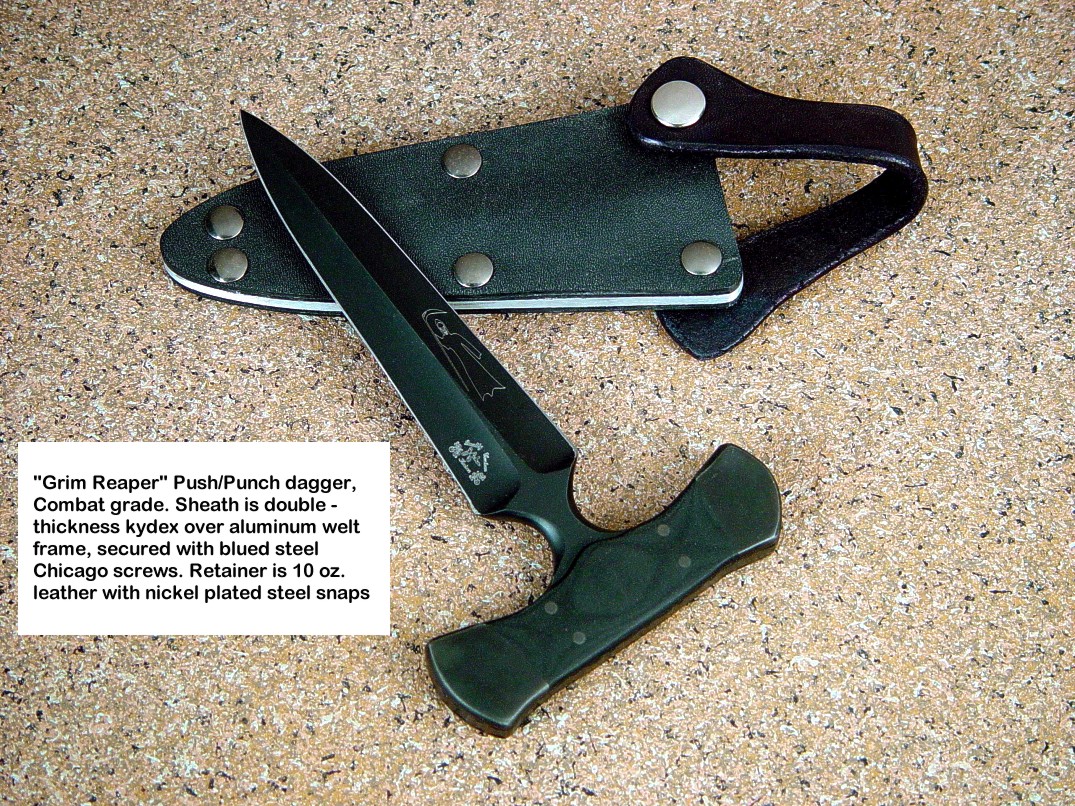
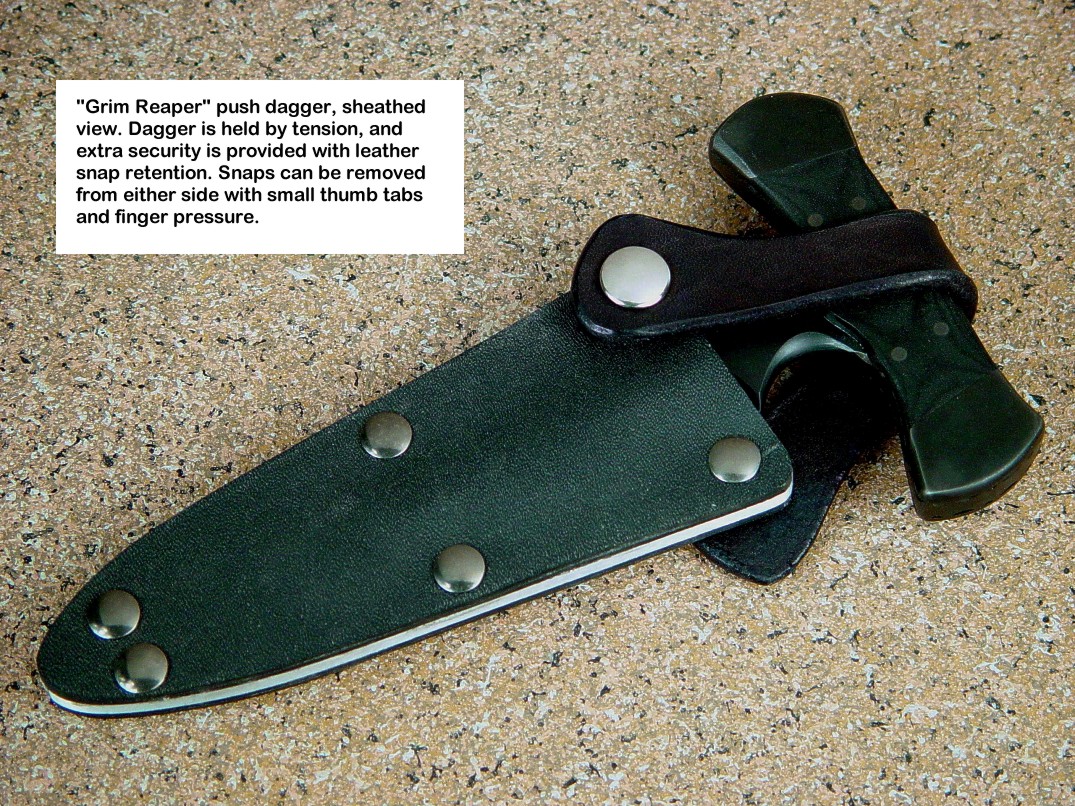
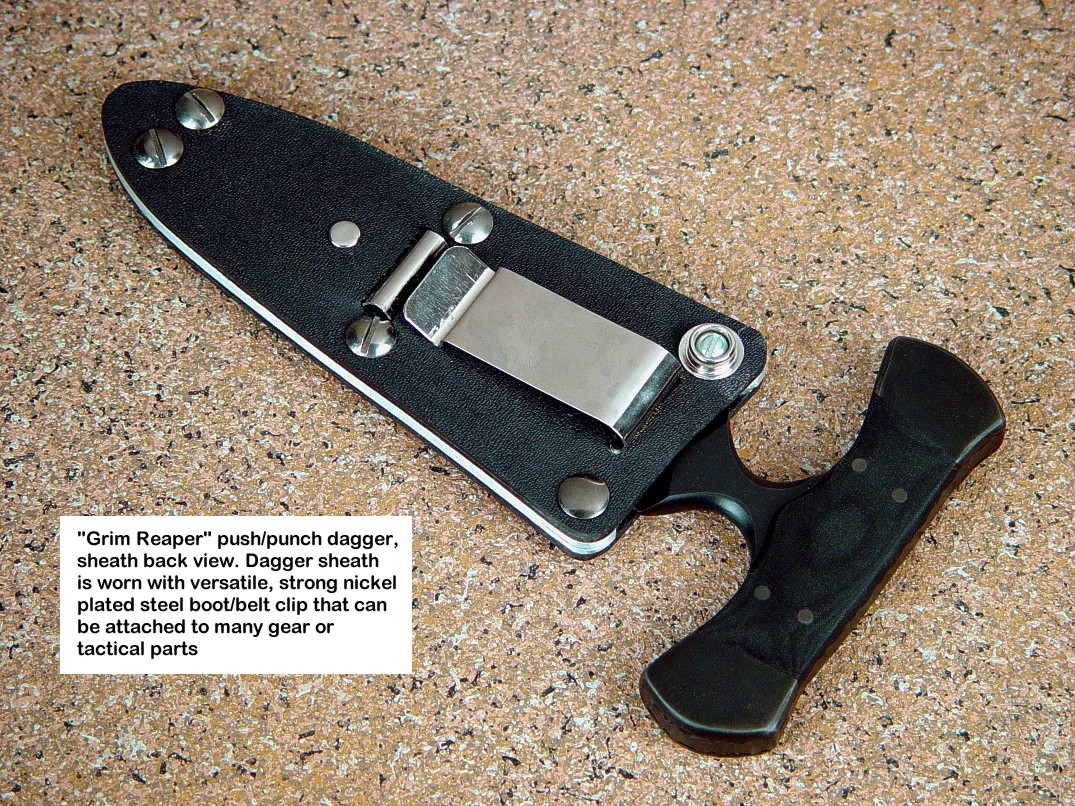
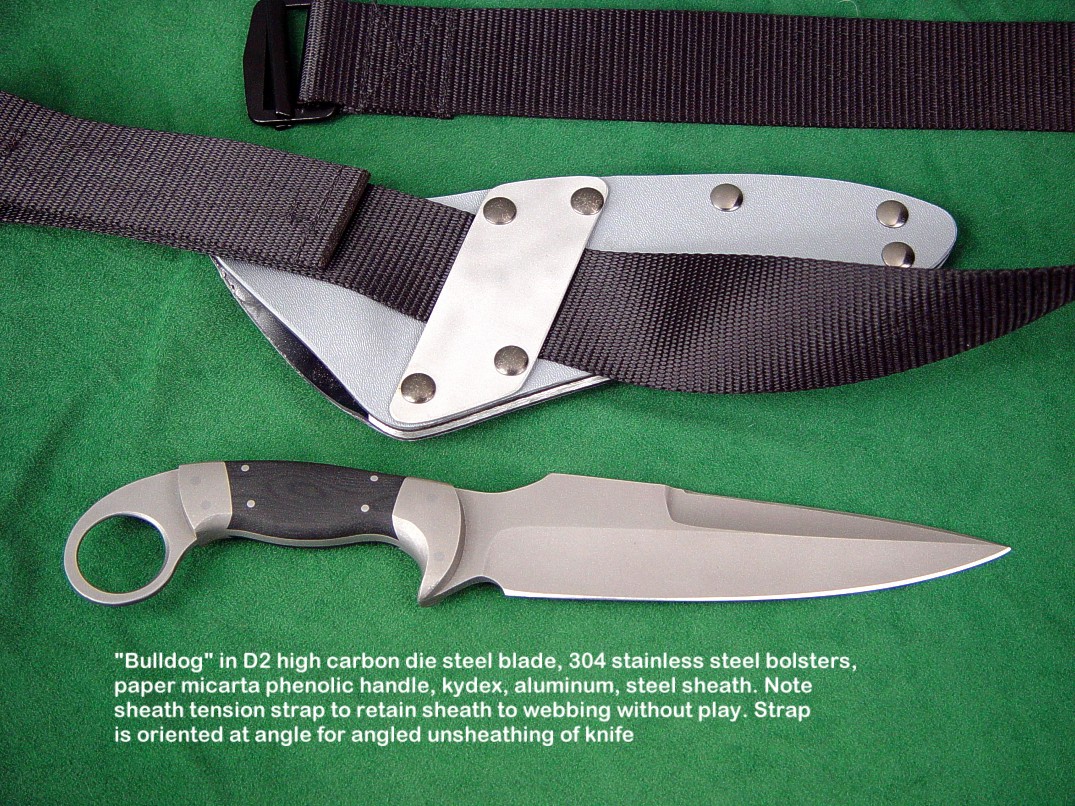
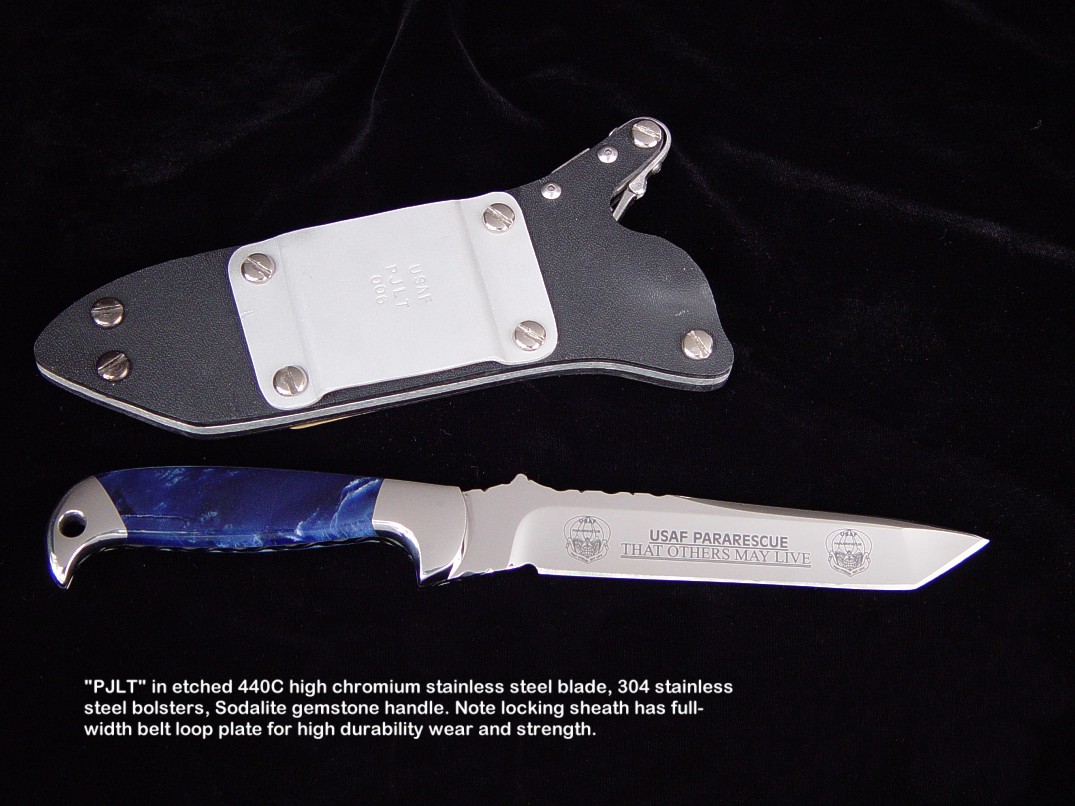
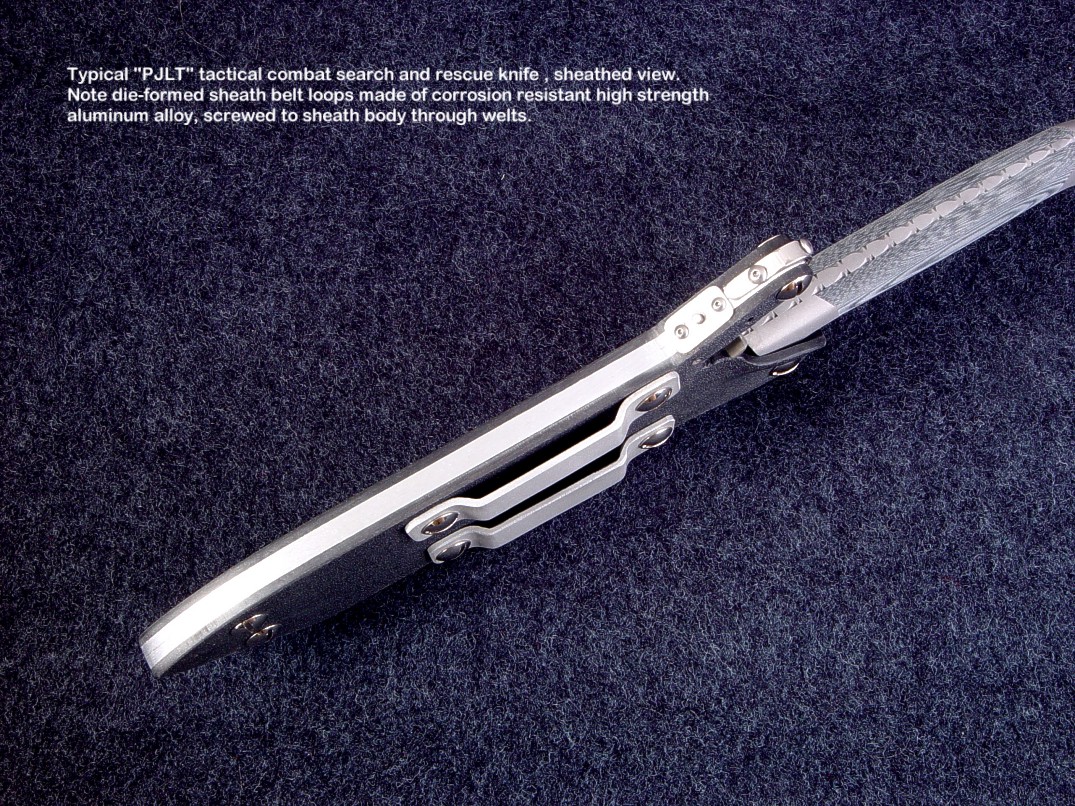
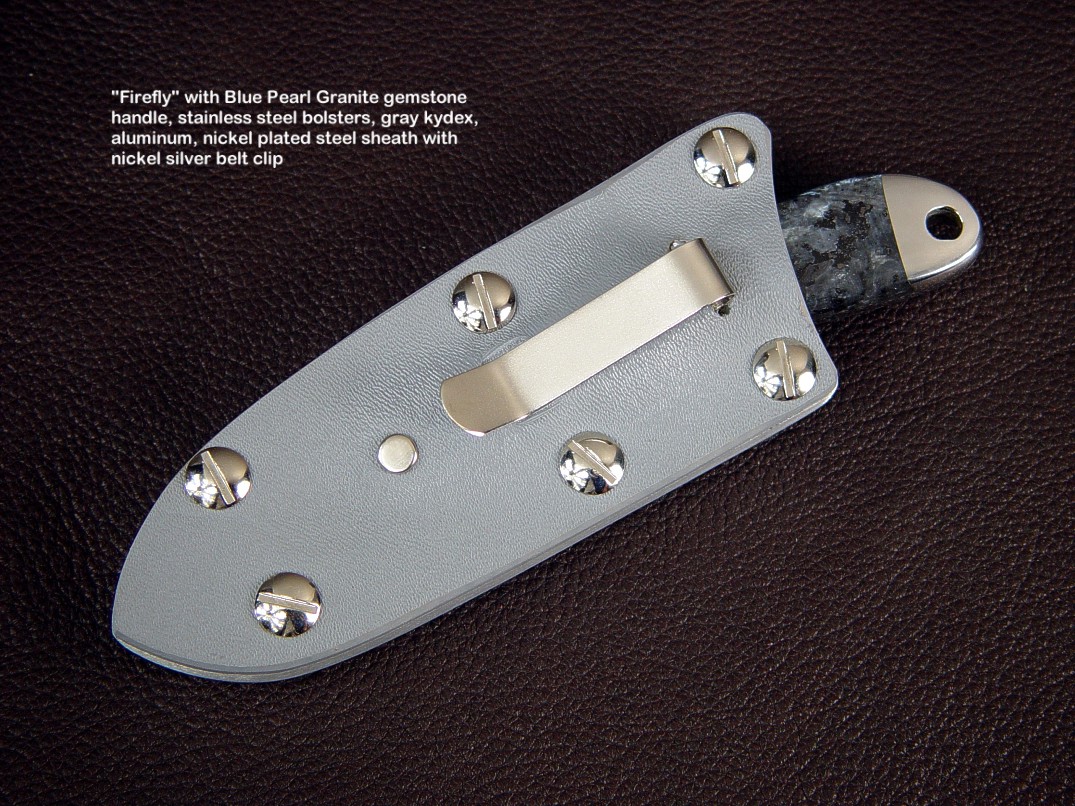
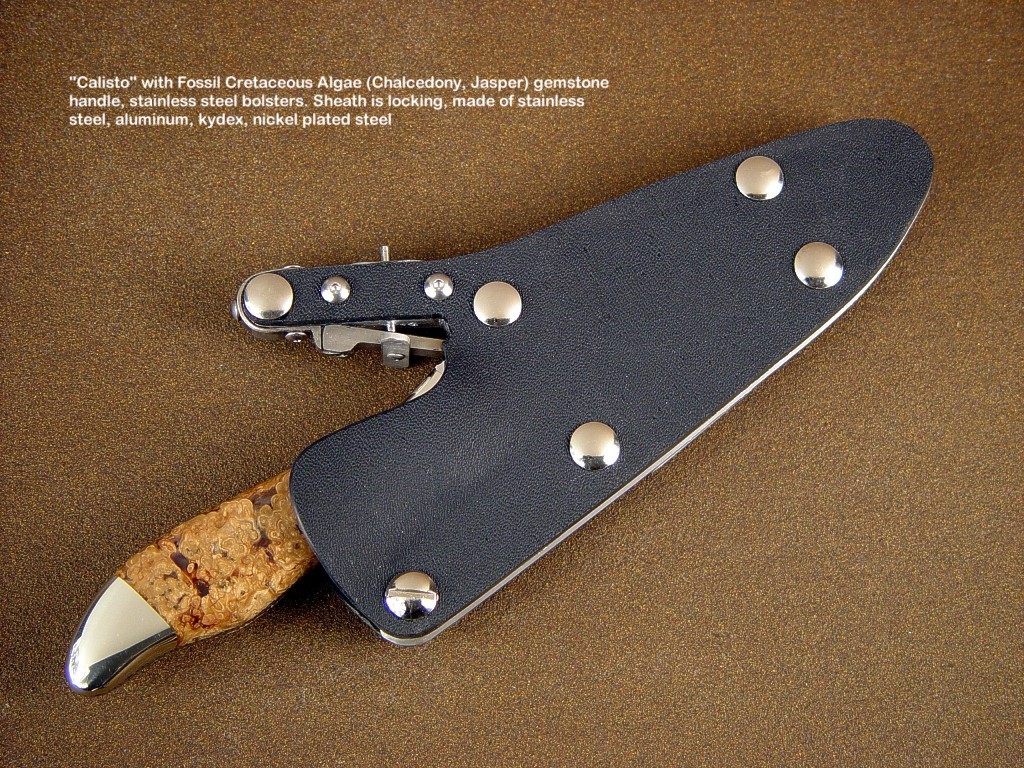
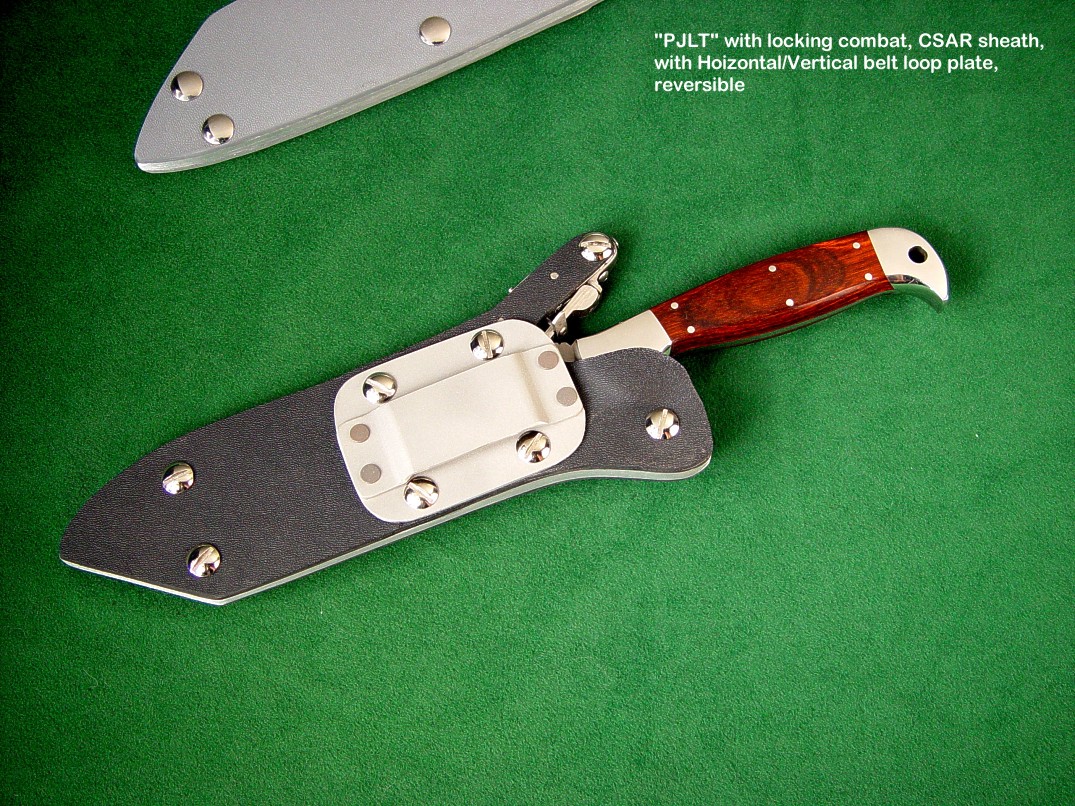
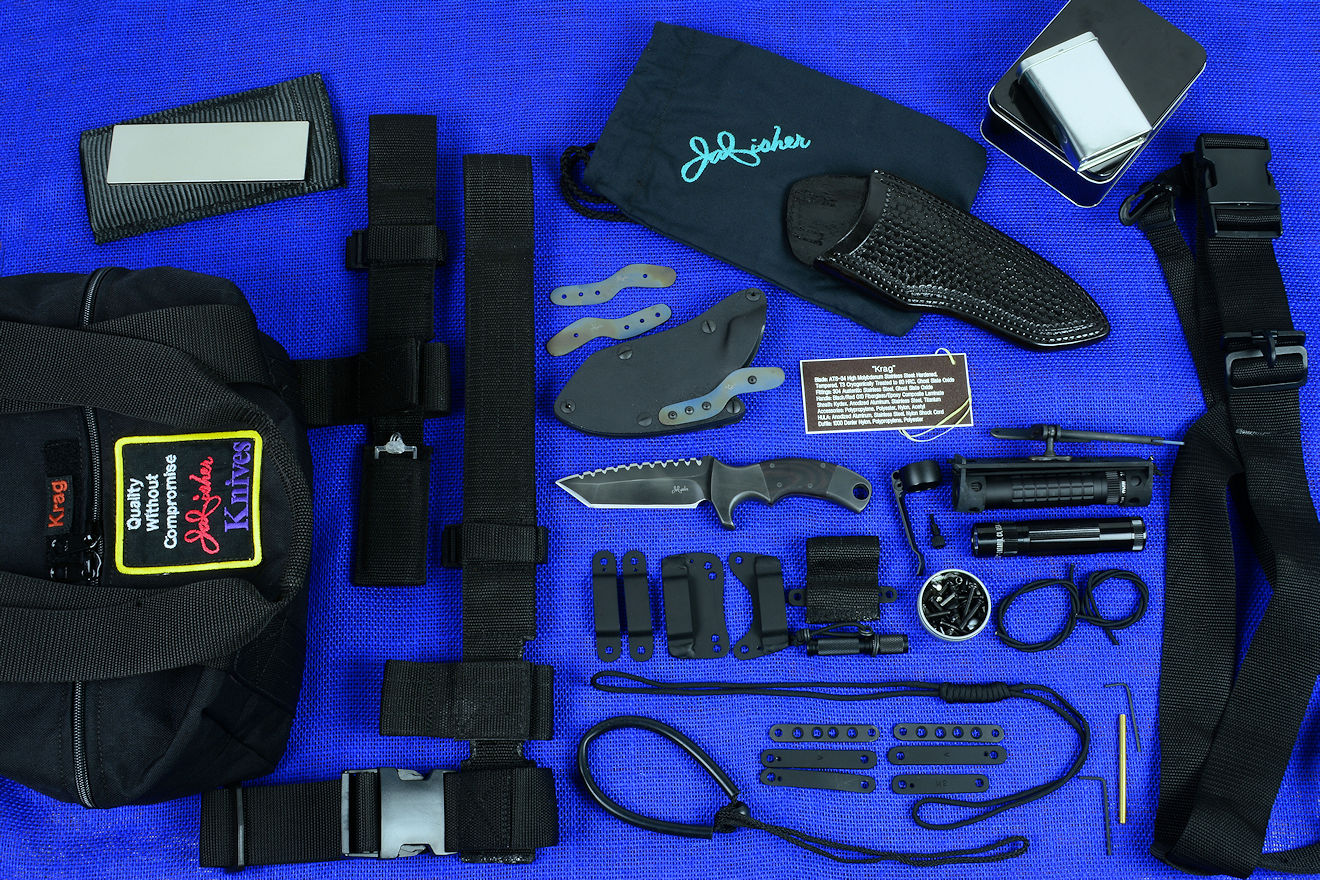
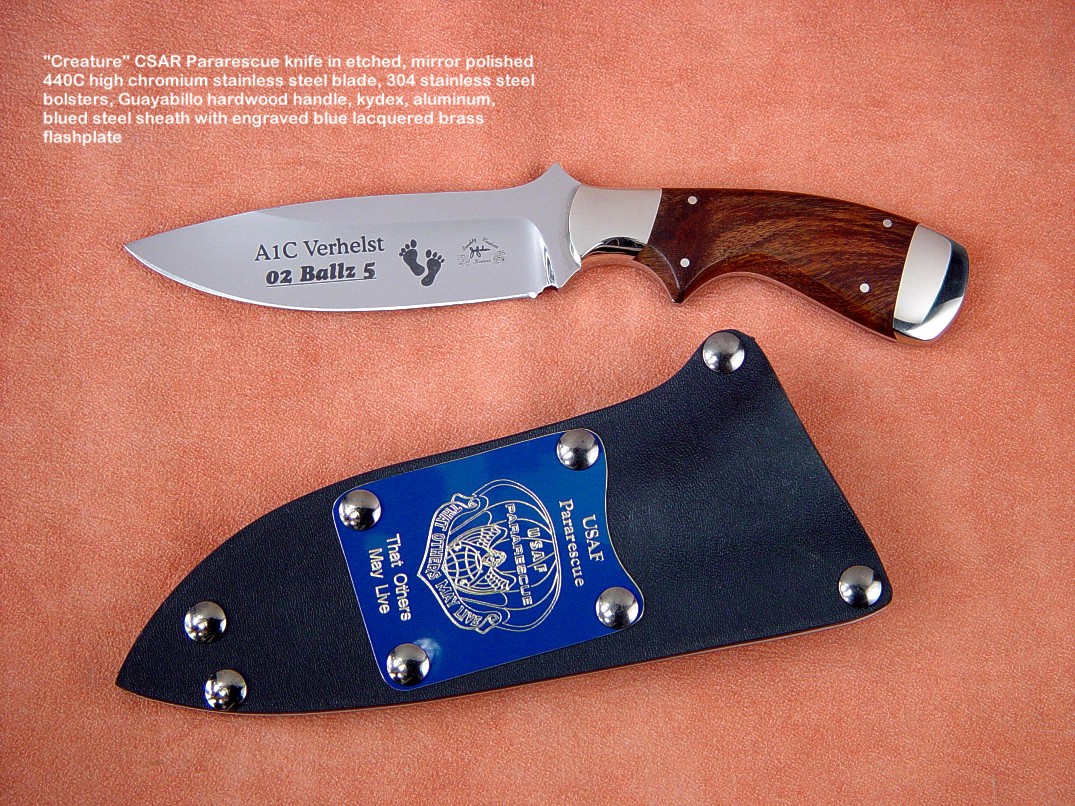
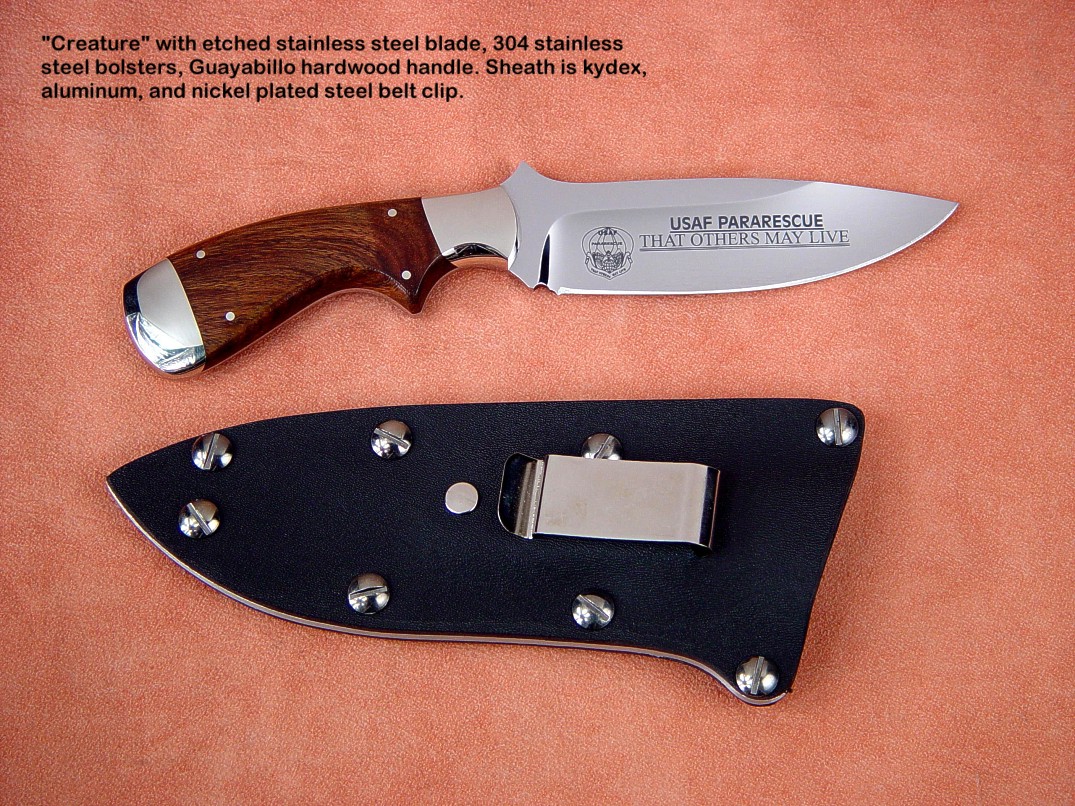
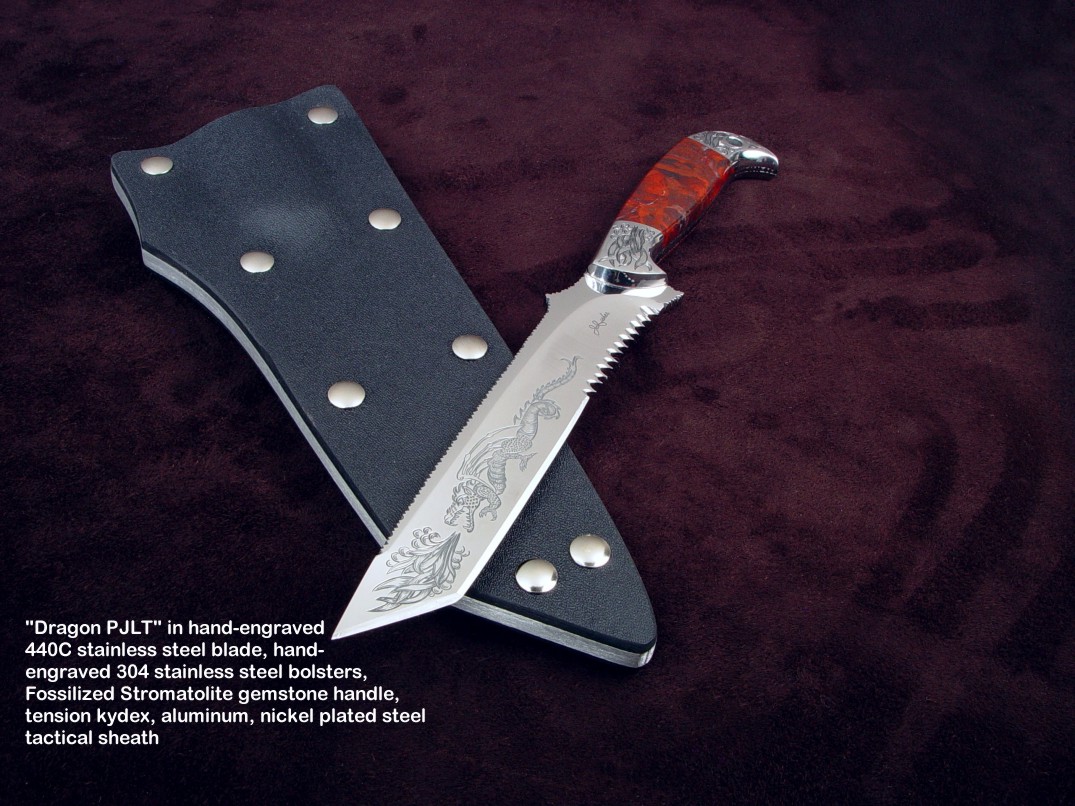
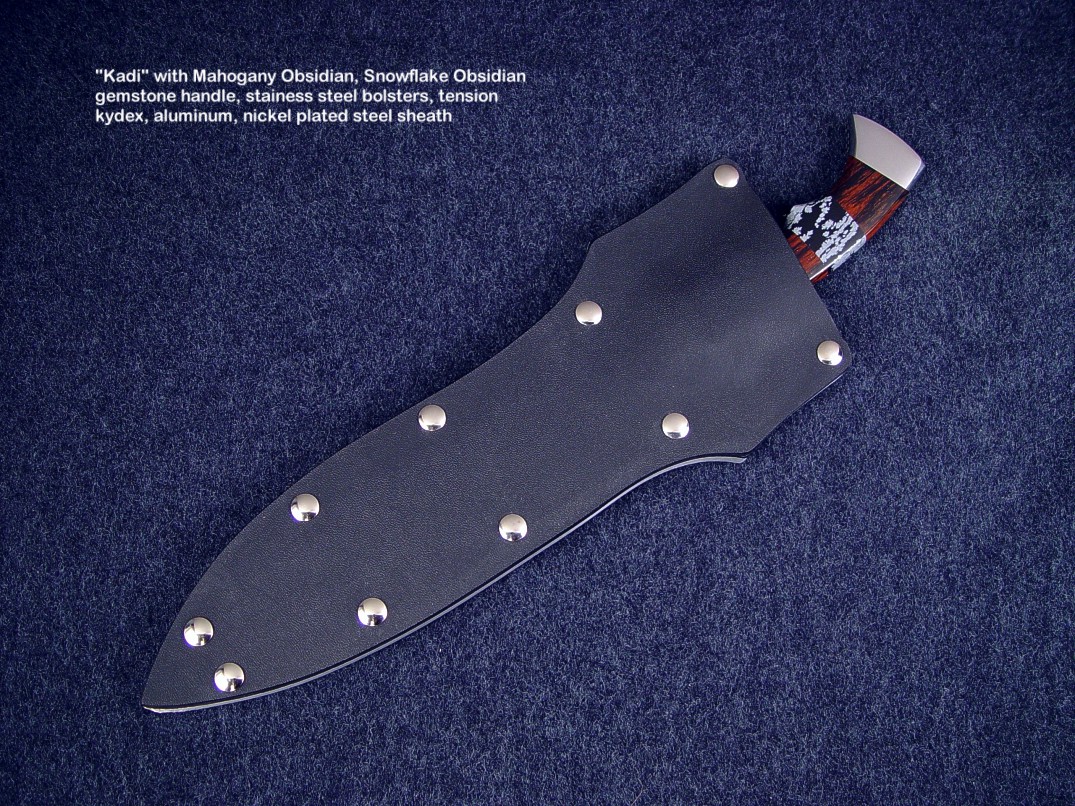
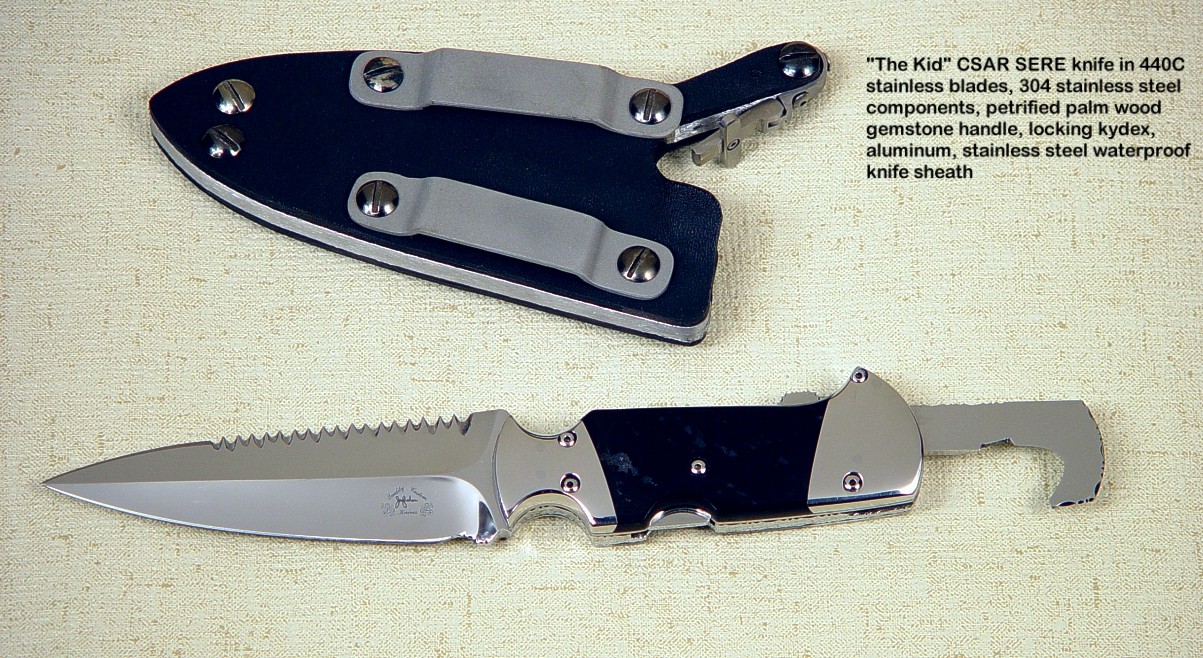
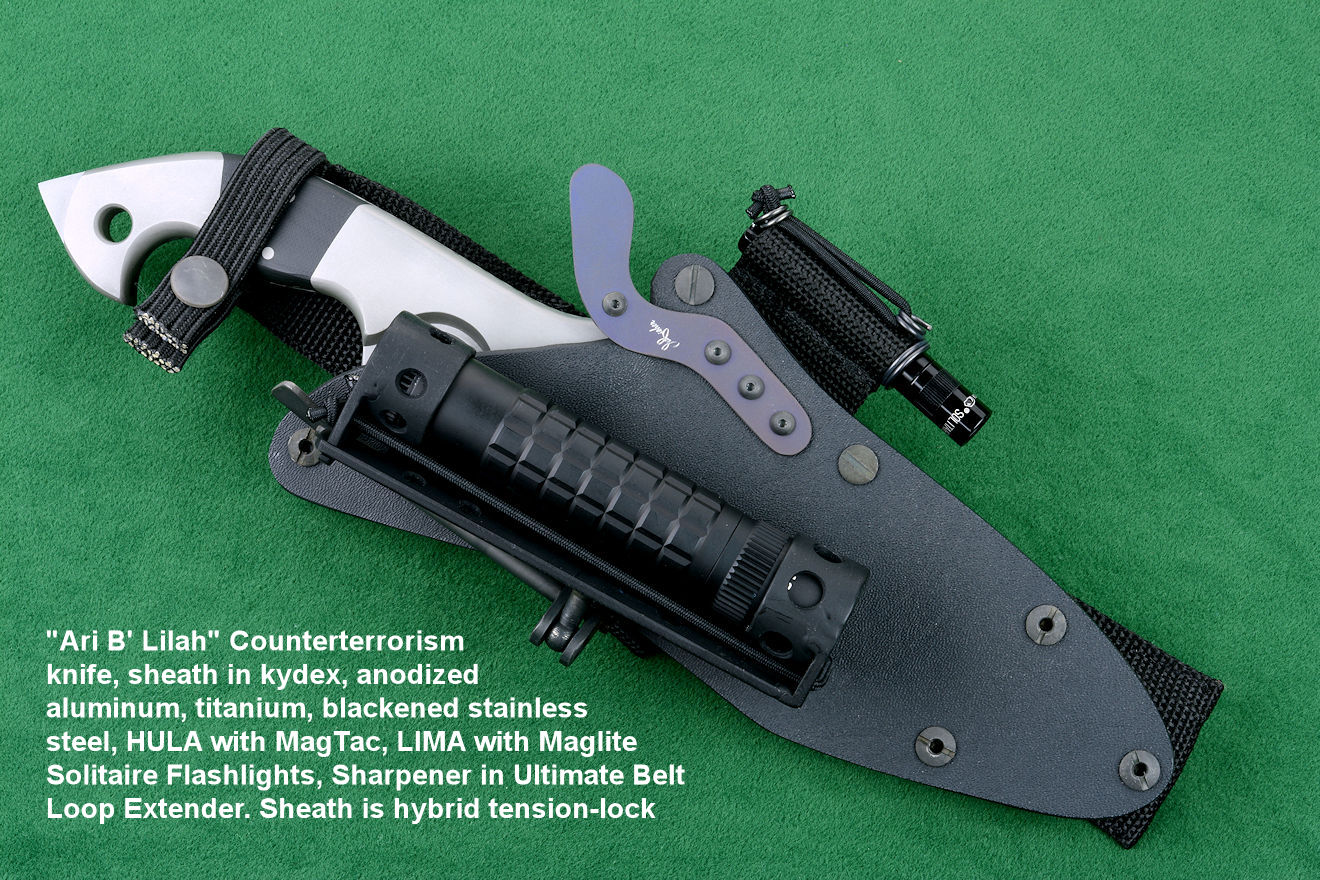
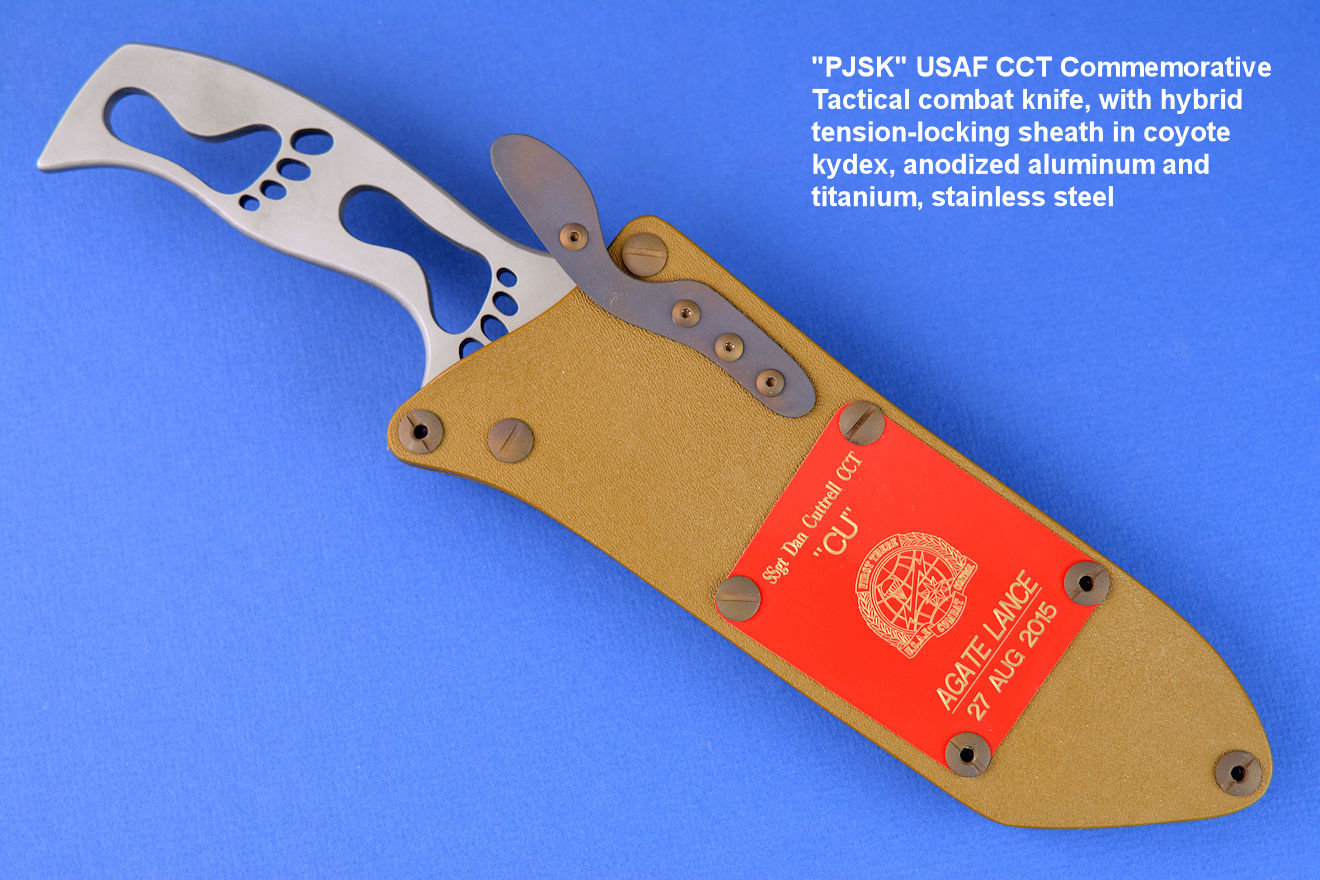
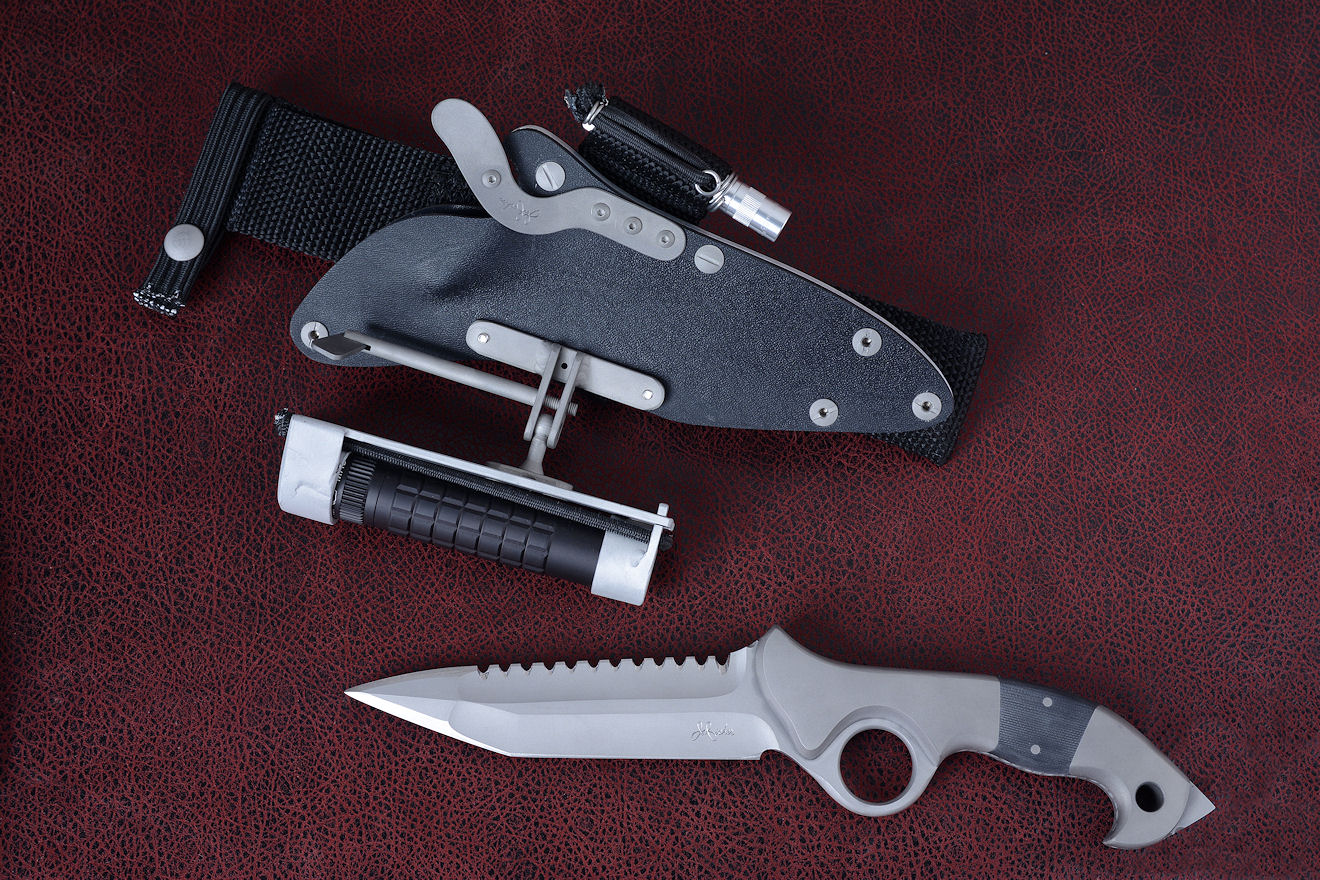
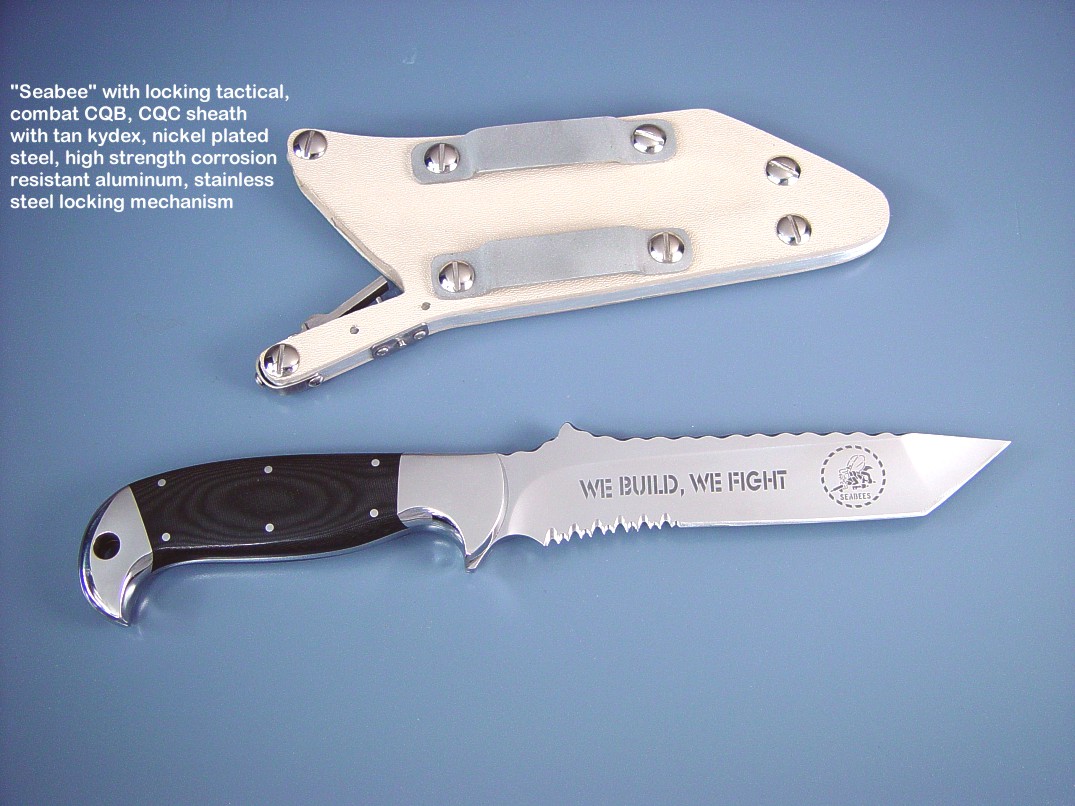
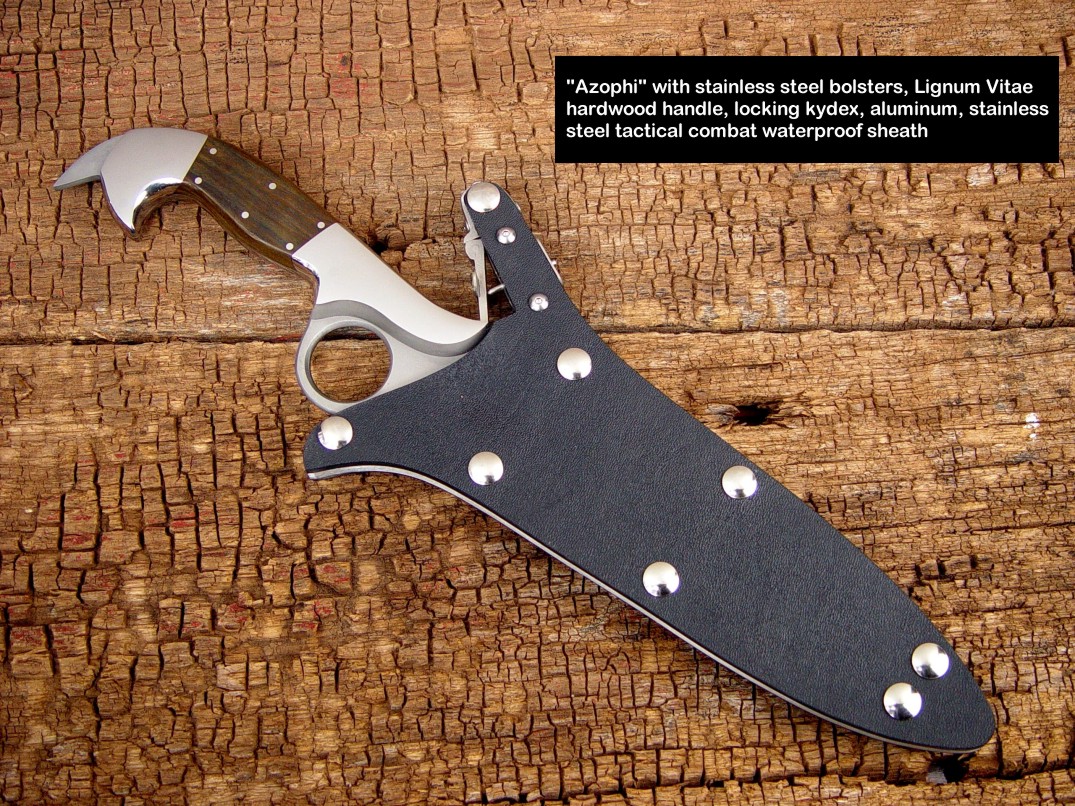
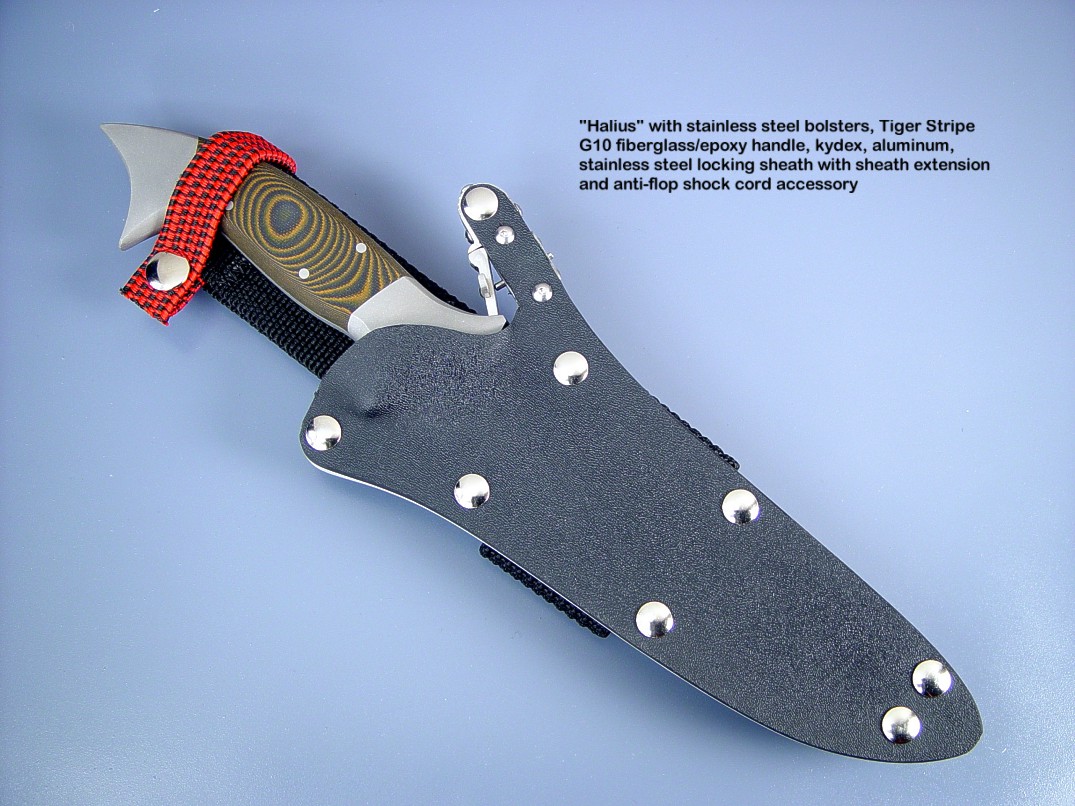
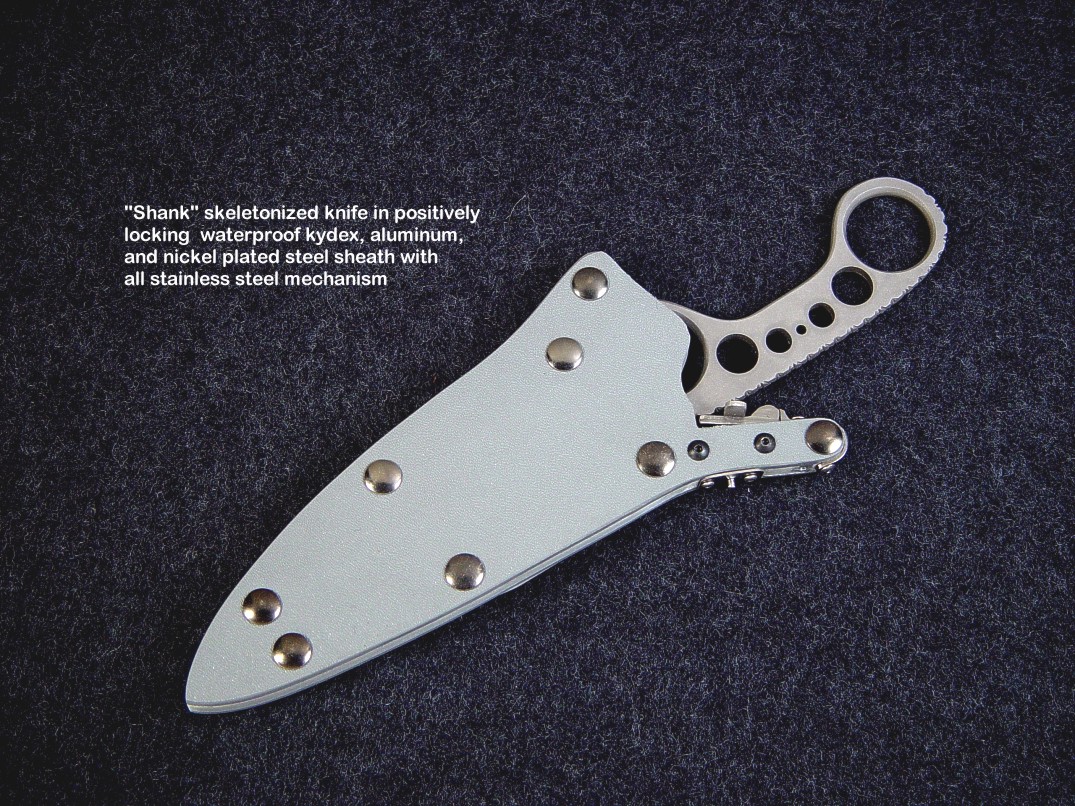
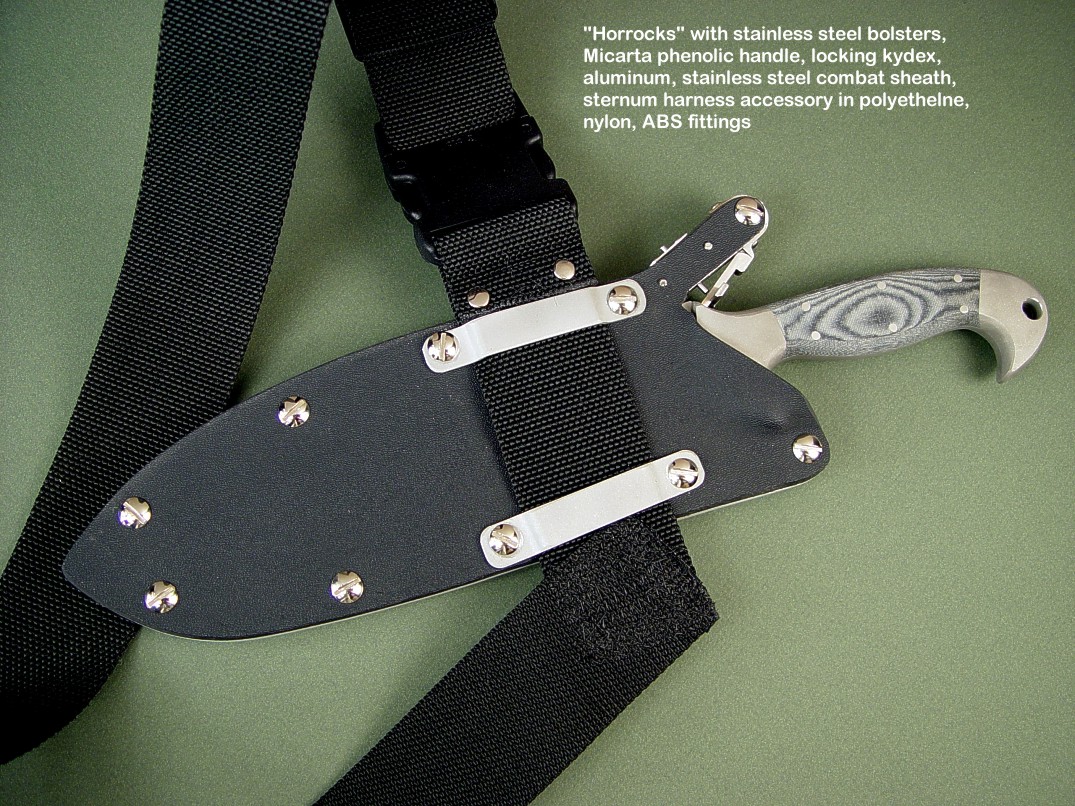
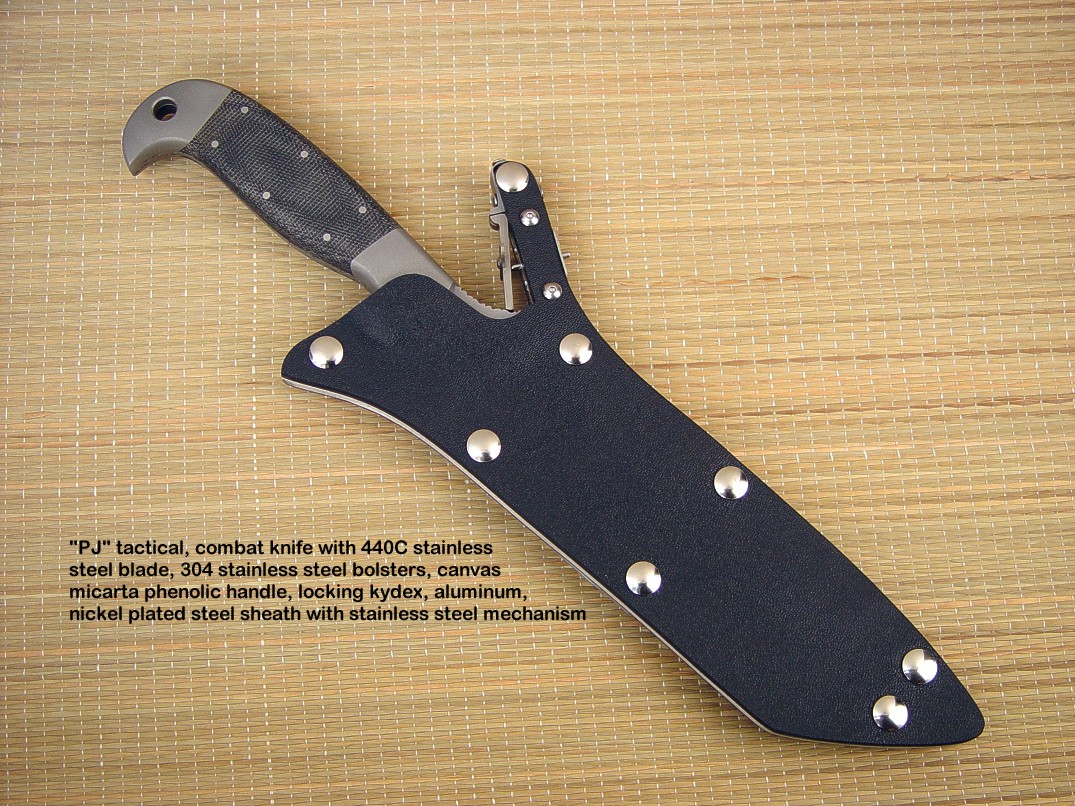
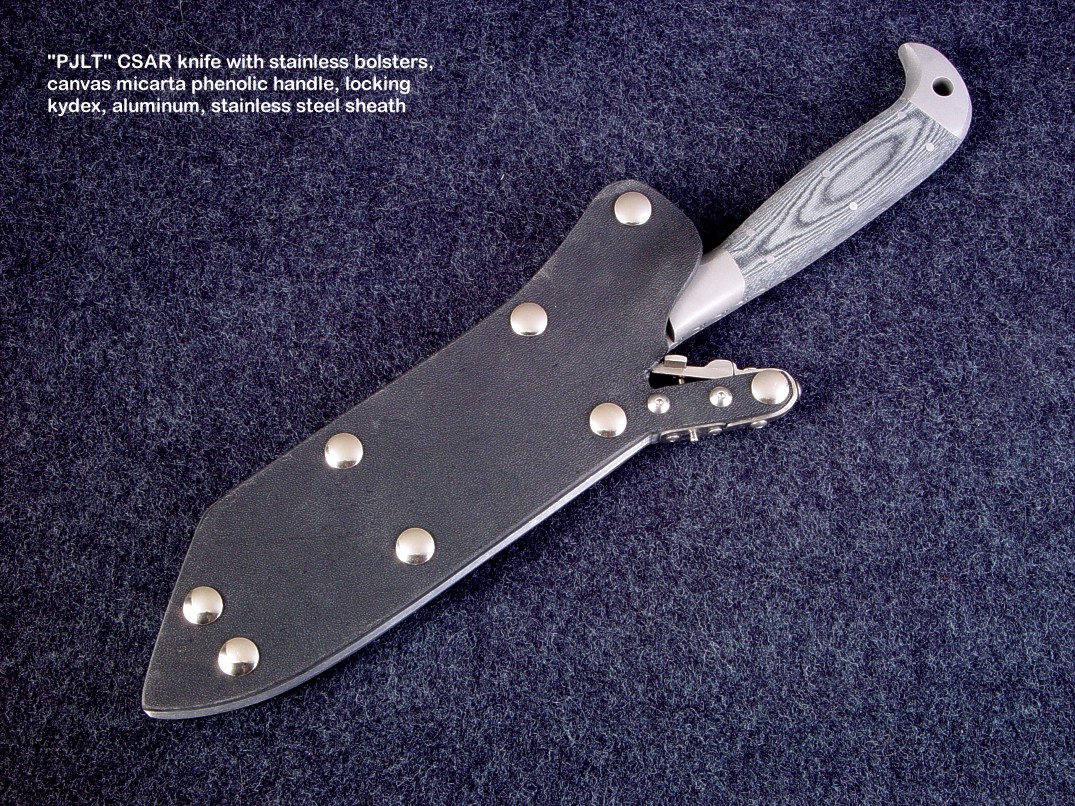
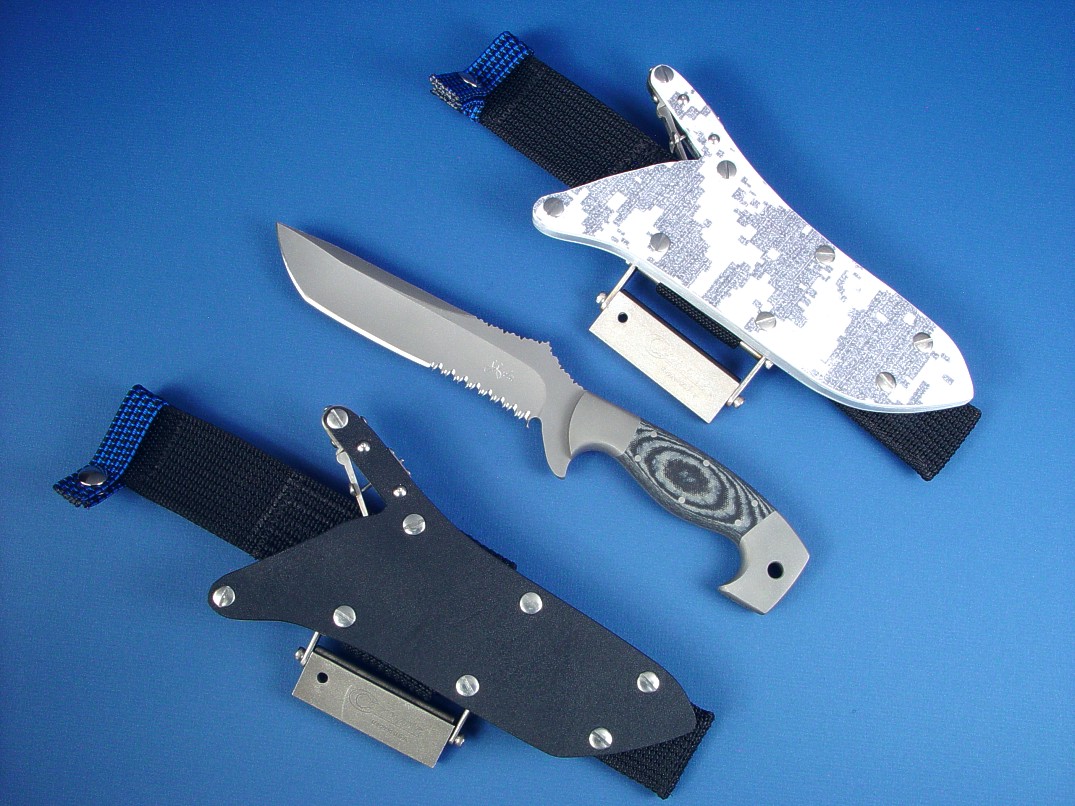
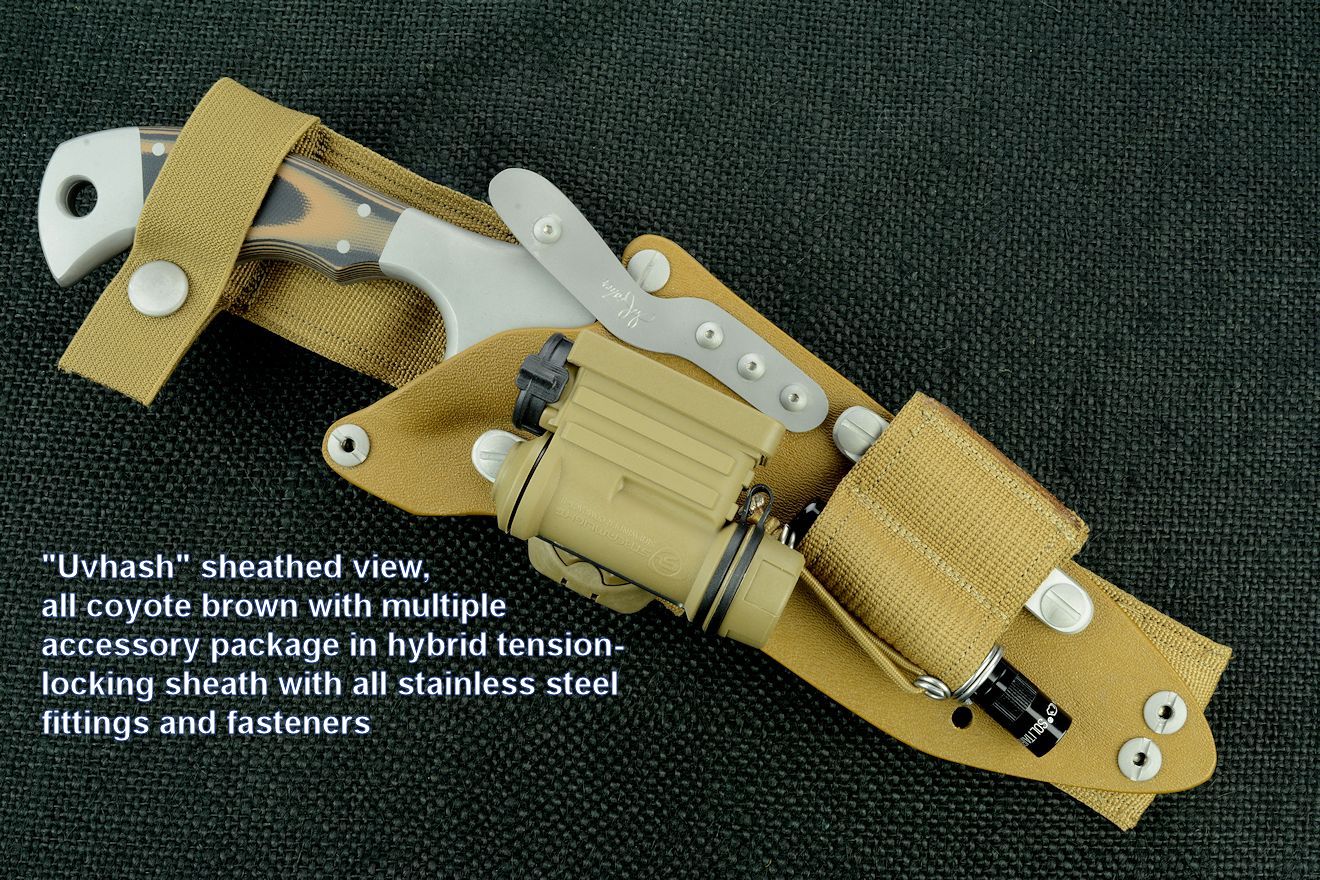
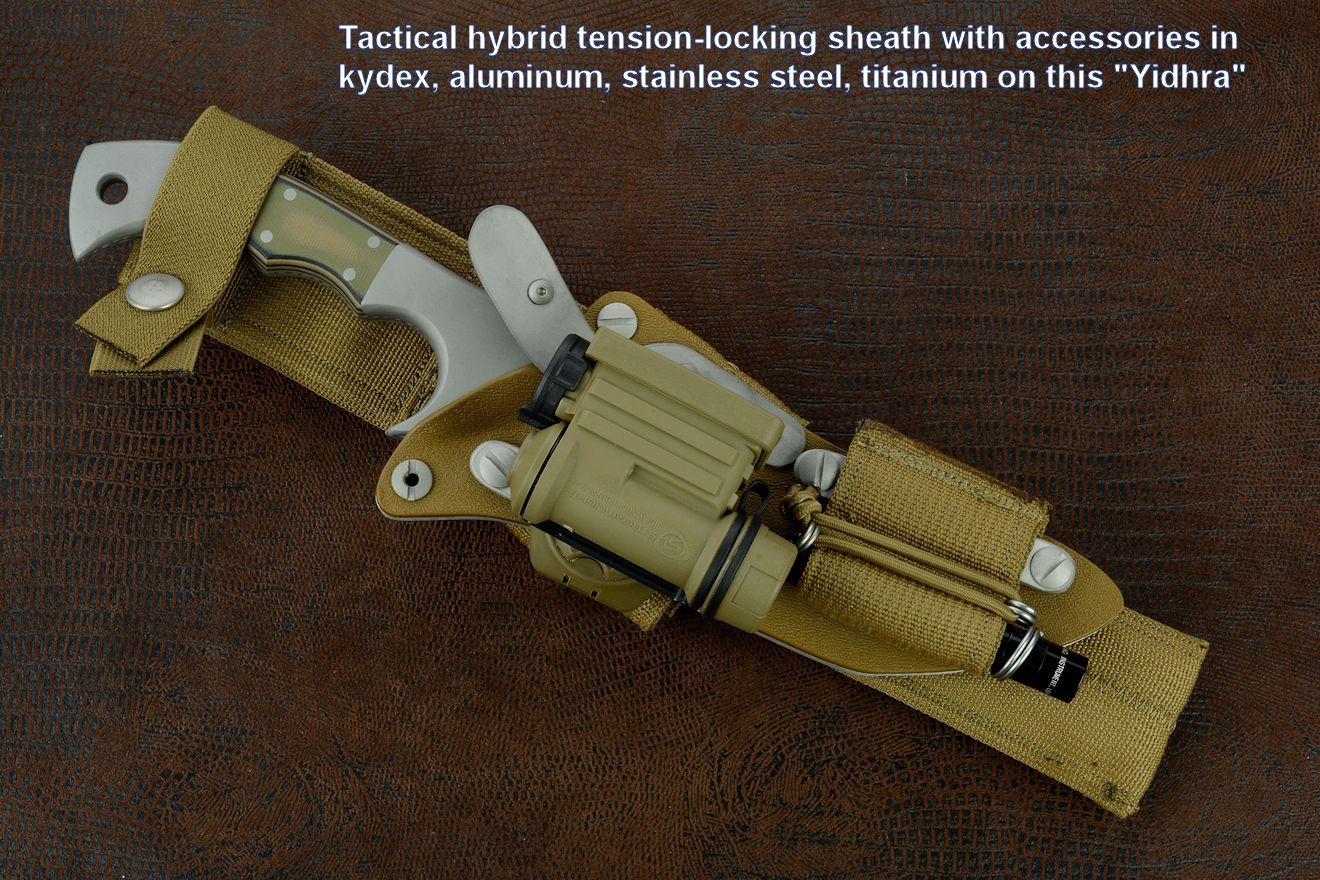
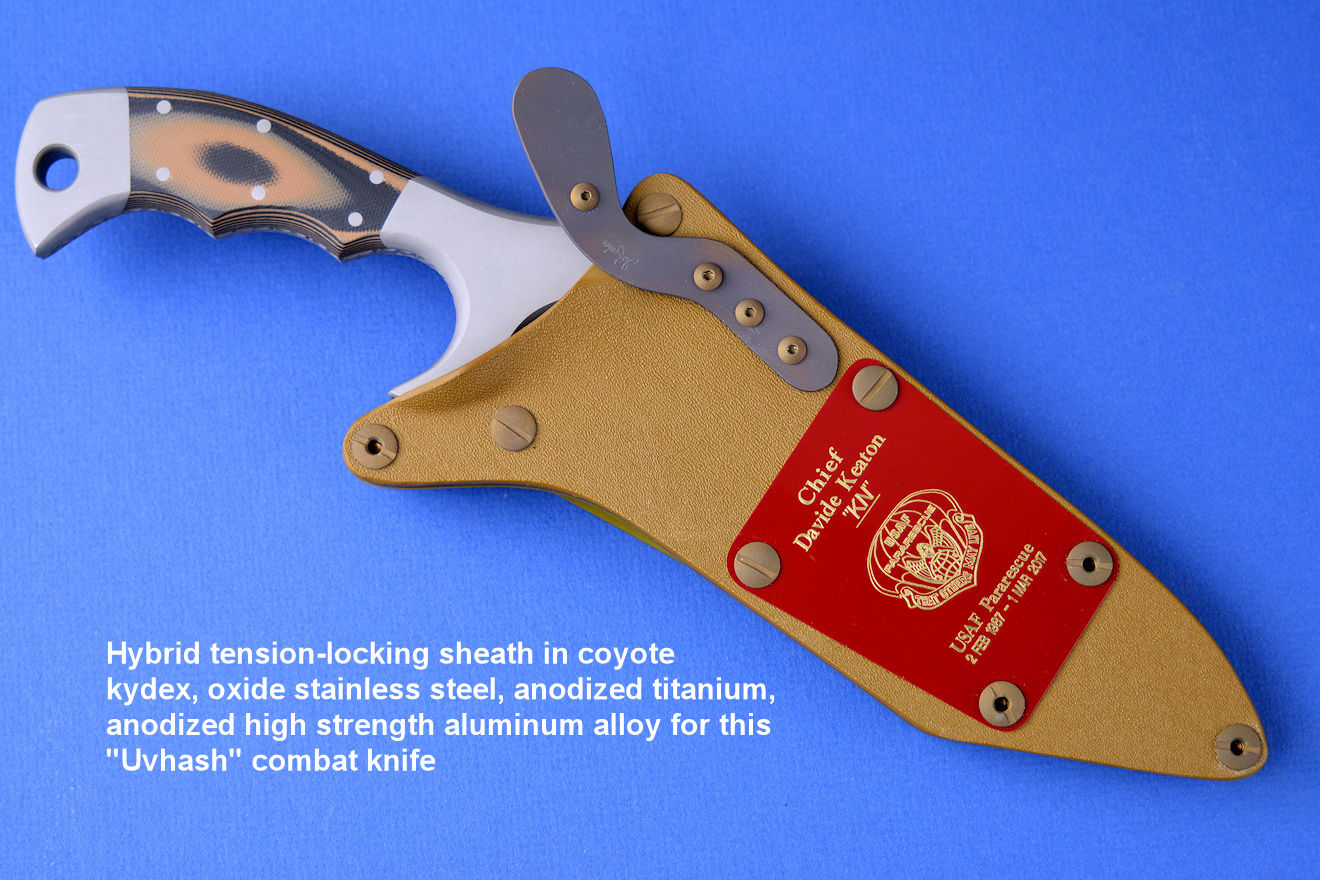
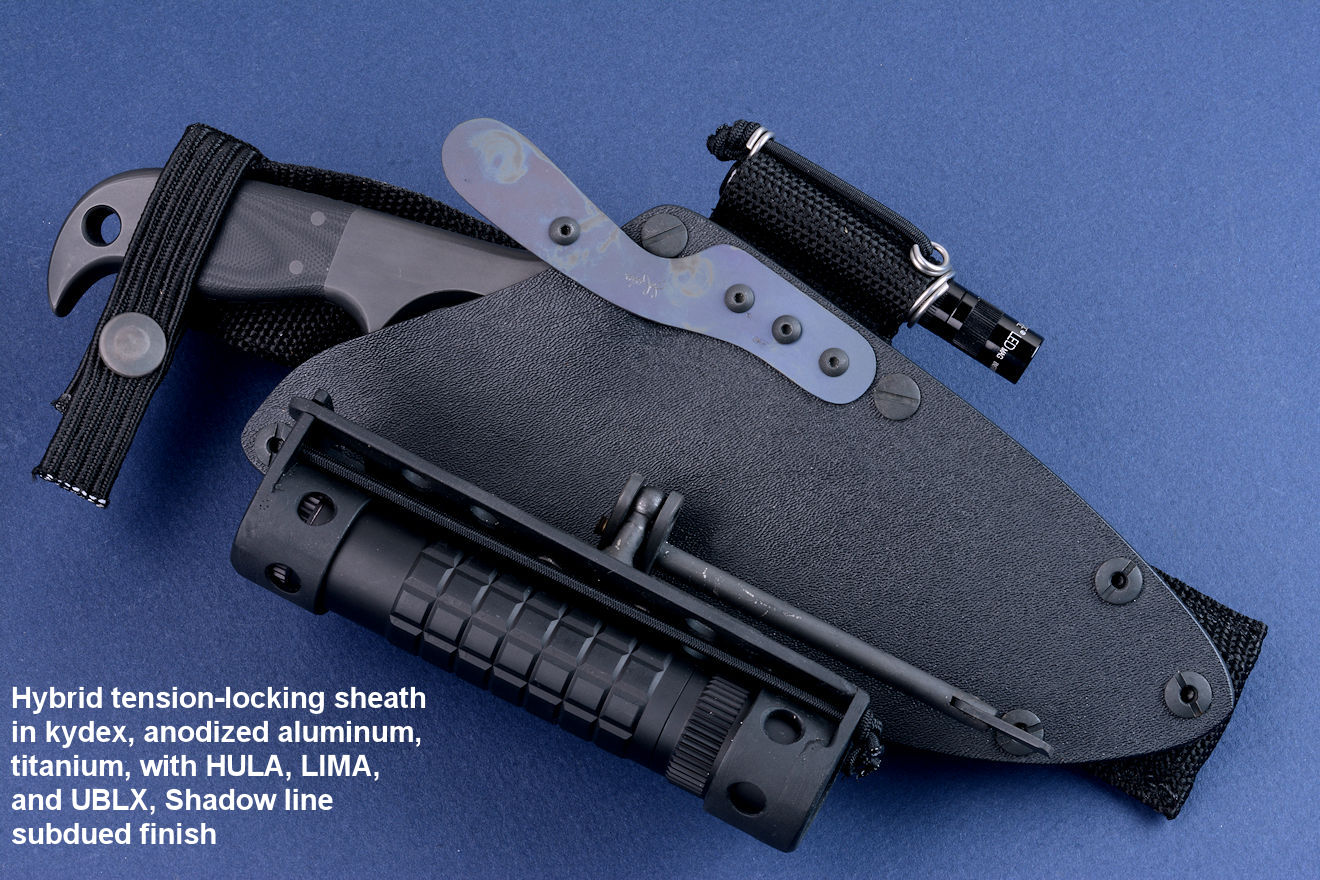
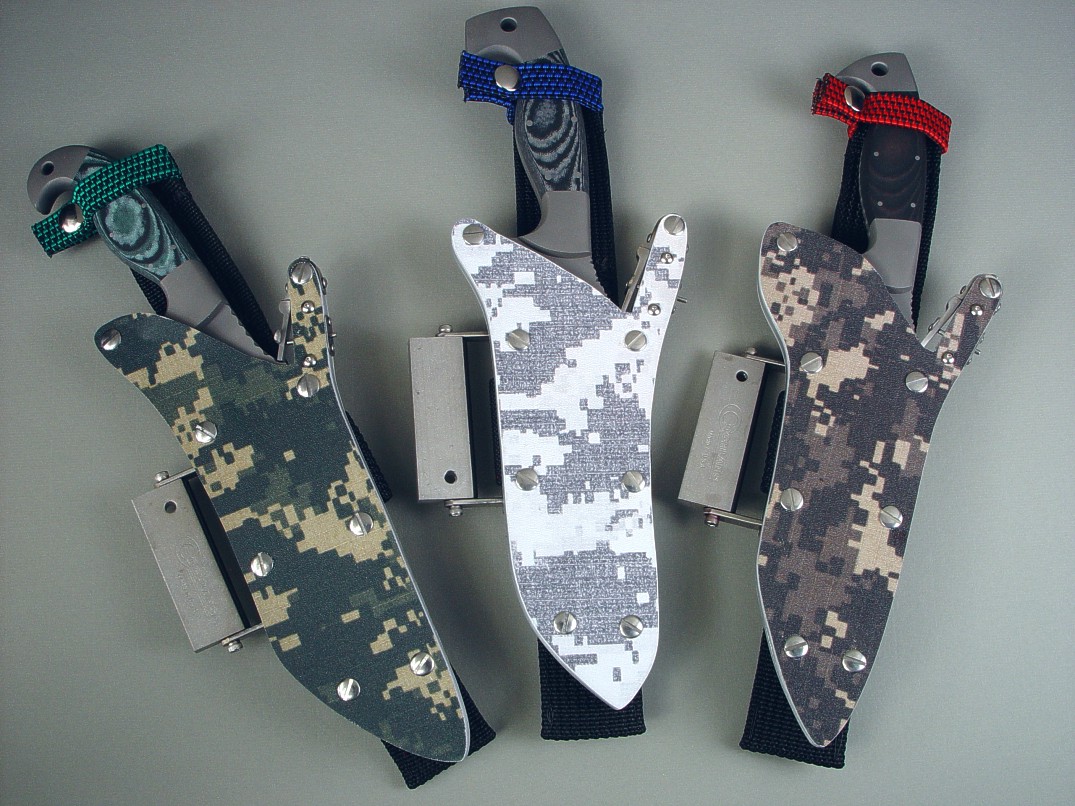
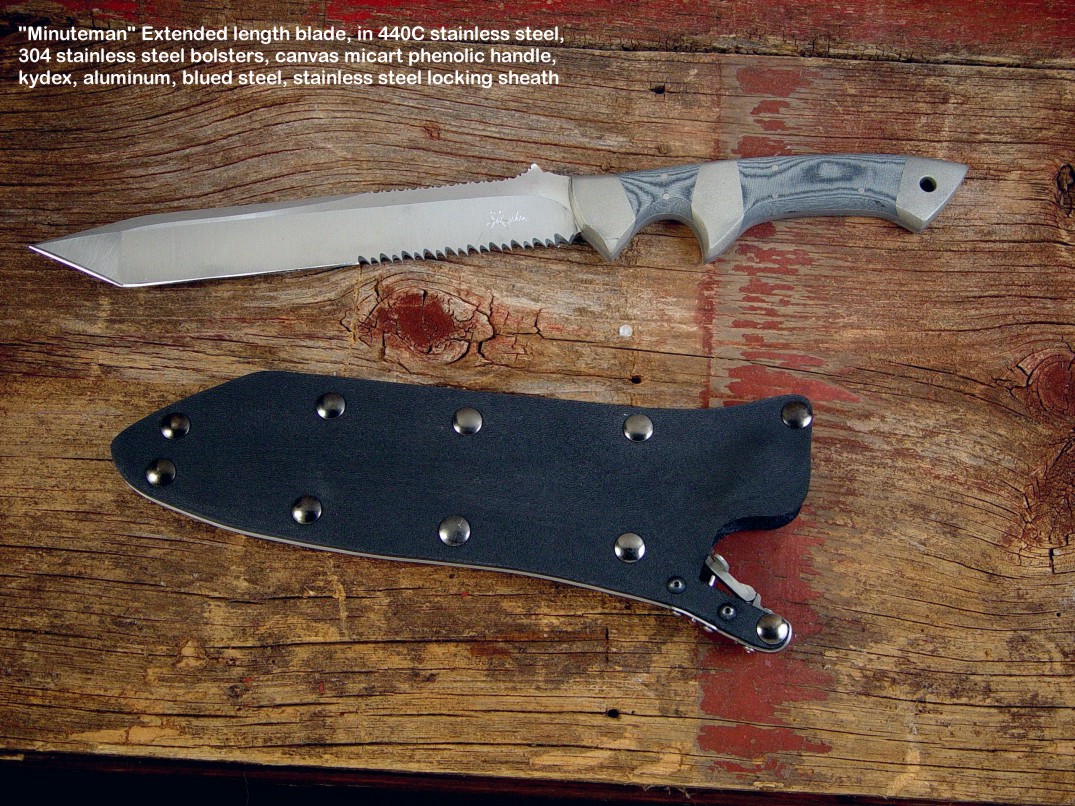
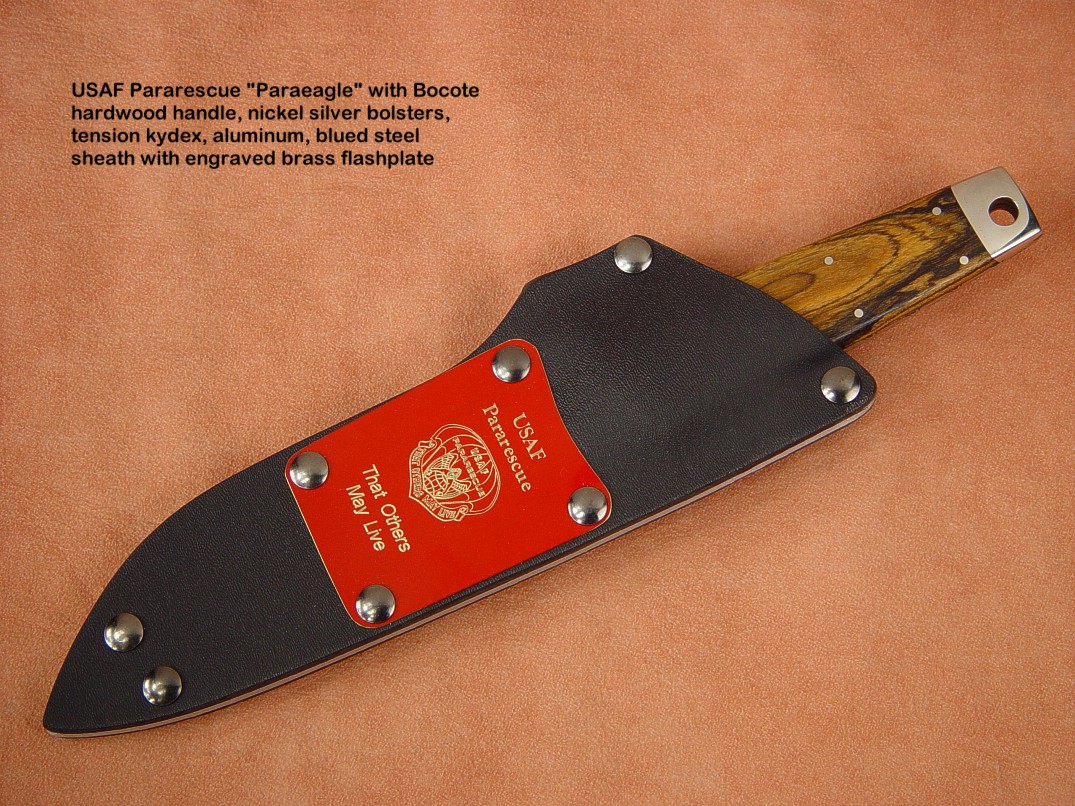
Tactical sheaths I've made are used by firefighters, police, SWAT teams, Sheriff's officers, hazardous materials teams, bomb squads (EOD), emergency responders, US Army Special Forces, Navy SEAL Team members, Airborne, Military Survival Specialists, Special Operations Squads and our nation's top military rescue service, USAF Pararescue. I also make incredibly versatile sheath packages for some of the world's top Counterterrorism Units, including the Israeli Defense Force/National Police Force YAMAM units. My tactical sheaths are made of two layers (double thickness of most kydex sheaths) of .062" kydex on each side or a .125" thick single layer, form-fitted to the knife over an 5052H32 corrosion resistant high strength aluminum alloy welt frame screwed together with nickel plated, blued steel, or stainless steel Chicago screws, and feature either nickel-plated steel belt clips, die formed 2" aluminum belt loops in several sizes, horizontal belt loop plates, vertical and horizontal flat clamping straps and all aluminum parts may be anodized for improved surface hardness and color. Kydex is a mixture of acrylic and PVC (methylacrylate and polyvinylchloride) and is impervious to just about everything but extremely high heat (above 250° F) and a few concentrated chemicals (like methylethylkeytone (MEK) and toluene). The aluminum is 5052H32 corrosion-resistant, high strength aluminum alloy, suited to salt water and chemically corrosive environments and exposures, and I offer the option of complete anodization, a near ceramic-hard coating impervious to salt water, chemicals, abrasion and wear, with the option of coloring to match the other sheath components or for subdued operations. The cements used in assembly are waterproof and continue to harden with age. The steel screws have a 1/4" fine thread post, and most of them are stainless steel which can be colored to match the gear. These are very, very tough sheaths!
I've been asked why I build over an aluminum welt frame, not simply use kydex hot formed over the knife and secured to itself with rivets. Kydex is a thermoforming plastic, and gets softer and more flexible in the heat. Though you won't reach the thermoforming heat by simple exposure to direct sunlight, you will impart a bit of flexibility as the sheath warms. This flexibility will not be enough to allow the knife to poke through the sheath body, but it can allow areas around fasteners to loosen. That is because as the kydex heats, it expands. When it cools, it contracts. This can leave gaps in fasteners, and if they can never be tightened (like rivets) this can lead to loosening or even cracking over time. Cold temperatures can also be a challenge to the kydex sheath with no support other than rivets and more kydex. Kydex becomes brittle below freezing and can crack or even shatter if it's cold enough! Most knife users will never be in that type of environment, but please remember, I make knives for the military and counterterrorism units, and they deploy everywhere.
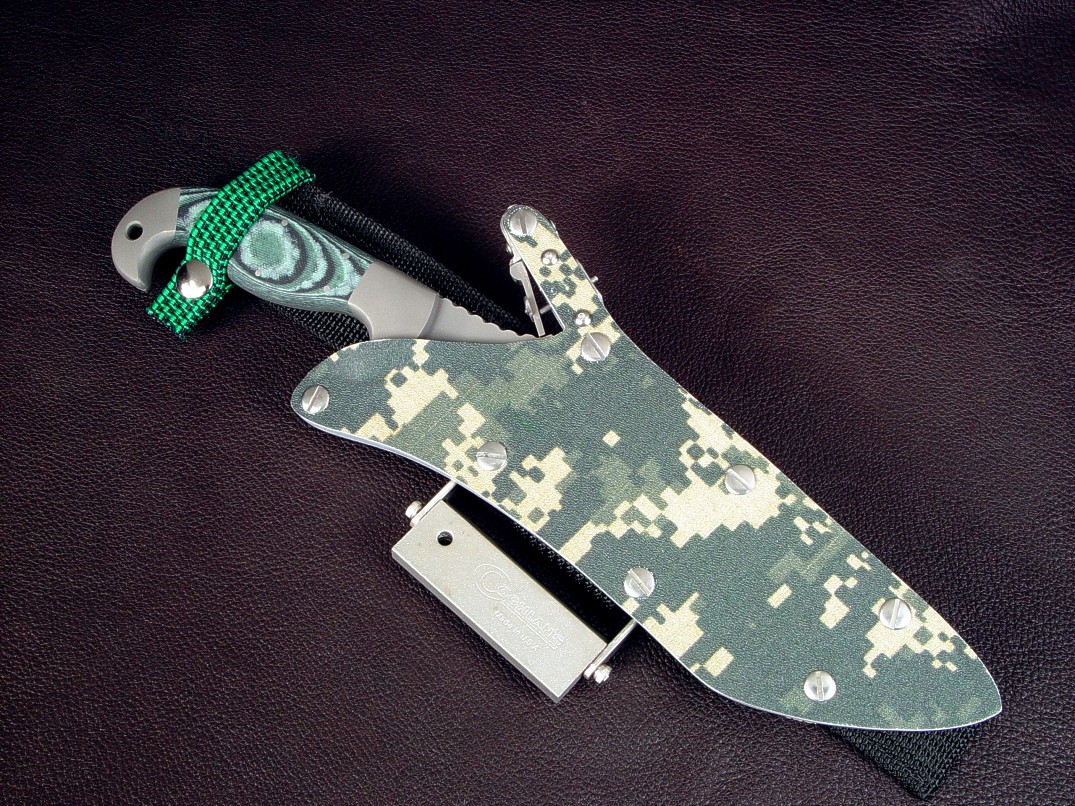
Most of my kydex military combat sheaths are black, with satin finished aluminum welts visible at the edges. Occasionally, I'll get requests for a different look. By custom order, I also use coyote brown, gray kydex, forest camo (traditional), desert camo (traditional) and even modern standard digital camo, polar digital camo, and desert digital camo kydex. All of the aluminum can be anodized and dyed to match, and the stainless steel components can be darkened and oxidized for a limited range of blending colors.
Hello Jay,
I bought a Krag from you several weeks ago. It is wonderful. Built like a tank, a perfect example of KISS. It
maybe isn't quite as lovely to look at as some of your other work, but I would expect gravity to fail before
the Krag failed.
But this letter is not about the Krag. It's about the Hybrid Kydex sheath that came with it.
I don't know if my experience with what is normally considered 'a sheath', is out of the ordinary, but until I got your hybrid sheath I never, ever had any sheath that was sturdy enough, or dependable enough, out of the box, to serve in anything but casual wear.
I have modified or replaced or discarded almost all of the other sheaths I have used. The ones that made it to non-casual use usually had some duct tape or electricians' tape doing one-shot duty, or maybe a cotter pin added, or somesuch. 'Kludge' is a good description.
I am in awe of the design and the execution of your hybrid kydex holster. You have won the holster/sheath contest, hands down, and nobody else made it thru the qualification trials. They can all go home and cry in their beer, because I don't think anyone is ever going to top what you have done.
Holster orientations of up, down, left, right, horizontal or vertical, use with different thicknesses of belt or strap, can all be selected just as one wants, and every single one of them is rock-solid dependable, not a hint of flaky or gimmick. Easy as can be to change in the field, is sorta a cherry tossed on top of a perfect piece of gear. Oh, and don't forget that the service lifetime of this holster looks to be long enough to outlive the user.
Perfect. It's just bloody Perfect.
Thank you again.
Regards,
R.
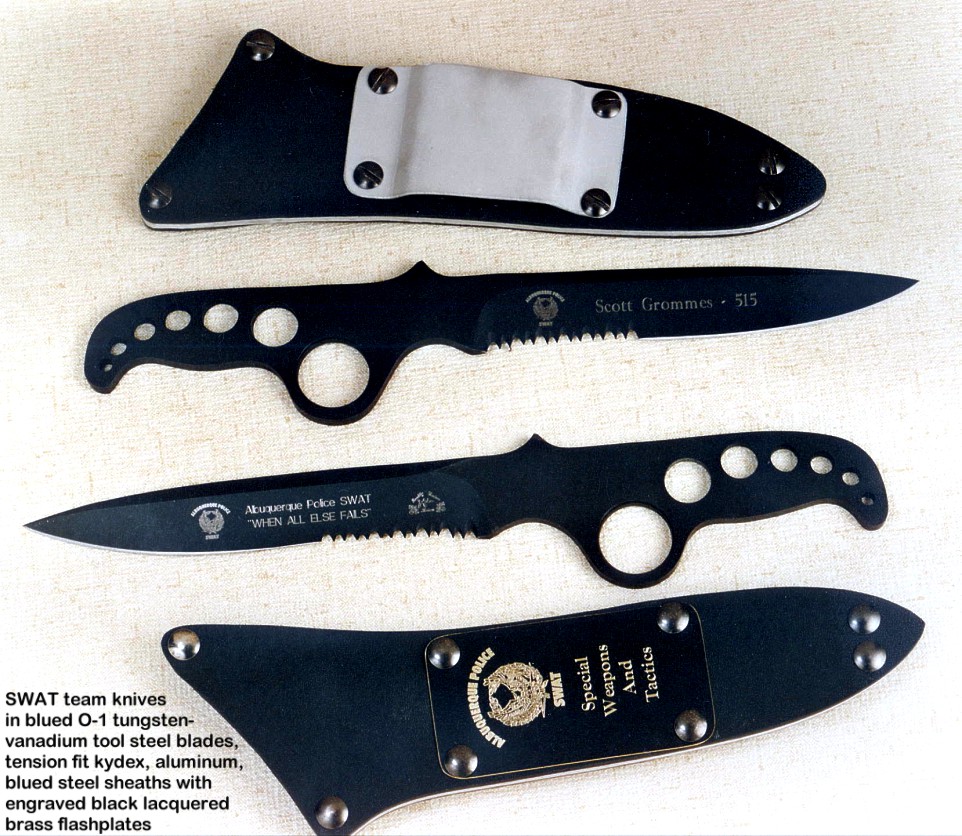
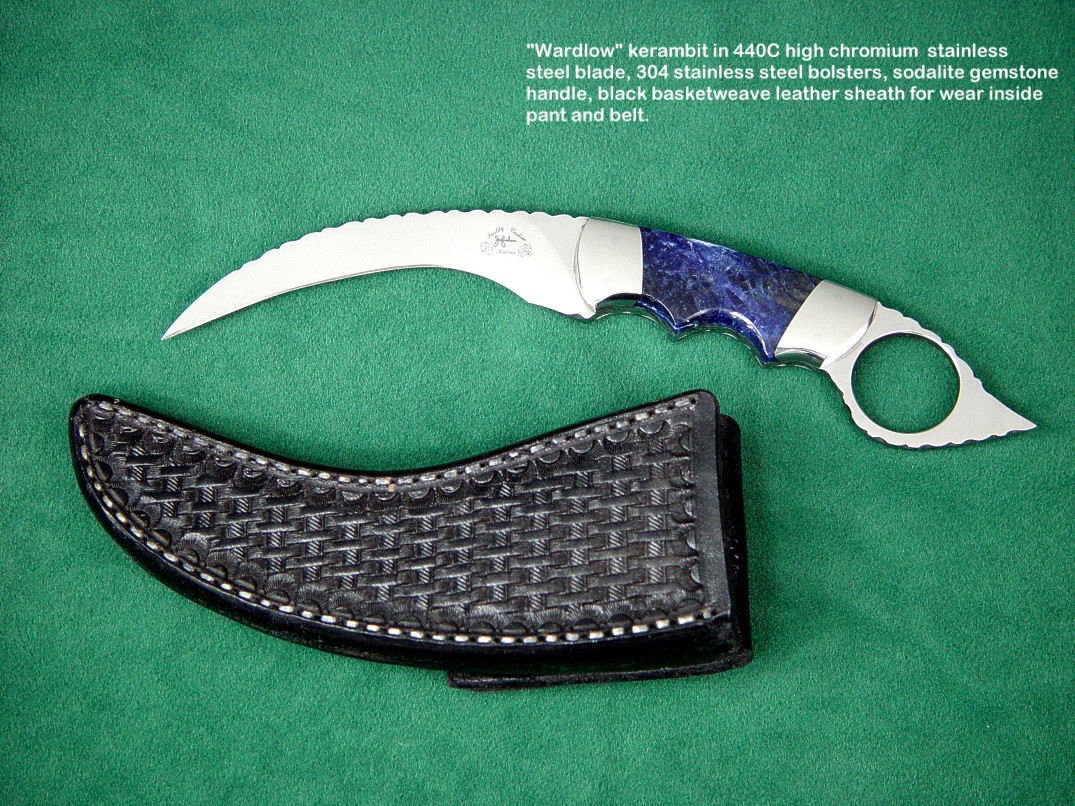
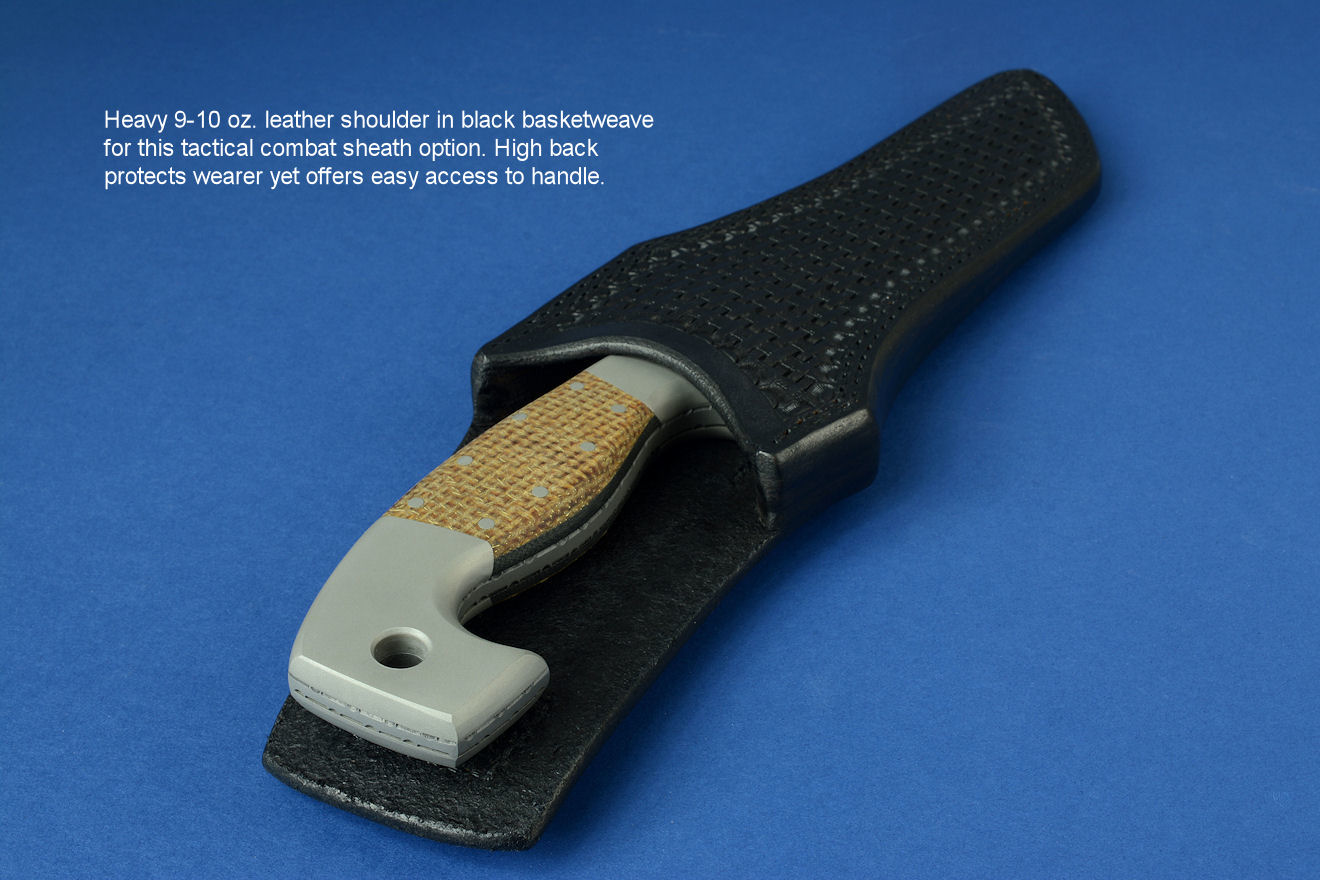
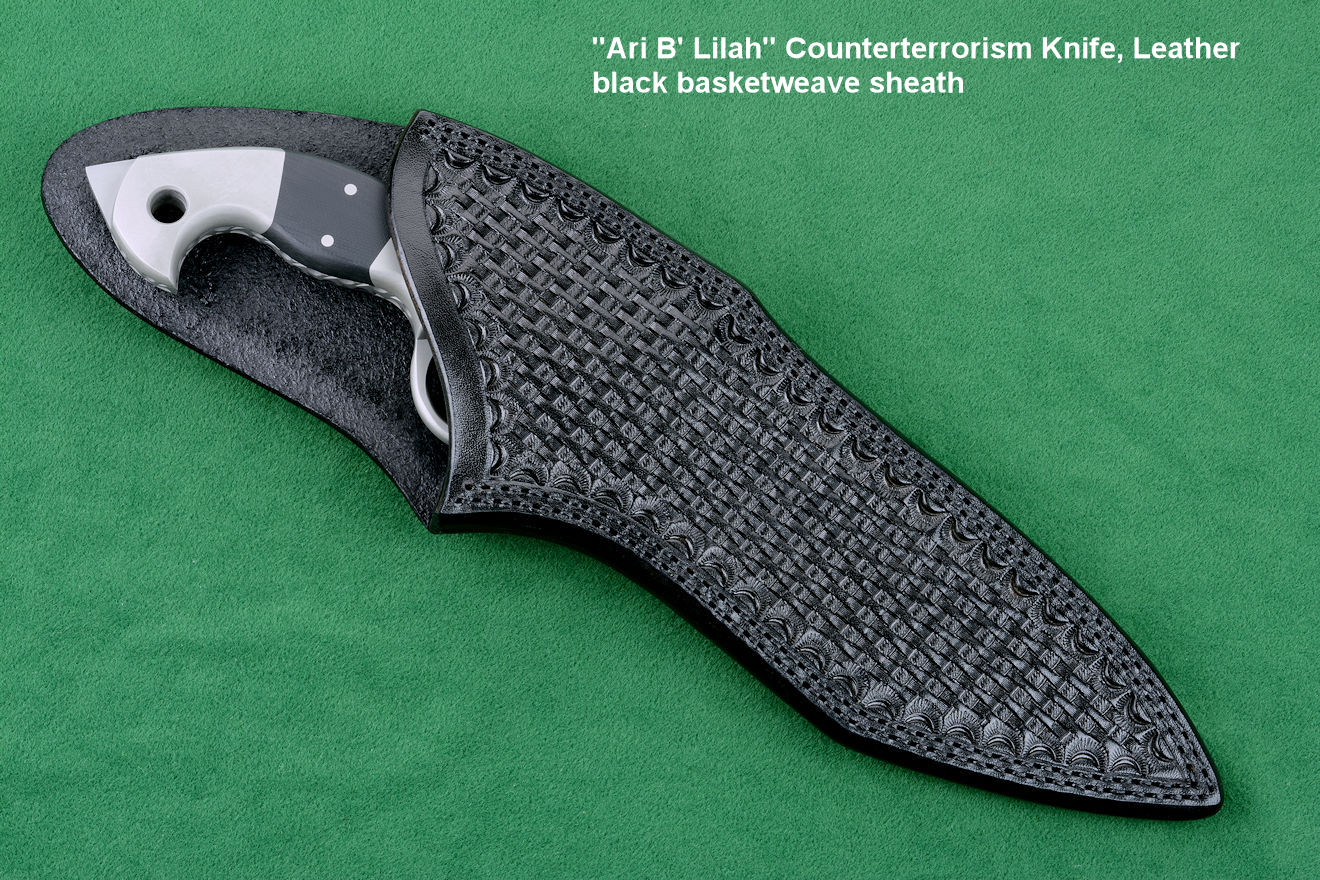
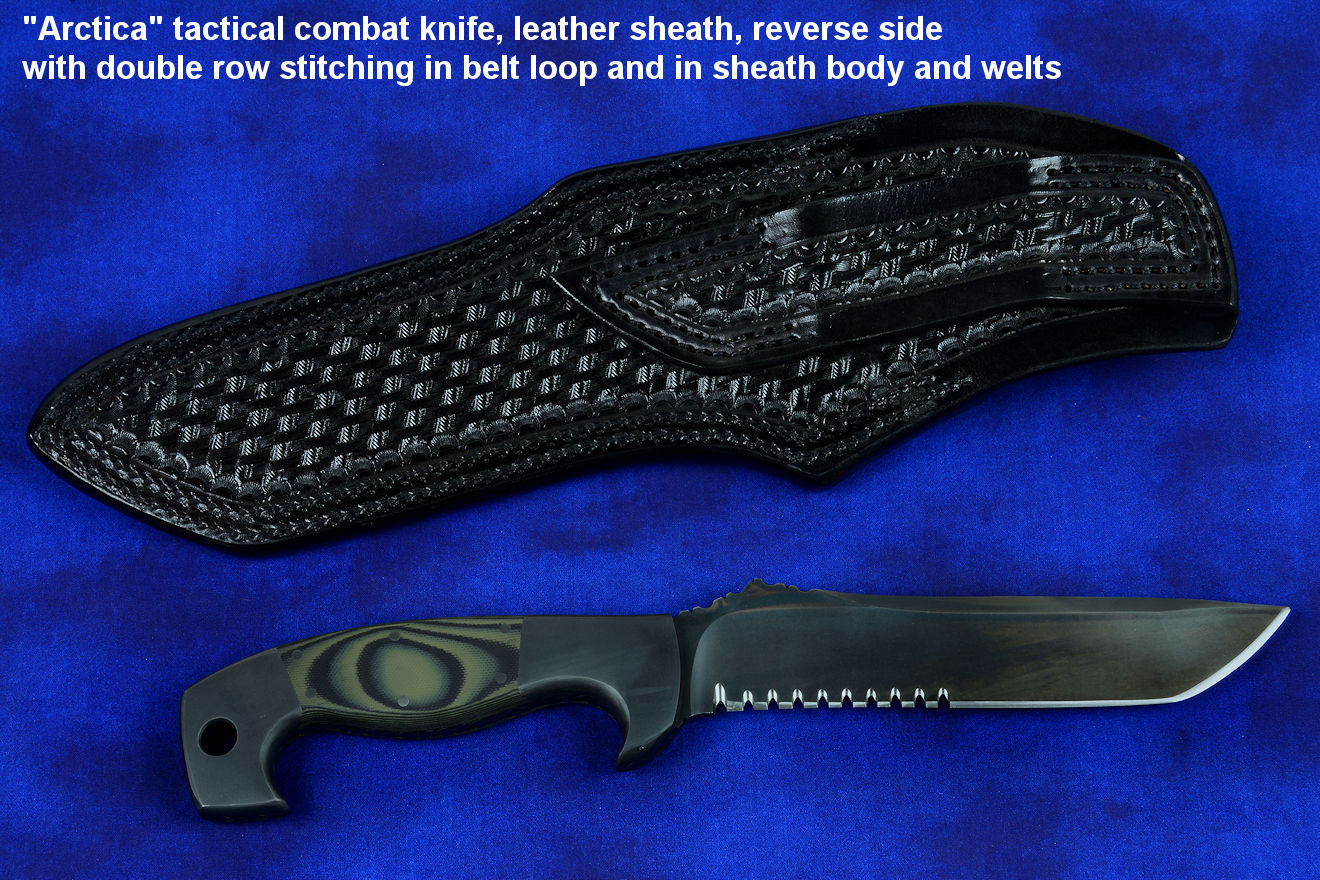
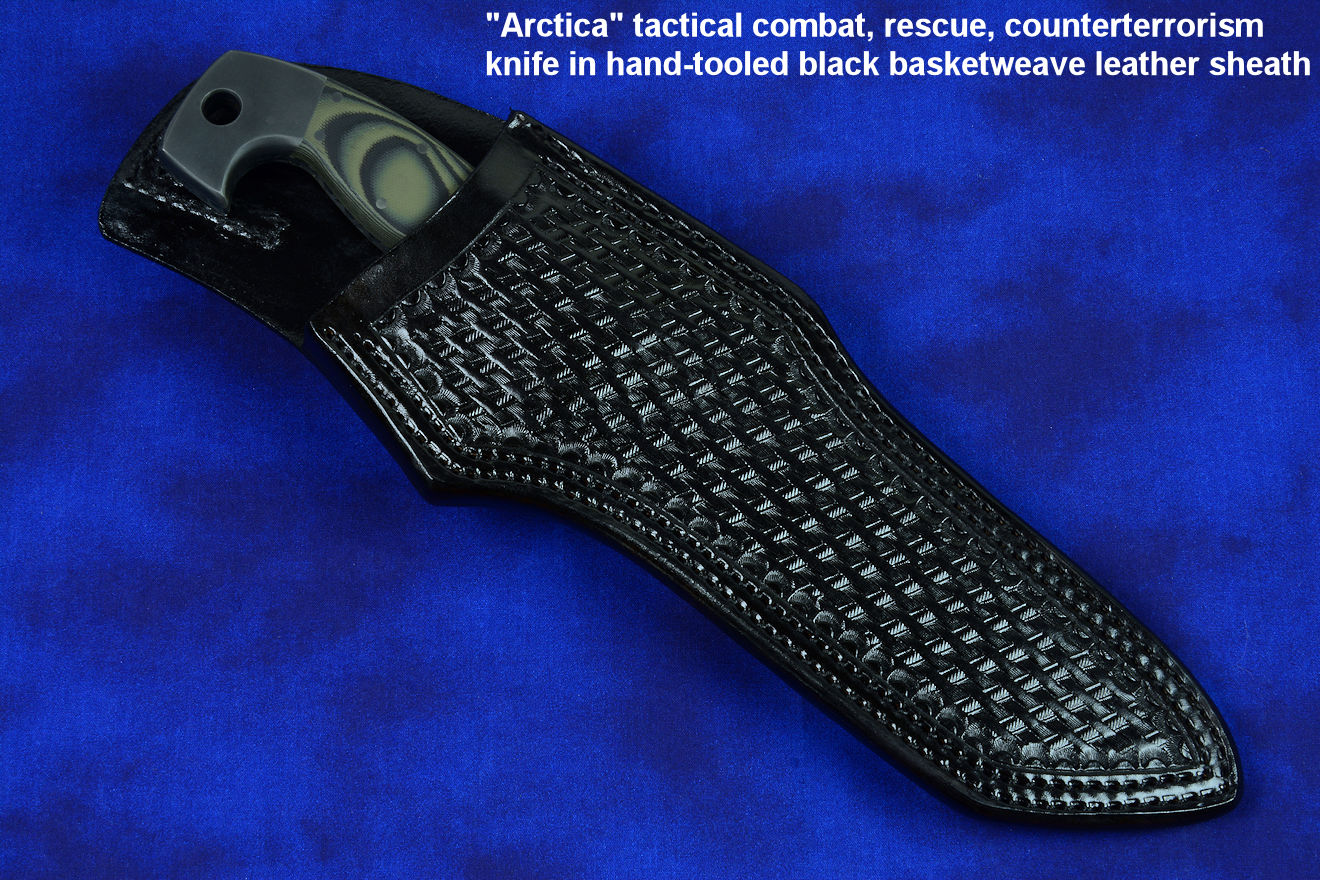
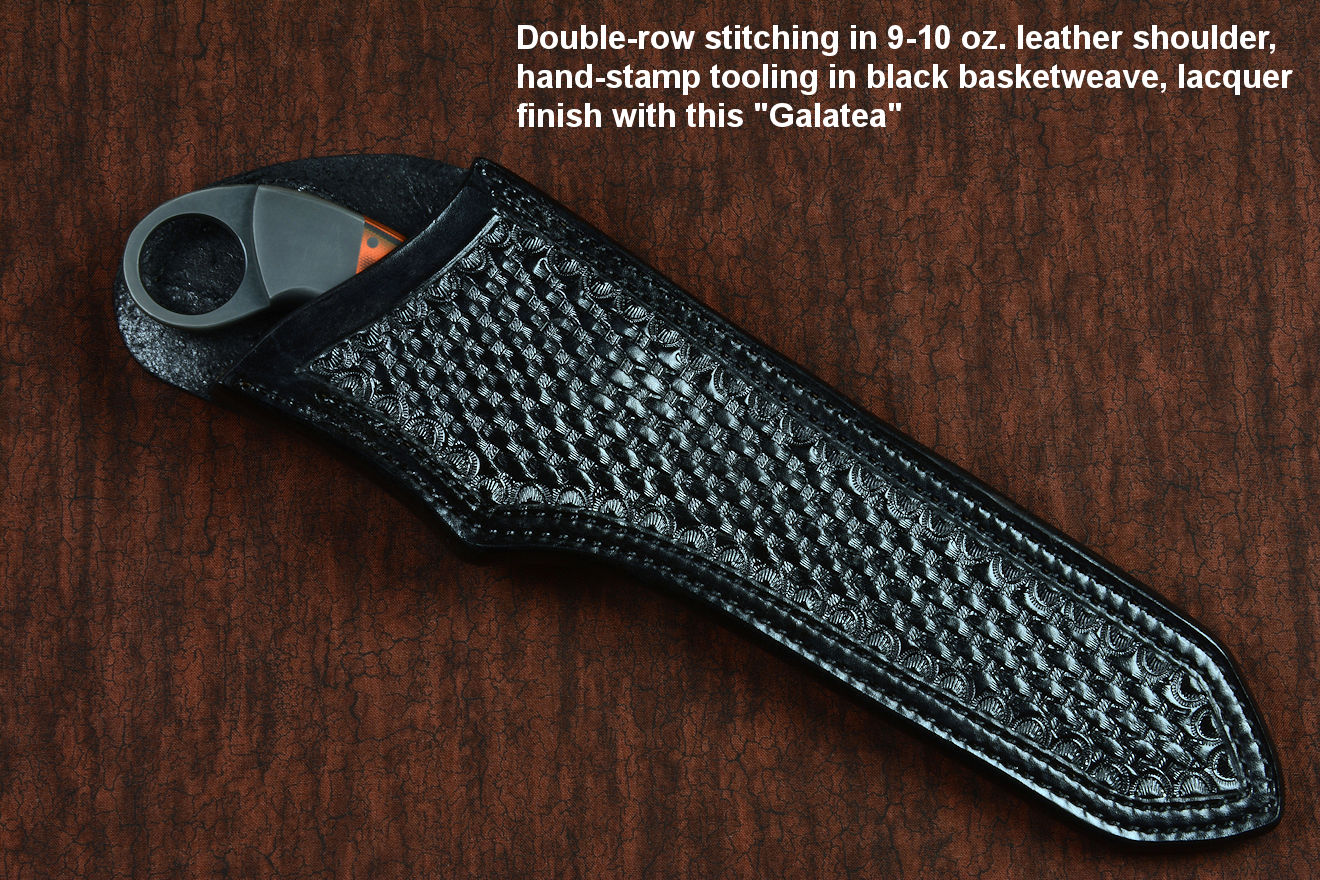
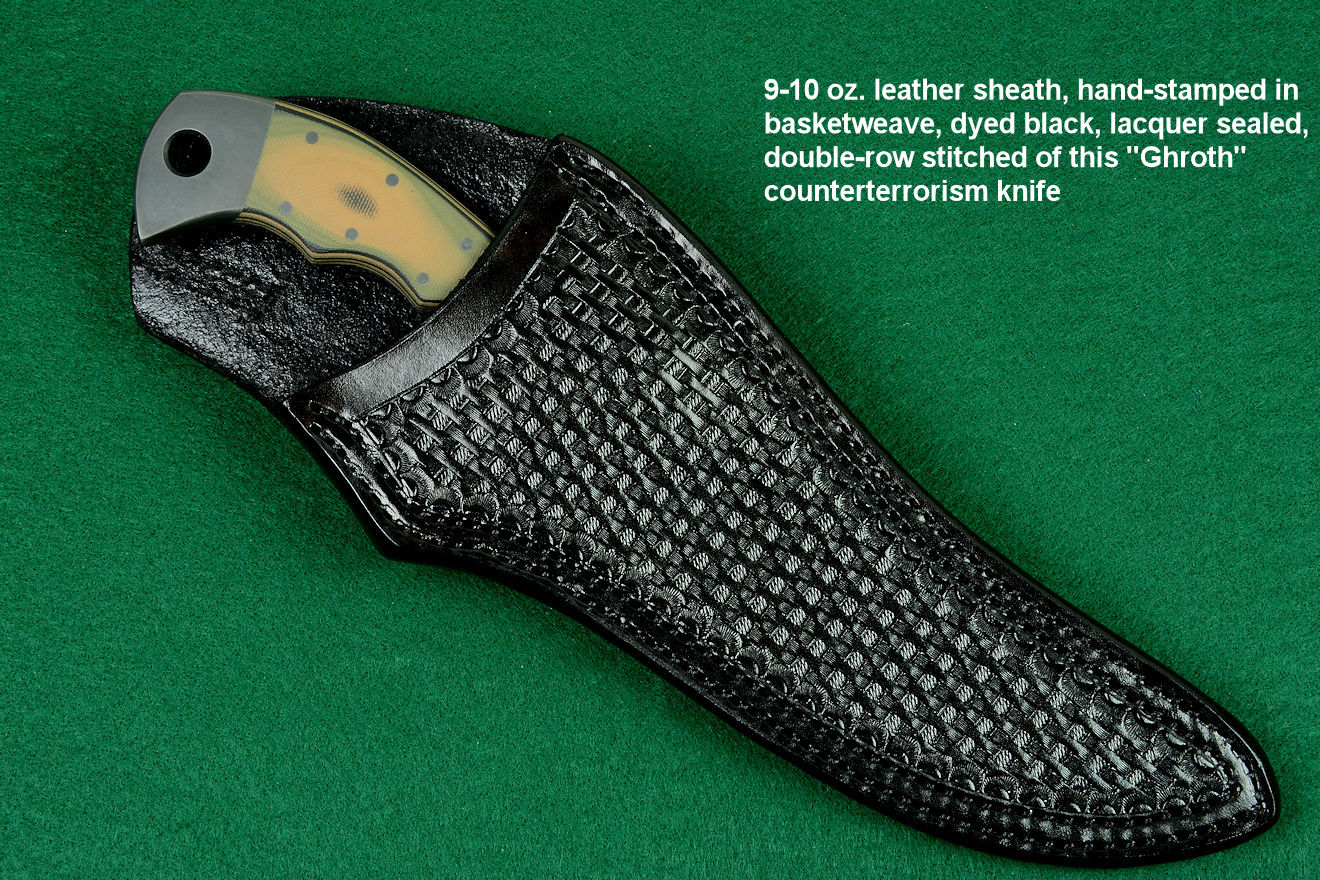
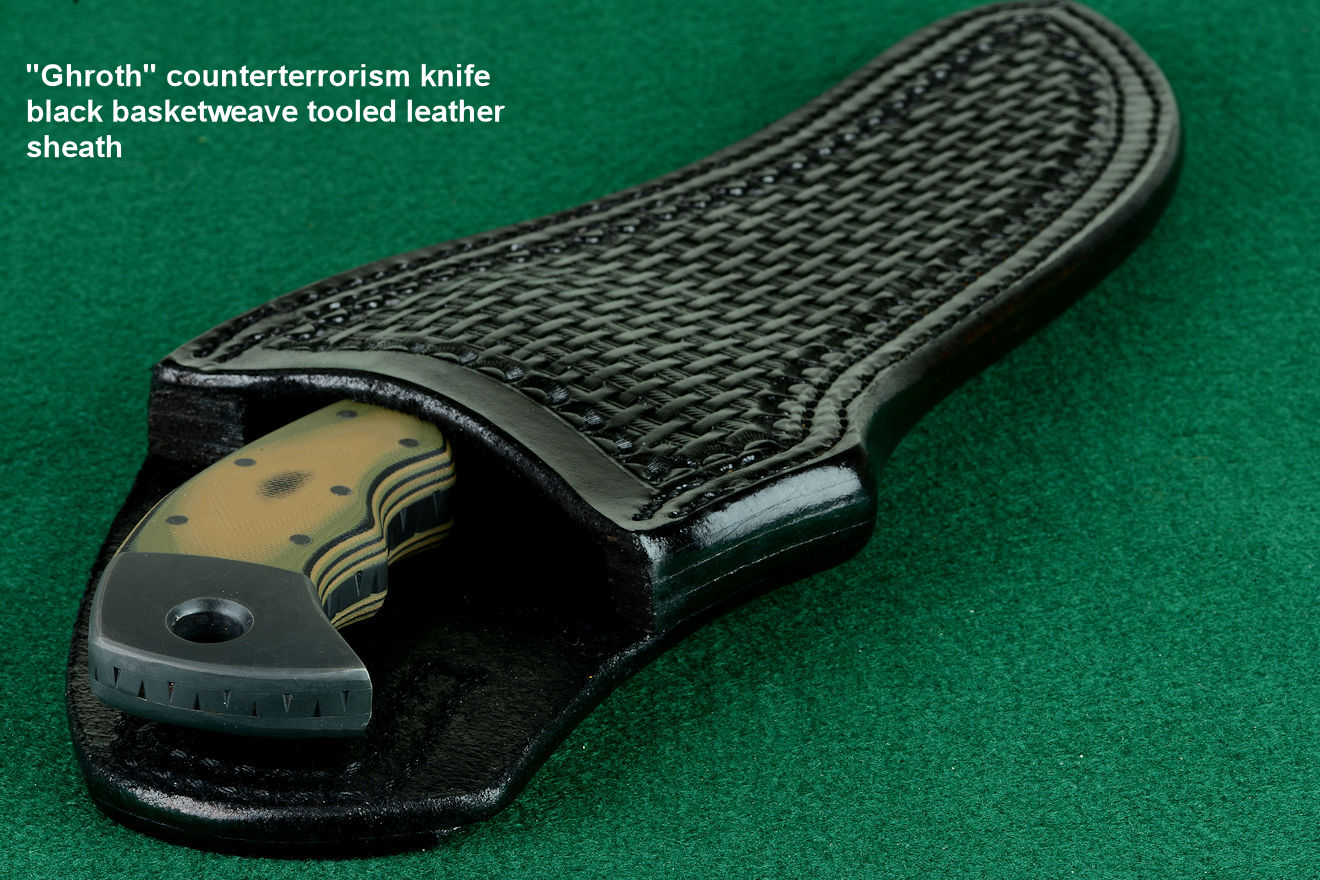
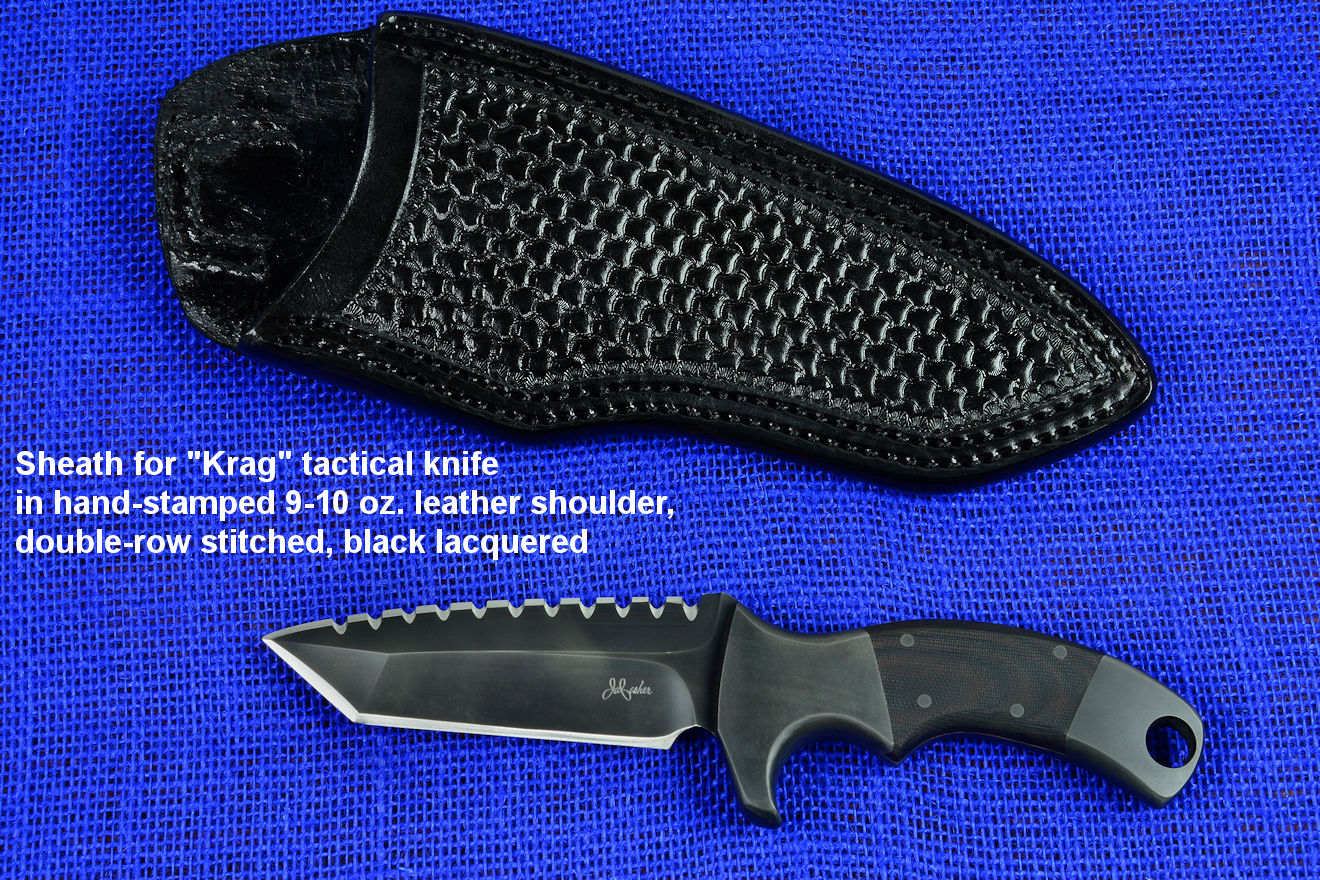
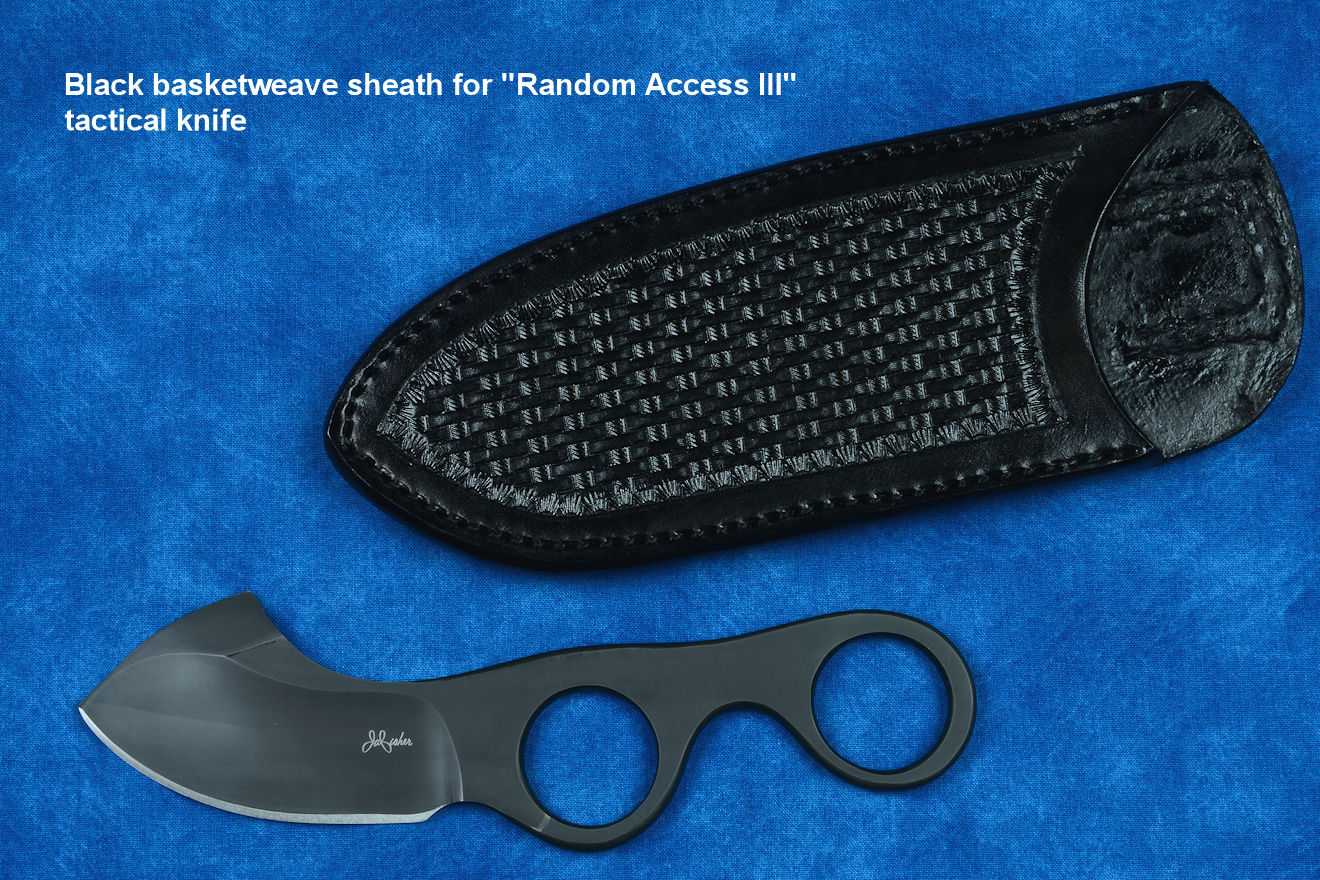
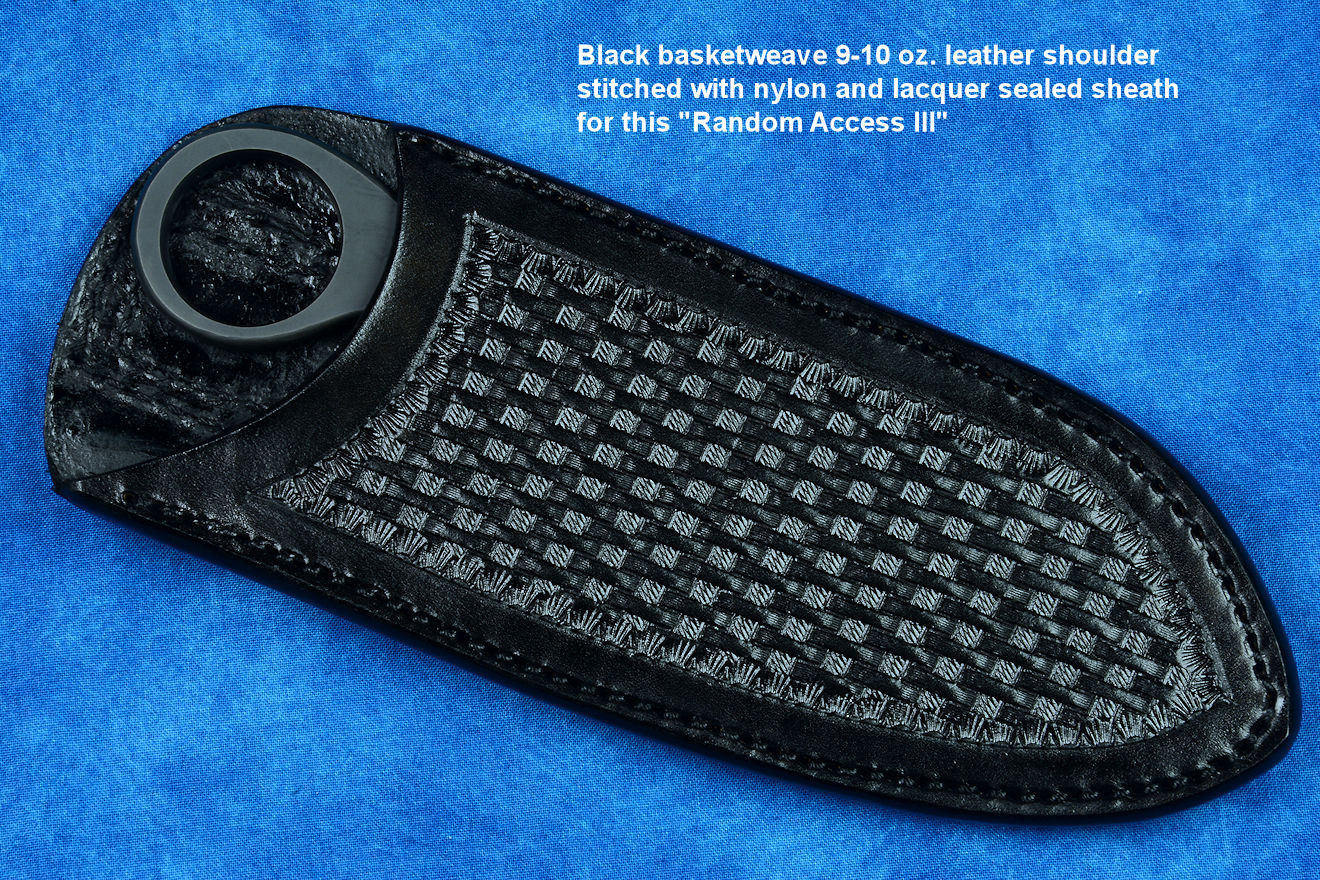
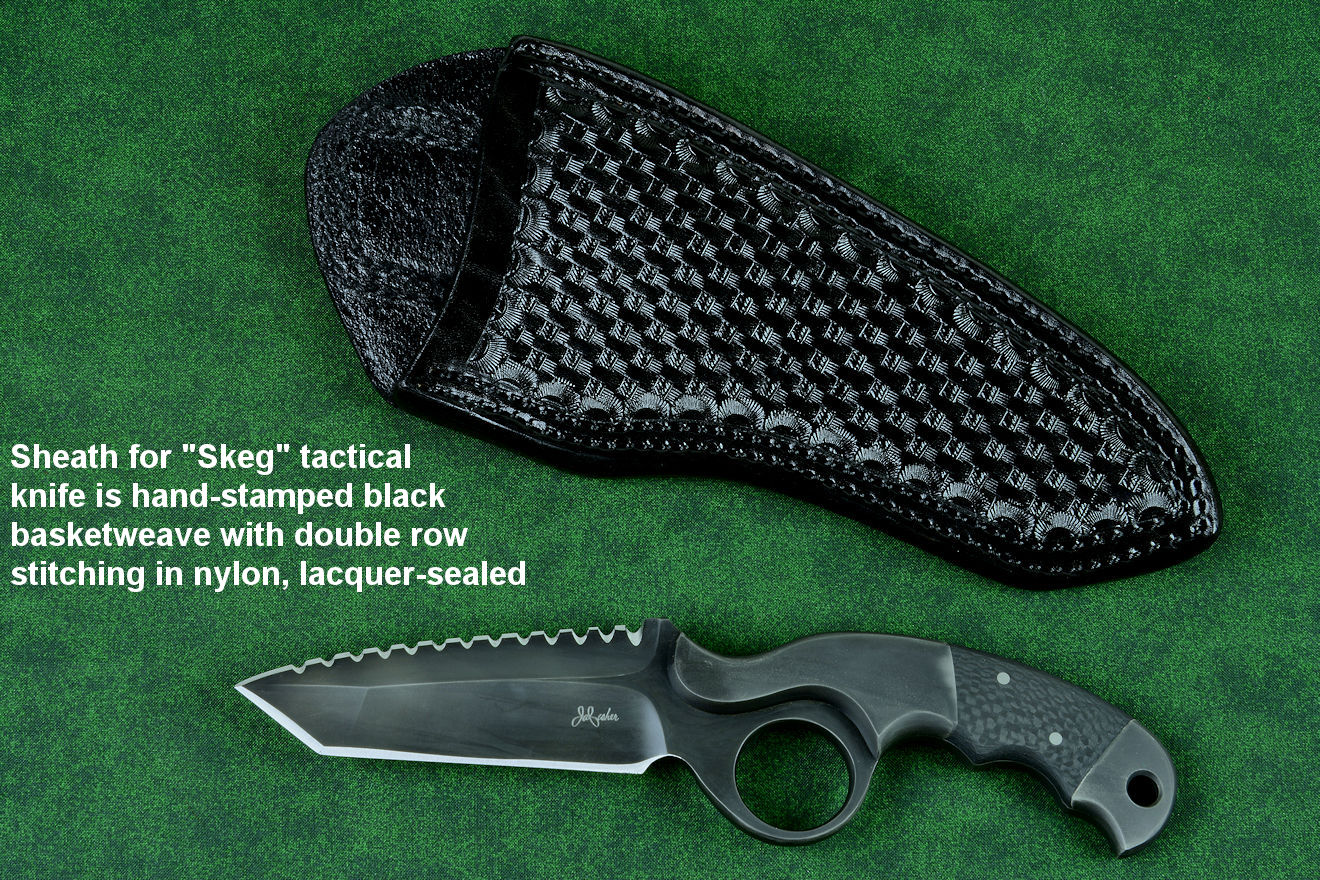
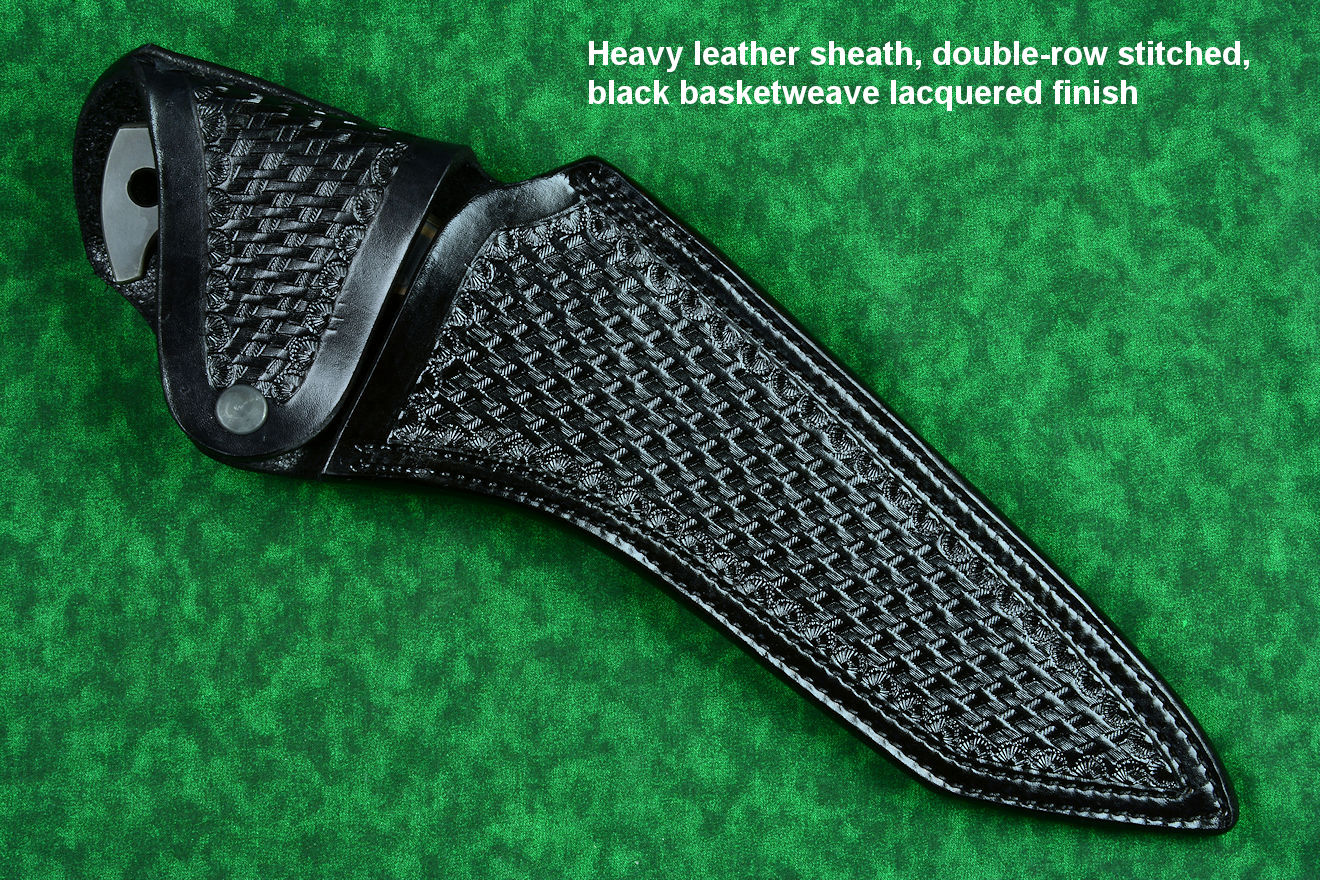
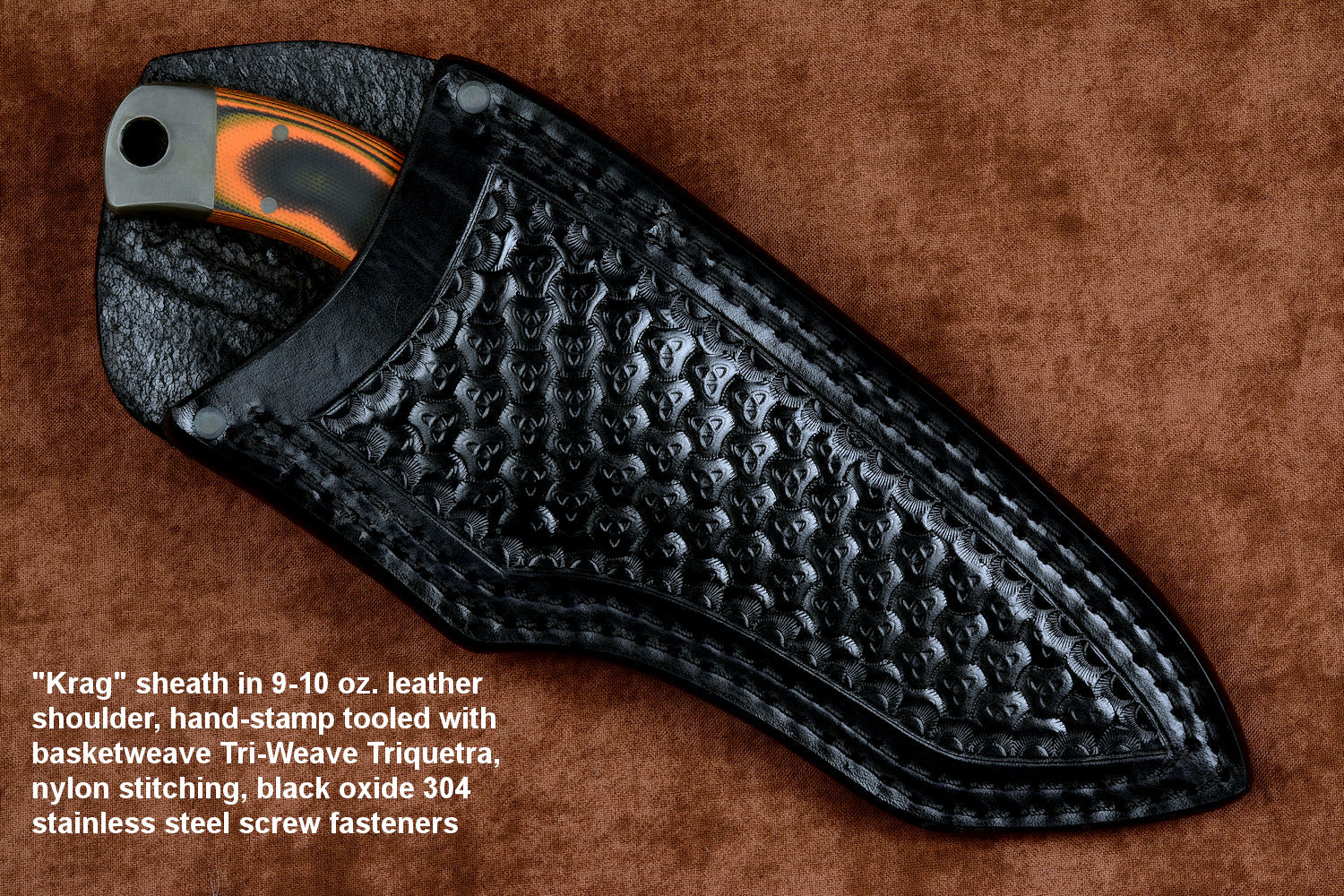
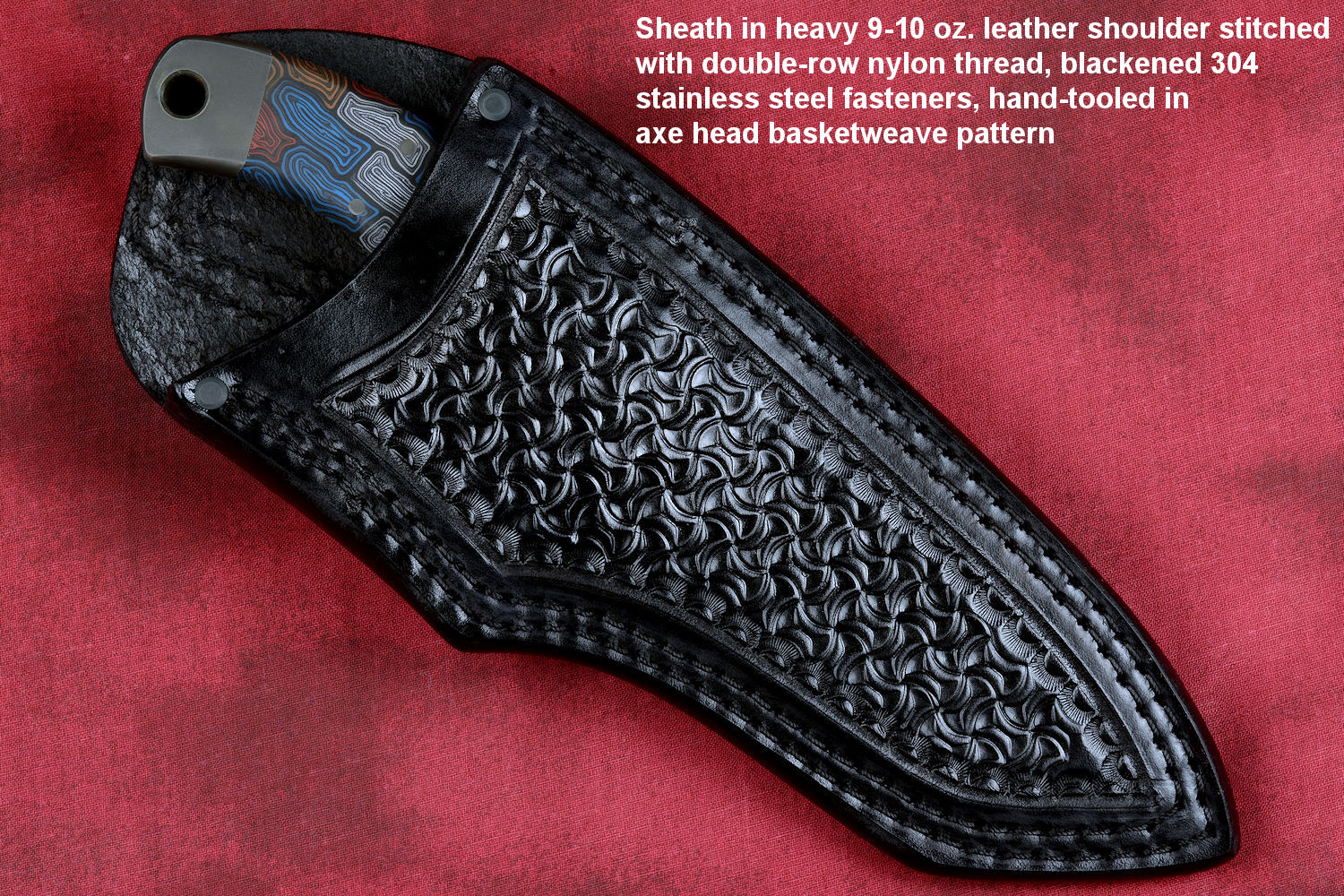
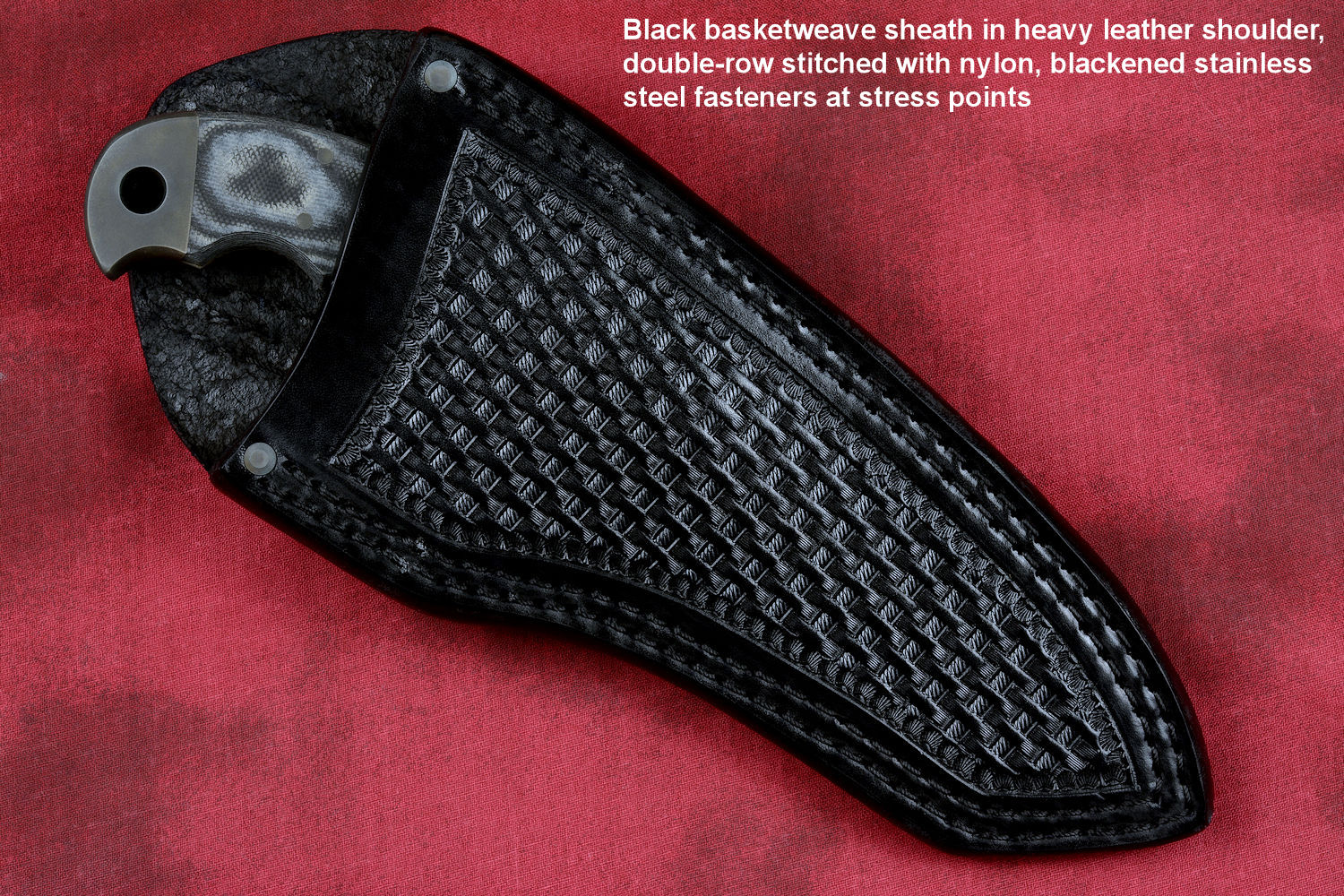
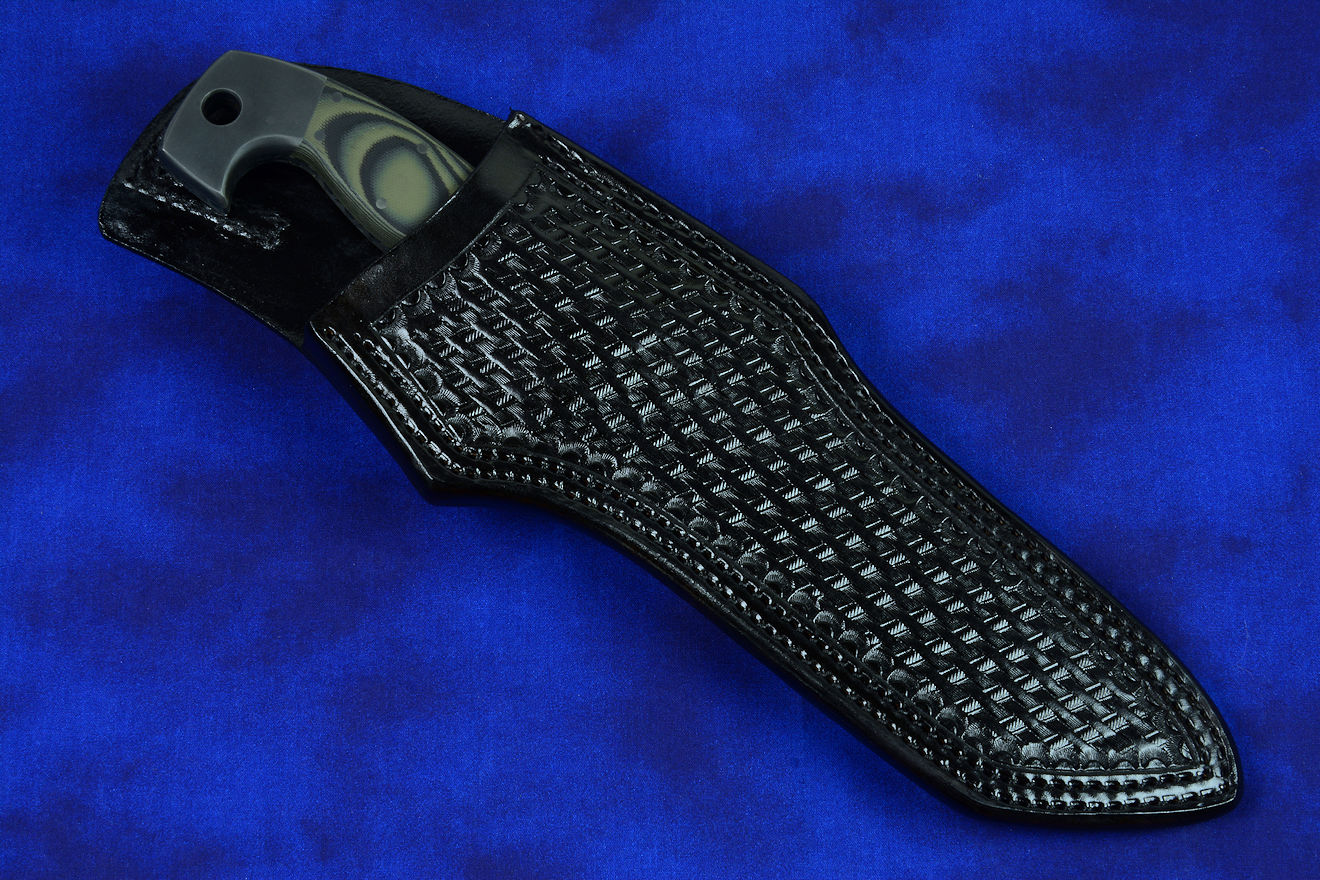
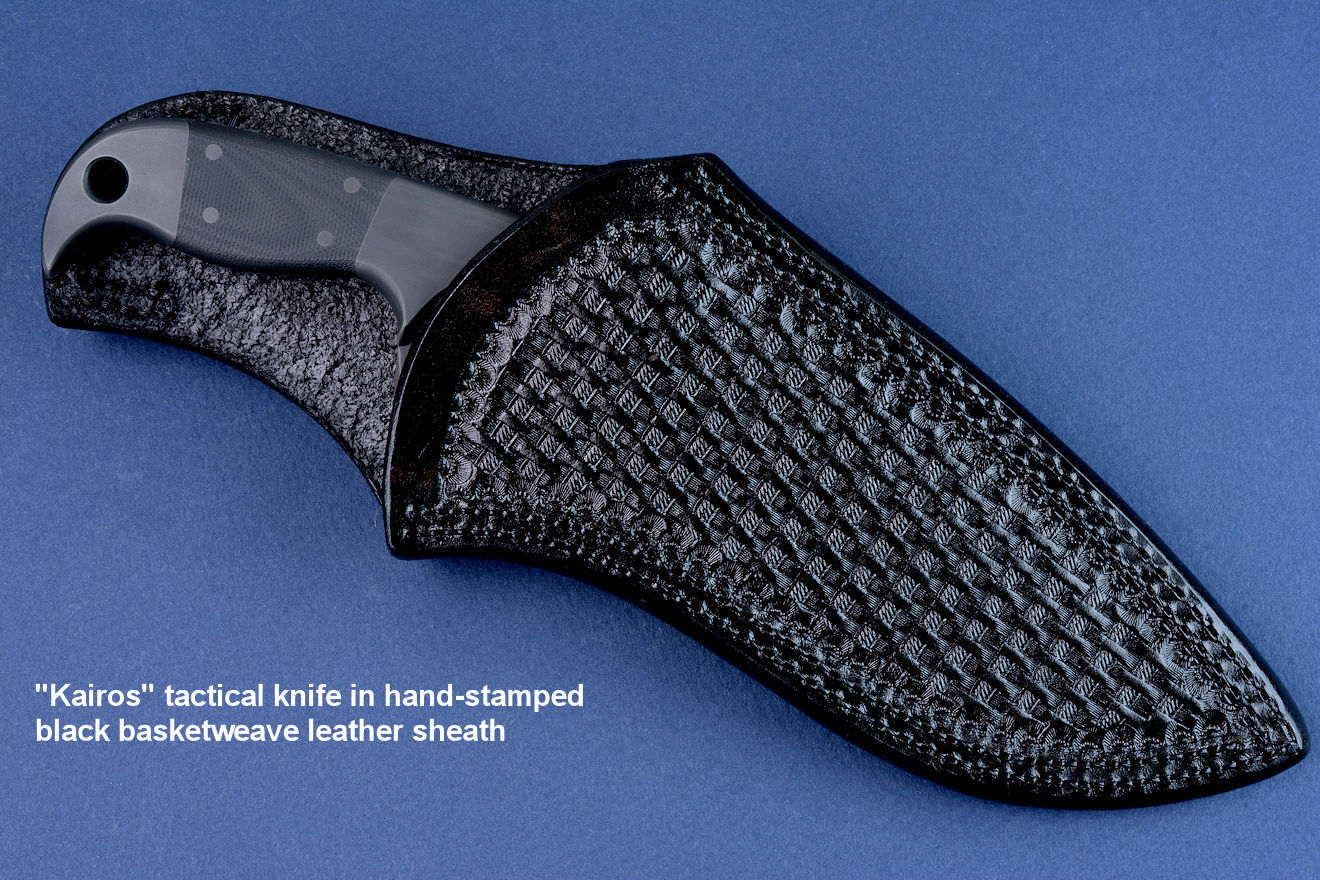
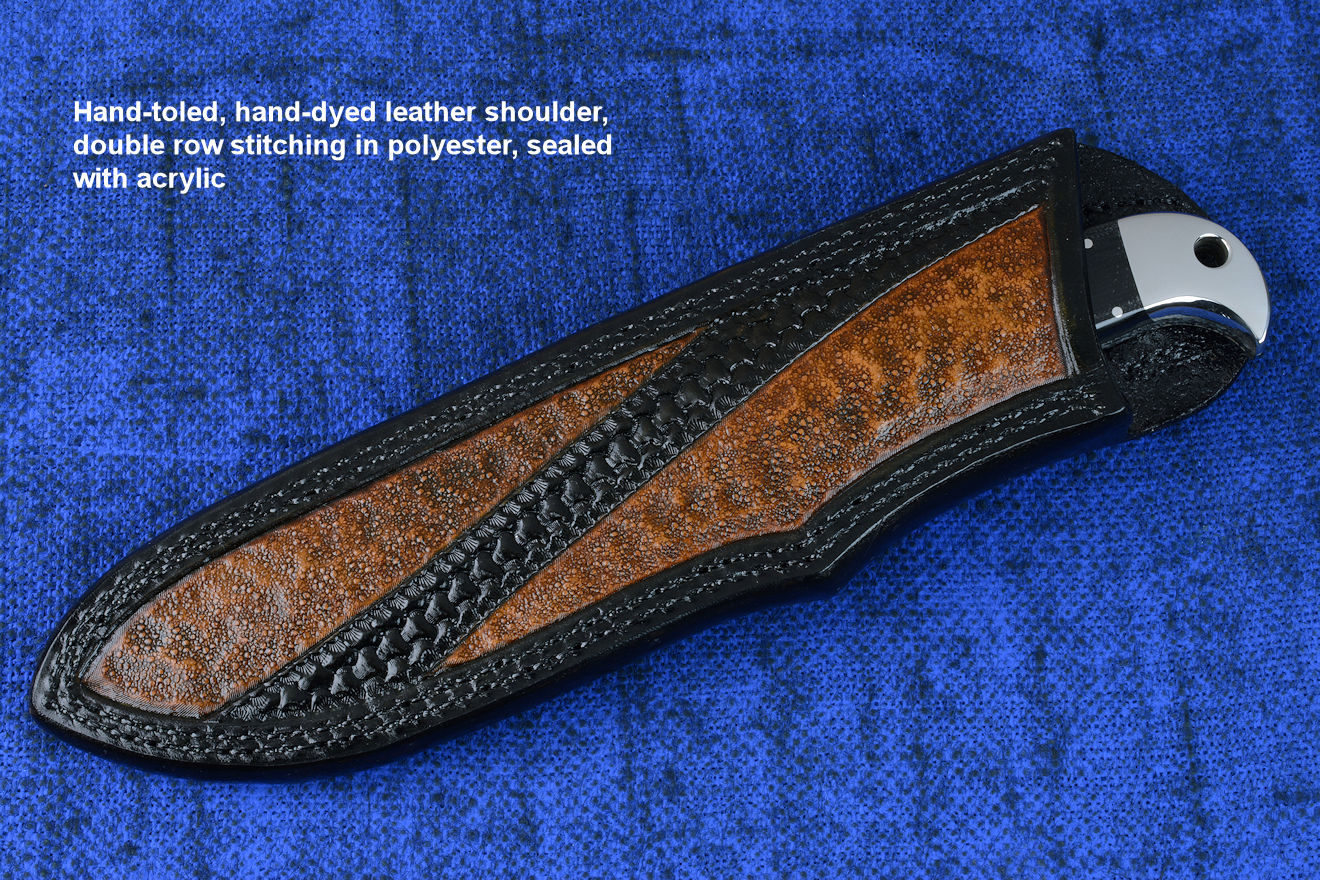
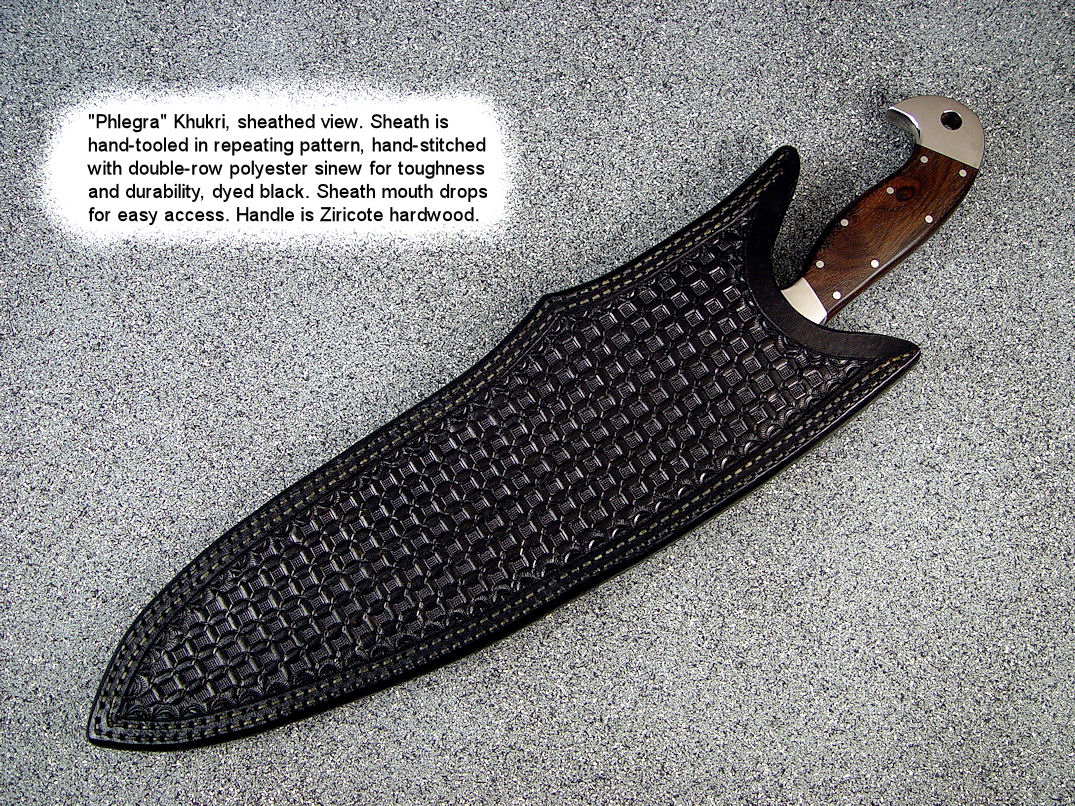
Standard in law enforcement, the black basketweave sheath is typically seen with most gear. Many departments require this finish and appearance, and it's so commonplace on law enforcement gear that many people think it's actually supplied by the department! The reasons that it is so popular and commonplace are:
From this, it's pretty clear to see why black basketweave is the most uniformly popular finish for leather in many fields: law enforcement, Principle Security Details, undercover work, counterterrorism, military, and tactical units.
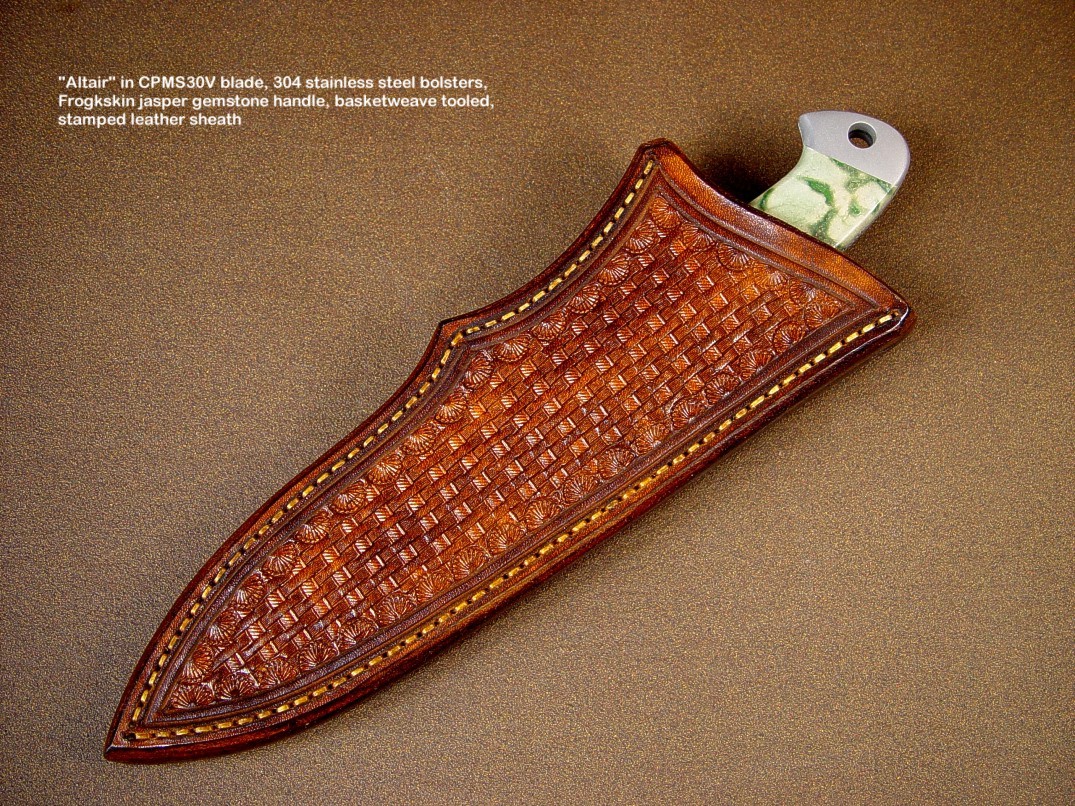
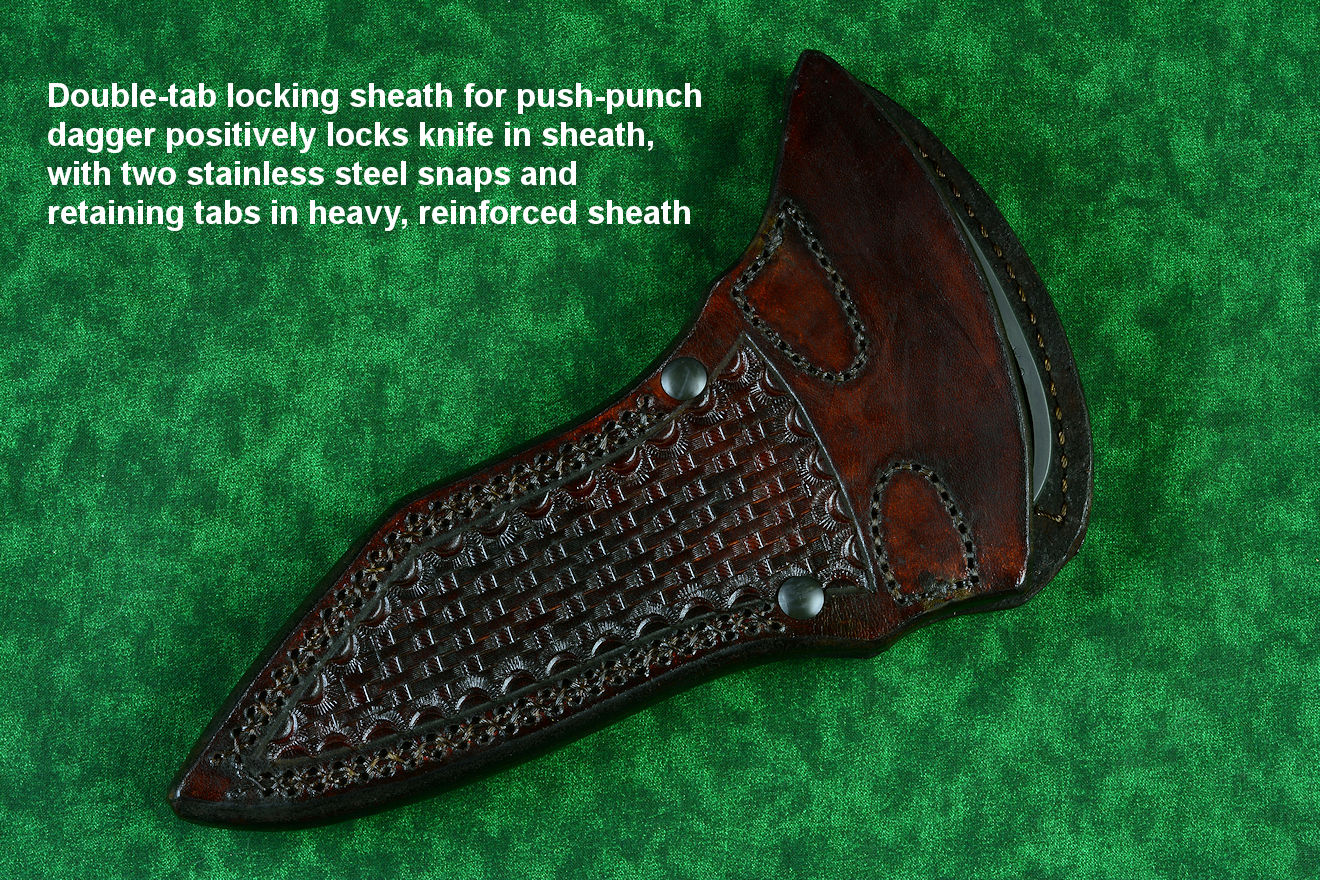
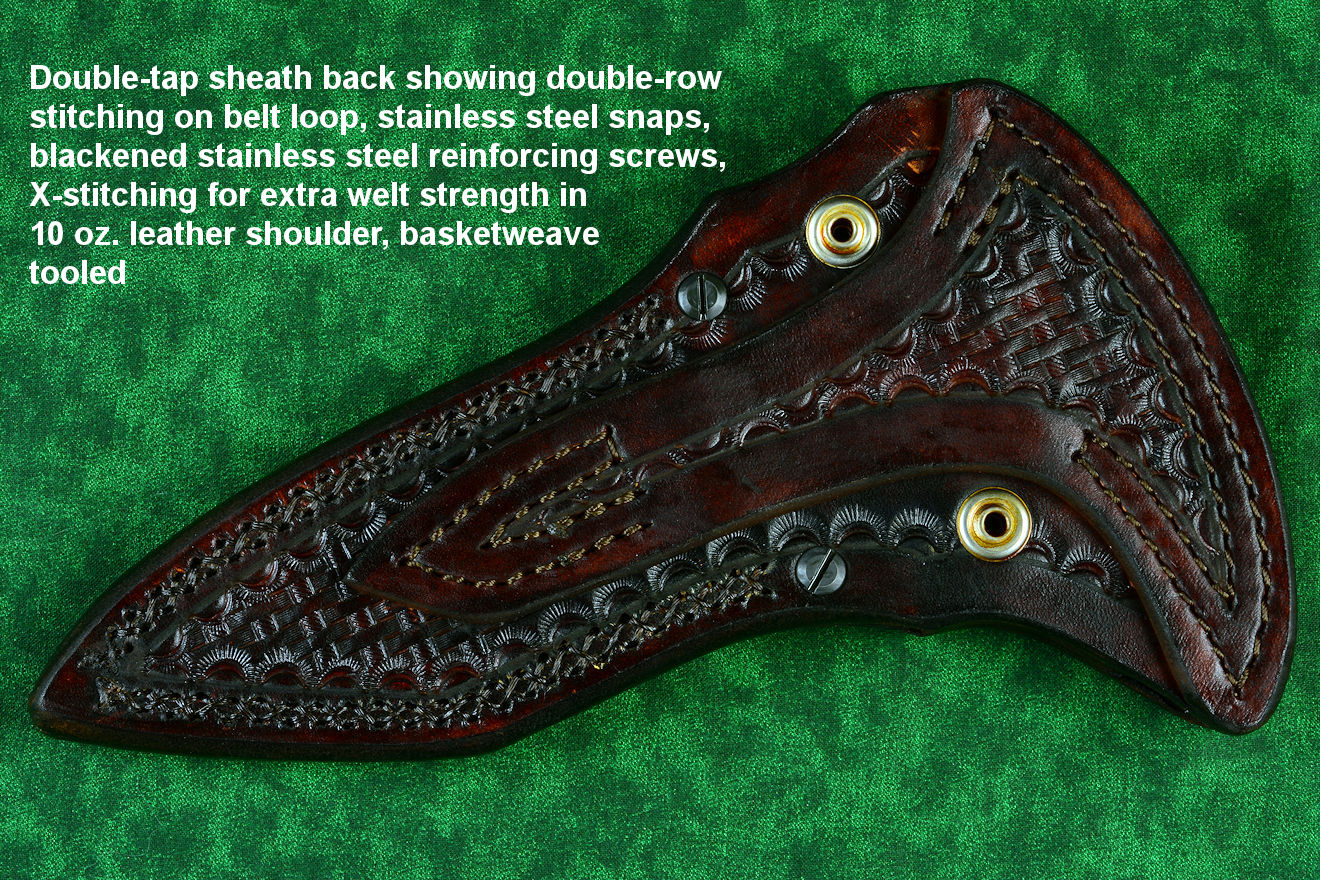
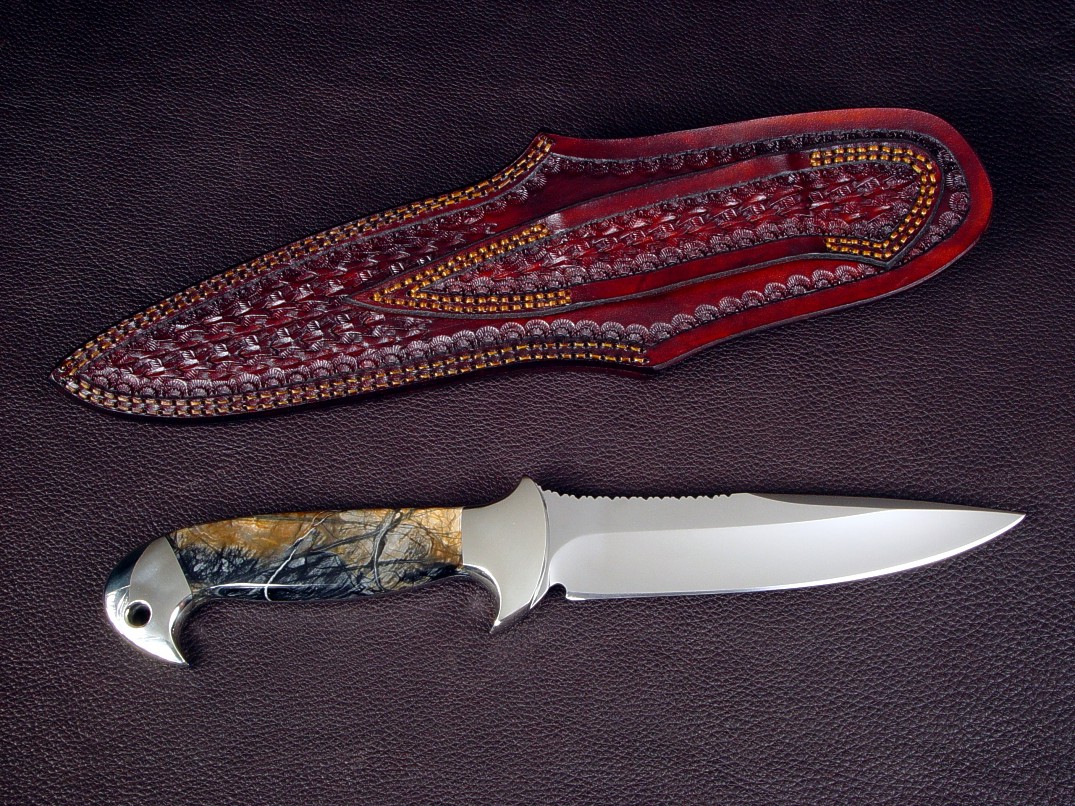
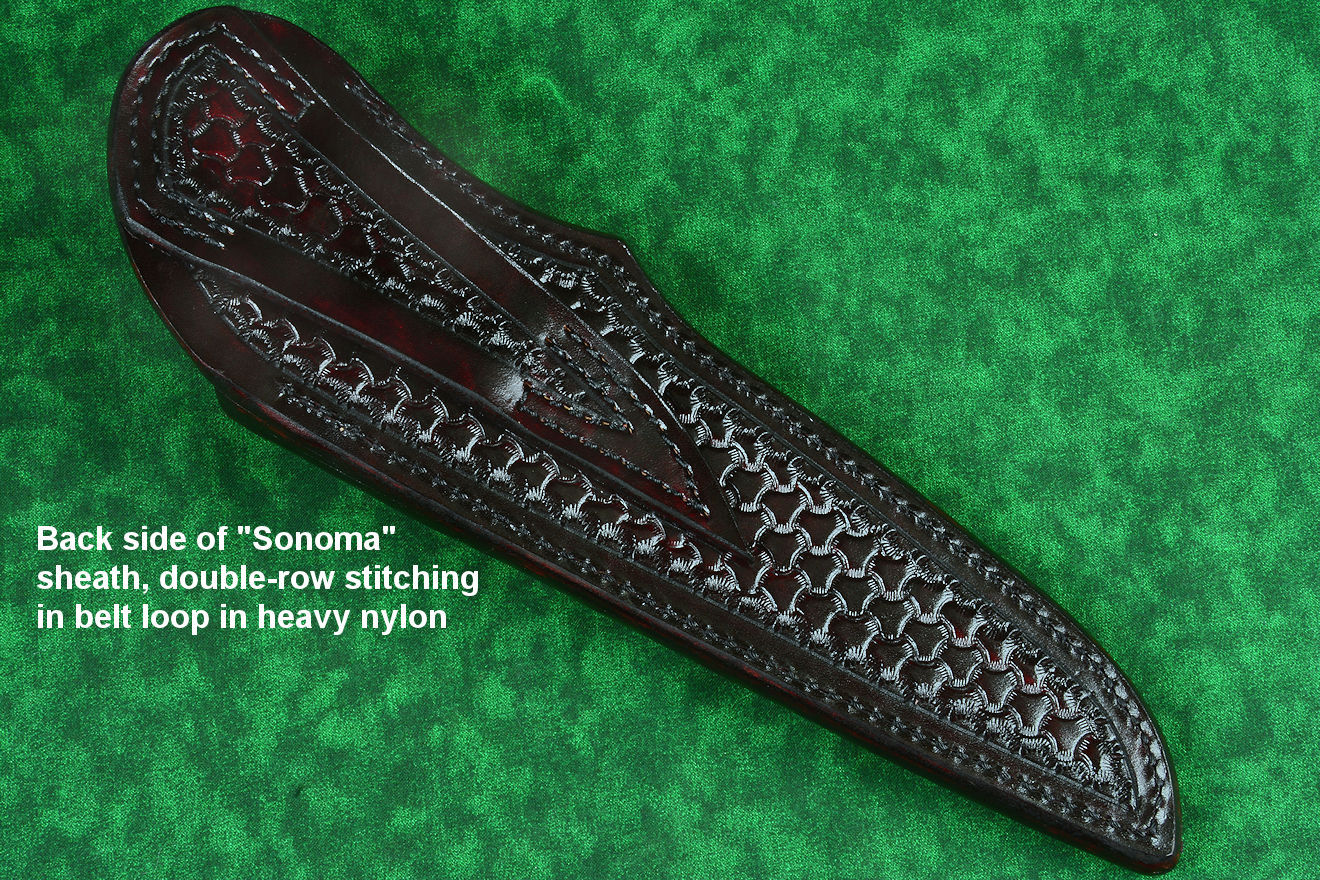
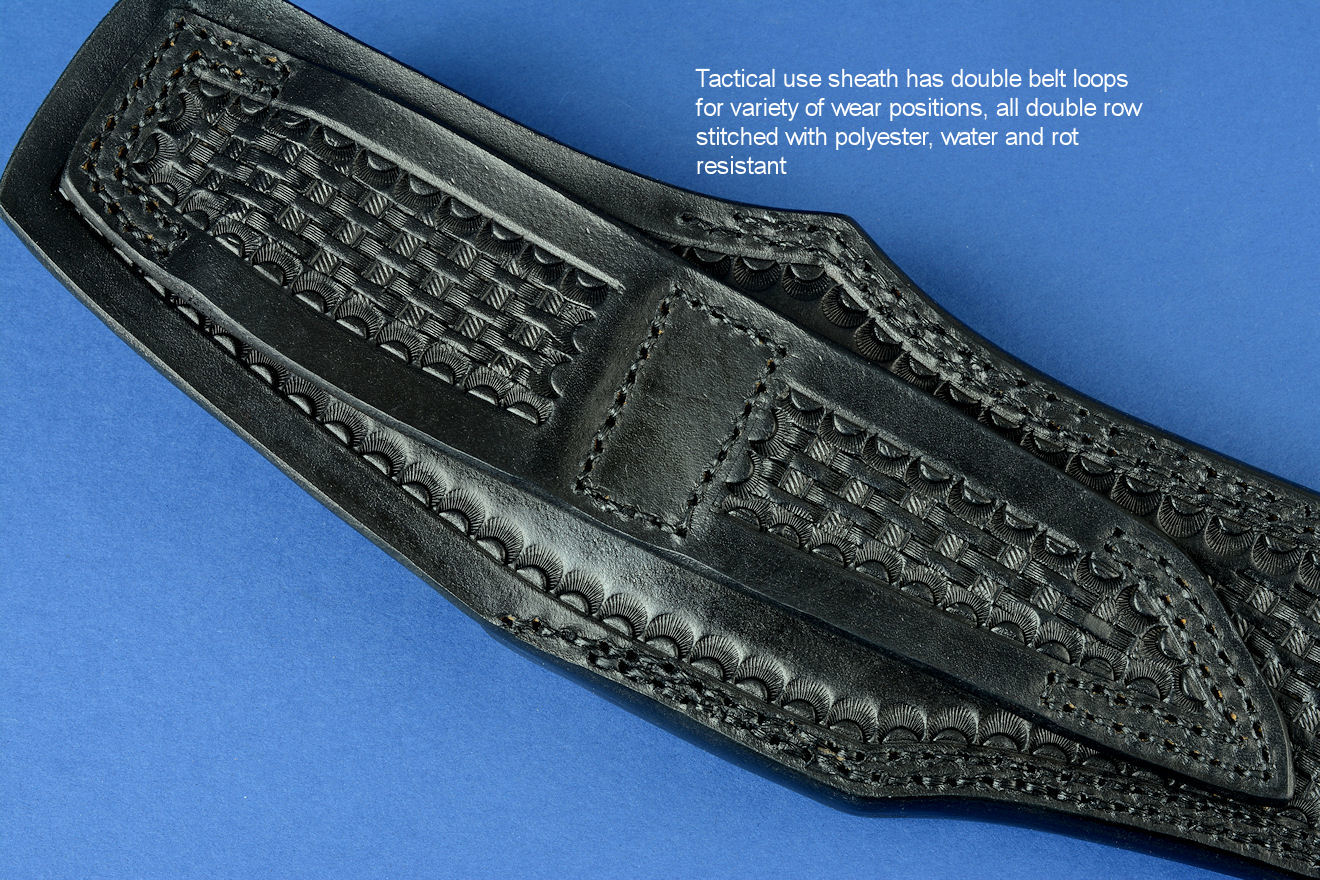
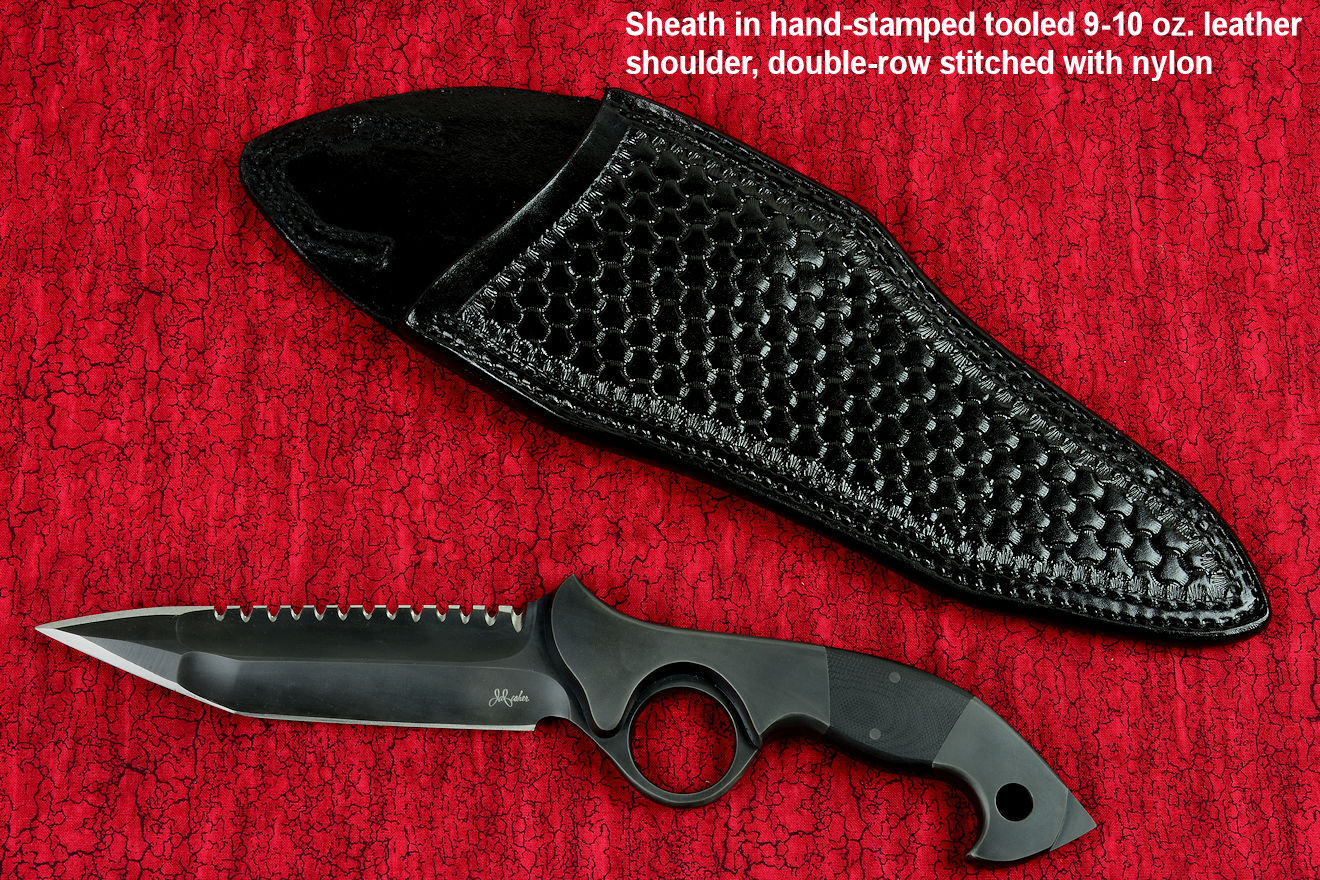
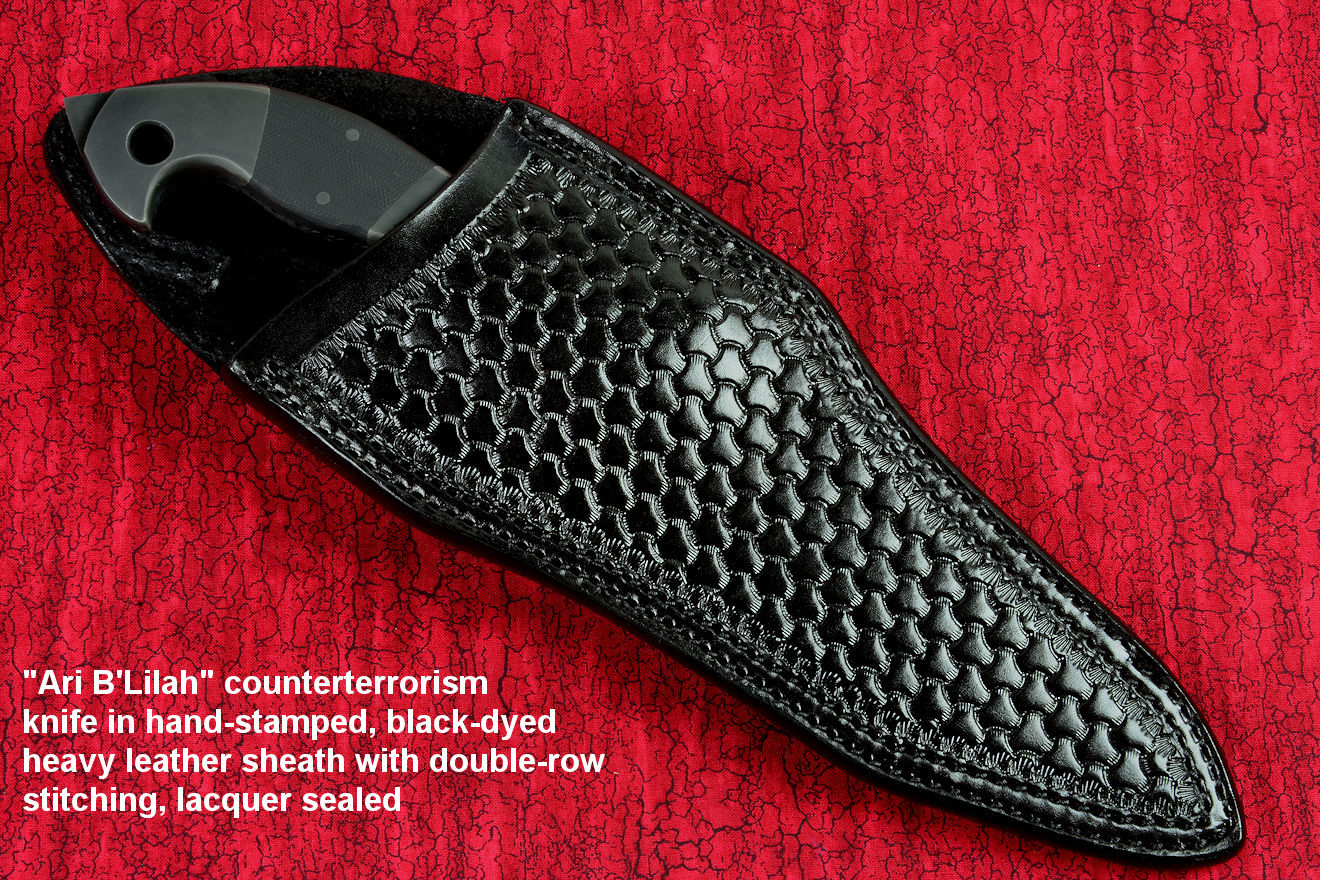
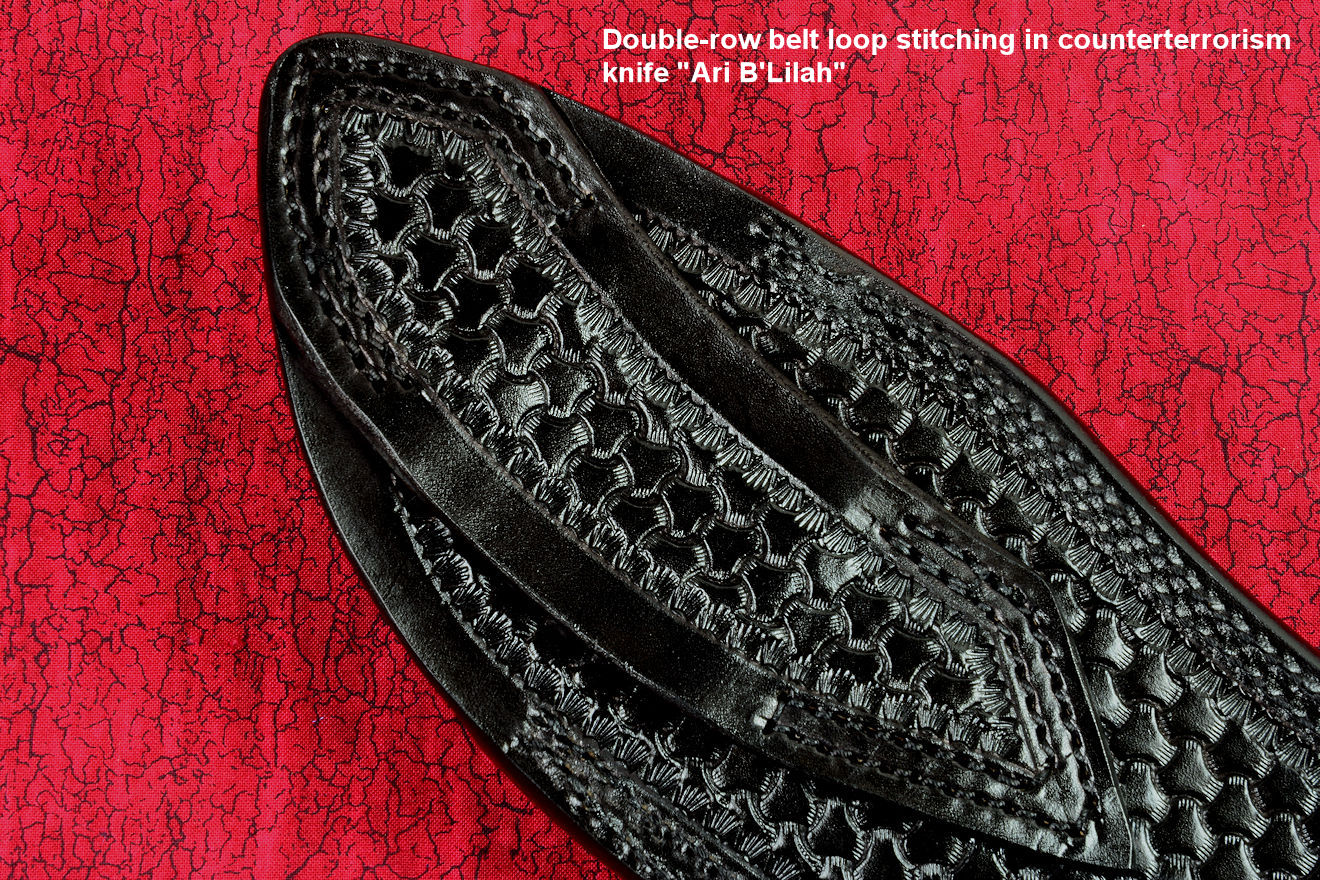
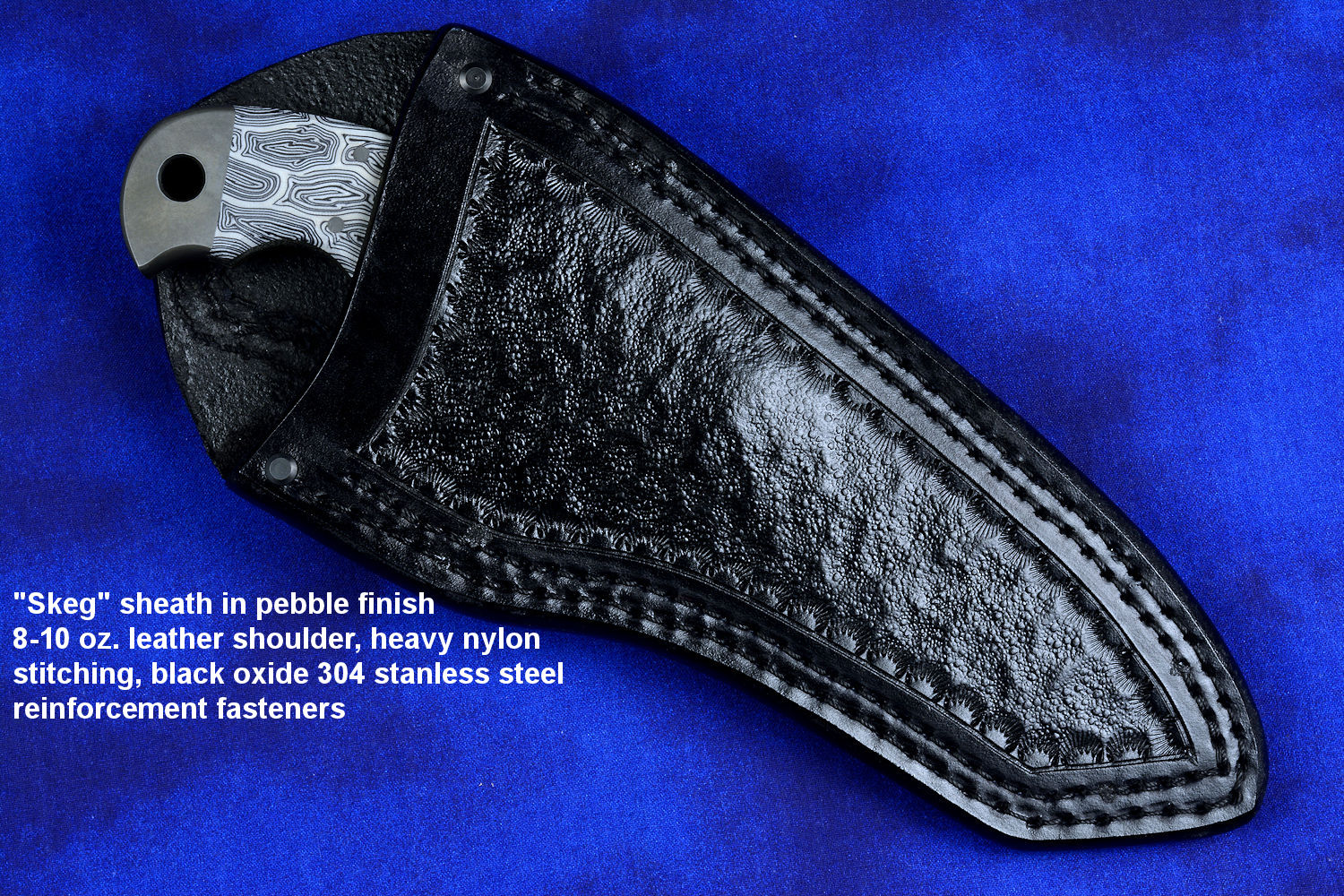
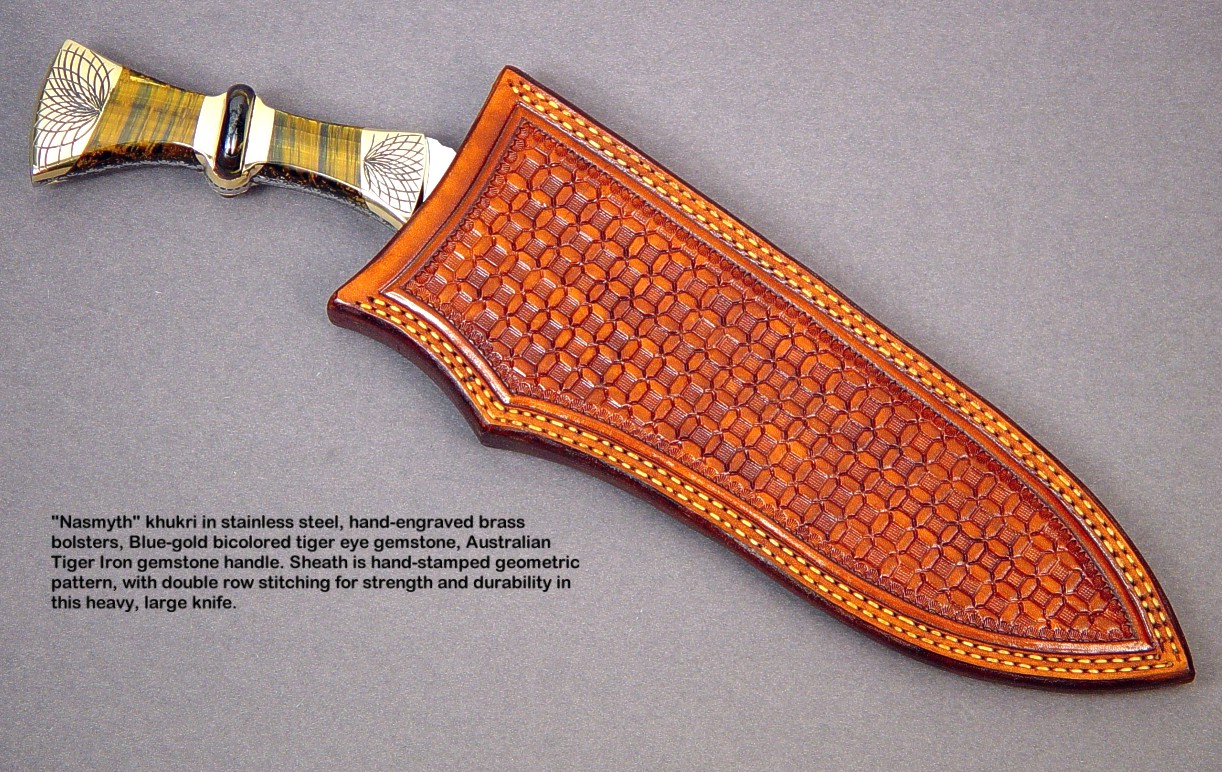
One thing rarely mentioned is that black basketweave finished leather doesn't always have to be a standard, straight basketweave pattern. All of these patterns are applied to the leather for sheaths by hand-stamp tooling. This means that stamps are held against the cased (properly dampened) leather, and then the impression is set into the leather when a rawhide hammer hits the stamping tool. There many different stamping tools, sizes, shapes, profiles, and patterns possible with these tools, and new stamps are being developed every year. There is no reason to stick to just one, plain, squared-off tool stamp and pattern, and I've never heard of any department carefully checking the stamping pattern to see if it "qualifies." Below, in the following picture set, you'll see a lot of different patterns and borders. There are some that appear clearly as basketweave, and others that are beautiful repeating patterns that are non-traditional and attractive.
The most important thing for a knife client is that the pattern and dying are well-done, neat, regular, accurate, and properly finished. Mismatched stamp alignment and crooked placement and varying depths of stamping and dying are what to look out for. A clean, regular, uniform look is desirable and both the front and back and belt loop should all be completely finished. Dyed surfaces should always be properly sealed not only to protect and preserve the leather, but also to inhibit dyes bleeding into clothing or other gear.
A locking sheath offers superior tactical performance.
A long time ago, a few military clients asked if I could make the ultimate knife sheath, one that was essentially waterproof, unbreakable, resistant to anything you could throw at it, a sheath that could be confidently carried into the field of battle and trusted to do its job. A few of them asked if I could design a locking mechanism, so the knife would positively lock into the sheath and even be carried upside down across their chest while parachuting on HALO jumps. These are High Altitude, Low Opening combat jumps designed to drop combat or rescue troops behind enemy lines without the aircraft being seen by radar as it flies at high altitudes. They also wanted sheaths capable of withstanding marine, oceanic, and even mountain rescue and combat environments.
This was no small order, but I got to work. I designed a sheath that has aluminum welts (to support with strength without adding weight), and double-layered kydex front and back (impervious to nearly all chemicals, water, salt and abrasives), and stainless steel locking mechanism (made of 304, 302, and 316 austenitic stainless machine screws, springs, and lock bars). Including the nickel plated, hot blued, or stainless steel Chicago screws, these sheaths consist of at least 38 individual components, all hand-fitted to the knife. These are very fine sheaths, absolutely the best made on the planet. Of the scores that are out there, in service, in combat, I've only had one problem since the prototype, and that is of one serviceman loosing his knife because he didn't shove the knife all the way in and make sure it was locked! Well, I can't think of everything...
I make three general types of combat grade, military service, combat search and rescue counterterrorism and tactical knife sheaths,
Since these are specialized sheaths, they require their own page, with additional links to seven dedicated pages on their custom accessories. Here's the link:
Hi Jay,
I came home yesterday, the knife was waiting for me since it arrived in Monday.
The knife and the sheath look great! The knife fits perfectly in my hand and the handle is very comfortable.
The blade is sharp and looks very aggressive. The sheath looks strong and very durable. The locking mechanism is awesome!
This is by far the best sheath I have ever had.
Jay, thank you for this great knife, it's definitely a knife that I can depend my life on.
--D. B.
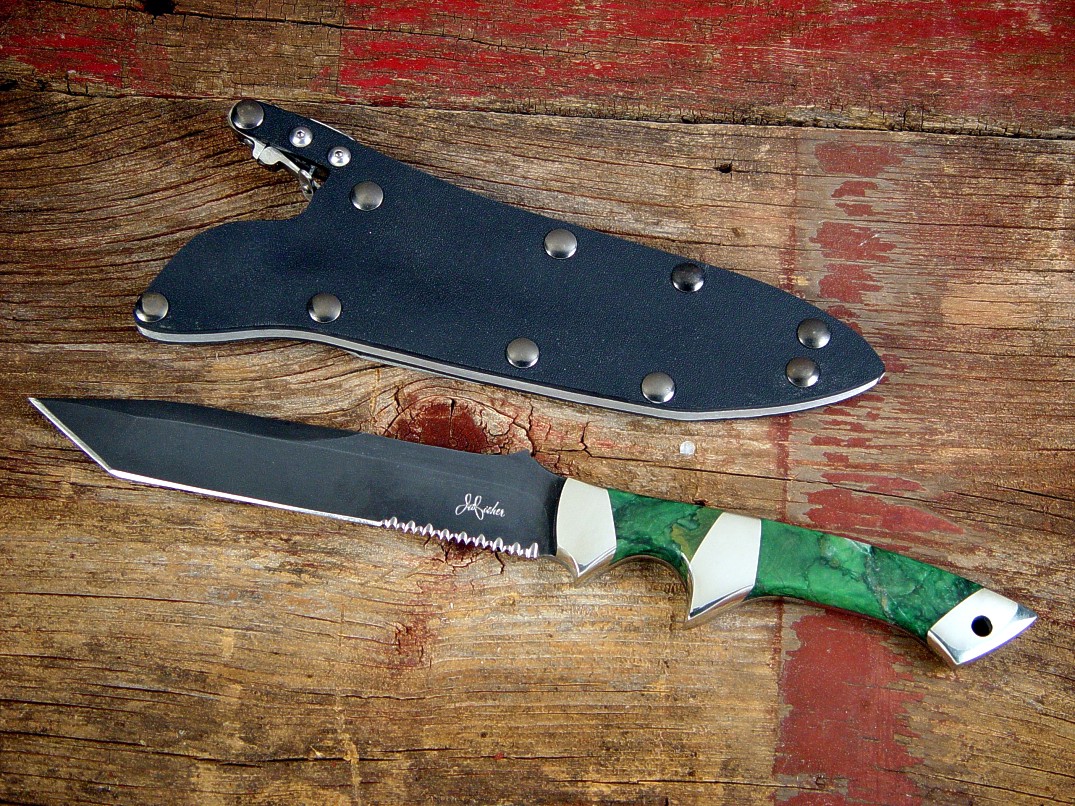
Hey Jay! Just got the knife today. WOW!!!
The pics you sent me did NO justice to the knife at all.
This is BY FAR the nicest knife I have ever owned! I
was also pleasantly surprised by how nice the sheath came
out. For the last few months I have been second
guessing my decision for the locking sheath. Now I am
glad I went in that direction. The pics I have seen of
that sheath do not show how sturdy and well built that thing
really is. I think you may need to show a side profile
of that in one of the pics. That large slab of
aluminum will show people its more than just kydex bolted
together. I think your description says how it is
built – but I didn’t understand till I actually saw it in
person! Anyways, thank you for a GREAT knife! I
will look forward to enjoying it for many years! Also,
I'm already planning my next one. You can be sure that
I will be showing it off to all my friends and letting them
know about you and the quality of your work! (most
already know as I've been talking about these knives for
quite a while – but I think they will be astonished when
they see they experience your work first hand)
Thanks again,
Adam V.
Moisture is everywhere. Don't store it on your knife.
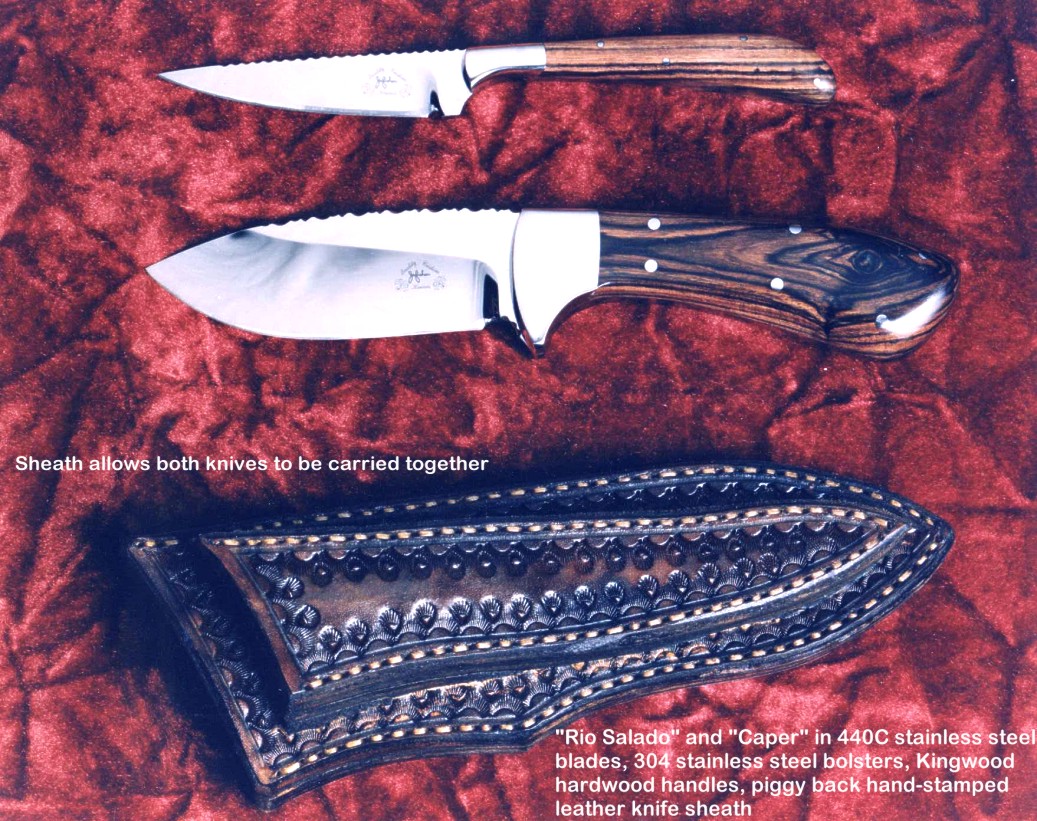
Please, don't store knives in sheaths! Incidentally, what do you think would happen if you stored a blued firearm in its leather holster for years, and never looked at it? Sure, you want to keep it with the sheath, and carry it in the sheath, but long term storage in the knife sheath is probably the most destructive thing you can do to your fine custom knife.
Please remember that heat treated martensitic stainless tool steels can corrode. These are not inexpensive low carbon stainless steels that factories often sell and tout as completely rust free; these are fine, high carbon martensitic stainless tool steels, and as such, are more resistant to corrosion than non-stainless, but can still corrode. I have posted this on my care sheet that I hand out with every knife (and has been available on this website since the beginning in standard and military form).
It makes no difference whether the sheath is leather or kydex and aluminum, whether the air is as humid as Florida or as dry as Nevada. The knife blade needs to breathe and stay dry. When humidity and temperature changes in the normal course of the day or the season, condensation can form on any steel. If the steel is allowed access to free air, it can stay relatively dry, and corrosion can not gain a foothold. But if the knife is stored in the sheath, and an ever-so-slight bit of moisture is allowed to stay against the blade, the blade will start to rust.
On a mirror polished blade, this can be ruinous, and if the knife has been custom etched, the only recourse is to grind off all the etching and corrosion, regrind and refinish the blade (including polish) and re-etch, which is very expensive and time consuming and may not even be possible. Even if the knife is coated heavily with wax, long-term storage in the sheath can encourage corrosion.
Please don't store the knife in the sheath!
I believe a knife should be handled. Held once in a while, waxed and buffed, fondled, looked over, admired and cherished, and yes, even used. To put it away in a drawer or closet is almost an insult. Look, if you want to store the knife long term without ever looking at it, there are a couple options:
Humor aside, it's simple; store your knife where it can breathe, not in the sheath, not where there are fluctuations of temperature or humidity, out of bright sunlight and high heat sources, and pick it up and fondle it, buff it off with a soft cloth, wax it now and then.
An uncared for arm is a useless arm.
Care of the custom knife sheath is similar to care of the knife.
Keeping the knife sheath reasonably dry and clean is common sense. Leather does not react well to flooding rains, salt spray, chemical exposures, dirt, mud, and debris. Though in heavy use working knives some of these exposures may not be easily avoided, it could mean the destruction of the leather knife sheath. Leather is organic, absorptive, porous, and sensitive to a variety of exposures. Though I (like most makers) do my best to construct a sheath that is sealed to resist penetration of moisture and contaminants, there is simply no way to make the leather impermeable. I use lacquers and sealants, either water or xylene, alcohol, or ester-based, but they are only coatings that soak into and preserve the surface of the leather. Please keep leather sheaths out of extreme environmental exposures.
Storing the knife long term in the sheath is a bad idea , and can damage the sheath as well as the knife (see the previous topic). Some metallic components of the knife can react with the leather, and possibly (in the presence of moisture) stain the leather, perhaps permanently. This is another reason that most of my knives are currently made with 304 austenitic stainless steel fittings, to limit all types of corrosion. Woods and other organics: brass, nickel silver, horn, bone, ivories and plastics all can have reactions with leather when the knife is stored long term in the sheath. Some loosening of the leather knife sheath may also occur when the knife is stored in it for a long time. Don't, ever, store the knife in plastic; the knife and sheath need to breath. That's why my heavy cotton denim drawstring bag is a great idea, it's dry and breathable. Still, the surrounding environment needs to be dry and not damp.
Cleaning the knife sheath should be done sparingly. Dampen a soft cotton cloth with plain water to remove tough dirt and soil, lightly rub a small area to soften debris and remove. Avoid soaking the leather, as this can cause permanent damage. Make sure that the knife sheath is dry before using, inside and out. Don't use forced air or any heating method to dry the sheath, this can over-dry the leather. I've seen sheaths become brittle and crack from over-drying. If the sheath is lacquer-coated, as most of mine are, the soil should be easy to remove. Don't use leather cleaners or chemicals, this will affect adhesive bonds, dyes, and sealants.
Waxing the shiny areas of the sheath can restore luster and offer increased protection to the knife sheath. I recommend only waxing the shiny areas because some of my sheaths have inlays of other skins and some of these skins are rough, soft, or have a surface texture that can be ruined if waxed. Hides like hippopotamus skin which has a soft, suede-like feel to it is an example. Shark skins I use are also left rough and unsealed. If, however, the inlay surface is smooth and glossy, like caiman, lizard, alligator, or ostrich, it too can be lightly waxed to bring up the luster and shine. Avoid over waxing, as wax filling cracks and seams is not necessary and can create white wax lines on the sheath surfaces. Typically, on most of my sheaths, the cow hide leather surface and body of the sheath can be waxed to improve appearance and increase longevity.
Storing the sheath out of high heat and light is important. Years ago, when I left knives on consignment, I might have the knife returned to discover that the leather sheath had been left in bright sunlight and had the color and luster bleached right out of it. The back of the sheath was rich and dark, but the front looked like the chalky skin of a senior citizen in Tucson. Just like the knife, it does no good to store the sheath in baking high heat or light, which can embrittle and prematurely age the leather.
Storing the knife sheath in contact with plastics or vinyl can damage the sheath. Plastics and vinyl may have chemicals in them that continuously bleed out and outgas over time, and when in contact with sheaths, they can create a contact stain on the leather. An example is the stuff that is used to line kitchen drawers and cabinet shelves. This puffy, soft material sounds like a great way to store knives and sheaths in a drawer, but it can and will react with the leather, inlays, and even the knife blade over time! I've even seen acrylic-coated aluminum stained with this stuff. I recommend that the knife and sheath be stored laying atop cloth, preferably a neutral cotton if stored in one position for a long time. Laying the knife on top of my heavy cotton canvas drawstring bag is a good option.

The most used knives reside in the kitchen.
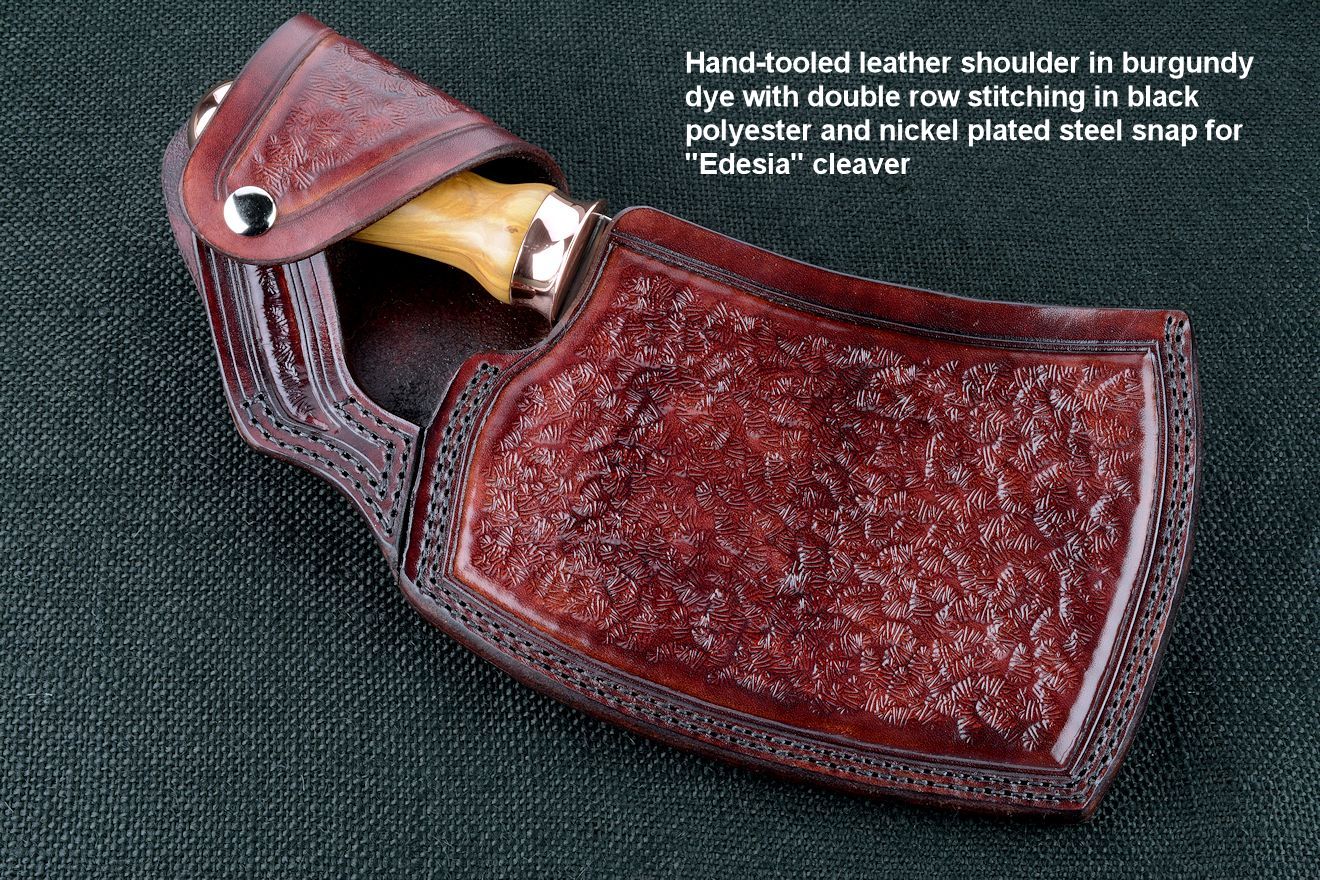
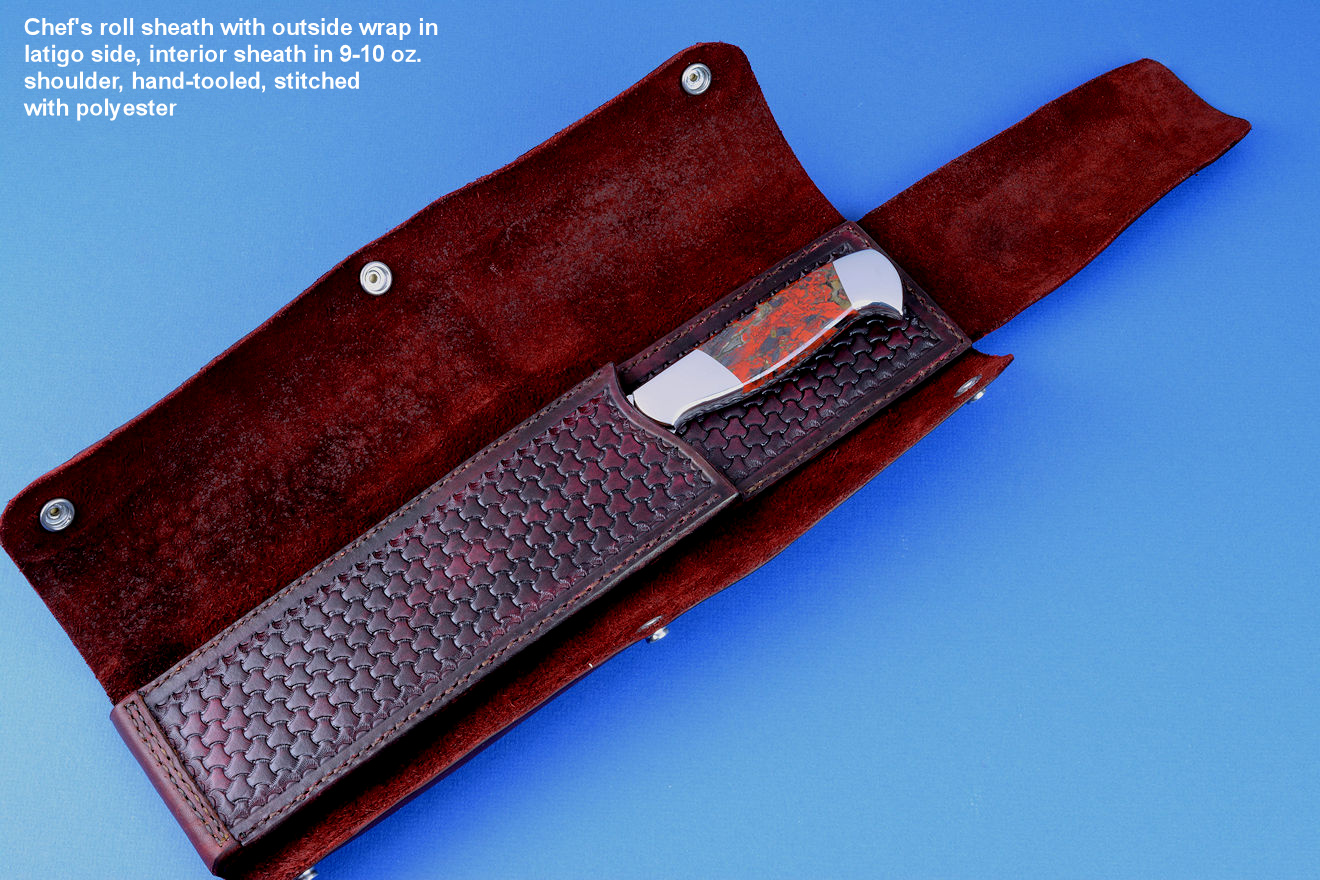
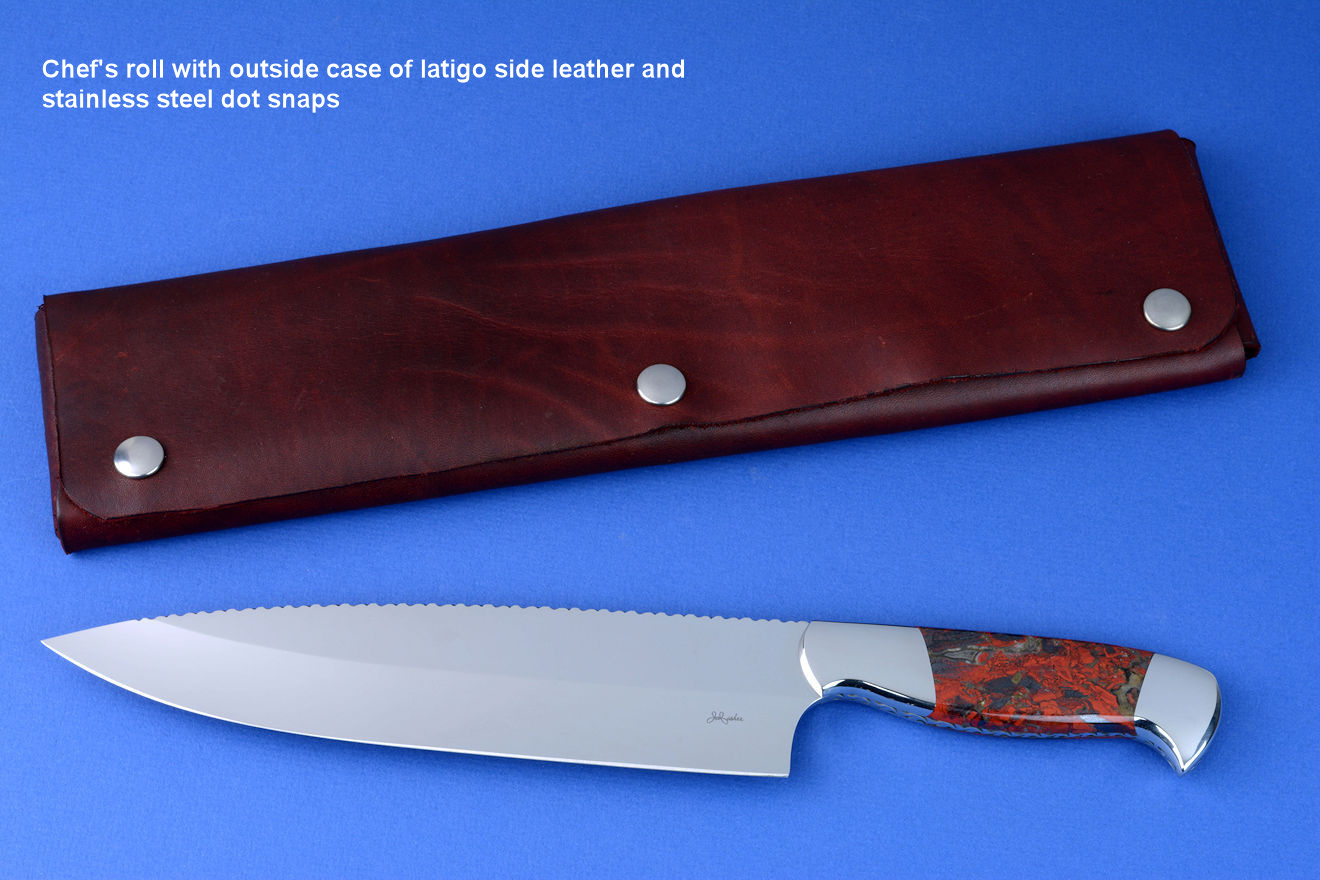
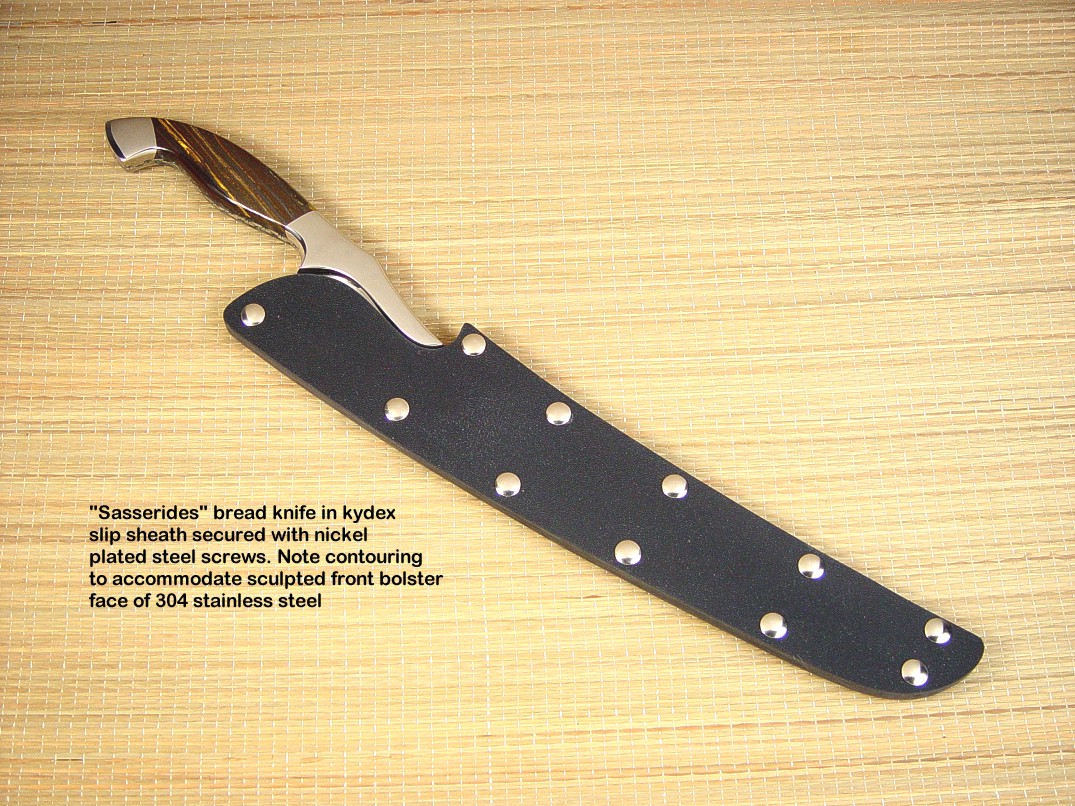
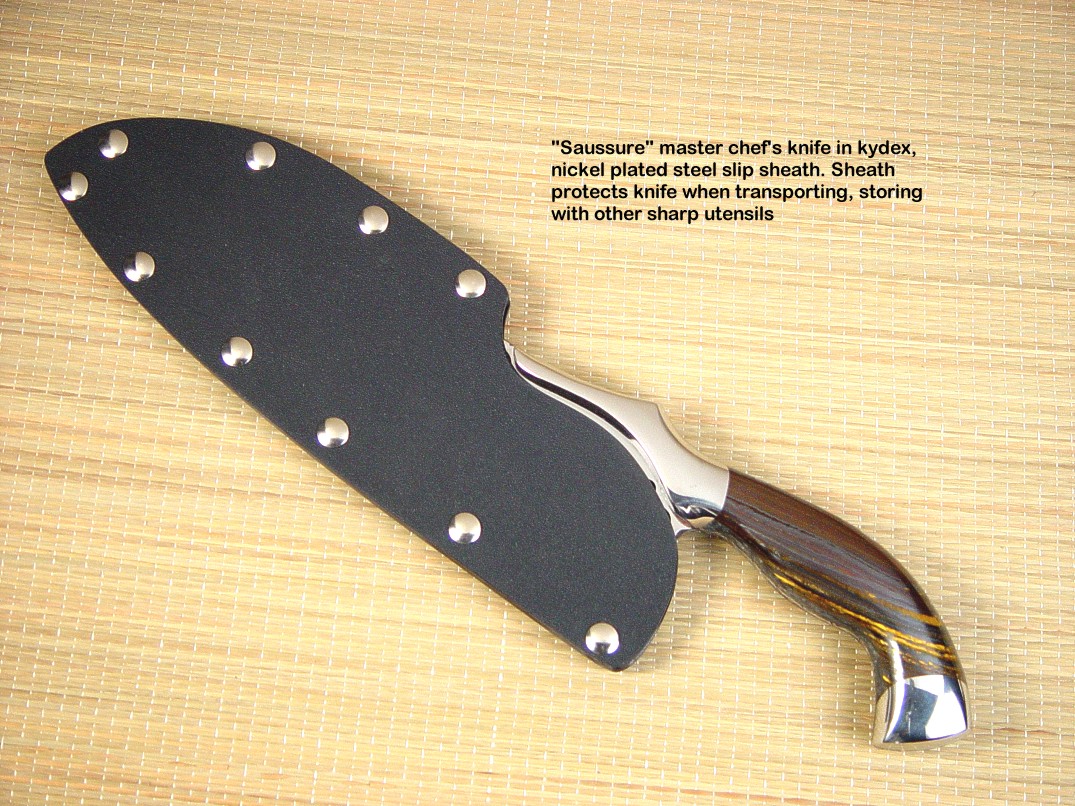
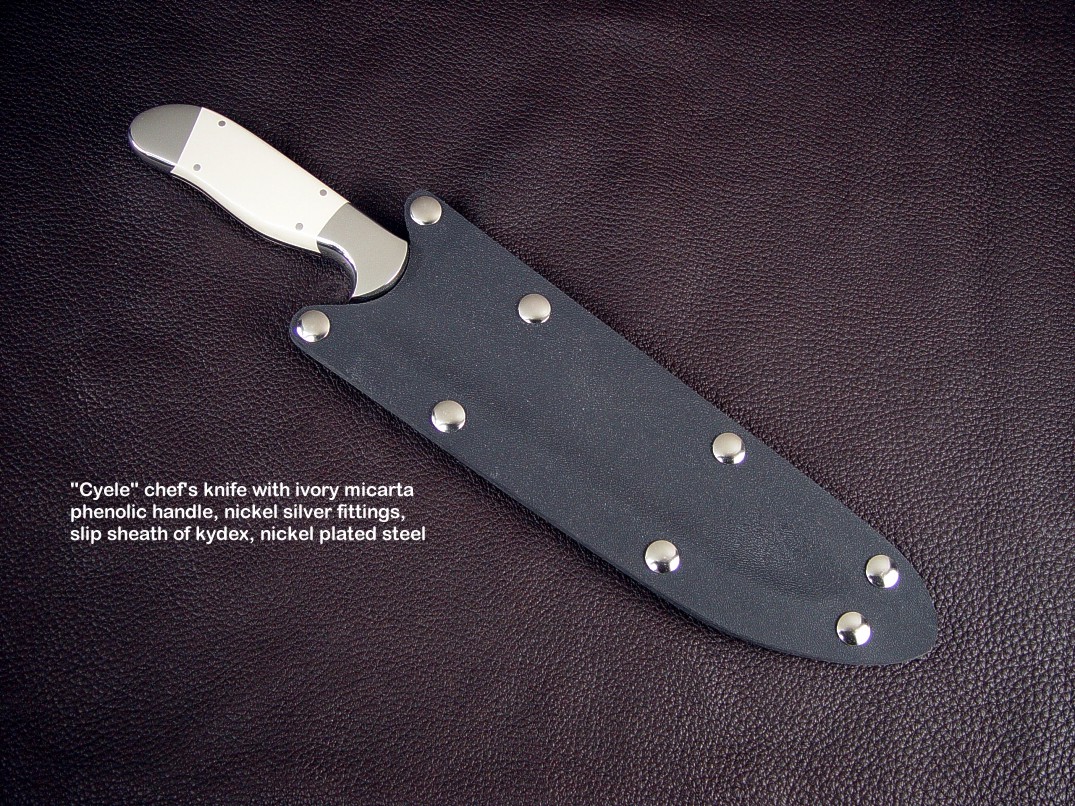
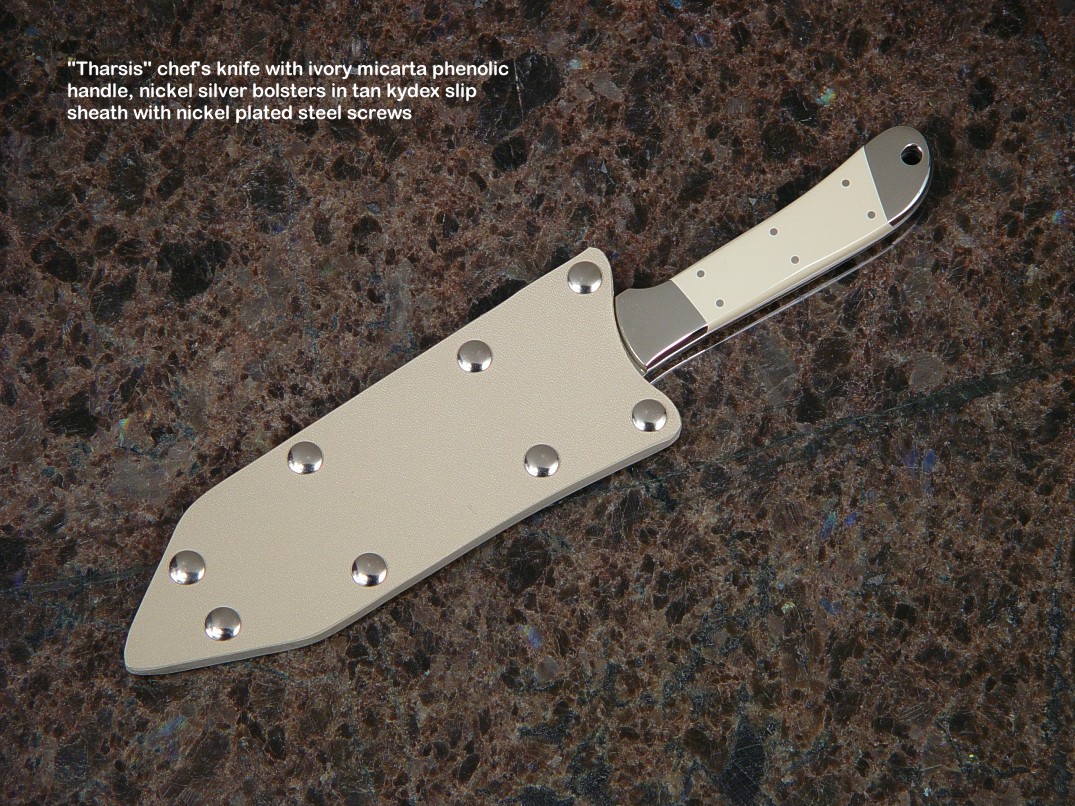
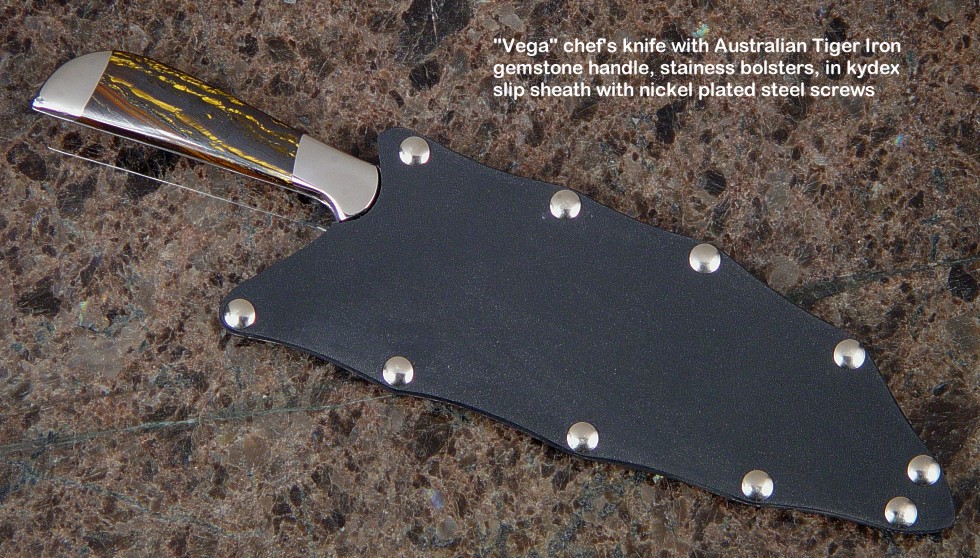
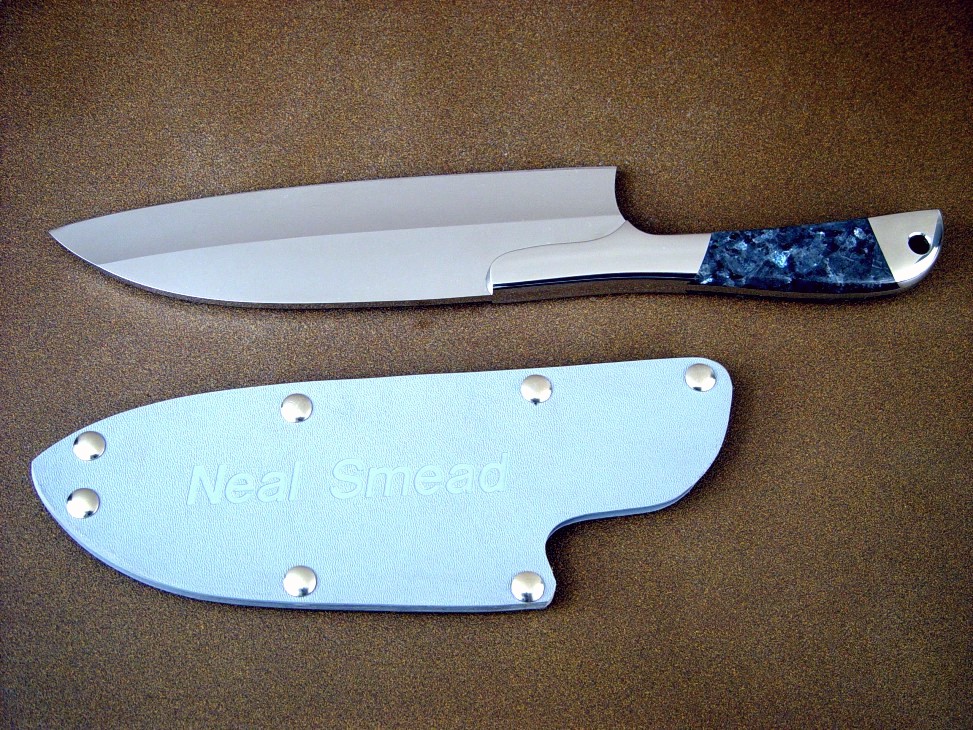
Though leather may be used for carrying, transporting, and protecting kitchen, food service, and chef's knives, I also make a special slip sheath for my chef's, kitchen, and food service knives. A sheath is needed and used on this type of knife if it does not reside in a block, stand, or have another storage option. Singular chef's knives may be carried in travels or stored in drawers, and are subject to damage from other knives and utensils. The slip sheath protects the blade, cutting edge, and chef as well as other nearby utensils and tools. Unlike leather, if the sheath and knife are dry, the knife may be stored long term in this type of sheath. Please remember though, they must both be dry! If either is damp when the knife is sheathed, corrosion will start if left damp for long periods.
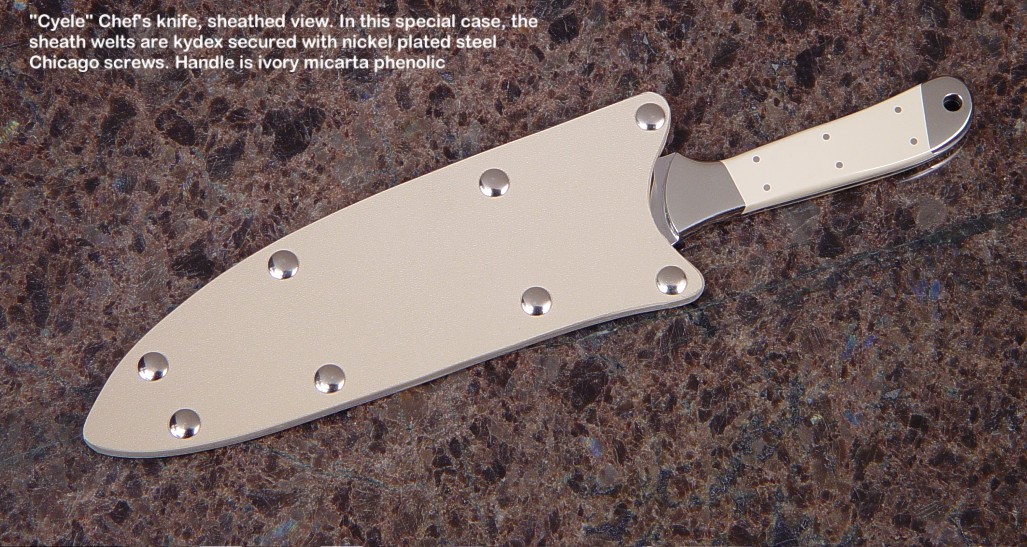
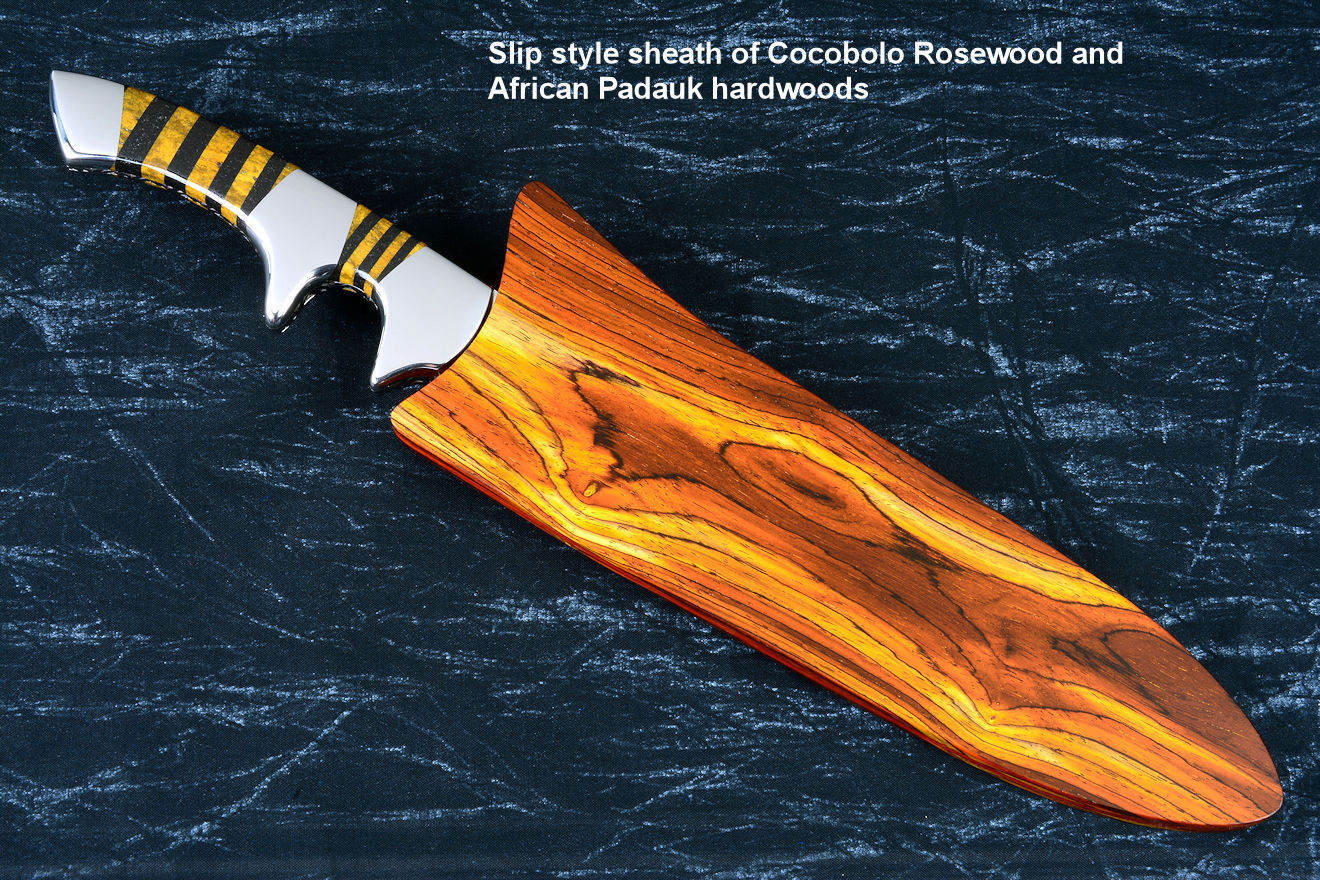
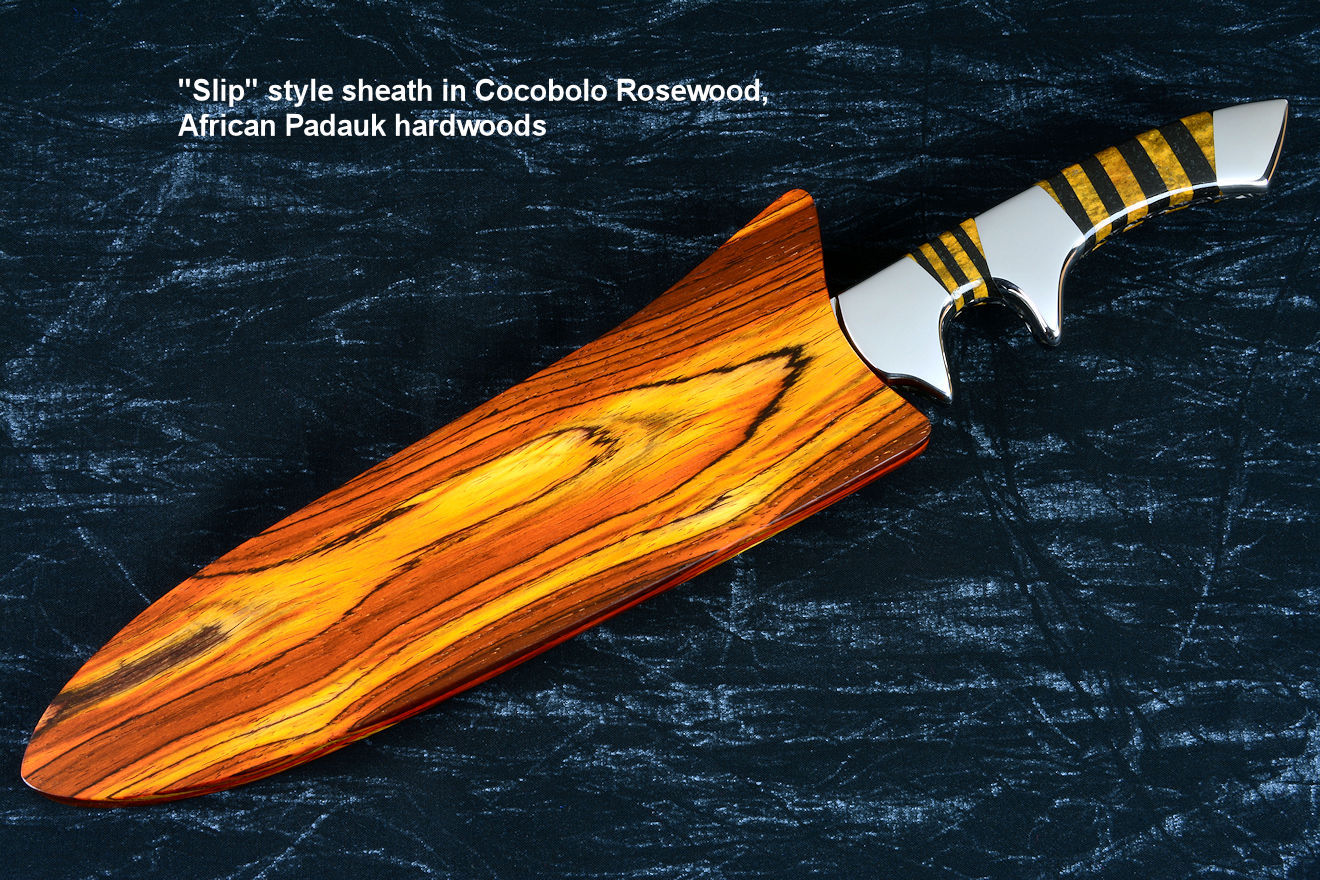
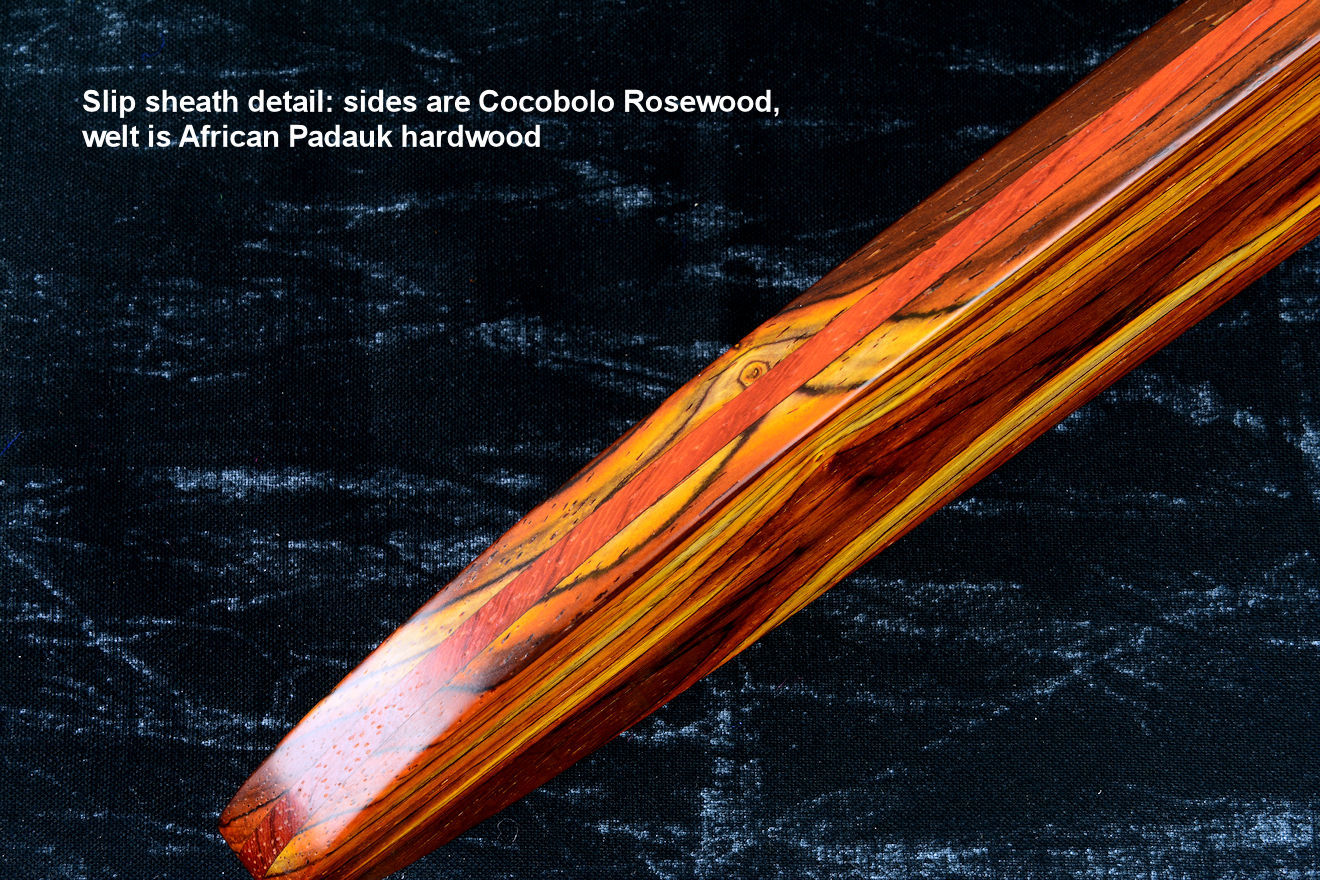
My slip sheaths are usually constructed of kydex, and lightweight since the knives and sheaths are not expected to see any harsh environmental exposures. They are typically made without any belt loops, clips, or other hardware. They may be constructed with nickel plated steel Chicago screws, or even stainless steel Chicago screws through either a single or double layer of kydex with all kydex sheath welts joined with waterproof cements. The welts are kydex because aluminum is not needed on this type of sheath and the razor keen edges of these knives can be well-preserved. I call this type of sheath a slip sheath because the knife simply slips in, and is not usually secured in place with tension or any other mechanical methods.
Cleaning and maintenance of this type of sheath is simple and straightforward. The sheath can be washed in warm soapy water, rinsed in clear water and drained to completely dry. Very little else is needed, and here is an excerpt from an inquiry about cleaning my kydex sheaths, particularly for the food service industry:
There is a difference between cleaning in warm soapy water by hand and power dishwashing. Kydex is a thermoforming plastic, that is, as it warms up it gets soft and starts to get flexible. That is how the kydex is formed around the knife, creating a custom fit, which is adjustable somewhat by spot heating and reforming if the knife happens to loosen in the sheath. Usually, in a sheath that does not have a locking mechanism, the area that is held or clamped by the kydex is the bolster area, which is very similar to the way leather holds a knife in most sheaths, by squeezing around the bolster. Now, what effect heating to above 200° F might have is to soften the kydex, and then it will either try to return to its manufactured form (flat) or swell and cause wrinkles where the screws are holding it against the welts. So this would be a problem, and I don't recommend power dishwashing, ever. If you're washing by hand, and the water temp is below 150° F, and you didn't let the sheath soak for more than a minute or two, I can't see why that wouldn't be all right. Most military users rinse the sheath by dipping in a rinse tank along with other gear to wash, and let drain and air dry, or blowing it out with light pressure compressed air.
Beyond that, and much more important, is the adhesive bond. The whole sheath is secured together by two means, mechanical and adhesive. The mechanical strength is derived from either Chicago screws or rivets through two layers of kydex and sometimes through the aluminum or kydex welts. The adhesive strength is derived from waterproof industrial grade contact cement, which cements together both layers on both sides of the sheath (that's four layers) and bonds the kydex to the welts, and sometimes secures 2-3 aluminum or kydex welt layers to each other. This will NOT take repeated high temperature cleaners and washings. Sorry, it will eventually degrade.
Along those lines, I hope you weren't considering dishwashing the knife also, because this will eventually degrade and ruin the epoxy and bonding of the gemstone, wood, or even plastic to the handle. To sum, I recommend only hand washing, without prolonged soaking, in mild soapy water (no bleaches or harsh chemicals), rinsing in clear water, and hand drying. See the knife care page and the military knife care pages for more information.
A knife maker's name is everything.
I get asked quite a bit about making knife sheaths for knives other than my own. In fact, this is one of the most often asked questions I get (read more on my "What I do and don't do" page) There are a lot of knives out there, and a lot of them need good sheaths. Whether for collection, hunting, professional, service, or military combat use, all knives need some type of reliable, worthwhile storage and carry medium. The volume of interest in this area demonstrates the universal and continual need for good knife sheaths.
I don't make sheaths for knives other than my own. If I started this, I'm certain that I'd be swamped with work and could live out my career never making another knife, only sheaths! This is not what I do, however, so I only make sheaths that accompany and are part my own knives.
You might wonder why most makers, factories, or knife companies don't offer a worthwhile sheath to accompany the knife. Frankly, I don't know why, but you might ask them; after all, it's part of this tradecraft. It certainly is a need, and any makers of the modern knife should be able to provide a suitable, commensurate and even superior sheath considering today's knowledge, manufacturing methods, and technology.
Here is an excerpt from an email I received from a man who took issue with my refusal to make sheaths for other's knives:
Subject: saw your site and...
I was just wondering why you don't do sheaths for
blades you don't make. Here's my situation...and
no i don't expect you to change your mind but hear
me out. I just purchased two daggers and need someone to
create a sheath that will hold both of them at
opposite ends. It needs to be able to be fastened
to a belt and carried horizontally. I'm a graphic artist
and; want to design my own sheath but lack the
leatherworking skills to accomplish this on my
own. It would probably entail engraving and
whatnot......obviously way too advanced for a novice. So
i came across your site while searching for (to be
honest) tutorials and was blown away by the stuff
you've done......and then disappointed when reading
you don't do custom sheaths only. So my question is: why
don't you do them for other blades....it could be
quite profitable I'm sure....and I'm sure you have a
good reason not to....I'm just curious. -C.
My response:
Dear C.-
I’m sorry, I don’t make sheaths for knives other than
my own. When I custom make a knife from scratch,
adjustments and tuning of the knife and sheath go
together. There is also an issue of putting my name on
work that goes with other makers. I have to be careful,
most of my clients expect exclusivity, and this
increases the value of their investments. If I just
cranked out any work for any project, my name would be
cheapened and that wouldn't be fair to my longstanding
clients.
Your question about profitability is valid, but I'm not in this business to purely make profit. As an artist, my goal is to increase my skill level and make the best knife/sheath/stand combination I can. And frankly, I do not need extra work, as I'm swamped with orders.
As a graphic artist, I'm sure you are aware of commensurate matching components in a knife-sheath pair. When a different mind creates these components, a different artistic idea is employed, and the assembly becomes segmented and sometimes confusing.
C., there are many leatherworkers who can make you a
serviceable sheath arrangement for your pieces. You can
find most of them on the knife forums here on the
internet, and some of them are quite good. You might also go to
the supplier of your daggers and ask why they don't make the
sheath(s) you need for your purchase.
Good luck,
Jay