Jay Fisher - Fine Custom Knives
New to the website? Start Here
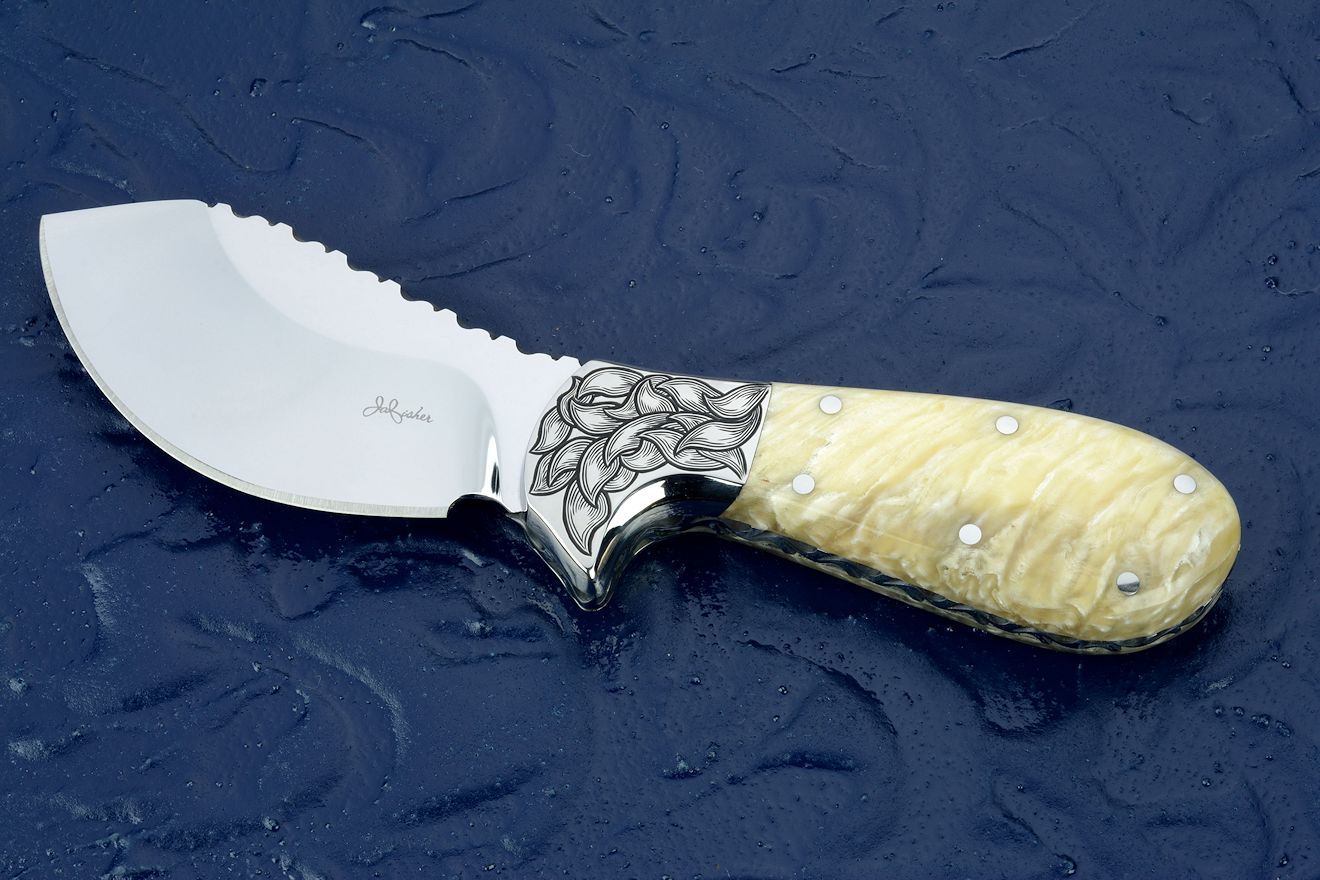
"Nunavut"
Jay Fisher - Fine Custom Knives |
|||
New to the website? Start Here |
"Nunavut" |
||
Thanks for coming here! It is my desire to present you with a positive internet experience on my site. You are in my domain, and I appreciate it. Your time, like mine, is valuable, and I'm honored that you've decided to invest your time learning about my life's work. Please bookmark this site as one of your favorites, and come back often, as this site is constantly updated.
Whether you are picking one or two topics on this page, or whether you read the entire page, I am certain that you will learn something of value here. If you are an interested knife patron, client, or enthusiast, this page will give you clear, reasonable, and definitive insight into the world of the modern custom knife maker, artist, and craftsman. If you are a knife maker, you'll understand and relate with some of the issues you may face that I write about here. If you are new to the world of individual knife artists, the internet, and the knife making world, I'm certain that this page will open your eyes.
Please remember that this website was first built in 1996, and that I've constantly added topics, and that many of these topics are not created or ordered by date. Some of them are over 10 years old, and some of them are recent. This is because no matter how old the topic is, I believe it's still important, or it wouldn't be here. People don't generally change, so neither do these knifemaking business concerns.
Though you'll see other sites by makers on the internet that claim mystical energy, the importance of breathing (which I consider absolutely critical to survival) or certain physical stretching exercises to allow one to access the spirit of knifemaker magic available through supernatural symbols and chants, please know that this is not that kind of website, and I'm not that ridiculous or juvenile. I take my patrons seriously, respect my tradecraft, and honor my art. This is a very grown-up website, and I make real knives, the best knives, the finest knives I can possibly make with the finest materials, modern methods, and craftsmanship. I will, however, strive to keep a great sense of humor and hope you cherish yours, too!
Some regard private enterprise as if it were a predatory tiger to be shot. Others look upon it as a cow that they can milk. Only a handful see it for what it really is - the strong horse that pulls the whole cart.
--Winston Churchill
-his mother was American!
Jay,
The e-mail pages are hilarious and are my end of day giggle. Love your comments and the eloquence of your written words add a great deal of
spice your website. Do you have elves make your knives at night? Either that or you are working on a 36 hr. day what with knife design and
production, site maintenance, e-mail answering, writing, photography and all the
rest you do for your business, Your site is truly a stupendous piece of work.
Seann Alden
Abbotsford, BC
Dear Mr. Fisher,
I happened on your website today and have been enthralled with
it for 4 hours now. I feel I have to write and tell you how beautiful I
think your work is.
It is wonderful that you can produce such extraordinary knives. Not to mention your
website, swords, sheaths, and novels too? You must never sleep! The integration of steel,
minerals, and wood is fantastic. I found myself staring at some of the gemstone handles
gently turning into the mirror finish of the steel. Wow!
You are a credit to this country and to artists everywhere. I have never seen such wonderful
creations. Sorry to gush and I'm sure you know all this but I needed to compliment you and
encourage you. Please keep your vision and continue to share these wonderful products with
the world. No need to respond to this if you haven't the time.
Please, get some sleep!
With much respect and admiration,
David C.
From time to time, I get questions, comments, and criticism about my website. Most of it is very encouraging, supportive, and inspiring. People like what I do here, or they wouldn't be keeping me in orders, and I am very thankful and honored by their time and interest.
Not all comments are positive. Some of the rude commentary falls to the level of name-calling. Always inspiring a chuckle, I usually delete or ignore this type of input, but sometimes I'll post the funnier ones on some special pages. Please enjoy them for yourself.
Some people get downright confused as to what this site is about. This site is about my clients. That's past clients, present clients, and future clients. So, of course, it's about my work, creations, directions, and ideas. My name is Jay Fisher, the site is named "jayfisher.com" and the site is about my career and life interest making knives professionally for all those clients who have supported me for decades.
If you could post your life's work on one website, how would that look? These days, a curriculum vitae is commonplace for all modern artists, and this is mine. In the future, most professionals' life's work will be able to be seen, cataloged, and verified on the internet and copyrighted in the Library of Congress, our world's top library and source of record. Many professional jobs today require a related web site for details of that professional's work, his achievements, history, education, and even his attitude and beliefs. It simply is the new medium of information and exchange.
The site is about selling my knives, too. You'll see that I don't have many knives available at any given time, because when I post them for sale, they may not last long before being purchased. Why? Because I do my best to make very fine knives, the best knives available, and offer a great product. Evidently, a lot of people want the knives,; because they just don't last long. Since the site gets about 100,000 hits a day, and over 95% of the visitors add it to their favorites list in their browsers, they keep a pretty good eye on what is new. I derive all my income from this website and its referrals. As a professional, this is my full time job and I love it.
The site is not just about selling my knives. I've tried to share some of what I know and think about knives, craftsmanship, art, and other related information. That's why I have over 15,000 pictures and over 500 pages of information here. If a person comes to the site and they stay a while, it's because they've found something useful or interesting. I'm constantly adding to the site, updating the pictures and information, clarifying and editing, and writing the code, words, pictures, and ideas.
Back to topicsMr. Jay Fisher,
I really love all that you do and what you have put into your website. I am not
asking for anything nor have questions for you. I just want to say "THANK YOU!"
and that I highly admire your skills, knives, and information that you have put
out there. I recently starting knife making (as a new hobby), and came upon your
web page as part of my research. I know my opinion doesn't mean much, but I see
you are the benchmark and gold standard of the field. I just want to thank you
for all of your information on your website. I have spent hours reading and
admiring your artistry and craftsmanship. Someday, I would love to own one of
your pieces. Thanks again for everything (even the emails page, for a laugh).
No response requested. I hope you have read to this point to know that people
appreciate you for you, as well as your standards and dedication of your trade.
Thank you and God Bless,
Noel Burns
Your site is the best of its kind on the web. Just when I thought I was developing some skill at engraving, leatherwork and knife making, I saw your stuff. You're quite an artisan with brilliant creativity. Thanks for putting you work in public view.
--Patrick Chitwood
Most people don't have any trouble negotiating this site, but occasionally I get a comment about the layout. Currently, I'm not using frames. Frames are the arrangement that allows you to have a permanent list of links usually on the left side of the page. Supposedly, this allows a faster hop to the page of interest, but it does cost, too. First, it costs screen width. Frames force the rest of the screen to be narrowed, which, in my opinion, makes a narrow, list-like page, accompanied with a narrow, list-like frame. It is proven that people scan these type of layouts rather quickly, and I don't want you to quickly scan, I want you to take your time. Also, because of the amount of pages (over 600), frame use would make a long, scrolling list by itself, constantly begging your attention away from the page. I don't want you to be distracted. Thirdly, why be like everybody else on the net? The interesting thing about the internet is that there is no standard format, no requirement that all pages look alike.
I had a laugh when one internet professional web builder insisted that large pictures are bad, and never should you even consider having a hundred thumbnail photos on a page. This person may be big on creating quick loading, fast, short, single page web sites, but she has absolutely no knowledge or experience running a professional web-based business. With today's fast computers, huge ISP memories, and large monitors, it is necessary to have plenty of large photos and full pages. When was the last time you visited another knife maker's site and saw only a handful of small pictures of his work and very little information? Did it leave you wondering, wanting more? When you go to a large knife manufacturer's website, note how small and vague the photos of the knives are. What can you actually see in a picture that is only two inches across? Are they hiding something?
When I go shopping and learning on the net, I like to see lots of information and lots of large, clear pictures. I don't want to see a little picture that quickly downloads on a telephone modem. Who's using these modems nowadays anyway, and why would we adjust our presentation to the slowest, smallest common denominator?
Sure, there will be those who view the internet on their cell phones, PDAs, Blackberries, IPADs, and other small gizmos, but they, too can usually be enlarged for a much closer, more detailed view of the item. No matter the type of device, it's all about the resolution and detail in fine handmade and custom knives, not the speed at which you can scroll through them and exit the site!
Jay, some feedback on your site. I love your “Feature of the Day.” Great idea. I’ve been coming back regularly just to see that. And then I always check out the knives for sale at the same time. I’m sure others do the same.
“The Chase”…it is absolutely mind blowing. The display! …and the knife itself! You always blow me away.
--C.K.
Another consideration is that most internet business websites are catalog-based. When you go to these sites, you are looking for a specific product, the info, price, and a picture of that specific product. This is not that kind of site. This site is a reference, contact, and descriptive illustration and detailing of the life's work of an artist, craftsman, photographer, and writer. I've designed the site to be interesting, informative, illustrative, coherent, thoughtful, and entertaining. It is not a manufacturer's catalog.
Take your time, look around; the highlights are at the top of every page, and when you get done with the page, a large group of links is at the footer. If you ever get lost, go to the Table of Contents page linked at the bottom of every page with every single link to every single page on this web site.
Are their restricted pages on the site? Yes, there are. These are pages I'm still developing or for projects that are not for public view. More on that as time goes on, as web development is a continuing affair.
Dear Jay,
I was reviewing your website after pulling my hair out reviewing “factory” sites and web forums, and it was with great relief that I read your information on your weapons, and knives generally.
--E.M.
Mostly, people come to this site via a search engine. I keep detailed stats on my traffic, so I know how, when, and from what area they are coming. I know what page they go to first, how long they stay, when they leave, and how many visits they have. They might come in because they entered a search phrase like "fine daggers." They enter, then, on my Daggers page. They immediately want to know what a dagger costs. There is no price scale anywhere on the site, because there are over 65 factors that determine the final price of a custom dagger or knife. They may get frustrated, because they just want to know how much a dagger costs! Ah, if it were that simple. If I only had six designs, six prices, six available models, then life would be easy...
Mr. Fisher: I'm glad I happened upon your website. Your work is impressive, and I appreciate the wealth of info you have placed on your site. I have never owned a custom made knife, but I recently had the pleasure of handling one of yours in North Carolina, where I decided to someday purchase a nice hunter from you when funds allow. That experience has also led me to decide to never buy another factory made knife, and to learn the art of knife making myself. With your permission, I hope it's OK if use your site as a source of learning and inspiration.
Sincerely, David W., Altavista, VA
Because I'm a true custom maker, making exactly what a client wants, there are as many arrangements, feature sets, and types of knives as there are clients. The truth is, in all the knives I've made (thousands so far) I've only made a handful of knives that have the same blades, finish, fittings, and handle material in my nearly thirty years in this business. And while I may make them similar, they are never exactly alike, because I vary the filework or engraving, unless they are working grade tactical and combat knife styles. So, most clients of mine are assured a one-of-a-kind original, never repeated again. So, there is no chart, no specific price that you can get if you just say "I want a dagger." You might be surprised at how many such inquiries I get like that.
Hello Jay, I am just starting out in knife making, and I would just like to say thanks for the inspiration. Every knife maker should visit your site to see what real craftsmanship and damn good knives look like.
--Trevor Walsh
My website undergoes continuous reconstruction, in order to meet and maintain standards compliance with the World Wide Web consortium guidelines. To the programming savvy, this means that the site has dynamic web templates and cascading style sheets, in XHTML STRICT language. I'm not using java scripts or nested programs; they are not applicable in this format, and they cause confusion and errors among various browser platforms. What I have found is that the very simple, static, and clean presentation is working well.
Hello Jay: I just wanted to let you know that I think your website is great. Very, very informative and you have a way to cut through the B.S. and tell it like it is!
Best wishes: Dan W.
It's curious to me that what people generally believe is a modern template for web sites typically consists of lots of clutter, dozens of links, distracting images, videos, graphics, and advertisements, advertisements, advertisements, all knotted up with a sophisticated and constantly evolving and risky content management system. I'm sure you've visited this type of site and have been frustrated as the loading, onslaught, and bombardment of continually revolving advertisements try to shove themselves in your eyes and jiggle, flash, and bounce, screaming for your attention. You may be startled suddenly by music (or noise) that you did not ask for, continually adjusting page sizes, or links that do not take you where you want to go.
You'll have none of that here. I do my best to keep my site clean, clear and simple, with predictable links, a steady tempo, and clear directions. You may choose your own music while you peruse, research, or dance through the pages, and all that I ask is that you give it a look. It won't cost you a fee, membership, or commitment, just whatever time you offer. You don't have to look at advertisements, redirects, or clickbait. In return, I promise to be honest, clear, and forthright, while sharing some of the best parts of living as a knife maker, artist, photographer, and writer. I promise that on you will learn something on every page; this is my service commitment to my tradecraft and art.
Howdy Jay, I wanted to drop you a quick line for several reasons. First and foremost, your website is by far one of the finest custom knife sites I've been to. Unlike every other website out there now, yours actually has a warm organic tone to it. Not only is it full of great art, info, and patterns, I (a horrifically computer illiterate newbie) can easily find my way around the whole site.
--J. Costello
The interesting thing about this site is the variety. That is why I settled on knife making and art, because I get to work with a variety of materials, shapes, processes, and designs. You get to see a lot of them here. Please do take your time, bookmark this site as a favorite, and come back often. There is no hurry to acquire your custom knife, I want you to take your time, think about your investment, learn about this world of fine custom knife making. Then, if and when you're ready, we'll nail down the specifics of your project, and you'll have a valuable investment in a one of a kind work of art that fits you perfectly.
Occasionally, I get letters (emails) of inquiry where the writer has offered up some sage internet advice. I do consider each comment and request, but some are humorous. People who've learned how to insert personally designed graphics into each email are sometimes so proud of their savvy and computer-based achievements, that they want to offer their critiques of my site. Most people realize that in email, short, quick, to-the-point text is king, and the rest is just fluff. Here's an example with my response:
Here's the email I received. "Signature" graphic included with this email submission, a face with some background and some post modern text, all in rather ugly shade of brown. Probably something created in a community college graphics design class. Email is as spelled.
Jay,
I was just wondering what it would cost for a dagger and a stand
for it that was completely custom? I don't know much about daggers, but am
looking at getting one for symbolic purposes. If I presented an artisit design,
could you do it? Is your skill level able to pull off something from paper?
Thanks in advance,
Great website and very informative. I would consider a resign though
for display. The average person wouldn't have strained so much to
find what they are looking for on the site. The content is good.
--S.C.
my response
Hello, S. Thanks for writing.
The price of an art dagger completely depends on the components
of the dagger. Also, the finish must be considered, and
embellishment, tooling, stand, case, or sheath. There are a lot of
options when one chooses a complete custom knife. I can and do work
with clients’ designs, but because this entails a lot of
drawing, tuning, consideration for geometry, steel types, and
general design work, it still requires the design deposit. You can
read about the details of the design fee here.
Thank you for your comments about my site. The site is complex; it’s a very complex field of artistry that I’m in. I’m not worried about the average person finding their way through my site, my site is geared toward knife aficionados and professionals, and they are very happy with the content and layout. Ah, if this field were only simple enough to have a simple site, with a couple pictures, and about three prices for knives… (smile).
May I be so bold as to offer you some advice, in kind? When you include your graphic with your email, nearly every firewall and modern email program stops your email cold, because of the possibility of the graphic containing malicious code. I had to retrieve your email from beyond my firewall. I almost deleted it… just a head’s up.
Thanks for your interest, and I’d love to see your design.
--Jay Fisher
I must have upset them, because I never heard from them again! Oh, well...
Your Web Site-
Dear Sir,
I am impressed; you are the epitome of a professional.
--Alan
Just like any modern source, you have to have a strong B.S. filter when you browse the internet. There is a huge amount of useless information, misleading data and commentary, and outright lies behind the facade of an internet presence. Not only are large and meaty web sites coated with the stuff, even the small players are getting in on the act. Now, with video sites, the fluff is exploding into a hopeless mess. People are even throwing out instructional YouTube videos like chum to sharks, hoping to catch an eye for their drivel, filled with bad information, lousy techniques and amateur process. Some of these are shockingly unsafe! I remember one (now removed) on YouTube where a guy was using a high speed buffer on a sharp knife. The buffer motor was held to a table by a dumbbell weight, and the guy was working on the wrong side of the wheel with no safety gear whatever. This is a horrible disaster just waiting to happen, and that would have been a viral video, indeed!
Why do these people do this? It's either pure egotism or they're hoping to ultimately cash in on the information exchange, but they never will. If it were all only about information, this business would be rife with process and knife construction techniques, data, and clarity. It is not. There is a bad way to make a knife, sheath, and accessories, and a simple comparison of what a professional makes with the products of novices and factories will yield plenty of particulars to detail the divide. It's not just information, it's technique, skill, and the eye of an artist, which is becoming a rare commodity indeed.
If you really want to know more about just what a poorly made knife is, take a look at my Factory Knives vs. Handmade Custom Knives page.
To get an idea of some of the misconceptions, drivel, and fluff sent my way, take a look at my pages of humorous clips, emails, and funny stories.
Back to topicsJay,
As of yet no premonition has revealed the mystical powers bestowed
to her but Wayland himself must have placed his hands upon your
shoulders as he smiled with delight. Beautiful she is and trusted
companion she'll become one truly for the ages. From the first and I
hope not the last email to you your customer service and
attentiveness has been nothing less than first class, something
retail and Big Box stores no longer offer. Another reason too buy a
Jay Fisher knife! Thank you for accepting the commission of my first custom
knife, I now know I made the right choice.
--Robert Ziliox
Mr. Fisher,
I am an amateur blacksmith and engineering student
hoping to break into knife making. Your website has provided me with more truly
useful information than not only any other source, but
ALL other sources that I have researched. I just wanted to say thank you; thank
you for taking the time to get to the real point and cutting out the fluff.
Thank you for putting your reputation on the line in a world where the vast
majority of people don't take responsibility for their actions. Thank you.
--D. M.
There is no easy answer for those who wish to learn knife making, as there is no official recognized organizational reference for knifemakers, and no official license requirement for making knives. There is also no complete and thorough text of information to detail all the facets of this skill. Read every book you can find on the subject, apprentice under someone if you desire, and start making. Feel free to read the information on this site, though, as you will surely become more knowledgeable about custom knives from this site than any other single knife maker's site on the internet!
There is no such thing as a certified knife maker. Some organizations have made attempts to endorse or proclaim a knife maker's status in their organization, but no official entity exists for custom knife makers to certify or guarantee that they are qualified to make knives professionally. With the growth of government entities and regulations in our litigious society, I imagine that someday this will come. Knife makers will be certified, regulated, and watched over by entities that do the same for the firearms or tools industry. At that point, knife making may be much harder to get into as an established maker.
Back to topicsI've seen your website and it is amazing. I've used a knife for the whole of my working life. To me they are a tool, like a wrench or a screwdriver. It's difficult to get good ones designed for what you need. They mostly let you down. I work with rope and must have a sharp knife. I also need a marlin spike to splice. I must carry both a sharp knife and a marlin to do the job. Marlins are hard to come by these days but a decent knife is almost impossible now.
I was looking for a quality knife then I saw your website. I want to say that in a world where I thought that nobody cared about quality or craft anymore, you've proved me wrong. Thanks for doing so.
Yours Sincerely, M. B.
Where is this all going? What is the history, and why does it matter?
There used to be only a couple of ways to buy a fine custom knife. You could buy a knife magazine like "Blade," "Knives Illustrated," "The Knives Annual" (Knives 2009, 2010...2016 etc.), "Tactical Knives," or others, and thumb through the articles and ads to look for something interesting. You could go to a local knife and gun show to see what you might find locally. You could travel to a big city knife show. You could postal mail a request for a list from a knife maker's organization, then call or write the individual makers. You could call every maker you could find and ask him if he would make your knife. With travel expenses, snail mail, far too few pictures, and the limited choices in print, buying the very knife you're interested in was tough!
Everything has changed. Internet technology is the present and future media of custom knife sales. It’s almost instantaneous, almost free, and a tremendous way to interact with custom sales and products. Companies (or individual craftsmen) who do not utilize this medium will be left in the dust. Knife shows are on the decline, dealers are turning to the web, and clients would rather spend their time in a comfortable chair browsing a good website than traveling to an expensive show. When you want to buy something like laundry soap or socks, nothing beats a local store. But when you want a custom piece of investment art, fine utility, or a combat weapon, and you want it just the way you like it, the internet is the only way to go.
Hi Jay,
Thanks for the CD. Over the last three days I've spent about
eight-nine hours reading your website. I've thoroughly enjoyed
the technical content, your wry sense of humor,
and your artistic talent.
--R.W.
For example, before the net, if I wanted a unique ball bearing set for a machine or power tool, I had to locate the manufacturer (either by subscribing to a business and professional register, visiting a local dealer or writing letters and making phone calls), detail the part (several conversations), send the money and wait, and hope it's the right part. Nowadays, I just punch in the info on a search engine, find several suppliers of my part, confirm it’s the right one (usually a photograph does that), and purchase it online. If I'm not sure of the supplier, I use a credit card, which allows me a good deal of protection from scams, as a charge can be reversed. It’s incredibly easy and very fast, as the shipment usually occurs within the same day.
In the old days, if you were selling widgets, you had to go door to door, business to business, and give just enough information to close the sale. Then, you had to return for the next sales pitch. Nowadays, the web requires all the information you can provide, the clients seek out the seller, and the seller has time to work on his business and be more productive.
There will be a time in the near future when all unique businesses like mine can only be located on the net. There will be a generation (probably my grandchildren’s) which will have the internet as their first contact and information tool. It is truly an amazing thing!
Hi Jay, no answer expected, just wanted to say what a great knifemaking site you have. I make knives for fun, and am a competent amateur. It's nice to see how far a single individual can go in mastering all of the diverse disciplines of fine custom knifemaking, and I wanted to tell you so. Thanks for the work you spent in making your website.
--Jim Frank, CBRE, Chief Engineer, Cherry Creek Radio, Montrose, CO
The other amazing part of this experience is that information is the key to success. In the old days (before the internet), clients stumbled along, knowing just enough to make their purchases, listening and looking for recognized names and popular brands, and took their place in line to receive the product. Now, they want as much information as possible to educate themselves on the product and purchase, to see testimonials from professionals using and buying the product. As time goes on, the hyperbole on the web will be identified, weeded out, or easily ignored, as this is a truly educational medium. More knowledge about the product will allow them insight into unwarranted claims and hype, to help them make an educated purchase. I've always said that 50 percent of this business is education, and the internet allows that at a free cost to the consumer, client, user, or collector.
[Email:]
Dear Mr. Fisher,
I have perused your website several times and I see
and read something new every time. That's not hard for me as I'm a
pre-newbie bladesmith wanna-be. I am amazed at the breadth and
quality of your bladesmithing skills, this is an inspiration to me.
I am researching the skills, the tools, the business, the education, and
the attitude necessary to become a bladesmith. I was referred to
your site by the forum posting of your Gemini Twin folders, and those
Jay, are simply breathtaking. One of the skills that I will learn
is mirror polishing a blade; what you wrote in regards to that makes
sense. For so many reasons, that facet of bladesmithing is crucial
to finishing a blade. I know that others have also applauded your
methods and skill, and so I am another fan of yours in a long line of
admirers.
Sincerely, T. D.
[my response]
Hello, T. Thanks for taking the time to write your thoughts. The neat thing about the internet is that it IS available for a person to educate himself on just about any subject. I think that competition is great, and with the net it forces us to look at other’s work for comparisons, something that just wasn’t available before the mid-1990s. So, overall, it should improve the level of workmanship in the tradecraft and art.
You are right about blade finishing, or finishing all materials and surfaces on the knife, for that matter. This is, sadly, a neglected area of many knife makers and all factories or production knives. I think it’s because it takes a lot of time and effort and attention to detail to properly finish any hard material. There is an old saying in the lapidary arts that “the finish is made in the sanding.” Sanding with successively finer and finer grits is sometimes a boring, tedious task, and many craftsmen are too rushed and impatient to take the time to properly finish any material. So, they sand along the blade length, or use a sanding flapper wheel to finish, or spend way too much time on the buffer and round over their grind lines. No matter the skills at the anvil, the customer, client, or knife aficionado will notice the finish first and foremost. Interestingly, I think the use of damascus (pattern welded) steels actually allows poor finishing practices. Since the blade is etched anyway, poor finishing is not noticed in the etched and patterned surface.
Thanks for your interest and support,
Jay
As an artist, I reserve the right to create unique works.
When I design or work with a customer's input to design a custom knife, that knife profile is reflected in a pattern. You can see all my patterns (over 500) on the patterns page. That pattern is simply a guide to the layout of the knife, and I often am asked to mix patterns, that is, match the blade from one with a handle from another. This may be bold enough of a change to dictate creating a wholly new pattern, or it may just be a hybrid knife. No pattern in my inventory of patterns is exempt from use on any project. There will, however, be differences in the final knives, making nearly every knife unique and valuable.
I rarely, if ever, use the same handle material on two knives of the same pattern style. If I do, I usually change the filework, the finish, the embellishment, the bolster materials, or the sheath, block, case, or stand. If a knife is marked with a specific name, commemoration, or design, that also makes it unique. And there are subtle differences that accompany each handmade knife adding to its unique property. If the knife has a gemstone handle, it simply can not be repeated the same exact way, as gemstone is different in every slice, even within the same rock. The knife client or patron expects an original, unique work of art, and repeating that would devalue his investment.
The only knives I make by sole authorship that resemble each other closely are the basic tactical models that are bead-blasted, with bead-blasted Micarta or manmade material handles. These are all very similar in construction and execution.
Once, I had a client protest because he bought a knife, and then saw on my site that I had listed a picture of the knife style with the text "taking orders." He claimed that his knife pattern was supposed to be one-of-a-kind, and that I wasn't supposed to make that knife ever again! I told him that I would never put the type of handle material used on his knife on another of the same pattern, or finish it in the same way, so his knife was unique. I've got so many materials to choose from, why would I? I guess he thought that I would never design the blade shape and handle profile ever again. How ridiculous is that?
Here's the thing: if the knife style is a popular one, I will get more requests for the knife. This is nearly always followed by requests for a change in handle material, embellishment, or sheath construction. If it's a popular shape, I will create the pattern profile again, though I won't outfit the knife with the same materials. It is my business to create unique works that clients want. Also, if a client works up the pattern design, I let him know up front that if I make the knife, I'll add his design to the pattern inventory. This is my way of honoring his (and my) effort, and improving my range of knives.
Another part of the custom knife making process that is always different is the sheath, stand, block, or case. At the time of this writing, I have never repeated these and do not offer copies of them on new knives. As an artist, I reserve the right to create unique works.
All my knives that have been cared for have appreciated over time, and should continue to do so no matter what happens to me, my career, or my work. I've created enough pieces, put out enough artwork that my reputation is well established. The hard part for me is to realize that the value of a client's investment will continue to increase, long after I (and he) have turned to dust... as the knives will still be around. I won't benefit from that appreciation, but he and his heirs will!
Back to topicsHi,
I would like to thank you for all
the info on your site, its a good one and you knives are a work of
art.
Thanks again, T.
From my FAQ page:
"If I submit a design, will you make my knife?"
Perhaps I will, but maybe I will not or can not make your knife. I'm limited by the amount of knives I make, and I reserve the right to refuse to make a particular knife. There may be many reasons for this. If my order list is long, I may not be able to accommodate your needs in a timely fashion. The knife design may be unworkable, or not in my design style. Not every maker makes the same type of knife, and though I make a lot of types, I do not make them all. The materials requested may not be available. The budget for the knife may be unworkable. A specific request for materials used, geometry, mechanical fittings, or finish may not be something I would recommend, so I wouldn't make a knife in that fashion. No worry though, you are on the internet, and there are many other fine knife makers who may accept your commission.
Now and then, I get an inquiry about a client's own design. He usually states that he has worked long and hard on his design, maybe he even has a host of designs (I even met a guy that had a book with hundreds of pages of knife drawings), and he wants one or two of them made. Usually, these guys are very protective of their work, sometimes copyrighting it, but always convinced of the high value of their knife drawings. They're certain that the shape, contours, or features of their design are worth a great deal of money, and they don't want the designs to fall into the wrong hands, where their hard labor and investment of time is "stolen" by a factory or self-serving knifemaker. They want me to make their dream come to reality, never to be seen again.
Usually, they have not considered the labor, skill, and machine techniques that must go into their idea. The value of a fine custom knife is not in the drawing or design, it's in the execution. Sadly, their designs, though lovingly created, are not worth much. So they hop around from knife maker to knife maker, searching for one who will keep their secret and make their knife for cheap.
I steer clear of these types. They are sad to learn that their drawings are usually not unique; in the millions of years man has been making knives, nearly everything has been considered at one time or another. They also are distraught when the find that true design patenting is a long, expensive process, and even it a design patent is granted, they must have plenty of money to defend it in court, proving their ownership of the design, proving that it has never before been designed in the history of man, and proving damages to themselves by the defendant. This is no small court matter, and unless the design revolutionizes the knife world, not much damage can be proven. Add to that most design patents last for nine years and then they are finished, and there isn't much sense in the process.
If a knife is truly a great design, why not honor that, name the design for the designer, and share it with the world where it can be appreciated? This is not the case with most of these guys, they think they will somehow get rich off their drawings. I know of no one in human history that has gotten rich from knife drawings. If the person is exceptional at drawing, perhaps he should become a fine artist. That will get him rich, if he's very good!
Some people take it a step further than just insisting on their designs and think they have come up with something really, really special, usually a design they've mashed-up on a CAD (Computer Aided Design) program. Maybe they've cobbled together an idea that they think will be the next best thing in knives since electrically heated socks. They are convinced that their work is not only unique, but patentable, protected, and valuable in inconceivable and magnificent ways to the knife market and world. They just need someone to actually make their prototypes, quietly, with limited exposure, and secretive nature, so that they can link their idea with a big name maker and peddle their idea to a manufacturer. They'll also need high quality, something not found in the typical places such ideas are peddled. They might try a website fund raising campaign so they don't have to spend a penny of their own money, and at the appropriate time, they'll spring it on the market, become zillionaires, and retire to Aruba with their shih tzu.
They'll try to lure me (and every other well-known maker they can find an email address to) with promises of sales, exploding popularity, and unbounded success if the maker would just make their project real. Never mind that maker has already established a huge market following and is in high demand; they don't consider this, only their pet project. They'll even require the maker and anyone exposed to this stunning idea to sign a NDA (Non-Disclosure Agreement) so that the word won't leak out and the Chinese or Pakistanis won't copy their work, and the individual maker won't profit from anything the so-called designer has created.
By the way, a knife designer is defined as a dude with a pencil or a tablet, or a computer and mouse, and having never made a knife, doesn't know the first thing about the process. Who does know about knife designs? Not manufacturers, they just make repetitive projects to market. The custom knifemaker, that's who. They are at the forefront of knife designs, and just about every other resource looks to them for trends, styles, and designs. This may explain why my "Knife Patterns" page is the number one page on this website, day after month, after year... for decades now.
It may help to know that knives have been made longer than any other implement, tool, or object by man, even before man was modern man (Homo sapiens sapiens), and if the potential millionaire entrepreneur has thought of this great idea, chances are, someone else has too. By the way, homo sapiens is Latin for "wise man." We hope they wise up; if they really have some great new idea, and want prototypes, they should go to a local machine shop to have them fabricated. If they want more personal control, they could buy their own CNC machine (most of these designs and ideas are created with computer programs anyway), and banks are eager to loan money for machinery borrowed against, say, an existing home. When the machinery is forced to sale, it's auctioned for pennies on the dollar, and the home, well, that's real property the bank can recoup on.
Don't get me wrong, if I am employed as a Professional Knife Consultant, and part of the project or work scope requires an NDA for legal or security reasons, I'll comply. It's just that I won't consider it for novice knife designs, since that's unreasonable and impractical.
What is unsaid in these deals is that the person peddling the idea is begging for a knifemaker's name and reputation to grubstake his master plan, as well as his tools, time, and knowledge. Remember, the idea guy has no name, no reputation, and no standing in the knife community, but the maker is easily recognized if he's been around a while and is successful. So the advantage is not to the knifemaker, but to the hawker of the plan, who stands to gain approval and recognition of the validity of his idea.
What the peddler hopes is that because he insists on an NDA, the maker will think the idea is uber-valuable and the knifemaker will be awed by the savvy pretense of market influence. The reality is different. An NDA is a contract, a legal document that shouts "I don't trust you, so I'm protecting myself with the threat of punishment and money gleaned from you should you violate my contract!" This is a great way to start a business venture; by insulting and threatening the creator of your unfinished idea...
Just found your website – New item on my bucket list – to one day have you create a knife for me!
Beautiful knives, website and very informative; I just spent the last couple of hours (maybe it was more
like 4 hours) reading some of the most straight forward and insightful knowledge on knives. My head is spinning !
Wow and wow – thanks for all of the hard work on creating your website and one day . . . a knife of yours will be mine!
--Danny Schmider
Once in a while, I get questioned on my knife prices and pricing structure. An interested person thinks his quote is high, and wonders why he would have to pay what I charge for his knife. I try to answer most reasonable questions clearly; perhaps he desires engraving or a complicated custom filework that takes many hours to complete. Maybe the handle material is rare and expensive, or the sheath work is time consuming and the materials exotic and hard to acquire. If his question is valid, I'm obligated as a business professional to answer his inquiry logically. Sometimes, this is not enough for him, and the urge to justify what I charge seeps into the conversation.
Justification is explaining every detail of the cost of a knife, and why each component costs what it does. When you justify, it degrades each creation or work of art into a list of costs and returns, a line by line breakdown of knife making steps, costs of materials, utilities, time spent on each process, and the costs of each expendable. It also gives away the knifemaker's right to charge what he wishes for labor. It demeans the whole process into a work order; the making of a piece of fine craftsmanship becomes an accounting of regimented steps. It is a glorious waste of precious time.
Sometimes, a client will ask this because he's seen my "My Knife Prices" page and thinks that the knife he's described should be at the bottom of my pricing structure. He's gone with a bead blasted finish and a Micarta handle with a plain sheath, so shouldn't that be the cheapest knife Jay makes? What he may not have accounted for is the size of the pattern chosen, the materials used, or the difficulty of construction.
My least expensive knives are mainly skeletonized, that is, they do not have ANY handle or bolster material, and only rudimentary milling. Everything that is done to the plain bar of steel in knife construction adds to the cost. A person who tries to make even a seemingly simple knife of good quality is shocked at how much work is involved.
I wonder if he would question one of the big knife manufacturers as to why they charge what they do for a knife? Would he go to a hardware store and ask them to justify why they set their prices where they do? Of course not, so why would he ask me that? People often see an individual artist and craftsman as a person, not a company. They can easily jump to the logic of calculating the singular knifemaker's labor, and often do this by trying to figure out how many hours it takes to make their knife. They are not thinking of what it costs to purchase the equipment, maintain and repair it, the cost of the building it's housed in, the cost of the utilities to maintain all the structure and gear, insurance, travel, shipping, janitorial services, and real estate taxes.
This is a business, and needing to justify prices is a slippery slope that is best avoided. Justification in any business is a drain of resources and time, and a sign of uncertain value. No one asks why an NBA player takes in millions every year, it's simply understood that the product he delivers is paid the going rate. If the rate is high, and he's still employed, that must be what the market has set for him. The same is true for custom knives. My prices are set, I have many orders and commitments, so the value must be in line with the market, or I'd be out of business.
The price of a knife is what it is. It's determined by features that go into the knife, the materials the knife is made of, the difficulty of executing each feature, the level of quality (intricacy and finish), embellishment and its difficulty, and all of the previously mentioned attributes applied to the accessories such as the sheath, case, or stand. The price is also set based on the marketable value of the knife and the workmanship.
When an interested person questions the price and insists on justification, it means that he can't afford the knife, and he should probably rethink his knife purchase.
Back to topicsHi, Jay.
My knife came yesterday and all I can say is Wow. This is
easily the nicest knife that I have ever held. The design is well
thought out down to the smallest details and is exactly what I was
looking for. Very ergonomic, capable of just about anything I would
need a knife for and a formidable weapon for self defense. The
craftsmanship is Incredible. The symmetry of the blade and the
fineness of the edge are magnificent. The mirror polish is just like
looking in the mirror. And it has the kind of balance that makes it
want to be in your hand. I really like both sheaths and your tactical sheaths is far nicer
than any that I have seen. I could go on and on. I'm moving to 30 acres
In Colorado in about 4 months so I wanted a nice knife to carry out there and this one got
the job. I plan on keeping this knife until I'm old and giving it to a
younger person in my family.
I feel like I got a very good deal from
you as far as pricing, it could have cost much more and I would
still have been happy. It is a privilege and honor to own this knife
and I am deeply grateful to have been allowed to get it.
You will probably hear from me in a year or
so and I will order a investment/display knife so that I have a mint
condition piece from you as I am now a big fan of your work.
Thank you.
Sincerely,
M. D.
I happened to get wind of a website where a guy had cut, copied, and pasted my comments about the steels I use on his own site, and followed them with his own abrasive and insulting opinions. He was careful to take every comment out of the context of my original paragraphs. He called it an "evaluation" and "review" of articles on my site.
I have no articles on my site. I do not get paid for what I write here, all I try to do is explain my way of thinking, my experience of many decades of successfully making fine, high quality custom and handmade knives. I guess I must have some public punch with my opinions and presence on the Internet, otherwise why would he have felt the need to attack me? Perhaps he was only trying to draw attention to his web site. By the way, as far as I can tell, the guy has never made one knife.
I took the time to respond to him directly, offering that it would be considerate if he would have contacted me first if he had concerns about statements on my site. It would give me a chance to correct them if needed. I also mentioned legal issues. He was kind enough to respond and claim that he would act professionally in the future. We shall see.
This episode brings up some huge legal issues about this digital medium that are currently being studied, discussed among lawmakers, and flooding into the justice system. There is, first, the legal issue of copyright and intellectual property law. Every part of a web page, all software, patents, books, photographs, trademarks, videos, and even the fictional characters in stories are intellectual property. And don't be fooled, copyright protection applies immediately upon creation of the work, so don't look for a copyright statement (there is one at the bottom of every page of this website).
If you and your business or personal pursuit is on the Internet and displays copyrighted property belonging to someone else, and you have not obtained their specific written permission to distribute or display that work, you are liable for damages. Even if you just use a small part of that work, just a few phrases or sentences from a page, the copyright protection still holds true. One MUST obtain written permission first. This is routinely done, and I've granted several entities permission to use my words on their own web sites, so it's not some unattainable goal. If you use copyrighted material for a business pursuit or to make money in any way, THIS IS A FEDERAL CRIME. This is much more serious than a civil crime which all copyright infringement is. Want to face some time in a federal penitentiary? Copy some copyrighted site's knives and sell them on your website. Cut and paste comments from one website without permission for your own financial gain.
The only allowable scenario is for educational purposes, and every word must be sourced, every claim must be backed by fact, and it must be presented in an educational setting. This means from someone who is a professional in their field. By the way, there is no such thing as a professional knife "tester," "evaluator," or "expert."
Another, perhaps more volatile and litigious concern, is the nature of those direct criticisms. It's one thing to criticize a largely public figure or celebrity, and quite another to libelously attack a small businessman, one running a one-man show and deriving all his income off contacts and business from his Internet web site (that's me). It would be easy to prove damages done by those comments, because (little known to the attacker) web site traffic, connections, IP addresses, server locations and site ownership are all easily traceable with modern web analysis software. It amazes me how many people entirely overlook this fact. Lawsuit time. We may complain about our litigious society, but when it starts to hurt my business, I won't hesitate to protect my income, which supports me and my family, my business, and my home. This is how it is done in our society and judicial system.
What does this have to do with dogs barking? There is a proverb that states, "Dogs don't bark at parked cars." On one hand, it means to me that this guy was just a little dog yapping as I sped by, and it doesn't mean that much. On the other hand, it means that me barking at him is foolish, because he's just a parked car, going nowhere.
Back to topicsWhether knives or architecture, critics abound:
"To see an eminent architectural critic picking over, bit by bit, his architectural rag-bag for architectural finery wherewith to clothe the nakedness of the young giant whose very muscularity offends as it confronts him is pathetic... "
--Frank Lloyd Wright 1908
Hi Jay.
I just received the Tribal Helhor and unpackaged it. I'm at a loss of words. I absolutely love it with all my
heart. The knife is gorgeous, it feels so good in my hands. I love the tribal engraving and the Pilbara Picasso
Jasper compliments the wood tones of the stand and sheath. The sheath and stand are a work of art alone, but
all three put the entire piece together as a whole.
It's better then I could have ever imagined. I love it, love it, love it.
I'm going to cherish it for the rest of my life.
Sincerely, R. S.
Introduction: I've divided this subject into parts to offer a better, wide ranging view of this topic. It's a prevalent topic in the best fine handmade and custom knives because it is true: fine handmade and custom knives are expensive. It's important to note that it's not simply the materials that make up the piece that contribute to their high price. Many people are shocked to hear that, yet cling to their belief that the materials alone make a valuable handmade knife. Fine knives are expensive for many reasons. They're better made, better finished, and are highly desirable. If any of these were not true, the artist and craftsman who makes them would be out of business in a hurry! The artist and craftsperson who does create these works must have a lot to offer, particularly if he's been doing it for over thirty years and has a substantial backlog that continues to grow and bring in new business. It's simple really; if your work is popular, it sells. If your work continues to be sought-after, and you continue to sell, year after year, decade after decade, you must have something people want. This simple logic, one that runs every business there is, seems somehow lost on some folks, which always surprises me. Below, in this section are distinctive points that detail my own experiences with this curiosity, and how some people react. I'm certain that I'll continue to add to this, as it's a common occurrence. I'll do this as I continue to be successful, making and selling fine handmade and custom knives.
Jay Fisher,
I have been reading your site with great interest for several days. I am
convinced that you may indeed
be the best knife maker in the world. I have tried through
Google and internet searches to find another
knife maker who thinks they are your equal. I have found none. There are many people on the internet
who seem intent on bringing you down. My opinion of you remains unchanged. I have decided to begin
saving for a Jay Fisher knife because I feel that in the future it will be an historically significant
piece of American history.
Regards,
--M. R.
"Pick a little, talk a little, pick a little, talk a little, cheep, cheep, cheep, talk a lot, pick a little more-"
Robert Meredith Wilson
-The Music Man
I spotted some traffic coming from a forum where a guy had downloaded a picture of one of my PJLT combat knives and proceeded to claim and complain that the knife (supposedly belonging to one of his "friends") had been purchased for $2300.00. The cackling hen's banter went back and forth, ad nauseum, with misstatements, ignorant claims, exaggerations, outright lies. For instance, the knife pictured and claimed to have been sold for $2300.00 was actually sold for considerably less than half that. Yes, these are lies, and the guy who wrote this is a liar, plain and simple.
"Cheep, cheep, cheep-"
Still, they just couldn't see how a knife could be worth more than 300 or 400 bucks, no matter how it was made or by who. They kept coming back to the materials, namely the blade steel, over and over, as if the blade steel was the determinant factor of a knife's value. I write about these ridiculous notions and misconceptions on numerous sections on my Blades page. It didn't matter to them that my PJLT pattern has a very long history and high performance reputation among United States Air Force Pararescuemen who actually use this knife; all that seemed to matter to them was the blade steel.
"Pick a little, talk a little-"
These hens go on to claim knowledge and experience with other steels, with other makers, and clearly try again and again to compare handmade custom knives to factory knives. No one even considered the grind geometry, the fit, the finish, the balance, the design, or the service of the knife in its potential use in the field. The knife they pictured has a 42 component locking stainless steel, corrosion resistant aluminum alloy welt frame, and double thickness stainless screwed waterproof knife sheath, clearly the finest combat knife sheath made in the world, but all they could say was that the steel was 440 (actually 440C, if that matters). Did they even stop to consider the cost of that sheath? It is significant. The knife has bolsters. None of the common factory or boutique shop knives they compared the PJLT to had any bolsters, and the bolsters on the PJLT are made of 304 high nickel, high chromium austenitic stainless steel. Hardly anybody makes bolstered knives; that's just too much trouble to make a knife that strong. If other makers of combat knives do (rarely) step out and use stainless steel for fittings, they use the softer, less corrosion-resistant 400 series of low carbon, low alloy martensitic steels, or (worse) brass or nickel silver. Did they consider the cost of that personalization, custom digitizing, or accessories? Did they consider any of the dozens of other factors that are detailed in significant facts and illustrations on my huge Tactical Combat Knives page? Nope, it's just about the steel type, which they would know well, being all trained machinists, and metallurgists, and knife makers themselves... whoops; they are none of those.
"Stop! I'll tell all-"
And by God, no one considered my professional track record, experience, longevity, history, and the actual value of my work, a value that keeps me continually in orders making some of the finest knives in the world. Just how does that work, anyway? How could I continue to stay in business, continue to have new and numerous clients, continue to have the reputation of making some the best knives in the world? How is it that people, entities, and organizations seek my Professional Knife Consultation?
"Cheep, cheep, cheep, talk a lot, pick a little more-"
They tried to demean the knife and the client's purchase and claim that the knife was made by one of my sons, as a collaborative piece, and that somehow it was a lesser knife for that. This is another outright lie, as the knife they detailed was made by my own hands alone, and is a sole authorship piece. Even if it was a collaborative knife, it would be made to the same extremely high standards as if my own hands had made it; all of our collaboratives were made this way.
"--brazen overtures with a gilt-edged guarantee-"
This demonstrates how ignorance festers and steams on the web. Not a one of these clucking hens owns one of my knives, and clearly, they never will. It's like the owner of a cheap automobile complaining that an extremely fine, hand-made vehicle could not be worth the price because they are both made of steel and rubber. Is the determining factor of any object's value based solely on economy? Because if it is, these guys would have the Pararescueman who owns the knife turn it in for a cheap piece of plastic handled junk from China, simply because they—as finely feathered authorities posting anonymously on the internet—can't afford it, so nobody else should.
"--you'll reveal a lump of lead as cold as steel where his heart should be-"
This illustrates, unfortunately, an attitude that currently seems to dominate conversations, media, and even politics, the attitude of "Haves vs. Have-nots." Those who do not have, and may not desire some item, lifestyle, location, or view take it upon themselves to tell others how they should live, what they should buy, how much it should cost, and, in effect, how much I should make for what I do. Would they do the same for an NBA basketball player, a Hollywood celebrity, or even their doctor? How about the mechanic that lives down the street, the health care worker in their family, or the teacher who teaches their child? Where does this stop? The only way, perhaps, for them to see the jealous, shallow, and vain attitude that they display so willingly to others is to have them be the recipient of such judgment. Tell these guys how much they should earn, no matter how good of work, how much experience, how much value they instill in the fruits of their labor, and the conversation would quickly change. Also be sure to tell them that they can not buy an expensive tactical knife, ever, because their compadres on some anonymous forum get to decide what they have and how they spend their money.
This is why I quoted "Pick a little, Talk a little" from the Music Man (1962) in this section. Please do take a minute to review the song from the musical available through youtube or other free internet sources. You'll get a great picture of who these fellows are, strutting around their little forum in their chicken-feather hats, cackling, clucking, cheeping, and complaining from the anonymous perch and safety of their like-minded brood.
I force no one to purchase the fruits of my creation, the yield of my labor and efforts. People buy my knives because they want to. To have someone else, usually a stranger, tell you what to buy and what not to buy is surrendering your own freedom to decide. Conversely, I do not go clucking and pecking on forums trying to run down their choices for what they purchase. Obviously, a cheaper knife is simply that, and there are many specific reason for this, detailed in clear and voluminous detail on this very site. If this is all a person can afford, and it is what he wants, I will not fault him or try to decry how he spends his money. Since the sales of cheap tactical-style knives is a billion dollar a year industry, they have many friends who can claim that their cheap knife is just as good as a fine handmade custom knife, while they ignore the clear distinctions and differences.
Yet, I believe, time and with information, clarity and reason will prevail. If only people would educate themselves about knives the way that they can rattle off sports figures' stats, dates, scores, and game plays, maybe they would actually know something about the world of fine handmade custom knives.
"Goodnight, ladies, Goodnight ladies, Goodnight ladies, we're going to leave you now..."
The jealous poison their own banquet, then eat it.
--Anon
Ignorance deprives men of freedom because they do not know what alternatives there are.
--Ralph Barton Perry
Philosopher, 1876-1957
Jay,
I was tracking the package eagerly and was happy to find it arrived a day early. The knife is simply
beautiful. Without being prone to hyperbole- it is the best knife I have ever held by far. I am
so, so impressed. The balance is absolutely perfect. This is a beast of a knife, but it fits my
hand like it was made for it- feels like an extension of my arm. The geometry of the blade is so
perfectly symmetrical and the the cutting edge is surgical.
I remember reading your website where it says that you "make the real thing." I believed that
statement when I read it, but now I feel what you mean. This is no factory production knife.
I know our men in combat who carry your knives have confidence that the knife will stand up to
any challenge. The kydex sheath is awesome and it locks the blade without even a slight jiggle.
The accessories are such a nice touch and I greatly appreciated that you put that much thought
into the components that would compliment the knife/sheath.
Jay, this is the finest object I have ever purchased. Thank you for being the professional that you are.
Sincerely,
--C. B.
Though this site is about knives, my knives in particular, please allow me to apply some transitional, translational, and parallel logic to make this topic... about steel. Here is the struggling knife maker:
"Steel is just too expensive. Everybody knows that steel is not worth what the foundries charge, what the distributors get, and how much we have to pay for it. The price of steel just keeps going up and up... and who can afford it, particularly in this economy? Sure, I know that there are cheap steels, but I don't want to buy them. I want to buy the very finest steel, but I don't want to pay any more for it than for the cheapest, low end, mass produced, junk steel that is peddled through the factories of China. It just isn't fair that I don't have enough money, enough income, enough resources to buy the good stuff, the very good stuff, for cheap. How dare those companies sell these steels for such outlandish prices! Who do they think they are? And why in the world do you have to wait for the very best stuff, pay more, jump through hoops to get it, while other people can just buy it with their chump change? I want the best too, and frankly, I can't afford it. I think that what I will do is to go on forums, bulletin boards, blogs, and anywhere I can to post my opinion, anywhere any one at all will listen to what I say, and complain about how high the prices are. That'll fix 'em! That will make those mean old companies change their way of doing business!"
If you don't see the unique and sarcastic parallel that I'm drawing in the previous paragraph, please let me explain, but from the steel producer's point of view:
"Steel ores and alloys are expensive. Research is expensive, production can be a nightmare. My steel company may have worked for years, some of them very lean and tough, faced financial peril, hardship, and sacrifice to reach the place my steel company has today. Sure, we make the best steels on the market, with exciting and unique processes that are unmatched by others. Many of the attributes we employ in our product are not even visible to the naked eye, the are built into the structure and design of the bar. We have to pay for transportation, machinery, and energy costs. We have to pay for increased regulation, local, state, and federal government requirements and guidelines for our business, and everybody wanting another piece of our profit pie. We have huge advertising expenses and risks, and face a continuous onslaught of critics who really don't know the value, details, and intricacy of our product, critics who post anonymously on blogs, the internet, and on forums about the price of our steel. Gosh, they want us to produce the finest steels out there, and we're trying, yet they somehow think that these should be cheap and easily accessible, particularly to them. I know that the real truth is that they can't afford our steels, so must try to convince themselves and others that our steels are overpriced. This somehow will foster agreement with other already like-minded individuals who can't afford the best and finest steels, and they will somehow feel better. I feel for them, but the truth is our steel is in high demand, and people are honoring us with their money, and are literally lining up to purchase our products. So, though some may complain, what this means is that because we are able to sell our steels continually at the prices we require, we are right in line with the market."
Surely you see the parallels in this conversation. If you don't, please indulge me. Go back and read both comments again, and instead of the word steel, please insert fine handmade knives.
It is true that my knives are expensive when you compare them with plain, manufactured, or knives by beginning or unskilled makers. I was less skilled too, and back then, my knives sold for under $100.00 US, because the quality was markedly less. Though I'm doing well now, I'm continuing to improve my work on every batch. This is how it should be, and the value of even the oldest of my works continues to appreciate.
One thing I don't do is go and publicly complain about the price of steel (or someone else's price of knife). Though I do so in the parody above, it would be foolish and unreasonable to waste my time doing so in a public forum. Would the complainer above do the same and write the maker of a fine automobile? No, he would never think that he should be able to afford only the very best, and nothing less, but only pay a budget price for it. He wouldn't be so ridiculous to post that Rolls-Royce should lower their prices so he can afford their cars. He wouldn't think of comparing those fine handmade autos with his F150, because there are certain to be some things that Rolls-Royce knows and builds into their cars that Ford simply does not. Yet the maker of fine knives is fair game for these notions. This is a peculiar part of the tradecraft and art that I hope to change by these very words, my own work and effort in this field, and the book I'm working on.
This conversation and topic is further defined on my Factory Knives vs. Handmade Custom Knives page.
Back to topicsHey. It's like squeezing wine from a snake.
Dear Mr. Fisher,
I wanted to take a moment and send a word of thanks to you and your organization for having such an informative website.
I was trolling the web for grinding ideas when I happened upon your site, and I have to say, wow. I am a hobbyist maker
on my best day, but, I do have a set of successes that I take pride in. I have a severe aversion to making "crap," so
when I get solid advice on making a better product by veterans, I am all ears.
When I first started in on your site I thought, gee, this guy is full of himself. However, even if you are a cutlery steel
sales rep with tons of book smarts behind you, I think there is no better schooling than listening to those who have trod
where you are now treading. Your site should be sold as hokum repellant.
Seriously, thank you for giving of your knowledge and time to those of us who need a good tuning up occasionally.
Much respect,
Brian
My knives were the subject of a forum topic, with one guy baiting the forum with a flaming statement suggesting my knives were "overpriced works of art." I noticed this, and I also noticed the upstanding gentlemen who called the guy on his inflammatory statement, and all agreed it could be better worded. I'm grateful that there are plenty of intelligent people in these groups that notice ploys like this and call the poster to the matt.
The discussion went on between members, suggesting that unless they had personally owned one of my knives, they didn't know of the quality (or lack thereof), and really could not comment on whether or not the knives were any good. This is, of course, ridiculous. It was then clarified by several members, the quality is clearly visible on this very website with over 13,000 pictures and 500 pages at the time of this writing. A member went on to decry that anyone without experiencing the product for themselves can not know the quality. Really?
Let's follow this logic a bit. I have never owned a Weatherby Vanguard rifle, but it's easy to see that these are some of the finest rifles in the world. How do I know this? Well, I learn this by educating myself. Here, on the internet, not only can you see a sales brochure for the Weatherby, but also you can read testimonials, detailed descriptions, see many logical and plainly presented points, and experience high quality photographs and graphic representations from many sources. This applies to not only rifles, but also just about any item for sale by any person, group, company, or manufacturer. If you can read, and you continue your reading off the internet, in books, you can even deepen your understanding of these products and creations. The more you read, the more you can see through the hype, false claims, and misrepresentations, because, typically, those who read become educated on the subject that they read about. This is the wonderful thing about the net.
Of course, some are attracted to the drama, strife, and conflict created by gross and inappropriate claims, taunts, and jibes, like the kid in hopes of seeing a fistfight after school. Appropriately, the person who is spending their money acquires a different kind of education. His education is for the good of his own dollar, one he has sweated and worked for. When I say my clients are by best critics and they vote with their money, I'm not kidding. This is real, this is my livelihood and my passion, this is my career and my dedication that will feed, house, and clothe my family. It's also part of the future of those in my family that I teach, share with, and bring into the world of handmade knives. It is beyond important to me, and it is substantially important to my clients who commission or purchase my works and the collaborative works we have offered. Just read a few dozen pages on this site, look over the knives and testimonials, and you can quickly see the level of dedication and devotion to my trade.
The point is, you don't have to own one of my works (and other people's works) to understand the quality. However, it was great to see that about a year after the subject had gone cold, a person who bought a Jay Fisher knife stepped up and posted this:
Well I own a Jay Fisher knife, its what most people would call a
"tactical knife", simply put it's the best knife I own, I paid 1800 for
it in 2010, the former owner who said the knife was never used and that
was the truth I had the blade inspected with a scope, today I'm told the
knife is worth 3000 and have been offered 2500 for the knife, so as an
investment the return is very good for a "passion" investment. In fact I
can't think of many funds that deliver returns like that. I like simple,
elegant knives that are made to be used, I don't buy "art" knives or
jeweled pieces, I want the highest quality "functional" knives known to
man.
I use this knife whenever I can and have brought it underwater with me
diving, in fact I killed a MONK FISH with it off of Long Island in 195'
of water while wreck diving then removed the piece of the monk fish that
you can eat....the "loin" on the surface with the knife. It's fair to
say that I beat the hell out of this knife.
Overpriced? Not when you consider all of the facts, they are very
expensive but I don't think you will loose money on the knife if you
were to buy one, very few knife makers can say that, in fact most if not
all of his knives appreciate in value.
Art Knifes? You're WAY off here, Jay does make some incredibly beautiful
"works of art" BUT EVERYTHING he makes is 100% functional and will out
last everyone on this forum, the stone handles are in fact more durable
then anything you'll see on "tactical" knives.
Steel: I've seen Jay criticized for his steel selection from time to
time, what I can say is this, my knife is made out of a readily
available steel, its nothing exotic but my Fisher holds a better edge
then any knife I own made from the exotic or super steels priced from
400 to 1000 USD.
Fisher Knives are in the category of "Best of the Best" but his knives
are certainly not for everyone and that's one of the reasons they have
value.
Though I had not personally benefitted from the purchase of this knife by the buyer who owned it, this speaks volumes. The only thing replied that was questioned by another member was that the subject was a year old, as if that somehow discounted what he wrote.... sigh.
My knives will outlast the members of this forum; they'll outlast me, and you, and our children, possibly their grandchildren if they are simply taken care of. And when I'm long dust, the knives will continue to be of value, more value than I'll have benefitted, simply because I've made them the very best way I can. Perhaps, in the future, there will be discussion that this long-dead knife maker's knives are still of high value, even overpriced by those who don't own them.
Back to topicsDear Mr. Fisher,
I am in utter awe of your work. I'm a 17 year old aspiring knife maker in
northern VA. I stumbled across your site and immediately was hooked on the
pictures. It was all I could do to pull myself away from the knives and see
if you offered training or anything of the like. I quickly found you didn't,
and even though a bit disappointed, I very much understand why.
I wanted to simply let you know that you have quickly become a hero in knife making for
me. If one day I can become close to making a knife half as beautiful as the
worst of yours, I would be extremely proud. Perhaps one day I can order a
knife from you.
I read the "Please, Serious knife purchase inquiries only"
but I thought, that perhaps after a long hard days work, the knowledge that
your work is truly appreciated and an utterly amazing inspiration to someone
could lighten your day. I do not wish to waste your time any longer. Forgive
me for taking this much. I hope you and your family have wonderful days, and
that your business prospers.
Sincerely,
Andrew Jablonski
Thankfully, the major portion of the email I receive is positive, even if it's not related to a specific knife order. I sometimes neglect to mention and acknowledge the huge outpouring of positive responses, great wishes, appreciation, and genuine thankfulness that people offer me for making these beautiful knives and writing so much about them, my trade, craft, and art, and posting all of it on this website. I am humbled by their wonderful testimonials, responses, and genuine honesty about what they see here. One look at my Testimonials, Letters, and Emails page and you'll understand. I know there are a literally a billion other websites they could be visiting and enjoying, yet they've chosen to spend their time here.
You who are reading this right now are one of these people. You have a deep interest in handmade knives, or you wouldn't be here.
Being human, we are problem solvers and tend to focus on the trouble spots and not the successful areas of our lives, careers, and happenings. This is nowhere more evident than in the national news programs where problem and disaster after death, destruction, and failing are the leading and main focus, day after day, year after year. All while a billion good things are happening to billions of people around the world, none of it is considered newsworthy or reported. Simply put, because we are problem solvers, we focus on the problem, the negative.
It's taken me many years to understand that the world is full of genuinely good people doing good things, in good ways. Being human, I, too, tend to focus on conflict, and being in a very narrow but bright public spotlight of this field makes me a target for discussion, disagreement, jealousy, and outright contempt. That's the cost of taking a stand; you must turn your back on half of the world when you pick a direction to face.
While this website is full of good, grounded, tested, proven, and specific logic, reasoning, and information, we humans still tend to focus on conflict, issues, and discussion because, frankly, proven and established results can be boring. No one will usually argue with detailed specifics about knives if the presentation covers all of the details in clear, succinct, and foundational knowledge and experience.
An example of this is the rather uninformed claim by those unfamiliar with my work that I only make collectors knives. This is blown out of the water when it's revealed that a great deal of my work is in combat knives for active duty units, for our nation's top military rescue service, and for some of the world's top counterterrorism teams. So, how to argue that I only make wall hangers? No conflict there, so conflict must be sought elsewhere. People then write that my concepts and executions of chef's knives is all wrong, until they find out I make for some of the top chefs, restaurants, and culinary clients in the world, and their argument falls apart.
Another complaint is that I run down or attack other maker's and manufacturer's work. Please note that I've written again and again on this site that there is nothing wrong with cheap knives, what is wrong is a cheap knife sold expensively. In the pages of this website, I'm frank about what I've experienced and what my clients have experienced as limitations or failings in knives generally and particularly throughout the decades I've been a professional knife maker. These are simple comparisons, clearly stated and illustrated, in great detail, explaining blades and handles, sheaths and stands, accessories and service. I know that each person who seeks the frank, honest, and clear statements appreciates them; they tell me so. I don't identify the sources of many failed and inferior knives.
Conversely, critics have no pause when singling me out by name to complain that I make comparisons, while they try to find and identify some fault in my own work. Yet, in the thousands of knives you see on this website, every single one—apart from the few occasional pieces available for sale—are sold and in the hands of satisfied clients.
Comments about me and my work are nothing new. From the first time I made a gemstone handled knife in the early 1980s, the war was on. Gemstone handled knives were considered ridiculous: nobody made them, they were not mainstream, it was a foolish concept, and people even told me to my face that they were ugly. Wow.
Do you wonder why I continued? It's because of history, that's why. Some of the finest knives ever made by man have gemstone handles, so history could not be wrong. Now, 35 years later, with thousands of successful projects under my belt and many years of future projects commissioned, it's clear that the issue of gemstone handled knives has lost its energy.
So, what to attack Jay on now? Ahh, Jay won't share; he won't teach; he won't answer my questions.
A lazy attack nowadays is the fairness paradigm. This one is easy to explain; it's based on plain, unvarnished jealousy. If I am successful, and others aren't, I'm obligated to share my success with them, because this is the root of social justice. No, this is the root of socialism, on the path to communism. When everyone is entitled to the very same result, no matter the effort, there is no reason to work at all. Look at the initial founding of our country, specifically Jamestown, and you'll see how socialism failed utterly.
Thankfully, I live in country where I can still choose to share what I do with people of my choice. I'm not obligated to turn all of what I have done and am over to a greater state, organization, people, government, or dictator, for the twisted idea that the masses will somehow benefit by surrendering of all individual rights, properties, ideas, processes, and freedoms. That way of thinking has never worked, and it dooms all who live under its spell.
Yet, today, it's fashionable to make demons out of the successful, suggesting that they did not earn it, do not deserve it, and shouldn't have it. After all, there are others who have not been successful, and how fair is that? It may help to remind people that this is earth, not heaven, and we'll never turn it into paradise, no matter how much political correctness we burden each other with. The big fish in the sea still gobble up the little helpless ones, and how shall we fix that atrocious inequity?
So it doesn't surprise me that the most vile attacks I receive are from people who demand that I teach others my trade, my business, and in actuality, my success, so that they, too, may be successful. They want personal instruction, almost always for free, at the expense of my family, business, and time. After all, I'm successful; it's only fair to share.
Well, I do share. You are, at this very moment, reading the largest, most detailed, most informative website ever built by a singular knifemaker, and it's free. Somehow, this escapes some people. If a person wants to learn, really wants to understand how to be a successful knifemaker, the most wide ranging, abundant, and coherent source of information available about this tradecraft is right here on this very website. Here, you can learn, for free, more than any other singular knifemaker's offering, for free, with admittance at any time of the day, for free, available in any country in the world that has internet access. Did I mention that this is for free? I haven't been paid one single penny for writing this gigantic treatise on modern custom and handmade knifemaking, and it is my gift to anyone who desires it, without even expecting a thanks.
When people then do send thanks, it is deeply appreciated. When they don't, and when they write to complain that it is somehow not enough, and I'm not helping everyone, and that they personally deserve more, for free, they humiliate themselves. For these people, there will never be enough. They don't understand the simple act of learning and experiencing life by doing, by burning their fingers, getting cut, punishing their joints, back, and feet, and then enjoying the tired feeling at the end of the day when you know you made progress.
You can't complain your way to success, and complaining to others just alienates you.
Hello Jay,
...I only e-mail to say thank you for your straight forward, understandable language
used to clarify all your personal ideas, visions and aspects around Knife-creating.
I found and visited your website by pure chance, in the exact right place and time whilst finishing my own process in fine-tuning
my visions, loose ends and fascinations as a visual-artist. Your clear voiced experience, and insight was helpful in a
more universal way than merely the building of quality Knives. Maybe
I could relate to the subject, because I have a fascination for Knives since my youth, and I believe I can grasp the mystical
aspect of the Knife.
Anywho... The devil is in the details, so Thanks again.
May your knife business flourish like all other D.I.Y. quality knife businesses, and all other businesses for that matter.
Cheers,
DLMS
I reserve the right to decide what I do and what I don't do. Thank you for your interest.
You might be surprised to read some of the hate mail I get over my Services Offered page. This page is a high-hitter in the web statistics, because people are constantly looking for knife related services and information. I created this page for a very specific set of reasons:
So, I created my Services Offered page, more bluntly named "What I Do and Don't Do." This was a great answer for the problem of having so many non-order related inquiries. I linked it to the only page that has my email address so it would not be ignored, and the non-order related inquiries dropped off immediately. This is because most people understand that all I do is make and sell my knives; that's it. To them, my thanks, as they understand my time is committed to my clients, and my personal time is committed to my family and myself.
Many other business and professional pursuits would be happy to have so many inquiries, and they wouldn't understand how anyone would want to limit these. This is a huge misperception about the power of the web, and the influence of a singular knifemaker's website. I'm only one man; I don't have an advertising department, a public relations team, a community service activist dedicated to international perception metrics. The web is international; not only do I get domestic inquiries, but inquiries throughout the world. The world is a very, very big place, with billions of souls. Every one of them will know what a knife is, and their interest will continue to grow as the internet grows and language barriers dissolve due to translation programs. I'm just one guy, trying to make and sell the best knives I can possibly make; that's all. I can't answer everybody's questions and needs.
Most people understand the need to limit access, conversation, and appreciate the redirection and information on my Services Offered page. A significant portion do not, and they continue to write. They would not even consider writing to a large company or small company about their interests, but because I'm only one man, they think I will be obligated to answer them. What a strange and convoluted idea!
I thought it would be interesting to include these inquiries on a page, with some of my own humorous comments. The reason I added the humor is because a long string of emails would be ridiculously boring, and people respond personally to humor. This page grew to multiple pages over the years, and I continue to receive many emails of thanks and appreciation for posting these emails and comments. This helps in understanding the vast range of interests, perceptions, and directions people have. The emails on these pages are from people who have ignored my "What I Do and Don't Do" page, confirming that they have a more important place than others who respect my time and direction. Many of them feel entitled to an answer, my time, and, in effect, the earnings due my family, as they get the information and attention they want for free. Frankly, this is quite rude, though they obviously don't think of it that way. They only see their personal need, and have no concept of anyone else in the world.
They state, "Just answer my question, Jay, and ignore all the others."
How considerate is that?
After many years, I will clearly reveal that the rudest, most hateful, most threatening, aggressive, and vile email I get is about teaching! To me, this reveals a hidden culture of entitlement that deserves further examination.
This particular brand of hate mail is usually from aspiring knifemakers who insist on me helping them make it in their business or hobby. Funny thing, they wouldn't ask another professional like an electrician, surgeon, or web site developer to give them some points, answer a few questions, or help them to sell some of what they make, but they demand that of knife makers. Would it interest them that I'm a paid professional knife consultant who provides answers as an occupation? Are they willing to pay for these answers? Others do.
After all, it's only one question, why wouldn't Jay Fisher answer? Isn't his web site about making knives?
This site is my professional business storefront, not an information source or how-to reference. My profession is making knives, but my focus is not on being a teacher, instructor, or resource for anything knife-related, other than my knives. I'm not a teacher! I'm not certified to teach, I'm not regulated, commissioned, recognized, or even qualified to be an instructor of anything! I don't work for a school district, I don't get paid with property owners' taxes to show up nine months (or less) out of the year for eight hours (or less) a day to present a regulated, verified, certified instructional program or curriculum about any subject.
I am not a teacher; I'm a professional knifemaker.
Even though, there is a tremendous amount of information available here at jayfisher.com, and all anyone has to do is read it. In fact, this is the most detailed, comprehensive, wide-ranging, and information and photograph-rich website of any singular knifemaker in the world. Yes, it's true. Yet, somehow, this is not enough for them and they demand more.
This very page has invaluable details about the art, tradecraft, and business of making knives, yet rather than read what is available on the website, these entitled growl, rant, spew, and then push send.
I go into more detail about this topic in my upcoming book, but here's the boiled-down version: most people treat knife making as a hobby, not a profession, so they think other knife makers are just like them. They also may think that a knifemaker is desperate and will take any contact or exposure available. Or, they believe that since they are talking to one person, emailing that person by name, that I will be obligated to respond. Worse, they have been brought up or assume the culture of entitlement, that they deserve special attention, recognition, and personal service, for free, simply because they personally have a need. And everyone else (in this case, me) is there to serve them. "Forget about Jay's paying clients, his business his time, and his family; I have a need (and I'm not going to pay for it, either!)."
I suggest they go to one of the big knife manufacturers and ask them to answer their questions for a few hours... what? They wouldn't do that? Okay, then how about a smaller company, say, one of the knifemaking boutique shops. Ask the owner to teach them how to make knives, and answer their knifemaking inquiries. No, they wouldn't do that; they wouldn't even expect a response. Then why do they attack me for not helping them out? Because I'm a single individual, obviously. Additionally, I'm successful, and that carries a lot of weight. Why write to a company that sells $150.00 knives; why not go to a guy that makes knives that sell for twenty times that much? He obviously knows more.
So, what happens when I don't respond to them, or perhaps post their rude and insensitive email on my funny pages? Why, they rage, threaten, rant, cry, insult, demean, and (dare I say) try to bully their opinion forward. How does this work for them? My delete button and email rules prohibit them from any further contact, that's how.
In my upcoming book, I detail this bizarre phenomenon and the reasons for it. It is one of the troubling spots of this new information technology we call the internet, and one of the costs of having an intensive, information-rich web site. It's also due to the current attitude of entitlement: in education, upbringing, employment, and society, which is clearly a pervasive and destructive direction.
Please take a look at some of these humorous and disturbing emails on my Funny Emails Pages: 1, 2, 3, 4 and 5. On Funny Emails Page Six, I dive into greater detail with specific and comprehensive information about particular knives and knife-related inquires.
The most commonly asked question (listed as the very first topic on my "What I Don't Do" list) is "Can you make a sheath for my knife?"
This demonstrates how other companies, makers, manufacturers, and purveyors of knives are failing. This is nothing new; when I made my first knife back in the late '70s, there weren't any good sheaths then, either. The sheath is the most neglected part of this tradecraft, and there is no excuse for it. History shows us how important the sheath is because a knife is worn, not carried. But modern knife makers and manufacturers somehow have forgotten this. I haven't and that's why I make a sheath that is commensurate with the quality of the particular knife, and always have. It's not unnoticed, so others think that because I make a good sheath, I might consider making one for a knife they have (which is not a knife I made). I explain that they clearly need to go back to the maker of their knife and get a sheath from them. I wonder how many do this, and how successful they are at it. Perhaps, one day, I'll get an email from another maker or manufacturer thanking me for suggesting this, because doing so will increase their sales dramatically. No, probably not.
The sheath, the most often seen, most critical part of the knife, remains a hated necessity of our trade. Others may mourn this, I celebrate its magnificence! More about the Knife Sheath.
Back to topicsAloha, Jay:
I just want to thank you for writing an excellent treatise on knives. I mostly deal with Nihonto (Japanese swords) these days,
but still have a great Damascus knife collection. I'll be looking into buying one from you sometime soon.
Mahalo! (Thanks!)
Ken
Ken Goldstein, Ph.D., P.E.
President, Japanese Sword Society of Hawaii
Kaneohe, Hawaii
There are an abundance of people in the world who know better than you do how to run your own business... for their benefit.
Once in a while, I get an email or request to change how I do business. Most of the time, it's things like payment plans, layaways, or delivery periods that the potential client is not comfortable with. Since I'm a singular businessman, they figure I'll be happy to go with what they want. After all, the customer is always right... right?
There can be a big difference between working with someone to their singular benefit and being fair to everyone. Working with an individual client by bending the rules, methods, and way that I do business says a lot about the client and about me, too.
The client may think that he is somehow special, more important than other clients who don't get a special break, service, or offer. He may think that I am like most knife makers and artists, desperate to make a sale, and will jump at the chance to do anything that the client desires. This type of person often thinks that businesses like mine will cater to their individual needs and wants, with just a little nudging. Usually, that nudging takes place with dollar bills, and even occasionally unsolicited gifts, promises, or manipulative methods that may have worked in the past on some other artist or craftsman. This same client would not even consider offering a large chain store, his grocer, his mechanic, or his physician the same types of hints, suggestions, or bribes. He wouldn't offer it to his banker or his employer. But I am fair game, because I'm just a one man show and surely, he can bend me to his personal wants.
This type of person couldn't be more mistaken. I operate my business with integrity. That means being fair to everyone. Though you may see some artists and craftsmen jump at a dollar bill dragged under their nose, I don't. Yes, I work for money, but I do it in a way that I expect to be treated, and I'm not desperate to make a sale. This is my business, but you would be surprised at how others think they know better than I do just how it should be operated... for their personal benefit.
I want it to be clear that 99% of my clients are respectful, patient, and understanding. It is because of them that I'm in business and have been blessed with the journey and successes I've known over the decades. They receive the same respect, patience, and understanding that they have offered me. You know if you are one of these fine people. My humble thanks to you!
I'll go into more detail in my book, under the heading of "Things they didn't tell me about when I started this outfit." Some of the details will be priceless.
Back to topicsHello Jay –
I cannot add to what compliments already appear on your website– therefore I am parroting……….
You have the best artist’s/craftsman’s website compared to all I have seen in my many years and your writing is superb.
I am 67, a dual citizen, and at one time posted to the 18th Airborne Corps at Ft. Bragg back in the 60’s and 70’s, so I know
how pleased ANY soldier would be to carry and trust your final pieces.
Very fine, very fine.
All the best to you.
--Bryce O.
Edmonton, Alberta
Mr. Fisher,
I have spent the past few days perusing your website. My brother told me about you and sent me a link. When
he told me that you made gemstone handles well, frankly, I thought it sounded stupid (sorry, read on). I
envisioned gaudy baubles fixed to sterling silver handles. Then I visited your site.... When I saw your work
I was blown away. I've never seen any comparison whatsoever. The amount of skill and attention to detail that
you demonstrate at every level of the process is just staggering. In particular, when I saw the Altair knife
with the Pietersite Agate Gemstone material, I thought that God must have made such a beautiful stone knowing
that we men would, one day, work it into art. What other explanation could there be for such a stone. I have
never seen such craftsmanship. I hope to save enough to purchase one of your beautiful knives one day soon.
No need to reply. I'm sure you're very busy but I wanted to give credit where it is due. Its important to
note that I've always been fascinated with knives and I began cutting a few myself last year. I guess we all
start somewhere but I felt like a monkey with a wrench after seeing your work. It is incredible. Keep it up.
Sincerely,
Matthew Hassoldt
Torrance, California
You would be right in guessing that I receive a lot of correspondence about making knives specifically designed for concealed carry. Whether it's military or law enforcement, urban or rural knife enthusiasts, everyone would like to have a little edge on what they perceive is a potential threat in our modern world.
In some states, knives of a certain blade length can not be carried in any concealed fashion. In other states (like mine) any knife that is capable of injury is illegal to carry concealed, unless it's on one's private property, within your automobile (which is also your private property), or in any official capacity (rather vague designation). So in truth, New Mexico actually has some very strict prohibitions on concealed knife carry. This is a bit stunning, because we are a fairly rural state, with every rancher, cowboy, and young man having at least a small pocket knife at his hand, though many of these now are carried in belt pouches, thus rendering them not concealed. Every state varies. I recommend highly that you get a clear picture of your own state's laws and the laws of any state you're travelling in.
Please remember that new laws are in the works at all times. Knives fit into concealed carry permit laws for some states, so knife carry may be considered under those statutes. Be sure and check your own state's permit options and requirements, which differ from standard state knife laws.
When looking over your state's knife laws, you can also get an idea just what they might be used for, as laws are refined during cases where specific knife carry laws may apply. In our state, for instance, if you are convicted of carrying a concealed knife (remember, in New Mexico, that is any blade capable of injury), it is a petty misdemeanor. So, as you can imagine, this law is only loosely enforced, and I think it's there more for the capability of law enforcement to detain and help convict suspects of violent crimes where the knife or blade plays a roll. Our state does not routinely arrest and charge people with carrying a knife in their pocket, in public, though they could... and every state is different.
The technical issues surrounding the mechanics of concealed carry knives are often more of a determining factor than the legal ones. I write about those on my Sheaths page here. For more detailed discussion of concealed carry of knives, please read my dedicated page on Concealed Carry of Knives.
Back to topicsJay,
I just spent the last hour looking at your website. I was drooling the whole time.
I am a 59 year old retired tool and die maker with 40 years experience. I have worked with CNC milling
centers, CNC sink EDM, & CMM. Done programing on all of the above plus worked on the actual machining
processes with these tools. I did complete an apprenticeship in tool and die making when I was a young
man. I am also a certified professional photographer. I ran a wedding and portrait business for 12 years
while I worked at GM as a tool and die maker.
Do you need an apprentice in your knife shop?
Great looking shop.
Sincerely,
Mike Cunning
Ajax, ON
I get them; every website with hefty traffic does. The complainers. The guys trying to offer constructive criticism. They're just trying to help, or they have a beef, or they're just unhappy about the way a particular view, idea, or concept is presented on this site. Sometimes, they're actually disturbed by how I've constructed the site, what I've included, and how it's structured in the markup. Even though before emailing me they read that I only answer emails about serious knife inquiries, they insist on giving me their two cents. Mostly, what I see from them is that they have some preconceived notion about what they think this site should say, what it should be about, and even how it is presented. Since the reality is different than they think it should be, they protest to me, perhaps thinking that I'll change it to suit their philosophy or design ideas.
I also get plenty of email with positive support and encouragement for what you see posted on this site, and the positive comments outweigh the negative by many, many times, so I know I'm doing something right. I've even had positive comments from dealers who market the factory knives that I've described on these very pages. Other makers have gleaned much information here, and I hope that I've inspired others and caused them to think about their knives, their businesses, their internet future.
With both types of comments, I try to be pragmatic. If I get enough requests for a change, and the change makes sense, I might consider it. Take, for instance, my Knife Anatomy page. I built this page because a lot of guys were trying to identify parts on a modern custom knife, but had no clear frameset to discuss those parts, areas, or components. Rather than type a detailed description in every email, the potential knife client can go to the knife anatomy page and identify the exact component. From there, we can have a conversation about his knife interest. Now, the page has taken on a life of its own, and is one of the top hitters on my site, with plenty of outside links to it, and new ones every week.
If you're reading this, you have more than a passing interest in knives. To you, I want to make this point crystal clear. This site is about my knives. It's all about the knives. In my focus on writing, photography, publication, presentation, web site development, marketing, education, growth, and business, one thing must and does take precedence over all the others ... the knives. I am here because of the business of pieces of steel sculpted into blades, wood and rock carved into handles, and skins and plastics formed into sheaths. The embellishment, the presentation, the promotion, the representations are all about the knives I make. Thanks for being here!
Back to topicsCongratulations Jay.
It is rather refreshing to come across inspired and inspiring people like you.
Many thanks for sharing your thoughts, knowledge, and expertise.
--J. G.
Portugal
...I enjoy your writing, colorfully injected with humor. I appreciate the work and knowledge base required to produce the works of fully functioning art you've pictured. I understand the research and diligence required on your behalf to have become top notch in so many fields (lapidary, leather tooling, computer knowledge/website design/script writing, and many more) makes you and your product one of a kind. The hours and dedication required to accomplish these feats is staggering. You have accomplished and mastered multiple specialties. Most will attain one, if that. Further, I appreciate your ability to articulate your thoughts utilizing proper English, grammar, and punctuation. That ability, pride in end product, and respect for the reader is rare these days; more and more people are using text lingo/slang in business writing. Thank you for taking this reader through the steps and equipment used and needed to offer such fine knives; a journey through your history as a craftsman, who clearly loves what he does to the point of learning other crafts in order to further his ability to offer the world a fine knife/work of art/investment opportunity/legacy item for generations to come. You are an amazing man and one who has every right to be proud of his accomplishments. I am truly amazed and inspired.
Thank you for your time if you have the opportunity to read my email, and in advance regarding an answer if you are kind enough to send a reply. Should my email not reach you, I am thankful still for having found such a valuable source of information in many fields. I hope to one day be able to own a custom piece made by you. Finally, a purchase my husband not only won't fight me on, but will happily help me with the decision making.
Best Regards,
Christina Coffman, GJG
This question comes up more and more. Dealers, knife collectors, makers, and enthusiasts are trying to figure out if the net is the place to shop, if shows are the place to be, and if they have focused their dollars in the right place. The truth is, no one knows what volume of internet sales exists, who's buying how many knives, and how that may compare with knife or craft show knife sales.
The show sales would be a more reasonable venue from which to draw data. Most guys know if a show is a good show; makers are pretty straightforward about the show's success, and often share this data with other makers and show promoters. If it's a successful show, the maker will probably return, and that's another good indicator. But those are only spot indicators, and are controlled by the venue, the advertising, the local economy in the show area, the type of knives brought to the show, the price ranges, and many other more minor factors. For example, a simple problem with hotel room booking requirements, or carrier-wide airline cancellations can make or break a show for a maker or client. The cost of travel, the limited time and availability of show merchandise, and the troublesome process of carrying knives to and from the show will only worsen.
The Internet is an altogether different medium. One can not claim to have any serious data on overall knife sales, but it is generally agreed that Internet knife sales have crushed show sales years ago. Specialty items like custom handmade knives will continue to soar in sales over the net, and shows will continue to decline. On the Internet, a client can take his time, learn to get to know the maker through the maker's website, see many more pictures of his work, testimonials, and much more information on his maker than he can in the short time they could meet at a knife show. Though many say this face time is important, makers can encourage clients to stop by their place of business when they travel (I do!), and the client can get to know the maker in his studio, at his storefront (he does have a professional business storefront, doesn't he?), and one on one. At the studio, the client can handle each pattern he's seen on the website, look over the various projects and materials, and get a clear picture of how a professional knife maker works in his real place of business. That will give him much more information than a quick meet and greet at a distracting knife show.
The horizon is bleak for shows, and though I believe they will continue, they will never have the grandeur of the late 1980s and early 1990s. More and more makers (like me!) are realizing their time is better spent in the shop, creating beautiful pieces, and maintaining a worthwhile website that their clients can comfortably peruse in their own pace. The continuous orders is testimony to the success of an Internet-based custom and handmade knife business.
Do you absolutely need some face time? Nowadays, this is an option with Skype's and Teleconferencing, and I do that too!
Back to topicsDear Mr. Jay Fisher,
I received your knife the Yarden about a month ago. Since then the knife has been an inseparable part of my daily life.
I use it to do everything around the ranch from opening bales of hay to skinning hides. The feeling of having this MAGNIFICENT
tool on my side is second to none.
I have to say that the knife is the BEST art work
I have ever seen or felt. From the shape and strength of the blade to the
unbelievable comfort and art of the handle. It is like the knife is an extension of my hand and simply feels so natural to handle!!
I have been around knives all my life but I finally understood the difference between a knife and a Jay Fisher knife!!
Without a doubt the unique balance, feel and art work is one of a kind!!!
I can not thank you enough for your effort in making this knife and
I will forever cherish this
marvelous tool.
Thank You.
Your friend,
N.
The Duhovni Ratnik has to be the best you have created in that style.
What amazes me is how you can come up so many different themes. Most knife makers stick to one or
two styles and call themselves artists, they would do themselves a service if they looked at your web
site and actually tried to learn something from it. I am sure their egos are to big.
--P. K.
When a knife dealer claims to know trends and directions of the vast field of custom knives, he is only talking about of the types, styles, and price range of knives that he has experience with. For instance, he may not even know that there are hundreds of fine gemstone handled knives that will never make it into the secondary market to be resold, simply because the knife client or collector wishes to keep his knives, and is not interested in reselling them. The dealer may be completely unaware of this price range and type of fine knives, as his clients and acquisitions may be limited to the interest of his own clients, and their ability to buy. The most limiting factor is that a dealer will never have access to knives that are bought directly from the maker if the maker refuses to sell to dealers (I do, and so do many other makers of fine knives). If the knives are rarely resold, the dealer may not even know they exist. So, if a knife client purchases from a dealer, the client may not acquire the best of knives from the dealer, because the best knives usually never make it into a dealer's hands. Where to get the best of knives? Directly from the maker, that's where.
As the internet grows and continues to be a direct source of purchase, this narrowing of knife dealer's access to high end knives will accelerate. I believe that dealers will continue to thrive, selling what I consider to be middle market knives, but more and more specialty knives will be purchased directly from the maker.
You might ask why a maker would sell to a dealer in the first place? There are many reasons; a new maker might want to get established through a dealer who has access to a large client base. The maker may not wish to trouble himself with the ongoing effort of a website. The maker may not be a good salesman and is uncomfortable dealing with this aspect of the knife business. More about that in the section immediately below: Knives sold only through dealers.
Most dealers nowadays require a percentage of the sale price of a knife. So it is generally expected that the maker should drop his price for the dealer by that percentage, so the dealer can benefit from the price difference, and sell the knife for what the maker ordinarily would. Though this may be acceptable to some knife makers, I believe this is unethical. How ethical is it to say that a dealer who has the ability to buy multiple knives at one time should get a discount over a soldier who puts his life on the line defending our country every day? Take the occupation out of the equation. How ethical is it to set prices differently for different clients for the same knife? No matter how you try to justify it, it won't wash. It is unethical to vary the price of a knife depending on who is buying it.
I know this goes on in the knife and art markets, but it's a dirty little secret that no one mentions to the final client. How would you feel if you found out that if you only purchased directly from the knife maker, you would have saved 20 percent? And makers who would try to sell you the knife at the same price as the dealer are saying to their clients: "you don't buy enough knives from me, so you have to pay more." What? Maybe this goes on across the nation in large volume stores and with massive purchases and acquisitions between companies, but knife making is a one-on-one personal purchase, and this is not Wal-Mart.
The ultimate limitation of purchasing from a dealer is that the knife will NEVER be custom. Custom knives are made to the client's requirements, and eliminating that contact, conversation, and interaction between clients, patrons, and the knife maker eliminates the possibility of a true custom knife. So any time you see the word "custom" mentioned in a conversation about a knife purchase from a dealer, it is in error.
Back to topicsHi Jay,
Thanks for all of the informative info on knives. I am very new to knife collecting, and admittedly, a bit ignorant on the subject (a little less after reading your site).
Thanks,
G. P.
You're looking for a knife, and you know that the maker is an individual, and he is engaged in professional knife making, but find out that his knives are only sold through dealers. Is this a good thing? Can you trust him; is this a viable business? Though you can buy a knife anywhere, some basic distinctions will help you understand the differences between buying from a dealer and ordering directly through the knifemaker.
You have the right to know who you are purchasing from. A good idea would be to ask why the maker sells this way, since the ultimate purpose of any professional business interest is to reach and satisfy its clients. Here are some of the reasons this type of separation between the knifemaker and client occurs:
If you are a prospective knife buyer or client, and you are on the internet looking for handmade knives from a knifemaker, why wouldn't you have the option of a conversation (through email or inquiry) about the very knife you are interested in? If you are ordering a custom knife, this conversation is absolutely essential to have the knife made to your specifications. If you are ordering a knife from a maker's inventory or his creative works, you should be able to ask questions and receive detailed answers about the design, materials, finish, embellishment, and accessories available for the knife.
Ultimately, as a knife buyer or client, it is your money and your choice in how you spend it. While a secondary knife market such as a dealer may be the most financially attractive option, you might be surprised at the cost of a knife ordered directly through the knife maker, since the dealer certainly has to take a cut of the maker's profit. A dealer (with the seller's or maker's permission) may mark up the price to get his cut. In this case, you are paying for the dealer to display the knife on his website, and operate his business, which is selling the knives from many makers in addition to his profit. If other makers' knives aren't selling, are you paying for the dealer to maintain, advertise, and store his inventory with the cost of your purchase?
Why not go directly to the maker for your knife needs? Of course, I, like most makers, would prefer this and it is certainly something for a knife client to think about. If you purchase directly through the maker, you do not pay for additional markup that a dealer may add to the price. You can get all of your questions answered directly from the original source of the knife: the guy who made the knife. Why wouldn't you want to buy this way?
Back to topicsDear Mr. Fisher,
I want to say thank you for sharing your vast knowledge of knife
making. I've been reading your website on and off for the past couple of
months and I really appreciate you putting the information out there. It has
been extremely helpful for a beginner such as myself and I am sure it will
continue to be a valuable resource as I hone my skills at this wonderful
craft. Again, thank you.
--Bruce Eisele
Every good knife eventually sells.
I don’t offer discounts. It wouldn’t be fair to other clients.
This is an odd curiosity about this business that I elaborate on in my upcoming book. It seems that knife makers appear a desperate lot to some buyers, like fruit salesmen at at common market. Who would think of going to an art show and trying to get a couple of paintings at a discount? Who might go to the hardware store and offer to pay a lower price if he bought two hammers instead of one? You wouldn't do this to your tailor, your auto mechanic, or your grocer.
If these comparisons seem a little off the mark because the fields are so different than knife making, let's look at some that are very similar. Would you go to the jewelry store and ask for a discount if you bought two rings instead of one? Think this is still different than the knife maker? How's this: go to the hardware store or the mall, to the section where they sell... knives. Take two up to the counter and request a discount if you buy both of them. See what the sales person tells you. What? You wouldn't do that? Then why would someone try this with a knife maker?
It's simple really. Knife makers are often, sadly, considered mere hobbyists in our culture, not craftsmen, not artists, and not deserving of the respect that most people give other artists and craftsmen in metals or other media. Perhaps some of them think that knife makers are desperate to make a sale and will do anything to move knives. Others may think that it is simply good business practice to ask, because heck, you never know what kind of deal you'll get. I understand the desire to pay less than everyone else because more than one item is moving. But volume discounts are for large chain stores or business to business ventures and typically deal with hundreds if not thousands of units, not one-of-a-kind works of art.
This request may originate in the buyer's idea that pricing is fluid. For you other makers who entertain this belief, please note that the practice of ever-changing prices will hurt your business long-term, and drastically affect the investment value of your knives. I'll go into more details in my book, but here are some of my own experiences with people who think prices are fluid instead of calculated.
I encountered a man who didn't have enough money to purchase the knife he wanted, so he asked me to change the price. He said, "The price is just a number you put on the knife! Just change the number!" I told him I would never sell him a knife.
I follow a strict pricing structure, a program that accounts for every effort, every ounce and inch of steel, every expendable, the overhead, electricity, and utilities it takes to make a knife as well as the current market value. See "How much do your knives cost?" on the FAQ page. This structure defines my exact cost to make the knife, and thus the exact price to sell it. With so many modifications in the features and options of a knife, I take into account over 65 variations in the pricing breakdown. Tool steel, gemstones, and exotics are very expensive, more so every year, as are abrasives, electricity, shipping, materials, and supplies. These costs are all figured into the quoted price.
Another time, at a custom knife show, a woman desperately wanted a knife for her husband, and had gone over all the show tables and returned to mine three times. She had her eye on a knife with a mosaic gemstone handle, one with clear areas of agate in the matrix of the stone. It was obvious that she wanted it badly. She asked first if I would drop the price for her, and I politely said no.
Then she looked at the agate and said, "This area here, it looks like epoxy. You should discount it for me."
I took the knife from her hand and told her that it was agate, not epoxy, and if she thought the knife had a flaw there was no way I would sell her a piece she thought was defective. She left my table in a huff. It was a couple months before the piece went to a collector who knew what he was looking at.
Besides being unfair, for me to discount any knife would suggest that the knife is not worth what the structure has assigned, or that I can’t sell within that structure framework, or that the knife has some flaw or defect. This degrades the piece, its value, my craftsmanship, the client, and all other clients who purchase my custom knives. It degrades the long term investment value of the piece, as well as the whole process. Experienced collectors or knife aficionados and professionals who depend on tactical knives, chef's knives, and working knives don't haggle about price. In some cultures haggling is expected, but this is not a produce market, and I'm not desperate to make a sale.
Incidentally, how would you feel if you worked for a company and every payday, someone from the accounting department came by to negotiate your salary in a downward direction? What if they told you that because they are paying for multiple paydays over the period of months or years that they deserved a break on what they would pay you. Even if you are desperate, once you open the door to this type of thinking, do you think that it would then remain fixed or would it continue to spiral downward, making your attitude spoil and your work less than... optimum?
What about knives that sit on my site for a long time unsold? Sometimes, a knife might sit on my site for three years before it is purchased. There are so many types of knives, styles, and options that it takes the particular individual who that style satisfies to meet his knife on my website and purchase the knife. Sooner or later, every knife sells. I have my own 30+ year history in this trade and business to attest to that. And if a knife doesn't sell for the calculated price, then I'd just as soon keep it for my very own, because I love knives! I just can't seem to keep any-
Back to topicsMr. Fisher.
Thank you for your wonderful and well informed site about knives.
So far I have spent quite a few hours reading fascinating info way beyond of what I was looking for.
I have masters degree from mechanical engineering. In the course of my study I have also studied some
[steel] metallurgy subjects. I work as an IT contractor for a large steelmaking corporation. I *very*
much appreciate your very sensible, balanced and pragmatic info on the topic.
I just wanted to say how much I appreciate the info and wonderful advertisements on site - the pictures of your fantastic work.
Best regards
--Stanislav
from Slovakia
I've read here on the internet that I'm hard on factory knives. Is it being too harsh to reveal the truth? Perhaps people who defend factory knives have spent their own hard-earned money on them and feel the need to defend their purchases. Maybe they hope that the value of their dollars are well-applied, and they won't be seen as mere consumers of a mass-marketed manufactured product. But when you openly compare factory knives to knives made by well known established knife makers, you open the conversation to reveal the differences in glaring reality. The most important thing to realize is that:
Factory or manufactured knives depreciate from the moment of purchase.
Fine handmade custom knives from well-known makers appreciate from the moment of purchase.
While there may be many complaints about design, materials, construction, fit, finish, presentation, service, and accessories in factory or manufactured knives, there are usually only two complaints about fine handmade custom knives by a well-known professional knife maker:
The same people who complain about those two realities will never attack the maker's knives, their design, their fit and finish, the maker's reputation, the service, or the accessories. They will usually agree that the knives are worth the price, particularly since the value and cost of the knives increases year after year. I've seen this continually in my own work. It's a stunning fact that the knife value is increasing while the knife is on order and waiting to be made! If you order a knife for $1x and wait three years for it to be delivered, it may well be worth $2x by the time it reaches your hand! Do you then wonder why then, even if a maker has a long list of orders, someone would order from him? The investment value of fine custom knives by well known makers is substantial and the savvy knife client knows his money is growing even before he has the knife in his hand. Show me a factory or manufactured knife that does the same thing!
Back to topicsMr. Fisher: I'm glad I happened upon your website. Your work is impressive, and I appreciate the wealth of info you have placed on your site. I have never owned a custom made knife, but I recently had the pleasure of handling one of yours in North Carolina, where I decided to someday purchase a nice hunter from you when funds allow. That experience has also led me to decide to never buy another factory made knife, and to learn the art of knife making myself. With your permission, I hope it's OK if use your site as a source of learning and inspiration.
Sincerely, David W., Altavista, VA
I've often heard or read of makers calling their knives "Custom." What does this mean and why do they do it? A custom knife is a knife made to order, with specific details and instructions from the knife client on how the knife is constructed, it's materials, its design, its finish, its accessories, and its embellishment. Making a custom knife entails an involved conversation between the knife client and the knife maker. It may be as simple as specifying a profile pattern and handle material (see over 500 I've made on my Patterns Page here), or may involve the client's own drawings, ideas, design, embellished artwork, and sheath, stand, or case.
The most important thing to realize is that:
Custom knives are made to order knives.
Knives not made to order are not custom knives.
Why do makers specify that they make custom knives? The word custom in the handmade knife world is very important. It signifies the maker is highly skilled, or he wouldn't be able to accommodate individual client's needs and directives. It means he is a direct participant in the conversation between client and maker. It means he can make the knife a client wants, not only the knives the maker wants to make. Incidentally, I never call the knives that are available in my inventory on my site custom. So when you do see the word custom or custom made on one of my knife pictures, descriptions, or featured pages, know that my client had direct, involved input in the design, components, arrangement, and accessories of the entire knife package.
Unfortunately, there is a lot of misuse of the word custom by knife makers, enthusiasts, and knife buyers and owners. Knifemakers will try to gather their work under the classification of custom by claiming that the specifications the knife was made to are the maker's, therefore the knives are custom. This is just foolish, and demonstrates to any knowledgeable knife client that the maker is desperate to make a sale, and probably is an unscrupulous businessman to be avoided. If the knife is not specifically made to order by the client who purchases the knife, it is not a custom knife.
Sometimes, a knife that is made to order is resold. The seller might try to sell the knife as a custom knife. If a knife is resold, it is no longer a custom knife. It can be reasonably stated in the description that the knife was originally made as a custom knife for John Doe, but if a name is not specified, and the original owner is not known, it is not a custom knife and should not be sold as such. To sell a knife on the open market and call it custom raises red flags about the maker, dealer, or seller and they should be avoided.
The same holds for any knife claimed to be a custom knife. The maker or seller should disclose who's specifications it was made for. If I tried to foolishly claim one of my inventory or creative knives as custom, I would then state, "This is a custom knife made to Jay Fisher's specifications by Jay Fisher." See how ridiculous that sounds?
How do you know if a maker is a true custom knife maker? The answer is (as always) right here on the internet. The maker's web site should have plenty of pictures, descriptions, and details about the custom knives he's made, and who he has made them for. He should have many profiles and designs, because if he's a true custom maker, many designs will be presented and created over the years. If he only has a handful of designs, and they are similar, the chances are good that he is not a custom maker willing to consider many and varied client's ideas.
Want to know a lot more about custom knives? Here's special page on custom knives I created just to detail this classification.
Back to topicsMr. Fisher,
I am a new knife maker but my family and I have been metal crafters for generations. I do customer order knives as your
definition states. I also do ready made, for sale, one-off knife designs. Not custom but no exact copies.
I use 1095, Damascus 1095 15N20, and 440C almost exclusively. I want to thank you for the clear description you have
given on the use of custom named products. It is very gratifying to build a knife for a client after you have sat with
them and designed the knife to their needs. This is a hobby for me now as I hone my skills and acquire more equipment.
One day I hope to be as good as you in presentation however I believe my quality is high even though my finishing skills
are developing.
Thank you for posting so much great information. I will continue to search your site and others who share your views to refine my craft.
...Please feel free to publish my comments and name. I believe you are one of the premier knife builders of our times and look for more great information from your site.
Kindest Regards,
Bill Anderson
Occasionally, you'll hear a knife called semi-custom, or you'll hear of a knife making company or endeavor called a semi-custom shop or a semi-custom maker, pre-production, semi-production factory. These are terms that sprouted up a few years ago, and along with Boutique Shop, they are used to describe knives that come from a small factory or manufacturer. This is a business that uses the name of the original maker, though the knives are made by a group of people (workers) who perform various jobs in the knife making process. Sometimes, all of the knife work is done in this establishment, and sometimes parts, pieces, and components are farmed out. Some parts may be imported from overseas suppliers, and often, parts are made by automated machinery. Knives are made and sold by volume, and there is no individual creation, no single maker creating the pieces, and no knifemaker whose name appears on the blade as the actual maker of the knife. Instead, the maker's name is simply a brand name or a trademark. In an effort to describe this type of knife and business operation, someone came up with the term semi-custom and others.
You are probably now thinking, "Why would they call these knives semi-custom, when what Jay is describing is a small factory?"
You head is certainly screwed on straight. This is an attempt to claim some advantage over a larger factory's production knives and claim some relationship to an individually hand-crafted knife. Incidentally, notice how the phrase hand-crafted has now found itself into submarine sandwiches, burgers, and food products made at fast food restaurants? Think that they are trying to cash in on some perception of fine craftsmanship? Hmm?
These terms are used to make you think that these are more than a small knife factory, or small knife manufacturer. Perhaps the original maker whose name appears on the blade is looking over each knife, but you can be assured that he is not making the knives. These are factory knives, pure and simple.
The use of the word custom is key here. Just like in the previous topic (What is a Custom Knife?), and the special page dedicated to defining and clarifying custom knives, the idea that a knife can be custom made or have custom features is valued in this tradecraft and field, and manufacturers know that people are often sold on words alone. So, just like using the terms bench and tech and tactical in their product lines and descriptions, they are hoping that you will be sold on the knife as being more than it really is, which is a knife that is manufactured, with many hands (sometimes from many countries) doing the work.
Sometimes, you'll see options that you may request on these manufactured knives and thus, the manufacturer claims that the knives are customized, or customizable. You may be able to request a pattern, a particular CNC engraving, or perhaps maybe a certain handle material that is in a pre-designated list of options. This is like picking a color on your new truck. Your truck is not a custom work, it is not made to order, and neither are these knives. If you doubt this, just ask for a handle design from one of their knives combined with blade design from another, and a handle material from yet another, and be sure to ask for a certain type of sheath that will fit your tactical webbing or gear with specific mounting options or orientations. Then, ask to have your name etched on the blade or perhaps some personal or stylized engraving on the bolsters. While you're at it, ask for a certain type of serrations, a modified blade length, or a finish that differs from what they offer. Of course, you can now see why you will be turned down flat, and convinced that these are NOT CUSTOM KNIVES.
So, what would be a good word that would describe these smaller manufacturing firms? How about the John Doe Knife Company? How about using the name of the family that started the process, like Buck® knives? This has seemed to work well for these other standard and very popular knife manufacturers. But these smaller firms don't want to do that, because they will be lumped in the same category, and will have to compete with other manufactured knives in price. After all, that is exactly what they are: manufactured knives made in a factory by many hands. They are not custom, semi-, pre-, or otherwise, and this is just a cheap advertising ploy. Contrast this with other small knife firms that have not used this tactic, and yet are doing quite well in the field. You can probably name several of them right off the top of your head. They didn't mislead their knife customers into thinking that the knives are made by the hands of some singular individual. They don't claim that their works are somehow custom. They simply have options. Perhaps a good name for these companies is Knife Manufacturers with Options. Not very glamorous, but accurate.
Look, I have nothing against any factory knife, if it is presented in truth without smoke an mirrors and hype and snake oil. A good, cheap knife is simply a good cheap knife for a cheap price. What bothers me is when cheap knives are claimed to be somehow superior while they lack fit, are poorly ground, poorly finished, presented without details on the steel type, alloy composition, or characteristics, have weak or poorly mounted handles, and have useless or even non-existent sheaths or accessories. Then, because they have someone's name on them, they're supposed to be worth more! Just how is that a service to a knife customer?
Back to topicsDear Jay,
Hello sir. I am a big fan of you and your knives. I feel that you are a true professional craftsman.
Not just in metal, but also in wood and leather. I’m afraid for the time being I do not have the kind
of money for one of your knives. But someday, you will hear from me, and the knife you will make will
be extraordinary! You’ll be hearing from me again. Until then,
Sincerely,
D.
If you've read the knife descriptions on my knives for sale pages, you'll see quite a write up about each knife. I take a lot of time to describe why I've made the knife, what its purpose is, how it's constructed and why, the materials, the properties and reasons for the materials choices, the ideas behind the accoutrements, the embellishment, and the overall artwork.
On one bulletin board, years ago, when I posted a particular knife's description, I was accused of having "professional advertising copy" and was snubbed by the members of the site for describing my own work! I removed all my postings and am not nor will ever be associated with that group again. It hasn't hurt my business one tiny bit.
It's a funny thing; I guess some people consider knife makers as backwoods hicks and want them to come across that way. "Yup, I just stuck together some steel and wood and leather and made this here knife."
Truly, there are some makers who come across that way, but the successful ones are professionals, with professional attitudes and methods. Do I pay a professional to write up the advertising copy for my knives? You bet I do, and that guy is me. Who would know more about the knife I've made than I would? Why wouldn't a potential buyer or client who invests his hard-earned cash in a knife purchase want to know all the details and passion that is the foundation of the particular knife creation? If it were me, I'd want to know everything, every small detail about the piece of artwork. My clients appreciate this, and I've never had one knife client tell me the he knew too much about his knife!
Back to topicsMr. Fisher,
I have been learning to make knives for three years and the detailed information you provide, for free, on your
website is extremely helpful. The volume of information is almost overwhelming, so I am constantly revisiting your
website to see what I missed from the last time. I am grateful that you take the time to maintain a huge website in
addition to the works of art you create.
Respectfully,
Robert
San Antonio, TX
After decades of successful knifemaking, you might guess that my name, alone, is worth something in this field to a lot of people, and that is why I do my best to protect it. While there are obvious attempts to discredit, mislead, or impugn my work, my ideas, and my website, usually by those who, for whatever reason, don't like what they see, there are those who would steal my name, my brand, and my efforts to enrich themselves.
One attempt, years ago, was a foreign website that literally stole photos from my site, and had claims on their site that they would make the knife in the photo for thirty, forty, or fifty dollars. I sent them an email and they disappeared. Of course, people are hopefully not that stupid to think that they would receive a stunning gemstone-handled knife for that cheap, but I have no way of knowing how much money this site actually made from the theft of my copyrighted material.
Another one was a guy who literally copied and pasted the text from my "Gemstone Knife Handles" page to his website, and used it to try to sell his service of slapping a piece of rock on factory knives. He changed the text after I contacted him because this is plainly copyright infringement.
A recent one is the use of my name, in association with knives, any knives, in a lame attempt to steal whatever notoriety I've achieved to link it to a website of cheap, crappy, and manufactured knives as a "review." Just to be clear: I don't review or endorse ANY knife apart from my own and the collaborative makers who have worked in my studio, my stepson, son-in-law and an occasional grandson. These are all easily found and referenced on my website that you are reading right now.
Any other "review," "evaluation," or reference to my name in any way on any site is an illegal attempt to claim I am involved in their business, in effort to enrich themselves with what recognition I've achieved through decades of knifemaking and dedication to the craft. I would hope that anyone who reads my name in any venue would do some real research to find out what is real, and what is a scam and a con, ultimately resulting in theft via copyright infringement and lies about endorsement. Don't fall for it!
Back to topicsThank you for all of your contributions to blade craft as well as the digital and literary world.
Yours humbly,
Aaron
Occasionally, I get asked to supply my artwork, craftwork, or knife projects to entities that are organizing art displays, museum exhibitions, or craft shows. They are looking for well-made products, cleanly and finely executed, to fill their roster and area for their shows. These take on several formats.
The first format is the donation. They claim that if I just donate a knife, I'll get plenty of exposure, publicity, and this will benefit my work, business, and art. That may be true, but at continuous orders and consultations, I'm not sure I could survive any more exposure! Making and supplying a knife or knife project for no reward other than exposure is not very reasonable. After all, at about 100,000 hits a day and 3 million hits a month on this site, just how much more exposure can I handle? And there is that pesky responsibility to my family, business, and self that requires me to pay my bills. Exposure and publicity aside, how responsible is it for me to postpone orders by paying clients to make an elaborate donation piece? The show organizers are always on a deadline, and never want something simple, after all...
Other donations take the form of gift donations, for causes or persons. I actually do make donations to certain military groups and individuals who I choose to, but I am at my maximum quota of donation, meaning I can't give any more. You would be surprised how many requests (dozens a year) I receive for free knives, free sheaths, free services, an any thing else that I might be able to provide for free to individuals, groups, organizations, and causes. There is usually no way to determine if these individuals or organizations are real, much less worthy of free handouts. Also, I simply don't have the resources to ferret out the specifics and validate the sources due to so many requests. Another consideration is that a donation implies my support and endorsement, and I have to be careful that these are real causes. The requests may be simple and clear, or they may arise from a complicated and detailed story about the hard times the person has suffered. Surely, some of these are scams, perhaps most of them, and I have to be very careful, as most artists, craftsmen, and businesses do. It's not that I don't have empathy for causes and events, it's that I choose how I donate, and it is not a choice made from a pleading email from an unknown person claiming to represent an unknown group or organization. Good grief, I even get donation requests from large companies!
The second format is the temporary custody. This can occur in exhibitions or during consignment. How this works is that I submit my piece(s) to them for their display or exhibition, and after their event is finished, they are returned to me. Sounds good at first, but if you've ever worked with anyone who is not a knife maker, and who does not have an investment in your work, the care factor can be severely limited; after all, it's not their bank account that will take a hit if something happens to my pieces. Knives and sheaths can be left cooking under intense, high heat lamps, may be subjected to mishandling and misuse, and can come back scratched, faded, and in some cases, ruined. While they are on display, who is responsible for them? Who is responsible for crating, boxing shipping and insuring that shipment? Will they insure your work against damage and theft while it is in their possession? Most will not, and knives are very attractive items and objects for thieves. I've had gallery owners tell me that knives are an "attractive nuisance," and they will not display them. And when your knives are "lost," how long will it take and through what immense red tape fiasco will I have to submit to get reimbursed? How is the value determined: by the value of the raw stock, the resale price, the appraised value, or the price I sell it for?
I don't want to sound negative, but this is not my first rodeo, and I've gone through every one of these scenarios I described myself at some point in my career; most well-known makers have. The outcomes have been, unfortunately, less than desirous, and I've yet to walk away from this and claim, "Now, that was a great experience!"
Everybody wants the work; I'm grateful and honored by that. I must consider, first, my responsibilities in this endeavor: to myself, my family, my business, and my clients, and my overall professional future. When the show is over, and the confetti is swept up, I still have to run my own show, complete my orders with diligence, and pay my bills.
Back to topicsHello Jay,
I was in the early stages of searching for a quality SRK and, eventually, I ended up on jayfisher.com.
Although I spent some of my younger years as a USAF forward controller, I have to admit that
I've never been much of a knife enthusiast. I really enjoyed the video on your homepage,
however, so I thought I'd type a few words of appreciation. Knife enthusiast or not, the underlying
message of self-sufficiency in your story really resonates with me. Please keep up the good work
and, even more importantly, keep spreading the word about old-world skills, problem-solving and
craftsmanship -- they're all dying concepts.
By the way, I was very pleased to see that you've dedicated some of your talent and vision to
military units like the USAF PJs. I trained and worked with some of them: and they clearly
deserve the recognition.
Have a good one,
--B.
This site is about my work, but I've also included a generous amount of my opinions about knives, steels, blade geometry, handles, bolsters, guards, sheaths, stands, and cases. I've described at great length the materials and techniques used to build a modern custom knife, and I've made it clear that these are my opinions based on over 40 years making knives, over 35 years as a full time professional knifemaker (this is my real job!). Most of the people reading this are interested in knives, some are enthusiasts, and some are a bit obsessive. Some of the obsessive types are not obsessive in a constructive way, and they are what I term: "obsessive-defensive."
What this usually means in the knife world is that they've spend a good deal of their money on a knife that is manufactured and then they've read somewhere on this site that a particular feature, material, process, or presentation of their factory knife is poor or cheap, and they feel the need to obsessively defend their purchase. Sadly, this will not make their money go any farther, no matter how many times they recite how great their knife is, how well made, how valuable, or how unique. They will often go on all the knife forums and bulletin boards posting over and again to anyone who might read that their knife is superior, better than other knives, made of better materials, of higher value, or any number of details to justify the dollars they've spent. They may even claim that their purchases are an investment, but this is foolish, as no factory knife sells for more than it is purchased for, unless it is very, very old. They won't convince the masses of their opinion, they won't increase the value of their factory or poorly made knife, but they will spend countless hours trying.
I get emails from these types. Not very often, but they do come in. Usually, the emails are in the form of constructive criticism about some comment I've made that might directly apply to their knife purchase or collection. They simply want me to change what I've written, to reflect their opinion, and because this site gets so much traffic, it might change many more minds in the handmade knife world. Stubborn me, I won't cooperate, and don't even answer their email. So they go on to the next venue, bulletin board, posting, web site, or comment box until they reach agreement and find themselves a happy home.
You'll see this type post often on knife forums, usually anonymously. This allows them their rant, they may even find sympathetic voices, but it does not relieve them of the buyers remorse they have for a cheap knife.
What is the answer? It's simple really, and I've repeated it countless times on this website. A fine knife worthy of investment will appreciate in monetary value over time, a knife that is not worthy will depreciate. I'm not saying that a factory knife or poorly made knife does not have its place in the world; it does. In the utility arena, where knives are abused, uncared for, and eventually discarded, this type of knife reigns. But to compare them to fine handmade collector's or investment knives is ridiculous.
For those who are obsessive-defensive, I'll offer this: Trying to change the value or opinions of the entire world by writing to individual websites or ranting on bulletin boards and forums is as rational as trying to push a rope up a wall.
The best critics are my clients; they speak with their money.
Hey Jay,
Long time no talk. I thought it was long overdue to give you some
feedback on the Anzu knife you were kind enough to sell me 7-8 months
ago.
First off, wow. What an unbelievable weapon. From its razor's edge to
the perfectly formed handle, it's the most impressive and useful tool I
have ever bought...because before the Anzu I didn't even
know what a real combat knife was. But now I can guarantee, it will be
on my gear anytime I go overseas.
Second, I got some serious use out of it in the field just recently
and that edge just keeps on cutting. It's still as keen as the day I
unopened it. Every time I take it out of its sheath, there are always
a few who look at it and ask where in the hell I got a knife like
that. Actually seeing the difference between a real combat knife and
those bendy POS knives from cold steel puts it into perspective.
Anyway, I am extremely happy with the knife and I apologize for not
writing sooner. Take care Jay, and the best to you and yours.
Respectfully,
-Chris
P.S. I will be contacting you in the near future with a custom knife order if you are accepting them right now.
Wouldn't it be nice if a website would just have nice things to say? Wouldn't it be great if there were only pictures of knives, nice ones, a friendly tone everywhere, and general support of all the kinds of knifemakers and knives in the world? Wouldn't it be a better world if everyone could live in peace and harmony and we could take lessons from the whales: bother no one and eat plankton all day?
Humans are judgmental creatures. We make continuous judgments, about action, about safety, about what to eat. We make judgments about the weather, our driving, and the people in our lives. We are meaning-assigning things and nothing is ever going to change that. We talk about not being judgmental, and then go on to judge the people who are more judgmental than us. Since it takes these weights and measures and considerations to live, we then make judgments about which judgments are valid, which are fair or unfair, which we will be a part of and which we will not.
I've had others, mainly knifemakers, tell me that I shouldn't be so judgmental on my site. That I shouldn't say anything about anyone else's knives or knife types (particularly theirs) unless I only have good things to say. This is the way you might council a child, but this is said because children don't have any experience to base their judgments in, simply because they are young and unknowledgeable. When I do receive this counseling from other knifemakers, I judge them: who they are, what they do, their experience in the field, their standing in the handmade knife world I (and they) inhabit. I do consider their opinion, though they may not believe it, and their salient points, but almost always, they have no actual solutions to issues or improvements that I would initiate in my tradecraft, writing, presentation, and personality that would help in any way.
Ah, but if we were only like the animals. Judge not, do they? The only thing a herbivore or small fish in the sea judges is where the food is, who to mate with, and whether or not he stands or runs when another creature wants to eat him. We humans have such a greater evolved judgmental framework, and it's not something to shun and ignore.
Let's just say, for the sake of argument, that I did not judge or critique knives on this website. Let's try this on for size, to see what could happen, and for who.
And now we come to the crux of the matter. Shutting Jay Fisher up would be a good thing for the "community" of knifemakers, because the raw and detailed comparisons and critiques would stop. That's all this is really about, then isn't it? Well, I have some big news here, if you think that be being a critic is a bad thing. This website is NOT for knifemakers; this website is for clients.
Knifemakers are certainly welcome here, and they do come, by the hundreds. Many of them come to learn something, and learn they will, if I have anything to offer, and I know I do. You simply don't make and sell thousands of knives in a career for decades without knowing something. Those makers that do want to learn will come away with a value judgment, and I hope that's why they come, but many of them come to know what their competition is up to. Yes, other knifemakers aren't usually my friends, they are competition. It would be foolish to think they are not, and I'll elaborate more on that in my book. Certainly, makers don't come to buy knives; makers aren't clients and patrons.
The issue arises when they visit the site and it leaves a bad taste in their mouths, and why is that? Could it be that my knives are so awful that it pains them to see? Could it be that my writing and presentation is so terrible as to be unreadable and incoherent? Could it be that they are determined to protect the environment of rock boulders and are horrified to know they are cut and shaped into knife handles? I'm being ridiculous, and the point is that readers, no matter who they are, are uncomfortable because of three things:
None of this really matters, because this website is not for knifemakers, it's for clients and patrons. I would be remiss and neglectful to deny my clients and patrons a detailed explanation of why I make knives how I do. This would be an insult to them; they are the ones supporting me by ordering, commissioning, and buying my knives. They are an intelligent group of people, and you might be surprised to know who they are. They appreciate the information, detail, and especially the comparisons so that they can make judgments based on information. They must make a judgment and comparison between all knives that are available, and expect and request comparisons, descriptions, new developments, processes, and creativity. Since they will compare, I must too; it's called communication. Often, they are excited to read some honest perspective and see some captivating knives. So I will continue to communicate the best way I know how, being the biggest critic in knifemaking, since it's something I know quite a bit about.
Since I'm not a world-class sommelier, I'll refrain from discussing flavor developments in wines after the great French wine blight of the mid-19th century.
I'll just stick to knives.
Hello Mr. Fisher,
As the title of this email already says, each time I am visiting your website (daily :) ) I become even more and more impressed.
You are for sure the best knifemaker alive and not only for your gorgeous work but also for your vast knowledge.
Any visitor, no matter of his profession will definitely find in your website a reason to go further, to learn more and to
improve reaching for perfection. I never tried to find a fault in your work as I am sure it would be a waste of time, the way you
are judging things, the sack of knowledge behind each and every thing you make is enough to know that you are facing a very fine
educated man and craftsman.
I simply adore your courage to face and combat the lies promoted by the huge "sharks" on the market, never seen this before and maybe I will never see it again; it requires arguments, self trust and motivation for the good of the customers. Once again thank you very much for all your efforts to share your vast knowledge with us! May God bless you for long and peaceful years in the Sharp Instinct Studio! :) All the best,
--A.
We speak a language of words. Words are used to describe physical objects, processes and techniques, and even skill sets and training. I do my best to choose the words that are applicable in this trade, but invariably, differences occur followed by sometimes heated discussion. At the time of this writing, I'm mainly referring to a conflict that arose on a major knife bulletin board forum posting. A guy self-claiming to be a "Master" of his trade took issue with my description of how I carve a sheath. Argued about a term I used: the word: "carving."
When I use a term, it is not off the top of my head. This particular term was taken from a published text by Al Stohlman, with input from A. D. Patten and J. A. Wilson, arguably the fathers of American leather crafting. The term was referred to describing the technique I used in several of these published works, which sit in the Library of Congress. These are real books by real masters.
The point is that when I use a term, I'm very careful about its source. Sometimes, a word is gleaned from the current language of the arts. For instance, the word "filework" can not be found in any dictionary, though the word is common among knife aficionados. Words are often misused, such as the welt of a sheath being called a gusset. I try to clarify some of these terms on my knife anatomy page.
When we have a source for terms used, that gives them weight, punch, and a recognition. Creating or using terms just for the sake of ego is another matter. Take the term: "Master." When one proclaims to be a master of his trade, that declares that he is experienced, knowledgeable, and proven in his field. But to put the word "Master" in front of his professional job title requires that he be officially recognized by a professional entity. You might allow me to say that I'm a master of gemstone handled knives, merely by virtue of having made more than any other single knifemaker in history. But if I put in front of my name: "Master Lapidarist Jay Fisher," this would imply that some official entity would have recognized me with a published certificate or a sanctioned recognition of that title. Frankly, you may master an art (or many arts) but you can not proclaim yourself a "Master." Someone else, some official entity, must do that for you.
You may be thinking that such discussion is frivolous, but in order to present yourself and your works to others, particularly people who will send you money for your product and artwork, you should be absolutely clear about what constitutes the basis of your description. Bloating your job description might be seen as a disingenuous, even dishonest act.
People who read are not stupid. People who read the web, understand the value and direction of fine art and craft, and invest thousands of dollars to pursue their artistic collection or interest are not fools, and they have my respect. If it weren't for them, I wouldn't have a job or career in this exciting field. I respect them enough to be forthright.
In other countries, there are classifications, such as "Master Harness Maker," or "Master Saddler" that are titles bestowed by trade groups and training schools on accomplished and educated tradesmen. In the United States, there is no such official title for leather workers or leather craftsmen. So one could say, "He is a master at leatherwork," but he could not rightfully use the term to describe himself, "Master Leatherworker: John Doe."
The only official title I know of in this field is that bestowed by the American Bladesmith Society, where qualifications for hand-forging knives must be met. This appears to be loosely based upon the European system of formal trade titles. This system has been traditional in Europe, classifying workers as laborer, tradesman, or professional, with sub-classifications of apprentice, journeyman, and master.
A title I do use frequently is "Professional." This indicates that what I do here is my profession; this is how I derive my income and support myself and my family. The term is accurate and descriptive as well as trade-oriented.
Back to topicsHello Jay
Just sending a big thank you for all the info you have in your web site to read and to learn the ways of knife making. 3 years ago I
sat down and saw your web site and it all started from there. I went down to the shed and started to have a go at this.
I always wanted to make knives all my life. I grew up on a cane farm and played around with steel and welding making
farm equipment and all sorts of stuff so it was a bit easy to have a go at knife making.
You inspired me and I regard you as a mentor for what i am doing. I live in Australia Queensland so it you ever get over this way look me up,
and if I end up going over your way I will look you up to thank you personally.
I just do this for a hobby so its all fun. I would love to buy one of your knives its the ARCTICA MODEL.
I should of got it when our dollar was at $1 US but it gone down to 80 cent US so that stuffed that idea.
I add some photos of my knives i use 440C and 316 stainless steel and pins for the bolsters and dymond wood for for scales
I'm starting to get into the Australian hard woods now one of my friends has a stabiliser so we are going to have a go at that.
I dove tail the bolsters and scales it took me a lot of stuff ups to do this but I kept at it and got it pretty good now thanks to you.
If you do it its the best way. Doing the hollow grinds ok as well I ended up getting a radiusmaster there made in Australia a great machine I love it.
SO ALL THE BEST MATE AND AGAIN THANK YOU
Robert Grech
My name came up in an internet posting of a craftsman's worry about comparison to my gemstone handled knives. I took a look at this guy's work and process. It was clear that the man invested a lot of time, effort, materials, process, and skill in making his gemstone handles to apply (glued) to factory knives. There really is no comparison.
Unfortunately, retrofit knives of any kind are not a good investment for the knife client, not because of the craftsman who makes and applies the handle, but because they are applied to cheap, common, and mundane factory knives. No matter how complicated, well-executed, and magnificent a piece of rock or other material is made into a handle, it does it no justice to apply it to a common factory knife. This retrofit does not make it an investment knife, a knife worthy of collection, or worthy of note in any way.
It's kind of sad, because as the guy in this case has the skill to make gemstone handles, he's probably got the skill to make the knives: the blades, the bolsters and fittings, the designs, the sheaths or stands, too. If he would apply that same dedication to the complete knife, it might surprise him how well he does.
Tying an individual maker's name to a factory refit doesn't do a maker any good, either. There are dozens of guys who have attached gemstone and other unusual materials to factory made knives, and there is a huge company here in the southwest that regularly offers this service. The knives are, and will continue to be cheaply made and of little value.
Look, there's nothing wrong with buying a factory retrofit, but please don't try to make a valid comparison to a handmade or custom knife of sole authorship by an established maker, and don't pay a substantial price for the piece. It was a cheap knife when it left the factory, and does not become better designed, finished, or of better quality in materials and workmanship simply by gussying it up with a piece of rock or other material. It's still a cheap knife, just with a nicer handle.
Back to topicsHello Jay,
I am just delving into knife making as a hobby. Your website is a treasure trove of valuable information that
has been a great reference for me. Thank you for investing the time to share your expertise.
Regards,
Charlie Ward Wright IV
People ask from time to time if I will refinish a knife. I make knives; I don't refinish them. I state so on my "Services Offered" page at this bookmark. I get questioned as to why I won't do this so here is the section giving the details.
Thankfully, this request rarely comes about for knives I've made. I can count on one hand the requests to refinish my own knives that has come in my 30+ years making knives. This is mostly due to the care of final knife owner, who has valued and cared for his purchase and investment.
This topic usually comes up because knives are made of steel, and steel can corrode. Though modern stainless tool steels inhibit corrosion, they are not "corrosion proof." Steel can and does rust. Stainless steels do not rust or corrode as easily as carbon steels that have significantly lower chromium, but they can and will show signs of rust and pitting if not cared for. A high alloy non-stainless steel (like O1) can rust even if blued, and it can rust deeply. The capability for any steel blade or fittings to rust depends on the type of steel, the finish, the heat treating (most high carbon stainless steels do not reach their full corrosion resistant potential until heat treated), and the exposures. See the details of knife care and corrosion resistance on my "Knife Care" page and my "FAQ" page at this bookmark.
Knife handles need their own specific care regime, service, and maintenance. Some have substantial potential stability and longevity problems. Horn, shell, bone, wood, stabilized woods, phenolics, epoxies, and other manmade and natural materials can and will all change over time. Probably the only handle material that does not is gemstone. Of course, any material can be abraded, blemished, and damaged.
It takes a lot of effort and skill to refinish an old knife. If the knife is a manufactured or factory knife, it makes no sense to go to the effort of grinding, sanding, and polishing an old blade. The cost incurred in labor, materials and supplies, electricity, and time far outweigh the value of a factory knife. If the manufactured or factory knife has significant value, it is almost always because it is very old, and old knives, like antique furniture, should never be refinished as this would effect their value.Custom and handmade knives do have significant intrinsic value, so the question of refinishing them has some basis. If the knife has noticeable corrosion damage, moisture exposure, or signs of abuse or neglect, the desire of the owner is to simply have the knife "cleaned up," and restored to its original appearance and value. Though it does not seem like much to ask, this is a serious, often unreasonable remedy.
Sometimes, the knife owner thinks that the best place to have a custom or handmade knife refinished is through the original maker. After all, he made the knife, surely he can "fix" it. This seems innocuous enough, and it seems reasonable from the owner's perspective. There may be other makers who refinish the knives they've made, but I don't.
There is a tendency by some owners to think that because a maker's name is on the knife, that maker becomes responsible for the maintenance, upkeep, refinishing, and repair of the knife for as long as he is alive. What other tradecraft does this? Does a furniture maker own all the responsibility of refinishing his creations after they've suffered neglect, abuse, or simple aging? Does a car maker own all the duty of removing scratches from the paint of a car that has his emblem on it for as long as that car exists? How many artists regularly take in their own paintings to repair damage by neglect? Does a gun maker own all the responsibility for re-bluing and refinishing barrels and stocks for as long as the gun is valued by an owner? Of course not, so why does this occur in this tradecraft? It's another unusual trait of knife making that I'll go into in greater depth in my book. Just because a maker's name is on the blade, it does not mean he owns the knife.
The knife is owned by someone else. Having the maker's name on the knife and taking the knife in to refinish it does not negate the fact that the knife is someone else's property. Extreme care and diligence must be taken while someone else's knife is in possession, and that includes protecting it from theft, damage, or unforeseen events, including responsibility for shipping, handling, and storage. Like many busy knife makers, I have plenty of orders, so the refinishing job should take a place in line, just as custom orders do. That means that if I have a five year waiting list, I will not push back the client who's waiting on his order to be filled so I can refinish a knife. Meanwhile, the knife waiting to be refinished sits and waits for years and I'm responsible for its safety, preservation, storage, and care during those years. Like most makers, I have too much to care for in my own business without taking on added responsibility of someone else's knives.
The knife may not be able to be refinished, no matter the skill, dedication, or determination of the maker or refinisher. Knife blades that are thinly ground as most of mine are should not and perhaps can not be ground thinner without compromising the strength and integrity of the blade. Grinding, sanding, and finishing any material will lead to thinner material. This has an affect not only on strength, but balance, weight, feel, and the way a knife fits into the sheath, stand, case, or hand.
Certain parts of the knife (like the blade) are actually finished before handle attachment. This means that the knife would have to be taken apart to properly regrind the blade. On most of my knives, the handle would be destroyed in order to be removed. The filework, which is preserved during the first grinding and finishing process, would not survive regrinding, as the profile of the blade overall would be reduced, changing the edgework drastically, perhaps erasing it altogether. Bolsters, which are permanent attachments, would have to be removed and replaced with new ones. The handle material, the bolsters, and the filework would all be changed, the knife would have to be brought down to a bare, roughed-in blade. This would bring it to the stage I call on my "Where's my Knife, Jay?" page as step 5 out of 25. This is very close to hand-making a new knife. So the price quote for doing so would be almost the same as making a new knife from scratch. If the knife is several years old, the owner might be surprised to learn that that cost will be several times what he paid for the knife originally!
Once a knife refinishing job is taken on, the responsibility rests with the refinisher, and the knife owner may claim the right to replacement if the job is not or can not be done to his satisfaction. This is a lot to ask of a busy knife maker, and the specter of furnishing a new knife as a replacement is always present. A replacement in this business means a knife at several times the cost of the original knife's price, at a complete loss to the maker.
What is the answer? The answer is the same as every other durable product, investment, or work of art purchased in this world. Care must be taken to maintain long-term value. It's really that simple!
I really can't recommend any action, apart from stopping further damage. In the case of corrosion, cleaning, drying, and waxing the knife may be the best answer, but this is a simplistic suggestion. Because there are so many variations in steel, finishes, mounting methods, materials, handles, fittings, sheaths and stands, there is no all-encompassing answer. This is another reason I don't go into detail here, because every case is different, every knife is different, every exposure is different.
Back to topicsMr. Fisher,
I simply must say thank you! Thank you for sharing. I am waiting for your book. Sometimes I feel as though the fire
of fine handmade craft is burning out, your site has changed my attitude on that.
I am enjoying the art and technical prowess demanded by knife making.
Fine furniture making will always be my first love.
I'm not fishing for questions to be answered, your writings have everything anyone could ever ask for.
However, should you ever need a fine-furniture making question answered please feel free to ask.
Cheers, and best wishes for 2018!
Aaron
aaronradelow.com
I absolutely guarantee my workmanship for my lifetime.
I cannot guarantee that a knife will not be misused or abused.
Anyone offering an unconditional lifetime guarantee is either selling cheap, replaceable junk or lying.
I've made literally thousands of knives in the last 40 years, so this one comes up rarely, but it does happen. Someone has purchased a knife from me, or someone sold them a knife that has my maker's mark on it, and it's abused, damaged, or even ruined. Since there are no knives that are indestructible, this is bound to happen, though thankfully, it's very rare.
Because my maker's mark is on the blade, they sometimes assume that I am bonded, committed, and welded to the pristine condition of the knife for the duration of my lifetime (since I'm still alive writing this, I have no idea if this concept extends to after my demise). You would be surprised to see a knife that may be 25 or 35 years old, popping up, because someone has pried something with the tip of the blade, and a tiny piece has snapped off.
Hint: never use a knife to pry, any knife!
They'll find my name through the internet and email me, "You've got to fix this knife; IT'S YOUR KNIFE!"
News flash: It's not my knife, it belongs to you, the person who owns it. I don't own knives I've made any more than Ford owns the vehicles the company has sold. I don't have it, I don't house it, care for it, use it, or have possession of it in any way or fashion.
I don't' get to tell you, "hey, don't stab this blade into a piece of steel."
I am not there to tell you, "Don't pry that knot out of that oak stump with this blade; it will snap!"
I don't say, "the knife that you broke in half was used in a vehicle break-in, and it was reported as stolen a year ago!"
Note: all of these situations have been presented to me, so please don't think I'm making this up!
Ah, but perhaps I'm negligent in my duties to be everywhere on the planet where a knife I once made finds itself in a dicey situation...
This concept would be the same for the person writing about their damaged knife, only applied to their own employment they have had in their life. Perhaps that person is a doctor. If he has made a repair in a limb or organ, does he own that repair and any further damage for infinity? If that person is an electrician, does he own the wiring in the house he's built for as long as he lives? How about his child? After all, he's created this offspring; does he own every exposure and experience this child has once the child becomes of age and embarks into the uncertain and perhaps dangerous world of real life?
Of course not. Yet, because a knifemaker is a singular person, and his name or mark is on the blade, he is assumed to "own" his work (conveniently when it comes to valuation, repair, or replacement) for eternity!
I do know that there are some knifemakers who claim a "lifetime guarantee," but I'll flat out declare that this is a misleading feint, stunt, or lie. The reason they do this is to close the sale, purely and simply. They either make very shoddy knives that are essentially worthless and thus very cheap and easy to replace, or they will clarify conditions on the replacement which nullify their so-called guarantee. No one is going to repair or replace every knife they have made for free, forever—that's ridiculous—and if you believe it, you have been fooled.
The reality is that they—like everyone else—can only guarantee their workmanship, and nothing else, since that's all they've really done. Look behind these sales techniques and you'll immediately see how they are used, and how they are absolutely limited in scope and number.
If you don't believe me, try this. Purchase a knife with a "lifetime unconditional guarantee." Of course, you'll first have to find such an animal, but there are enough makers who claim it is so. Then, once a year (we don't want to bother the maker with the frequency of once a month), hammer the tip of the point into a piece of hickory, good and hard, and move the handle laterally (side to side), bending and flexing the knife tip until it breaks. On some heavy overground knives, you may have to use a bench vise and a cheater pipe to clamp hard on the tip and offer mechanical advantage, but I'm certain that it will break if you give it a full effort.
Then, get your replacement. Once a year, remind the maker he has offered a lifetime unconditional guarantee, and hold his feet to the fire: a new knife, refund, or a perfect repair. Tell him you plan to do this for him every year, until he is dead and buried (or cremated, whichever he chooses). Listen to him carefully, as he assures you that he will happily furnish you with a new creation year after year after year.
If he seems like he is accommodating of this idea, tell him you've decided to move the breakage time frame up to a week. So he will be furnishing you with a new knife every week for the rest of your life or his—whichever ends sooner—and he had better cooperate and get busy with all of his new knives, since there are many, many weeks to come.
What? You don't think this is feasible? You don't think he'll play the game? Now you get it.
How about repairing knives for money? Why not write Jay and insist that he "fix" a knife he's made that's been damaged? After all, you're willing to pay, a bit at least. This goes directly to the reasons why knives are not refinished in the previous topic, so I'll refer that to you in case you missed it. You might think this topic is redundant, but people have many ways of framing and presenting their ideas and schemes, so I wanted to make sure all the bases were covered.
"If you've lived to 29 and you have no enemies, you're a failure."
I read a comment on a forum that Jay Fisher is pretentious. I like this; at least they spelled my name correctly.
Pretentious is characterized by pretension: making usually unjustified or excessive claims: expressive of affected, unwarranted, or exaggerated importance, worth, or stature: making demands on one's skill, ability, or means: ambitious: showy. So let's tear this apart a little and examine it.
Unjustified or excessive claims? Just what would those be? The only claim I make on my site is that I make knives, and I express my opinion about those knives. Many claims or statements about my knives on this website are not made by me, but by my clients, in the testimonials spread throughout the site. I don't claim any knife I make to have any kind of unjustified or excessive power, ability, or value. A knife is only a knife, and any knife can be damaged, devalued, or destroyed. I only give my opinion based on my experience. And value? The value of my work (as all others') is bedded in the market. If a knife is not worth what it's sold for, it simply won't sell. Try repeatedly to sell knives for higher than the market requires, and the market will leave you with accumulating inventory. I don't have much inventory, usually less than a few knives, so I must be in line with the market.
How about that exaggerated importance? Just where has old Jay claimed he's important? I'm a knife maker; I'm not president of the clan, speaker of the house, or holder of the throne. I'm satisfied that when I'm gone, the knives will stay around, but the memory of me will quickly fade, just as every knife maker's name will over time. I don't claim any importance on my site, only my preferences and ideas. Any honors given or recognition has come from someone else. And worth or stature? My worth in my tradecraft is only to those who purchase the art, tools, and weapons I make. They honor me with their hard-earned money, and I'm deeply grateful to them. They make it possible for me to do what I do.
How about making claims on one's skill, ability, or means? Well, scratch the means off right away, because I'm not making knives to get rich, no one is, and no one will be who chooses this profession. Ability? You can see what that ability is right here on the site. I've included several thousand pictures of knives I've made, so that illustrates just what that ability might be. The skill I have is hard earned, too, and as I've said repeatedly, I'm learning on every batch of knives I make.
So that leaves us with "ambitious" and "showy." Well, yeah. Of course I'm ambitious. I'm ambitious enough to get up every day, spend 9 - 11 hours in the shop, take no days off for months on end, beat up my hands, strain muscles, write XHTML code, burn my fingers, repair and maintain machinery, defend my writing and knives, add constantly to this site, and make knives for decades on end, as do many of my brother knife makers. You bet I'm going to show off my work, because that is my profession.
What would these insulting commentators have me do? Live a silent life, not comment about my work or my field, not have a thought that makes a wave unless they approve...? Would they have me make plain, boring, or inferior knives so that I may inspire comfort and familiarity with their traditional concepts? To them I say: show me your knives, the knives you've made and spilled your blood on. Show me what you can do, so that I may comment (anonymously) from another place, often another country about how your website, your work, and your attitude is pretentious. Good grief!
Does it follow that I reject all authority? Perish the thought. In the matter of boots, I defer to the authority of the boot-maker.
-- Mikhail Bakunin
Dear Mr. Fisher,
I'm 19 years old, and I've just arrived back in the states after working on a mission in Western
Africa for the last six months. I've been forging knives out of carbon steel since I was 15, but
after returning from a place on the equator line where they all rust, your site has been most helpful
in helping me understand that quality stainless steels are not only a corrosion resistant alternative,
but also more than durable comparisons (if carbon is worthy of comparison at all, which I'll soon find
out).
In addition, your latest page, 'funny emails' and your cleverly placed comments between the lines
is simply hysterical! The woman building her relationship with a man that was begun with a sue-worthy
design on a paper napkin is a winner. I'll be reading some of these aloud to my family around the dinner
table tonight, and have no doubt they choke with laughter the way I did.
All in all, I would like to personally include my thanks among the many others who have also done so, for your site
is very informative and inspiring to both aspiring craftsmen and adventurers alike, not to mention the new element
of clean, tear drowning entertainment.
Stay sharp!
Joseph
P.S. Please forgive me for any ignorance on my part in case I've missed something that already exists, but if you ever have a subscription option, even a paid subscription, I'd definitely be interested, as I am positive countless others would be as well. It's rare to find a site that is bursting with legitimate information and good humor.
Attacks of successful knifemakers on forums and bulletin boards are commonplace; anonymous posters love to flame, incite, and foment anger. One guy just had to keep declaring that on my site I claim to be the best knifemaker, and (of course) that attracts a lot of negative comment.
I want this to be very clear: I do not claim to be the best. I only claim that it is my absolute determination and focus to make what I consider to be the best knives possible. This means making the best knives possible that fit within my client's budget, scope, and desires for each project: that's all I claim. What that means is that I'm not determined to make the cheapest, the fastest, the most embellished, or the most expensive. It means that in every knife project, I strive to do my very best for the client, my best within my capabilities (which, hopefully, improve every year!)
Just who, then, is the best knifemaker making the best knives? Well, this is ridiculous, just an inflammatory comment made to incite argument. Ask anyone what they think is the best car, the best truck, the best watch, the best jewelry. Ask which is the best hamburger, the best doctor, the best mortgage plan, the best hairdo. What happens when you do this? Why, endless and often pointless discussion, that's what! And that is what many of these guys want, someone to talk to, some discussion, some points of argument or contention. That way, their juices get flowing and they feel more... alive. Do they actually know what they are talking about? Well, let's look at this a bit closer, just for fun.
Let's not talk about knives; let's talk about vehicles. Let's simply ask which is best. Please take a few moments to think about that...
Thinking...
Thinking some more...
Have you come up with an answer? Chances are you probably haven't. That's because there is no best, no general best for everyone that suits the broadest range possible. Do you even know if you're considering a truck or a car? If you have to carry a load frequently, a car, no matter how well it's made, no matter what value, is not going to be of the best use to you. If you have a four wheel drive, yet never leave the city pavement, would that be the best vehicle for you? What about dependability, cost, mileage, range, and style? What about speed? What about maneuverability? What about service, warranty, and dependability? What about cost?
If you go by sales, then the best vehicles are the ones that are sold the most. For the most recent year, that would be the Ford F150 pickup truck. Yep, it's now clear that the very best vehicle in the world is the plain Ford truck. So, you might as well just junk the other types of vehicles; this one obviously has outclassed, out done, and is far superior to all other vehicles.
If you agree with this, know that the very best selling knives are clearly the cheapest imports from China. They sell the best, so are obviously the most desirable, and why would any one want anything else? Just forget all other knife types, companies, styles, products, and suppliers: we've found the answer. Don't you agree?
This is why there is no ultimate best for everyone, and it's the same for knives. That's why even I have over 500 different designs of knife I make, because each person sees or needs something differently in their own knife. That's why custom work is so important; each person gets what he wants.
On one forum, one of my knives was attacked by being uncomfortable or even impossible to use, because of the design of the guard. The posters claimed that I didn't know what I was doing (really?) to design a knife like that; that the design could not be used in combat. Little did they know that the original design was actually created by a Principal Security Detail officer, a highly trained, highly skilled, and highly experienced professional, designed for his use in protecting some of the most desirable high focus targets in the active field of a real war: diplomats in Iraq. Gees, how much more direct input can a knifemaker get? And yes, if you're wondering, he loved it, used it, and uses it still. Other military professionals ordered copies of the same knife, and not a one brought up the guard as being in any way detrimental to the design; quite the opposite; they loved it. This shows that in all commentary and criticism, consider the source, anonymous or not. I do wonder if the veil was lifted, and if the names of these flamers were attached to every post, if their attitude would adjust...
These anonymous posters never consider that someone may be different from them, that the client requires a different knife (or vehicle) than they do, that the structure, design, materials, finish, embellishment, and even the maker is the client's choice, not the choice of an anonymous poster on an internet chat room, bulletin board or forum. It's the client's money, after all, not the posing poster. This set of decisions about a knife's features may not even originate in the knifemaker, the knifemaker may be simply making what the client wants.
Hopefully, the maker is doing his best, like I'm doing my best, to create the best knife I can for that individual client. Others may want to create the cheapest, fastest to deliver, most units sold, or largest client base. Others (and all factories) want to create the lowest cost items, that is they want to get the most they can for the least expense. That's not trying to make the best; that's trying to make the cheapest and sell the most units, and make the most profit overall.
That's the difference.
Back to topicsThank you very much! Finally a web site that newbies can access to get a good start on real, useful knives (at least what to value when researching knife purchases).
Your website is in my Top 10 (5?) of useful sites, any subject. I started reading, became absorbed, then 1 minute in, CTRL+D, bookmarked the page , twice! I knew
most of what I was seeing on review sites was probably marketing info and pure fan-boy hype. You give a person factual information to make sound decisions.
And your knives are impressive. Can’t afford one, maybe someday!
Respectfully,
Bob Jacobo
P.S. Please forgive my sending this email, you must be very busy. Wanted to let you know your knowledge is appreciated, thanks for sharing it freely!
No maker or individual can make every style of knife, and as each artist grows, he should endeavor to make the style that pleases him and his clients. Often, the clients themselves will let him know what style they like, simply by spending their hard-earned money. Styles that appeal are quickly snatched up, custom ordered, or requested, whereas styles that do not appeal to his clients are simply not mentioned.
A maker (or any artist) can make a big mistake looking to his contemporaries for a viable stylistic version. This happens a lot because we are living in an age of information, and access to other knives, their descriptions, photographs, and information about specific styles may dominate a particular medium. For instance, there is a large following on bulletin board forums for the style of knife that has a fairly straight carbon steel damascus blade and a stag or mammoth ivory handle. Guys who prefer this type of knife call themselves "collectors" because nothing can be really done with a knife that easily rusts, often has carbon steel fittings that can also rust, and more importantly has fragile handle material like stag or ivory. Though I make this kind of knife occasionally, the relative fragility of the materials limits use, longevity, and functionality of this kind of knife.
Often, these guys will comment on the postings of gemstone handled knives, usually complimenting the knife, but throwing in the comment that it's "not my style." What they might not realize is that it is the style of hundreds of paying clients, who are on a four to five year wait for just such a style of knife. Fortunately, the style the commenter prefers can be purchased at literally hundreds of other makers' sites, as it is fairly common. It's a safe bet that he will find like-minded stylistic contemporaries who also agree their style is the preferred one...
"Art exists not in objects, but in a way of seeing."
--Robert Irwin
For much more on knife styles including distinctive types, definitions, values, and important concepts and practices, link to my Knife Styles page. There, you can read a much more detailed discussion of this very topic: Not My Style!
Back to topicsJay
I have been looking at your website and I thought it appropriate to
complement you on maybe the most comprehensive website of its kind in the
world and some of the most beautifully crafted knives I have ever seen!
My son is a young knifemaker (18) and you are an inspiration to us both.
Regards
Tinus and Magnus Stone, South Africa
With Facebook, Instagram, MySpace, Twitter, LinkedIn, Yahoo, Xanga, bulletin boards, forums, and other social or related networking sites, there is always a drive and desire to add a name to a list. If you have submitted my name, email, or related URL, chances are I've received the request, but did not respond.
I simply do not have time to address or involve my name, site, or work in these social networking sites or lists. Being on any list will only add to the emails received, requests, and responses needed and I simply don't have the time to add another task or responsibility to my already overwhelming list.
Please understand, I get lots and lots of these. I realize that the submissions are complimentary, and I'm honored that you would consider me in your list. But opening the door only publicizes that I respond, and invites even more email. The email contact that is inserted is often the subject of intense spam submissions, as dedicated spiders and robots search and scour these lists for destinations to send their junk. Please consider this for all of your friends that you post links to!
The addition can also suggest endorsement, and invite controversy, as associations that are, in reality, superficial and from a business standpoint are taken as collaboration or even assistance for one person and not for another. I write about this at greater length in the book I'm working on, but for this website and my business it comes down to this: I try to limit my responsibilities, email, and contacts to viable professionally-related communication or contacts, which means strictly the marketing and selling of my knives. Otherwise, I'd never get away from the keyboard and monitor and into the shop where I need to be!
Thanks for understanding.
Note for 2020: in late 2019 and early 2020, I signed up for Instagram under the name "jayfisherknives" and posted several hundred photos and videos of my works, my studio, friends, and personal items. I thought it would be good to, at least, see what happened and give a more active notice of new and recent things I'm doing in the studio.
What I discovered is that there is a lot wrong with these venues, particularly Instagram. First, the platform is designed for quick photos and videos submitted from a cell phone. Cell phone = lousy resolution, limited format, and difficult access to other image sources. While it may be interesting to use Instagram for shop photos, it does no justice to knives. In order to post knife photos, I had to reduce their size and resolution, upload them to the cloud, download them into my phone or Ipad, and then wait for all this to happen. It is not instantaneous. The photos had to be limited in not only size, but amount.
The way I work with photos of my projects is clear, if you have looked at several dozen of my "Featured Knives" on my Featured Knife pages. I take a group of photos of the project, from many angles and directions, and, in the case of my more elaborate projects, each photo is accompanied by a detailed description of process, features, background, and construction, as well as artistic inspiration.
For Instagram, to add this would be to add pages of text to each photo, and Instagram is not designed for this. Instagram is designed for the attention-limited. Clearly, it's made for quick photos and a little bit of thumb-text input from your phone.
This presents another problem, text input. Since Instagram will not accept long strings of text without adding additional apps and programs, this presents a lot more hassle. I can input text from an Ipad, using a keyboard, but Instagram absolutely will not display in a landscape mode, the orientation for keyboard use. This is because it's only designed as a phone app, not a desktop app. So, you're typing in text while looking at a sideways display, and that's just ridiculous.
Probably the largest technical issue is the prevention of links. Instagram does not want you to leave the platform, so they prohibit the insertion of links, even links to my own website, in their standard setup. If I want to link to a section on this very website where an interested reader could get more information he desires, Instagram won't allow this. They only let me include a link to my home page, and no more.
This is absolutely absurd, since the internet is all about information! They seem to want to have a tight control on the information, and that brings me to the big problem. I learned that Instagram had a distinct political agenda, and this is not something I'm interested in endorsing or supporting.
My work, my career is about knives, not politics. For example, the owners and operators of my web server (the one you are using to read this right now) may have a political agenda, but they don't use it to control what is created and seen by the people and businesses who use their server. They are simply interested in creating a server that works, with minimal downtime, and a fair price. That is not what Instagram is about; Instagram has an agenda.
What it seems to be mainly about is advertising. Here's how it works: have Instagram users submit all the content and text, for free, so the platform can push advertising in the faces of users. Advertisers pay, users do not. Limit the input of photographs, or at least discourage large photographs, absolutely do not allow links, make it difficult to input text, so that attention spans remain short, and more advertising can be put in the faces of users more frequently. What a great business model!
There is nothing wrong with Instagram, but it's not a place to deeply learn things. I like the meme sites, they offer the same kind of glimpses into life, with none of those troublesome details and the same kind of distractions: short and pretty much entertainment. When politics and fake news enters the fray, it's not fun anymore and families and friends are wedged into pigeonholes and divisiveness. We don't need that in our lives, and we don't need that in our knives.
While I had some good friends there, there were also a lot of troublesome contacts. Because you are on Instagram, they think it's time open up the question and answer stream, and Jay would detail every little thing about knifemaking. Remember, that information is all here on this website, but some of these people wanted a personal tour, one question at a time, repeating everything on this 600+ page website, hand-typed on their Instagram feed. There is not enough time for that!
Probably the worst part about that venue is that it relies upon the platform and company. For instance, all of the information I posted there is, in an instant, gone. It's not archived, it's not saved, it's fleeting and temporary, and thus, leaves the memory and feeds of every participant with the slightest command. Why go to the trouble of detailing, for instance, a blade microstructure condition, when:
How about this? I'll keep building this website in a more determined and thoroughly documented way, and if people have intelligent questions, they will continue to ask them. If I can, and it's beneficial to the discussion of fine handmade knives, I'll post answers on this website. That way, it's available for all to see, it's not limited or truncated, and it can be read by anyone, anywhere, anytime, and it's archived for posterity. Here's an example about the quenching rate of high alloy steels. Isn't that a lot better than a quick glimpse on a vanity advertising site?
If you're reading this, and have an intelligent question, know that I do find these questions interesting. I'm not here to teach knifemaking, so I won't tell you how to mount bolsters, or gemstone, or how to heat treat high alloy stainless steels, since you probably don't have a cryogenic freezer and cryostats with temperature controlled quenching blocks. But you can learn all about them on my Heat Treating page, if you're interested. By the way, the page is the very best of its kind in the world, and it won't even fit on an Instagram post.
Back to topics"My passionate sense of social justice and social responsibility has always contrasted oddly with my pronounced lack of need for direct contact with other human beings and human communities."
--Albert Einstein
Jay,
I know your busy so I’m not really expecting an answer to this email.
I came across this page looking at other knives online and just wanted to
compliment your work. I LOVE knives and enjoy collecting them, but am not
able to afford one of these… That said, you make some beautiful knives!!!
NICE WORK!!!
Best Regards,
Adam D. Peavler
I came across a posting on a forum that included a link to my site. The forum topic was clearly a wannabe combat, tactical knife pursuit, with the appropriate types chiming in, offering their ideas about real knives. One of them offered a link to my Pararescue Knives page, with the caveat that he wasn't sure the site was real.
In another shockingly ignorant posting, one anonymous person claimed that anything a knifemaker says is suspect because knives could be made in China and just "preped up" a bit to "look pretty." Sigh...
With a couple hundred pages and thousands of pictures of knife making, my career, and every conceivable bit of information and direction that I have time to write about, photograph, and offer on JayFisher.com, these guys were still not quite certain that this site was valid. Perhaps Jay Fisher himself is not real, perhaps he is someone who is in some strange and backward foreign land, camped in front of a computer, generating these images and details with a beaten 486 and Windows ME, along with a twenty year old copy of Photoshop. Sure, he makes the knives look real, but animation is so advanced these days, and the writing, well, it could all be just made up. The location of this "Jay Fisher" character is probably some fabricated address; after all, who actually has visited New Mexico, much less lived there? You have to have a passport just to go there, right?
This occurrence brings up a good point: that some unscrupulous entities can create mirror websites that are designed to fish for information, credit card numbers, identity details, and separate the unsuspecting browser (the person, not the program) from their dough. If a site looks like your bank, but does not have the bank's correct URL, this is a significant hint that your password should probably not extend from the tips of your fingers to the keyboard. But can I assure you that I am, in fact, Jay Fisher and that I do operate this web site, make these knives for the military, users, and collectors, and the names, details, and information on all the testimonials is real?
If the depth of this site alone does not convince you, and you are still uncertain when you plug my name into your favorite search engine (along with the word knives, if you please), and you have visited a significant number of sites that might mention me or my works, then you are quite a crafty, careful, suspicious, and wily character indeed! Hurrah for you. You may be safely assured that I will not fleece your accounts. Be sure not to use your real name or your Internet Service Provider's email address, that you may remain careful, secret, and protected in your shell of isolation. Like an anonymous clam in the unknown area of the vast ocean, you are secure in your brief and unnoticed stay in this world. No one will perceive that you have been, nor will they know when you cease to be. It's... comfortable that way. Unless you type your opinion into a public posting and then they find out who you really are...
For the rest of you, thanks for indulging me with this topic. I bet you know someone like this. No, wait. you've already forgotten them.
Back to topics"Ignorance is the mother of suspicion."
--W. R. Alger
American Clergyman
1822-1905
I thought about what i must write in this letter for 7 last years.
Mr. Fisher, you have been my teacher, inspired and role models at all that time.
For anyone who wants to learn how to make a finest knives, just need to read
read and again read your web site. Encyclopedia of knives! 8 years have passed
since as I started studying and learning on your web site. Thanks for your titanic
work! Thank you for your web site, a place where you disperse many myths about
the knife making reality! I look forward for date of publication your book, your
book for me is the most cherished dream.
I wish you a long life, God bless you for your work.
Best regards
--Igor Pozdniakov
You are on the internet. You are reading this. How would it be if I simply removed most of the links, the photos, the text, the structure, and the content of this site? How would that look?
You're smiling now; I can feel it. "How ridiculous!" you mutter, "What would be the point of that?"
Yet there are a notable number of web sites, made for, by, and about knife makers (and other artists and craftsmen), that are lacking content, lacking photos, and lacking functionality. Worse, they have dates signifying when the last word was written into the coding of the site. You might be surprised to find out that some of those dates are literally years old.
If one expects to have a viable business presence on the internet, it is beyond discussion that he must have a working website. Otherwise, what does this say about his entire business practice? Having a page or two under construction is one thing, but dozens of pages missing content, cloned black and white profiles of knives instead of real knife photographs, and promises of a "website coming soon" do not inspire, but simply paint the web developer as incompetent, and the web owner as uncaring and uncommitted.
The number one tool of an internet-based business is the web site. It's not complicated, really, just text and photos. Sure, some sites have cute little scripts and applets that interact with your computer or display device, or frustrate your anti-virus software, and some sites embed video files and sound files. But when very little of the basics (text and pictures) exist, how does this look to a knife client?
I remember going to an artist's site I knew, and was shocked to discover that the site had not been upgraded, not changed, not developed, not altered in any way whatever since 1995. Yes, it's true! The site was over 16 years old and still had the same photos, the same text, the same layout, and the same resolution that it did over a dozen years ago, and the site owner only complained that the internet just wasn't working for her business! It is beyond comprehension to me why; after all, the 1995 Chevy Lumina Minivan is still a good looking and desirable automobile, right?
How about the maker who puts up a 1" wide photo of his knife for sale on his site, and reveals the blade steel type, handle material type, and price (and nothing else)? He wonders why he has never sold a knife on the internet and how guys like me do it. Has he even looked at my site?
How about the maker of combat knives that has had his site under construction for over three years, and leaves the date up there with an intense amount of pages that have no content, only titles, photo templates with no photos, and a request to come back soon? Since he hasn't got the site up and running in over three years, how long should a client wait before coming back? Another three? Six? Ten?
The lesson is clear. If you don't have enough content, structure or capability to put together even a simple web site, don't hurry and put up a failure; that will paint you the same color as your site: incomplete, ineffectual, and pretty much useless.
Back to topicsHey Jay,
I have just spent about 4 hours on your site (just kept opening tabs with more useful information), and
I'm going to have to keep this brief because I'm aware of just how many emails you must still get.
Man, what a fantastic resource your site is, how well written, how honest, how informative. Being raised
in Sydney, Australia, I was raised to view weapons as tools used only by military / law enforcement, and
a sign of insecurity or aggression if carried by a civilian (it's very different over here, I've never
seen a knife displayed in a home, let alone carried on a person, save maybe a
Swiss army knife). Becoming
older however, I've revisited previous assumptions, and it's just fantastic to read about your craft,
and not just your knife making, your philosophy on things, it's bringing me around.
Being an avid hiker, I'm all but sure one day I'll be emailing you with a design for my own Jay-forged knife. The only thing is, your
website has created just as many questions as it solved. I've realized it's going to take me a year to even work
out and express to you what I want in a knife. Although the solution of course is to have you make me a dozen
knives, one for each task, since I probably still need to eat, I plan to dream up the perfect knife for the average
tasks I will encounter from now till forever.
Short version: Your website is inspirational and awesome, keep doing your thing! Currently finding more work so I
can be a proper Jay customer some day soon.
Kind Regards,
James Bailey
Frequently, I get inquiries from people who are trying to sell a web service. This is internet web site development, search engine optimization, web site improvement, revamping, rebuilding, administrating, and coding. I find this rather strange in several ways.
First, why write to an obviously successful web site owner (me) and offer to improve my website? I might guess that they think there is some problem with the site, some issue of underdevelopment, some issue that limits or prevents what I want the website to be and to do.
Well, that's just wrong. It's important to understand that this website is the most informative, most detailed, most photo-rich, most successful website of any singular knifemaker in the world. How can I say that?
Take a serious look around at all individual knifemaker websites, and I will guarantee that there is not one that compares. How many have a 300+ word definition list? How many have hundreds of pages of completed knives with multiple high resolution photographs of the knife from every angle? How many sites or knifemakers complete even one single write-up of individual knife details that describe and accurately specify and itemize each facet of the knife, it's size, weight, shape, geometry, materials, finish, sheath, stand, case, accessories and the inspiration for the entire piece? Not to mention dozens and dozens of pages and hundreds of topics on knife issues, use, materials, construction, trends, features, and design. How many individual knifemakers offer over 500 patterns with links and photos to completed works?
The simple truth is no other knifemaker can compare, and I'll go so far as to say that no other knifemaker will catch up, until I quit making, publishing, and die. Then, maybe, far in the future, they'll look to this site and agree that it is the best singular knifemaker's website in the world.
For now, it's important to know that Google, Bing, and all the other search engines know this as well. At least, their program algorithms do, because JayFisher.com receives millions and millions of hits a month, thousands of new visitors every single day. The site is so successful that it keeps me constantly in orders and consultations, and it shows no signs of letting up. It is truly a hugely successful site. And it is incredibly simple.
This simplicity is what throws off most of the people who see it and want to somehow benefit from it. Why do I suggest that they are seeking to benefit from my website and my web development? Because it's the most successful singular knifemaker's website in the world, that's why. Wouldn't it be great if they could sign their name to my creation, sign their name to my invention and my achievement? After all, it's already built, in strict XHTML coding, with very few errors, and has a fantastic warehouse of photography and topics, all categorized, all arranged, and all organized by topic and relation. They don't have to do anything but make some coding changes to sign their name to it, and create what they think would be a better site. Building a site from the ground up is, after all, a very difficult affair needing lots of coding, lots of writing, and lots of photos. Why not start at the top, make a few tweaks, and slide right into a superior venture?
It's because if there are improvements to be made here, I've already thought of them, already tried them, and already discounted them. I started building this site in 1995, and have done all of the coding myself, inserted every photo, arranged, organized, cataloged, and maintained this site from its inception. There are many who think the site appears "dated," and doesn't have the flash and gimmicks that so many other websites have. There are no JAVA applets, no nested codes, no hypertext preprocessor (PHP) and no MySQL databases. Oh, I know about these things, and have tried them several times, but frankly, don't need all the extra hassle of building, maintaining, and servicing them so that my site will display in every platform out there with loads and loads of busy crap that seems to dominate the web these days.
There is another aspect of this that most of these developers don't realize. In order to build the most flashy site, they add features and programs that can cause untold legal headaches. For example, if you have a site that gleans information from individual browsers, accepts input and collects data and interacts with people, there are several states in our glorious United States of America that have decided that this makes them fair game for lawsuits, and those lawsuits must be tried in their state, with their lawyers, and their courts. So you had better be ready to bring your money to their state to defend yourself, even if a lawsuit is entirely frivolous and ridiculous! I'll go into more detail about this in my book, but if you want the gist of it, look up Zippo vs. Zippo to see the ruling. The fact is, a website that is static (this one is, for I ask for no input or information here) is not considered a threat to the population of certain states because of website interactivity. Interesting, no?
Of course, none of these people writing to "help" me improve my website know about this; they've taken a course at their local community college on WordPress (the cheapest Honda Civic of free coding programs) and are convinced that my plain and boring site needs their help. And they know I can pay, because, after all, my site is successful. They even offer to trade for knives for their services. What they don't realize is that this plain, static, boring site only has knives and knife topics, with links to a few videos, and doesn't need any help. It has meaningful topics and facts, meaningful detailed photos and descriptions, and knives, knives, knives. It doesn't need campaigns, advertisements, or pages so loaded with distraction that you can't read the words.
Hey, maybe that's why it's a success! Or it could be the knives...
Back to topicsHi Jay,
Just had to say thanks a ton for all the great info on heat treating and cryogenic treating of knives.
I'm a novice to knives but an analyst by trade, so I appreciate that level of detail to learn more about
the process. The more I learn, the more I appreciate all that goes into the art and science of knifemaking.
--E. B.
If it were easy, everybody would be doing it.
Often, I get asked about the career of knife making. Here's a typical email:
Mr. Fisher,
I have always loved knives and the idea of making and creating knives. I am in entering a career change @ 48 yrs.,
and am not sure of the direction that my life will take me. I've been working in
(location deleted) since mid-july
as a flooring installer. Before that, I owned a flooring (sub contractor) business that I left in June of "08"..
Needless to say, Flooring is not my style and realistically, not my Talent. Business has been slow and B. Pass,
impassable. I had to go across S. pas, and in doing so, I drove by a "Custom Knife Maker"
(Name Deleted)
and promptly turned around to check him out. I've never met one before. He offers 3 day classes for $750.00 and said
that the knife business isn't affected by the current recession because the clientele has the money to purchase thing
that they want not the thing that they can only afford. BRAINSTORM.. He also mentioned that there is virtually no
competition amongst custom knife makers. I am going to look into Gov. Grants for small businesses to see if this is
feasible.. Do you have any thoughts or advice?
Sorry for the long letter.. I'm just a little excited..
--S. V.
My response:
Hello, S. Thanks for asking for my opinion.
Please note that this is only my opinion, after having made knives for over 30 years, and professionally for
the last 20. I like the phrase: “If it were easy, everybody would be doing it.” Knife making is a hard business.
If you’re talking about making a few dozen knives a year in a garage, that’s one thing, but taking knife making
on as a profession is an entirely different matter, particularly if you’re trying to feed and house yourself and
your family. Knife makers are extremely competitive. To know just how much, please go to a fine handmade or custom
knife show and take a good hard look around. Outwardly, knife makers are a gregarious bunch, and wear their “best hat”
when interacting, but make no misjudgments: these guys are competitors, clearly and simply. For a very
inexpensive view, please take a look at the knife forums and bulletin boards on the internet. This can also give
you a very good idea how knives are priced, and who is selling them. The internet is a great source of information,
but please read between and behind the lines to get to the reality.
Buyers of low end knives are the first hit hard by the economy. Beginners and newcomers are hurting from the current economic situation because they can only make and sell low end knives. That is because it takes years to develop the skills necessary to create a fine, elaborate, and expensive knife, and there is no shortcut. No one “breaks” into this business, it is built year after year, one knife at a time. As skill level increases, the knives get better, and the price can go up. Along with this, it takes about ten years of making before your name gets some recognition. There are literally thousands of first time makers who may be recognized and labeled “best new maker” in shows and periodicals, and then fade into obscurity because they can’t make a living at it.
Please realize that this is a real business that requires a very substantial investment of tools and machinery, workspace, materials and supplies, and most of all, labor. Though you may be able to start with some simple tools, to be productive will require much more.
S., I don’t want to discourage you from learning and making. If you truly love knife making, you will get there. I would
suggest some serious research, right here on the internet is the best place to start, and look for some professional instruction.
Professional instruction is that which is done by well-established makers who have a significant presence on the market and
on the internet. Most of these guys have large, powerful web sites, and some are affiliated with knife networks and forums
that sponsor their instruction. There are a lot of good DVDs that are reasonably priced that offer detailed ideas and
techniques, and with DVDs, you can have them ready to review at any time. Please take the time to research the person who
offers the instruction. As a professional, I cannot recommend any particular source, but if you take a good, serious look
around, you’ll figure out who’s selling the dream, and who’s selling the meat and potatoes of instruction.
Good luck on your search.
Jay
There is a lot to read between the lines. I did some simple research on the guy who was selling the $750/3 day lessons, and the guy is not a well-known established maker. He didn't even have a web site. The knives he was making (and instructing about) were distinctly low-end, and that is the very market that will be hurting in an economic downturn. Add to that the new guy who wants to make a career out of it does not have the experience necessary to make a very good knife, simply by nature of his individual time behind the grinder.
Another issue is that only a limited amount of this business is in the production (the making). In my book, I'm going into the meat and potatoes of this career field, the marketing, advertising, research, accounting, and all of those pesky attributes necessary to making a small business fly.
I don't want to discourage anyone who might want to consider fine custom or handmade knife making as a career. Anyone who is considering it needs to go in with some serious adult information about the trade, the workings, the potential and the pitfalls of the field, particularly if he is intending on supporting his family, and paying his mortgage with the profits. It's not wrong to spend hundreds of dollars a day to get instruction; just know the source and their track record.
Of course, I could be way off here; maybe the instructor dedicates half the time to study business practices and techniques...
"Haste in every business brings failures."
--Herodotus, 450 B.C.
"If people knew how hard I had to work to gain my mastery, it would not seem so wonderful at all.”
― Michelangelo Buonarroti
Hello Mr. Fisher.
I just wanted to say how wonderful and valuable your site has been to me. Your works of art are true
inspirations-not just as knives but as sculptures, beauty and functionality combined into one elegant
piece, not just once but countless times over. It is as if your canvas on which you work is as plentiful
as your imagination-which seems to be endless; blending every aspect of a project together and
creating a uniform and whole piece of art. Your site has been the most educational site I have come
across. In my opinion, without the detailed instruction of every process allows you to work on the
philosophy behind the work-the dedication, reasoning, science and the means to creating something
beautiful and timeless. And what is a learning experience if someone hands you all the information
and solves your problems for you? So far as "instruction" goes, your site can not be beat... I am
sixteen years old and have my own, and even successful business- thanks to you. I have learned a
great deal, such as proper grinds, heat treating, sole authorship, the use of materials and even
working with customers, just from the methodology behind every
skillfully crafted knife and valuable
insight on the many pages of your website. Your work has kept me going on pieces which I did not
think I could finish, when I'm in the dumps because something has gone wrong-a quick browse on your
site gives me the fervor and dedication to keep going. Not that I am even close to your skills or
knowledge, but I hope someday I might be half as good. One day, If I am lucky enough I will own a
Jay Fisher knife- and treasure it forever. I thought that if I never wrote this I would feel guilty... just thank you.
Please keep up the amazing and inspiring work.
-Josh Miller
I've mentioned before on this site when someone asks about a maker's mark, initials, or stamp trying to identify a particular knife they have acquired. They may even know the maker, and claim his knives are the best ever, yet wonder where he is or what he is doing currently. I don't know why they ask me this; perhaps they figure I know of every maker who has ever stood at a grinder. I know about a heck of a lot of them, but this is a big world, and a lot of men (and women) have made a lot of knives.
What many people don't realize is that it is a very rare person who makes a full time, sustainable career of making knives, and rarer still one who continues on through decades with knifemaking as his sole source of income. Men become fascinated with making knives, and many will try their hand at it. A few will have the desire or internal motivation to make an endless parade of knives for decades. And the early years can be tough...
I had a guy come by the studio who was fascinated by knives, and after several conversations, it was clear to me that he desperately wanted to make knives and sell them. This is a good thing; I encourage it! He asked for some simple advice, I was kind to him and told him my own story: how I got started, what I expected, and what some of the pitfalls and glorious moments were when I made the decision to make a career of knifemaking.
He got started. He didn't want to invest in expensive machinery, so made some of his own, cobbled together from found items. When this wasn't working, he bit the bullet and invested in some decent machinery, and got to work. He completed some pieces and posted them for sale on forums, internet sites, and locally. They weren't selling.
After a while, he brought his knives to me and asked for my opinion. Now, in knifemaking, this is a scary thing. Like most people, I try to be kind, and I didn't want to crush his dream. So this is an area that most established makers avoid, or at least tread very lightly upon. It's a tough call; the new maker desperately needs to know why he can't sell the knives, yet the truth can be painful. I know this because I, too, took this path. People may think that I'm just lucky, but this particular skill comes from decades of dedication and practice; I've paid my dues. When he asked for my honest opinion, I countered with, "are you certain you want to hear it?" He braced at this.
He admitted that he needed to sell some knives, that his wife was a bit torqued about his investment in tools and shop essentials with no returns. I looked the knives over. The grinds were rough, but serviceable. The fit was fair, the finish was incomplete. There were some gaps, there were some gouges in the handles, there were some balance problems and sheath issues. We discussed these at length; he asked how he could improve those areas, and I gave him my take on the problems and the solutions I used, since I had been there, too. I also told him about the good stuff: the designs were attractive, the blades were sturdy and handles solidly attached. He had a good theme, overall, and was clearly on his way.
I told him that for his early works, the knives were decent, and I didn't understand how he had a problem selling them. So I asked him, "If you don't mind telling me, how much are you asking for these knives?"
He told me his basic 4" long drop point knives were starting at between $600.00 and $1200.00. Surely, he saw my mouth drop open. I suggested that the prices were rather steep for beginning knives, and he told me that since I sold mine for so much, he figured he would start high, to make it worth his while to make the knives. I suggested gently that he should price these to sell, so that he could move on and get more practice, that there would be more knives in his future without issues, that he could sell those better-made knives for more. He insisted that he had to get that high price for these very knives, and he would continue to try to sell them before moving on to other knives.
And then, he said goodbye, and I never heard from him again.
As far as I know, he hasn't made any more knives, at least not any that are publicly posted for sale. His name no longer brings up any search results and, from all appearances, he's gone from the field. Had he only looked at it from a client's perspective, the knives he sold (in line with comparable knives) would be gone, his work would have improved through learning and practice, and he would have moved on to other, better-made projects. But this did not happen; he stubbornly refused to let the knives go at less of a price than that which was in his head. He was determined that his first knives would pay for all of his shop, equipment, and expenses.
The lesson here is tough; makers come and go for a variety of reasons. Some reasons seem simple and straightforward from the outside looking in, and it helps to know that the desire to make knives for money must be balanced with reason, logic, and lots and lots of practice making knives.
"It goes without saying that there is no other way to gain the skills necessary than to make knives, many of them."
-Bob Loveless
-How to Make Knives (1987)
Hello Mr. Fisher,
I just want to thank you a lot for writing your long detailed page on heat treating.
After about 4 days of scrolling internet forums and such, your post laid it out the best.
So relieved...!
Thank so much for your time... otherwise all the best!!
Sincerely,
Marc Stanton
Thank you again- like finding the holy grail of treating that cut through all the floating opinionated stuff.
The reason I do critique other knives is clear. I am a professional, in the business of full time knifemaking, this is the area I have expertise in. I have an obligation, a duty, and a dedication to the field of knifemaking in general, and to knife clients, buyers, and users in particular.
I'm well-versed in knives; you simply can't be in business for three decades and not be educated in your field. I believe it's my responsibility to educate others about the differences in my knives and the knives of others. Occasionally, I get criticized for comparing what I do to what others do. While they may complain that I "run down," or "attack" their work, it's okay for these same anonymous posters and commenters to do the same to my work, usually with low information and ignorance about what they comment on, and who they are commenting about. It's all very one-sided for them: I should take their criticism, and not offer any of my own. They have little to no experience making and selling custom knives, I've had over three decades of very successful business and experience, working with some of the top knife users and owners in the world, and have individually made literally thousands of knives. Hmm...
There are lots of comments about my work, my site, and my attitude on the internet. This is, currently, a free speech right, though in the future, any slanderous commentary that actually harms someone financially will likely be the focus of litigation and prosecution.
I have a big mouth. I know you are stunned reading this, but (sigh) it's true. When I was a kid in elementary school, I was told by my teachers that I had a big mouth and talked too much. Now, in my mature years, not much has changed. I still say what I think, when it's important. I guess I could blame my folks; they didn't enforce the rules of shut up, question nothing, and eat your lettuce.
Many people choose to obey these rules, eating their lettuce while vigilantly looking around to make sure that everyone else at the table is eating their lettuce, too. If the guy next to them doesn't eat his lettuce, it's time to shout attention to the matter, to make the authorities of lettuce protocol force the green down his throat. After all, compliance is key to good social justice.
What does this have to do with knives? It occurs occasionally that someone posts on a forum or board that big mouth Jay should just shut up about other peoples knives; that it's a bad thing to "run down" other knifemakers' or knife manufacturers' work to "make Jay's work sound better." Really?
If you haven't noticed, I've never brought up or identified any specific knifemaker, knife manufacturer, knife boutique shop, pre-production shop, semi-production shop or other entity by name on this entire website. The only exception would be on my Funny Emails pages where a stranger writes me and specifically mentions knives and makers, and most of those I've deleted. I've even written about not naming names, because most reasonably intelligent people can recognize the specific features, failings, and limitations in the knives and knife business practices I write about.
The reason I do critique other knives is clear. I am a professional, in the business of full time knifemaking, this is the area I have expertise in. I have an obligation, a duty, and a dedication to the field of knifemaking in general, and to knife clients, buyers, and users in particular. This is a service aspect of my field that I take seriously. So how would it be if I just ignored falsehoods, wives' tales, and outright lies by others in my field? How does that help my profession, exactly?
How does it help a soldier in the field of combat to think that a parachute cord wrapped around a shank of steel is durable enough to trust his life to? How does it help the outdoorsman to think that two or three small rivets through a handle is plenty to keep the flat scale from falling off his knife when he's splitting wood in the dark for a fire? How does it help the professional restaurant chef to know that a plain carbon steel blade will not dull, rust, pit, and stink up the food he's carefully prepared? How does it help the professional collector to know that the deer horn handle of the knife is actually dense hair, and that it will never split, loosen, or fall off the knife? It doesn't' help because these are falsehoods, yet this type of knife fallacy is a daily occurrence in our industry. It needs to stop.
Perhaps it's not that bad, you may think. That these are only stylistic differences in knives that have no bearing on the knife function, use, or value. Please allow me to enlighten you. Most of what I write about are serious, blatant failings of knives. These are cheap practices, presented as valid values. These failings are common, massive, and corrosive to our industry, and frankly, there is no excuse for them.
Think about this for a minute. In televisions, there have been great strides made in the entire field in the last decade, not to mention the last 50 years. Do you want to stare at a 12" grainy black and white cathode ray tube and change the channel with a dial on the front? In motor vehicles, there have been many great improvements in all facets of cars and trucks in the same time. Why would you want an engine that only lasts 60,000 miles and a starter and alternator that has to be changed every 20,000 miles? Good grief, a modern vehicle doesn't even need a tune up until 100,000 miles! These great strides have not been presented in knives, and many makers and manufacturers are making a weak, short-lived, and cheap knife the very same way it was made in 1950. What about hand-forged knives made the same way they were 700 years ago?
Outright, there is nothing wrong with a cheap knife, if it's presented cheaply, and sold for cheap. Want a throwaway knife? Buy one made in China, use it a while, hate it (you will), and then throw it away and buy another. No problem. The problem I have is when knifemakers and manufacturers hype, lie, and inflate the value, durability, and price of a cheaply made knife, trying to pass it off as custom, handmade quality, combat-ready, or as one of the best knives made, when clearly it is not. This is when my big mouth opens, and (through these keyboard strokes), the illumination comes out. Many don't like that; they have spent their money on a false dream, a weakly-supported claim, some tired historical reference, or some pop-culture ideal. And when the absolute facts are presented, with solid, clear descriptions, they don't like it one little bit.
So, shut up the messenger, that bigmouth. We don't need no stinking facts here.
Back to topicsDear Mr. Fisher,
I just finished reading your new article about heat treating and cryogenic process. WOW, thank you very much for sharing
such lots of information and knowledge. Reading it sure does brings back old memories of college times, as metallurgy is
one thing I studied back in college. The way you describe it amazes me; you do it as like you are a lecturer. Very clear
explanation, so easy to understand.
Thank you for sharing, and keep up the good work.
--Hendrik Rinaldi
I've made a lot of knives in my career. A lot. Thousands. I made my first knife in 1979, sold my first in 1980, and have been a full time professional knifemaker since 1988. Since I've made so many knives, there are lots of my knives out there in the world. People naturally will come to me for information about a knife I made, since it has my maker's mark on it, and that's understandable. I used to try to answer their questions, dig deep into my early receipt books, records, files, and spreadsheets, hunting for information about the knife. Every time this happened, the conversation led to questions about the worth of the knife, in other words, a free appraisal, done by me, in a market that I don't do business in, get paid for, or have any participation in, all at the cost of my time and effort, taken away from my current clients. In the next topic below "How much is an old Jay Fisher knife worth?" I describe this practice in detail.
I no longer answer questions from strangers about my previous knives, even if not related to a direct appraisal. Please understand if it's a client of mine, and they have questions about their particular knife, I'll answer anything I can. I won't give a previous client an appraisal, and the client knows what he paid for the knife, anyway. I will not answer any of a stranger's questions about my previously sold knives.
If it's an old knife that I made, I may not have any information about it. Every knife I've ever made had a tag or detailed description accompanying it identifying the materials, the steel type, the hardness, and the accessories and this information was either on laminated, plastic-covered business cards with my contact information secured to the knife sheath with a cord, or they were machine-engraved co-extruded acrylic plates that were secured in the same fashion. This is a lot more than most knife makers do, and I've done it for decades with plenty of thanks from my clients. However, I cannot be responsible if someone discarded the information, and, particularly in older knives, I don't have detailed records of these things to convey.
Another request is usually the date of making. I don't date and number my knives, in any fashion apart from my own business records, and since the knives will be around long, long after I'm gone, I don't think any collector in the future will care if the knife was make in August of 1992, or December of 1994. Dating them seems a bit fanatical and obsessive, though I do know of some makers who do this.
People wonder what the knife originally sold for, and sometimes ask who purchased it! This is an easy one to explain: it's none of their business! I don't give away any of my client's private information, and their financial information is actually protected by law and statute. My state and federal government can ask this question, anytime, and I'll let them see my records, but for an individual to ask this, a total stranger: that takes a lot of nerve! But people have tried this in the past, so that's why I'm making this clear.
One of the positive things I do is maintain this very website, and you can see literally hundreds and hundreds of my completed knives, with pages of descriptive text about the inspiration, pattern, type, materials used, hardness and treatment, along with many alternate and additional photographs of the piece. While I don't do this for every knife, I do it for most of them, and that is more than any other knifemaker or knife manufacturer, anywhere in the world, will do for their clients and the public! If a knife was recently up for public sale, the price sold is well known, though not applicable to current knives, as costs and values go up continually.
This very website is archived at the Library of Congress of the United States, and I'll try to continue that until I retire, which at the time of this writing will be when they pry my corpse away from the grinder- The point is, if there is any additional information about one of my previous knives, it can probably be found on this very website, if one takes the time to look around.
Most of the time, these inquiries made by strangers are done because they are looking at selling or buying an early knife of mine, and want to know the value. They are too cheap to get an actual appraisal (which costs about $15.00 US at the time of this writing), and are dancing around the subject wanting to know when I made it, what the materials were, what the inspiration was, and other seemingly casual questions asked to encourage my conversation, while they sneak up to the climax of actually asking, "So, Jay, just what do you think this knife is worth?" This is why I no longer will respond to these inquiries.
To the person hoping for this dance, if you can't find the information on this very website, it probably doesn't exist or is none of your business. See the next topic for more details and answers to your questions.
Back to topicsIt happens. You've invested in a knife of mine, maybe a while back, and you're wondering what it might be worth. The reasons are endless. The knife may have been given to you. You may wish to upgrade. You may need an appraisal for an insurance policy or claim. You might have lost your job or fallen on hard economic times and you need to sell. Someone may have willed the knife to you when they passed away. You may have a need for money for another investment. Someone in the family is sick, someone needs help, or your business is faltering and you need to liquidate. For whatever reason, you need to sell your knife or collection of knives. Why not just go to Jay and ask him how much the knife is worth?
This sounds simple enough. After all wouldn't the maker know what his old knives are worth? It might be surprising to find out that the answer is no. The hard truth is, I sell knives I make now, not my old knives, because I'm not a dealer or a reseller, I'm a maker. I don't buy and sell my older knives.
Sometimes, people are outright angry that I can't give them a value price quote for a knife that I made years ago. I was surprised to find out that on someone's blog I was called "user-unfriendly" by a guy who was given a knife of mine someone else had purchased over 15 years ago. He made sure to say that that person and I had "argued." Yes, the guy who argued wanted to buy the knife for much less than he paid for it. He wanted to barter and banter like a tourist at a fruit market, when I gave him a fixed price. He did end up purchasing the knife, but then gave it away to this other fellow. The other fellow fell upon some hard times and wanted to turn the knife for a quick buck. But rather than pay the measly $15 for a real appraisal by a professional, he wanted the knife evaluated by me for free. He wrote to me and was upset that I wouldn't offer him another professional's free service. Yep, I'm a bad guy for not apprising a fifteen year old gift in unknown condition from unknown materials from someone else, simply because I originally made it! Did he bother to look up the original knife owner to ask him how much he paid for it? Nope. He just slammed me and in the same posting, tries to sell the knife. How's that working for him?
If you just need to know the value for insurance purposes, a professional appraisal is the way to go. There are a handful of guys that can do this for you, just do an internet search and check them out. Be sure to do your own background work on them, determining if they are indeed who they claim to be. They should have plenty of info and connections to the knife world in their background. If they do not, they probably won't be able to give you a viable appraisal.
If selling is your goal, there are many places on the internet where knives may be sold. Some good research would be in order, and perhaps contact with a dealer who regularly deals in handmade or custom knives by big name makers would be a great place to start. Whatever you do, don't try to sell fine custom knives on Ebay or Craig's list, because they are distinctly low end, bottom markets, usually dealing in knives worth less than $200 US. You simply won't find people who buy fine custom knives lurking on these bottom of the market sites anxious to snap up a fine collector's grade knife. Knife forums and bulletin boards are also not good candidates for locations to sell fine custom and handmade knives, as they, too, can cater to the lower end markets, although there are some exceptions. The employ of a professional dealer may also add gravitas, significance, dignity, experience, and class to the ordeal of having to part with some or all of your collection.
A professional dealer may also be able to guide you in establishing what the knife is worth. The things to consider are the same as with any knife. The knife overall, the maker, the materials, the finish, the condition, the age, and the original purchase price are all considerations that a professional dealer should take into account when giving you a value for your knife. Expect to pay a dealer a portion of the sale, of course, because he has to make a living too! The dealer may suggest appraisal of the knife, but do not expect to receive the appraised value in the sale. This is because anyone who wants to purchase the knife will want to do so at a lower price than the appraisal, so that he, too, can get a deal.
You might be very interested in this story about a particular knife I made that was offered for over five times its original purchase price, though there are some "curious" circumstances involved. This page on the "Sandia" knife will certainly give you some insight!
Please forgive my rather abrupt tone; but this is really for guys who have erred...
Sometimes, it just doesn't matter what advice I give about my knives, some guys just won't listen. Because they think they have more wisdom than the knifemaker (who has been doing this for over 35 years at the time of this writing), and definitely more wisdom than a knife dealer (who may deal in thousands of knives resold on the secondary market every year...ahem), they're going to save a few bucks and do exactly what I tell them NEVER TO DO:
But hey, you sold your old VW Dune Buggy and some half-worn rims on EBay. Isn't a fine, handmade knife the same as the other junk? The word "junk" should give you a pretty good idea.
Now here's a really important issue: if you have tried to sell fine handmade knives on EBay or at a forum, don't bother trying to go to the dealer. It's too late. Everybody who has access to a computer will know that you first could not peddle them, and will think they have significantly reduced value. You'll never get what you wanted for them, and not near what they are worth. I'm sorry this happened to you, but I'll try to help:
What to do: Boy, I'm going all the way for you here, but here goes, and this is just my opinion after being a professional knifemaker and understanding the trade and values for many years, so that should count for something.
If it were me in the same position, I would put the knives back for years. Yep, as many as possible, perhaps 10. Why? Because, friend, old Jay Fisher is a very, very good knifemaker, and the older he gets, the more he charges for his work, due to desire and limitation. That should (and does) grow as Jay does, and is linked directly to his career, which is obviously going someplace (since I've already contracted for knives five years out when I'm 61, at the time of this writing). Jay is establishing a legacy of knifemakers through two more generations, and this shows no signs of stopping. The longer you sit on your investment, the more it will be in desire, as a knifemaker has only so many knives he makes in him, and the early ones get more valuable as he gets older. Sit, wait, and pray that the market has forgotten your attempt. Then just try to sell one. Just one at a time. Make them wait for it. You may be very surprised to see what happens then!
Now, sorry to say that if you've grown impatient and dribbled away the opportunity by dumping them at the local Lion's Club Knife and Gun Show at your Civic Center, then envy for just a few minutes the guy who has them. He's eying his investment now THROUGH THESE VERY WORDS (because he owns a computer with a search engine), and will undoubtedly make his investment cash, and quite a bit more if he just knows how to read, listen, and learn.
Back to topicsHello,
This is the first contact I have ever attempted to any manufacturer, company, or individual creator of anything ever.
I'm 54 years old. I came across this website and your amazing knives
quite by accident, web surfing for a good quality
survival,/combat, quality knife that I could trust with not only my life but my families if I ever was in a situation
that required it. I have looked at hundreds, finally bought a Gerber hunter/ survival knife; its seems to be a quality
blade, too short, but I believe it wouldn't break, I'm not happy with the edge or length or overall profile/ geometry
its got @1 3/4 serration near the grip which kinda makes the straight blade edge too far from the grip to control but
its the best I've found save an old Kabar bayonet my dad( ex ranger) had from Korea. Both just aren't quite right and
seem crude to me, I have not abused either and wouldn't anymore than I would abuse any other tool I own. They just lack
the right feel. Any knife, any good knife should be an extension of your intent....balance, weight, visually, and most
importantly it needs to cut anything you intend to every time without fail: no chipping, no breaking, hold an edge. Just
as you mention in your incredible explanations it needs to be a perfect combination of hardness, flexibility, balance,
perfect blend of form and function. That's just not going to happen with a mass produced knife.
I have some experience In engineering, heat treat and metal fabrication, over 30 years, my dad for over 40 years before me.
I live to create, anything really, but to me form has to meld with function, or its just not complete. It's not enough
for it to work, it has to look and feel right as well.
I don't have the words to express the respect I have for your creations, not just what they are but especially what
went into it. Someday I will ask you to create one for me. It will have to be the perfect size, shape and I have
absolutely no doubt if you make it it will function as well. I hope to send you a drawing and a idea of what I'm
envisioning and let you mold it, tweak it , whatever into the perfect blade .its going to be one of the most difficult
things for me to do because ideally I would be there watching you do it.
The things I have that I value the most are
things i have made or modified myself. Because of the demand and your exacting methodology I'm sure that's not possible
for me to do.
What you do and how you do it is truly unique, especially in this age of mass produced disposable crap that passes
for quality. The value of what you represent in your pursuit of perfection in your art is really priceless. That being
said I hope you have taken an apprentice who could perhaps continue in your craft, it would truly be a great loss to
have the skill and knowledge you have worked so hard to achieve be lost. Every once in a great while someone emerges
who has transcended those before , as I believe you have. Please don't let it be lost.
I would jump at an opportunity to see you ply your craft in person; would you ever consider having someone visit for
a while to maybe watch and learn something about how you go about you trade? Hopefully you will he able to complete my
knife and probably a fighting type sword if I can scrape up the cash for both, they will undoubtedly become heirloom
blades for my future family.
I had to write, obviously you don't need my approval, or my compliments, I'm sure you get many from professionals
who use your knives in real, meaningful situations. I just never felt strongly enough about anything to take the time
to write before.
Thank you for being who you are, the world needs more like you, not just blademasters but any who would put the time
and effort into their chosen passion as you have. That lack of passion is lost on our youth today and its a tragedy.
I just felt compelled to say something, sorry for taking up your time. I really would love to have an opportunity to
talk with you and see how you make these incredible blades on your website, as I'm sure many many others would as well.
Thank you,
Dennis
I believe it's important to put plenty of information on my site about my knives and knife making career. A web site is a curriculum vitae, a resource where the client can learn about the philosophy of the knife maker, his directions, his goals and achievements, and his reputation from his own perspective. The knife enthusiast or client can then determine whether the maker knows what he is talking about by defending and describing his methods and directions, and whether or not a knife from the maker is worth the client's hard-earned money.
If you spend enough time on the internet, you'll come across other makers' sites, and you (like I) will probably make a comparison to this site, which is a healthy and reasonable thing to do. It's good for me to know my competition in this giant world of a marketplace. When I see sites that cover pages with a bunch of mythical fluff, I cringe and then reflect on my own web site and development, making sure not to make the same mistakes.
This knife maker's site is about knives, the knives I make, the materials, direction, inspiration, and creativity that fires it all up and gets my wheels turning. While I may delve into facets of this tradecraft that may not directly relate to every individual piece, I try to stay clear of mythology, fantasy, or mystical topics. The only time you'll read about these things on JayFisher.com is when I explain my creative reasoning behind the inspiration for the piece.
When a knife maker or artist claims more than a creative and casual relationship with a mystical, mythical, or fantasy origin for his knives or work, he can appear ungrounded at best, and bizarrely unbalanced at worst. Someone who carries the notion that a knife, steel, handle material, or design has otherworldly powers or relationships is just silly. This is a folly because the reasonable knife client, user, or collector might have some suspicions about a method of construction that has as its basis a ridiculous or eccentric notion. While I do let myth inspire my creative ideas, I rely on my technical knowledge to create a durable, valuable, beautiful, and desirable knife with long-term value. There are no elves waving wands over my creations, just good, solid, and practiced techniques applied by my own hands.
As I've mentioned before on this site, there are no magical secrets to steel ingredients, to heat treating, to knife or blade shape, geometry, or materials. There is no enigma in the blade, no mystical materials; we don't quench in the blood of our enemies, there is no romance to the cutting edge, only artistic interpretation. No sword or crystal has supernatural powers, steel can't cleave stone, and a suitable dagger will not allow you to fly. Fine knives come from trained and practiced hands, not from a hidden tomb in a mountain. They are tools and sometimes works of art made by people like me who love to make them.
At least that's what I tell the creepy Golem that has assembled itself from my metal scraps, wood cutoffs, and stone chips and lives in the darkest corner of my studio... be quiet! He watches my every move-
Back to topicsTitled: Knife Heat Treating Article
"Nice article. A college course in itself.
I have learned more about knives from your web site than anywhere else.
Those TV shows like 'Forged in Fire' are somewhat amusing now."
--R. S.
If you are in the business of making and selling knives, your knives are legally and continuously held to the highest professional standards. If you make and sell knives as a hobby or sideline, you are not a professional.
If you've read a hunk of this web site, you'll read the word professional plenty of times when I refer to my own participation, involvement, history, and direction of fine handmade knives. There is a big difference in this trade (as in most) when a person claims to participate, and when they claim to be a professional.
People expect a professional to know his business. If a guy hangs out a shingle and claims he is a physician, lawyer, or accountant, he presents himself as a seasoned veteran of his particular trade or profession. He is, then, held to a higher standard of practice than a volunteer, intern, hobbyist, beginner, or even a part-time participant of his trade.
In this field, since there really are very few professional knife makers, a lot of substandard work is tolerated and even accepted as of some significant quality. Couple that with the huge misconceptions, advertising hyperbole, corner-cutting practices, and limited information about knives, and this field has plenty of downright shoddy work. The truth is, very few people have ever actually seen a fine knife, much less owned one.
Why aren't there more specific comparisons among knives, just as one would compare art, tools, machines, forms, investments, collections, whether historic or contemporary?
There are many more reasons that few actual valid and structured comparisons do not exist, and I'm not talking about the ability of a knife to chop a pine two by four or slice through a hanging rope, something that many factory knives or five dollar machetes can be made to do. As the internet develops, I hope that knife enthusiasts, professionals, collectors, and users become more educated about the distinctly different styles of knives, the makers and people who use the knives, and the direction and nature of the knife in our modern world. This very medium, the Internet, is making that happen.
Much more technical information about determining a knifemaker's professional status at this bookmark on my Modern Knifemaking Technology page.
Back to topicsHave you heard of this new thing called the internet? It's giving people new expectations. It's allowing them to become their own expert. Knowledge lies anxious at their fingertips. Gloss over the truth in your advertising and you'll quickly be dismissed as a poser.
--Roy H. Williams
Hi Jay,
Thanks for the great site, sharing your beautiful knives, and your knife knowledge and philosophy.
I was raised as a mechanic and welder in my family’s heavy equipment business and 30 years ago, the
knowledge you are freely sharing was handed down father to son and not shared to the world.
My wife is a professional pastry chef, food blogger, and teacher. I thought she needed a custom
knife for valentines or her birthday and looking at all the $500 ‘customs’ I thought, hell I could
do better than that I have a metal shop in the garage. I started reading the knife forums and the
usual drivel about real knives being forged. Being disabled, my hammer swinging days are over.
Then I ran into your site. I spent the last week and a half studying as much as of your site as I
could digest and as importantly as how, the why's.
Thanks again for the copious knife knowledge, I help my wife on her blog so I know how involved
building and maintaining a site is. If I was blessed with riches, instead of free time and enough
knowledge and tooling to be dangerous I would put her name on your list for gorgeous Concordia,
instead she will get a well-crafted RogboBilt O1 chef and paring knife, plain but made with love.
Best,
Roger
Once in a while, an interested person asks why I don't accept layaways, payments over time, or any other holding plans for any knife purchase, either custom ordered or knives in my inventory. There are quite a few reasons for this.
Ultimately, I have been using this same payment process for thirty years. In three decades, I've made and sold several thousand knives using these methods, and they have worked and are working very well. For custom orders, the low deposit and balance due on completion method allows clients to plan for, save, and set aside their final payment. For inventory knives, the simple pay and ship method allows a fast, simple, and efficient process for the client and knifemaker alike!
Back to topicsEvery artist has to start somewhere, and knife makers are no different. As we evolve, learn, and improve, we leave behind poor grinds, bad finishes, crude geometries, and beginner's work. Most of us are downright embarrassed by our early works. When I've shown some of my early pieces to friends and family, they laugh out loud. Having someone laugh at your early work is a humbling experience. You might try to describe what you were thinking when you made the piece, why you were limited in your endeavor, and how you have learned. No matter the explanation and reasoning behind the response, it is still painful to have the result of your efforts laughed at.
Would they have laughed at the early work when you originally presented it? No, most people would not, as it is simply understood that the current work you are presenting is the best you can do at the time. But when you compare early crude works to contemporary ones, the difference is so glaring and the success of the current creations makes comparisons ridiculous. I think that people are laughing more at the ridiculous comparison than the work.
Just about every knife maker would like to have his early works forgotten or destroyed. I've even heard of makers buying up their early works just to spare themselves embarrassment. After all, you want your name only on the best of creations. This is a waste of precious time, time you could be building, growing, or improving your skills, instead of chasing old ghosts. The early knives are a proud testament to your longevity in the trade. They signify the journey through your years or decades of making, they are the foundation for what a maker builds. Consequently, many of the early works of knife makers are sought after, and fetch high prices when resold, perhaps many times their original value!
I've decided to include more photographs of my early knives on the website. I think they are important too, and after thirty years of making, they deserve their historic place in this archive. To me, they are like photos of us when we were kids: simple, innocent, maybe even... cute. Take a look at some of these knives on a special Featured Knives Page of Older/Early Works. You can also see many of them on my Patterns Page links to completed knives.
Back to topicsPeople can be passionate about their knives. It is just such passion that drives me to get up every day to make them, and drives clients who appreciate my creations to keep an eye on the site, read, learn, and build their on private and very personal collections. I appreciate the passion, and live with it every day.
I'm also occasionally confronted with another's passions about a topic, a particular knife style, or type and application of a preferred knife. First, they may claim that they've spent a good deal of time reading the content on my site. This is the first alert, as my site does not have simply content, but it has my opinions and experience. These are opinions and my personal and professional beliefs after having made knives for over three decades, professionally for over 25 years. I'm thankful to have my knives used by the military, professionals, law enforcement, survival specialists, and hunters, outfitters, and every kind of knife user you might imagine in that time. My combat and working knife models and ideas are based on input from the users and owners, as their money and support is worth more than any other outside evaluation. It's a simple business model really; I make what they like, they help me tune, adjust and create more types, styles, and features, and I make what they like again, hopefully, even better.
If others write who don't purchase my works, that's fine, but the opinions have to be taken with their own limitations. These are the guys that will sometimes gloss over the site content, find something they disagree with, and then offer their own two cents worth. In internet speak, they sign off with the comment, "just my .02." The comment is similar to the comment, "no disrespect intended, but..." which translated means: "I now assign myself permission to disrespect you." The .02 sarcastic implication is that the importance of their comment is worth much more, profoundly more, and they are not to be ignored.
While I understand the passion of these individuals, their beliefs are not often based in historic traditions, experience and knowledge, or reference, but often based in contemporary knife culture, which is often a self-supporting business of writing and publishing. This is based on evaluation by individuals who may or may not have any professional experience apart from looking at knives made by others, and taking the knives out back for a few whacks at a tree or some beer cans filled with water (the beer being first properly disposed of in the traditional manner). These writers and self-proclaimed experts in knives and knife use often demand free knives to be given to them for evaluation, and then proceed to give reviews about how the knife can chop two by fours as a valid reason for the knife's worth. They may saw through cardboard, cut a hanging rope, or whip the knife through the air at a row of cans, plastic bottles, or milk cartons as a test of the knife's usability. This is fairly common knowledge in the established knife making community, though rarely talked about, so as not to step on anyone's toes. Incidentally, any five dollar machete can be made to perform just as well with a little bit of whetstone and elbow grease.
There was a time, briefly, in my early career when I considered that I would have to part with my hard-made knives to give to these guys so they could be evaluated, and then published about in some magazine or periodical for the advantage I would have of publicity. I go into more detail about this practice in my book, but as you can imagine, I think the whole affair is distasteful. The internet is destroying this practice because publication by individuals (like what you are reading) is available to the millions and millions of readers without any cost, kickback, stipend. You, the reader, can evaluate Jay Fisher's own .02 and decide for yourself if it's worth considering, and if not, simply move on by closing your browser window.
Am I here to promote my own knives and artwork? Of course I am, what would you expect from a site named jayfisher.com? Every site is promoting something; the differences are in the way the data, information, context, and facts are presented and by who. This evaluation is up to the reader to assess. I give the reader full credit for interpreting what he sees on my site, with detailed explanation and descriptions. I trust the reader's intelligence completely.
The difference between me and some anonymous poster offering their own .02 is this: I make knives professionally, and you can see a couple thousand pictures of them and the associated 550+ pages of information right here. This is not the fleeting, vague, brief comment of an impassioned poster on some discussion forum. Both have their merit, and both have their significance. You add up the pennies; you know how.
Back to topics"Fools with bookish knowledge, are children with edged weapons, they hurt themselves, and put others in pain. The half-learned is more dangerous than the simpleton."
--Johann Georg Zimmerman,
Swiss physicist
1728-95
While looking over my website traffic stats, I came across a forum posting string from a forum sponsored by a factory knife company. While the sites are not uncommon, the amount of traffic coming from this site was, as factory knives rarely dive into the discussion realm of handmade and custom works. The guys posting in the forum were obvious fans of the factory products (mostly made in China) and were incensed that I had written so many negative comments about manufactured knives in general, knives just like they had spent their money on, knives like they owned and were fans of. Even though I never mention brand names, they were cognizant enough to know that the manufactured knives they owned were what I was talking about. What they got from my site was my desire to have them buy from me, and not buy from their favorite factory. How dare I try to coax away the giant factory's business with my modest website. How dare I make and sell knives and illustrate the exact differences that distinguish well made custom and handmade knives from their precious and revered factory knives.
How dare I try to make and sell a superior knife while disclosing how and why it is better!
Yes, that's me, a singular knife maker and businessman, trying to ruin a multi-million dollar knife manufacturer by telling some simple truths. Yeah, I'm certain my one-man show (with occasional collaborative works) is going to make a real dent in the factory's market share. Yes, I'm sure that the factory is worried...
What really happened here is that they got a bit of education, and it tasted bad in their mouths. The forum participants kept repeating how information rich my site was, how much knowledge and data was given to them to read and study, and how reasonable and correct it sounded to them, at the same time berating my direction as a businessman to offer to make a product that someone would want to buy. Just what did they expect from a site named jayfisher.com, designed to illustrate, educate, and sell my knives? Would they make the same demands of their large and faceless manufacturer? Why, of course not. The forum the manufacturer provides is all just one big advertisement, meant to spur sales by envious owners of the cheap knives, knives that will never appreciate one cent, knives that are cheap, poorly made, and distinctly low-end.
This anonymous drivel is, unfortunately, a product of the internet revolution. Their knife company has tiny little pictures of plastic-handled knives for cheap, with bad finishes, poor design, and second-rate materials, and they chat up how great the knives are. When a really well-made knife and decent information drops in their lap for free, they scurry back to their forum hole where they can find like-minded robots to sing the company song, and rally round the manufacturer who really couldn't care less about the whole discussion. This is part of the game, and the bottom line is this: they don't realize how much traffic they have driven to this single knife maker's site, and how much that, overall, helps guys like me in the internet marketplace. All traffic helps drive search engine placement and optimization, and I thank them for the new clients that will now find my site a little easier in this great, big, beautiful internet world!
Back to topicsDear Jay,
I was reviewing your website after pulling my hair out reviewing “factory” sites and web forums, and it was with great relief that I read your information on your weapons, and knives generally.
--E.M.
Universal and traditional web site design considers the lowest common denominator first. Web site professionals who design sites for a living regularly recommend that web sites are constructed for the smallest, narrowest, slowest, and oldest computer, host, browser, and user known. This is like in third grade, where we painstakingly suffered while the slowest kid struggled with every word when asked to read aloud for the class. Look, I feel for the need for the child to learn, but he deserves individual time and dedicated tutoring, and will not learn by punishing the rest of the class into torturous boredom; that won't help him a bit!
Web development is kind of like that. Most developers (like some teachers) do not have any real world sales experience, much less business development experience. This web site (like most that have the ".com" generic top level domain) signifies a company, and in this case a company means a business. My business caters to serious knife buyers, collectors, and users, not to students, researchers, or guys that are using a cell phone to surf the internet for cool pics for their MySpace page. I use large photographs, knowing that my clients are using monitors over 1200 pixels wide. It's not that I don't care if you're using a smaller monitor, I care about showing the knives and artwork in the highest detail. This means big, and sometimes wide, photographs are necessary. If you're going to drop $1k, $3k, or $10k on a fine custom, handmade, or combat tactical knife, I want you to see every detail. Contrast this method with knife factories, who traditionally offer a final photograph only 2.5" wide on your screen, and you'll wonder what they are hiding!
If you're one of the guys with a 480 by 640 monitor from the early '90s that has to scroll around to see the pictures, and you're not going to invest in one of those newfangled LCD 20" monitors, it's probably unlikely you'll be dropping $2k on a fine knife, isn't it? There are plenty of cheap factory knife sites with the little photos and limited descriptions of their knives, and their web pages will fit nicely on your twenty year old system...
If you are browsing on your cell phone, you really need to make an effort to look at a larger image. Plug into a real monitor, a television port, or at the least a big laptop. Your neck will thank you, your eyes will be happy, and you'll be able to see what the knives really look like!
Back to topics"Our praises are our wages"
--Shakespeare
I've heard it before. They are too nice. Too well-made. Too expensive. Too shiny. Too out-of-the-mainstream for real combat and tactical use. These are just "show" knives, right? People just buy these to look at, not to use, right?
It doesn't surprise me to read some of the commentary on the internet, inquiries by potential clients, and in publications about knives in general about my tactical knives in particular, as I've seen these comments for decades. This is an evolution of "That knife is too pretty to use!" on my FAQ page. Since my knives are unique, extremely well made, extensively accessorized and outfitted, and not typical, many people are simply confused. By the way, a new shiny truck is just to look at, so is a new shiny appliance, a new shiny firearm, and a shiny new home, right?
Often, guys who portray themselves as great warriors from the safe and anonymous perch of a forum or bulletin board will often decry that I present my knives as tactical. After all, since it's not a 1945 model Ka-bar with a leather washer handle, or a modern plastic, black paint-covered factory knife in a cheap camo print nylon sheath, it simply can not be a tactical knife, suitable for any real use...right? They've spent $160 on a knife made in China and it's the best they've seen so why would someone use a tactical knife for over $2,000.00 (or $4,000.00)? Often times, these guys will even claim that they are soldiers, professionals, or cops to try to bolster their argument about their great and wide-ranging knowledge about knives (without any proof of who they are). It's sad to see, as ignorance, no matter how many times it is repeated and by how many, is still an ugly thing.
To illuminate those dark areas of misunderstanding born of typified stylistically common wives' tales, cliché's, and outright lies, I've spent considerable time and effort to light up the darkness with real, solid, concrete, extensively defined and illustrated facts on the many pages of this site. Rather than gloss over the response to "a real marine would never have a knife like that," I actually detail the knife, its features, why it's constructed the way it is, the geometry, the finish, the grip potential, the materials, the sheath, and the accessories and often reveal the disposition of the actual knife. I thoroughly detail each piece in explicit detail, but guys who don't understand have one major stumbling block that will keep them forever from being or understanding a professional, and knowing why that marine is actually using and carrying my knife in combat. That block is their inability or unwillingness to read, learn, comprehend, or understand what is written right here, right on this website. The guys who do matter are, in fact, professionals: soldiers, marines, Pararescuemen, special forces, rangers, counterterrorism units, and law enforcement and tactical pros who use carry, wear, and need my knives. If you are one of those, you have my deepest admiration and respect, and my promise that for you, I will supply the finest combat tactical knives made. You know the difference, have commissioned me with your hard-earned money, and can trust your combat weapon and tool. You can trust it to perform durably and dependably, to interface with your equipment, to have all of the necessary accessories, hardware, and sheath to get there and back.
As for the negative comments, the first thing to do is consider the source. Consider the commenter's country, their level of expertise, their employment, and their level of involvement in the real knife world, not the manufactured knife world. It is when you take a close look at who is making the comment, that the comment loses (or gains) credibility. You can see on this site who I am, what I've done in my career, and why I make knives like I do. Wouldn't it be nice if everyone who claimed to have a thought on the subject and posted it would also have to post their own verifiable curriculum vitae alongside? If not that, how about simply their name, since anonymity breeds contempt, jealousy, and hostility? More about that in my upcoming book.
I do understand if people can't afford my knives; that's fine. For them there are plenty of throwaway knives out there to carry. I do wish they would speak to a real owner of one of my knives for some perspective, to see if they regret any part of their knife purchase. If not, simply looking over my Testimonial page would be enlightening.
If cheap knives are good knives, why is it that those $160 Chinese-made knives have not run me out of business? Why do custom knifemakers have plenty of orders with no end in sight, even in these troubled times? Could it be that I really do make a very good knife, one of the best knives in the world? Could it be that those exact and specific details are posted on this very web site on my Tactical and Combat Knives page and Factory vs. Handmade Knives page as well as my Top Reasons page and the Six Differences page? Ahh, but they would have to actually read them... sigh.
Back to topics"It is ridiculous for any man to criticize the works of another if he has not distinguished himself by his own performances.
--Joseph Addison, 1672-1719, English essayist
At the end of 2010 and beginning of 2011, I had to face the reality that my page names were causing some grief in navigating and arranging the web site. Many of the names of older and early pages were done on the fly, and the nomenclature structure was hard to navigate, even for me! What I'm talking about is the html page name that is in the URL (Uniform Resource Locator) and is the actual address of the page on the internet. Writing page names with spaces in them caused the "%20" character to be inserted, I didn't have a reliable and quick naming process and convention, and this was slowing everything down. Please remember, I started naming my pages and building my website when you could only have eight characters in a file name! My page names needed to be straightened out, once and forever. So as part of the upgrade, I had to rename pages with a system that can grow as the site continues to grow.
If a link to a renamed page existed in someone's email, and they click on it, their browser will deliver a "Page Not Found" error, because it is now the wrong name. The same goes for people who are trying to access the site through a link on another site. The only page that will never change is the home page, but just about every other page name had to be changed. So, I've included this comment on several appropriate pages of the site:
This is actually a good thing. With my eye on the positive growth and expansion of the web site and service to my clients and customers, current and future, I am determined to keep this the best individual Professional Knife Maker's site on the internet! If you are reading this, I thank you for being here!
Back to topicsI am exceedingly grateful for those clients and patrons who have supported my work, my art, my creativity over the years. These are a great bunch of people. You might be surprised to find out just who they are. The range of knife enthusiasts is very large indeed!
They may be soldiers, tactical officers, or in law enforcement. They may be veterans, retired, or young and still in college. They may be physicians, dentists, or bankers. They may be authors, artists, celebrities, or professional hunting guides. There are chefs, furniture makers, managers, and guys that work at the Pentagon, all ordering custom knives or purchasing knives from my inventory.
I cannot express how grateful to them that I am. They have made my business over the decades, and kept me in steel, stone, and abrasives. They have patiently waited for their knives, worked through the conversations from design idea to finished prototype. They have invested as patrons in my artwork, and warriors who carry my edged weapons and tools into battle. They've brought me new ideas that I would have never considered, new opportunities I would have never known.
There are many more people who you might not consider who make a knife maker's life and process work. These are the suppliers. There are large companies that make the fine tool steels I use. They may be huge, faceless entities, but it is usually one person I talk to who understands my needs. There are the tool suppliers who give me a discount just because I'm a regular customer. There are the suppliers of exotic leathers who send out swatches just for the asking. There are the suppliers who I've purchased from for decades, guys who know me from back in '83, or '88, or "the '90s." There are local businessmen who have helped me acquire tools and materials that improve my skills and products. There are even people I will never know, in foreign countries, who do not speak my language sending raw rocks halfway around the world so that I make turn them into knife handles.
Another group of people who are important to recognize are those supporters who view this site and who offer support by recommending the site to others, posting links, and even writing emails of encouragement. Many of these people do not expect a reply, are kind and supportive, and do not expect any return or acknowledgement of their input. They only want to say thanks for my work, input, and website. I'm grateful for every email I get, and honored that they would take the time to write.
And then there are those who are close to me. My family has always, unfalteringly been supportive of what I do. I could not ask for more, and I could not do any of this if it were not for them. They understand, offer support, advise, and believe in what I do, even when I might not. God has blessed me by surrounding me with people in a country of freedom that nourish what I do. Who could ask for more? So I thank Him the most.
Back to topics