Tactical, Military, Combat Knife Care
The first version of this page was short and sweet, with the standard
list of do's and don'ts for the care of one of my typical tactical knives
that I hand out with each knife purchase. When I did the website
rebuild, I decided to go into much greater detail on this page, to
provide a clear and concise reference for protection of your investment
and tool. From the simple axiom of keep it clean, dry, and sharp, this
page evolved into discussion of points of value between oils and
proprietary waxes, among other topics. My hope is that this page is
considered a worthwhile reference and service to my knife client and
knife community, an important part of what I do as a professional knife
maker.
Page Topics
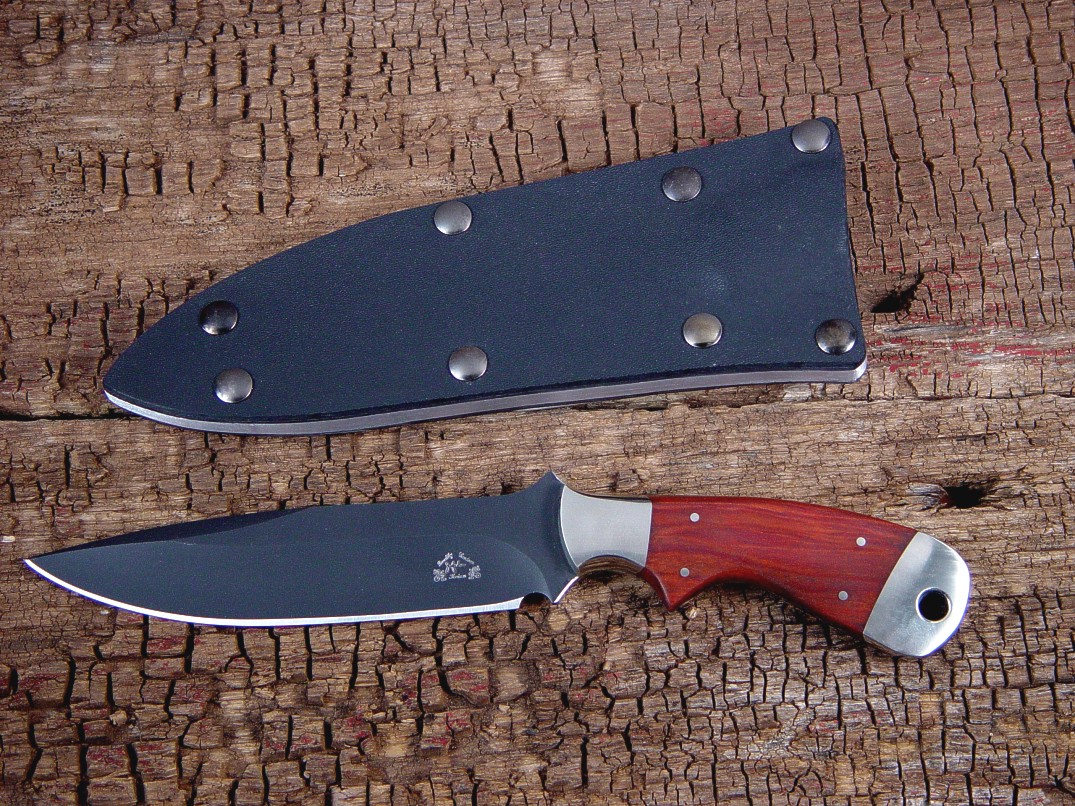
The most important rule to remember is:
Do not store the knife long term in the sheath.
Long term storage in the knife sheath does not allow the metal to breathe, and condensed
moisture can accumulate in the sheath body no matter the climate or environment. This
will lead to rusting and pits on every type of knife steel. If the knife is to be stored,
keep it near the sheath, but not in the sheath, in a stable, dry environment. I talk about this
subject in great detail at
this bookmark
on my FAQ page.
Page Topics
The expectations of life depend upon diligence; the mechanic that would
perfect his work must first sharpen his tools.
--Confucius
The only way to have a worthwhile combat, tactical, rescue, and service duty knife that is
up to the task is to keep it ready. Ready means sharp, clean, maintained, and prepared for
immediate action, perhaps in defending your own life.
Thankfully, modern tactical and combat knives are made with durable, tough, and reliable
modern materials (or should be) that are fairly easy and simple to maintain. Below is a
more detailed version of the standard
list of details that I typically hand out with each tactical and combat knife I make, with some
current bulleted and clear points to keep your investment, tool, and weapon in the best shape.
- Blade Steels:
The main long-term concern with
blade steels is corrosion. It is important to understand that there
is no absolute corrosion-proof tool steel. These blade steels have varying
amounts of alloys, which dictate their hardness-toughness
range, wear-resistance, and corrosion resistance.
Knife blade steels are discussed in greater detail on my
Blades page.
There you will find resources, instructions, and links about
sharpening.
- O-1 High Carbon Tool Steel:
I use a high tungsten-vanadium alloy oil-hardening version of this tool steel available in
several finishes: bead blasted, satin, mirror, and hot blued.
This steel has very little corrosion resistance and will easily
and readily rust if not cared for. I frequently hot-blue my O-1
blades for increased corrosion inhibition but this does not
absolutely eliminate the potential for rust. O-1 blades require the use of a coating to
protect the steel from corrosion. I recommend a silicone resin-based car wax, as
it is the most durable and serviceable and is readily available.
An alternative (that is a little harder to find) is Briwax®,
which is a heavy, durable, natural, and long-lasting wax created
for fine furniture. Always clean the blade with gentle
detergent, rise in clear tap water and dry before applying. Follow the
directions on the container. Microcrystalline waxes work too,
but the coating is not as thick as with the silicone car wax
or the Briwax®.
Some light fogging is typical on hot blued and bead blasted
blades if wax is applied; this is the wax accumulating in the
low points of the surface.
More about O1.
- D-2 Extremely High Carbon Die Steel:
Since it has 12% Chromium, it does have aqueous
corrosion resistance, but less resistance against acidic or
caustic exposures. D2 is at the lower end of stainless
steels and is not as corrosion resistant as higher chromium
types like 440C, ATS-34, CPM154CM, CPMS30V, and others.
D2 is a very tough, extremely wear resistant tool
steel that can be tempered very hard, but requires some care. I recommend the same care as O-1 above, though it is
much harder for D-2 to oxidize and corrode. Prolonged exposure to acidic fluids such as
orange juice or blood will corrode the blade. It is normal for mirror polished
D-2 to have a noticeable "orange peel" granularity due to the chromium carbide
crystal structure.
More about D2.
- 440C High Chromium Stainless Steel:
This is the most corrosion resistant of knife steels, and with 17%
chromium, requires little care. Suitable for temporary saltwater
use and lightly corrosive environments, it is recommended to
rinse in clear water after use so salt and contaminants do not
accumulate between bolsters, guards, and around mechanisms. If
corrosive fluids: soda, fruit juices, salt water, sweat or blood
are left on 440C to dry, corrosion and rust will appear. For
ultimate protection, use a silicone based car wax or Briwax®.
More about 440C.
- ATS-34 High Molybdenum Stainless Steel:
This is the same as 440C, but three to four percentage
points of chromium have been replaced with molybdenum for extra
toughness at high hardness. This lends itself to allow a smaller
cross sectional blade geometry, and a thinner serviceable grind.
Care for as 440C, but do not leave acidic fluids on the blade.
It is not as corrosion resistant as 440C but is a true stainless
steel. For ultimate protection, use a silicone based car wax or
Briwax®.
More about ATS-34.
- CPM154CM High Molybdenum Crucible Particle Metallurgy Stainless Steel:
This is very similar in alloy components to ATS-34 above, but is formed by the
crucible particle metallurgy process. The process leads to a
finer, more even distribution of alloy components in the
billet. I believe that is what makes this stainless tool
steel more corrosion resistant than ATS-34, perhaps as much
as 440C. For ultimate protection, use a silicone
based car wax or Briwax®.
- CPMS30V, CPMS90V High Vanadium Crucible Particle Metallurgy Stainless Steels:
These are high vanadium stainless tool steels formed by the crucible
metallurgy process. Though their specifications claim that
they are more corrosion resistant than 440C high chromium
stainless steel, that spec assumes the same surface finish.
CPMS30V and CPMS90V (and the discontinued CPMS60V) can not
be effectively mirror polished, so bead blasting, satin
finishing, and etching are more commonly used for a surface
finish. This leaves a roughness in the blade surface, which
makes the blade surface more susceptible to corrosion than
mirror polished 440C. For ultimate protection, use a silicone
based car wax or Briwax®.
- Bolsters, Guards, and Fittings:
In my combat, tactical, law enforcement, and military service duty knives, I
opt for tougher materials than many other types of
knives, but since this is a custom affair, a variety is
offered. Bolsters, guards, and fittings are discussed in greater detail
on a dedicated page.
- Brass:
Most of the brass I use
on tactical knives these days is Naval brass, a
zinc-copper alloy that has a high tin content (type
464). This makes it very strong with a high
resistance to corrosion in sea water and marine
environments. But all brass can darken and corrode,
and the patina that is formed can be removed by
buffing and polishing with any brass polishing
compound or Simichrome® metal
polish. An application of silicone based car wax or Briwax®
helps preserve the finish.
- Nickel Silver:
This is actually called a
"white" brass, in that it contains copper, nickel, and sometimes
zinc, but no silver. Nickel silver is highly corrosion
resistant, much more than brass, but may have a hint of patina
and cloudiness over time. The surface and finish can be
restored with any brass polishing compound or Simichrome®
metal polish. An application of silicone based car wax or
Briwax® helps
preserve the finish.
- Carbon Steel:
I rarely use plain carbon
steels (low carbon steels) by request, usually for knives that
have black blades and cold-blued bolsters. Though cold-bluing
can inhibit corrosion slightly, it is by no means a rust
preventative and must be reapplied throughout the life of the
knife (just like a wear area on a blued steel firearm). Follow
the instructions with the cold blue solution, and an application
of silicone based car wax or Briwax® helps preserve the finish.
Like the blades, do not oil, as oil attracts dust and can
accumulate in sheaths, weakening adhesive bonds.
- 304 Stainless Steel:
This is my most
commonly used and most preferred method of bolstering, guarding,
and pinning or screwing the fixtures, handles, and fittings on my knives.
304 stainless steel is a high nickel, high chromium austenitic
stainless steel and is also called 18-8, the stainless
material used to make stainless steel nuts, bolts, and
fasteners. It is extremely tough, fairly hard, and extremely
corrosion resistant. In fact, it is the most corrosion resistant
fitting material I've found. Care is... wash and dry and that's
it!
- Handles: For tactical
combat, service duty, professional and law enforcement knives, a
surprising variety of handle materials are used, with one thing in
common: they are all mostly care free:
- Woods:
I use many different types of exotic and domestic hardwoods for my tactical
knife handle materials. Most are very durable, and
only need physical protection from metals and abrasives
that can cut and scar. Do not soak wood handles for
extended periods in water, as this can lead to
swelling in most woods, which will loosen pins and
weaken bonds. Wet only the surface of the wood if
necessary while cleaning. A mild soap and water
solution should remove any dirt and debris, followed
by a rinse, dry, and good waxing and hand buffing to
restore luster and offer some protection. Though the
same silicone based car wax can be used to protect
the wood, there are very fine and durable wood waxes
like Briwax®, that offer
heavy duty protection while sealing pores of most
hardwoods. More details on my
Wood knife
handles page.
- Stabilized Woods: Stabilized woods and
laminates like Dymondwood are plastic-impregnated woods that are
fairly impervious to moisture penetration and most contaminants
and are much more durable than most plain woods. Though they are
more moisture and exposure resistant than hardwoods, I would not
recommend immersion for long periods of time, as the wood
fibers could swell. Care for as woods above.
- Micarta Phenolic: Micarta phenolics are
tough, durable, waterproof, and long-lived. Whether bead blasted, satin
finished, or highly polished, there is little care needed for
micarta. Micarta can be physically abraded by metals and abrasives. To restore the visual contrast and appearance, the
micarta handle can be lightly oiled with WD-40® water displacing
oil or silicone spray. Wipe off any excess. More details
on my
Manmade knife handle materials page.
- G-10 Fiberglass-Epoxy Laminates: These are
manmade materials that are tough, durable, and waterproof. G-10
is slightly more brittle than micarta but slightly harder. Care
is the same as for micarta phenolics above. More details
on my
Manmade knife handle materials page.
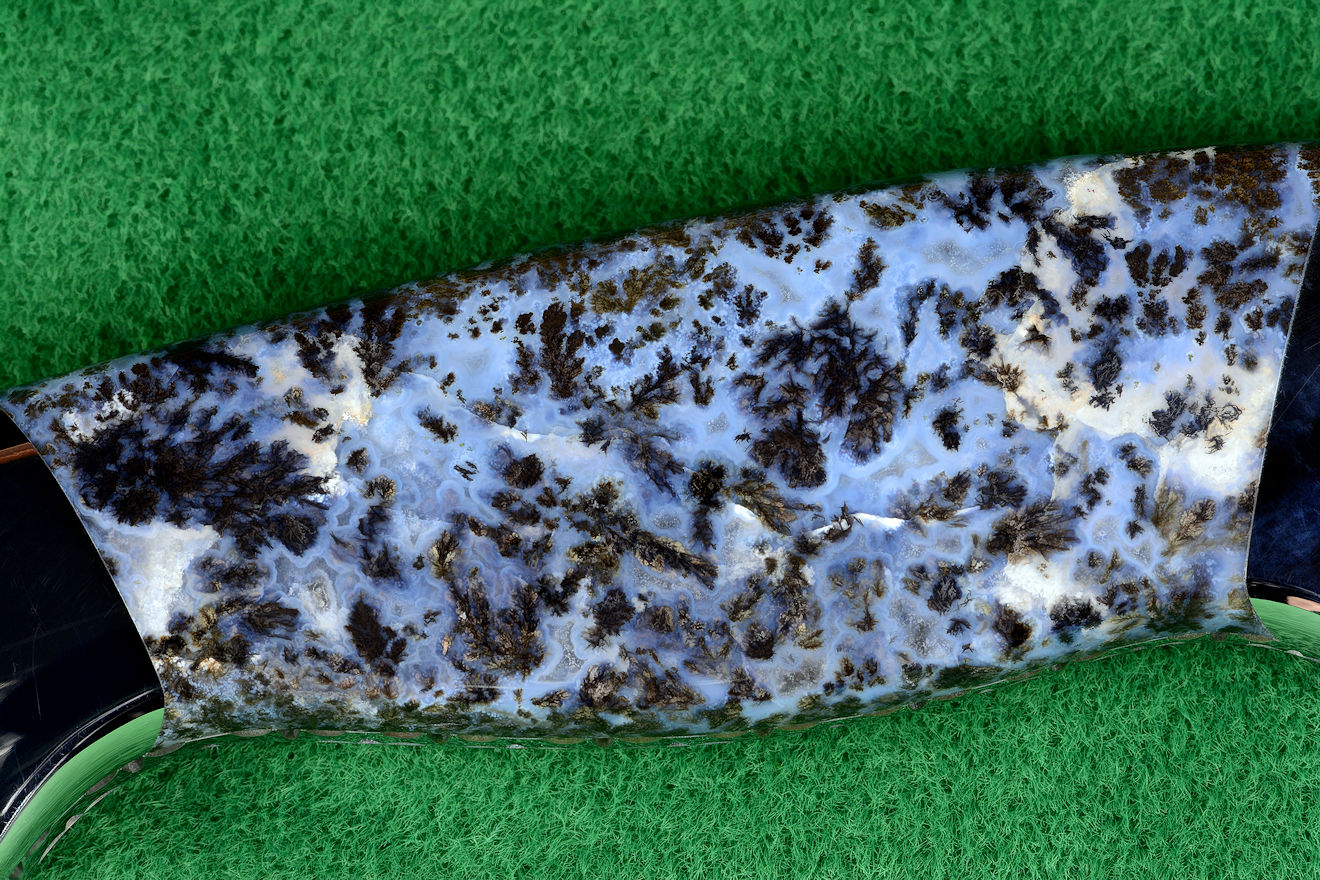
- Gemstone: Some of my tactical knife clients
have gemstone-handled knives. Gemstone is waterproof, tough,
durable, and hard, resisting most chemical exposures and
mechanical encounters, even with metals and abrasives. Care is
the simplest of all the materials: wash and dry. Wax them if it
makes you feel better, but they don't need it! More
details on my Gemstone
Knife handles page.
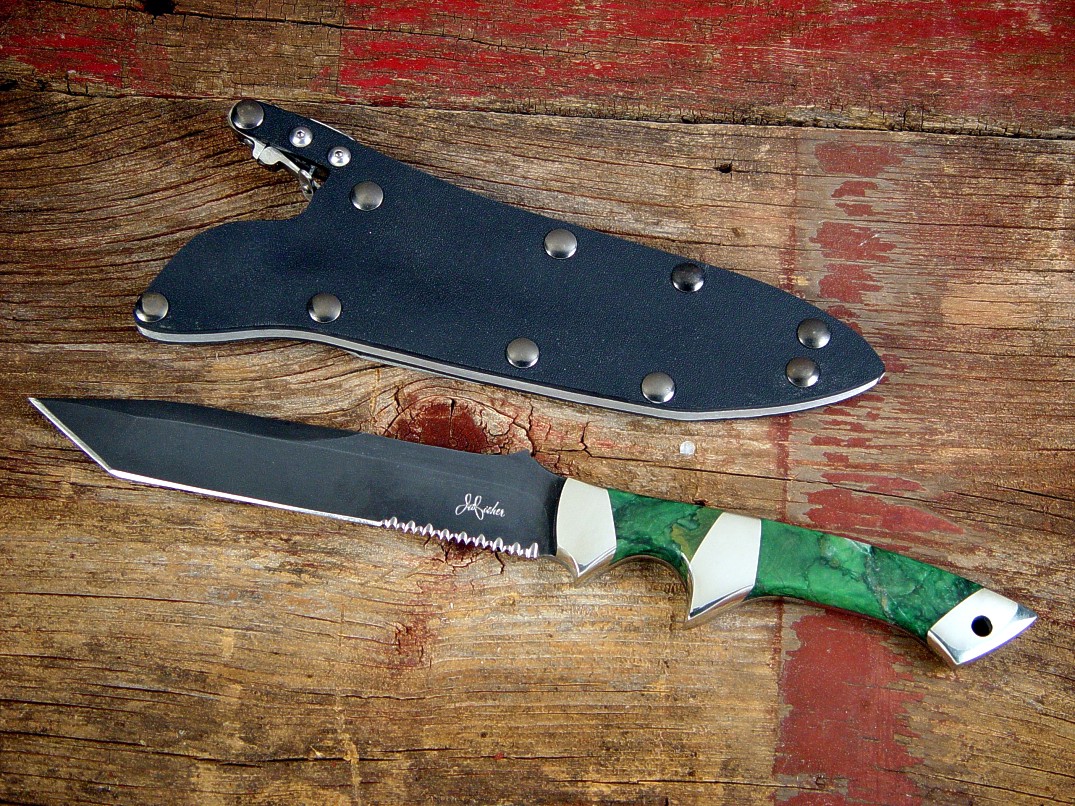
- Sheaths: Most of my
tactical knife sheaths are kydex, but some are leather, such as law
enforcement basket weaved styles. Details about all types of sheaths
on my Knife Sheaths page.
- Leather:
Care of the leather sheath is
necessary for long term protection. Leather is permeable so
should not be exposed to water or liquids. Keep clean and dry,
and lightly wax with Briwax® or
Renaissance® wax or other hard wax.
Avoid water based waxes like the silicone-based car wax
recommended for the knife blades above. Do not use
oils like Neat's-foot oil, creams, or balms like Mink Oil or shoe
waterproofing as these can soften the leather, allowing it to
flex, and the knife to poke through! These compounds can also
degrade and soften the adhesive bonds of the sheath, welts,
stitches, and belt loops. Use the hard waxes only on the cow
shoulder surface which is the main leather body, the welts
(sides) and not on inlays, if equipped. Wax around the stitches,
fittings, and fixtures well to protect these mechanical parts.
Hand-buff to a high sheen.
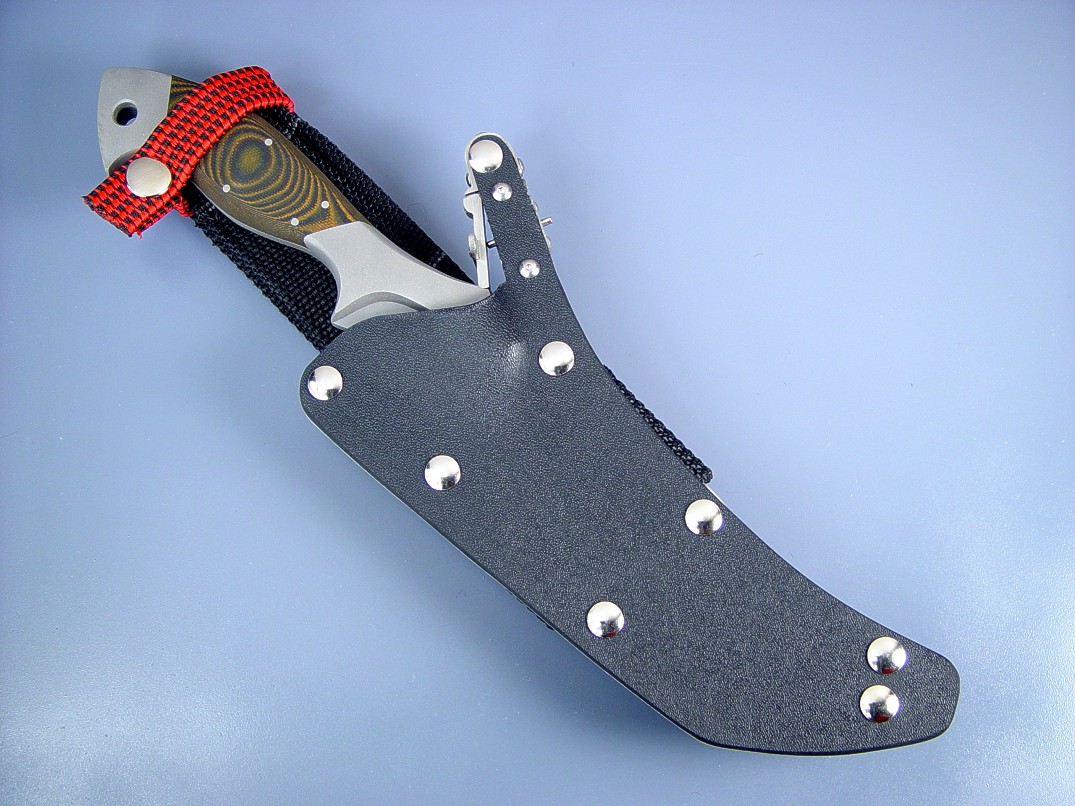
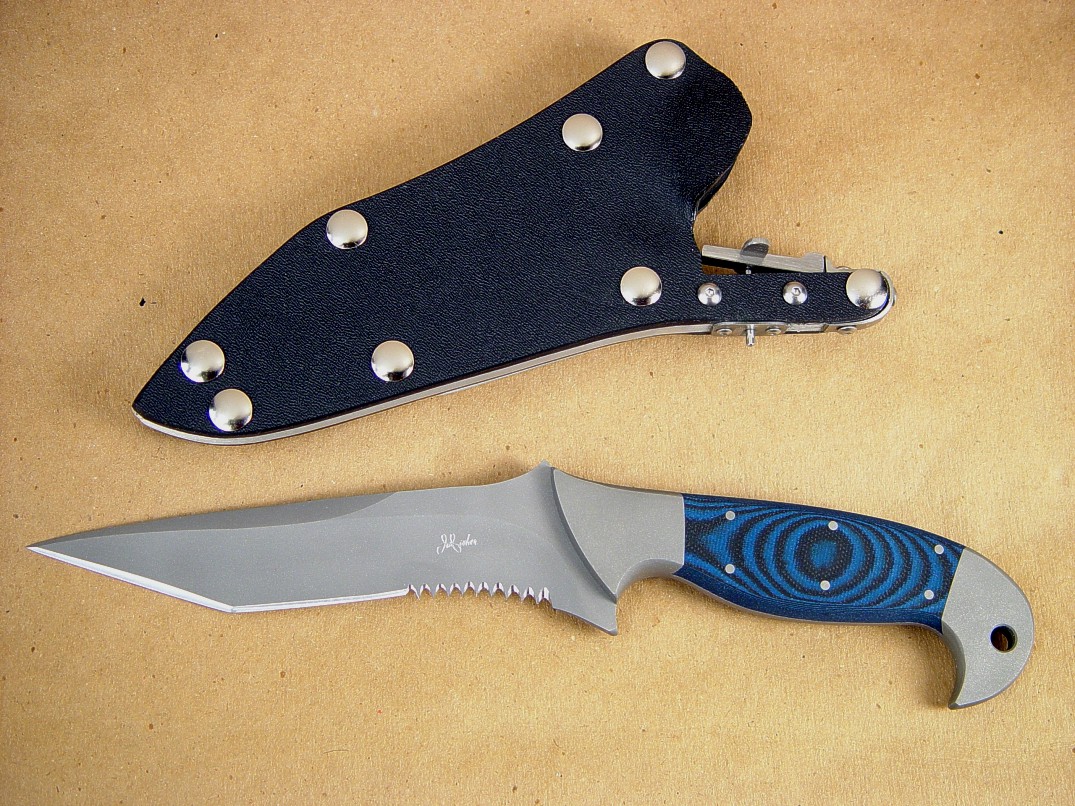
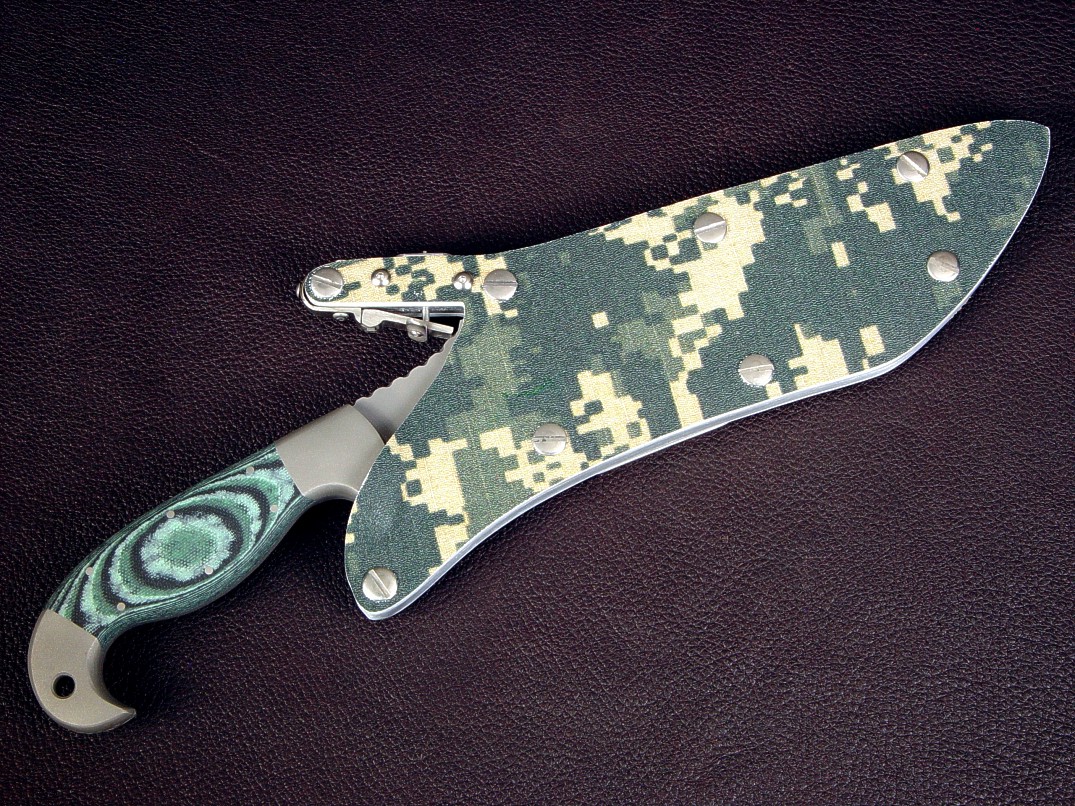
- Kydex (Tension fit):
My tension fit kydex sheaths are typically constructed over a
frame of 5052H32 corrosion resistant high-strength
aluminum alloy and are bolted together with steel
Chicago screws, which are blued, nickel plated, or
stainless steel. Very little care is needed as this
sheath is essentially waterproof. Clean with light
soap solution, rinse, and dry. To restore some
visual contrast and appearance of the kydex surface,
wet a paper towel with WD-40®
water displacing oil or silicone spray, and wipe the kydex. Do
not spray, soak, or immerse the sheath in these penetrating oils
or silicone liquids and do not spray the inside as they
will degrade and soften the waterproof cement
between the welts and kydex. Wipe off any excess as oils can
attract dust.
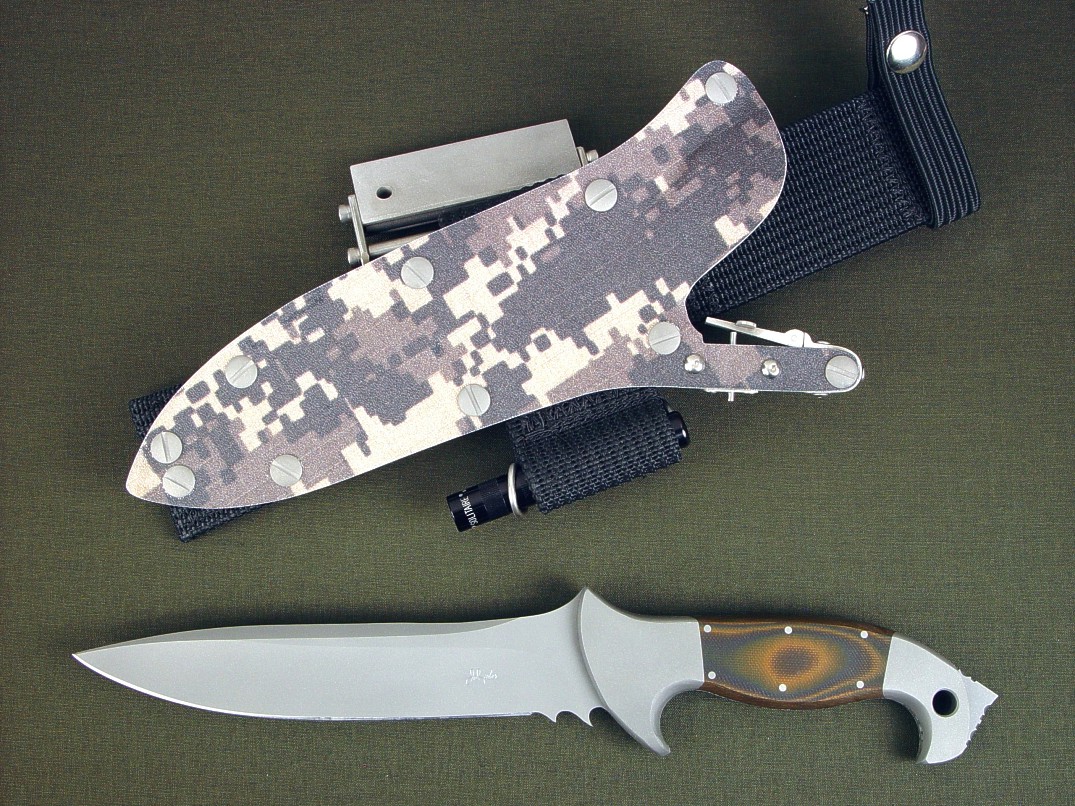
- Kydex (Locking):
The care of my locking kydex sheaths is the same as the tension fit
sheaths above. The only addition is the locking
mechanism which is all stainless steel. Corrosion
protection is not a worry, but the mechanism should
be kept clean and as free of dirt, mud, and debris
as possible, as this may prevent it from working.
Always keep the mechanism clean, and make sure it
operates. My locking sheaths have their
own page
with more detailed information.
-
Patterned or Color- dyed Kydex: This
applies to camouflage, Digi-camo, or any kydex
where the surface is a different color than the underlying
substrate.
These colors and patterns are dye printed into the
surface. While they are fairly colorfast, solvents
can dissolve them so they should only be cleaned
with soapy water and rinsed in clear water. The
surface will show scratches after a while, and the
colors can be touched up with appropriately colored
permanent marker, like Bic®
Mark-it. You may have to buy the large assortment of
colors (like Bic's Color Collection) to find a closely
matching color. The markers are durable and long-lived, and
the ink is acid-free.
Page Topics
Though specific care is listed above, I think it's important to offer some suggestions in cleaning the knife and
sheath that will make it easier to maintain the value, finish, and longevity of the knife as a weapon and tool.
- Mild Soap and Water:
make sure that this is the strongest cleaner you use on your knife and sheath. A
half of a teaspoon of dishwashing detergent in a quart of warm (not
hot) water is as strong as is necessary. You can dedicate
a worn toothbrush to your knife care kit, and after thoroughly wetting the dirt and soil, the toothbrush can scrub
away any debris. The toothbrush does not scratch the steel, but the soil and dirt may, so be carful here and
rinse away as much as you can without scrubbing. This doesn't usually matter with satin finished or bead blasted
knives, but mirror finished knives can be scratched with the quartz that is in sand.
Never use a wire brush.
- Do not use any solvents:
Though it may be tempting
to use brake cleaner, mineral spirits, denatured
alcohol, gun solvents, or other chemical solvents, do not use them.
They can attack the bonding and bedding agents of the
knife handle, and pull resins, oils, and waxes from
hardwoods, causing them to shrink. Don't use them on the
sheaths either; if your kydex is standard camouflage or Digi-camo patterned,
these solvents will dissolve the color right out of them! Of particular interest to my military
and law enforcement clients who use firearms: never use
any chemical cleaners used for firearms on your knife!
Military grade solvents like Mil-Spec CLP cleaner have
chemicals that dissolve carbon to remove crud from gun
barrels, and this will attack the carbon in the steel
blade, actually dulling the cutting edge and etching the
surface of the steel blade!
- Never use any compounds
to clean the knife or
sheath: It may be tempting to use rubbing compound,
polishing compound, or restorative compounds, but if it
has the word "compound" in the name it definitely has
abrasive particles in suspension, either silicon
carbide, aluminum oxide, garnet, quartz, or iron oxide.
These will abrade the surface of the knife, possibly
ruining the finish. Don't use them.
- Never use Steel Wool or Scotch-Brite®
or any abrasive pads, papers, wheels, or any surface
conditioning abrasives or pads of any kind on the knife.
Though they may be fine for a glass baking dish or your
tailpipe, you certainly wouldn't use them on your chrome
plated bumper because they will fog and scratch the
surface. Same for your knife; don't use them.
Page Topics
I think it's important to understand the difference between oiling and waxing the knife blades, handles, sheaths,
components, and accessories. We all have the image of the warrior oiling his blade in the firelight, keeping in clean and
slick for the upcoming battle. Of course, we also have the image of him sharpening it on a rock-
Neither of these practices are recommended. In my upcoming book, I go into where this practice and image comes from, but for
this tactical knife care page, I just want to cover the basics. The clearest way is a comparison
table:
| Oil |
Wax |
| Oil is wet. |
Wax is dry. |
| Oil is short lived, and distillate oils like WD-40 actually evaporate over time |
Wax is-long lived and lasts a very long time. |
| Oils can be easily removed by ordinary soaps and even salty water. |
Waxes can not be removed by ordinary soaps and salty water. |
| Oils transfer to anything they touch: skin, objects, and other components. |
Waxes do not transfer, and stay where they are applied. |
| Oil contains petroleum distillates which chemically react with plastics, epoxies, and adhesives. |
Wax contains lipids and typically long-chain stable molecules that have little reaction potential. |
| Oils are sticky and thus tend to hold dirt, dust, and debris. |
Waxes are slick and smooth, and do not hold or grip dirt, dust, and debris. |
| Oils will dry out, making them more sticky. |
Waxes are already dry, so do not change. |
| Oils can easily be rubbed off by normal physical actions. |
Waxes can not easily be rubbed off, and are actually smoothed and polished by normal physical actions. |
| Oils are easily removed by other chemicals and solvents |
Waxes are not easily removed by chemicals and solvents. |
| Oils are distillates, chemically and industrially produced. |
Waxes tend to be natural, produced by plants and animals. |
| Fine, museum grade collections are never oiled. |
Fine, museum grade collections are typically waxed for long term preservation. |
| Oils are easy to apply. |
Waxes are more difficult to apply, and must be rubbed out and polished. |
| Oils are common and inexpensive |
Waxes are more expensive, but a little goes a very long way. |
It's easy to see why I prefer waxing knife blades, sheaths, and components. Please make the effort to acquire
a good wax for your care kit, and apply it at least once a year. Work the wax into the crevices around the blade
to bolster or blade to guard junction, and keep a light coating on the blade. It will add tremendously to the long
term protection of the knife.
Page Topics
My military, combat, tactical, and service duty professional knives are made the best that I can make them,
but where you take your knife and how you treat it may have an effect on its ability to work for you when you need it.
Extremely high heat can affect the temper of any blade, so, obviously, don't stick your knife in a fire or heat source.
Knife temper starts to change over 300° Fahrenheit
(150° C), and epoxies, bedding agents, and manmade handle materials
start to break down at 325°F (160° C). In short, anything above boiling
is detrimental to a knife.
Sheaths are even more sensitive. Leather stiffens, dries,
and shrinks above 150°F (65°C), so you
can see that leaving the leather sheath in the bright
sunshine of a car window will definitely have a negative
affect. After overheating, leather can not be "brought back"
to its previous condition. Kydex is more forgiving,
but any high temperature exposure above 200°F (90°C) can
cause this thermoforming material to soften. On the other
end of the scale, kydex can become brittle below 0°F (18°C),
so avoid shattering blows when the sheath is this cold.
Page Topics
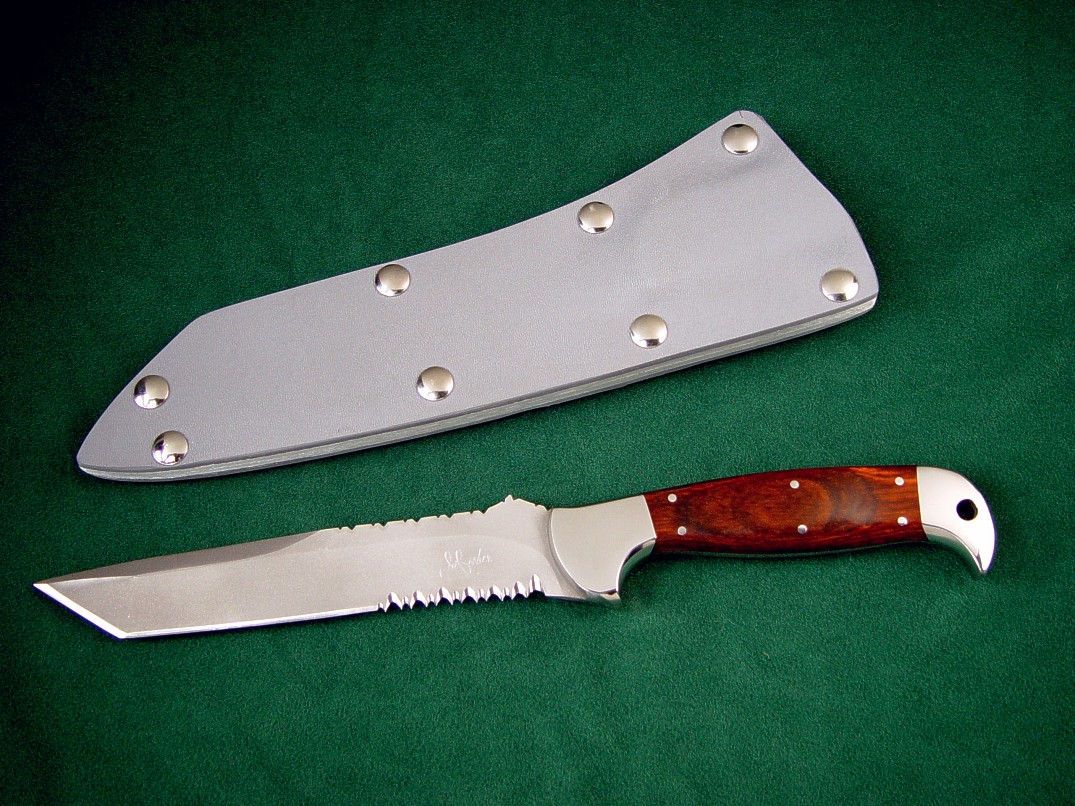
Unlike a knife collector who has stored his blade for years in a closet without looking at it and then discovers
to his horror that the blade has rusty pits deep into the mirrored finish, the tactical combat knife is more often
used, carried, and exposed to the elements. It is in the visual field of the soldier,
rescueman, or law enforcement professional fairly often (or should be) and so he can keep an eye
out for indicators of future problems.
- Corrosion:
if corrosion starts to appear, this will show up in several places. Hands are usually acidic, and corrosion can start to
show on the tang of a full tang knife. Any discoloration of the tang indicates the knife
should be cleaned, dried,
and waxed at the first opportunity. Darkening at the cutting edge may appear more frequently, as the knife blade
cuts corrosive materials, tissues, or objects, and has the cutting edge surface and relief more abraded. This is
usually nothing to worry about and will disappear with the next sharpening.
- Sheath Rubbing:
if you notice an area on the sheath that has
rubbing, be sure and check your rig, mounts, and equipment. Though
kydex is durable, it is a thermoforming plastic, and can be abraded
and worn, weakening it. Make sure your mounting method keeps the
sheath as close as possible to your body.
- Sheath Fasteners: If you've changed
the orientation of the kydex tension fit aluminum belt
loops, straps, or plate, be sure and check the Chicago
screws for tightness.
Page Topics
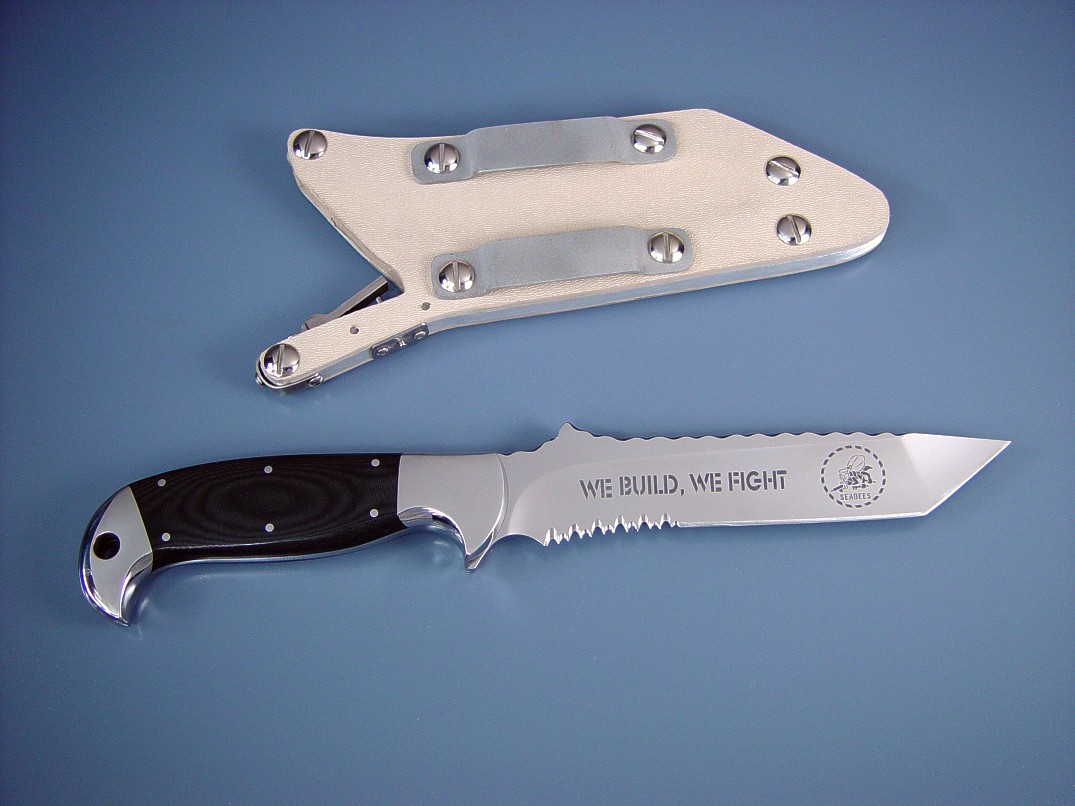
"If i get 8 hours to cut a tree i'll spend 7 hours to sharp my knife."
--Abraham Lincoln
You can sharpen your knife. Sharpening the knife is one of the most critical
operations a knife owner is expected to perform. There are some important things to understand
in the world of fine and custom handmade knives that can help tremendously with sharpening the blade.
- First, it may help to know that every knife dulls. There is no such thing as a blade that does not dull, unless it's a blade that is never used. No matter how
hard the steel is, no matter what the alloy, no matter how it is used, eventually it will dull. Humanity makes no knife that never, ever dulls.
All knives dull because they have thin cutting edges, and force and
abrasion are applied directly to that edge in many hundreds or
perhaps thousands of pounds per square inch. Even the hardest
material we know of, diamond, will wear down at an edge. Knowing this, it's clear that if you use your knife,
you will have to sharpen it. Clearly, you can dismiss any claims by
any maker or manufacturer of knives that they never need sharpening.
- High alloy, stainless, hypereutectoid steels hold better
edges at a high hardness than most other steels commonly
used for knife blades. If you have one of mine, you've got a very
good start on holding the edge for a longer time than any medium,
low carbon, hypoeutectoid, or lower alloy steel. If your knife made
by me is
cryogenically hardened and treated, it is in the best condition
the steel can possibly be, holding an edge for as long as possible.
Even though the hardest and most wear resistant steels will wear,
it's an extremely good start to have one of my knives.
- Sharpening is not complicated! While the
constant drive to sell sharpening products, devices, equipment, and
methods can be confusing, please know that sharpening a simple hand
knife is, well, simple. All you have to understand is the idea of an
acute angle. What these angles are and how to apply them to a
cutting edge is not complicated; it's extremely simple. Understand that
companies selling equipment to sharpen knives
are making money by complicating the process, suggesting that you
purchase their product to make sharpening simpler and somehow
better. This is not the case; they are simply selling their product.
- There is a classic, clear, and simple method to
sharpen knives available in print, and it takes about a half of an
hour to understand. Once you read it, you'll know exactly how to
sharpen every knife you may have, and you'll probably be eager to do
it. While you may read or see that the method is "dated," "old,"
"folksy," or described by other terms, know that the guy who wrote
this simple text was a sharpening consultant to industry,
including the meat packing and textile industry for 40 years. I
know of no current professional who has had such experience in the
field, and many years ago, he wrote a clear and simple text. You
need to get this book and read it. It's The Razor Edge Book of Sharpening
by John Juranitch (ISBN-10: 096660590X), (ISBN-13: 978-0966605907).
You can find it on Amazon and many other online sources; just plug
the title or numbers into any search engine. It's about $20.00 and
it will be worth every penny. Once you have it, you'll have a
simple, clear understanding of how to sharpen your knife. If I
thought I could improve on this method, I would, but even in the
most modern technology cutting edges, there is nothing that is as
clear and simple as John Juranitch's method for the knife owner and
user.
- You need a good stone. I use the word stone,
but know that I'm talking about a whetstone, a sharpener, bench
stone, and a hone. If you have one of my knives, I will suggest the
investment of a diamond abrasive stone. These are steel or
plastic-bodied blocks, with nickel plating adhering industrially
grown diamond particles on the surface. The best of these are made
by DMT (Diamond Machining Technology). The diamond stone is
expensive, but it will probably be the last stone in any particular
grit that you will ever buy. It will not cup, wear down, or clog. It
does not require water, oil or any liquid. It's durable, solid, and
wide enough to assure that your blade will not become wavy, which
happens with point contact sharpeners like rods, steels, tubes,
shafts, or cutters. Sharpening by hand will make sure the blade is
never microscopically heated at the cutting edge, something all
motor-driven edge grinders do, no matter how much water is used, and
no matter what the company selling these sharpeners claim.
- Two grits are necessary for complete
sharpening, and only one grit is required for simply sharpening an
existing edge without relieving. A very coarse grit is used to
establish the relief, and a fine grit to apply the cutting edge. I
usually recommend DMT's "Extra-Extra Coarse" (120 micron or 120
mesh) for the relief, and DMT's "Fine" (25 micron, 600 mesh) for the
cutting edge. You'll understand more once you read Juranitch's book,
and may wish to purchase other grits for your specific desires. The
only difference and change to Juranitch's method is the development
of diamond abrasive technology, which was not widely available at
the time he wrote the book.
Knife makers, distributors, hobbyist makers, and enthusiasts can get
very complicated about cutting edges. They suggest ridiculous
complexity, paper wheel abrasives, motor-driven polishers, complicated
angle-establishing jigs, holders, and guides. You don't need any of
these. As a knife client, you deserve to know the clearest,
simplest, most reliable and proven method to sharpen your knife, and
it's been established many, many years ago. Do you honestly think that
we have improved on a method that industry uses to dispatch thousands of
miles of cloth, material, and textiles? Do you think that packing plants
have some complicated and lengthy process to separate billions of pounds
of meat from bones? Meet the clearest method and the guy who advised
them in a classic, reasonable process that anyone can understand. Get
the book, read it, practice on some of your older, cheaper knives, and
be amazed by what you can do!
I have no relationship whatever to Juranitch's book, his family, or
endorsement of any kind, just like I have nothing to gain by
recommending DMT for diamond sharpening stones. These are the methods I
use, they work, and I simply suggest them because my clients deserve a
reasonable, reliable, and simple method to sharpen and maintain their
knife's cutting edge.
Note on serrations: If you have to sharpen
serrations on your blade, I've included a simple system to sharpen the
serrations I make on my knives on a
special section
about sharpening serrations on my "Serrations" page.
Need Details? More about knife owner sharpening on my 'Knife Care" page
at this bookmark. For more advanced details about
sharpening, please read my "Sharpening
and cutting edge types; Refinement of sharpening by the knife owner"
on my Knife Care page.
Page Topics
 More
More about this Ari B'Lilah
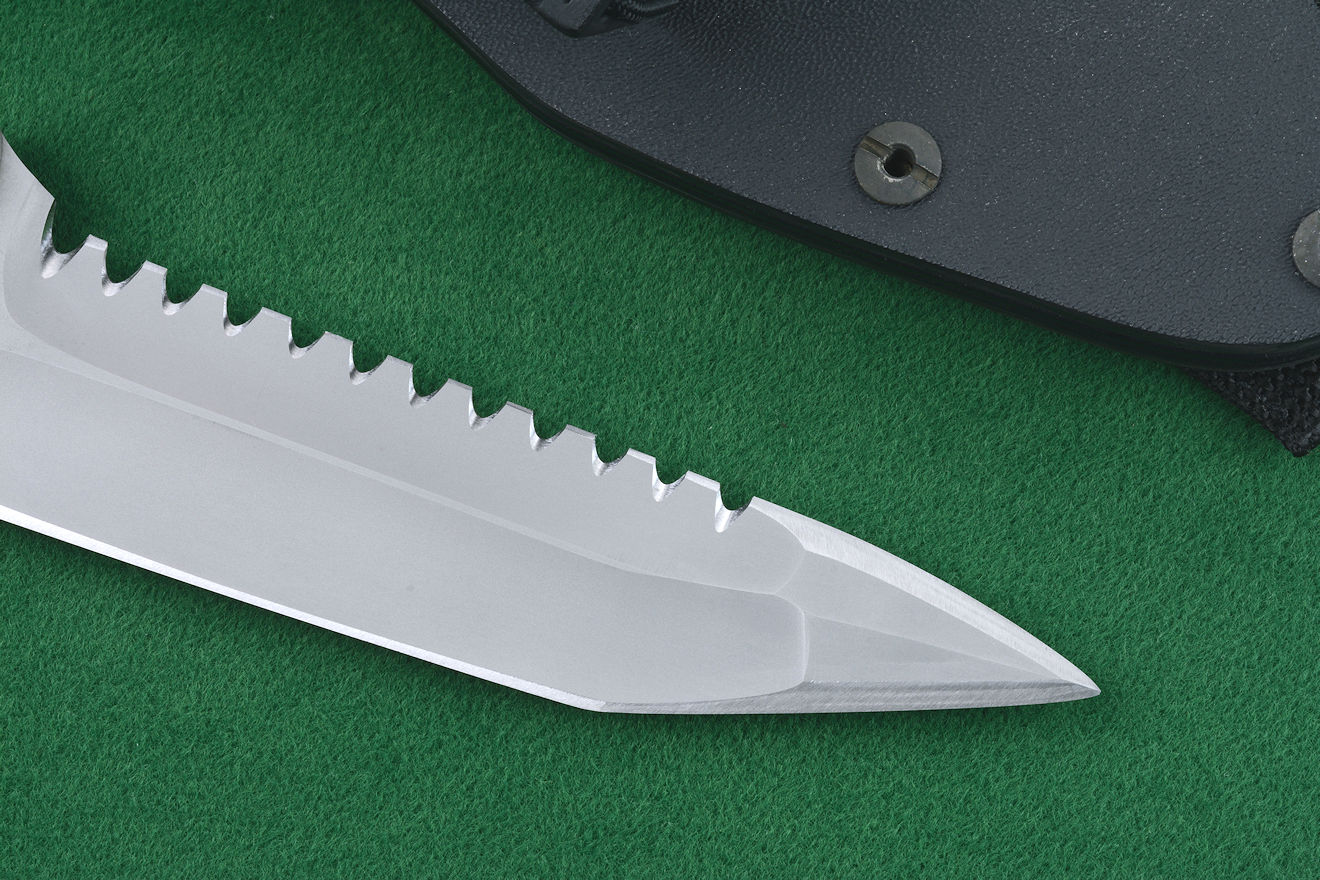
Knives may be commemorative models, that is, embellished with either machine or hand-
engraving, etched, and electroplated or electroformed with other metals.
- Machine engraving, hand-Engraving, or etching on blade:
There is no specific care required for machine engraving on the knife blade,
but debris may be removed by a wetting in mild soap and water, and scrubbing with an old toothbrush.
Apply wax to preserve.
- Electroplating or electroform on blade:
I electroform (heavy, thick, multi-component
electroplating) dissimilar metals on some knife blades. The harder
metals like nickel are very tough and durable, but gold,
copper, green gold, rose gold are softer metals and can
be rubbed off after years of polishing. Clean lightly
and never use any compound or abrasive cleaners,
keep waxed.
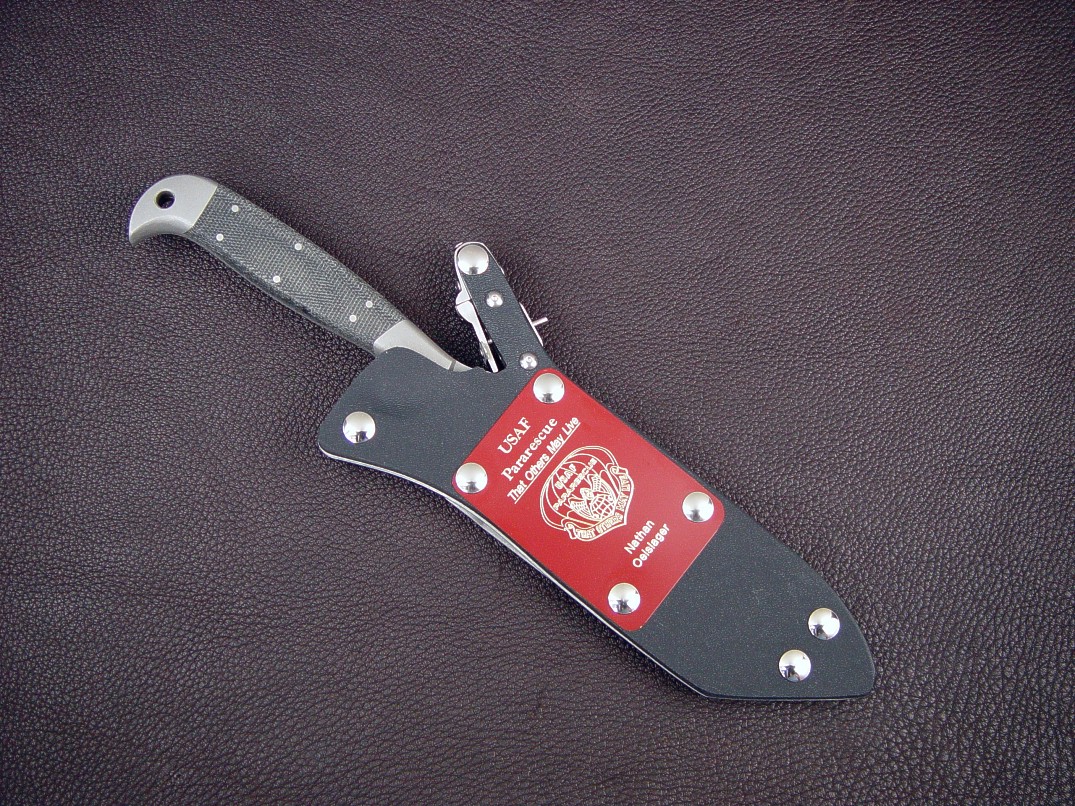
- Sheath flashplates: Some of
my commemorative or service duty tactical and combat
knives have machine engraved or etched flashplates on
the sheaths. The flashplates are easily removable, and
are typically removed and set aside for the knife's
retirement display. This also allows the sheath to have
a more subdued appearance. The flashplates are either
acid etched nickel silver or brass, or machine engraved
lacquered brass or aluminum. All types of flashplates
are easily scratched, so please be careful. A wetting
with mild soap and water and and cleaning with a soft
cloth is advised, not a brush. Wax as with the knife
blade.
Page Topics
The basic rules for any knife care are posted on my Knife Care
page, and here's a quick review:
- The weakest part of any knife is usually the tip, which happens
to be the most abused part! Take care of the point, and the rest of
the blade will follow.
- Never throw knives, unless specifically designed for that use. I
don't make throwing knives.
- Never use knives to pry, dig, or chop. Get a pry bar, shovel, or
axe instead.
- Do not leave knives and sheaths in direct sun or high heat.
Ultraviolet light oxidizes woods and bleaches the color out of some
gemstone. Heat bakes the protective oils out of most hardwoods and
weakens adhesive bonds. Prolonged exposure to the sun and heat can
also destroy knife sheaths.
- To clean, hand wash blades when necessary with non-abrasive
gentle detergent, rinse well and dry, then polish blades and fittings with good quality
polish like Simichrome®. Avoid abrasive
cleansers or textiles.
- Clean handles and sheaths with damp cloth and buff with soft dry
cloth. A light coat of Renaissance Wax or Briwax can bring back luster. Do not
over-wax. A very small amount goes a long way.
- Do not use any kind of oil on the sheaths; this will cause them
to soften, weakening their protective function, softening glues,
sealants, and dyes.
- Protect carbon steel and stainless steel knives with a light
coating of hand-buffed wax, not oil. Oil attracts dust as well as
weakens the sheath. Renaissance® wax is the best!
- Some carbon steel knife blades are blued
(related topic).
Nitrate bluing is a very thin patina that can eventually wear away,
leaving a gray metal finish. Sodium (gun) bluing is black, more
penetrating, but can also eventually wear away. These are hot blues;
used to temper, lightly protect, or cosmetically enhance the blades.
They are rust inhibitors, not rust preventatives. Keep clean and
dry, wax as above.
- Chemical etching is used in the maker’s mark on my mirror
finished blades and for cosmetic enhancement. If you live long
enough to polish away the etching without the help of power
equipment, you won’t have any fingertips left!
- Wood handles usually benefit from a light coating of furniture
wax or Renaissance® wax or Briwax® and a good hand rubbing.
- Brass and Nickel Silver fittings can be hand-polished with
Simichrome® and lightly waxed for
protection. It is normal for some scuffing to show on the front
bolster or guard, this is where the sheath holds the knife
(related
topic). Polish brass often, coat with wax.
- For very long term storage, store your knife with the sheath,
not in it! The chemicals used in tanning of leather
sometimes react with moisture in the air, leading to corroding of
even stainless steels! Condensation even within military grade kydex
sheaths can invite corrosion. If you can't keep the knife in the
open, dry air, store with photographic quality desiccant in a
plastic bag apart from sheath.
- Keep knives sharp. Most accidents occur when dull knives are
pushed too hard. For sharpening: The Razor Edge Book of
Sharpening, by John Juranitch (Warner books 38-002) or go to
Knife Sharpening
(related topic).
Thanks for caring for your knife!
Page Topics