Jay Fisher - Fine Custom Knives
New to the website? Start Here
"Nunavut"
Jay Fisher - Fine Custom Knives |
|||
New to the website? Start Here |
"Nunavut" |
||
Jay,
Thanks again. The PJLT arrived Safely. Very nice! The blade is gorgeous. Balance is perfect at the
forefinger, and it feels weightless and natural in hand.
I have not explored the accessories yet, other than the sheath. The sheath itself is a work of art.
I am very impressed. As law enforcement officer, a diver, paratrooper and avid outdoorsman,
I have always sought out proper and secure carry systems. I have a few dive blades with click
in and press button release systems, but they don’t come close to your sheath for security.
It is a shame that I must release this blade to my Son, but he will definitely get real world
use out of it. I will be revisiting for another blade.
Thank you for the time, effort and craftsmanship that you put into the knife.
--R. in NY
What would a professional tactical knife user want? What might be the most serious needs and concerns with a true tactical combat or counterterrorism knife?
Of course, the knife itself is the main focus. Cutting ability, durability and edge retention (wear resistance), corrosion resistance, and toughness are paramount to dependable, reliable knife function. Consequently, most people begin their focus on the knife: the blade, the fittings, the handle.
Most people are not actual tactical knife users. A real tactical knife user encounters hand-to-hand Close Quarters Combat. You might think that this doesn't happen in modern times, but let me assure you, the real tactical, combat, and counterterrorism knife has many active functions, including CQC. The functions are not limited to combat; the knife may be use in other critical, often lifesaving operations.
When a person depends on a knife in a mobile situation (all mission and real tactical knife use is mobile), the function of the knife depends on the knife being present. How does the knife get to the mission? How does it arrive; how does it make it to the place it's needed? How does the knife remain present, accessible, with speed and efficiency, without being a safety hazard to the knife owner and user? Remember, a knife is simply an object, with a dangerous sharp cutting edge and point, and cannot be made safe on its own, in the hand.
The most important consideration for the knife owner is safety. A fixed blade hand knife is made safe by being secured inside a sheath. I'm not even considering folding knives, since a folding knife is inherently unsafe and should never be used in any tactical combat situation, ever.
If you expect your enemy to be wowed (or stopped) by the click of a three inch folding knife blade, you need to get out more and understand just how dangerous the world really is.
To make a fixed blade knife safe, it must be secured in a sheath. The sheath must be durable, and robust beyond what the knife and professional user is exposed to. Running, climbing, crawling, and fighting for life itself is inconceivably active, and beyond most people's understanding. The violent, crashing, thrusting, beating that a knife and sheath may have to endure must not have any effect on the owner, the knife, the sheath, and its position and accessibility on the body of the wearer. By the time any of this violent activity happens, the knife is usually the very last defensive tool and weapon. Merely riding on the hip in a loose, casual way, like a decorative sash or adornment is NOT the epitome of fashion sense; it's inviting disaster or death itself.
Therefore:
A knife is not carried; it is worn. No one carries a knife into battle, it's borne with the gear that the tactical knife user is wearing. He may be carrying his rifle or his pistol in his hands, but even when they are not being carried, they, too, are worn in a holster or on a sling. A knife is ALWAYS worn, unless it's being used. This means that the method and device of wear must be adaptable, customizable, usable, convenient, and above all, safe.
This is why I make the knife sheaths and accessories the way I do. I want the knife to be absolutely secure when in the sheath (as my client wishes) and absolutely accessible. I want my client to be able to decide how he wants to wear his knife sheath, in what position, and with the devices and equipment that secure it as dependably and safely as possible. I don't want his knife ever to fail him; to punch through a thin plastic sheath if he falls, to slice through a thin bit of leather that dangles unsafely from a belt, to cut through, or wear through, or tear through a flimsy and hastily-constructed sheath.
The sheath, then, in many ways, must be stronger than the knife. Since this is not possible (the knife is, after all, high alloy, high strength steel) then the interaction of the knife and sheath when they are together solidifies and strengthens the entire assembly. The sheath must retain its shape, without bending or flexing; it must be very tough and durable; it must be entirely corrosion resistant.
The only exception would be leather sheaths that are worn in more casual, muted, or conventional methods, and even then, the leather sheath must be built to superior toughness and durability. Since this section is about tactical combat sheaths and the associated accessories and hardware, I'll stick to non-leather.
These requirements are why my locking sheaths, my hybrid-tension locking sheaths, and my tab-lock hybrid tension sheaths are the very best in the world, used by some of the top military and counterterrorism teams in the world. There is no one who has put as much thought, planning, testing, and refining into these sheaths, and no one who is even close to copying their design and function. Do you wonder why?
I'm obsessed with sheath performance. Call it personal, call it professional, and having made a career of knifemaking, I'll reveal that the sheath and accessories are the most neglected part of our entire tradecraft. More about that on my "Sheaths" page, but understand that I'm committed to make a sheath at the same level of competence and caliber as my knives, and I'm only interested in making the very, very best.
Why don't other knifemakers or knife manufacturers do this?
It's because this level of sheath and accessory quality is extremely hard to make, and no knifemaker, manufacturer, or company is willing to make a sheath that may well take more effort and cost more than the knife that is in it!
Sadly, the persistent idea—that a sheath is a mere afterthought—is one of the main failures of the knife industry overall, and the idea is stubborn and corrosive, weakening our tradecraft and science.
Why make the strongest, most wear-resistant, corrosion-resistant, and tough steel blade with the most durable fittings and handles and then cripple the knife with a flimsy, delicate, hot-molded kydex sheath held together with a few thin, hollow, weak eyelets more suited to a canvas awning, ladies purse, or child's tennis shoe?
This is why I claim (over and over) that if you want to know if a knife (and knifemaker) is truly combat-focused, take a very good look at their sheaths.
Because this level of sheath is difficult to make, few knifemakers attempt it. They claim that they are knifemakers, not sheathmakers; they try to deflect and distract; they even try to steer their prospective clients to leatherworkers or kydex-molders (or their wives) to make the sheaths for their knives—and this is just wrong.
A sheathmaker doesn't know how the knife works; he's just fitting it in a sleeve. He doesn't know if his client might need a positive lock or a variable hybrid mechanism that may change depending on his mission, he doesn't know in what position on his gear he might need to wear the apparatus. He doesn't know how to lock the knife in the sheath, or have variable tension on that lock. He doesn't know if the sheath will dull the knife, or if the knife may be able to cut through it. He doesn't know the temperature at which the knife and sheath will be used, nor the level of humidity, exposure, or pressure (in the case of dive knives). He doesn't know how and if the knife sheath with chemically interact with the knife, doesn't know how to shield or bed the cutting edge and point to protect it, doesn't know how to create a dedicated mechanism to lock or secure the knife into the sheath. By the way, the average knifemaker and sheathmaker don't even realize that the sheath is an apparatus at all, but consider it a little bag to stick the knife in!
The tactical knife sheath is then an apparatus that interacts with the knife, and, if correctly made, does these things:
This sounds like a pretty tall order! To ask this of a knife sheath is unheard of within our trade, a trade that, for the most part, considers most knife sheaths an inconvenient afterthought. Read more about this insidious attitude on my Sheaths page.
This section describes why I make the tactical, combat, and counterterrorism knife sheaths the way I do. In following sections and pages, I detail how this all works, and all of the accessories to make it all work.
...the locking sheath is brilliant, and I can't imagine a blade without one!
-J. S.
I've been making knives for a very long time. Decades ago (1995), I was making a lot of knives for United States Air Force Pararescue, our nation's top military rescue service. More about the PJs on a dedicated page on the site at this link.
Several PJs asked me if I could make a true combat-grade positively locking sheath, one that would hold up to the rigors of real combat, something that they could trust to have their knife ready at the instant, yet a sheath that would secure the knife and protect the wearer during the high energy activity of tactical, and rescue operations, often in combat. They requested that the sheath be "bulletproof," that is, as tough as I could make it without extra weight.
Although the knife sheath has always been the most neglected part of this modern tradecraft and art, the fully functional combat knife the sheath is the most important part of the assembly. No matter how the knife is designed, crafted, and suited to tactical or combat use, if it can't be reliably carried in a functional, dependable, and durable knife sheath, it is useless. A frustrating or impractical sheath will be left at home, or at base, and never worn on any mission, and the person who decides this is the knife owner and user. It is he that decides the ultimate effectiveness and convenience of the knife/sheath combination.
I've always believed that a tactical knife sheath is not merely something that looks stylishly tactical, covered in camo print nylon, or single layer thin kydex secured with weak eyelets. But this is all that is available from factories, manufacturers, and sadly, most modern knife makers. Simply put, there is a critical, essential need for a combat-functional knife sheath, commensurate with the quality and intended purpose of the knife.
After being charged with this mission of creating this type of sheath, I designed, experimented, and created various options with the input of military professionals. I listened and discussed, invented and tested, until I came up with what is clearly the most durable, reliable, and best tactical combat positively locking knife sheath made at that time.
Updating this page in 2021, I'll flatly claim that it is still the most durable, reliable, and now time-tested locking knife sheath made in the world. In fact, in the 26 years since I invented and created these sheaths, there has not been a single report of a failure of a single one. I have made hundreds of these sheaths, in service in some of the most demanding, dirty, wet, and torturous environments in the world.
Not one has been returned for adjustment, alignment, or service, not one has ever failed. How many other sources can claim a sheath that will last as long as the knife, a sheath of any kind, much less a waterproof positively locking sheath?
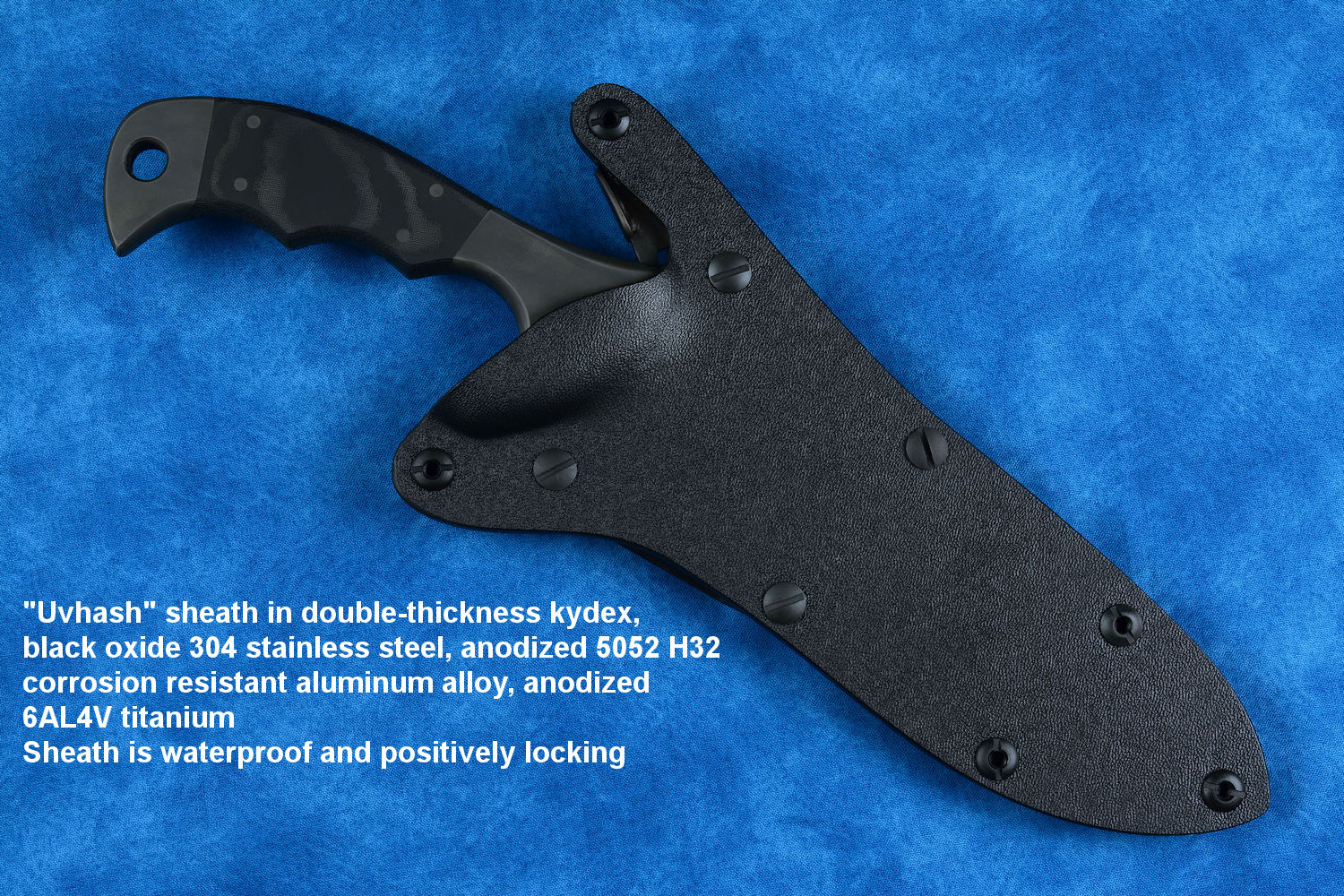
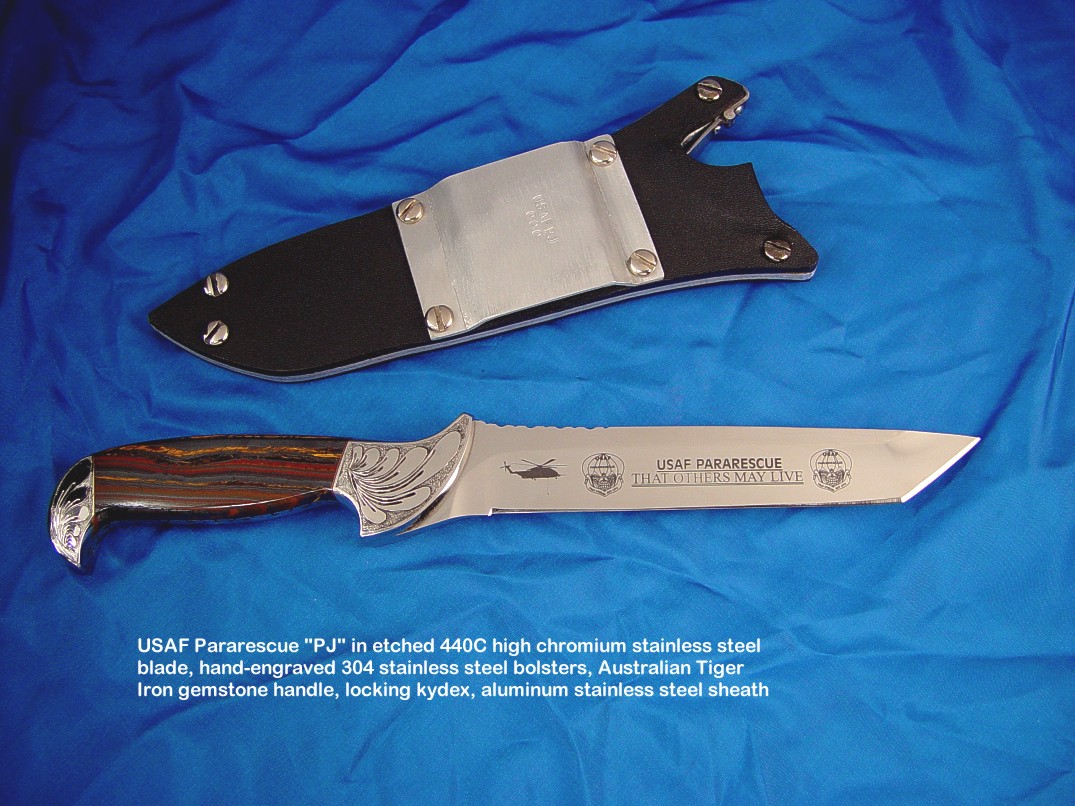
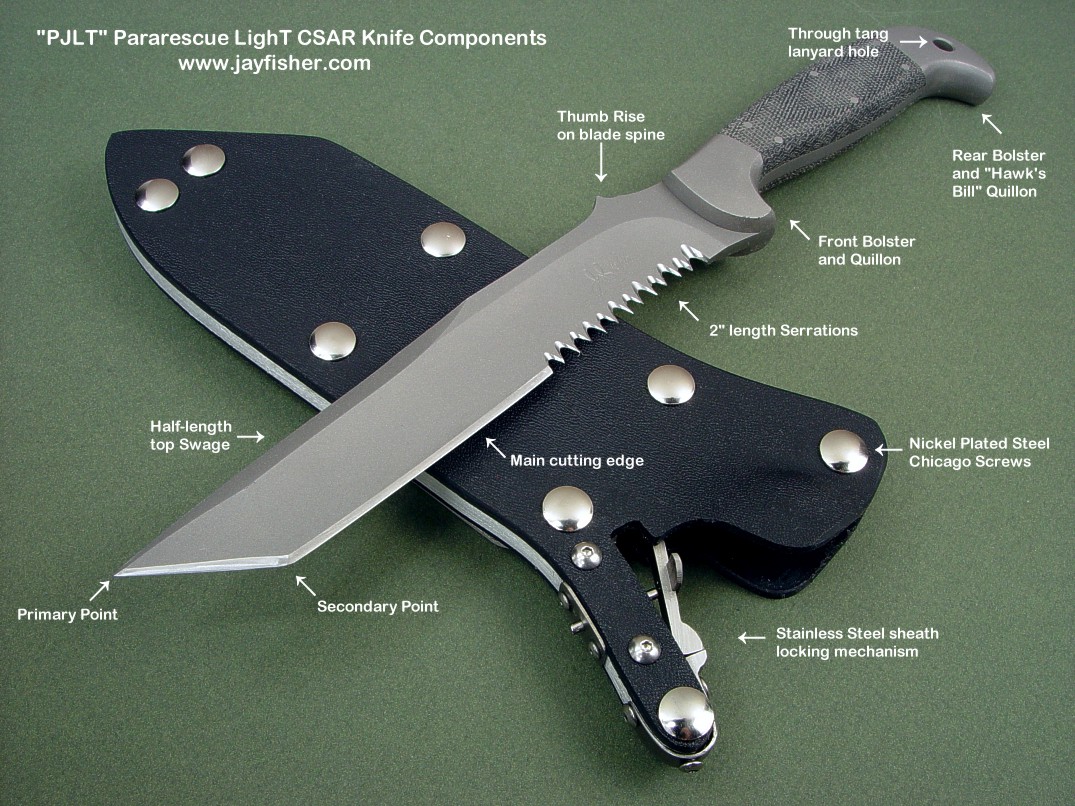
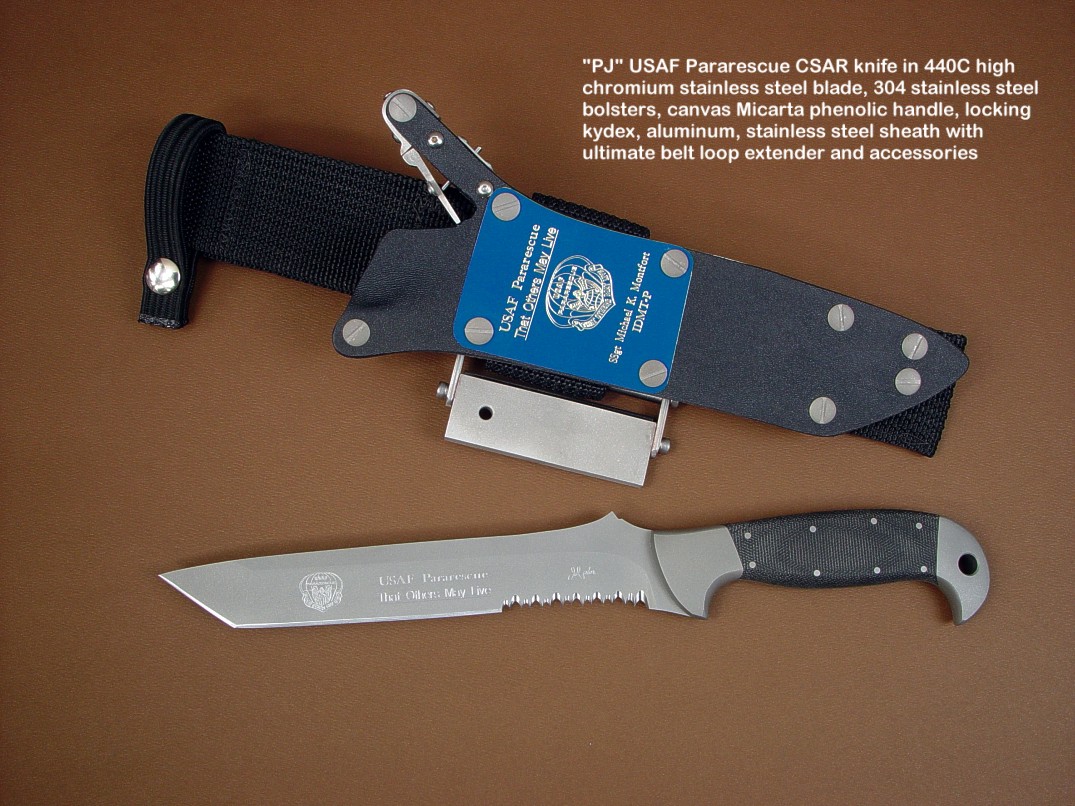
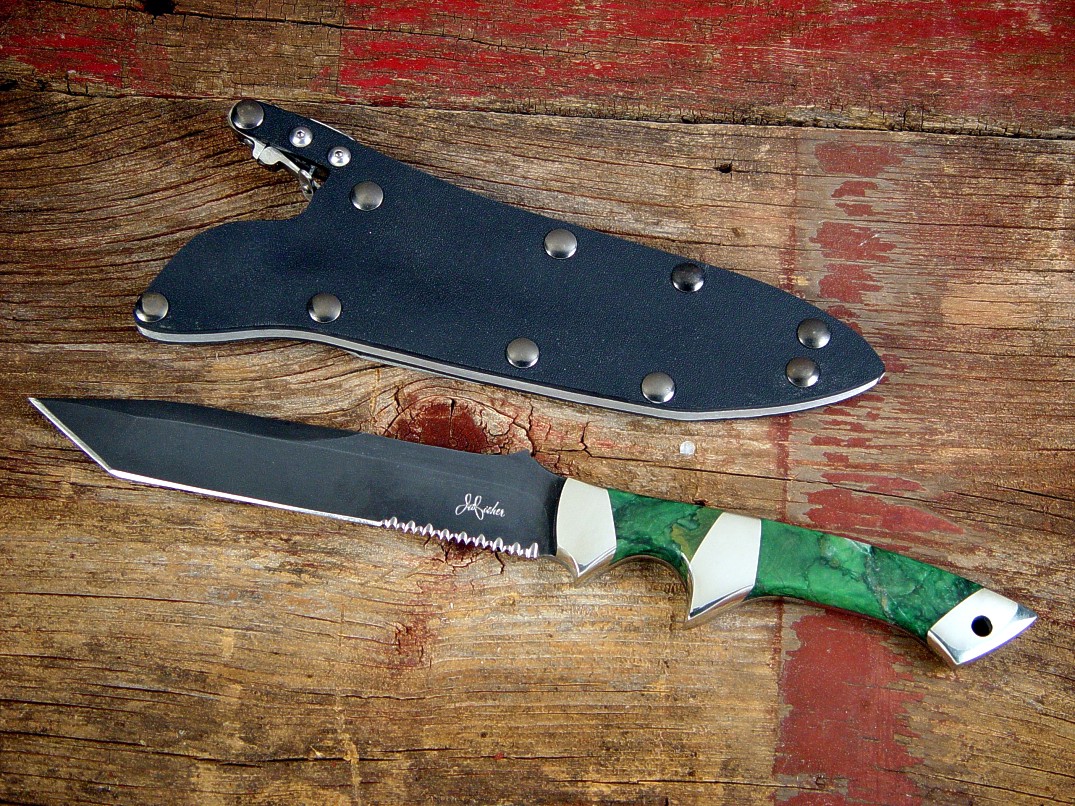
In Version 1.0 of my positively locking sheath, every component except the lift spring was external. An advantage of this design makes it easy to verify the locking components and operation by touch and feel alone, and also makes it somewhat easier to unlock because the thumb contact was outside of the aluminum welt frame. It's also very easy to keep clean and to see the position of the lock. The drawback of the design was the components were out in the open, and could hang up or possibly snag on textiles and materials.
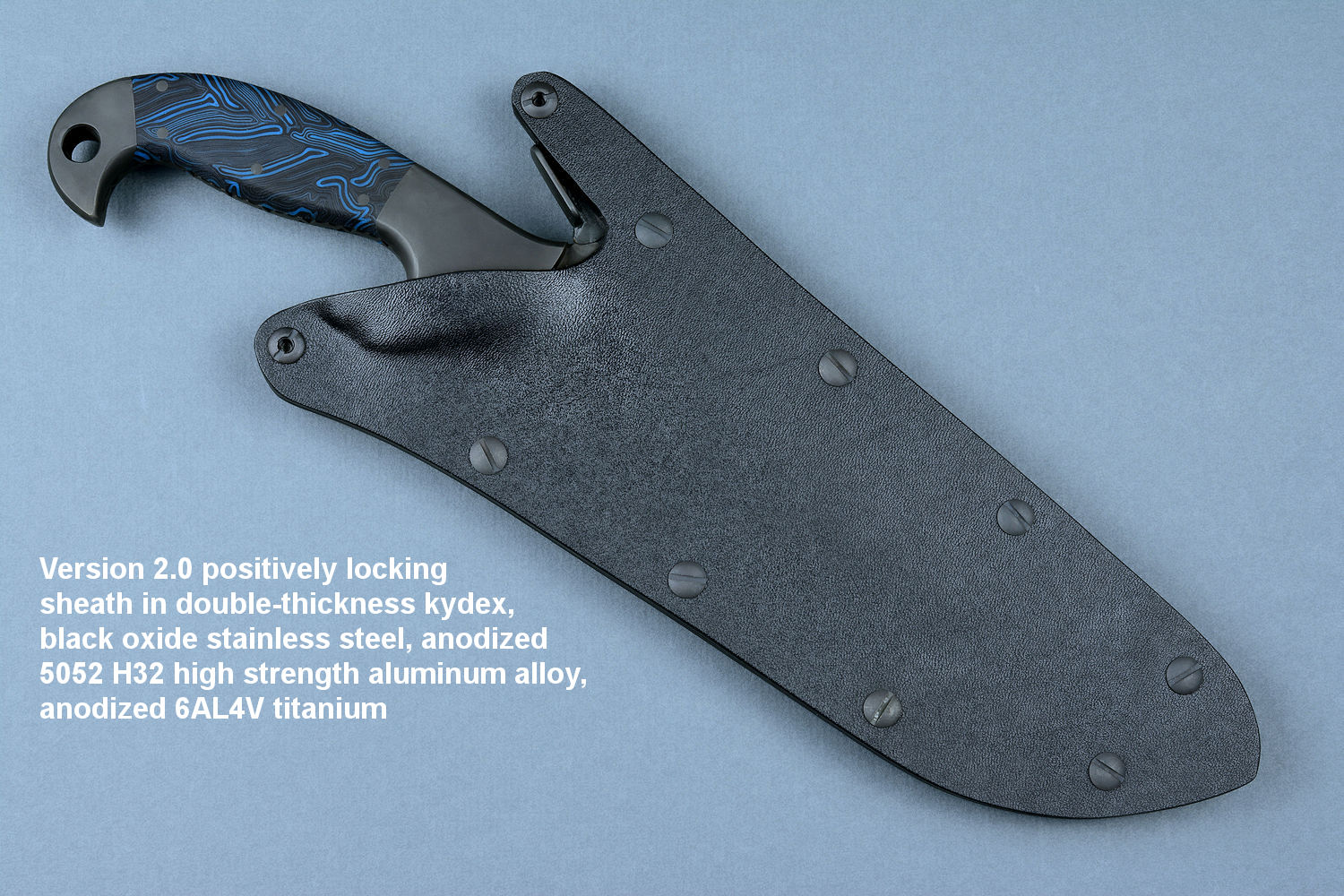
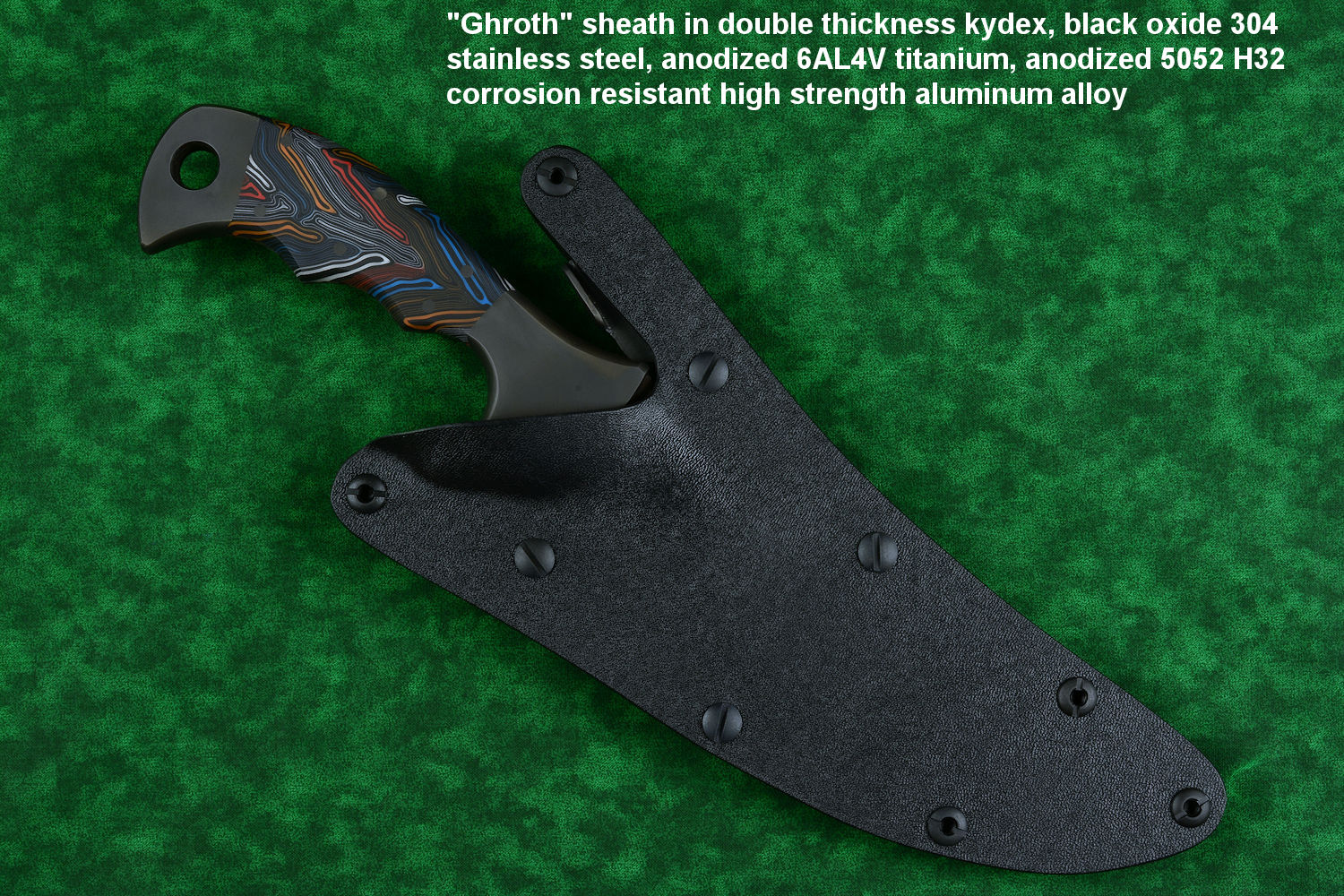
About 2018, I made a substantial improvement in the positively locking sheath, moving the operable components to the inside of the sheath welts. This is version 2.0. In Version 2.0, the mechanism and spring are protected within the aluminum welt frame. There are less pieces, the ramp is smoother, the exterior hinge has been eliminated. The spring is a titanium leaf instead of coiled stainless steel. There are fewer fasteners.
However, there is no perfect design, so the drawback of Version 2.0 is that it's a bit more protected and has a smaller ramp to operate the release. It may be hindered in operation in extremely muddy or soiled environments, even though that hasn't been reported yet.
I still make both types, depending on the knife, the client, and the commission.
You can see more of these sheaths on the various tactical knife pages of my site available through Military and Tactical Knives Portal Page. You'll be able to tell the difference between the two designs by looking at the mechanism where it engages in the knife spine.
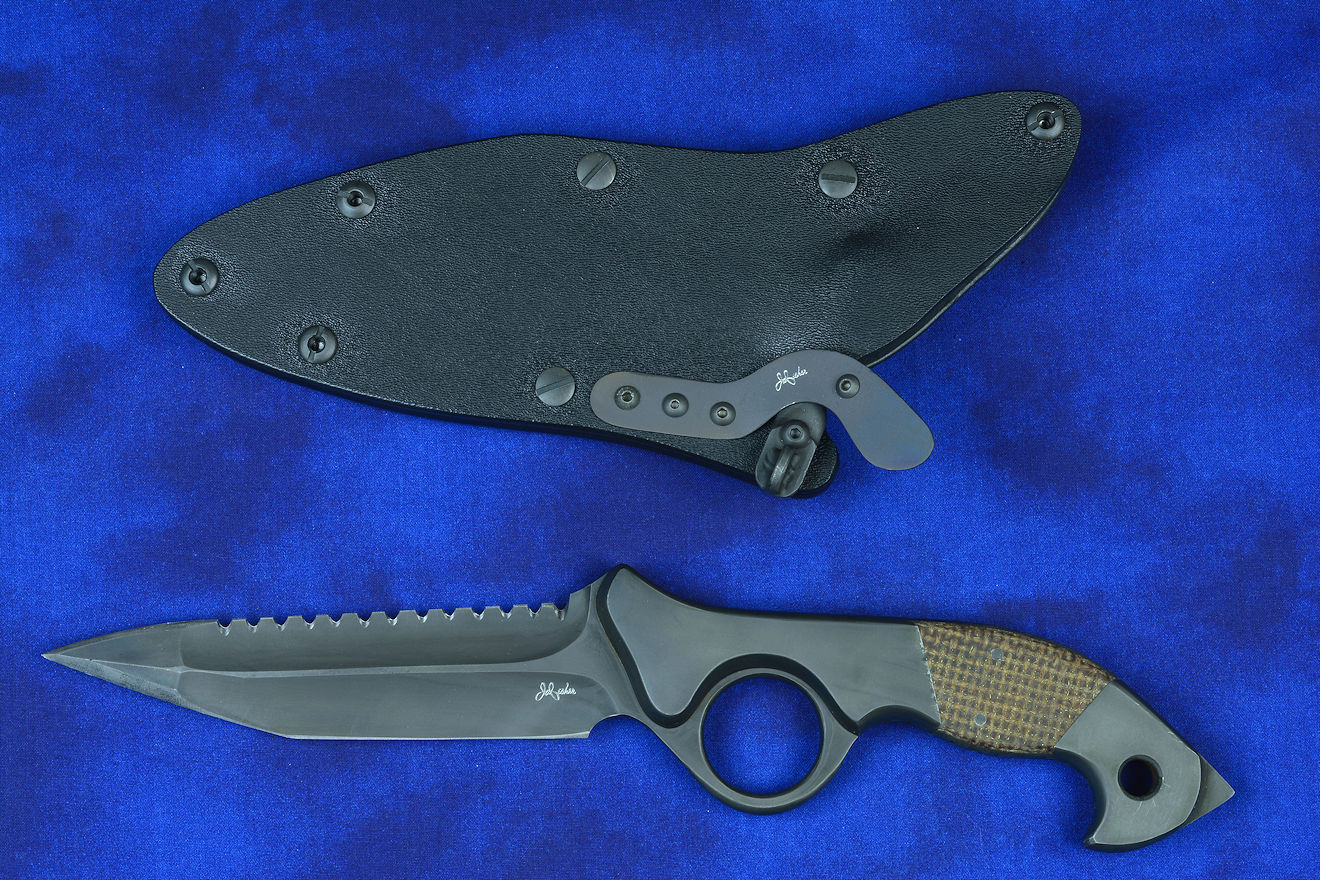
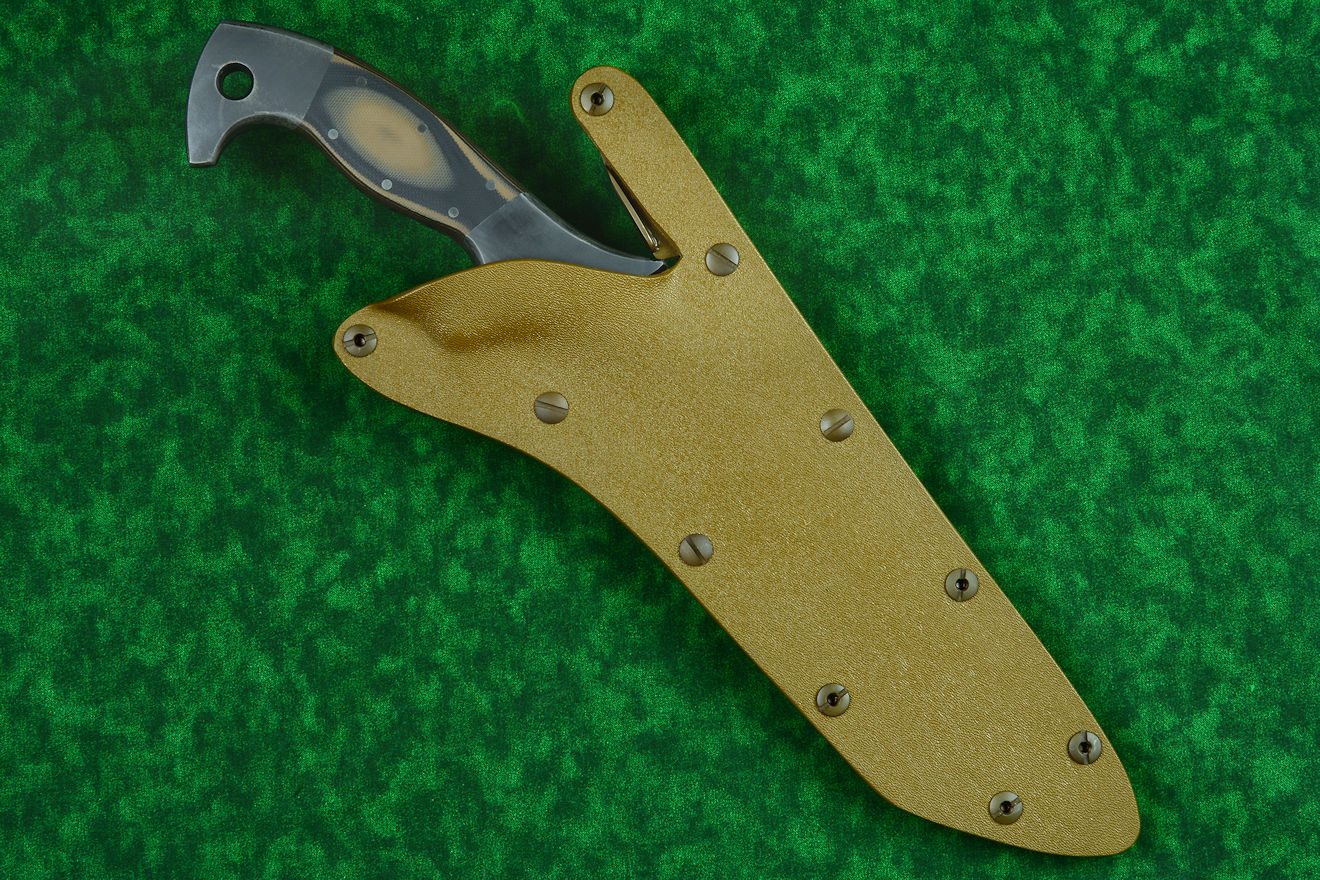
The positively locking sheath operates just as it is named, positively locking the knife in the sheath until it is released. In the simplest explanation, a boss (a projecting metal piece) of stainless steel engages a notch in the spine or thumb rise of the knife. The knife cannot be removed from the sheath until this stainless steel lock boss is displaced. The boss is displaced by a simple forward motion of the thumb when the hand grips the knife handle. The thumb—at the outside of the thumbnail—lifts the pivoting lock boss and the knife can be withdrawn from the sheath. The motion is natural and smooth for the human hand.
To lock the knife in the sheath, the knife is aligned into the sheath mouth and pushed forward until the lock boss clicks into engagement in the knife spine or thumb rise notch (or socket). A tug on the knife handle makes sure the lock has engaged.
There are limitations to this design.
It cannot be used on a double-edged knife. The lock ramp and boss would be dragged along the top cutting edge, dulling the knife as the blade contacts stainless steel. Worse, in unsheathing, a knife that has top edge serrations would engage the lock boss, preventing removal and tearing up both the stainless steel lock boss and the cutting edge.
Because of these limitations, both Version 1.0 and Version 2.0 can only be used on a single-edged, smooth-spined knife.
Consequently, this led to the design of my Hybrid Tension-Locking Knife Sheath (next).
There is only one way to make a knife safe, and that is to sheath it in a positively locking knife sheath made as strong as possible.
Hey Jay!
Just got the knife today. WOW!!! The pics you sent me did NO justice to the knife at
all. This is BY FAR the nicest knife I have ever owned!
I was also pleasantly surprised by how nice the sheath came out.
For the last few months I have been second guessing my decision for
the locking sheath. Now I am glad I went in that direction.
The pics I have seen of that sheath do not show how sturdy and well
built that thing really is. I think you may need to show a
side profile of that in one of the pics. That large slab of
aluminum will show people its more than just kydex bolted together.
I think your description says how it is built – but I didn’t
understand till I actually saw it in person!
Anyways, thank you for a GREAT knife! I will look forward to enjoying it for
many years! Also, I'm already planning my next one. You can be sure that I will be showing
it off to all my friends and letting them know about you and the
quality of your work! (most already know as
I've been talking about these knives for quite a while – but
I think they will be astonished when they see they experience your
work first hand).
Thanks again,
Adam Vuksich
The knife is part of the sheath; the sheath is part of the knife, in every way.
About 2011, I started experimenting with designs for a new sheath. The first issue with the positively locking knife sheaths (previous topic above) was that the design could not be used on a double-edged knife, because the lock boss would engage the knife's upper cutting edge. On some of the counterterrorism knives I was making at that time, the upper cutting edge was also serrated, which was even more destructive to any locking mechanism that contacted the spine of the knife blade.
Another issue was that—in an emergency—some knife users may not be able to locate and unlock the knife from the sheath quickly. I wondered if I could make a "limited effort" design. The idea was that a knife could be secured in the sheath, and it would take a certain force to unsheathe it.
This intrigued me. Could I make a knife that would stay in the sheath in nearly every circumstance, yet when 10 pounds of pull was exerted on the knife handle, the knife would be unsheathed? How about 20 pounds of force? 30 pounds?
This new design would be ideal for bolstered and unbolstered skeletonized knives as well. If it was simple enough, I could also lighten the sheath mechanism overall.
Just as with the positively locking sheaths (previous topic), there was a lack of extreme use and reliable knife sheaths in the real combat realm to make any comparison. Since I was in direct communication with counterterrorism professionals, I had their help, input, and testing. They helped me to create and perfect this critically essential sheath type.
The name is technically descriptive. It is a hybrid of a locking sheath and a tension sheath.
Nothing in history even resembles this design.
Tension holds the knife in the sheath, and the simple device locks it there. It is not positively locking; nor is it designed to be.
Nearly all other available knife sheaths offered for so-called "tactical" use are made by simply heating and bending the thermoforming kydex around the knife. They use the tension of the hot-formed single layer of kydex as the device to hold the knife in place. The problem is that kydex is not a spring, it will wear out quickly, since it's just a piece of soft, thin plastic.
To use soft, thin plastic as a knife retention method is a weak, ineffective, and flimsy way to make a sheath, but it is just about all you will see from factories and other knifemakers. They make them this way because the knives are not meant to last, they are cheap and inexpensive, and they are quick and easy to make. This is a decision based on the manufacturer or knifemaker's convenience, not the reality of the actual tactical knife user's needs.
The hybrid tension-locking sheath is a real-world accessory, made for continual, heavy use.
When materials rely upon tension, there must be movement and contact (rubbing) of one material against another. In the typical hot-formed kydex sheath, the steel blade, metal fittings, or hard handle material rubs against the soft, thin plastic kydex, pushing it out of the way, allowing the knife to slide by, and out of the sheath. The same action happens when sheathing the knife. Rub, rub, rub, abrade, scrap, tear, bend, until the knife sheath loosens and fails.
Nevertheless, those knives aren't made to last, so I suppose that doesn't matter. This type of sheath will also rattle and clatter as the sheath loosens around the knife. It's doomed to fail.
This is not the way I want to make a sheath.
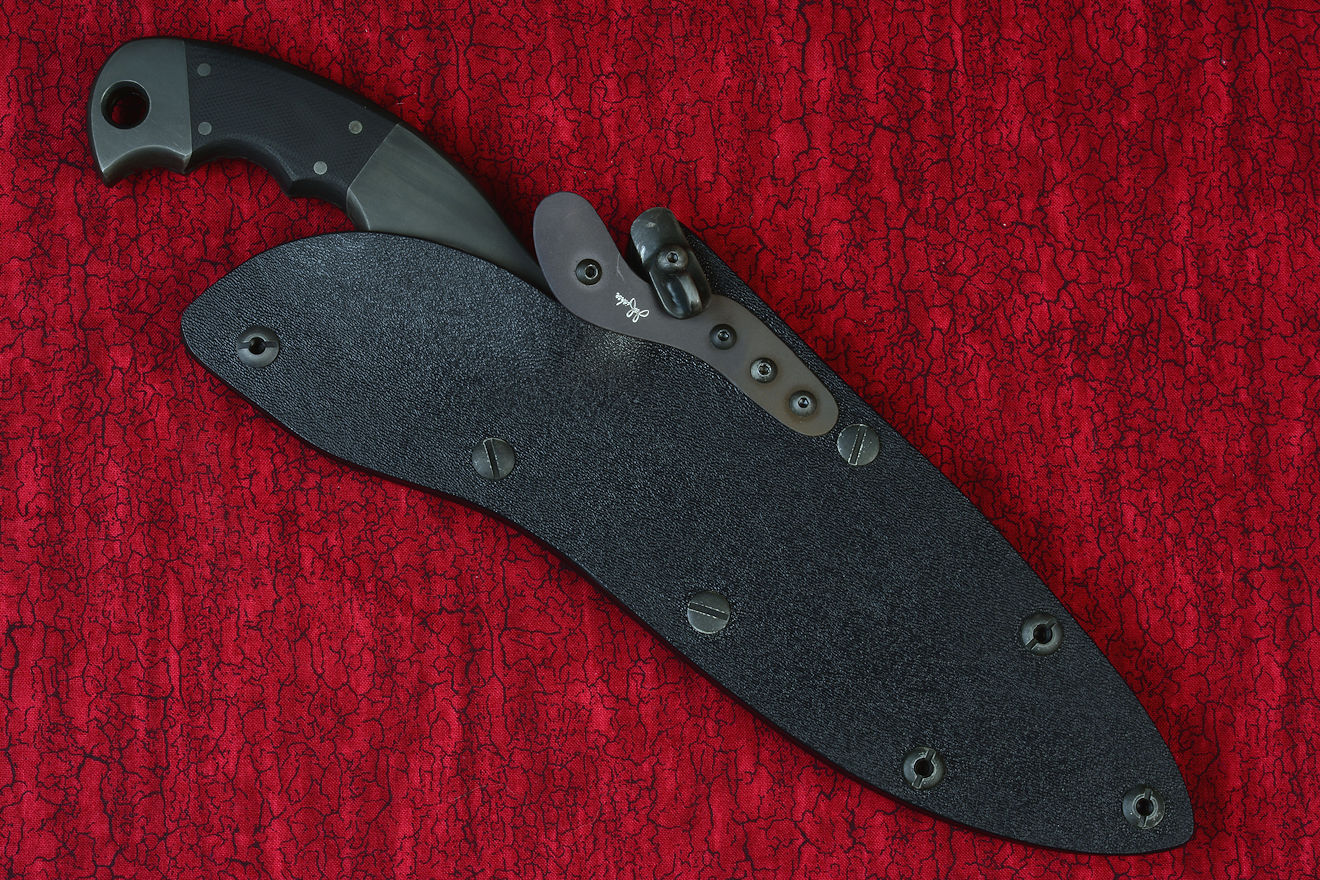
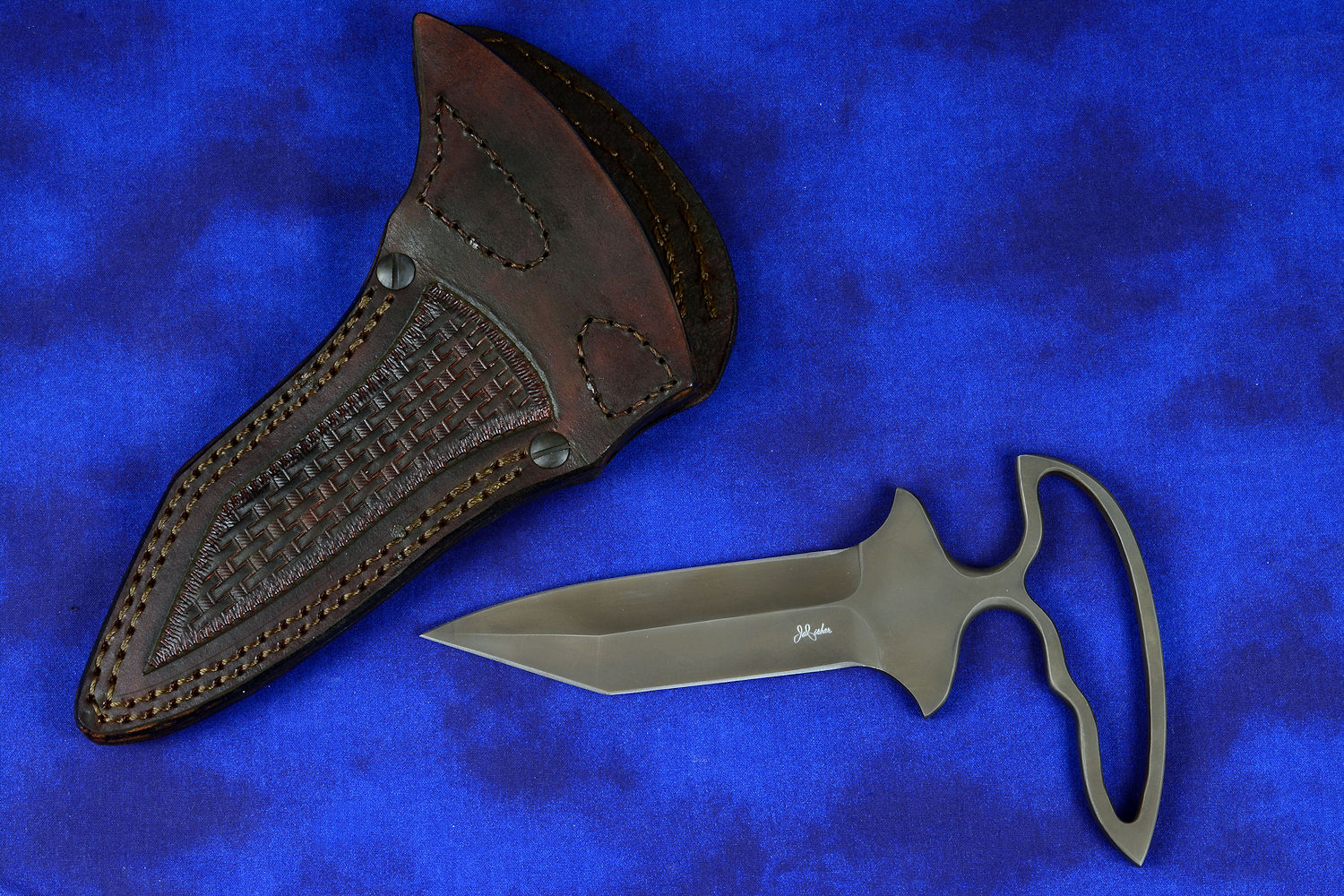
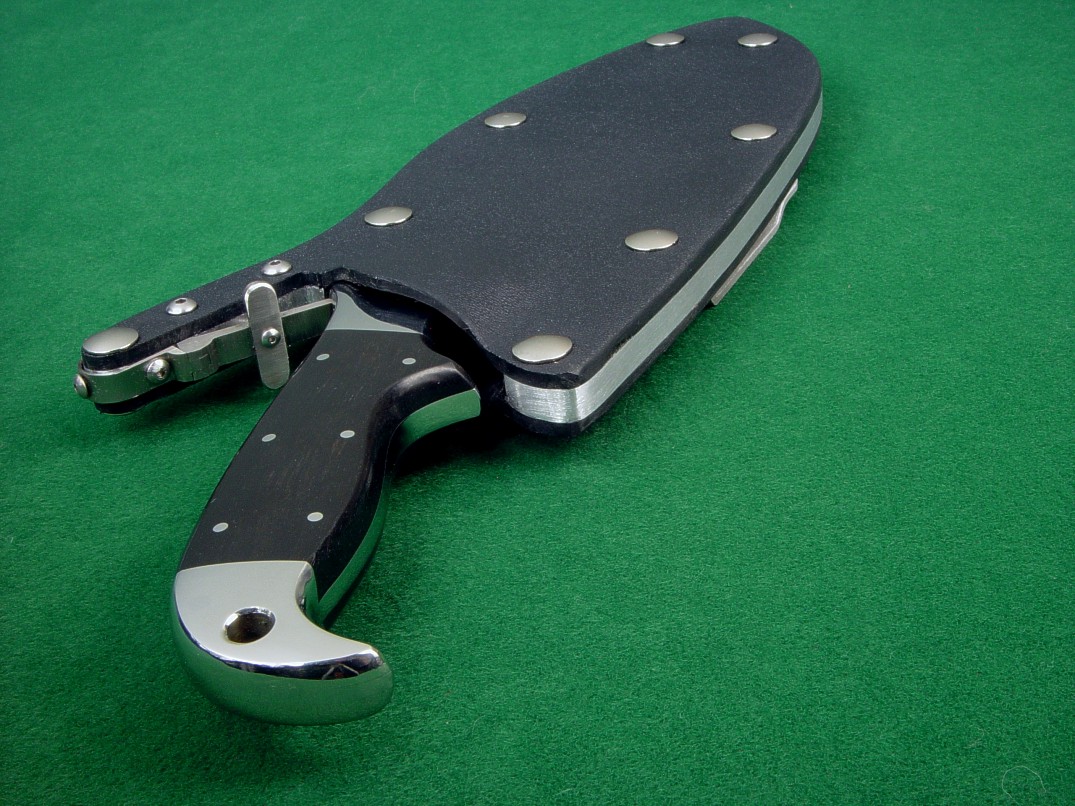
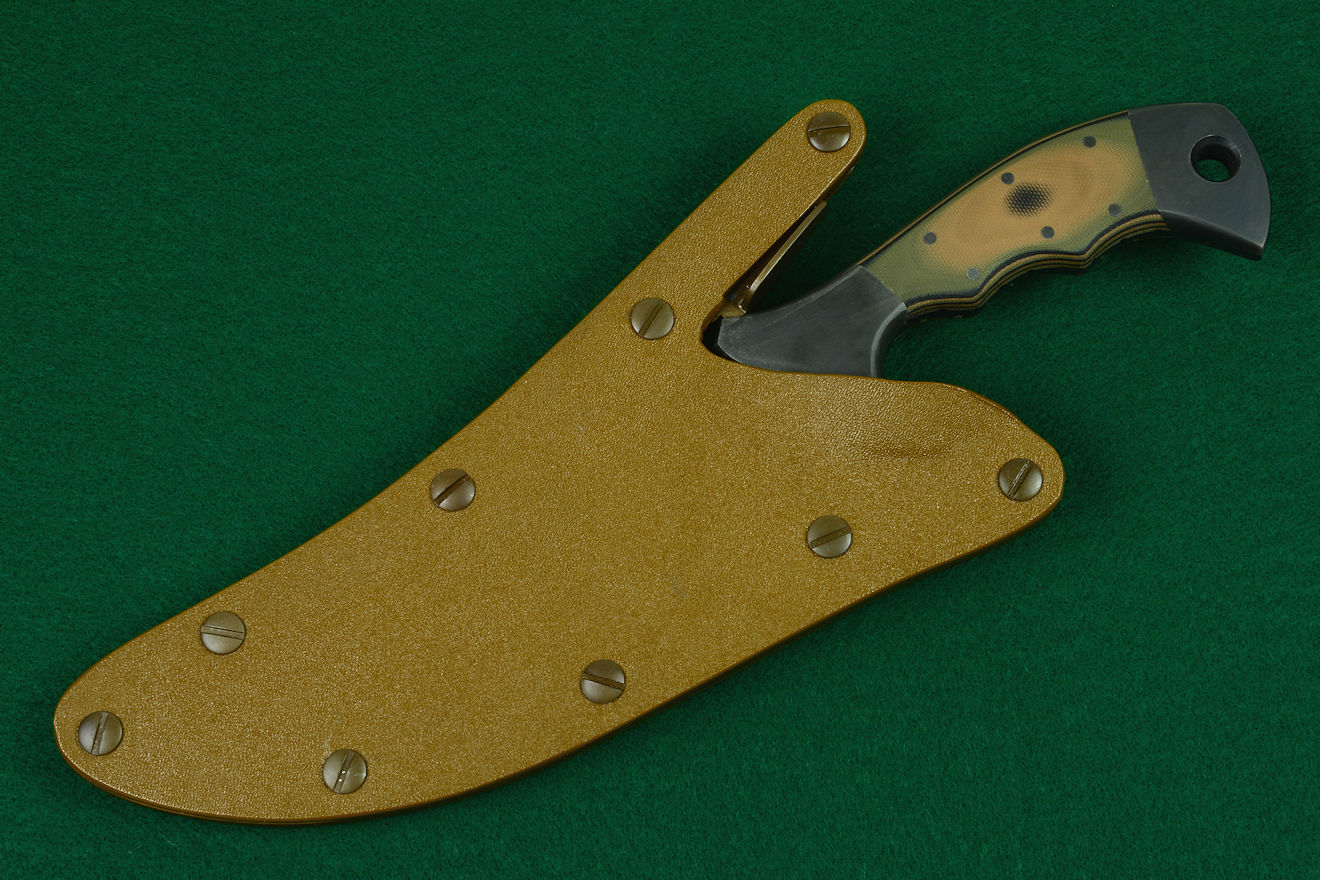
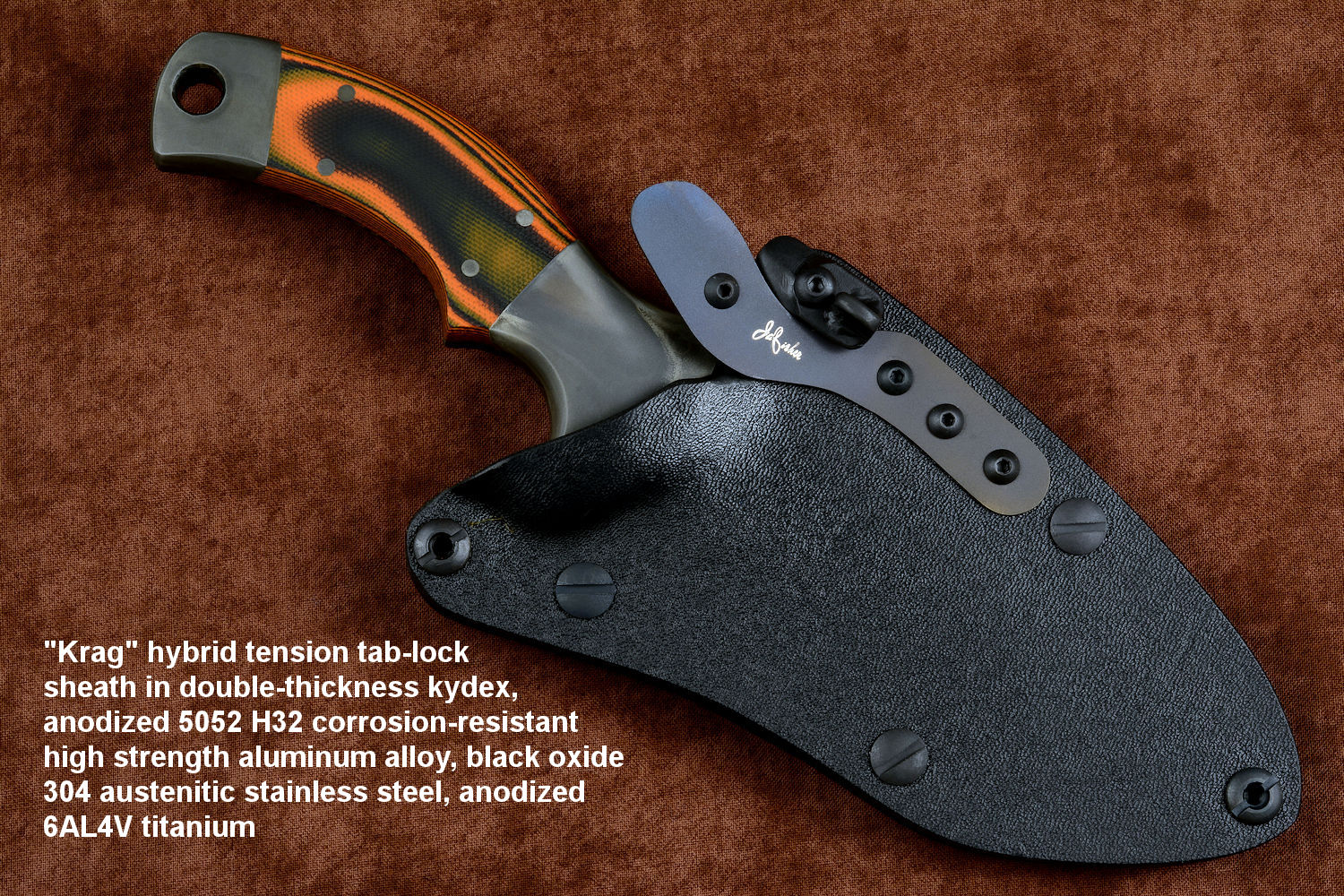
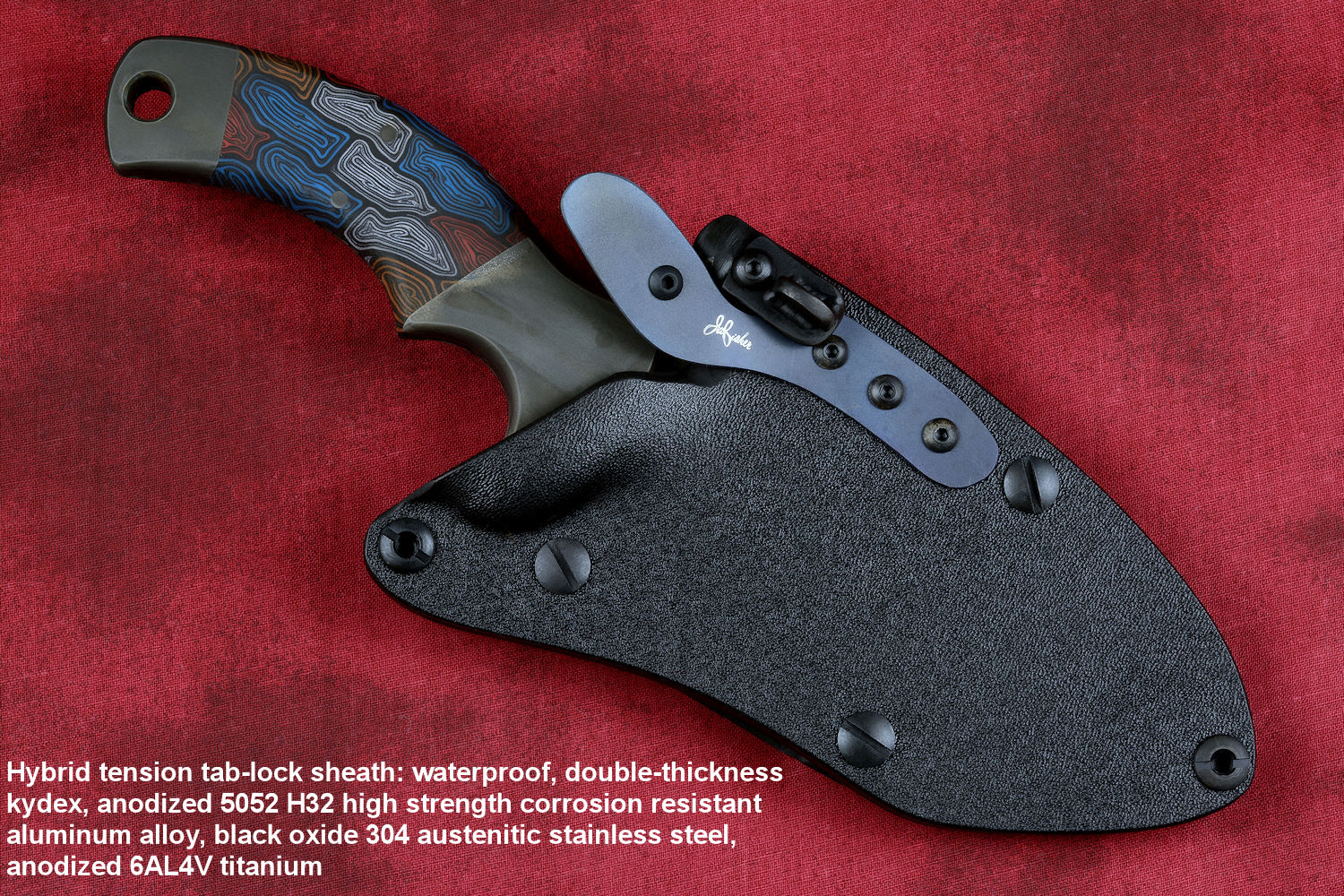
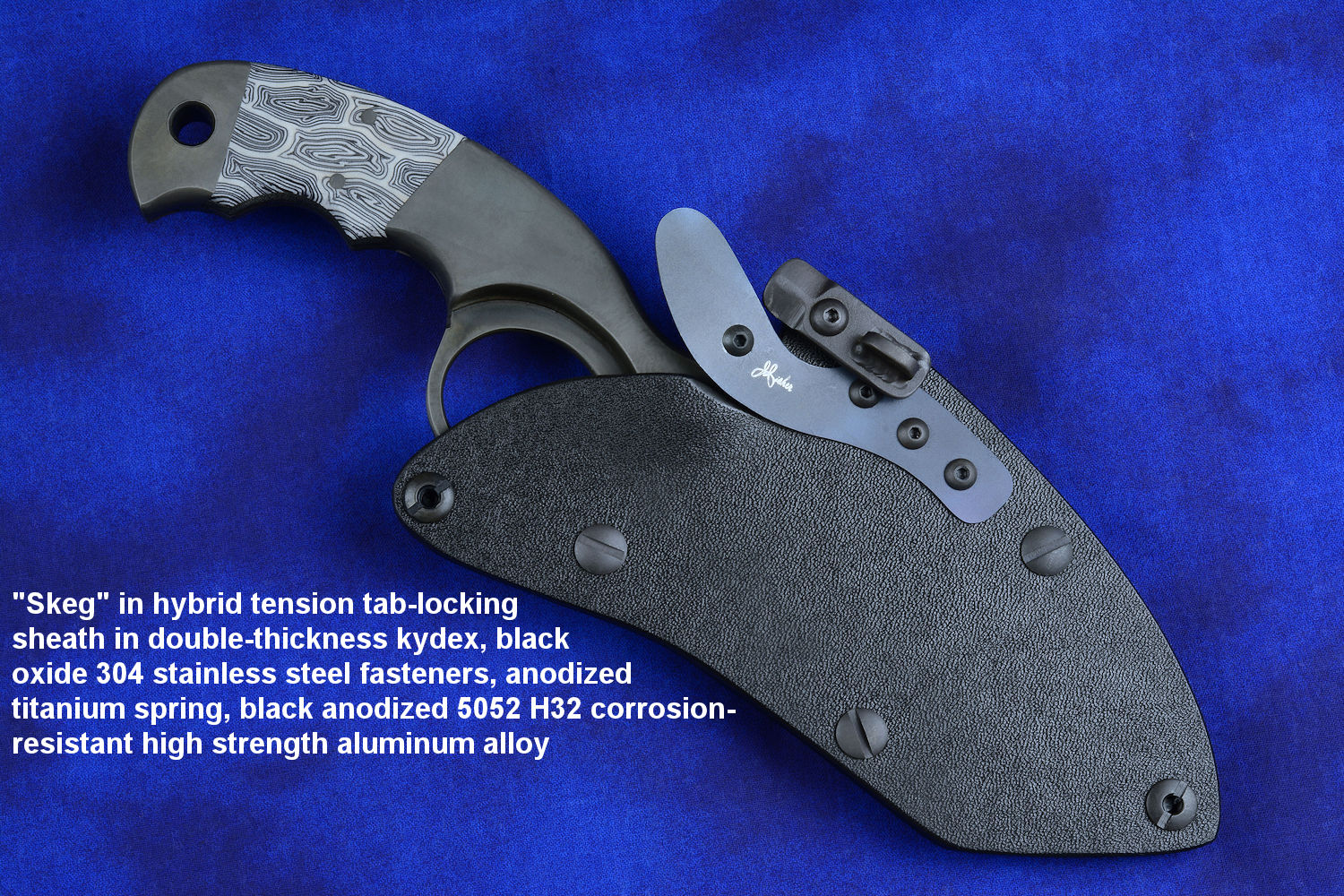
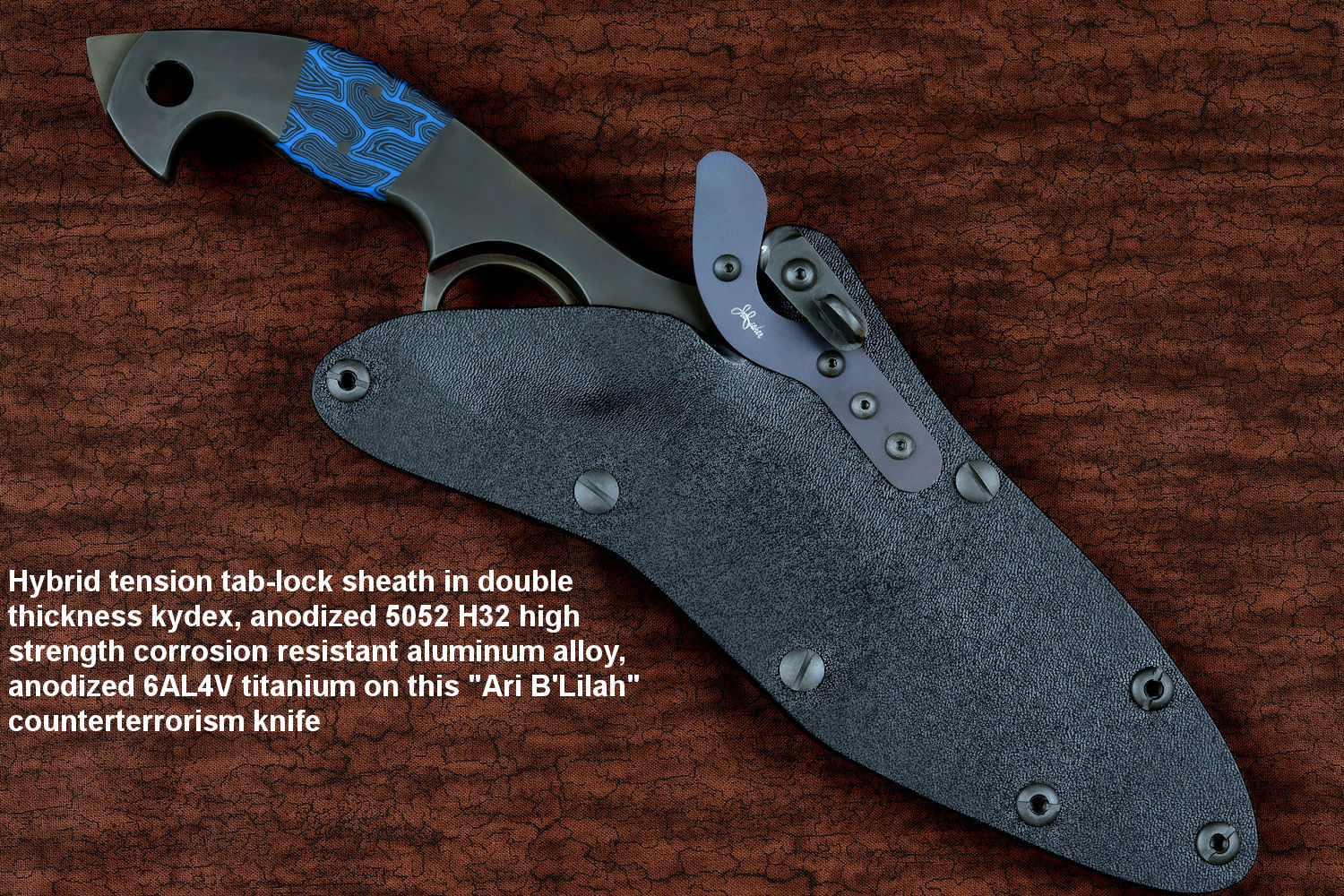
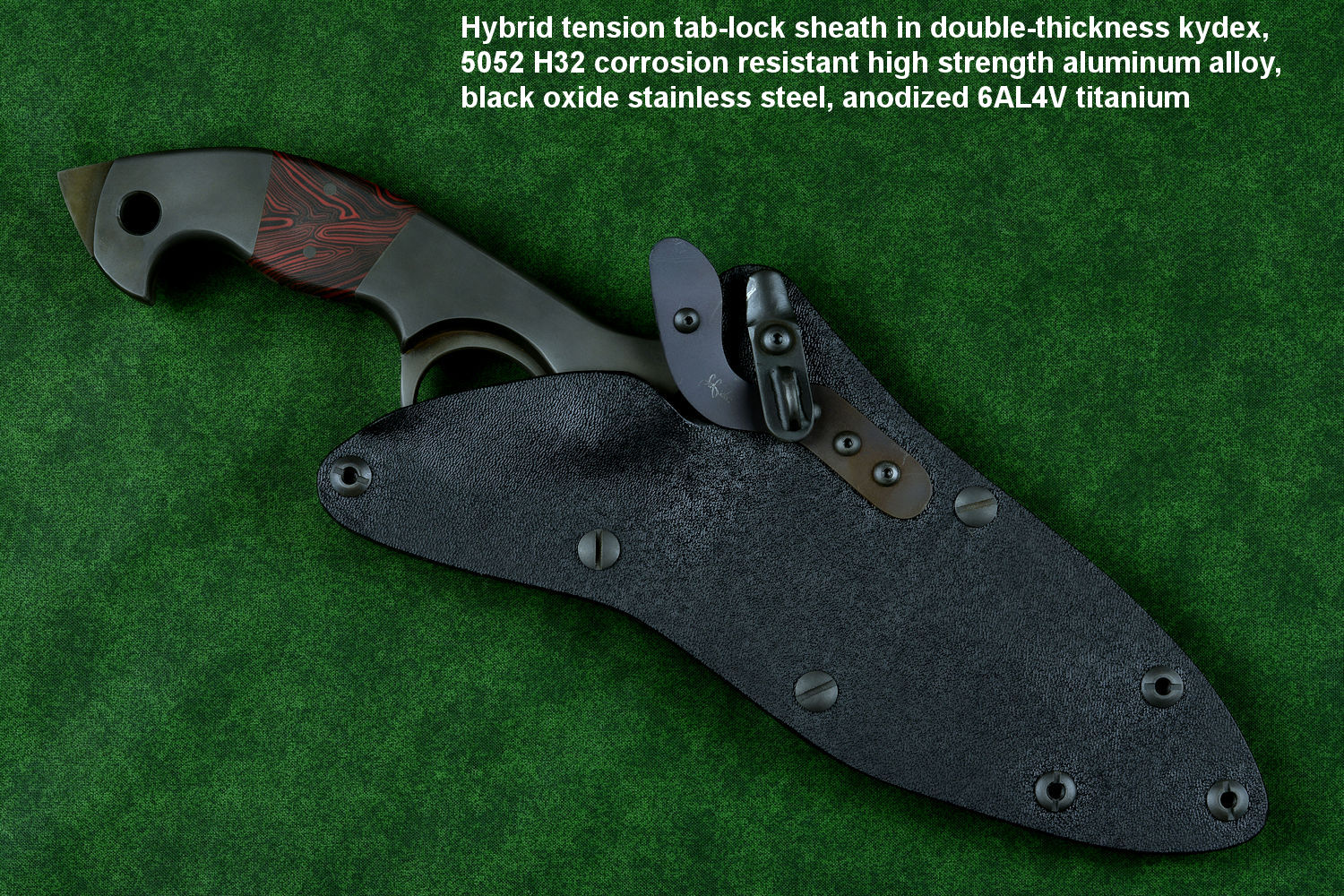
In my hybrid tension-locking sheaths, the knife is retained in the sheath with a tension spring of 6AL4V titanium. This is a true spring material, which will outlast the knife; it's incredibly tough and extremely durable and completely corrosion-resistant. It's so corrosion-resistant it's used to make biomedical implants. For example, the five screws reinforcing the tendons in my right shoulder are made of 6AL4V titanium. Titanium may also be anodized for color matching, improved surface hardness, and subdued operations. And that's just the spring.
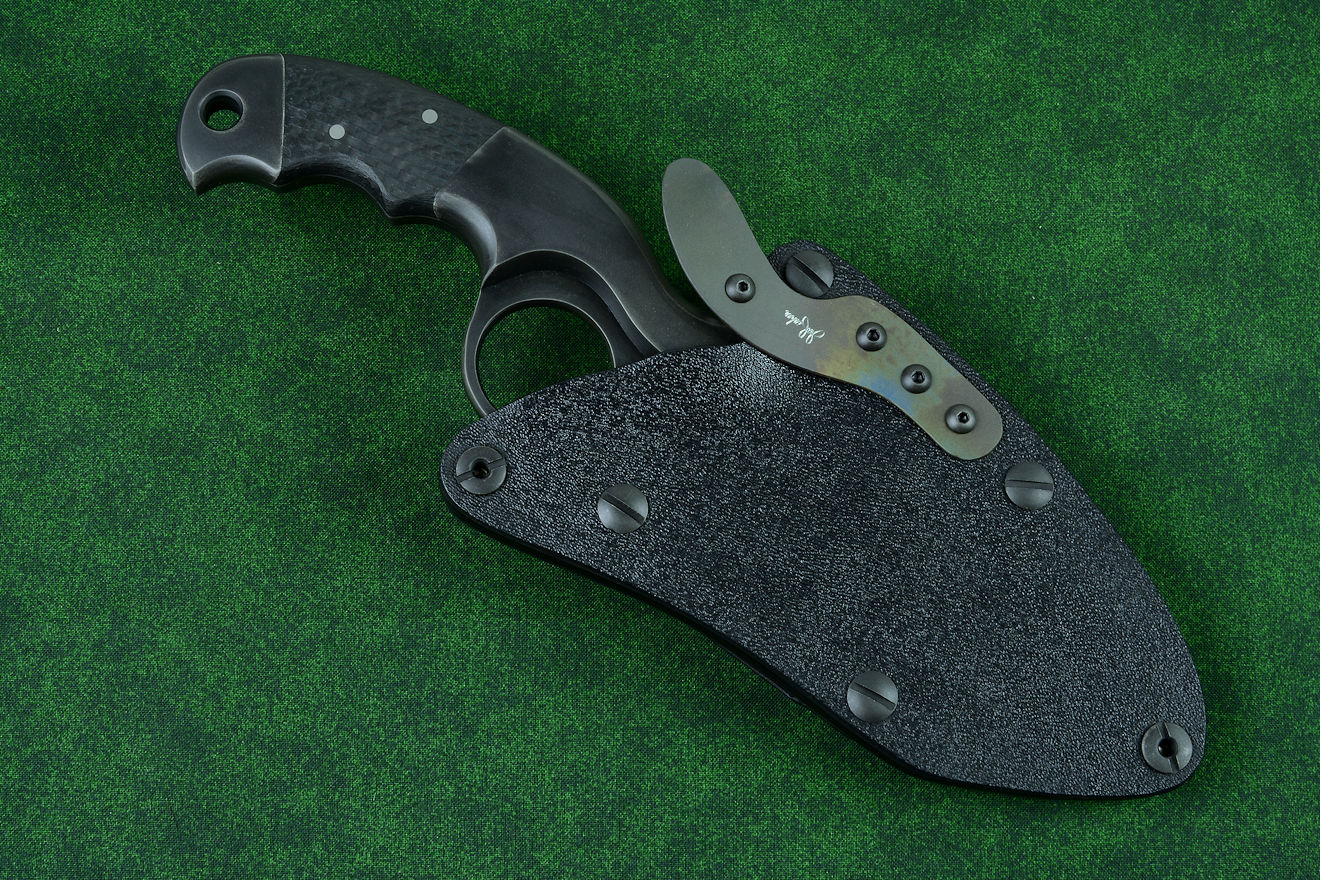
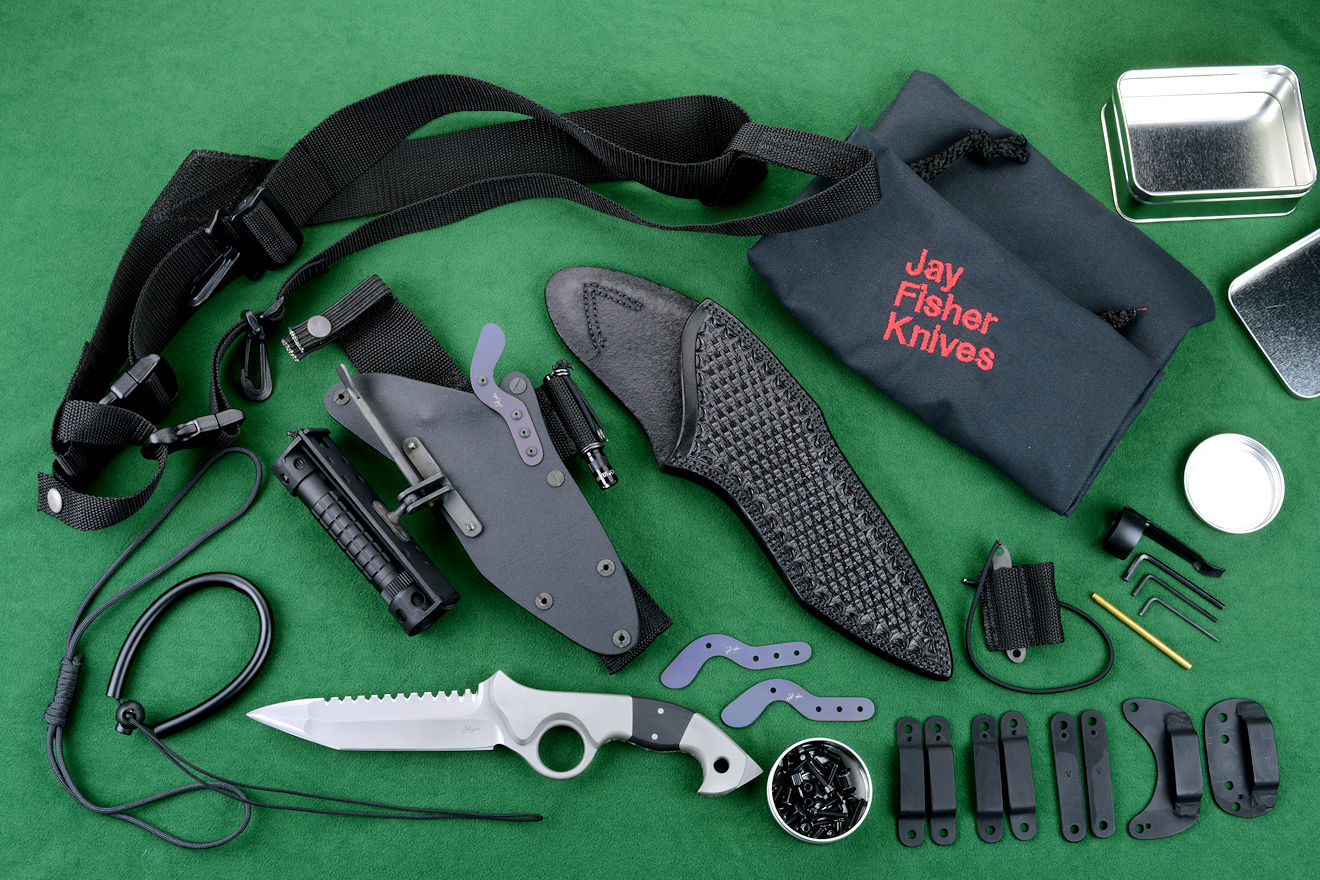
The spring is often shaped like a dog's crooked back leg, so I call it a "dog-leg" spring. I've design the sheath to have different thickness and shapes of titanium spring, so my knife owners can select the spring pressure they choose to retain the knife in the sheath. I usually include at least three different dog-leg pressure springs in my kits.
This feature alone is unavailable in any other knife sheath in the world.
The spring is attached to the sheath welts, which are 5052 H32 corrosion-resistant high-strength aluminum alloy. This is some very tough stuff, extremely durable, very strong. I know of no other knifemaker currently using aluminum welts in their sheath frames, apart from the knifemakers who have copied mine in the last 10 years or so. Add to that, my aluminum alloy welts are anodized to a tenacious, durable, near-ceramic hard coating that accepts permanent dyes with UV-resistant sealer. This means no corrosion whatever in the aluminum components, and even further strengthening. The dog-leg spring is attached to the welt frame with multiple stainless steel machine screws.
This feature also is unavailable in any other knife sheath in the world.
The spring is mounted to a stainless steel ball-lock device. Each "ball" is a different design, size and shape, accommodating the bolster, thumb rise, or contact area of the knife blade and/or handle. Since the ball is rounded and domed, this allows displacement by a hard tug on the knife handle, unsheathing the knife in an emergency. The pressure required to unsheathe the knife depends on the strength of the spring chosen by the knife owner. I typically include three strengths of spring in the kits. The spring and ball are pushed aside; the knife can be withdrawn.
This feature also is unavailable in any other knife sheath in the world.
What about quietly unsheathing the knife? What if you don't want the ball-lock to drag on the bolster or blade spine (it will, and will leave a wear mark, eventually). How is this done?
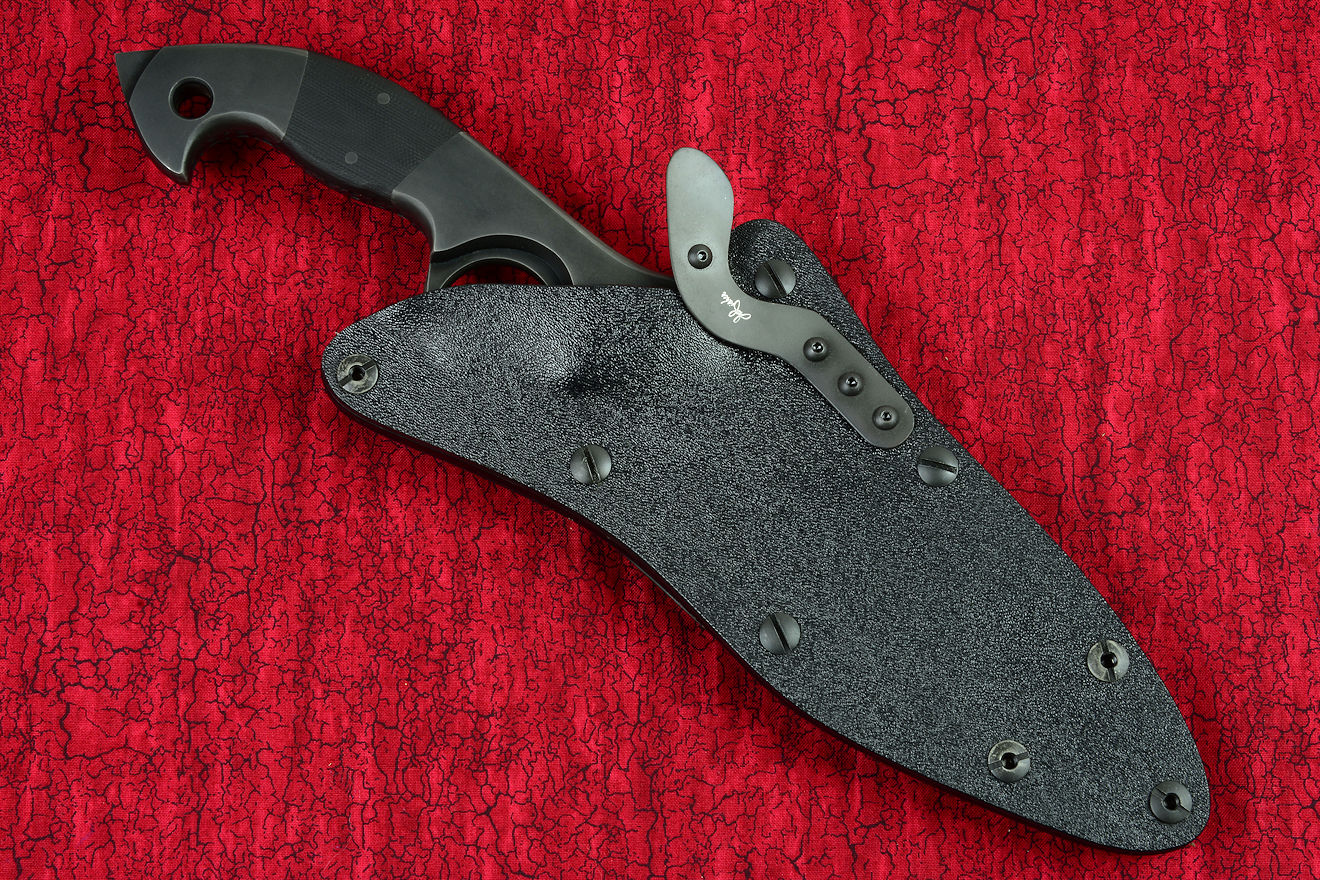
I've created the dog-leg spring with a large thumb-tab. The thumb pushes sideways, away from the axis of the knife blade, moving the ball away from the lock area, freeing the knife to be unsheathed.
This feature also is unavailable in any other knife sheath in the world.
To sum, the knife can be released quietly with a thumb, finger, or knuckle to release the tension of the spring, or, the knife can be unsheathed instantly with a good, hard, firm pull on the handle. The pull varies with each knife, and I typically include several springs of varying tension so that the knife user can select his own preference, of light, medium, or heavy pull and retention.
The pull varies between 15-30 pounds of force, so this is still a well-retained knife. This is also a retention method that can be used on critically double-edged knives, with upper edges that would interfere with the locking mechanism of my positively locking sheath.
This feature also is unavailable in any other knife sheath in the world.
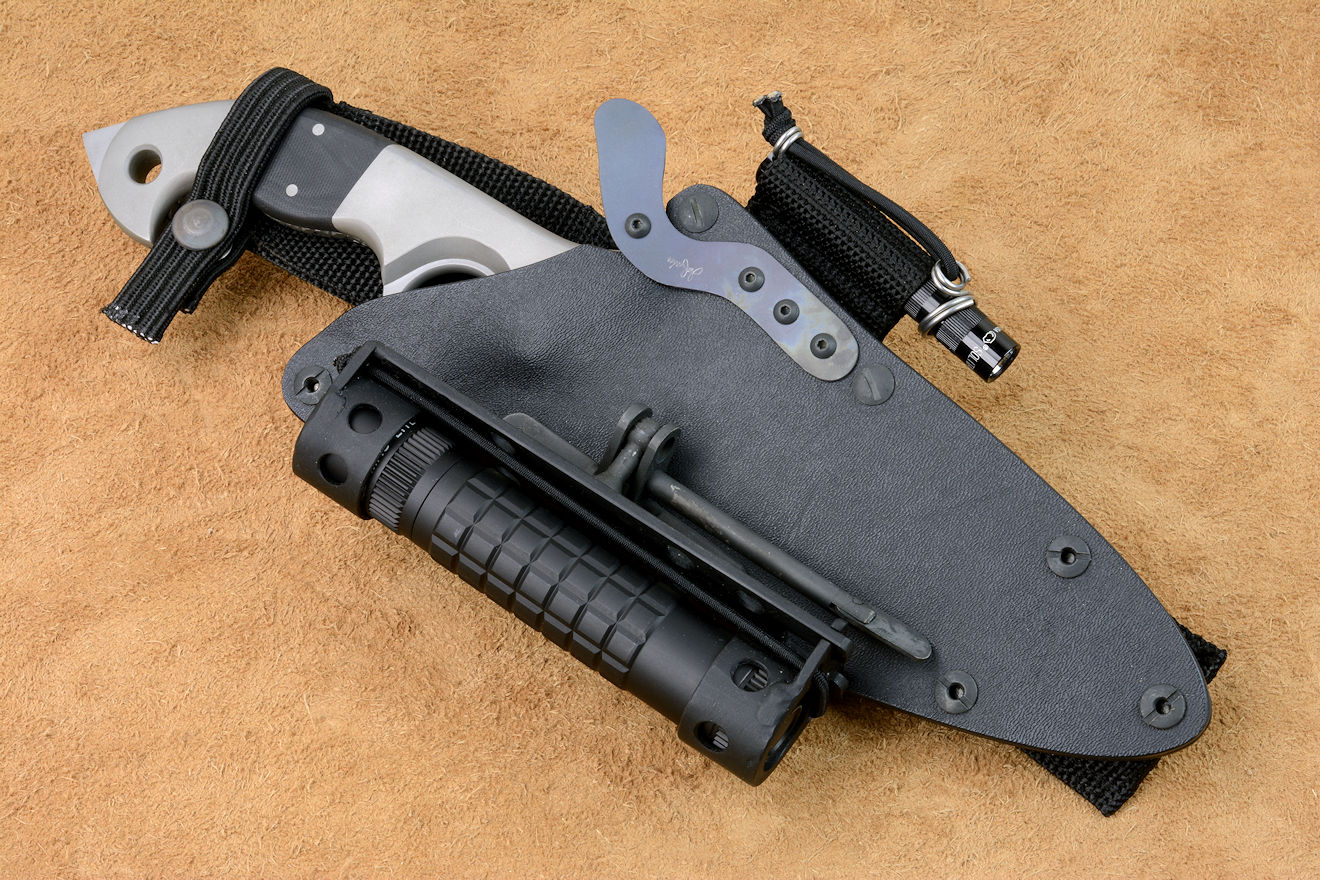
Incredibly, just as with my positively locking sheaths, all of the components are completely reversible for a huge variety of wear options and positions on military or tactical gear. Also, just as with my positively locking tactical sheaths, all have the same bolt-hole pattern for the wide range of components I offer for critical applications, such as flashlights, sharpeners, web mounts, and positional mounting arrays.
This feature also is unavailable in any other knife sheath in the world.
The reason I've repeated this "feature" phrase over and over in this topic section is because I want you, who are reading this, to understand, completely and clearly, the unique nature of this design and sheath. You might wonder why I've posted this description and photos, for all to see and try to copy, which they undoubtedly will.
Just as with my locking sheath, every knife is different, and every individual knife must be matched to the sheath, and the sheath matched to the knife, necessitating building them together. Clearly, the knife is part of the sheath and the sheath is part of the knife in every way.
This is one of the main reasons this design is not easily be copied; each one has to be constructed individually, and the sheaths are not interchangeable, even with the same knife model, design, and profile!
Funny thing about that. I used to think that my sheaths would be quickly copied, and a few knifemakers have tried it over the years. Lacking their own creativity, they try to steal other's.
But here's the thing: it takes a large amount of effort, dedication, machinery, skill, and practice to make a sheath this advanced, and very, very few knifemakers are willing to try it. They just keep hot-forming their kydex, sticking it together with hollow rivets or eyelets, and taking the easy way. Frankly, they aren't interested in improving their knife sheaths, so they don't.
What about manufacturers? Because of the great variety of designs, and because of the close tolerances required for this type of sheath, it's expensive and time-consuming to make and fit, and the materials to build a sheath this way are beyond what most manufactured knives alone cost. It's not in their interest, either. They won't bother with all that trouble; after all, they make a cheap knife. Why put a cheap knife in a costly, elaborate sheath?
For me, these sheaths have been a great success, met with excellent feedback, particularly in the counterterrorism knife field. That should say enough. They work and work well.
Hi Jay,
I came home yesterday, the knife was waiting for me since it arrived in Monday.
The knife and the sheath look great! The knife fits perfectly in my hand and the handle is very comfortable.
The blade is sharp and looks very aggressive. The sheath looks strong and very durable. The locking mechanism is
awesome!
This is by far the best sheath I have ever had.
Jay, thank you for this great knife, it's definitely a knife that I can depend my life on.
--D. B. (Israeli Defense Force)
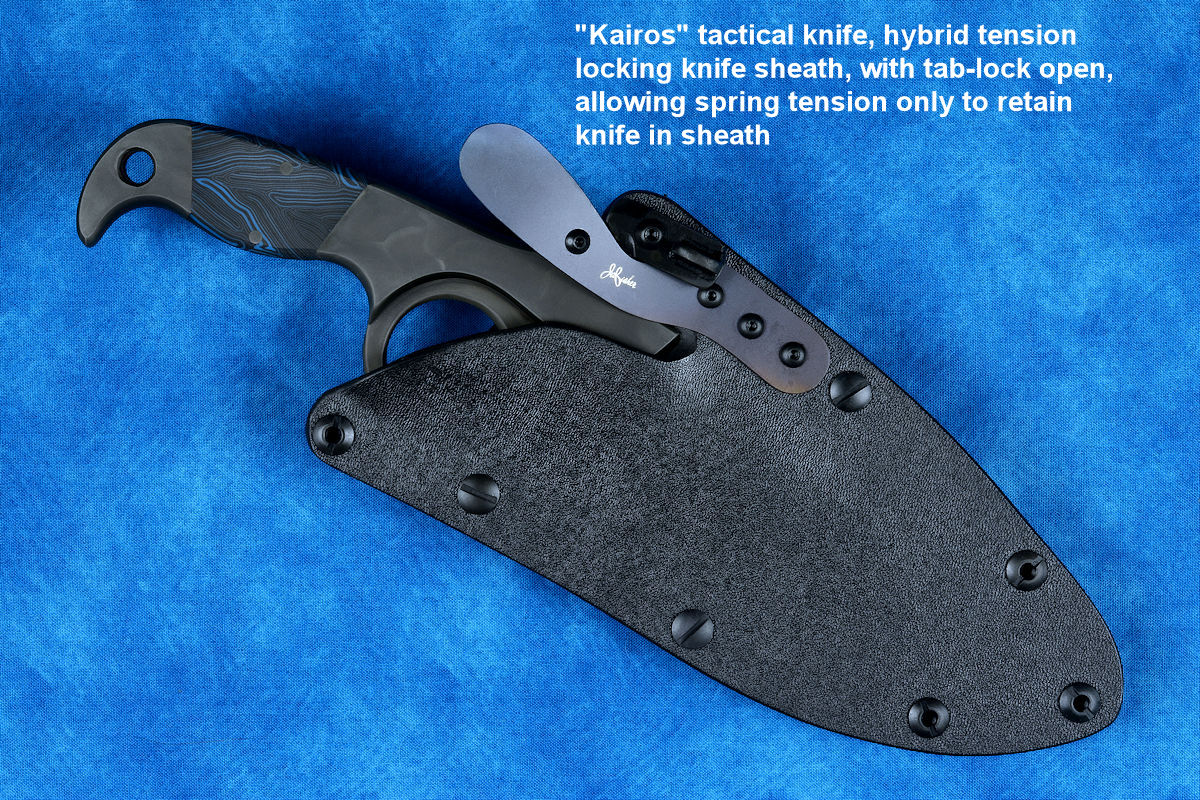
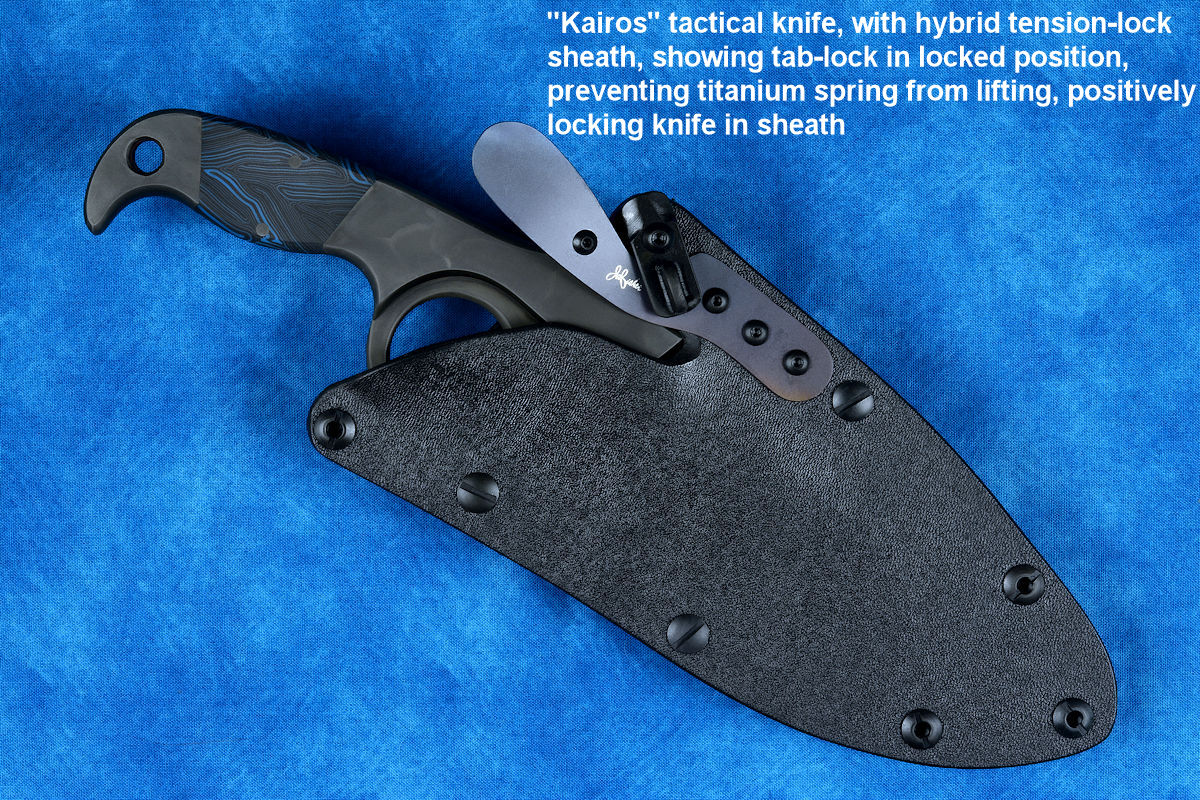
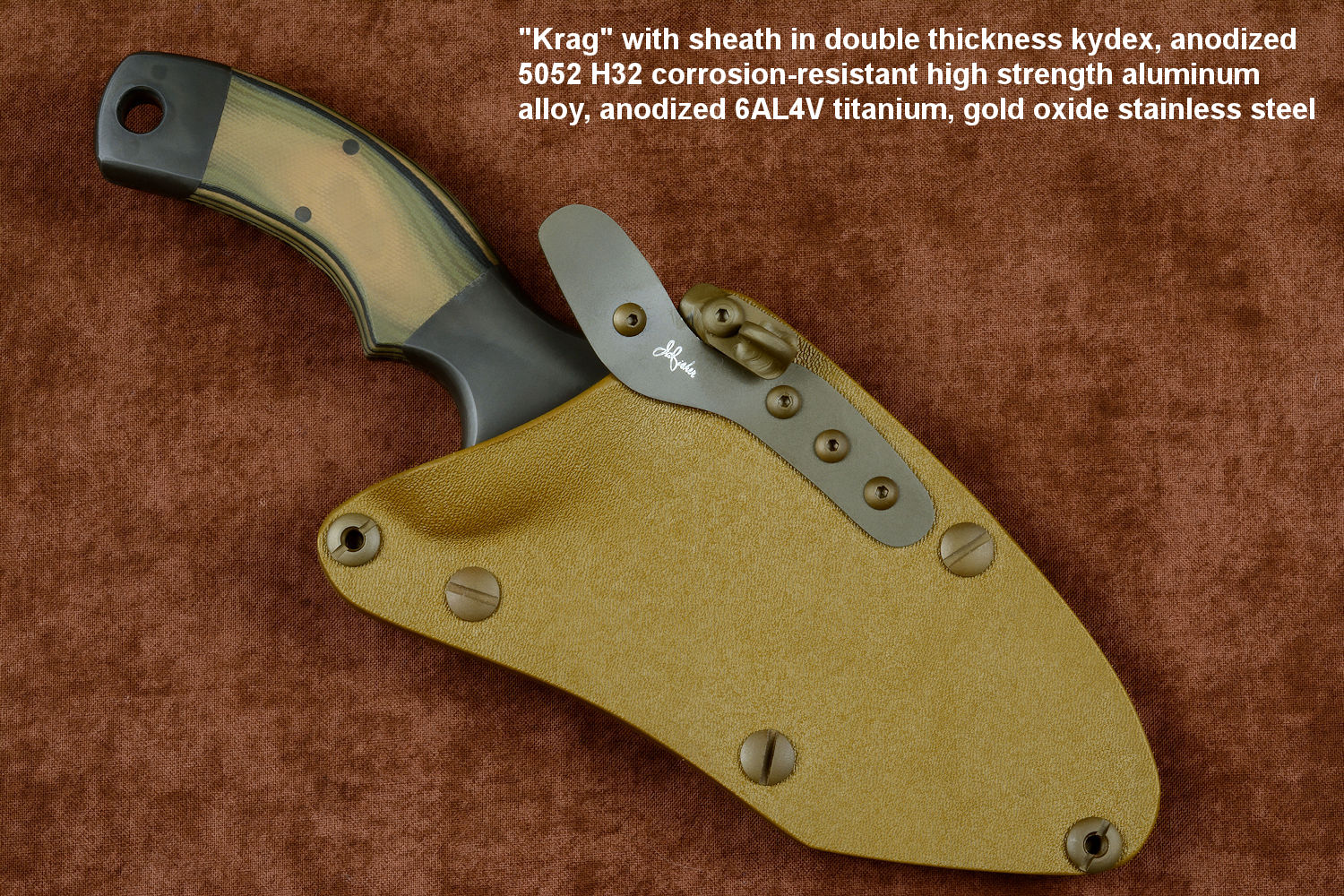
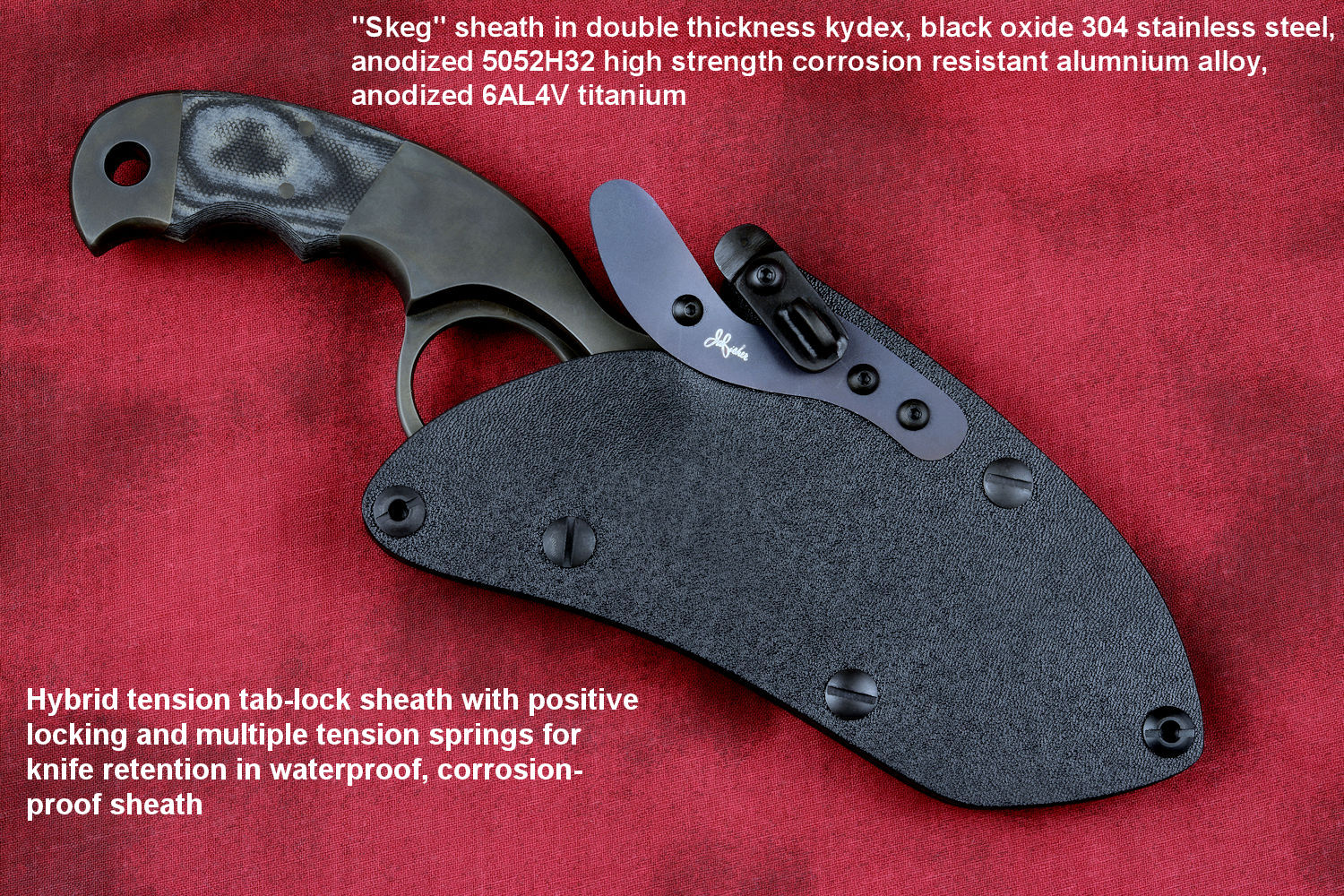
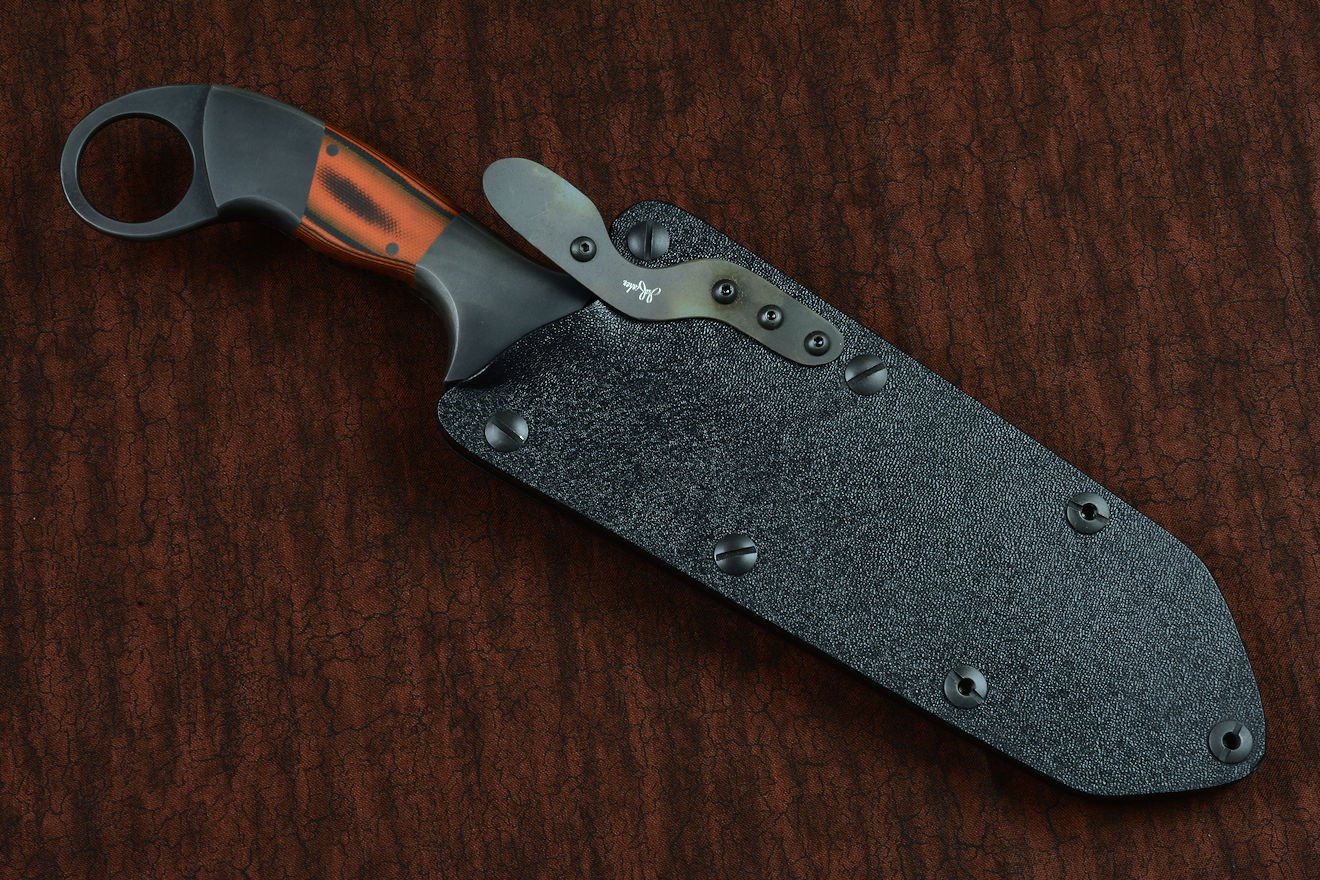
When I started making tactical combat dive knives—yes, there is such a thing—one of the necessary technical requirements was having a double-edged blade. If you've read the two sections above, you now know that the only way to have a device to secure a double-edged blade I've relied upon was the hybrid-tension design, since the positive lock would tear up the serrations or vice versa.
In certain environments, it's paramount to secure the knife. Under and above water, or in elevated positions (think mountain rescue or hostage rescue in multi-storied buildings), the security of the knife in the sheath is vital. I have clients who actually do what I've described, so I was determined to make their knives as secure as possible in those extreme environments.
For them, I needed a create a way to secure the ball-lock if my knife user required it. Additionally, it would be neat and advantageous if the ball-lock could be cleared away from the knife completely, allowing easy insertion without displacing or dragging the ball on the knife spine or bolster. This would add the advantage of keeping unsheathing quiet, another request by counterterrorism and other professionals.
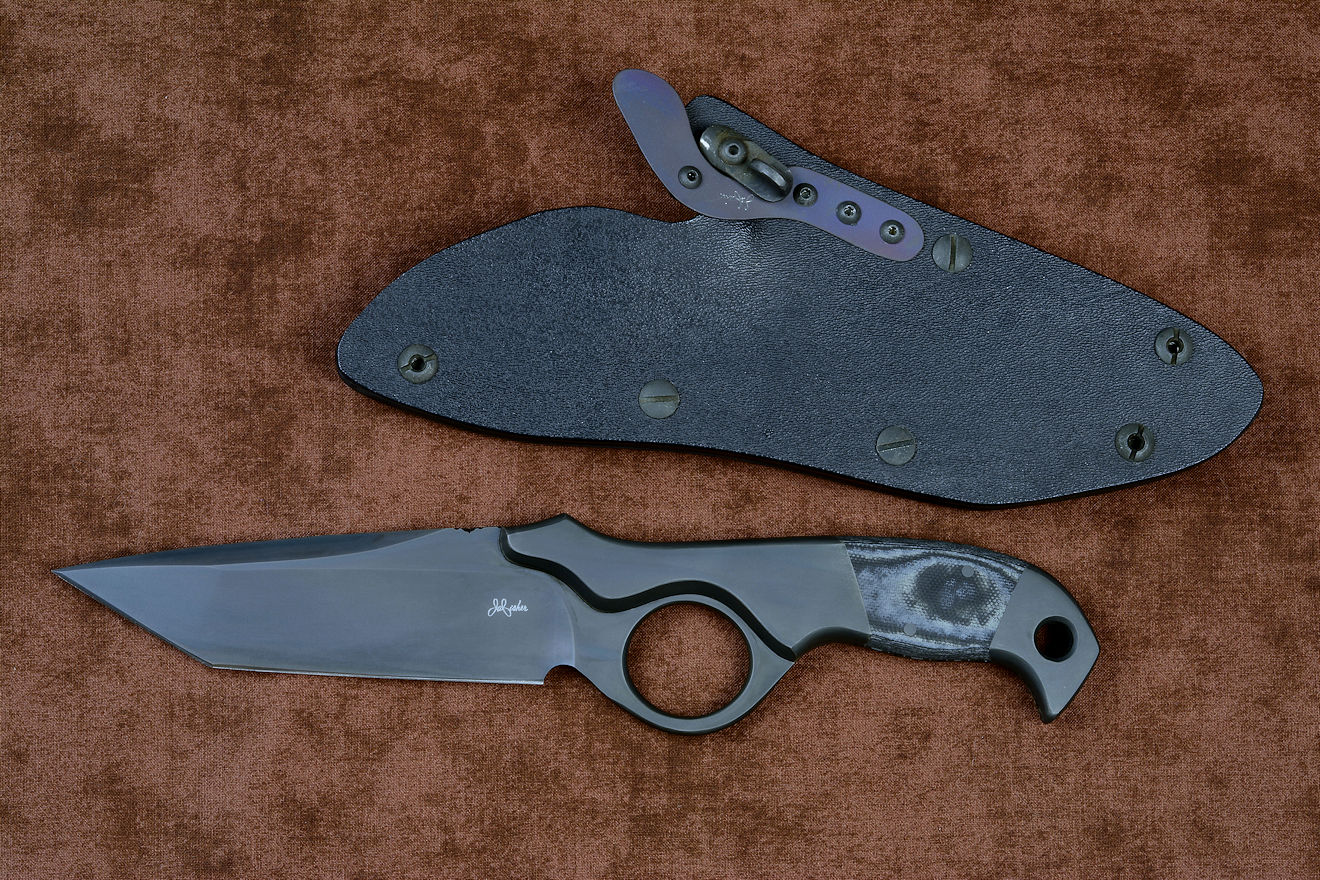
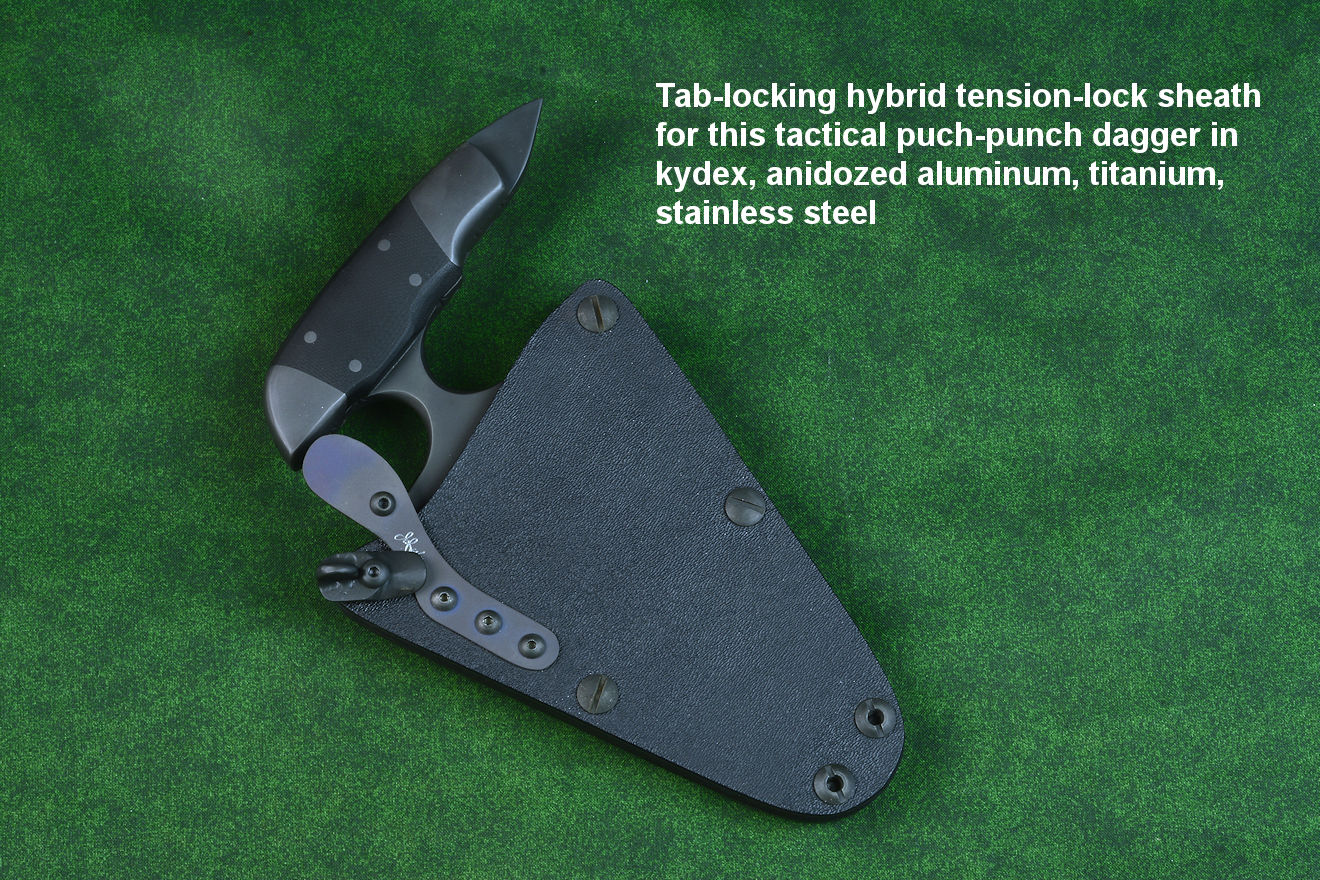
I developed a simple post-mounted device with a dual-tab and ramp system. I made it completely optional for the hybrid tension-locking sheath; a client may wish to use the standard hybrid tension-lock or he may wish to add the optional tab-lock device. Again, a component-modular approach allows the greatest variety of options.
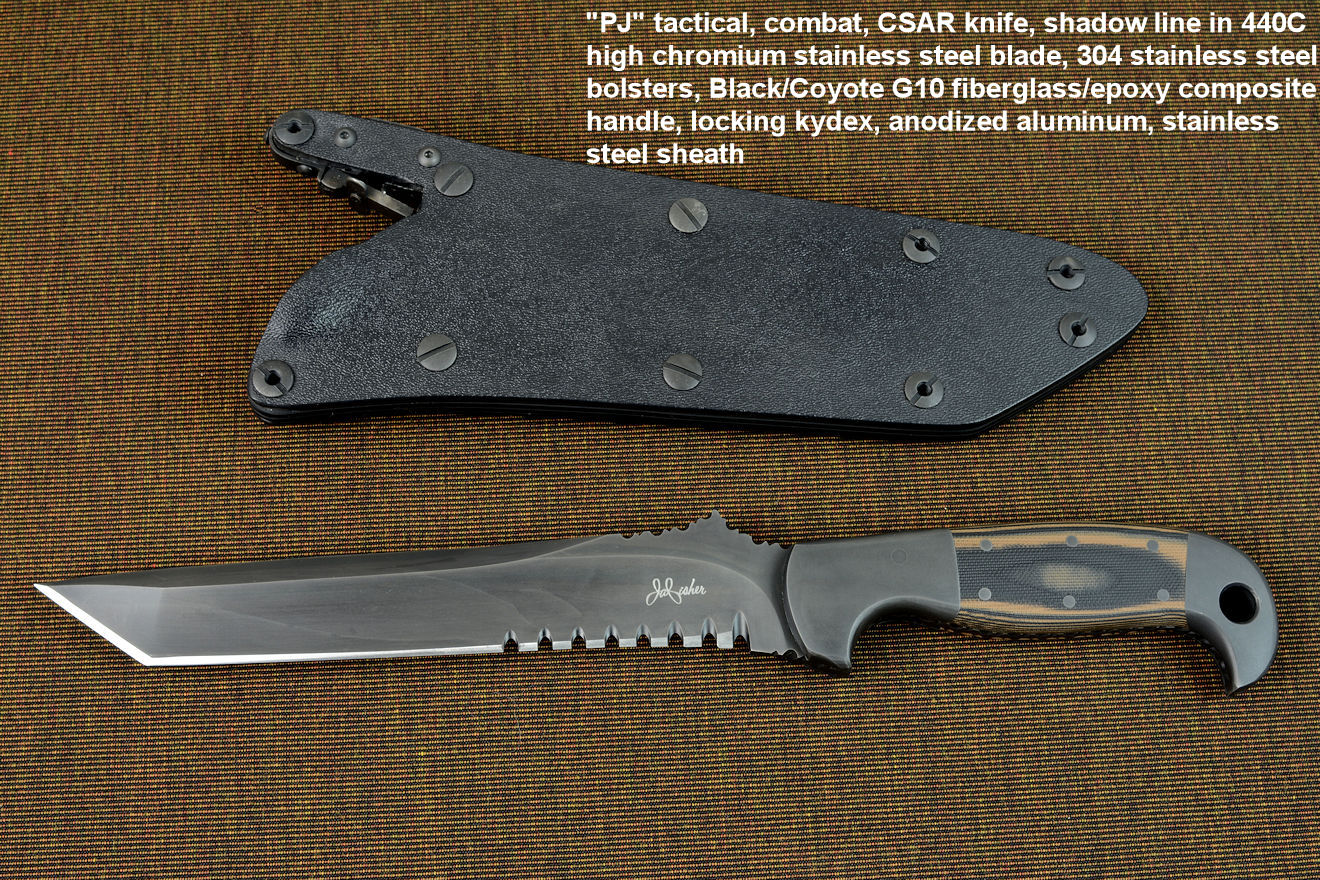
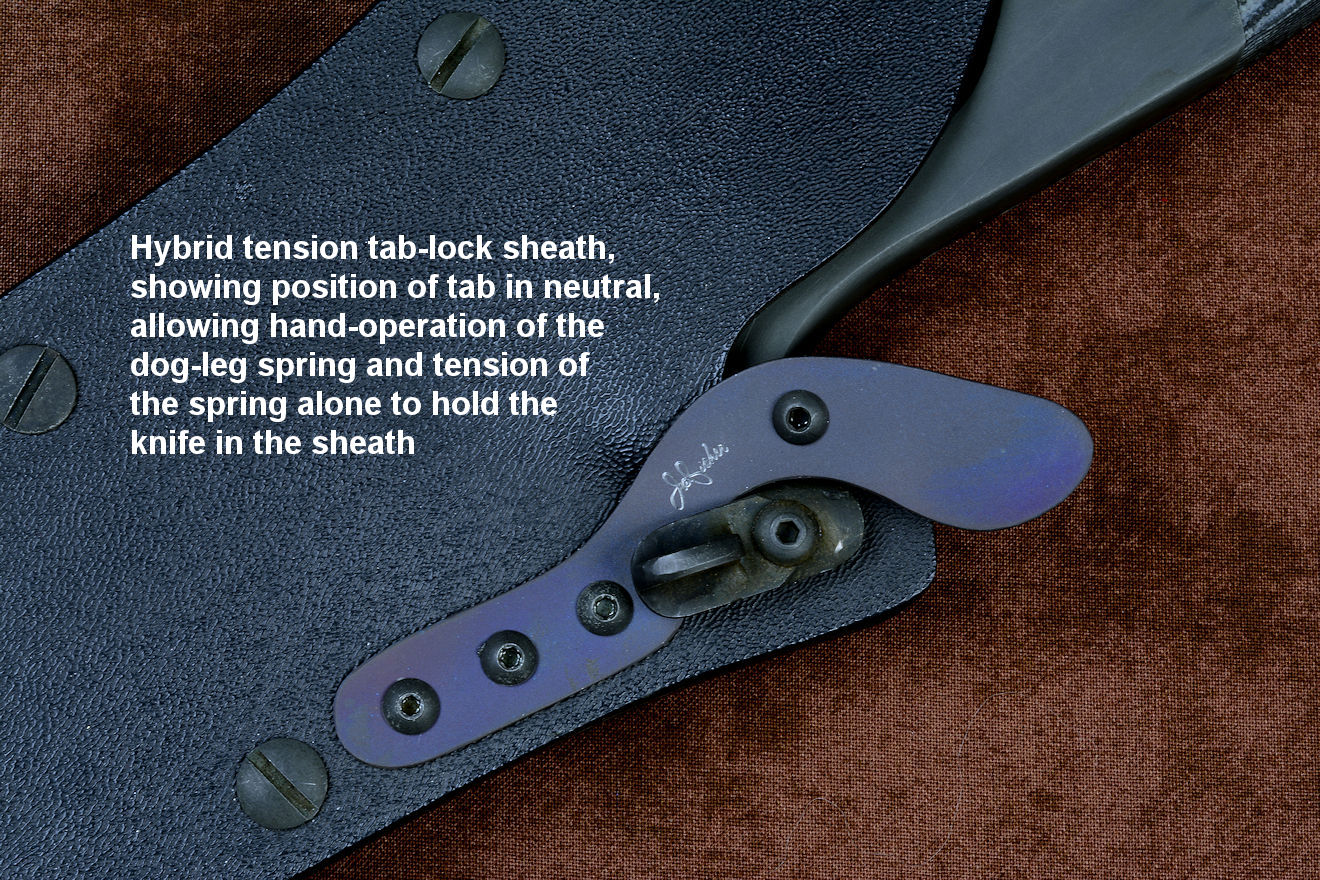
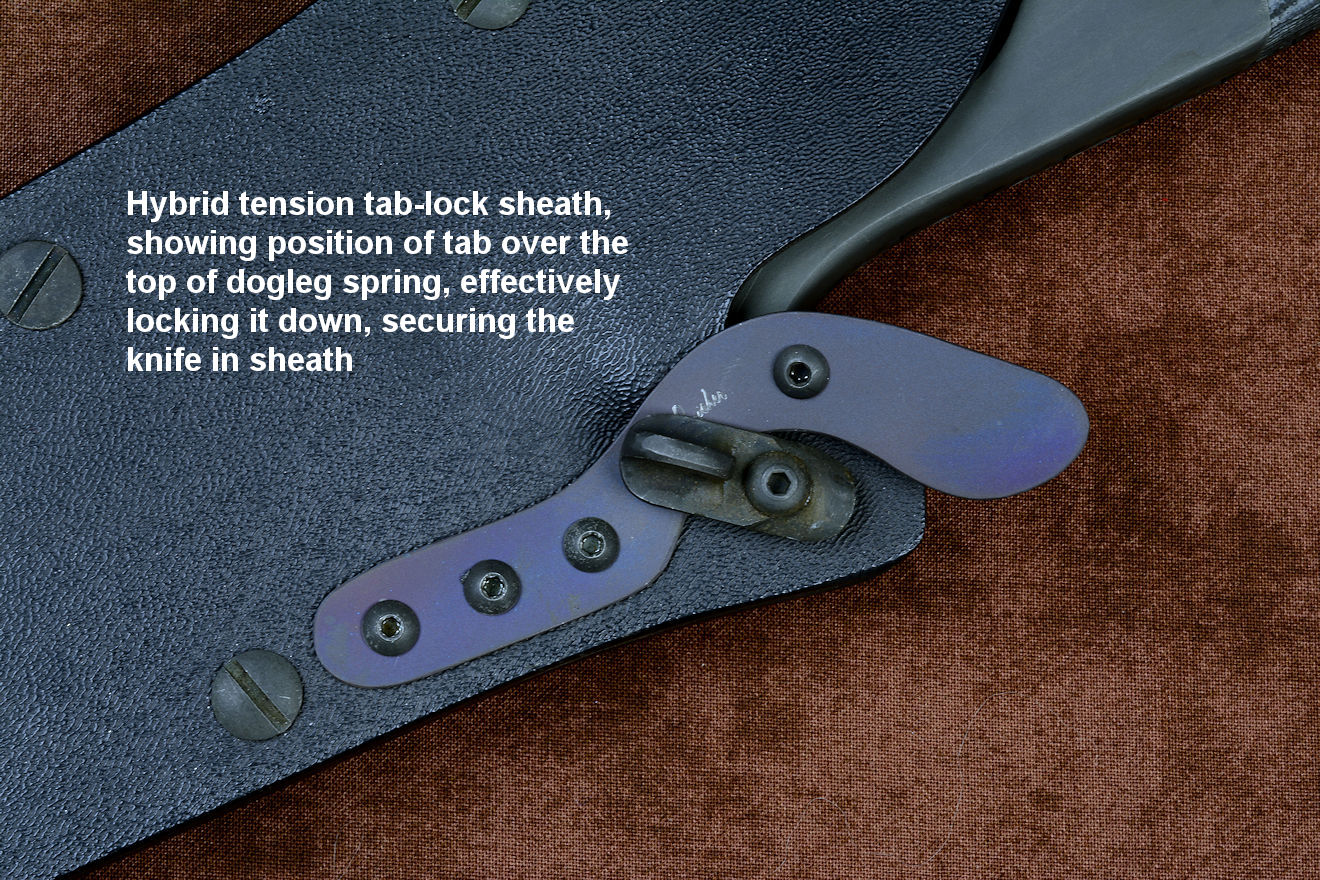
The tab is a small, rotating element made of stainless steel that has four actual small, robust ramps. When the knife is secured in the sheath, one ramp can be rotated over the titanium dog-leg spring and it's held in place with friction. This prevents the dog-leg spring from rising or lifting the ball away from the knife bolster or spine. Effectively, this prevents the knife from being removed from the sheath. It would take an incredible amount of pressure to bend and displace the titanium; thus, the knife is effectively locked when the tab is in this position. The angle of the ramp offers enough friction to hold the tab in place.
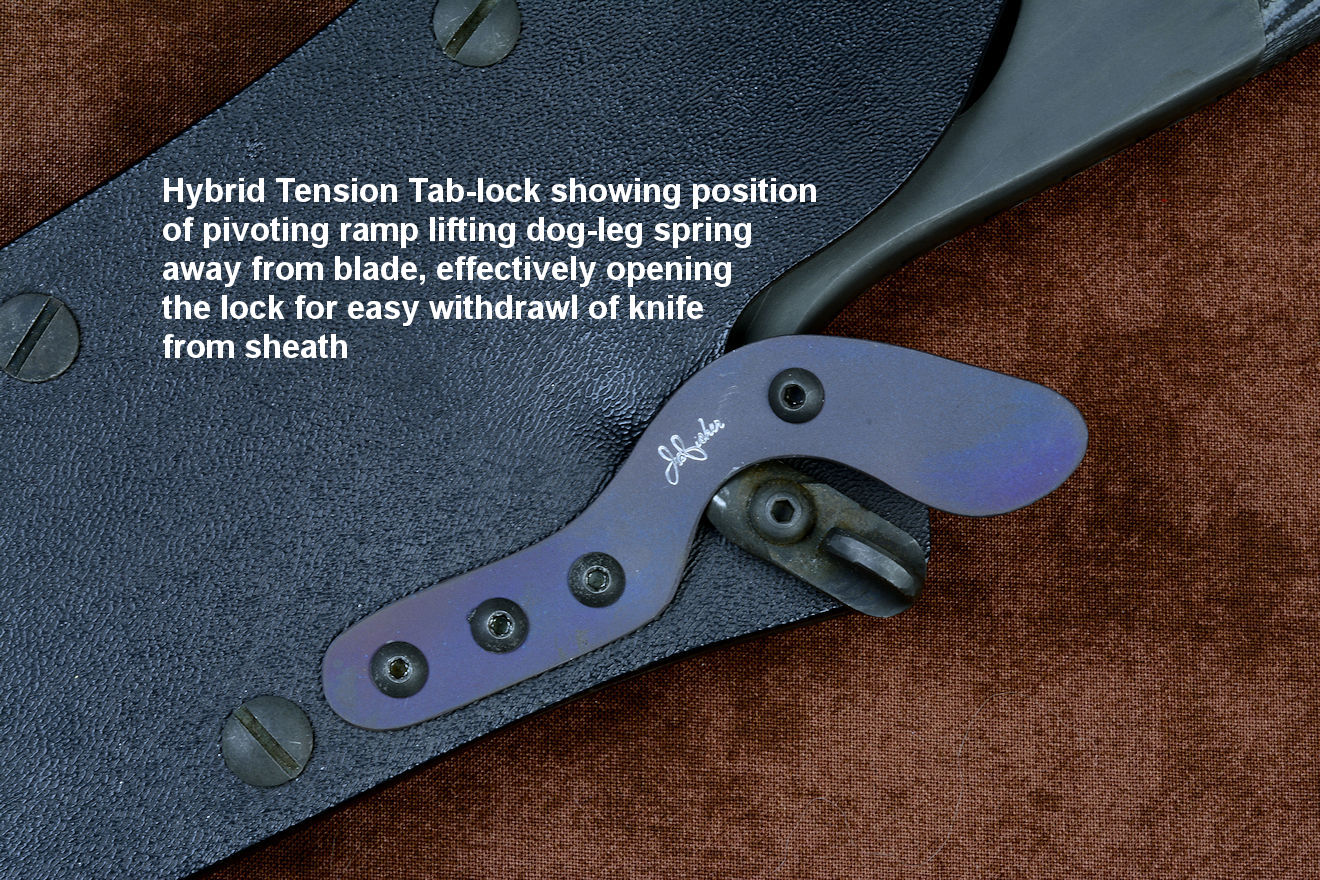
To remove the knife, the tab can be rotated with the fingertips or thumb. When this happens, a different ramp wedges underneath the dog-leg spring, lifting the ball-lock away from the knife spine or bolster, releasing the knife from the pressure of the ball lock. Because it, too, is held in place by friction, it can be left in this position, and the ball completely clears the knife and opens the sheath mouth wide.
In dive knives, this mechanism can lock the knife into the sheath in one position, requiring the thumb or fingertips to rotate the tab, followed by pushing or displacing the ball and spring out of the way of the knife, unlocking it. The knife can be used, the sheath left "open" and the sheath "closed and locked" after re-sheathing by rotating the tab over the spring.
It's an incredibly simple design, but it's complicated to make. Every single knife, even with the same profile and design, requires close tolerances and extensive hand-tuning to get the fit just right. No mass-produced device will work. The tab-lock is all stainless steel, including the pivot, which is secured to the knife sheath at the top screw position, and (of course), I make these completely reversible, so the sheath can be worn in any position desired.
I started making this design in 2020, after working through several iterations on earlier dive knives. It's worked so well that I've started including it in my counterterrorism and tactical combat knives. Since it's optional, my clients can assemble the hybrid tension lock to include the tab-lock or not, depending on the intended use.
Howdy Jay,
Short version:
The attention paid to every detail during the creation of this package (piece of kit) is perfect. I am speechless.
~~~~~~~~~~~~~~~~~~~~~~~~~~~~~~~~~~~~~~~~~~~~~~~~~~~~~~~~~~~~~~~~~~~~~~~~~~~~~~~~
More comprehensive evaluation:
The sheet of paper included with use / care instructions written by
Tom Clancy sums up your blending of old school craftsmanship with modern
materials.
Hooded Warrior:
I am trying to break through "speechless" mode. Each work you craft takes on a unique character during the process. I have seen other examples
of the Hooded Warrior pattern and they differ in subtle ways. The blade is so beautiful that I'm tempted to never use it. At 61.5 HRC it should
perform extremely well, yep, I can sharpen that. I've been sharpening most of my life, I now follow the recommendations of John Juranitch,
I cheat a bit with a 1" X 30" grinder when I can.
The leather sheath is perfect for display or dress wear. I have no idea where I would don that tool in a more formal setting, I think you get
my drift. Set aside the fact that I avoid "formal" stuff. Not my cup of tea.
The field sheath speaks differently to me. That sheath is for me, a working man. The blade and sheath are a team. I do not know of any other craftsman that
marries the blade and sheath this well. I wish to thank you for allowing me to purchase this package. This is a most suitable piece of kit for my future needs.
This is my Hooded Warrior.
There are others like it.
This one is mine.
I sincerely thank you.
That is all.
B. S.
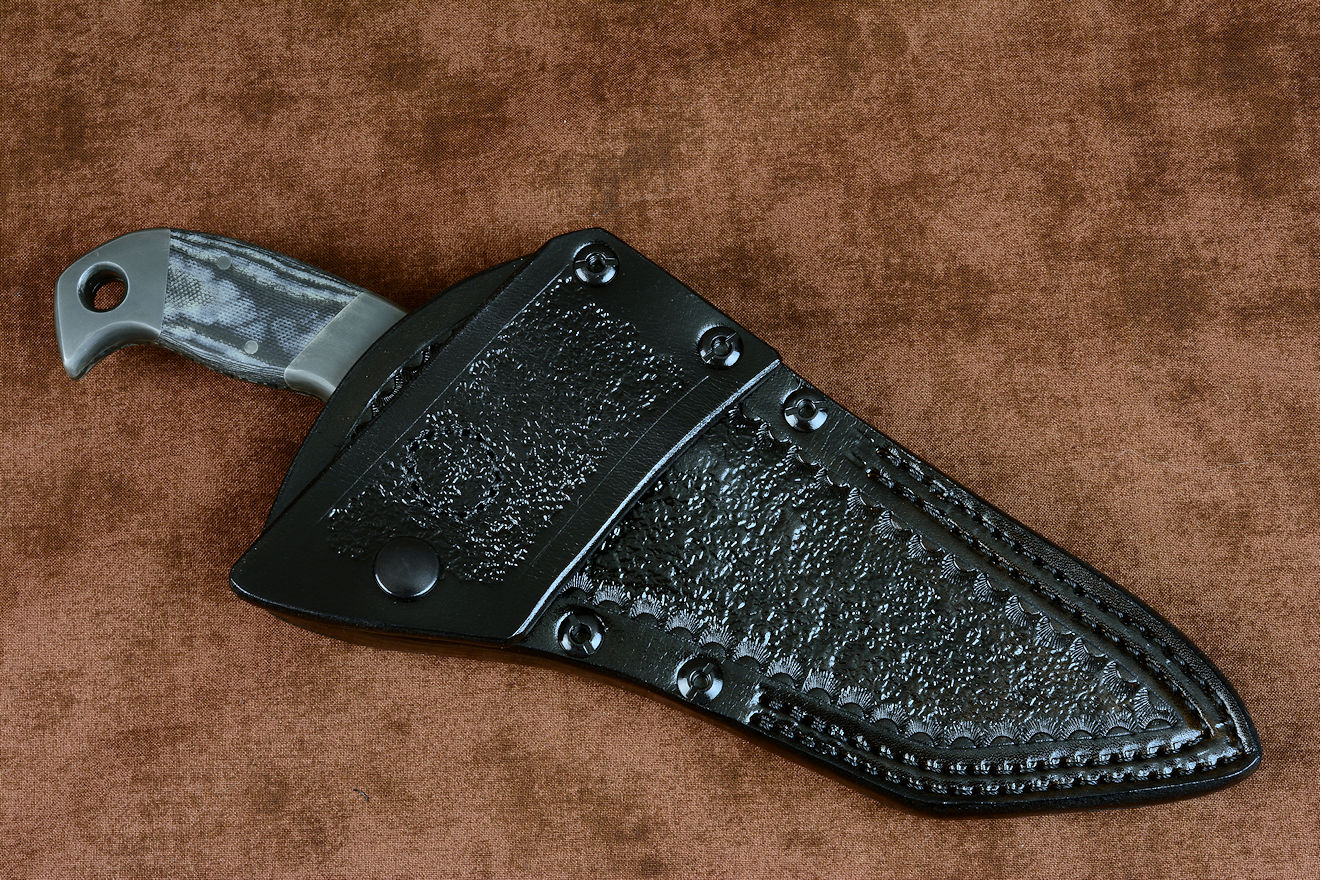
My positively locking V1.0 sheath is made of more than 40 components. The hybrid tension locking sheath and tab-lock sheaths are made of 24 to 40 components. All parts and fasteners are hand-fitted to the individual custom combat, tactical, or rescue knife. The sheath is matched to the knife and no other knives can be used in the sheath.
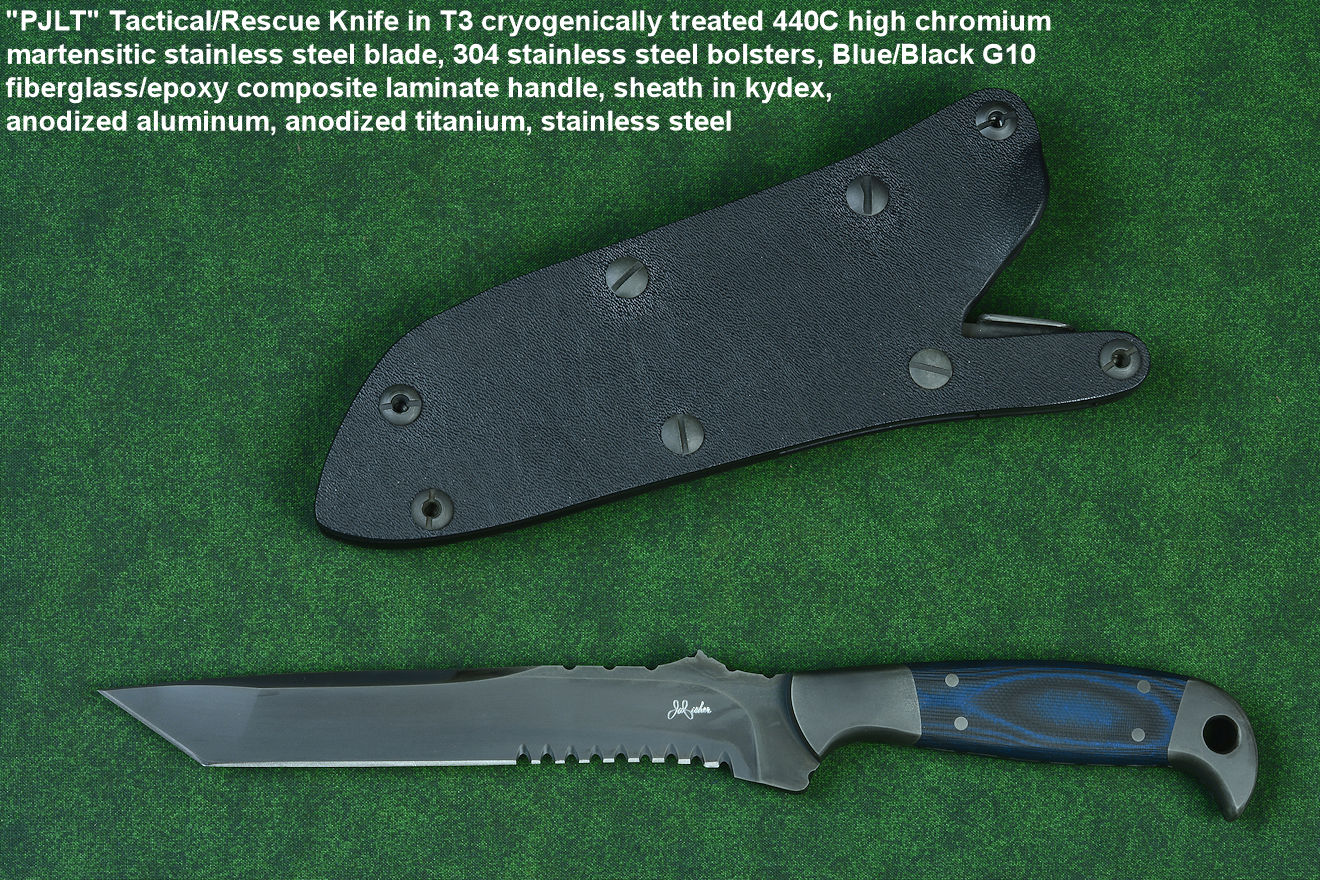
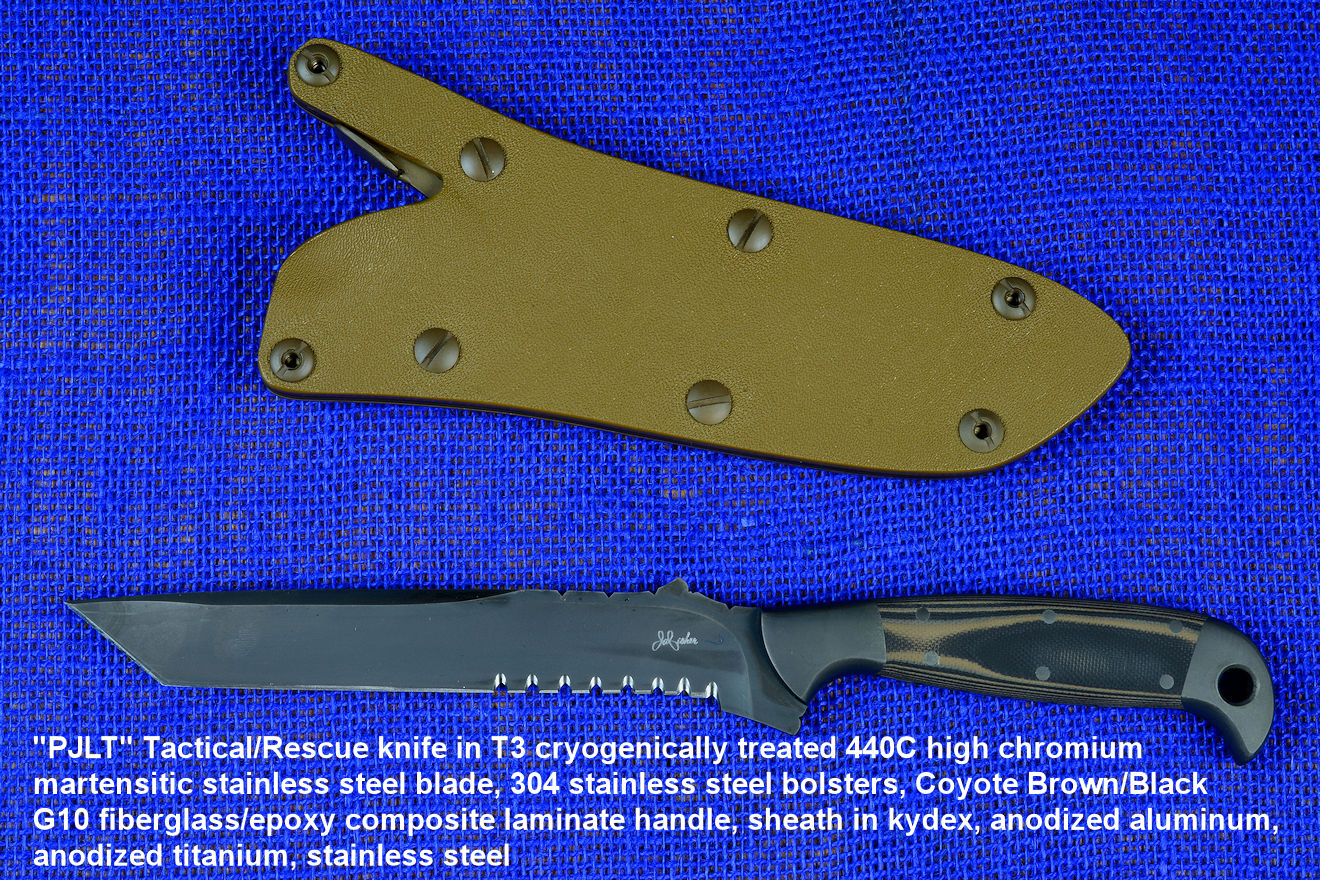
The front and back of the sheaths are made of a single layer of .125" thick Kydex® thermoforming plastic (methyl acrylate and polyvinylchloride), which may be hot-formed and molded to clear the knife bolsters and handle. This is double the thickness of every typical kydex sheath or pistol holster. Unlike others' sheaths, the kydex is not used for retention or in any mechanical fashion, so no wear, bending, abrasion, or flexing of the kydex ever occurs. It simply serves as a front and back of the sheath.
The strength of the sheath relies upon the welts, not the front and back. The welts (or frame members) of the sheath are made of two layers of 0.125" thick (total thickness: 0.250") milled and dressed 5052 corrosion-resistant high strength aluminum alloy at H32 hardness. This is a high chromium-magnesium aluminum alloy, used for aircraft fuel tanks, storm shutters, refrigerator liners and panels. I offer professional 1-mil thick anodization (twice the thickness of flashlights and aluminum tools) which imparts a near-ceramic hard surface to the aluminum. Then I usually dye it to match the knife, sheath body, and other components. This is prevalent on my "Shadow Line" for non-reflective camouflage in subdued operations. The anodization also increases the corrosion resistance tremendously, so that dive applications in marine environments are corrosion-free. The anodization also stiffens the aluminum by completely coating the outside with two layers of rigid aluminum oxide.
The aluminum welts and double-thickness kydex, front and back, are adhesively secured with waterproof cement, and bolted together with blued steel, nickel plated steel, or stainless steel Chicago screws with a 0.250" shank. These days, most of my sheaths are fixed with all stainless steel hardware and fasteners. The stainless steel Chicago screws can be blackened, oxide-toned for color, or passivated for complete corrosion resistance in salt water.
The locking mechanisms; boss, plates, ramps, pivots, ball, tabs, and all machine screws. are made of 304 high nickel, high chromium stainless steel (18-8 SS). These parts may be blasted and darkened through surface treatment or oxide colored to match the coyote parts. They are zero-care stainless steel, resisting even salt water exposure.
The springs in all later models are 6AL4V titanium. This is a spring titanium, and can be anodized with heat or chemistry to a dark blue or golden brown surface. This is completely corrosion-free and will last through many thousands of operations and flexing.
To condense this simply, my tactical sheaths are made of double-thickness kydex, anodized aluminum alloy, 304 stainless steel, and titanium. That's it.
Dear Jay,
I finally found some time to write back to you. The parcel was opened by the authorities and resealed. They certainly checked
it judging by the way they put the various pieces back together. They were probably as astonished as I was when they held this
knife in their hands. You describe it on your web page and many customers confirm the experience in writing but unless you
touch and feel a Jay Fisher knife you don't really know what this all means. I will recommend those knives to everyone that
I trust to own such a wonderful piece of art. I came to you not because of what I wanted but because of who you are. This
quote is true for me too and I am not disappointed. I am really happy to have had the chance to meet you through the internet
and also talk to you.
When I hold that knife in my hands I know why the best soldiers and rescue services trust it. Having been both a soldier and
a fireman for many years I have a lot of appreciation and understanding for the quality and "finesse" of that knife.
Dear Jay thank you for making me a member of your client base. There are many more thoughts that I would like to share
with you but for now I just want to express my gratitude for your outstanding service (many businesses could learn from
you and you could add client relationship expert to your credentials) and your high quality art work
kind regards,
M.
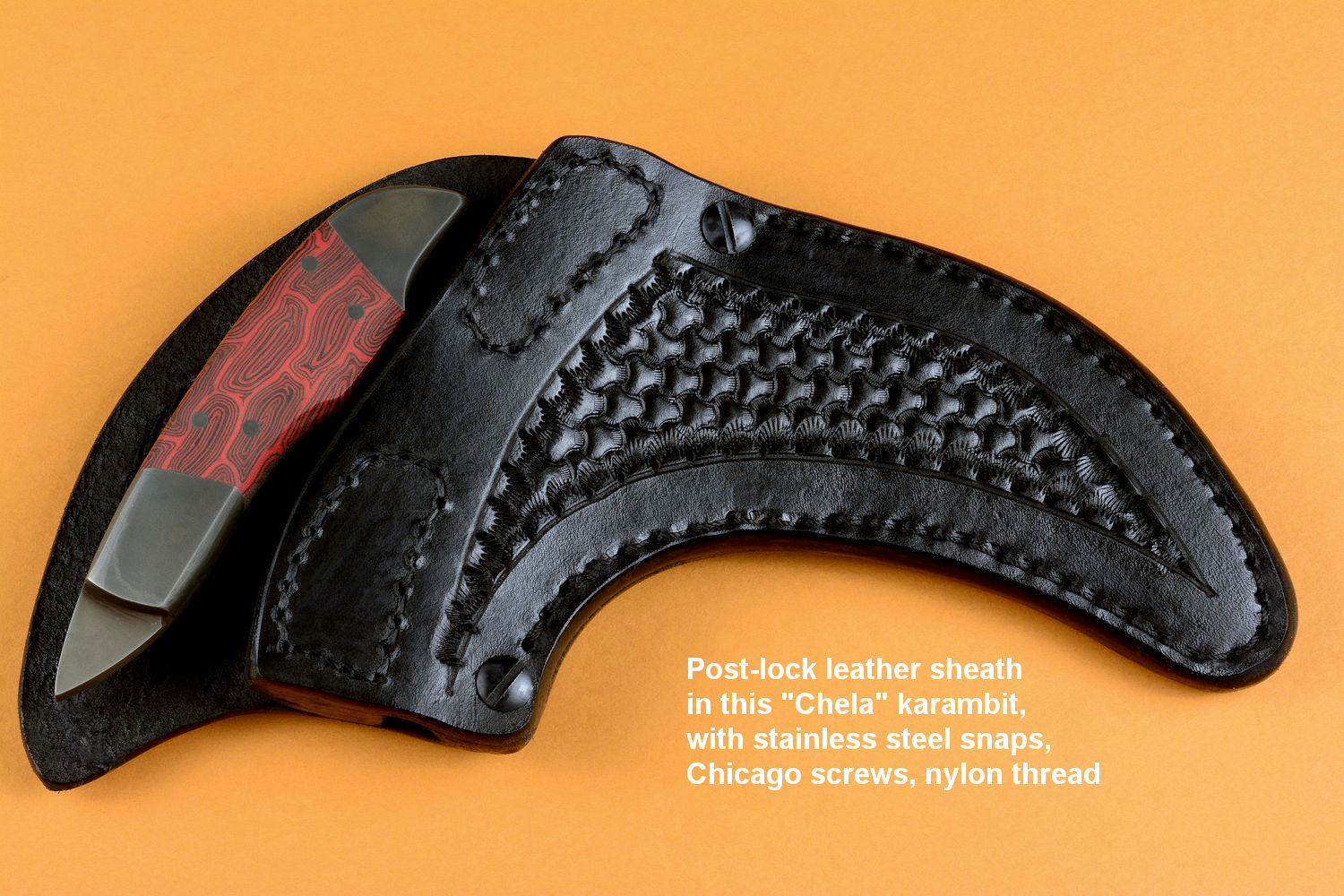
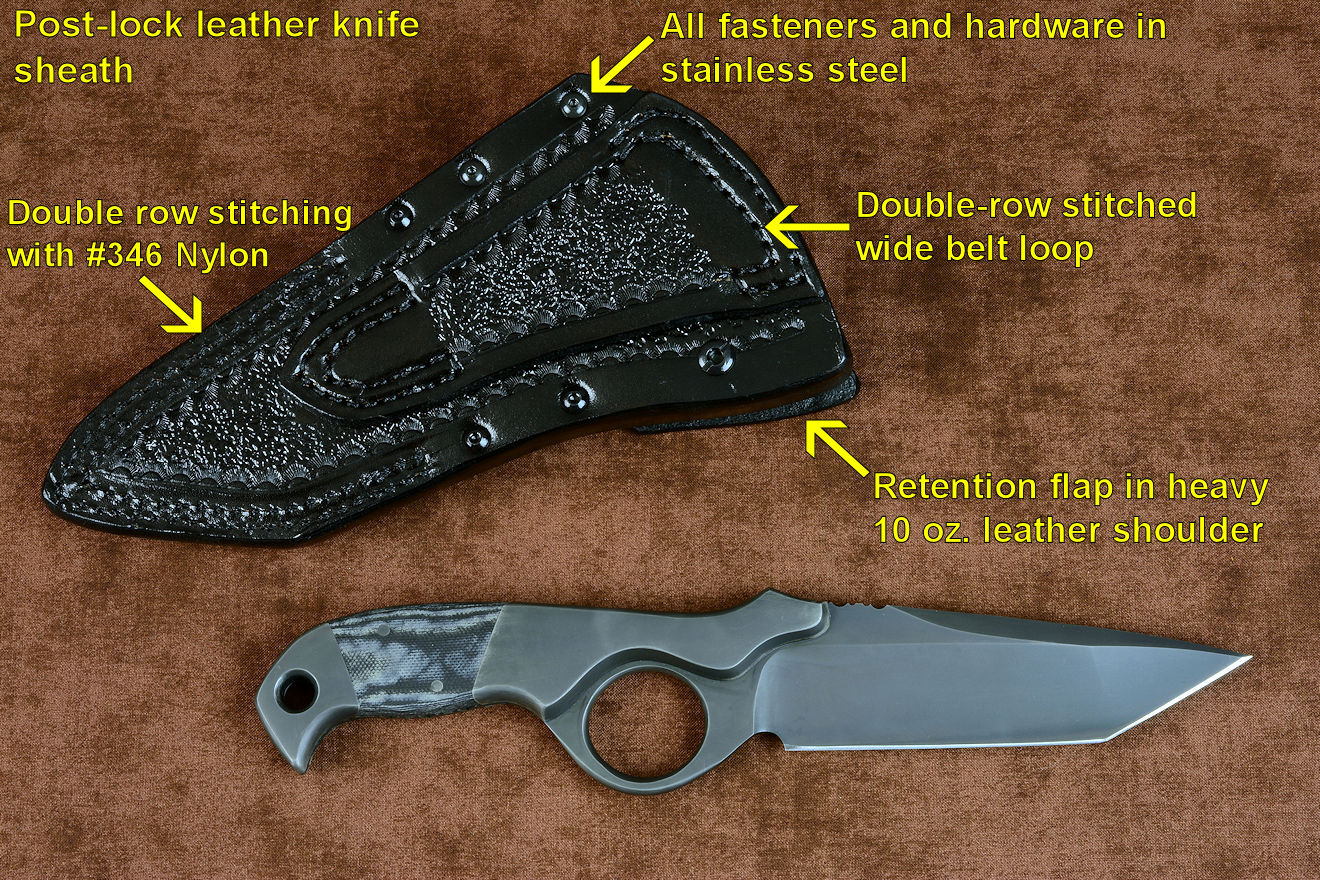
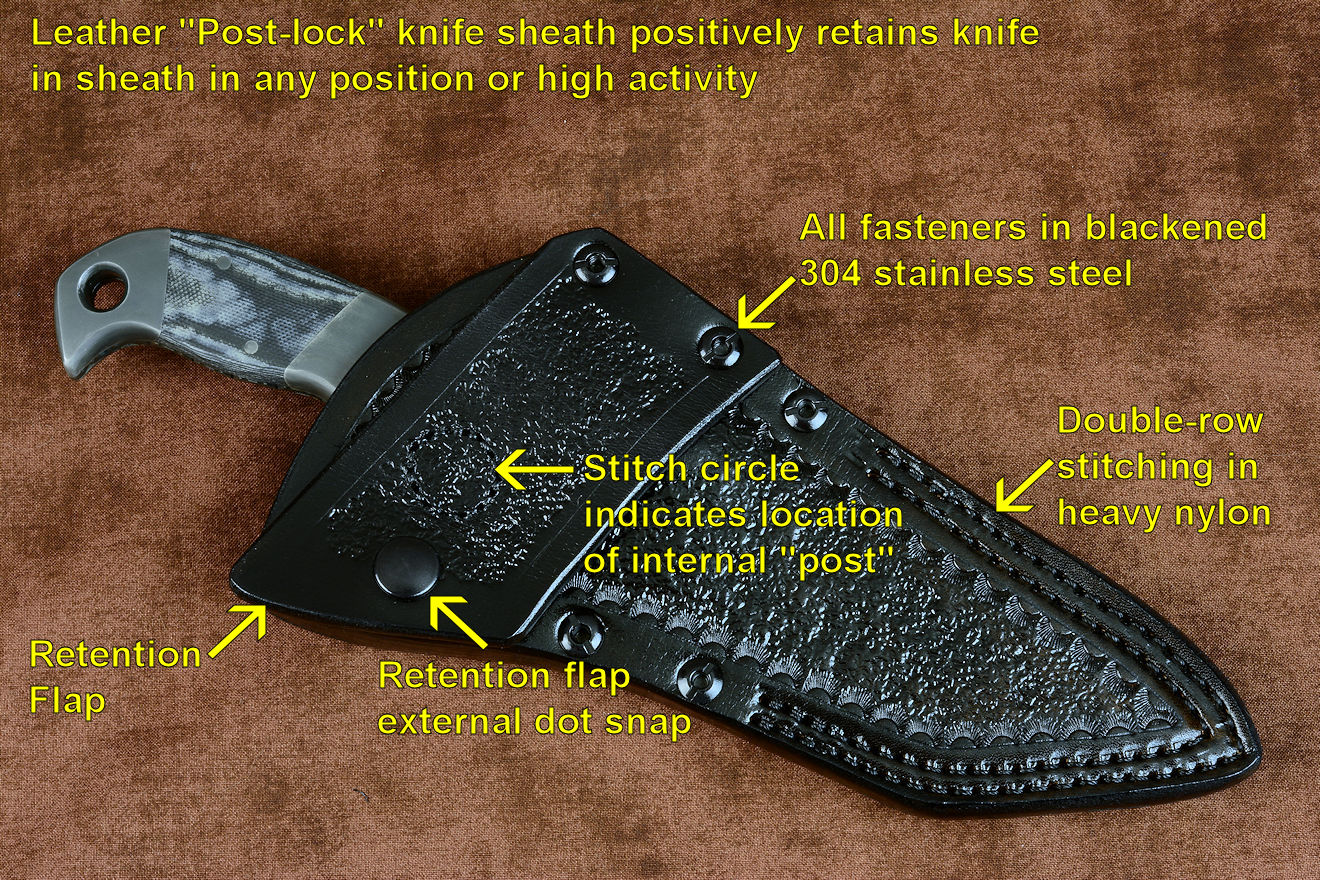
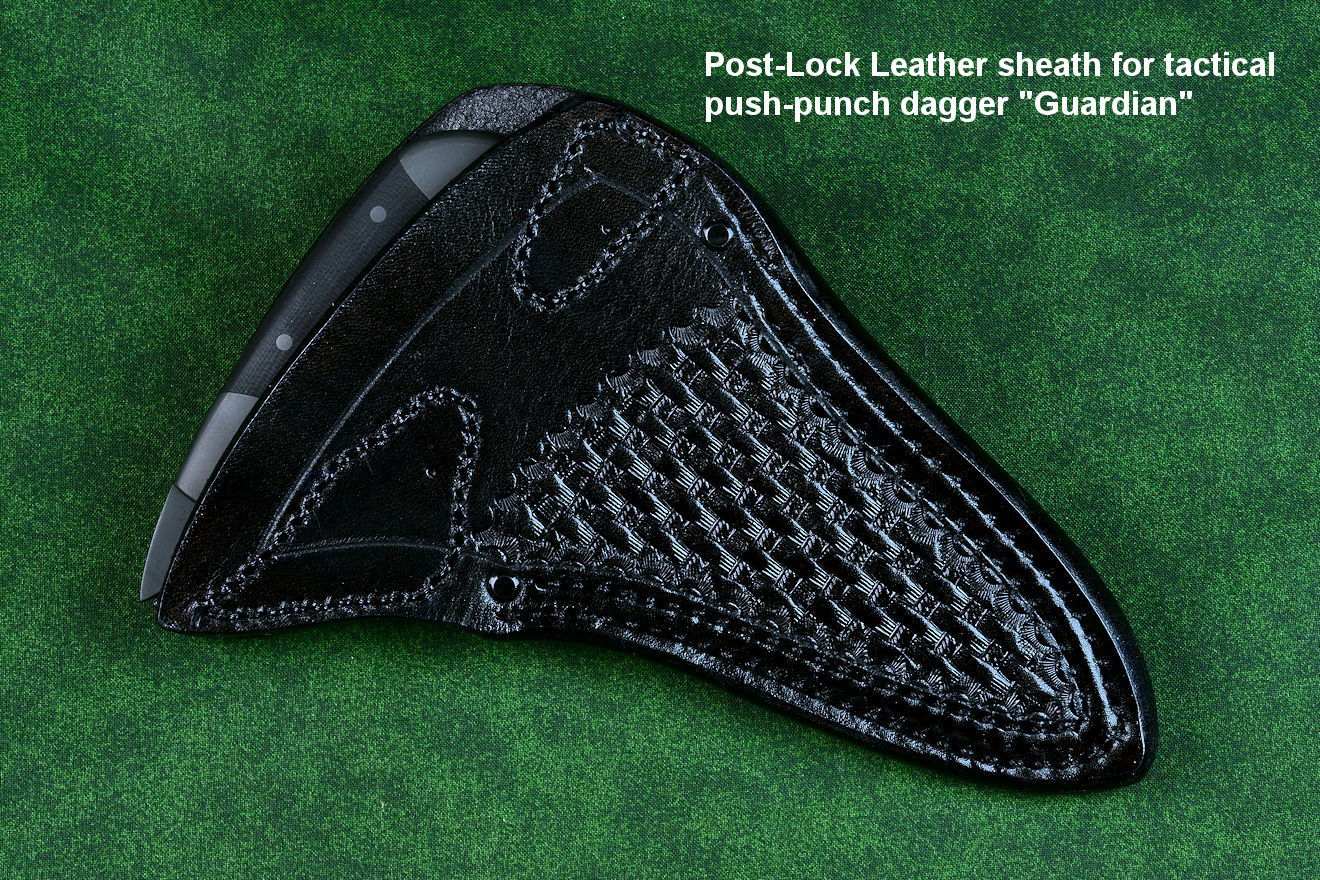
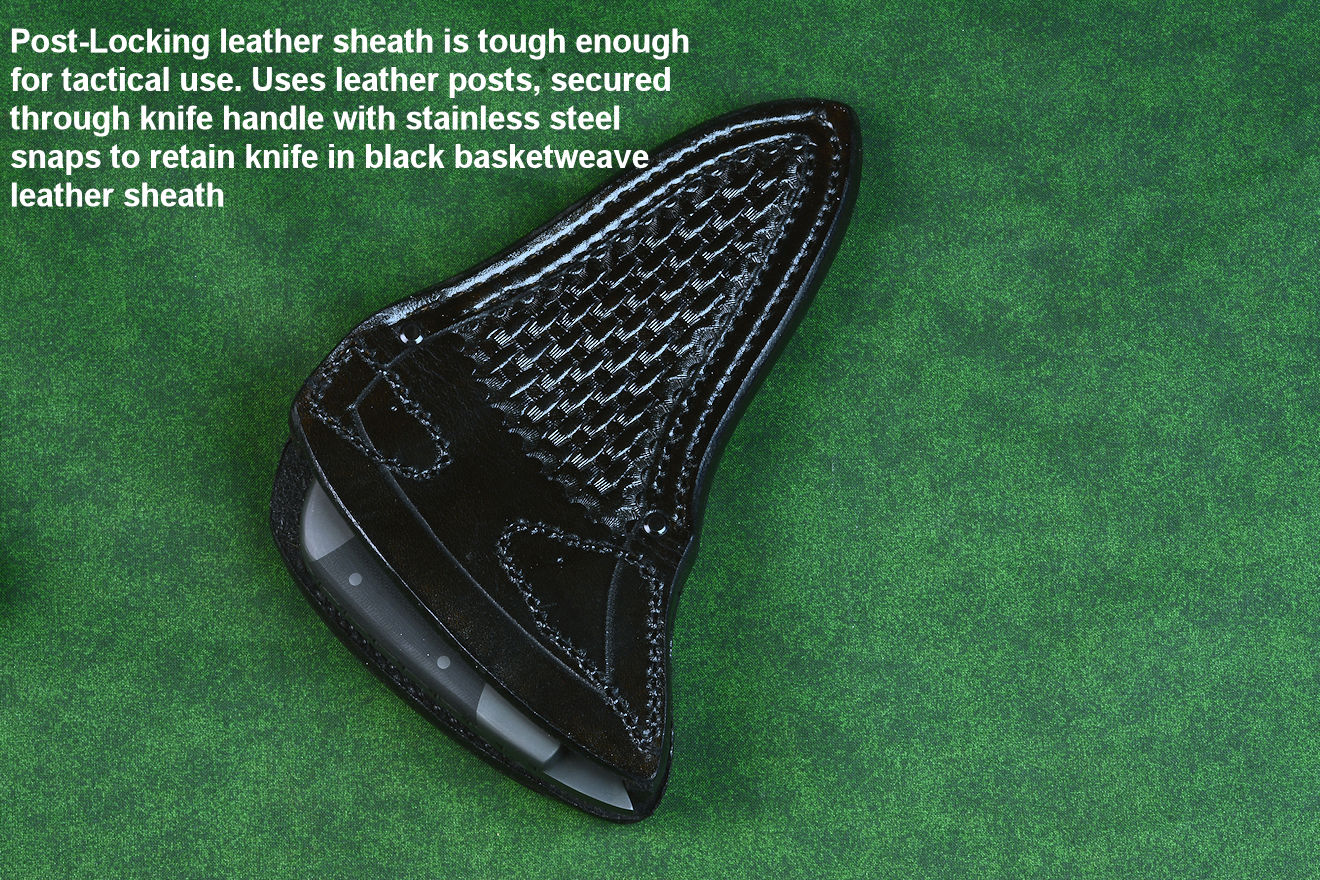
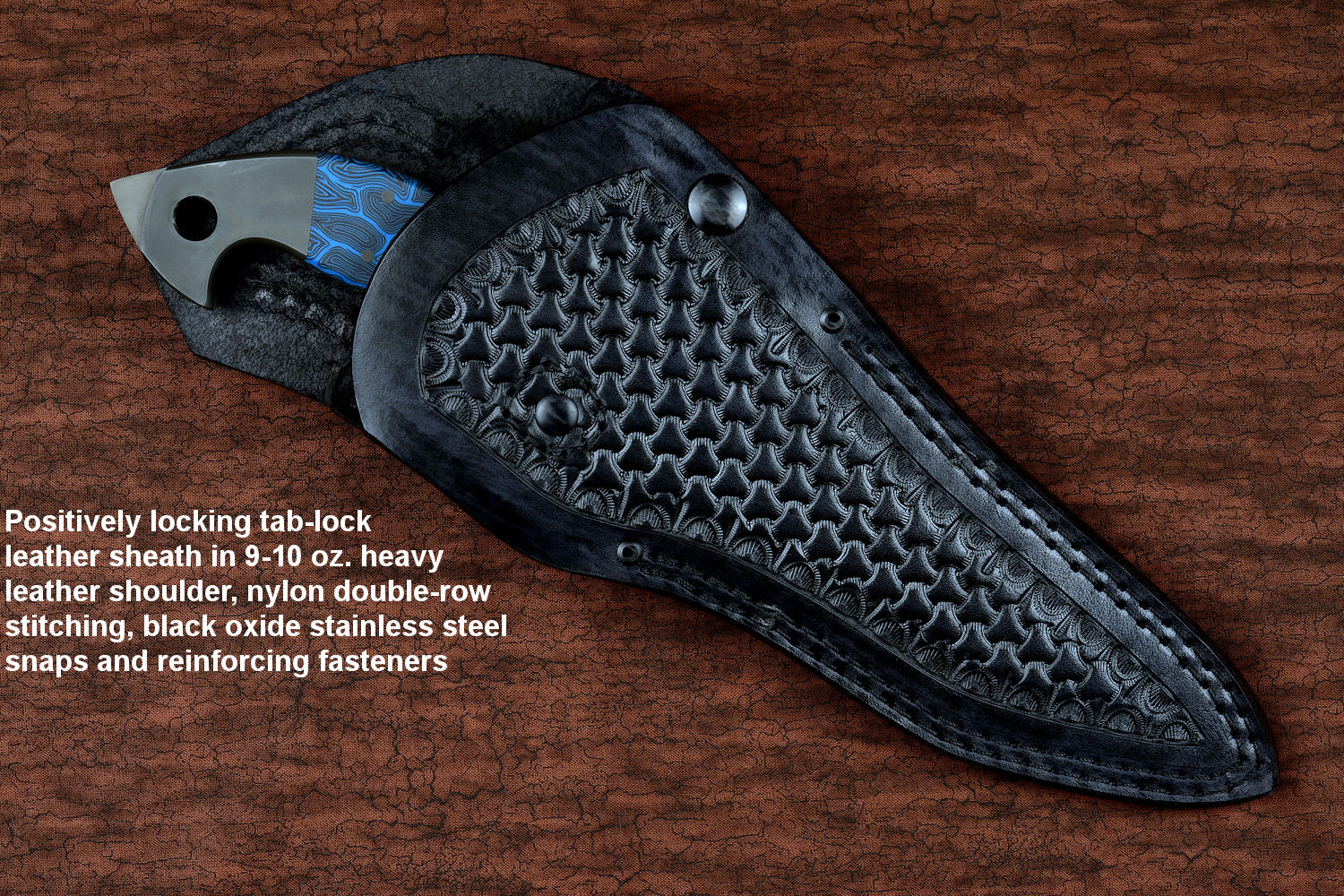
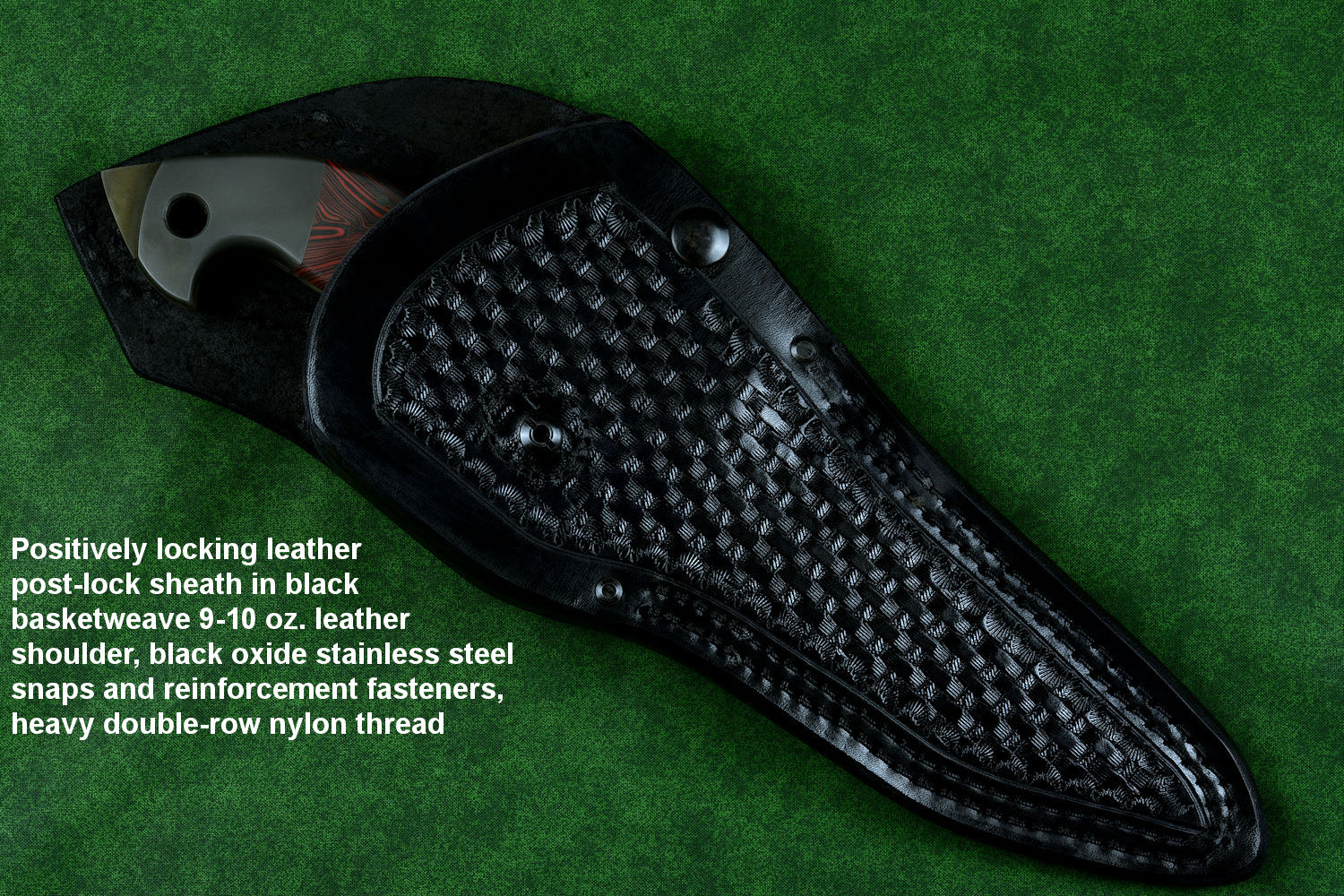
When clients make requests, I do my best to listen to their needs. There are knife uses and sheath-wearing situations where a solid, aluminum-framed locking sheath may be too heavy, too cumbersome, or too visually obvious to use. There may be more casual situations and exposures; the client may wish to meld with a Principle Security Detail-type of wear option. He may wish to wear it on wild-land gear, outdoors, or in guiding and hunting applications where the metal-reinforced tactical sheath is simply overkill. This type of request is the reason I designed the post-lock leather sheath.
What was needed was a sheath that exposed plenty of knife handle, without the high back you see on most of my knife sheaths. Some of the advantages of the open-handle are that the handle is "reach and grab" fast, similar to my positively locking knife sheaths. This means my knife owner doesn't have to deal with the sheath back making the handle harder to wrap the fingers around. This type of arrangement also makes a smaller sheath overall, since the sheath covers just the blade and a small portion of the handle, not the entire length of the blade and handle. The size reduction also makes for a lighter weight sheath, improved even more by the fact that the majority of the post-lock sheath is leather.
The other issue is the nature of retention. A knife is normally retained in a leather sheath with tension: the squeezing of the leather around the front bolster and handle. Some of my sheaths have tabs that engage with the shape of the knife to retain the knife in a more definite locking fashion. In the post-lock sheath, I wanted to incorporate the finger ring itself as the locking mechanism. The finger ring may be round or elliptical in many of my tactical knives, and it offers a very secure fit to the hand. Why not use the same ring to retain the knife in the sheath?
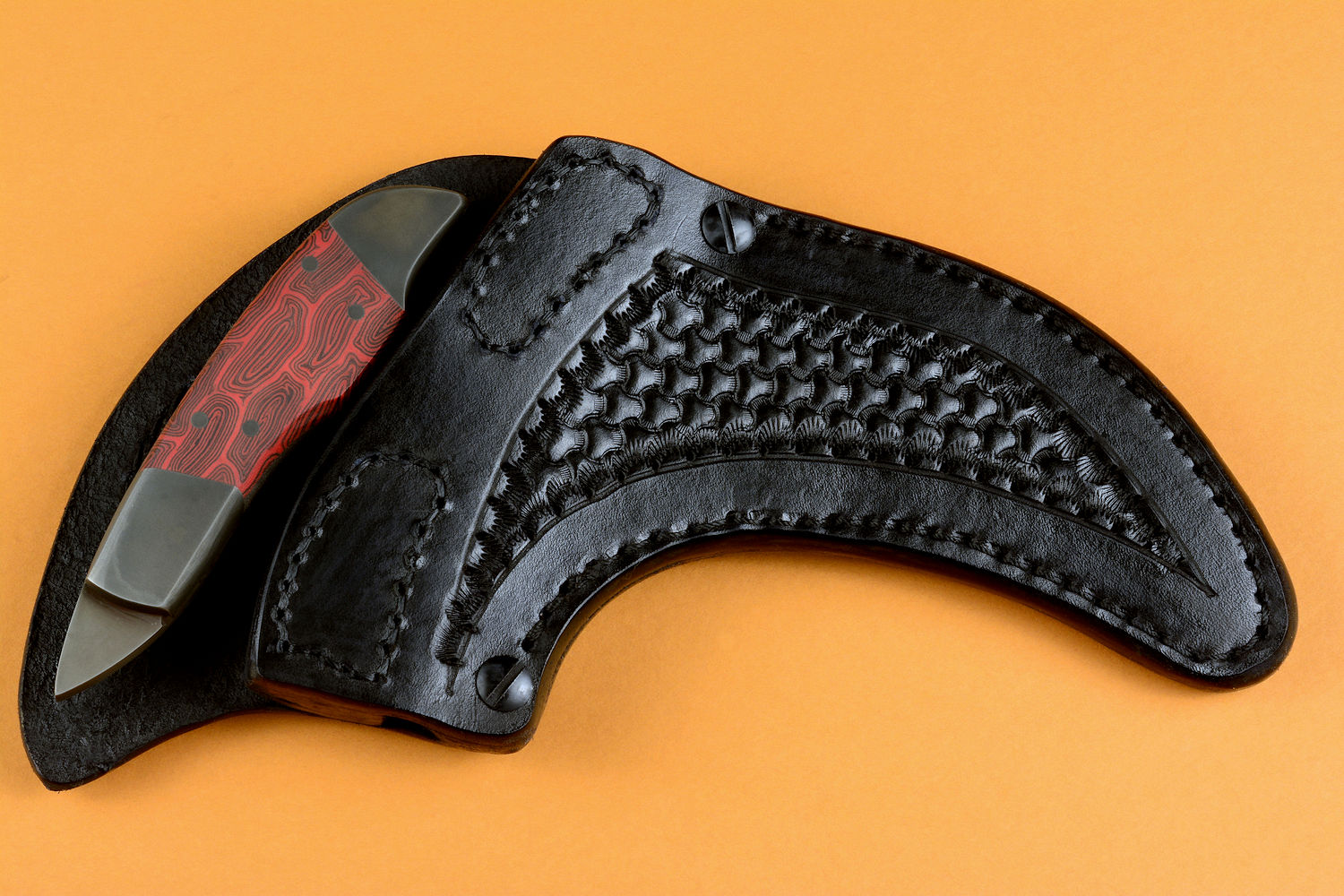
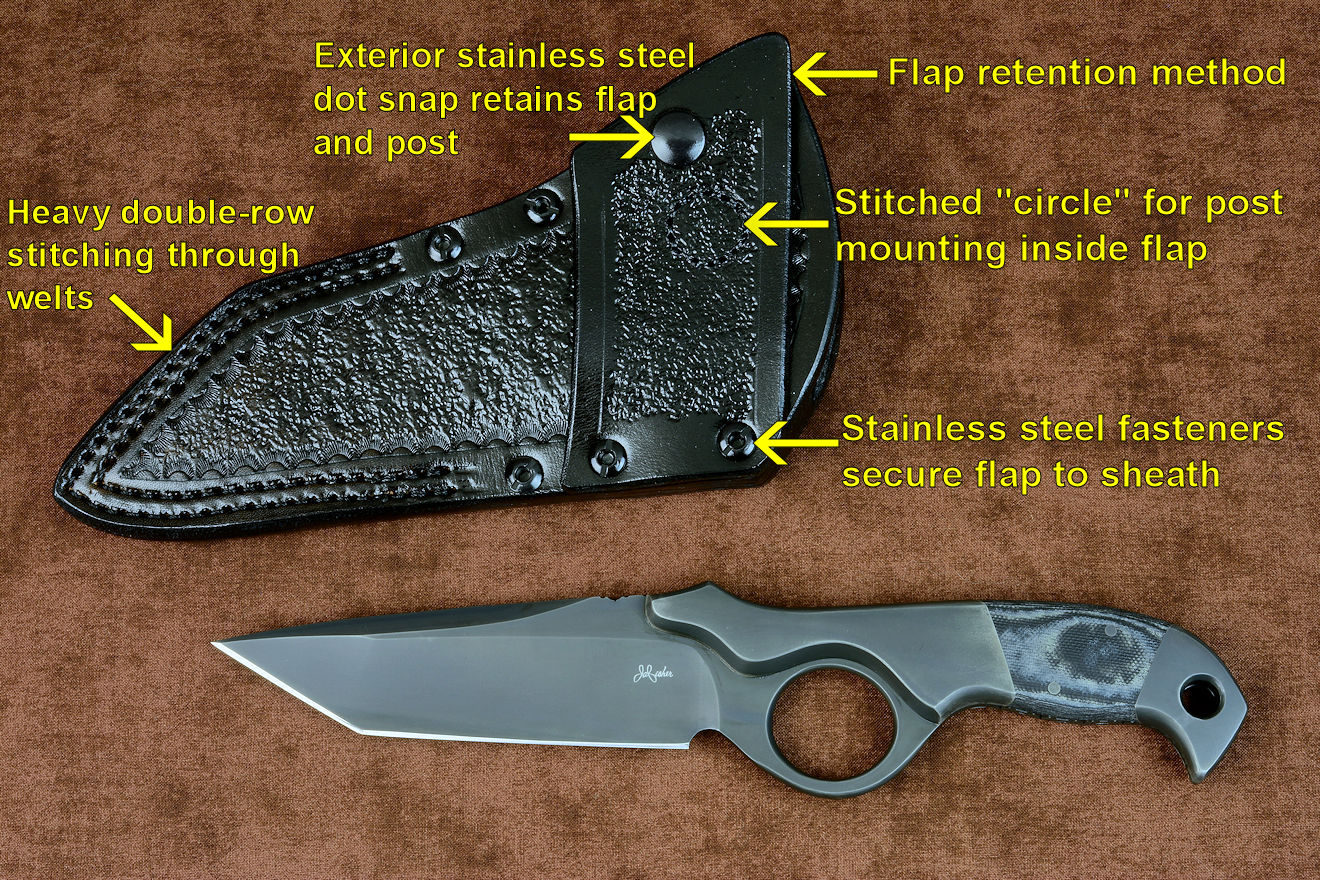
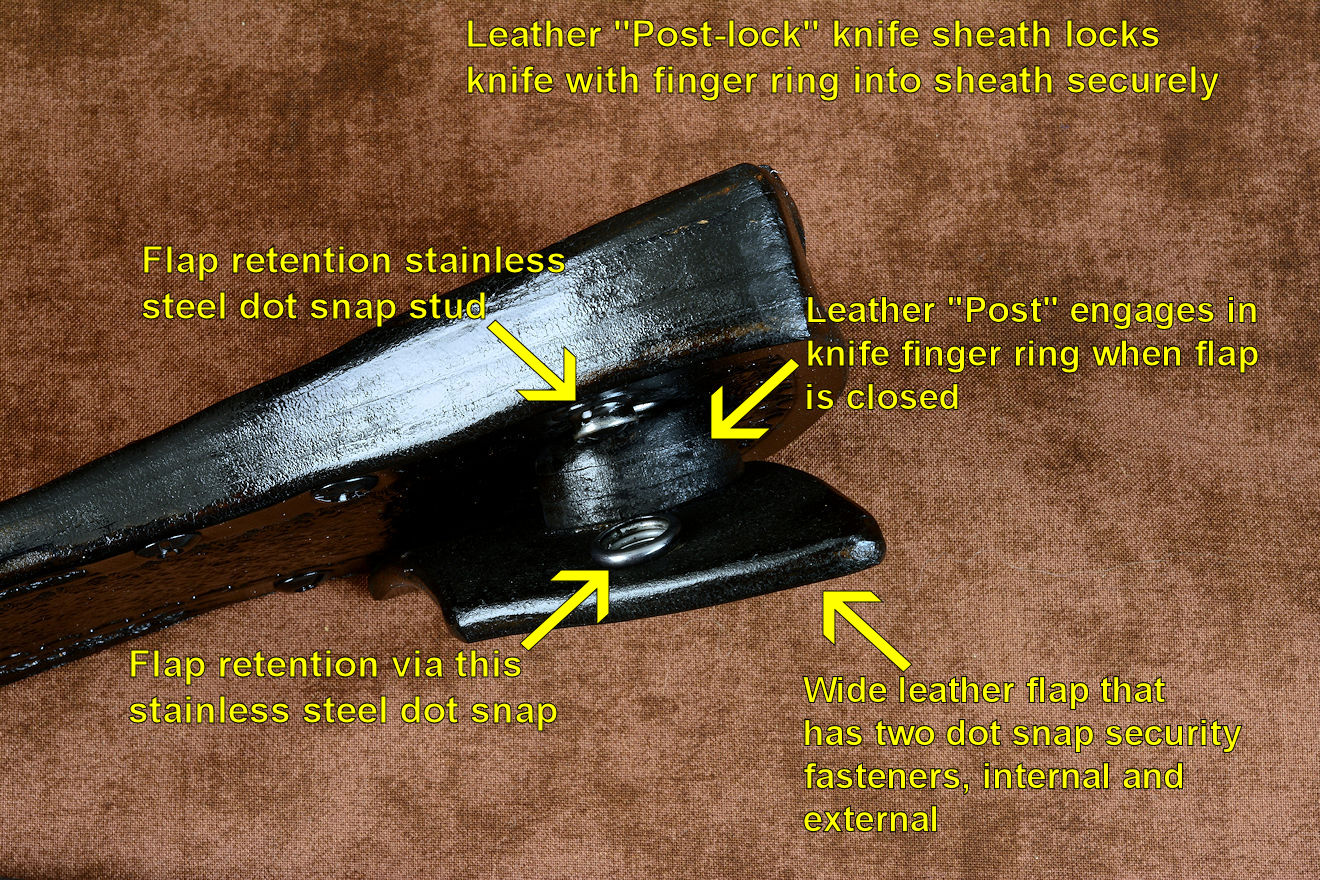
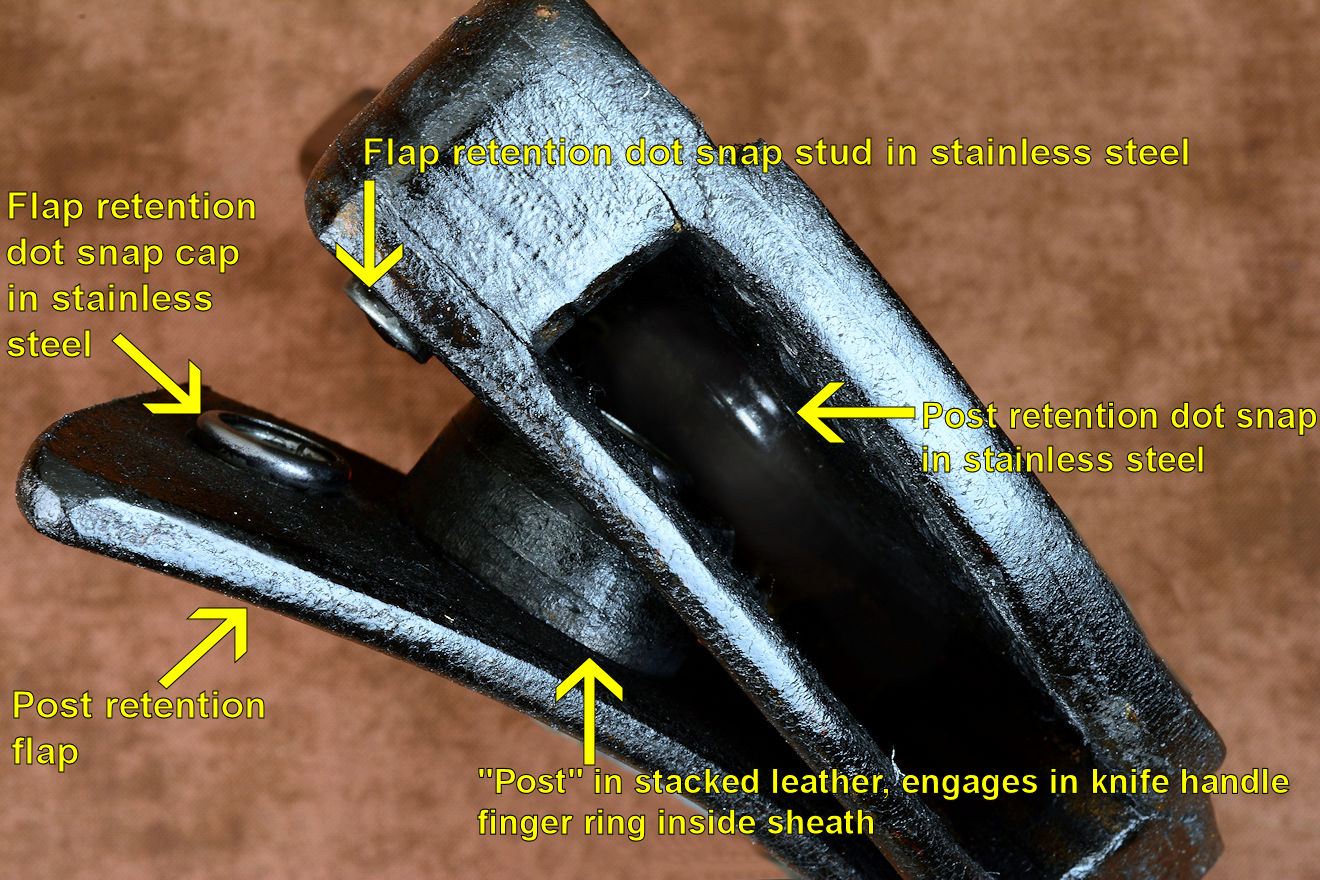
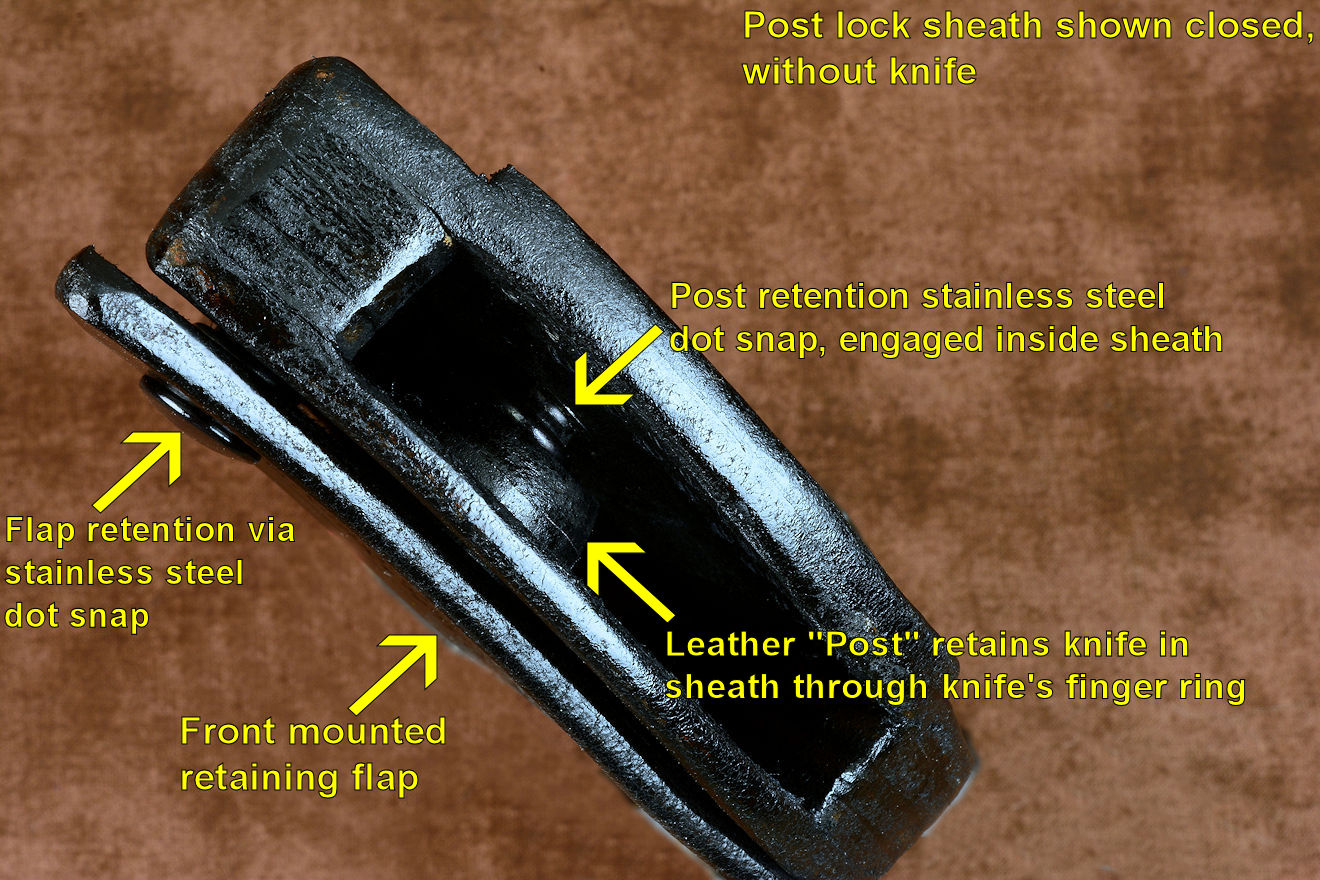
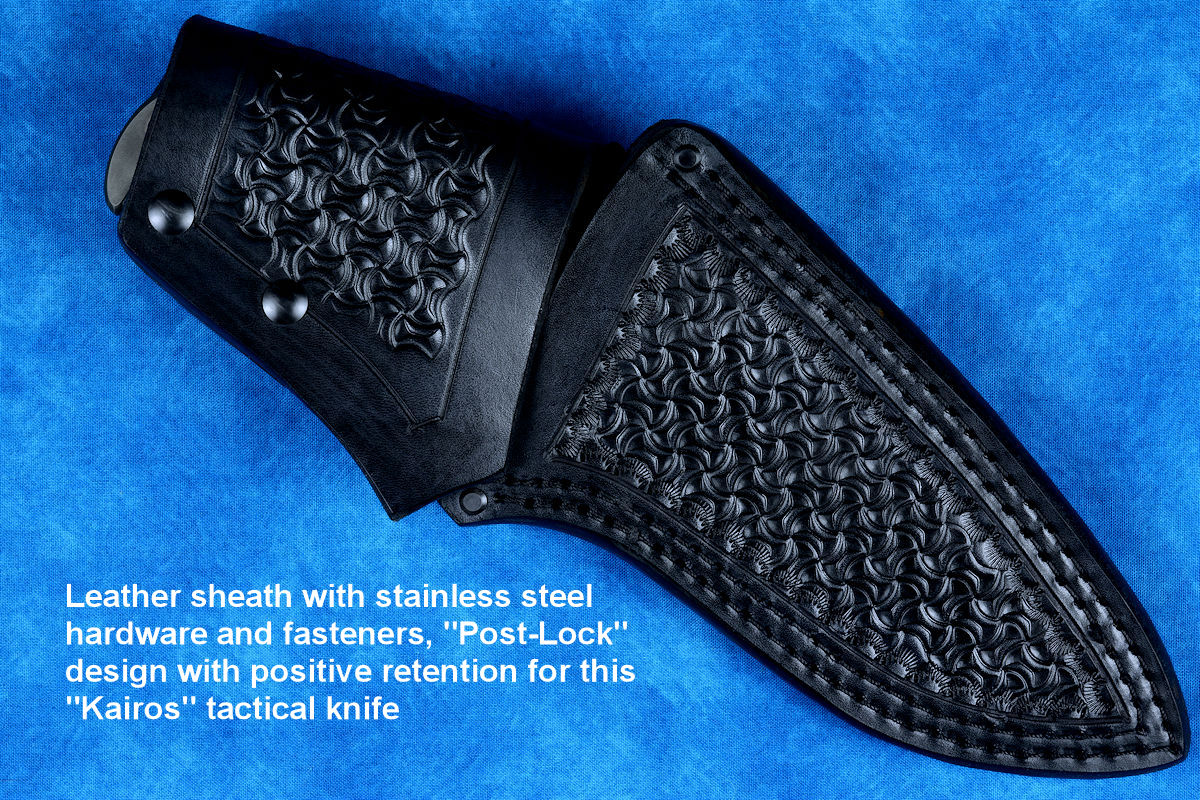
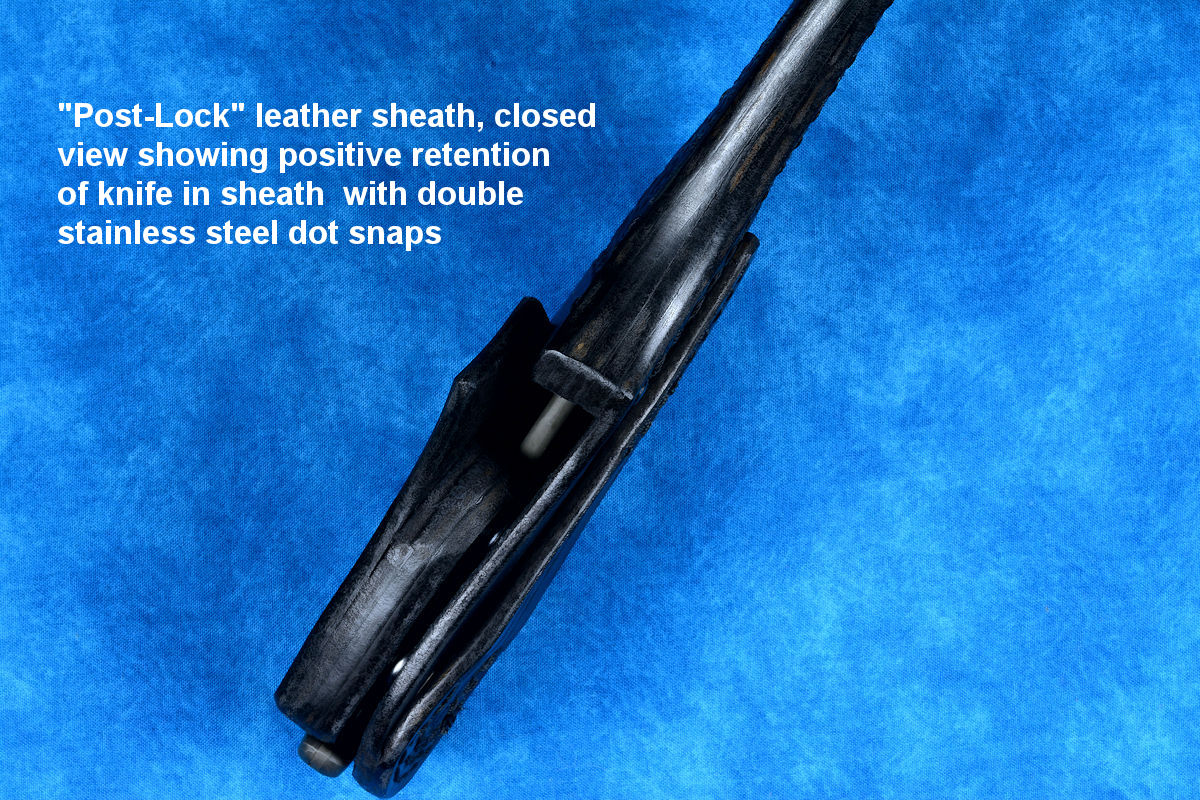
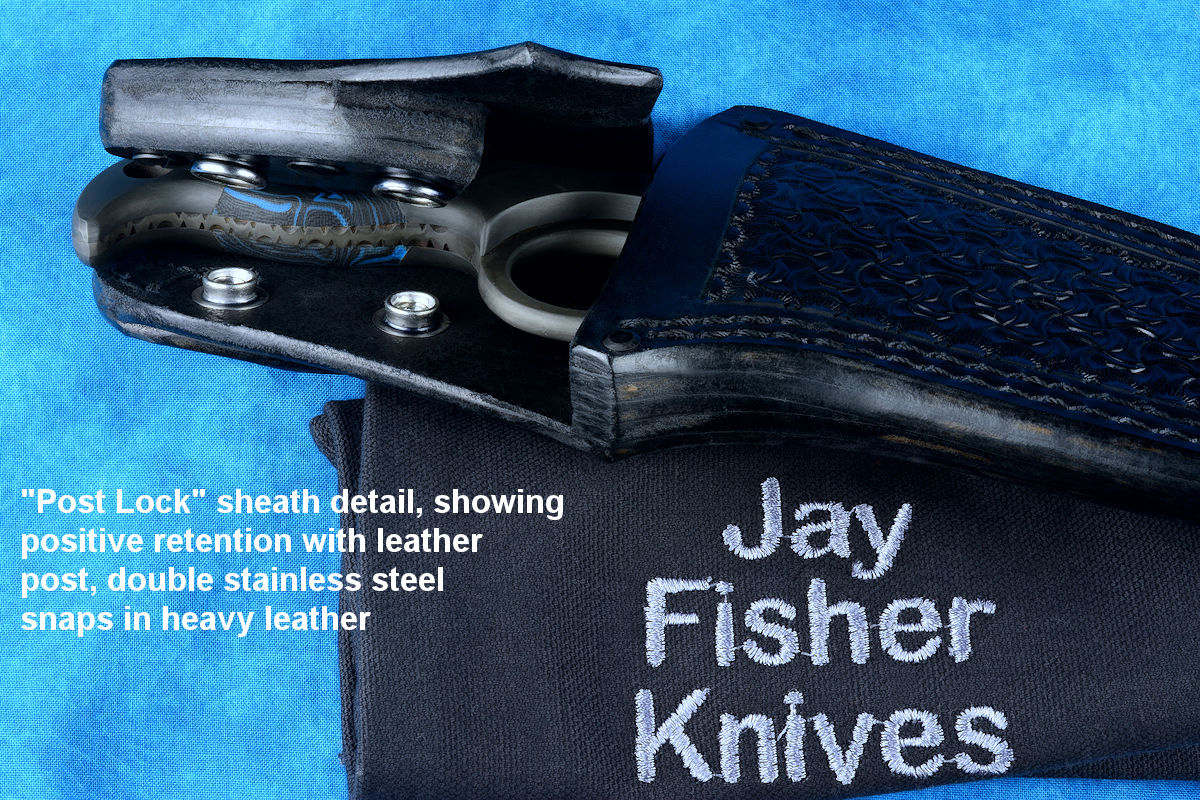
I worked through some ideas and prototypes and got it all figured out. The most secure method is to create a "post" that actually passes through the finger ring when the knife is locked in the sheath. The post can't be sheared away, and the size of it means that as long as the post is secured in the sheath, pulling on the knife handle cannot remove the knife from the sheath. The post is made of leather, bonded in a stack that is secured and cemented, reinforced with heavy nylon thread that mounts it permanently to a large flap on the sheath front. The post has a stainless steel snap at the base, inside the sheath, that engages when the post is pressed through the finger ring. It's impossible to shear the post away, I'm certain that it would take the weight of several men to distort the sheath and post enough to break the knife free of this retention method.
I wanted some extra security, so I also installed a second stainless steel snap in the large retention flap. This design, with two separate stainless snaps that have to be released in order for the post to move, insures a double-safe locking feature. The flap is secured to the sheath frame (welts) with stainless steel screws and fasteners, and will not come off. The flap forms a large hinge that can easily be operated to release the post and the knife.
When the knife is needed, the hand wraps around the handle, and a finger or two pushes the flap away from the sheath front, unsnapping both internal and external snaps. This allows the post to pivot away and move out of the finger ring. The knife easily is unsheathed. Sheathing is also easy: the knife is pushed into the sheath, the flap and post are folded flat, both snaps audibly click. There is a "stitch ring" in the flap face to indicate where the finger presses to engage the internal snap.
Of course, the snaps, screws, and hardware are all stainless steel, and can be blackened to match the sheath color and tooling. The belt loop is very high, so the knife handle rides high and accessible, making it easy to get to. The knife shown below is made for a right handed person, left side crossdraw, but any arrangement can be made if the knife has a forward finger ring. I look forward to adding these to the kits, and making more of them in the future!
Currently, I'm making knife sheaths and accessories in two color schemes: black or coyote brown. The surfaces are media-blasted and flat, non-reflective. The kydex, the anodized aluminum, the webbing, the hardware and fasteners all match. I can leave the aluminum and stainless steel a natural metallic color, but rarely do clients request this now that I'm regularly anodizing.
Tactical, combat, counterterrorism, and rescue knives are made to be used. In use, any knife is going to show normal scuffing, surface wear, and typical changes from use.
This is reasonable, but the purpose I'm writing this is because some people might think and this kind of knife should be kept in pristine condition. If a person is serious about that, perhaps they should be looking at fine, mirror polished art pieces that are never touched, never used, and maintained in a safe. I can make and supply those as well, but they are not tactical knives. I just wanted to get that obvious fact out of the way.
With my designs and the interaction of the knife and sheath, there will be expected some wear on the contact areas of the knife and sheath.
From this, you can guess that it is impossible to keep a knife in pristine condition if it interacts with a sheath. This is ANY sheath. Even the softest, newest leather rubs against a mirror polished bolster and produces a light scuffing wear pattern. The only way to prevent this is to never, ever put a knife in a sheath.
I know; this sounds ridiculous, but I need to be completely clear and describe the common and expected wear patterns. After all, these are robust working tools, not dainty wallflowers.
All successful businesses have critics, and it's important to educate so that low information does not rest without challenge. I owe it to my clients and patrons and future clients and patrons to be very blunt, clear, and concise about these criticisms, so that they can make an educated decision in their own knife and sheath selections. It's important to not let misinformation stand, lest it root there and become belief.
There isn't too much criticism about my locking sheaths, or any of my sheaths, for that matter, but once in a while a person who does not have access to one of my sheaths will make some careless and irresponsible claim about them. This is humorous, because they don't even have a sheath to examine, inspect, or use, yet feel compelled to offer their evaluation!
Conversely, the people who do have them are happy with them; in the hundreds of this type of sheath I've made since the 1990s, I've never had one returned for even an adjustment, much less a repair of any kind! I also receive continual requests for a locking or hybrid tension-locking sheath for every single tactical, combat, or counterterrorism knife I create; my clients demand them.
One anonymous poster on a forum claimed that "there is a reason no one else uses aluminum in their kydex sheaths," insinuating that I was somehow wrong for building a clearly superior sheath. This is quite funny, because this person saw fault in building what is the best, most sturdy, and most durable knife sheath in the world today. He thought that all sheaths were supposed to be weak, made of single thickness (.060") kydex, and with soft kydex welts, not the .250" thick high strength aluminum welts I use. Why wouldn't I build them weak, like everyone else does?
Then, a claim was made about the accessories; that they "looked weak and might break if the wearer took a tumble." This shows the absolute ignorance and contempt these uneducated types spew in hopes of casting some doubt on the most successful of us. The accessories, like the sheath, are the strongest made in the world today. In just one example (the tactical flashlight holder, the HULA), I'll make a simple comparison: Mine are built of all welded zero-care austenitic stainless steel and high strength aluminum alloy. Theirs are built of flammable, weak, flexible, thin plastic, or nylon cloth!
My accessorized units are used by some of the top military, law enforcement, and counterterrorism teams in the world, and there is a reason for that. By the way, I've never had one returned for even an adjustment, much less a repair, not one of any type in over 25 years making them and hundreds of knives. NOT ONE.
Rather than simply explain who is using these sheaths and accessories, and for how long they have been using them, I'll commit to describe the exact components used so it's absolutely clear how durable these sheaths are. This is done lower on this very page, at the topic: Compare. You can read it yourself, and make an informed decision.
As for me, I'll keep making the strongest, most durable, most reliable locking waterproof knife sheaths made in the world today. They will continue to be the very best.
Every now and then, I get a letter that moves me. It is one of the reasons I'm so hard on factories and other knife makers about their work. It disturbs me greatly to know that our men and women are not carrying the best knives into battle that this country is capable of producing. Here's one of those letters and my response.
Sir,
I'm currently deployed to Iraq and found that a back up is a must
have. I work in closely with the local population and my weapon at
time's cannot be used due to distance or situation. I have a
Fainbrain-Applegate full size fighting knife now. I read your web
page and you seem to know what's going on with knives and sheaths.
The problem I have is I don’t have the proper sheath. I need a
combat locking sheath like in your pictures, so I can access my
knife in a split second. The best and most concealed place while in
IBA is the small of my back. Mounting the knife horizontal on
my belt seems the best. If you have any ideas on what to do or a
different path to take please let me know.
-TSgt H.L.
Ali AB, Iraq
My response:
Hello, TSgt L. Thanks for writing. And thank
you for your service to our country.
Your letter hit me hard. It is truly sad that
manufacturers and makers of knives do not carefully consider the
sheath when making and selling their knives, and do not consider the
lives that may be at stake because they do not supply an adequate or
useful sheath. All I can do is not make that mistake on my own
knives.
I’m sorry that I can not make a sheath for your
knife. My locking and combat grade sheaths are constructed with the
knife, in concert, so that components like thumb rises, ricasso
ramps, edge clearances, and mounting variations must happen in the
construction of the knife, so that a workable locking sheath can be
designed around the knife, with the knife. Each individual sheath
can only fit a specific knife. Unfortunately, I cannot build a
sheath around a factory knife or other maker’s knife, as they don’t
build the knife with the components and geometry that can allow a
locking sheath to work. Beyond that, I get so many requests to
correct inadequate sheath work that I would be out of the knife
making business, and into the sheath making business only. Even if I
did take on that type of work, it would require the knife in my
hands while you would be left in the field unarmed.
I do make an extremely good combat knife, and
can make it to your specifications, to fit a specifically designed
locking combat sheath of my own construction. I know my work is not
cheap, but I’ve got one of the best track records of useful and
durable combat and tactical knives and sheaths in the business.
I know this does not help you at the moment. In the chance that
they might be of help, I would contact the company or maker who made
the knife and ask them to outfit their knife with a proper sheath.
Please be brutally honest in their shortcomings of the sheath they
supply for their knife, because it is your life and other lives at
stake.
Barring that, you may have to do what I’ve
heard of other soldiers doing in the field: using found parts,
moleskin, leather bindings, bent metal, screws and other parts to
make their sheaths work. I’m terribly sorry I could be of no further
help.
Sincerely,
Jay Fisher
My tactical knife sheaths are absolutely the best made in the world today. How can I say this? In my 40+ years of knifemaking, I've seen many a sheath. I think it's important to detail the exact and specific features, factors, and components that prove my claim, so here it is.
Many of the points listed below apply to all types of my knife sheaths: locking, hybrid tension locking, tab-locking, and post-locking leather. Here are a list of critical and specific points and counterpoints comparing other maker's and factory knife sheaths to my locking and tactical knife sheaths to consider.
Other sheath makers, knife makers, and manufacturers will not illustrate these points for you, and as you read, you can understand why you deserve to know what you are depending on (or not!).
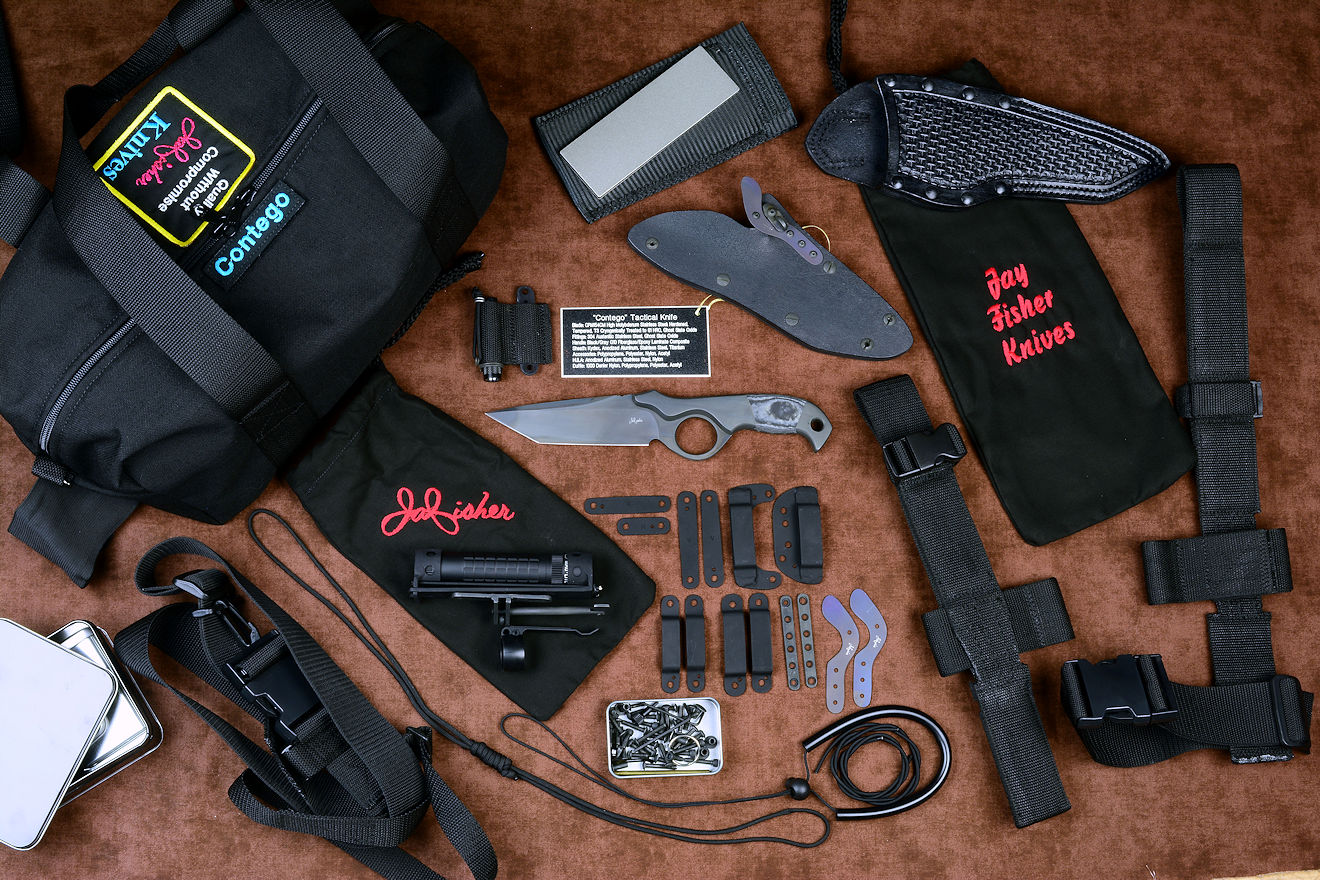
Some minor care can allow my tactical combat knife sheaths to last as long as the knife.
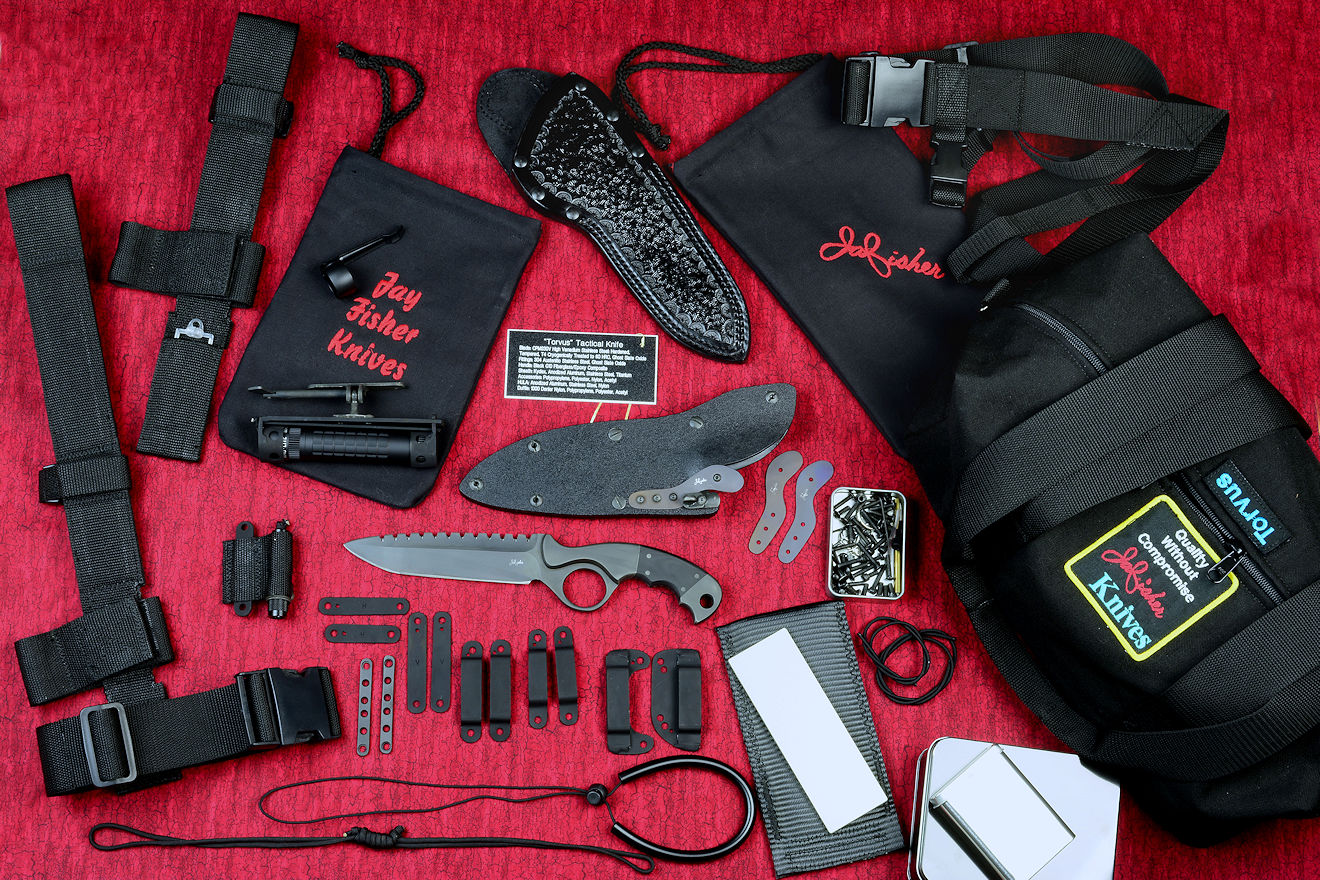
When you first acquire my tactical sheath with matching knife, you may notice a few white or black flakes on the blade and in the mouth of the sheath. This is normal; it is the epoxy-based bedding along the edge run on the inside of the edge welt that is being cut away while the knife edge is seating in the new sheath. After a few dozen insertions and removals, it will seat and you won't see any more flakes. The coating beds the cutting edge, and protects the edge from the aluminum welt. You can see it when you look down the throat of the sheath. Some cutting and light chipping of this material is normal, particularly if you have serrations on the blade.
When first acquired, the new knife owner is often too gentle with the insertion of the knife in the sheath. Once the blade is lined up, it's fine to shove the knife in solidly in order to bed the mechanism and positively lock the knife. You're not going to hurt the knife by shoving it hard in these sheaths; they are very stout. Just be sure that you have the correct orientation, as shoving it in upside down will cause the stainless locking mechanism to ride on the cutting edge, and that won't help the edge... and it also won't work!
Learn to use the sheath, get comfortable with it, and know that you are using what is probably the best locking combat and tactical knife sheath made.
Most of my locking combat tactical sheaths are reversible. This means that the belt loops can be mounted on either side of the knife. When changing the setup of the sheath, the most important thing is to not cross-thread the stainless steel machine screws. Make sure they are clean, start them gently by hand, do not force them. To see how all this works, click on the detailed pages linked below.
If you have a problem with the positively locking mechanism of the sheath, please do not attempt a field repair. The mechanism is assembled under tension and once removed, the machine screws can not be reinserted in correct alignment. Just send the sheath (with knife) back to me, and I’ll tune it up for you for free! Incidentally, since I've started making these sheaths (1995) I have had not a single one returned with a single problem. Wow!
The Hybrid tension locking and tab-locks are even simpler. You can easily remove the components and reverse them on the sheath. The only reason you might have difficulty is because a sheath is full of mud or debris. Spray it out with a water hose, let it dry.
If you have any problem, contact me. I'm committed to my client's satisfaction and service.