Jay Fisher - Fine Custom Knives
New to the website? Start Here
"Nunavut"
Jay Fisher - Fine Custom Knives |
|||
New to the website? Start Here |
"Nunavut" |
||
This is actually a popular page on my site. You might be surprised how many knife makers, dealers, purveyors, or factory knife outlets on the internet do not include simple instructions on how to care for your custom knife, or any knife for that matter. Some people think that when the knife sale is over, the transaction is complete. I think about it differently. After the sale is when the knife goes into the field, into the hands of the user, and that it when it has to prove its worth and maintain its value.
A fine knife is like any investment in a tool; you have to do some simple things to care for it. Unlike silverware, which may sit in a drawer for years without the slightest care, a custom knife is a finely made tool with an organic component (the carbon in the steel), and can deteriorate if not cared for. The simplest comparison would be to a fine custom-made firearm of blued steel. You must keep it clean, dry, stored with access to dry air, avoid sudden changes in moisture, shock, corrosive environments, and residual contact left by handling.
The use of a knife is also an important factor. A knife is not a pry bar, not a screwdriver, not a shovel, or an axe. Please read these instructions below for a clear, concise description of knife care.
Your Jay Fisher knife has been constructed with the finest materials available. It is, however, a tool, and though some fine knives will never cut anything but gasps of admiration, all knives deserve proper care. My knives are built to last for several generations, with sheaths that should last at least one generation with moderate care. There’s no reason your knife can’t outlive you, unless you’re a relentless cutting maniac! Some important points:
Thanks for caring for your knife!
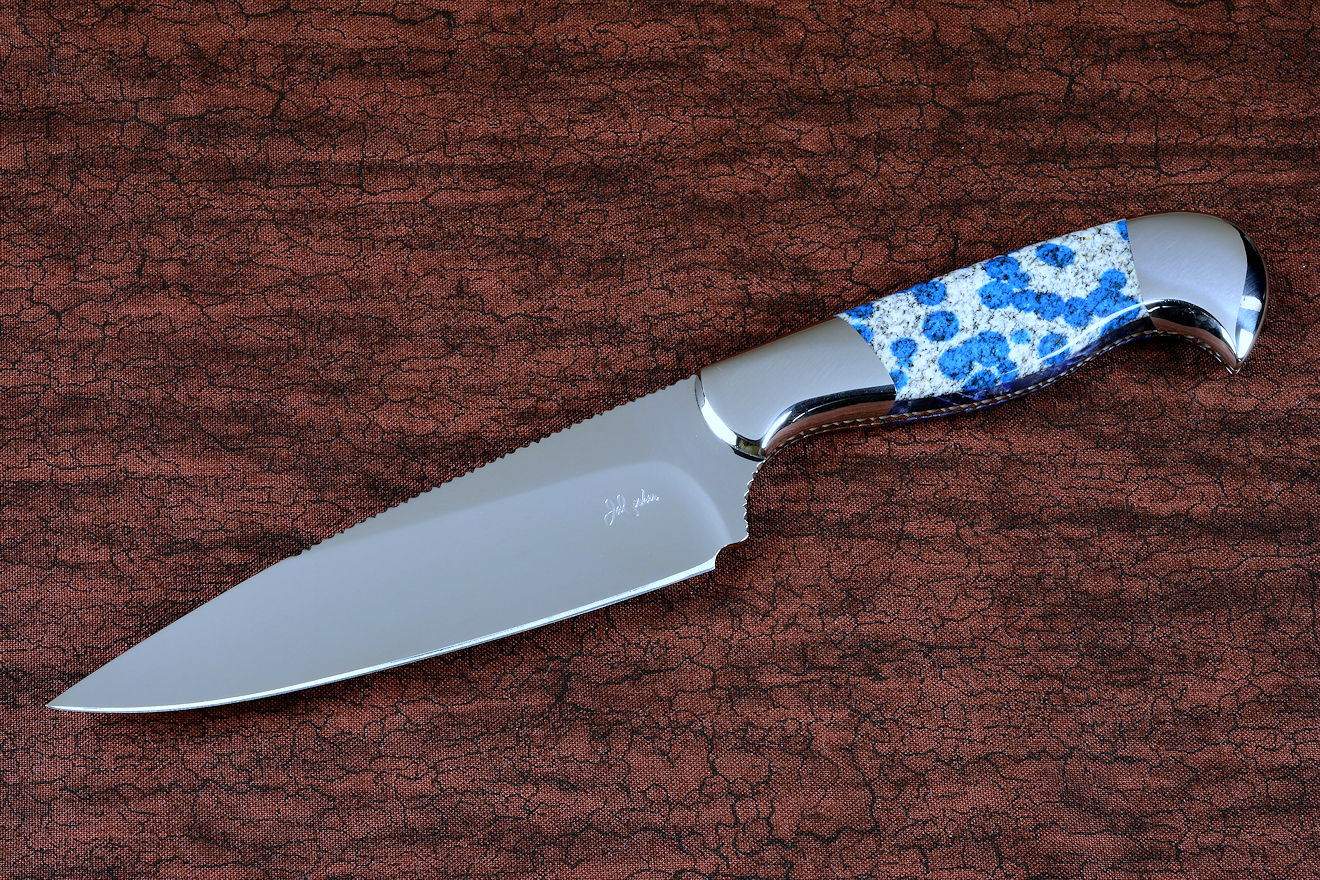
It is interesting to note that if you have one of my knives that has a stainless steel mirror polished blade, with 304 stainless bolsters/fittings and a gemstone handle, the most ambitious care requires only an occasional dusting and waxing. Most gemstones will outlast the blades!
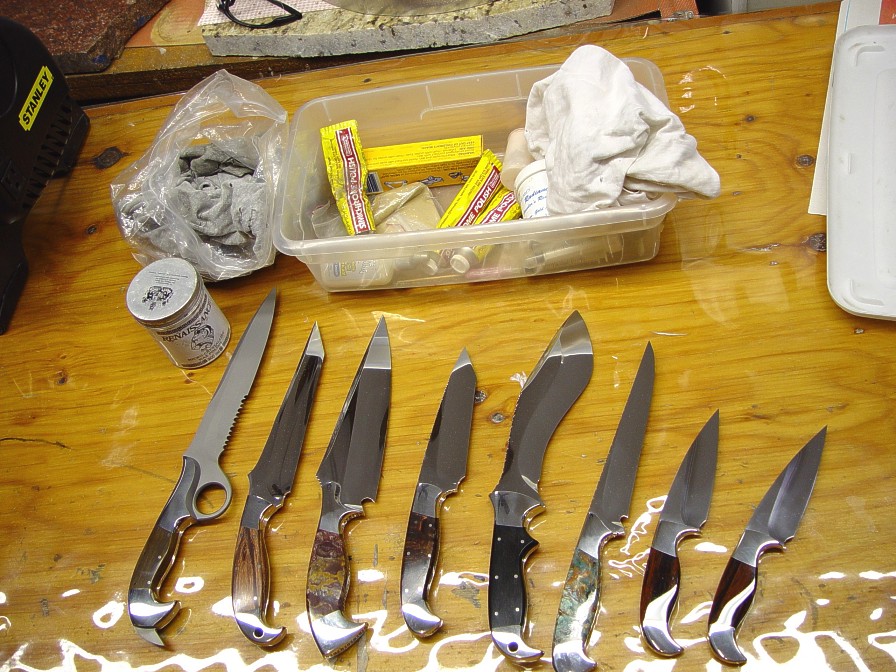
Polishes for metal are not protectants, though they often contain protective elements. Don't confuse polishes with waxes, they are starkly different! Polishes usually contain extremely fine abrasives such as aluminum oxide and iron oxide. These particles, though very small, actually abrade the surface of the metal, though lightly. These polishes also contain metal oxidizers and acids, which chemically break down the surface of the metal to accelerate the abrasive process by etching the metal chemically. Some steels, like blued steel, can be ruined by repeated uses of these harsh metal polishes. Some metals, like brass and nickel silver, will benefit greatly from the etching and abrasive action of these polishes, which can leave a bright, beautiful finish.
This is why it is very important that you know what you are using to protect your knife, components, and fittings. Waxes typically contain only non-abrasive mediums, and do not abrade, cut, etch, or chemically react with the surfaces of metals.
So how do you know what to use, when to use it, and where to use it? The table below should give you a good idea. Notes on the table:
| Material | Finish | Etching, Plating, Bluing | Condition | Care |
| Stainless Steel | Mirror or Satin | None | Excellent to Good | Clean, then Wax only |
| Stainless Steel | Mirror or Satin | None | Fair to Poor | Clean, then Simichrome®, clean, then Wax |
| Stainless Steel | Mirror or Satin | Treated | Any | Clean, then Wax only |
| Stainless Steel | Media (Bead) Blasted | None | Excellent to Good | Clean, then Wax only |
| Stainless Steel | Media (Bead) Blasted | None | Fair to Poor | Clean, then Simichrome®, clean, then Wax |
| Stainless Steel | Media (Bead) Blasted | Treated | Excellent to Good | Clean, then Wax only |
| Stainless Steel | Media (Bead) Blasted | Treated | Fair to Poor | Clean, then Wax only |
| Non-Stainless Steel | Mirror, Satin, or Media (Bead) Blasted | None | Excellent to Good | Clean, then Wax only |
| Non-Stainless Steel | Mirror, Satin, or Media (Bead) Blasted | None | Fair to Poor | Clean, then Simichrome®, clean, then Wax |
| Non-Stainless Steel | Mirror, Satin, or Media (Bead) Blasted | Treated | Any | Clean, then Wax only |
| Other Fitting Metals | Mirror or Satin | None | Any | Clean, then Simichrome®, clean, then Wax |
| Other Fitting Metals | Media (Bead) Blasted | None | Any | Clean, then Wax only |
| Other Fitting Metals | Any | Treated | Any | Clean, then Wax only |
Bolsters (and guards) deserve special consideration and description. Their care depends on the material and the finish.
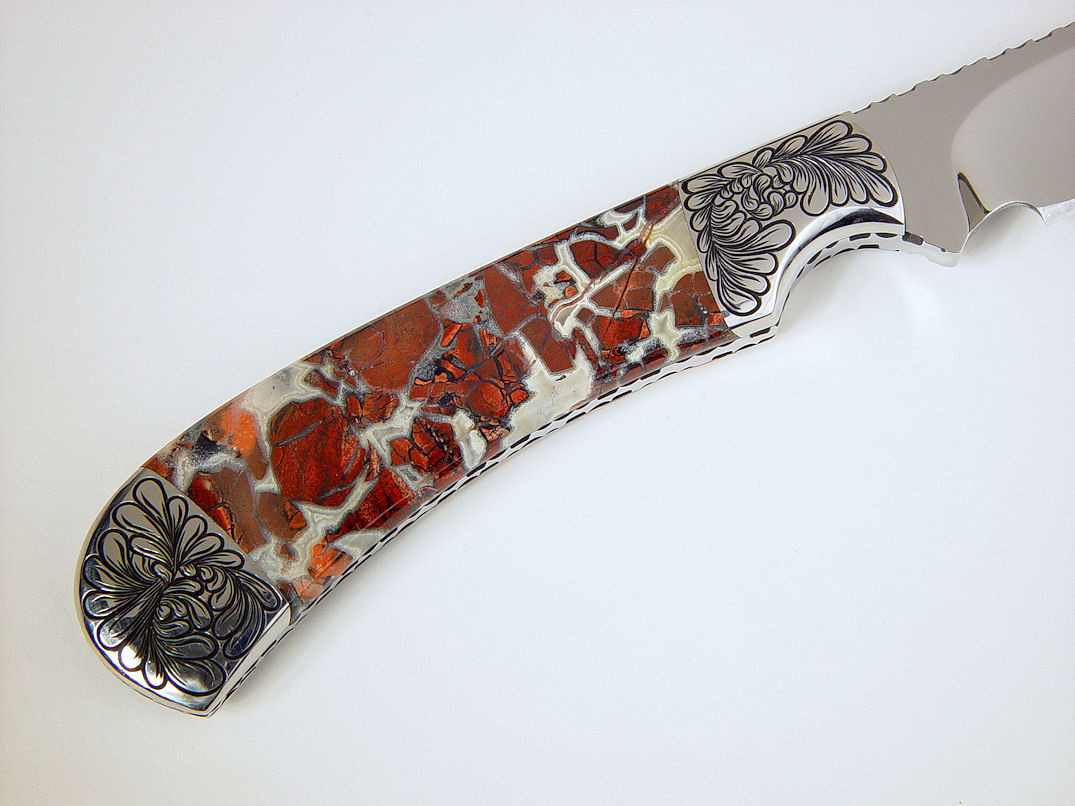
I use different bolster types for my knives, but most of them are 304 stainless steel. 304 is a pretty much "zero-care" stainless; you'll see me refer to it as such in most of my knife descriptions. 304 is the same as 18-8 stainless used in stainless steel nuts, bolts and fasteners; it is tough, durable, and highly corrosion resistant. Care of the 304 stainless steel is, well, zero! No polishing is required, no coating, sealants, or oxidation worries whatever. Hands contacting this steel do nothing to it, there is no special consideration for salt water exposure or anything a hand knife would normally encounter. If there is very light scuffing or fogging, a simple metal polish (Simichrome® or Flitz®) should clean that up. If they don't, it's not fogging but a scratch, and beyond the care of most knife owners. More on scratches below.
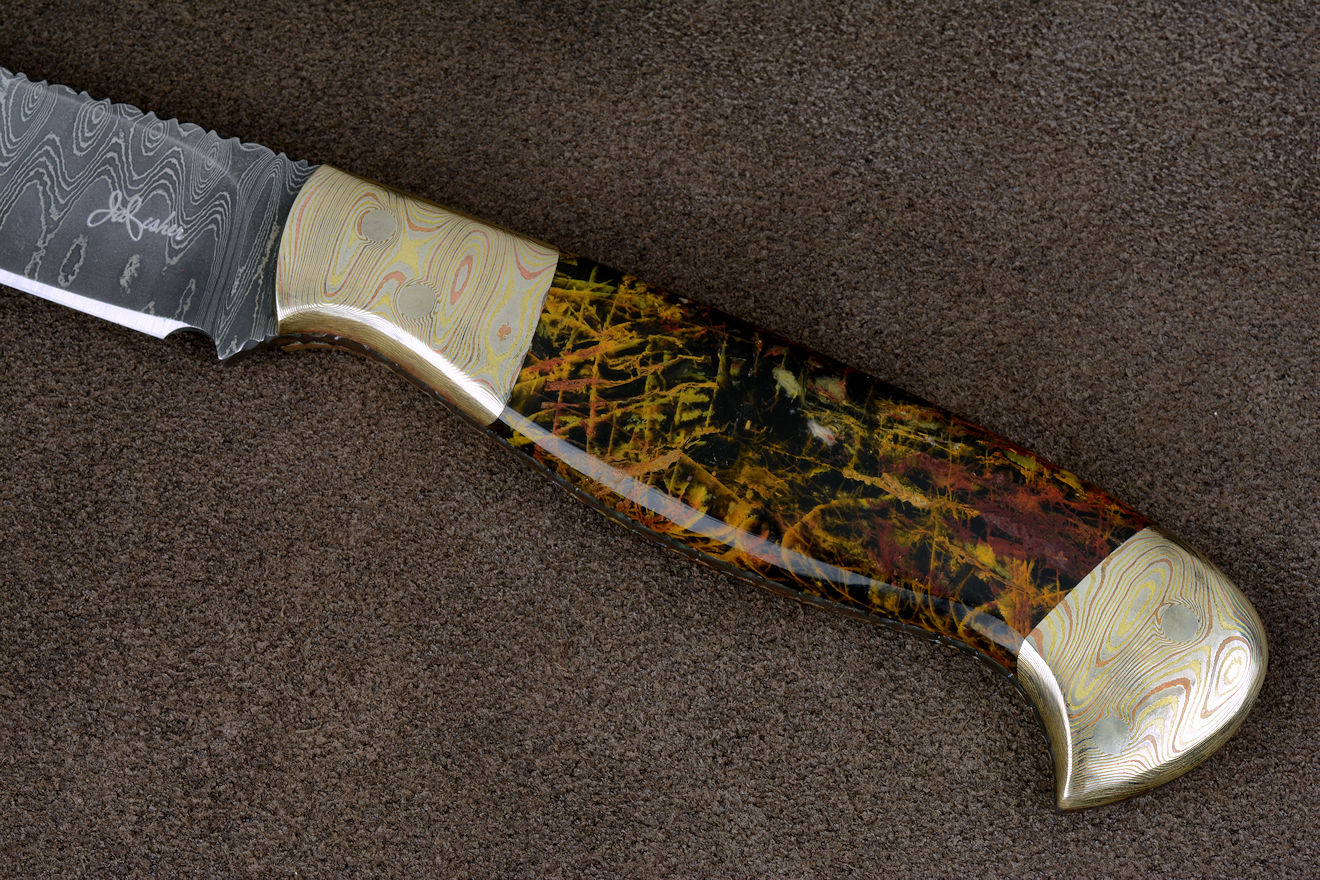
With copper bearing alloys (copper, brass, nickel silver), there are normal oxidation reactions depending on the environment. When they are blended together in a diffusion welded and forged material called mokume-gane, they are chosen for the distinctive appearance and not because the material is more durable or care-free. Since the appearance is important, caring for the surface and knowing what to expect is helpful.
The only reason to polish mokume-gane is because of a corrosive environment or discoloring that is heavy and unattractive. This can be caused by simple exposure to the hands. People's hands vary in acidity and some hand-stains can actually cause pitting! This is why, with mokume-gane, it's a good practice to simply wipe down the handle before putting it on the shelf or storage. Remember, no knife should be stored in the sheath, and particularly in copper-based bolster materials, this will lead to corrosion, and ultimately, pitting!
If there is undesirable darkening to the mokume-gane, it can be hand-polished with the listed metal polishes. Never use a powered buffing wheel or any other aggressive polishing means; that's too much. When newly polished with a metal polish (Simichrome® or Flitz®), the appearance will be bright and reflective. This is not typically what one wants to see in mokume-gane; they want contrast. The metal will be shiny uniform, and the pattern of contrasting metals will be minimized. You can simply leave the bare, polished surface to oxidize in the normal atmosphere and the contrast will appear again, usually in days and definitively in weeks. I don't advise using any agent (chemical: whether household or industrial) to accelerate this process. Just let it age, without fingerprints or handling, and the pattern will appear again. Over time, the pattern will become very bold as the copper darkens first and most, followed by the brass, and finally the nickel silver. They will always have contrast, since the metals all assume a different color depending on their level of oxidation and reaction to their environment.
Once this contrast is visible, and you are happy with what you are seeing, give a generous coating of wax to the bolsters. Renaissance Wax® or BriWax® are both great, the BriWax® will have a bit of a thicker and more durable coating. Keep the bolsters well-waxed, and wipe down after use, and the contrast will look great.
I think it's important to understand the difference between oiling and waxing the knife blades, handles, sheaths, components, and accessories. We all have the image of the warrior oiling his blade in the firelight, keeping in clean and slick for the upcoming battle. Of course, we also have the image of him sharpening it on a rock-
Neither of these practices are recommended. In my upcoming book, I go into where this practice and image comes from but for now, I just want to cover the basics. The clearest way is a comparison table:
| Oil | Wax |
| Oil is wet. | Wax is dry. |
| Oil is short lived, and distillate oils like WD-40 actually evaporate over time | Wax is-long lived and lasts a very long time, perhaps indefinitely if not dissolved by solvents. |
| Oils can be easily removed by ordinary soaps and even salty water. | Waxes can not be removed by ordinary soaps and salty water. |
| Oils transfer to anything they touch: skin, objects, and other components. | Waxes do not transfer, and stay where they are applied. |
| Oil contains petroleum distillates which chemically react with plastics, epoxies, and adhesives. | Wax contains lipids and typically long-chain stable molecules that have little reaction potential. |
| Oils are sticky and thus tend to hold dirt, dust, and debris. | Waxes are slick and smooth, and do not hold or grip dirt, dust, and debris. |
| Oils will dry out, making them more sticky. | Waxes are already dry, so do not change and they are not sticky. |
| Oils can easily be rubbed off by normal physical actions. | Waxes can not easily be rubbed off, and are actually smoothed and polished by normal physical actions. |
| Oils are easily removed by other chemicals, soaps, surficants, and solvents | Waxes are not easily removed by chemicals and solvents. |
| Oils are distillates, chemically and industrially produced. | Waxes tend to be natural, produced by plants and animals. |
| Fine, museum grade collections are never oiled. | Fine, museum grade collections are typically waxed for long term preservation. |
| Oils are easy to apply. | Waxes are more difficult to apply, and must be rubbed out and polished. |
| Oils are common and inexpensive | Waxes are more expensive, but a little goes a very long way. |
It's easy to see why I prefer waxing knife blades, sheaths, and components. Please make the effort to acquire a good wax for your care kit, and apply it at least once a year. Work the wax into the crevices around the blade to bolster or blade to guard junction, and keep a light coating on the blade. It will add tremendously to the long term protection of the knife.
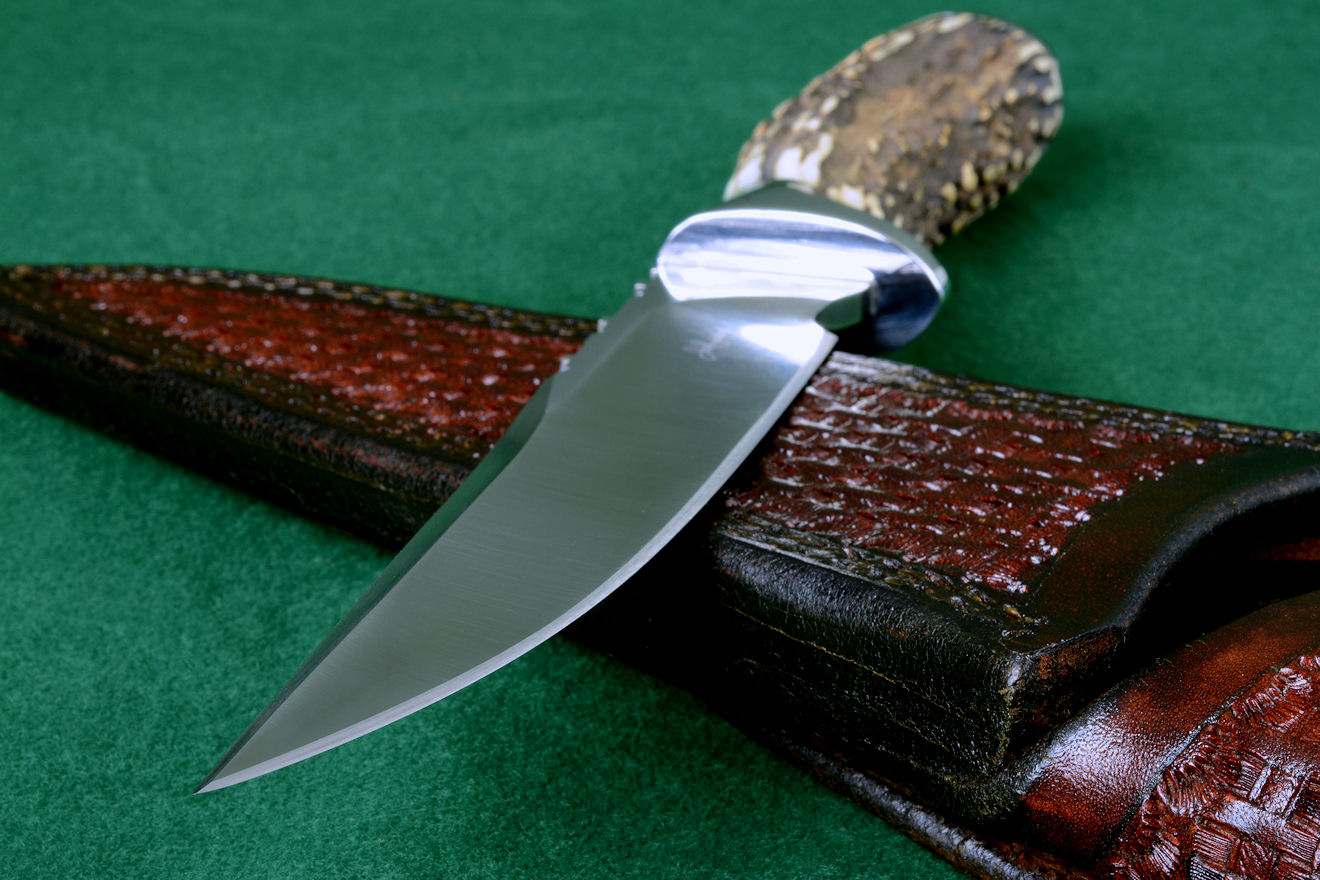
My number one complaint is that the client has stored his knife in the sheath, or forgotten that he's left it in the sheath (sometimes for months or years) and that there are little spots of rust starting to form. I can't say this enough: don't store knives in sheaths! Incidentally, what do you think would happen if you stored a blued firearm in its leather holster for years, and never looked at it? Sure, you want to keep it with the sheath, and carry it in the sheath, but long term storage in the knife sheath is probably the most destructive thing you can do to your fine custom knife.
Please remember that stainless tool steels can corrode. These are not low carbon steels used in mass-produced and mass-manufactured kitchen knives, and they are not completely rust-free austenitic steels used in flatware; these are fine, high carbon, high alloy martensitic stainless tool steels, and as such, are more resistant to corrosion than non-stainless, but can still corrode because of the high carbon content. I have posted this on my care sheet that I give out with every knife (and has been available on this website since the beginning in standard and military form).
It makes no difference whether the sheath is leather or kydex and aluminum, whether the air is as humid as Florida or as dry as Nevada. The knife blade needs to breathe (have access to dry air) and stay dry. When humidity and temperature changes in the normal course of the day or seasons, condensation can form on any steel and in any sheath. If the steel is allowed access to free air, it can stay relatively dry, and corrosion can not gain a foothold. But if the knife is stored in the sheath, and even atmospheric moisture is allowed to stay against the blade, the blade will start to rust.
On a mirror polished blade, this can be ruinous, and if the knife has been custom etched, the only recourse is to grind off all the etching and corrosion, regrind and refinish the blade (including polish) and re-etch, which is very expensive and time consuming and may not even be possible. Even if the knife is coated heavily with wax, long-term storage in the sheath will encourage corrosion. Please don't do it! Please read the related topic on my FAQ page.
In use, it's normal to encounter small scratches, scuffing, and marks on the surface of a mirror polished blade, as well as media blasted or flat finished blades and fittings. Just inserting the knife into the sheath repeatedly will cause scuffing or burnishing of the surface, and this can be seen, particularly on mirror polished surfaces. The higher the polish, the more this wear pattern or scratches, in general, can be seen. The human eye can detect minute differences in a polish, and the pattern or scratch may seem much deeper than it actually is, but it's noticeable.
A lot of makers hand-sand or hand-rub their knives along the length of the blade so that these small abrasions will not be noticeable. They figure that the direction of the scratches will be in this pattern, so they help the owner along by "pre-scratching" the blade and leaving it in an unfinished state, and this also saves them a lot of laborious handwork, as they don't actually have to finish the blade surface, and any errors will be unnoticeable. When a maker graduates to a mirror polish, his work, by necessity, becomes much more detailed, much more difficult, as any irregularities in the surface will be amplified when contrasted with the monolithic and uniform mirrored surface. A mirror polish is a sophisticated and refined finish, definitely not for the casual maker of any handmade product.
The benefits of a mirror polish are tremendous, and I detail this on this section on my "Blades" page. Simply put, the mirror polish is the highest form of finish for all metals, and the most valued through history. Preserving the mirror polish is important to the knife owner, and certainly helps the long-term value of the knife overall. Some distinctions of individual knife use and care must be made.
When asked to work on knives I've previously made, I have to be clear that refinishing or repairing knives is not something that I can do, and I hope that this section details the important reasons why. I write about refinishing extensively on my Business of Knifemaking page at this bookmark. The cost of refinishing, the danger involved, the unlikelihood of acceptable results, and the five year backlog I have of other orders means that this is just not something I can do.
If the blade has light scuffing, there really is only one thing to try. Place the blade on a firm, non-scratch surface, and use a specific metal polish (Simichrome® is the best) to hand buff it with a soft cotton cloth. Make sure the cutting edge is as flat as possible in contact with the surface (hard wood covered by thick leather is the best), so that your fingertips can not come in contact with the cutting edge! Try hand-buffing the surface. The cotton with the Simichrome will become black; this is the metal being oxidized and abraded away by the fine polish. Don't expect too much with this method, Simichrome is a very light polish, with extremely fine aluminum oxide and iron oxide, and works chemically to react with the surface with ammonium oleate, an acidic salt that dissolves the surface on a microscopic scale. It won't do much, but it may be enough to remove a light fog of scuffing.
Do not use any rubbing compound, or any abrasive polishing compounds. The reason is that these are extremely abrasive, and will totally ruin a mirror polished surface. These are usually sold in the automotive department of stores and are made for cleaning up heavy corrosion. They have relatively coarse grit iron oxide and aluminum oxide, some have hard ceramics, and the blade will be left in a foggy, scratched surface, much more noticeable than the scratch. Also, corrosion resistance will be affected, as a roughened surface is much more likely to corrode than a highly polished surface, as detailed on my Blades page at this bookmark on finishes. While a rubbing compound may be fine to remove heavy rust on a steel vehicle part, it is far too abrasive for a polished tool steel surface. Good grief, some of these compounds are used to grind and lap hardened engine valve seats!
If the blade has heavy scratching that can't be removed by the Simichrome, or (heaven forbid) you can actually feel the scratch with your fingernail, I'm sorry, but there's not a lot you can do. The blade would have to be reground, which, as I detailed above, is probably not possible.
For some knife users, the patina and surface of a well-used knife develops a character of its own; it's not a safe queen or a protected work that simply collects dust; it's a working tool that wears the charm of use like an old face. It attests to its value in the action of cutting, and while the first scratch or two is hard to take, like a new vehicle, after a while it becomes the dependable tool that you're not afraid to take out of the garage. For me, that's the ultimate honor; to have the knives used, worn, resharpened, and used again, and depended on to perform. That's why I've conveniently put handles and cutting edges on each and every one!
"If i get 8 hours to cut a tree i'll spend 7 hours to sharp my knife."
--Abraham Lincoln
You can sharpen your knife. Sharpening the knife is one of the most critical operations a knife owner is expected to perform. There are some important things to understand in the world of fine and custom handmade knives that can help tremendously with sharpening the blade.
Knife makers, distributors, hobbyist makers, and enthusiasts can get very complicated about cutting edges. They suggest ridiculous complexity, paper wheel abrasives, motor-driven polishers, complicated angle-establishing jigs, holders, and guides. You don't need any of these. As a knife client, you deserve to know the clearest, simplest, most reliable and proven method to sharpen your knife, and it's been established many, many years ago. Do you honestly think that we have improved on a method that industry uses to dispatch thousands of miles of cloth, material, and textiles? Do you think that packing plants have some complicated and lengthy process to separate billions of pounds of meat from bones? Meet the clearest method and the guy who advised them in a classic, reasonable process that anyone can understand. Get the book, read it, practice on some of your older, cheaper knives, and be amazed by what you can do!
I have no relationship whatever to Juranitch's book, his family, or endorsement of any kind, just like I have nothing to gain by recommending DMT for diamond sharpening stones. These are the methods I use, they work, and I simply suggest them because my clients deserve a reasonable, reliable, and simple method to sharpen and maintain their knife's cutting edge.
Note on serrations: If you have to sharpen serrations on your blade, I've included a simple system to sharpen the serrations I make on my knives on a special section about sharpening serrations on my "Serrations" page.
More about sharpening on my "Blades" page at this bookmark.
Typically, I advise clients, makers and knife enthusiasts to get and acquire John Juranitch's book on sharpening, because the information presented there constitutes the majority of the details needed to establish, maintain, and preserve an effective cutting edge on the modern knife. For most people, this is enough information. However, I'm not so rigid and dated as to believe that it constitutes the absolute complete set of details about the cutting edge, and in this section, I'm going to dive into some of the limitations of his text, his process, and how these apply to modern cutting edges.
You might think that cutting edges of knives have not developed in the last 20 or 30 years, but just like everything else in our world of knives, they have. Some of these developments are so substantial that they have an effect on cutting itself and its interaction with the material being cut. I'll detail these one by one below, but first some history.
In my early years, I used to sharpen my knives to their absolute pinnacle, at least that described by Juranitch in his text. When using his technique, this means creating a very smooth, slick cutting edge. He recommends a testing stick which is hard plastic that is dragged, pushed, angled, and pulled across the blade, the stick magnifying every tiny microscopic irregularity in the blade. I accented the word irregularity because using this technique, the slightest little uneven area will be felt, as the stick bumps and hangs up at these irregular points. In theory, this is sound practice, particularly if a knife is made for and used to cut meat. Please remember that the mainstay of Juranitch's method was for butchers and meat packing plants, with secondary emphasis on textiles and cloth cutting. If a knife is sharpened and brought to its highest finish at the edge, some issues do occur, mainly, the appearance and feel of a slick or smooth cutting edge. When I supplied these edges to clients, particularly military and professional tactical knife users, they would complain that though the edge was extremely sharp, it lacked tooth, or the ability for the edge to grab particular materials to cut them. I had to back off on my sharpening regime, to only finish a blade to about 220 or 320 grit to satisfy what they requested. This brings me to the first development about sharpening technique and the cutting edge:
I recommend a starting point, and the Juranitch method is the best I've found. No universal sharpening process is applicable in all materials. In my upcoming book I'm diving into this in greater detail (you're probably wondering how more detail is even possible), and I assure you that there is a lot more to the cutting edge than most people, knife enthusiasts, knife users, knife manufacturers, and knife makers even realize!
Thanks to Bill S. for inspiring me to write this section in his search for his perfect cutting edge!
For as long as man has been alive, he's needed to sharpen his cutting edges. I suppose, in the stone age, a dull piece of flint was taken to the tribe's most skilled knapper to do his magic, and refine an edge. I'm sure he had to explain to the user that he would have to chip away some of the rock to make it sharp again, and it wouldn't look the same. But when it was finished, the blade owner was happy, and the mystical wisdom of blade sharpening would be a coveted and magical talent carried down through the generations, like cooking meat.
This mystery of sharpening and the need for a sharp blade is a never-ending quest. Every single blade needs sharpened eventually, and there are individuals and businesses who thrive on and make profit from the sharpening need. Just like new mouse traps, new sharpeners are developed every day, and because the value of knives continues to climb, so must the value of the sharpeners, right? Now we bring electricity into the mix, with drive wheels, discs, and pads, to make easy this completely unknown and unobtainable result of a razor sharp blade. Don't do it, don't fall for it, just don't!
Any power-driven sharpener is a bad investment, a bad choice, and a bad result will be experienced with these units. Sorry, you probably didn't want to hear this, but it's time a real knife professional spoke up and told some simple truths about these units, since everybody and his brother are getting on the power train, and these power tools are literally flying out of the People's Republic of China at unbounded volume. What are they, why are they popular, how do they work, and why are they actually detrimental to knife blades?
The problem is this: every kitchen has cheap, crappy knives. These are foreign made junk, knives we simply don't care about, knives that are bought for cheap, given as gifts, used, abused and replaced like worn socks. They typically have blades of low alloy, low carbon, hypoeutectoid stainless steels (420 is the most common), steels that can never be hard, never be wear resistant, and are never expected to last. Is it any surprise that frequent sharpening is needed? Is it any surprise that because these knives need such frequent sharpening, people are looking for an electrically powered machine to do the work? Is it any wonder that the same companies that sell the cheap knives also sell the powered sharpeners because these blades simply don't hold an edge? See how this all works? You buy the cheap knives, and then you have a bunch of them, and you tire of the softness and wear at the cutting edges, so you then are convinced you need a power sharpener to aid in constantly grinding up an edge, since the knives are eternally dull. What a hopeless cycle! Here are some salient points to consider:
Powered sharpeners are bad (yep, that's what I wrote). They use an electric motor to make the task of grinding and sanding (and grinding and sanding is exactly what they do) faster than what can be done by hand. They speed up the process of abrading away steel to create a cutting edge. Their main advantage is speed. Faster, quicker, with less effort is the promise. Like everything, there is a cost to this concept:
What about skill? Many people complain that they just aren't skilled enough to use a bench stone, in any type. This, I say, is bunk. If you are so badly fumbling with your hands that you can't simply drag a blade across a stone, slowly and carefully, you have no business using a knife to cut! It's the same hand that cuts the zucchini, the same hand that dices the garlic, or skins the whitetail, or opens a box without ripping through the contents. You can guide the knife through all these cutting chores yet you can't simply drag it at a relatively constant angle across a stationary stone? This is not rocket science; man has been sharpening metals since the bronze age, and cutting things for much, much longer. Just as a person learns how to cut mushrooms, julienne carrots, or dice radishes, he can easily learn to sharpen a knife. Please read the section above again, to see just what I recommend to do this. Don't be hoodwinked into buying a motor-driven blade-ruining wheel that will grind away and soften your blades in every pass. Learn to hand-sharpen on your cheap, throwaway knives (yes, they will sharpen, each and every one of them) and then look for a better knife, once you have that simple skill down. I guarantee that by the time you sharpen 10 knives by hand on a bench stone, you will be the envy of every person who uses the knives, no matter how cheap they are. Do a little practicing, learn to sharpen, and never be taken again.
If you can't, if you've bought the book, a good stone or two, and practiced for several hours and you still can't get the process recommended above down, you do not have the "skills" to manipulate anything involving a sharp edge or a point. Do not go anywhere near a knife, razor, chisel, or saw, and maybe even pins and needles should be removed from your vicinity. Seriously, it's not that difficult and you owe it to yourself to try to learn what every serious knife user and owner has known and used for millennia to sharpen a knife blade: a good piece of metal and a flat rock.
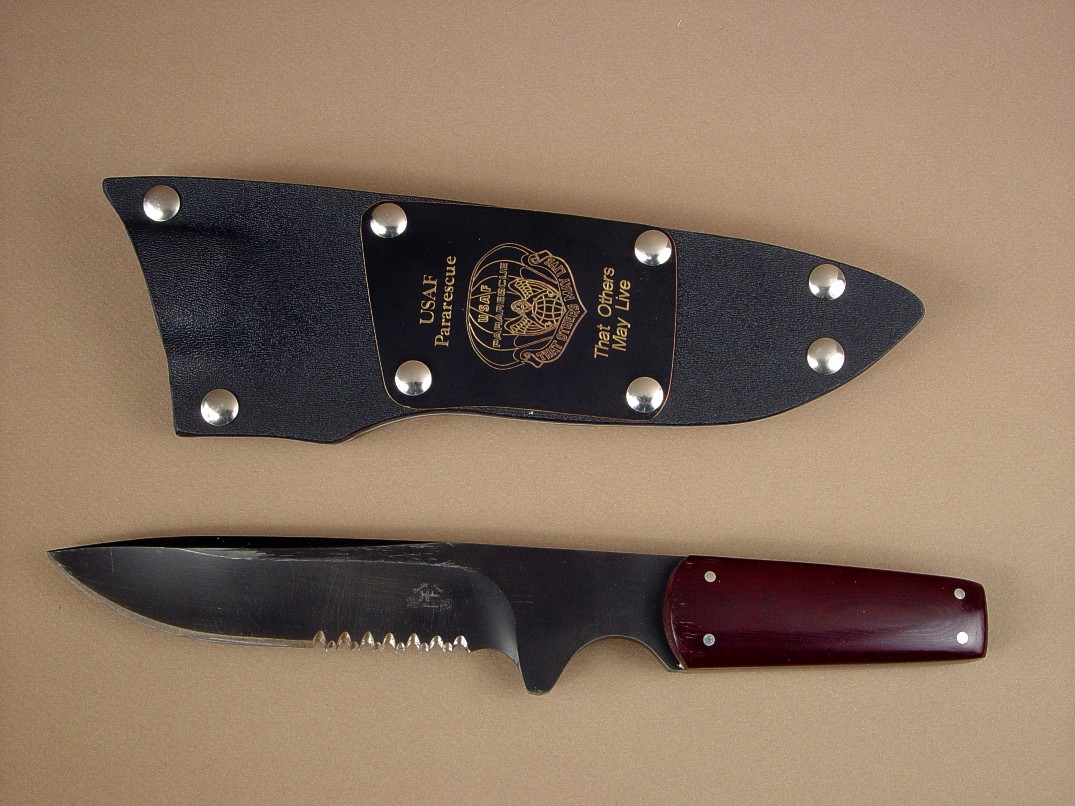
Though military combat and tactical knives are often tougher, and made with more corrosion resistant materials, they also have specialized care needs that may not apply to collectors, investment, hunting, or daily working knives. I've created a special page for Tactical, Military, and Combat Knife Care.
Here are a couple interesting emails about common knife care. Some of these are posted on my Funny Emails pages. Though I've answered some, others I have not been able to respond to. I do hope you find them interesting.
Hi Jay,
I wonder if you can give me some advice.; I have a set of beautiful antique bone/sterling tipped handle knives.; The
bone is suddenly looking really dull with small cracks. Is there a way to bring back at least some of the bone's beauty and
increase the longevity?
Thank you, J.
My response:
Hello, J. Thanks for writing.
Unfortunately, there is not much that can be done to preserve bone, as it is porous and changes
dramatically with moisture and temperature. A light microcrystalline wax and keeping them
out of the sun is best. If the knives are valuable antiques, the less you do to them, the better.
Good luck,
Jay
J.'s response:
Thanks for the advice....BTW you have a very good website...
J.
Hi Jay:
My wife put an antique horn handle carving knife into the dishwasher
and completely ruined it. Is there anything that I can do to bring it
back? It is all dried up like an old bone. Thanks in advance for any
advice.
Regards
B. L.
"Bring it back?"
Hello
I inadvertantly put my housemates bone handled knives through
the dishwasher, the dishwasher is broken and ran for 9 hours
straight! Is there anything I can do to care for the knives now to
stop them drying out?
Thanks
Linda
Lots and lots of lotion, Linda. (I'm kidding!)
I have a custom knife that I left in the sheath too long and the sheath
is a bit stained from the brass hilt. Is there any
way to clean the sheath stain?
Thanks. Weldon
Cleaning out my dad's closet I came upon a knife made by the Sidney
R. Baxter & Co. of Boston. Carbon steel, rusty
and corroded. How can I best clean and get in
good condition. I see you want me to use silicone car wax, but what will
first stop the rusting? Thanks for your time and expert advice.
Rmb
It is easy to see that once certain damage is done to blades and handles of knives, there simply is no realistic, economical, and reasonable way to eliminate the problem and return the knife to its original form, finish, and value. The best thing you can do with knives is to not neglect them in the first place.
This page is simply a light overview of the knife care process. For a much greater detailed examination of different steel types, discussion and information on preservatives and protectants, recommended care procedures, compounds, and treatments, chemistry and cleaning, as well as care of the sheath, stand, components, and accessories, please visit my Tactical, Combat, and Military Knife Care page. Most of the detailed information on that page also applies to collector's handmade and custom knives.